The Old Testament
Introduction
The OT consists of thirty-nine books, written and collected over a period exceeding a thousand years. Sacred to both Jews and Christians, this collection was the Bible used by Jesus, Paul, and the early church. It was the OT from which the first Christians drew their doctrine, upon which they grounded their lives, in which they found prophetic references to Jesus and themselves, and from which they derived comfort, strength, encouragement, and vision for the future.
The books are of unequal length (Obadiah being barely a page long, Psalms having 150 chapters), written mostly in Hebrew. (Small portions of Ezra, Jeremiah, and Daniel are written in Aramaic, a language similar to Hebrew.) These books exhibit great diversity of literary style, including narrative, poetry, sermons, dialogue, prayers, hymns, songs, letters, and prophecies. They also show great linguistic diversity.
While there were many other books written in antiquity, some of which are mentioned in the OT (the Book of Jashar in Jos 10:13, for example), these were not preserved and used as sacred literature by the Israelites. But under the guidance of God, those books that he had inspired were gathered together, until, at last, the collection of writings was complete. There the Word of God to his people was to be found.
The books, as found in the Protestant Bible (the Roman Catholic Bible adds another small collection called the Apocrypha), are arranged in the order of law–history–poetry–prophecy.
The legal and historical material (Genesis–Esther) begins with the creation of the world, continues through Israel’s waxing and waning fortunes, including the division of the kingdom and the eventual exile first of Israel and then of Judah, and ends with Judah’s return to its homeland after seventy years of exile in Babylon. Some overlap occurs in the accounts, and the material does not run in strict chronological order, but it is history in the fullest sense of the word. Here are events of life, often broadly conceived on a national scale, where nations rise and fall, but also seen on a personal level, where the faith and courage or pride and deceit of individuals is the focus of attention.
The poetic books (Job–Song of Songs) were grouped together mainly because they are almost entirely in poetic form. These books deal with very personal issues, from devotion to God, to the trials of faith, to human love and the inevitability of death.
The prophetic books contain the complex message of Israel’s prophets. These messages are urgent, direct, contemporary, morally informed, and filled with warning, promise, or judgment. There is also a universality about them that reaches out to the nations surrounding Israel; indeed, they speak to any nation at any time.
In spite of the great diversity of the OT books, a profound unity remains as well. What gives the OT its focus is the doctrine of a personal God who created the world and, in spite of the world’s defection from him through sin, has not given up on it. God’s fatherly concern was expressed in his selection of a nation to represent him to humankind, and through which he would offer salvation to anyone willing to accept it. The many theological themes to be found in the OT are all part of this presentation of God as the Creator, Sustainer, and Redeemer of the world.
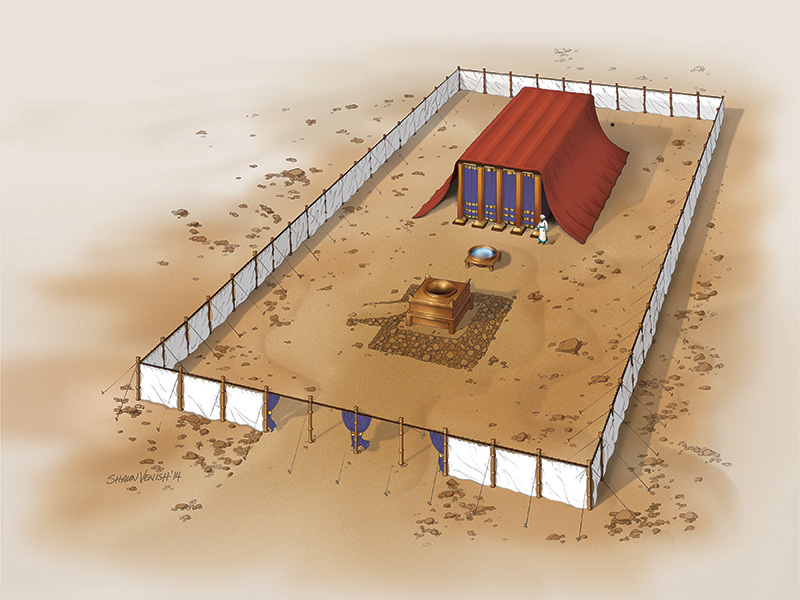
Israel had only one sanctuary to remind them that they paid allegiance to only one God. It was highly portable and had multiple zones which imposed increasing restrictions on those approaching the innermost chamber, the place where the Lord was present in a special way.
The writers of the NT look back on the OT as foreshadowing, indeed prophesying, their own day. God was preparing the world for a full and final revelation of himself in his Son, Jesus Christ, in the types and shadows that he used in earlier times. “Long ago God spoke to the fathers by the prophets at different times and in different ways. In these last days, he has spoken to us by his Son” is how the writer of Hebrews puts it (Heb 1:1–2). Jesus is seen as the fulfillment of all that went before and as the summation of all God’s dealings with humankind. His life, death, and resurrection marked the end of the old and the beginning of the new. Because the OT points directly to Jesus, the early Christians used it as their own Bible and structured their lives according to its spiritual teachings. These two Testaments, the Old and the New, compose one Bible and tell the story of God’s redemptive work to reclaim, restore, and reinhabit his creation marred by human sin. Marvelously and mysteriously, God chose to do this work of re-creation as an “insider,” through the incarnation of Jesus the Messiah—who is “making everything new” (Rv 21:5).