Introduction
Overview
The book of Exodus reports the most dramatic events in the Hebrew Bible. After the Israelites have spent 430 years in Egypt (Ex 12:40), God delivers his people from oppression, brings them into the bonds of covenant relationship at Mount Sinai, and establishes his sanctuary in their midst. The exodus is a foreshadowing of the deliverance from the bondage of sin accomplished by the atoning death of Jesus Christ as the Passover lamb (1 Co 5:7; 1 Pt 1:18–19).
Three major themes dominate the book of Exodus:
1. God delivers his people and brings them up out of Egypt. The fundamental message of Exodus is that God saves and delivers his people. Throughout the rest of the OT, the exodus event becomes the primary picture of what salvation is all about.
2. As God delivers Israel, he will act in such a way that everyone will “know” and recognize his power. Those who trust in him will “know” his salvation. Those who defy him will “know” his judgment. One way or the other, everyone will know him. There is no middle ground and no way to ignore him.
3. A critical aspect of the covenant relationship that God establishes with the children of Israel after he rescues them from Egypt is that he will dwell in their midst. Thus the presence of God is a major theme throughout the book. The second half of the book (Ex 25–40) deals with the construction of the tabernacle, where the presence of God will dwell.
Closely connected to the three central themes in Exodus are two frequently repeated phrases that occur throughout Exodus in various formulations. First is the statement “I am the LORD, who brought you out of Egypt”; this occurs in several forms, all stating that God is the one who has brought the Israelites up out of Egypt (e.g., 6:6–7; 20:2). This connects to the main themes of deliverance and knowing God. The second frequently repeated statement is that someone “will know that I am the LORD” (e.g., 6:7; 7:5, 17; 10:2; 14:4, 18; 16:12). As mentioned above, one of the central themes in Exodus is that God’s spectacular demonstration of his power will be decisive and not ambiguous. Everyone will know that “he is the LORD,” either in salvation or in judgment.
Title
The Hebrew title of the book, Shemot (“Names”), is based on the first key word of the text. It refers to the names of the children of Israel who went down to Egypt, and it establishes continuity, in spite of the centuries of intervening silence, with the events that closed Genesis. The English title, Exodus, comes from the Greek Septuagint title, from a Greek word that means “to go out,” and addresses the theme of the first part of the book.
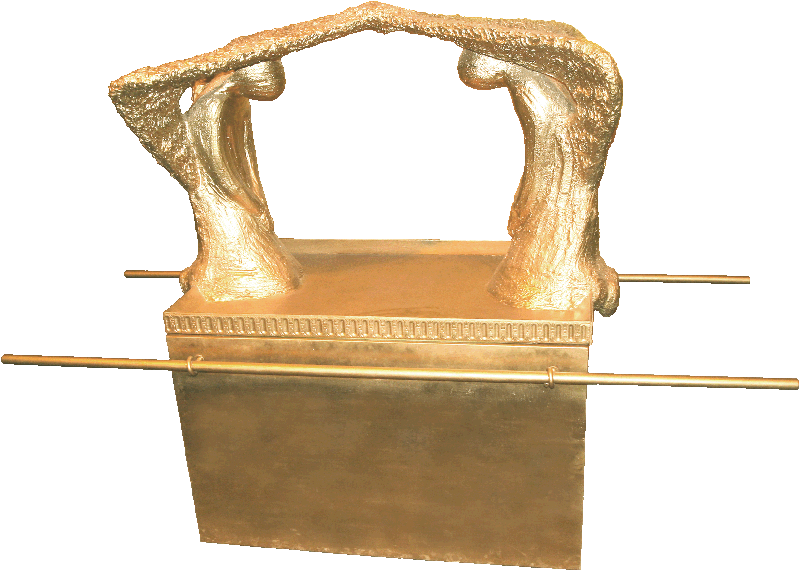
Model of the ark of the covenant from the tabernacle model at Timna Valley Park, Israel
Date and Historicity
The historicity of the exodus has prompted extensive scholarly debate, accessible in standard texts on the history of Israel. The following commentary is written from the perspective that the exodus was a historical event during which the Israelites were freed from their bondage to Pharaoh in Egypt. That there is no mention of the event in the Egyptian sources is not surprising; temple inscriptions were designed as positive propaganda, reminding the deity that the pharaoh had ruled well. The devastation of the country and the stunning defeat of the Egyptian army in Exodus demonstrate the opposite. In addition, written words were viewed as magically powerful; an event might repeatedly recur if committed to writing. The reverse was also true; if something was not written down, it was as if it had never happened. Finally, the mud flats of the delta regions are far from ideal for preserving buildings, let alone documents. From the perspective of Israelite historiography, it is unlikely that later writers would concoct such a humiliating narrative if it were not true.
There are two positions regarding the date of the exodus, each having significant supporting data as well as unanswered questions. The early date, primarily based on 1 Kg 6:1, is 1446 BC, placing the exodus during the Eighteenth Dynasty. According to Ex 2:23 the ruling pharaoh died shortly before the exodus. In fact, the Eighteenth Dynasty’s Thutmose III died circa 1450 BC. If the exodus occurred in 1446 BC, Amenhotep II (1450–1426) was pharaoh at the time. Thutmose III’s immediate predecessor was Hatshepsut, a formidable woman who was both the wife and half sister of Thutmose II. She coreigned with Thutmose III for a period of time and exercised considerable power in Egypt. Hatshepsut’s character could fit the biblical picture of the daughter of Pharaoh who rescued Moses. Akhnaton (Amenhotep IV), a Late Eighteenth-Dynasty pharaoh, briefly championed a form of monotheistic worship of the sun. If the effects of God’s miraculous work on behalf of Israel had an impact in Egypt as it had on the nations around (Ex 18:1; Jos 2:10; 1 Sm 4:8), perhaps the brief turn away from polytheism was one of them.
The late date locates the event in the middle of the thirteenth century BC. New Kingdom palaces and temples had storage facilities associated with them, perhaps the focus of the Israelites’ labor at Pithom and Rameses (Ex 1:11). The name Rameses does not occur in dynastic lists until the Nineteenth Dynasty, and Rameses II (1290–1224) was recognized as the preeminent builder among the pharaohs. It is logical that the city of Ex 1:11 was named in his honor. If so, Israel was still in Egypt at the start of Rameses II’s reign. Nevertheless, Pharaoh Merneptah (1224–1214) recorded a conflict with a group named Israel already in the land of Canaan. Locating the exodus in the Nineteenth Dynasty encounters difficulties regarding the length of Rameses II’s rule, the need for a change in pharaohs, and the necessary time to accommodate the wilderness wanderings and get Israel into the land by the time Merneptah became pharaoh.
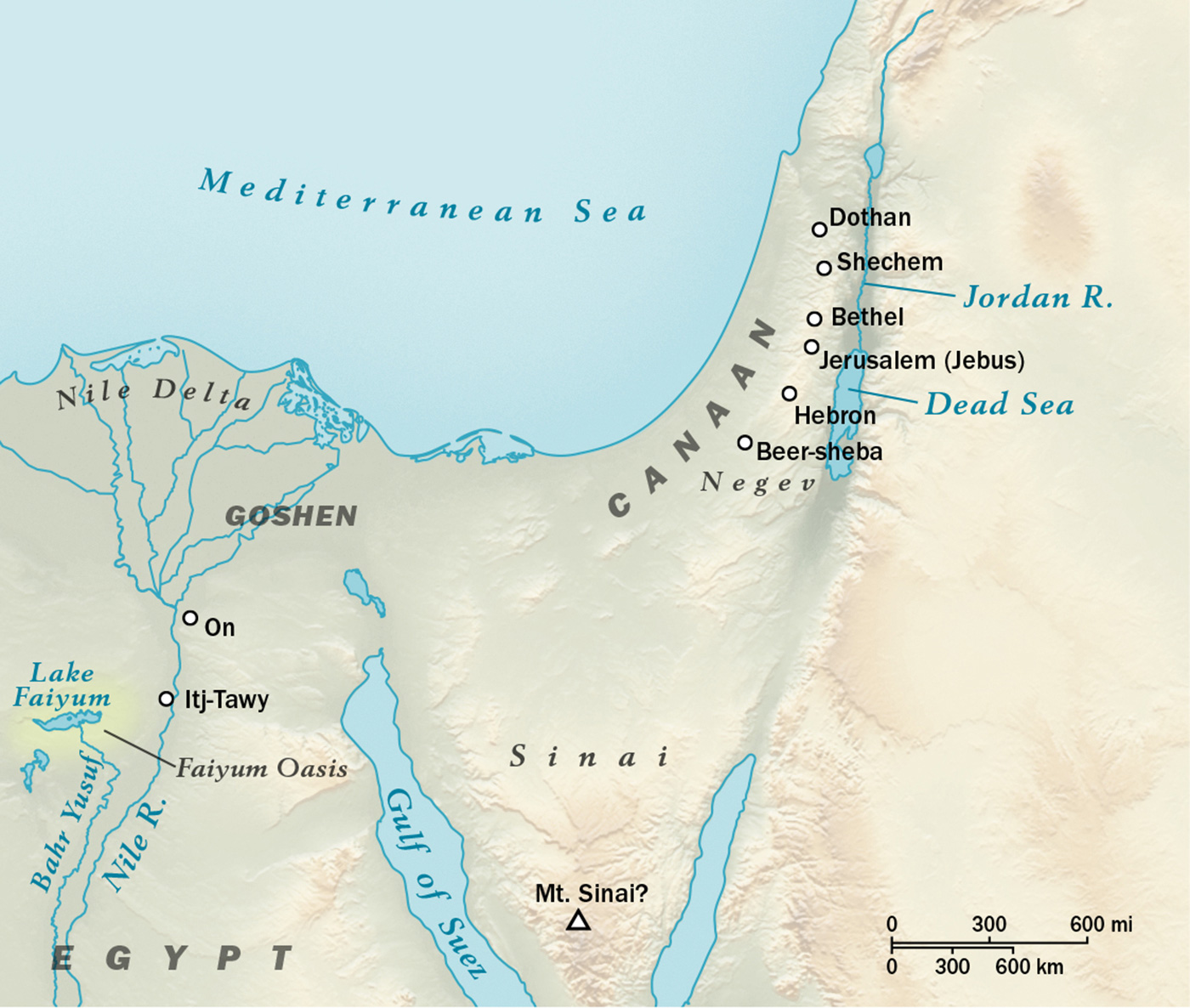
Egypt and Canaan
Authorship
It is not improbable that Moses, reared in the highly literate court of Pharaoh, was capable of recording the history of his people, the events that they experienced, and the stipulations of God’s covenant. There are direct indications of his writing in Ex 17:14 and 24:4, 7. Nevertheless, the Documentary Hypothesis regarding the composition of the Pentateuch poses four distinct sources, JEDP, originating considerably later than Moses. While such a complete rejection of Mosaic authorship is not necessary, later editing of the Pentateuch is entirely possible. (See the article “Who Wrote the Pentateuch?” in the introduction to Genesis.)
Theological Themes
More important, however, than the quest for underlying sources are the timeless theological themes of revelation, redemption, and relationship that are intertwined in the narrative. God reveals himself to Moses at Horeb (Sinai), reasserting the covenant relationship already established with Abraham, Isaac, and Jacob, and declaring his intention to rescue the people from bondage. He reveals himself to the Israelites in the mighty acts that lead to their deliverance at the Red Sea, and he reveals the words of the Sinai covenant. God gives instructions for the tabernacle and priesthood, essential provisions for the wayward people to maintain their relationship with God.
Redemption means paying a price to buy back either persons or property. God’s powerful deliverance of his people, called redemption (Ex 6:6; 15:13), is linked with the firstborn. Israel is God’s firstborn; because Egypt will not allow God’s firstborn to go free, the Egyptians pay with their own firstborn sons (4:21–23). Even so, this was not without cost to Israel. Their firstborn males are to be consecrated to the Lord, animals sacrificed and firstborn sons redeemed, commemorating the payment of the blood of Egyptian firstborns on behalf of God’s own firstborn (13:11–16). This provides the cultural and theological backdrop for Jesus’s declaration that he will give his life as a ransom for many (Mk 10:45) and Paul’s affirmation of the redemptive blood of Christ (Eph 1:7), the firstborn over all creation (Col 1:15). Undergirding these Exodus themes is the truth of God’s sovereignty. He is able perfectly to accomplish his good purposes, carrying out his will and working through the course of human history.
Outline
1. From Bondage to Freedom (1:1–15:21)
A. Connection with the Past (1:1–7)
B. Oppression of Israel (1:8–22)
C. Birth, Preservation, and Preparation of Moses (2:1–25)
D. Moses’s Call and Commissioning (3:1–4:17)
E. Return to Egypt (4:18–31)
F. God of Israel versus the Gods of Egypt: The Initial Request (5:1–6:1)
G. Covenant Lord and His Ministers (6:2–30)
H. Moses and Aaron Confront Pharaoh (7:1–13)
I. Nine Plagues (7:14–10:29)
J. Warning of the Tenth Plague (11:1–10)
K. Instructions for Passover (12:1–28)
L. Tenth Plague and Departure of Israel (12:29–42)
M. Instructions for Commemoration (12:43–13:16)
N. Deliverance at the Sea (13:17–14:31)
O. Song of Victory (15:1–21)
2. Tests in the Wilderness (15:22–18:27)
A. Bitter Waters (15:22–27)
B. Threat of Starvation (16:1–36)
C. Thirst in the Desert (17:1–7)
D. Attack from Enemies (17:8–16)
E. Reuniting with Family (18:1–12)
F. Settling Disputes (18:13–27)
3. Covenant at Sinai (19:1–24:18)
A. Preparations to Receive the Covenant (19:1–25)
B. Ten Commandments and the People’s Response (20:1–26)
C. Covenant Stipulations (21:1–23:19)
D. Preparing the Way to the Land (23:20–33)
E. Covenant Ratification (24:1–18)
4. Instructions for Sanctuary and Priesthood (25:1–31:18)
A. Contributions (25:1–9)
B. Ark of the Covenant (25:10–22)
C. Table and Lampstand (25:23–40)
D. Tabernacle (26:1–37)
E. Altar and Courtyard (27:1–21)
F. Priestly Attire (28:1–43)
G. Consecration of Priests (29:1–46)
H. Incense Altar, Half-Shekel Contribution, Wash Basin, Oil, and Incense (30:1–38)
I. Spirit-Filled Artisans (31:1–11)
J. Sign of the Covenant (31:12–18)
5. Apostasy at Sinai (32:1–34:35)
A. The Golden Calf (32:1–29)
B. Moses Intercedes for the People (32:30–33:17)
C. Revelation of God’s Glory (33:18–34:9)
D. Restating the Covenant (34:10–35)
6. Assurance of God’s Presence (35:1–40:38)
A. Sabbath (35:1–3)
B. Establishing the Tabernacle (35:4–40:38)