Introduction
Overview
If the holy, awesome God is coming to dwell among the Israelites in the tabernacle (Ex 25–40), how will that change their lives? How can sinful people survive with the holy, awesome God living in their midst? How should they approach him? What is the appropriate way to praise God and thank him for his blessings? How can sin be covered so that the relationship is not severed? The book of Leviticus answers these questions. Leviticus stresses that everything in their lives will change; for now—with the holy presence of God residing in their midst—all of their thinking and acting (their worldview) will revolve around what is holy and what is clean. Within this context, four primary themes run throughout the book: (1) the presence of God, (2) holiness, (3) the role of sacrifice, and (4) how to worship and live within the covenant.
Title
The Hebrew name of Leviticus is taken from its first word: Wayyiqra, “Then the LORD summoned.” This name is fitting because the book records more direct divine speech than any other biblical book. The title Leviticus is the Latin form of the Septuagint Greek name Leuitikon, which characterizes the book as concerning Levites. The book barely mentions the Levite tribe (25:32–33), but much of Leviticus relates to ritual matters supervised by priests belonging to this tribe.
Genre
Leviticus consists mainly of instructions from the Lord, arranged in a series of divine speeches to Moses for the Israelites as a whole (e.g., 1:2; 4:2; 7:23, 29), for the priests (6:25; 21:1, 17—to Aaron for all priests), or just for the high priest (16:2). These instructions generally take the form of legal prescriptions to be applied on any number of future occasions. However, the book contains two narratives describing events that generated some additional legislation (8:1–10:20; 24:10–23).
The presence of the holy God dwelling among his people—this is the theme that connects Leviticus back to Exodus.
The legal genre that dominates Leviticus is also prominent in some other biblical books, especially Exodus and Deuteronomy, the laws of which have many parallels with those in Leviticus (e.g., laws regulating servitude in Ex 21; Lv 25; and Dt 15). This genre can be subdivided into ritual law, governing practices relevant to the sanctuary (e.g., Lv 1–7), and nonritual law. Nonritual law includes moral or ethical law, which is generally stated in apodictic formulation as direct statement of principle (“Do not . . .”; e.g., 18:20; 19:3–4, 11–12), and civil law. Civil law, usually in casuistic (case law) formulation (e.g., “If . . . then . . .”), applies timeless moral principles within the ancient Israelite context and often stipulates penalties to be administered under the judicial system of the Israelite theocratic government (e.g., 24:15–21).
Some interpreters have suggested another subdivision or category of the legal genre: health law. Undoubtedly rules regarding diet (11:1–46; 17:10–14), diagnosis of disease and quarantine (13:1–59), and sanitation (15:5–12; cf. Dt 23:13–15) would have an effect on health. But nowhere in the Pentateuch is a health motivation attached to a particular law. Rather, God promises health to those who obey all of his commands (Ex 15:26). This implies that health is affected by every aspect of a person’s life.
Modern Application
Basic moral and health principles are timeless, but the Israelite sanctuary (or temple) and judicial system ceased operation long ago. So modern people, who live under a different form of government, cannot keep the ritual laws or administer civil penalties as specified in the Bible even if they want to. However, they can greatly benefit by applying underlying timeless principles to the extent that they can do this within their respective contexts.
Leviticus teaches God’s faulty people how to worship and live with their Redeemer in close proximity as he dwells among them. The book reveals the divine character in relation to human nature and the Lord’s plan to forgive and cleanse sinners through sacrifice. Much of Leviticus concerns rituals, but the scope of the book is broader than the ceremonial system. From the center at the Lord’s sanctuary headquarters, holiness is to extend outward to all of the covenant people in every aspect of their lives. Thus Leviticus is the charter for fulfilling the Lord’s promise that his chosen people are to be his “kingdom of priests” and “holy nation” (Ex 19:6).
Christians who inherit this promise in spiritual terms (1 Pt 2:5, 9) and desire intimacy with God (Ps 23:6; Rv 21:3) through the priesthood of Christ (Heb 4:14–16; 10:19–25) can learn a great deal from timeless principles of divine-human interaction encapsulated in Leviticus. Most important, they can gain a deeper understanding of the sacrifice of Christ, which was typified by the ancient Israelite sacrifices (cf. Jn 1:29). Sacrifice is necessary for God to extend mercy without compromising justice, the other side of his character of love. While only Christ’s sacrifice is ultimately effective in reconciling sinners to God (Heb 10:1–18), the Israelites were to experience the hope of that unique event and receive grace through faith by enacting powerfully dramatic rituals. Since Christ’s once-for-all sacrifice is so rich, different kinds of Israelite sacrifices were necessary to teach various aspects of it.
Date and Authorship
Leviticus belongs to the larger Pentateuch (Torah) collection. The authorship of the Pentateuch is anonymous, but traditionally it has been attributed to Moses. Modern historical-critical theory, however, denies Mosaic authorship, detaching the origin of pentateuchal books from their narrative setting (see the article “Who Wrote the Pentateuch?” in the introduction to Genesis). Rather than seeing Leviticus as authoritative divine instruction, critics view it as the literary production of later priests concerned with promoting their own ideals and interests. Because there is no hint of monarchy in Leviticus, many critics have assumed that the book must have been assembled to address the Jewish community after the fall of the Judahite monarchy in 586 BC. For them the wilderness sanctuary is fictitious, a retrojection into the distant past to provide the backdrop for a credible human claim to divine authority.
Some historical-critical interpreters find evidence that the language and contents of Leviticus fit the historical context of preexilic Israel. If so, the book reflects a ritual system that actually operated in the first (Solomon’s) temple. However, placing authorship of the book during the First Temple period does not account for the absence of monarchy in Leviticus and still detaches the book from the wilderness setting of divine revelation to Moses.
Comparison and contrast between Leviticus and other ancient Near Eastern texts (especially ritual, legal, and treaty texts) and cultural artifacts from the second millennium BC indicate that there is no compelling reason why the book could not have originated before the monarchy during the second millennium BC, in harmony with its explicit narrative context, although editing and updating of language could have taken place later.
Like other peoples of the second millennium BC, early Israelites possessed a complex ritual and legal system. They shared many aspects of culture with those around them, but significant features of the biblical instructions were countercultural, in accordance with the Lord’s distinctive theology. For example, death was holy for Egyptians, but for Israelites things associated with death were ritually impure and restricted from contact with the sacred sphere (e.g., Lv 21:1–6, 10–12). Also, the “Bread of the Presence” ritual encapsulated a message that was opposite to that of non-Israelite food presentation offerings: rather than signifying that the Lord’s people fed him, the bread offering acknowledged that he provided food for them (see 24:5–9).
The ritual portions of Leviticus contain selected details regarding activities, with little explanation of meanings attached to the activities. This suggests that the text was written when its ritual system was actually performed. The text has the stated purpose of guiding priests and other participants, who could observe what was going on. So they did not need all the details and explanations that would characterize a text describing rituals that were imaginary or no longer performed.
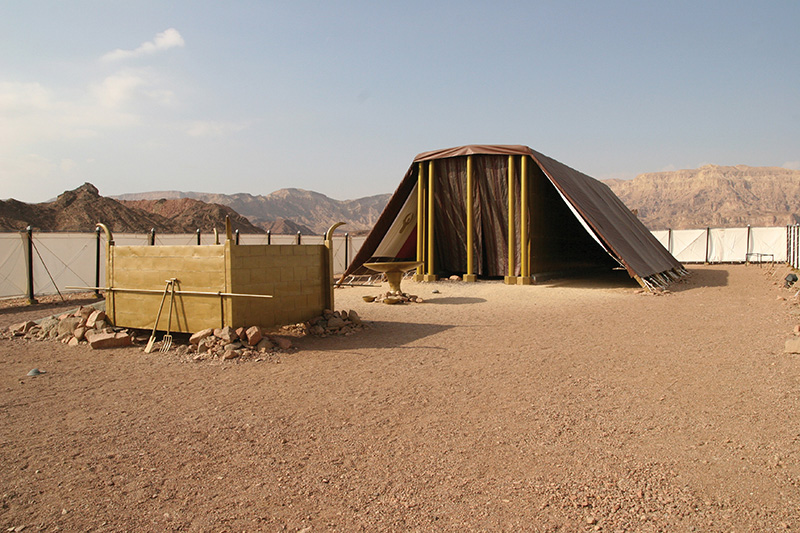
The tabernacle model at Timna Valley Park, Israel
Structure
Interpreters of Leviticus have viewed its logical structure in various ways according to factors such as literary style (including a combination of genres), vocabulary, rhetorical features, topics, divine speeches, repetitions (e.g., between chaps. 18 and 20), and sacred space. Perhaps it is most helpful to recognize that the book progressively introduces concepts in a way that is logical for the purpose of teaching.
The book begins with basic instructions for three voluntary forms of sacrificial worship (burnt, grain, and fellowship offerings), at least two of which were already known to the Israelites (burnt and fellowship; Ex 10:25; 18:12; 24:5) but adapted to the new ritual system of the sanctuary (Lv 1–3). Then it adds two new mandatory kinds of sacrifice (sin and guilt offerings) to remedy some moral faults (4:1–6:7). Following are additional instructions regulating the five kinds of sacrifices (6:8–7:38), knowledge of which is essential for understanding combinations of ritual types employed at the initial consecration (chap. 8) and inauguration (chaps. 9–10) of the sanctuary’s ritual system.
Next, Leviticus presents rules governing physical ritual impurities associated with the birth-death cycle of mortality, which must be separated (in some cases by sacrifices) from the sphere of holiness and life (chaps. 11–15). Special rituals on the yearly Day of Atonement, culminating the first major part of Leviticus, remove both moral faults and physical impurities from the sanctuary and the Israelite community (Lv 16). Following are reiterations of some instructions regarding sacrifice and purity, with additional warnings and explanations (chap. 17). Many scholars have regarded Lv 17 as commencing a so-called Holiness Code of laws that concludes with chapter 26, but the ritual concerns of chapter 17 have much in common with the earlier chapters.
The subsequent portion of Leviticus (chaps. 18–26), united by the refrain, “I am the LORD” (e.g., 18:2, 4–6), exhorts the Israelites to live holy lives in accordance with the will and character of their holy God, who is the authority behind the laws presented here (cf. 11:44–45). Holy lifestyle rules out sexual aberrations and idolatry (chap. 18) and governs a comprehensive variety of divine-human and human-human interactions (chap. 19). Chapter 20 contains additional instructions, penalties, and exhortations regarding some cases in chapters 18 and 19.
The following sections regulate priestly lifestyle and holy offerings (21:1–22:16), call for periodic observance of sacred times of worship (chap. 23), and make provision for regular rituals inside the sanctuary (24:1–9). Holy life rejects assault and blasphemy (24:10–23) but observes sacred times of rest for the land and release from debt servitude (chap. 25). Life in harmony with all the Lord’s instructions is the condition for maintaining a positive, beneficial covenant relationship with him (chap. 26).
Notice the progression of holy things in Lv 18–25 from all Israelites (chaps. 18–20) to priests (21:1–22:16), animal offerings (22:17–33), time (chap. 23), light (from oil) and bread in the outer sanctum of the sanctuary (24:1–9), God’s name (24:10–23), and the promised land (chap. 25).
Chapters 25–26 are a unit delivered to Moses on Mount Sinai (25:1; 26:46), which deals with treatment of the land and blessings and curses associated with it. The comprehensive covenant blessings and curses of chapter 26 bring the book to a logical conclusion, but rules for dedications of persons, animals, and real estate must follow in chapter 27 (often regarded as an appendix) because they partly depend on the Jubilee release of land (27:17–18, 21, 23–24), which is explained in chapter 25.
Outline
1. Sacrificial Worship (1:1–7:38)
A. Voluntary Sacrifices (1:1–3:17)
B. Mandatory Sacrifices as Moral Remedies (4:1–6:7)
C. Additional Instructions regarding Sacrifices (6:8–7:38)
2. Establishment of Ritual System (8:1–10:20)
A. Consecration of Sanctuary and Priests (8:1–36)
B. Inaugural Priestly Officiation and Divine Acceptance (9:1–24)
C. Divine Nonacceptance of Inaugural Ritual Mistake (10:1–20)
3. Impurities and Ritual Remedies (11:1–17:16)
A. Separating Physical Impurities from Persons (11:1–15:33)
B. Separating Defilement from Sanctuary and Community (16:1–34)
C. Additional Instructions regarding Sacrifices and Impurity (17:1–16)
4. Holy Lifestyle (18:1–27:34)
A. Holiness of People (18:1–20:27)
B. Holiness of Priests and Offerings (21:1–22:33)
C. Holiness of Time (23:1–44)
D. Holiness of Light and Bread (24:1–9)
E. Holiness of God’s Name, and the Taking of Human and Animal Life (24:10–23)
F. Holiness of Promised Land (25:1–55)
G. Covenant Blessings and Curses (26:1–46)
H. Holiness of Dedicated Items (27:1–34)