Introduction
Overview
The action story line of the book of Joshua is about conquering, distributing, and taking possession of the promised land. The theological story line is the same as that presented in Exodus, Numbers, and Deuteronomy: obedience and trust in God result in deliverance, victory, and blessing, while disobedience results in tragic defeat, judgment, and the onset of curses (i.e., the opposite of blessings). Also at the heart of this book is the proclamation that God is faithful to his promises. He gives Israel the land of Canaan, just as he promised their forefather Abraham.
Important subthemes run throughout the book as well. For example, closely related to the themes of “land” and “blessing” is the promise of “rest,” a theme recurring frequently in Joshua (1:13, 15; 11:23; 14:15; 21:44; 22:4; 23:1). After wandering for years and waging war constantly, now the people will soon be able to settle down on their own farms and raise their families quietly and peacefully. Another subtheme that emerges early in Joshua through the long episode dealing with Rahab (Jos 2) and Achan (Jos 7) is that ultimately inclusion into the people of God is based on trust and faith in God, not on Hebrew ethnicity. This is another example of how God works behind the scenes of the story to fulfill the Abrahamic covenant (“all the peoples on earth will be blessed through you,” Gn 12:3).
Finally, another faint subtheme that nonetheless persists throughout the book is the quiet, subtle reminder that the Israelites are not quite successful in driving out all the Canaanites (13:1–5, 13; 15:63; 16:10; 17:12), something that will come back to haunt them in the book of Judges and in the years to follow.
Although it ends in the tragedy of exile, the history of Israel recounted in Joshua through 2 Kings starts out well, for Joshua is a “good news” book, filled with victory and success.
Authorship
Although the book is named after Joshua, the central character of the narrative material, nowhere within the book or within Scripture is the identity of the book’s author revealed. There is no compelling reason to rule out Joshua himself as the author of the bulk of the material within the book. After all, 8:32 and 24:26 show that Joshua was capable of making and indeed did make records of historical events. If he wrote the book in his old age, years after the events narrated in the first half of the book had transpired (cf. 23:1), then the intervening years could conceivably explain the recurring phrase “still . . . today” that frequently punctuates the narration, especially in the first half of the book (4:9; 5:9; 6:25; 7:26; 8:28–29; 9:27; 10:27; 13:13; 15:63; 16:10). In fact, if 6:25 is taken literally, then Rahab must have still been alive when that episode was recorded. This suggests that the events narrated may well have been written down within a generation of their having taken place. But even if Joshua did write the bulk of the book, he could not have recorded his own death and burial and written about what happened after his death, in 24:29–33. So either editorial work was done on the book after Joshua had written the bulk of it, or an unknown author wrote the book not long after Joshua’s death.
Structure
The book of Joshua is roughly divided into three major sections plus an epilogue. The first section (1:1–12:24) concerns Israel’s effort to take possession of the land. This can be further divided into two subsections: 1:1–5:15 records what Israel does to prepare for war, while 6:1–12:24 records the actual military campaigns and their results. The second section (13:1–21:45) concerns the allotting of the land to the various tribes, plus the setting up of cities of refuge and Levitical cities. The final section (22:1–24:28) recounts a potential crisis and Joshua’s two parting speeches, with a focus on covenant faithfulness as a necessary condition that will make it possible for the people to continue living in the land. The epilogue (24:29–33) records the death and burial of Joshua.
Theological Themes
Although the book of Joshua was written to trace the historical fulfillment of the Lord’s promise to the patriarchs and Moses to give Israel a national homeland in Canaan, throughout the narration there is also a strong emphasis on the fact that Israel’s success is a direct result of obedience. This can be seen in that the author seems to have taken great care to show that almost every significant step Israel takes is exactly as Joshua commanded, and that Joshua, in turn, follows exactly the Lord’s instructions (4:3–9, 15–17; 5:2–3; 6:3–20; 7:13–25; 8:1–8, 18, 27; 10:24, 40; 11:6, 9). On other occasions, it is also emphasized that Joshua and the Israelites have followed exactly the commands Moses left behind, which he, in turn, received from the Lord (4:12; 8:30–35; 11:12, 15, 20, 23; 14:2, 5; 17:4; 20:1–3, 7–9; 21:1–3; 22:1–2). Thus, throughout the book, Israel’s many successes are presented as resulting directly from obedience at every level, from leader to people.
Conversely, disobedience is also clearly presented as an obstacle to success. First, the past generation’s forty years of wilderness wandering is presented as resulting from disobedience (5:6). Then within the conquest narrative, the one significant defeat Israel suffers is also attributed to the disobedience of one man in their midst, Achan (7:1, 10–12), who violated clear instructions regarding the devoted things. Not until Achan and all that belongs to him have suffered the consequences and have been eradicated from among the people is Israel able to enjoy success again. Thus, by both positive and negative examples, the author has made it abundantly clear that the condition through which Israel enjoys success is obedience.
But while obedience may be the condition through which Israel enjoys success, the author also leaves no doubt that Israel’s success comes directly from the Lord. For not only is the crossing of the Jordan (3:1–17) a spectacular miracle calculated to remind one of the crossing of the Red Sea (cf. Ex 14:1–31), but also the appearance of the commander of the army of the Lord before their first battle (5:13–15), the ritualistic rather than military approach through which the wall of Jericho is brought down (6:6–20), and the miracle of the sun and moon standing still in the battle against the southern coalition (10:12–14) all point to the Lord’s miraculous intervention rather than Israel’s own military prowess as the ultimate source of victory. Even in the more conventional battles, such as Israel’s second attempt to take Ai and the campaign against the northern kings, military strategies such as the use of ambush and the hamstringing of horses and burning of chariots are presented as coming directly from the Lord (8:2; 11:6). This emphasis on the Lord as Israel’s ultimate source of victory thus reinforces again the great importance of obedience as a condition for success. [The Morality of the Conquest of Canaan]
Outline
1. Taking the Land (1:1–12:24)
A. Preparation for War (1:1–5:15)
B. Campaigns of War (6:1–12:24)
2. Distributing the Land (13:1–21:45)
A. Land Yet to Be Possessed (13:1–7)
B. Distribution of Land to the Tribes and to Joshua (13:8–19:51)
C. Cities of Refuge and Levitical Towns (20:1–21:45)
3. Staying in the Land (22:1–24:28)
A. Dealing with Potential Covenant Violation (22:1–34)
B. Covenant Exhortations and Renewal (23:1–24:28)
4. Epilogue: Death and Burial Notices (24:29–33)
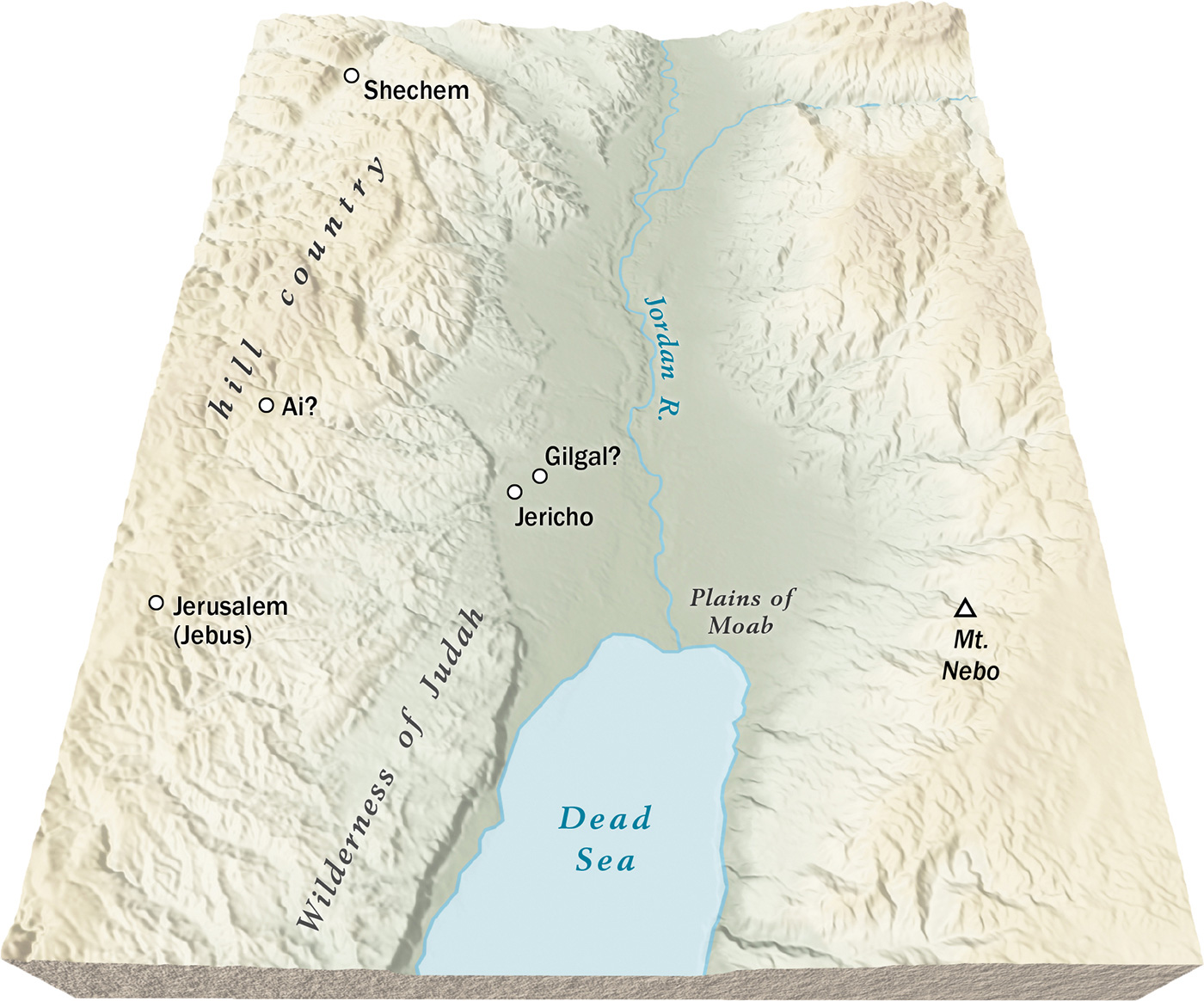
Jericho, Gilgal, and Ai