Introduction
Overview
There are two central themes of Ezra: rebuilding the temple and reconstituting the people of God. Nehemiah will later add a third theme: rebuilding the walls of Jerusalem. After the destruction of Jerusalem and the exile, the return of the Jews back to Jerusalem and the reconstruction of the temple are nothing short of miraculous. Indeed, the prophets had proclaimed that after the judgment there would be a glorious restoration of Israel to the land. Perhaps this is it!
Ezra and Nehemiah, however, as well as the postexilic prophets Haggai, Zechariah, and Malachi, give the sobering answer: no. This return is not the wonderful, glorious restoration promised by the prophets. The very constant presence of Persian monarchial power throughout the story of Ezra and Nehemiah is a stark reminder that Israel very definitely does not have a Davidic king on the throne and does not rule over the Gentile nations (as the prophets have prophesied). Furthermore, conspicuously missing from Ezra’s account of the temple reconstruction is the presence of God. The Lord does not come to fill the temple with his presence as he did in the case of the tabernacle in Ex 40:34–38 and the Solomonic temple in 1 Kg 8:10–11, so the glorious restoration must still be in the future.
So what is happening in the book of Ezra? God is setting the stage for the coming of the Messiah. For a Davidic king and deliverer to come from Israel, the nation must stay intact and maintain a national identity. So God preserves the nation, albeit in remnant form. In the meantime, while they wait for the great coming restoration, those Jews who are back in the promised land are to continue worshiping the God of their fathers. Only as they stay faithful to the Lord in worship and in obedience to his commandments will they be able to keep focused on the coming messianic hope, the fulfillment of the Davidic and Abrahamic covenants. Finally, even though the reestablishment of Israel described in Ezra and Nehemiah falls short of the glorious restoration promised by the prophets, it is nonetheless a significant start. It is a reminder that God has not abandoned his people and that he is moving forward with his plan to fulfill his promises.
The book of Ezra focuses on rebuilding the temple. The book of Nehemiah then tells the miraculous story of how Jerusalem is reestablished in the postexilic period. In spite of serious opposition from enemies of the Jews, the new governor Nehemiah rebuilds the walls of Jerusalem, thus providing the city with a means to defend itself, reestablishing the city as a viable political entity. With a rebuilt temple (Ezra) and a rebuilt city wall (Nehemiah), the physical components are in place for a rebuilt people. Rebuilding the people around a true worship of God is probably the true ultimate goal of both Ezra and Nehemiah; the temple and the wall are just part of the means. Thus the latter half of Nehemiah focuses on his efforts to address internal problems and to get the Jews who are back in Judah to follow and obey God faithfully. The reality is that rebuilding the nation is perhaps more difficult than rebuilding the wall or the temple. Both Ezra and Nehemiah struggle with this, and as the book of Nehemiah ends, the jury is still out on whether the people are going to remain faithful to God without Nehemiah standing right over them watching.
Composition
In regard to the composition and construction of Ezra-Nehemiah, the books of Ezra and Nehemiah both receive their names from their principal characters. In the Jewish tradition, the Hebrew Bible and the Talmud consider Ezra-Nehemiah to be one book in two parts. In the Christian tradition, since the time of the church father Origen (AD 185–253), Ezra and Nehemiah have been considered separate books. In modern times opinions have fluctuated: some scholars have considered them written as two separate books; however, recent studies tend to sustain the view that Ezra-Nehemiah was composed as one work.
Several blocks of material are evident in Ezra-Nehemiah: (1) the narrative of the first return (Ezr 1–6); (2) the Ezra memoirs, apparently written by Ezra (Ezr 7–10); and (3) the Nehemiah memoirs, apparently written by Nehemiah (Neh 1–7 and much of 11–13). How, then, was this book composed? Although some details of the process remain unknown, apparently the author-editor used these three blocks of material, along with some other documents such as inventories, lists of returnees, and letters. Inserting summary notations, the author joined them into one work, the book of Ezra-Nehemiah.
Authorship and Date
Who was the author of Ezra-Nehemiah? The most likely candidate seems to be Ezra himself. It has been suggested that Ezra-Nehemiah was written by the same author who compiled 1–2 Chronicles, since the two works have some points of view in common. However, the different context, focus, and structure of each would indicate different authors for Ezra-Nehemiah and 1–2 Chronicles.
When was Ezra-Nehemiah written? The memoirs of Ezra and those of Nehemiah certainly were written first, perhaps at different periods. Since there are no people or events mentioned in Nehemiah that require a date later than 400 BC, we can assume it was finished sometime before then. If Ezra was the final author, Ezra-Nehemiah must have been completed around 420 BC.
Literary Features and Structure
Most of Ezra-Nehemiah consists of narrative that combines historical, literary, and theological writing. Understanding the structure of Ezra-Nehemiah’s narratives helps us discern the main emphases of the work. The entire work can be divided into four main blocks: three principal “missions” and a fourth section, a “concluding resolution” to the entire plot.
1. The first mission is the return of the Jews to Judah to reestablish themselves in the promised land and to build the house of worship under the leadership of Sheshbazzar and Zerubbabel (Ezr 1–6).
2. The second mission is that of Ezra, teacher and scribe, to “appoint magistrates and judges to judge all the people” and to teach “the law of your God and the law of the king” (Ezr 7–10; see 7:25–26).
3. The third mission is that of Nehemiah to lead the people in restoring the wall around Jerusalem (Neh 1–7).
4. The fourth section, although it may be considered a continuation of Nehemiah’s mission, brings the whole narrative to a conclusion by highlighting the consolidation of the covenant community (Neh 7:5–13:31).
The edict of Cyrus is cited at the very end of 2 Chronicles (36:22–23) and then again (more completely) at the beginning of Ezra (1:2–4), tying these two books together.
These different sections are surprisingly similar in their construction. The first three divisions, dealing with the three main missions of the people, seem to have a parallel structure: preparation for the work, the beginning of the work, opposition to the work, resolution of the conflict or opposition, and the conclusion. Some of the elements are more prominent than others, but they all follow the same general order in each division (see the outline below). Through the similarities we can see three basic themes: (1) the continuation of the people of God, with emphasis on the community rather than on powerful leaders; (2) the construction of the house of God, with its strong emphasis on worship; and (3) the importance of the authority of written texts, primarily the law of God, but also the law of the king and written resolutions of the community.
The book of Nehemiah also displays community development and renewal processes similar to those described in modern sociological studies. In Neh 1–2 we can see an “innovation process.” A society begins to change when someone (or some group) is concerned about community problems, investigates their causes, finds solutions, and persuades the community to take action.
Theological Themes
An amazingly complete biblical theology is implicit throughout Ezra-Nehemiah, which includes all the basic OT teachings about God: his creation (Neh 9:5–6), his infinite knowledge and power (Neh 1:6, 10; 4:14; 6:16; 9:10–11), his sovereignty over all the nations (Ezr 1:1; 5:5, 11; 7:27; 8:22; Neh 2:8; 4:14, 20), his covenant with Israel (Ezr 9:6–15; Neh 1:5–11; 9:5–37), his judgment (Ezr 9:7, 13–15; Neh 13:18), and his mercy (Ezr 3:11; Neh 9:9, 17, 19). Of special interest is how this theology is worked out in the restoration of the Jewish people both physically and spiritually, which is the basic theme of Ezra-Nehemiah.
As we notice several theological emphases in Ezra-Nehemiah, we should not miss their relevance for God’s people today.
The author highlights God’s sovereignty and providence in the continuity of his plan and his people. The text constantly emphasizes that God moved the Persian kings to allow the return, to allow the construction of the temple, and to favor the work of Ezra and of Nehemiah. In the events of their day, the Jews saw parallels to the manifestations of God’s sovereignty and providence in the exodus, the wilderness journey, the conquest of Canaan, and all their history. They commemorated these events in their annual feasts. All this deepened their conviction that they embodied the continuity of God’s people.
The author insists that God’s holiness requires his people’s separation from evil. If Ezra’s and Nehemiah’s actions seem too stringent to us, we must remember how important it was to God for this community to maintain its identity as God’s people—if they failed, they might face another exile.
Throughout Ezra-Nehemiah there is an emphasis on the authority of written documents, especially on God’s written Word, and the centrality of God’s Word in the life of the community. God’s law is a recipe for a healthy society. This community accepted the authority of the Pentateuch, as evidenced by the fact that stipulations from all parts of the Pentateuch are found in Ezra-Nehemiah. Under Ezra’s and Nehemiah’s leadership the people recognize the law’s authority, repent of their disobedience, decide to obey, and confirm their decision in writing and by definite action.
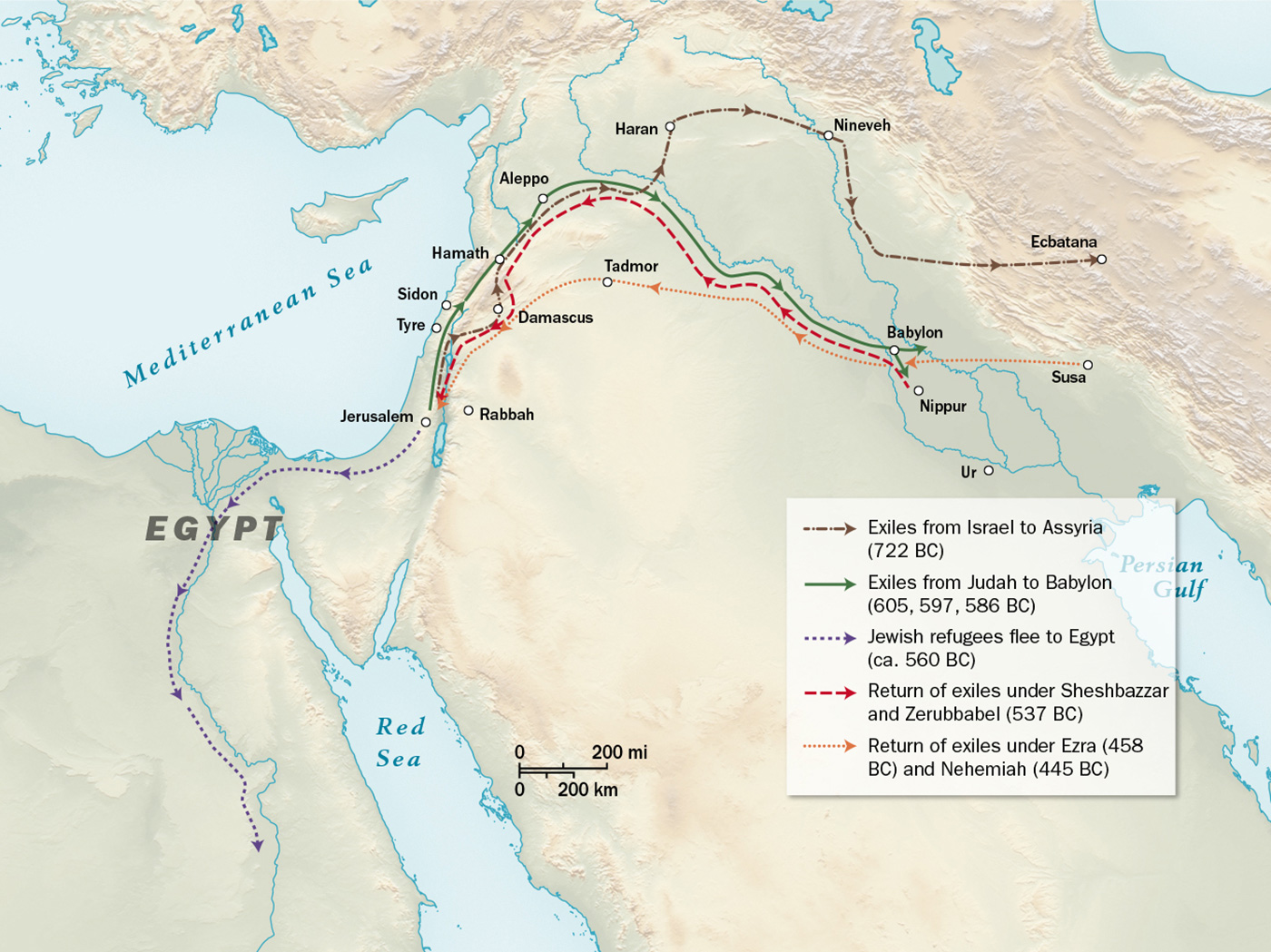
The Exiles and Returns
Throughout Ezra-Nehemiah we see an emphasis on worshiping and glorifying God. The convictions in the people’s hearts lead to genuine worship. What we believe determines our priorities and our decisions. The first returning exiles build the altar to worship God before they build the temple. The emphasis on worship and God’s Word leads to renewal movements, with a focus on repentance, definite decisions for change, renewed worship, and specific follow-up. But that is not the end of the matter, for the people document their decisions and make special efforts to continue the changes.
The author artfully combines theology and history: a living faith based on a vital theology produces dynamic application. Here we will mention three significant themes in Ezra-Nehemiah that greatly affect their future history: prayer, renewal, and consolidation.
Prayer is emphasized throughout Ezra-Nehemiah. Ezra calls for a time of fasting and prayer before making the trip to Jerusalem. In Ezr 9, Ezra’s prayer marks a turning point in the community. Nehemiah also constantly turns to God in prayer. He spends four months in prayer before approaching the king with his request (Neh 1). The statement “the king granted my requests, for the gracious hand of my God was on me” (Neh 2:8) recognizes that response as an answer to prayer.
Renewal, while closely related to prayer, is also a distinct key factor in Ezra-Nehemiah. Some historians have used the figure of the “hinges” of history, key events or turning points in the history of a nation (e.g., the Wesleyan revivals in Britain and the Great Awakenings in the United States). The renewals in the postexilic community were hinges in the history of Israel. We see this in Ezr 9 and again in Neh 8–10. These renewals made a difference in people’s attitudes and brought unity and purpose, which resulted in the people working together to build the temple and restore the wall.
Consolidation of the community through unity and mutual dedication is important in the last section of Ezra-Nehemiah (Neh 8–13). In Neh 8–10 the people renew their covenant with God and rededicate themselves to obedience to the law. This spiritual revival is also a revitalization of their Jewish culture (Neh 9:38–10:39).
Consolidation of the restoration community also requires taking care of details. If Jerusalem is to be a vital religious center, more people will have to live there. So, many of the Jews voluntarily give up their preference to live in the suburbs outside Jerusalem in order to populate the city itself and thus consolidate the decisions they have just made.
Consolidation of the community is strengthened by celebration, a great and joyous dedication of the completion of the wall (Neh 12). Such celebrations, directed at honoring God for what he has done, enhance the unity and dedication of the people.
Consolidation of the restoration community is also achieved by discipline and caring for administrative details. The litany of reforms in Neh 13 may seem to be an anticlimax to the story of Ezra-Nehemiah; however, even a renewed community includes human frailties. God uses consecrated leaders to address these details and lead the community forward to fulfill God’s purposes.
Outline
1. The First Mission: The Return of the Jews to Judah (Ezr 1:1–6:22)
A. Cyrus’s Proclamation (1:1–4)
B. Preparations for the Return (1:5–11)
C. The List of Returnees (2:1–70)
D. The Work Begun (3:1–6)
E. Rebuilding the Temple (3:7–13)
F. Opposition to the Work (4:1–23)
G. Resolution: The Temple Building Continued and Finished (4:24–6:22)
2. The Second Mission: The Return under Ezra (7:1–10:44)
A. Introduction and Preparation (7:1–28)
B. The Return to Jerusalem (8:1–36)
C. Opposition from Within: The Crisis of Intermarriage (9:1–15)
D. Resolution: The Covenant to Change (10:1–44)
3. The Third Mission: Nehemiah Restores the Wall (Neh 1:1–7:73a)
A. Preparation (1:1–2:10)
B. The Work Begun (2:11–3:32)
C. Opposition to Rebuilding the Wall (4:1–6:14)
D. Resolution: The Wall Completed; Community Consolidation Begun (6:15–7:73a)
4. The Consolidation of the Covenant Community (7:73b–13:31)
A. Spiritual Renewal according to the Torah (7:73b–12:26)
B. Celebration and Dedication (12:27–43)
C. Conservation of the Renewed Community (12:44–13:31)