Introduction
Overview
While the Psalms do inevitably address doctrine and moral behavior, their primary purpose is not focused on teaching doctrine and morals. Their primary purpose is to give us divinely inspired models or patterns of how to pray to God, how to praise God, and how to meditate on God, in response to all God has done for us. Thus it is important to remember that most of the psalms are addressed to God, not to us. They enable us to express to God our deepest emotions and needs, especially in the crisis times of life.
The Psalms can be grouped into two main categories relating to very different contexts of human life. First, there are times when we are doing well, and we simply want to praise God for all of the wonderful blessings he has given us. Or perhaps we simply want to praise God because he is so great and praiseworthy. As we reflect on God or meditate about God, our normal response should be to break out in praise. There are many psalms that lead us in this.
The second main category of psalms is called “lament.” A lament is a woeful cry of anguish and hurt, an ancient theologically shaped form of the blues. Sometimes life hits us so hard that we feel as if someone has punched us right in the stomach. Tragedy can strike without warning or without any rhyme or reason, devastating us and crippling us so that we can barely breathe or function. Pain and anguish, mixed with fear and doubt, can downright overwhelm even the strongest of God’s people (like David, for example). The psalmists in general, and David in particular, are brutally honest with God in these situations, pouring out their heartfelt anguish, doubt, anger, fear, and pain to him in powerful, poetic laments. Usually the psalmists use their cry in the Psalms to work through their pain, often eventually ending up with resolve to trust, worship, and praise God, in spite of their difficulties. This too is a model for us, but it does not preempt the need to cry out in pain.
So the two central themes of Psalms are praise and lament, with the lament usually eventually ending up as praise.
Composition, Authorship, and Structure
Under God’s guidance, the 150 psalms tell a unified story—a story of hope in the midst of the chaos of life. They begin with a picture of life as it should be: the righteous always triumphing, the wicked always losing. In other words, Ps 1 portrays life in an ideal world, not the world that we experience. Psalm 1, however, establishes one of the key themes of the Psalter: the battle between the righteous and the wicked.
Psalm 2 presents the second major focus of the book of Psalms: the messianic hope—the Messiah who intervenes in the epic battle between good and evil, defeating his enemies and bringing victory to his people. That messianic victory drives the Psalter (and life for the believer) to its ultimate conclusion—to Psalm 150—to the free, unencumbered joy of praising God. Like Psalm 1, Psalm 150 does not describe a reality of present-day life. Even the delight experienced and expressed in corporate worship is often tainted by our exhaustion from a week of work or by our worries about family problems, career, personal failures, future plans, or what’s for lunch. The unspoiled, exuberant expression of praise to God—and seeing those around us also freely proclaiming the wonder of our God—is in its purest sense an experience reserved for us in heaven.
The psalmists are realists. They recognize that life is less than perfect, that it is, in fact, downright difficult. They know that life is not as it should be or as it will be, so they recorded the psalms in between Pss 1 and 150 to present a picture of life as it is—that is, a picture of the realities of life, where there is pain and suffering, where good does not always triumph, and where evil (at times, or even much of the time) seems to overwhelm. On occasion, God graciously gives us an inside glimpse to the world of Pss 1 and 150, but for the most part we live in the world of the in-between psalms.
The 150 psalms of the Psalter were written over a period of approximately one thousand years—from the time of Moses (Ps 90), if not earlier, to the time of Ezra (Ps 119?), Haggai and Zechariah (Pss 146? and 147?), or later (if the Septuagint, the second-century-BC Greek translation of the Hebrew Scriptures, is correct). The superscriptions of the Hebrew text identify seven different authors as having written one hundred of the psalms (crediting David with seventy-three of them), the remaining fifty being anonymous (the Septuagint alleging five individuals as writing fourteen of them). Note, however, that there is debate regarding what a superscription actually means when it declares a given psalm to be “of David,” “of Asaph,” or “of” anyone else. Many argue that the Hebrew preposition translated “of” is intended to mean “written by,” whereas some favor other grammatically possible meanings, such as “written about,” “written for” (i.e., commissioned by), or “written to.”
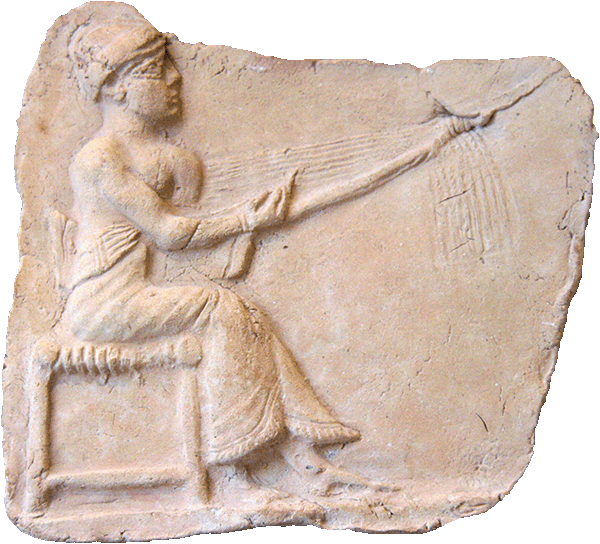
Twelve different psalms mention praising God on the harp.
Through the centuries, God guided the writing, collating, and editing of the Psalter, which links certain psalms into unified groups (e.g., Pss 22–24; 56–60; 93–100; 107–18; 120–34; 146–50). The compilers and editors brought the individual psalms together into five books and then, at the linking of the five books into one, possibly added similar words of praise to the concluding psalm of each of the first four books (even though that psalm might not be a praise psalm itself). In drawing those books together to convey God’s intended story, the compilers emphasized either God’s covenant relationship with Israel by the use of his name Yahweh (books 1, 4, and 5) or his power and authority over all peoples by using his general title Elohim (book 2; book 3 also has a preference for Elohim, but it is less pronounced).
Each of the five books contributes to the overall story of the Psalms, with each book advancing a different perspective on that story. By presenting how the author reacts to the crises he or others are facing, the first chapter of each book sets the emotional tone for its respective book. The flow of these “first chapters” reveals a deepening of despair from book 1 to book 3. In book 3, that despair begins to shift to a sense of hopefulness—hopefulness that grows into bold confidence by the end of book 5.
Although the first chapters present what may appear to be a straight-line path from confidence to discouragement to exuberant delight, the individual psalms within each book do not rigidly follow this pattern. At times, they project more or less optimism or pessimism than do their respective first chapters, but those psalms nevertheless do tend to reflect, in some ways, the tone of that first chapter.
Psalms 1 and 2 are introductory chapters to the entire Psalter. As noted above, they lay out the major themes of good versus evil and the messianic hope, respectively.
In Ps 3, the first psalm of book 1, David exhibits fearless confidence in God’s control over all things. Despite the fact that he has been dethroned by his son Absalom and is fleeing for his life, David expresses no doubts whatsoever that God will give him victory in the midst of what arguably could be considered one of the greater tragedies of David’s life. Book 1 is very positive. Note, for example, the difference between the tone of Ps 23 (book 1) and that of Ps 88 (book 3). Both speak about being close to death, but whereas Ps 23 is quite upbeat, Ps 88 is anything but.
Psalm 42 (opening book 2) reveals that discouragement has set in. The author conveys the sense that life used to be happy but is now sad. He remembers God; he knows that God is good; yet he finds himself in despair and has to steel his courage to place his hope in God.
Hopelessness is the operative word for the first half of Psalm 73, the opening chapter of book 3. The psalmist, a leader among God’s people, is so depressed that he is ready to forsake the way of righteousness and to join with the arrogant oppressors. They prosper; he knows only failure. Then one day, when he is at his lowest, he discovers God’s perspective on life: the wicked may have victory in this life, but the righteous will have victory for all eternity. The psalmist’s bitterness turns to hope. He knows that, with God’s help, he will ultimately succeed.
Book 4 continues the move toward joyful confidence in God. Moses, the author of Ps 90, gains further understanding that God, not the wicked, holds sway over all that transpires in life. Moses also realizes that the true source of their crisis is not their enemies but God, who is judging them (Moses and his people) for their sins. Moses then calls on God to help them walk humbly and joyfully before him. Interestingly, by the end of book 4 (and prominently in book 5), the command “Hallelujah” (i.e., “Praise the LORD”), not seen previously in the Psalter, bursts forth in glorious splendor.
Psalm 107 begins book 5 by declaring that God guides his people and deals with them wonderfully when they turn back to him. God defeats the wicked and gives victory to the upright, even though he does not remove his people from the problems of life. The remainder of book 5 advances hope and confidence in God. It concludes with five psalms of joyous praise—the final psalm being essentially pure praise for who God is and what he does.
Having seen that the Psalter tells a story, how then should we study it to determine God’s intended meaning and how that meaning might impact our lives? [Music in the Old Testament]
Methods of Interpretation
Although there are many ways to study the Psalms, four methods are most commonly used. First, the devotional method reads the various psalms in no particular order, for the purpose of receiving a blessing from God. One drawback is that this approach may rip verses out of their proper context or lead to an inadequate understanding of the theology of the passage. Second, the historical-context method also reads the Psalter in no particular order but reads a given psalm in light of the context of the original author, setting, and readers. However, this method cannot always re-create the original context fully enough to ensure that a psalm is being understood in its original setting. Third, the functional-genre method reads a psalm in light of its function within the worship practices of the ancient people of Israel (e.g., as hymns, community laments, thanksgiving songs of the individual, or laments of the individual) or classifies psalms according to their content or style (e.g., psalms reflecting the human soul in its cry for God, focusing on God himself, relating to the Messiah, or invoking a curse). This method helps readers understand a given psalm in light of other psalms that follow a similar pattern, but it tends to overlook subtle differences among the various psalms of a given functional category.
A fourth approach, to which the present commentary adheres, is the literary-context method. This approach reads a psalm in light of its context within the written Word of God—that is, in the context of the psalms that surround it. This method views the 150 psalms of the Psalter as a literary unit, recognizes the canonical nature of the psalms, and accounts for the arrangement of the psalms and for the editing of the Psalter. On occasion this commentary discusses the interconnections between various psalms. Because space is limited, however, only a few connections are cited.
Some of the linkages between psalms may be identified by observing the following: similar themes; repeated terms, phrases, or even complete verses; a question asked in one psalm being answered in the next; the ideas at the end of one psalm flowing into the beginning of the next; or words rarely used in the Psalms or in Scripture appearing in both psalms. There are also other legitimate connections that can be made among sequential psalms.
To be able to understand the meaning of individual psalms requires not only that we study them in their literary context but also that we interpret them in light of the principles of Hebrew poetry. Hebrew poetry is not based on either a rhyme scheme or meter; instead, it operates on the basis of a parallelism of ideas. That is to say, the second line of a couplet plays off the first, at times bolstering or restating in different words the thought of the first line (synonymous parallelism), at times showing a contrasting idea (antithetical parallelism), and at times completing the thought or moving in a different direction (synthetic parallelism). Neglecting to understand Hebrew poetic form may result in incorrect interpretations of a given psalm.
Key Terms
Following are brief discussions of selected terms appearing in the Psalter or in typical analyses of Hebrew poetry.
Acrostic or alphabet psalms. Psalms in which typically the first word of each verse begins with a different letter of the Hebrew alphabet, running in sequence from the beginning to the end of the alphabet (Pss 25; 34; 37; 111–12; 119; 145). Not all acrostic psalms are complete (Pss 9–10; 145). Psalm 119 is unique in that it begins the first word of eight verses in a row with the same letter of the alphabet, moves on to the next letter of the alphabet in the following eight verses, and continues doing so throughout the remainder of the psalm, completing the alphabet in that way. A given author may have written an acrostic psalm to provide a memorization aid or to suggest that he had “covered” the topic of the psalm “from a to z.”
Chiasm/chiastic structure. Within a verse, a chiastic structure indicates that the first part of the first line parallels the last part of the second line, while at the same time the last part of the first line matches up with the first part of the second line. The chiastic structure strengthens the interconnections between the ideas. Psalm 2:10 provides the following example:
A kings
B be wise
Bʹ receive instruction
Aʹ you judges of the earth
When observed in a sequence of verses within a psalm (e.g., 67:1–7; 126:2–3), a chiastic pattern appears as follows (note: the pattern may contain fewer or more elements—with the central item[s] in the structure being presumed to be emphasized):
A (first idea)
B (second idea)
C (key idea)
Bʹ (second idea restated, typically in different words than before)
Aʹ (first idea restated, typically in different words than before)
Imprecatory psalms. These psalms call for the brutal destruction of the enemies of God, of God’s people, or of the psalmist (Pss 35; 58–59; 69; 83; 109; 137). The psalmist’s rage often extends to the families or descendants of those enemies.
Inclusio. The repetition of a thought or words to mark the beginning and end of a group of verses or psalms (e.g., the word “happy” appears in 1:1 and 2:12 to set Pss 1 and 2 apart as a unit of thought; see also the repetition of an entire verse in 107:1 and 118:29 that links all of the psalms from 107 through 118 together).
Messianic psalms. Any psalm that makes reference in any of its verses to the coming Messiah. The surest way to label a psalm as messianic is to discover other passages of Scripture that make reference to a verse or idea in the psalm and do so in a context of a discussion regarding the Messiah.
Praise and lament. The primary (though not exclusive) communicative components of the individual psalms are the expressions of praise and lament. These expressions may have been originally the spontaneous outbursts of emotion of the psalmists or the reasoned thoughts of worshipers in quiet moments of meditation or prayer. The fact that the psalms are now written documents, on the one hand, lessens to some extent their spontaneity or freshness; on the other hand, it intensifies the reflective moment, moving each psalm from mere words on a page to that which calls for—demands—our attention and response.
Selah. The precise meaning of the term “Selah” (appearing over seventy times in the Psalter) is unknown. Some of the more frequently offered interpretations are that it means a musical interlude, a pause for meditation, or a crescendo of music.
Sheol. This term has a range of meanings, including a pit in the ground, a grave, the place of the dead, and hell.
The righteous. The psalmists use the title “the righteous” to indicate all who are committed to God, irrespective of whether or not they are living godly lives. In other words, all who have a personal interest in God are identified as “the righteous.”
The wicked. The psalmists use the title “the wicked” to indicate all who have no interest in God, irrespective of whether or not they are living sinful lives. In other words, all who do not have a personal relationship with God are identified as being “the wicked.”
Outline
1. Book 1 (1:1–41:13)
2. Book 2 (42:1–72:20)
3. Book 3 (73:1–89:52)
4. Book 4 (90:1–106:48)
5. Book 5 (107:1–150:6)