Introduction
Overview
Jeremiah’s message is typical of the OT prophets and can be synthesized down to the three basic themes of the prophetic message: (1) You (Judah) have broken the covenant; repent! (2) No repentance? Then judgment! (3) Yet there is hope for future restoration, both for Israel/Judah and for the nations.
Much of Jr 1–29 focuses on the many sins that characterize Judah and Jerusalem, underscoring how severely they have broken the covenant God made with them in Exodus and Deuteronomy. These sins can be grouped into three major categories: idolatry, social injustice, and religious ritualism. Like a prosecuting attorney in a courtroom, Jeremiah accuses Jerusalem and its leaders of committing idolatry and social injustice. They are quite mistaken in thinking their religious rituals will cover their unethical behavior and make things all right with God. In fact, Jeremiah warns, a terrible time of judgment is coming.
Jeremiah 30–33, by contrast, focuses on the coming glorious restoration after the judgment. At the center of this messianic message is the description of the coming “new covenant.”
The remaining chapters, however, chronicle how the kings and people of Jerusalem refuse to listen and repent, thus sealing their fate. The Babylonians do indeed come, and the book of Jeremiah describes the terrible fall of Jerusalem. Also included in Jeremiah is an extensive section containing judgment on the surrounding nations for their sin.
Historical Context
What brought on the political crisis in the land of Judah at the turn of the sixth century was a moral and religious depravity traceable to the long reign of Manasseh, Judah’s most evil king (686–643 BC). Manasseh reintroduced Baal worship and set up altars to foreign gods in the Jerusalem temple area, not to mention other practices of the most bizarre kind (2 Kg 21:6). For offenses not nearly as significant, Israel, Judah’s northern neighbor, had been invaded by the Assyrians in 722 BC. Its capital, Samaria, had been captured. Judah, the prophet Jeremiah warns, would face a greater tragedy.
Yet “crisis” could hardly describe Judah during Josiah’s reign (641–609 BC). Manasseh before him had been a vassal of the Assyrians. But with Assyrian power waning, Josiah enlarged Judah’s territories. Times were prosperous. It even seemed that Josiah would turn the nation to God. When the book of the law, possibly Deuteronomy, was discovered in the temple in 622, he took strong measures to reform Judah’s religious life (2 Kg 22–23). But the reforms turned out to be temporary. A number of prophetic oracles in the first six chapters of Jeremiah date from Josiah’s reign. They claim that the situation, for all its apparent calm, is serious.
To aggravate matters, Jehoiakim (609–597 BC), Josiah’s son, reversed the direction set by Josiah. He, in fact, returned to pagan idols and even practiced child sacrifice. Despite wealth being drained to Egypt, to whom Judah had become a vassal, Jehoiakim built himself a showy palace. He failed to compensate the laborers, nor did he care for society’s poor. He callously disregarded the God of Israel, whose message was read to him from a scroll prepared by Jeremiah. He sliced the written columns as they were read and tossed them into the fire (Jr 36).
Such brazen disregard for God propelled the people into a national crisis both religious and political. Josiah, the highly respected king, had been killed in 609 BC at Megiddo in an attempt to halt the Egyptians, who were moving northward to the aid of an ailing Assyria. A fast-moving Babylonian, Nabopolassar, had captured Nineveh, Assyria’s capital, in 612 BC. With a decisive victory over Egypt at the Battle of Carchemish in 605 BC, Nebuchadnezzar, who succeeded Nabopolassar to the throne, was about to swallow the little countries of Syria-Palestine, including Judah.
Nebuchadnezzar swept down the Mediterranean coast soon after 605 BC and, in response to Jehoiakim’s maneuvers, attacked Jerusalem. He took the elite of that city, including Jehoiachin, the recently inaugurated king who followed Jehoiakim, captive to Babylon. In its last two decades Judah had five different kings. With the Babylonian attack in 597 BC, disaster came to Judah, as God’s prophet had warned.
Nebuchadnezzar appointed Zedekiah to be his vassal king in Jerusalem. God’s messenger Jeremiah threatened further disaster if king and people would not turn from their evil, their lying, their violence, their injustice, and their flirting with strange gods. Zedekiah was a vacillating king, controlled and confused by rival political parties, the strongest of which urged alliance with Egypt. At one point Zedekiah made a courageous social and religious move. He followed the Mosaic law and released the slaves—but days later he went back on his word (Jr 34). Widespread corruption reached crisis proportions. God’s agents the Babylonians were on hand. When Zedekiah rebelled against his overlord in 589 BC, Nebuchadnezzar laid siege and after eighteen months broke into the city. He destroyed it, including the palace and the four-hundred-year-old temple.
More persons were taken captive to Babylon. Gedaliah was appointed governor. One of his own countrymen, an Israelite, assassinated him. Fearing revenge from the Babylonians, some Jews left to settle in Egypt. Even after all this, little had been learned, so it seemed, because there too people preferred a pagan deity, the Queen of Heaven, to the worship of the God of Israel.
The story line of the book of Jeremiah stretches from 627 BC, the year of Jeremiah’s call to be a prophet, to 562 BC, the last chronological marker mentioned in the book’s appendix. For Judah those years were the most convulsive in its history.
Jeremiah the Prophet
One of God’s spokespersons during these troubled decades was Jeremiah. His contemporaries included Zephaniah, Habakkuk, Nahum, and Ezekiel. Born, it is believed, into a priestly family in 640 BC, Jeremiah was commissioned by God in 627 BC. As a youth, Jeremiah witnessed Josiah’s reform and was almost certainly supportive of it, though explicit endorsements are not found in the book. Jeremiah gave most of his oracles during the reigns of Jehoiakim and Zedekiah. When Jerusalem fell, Jeremiah was singled out by the Babylonians for preferential treatment. Yet he chose to stay with his people, even when, against his counsel, they went to Egypt. Nothing is known about his death.
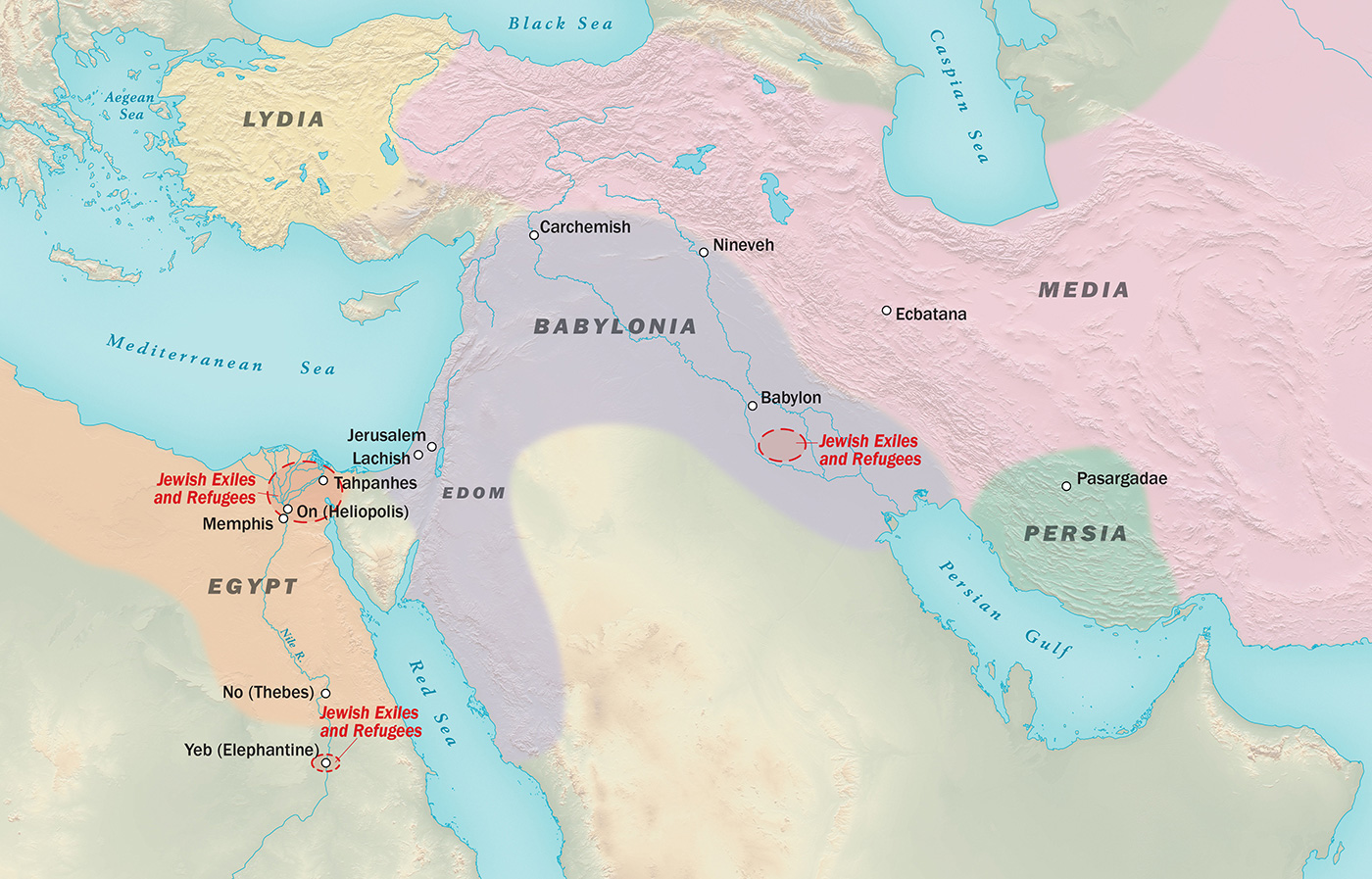
Locations of Jewish Exiles in the Sixth Century BC
Jeremiah’s message, largely one of warning, made him few friends; indeed, he was pitted against kings, prophets, priests, and society at large. Throughout the book, he reprimands Jehoiakim for his extravagance. He prophesies woe for Jehoiachin and urges Zedekiah to submit to the Babylonians rather than to resist them. Jeremiah charges his peers, the prophets, with complicity. He brands them liars. He rails at them for talking about peace when God is about to inflict disaster. He writes to the exiles, naming the prophets of whom they should beware. As for the priests, they, like the prophets, dislike him. So do the ruling officials. Jeremiah languishes in a mud dungeon because of their schemes and comes close to death. A sermon at the temple brings him a near-lynching by the incensed crowd. At times he is forced, along with Baruch his scribe, into hiding.
God asks him to engage in symbolic actions. Jeremiah buys a new garment, and then he promptly buries it in the sand. He buys a jar and, in an object lesson to the city elders, smashes it before their eyes. He wears an ox yoke as he lays out God’s word to dignitaries from neighboring nations; he is a prophet not just to Israel but to the nations.
An intense man with deep emotions for his people, Jeremiah agonizes over the messages God asks him to give. He is disgusted by the evil around him and devastated because of the lack of response. Even the joy of being God’s servant vanishes on occasion. He is so depressed that he curses the day of his birth. No other prophet allows us such a deep look into his interior life.
Jeremiah was courageous, for he presented God’s word at the risk of his life. He was persevering. For more than twenty years, he called on people to repent but without result. Jeremiah was gentle, tender, and sensitive. He felt pain that God would have to mete out punishment. He uncompromisingly delivered God’s unpopular but necessary warnings. The word of God was to him like a fire and like a hammer. More than 150 times one reads, “This is what the LORD says,” or similar expressions.
In the NT period, some identified Jesus with Jeremiah, and for good reason (Mt 16:14). Both were opposed to the religious establishment. Each preached repentance. Each warned about the fall of Jerusalem. Both had a small band of supporters. Both endured the rejection of the masses. Jesus’s passion story has its counterpart in the passion narrative of Jeremiah (Jr 26–44). According to one count, there are forty quotations from and allusions to Jeremiah in the NT. Many are found in the book of Revelation; the most striking is Heb 8, which quotes the new covenant passage in full (Jr 31:31–34).
Theological Themes
In simple terms, one could say that Jeremiah’s message for his society centers on the interplay between God, people, and land.
Between God and people there is a covenant. It consists of a commitment for God to be God of his people and a demand for the people to be God’s kind of people. Covenant is an intimate arrangement that calls for loyalty from the covenant partners. A covenant was established at God’s initiative when he called Abraham and later when he delivered his people from bondage into freedom. In the opening oracles of Jeremiah, the covenant is depicted using marriage as the primary metaphor (chaps. 2–3).
But Israel’s sporadic disloyalty has become chronic, and therein lies the crisis. The relationship between God and Israel is strained to the breaking point. In fact, God declares that the covenant is broken. Through repeated exhortation, encouragement, and warnings, however, God intends to salvage the covenant.
The presupposition for God’s message to Judah about the covenant is also the backdrop for God’s message to the nations: God the Lord is the sovereign Lord. The title “LORD of Armies,” though common in the OT, is concentrated in Jeremiah, where it appears eighty-two times. That title, with its military overtones, emphasizes God as supremely in command. As sovereign dispatcher, God is the one who has sent Nebuchadnezzar, his “servant,” against Jerusalem. Because God is God, idolatry is both intolerable and foolish. As supreme Creator, God is able to make his purposes stand, whether for Israel or for the nations. With him nothing is impossible (32:17).
God delights in righteousness. Of prime value, therefore, is not human wisdom, strength, or riches but a knowledge of God, who “exercises kindness, justice and righteousness on earth,” for, he says, “in these I delight” (9:24). His wrath is against all unrighteousness, and Judah is grossly unrighteous. For this reason, perhaps, God’s wrath is a secondary theme in the book.
The shape of evil, as Jeremiah exposes it, on the part of nations is a disregard of the sovereign God, and on the part of Israel it is a rejection of the covenant God. Jeremiah addresses a stinging rebuttal to all who substitute images for the sovereign God (10:1–16), or to nations who worship deities other than God, such as Chemosh, Molech, or Marduk. Arrogance and ego obsession also come under the judgment of God.
In Judah an assortment of evils jeopardizes the covenant relationship. Preponderant among them is injustice. The poor, the disadvantaged, and those on the margins are neglected and even exploited. Violence and sexual license have become common. Lying and deceit are widespread national ailments that affect even religious persons. Prophets, for example, sanction the evil plans of others with their benedictions (23:14–18). Religiously the people are stiff-necked. They refuse to listen to God’s word and refuse, too, to take correction.
Israel has set God aside; people are secure in the land—or so they think. They are wrong! Covenant breaking, the severing of ties between people and God, has consequences—among them the dislocation of people from their land. Repeatedly Jeremiah warns that a northern foe will invade Judah. Havoc will come to Jerusalem. Worst of all, for those who escape death, there will be the loss of land and of an ordered life. People will be taken into exile. God’s judgment on the sin of covenant disloyalty in his people did indeed affect their land. Drought came, and eventually they lost their land.
God judges all sin—also that of nations. They too, according to Jeremiah, will suffer loss of life and property. Empires will shatter, and nations will go into exile. Removing people from their land and returning them to their land are both acts of God. The land of Israel, while a geographical territory, eventually will become a symbol of the good life, the life with God. Land is something like litmus paper in chemistry, an indicator of where one stands spiritually and theologically. Loss of land is not the last word, however. The salvation word is about land too. Israel will also return to its land. More than that, it will recover what has been lost, and good times will come again (chaps. 30–31). Central to these good times will be a spiritual return to God. In fact, God will make a new covenant—certainly the high point in Jeremiah’s message—in which people will be given a new heart and will know God immediately and intimately (31:31–34). God will save his people. The announcement of good news is sealed, as was the announcement of bad news, by a symbolic action. Jeremiah buys property to show that after the exile normal routines will be resumed.
Jeremiah’s message raises questions appropriate in every age. What is the nature of the relationship between God and his people? What is the shape of evil in church or society? Where and by whom is God’s message freely proclaimed? When is the message of repentance appropriate? What is the word from God to modern nations on the brink of global disaster? To what extent and in what way is a believer to be involved in society, especially in its political life? To what degree is the good life “guaranteed”?
Literary Features
The book of Jeremiah has several distinctive features. It is the longest, by word count, in the Bible. Several short sections are duplicated in scattered places. The book has an appendix, taken largely from 2 Kg 24–25. The book as a “prophetic” book supplies an amazing amount of historical information. Similarly, there is more of a biography of the prophet, including Jeremiah’s emotional pilgrimage, than in any other prophetic book. Among personal-interest stories are Jeremiah’s symbolic actions.
The first twenty chapters plus the first two in the Book of Comfort (chaps. 30–33) are mostly poetry. The poetry is vigorous and expressive, and filled with metaphor, such as that of the marriage between God and Israel, which is similar to Hosea. The prose sections are much like Deuteronomy in style—a fact that has spawned numerous theories about the relationship between Deuteronomy and Jeremiah. Often-occurring expressions include “they/you did not listen”; “the LORD of Armies”; and “I will be their God, and they will be my people.”
Structure and Authorship
The book of Jeremiah appears scrambled because it is not chronologically or even topically arranged. In addition, the Greek text (Septuagint) is one-eighth shorter and places chapters 46–51 in the middle of the book (after 25:13). There have been many theories on how the book came to be composed. One possibility is that the scroll Jehoiakim burned was dictated a second time. Since it contained warnings, it is likely, though not stated, that part or all of chapters 1–20 were part of that scroll (see 36:32). Since Baruch was Jeremiah’s scribe, and since the narratives about Jeremiah appear in the third person, it has been suggested that chapters 26–45, excluding the Book of Comfort (chaps. 30–33), are his work. In summary, Jeremiah himself as “author” would be responsible for chapters 1–20 (25), 30–33, and 46–51. Baruch may have been the author-compiler of chapters 26–29 and 34–45. An editor may have added the appendix (chap. 52).
More helpful than trying to determine authorship is attention to the book as it now lies before us. Several different blocks of material can be distinguished. The warnings and threats to Judah, sermon-like, dominate chapters 1–20. Stories from Jeremiah’s experience are found in chapters 21–29 and 34–45 to illustrate the wicked society. The Book of Comfort has a tone totally different from the rest of the book. The oracles against the nations (chaps. 46–51) put the reader on the world stage. The book tells about the experiences of a prophet; it surveys nations. Most of all it acquaints us with God, and that with a passion.
Outline
1. Jeremiah’s Credentials (1:1–19)
2. Sermons Warning of Disaster (2:1–10:25)
A. A Marriage about to Break Up (2:1–3:5)
B. A Story of Two Sisters (3:6–4:4)
C. Trouble from the North (4:5–6:30)
D. Examining Public Worship (7:1–8:3)
E. Treachery, Trouble, and Tears (8:4–10:25)
3. Stories about Wrestling with People and with God (11:1–20:18)
A. Coping with Conspiracies (11:1–12:17)
B. Pride Ruins Everything (13:1–27)
C. Dealing with Drought (14:1–15:21)
D. Much Bad News, Some Good (16:1–17:27)
E. A Pot Marred, a Pot Smashed (18:1–19:15)
F. Terror on Every Side (20:1–18)
4. Challenging Kings and Prophets (21:1–29:32)
A. Addressing Rulers and Governments (21:1–23:8)
B. Addressing Prophets and Their Audiences (23:9–40)
C. Divine Anger (24:1–25:38)
D. Jeremiah versus the People (26:1–24)
E. Submit to Babylon’s Yoke! (27:1–28:17)
F. A Pastoral Letter (29:1–32)
5. The Book of Comfort (30:1–33:26)
A. Coming Back to the Land (30:1–24)
B. Coming Back to God (31:1–40)
C. A Property Purchase (32:1–44)
D. Things Great and Unsearchable (33:1–26)
6. Case Studies in the Failure of Leadership (34:1–39:18)
A. Going Back on One’s Word (34:1–21)
B. Obedience (35:1–19)
C. The Burning of a Scroll (36:1–32)
D. Troubling a Prophet (37:1–38:28)
E. The Fall of Jerusalem (39:1–18)
7. After the Catastrophe (40:1–45:5)
A. Trouble from Within (40:1–41:18)
B. Trouble in Egypt (42:1–43:13)
C. Failure to Learn from History (44:1–45:5)
8. Oracles about the Nations (46:1–51:64)
A. Egypt (46:1–28)
B. Philistia (47:1–7)
C. Moab (48:1–47)
D. Ammon (49:1–6)
E. Edom (49:7–22)
F. Damascus (49:23–27)
G. Kedar and Hazor (49:28–33)
H. Elam (49:34–39)
I. Babylon (50:1–51:64)
9. The Fall of Jerusalem (52:1–34)