Introduction
Overview
The prophets preach to Israel and Judah with the book of Deuteronomy in mind. That is, the prophets announce that the people of Israel have broken the covenant agreement as legally documented in Deuteronomy, and thus they will experience the terrible consequences clearly spelled out in Deuteronomy (especially in Dt 28). Unlike most of the other prophets, Joel skips over listing the specific covenant violation sins of Israel (idolatry, social injustice, reliance on religious ritualism), and in his opening two chapters he goes straight to judgment. Pulling from Dt 28:38 and Dt 28:42, Joel describes a terrible locust plague that comes on the land as God’s judgment for rejecting and abandoning the laws of Deuteronomy. Yet like the other prophets, Joel also moves beyond the judgment to describe the wonderful time of future restoration—a time when God would pour out his Spirit on all his people.
Canonical Context
The book of Joel tells the story of Judah and its dramatic rescue, tracing its journey through pestilence, famine, exile, and restoration. Equally significant is the prophetic overview of God’s ultimate victory and rule over his enemies embedded within Joel’s oracles. Despite the book’s brevity, the reader should not underestimate the eschatological significance of Joel’s prophecies for the original audience as well as its contribution to NT revelation. Joel’s frequent allusions to the Pentateuch, the five books of the Law, as the authoritative foundation for his prophecies, combined with his appeal to the work of his contemporaries, underscores the immediate historical relevance of his words to a nation in crisis.
The allusive nature of Joel’s prophecies can be seen in the generous number of shared literary links with eschatological or apocalyptic themes in other prophetic books, including several allusions to Isaiah (Jl 1:15 [Is 13:6]; 2:3 [Is 51:3]; 2:27 [Is 45:5–6, 18]; 3:2 [Is 66:18]), Jeremiah (Jl 3:1 [Jr 33:15; 50:4, 20]), Ezekiel (Jl 1:15 [Ezk 30:2–3]; 2:3 [Ezk 36:35]; 2:28 [Ezk 39:29]), and the Psalter (Jl 2:17 [Ps 79:10]; 2:21 [Ps 126:3]). These affinities reaffirm the continued theological struggle Israel experiences as it seeks to harmonize the merciful and compassionate disposition of God with the demands of his divine holiness, which punishes sin and requires restitution. In addition, Joel demonstrates a broad familiarity with other authoritative works, interweaving motifs such as the exodus, the divine attributary formula (Ex 34:6–7), and themes of judgment and restoration from Dt 32, along with mythological concepts, such as the sacred mountain or divine warrior imagery. In the process of drawing from such works, Joel underscores the divine origin of his prophecies, validating his message as a continuation of previous revelation.
Joel describes current events as orchestrated by God, threatening rebellious Judah with divine chastisement while assuring it of its eventual deliverance. The writer adeptly navigates the transitions between imminent fulfillment and the cosmological scope of a later, more complete realization of his prophecies. While Joel’s words have immediate relevance for his contemporary audience, the apocalyptic nature of his prophecies points forward to unrealized fulfillment following worldwide catastrophic events in the eschatological future, when the Messiah himself will render judgment on the nations and exercise dominion from his throne in Jerusalem.
Incorporating apocalyptic imagery and language designed to incite hope for a devastated nation, Joel speaks in terms of visions, cosmic anomalies, and an ultimate final conflict between good and evil. Divine victory eradicates evil and establishes the cosmological reign of a messianic king. The citation of Jl 2:28–32 in Ac 2:17–21 associates this unique prophetic vision with the gift of the Holy Spirit at Pentecost, bridging the chasm between an ancient past and a glorious, unrealized future.
Joel the Prophet
The identities of Joel and his father, Pethuel, remain uncertain since 1 Chronicles mentions a number of individuals with the name Joel living during the period between the transition to Israel’s monarchy and the postexilic return (e.g., 1 Ch 4:35; 5:4, 8, 12; 6:21; 7:3; 15:7, 11; 27:20). The geographic references to Jerusalem, Judah, and Zion, as well as Joel’s obvious familiarity with priestly practice and procedures, imply the prophet lived within the centralized temple community. While the majority of scholars affirm Joel as the author of the book, a few commentators doubt that the apocalyptic sections (1:15; 2:1–2, 10–11; 2:28–3:21) originated with the prophet.
Date
Scholarly opinions diverge widely concerning a date for the book. The superscription (1:1) does not specify the historical time period. Those who argue for a postexilic date for composition base their arguments on a number of criteria, suggesting that contextual evidence of regular sacrificial offerings and references to the priesthood point to the rebuilding of the temple, after 516 BC. In addition, the prophet does not specifically mention a king or the monarchy in his message. Allusions to Israel’s and Judah’s captivity and deportation appear to support a late date for the prophecies. Moreover, the transitional content of the book from prophecy to apocalyptic material leads some biblical experts to propose that it dates from the fourth century BC.
The same criteria used for a late date of the book, however, also support an eighth-century-BC composition. References to the temple and the priesthood could indicate a preexilic origin. The failure to mention Assyria, Babylon, or Persia as political threats, combined with the inclusion of the Phoenicians, Philistines, Egyptians, and Edomites (3:4, 19) as Israel’s enemies, argues favorably for an origin before the exile. In addition, an eighth-century historical setting best reflects the relative autonomy of those foreign nations listed in chapter 3. The mention of a city wall (2:9) may also suggest either an early or a late date. The book’s canonical position, situated with Hosea, Amos, and Jonah, presumes these works as contextual contemporaries, and the prophet’s association of the “day of the Lord” with an earthquake harmonizes well with King Uzziah’s reign and Amos’s descriptions. Joel employs literary themes and events consistent with a preexilic composition, sharing dozens of terminological and linguistic links with early prophetic works. The evidence therefore favors a compositional origin sometime in the mid-eighth century (ca. 750–740 BC).
Literary Features
A devastating locust plague occasions the writing of the book, which describes an insect invasion so comprehensive in scope that it threatens the survival of Judah’s population (1:2–12). Joel envisions the extent of the destruction by voracious locusts as equivalent to the widespread judgment of the day of the Lord. The prophetic warning in 2:1–11 uses the metaphor of a second, unparalleled locust plague, followed by drought, to characterize God’s chastising Judah by means of an enemy invasion. While locusts never figuratively symbolize armies in ancient Near Eastern literature or the biblical text, locusts are mentioned in Dt 28:38, 42 in light of future conquest and exile. The far-reaching consequences of the locust invasion that Joel emphasizes seem to extend beyond the realm of a literal swarm of pests to symbolize the wide-reaching effects of enemy attack and conquest of Judah. The connections between the two sections, offset by corresponding passages focusing on repentance (1:13–20; 2:12–17), reinforce the theological emphasis on the day of the Lord as a time of divine discipline and cleansing, followed by eventual restoration.
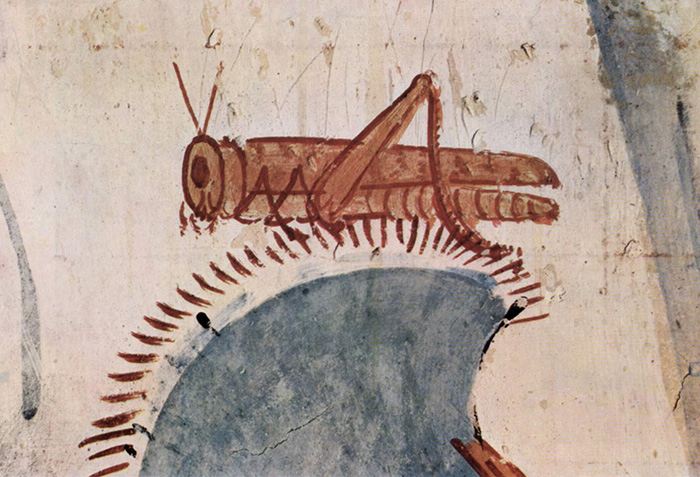
Locusts will swarm when environmental conditions are right, leaving devastation in their wake (Jl 1:4).
© Yorck Project / Wikimedia Commons.
All the Hebrew manuscripts and ancient versions attest to the unity of the composition, although chapter-and-verse divisions vary. The Greek and Latin versions originally divided the text into three sections. The first rabbinic Bible as well as later Hebrew editions, including the modern standard edition (Biblia Hebraica Stuttgartensia), segment the book into four sections. Consequently, 3:1–5 in the Hebrew (Masoretic Text) corresponds to the English 2:28–32, and Hebrew 4:1–21 reflects its English counterpart, 3:1–21.
Theological Themes
The book of Joel emphasizes certain eschatological themes, describing God’s role and relationship to Israel. The Lord preserves a remnant of his people, pouring out his Spirit on all of them without class distinction. Supernatural visible signs, such as the eclipse of the sun (3:15; cf. Am 5:18–20; 8:9; Zph 1:15) and the hail of blood and fire, attend the day of the Lord. God regathers and rescues Israel and leads her in triumphal procession back to the land, engaging and defeating the enemy nations in a great final battle.
Structure
The clever structure of the book reflects Joel’s skillful use of repetition, in particular through the forty-seven instances of twice-repeated terms and phrases in the book. The two halves of the book correspond to one another, as reflected in the outline below.
Outline
1. The Locust Invasion as the Lord’s Judgment of Judah (1:1–20)
A. The Devastating Consequences of the Locust Invasion (1:1–12)
B. The Lord’s Call for Judah’s Repentance (1:13–14)
C. Judah’s Appeal for the Lord’s Rescue (1:15–20)
2. Military Conquest as the Lord’s Judgment of Judah (2:1–17)
A. The Devastating Consequences of Judah’s Invasion by Its Enemies (2:1–11)
B. The Lord’s Call for Judah’s Repentance (2:12–17)
3. The Lord’s Response to Judah’s Appeal (2:18–32)
A. The Lord’s Conquest of the Enemy Restores Productivity to the Land (2:18–27)
B. The Rescue of the Lord’s People and His Reign on Mount Zion (2:28–32)
4. The Day of the Lord as Victorious Rule and Reign (3:1–21)
A. The Lord’s Defeat of Judah’s Enemies (3:1–16)
B. The Lord’s Establishment of a Permanent Kingdom in Jerusalem (3:17–21)