Introduction
Overview
Matthew’s main concern is to show that Jesus is the true King and Messiah. From the very beginning Jesus is revealed as the “Christ, the Son of David, the Son of Abraham” (Mt 1:1). Matthew wants to show that this new movement within Judaism (eventually identified as Christianity) is authentic Judaism because these people are following the true Messiah—Jesus of Nazareth. Jesus is the Jewish Messiah, but he also fulfills God’s plan to bring salvation to the nations, and the Gospel ends with a commission to “make disciples of all nations” (Mt 28:19).
Matthew’s first readers probably needed encouragement to endure persecution, to stay strong in their faith, and to take this good news of Jesus to the nations. No wonder the Gospel of Matthew was extremely popular in the early church.
Authorship and Date
Although the Gospel itself is anonymous, the title (added in the second century) specifies Matthew as the author. Church tradition also attributes it to Matthew the apostle. Modern scholarship has questioned these traditions, but some scholars continue to support Matthew as the author of the First Gospel.
One difficulty for determining authorship is the nature of narratives, which point away from the author and toward the story being told. Matthew’s author intends the audience to focus its attention on Jesus and the events and time frame of his life rather than on the author and the author’s world. Yet reconstructing something about the author, audience, and date from the Gospel is possible by studying indirect references within the story (e.g., does 22:7 indicate Matthew writes after the destruction of Jerusalem?) and attending to direct authorial commentary where it occurs (e.g., 24:15; 28:15). Such reconstruction of the implied author, date, and audience (implied within the narrative) may be sketchy, since internal evidence can support contrasting reconstructions (as in the dating of Matthew).
The internal evidence of the First Gospel suggests that the author is a Jewish follower of Jesus (e.g., 1:2–17; OT fulfillment themes), possibly from a scribal background (cf. 13:52; 23:1–2), who writes to a primarily Jewish audience (e.g., explanation of Pharisaic traditions from Mk 7:3–4 omitted in Mt 15:1–2; also Gentile-inclusion theme), most likely between AD 68 and 85. In this commentary, “Matthew” will be used to refer to the Gospel’s implied author.
Sources
Matthew’s clearest source is the Jewish Scriptures (the OT), which the Gospel cites and alludes to frequently (over seventy times by some counts). In fact, the OT story is assumed and evoked throughout Matthew (e.g., Israel’s exile and restoration in chaps. 1–4; Ps 22 in Mt 27:32–50). Of the four evangelists, Matthew cites the OT most often. Ten times he employs a formulaic introduction to highlight Jesus as fulfillment of the OT (1:22–23; 2:15, 17–18, 23; 4:14–16; 8:17; 12:17–21; 13:35; 21:4–5; 27:9; see also 2:5; 3:3; 13:13–15). These fulfillment quotations typically connect at the story level (by connecting the OT quotation with an event in Jesus’s life) and function theologically (on the discourse level) to illuminate Jesus’s fulfillment of OT themes and contours in a more thematic way. Matthew’s use of the OT sets Jesus’s life and mission within the story and promises of Israel.
Modern Gospels scholarship has argued for a written dependence between Matthew, Mark, and Luke (the Synoptic Gospels), given their frequent overlap (see the article “The Synoptic Problem” in the introduction to Mark). Matthew most likely used Mark as a source for his Gospel, along with other oral and/or written Jesus traditions. Matthew begins making use of Mark at Mt 3:3 (cf. Mk 1:3), continuing to borrow material throughout his Gospel. (About 90 percent of Mark is included in Matthew.) Matthew omits some material from Mark (e.g., Mk 8:22–26), adds freely to it (e.g., blocks of Jesus’s teachings), and sometimes rearranges passage order (e.g., Mk 4:35–5:43 lies behind Mt 8:23–9:26 prior to material from Mk 2:23–4:34 in Mt 12:1–13:58). Such freedom of arrangement would have fit ancient narrative practices. For example, Greco-Roman biographies were typically arranged by topic rather than strict chronology (e.g., eight kingdom parables clustered in Mt 13).
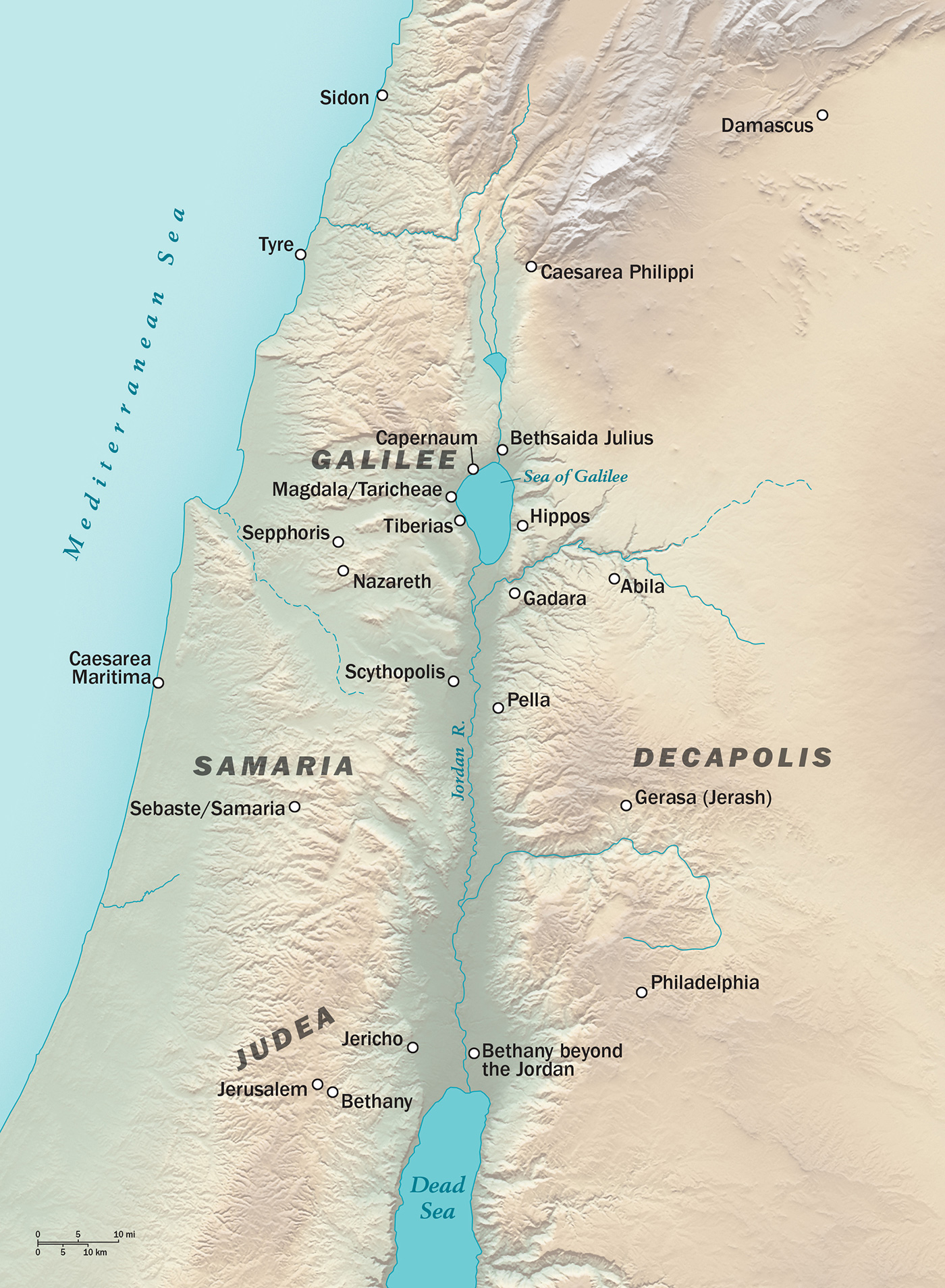
Key Sites of Jesus’s Ministry
Theological Themes
God’s reign (the kingdom of God) as theological centerpiece. Studying a Gospel’s theology involves exploring the author’s presentation of God’s person and activity, which in Matthew focuses on the kingdom of God (Matthew’s “kingdom of heaven”; see 4:17–25). A key assumption in Matthew is that Israel’s God has promised to restore them in faithfulness to covenant promises. God’s rule will be fully established in this world when God comes to bring restoration (e.g., Is 52:1–10). A central affirmation in Matthew is that Jesus, the Davidic Messiah, inaugurates God’s reign, as God’s chosen king and Lord (28:18) and the manifestation of God with us (1:23; 28:20). Matthew also develops the kingdom theme by reference to Isaiah’s motif of exile/return (e.g., Is 40:1–9; cf. Mt 3:3). Jesus is portrayed as the one who both makes possible and enacts Israel’s return from exile.
An “already / not yet” eschatology characterizes Matthew’s kingdom theology. God has inaugurated the kingdom in Jesus, the Messiah-King; yet the consummation of God’s reign is future, at “the end of the age” (a phrase Matthew uses; cf. 13:39, 40, 49; 24:3; 28:20). In line with the “not yet,” Jesus’s teaching highlights the present hidden nature of the kingdom, so that divine revelation and human faith are needed to perceive it (chap. 13). The hiddenness of the kingdom arises partly from the paradoxical way Jesus comes to be king—not through assertion of power but by willing and missional self-sacrifice (27:27–50). Yet Jesus’s cross-shaped mission is authenticated and vindicated by his resurrection, when God grants Jesus all authority (28:18), showing him to be God’s faithful and favored Son (3:17; 17:5).
In OT prophetic expectation, God’s reign and Israel’s restoration would coincide with Gentile ingathering (e.g., Mc 4:1–2; Is 25:1–12). Matthew emphasizes this aspect of God’s kingdom throughout his narrative, beginning by highlighting Gentiles in Jesus’s genealogy (1:3, 5–6) and concluding with Jesus’s mission to all nations (28:19; see also 2:1; 4:15; 8:5–13; 15:21–28; 21:43; 24:14; cf. 10:5–6; 15:24). God’s plan that Abraham’s family would be a blessing to the earth’s peoples (Gn 12:3) comes to fruition as Jesus inaugurates the kingdom.
Christology. Matthew’s portrait of Jesus is multifaceted and informed by various christological titles, Jesus’s actions in the plot (e.g., healings; cf. 11:2–5), and key OT story lines and texts tied to his identity. Four (overlapping) categories that will emerge in this commentary are sketched here: Jesus as Davidic Messiah who inaugurates the kingdom, as representative of Israel, as the embodiment of Yahweh in Israel’s restoration, and as fulfiller of the Scriptures.
Matthew consistently portrays Jesus as Davidic Messiah, emphasizing his royal identity (1:1; 2:5–6; 21:1–11). Though first-century messianic views were numerous and varied, the royal connotations of Davidic association would have been commonplace (cf. “Son of David” title in 9:27; 12:23; 15:22; 20:30, 31; 21:9, 15; 22:42). This association coheres with Matthew’s theological emphasis on God’s kingdom begun in Jesus, the royal Messiah. Yet Matthew also expands this category as Jesus speaks and enacts God’s reign in ways that move outside Jewish messianic expectations, especially as he enacts the role of servant of the Lord from Isaiah (cf. Is 42:1–4 cited in Mt 12:18–21; Is 53:4 cited in Mt 8:17; also likely allusions to Is 53 at Mt 20:28 and 26:28). For Matthew, Isaiah’s portrait of the servant, who willingly takes on suffering to bring justice and mercy to Israel and the nations, describes Jesus (though not in first-century Jewish expectations, since Isaiah’s Suffering Servant was understood as referring to Israel, not the Messiah; e.g., Is 44:1).
Another messianic title Matthew uses is “Son of God” (e.g., 14:33; 16:16), easily heard by modern ears as a divine title. Yet the clearest OT examples of those called “son” by God are Israel (e.g., Ex 4:22; Hs 11:1) and Israel’s kings (2 Sm 7:14; Ps 2:1–12). Therefore, the term “Son of God” has messianic connotations. In addition to evoking Jesus’s role as Israel’s representative (see below), Matthew uses the phrase as an alternate way to designate Jesus as Messiah (cf. 16:16; 26:63; alternate to “King” in 27:41–44), although with emphasis on Jesus’s intimacy with the Father (e.g., 3:17; 11:25–27; 17:5).
Matthew highlights Jesus as the faithful representative of Israel in identity and mission, especially in chapters 1–4. Just as God brought Israel out of Egypt, God does the same for Jesus and his family (2:15, 19–21). In contrast to Israel’s disobedience when tempted in the wilderness, Jesus proves his faithfulness to God when facing the same temptations (4:1–11) and demonstrates the covenant loyalty that God requires of Israel (compare 3:17 with Is 42:1–4; see also Matthew’s use of Ps 22 in Mt 27:27–50). Jesus’s faithfulness even to death is vindicated by God in the resurrection, again at the temple’s destruction in AD 70 as Jesus predicts, and finally at “the end of the age,” when Jesus will judge all humanity. Matthew highlights vindication by repeated evocation of Dn 7:13–14, which pictures a vindicated “son of man” approaching God’s throne and receiving all authority (see 10:23; 16:27–28; 24:30–31; 26:64; see also 25:31 and 28:18). In Daniel’s vision explained, it is “the holy ones of the Most High” (i.e., Israel’s faithful) who are represented by the son of man (cf. Dn 7:18, 22, 27), so that Matthew’s use of this vision connects the vindication of Jesus’s faithfulness to his role as Israel’s representative. Matthew’s use of “Son of Man” is always a self-designation by Jesus. In many cases, it seems to be just that: a way that Jesus refers to himself, possibly in solidarity with Israel (see God’s frequent reference to Ezekiel as “son of man,” e.g., Ezk 2:1). Yet when “Son of Man” occurs in allusions/citations to Dn 7:13–14, Matthew means to communicate Jesus’s vindication to a position of universal authority.
A central christological affirmation implicit but crucial to Matthew’s story is Jesus as the embodiment of Yahweh (Israel’s God; cf. Ex 3:14–15). For Matthew, Jesus enacts Israel’s redemption (1:21), fulfilling God’s promises that God will bring redemption. For example, Matthew affirms Jesus as “the Lord” for whom John prepares the way, citing Isaiah’s prophecy that the Lord (“LORD” translates the divine name Yahweh; Is 40:3) will return to Zion (Mt 3:3; Is 40:1–5), connecting Jesus intimately with Yahweh’s mission and even identity (cf. Mt 22:41–46). Jesus is also granted the role of universal Lord and judge, a role reserved in the OT Scriptures for God alone (11:27; 25:31; esp. 28:18; cf. Dn 7:13–14). Jesus’s lordship implicitly affirms Jesus’s inclusion in the one divine identity. Appropriate to Jesus’s lordship, Matthew portrays characters worshiping Jesus. Matthew highlights worship of Jesus by beginning and ending with it (the Magi in 2:2, 11; Jesus’s followers in 28:9, 17).
A final christological category Matthew emphasizes is Jesus as fulfiller of the Scriptures. This category arches over the others, since, according to Matthew, the covenant and promises of God find their fulfillment in Jesus (with “the Law and the Prophets” referring to the OT Scriptures at 7:12 and 22:40; cf. 5:17; 11:13). Matthew highlights this category with his many OT citations and allusions and his affirmation of Jesus’s obedience to God’s will (see above; also 12:12). Yet Matthew focuses particular attention on Jesus’s relationship to the Jewish law (Hb torah). Jesus is shown to fulfill rather than abolish the law (the torah) by interpreting and teaching it rightly (5:17, with 5:21–48), because Jesus interprets the torah by its central qualities of mercy, justice, love, and faithfulness (9:13; 12:7; 22:24–40; 23:23). In this way, Jesus’s torah interpretation is not burdensome (11:28–30), like some teaching he critiques (23:4). Yet Matthew’s Jesus also embodies the torah by virtue of his messianic authority (e.g., 7:29; 11:25–30). It is Jesus’s teaching (on the Law and the Prophets) that is authoritative for his followers (28:19).
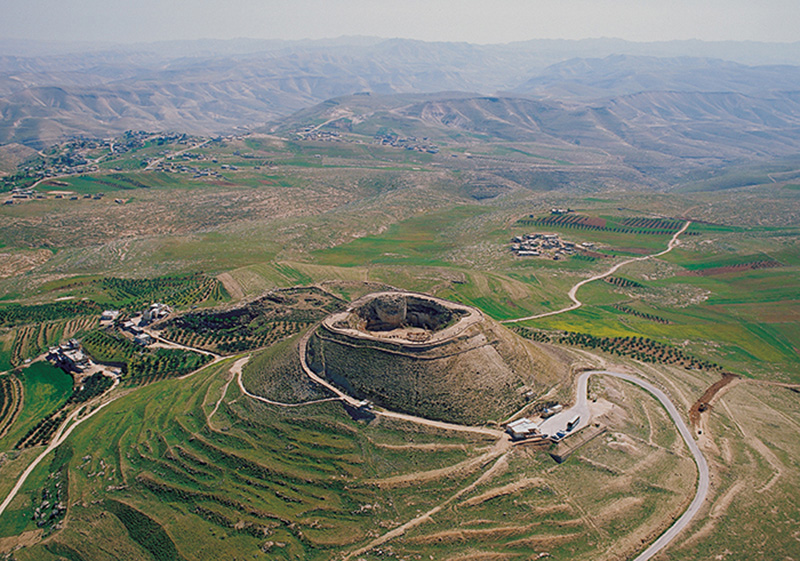
The remains of the Herodium, the fortress Herod the Great built near Bethlehem.
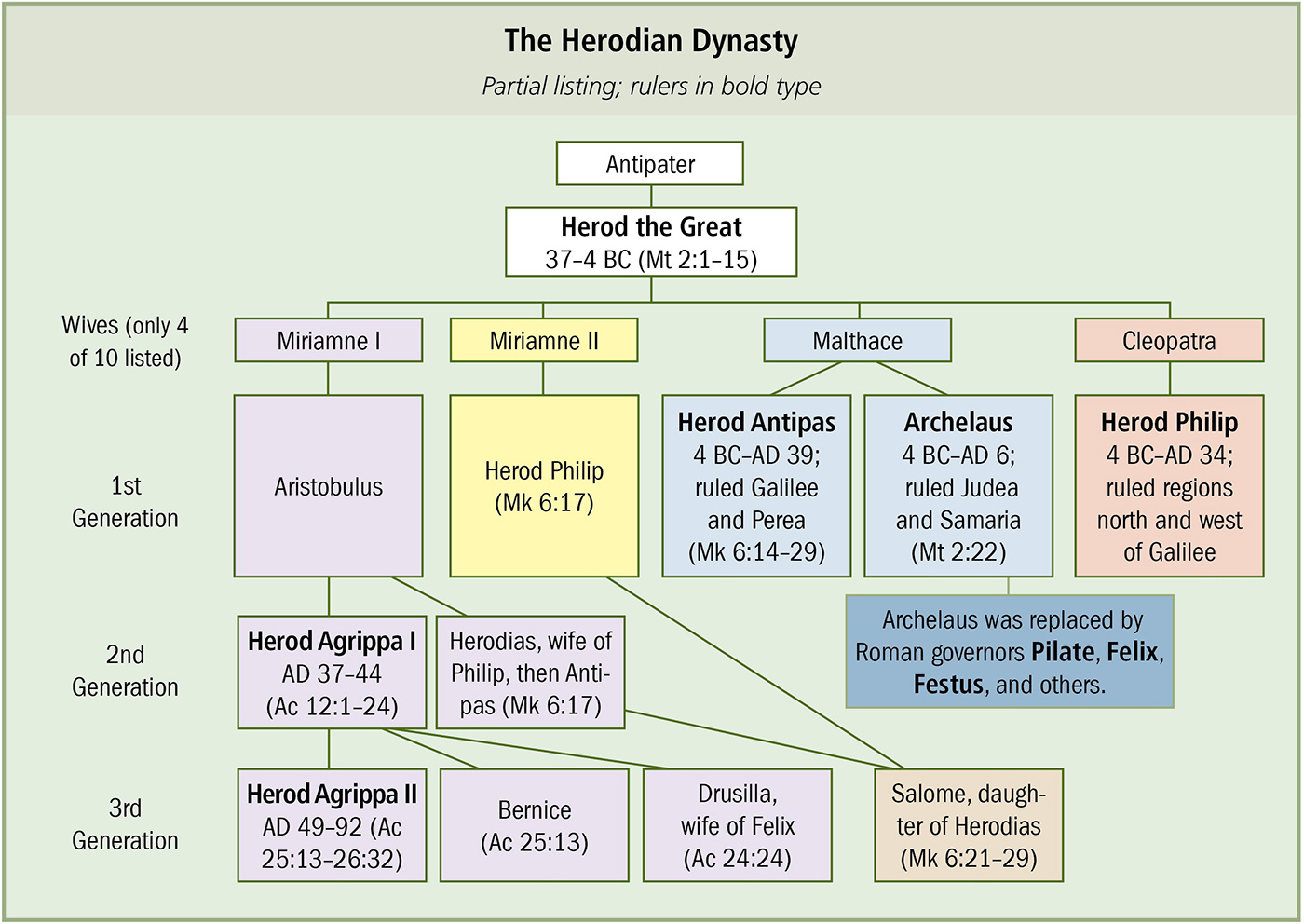
Structure
While scholars debate Matthew’s overarching structure, it is not for lack of discernible structural clues, which are abundant. The twofold “From then on Jesus began to [preach/point out] . . .” at 4:17 and 16:21 signals major turning points in Matthew’s plot. Second, each of the five major blocks of Jesus’s teaching concludes with the formulaic “When Jesus had finished . . .” (7:28–29; 11:1; 13:53; 19:1; 26:1), transitioning between Jesus’s teaching and the subsequent story. Other structural signs include use of inclusio (a bookending device; cf. 4:23 // 9:35; 1:23 // 28:20) and a preference for groupings of three (e.g., 8:1–9:34—nine miracle stories in three groupings of three; 21:28–22:14—three parables).
Outline
1. Jesus’s Identity and Preparation for Ministry (1:1–4:16)
A. Birth and Infancy (1:1–2:23)
B. Baptism and Temptation (3:1–4:16)
2. Jesus’s Announcement of the Kingdom to Israel and Resulting Responses (4:17–16:20)
A. Proclamation of the Kingdom in Word and Action (4:17–11:1)
B. Rejection by Leaders and Jesus’s Withdrawal from Conflict (11:2–16:20)
3. Jesus to Jerusalem: Kingdom Enactment through Death and Resurrection (16:21–28:20)
A. Journey to the Cross and Teaching on Discipleship (16:21–20:28)
B. Final Proclamation, Confrontation, and Judgment in Jerusalem (20:29–25:46)
C. Jesus’s Execution by Rome and Resurrection/Vindication by God (26:1–28:20)