Introduction
Overview
The situation or crisis in the Galatian churches involves three key players: the apostle Paul, the false teachers, and the Galatian Christians. When Paul first preached the gospel of Christ crucified to the Galatians, they not only accepted him (4:13–15) but also believed his message and received the Holy Spirit, a sign of God’s blessing (3:1–5; 4:6–7). But soon after Paul planted the churches in Galatia, false teachers arrived and began to demand that these new Gentile Christians be circumcised (5:2–4; 6:12–13) and perform other religious requirements (4:9–10) to obtain full Christian status. The false teachers probably appealed to the example of Abraham as well as to the authority of the Jerusalem apostles. Many scholars refer to this movement as Judaizing.
It is not completely clear who these agitators or opponents were, but Paul’s letter does indicate some of their activities. They are twisting the true gospel into a false gospel out of selfish motives (1:7–9; 4:17; 5:4, 8–9; 6:12–13). They are disturbing and troubling the Galatian Christians by hindering their obedience of the truth (1:7; 3:1; 5:7, 10, 12). They are advocating observance of the law and circumcision for Gentile Christians, although they fail to keep the law themselves (6:12–13). Finally, they are driving a wedge between Paul and the Galatian Christians (4:16–17; 6:17).
We should remember Paul is primarily in dialogue with the Galatian Christians rather than with his opponents. The false teachers’ persuasive message must have been very attractive to the Galatians. The commitment to Christ with which they had begun the Christian life was being viewed as insufficient and supplemented with “works of the law” (3:3). This shift in focus was causing divisions in their churches (5:15) and was pushing them away from their father in the faith (4:16). These Gentile Christians were being told that to be fully Christian, they had to become like Jews. Paul tries to deal with this crisis by treating the underlying theological issue—What makes a person fully Christian?
An important question in early Christianity was how Gentile Christians were supposed to relate to the law. Galatians helps to answer that question.
Authorship
The vast majority of scholarly opinion has affirmed the apostle Paul as the author of the Letter to the Galatians. The characteristic opening line, which identifies his name and apostolic claim, the personal final greeting, and the theological focus all point to the historical Paul. Only a few scholars, mostly in the nineteenth century, have questioned this rather universal acceptance through two millennia of church tradition.
The majority of the letter was likely generated through the process of dictation to an amanuensis (secretary), as was common in first-century letter writing of this size and importance. The appearance of two unfinished sentences in 2:6 gives further credence to this view, while also displaying the emotional intensity of the words there. His reference to the “large letters” he writes “in my own handwriting” (6:11) points to where Paul personally took up the pen to provide his authenticating mark and final exhortations.
Occasion, Purpose, and Destination
While broad agreements exist on many of these questions, there are few more difficult issues for the student of the NT than those associated with fitting the actual writing of Galatians (and indeed many of Paul’s Letters) into the historical outline supplied by the book of Acts. The occasion (the reasons why a letter was written when it was) and the purpose (what Paul sought to accomplish) of each letter are crucial components for proper interpretation of a letter’s meaning. We need to navigate through some of the discussion surrounding these issues before the reader can sufficiently weigh the evidence regarding the historical context of Galatians.
The difficulties begin even with the name of the epistle and the people Paul intends to address. The term “Galatia” referred to one of the Roman provinces of Asia Minor (modern-day Turkey). This province cut in a north–south direction across the middle of the peninsula, encompassing a number of diverse peoples, cultures, and languages.
Beyond reference to the territory, however, the term “Galatian” could be used to designate certain groups of ethnic people within that province. These people would be the descendants of the ancient Gauls, likely a barbaric tribal group from northwestern Europe. They settled in the northern part of the territory that would subsequently bear their name around 278 BC. The ancient cities of Ancyra (Ankara, the modern Turkish capital), Tavium, and Pessinus would be associated with the areas settled by the ethnic Gauls prior to, and at the time of, this letter. Once conquered by the Romans (189 BC), this land, as well as more southern areas, was incorporated under the provincial name of Galatia.
Thus, when Paul uses the term “Galatians” (especially in a derogatory way in Gl 3:1), it is difficult to know whether he has a provincial or ethnic designation in mind. Those who have attempted to answer this question often use their position as a starting point to adopt a view on the destination of the letter, usually calling it either a “northern Galatian” or a “southern Galatian” theory.
These theories are based on the premise that Galatians was written to a group Paul visited and among whom he also founded a church during one of his missionary journeys recorded in the book of Acts. The decision one makes regarding the destination of the letter governs one’s view of its date and, possibly, its purpose.
If Paul used the term “Galatia” to designate the Roman province, the first missionary journey recorded for Paul and Barnabas in Acts would likely be the time when he initially made contact with these Galatian people. This aligns with the southern Galatian theory. The destination of the letter is believed, then, to be the churches at Pisidian Antioch, Iconium, Lystra, and Derbe (Ac 13–14). Such a position allows for (but does not necessitate) Galatians to be one of the earliest written, if not the very first, of Paul’s Letters.
The alternative, northern Galatian theory is now not generally as popular as the southern theory. Those who hold this position believe Paul would not refer to the church members of the south as “Galatians” if they were not racially associated with that tribe. The major difficulty of holding to this position is the lack of any specific mention in Acts of Paul’s travels in the northern part of the province. Paul could possibly have visited this area on one of his journeys from Antioch to Ephesus (Ac 16:6; 19:1). However, the passages in view make no mention of the founding of churches during any presumed time in these areas. Holding this view forces the date of the letter’s writing to a much later time period than that of the southern theory.
Certainty on this issue is impossible, but there are a number of reasons to favor the southern Galatian theory: (1) the churches of the south became important and strong communities in apostolic times, though we know nothing about any northern churches (this would provide motivation for the preservation of the letter); (2) two of Paul’s major companions came from this area (Timothy and Gaius), and they appear to represent Galatia (1 Co 16) in the collection taken for Jerusalem; (3) Gl 4:13 may well imply more than one visit by Paul to these churches, a fact verified by the book of Acts (Ac 13–14; 16); (4) the repeated mention of Banabas without further elaboration seems to suppose acquaintance with him—we know that Barnabas accompanied Paul to the cities in the south during the first missionary journey.
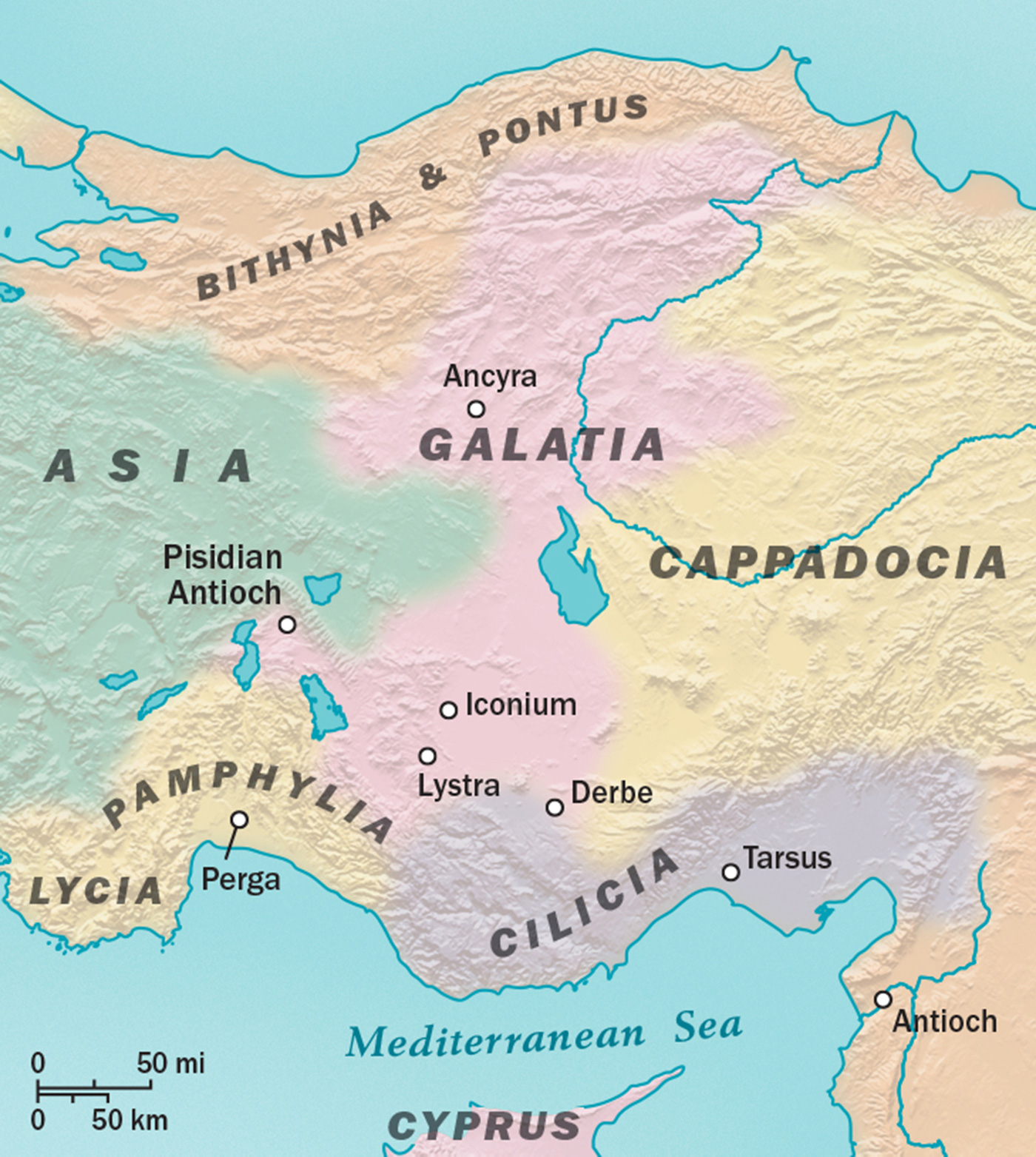
The Region of Galatia
Paul traveled in the southern part of Galatia on all three of his missionary journeys.
Date
A further major difficulty in harmonizing this letter with the book of Acts is Paul’s description of his contact with the church in Jerusalem and its leadership in the first section of the letter. While Paul records two visits to the city after his conversion experience, Acts records three.
Most scholars agree that Paul’s first postconversion visit (Gl 1:18) is identical to the visit mentioned in Ac 9:26. Difficulties arise as to the alignment of the visit described in Gl 2:1 with either Ac 11:30 or Ac 15:1–4. The decision made on this issue brings with it some major implications for the determination of date, occasion, and destination of the letter.
The proposal that Ac 11 corresponds to Gl 2 appears most natural, since the book of Acts records one more visit than does Paul. It would seem likely, then, that Galatians was written after the second and prior to the third visit recorded in Acts.
This alignment is strengthened by the basic apologetic nature of the early chapters of Galatians. Principally the argument is that Paul, in defending his independent and equal apostolic status compared to that of the apostles in Jerusalem, must report on any and all interactions he has had with the church at Jerusalem.
Under this scheme, Galatians would have been written very early in Paul’s ministry, at least before the Jerusalem Council of Ac 15 (AD 49–50), and very close to his return from the first missionary journey (Ac 13–14). This view helps place in perspective his surprise at his readers’ desertion from the gospel “so quickly” (1:6), since he would have been through the region of Galatia in the very recent past.
The evidence, however, seems to favor a different alignment. There is a noticeable similarity of style, vocabulary choice, theological development, and, most important, the type of opposition faced by Paul in this letter with that found in his letter to the Romans and the Corinthian correspondence. Thus, many scholars have made a strong case that Galatians belongs to the same time frame as do these others (AD 54–56). This would place the writing of Galatians after the Jerusalem Council.
The decision on this matter turns on how much it is believed Paul would have felt it unnecessary to mention the famine relief visit of Ac 11 in recounting his past contact with Jerusalem. Scholars are divided as to how crucial it would be to Paul’s credibility if he did not mention every visit to Jerusalem.
This criticism is mitigated by pointing to Paul’s main purpose in recounting his visits to Jerusalem. It may not have been to cite every visit to the city but rather to indicate those occasions upon which he personally met with the main apostles in Jerusalem. Since the question at issue was how much he relied on their permission for his work, recounting a visit where he did not encounter the leaders there would be unnecessary. Thus, he would not need to mention the famine relief visit of Ac 11:30 since he apparently met with no apostles during his time there.
When all is considered, the alignment of Gl 2 with Ac 15 appears to have more strength, and that is the position adopted here.
Opponents
Throughout the letter, Paul makes reference to a group of opponents to his work in Galatia. Over the years, scholars have often used the term “Judaizers” to describe a group of conservative Jewish Christians who mandated that a Gentile must first obey the precepts of Judaism, particularly symbolized by submission to the rite of circumcision, prior to being accepted as a full member of the people of God.
The conflict Paul had with these opponents represents a pivotal point in the history of the early Christian movement theologically as well as ecclesiastically. The outcome would determine whether the faith would retain the identity marks of orthodox Judaism or, as Jesus himself seemed to command (Mt 28:19), would be made available to all of humankind with equal accessibility.
Both Paul’s Letters and the book of Acts evidence a considerable difference of opinion among the Jewish members of the early Christian movement as to how to integrate the numbers of Gentiles who seemed attracted to the faith. This difference reflected a long-standing animosity between the Jewish and Gentile communities of the ancient world.
A principal issue of distinction between these believers was the practice of circumcision. This rite, performed on every male Jew shortly after birth, was seen to be both a loathsome rite for adult Gentile converts to follow and a culturally disdained practice in the Hellenistic world. It also had an implied retention of male privilege in the new community (cf. Gl 3:28). Perhaps because it revealed a strong measure of commitment, many Jewish followers in the early church were adamant about its continued practice for all those who followed Christ. While they recognized that the message of Jesus was not universally accepted among their own people, they did not consider the Christian movement to be outside of Judaism.
Thus, the Letter to the Galatians represents the collision of those two ideologies. We gain from the Pauline perspective an appreciation of the issues (as well as the personalities) involved. We also gain an understanding of the viewpoint that eventually won the day and went on to characterize the Christian church.
Theological Themes
Common to all the Pauline Letters is the fact that Paul is first and foremost a “task theologian.” His letters are primarily written to address certain concerns that were troubling the church(es) involved. Thus, we look in vain for any full systematic treatment of theological issues. Rather, we usually hear Paul give only as much theological material as is needed to correct a crisis situation or to maintain a church’s resolve until he can personally be on the scene.
This is quite evident when we look at Galatians, as he seems to touch on those issues at stake in the Judaizer controversy and little else. Yet what we can glean from the letter is the overall sense of how Paul emphasized the completely new reality inaugurated for each believer as he or she accepted Jesus Christ as the risen Lord and Savior.
Permeating the incredulity that Paul has at the behavior of the Galatians, who seem willing to submit to the circumcision “party,” is the sense that they have missed the most important aspect of their new life of following Christ. Whereas formerly, as Gentiles, they were often considered to be outside the realm of God’s covenant promises, they have now been, through God’s great initiative in Christ, fully embraced into the fullness of that covenant. The Galatians have been included in the reality that Judaism has longed for: life in the Spirit. This new reality was of a nature so superior to everything that had gone before that it completely changed all social and religious categories used to value human persons. The basis for acceptance before God was found not in ethnic, sexual, or social status but in an individual’s possession of God’s Holy Spirit.
Paul’s advocacy of this new reality strikes at the very heart of established Judaism’s exclusivity. Paul portrays the Mosaic law (and its traditional interpretations) as the guardian against human immorality. It is the tutor that has pointed toward the holiness of God and preserved Israel for the coming of the Messiah. In the new reality found in Christ, the ethnic divisions that it has caused have been superseded by the appropriation of God’s own Spirit into the life of each person aligned with Christ. Thus, rather than humans standing as “outsiders” to God’s will and ways, the new reality has brought humankind into an “insider” position, where the Spirit interacts directly with each person’s own heart. In response to this new reality, followers are to “keep in step with the Spirit” (5:25) while they also continually “examine” themselves (6:4) as to the constancy of their walk by comparing their actions and attitudes with both the “fruit of the Spirit” (5:22) and the “works of the flesh” (5:19). Bearing spiritual “fruit,” not circumcising the flesh, has now become the tangible sign of one’s inclusion into this new reality of God’s kingdom.
Galatians, most likely written in the same time frame as 2 Corinthians, gives further explanation to that letter’s great proclamation in 5:17: “If anyone is in Christ, he is a new creation; the old has passed away, and see, the new has come!”
Outline
1. Introduction (1:1–10)
A. Salutation (1:1–5)
B. Occasion for Writing (1:6–9)
C. Review of Accusations (1:10)
2. Paul and the Nature of His Apostleship (1:11–2:21)
A. Preconversion Days (1:11–14)
B. Conversion (1:15–17)
C. First Meeting with Jerusalem Leadership (1:18–24)
D. Second Meeting with Jerusalem Leadership (2:1–10)
E. Correcting Cephas (2:11–21)
3. Treatise: The Efficacy of Grace over Law (3:1–4:7)
A. The Argument from Experience (3:1–5)
B. The Argument from Scripture (3:6–18)
C. The Purpose of the Law (3:19–25)
D. The Results of Faith (3:26–29)
E. Maturing into Sonship (4:1–7)
4. An Appeal to the Galatians (4:8–31)
A. An Appeal to Maturity (4:8–11)
B. An Appeal to Their Personal Relationship (4:12–20)
C. An Allegorical Appeal (4:21–31)
5. Freedom in Christ (5:1–6:10)
A. Thesis (5:1)
B. Warnings and Reproof (5:2–12)
C. Proof of One’s Grounding (5:13–26)
D. Practical Ethics (6:1–10)
6. Conclusion with Personal Appeal (6:11–18)