Introduction
Overview
In Colossians, Paul emphasizes that Christ is supreme over all other spiritual powers and is sufficient for the Colossian Christians. A false knowledge of Christ must be countered by a full knowledge of Christ. The many qualities of Christ described in 1:15–22; 2:3, 8–10, 15, 17; and 3:1 stand in contrast to particular aspects of the false philosophy that Paul opposes.
Destination, Audience, and Major Themes
Located strategically in the Lycus Valley near the Meander River in western Anatolia (modern Turkey), Colossae facilitated trade with its two larger neighbors, Laodicea and Hierapolis. Though the city had seen grander days, in the first century AD it lived in the shadow of its nearby rivals. The wealth of Laodicea and Hierapolis no doubt helped the Colossian economy, which continued to be known for its wool industry. The prosperity of all three cities was severely shaken with a major earthquake in AD 60/61. Laodicea rebuilt itself without help from Rome. Perhaps Colossae also regained some of its earlier strength, but evidence is sparse, and no excavations have been done of the city.
Even before Colossae was stirred up by the earthquake, not all was calm within the city’s young Christian community. The church was not in imminent danger of casting off their faith, but the situation was sufficiently worrisome that Paul dispatched a letter to address the brewing unrest. What exactly was the trouble? Paul’s letter reveals growing tensions caused by what he calls an errant “philosophy” (Col 2:8). The term “philosophy” calls to modern minds ivory-tower ruminations about abstract theoretical principles. In the first century, however, philosophy was closely coupled with ethics; it promoted rational thought over superstitions and carried positive connotations of an educated person and a well-run society. The term’s use in Colossians probably carries the ironic sense that though its adherents see it as wisdom, Paul discounts it as mere human musing.
There are many parallels between Ephesians and Colossians, suggesting that they were written close to the same time or that they are interdependent in some way.
Paul warns the mostly Gentile church against the individualism underpinning this philosophy, which focuses on visions and asceticism and is rooted in their particular application of the law of Moses. Paul emphasizes two points: first, being in Christ means being in a community of which Christ is the head; and second, living in this community does not include, for Gentiles, following Jewish ritual practices or esoteric pursuits, such as a quest for visions.
Purpose and Content
The authorship and date of Colossians are both hotly contested and tied tightly to questions about the philosophy. Therefore, before we can address authorship questions, we must discover why the letter was written and what was involved in the philosophy.
One theory about the philosophy Paul refers to is that it was a syncretistic movement that drew on folk religious beliefs and magic, as well as conventional Jewish thinking and practices, as a way to confront the supernatural powers controlling the world. In this view, the philosophy had not abandoned monotheism but lined up with certain pagan assessments about how to control the forces of nature and fate. In this view, the promoters of the philosophy came from within the church and were most likely Gentile, although a few might have been Jewish. They did not teach a different gospel as much as fail to give Christ his due. They focused on the present dangers created by spiritual forces and local gods and looked to angels for protection. The philosophy sought security in visions that served as initiation into a full Christian life.
However, many scholars are unconvinced by the syncretistic explanation. Some of the characteristics labeled as pagan, such as the interest in food and drink and religious festivals (2:16), could easily fit with Jewish practices. The syncretistic theory fails to adequately account for the references to circumcision (2:11, 13; 3:11) and the written code (2:14).
At the same time, while a few characteristics of the philosophy clearly speak of Judaism—for example, the mention of Sabbath (2:16)—other characteristics sound ambiguous. A primary question is whether Paul, or any Jew, would describe the law as part of the powers and principalities (2:20), as human tradition and “empty deceit” (2:8). Perhaps more disturbing is the possible link made between the law and the basic principles of this world, or stoicheia (Col 2:8, 20). Interestingly, in both Galatians and Colossians, the stoicheia are mentioned next to comments about the attraction of special Jewish observances and festivals and interest in angels (Gl 3:19; Col 2:18). This intimates a common thought trajectory behind both the Galatian Judaizers and the Colossian philosophers.
Much of this discussion hinges on a historical situation that included Gentile-Jewish interaction. Asia Minor incorporated large numbers of Jews, such as the Jews from Asia and Phrygia who traveled to Jerusalem for Pentecost (Ac 2:9–10) and Philip the apostle (or evangelist; Ac 21:8–9) and his virgin daughters, who settled in Hierapolis. Is a robust, confident, and self-assured Jewish community the target of the letter’s argument?
It seems the philosophy is best understood as a Christian group emphasizing that Gentiles must fulfill the Jewish law (i.e., be circumcised) to be full members of the community. The philosophy’s particular slant on obedience to the law included an ascetic component, with an interest in visions. To combat the philosophy, the Letter to the Colossians elevates Christ by speaking of creation, including all powers and authorities, as coming through the Son (1:16). The same language is used to describe the Colossians’ previous status as being uncircumcised and dead in their flesh but made alive when Christ on the cross “disarmed the rulers and authorities” (2:13–15). At some level, then, these powers and authorities are connected to or synonyms for the Jewish law. [Stoicheia (“Elements”) in the New Testament]
Authorship
Colossians announces its author as the apostle Paul (and Timothy; 1:1), but recent scholarship has called that into question. Many scholars conclude that the differing cadence, style, and language add up to a literary style that may imitate Paul. Here we see not the varying hand of the secretary but the deeper evidence of (unconscious) authorial mannerisms in speech and thought patterns. If it were only at the literary level, however, many scholars would probably explain the unique qualities as a more developed Paul, a different secretary, or the influence of Timothy. But the differences extend to theological categories, which are said to stand at odds with Paul’s undisputed letters. For example, the Christology found in 1:15–20 and 2:9–10 is argued to be more fully developed than what would be expected in the first-generation church. Likewise, the ecclesiology seems further along the historical trajectory of the early church than what would be current in Paul’s time. Moreover, some argue that standard Pauline topics are missing. For example, in the vision of the church there is no mention of the Spirit (as in Gl 5), guiding and empowering believers in their lives of holiness. Absent is the eschatological stress on the future; instead, a strong realized eschatology permeates the letter. No mention is made of justification, the bedrock of Paul’s thought.
Finally, Colossians is remarkably similar to Ephesians, a letter many scholars consider post-Pauline. Some argue that Colossians served as a template for Ephesians, but even so, the fact that Colossians was used calls its own status as Pauline into question. That is, Colossians was appealing as a model for Ephesians precisely because it represented a step beyond the authentic Paul and could be a guide for how to interpret and configure Paul for the next generation of readers. Timothy has been put forward as a possible author. Complicating matters are the connections between Colossians and Philemon, a letter that most regard as genuinely Pauline.
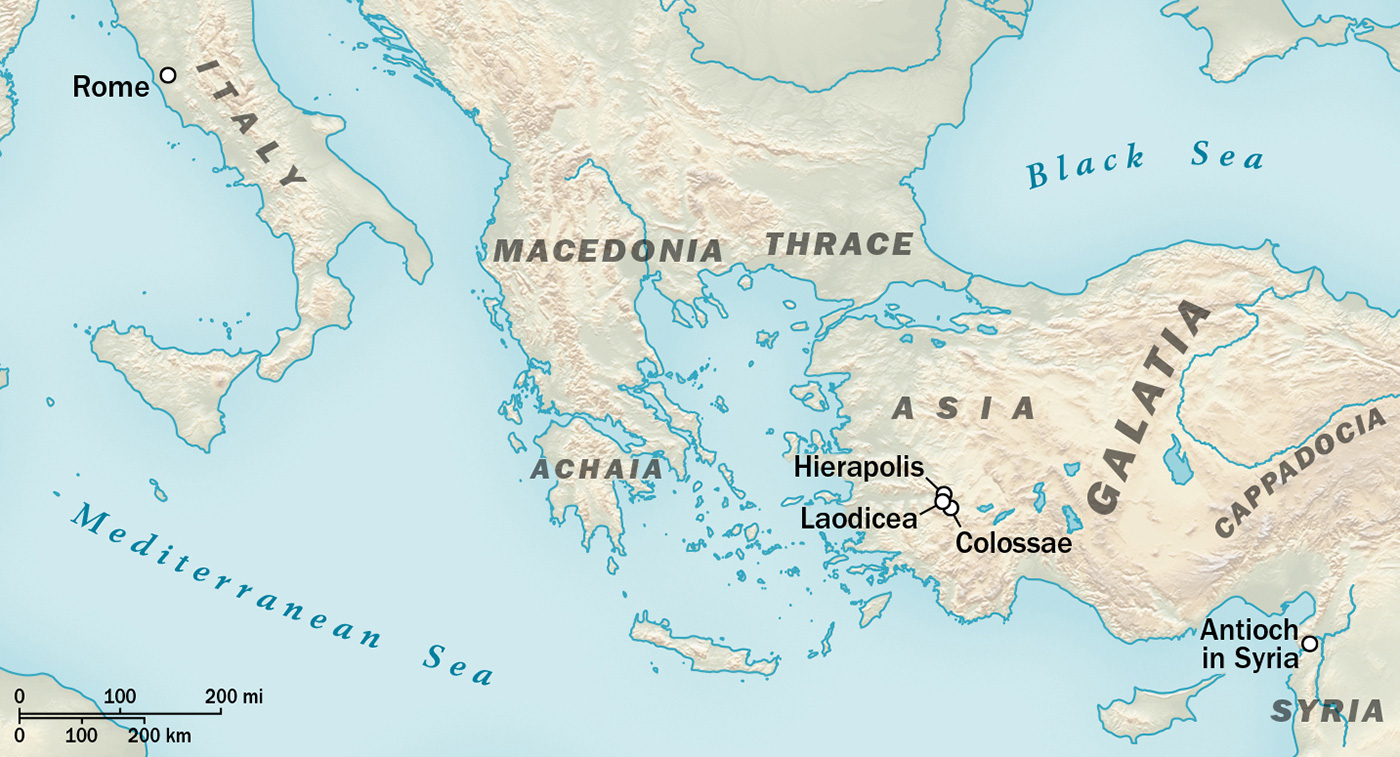
The Location of Colossae
A growing number of scholars are dissatisfied with this debate. They argue that the style, sentence structure, and theological outlook could well fit the range of Paul’s expressions. While the tone of the letter is softer and less direct, this is due to Paul’s “outsider” role; though Epaphras established the church directly, Paul felt an oversight responsibility toward the Colossian congregation because Epaphras was part of Paul’s team. Again, the letter’s structure matches what is found in the undisputed Pauline Letters.
Those who believe Paul authored Colossians claim that theological differences are overstated. As is characteristic of Pauline authorship, allusions to the OT abound (such as the “exodus” described in 1:12–13). Other Pauline themes appear. The church is presented as the people of God and the body of Christ (cf. 1 Co 12). Suffering is promoted as a key component of the Christian’s life (1:24; cf. 2 Co 1:3–11; 4:7–18; Rm 8:17–25). The cross, which is central to Paul’s thought, is emphasized in Col 1:20 and 2:14 (cf. 1 Co 1:17–18; Rm 6:6; Gl 2:20). The charge that Colossians expresses only realized eschatology also falls short of the mark. Colossians makes clear that future glory awaits the Christian when Christ appears (3:4). Central to Paul’s thought is the unity of Gentiles with Jews as the new people of God, inaugurating the new age of the Spirit (Col 1:8, 20, 27; cf. Gl 3:28; 1 Co 12:13; Php 1:27–28).
The personal material of 4:7–17 also is hard to explain in any other way than that Paul wrote it. The section contains not detached personal details but an intimate narrative suggesting direct and personal knowledge of the Colossians. One can hardly imagine any church receiving this letter in AD 70 or 75 being impressed with this level of personal detail, knowing all the while that Paul has been dead for a decade or so.
Two figures play an important role in this discussion: Philemon and Onesimus. Most scholars note the significant overlap between Colossians and Philemon. Both letters are sent from prison and claim to be from Paul and Timothy. Both contain an almost identical list of people, including three who traveled with Paul to Jerusalem before his arrest—Aristarchus, Timothy, and Mark—as well as Onesimus, Luke, Demas, and Epaphras (the founder of the Colossian church). Ironically, however, Philemon himself is not mentioned in Colossians. This seems odd if (as some suggest) the Letter to Philemon was used as a template for Colossians by a later imitator of Paul. Why not then mention Philemon? Why use such a short, personal letter as a template at all? The most reasonable explanation of the data is that Paul authored the letter.
Date
Of course, dating the letter depends on one’s decision about authorship. We have an added factor to consider when dating this epistle: Colossians is part of a group of four letters from Paul called the “prison epistles” because all refer to Paul as a prisoner of Jesus Christ (Php 1:12–14 describes in detail his imprisonment by the imperial guard). Scholars suggest three primary imprisonments as possible places and times for Paul’s communications. While it is possible that Paul wrote these four letters while languishing at Caesarea (see Ac 24:27), most scholars suggest either Ephesus (an Ephesus setting for composing the epistle would date the letter to the early 50s) or Rome as the most likely site.
Evidence pointing to a Roman imprisonment includes the direct documentation in Ac 28:13–31; we can be certain that Paul did indeed suffer imprisonment in Rome toward the end of his ministry. Second, the nuanced and distinctive style of the letter is better explained as coming at the end rather than the middle of Paul’s ministry. This is especially relevant when taking into account Colossians’ similarity to Ephesians, for most date Ephesians to the end of Paul’s ministry, if not considering it post-Pauline. Paul’s imprisonment in Rome detailed at the end of Acts probably occurred in the early 60s, placing Colossians about this time. But we can be even more specific. In AD 60–61, when the nearby cities of Laodicea and Hierapolis were destroyed by a severe earthquake, it is most likely that Colossae was also heavily damaged. Because Paul gives no hint in his letter of such devastation, we can assume that the calamity had yet to occur. Finally, in suggesting Colossians and Philemon were dispatched at the same time, we explain the fact that the Letter to Philemon does not mention Tychicus, while Colossians does not mention Philemon—both men were present to deliver the letters. Probably Onesimus left Rome with the Letter to Philemon in the company of Tychicus, who carried the Letter to the Colossians. Paul indicates that Tychicus and Onesimus traveled together (Col 4:9).
Outline
1. Greetings from Paul and Timothy to the Colossians (1:1–2)
2. Thanksgiving (1:3–12)
3. The Hymn to Christ (1:13–27)
A. The Father Rescues His People (1:13–14)
B. The Son Offers Reconciliation (1:15–20)
C. The Colossians Stand Firm in Faith and Hope (1:21–23)
D. The Example of Paul’s Suffering (1:24–27)
4. The Call to Christian Maturity (1:28–4:6)
A. Paul Contends for the Colossians (1:28–2:7)
B. Christ Is over Every Power and Authority (2:8–15)
C. Reject False Teachings (2:16–23)
D. Set Your Heart and Mind on Things Above (3:1–4:6)
5. Final Greetings (4:7–18)