Jonah
1. THE LORD’S FIRST COMMISSION AND JONAH’S DISOBEDIENCE (1:1–16)
A. The Lord’s first commission to Jonah (1:1–3). The Lord commands Jonah, “Get up! Go to the great city of Nineveh” (1:2), a command that recurs in Jonah’s second commissioning from God (3:1). Nineveh’s inhabitants were known for barbaric and cruel treatment of their captives, specifically those from Israel; consequently, Nineveh’s moral decline draws God’s attention. Other prophetic books describe Ninevites as arrogant and godless (Zph 2:13; Nah 3:19). Jonah’s refusal to travel there underscores Israel’s animosity toward Nineveh.
Jonah gets up and flees to Joppa, near Jerusalem (1:3). There he boards a ship headed to Tarshish, probably a seaport located on the west coast of the Mediterranean, in the opposite direction of Nineveh. Jonah seeks to escape God’s presence, despite his knowledge that God is all-knowing and everywhere. After God calls Jonah to “get up” (1:2), Jonah goes down to Joppa (1:2–3), goes down into the ship (1:5), and later goes down to the bottom of the sea (2:3, 6). Descent figuratively represents Jonah’s growing distance from the Lord.
B. The Lord’s response to Jonah’s refusal to obey (1:4–6). The Lord reveals his omnipresence through physical manifestations of his power. God throws a great wind toward the sea, rousting violent swells that threaten to capsize the ship of pagan sailors (1:4). The polytheistic sailors, perhaps acknowledging that the sudden storm represents the active displeasure of a sea god, call out each to his own god, and when those prayers do not yield tangible results, they hurl cargo from the ship to lighten the load (1:5a).
Meanwhile, Jonah’s absence is conspicuous. His obvious lack of concern for the ship’s predicament troubles the sailors. The captain confronts Jonah in the berth where he has gone down to rest and is sleeping deeply, beseeching him to “get up” and call on his God for rescue (1:5b–6). The man of God seems oblivious to the consequences of his disobedience, nor does he appear to feel responsibility for the sailors he has endangered.
C. The sailors’ response to crisis at sea (1:7–16). 1:7–10. The narrative never explicitly tells us that Jonah prays to the Lord for the sailors. Frightened by the worsening conditions, the sailors seek a resolution to their impending destruction through casting lots (1:7). God’s sovereignty is once again demonstrated, as the lots indicate Jonah is somehow responsible for the raging storm.
The sailors ask Jonah to identify his occupation, birthplace, and ethnicity (1:8). Jonah answers the question indirectly, first identifying himself as a Hebrew, then launching into a doxology praising the sovereignty of the Lord, the one God, dwelling in heaven, “who made the sea and the dry land” (1:9). The expression reinforces the Lord’s control over all creation. The sailors grow even more frightened at Jonah’s response, perhaps in light of Yahweh’s reputation among the nations as a fierce and wrathful God and because Jonah has already told them he is fleeing from the Lord’s presence (1:10).
1:11–16. The sailors demonstrate remarkable ethical and moral standards as they struggle to determine how to deal with Jonah’s disobedience and the Lord’s wrath. Jonah instructs the crew to hurl him into the sea, assuring certain death (1:12); however, the sailors do not want to risk intensifying the Lord’s anger by killing one of his people, and they make a final effort to wrestle the ship under their control (1:13). The narrative hints at the concept of human sacrifice as a means of appeasing the sea god and depicts the sailors as morally upright in seeking other alternatives. Finally, the men seek the Lord’s mercy by asking him not to hold them responsible for shedding innocent blood as they hurl Jonah into the sea (1:14–15).
Following the immediate calming of the sea, the sailors offer sacrifices and make vows to the Lord in gratitude and allegiance (1:16). Clearly, the placid sea demonstrates that Jonah’s disobedience caused the storm. It is uncertain whether the sailors’ actions constitute a genuine conversion to the one true God. The adverse circumstances of the crew may have prompted them to appeal to God temporarily, out of desperation and the threat of imminent death rather than from religious conviction. They also may simply be welcoming Yahweh into their pantheon of gods, since such a practice of acknowledging other gods was quite common in the ancient Near East.
When the Pharisees ask for a sign in Mt 12:38–41 (cf. Lk 11:29–32), Jesus tells them that the only sign they will get is “the sign of the prophet Jonah,” drawing an analogy between his own impending death and resurrection and the imprisonment of Jonah. Jonah’s salvation by a providentially provided creature typifies God’s provision of Christ as a means of salvation and depicts his resurrection from the dead.
2. THE LORD PROTECTS AND RESCUES JONAH (1:17–2:10)
A. The Lord’s provision of the fish (1:17–2:1). The Lord appoints a “great fish” or sea creature to swallow Jonah, in which Jonah remains alive for three days and nights (1:17). This is the first of only two occasions in which Jonah prays to God (2:1; cf. 4:2).
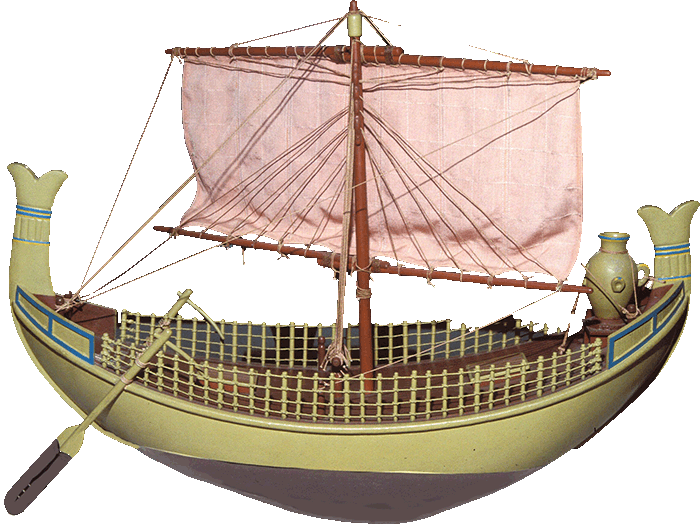
A model of a Canaanite merchant ship (ca. fourteenth century BC), which may be similar to the ship on which Jonah sails bound for Tarshish.
B. Jonah’s prayer for the Lord’s deliverance (2:2–9). Jonah’s prayer resembles the form of a typical thanksgiving psalm and is linked to several psalms through similar language and themes (e.g., Pss 18:4–6; 30; 34; 40:1–12; 52). Jonah’s psalm includes an introductory call (2:1–2), followed by a description of his former catastrophe (2:3–6), and concludes with gratitude to the Lord for his rescue from Sheol, or death (2:7–8). In response to his deliverance, Jonah promises to make sacrifices and fulfill a former vow (2:9).
Jonah calls out to the Lord from “deep inside Sheol,” a location normally associated with death (2:2), and observes that the gates of the earth restrain him (2:6). Several texts mention the “gates” of Sheol (Jb 17:16; 38:17; Ps 9:13; Is 38:10). The term designates a place of separation from God, yet Jonah’s poem affirms that God hears his prayer even from the foundations of the mountains and that he has been rescued by the Lord from “the Pit” (another synonym for death) (2:6).
Jonah’s submersion in the rough seas, combined with the choking mass of seaweed, threatens to drown him (2:5). Although it seems Jonah has resigned himself to certain death and separation from God, he “remembered” the Lord, associating the Lord’s presence in the temple with the place where prayer is heard and answered (2:4, 7). Jonah’s utterance in 2:8 does not fit well in the psalm, but perhaps it reflects an admonition toward the sailors from the ship, who place their trust in worthless gods.
C. The Lord delivers Jonah (2:10). Creation responds at the spoken word of the Lord. Jonah is deposited unceremoniously on the dry land, apparently near God’s original destination for him.
3. JONAH’S SECOND COMMISSION AND NINEVEH’S RESPONSE (3:1–10)
A. Jonah’s proclamation of the Lord’s message to Nineveh (3:1–4). The Lord’s second commission to Jonah mirrors 1:1–3, although here Jonah obeys the Lord. While 1:2 states the reason for Jonah’s visit to Nineveh, in 3:2 Jonah is simply told to proclaim the message the Lord is about to give him. The adjective “great” describes the city four times (1:2; 3:2, 3; 4:11), indicating its political, cultural, and geographic importance. Nineveh, located at the crossroads of two major trade routes, served as the capital of Assyria. While the text describes Jonah’s journey as of three days’ duration (3:3), we are uncertain whether it took three days to arrive at Nineveh or whether the prophet traveled around the eight-mile circumference of the city for three days. It is also possible that the three-day journey included visits to the entire district of Nineveh. The use of “three-day walk” alludes to the time Jonah spent in the sea creature and connects the preceding narrative with the events in chapter 3.
Jonah’s proclamation, the only prophetic oracle in the book, announces judgment within forty days (3:4). The number forty frequently describes the length of a divine encounter (e.g., Gn 7:4; Ex 24:18; Dt 9:9–10; 1 Sm 17:16; Ezk 4:6). The threat of judgment is not implausible in light of a military threat against Assyria from an enemy to the north.
B. Nineveh’s response to the Lord’s message (3:5–9). 3:5. Significantly, the people take the initiative and begin fasting. The practice of fasting as well as the donning of sackcloth typically represented mourning (Ezk 7:18). Prophets often wore sackcloth and fasted, outwardly demonstrating their grief over the people’s sinfulness (2 Kg 1:8; Zch 13:4). The extent of the fast supersedes social strata and class distinction.
3:6–9. After hearing of Jonah’s announcement, the king steps down from his throne to sit on the ground in the dust, a gesture of great humility (3:6), and he officially decrees a fast throughout the kingdom (3:7–9). The participation of animals in ritual mourning seems unparalleled in the ancient Near East, yet Jonah does not question the practice.
The king follows his physical decree with an ethical command, beseeching the citizens to “turn” from their violent and evil behavior (3:8). A call to moral reform is unusual, since typical Assyrian practice sought to divert divine wrath through rituals. The king carefully phrases his words, acknowledging that God is free to act despite the nation’s repentance, yet affirming the possibility that God could “turn” and refrain from judgment (3:9).
When Nineveh repents, even the cows fast and are covered in sackcloth (Jnh 3:7). In the last verse of the book, God states his concern for Nineveh, which has 120,000 people in it . . . and many cattle as well.
C. The Lord relents from judgment (3:10). Significantly, the Lord recognizes not the outward expression of Nineveh’s contrition but the city’s willingness to renounce wickedness and evil. In his great compassion, the Lord relents and spares Nineveh.
4. JONAH’S UNJUSTIFIED ANGER AND GOD’S RESPONSE (4:1–11)
A. Jonah’s unjustified anger toward God’s sparing of Nineveh (4:1–4). Jonah demonstrates his arrogance and lack of understanding as he reacts with unjustified anger after the Lord revokes his judgment toward Assyria (4:1). Ironically, God’s compassion lessens his divine wrath in 3:9–10, while the anger of Jonah is further inflamed. Jonah affirms his knowledge of God’s gracious and compassionate character, employing the formula in Ex 34:6–7 describing divine attributes (4:2; cf. Ps 103:8–13; Nah 1:3; Mc 7:18–19; Jl 2:13–14). In some sense, Jonah believes that the Lord’s mercy is exclusive to the nation of Israel and should not extend to the Gentiles.
Jonah concludes his outburst by telling God that he should take Jonah’s life (4:3). Jonah’s request further clarifies his misunderstanding concerning God’s will, which is not constrained or dictated by his creatures. God questions Jonah’s right to be angry, since God has also extended grace and compassion toward Jonah (4:4).
B. God’s response to Jonah’s unjustified anger (4:5–11). 4:5–8. Jonah travels east of Nineveh and settles down to wait for Nineveh’s demise, as if it is inconceivable that God would spare the city (4:5). In an expression of mercy and compassion, the Lord appoints (cf. 1:17) a plant to shade and cool Jonah (4:6). Jonah rejoices in God’s merciful provision, an accommodation that Jonah does not deserve.
Then the Lord appoints a worm to chew the roots of the plant so that it withers and dies, and finally the Lord appoints an east wind to blow on Jonah (4:7–8a). At the height of summer, the desert temperature can reach 110 degrees Fahrenheit and, combined with the sirocco, or east wind, can render the air and ground devoid of any moisture. People normally seek sturdy, protective shelter from the fierce winds. Jonah remains unprotected except for a small, temporary shelter (4:5). Jonah suffers in the blazing heat and, once again, pleads to die (4:8b).
4:9–11. The Lord once again asks Jonah if he is justified in his anger over the shade plant, but the prophet refuses to acknowledge his error (4:9). God aims to bring Jonah to the realization that none of his creatures deserve God’s mercy, compassion, and grace. The author contrasts Jonah’s pleasure in God’s provision of undeserved mercy on his behalf with Jonah’s disappointment in God’s compassionate response to Nineveh. The Lord poses a rhetorical question that highlights his sovereignty and care for the world (4:11), yet it remains uncertain whether Jonah reaches a full understanding of the nature of God. Regardless, the Lord uses Jonah’s ministry to Nineveh and Assyria to reinforce his covenant promise to bless the nations through the descendants of Abraham (Gn 12:1–3).