36:1–19 The taking up of “the history of Jacob” (37:2), the next patriarch, is preceded by a fairly detailed genealogy of Esau, to which is appended both the genealogy of Seir the Horite, whose descendants were the contemporary inhabitants of Edom and a listing of Edomite kings and chiefs. Jacob’s and Esau’s posterities, as history would go on to show, would not be in isolation from each other as originally intended (vv. 6–8). They were to become bitter enemies engaged with each other in war.
36:1 Edom. Cf. verse 8; see note on 25:30; see Introduction to Obadiah.
36:7 too great for them to dwell together. Crowded grazing and living conditions finally clinched the decision by Esau to move permanently to Edom, where he had already established a home (cf. 32:3; 33:14, 16). Since it was Abraham’s descendants through Isaac and Jacob who would possess the land, it was fitting for God to work out the circumstances, providentially keeping Jacob’s lineage in the land and moving Esau’s lineage out. It is not revealed if Esau had understood and came to accept the promises of God to Jacob, although his descendants surely sought to deny Israel any right to their land or their life.
36:8 Mount Seir. This was divinely assigned as Esau’s place (Deut. 2:5; Josh. 24:4).
36:10–14 Cf. 1 Chronicles 1:35–37.
36:15 the chiefs. This term, “ruler of a thousand,” apart from one exception (Zech. 12:5, 6), is used exclusively for the tribal princes or clan leaders, the political/military leaders in Edom. It may suggest a loosely formed tribal confederacy.
36:20–28 Cf. 1 Chronicles 1:38–42.
36:31–39 kings . . . before any king . . . of Israel. Sandwiched in the genealogical details of Edom is a statement prophetically pointing to kingship in Israel (17:6, 16; 35:11; 49:10; Num. 24:7, 17, 18; Deut. 17:14–20). The kings’ list does not introduce a dynasty, each ruler not being the son of his predecessor. Kings more likely suggests rule over a more settled people than tribal groups.
36:43 father of the Edomites. The closing title of the genealogy calls attention to the Lord’s words to Rebekah at the birth of her sons, “two nations are in your womb” (25:23); here was the nation from the older son.
37:1 father was a stranger. This by-line into the story of Jacob’s son, Joseph, informs the reader that Jacob’s father, Isaac, hence his sons as well, though in the land, had not yet entered into possession of their inheritance. They were still alien residents. land of Canaan. Actually Jacob and his family were in Hebron (v. 14). See note on 13:18.
XI. THE GENERATIONS OF JACOB (37:2–50:26)
37:2 Joseph, being seventeen years old. Eleven years had passed since he had entered the land of Canaan with his family (cf. 30:22–24), since Joseph was born six years before departing from Haran. a bad report. Whether Joseph brought this at his own initiative or reported back at the father’s demand on four of his brothers (e.g., v. 14) is not elaborated upon, nor specifically cited as the cause of the brothers’ intense dislike of Joseph (cf. vv. 4, 5, 8, 11, 18, 19).
37:3, 4 Overt favoritism of Joseph and tacit appointment of him as the primary son by the father (see note on v. 3 ) conspired to estrange him from his brothers. They hated and envied him (vv. 4, 5, 11) and could not interact with him without conflict and hostility. Joseph must have noticed the situation.
37:3 tunic of many colors. The Septuagint (LXX) favored this translation of the Hebrew phrase used by Moses, although some prefer “a long-sleeved robe” or “an ornamented tunic.” It marked the owner as the one whom the father intended to be the future leader of the household, an honor normally given to the firstborn son.
37:5–10 The content of the dreams which Joseph recounted exacerbated fraternal hostility, with the second one also incurring paternal rebuke. The dream symbolism needed no special interpretation to catch its significant elevation of the favored son to ruling status over his brothers (vv. 8–10).
37:11 kept the matter in mind. Unlike the brothers, who immediately rejected any meaning to Joseph’s words, yet, still allowed the dream to sorely irritate them into greater resentment of their brother (v. 19), the father, notwithstanding his public admonishment of Joseph, continued to ponder the meaning of the dreams.
B. Family Tragedy (37:12–38:30)
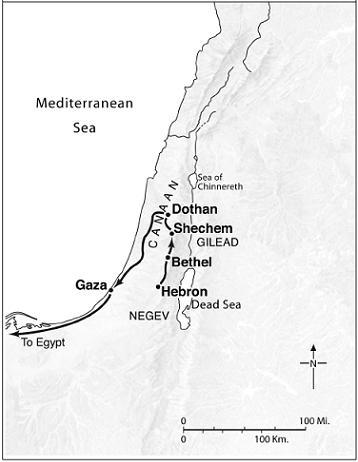
37:12–17 The assignment to Shechem brought Joseph providentially to Dothan, a site more convenient for contact with merchants using the main trade route on their way to Egypt.
37:12, 14 Shechem . . . Hebron. Shechem (see note on 12:6 ) was located c. fifty miles north of Hebron (see note on 13:18 ).
37:17 Dothan. Almost fifteen miles north of Shechem.
37:18–27 The brothers’ plans for murder and cover-up, the fruit of hate and envy, were forestalled by two brothers: first by Reuben, who intended to effect a complete rescue (vv. 21, 22), and then by Judah who, prompted by a passing merchants’ caravan, proposed a profitable alternative to fratricide (vv. 25–27).
37:25 Ishmaelites. A people-group also known as Midianites (cf. vv. 28, 36; 39:1). The descendants of Ishmael and of Abraham through Keturah and Midian (25:1, 2) were sufficiently intermarried or were such inveterate travelers and traders that they were viewed as synonymous groups. These were coming west from Gilead. Gilead. See note on 31:21.
37:27 This criminal behavior would later be prohibited by the Mosaic legislation (Ex. 21:16; Deut. 24:7)
37:28 twenty shekels of silver. This was the average price of a slave at that time in the second millennium B.C. Although most slaves were part of the booty of military conquest, private and commercial slave-trading was also common. Joseph was sold into slavery c. 1897 B.C.
The MacArthur Study Bible, by John MacArthur (Nashville: Word Publishing, 1997) 70. © 1993 by Thomas Nelson, Inc.
37:29 Reuben . . . tore his clothes. Although he was absent at the time of the sale, he would be held responsible for the treachery, and so joined in the cover-up (vv. 30–35). His grief manifested how much he had actually wanted to rescue Joseph (see 42:22).
37:31–35 The deceiver of Isaac (27:18–29) was deceived by his own sons’ lie. Sin’s punishment is often long delayed.
37:35 grave. This is the first OT use of this term for the abode of the dead (in 35:20, it is used to refer to an earthly burial plot). It is a general Hebrew term meaning the place of the dead (Sheol—used sixty-five times in the OT), referring either to the body in its decaying form or to the soul in its conscious afterlife.
37:36 Potiphar. He was a prominent court official and high-ranking officer in Egypt, perhaps captain of the royal bodyguard (cf. 40:3, 4). His name, a most unusual grammatical form for that period, either meant “the one whom the god Ra has given” or “the one who is placed on earth by Ra,” making it a descriptive epithet more than a personal name. See note on 40:3, 4.
38:1–30 The Judah Interlude, as it is sometimes known, is bracketed by references to the sale of Joseph to Potiphar (37:36; 39:1). Such a parenthesis in the Joseph story demands some reason why a chapter laced with wickedness, immorality, and subterfuge should of necessity be placed in this spot. The answer is that the events recorded are chronologically in the right place, being contemporary with the time of Joseph’s slavery in Egypt (v. 1, “at that time”). The account is also genealogically in the right place, i.e., with Joseph gone (seemingly for good), with Reuben, Simeon, and Levi out of favor (for incest and for treachery), Judah would most likely accede to firstborn status. It provides a contrast because it also demonstrates the immoral character of Judah, as compared with the virtue of Joseph. Canaanite syncretistic religion and inclusivism threatened to absorb the fourth and later generations of Abraham’s heirs, but Egyptian exile and racial exclusivism produced not loss of their ethnic identity, but the preservation of it.
38:1 Adullamite. Adullam was a town about one mile northwest of Hebron.
38:2–5 Judah’s separation from his brethren was marked by more than the geographical; it involved integration. His Canaanite wife had three sons for his family line.
38:6–10 Two sons were executed by the Lord, one for unspecified wickedness and one for deliberate and rebellious rejection of the duty to marry a relative’s widow, called a levirate marriage. This was a rather dubious distinction for the line of Judah to gain. For details on levirate marriage according to later Mosaic Law, see note on Deuteronomy 25:5–10; see Ruth: Interpretative Challenges.
38:11 Remain a widow . . . till my son. Taking her father-in-law at his word and residing at her father’s household as a widow would do, Tamar vainly waited for Judah’s third son to protect the inheritance rights of her deceased husband (v. 14) and finally resorted to subterfuge to obtain her rights (vv. 13–16). In so doing, she may have been influenced by Hittite inheritance practices which called the father-in-law into levirate marriage in the absence of sons to do so.
38:12 Timnah. The specific location in the hill country of Judah is unknown. Cf. Joshua 15:10, 57; Judges 14:1.
38:13 shear his sheep. Such an event was frequently associated in the ancient world with festivity and licentious behavior characteristic of pagan fertility-cult practices.
38:14, 15 Feeling that no one was going to give her a child, Tamar resorted to disguising herself as a prostitute, obviously knowing she could trap Judah, which says little for his moral stature in her eyes. Judah’s Canaanite friend, Hirah (vv. 1, 20), called her a shrine-prostitute (v. 21), which made Judah’s actions no less excusable just because cultic prostitution was an accepted part of Canaanite culture. He solicited the iniquity by making the proposal to her (v. 16), and she played the role of a prostitute, negotiating the price (v. 17).
38:18 signet and cord, and your staff. A prominent man in the ancient Near East endorsed contracts with the cylinder seal he wore on a cord around his neck. Her request for the walking stick suggests it also had sufficient identifying marks on it (cf. v. 25, “please determine whose these are”). The custom of using three pieces of identification is attested to in Ugaritic (Canaanite) literature.
38:20–23 It was not good for one’s reputation to keep asking for the whereabouts of a prostitute.
38:24 let her be burned! Double standards prevailed in that Judah, no less guilty than Tamar, commanded her execution for immorality. Later, Mosaic legislation would prescribe this form of the death penalty for a priest’s daughter who prostituted herself or for those guilty of certain forms of incest (Lev. 20:14; 21:9).
38:26 more righteous than I. This was not an accolade for her moral character and faith, but a commendation by Judah for her attention to inheritance rights of her family line and his shameful neglect thereof. Her death sentence was rescinded.
38:29 Perez. This first of the twins, born of prostitution and incest to Tamar, nevertheless came into the messianic line, which went through Boaz and Ruth to King David (Ruth 4:18–22; Matt. 1:3). His name means “breach” or “pushing through.”
C. Vice Regency over Egypt (39:1–41:57)
39:1 Potiphar. See note on 37:36. Ishmaelites. See note on 37:25.
39:2 The LORD was with Joseph. Any and all ideas that Joseph, twice a victim of injustice, had been abandoned by the Lord are summarily banished by the employment of phrases highlighting God’s oversight of his circumstances, e.g., “with him” (vv. 3, 21), “made all he did prosper” (vv. 3, 23), “found/gave him favor” (vv. 4, 21), “blessed/ blessing” (v. 5), and “showed him mercy” (v. 21). Neither being unjustly sold into slavery and forcibly removed from the land (37:28), nor being unjustly accused of sexual harassment and imprisoned (vv. 13–18) were events signaling even a temporary loss of divine superintendence of Joseph’s life and God’s purpose for His people, Israel.
39:2–4 successful . . . overseer of his house. This involved authority as the steward of the whole estate (v. 5, “house and field” and v. 9, “no one greater”), one of the criteria for which was trust. No doubt, Joseph was conversant in the Egyptian language (see note on 29:9 ).
39:5 blessing of the LORD. Joseph was experiencing fulfillment of the Abrahamic covenant, even at that time before Israel was in the land (see 12:1–3).
39:6 except for the bread which he ate. Since Joseph proved trustworthy enough to need no oversight, his master concerned himself only with his own meals or his very own personal affairs. Joseph himself remarked that Potiphar had delegated to him so much that he no longer knew the full extent of his own business affairs (v. 8); in fact, he knew only what was set before him (v. 6).
39:9 this great wickedness. Joseph explained, when first tempted, that adultery would be a gross violation of his ethical convictions which demanded (1) the utmost respect for his master and (2) a life of holiness before his God. Far more was involved than compliance with the letter of an ancient Near Eastern law code, many of which did forbid adultery, but rather obedience to the moral standards belonging to one who walked with God, and that long before Mosaic law-code prescriptions applied (cf. Ps. 51:4).
39:10–18 Her incessant efforts to seduce Joseph failed in the face of his strong convictions not to yield nor be compromised. At flashpoint, Joseph fled! Based on false accusations, Joseph was deemed guilty and imprisoned. Cf. 2 Timothy 2:22 for a NT picture of Joseph’s attitude.
39:12 his garment. See 37:31–35 for the other time one of Joseph’s cloaks was used in a conspiracy against him.
39:17 Hebrew servant. This term was used by Potiphar’s wife as a pejorative, intended to heap scorn upon someone considered definitely unworthy of any respect. Its use may also suggest some latent attitudes toward dwellers in Canaan, which could be aggravated to her advantage. Potiphar’s wife also neatly shifted the blame onto her husband for having hired the Hebrew in the first place (vv. 16–18) and stated this also before the servants (v. 14).
39:19, 20 The death penalty for adultery may not have applied to a charge of attempted adultery, attempted seduction or rape (cf. vv. 14, 18), so Potiphar consigned Joseph to the prison reserved for royal servants, from where, in the providence of God, he would be summoned into Pharaoh’s presence and begin the next stage of his life (cf. chs. 40; 41). See note on 40:3, 4.
39:21 showed him mercy. God did not permit this initial painful imprisonment to continue (cf. Ps. 105:18, 19).
39:22, 23 Once again Joseph, though in circumstances considerably less comfortable than Potiphar’s home, rose to a position of trust and authority and proved to be trustworthy enough not to need any oversight.
40:1 the king of Egypt. He should be identified as Senusert II, c. 1894–1878 B.C.
40:2 the chief butler and the chief baker. Both these occupations and ranks in Pharaoh’s court are attested in existing ancient Egyptian documents. The butler was the king’s cupbearer, who gave him his drinks. The baker cooked his bread. Both had to be trustworthy and beyond the influence of the monarch’s enemies.
40:3, 4 captain of the guard. See note on 37:36. If this was Potiphar, the captain of the guard, then Joseph’s former master directed him to attend to the two royal servants remanded into his custody until sentence was past. This prison was also called “the house of the captain of the guard” (v. 3), “his lord’s house” (v. 7), and “dungeon” (40:15; 41:14), unless Joseph had been moved to another penal facility.
40:5 dream. Oneiromancy, the science or practice of interpreting dreams, flourished in ancient Egypt because dreams were thought to determine the future. Both Egypt and Babylon (Dan. 2:2) developed a professional class of dream interpreters. Deut-eronomy 13:1–5 shows that such dream interpreters were part of ancient false religion and were to be avoided by God’s people. By some 500 years later, a detailed manual of dream interpretation had been compiled. Unlike Joseph, neither butler nor baker understood the significance of their dreams (cf. 37:5–11).
40:8 Do not interpretations belong to God? Joseph was careful to give credit to his Lord (cf. 41:16). Daniel, the only other Hebrew whom God allowed to accurately interpret revelatory dreams, was just as careful to do so (Dan. 2:28). Significantly, God chose both men to play an important role for Israel while serving pagan monarchs and stepping forward at the critical moment to interpret their dreams and reveal their futures.
40:9–13 the chief butler. Consistent with his duty as the cupbearer to the king, he dreamed of a drink prepared for Pharaoh. It was a sign that he would be released and returned to his position (v. 13).
40:14, 15 remember me. This was a poignant appeal to the butler, whose future was secure, to speak a word for Joseph’s freedom, because he knew butlers had the ear of kings. The butler quickly forgot Joseph (v. 23), until his memory was prompted just at the right moment two years later (41:1, 9).
40:15 the land of the Hebrews. Giving this designation to the land of Canaan indicates that Joseph understood the land promise of the Abrahamic covenant.
40:16 the interpretation was good. The chief baker, noting some similarity in the dreams, was encouraged to request interpretation of his dream. Joseph’s words employ a subtle play on words: the butler’s head would be “lifted up” (v. 13) but the baker’s would be “lifted off” (v. 18).
40:20 Pharaoh’s birthday. The Rosetta Stone (discovered in A.D. 1799, a trilingual artifact from Egyptian antiquity, c. 196 B.C., whose Greek inscription enabled linguists to understand the language of hieroglyphics) records a custom of releasing Pharaoh’s prisoners; but, at this party held for his servants, Pharaoh rendered two very different kinds of judgment (vv. 21, 22).
41:1 the river. Probably the Nile River, which dominated Egyptian life.
41:8 no one who could interpret. The combined expertise of a full council of Pharaoh’s advisers and dream experts, all of whom had been summoned into his presence, failed to provide an interpretation of the two disturbing dreams. Without knowing it, they had just set the stage for Joseph’s entrance on the scene of Egyptian history. Compare a similar situation almost 1,200 years later in Babylon with Daniel (Dan. 2:1–45).
41:9 Then the chief butler spoke. With his memory suitably prompted, the butler apologized for his neglect (“I remember my faults”), and informed Pharaoh of the Hebrew prisoner and his accurate interpretation of dreams two years earlier (vv. 10–13).
41:14 Then Pharaoh sent and called Joseph. The urgent summons had Joseph in front of Pharaoh with minimum delay, in prized, clean-shaven Egyptian style for a proper appearance.
41:16 It is not in me; God will give. Deprecating any innate ability, Joseph advised at the very outset that the answer Pharaoh desired could only come from God.
41:25 God has shown. Joseph’s interpretation kept the focus fixed on what God had determined for Egypt (vv. 28, 32).
41:33–36 After interpreting the dream, Joseph told Pharaoh how to survive the next fourteen years. Incongruously, Joseph, a slave and a prisoner, appended to the interpretation a long-term strategy for establishing reserves to meet the future need, and included advice on the quality of the man to head up the project. Famines had ravaged Egypt before, but this time divine warning permitted serious and sustained advance planning.
41:37–41 To Pharaoh and his royal retinue, no other candidate but Joseph qualified for the task of working out this good plan, because they recognized that he spoke God-given revelation and insight (v. 39). Joseph’s focus on his Lord had quickly taken him from prison to the palace (v. 41).
41:38 Spirit of God. The Egyptians did not understand about the third person of the triune Godhead. They merely meant that God had assisted Joseph, thus “spirit” would be more appropriate than “Spirit.”
41:41 set you over all the land of Egypt. The country-wide jurisdiction accorded to Joseph receives frequent mention in the narrative (vv. 43, 44, 46, 55; 42:6; 45:8).
41:42 signet ring . . . garments . . . gold chain. These are emblems of office. A reward of clothing and jewelry suitable to the new rank accompanied Pharaoh’s appointment of Joseph as vizier, or prime minister, the second-in-command (v. 40; 45:8, 26). Joseph wore the royal seal on his finger, authorizing him to transact the affairs of state on behalf of Pharaoh himself.
41:43–45 Other awards appropriate to promotion were also bestowed on Joseph, namely official and recognizable transportation (v. 43), an Egyptian name (v. 45), and an Egyptian wife (v. 45). Further, the populace was commanded to show deference for their vizier (v. 43, “bow the knee”). All these dreams had been revealed by God, in a rare display of manifesting truth through pagans, so that Joseph would be established in Egypt as a leader and, thus elevated, could be used for the preservation of God’s people when the famine came to Canaan. Thus, God cared for His people and fulfilled His promises (see note on 45:1–8 ).
41:43 the second chariot. This signified to all that Joseph was second-in-command.
41:45 Zaphnath-Paaneah. This name probably means “The Nourisher of the Two Lands, the Living One.” It could also mean “God speaks and He lives.” However, certainty of that meaning still eludes scholars. Foreigners are known to have been assigned an Egyptian name.
41:46 thirty years old. C. 1884 B.C. Only thirteen years had elapsed since his involuntary departure from “the land of the Hebrews” (cf. 40:15). Joseph had been seventeen when the narrative commenced (37:2).
41:50 On. One of the four great Egyptian cities, also called Heliopolis, which was known as the chief city of the sun god, Ra. It was located c. nineteen miles north of ancient Memphis.
41:51, 52 Manasseh . . . Ephraim. The names meaning “forgetful” and “fruitful,” assigned to his sons together with their explanations, depict the centrality of God in Joseph’s worldview. Years of suffering, pagan presence, and separation from his own family had not harmed his faith.
41:54–57 The use of hyperbole with all (vv. 54, 56, 57) emphatically indicates the widespread ravaging impact of famine far beyond Egypt’s borders. She had become indeed the “breadbasket” of the ancient world.
41:55, 56 Go to Joseph. After seven years, Joseph’s authority remained intact, and Pharaoh still fully trusted his vizier. He dispensed the food supplies by sale to Egyptians and others (v. 47).
D. Reunion with Family (42:1–45:28)
42:1–3 Jacob’s sons were traumatized in the famine, and Jacob was reluctant to let his family return to Egypt, not knowing what would happen to them (v. 4). But, with no other choice left, he dispatched them to buy grain in Egypt (v. 2).
42:4 Benjamin. See 35:16–19. He was the youngest of all, the second son of Rachel, Jacob’s beloved, and the favorite of his father since he thought Joseph was dead.
42:6 bowed down. Without their appreciating it at the time, Joseph’s dream became reality (37:5–8). Recognition of Joseph was unlikely because: (1) over fifteen years had elapsed and the teenager sold into slavery had become a mature adult; (2) he had become Egyptian in appearance and dress; (3) he treated them without a hint of familiarity (vv. 7, 8); and (4) they thought he was dead (v. 13).
42:9–22 The brothers’ final evaluation after being imprisoned for three days, after protesting the charge of espionage, and after hearing the royal criterion for establishing their innocence (vv. 15, 20), revealed their guilty conscience and their understanding that vengeance for their wrongdoing to Joseph had probably arrived (vv. 21, 22). Calling themselves “honest men” (v. 10) was hardly an accurate assessment.
42:9 remembered the dreams. Joseph remembered his boyhood dreams about his brothers bowing down to him (37:9) as they were coming true.
42:15 By the life of Pharaoh. Speaking an oath in the name of the king would most likely have masked Joseph’s identity from the brothers. Perhaps it also prevented them from grasping the significance of his declaration, “I fear God” (v. 18). unless your youngest brother comes. Joseph wanted to find out if they had done the same or a similar thing to Benjamin as to himself.
42:19, 20 If you are honest men. Joseph took their assessment of themselves at face value when exhorting them to respond to his proposals, but still asked for a hostage.
42:21 anguish of his soul. The brothers had steeled their hearts when selling Joseph to the Midianites (37:28, 29), but they could not forget the fervent pleading and terror-filled voice of the teenager dragged away as a slave from home. Reuben reminded them of his warning at that time and the consequence.
42:22 blood . . . required of us. This declaration referred to the death penalty (9:5).
42:24 took Simeon. He did not keep Reuben, the firstborn, hostage but Simeon, the oldest brother, who willingly participated in the crime against Joseph (37:21–31).
42:28 God has done. Their guilty conscience and fear of vengeance from God surfaced again in this response to the money with which they had purchased the grain being returned and found in the one sack which had been opened. Later, upon discovering that all their money had been returned, their fear increased even further (v. 35).
42:36 Jacob could not handle the prospect of losing another son, and he did not trust the brothers who had already divested him of two sons by what he may have thought were their intrigues. All . . . against me. The whole situation overwhelmed Jacob, who complained against his sons (cf. 43:6) and would not release Benjamin (v. 38).
42:37 The always salutary Reuben generously made his father an offer easy to refuse—killing his grandsons.
43:3 solemnly warned us. The seriousness of Joseph’s words portended failure for another mission to buy food, unless the criterion he had set down was strictly met.
43:9 I myself will be surety for him. Reuben’s offer to guarantee the safety of Benjamin had been rejected (42:37, 38), but Judah’s was accepted (v. 11) because of the stress of the famine and the potential death of all (v. 8) if they waited much longer (v. 10).
43:11 a little. Likely, this was a significant present because they had little left. But there was no future at all past the little, if they did not get grain in Egypt.
43:14 Jacob’s acquiescence to let Benjamin go (v. 13) ended with prayer for the brothers’ and Benjamin’s safety and with a cry of being a helpless victim of circumstances. Pessimism had apparently set into his heart and deepened after the loss of Joseph.
43:23 Your God . . . has given. This is an indication of Joseph’s steward either having come to faith in God or having become very familiar with how Joseph talked of his God and life. So concerned were the brothers to protest their ignorance of the means of the money being returned and to express their desire to settle this debt (vv. 20–22) that they missed the steward’s clear reference to the God of Israel (“the God of your father”) and his oversight of events in which he had played a part (“I had your money”).
43:26 bowed down. Again, Joseph’s boyhood dream (37:5–8) had become reality (cf. 42:6).
43:29 God be gracious. Joseph easily used the name of God in his conversation, but the brothers did not hear the name of their own covenant God being spoken by one who looked just like an Egyptian (cf. 42:18).
43:30 to weep. Joseph was moved to tears on several occasions (42:24; 45:2, 14, 15; 46:29).
43:32 not eat food with the Hebrews. Exclusivism kept the Egyptians sensitive to the social stigma attached to sharing a meal table with foreigners (cf. 46:34). Discrimination prevailed at another level, too: Joseph ate alone, his rank putting him ahead of others and giving him his own table and setting.
43:33 the firstborn . . . the youngest. To be seated at the table in birth order in the house of an Egyptian official was startling—how did he know this of them? Enough clues had been given in Joseph’s previous questions about the family and his use of God’s name for them to wonder about him and his personal knowledge of them. Obviously, they simply did not believe Joseph was alive (44:20) and certainly not as a personage of such immense influence and authority. They had probably laughed through the years at the memory of Joseph’s dreams of superiority.
43:34 Benjamin’s serving. Favoritism shown to Rachel’s son silently tested their attitudes; any longstanding envy, dislike, or animosity could not be easily masked. However, none surfaced.
44:2 my cup, the silver cup. Joseph’s own special cup, also described as one connected with divination (vv. 5, 15) or hydromancy (interpreting the water movements), was a sacred vessel symbolizing the authority of his office of Egyptian vizier. Mention of its superstitious nature and purpose need not demand Joseph be an actual practitioner of pagan religious rites. See note on verse 15.
44:5 divination. See note on Deuteronomy 18:9–12.
44:7–9 The brothers, facing a charge of theft, protested their innocence by pointing first to their integrity in returning the money from the last trip, and then by declaring death on the perpetrator and slavery for themselves.
44:12 began with the oldest. Again, there was a display of inside knowledge of the family, which ought to have signaled something to the brothers. See note on 43:33.
44:13 tore their clothes. This is a well known ancient Near Eastern custom of visibly portraying the pain of heart being experienced. They were very upset that Benjamin might become a slave in Egypt (v. 10); Benjamin appears to have been speechless. They had passed a second test of devotion to Benjamin (the first in v. 34).
44:14 fell before him. Again, the dream had become reality (cf. 37:5–8; 42:6); but now prostrate before him, they had come to plead for mercy, both for their youngest brother Benjamin and for their father Jacob (vv. 18–34).
44:15 practice divination. See notes on verses 2, 5. Joseph, still disguising himself as an Egyptian official before his brothers, permitted them to think it so.
44:16 Then Judah said. Judah stepped forward as the family spokesman since it was he who came with his brothers to Joseph’s house and he who pled with him (cf. vv. 14, 18); Reuben, the firstborn, had been eclipsed. God has found out the iniquity. Judah, showing how his heart had changed, acknowledged the providence of God in uncovering their guilt (note the “we” in the questions), and did not indulge in any blame-shifting, even on to Benjamin.
44:18–34 An eloquent and contrite plea for mercy, replete with reference to the aged father’s delight in and doting upon the youngest son (vv. 20, 30) and the fatal shock should he be lost (vv. 22, 29, 31, 34). Judah’s evident compassion for Jacob and readiness to substitute himself for Benjamin in slavery finally overwhelmed Joseph. These were not the same brothers of yesteryear (45:1).
45:1–8 Stunned by the revelation of who it really was with whom they dealt, the brothers then heard expressed a masterpiece of recognition of and submission to the sovereignty of God, i.e., His providential rule over the affairs of life, both good and bad. See note on 41:43–45.
45:6 these two years. Joseph would have been thirty-nine years old and away from his brothers for twenty-two years (37:2).
45:7 to preserve a posterity. These are words reflecting, on Joseph’s part, an understanding of the Abrahamic covenant and its promise of a nation (cf. chs. 12; 15; 17).
45:8 father to Pharaoh. A title which belonged to viziers and which designated one who, unrelated to Pharaoh, nevertheless performed a valuable function and held high position, which in Joseph’s case was “lord of all Egypt” (v. 9). A new and younger Pharaoh now reigned, Senusert III, c. 1878–1841 B.C.
45:10 land of Goshen. This area, located in the northeast section of the Egyptian delta region, was appropriate for grazing the herds of Jacob (cf. 47:27; 50:8). Over 400 years later, at the time of the Exodus, the Jews still lived in Goshen (cf. Ex. 8:22; 9:26).
45:14, 15 Reconciliation was accomplished with much emotion, which clearly showed that Joseph held no grudges and had forgiven his brothers, evidencing the marks of a spiritually mature man. See note on 50:15–18. It had been twenty-two years since the brothers sold Joseph into slavery.
45:16 So it pleased Pharaoh. The final seal of approval for Joseph’s relatives to immigrate to Egypt came unsought from Pharaoh (vv. 17–20).
45:24 troubled along the way. This was a needed admonition because they would have so much sin to think about as they readied their confession to their father.
45:26 Jacob’s heart stood still. Like his sons (v. 3), Jacob was stunned by the totally unexpected good news. Even though the record is silent on the matter, this was the appropriate occasion for the sons to confess their crime to their father.
E. Transition to the Exodus (46:1–50:26)
46:1 offered sacrifices. The route to Egypt for Jacob went via Beersheba, a notable site about twenty-five miles southwest of Hebron and a favorite place of worship for both Abraham and Isaac (21:33; 26:25).
46:2–4 God spoke . . . in the visions. Jacob’s anxiety about his departure to Egypt was allayed by the Lord’s approval and confirmation of his descendants returning as a nation. God had previously appeared/spoken to Jacob in 28:10–17; 32:24–30; 35:1, 9–13.
46:4 hand on your eyes. A promise of dying peacefully in the presence of his beloved son (cf. 49:33).
46:6 went to Egypt. C. 1875 B.C. They remained 430 years (Ex. 12:40) until the Exodus in 1445 B.C.
46:8–27 The genealogical register, separately listing and totaling the sons per wife and handmaid, is enveloped by notification that it records the sons/persons of Jacob who went to Egypt (vv. 8, 27). Ancient Near Eastern genealogies could include historical notes as is true here, namely the death of Er and Onan (v. 11), and that Laban gave the handmaids to his daughters (vv. 18, 25).
46:8 the children of Israel. This was the first time that author Moses referred to the family as a whole in this way, although “in Israel” had been used by the sons of Jacob before (cf. 34:7).
46:26 sixty-six persons. The total of verses 8–25 is seventy, from which Er, Onan, Manasseh, and Ephraim need to be deleted.
46:27 seventy. Jacob, Joseph, Manasseh, and Ephraim should be added to the sixty-six. The seventy-five of Acts 7:14 included an additional five people, born in the land, which were added in the LXX reading of 46:8–27 (cf. Ex. 1:5; Deut. 10:22). These five included two sons of Manasseh, two sons of Ephraim, and one grandson of the latter. See note on Exodus 1:5.
2. Occupation in Goshen (46:28–47:31)
46:28 sent Judah before him. Once again Judah was the leader going ahead as Jacob’s representative, not Reuben. See note on 44:16. Goshen. See note on 45:10.
46:31–34 Joseph’s instructions about his preparatory interview with Pharaoh were designed to secure his relatives a place somewhat separate from the mainstream of Egyptian society. The social stigma regarding the Hebrews (43:32), who were shepherds also (v. 34), played a crucial role in protecting Israel from intermingling and losing their identity in Egypt. See note on 43:32.
47:1–6 in the land of Goshen. By informing Pharaoh of where he had located his family (cf. 45:10; 46:28) and, then, by having the family’s five representatives courteously request permission to reside in Goshen (vv. 2, 4), Joseph, wise to court procedures, paved the way for Pharaoh’s confirmation and approval (v. 6).
47:7, 10 Jacob blessed Pharaoh. The aged patriarch’s salutations pronounced, undoubtedly in the name of God, a benediction on Pharaoh Senusert III (see note on 45:8 ) for his generosity and his provision of a safe place for Jacob’s family. Though Senusert III had ascended to the throne before the famine ended, he honored his father’s commitments.
47:9 my pilgrimage . . . few and evil. Since neither Jacob nor his fathers had actually possessed the land of Canaan, describing life as a pilgrimage was a fitting evaluation to give. In addition, his years seemed few in contrast to those of the two who had visited Egypt long before him—Abraham and Isaac (175 and 180 years, respectively). Still overshadowed with pessimism, the days were “evil,” in the sense of toil and trouble, of many sorrows, distresses, and crises. See note on 48:15.
47:11 land of Rameses. An alternative designation for Goshen (cf. 46:34; 47:1, 6), with this name perhaps used later to more accurately describe the region for Moses’ contemporary readers. See note on Exodus 1:11 regarding the name Rameses (“Raamses” being the alternate spelling in Exodus). This region is also called Zoan elsewhere (cf. Ps. 78:12, 43).
47:12 according to the number in their families. A rationing system was evidently in operation.
47:13–24 When the famine finally exhausted the Egyptians’ supply of money, Joseph accepted animals in exchange for grain (v. 17). After the animals ran out, the people were desperate enough to exchange their land (vv. 19, 20). Eventually, Pharaoh owned all the land, except what was the priests’ (v. 22), though the people were allowed to work the land and pay one-fifth of its yield to Pharaoh (v. 24). Whatever may have been the land-tenure system at that time, some private land ownership did at first exist, but finally, as in a feudal system, all worked their land for Pharaoh. Landed nobility did lose out and declined during major social reforms undertaken under Senusert III. This is the first record in Scripture of a national income tax, and the amount was twenty percent. Later, after the Exodus, God would prescribe tithes for Israel as national income taxes to support the theocracy (see Mal. 3:10).
47:15 when the money failed. The severity of the famine finally bankrupted all in Egypt and Canaan. With no monetary instruments available as a medium of exchange, a barter system was established (vv. 16–18).
47:16–18 Land soon replaced animals as the medium of exchange.
47:25, 26 The extra measures imposed by Joseph to control the impact of the famine, i.e., moving parts of the population into cities (v. 21) and demanding a one-fifth tax on crop yields (v. 24), did not affect his approval ratings (v. 25). Whatever the gain to Pharaoh, the people obviously understood that Joseph had not enriched himself at their expense.
47:27, 28 grew and multiplied. For seventeen years, Jacob was witness to the increase; he had a glimpse of God’s promise to Abraham, Isaac, and himself in the process of being fulfilled.
47:29 your hand under my thigh. Cf. Abraham and Eliezer in Genesis 24:9. do not bury me in Egypt. With the customary sign of an oath in that day, Joseph sincerely promised to bury Jacob, at his request, in the family burial cave in Canaan (cf. 49:29–32).
47:31 Cf. Hebrews 11:21.
3. Blessings on the Twelve Tribes (48:1–49:28)
48:3–6 After summarizing God’s affirmation of the Abrahamic covenant to himself, Jacob/Israel, in gratitude for Joseph’s great generosity and preservation of God’s people, formally proclaimed adoption of Joseph’s sons on a par with Joseph’s brothers in their inheritance, thus granting to Rachel’s two sons (Joseph and Benjamin) three tribal territories in the land (cf. v. 16). This may explain why the new name, Israel, was used throughout the rest of the chapter.
48:4 Cf. Acts 7:5.
48:8 Who are these? Blind Jacob asked for identification of Joseph’s sons before he would pronounce their blessings. Perhaps, at this point, he recollected the time of blessing before his own father and the trick played on blind Isaac (27:1–29).
48:14 guiding his hands knowingly. Intentionally crossing his hands, Jacob altered what Joseph expected to happen and placed his right hand on the youngest, not on the firstborn. When Joseph attempted to correct Jacob’s mistake (vv. 17, 18), he learned that Jacob knew exactly what he was doing (vv. 19, 20). The patriarchal blessing took on prophetic significance with such action and words, since Ephraim would be the most influential of the two to the extent that Ephraim would become a substitute name for Israel (see note on v. 19 ).
48:15 blessed Joseph. With hands on the sons’ heads, Jacob uttered the prayer-wish for Joseph, which indicated by his wording that these two would be taking his son’s place under Abraham and Isaac. See note on verses 3–6.
48:15, 16 Pessimism no longer overshadowed Jacob’s testimony; he recognized that every day had been under God’s hand or that of His angel (see note on 16:13 ). This was a different evaluation of his life than previously given (47:9).
48:16 redeemed me. This is the first mention of God as redeemer, deliverer, or Savior.
48:19 younger brother shall be greater. Ephraim did indeed become the dominant tribe of the ten northern tribes, eventually being used as the national designate for the ten tribes in the prophets (Is. 7:2, 5, 9, 17; Hos. 9:3–16).
48:21 bring you back. Dying Jacob gave voice to his undying trust in God’s taking his descendants back to Canaan.
48:22 one portion . . . with my sword. Jacob’s history does not record any conquest of Amorite land. He did purchase property from the children of Hamor (Gen. 33:19) but that was not by conquest. At some time, this military event had actually occurred, but for some unknown reason, it finds no other mention in God’s revelation.
49:1–28 With Judah and Joseph receiving the most attention (vv. 8–12, 22–26), the father’s blessing portrayed the future history of each son, seemingly based upon their characters up to that time. The cryptic nature of the poetry demands rigorous analysis for correlating tribal history with Jacob’s last word and testament. See Moses’ blessing on the tribes in Deuteronomy 33, c. 1405 B.C.
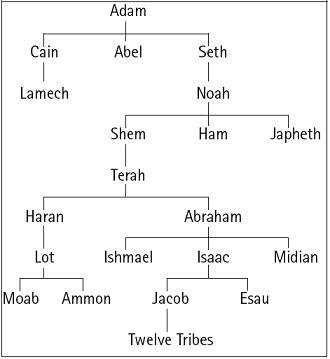
Adam to Israel’s Twelve Tribes
The MacArthur Study Bible, by John MacArthur (Nashville: Word Publishing, 1997) 87. © 1993 by Thomas Nelson, Inc.
49:1 in the last days. The key expression leading into the poetic content of Jacob’s prediction for each son often signifies the last days in prophetic literature (Is. 2:2; Ezek. 38:16) or points more generally to “the latter days” (Deut. 4:30; 31:29), i.e., in the sense of “in subsequent days.”
49:2–27 The names of the sons are not given in birth order (cf. 29:32–30:24; 35:18), nor in the pattern of wife, then handmaid (cf. 46:8–25). The order is as per the mother: (1) the six sons of Leah; (2) one son of Bilhah; (3) two sons of Zilpah; (4) one son of Bilhah; and (5) the two sons of Rachel. Other than the reversal of Leah’s fifth and sixth sons, the others remain in chronological order in relation to their mothers. No other pattern is discernible. It may have been nothing more than a mnemonic device, or just how Jacob personally had come to recall them to mind.
49:3, 4 The seriousness of Reuben’s sin (35:22) were not forgotten. Its consequences erased his birthright (1 Chr. 5:1–3), and whatever dignity and majesty he might have had, his tribe received scant mention in Israelite history and produced not one judge, prophet, military leader, or other important person (cf. Judg. 5:15; 1 Chr. 5:1). Moses prayed for this tribe not to die out (Deut. 33:6). “Unstable as water” literally means “boiling” and shows instability.
49:5–7 The cruelty and anger of Simeon and Levi at Shechem were not forgotten (34:25). Their consequences affected Simeon who: (1) became the smallest tribe in the second census of Moses (Num. 26:14); (2) was omitted from the blessing of Moses (Deut. 33:8); and (3) later shared territory with Judah (Josh. 19:1–9). Levi was “scattered” (v. 7) throughout Israel; they became, by God’s grace and through their loyalty to God (Ex. 32:26), the priestly tribe and residents of the cities of refuge. Neither possessed their own designated region in the land, although Levi’s priestly position was certainly a privileged one (cf. Deut. 33:8–11; Josh. 21:1–3). “Hamstrung” means to cut the leg tendons as a means of destroying the animal’s usefulness.
49:8–12 As strong as a young lion and entrenched as an old lion, to Judah’s line belonged national prominence and kingship, including David, Solomon, and their dynasty (640 years after this), as well as “the one to whom the scepter belongs, “ i.e., Shiloh, the cryptogram for the Messiah, the one also called the “Lion of the Tribe of Judah” (Rev. 5:5). On the march through the wilderness, Judah went first (Num. 10:14) and had the largest population in Moses’ census (cf. Num. 1:27; 26:22). This language (vv. 11, 12) describes prosperity so great that people will tie a donkey to a choice vine, letting it eat because there is such abundance; wine will be as plentiful as water and everyone will be healthy. This is likely a millennial prophecy.
49:13 Although Zebulun’s territory did not border the Mediterranean Sea or the Sea of Galilee, the tribe was situated to benefit from the important trade route, the Via Maris, traversed by sea traders moving through her territory.
49:14, 15 Issachar, an industrious, robust, hardy, and stalwart tribe, lived up to the name of their founder whose name meant “man of wages” (cf. 1 Chr. 7:1–5; 12:32).
49:16–18 Dan, whose name meant “judge,” fathered an aggressive tribe that would also judge in the nation but would not be known for moral stature or religious faithfulness (cf. Judg. 13:2; 18:1ff.; 1 Kin. 12:28–30; 2 Kin. 10:29). Dan would later abandon its land allotment (Josh 19:40–48) and migrate to the extreme north of Israel (Judg. 18:1–31). Jacob’s closing cry expressed hope for Dan in the day when salvation would indeed come to Israel. Dan, however, is omitted in the list of tribes in Revelation 7:4–8.
49:19 Settling in Transjordan exposed Gad’s people to invasions, making them valiant fighters worthy of victory and commendation (cf. 1 Chr. 5:18–22; 12:8–15).
49:20 Asher benefited much from occupying the agriculturally rich coastal region north of Carmel, and provided gourmet delights for the palace. Cf. Joshua 19:24–31.
49:21 Deer-like speed and agility marked Naphtali’s military prowess (cf. Judg. 4:6; 5:18). The song of Deborah and Barak, who hailed from Naphtali (Judg. 4:6), is representative of his eloquent words (Judg. 5).
49:22–26 Addressed to Joseph, but applicable to his two sons (cf. 48:15–20), these words thrust forth a contrasting experience of growth and prosperity alongside hostility and conflict. Verses 23 and 24 may be a biography of Joseph. No other tribe had such direct reference to the Lord God (vv. 24, 25) in their blessing as addressed to Joseph. The four names for God well reflect Joseph’s emphasis on the sovereignty of his God, no matter the misfortune and grief which attended his way (cf. v. 23). Samuel was from Ephraim, Gideon from Manasseh.
49:27 The warlike nature of the small tribe of Benjamin became well known, as exhibited in their archers and slingers (Judg. 20:16; 1 Chr. 8:40; 12:2; 2 Chr. 14:8; 17:17) and in the brazen defense of their wickedness in Gibeah (Judg. 19; 20). Both Sauls in the Bible were from this tribe: the first king in Israel (1 Sam. 9:1, 2) and the apostle Paul (Phil. 3:5).
4. The death and burial of Jacob in Canaan (49:29–50:14)
49:29–32 Jacob’s dying instructions were fully carried out (cf. 50:12–14). See 23:6–20.
| Joseph | Parallels | Jesus |
| 37:2 | A shepherd of his father’s sheep | John 10:11, 27–29 |
| 37:3 | His father loved him dearly | Matt. 3:17 |
| 37:4 | Hated by his brothers | John 7:4,5 |
| 37:13, 14 | Sent by father to brothers | Hebrews 2:11 |
| 37:20 | Ohters plotted to harm them | John 11:53 |
| 37:23 | Robes taken from them | John 19:23, 24 |
| 37:26 | Taken to Egypt | Matt. 2:14, 15 |
| 37:28 | Sold for the price of a slave | Matt. 26:15 |
| 39:7 | Tempted | Matt. 4:1 |
| 39:16–18 | Falsely accused | Matt. 26:59, 60 |
| 39:20 | Bound in chains | Matt. 27:2 |
| 40:2, 3 | Placed with two other prisoners, one who was saved and the other lost | Luke 23:32 |
| 41:41 | Exalted after suffering | Phil. 2:9–11 |
| 41:46 | Both 30 years old at the beginning of public recognition | Luke 3:23 |
| 42:24; 45:2, 14, 15; 46:29 | Both wept | John 10:35 |
| 45:1–15 | Forgave those who wronged them | Luke 23:34 |
| 45:7 | Saved their nation | Matt. 1:21 |
| 50:20 | What men did to hurt them, God turned to good | 1 Cor. 2:7, 8 |
49:31 there I buried Leah. Honor was finally accorded to Leah in death and in Jacob’s request to be buried alongside his wife, as were his fathers. Burial alongside Rachel, the beloved wife, was not requested.
49:33 Jacob . . . breathed his last. C. 1858 B.C. gathered to his people. See note on 25:8.
50:2, 3 physicians to embalm. Joseph summoned medical men, who were fully capable of embalming, rather than the religious embalmers in order to avoid the magic and mysticism associated with their practices. Usually in Egypt, mummifying was a forty-day process, which included gutting the body, drying it, and wrapping it.
50:3–6 Once normal embalming and mourning had been properly observed according to Egyptian custom, Joseph was free to seek permission to conduct a funeral in Canaan.
50:7–11 Out of respect for Joseph, a substantial escort accompanied him and all his relatives into the land of Canaan. This extraordinary event gave assurance to later generations because the bodies of the three patriarchs were in Canaan and Joseph’s bones awaited transport there when, as per Joseph’s last words, God’s promises to the three began to be fulfilled.
5. The death of Joseph in Egypt (50:15–26)
50:15–18 The brothers’ guilty consciences reasserted themselves and caused them to underestimate the genuineness of Joseph’s forgiveness and affection for them. Jacob’s concern to plead on his sons’ behalf equally underestimated Joseph’s words and actions toward his brethren.
50:19 am I in the place of God? This concise question tweaked their memory of Joseph’s explanation of how God had put him where he was (cf. 45:3–8), in the place God intended him to be at that time.
50:20 but God meant it for good. Joseph’s wise, theological answer has gone down in history as the classic statement of God’s sovereignty over the affairs of men. See note on 45:1–8.
| 1. Adam | Romans 5:14; 1 Corinthians 15:45 |
| 2. Abel | Genesis 4:8, 10; Hebrews 12:24 |
| 3. Aaron | Exodus 28:1; Hebrews 5:4, 5; 9:7, 24 |
| 4. David | 2 Samuel 8:15; Philippians 2:9 |
| 5. Jonah | Jonah 1:17; Matthew 12:40 |
| 6. Melchizedek | Genesis 14:18–20; Hebrews 7:1–17 |
| 7. Moses | Numbers 12:7; Hebrews 3:2 |
| 8. Noah | Genesis 5:29; 2 Corinthians 1:5 |
| 9. Samson | Judges 16:30; Colossians 2:14–15 |
| 10. Solomon | 2 Samuel 7:12, 13; 1 Peter 2:5 |
| 1. Ark | Genesis 7:16; 1 Peter 3:20, 21 |
| 2. Atonement sacrifices | Leviticus 16:15, 16; Hebrews 9:12, 24 |
| 3. Bronze serpent | Numbers 21:9; John 3:14, 15 |
| 4. Mercy seat | Exodus 25:17–22; Romans 3:25; Hebrews 4:16 |
| 5. Passover lamb | Exodus 12:3–6, 46; John 19:36; 1 Corinthians 5:7 |
| 6. Red heifer | Leviticus 3:1; Ephesians 2:14, 16 |
| 7. Rock of Horeb | Exodus 17:6; 1 Corinthians 10:4 |
| 8. Scapegoat | Leviticus 16:20–22 |
| 9. Tabernacle | Exodus 40:2; Hebrews 9:11; Colossians 2:9 |
| 10. Veil of the tabernacle | Exodus 40:21; Hebrews 10:20 |
50:24 God will surely visit you. Joseph died just as he had lived, firmly trusting in God to carry out His promises (cf. Heb. 11:22). Almost four centuries later, Moses took Joseph’s remains out of Egypt (Ex. 13:19) and Joshua buried them at Shechem (Josh. 24:32). to Abraham, to Isaac, and to Jacob. The death of Jacob had finally allowed for the three patriarchs to be mentioned together.
50:26 one hundred and ten years old. C. 1804 B.C. Joseph’s span of life was considered, at that time in Egypt, an ideal lifespan. Amenemhet III (c. 1841–1792 B.C.) was the reigning Pharaoh. Exodus picked up the his-
Further Study
Davis, John J. Paradise to Prison: Studies in Genesis. Grand Rapids: Baker, 1975.
MacArthur, John. The Battle for the Beginning. Nashville: Word, 2001.
Morris, Henry M. The Genesis Record. Grand Rapids: Baker, 1976.