
Introduction
In the introduction to the first edition of his German New Testament (1522), Martin Luther made the following oft-quoted remark about the book of James:
In fine, Saint John’s Gospel and his first epistle, Saint Paul’s epistles, especially those to the Romans, Galatians, Ephesians, and Saint Peter’s first epistle,—these are the books which show thee Christ, and teach thee everything that is needful and blessed for thee to know even though thou never see or hear any other book or doctrine. Therefore is Saint James’s epistle a right strawy epistle in comparison with them, for it has no gospel character to it. (Cited in James H. Ropes, The Epistle of St. James, The International Critical Commentary [Edinburgh: T. & T. Clark, 1978], 106)
The great Reformer was by no means denying the inspiration of James (as his phrase “in comparison with them” indicates). Nevertheless, his disparaging remarks about the epistle have been echoed by many throughout the history of the church. In fact, due to its brevity, the fact that it was addressed specifically to Jewish Christians, its lack of doctrinal content, and because it was not written by one of the twelve apostles or Paul, James was one of the last books added to the New Testament canon.
But such downplaying of the value of James is shortsighted. Luther had little use for James because it contains little teaching about the great doctrines of the Christian faith that he so passionately defended. (In fact, some of his hostility to James stemmed from his Roman Catholic opponents’ misuse of James 2 to defend justification by works.) It is true that James is not a doctrinal treatise but an intensely practical manual for Christian living. Yet that does not lessen its value, since holy living and sound doctrine must not be separated. Commenting on the importance of James, D. Edmond Hiebert writes,
This epistle sternly insists upon Christian practice consistent with Christian belief, heaps scathing contempt upon all empty profession, and administers a stinging rebuke to the readers’ worldliness. Its stress upon the gospel’s ethical imperative makes the epistle as relevant today as when it was first written. The presence of this practical epistle in the New Testament canon is a magnificent monument to the moral sensitivity and concern of the Christian church. (The Epistle of James [Chicago: Moody, 1979], 11)
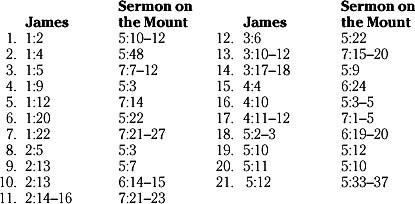
The book of James has been compared with the wisdom literature of the Old Testament, particularly the book of Proverbs, because of its direct, pungent statements on wise living. And James’s strong condemnation of social injustice (cf. chaps. 2, 5) has prompted some to call him “the Amos of the New Testament.” But James was also profoundly influenced by the Sermon on the Mount; in fact, as noted in chapter 1 of this commentary, his epistle may be viewed as a practical commentary on our Lord’s sermon. The extent of the Sermon on the Mount’s influence on James may be seen in his many references and allusions to it (see table).
AUTHOR
Of the various men in the New Testament named James, only two were prominent enough to have penned such an authoritative letter: James the son of Zebedee and brother of John, and James the Lord’s half brother. But James the son of Zebedee’s early martyrdom (Acts 12:2) eliminates him as a candidate, leaving James the half brother of the Lord as the author. James, along with the rest of Jesus’ brothers, initially rejected Him (cf. John 7:5). Later, however, he came to believe in Jesus as Israel’s Messiah. Such was his godliness and zeal that he soon became the recognized head of the Jerusalem church (cf. Acts 12:17; Gal. 2:9). James held that position until his martyrdom about A.D. 62. (For further biographical information on James, see chap. 1 of this volume.)
Further evidence that James wrote the epistle comes from the strong verbal parallels between the book of James and James’s speech and letter recorded in Acts 15. The Greek infinitive verb chairein (“greetings”) appears in the New Testament only in James 1:1 and Acts 15:23 (except for its use by the Roman, Claudius Lysias, in Acts 23:26). Other parallels include “beloved” (James 1:16, 19; 2:5; Acts 15:25), “your souls” (James 1:21; Acts 15:24), “visit” (James 1:27; the same Greek verb is translated “concerned Himself about” in Acts 15:14), and “turn” in the sense of turning from sin to God (James 5:19–20; Acts 15:19).
The epistle’s distinctively Jewish character is in keeping with the picture of James given in Acts 15 and 21. The book of James contains four direct quotes of the Old Testament and more than forty Old Testament allusions. In addition, James expresses himself in distinctly Old Testament terms, beginning in the first verse with the reference to the “twelve tribes who are dispersed abroad.” James describes the gospel as the “law of liberty” (2:12). He describes his readers’ meeting place using the Greek word transliterated “synagogue” (2:2). In 4:4 he uses the common Old Testament figure of adultery to describe spiritual defection. Contemporary Jewish abuses regarding oath taking are condemned in 5:12. The prominent Old Testament figure Elijah appears as an example of the power of righteous prayer (5:17–18). Such important Old Testament names as Abraham (2:21), Rahab (2:25), and Job (5:11) also appear in the epistle. James is also the only New Testament writer to employ the distinctly Old Testament title for God, “Lord of Sabaoth [Hosts].” (Paul refers to that title only in a quotation from Isaiah in Romans 9:29.)
Despite the specific inspired identification of James in 1:1 and the persuasive evidence that James the Lord’s half brother wrote this letter, unbelieving pseudoscholars have rejected him as author. They cite several unconvincing lines of evidence to support that dubious conclusion. Normally they would not even be helpful to consider, but they do provide a backdrop against which to further demonstrate features of the epistle related to its author.
A simple Galilean peasant like James, they argue, was incapable of writing such excellent Greek. Research has shown, however, that many first-century Palestinian Jews likely spoke Greek in addition to Hebrew and Aramaic. That would have been especially true in predominantly Gentile Galilee (cf. Matt. 4:15), particularly in Nazareth, which lay on a busy trade route. Thus it is highly probable that James knew Greek from boyhood. And as head of the Jerusalem church, he would have been in daily contact with the Hellenistic (Greek-speaking) Jewish believers, who had been part of the Jerusalem church from its inception (Acts 6:1). That contact would have given James ample opportunity to polish his Greek.
Others cite the lack of any emphasis on James’s exalted position as the Lord’s brother and head of the Jerusalem church as evidence that he did not write the epistle. But James, like Paul, recognized that knowing Jesus “according to the flesh” was no longer of any value (2 Cor. 5:16; cf. Matt. 12:47–50). Ironically, many of those same scholars claim 2 Peter to be pseudepigraphic (i.e., a “pious forgery”) precisely because it does contain autobiographical references to Peter. That conundrum prompted R.V.G. Tasker to remark that
[if] the criteria of pseudepigraphy are so uncertain, we seem to be on surer ground if we assume that, even in the case of books which were received into the canon of the New Testament comparatively late, there was general agreement that they really were the works of the author whose names they bear. (The General Epistle of James, The Tyndale New Testament Commentaries [Grand Rapids: Eerdmans, 1975], 20)
Actually, that the writer of James does not emphasize his personal authority argues convincingly that he was so well known and respected that such claims were unnecessary.
Still others point to the epistle’s lack of emphasis on the great doctrinal themes of the Christian faith, particularly those concerning the life, ministry, death, and resurrection of Jesus Christ, as evidence that James was not its author. James the Lord’s brother, who was well acquainted with those momentous events, surely would have mentioned them, they argue. But such a claim overlooks James’s purpose in writing his epistle which, as noted above, was practical, not doctrinal. And the absence of doctrinal content makes it difficult to discern any motive for a forger.
Finally, some argue that the epistle’s references to persecution (1 : 2ff.; 2:6–7; 5:1–6) point to a date of writing after James’s death. “But there is no evidence that the afflictions being suffered by these Jewish Christians were due to governmental persecutions. They were rather the result of the impositions of the rich upon the poor, the injustices of the employers toward their employees” (D. Edmond Hiebert, An Introduction to the Non-Pauline Epistles [Chicago: Moody, 1962], 42).
None of these arguments is sufficient to overturn the traditional view that James, the half brother of Jesus and head of the Jerusalem church, wrote the epistle that bears his name.
DATE AND PLACE OF WRITING
The absence of any reference to the Jerusalem Council recorded in Acts 15 (c. a.d. 49) points to a date of writing for James before that council met. It is unlikely that, in a letter addressed to scattered Jewish believers, James would have failed to mention the Jerusalem Council if it had already taken place. That early date is supported by the lack of any reference to Gentiles, Gentile churches, or Gentile-related issues (e.g., circumcision, or the eating of meat sacrificed to idols). The most probable span for James’s writing is a.d. 44–49, making it the first of the New Testament books to be written.
The epistle of James was undoubtedly written from Jerusalem, the city where its author lived and ministered. For information on the recipients of James’s epistle, see chapter 1.
As will be noted throughout this commentary, James wrote his epistle to challenge his readers to examine their faith to see if it was genuine saving faith. Accordingly, the outline is structured around that series of tests.