14:18-22. However, for the present time it appeared to Job that God wanted to wear him down and destroy his hope. His body was still experiencing pains, and he mourned (like a crumbling mountain or stones worn away by water) only for himself with no one to comfort him.
III. Second Round of Speeches between Job and His Friends (15:1–21:34)
A. Eliphaz Delivers His Second Speech (15:1-35)
The second round of speeches by Job’s three friends, and Job’s response to each, occupy chaps. 15–21. For the most part, the three men repeated their earlier contention that sin was the reason for Job’s suffering. Eliphaz’s tone changed noticeably in his second speech (chap. 15). He abandoned any effort to be gracious toward Job and assaulted him immediately with a flurry of accusations. All three speeches are more abrasive, showing more intolerance toward Job for insisting he was innocent and refusing to repent. His friends were also disturbed by Job’s bold challenge to God to prove His case against him. They used more insulting language and, interestingly, in this cycle they did not call for Job to repent and thus end God’s heavy hand of seeming chastisement on his life.
15:1-6. Eliphaz began his second address to Job with a withering frontal attack, accusing Job of being nothing more than a windbag, filled with hot air like the east wind that blows in from the desert. Instead of speaking as a wise man, Job relied on useless talk and words which are not profitable (vv. 2-3). Even worse, Job’s words were impious, without a proper respect (reverence) for God. Job spoke out of the guilt of his heart, relying on clever words instead of sincere speech (vv. 4-5). Eliphaz felt justified in this charge, since in his view Job had condemned himself with his own words. Like a triumphant prosecutor, Eliphaz felt all he had to do to prove his accusation was to point at Job the defendant and say, “There, you heard it for yourself from his own lips.”
15:7-16. Eliphaz was disturbed that Job thought he alone had special access to the counsel and wisdom of God (vv. 7-9). Eliphaz attacked Job’s presupposition that God knew he was innocent, and that Job was wasting his time talking to his friends when he ought to be addressing God himself (cf. 13:3). Eliphaz also assailed one of the foundations of Job’s argument, by asking What do you know that we do not know? What do you understand that we do not? (v. 9). Twice Job had used the argument that he knew everything his friends knew, making him their equal in terms of wisdom (cf. 12:3; 13:2). But Eliphaz threw Job’s assertion back in his face, accusing him of disdaining the counsel of his elders. Eliphaz even described his words as the consolations of God (v. 11) that he had spoken gently to Job—at least in his first speech.
However, instead of welcoming his rebuke as the message of God, Eliphaz said that Job had let his emotions get the best of him—causing his eyes to flash in anger, his spirit to turn against God, and mouth to pour out evil words (vv. 12-13). Then Eliphaz posed a rhetorical question with which Job would have agreed: What is man, that he should be pure, or … righteous? (v. 14) before God. In fact, Job had expressed the same view in 7:17 and in 14:4. Eliphaz answered his own question in vv. 15-16; no person can be pure in the sight of a God who does not trust His angels, and before whom the heavens are not pure. How much less would God hold guiltless human beings who are detestable and corrupt—like Job, whom Eliphaz no doubt had in mind as the primary example of his argument. He was direct and blunt in his accusations against Job.
15:17-35. Lest Job miss his point, Eliphaz concluded his second speech with a lengthy reminder that the wicked man (v. 20) will suffer a terrible fate. Job had argued that the wicked actually prosper (12:6), to counter his three friends’ dogged insistence that God uniformly rewards the righteous and punishes the unrighteous. But Eliphaz threw his verbal weight against this foundation of Job’s defense by affirming that wicked people do not prosper, but are constantly in pain (v. 20), suffer anxiety that robs them of peace (v. 21), go hungry (v. 23), and experience terrifying distress and anguish (v. 24). Verses 25-26 explain the reason the wicked suffer all of these ills. It is because they have stretched out their hand in pride and arrogance against God and rushed headlong at Him in a fierce, determined attack. Clearly, Eliphaz saw Job as the attacker in this war with God, the exact opposite of Job’s contention that God was at war with him (cf. 7:20; 13:24).
Even though the wicked are fat with self-indulgence and are not hesitant to live in desolate cities that God has cursed (cf. Jos 6:26; 1Kg 16:34 [Zuck, Job, 74]), they will experience the failure of their crops (v. 29), darkness (v. 30), emptiness (v. 31), and barrenness (v. 34)—all because they are godless (v. 34), mischievous, and deceptive (v. 35). Once again, it becomes obvious that the theology of Eliphaz and his friends was slanted toward a strictly retributive theology. If a person is a sinner, God will punish him, and if he is not, God will not.
B. Job Responds to Eliphaz’s Charges (16:1–17:16)
Job’s reply to Eliphaz heightened the tension in his deteriorating relationship with his three friends/enemies. It is not surprising that he rejected Eliphaz’s speech, dismissing it as the same rhetoric he had previously heard. The opening verses of chap. 16 contain Job’s response to Eliphaz, after which Job plunged headlong into another lament in which he sharply, and wrongly, accused God of hounding him to the grave despite his clean record. Job also called on God again to give him a hearing so that he might present his case and end God’s unfounded persecution of him.
16:1-17. Job wasted no time dismissing Eliphaz and his friends, accusing them of monotonously repeating their attitudes and arguments. Their words were of no help; in fact Eliphaz and his friends were sorry comforters (v. 2). Job turned Eliphaz’s accusation that he was a windbag (cf. 15:2) around on his three unhelpful friends, lamenting that there seemed to be no end to their hot air. In v. 3, he asked them, what plagues you that you answer? Job wanted to know the reason his visitors were so irritated with him and his desire for a hearing before God. To him, this seemed the only right way to get to the bottom of his troubles and prove once and for all that he was innocent, despite their accusations that he had sinned. He chided them with the reminder that if the situation were reversed, it would be easy for him to sit in the judge’s seat and make accusations. Instead, Job said he would speak words of solace that would lessen their pain (vv. 4-5), just as Eliphaz said Job had done in the past (cf. 4:4). Now Job could not even lessen his own pain, whether he spoke or remained silent (v. 6).
But as painful as were the accusations and insults of Job’s three counselors, vv. 7-9 (also vv. 11-14, see below), they reveal that Job’s greatest agony was a result of the way God had exhausted him, laid waste his life, and shriveled [him] up through His relentless attacks. Job viewed his troubles as a witness against him, evidence that his friends considered to be proof of God’s judgment against Job for the sin that he refused to admit. Job felt there was not much he could do to counter this seemingly ironclad evidence, since his leanness, his shriveled sore-encrusted body, was evident to all and spoke against him. He was like a helpless prey whom God, depicted here as a savage predator, tore apart with His teeth.
Far from being helpful, Job’s counselors had become condemners whom God had used against him (vv. 9b-11). Their rebukes were like a slap in the face to Job, the ultimate act of contempt in many cultures. Were Eliphaz, Bildad, and Zophar the ruffians and wicked men into whose hands God had given Job? Alden believes so, although he also suggests that they may have been the Sabeans and Chaldeans (cf. 1:14-17) who ravaged Job’s property (Job, 184). But again, more painful than the insults or attacks of other men were what Job called the attacks that God launched against him, seemingly from nowhere and without cause while Job was at ease (v. 12). Job used vivid word pictures to describe what he had experienced, from God shaking him by the neck to direct assaults that created breach after breach in Job’s life into which God rushed like a warrior to conquer his enemy (vv. 12-14). Job’s response was to don sackcloth, lower his horn (a figure for his strength) in the dust, a sign of defeat, and weep until his face was flushed and his eyelids were a deep dark color, signs of mourning (vv. 15-16). Job’s lack of violence, or wrong actions, and his pure prayer made his ordeal even harder to endure (v. 17).
Job was mistaken in his assumption that God was his enemy, assaulting him for no reason. These verses are a reminder that one must be extremely careful when trying to comfort a person whose world has suddenly come apart “at the seams.” The comforter may or may not have a clear understanding of the ordeal their acquaintance is undergoing. Often when a person is in the middle of an ordeal, that is not the time to try to explain why the suffering has occurred. Sufferers do not want answers. They want their suffering to vanish, and as important as good answers are, those answers will often not alleviate the anguish.
16:18-22. God, Job said, was his witness (v. 19), but his friends were his antagonists (v. 20). Sensing that he would soon die, he longed for someone to plead his case with God—a heavenly witness who would testify to Job’s integrity, even after he was dead and gone (vv. 21-22). In asking for an advocate on high, Job is looking for a divine intercessor. As such, “Job wants nothing less than an advocate with the Father, a longing that will find expression much later in 1 John 2:1” (Kaiser, Messiah in the Old Testament, 63).
17:1-5. The thought of death reminded Job that he already felt as if he had “one foot in the grave.” Even though his eyes were dark from crying, he had to gaze upon the charges and insults of his three tormenters—they were right under his nose. Job accused his so-called friends of being mockers (v. 2), and then longed for God to pledge his safety as a guarantor (v. 3). That Job did not expect his friends to fulfill this role is clear from his statement in v. 4 that God had kept their heart from understanding his situation (v. 4). Even worse, Job charged them with turning against him from the selfish motive of wanting to secure some of his property for themselves, a despicable act that would bring harm down on the heads of their children (v. 5).
17:6-9. Job said he had become a byword of the people (v. 6), that is, they mocked him and spat on him, another despicable action in the ancient Near East. He was grieving, and losing weight (his body was like a shadow, v. 7), so that upright people were astonished (v. 8). This thought seemed to give Job a temporary spark of hope that when godly people saw the way he was being abused without cause, they would rally to his side. It is also possible that Job was being ironic in v. 8. Whereas his friends should have been appalled at a righteous man’s mistreatment, they had acted like the godless by pulling away and denouncing him (Alden, Job, 190). Nevertheless, Job seemed to gain a sense of strength just when he felt he was at his weakest.
17:10-16. Job’s rally in spirit may be behind his invitation to his critics to accuse him once again (v. 10). Job seemed ready for their next assaults because he was confident that there was no truth in their accusations. There was not a wise man among them. But lest anyone think Job had overcome his agony, he immediately returned to the hopelessness of his situation (vv. 11-16) in a “dirge about death” (Zuck, Job, 80). Plans and wishes he had for his life were now gone. Making night into day may refer back to 11:17, where Zophar had said that Job’s “darkness would be like the morning.” Once again, Job wondered if death (the meaning of Sheol here) would be his answer (vv. 13-14). He felt himself so close to death that he considered the pit, or grave, and the worm as his family. (“Pit” could be from another Hb. root meaning “corruption” [cf. Ps 16:10], and based on the parallel with “the worm” this is more likely.) In death his body would be consumed by worms, and any hope he had would go to the grave with him.
How can Job’s statement of the finality and hopelessness of death here be reconciled with his belief in resurrection (see comment on 14:14)? Job’s emotions ebbed and flowed throughout his ordeal, sometimes giving him hope and at other times dragging him down to the pit of despair. Thus it should not be surprising that one can find a wide range of Job’s beliefs and observations on a number of subjects—including resurrection—throughout the book, depending on his state of mind at the moment. With regard to the resurrection of the body, a few chapters later comes Job’s strong affirmation of his belief that he would live again after he died (cf. 19:26-27).
C. Bildad Delivers His Second Speech (18:1-21)
Bildad was the next to answer Job, betraying great impatience at the latter’s words by his question, How long will you continue to babble (v. 2)? But Bildad offered little in the way of fresh ideas in his second speech, largely repeating Eliphaz’s theme in his second speech of the fate of the wicked. One difference was that while Eliphaz said evil people are brought down by God, Bildad said they bring about their own downfall (cf. 18:7b-8 [Zuck, Job, 81]). Another difference in Bildad’s second speech is that he was even more sharp-tongued toward Job than he was in his first response.
18:1-4. Bildad the Shuhite was clearly disturbed by Job’s defense. He had waited impatiently for Job to finish so he could speak. (How long … ? was also the question with which Bildad opened his first speech, v. 2; cf. 8:2.) Bildad was also offended by Job’s comparison of his three friends to carnivorous beasts (cf. 12:7-9), implying that they were more stupid than animals who unthinkingly hunt and tear at their prey (v. 3). Job had said that God tore at him and hunted him down (16:9), likening God to a predator. But Bildad contended that Job was tearing himself by his anger toward God and his friends. Bildad also scornfully asked Job if he thought the earth should stand still just for him (v. 4).
18:5-21. Bildad then cited the many ways the wicked are judged, a thinly veiled reference to Job (note the change from second person [vv. 2-4] to third person in the remainder of the chapter). God is not mentioned until the end of this speech (v. 21), but these judgments can be viewed as His activity. They include the light of the wicked being snuffed out (vv. 5-6), a picture of a person suddenly being plunged into darkness. This extinguishing of the light, or prosperity, in a wicked person’s life is well deserved, given that person’s evil scheming against others. The wicked are caught in the net … snare … trap … and noose that they lay for others (vv. 8-10).
As a result, they experience terrors (v. 11), their strength is gone and their skin is diseased (vv. 12-13), certainly a reference to Job on the ash heap. Job had been torn from the security of his tent as everything he had was reduced to nothing (vv. 14-15). Job was, in Bildad’s view, one of the wicked of whom he spoke, so Job could expect to be forgotten (v. 17) and have no offspring (a biting reminder of Job’s loss of his ten children, v. 19). The end of a wicked person would be so terrible that people far and wide who heard of it would be appalled at his fate (v. 20).
D. Job Responds to Bildad’s Charges (19:1-29)
Job’s reply to Bildad began in a familiar way, with his rejection of the latter’s relentless accusations. He even used Bildad’s favorite question, “How long … ?” (19:2), to indicate his own impatience. Bildad accused Job of creating his own grief, but Job strongly repudiated that charge, saying, in effect, “This is all God’s doing.” Job then turned to lament his condition again in a powerfully emotional word picture of a man utterly rejected. But the chapter also includes a high note of hope (19:25-27).
19:1-12. Job began his reply to Bildad with a hyperbole, saying that they had crushed and insulted him ten times with their useless words, without any remorse (vv. 2-3). Job raised the hypothetical question, Even if I have truly erred, his sin did not harm the three men sitting with him (v. 4). But he quickly denied any wrongdoing on his part, saying (foolishly) that it was God who had committed the wrong (v. 6). Though he called for justice and the restoration of his honor, (vv. 7-9) he did not get it. God had broken Job, considering him an enemy to be surrounded and defeated (vv. 10-12).
19:13-22. Seeing himself as abandoned and even attacked by God, Job recounted the hostility he had suffered at the hands of his family, including his wife (v. 17), his friends, and even his household servants. Job’s sad plea, Pity me, Pity me, O you my friends (v. 21) came from the mouth and heart of a sufferer who believed that the hand of God was against him and who longed for human affection (vv. 21-22).
19:23-26. Feeling utterly alone, Job wished that the words of his defense would be permanently inscribed in a way that “would allow future generations to judge the justice of his case” (Zuck, Job, 89). Yet even in his horrific circumstances, Job was confident that his Redeemer lived and that when he died, he would see Him from my flesh (vv. 25-26). Admittedly, this is a highly controversial passage, particularly the two statements of v. 26. Commentators differ widely on the identity of Job’s Redeemer and the question of whether Job states a clear belief in bodily resurrection. On one point all seem to agree: these verses are “the crescendo of faith to which Job attains” (Gordis, The Book of Job, 204).
The first difference of opinion concerns the identity of the Redeemer (v. 25). Several views have been suggested through the centuries: (1) a heavenly witness (Reyburn, Handbook on the Book of Job, 363; Hartley, Book of Job, 293); (2) God as kinsman and friend (Harris, et al., “ga’al,” in TWOT 1:144–45); (3) Job’s innocence personified (David J. A. Clines, Job 21–37. WBC [Dallas, TX: Word, 2006] 1:445); (4) an arbiter or blood avenger; (5) God (Andersen, 194; Dhorme, Commentary on the Book of Job, 283; Pope, Job, 146; Elmer Smick, “Job,” 4:786-87); or (6) the Messiah (Alden, Job, 207; Kaiser, Job, 63). Several reasons support the idea that it refers to the Messiah. First, the meaning of the word Redeemer points to a messianic idea. It refers to a close relative upon whom fell the responsibilities of levirate marriage, restoring property that was in danger of being lost to a family, or avenging the murder of a relative. Hence, Job is looking for a human Redeemer. Further, this Redeemer is described as a living person (I know that my Redeemer lives). Second, the Redeemer will stand on the earth, which points to a human vindicator. Third, the Redeemer is an eschatological figure, who will appear at the last (all emphases added). Finally, the Redeemer appears to be divine, in that Job said, when he sees the Redeemer, he will see God. As Kaiser states, “This ‘Redeemer’ will be a living person whom God will raise up ‘in the end,’ i.e., who will appear on the earth at the end of all things. At that time, he will stand on the earth as the final vindicator of the beaten-down Job and vindicate him” (Kaiser, The Messiah in the Old Testament, 63). This is likely the advocate for whom Job previously longed (cf. Jb 9:33; 16:19-21).
As for the second area of contention, Job’s anticipation of resurrection, it seems that Job was also confident that “in” his flesh, even if he died, he would see his Redeemer (v. 26). This suggests a solid belief and “awareness of the bodily resurrection that awaits all redeemed believers in the Resurrection” (Archer, Encyclopedia of Bible Difficulties, 240–41). Archer’s statement points to a key issue in v. 26, the meaning of from in the phrase, from my flesh. The word translated “from” may mean from the perspective of Job’s flesh, that is, from the vantage point of his present life on earth. Or it could suggest “apart from” his flesh, signifying that Job expected to have conscious communion with the eternal God after his death without reference to a bodily resurrection (Bullock, An Introduction to the Old Testament Poetic Books, 99). However, “from” could also be rendered “in,” suggesting that Job would see God in a resurrected body. Translated in this way, the word virtually demands that Job have a resurrected body when he sees God, since he had already stated in v. 26a that his expectation of seeing God was after his physical death. This early belief in the future resurrection is exhibited in Job’s belief system that existed at the time of or before the patriarchs (Gn 12–35), when this book was written.
Job’s hope was that despite the direction his life had taken, in the end, the Messiah would vindicate his claim of innocence (cf. 9:21, “I am guiltless”). He knew that God is pure and righteous, even if Job’s vindication did not occur in his lifetime, though he hoped that would be the case. In 13:18 he declared, “I have prepared my case; I know that I will be vindicated.” Job believed that the vindication he longed for (19:23-24) would come from his Redeemer (v. 25), even though his life (skin and flesh) was being destroyed. If Job’s anticipated vindication did not come in his earthly lifetime, it would basically require his resurrection because God’s holy governance of the universe would not leave an innocent man unjustly condemned.
19:27-29. Job was overwhelmed at the thought of seeing God for himself (v. 27). He then turned to his friends and warned them that their unjust accusations against him would turn on them and they would experience the severe judgment they believed Job had so richly deserved.
E. Zophar Delivers His Second Speech (20:1-29)
Zophar then spoke up for the second time (20:1-29), seething with anger against Job. His second speech was another diatribe against wicked people, except that this time he developed the thought that the wicked would lose their wealth and see their lives shortened as God judged them severely for stealing from and defrauding others to get rich. He pictured the wealth of evil people as food that turns in the stomach of the eater, making him sick enough to vomit it up. Other than taking a slightly different tack, Zophar’s message came to the same conclusion as those of his first speech and the speeches of Eliphaz and Bildad: God always rewards the righteous and punishes the wicked. It was obvious to Zophar that Job’s sudden loss of wealth made him the wicked person of Zophar’s description.
20:1-3. Zophar felt disquieted, agitated, and reproved by Job’s insult (v. 3), apparently his warning to the three friends in 19:28-29 to think twice before condemning him lest the sword of God’s judgment fall on them.
20:4-11. Zophar’s description of the wicked person’s brief enjoyment of life is captured in words like short … momentary (v. 5), a life that vanishes quickly like a dream (v. 8). Job was sitting on the refuse heap, which apparently served for Zophar as an apt picture of Job’s demise as one who was so clearly wicked, or so his friends thought. The wicked man’s sons would repudiate his greed by acting charitably toward the poor, while the man himself would have to return the wealth he earned by oppressing the poor (v. 10; cf. v. 19). The vigor of the wicked person’s life also evaporates while he is still in his youth (v. 11).
20:12-19. To the wicked, Zophar said, evil is sweet, something to be savored (v. 12). However, while this one may enjoy his ill-gotten riches for a while, in the end he loses them (he will vomit them up, v. 15). The reason is clear: God brings judgment on the wicked because they have oppressed and forsaken the poor (v. 19), gaining their wealth by evil means that God will surely punish.
20:20-29. Then Zophar repeated his point that the prosperity of the wicked does not last. Everything he desires will be taken away from him (v. 20). God in His anger will pierce him with His bronze bow of judgment (v. 24). Verse 25b, the glittering point from his gall, is a difficult expression in Hebrew. It seems to picture the gleaming point of the arrow fired from the bronze bow piercing the wicked man’s stomach and having to be pulled out—“a ghastly picture of the end of a man who is the object of God’s wrath” (Zuck, Job, 96). And if this were not enough, Zophar said God would also bring terrors and darkness on those who do evil (vv. 25-26), and their iniquity would be attested both by the heavens … and the earth (v. 27), a sad heritage of God’s judgment on evildoers (v. 29).
In this second round of debates these three friends all aligned Job’s future with that of the destiny of evildoers (Eliphaz, 15:17-35; Bildad, 18:5-21; Zophar, 20:12-21). In fact, in his first speech Eliphaz had emphasized that suffering is never the experience of the innocent or the upright (4:7).
F. Job Responds to Zophar’s Charges (21:1-34)
In chap. 21, Job answered the continued insistence of Zophar, and of all three men, that judgment and suffering are always and ever the lot of wicked people, because God always rewards good and punishes evil in life. Therefore, in their view Job had to be a great sinner to have suffered the way he was suffering. Zophar had responded angrily in his second speech (chap. 20), but Job’s reply is more measured and thoughtful. He built a solid case that, in fact, evil people often seem to thrive in life and suffer little in the way of retribution for their sins. Job’s previous two defenses had been concerned with his charge that God had made Job His enemy with no justification. In this chapter, however, Job took a more probing look at the issue of evil.
His complaint that the wicked often prosper calls to mind a similar complaint made centuries later in Ps 73:1-14, where the psalmist lamented the prosperity of the wicked and said he had kept himself pure for nothing—a charge that he reverses when he saw the truth from God’s perspective (Ps 73:15-28). The experiences of Job and the psalmist reveal that the seeming triumph of evil is a problem people have wrestled with since the earliest times.
21:1-6. Job addressed his counselors and inferred that “with friends like these, who needs enemies?” He begged for their attention because he had something worthwhile to say, not just a further defense of his innocence or charge that God was attacking him without cause. “Listen to me,” Job said, “and then if you still think what I have to say is worthless, go ahead and mock me again” (vv. 1-3). He said his complaint was to God anyway, and not to them, so they had no reason to become so angry at his words. His ghastly appearance should have shocked them into silence. Job himself was horrified at the way he looked (vv. 4-6).
21:7-16. Job unfolded a long list of the ease, comfort, financial success, and other aspects of the good life that wicked people enjoyed (vv. 7-13). Job disagreed strongly with Zophar, who had said the wicked lose their wealth and die or live short lives. In Job’s view the wicked … continue on (v. 7). Their livestock increase, they enjoy life, and they prosper, while all the time refusing to have anything to do with God. Even more puzzling, they do all this while openly rejecting God and challenging Him to His face (vv. 14-15). Yet Job did not want his friends to think that he envied the wicked or followed their example (v. 16).
21:17-26. Job’s contention that the wicked often live full lives and seem to suffer no judgment for their sin (vv. 17-18) was another refutation of his friends’ theology of retribution, which says that sin always brings swift and sure judgment (cf. 20:5, 8, 11). And lest they should protest that the judgment for an evil person often falls on his children, Job asked, What does he care for his household after him? (v. 21). A wicked person who dies does not know or care about what his descendants may have to endure. The mysteries of God’s dealings mean that Job’s friends cannot presume to tell God what to do (v. 22). Sometimes a person dies in his full strength (v. 23), and another dies with a bitter soul, but both die (v. 26). Job’s perspective, of course, does not take into account God’s final judgment of the wicked.
Today believers must be careful not to covet the lifestyle and material wealth of those who do not follow God, and who have gained it by evil means.
21:27-34.
Job said he knew what his friends were thinking, how they were planning to continue attacking his integrity (v. 27). Rather than viewing the wicked as prosperous, Job’s friends needed to see that the wicked will face days of calamity (v. 30). Yet he said that despite this, evil men are often honored in death and beyond. In view of these facts, Job concluded that all the advice of his friends had been useless and full of falsehood (v. 34).
IV. Third Round of Speeches between Job and His Three Friends (22:1–26:14)
A. Eliphaz Delivers His Third Speech (22:1-30)
Commentators seem to agree that the third round of speeches by Eliphaz and Bildad, beginning in chap. 22, do little to advance the case. Alden says flatly, “There is not much new in Eliphaz’s third speech” (Job, 229). Bullock notes, “In his original speech Eliphaz had acknowledged Job’s benevolent conduct (4:3-4), but now the intervening arguments and emotions had come to so dominate his objectivity that he was fully convinced that Job had required illegal pledges [cf. Ex 22:26; Dt. 24:10-13] and had taken undue advantage of the poor generally” (An Introduction to the Old Testament Poetic Books, 100). These allegations are among the specific sins with which Eliphaz charged Job, charges Job vigorously denied.
22:1-11. As far as Eliphaz was concerned, Job’s righteousness and reverence had little impact on God, who was above being affected by human actions (vv. 1-4). Eliphaz believed that God was afflicting Job not because he was pious, but because he was a great sinner (v. 5) who had gained his wealth by abusing the helpless and downtrodden (vv. 6-7, 9). In fact, there was no end to Job’s wickedness and iniquities, which Eliphaz then enumerated in withering detail. There does not seem to be a category of people whom Job did not mistreat: his brothers … the weary … the hungry … widows … orphans. Charging Job with mistreating these last two groups was especially cruel of Eliphaz, for as Zuck says, “To reject widows and orphans was an atrocious felony, because widows and their children (orphans were usually fatherless children living with their mothers) were subject to social and economic losses, being without male protection” (Job, 104). For these crimes, Eliphaz contended, Job was suffering the catastrophic judgments that had come upon him (vv. 10-11). Job later refuted this specific charge (cf. 31:16-22).
22:12-20. Eliphaz was indignant that Job was not only guilty of terrible sins, but that he committed them in defiance of the God who is in heaven (vv. 12-14). The unrighteous view God as being detached and uninterested in human affairs (vv. 13-14), so that they can conduct their underhanded business without fear of divine retribution. Given what Eliphaz saw as Job’s wanton contempt for God’s power and justice, he warned Job that the One who walks on the vault of heaven, that is, God (v. 14), was mocked by the wicked, meaning by Job, who will be cut off (v. 20) in the end. Eliphaz’s point is that Job will be among them.
22:21-30. Eliphaz’s call for Job to return to God (vv. 21-24) could, as Alden notes, “easily be turned into a sermon for today. Results from these imperatives (‘submit, accept, return, assign’) are all desirable outcomes (‘peace, prosperity, restoration, [spiritual] gold and silver’). Eliphaz’s error, which could be ours, was preaching this fine sermon to one who already knew the Lord. The message that Job needed God himself would deliver in chaps. 38–41” (Job, 235–36). Job certainly was not enjoying peace with [God] at the moment (v. 21), but not for the reason Eliphaz assumed, that is, Job’s sinfulness. The path to Job’s restoration was to receive instruction from God and allow Him to establish His words in Job’s heart (v. 22). Eliphaz named Job’s problem as unrighteousness, which if true would need to be removed from Job’s tent, his life. Job also needed to renounce his trust in material wealth (v. 24), another erroneous accusation from Eliphaz—which Job answered later (cf. 31:24-28). The benefits of this repentance are spelled out in vv. 25-30 (also good in v. 21), and they are impressive. Job would enjoy restored fellowship with the Almighty, who would hear his prayers (vv. 26-27), which, his three friends assumed, God was not doing for Job as he sat on the ash heap. He would also experience success (v. 28), and the humble person would be blessed by Job’s righteousness (v. 29). Even those who are not innocent would be delivered through Job’s uprightness (v. 30).
B. Job Responds to Eliphaz’s Charges (23:1–24:25)
In his third reply to Eliphaz, “Job does not dignify Eliphaz’s accusations with a direct denial. Instead, he tells of his efforts to find God, hoping to be vindicated through this confrontation. Even in his extremity Job still believes that if he could meet his divine Adversary, God would recognize his essential uprightness” (Gordis, The Book of Job, 253). The problem, Job said, was that although he longed to find God and present his case, God was nowhere to be found. Evidently Job had abandoned the approach of trying to persuade his friends of his innocence. He wanted to try his case in the court of God. Eliphaz had told Job to “return to the Almighty” (22:23), “but for Job that counsel was pointless” (Zuck, Job, 107). In chap. 24, Job presented his point once more that his friends’ rigid view of retribution was unsupported by the realities of life. More than that, Job “lambast[ed] God for being so apathetic about injustice … [and] God’s apparent neglect to use [His] majesty to correct the world’s wrongs” (Zuck, Job, 109).
23:1-7. Job wanted to present his case to God, to make his complaint about the way God was treating him, even though he believed that doing so would be counted as rebellion against God. Job lamented that God’s hand was heavy on him in judgment, despite the intensity of Job’s groaning in pain of body and anguish of soul (v. 2). Job’s desire for a hearing before God was so strong that he had already filled his mouth with arguments to present, though he would also be careful to listen to what God had to say to him (vv. 4-5). Job’s confidence in his innocence and God’s acquittal had grown to the point that instead of worrying about God overwhelming him with the greatness of His power, Job was certain that God would listen to him and he would be delivered from God, his Judge (vv. 6-7).
23:8-17. But Job’s hope for a hearing was futile, because he could not find God no matter which way he turned (vv. 8-9). But he knew God could find him (He knows the way I take, v. 10). Job’s declaration in the second half of v. 10, When He has tried me, I shall come forth as gold, has, as Alden notes, “lent strength to believers through the ages as they passed through fires of tribulation and trial” (Job, 241). However, other commentators see in this Job’s confidence of his innocence rather than a declaration of steadfastness in trial. Zuck represents this viewpoint: “When God would appear in court and try Job’s case, it would be evident, Job asserted, that he was gold and would shine like it…. Although trials may help to purify the believer’s faith … that does not seem to be what Job was saying here” (Job, 108). This view seems to be confirmed by vv. 11-12, in which Job reasserts his faithfulness to God’s requirements.
But Job’s confidence faded (v. 13) when he lamented that God is a Sovereign who acts according to His own desires, despite whatever evidence Job might present of his innocence. Therefore, Job was terrified and dismayed (v. 15) at the thought of appearing before God, for it was God who had made his heart faint and had dismayed Job by what he saw as God’s unjust punishment of him. Still, Job asserted that he was not going to be silenced by the darkness and gloom that had enveloped his life (v. 17).
24:1-12. This chapter presents Job’s complaint that God seems to tolerate the terrible evil in the world. He asked why God did not have specific times for judging the ungodly so that those who know Him could see Him at work, dispensing divine justice (v. 1). Job was concerned that God did not seem to do anything about people who, for example, remove the landmarks of their neighbors in an attempt to expand their own property illegally, a sin that was forbidden in the law of Moses (v. 2; cf. Dt 19:14; in 27:17, the person who does this is cursed). An equally heinous crime in an agricultural society was to steal another’s flocks, and to mistreat the poor (vv. 3-4). As a result of this mistreatment, the poor had to scratch and beg for food, being reduced to gleaning in the vineyard of the wicked, those who were oppressing them (vv. 5-6). At night, the poor had no covering against the cold, leaving them to get soaked by the rain and hug the rock in a desperate attempt to gain shelter (vv. 5-8).
Job continued his litany of oppression by describing how a fatherless baby was snatched from its mother, and how the poor were made to work and yet were not allowed to eat or drink from the fruits of their labor (vv. 9-11). Yet even in the face of these terrible injustices, Job charged God with not pay[ing] attention to folly (v. 12).
24:13-17. In contrast to these visible evils are those who sin in secret: the murderer … thief … adulterer (vv. 14-15). They may wait for the cover of darkness to do their evil, but even though their sins are hidden from the eyes of others, surely God must see what is being done. “Therefore, how can God withhold retribution?” (Zuck, Job, 111).
24:18-25. These verses express such a seemingly opposite view from vv. 1-17 that some commentators assign this section to one of Job’s friends, either Zophar or Bildad, or view this as Job quoting his friends, with the introductory words “You say” and vv. 18-20 in quotation marks, with vv. 21-25 being Job’s rebuttal (Zuck, Job, 111). But a sudden change of perspective need not signal a different source for these verses that the text includes in Job’s response. A similar change is seen later in Ps 73:16-20, where the psalmist turned from lamenting the success and ease of the wicked to their sudden destruction at God’s hands. Job did not say the wicked would never be judged, only that they are exalted a little while before being forgotten and cut off like heads of grain (v. 24). Job’s point is that God appears to treat the wicked and the poor in much the same way. He appears detached and uninvolved, and everyone fades away in the end. Job’s friends had argued that evildoers are judged immediately, but Job countered that the realities of life proved their theology of retribution to be in error. If that were not the truth, Job challenged any one of his friends to prove him to be a liar (v. 25).
C. Bildad Delivers His Third Speech (25:1-6)
Bildad’s final speech (25:1-6) is something of a last gasp from Job’s accusers, an attempt by Bildad to say something by way of defense of the three men’s “one-tracked” theology (Zuck, Job, 113) of retribution rather than being silenced. That Zophar did not make a third speech is also evidence that the three had run out of ideas and had no answer to Job’s realistic portrayal of the inequities of life. One difference in this speech is that instead of speaking about the fate of the wicked, Bildad extolled the greatness of God.
25:1-6. God is a great Sovereign, Bildad said, to whom dominion and awe belong (v. 2). His troops, whether referring to angels or stars, are innumerable, befitting the Ruler of the universe, and His light shines upon every creature He rules (v. 3). Given the awesome majesty of God, the question becomes, How then can a man be just with God? (v. 4). Bildad’s rhetorical question suggests no positive answer. The second halves of vv. 4 and 6 strengthen his claim that all the human race is sinful and unclean before God—including Job. And lest Job miss the point, Bildad indirectly called him a maggot and a worm, which would have been extremely painful references for Job in his pitiful physical condition (v. 6).
D. Job Responds to Bildad’s Charges (26:1-14)
Job’s third reply to Bildad is in chap. 26. The latter’s extremely brief speech brought the words of the three friends to a close, since Zophar did not venture to speak for a third time (see below). Their argument never advanced beyond their basic syllogism: Only the wicked suffer at God’s hand; Job is suffering at God’s hand; therefore, Job must be wicked. Job resisted their conclusion to the very end of the argument. He dismissed Bildad’s final words with biting sarcasm, which Alden terms “Insult with Irony” (Job, 257). Bildad offered no new insights on Job’s case, and the brevity of his speech signaled that Job’s accusers had no meaningful response to him.
26:1-4. Job sarcastically chided Bildad for his unhelpful words. Verses 1-3 drip with irony: “Where in the world would this poor soul be without your amazing counsel and wisdom!” Job cried out in mock awe. Verse 4 delivers the punch line. Job told Bildad his words were not even his own. He was simply parroting what others said. He continued by informing Bildad that his comfort had been worthless.
26:5-14. Job continued by claiming that he understood more about the greatness of God than did Bildad, or any of the three friends, for that matter. Verses 5-14 are a declaration of God’s majesty that rightly describes His power and omniscience. “Bildad had stated that God was majestic [25:1-6]; Job responded with statements about God’s majesty that were far more majestic than Bildad’s” (Zuck, Job, 115). Job asserted that nothing is hidden from Him: Naked is Sheol before Him, and Abaddon has no covering (v. 6).
He knew that God had: (1) stretch[ed] out the north over empty space and suspended the earth on nothing (v. 7). The first statement could be a reference to Mount Zaphon (the word for “north”), where in the Canaanite mythology of Job’s day the gods dwelled (Gordis, The Book of Job, 278–79; Zuck, Job, 117). Job’s statement would then be a polemic against the mythology of pagan religion, showing that the mountain of the gods in myth was “the majestic heavens in divine cosmology” (Zuck, Job, 117). And v. 7b is an amazingly accurate statement of the earth’s suspension in space, a fact that was not known scientifically until several millennia after Job lived; (2) inscribed a circle on the surface of the waters, that is, marked out the boundaries of the oceans (v. 10a); (3) shattered Rahab, a sea god in Babylonian mythology that stood for the raging sea (v. 12; cf. 9:13). In Isaiah 51:9, God is the One who “cut Rahab in pieces,” signifying God’s power over pagan deities; and, (4) pierced the fleeing serpent, which may parallel Job’s reference to the shattering of Rahab. Yet, for all of this, what people know of God is limited (v. 14). Job’s point is that all of creation, and all earthly creatures, derive from God and are subject to His sovereign dictates.
From the exchange of addresses between suffering Job and non-comforting Eliphaz, Bildad, and Zophar, they concluded it was evident that he had sinned in a terrible way to have so much havoc in his life. Also, because they logically jumped to unsupported conclusions based on partial evidence and generalizations, they did not accomplish their purpose in coming to comfort their friend Job. As Bullock observes,
Their defense of God turned into a defense of their own theology at the expense of their friend Job … Job taught that although he could not see through the mystery of his suffering, he must still hold fast to the fear of the Lord, and that those who feared Him must be judged by a different principle than the cause-effect principle that the friends had used. (An Introduction to the Old Testament Poetic Books, 73, 75)
V. Job Continues His Speeches (27:1–31:40)
A. Job’s Final Speech to His Friends (27:1-23)
27:1-6. Job took a strong oath, As God lives (v. 2), to reassert his innocence. He was convinced enough of his purity to invoke God’s name and existence, yet he also said that it was the Almighty who had made his life bitter. Nevertheless, Job was determined to cling to his innocence as long as he had breath (v. 3), and he declared that he would not utter any lies (v. 4). That is why he would not say his accusers were right in what they had spoken against him, charging him with sin (v. 5). On the contrary, Job asserted that his conscience was clear (v. 6).
27:7-10. Some commentators regard vv. 8-23 as Zophar’s third speech, although there is no evidence for this in the text. Instead, vv. 7-10 are Job’s curse on his enemies, whom he likens to the wicked in that he desires for them to have the same fate. Bildad had accused Job of being wicked (18:5, 21), but now Job turned the charge around and prayed “that Bildad (or all three friends) might be punished as the wicked deserve” (Alden, Job, 263). The godless have no hope when they cry to God (vv. 8-9), nor will they find any delight in the Almighty. As Alden notes further on this section, “Verses 8-10 are somewhat out of character for [Job] since they describe bad things happening to bad people. This is what the friends usually said, not Job” (Alden, Job, 263).
27:11-23. Eliphaz had urged Job to receive instruction from God (22:22). But now Job reversed that suggestion, telling his three accusers that he would instruct them about God’s power and teach them about the Almighty (v. 11). Since they already knew what Job was going to tell them, it was foolish for them to accuse him falsely (v. 12).
Job then recounted the fate of a wicked man (v. 13). Both his family (vv. 14-15) and his wealth (vv. 16-23) will be lost, despite that his sons are many (v. 14) and he lies down rich (v. 19). The wicked man himself will suddenly be swept away as if by a strong east wind from which he is unable to escape. Those who see the wicked man swept away in judgment will clap their hands in derisive joy that he is gone.
B. Job’s Message Concerning God’s Wisdom (28:1-28)
Job 28 is regarded rightly by many scholars as the theological and literary heart of the entire book (see, for example, Elmer Smick, “Job,” 4:848; Dorsey, The Literary Structure of the Old Testament [Grand Rapids, MI: Baker 1999], 72; Alan Cooper, “Narrative Theory and the Book of Job,” Studies in Religion 11 [1982]: 42). It is sometimes seen as an intrusion into the book. It presents a loftier view of God’s providence and skill than is found elsewhere in the book, and it forecasts some of what is found in chaps. 38–42 when God confronts Job with how little Job actually knows. But Kaiser points out, “Rather than viewing Job 28 as an inserted interruption in the flow of the argument between Job and his friends, it was rather the writer’s attempt to give his readers a revelatory perspective in the midst of so much talk which was devoid of divine wisdom” (Toward an Old Testament Theology, 169).
The chapter extols God’s wisdom, an attribute of God that concerns His sovereign skill and knowledge with which He creates and administers the universe, including human affairs. In Wisdom literature and Hebrew poetry, wisdom is often personified as an associate or agent of God. Job indicates that while human technology can be astonishing (e.g., mining, vv. 1-11), no one can discern how or why God does what He does in the world. Part of the motivation for Job noting these truths about God’s wisdom relates to the presumption of Job’s friends, who thought they “had it all figured out” when in fact they did not. Their belief in retributive justice—that people suffered because of their sin—was too reductionistic and put God in a box.
Sin can and does bring God’s retribution in the form of human suffering. Yet at other times, God designs suffering to be disciplinary and remedial (see Heb 12:1-11), and sometimes suffering is intended strictly for God’s glory (see Jn 9:3). It is not always and only a divine reaction to human sin. In contrast to his friends, Job demonstrated that God is not nearly so one-dimensional, and that his own circumstances did not fit their erroneous theology. It was only the true God and His wise control of the universe who knew why the turmoil had entered Job’s life and what purpose it had for Job. But His purposes remained inscrutable for Job and, though they denied it, for his friends as well.
28:1-14. Men have penetrated the earth in search of precious metals and stones, often facing danger in the process. They dig precarious mines and shafts into the earth, and they descend with the aid of ropes and hang from them (v. 4) while they are excavating. They labor in the cracks and crevices of the mountains, searching for metals and stones that have human value. They will go where no bird of prey or fierce lion has ever gone in search of riches (vv. 7-8). But while humanity has been successful in searching for precious metals and stones (what is hidden he brings out to the light, v. 11), man has not been successful in finding godly wisdom.
Where is the source of wisdom (v. 12)? It seems to be hidden, not found in the deep or in the sea (v. 14). Wisdom has ultimate value and is not found under a mountain, or a rock. Meredith Kline asserts, “Man’s reverent acknowledgement that he and his world are subject to the Creator is so much the lifeblood of human wisdom that it can be identified with wisdom. A man begins to be wise when he ceases to strive for wisdom independently of God and in his own power” (“Job,” in The Wycliffe Bible Commentary, ed. Charles F. Pfeiffer and Everett F. Harrison [Chicago: Moody, 1990], 480). Parsons adds,
Job said that the wondrous acts of God in nature are inexplicable to him. He could not perceive God’s nature in these sovereign works (see: 9:10-12; 26:14; and perhaps Job 28). Rather, God’s sovereign control of nature (creation) appears to indicate an arbitrary abusive power and wisdom (9:12, 14-24; 12:13-25; also, 30:18-23). At the same time, Job appeals to nature to be a witness for him of [what Job considered to be] the obvious injustices of God against him (12:7-10; 16:18-19) and his own ethical purity (see: 31:8, 12, 38-40). (Gregory W. Parsons, “The Structure and Purpose of the Book of Job,” BibSac 138 (1981): 146)
28:15-22. The value of wisdom is vastly beyond that of precious stones (v. 16) that have human value, and cannot be purchased with gold … silver … onyx … sapphire … coral … crystal … pearls … topaz … or even pure gold. From where wisdom comes, only God knows.
28:23-27. God was not just sovereign and in control of Job’s turmoil and catastrophes; He was wisely in control. Only God knows what God plans: God understands its [wisdom’s] way, and He knows its place (v. 23). Job began to fathom that there might be a reasonable design for what had befallen him, and vv. 23-27 reflect in a superficial, initial sense what God makes explicit in chaps. 38–41 about His skill and knowledge in running the universe. However, the details as yet escaped him.
28:28. True wisdom teaches a person how to live skillfully before God both in the triumphs and the tragedies of life and all points in between (28:28; Ps 111:10; Pr 1:7; 9:10). God established wisdom and said that the fear of the Lord is wisdom. God’s wisdom is His divine skill and knowledge in how to manage the affairs of all creation. Human wisdom is skill for living and managing one’s life—skill that is ultimately derived from the fear of the Lord, the need to respect Him so profoundly that one will depart from evil.
C. Job Reviews His Life (29:1–31:40)
The recurring theme in these three chapters is Job’s adamant claim that he was upright enough that the suffering he endured was undeserved. He recalled the happy days of the past when God had blessed him (29:1-25), recounted the pain of his present suffering (30:1-31), and disavowed once again any wrongdoing on his part (31:1-40).
29:1-7. Job yearned for the return of his prosperous and happy times before calamity befell him. Those were the days when God watched over him (v. 2) and Job walked in the light of God’s favor (v. 3). God was his friend; the Almighty was with him (vv. 4-5a). Job was also surrounded by his ten children, a picture of a father (and perhaps, grandfather) delighting in his sons and daughters. Job also recalled his great prosperity; even the rock poured out for me streams of oil! (v. 6). He also had great status and influence as a respected elder at the gate of his city (v. 7).
29:8-16. In former days, when he was a leader among his peers, Job was well known for his wisdom. When he came to the gate of the city, both young and old stood, and talking ceased as even the nobles fell silent to hear what Job had to say (vv. 8-11). He was also known for the justice and mercy he gave those in need (the poor, the orphan, the widow, the blind, the lame, the needy, vv. 12-16). No one who had a need of any kind was turned away from Job’s door, and he made sure that justice was done even for those whose situation he did not know, perhaps strangers (v. 16b).
29:17-25. Job opposed the wicked (v. 17) who oppressed the poor and needy, picturing himself as rescuing the prey from the jaws and teeth of the wrongdoer. Job felt he would live on (that his days would multiply, v. 18) in strength and blessing because he had been a defender of the weak. His root would always reach the waters and dew perpetually rest on his branch (v. 19). His bow, “representing strength and resilience” (Alden, Job, 285), would stay fresh with him. “Job said that he expected to continue with God’s blessing on him right up to his death” (Zuck, Job, 128). He was highly esteemed by the masses as he encouraged them with his words (vv. 21-25).
30:1-10. Chapter 29 described what God had given Job; chap. 30 describes what God had taken away (cf. 1:21). But now those younger than I mock me, Job complained (v. 1). And even worse than being dishonored by his juniors, Job’s mockers were the sons of contemptible men Job would have disdained in his days of prosperity and blessing. Verses 2-8 describe this rabble crowd in vivid terms, picturing them as acting like animals and so being driven from the community as troublemakers (v. 5). How painful for Job that those who were of no account, and whom he may have even helped at one time, now taunted him, considering him even lower than themselves (vv. 8-9). Once he judged them, but now they passed by, even spitting at his face, the worst of insults (v. 10).
30:11-15. Job felt that God had left him defenseless against his opponents by loosening his bowstring (v. 11), leaving him without any way to defend himself. Seeing Job’s vulnerability, his brood of enemies came at him in full fury, knocking him off his feet and building a siege ramp against him (v. 12). They managed to destroy him without any outside help (“restrains” here means “helps” [Zuck, Job, 130–31]). They broke through a wide breach in the walls of Job’s life, and rushed in upon him like a marauding army (v. 14). Little wonder that Job was seized with terrors (v. 15) in the face of this relentless assault.
30:16-23. Job then turned to bemoan the physical and emotional suffering he was experiencing at the hands of God (vv. 16-18). Job’s bodily agony was constant, causing him to writhe at night in pain until his garment was twisted around him. Job felt that God had cast him into the mire (v. 19). Job cried out to God for help, but instead of receiving help, Job charged God with being cruel to him, persecuting even to death (vv. 20-23).
30:24-31. Having been abandoned and even ill-treated by God, Job lamented that he had also been abandoned by people. This was especially painful to him because he had been deeply concerned about the needs of others (v. 25). Yet when he needed help, all he got in response was evil … darkness … and affliction (vv. 26-27). He had no comfort though he cried for help (vv. 28-29). His physical suffering was accompanied by mourning that left Job in grief (vv. 30-31).
31:1-8. Job ended his words (v. 40) with a lengthy defense of his innocence in various areas of his life. He couched his defense in the strongest of terms, a self-malediction, invoking curses on himself if he were guilty of any of the sins he named in this chapter. “So convinced was Job of his integrity and freedom from sin that he listed here about seven categories of crimes, whose consequences he would be glad to suffer” (Alden, Job, 297). Job’s first claim was freedom from sexual sin. He claimed that he had made and kept a covenant with his eyes concerning sexual lust, and therefore had not sinned even with a lustful glance (v. 1). Job was restrained from sin by the thought that the God who meted out calamity to evildoers had His eye on Job, seeing everything he did (vv. 2-4). Verse 5 begins Job’s series of self-maledictions (the word If occurs at least 14 times in chap. 31). If he had been guilty of falsehood or deceit in his actions or dealing with others, then let God weigh Job, judge his actions, and carry out whatever consequences Job had coming (vv. 5-6). But Job maintained that he was upright, confident that not even a spot of wrongdoing was on his hands (v. 7). But if he was found guilty, he was willing to let his crops be uprooted (v. 8), the ruining of his income as a farmer.
31:9-15. Job added that he had not been enticed into an illicit relationship with another woman, as that would be a lustful crime and an iniquity deserving the kind of treatment he was receiving from God (vv. 9-11). But this was Job’s point; contrary to the charges of his friends, who accused him of the crimes he outlined in chap. 31, Job was free of guilt—which in his mind proved that the treatment he was receiving from God was unjust. Job also asserted that he had been fair in the treatment of his servants, recognizing that they were also the creation of God’s hands even as he was (vv. 13-15).
31:16-23. The poor and needy also were blessed by Job’s care. In 29:12-17, Job had claimed that his concern for orphans, widows, the hungry and others suffering need was the reason God had blessed him with material abundance. He reasserted that claim here, saying the poor … the widow … and the orphan had been cared for at his table and from his flock (vv. 16-20). He also said that he had never used his clout at the city gate for self gain or to take advantage of the downtrodden (v. 21). Again, in the matter of the needy, Job said if he had failed to help them, he was willing to suffer physical agony (v. 22). But his fear of the Lord kept him from doing evil (v. 23).
31:24-28. Job further claimed that he had not placed his trust in gold, nor had he gloated despite God having blessed him with wealth (vv. 24-25). He also disavowed any involvement in idolatry or astrology (vv. 26-27), sins that would also merit God’s judgment.
31:29-40. Job added revenge against his enemies to the catalog of sins of which he was innocent (vv. 29-30), a disavowal for which his three friends might later give thanks to God! Neither was Job miserly with his wealth, he claimed (vv. 31-32), nor had he tried to cover up his sins the way Adam had done by hiding from God (Gn 3:9-10). Job said he had no reason to hide from the gaze of others, because he had done nothing wrong (vv. 33-34). Therefore, he longed for God to answer him so he could approach God in confidence like a prince (vv. 35-37). He closed his testimony by claiming that he was innocent of any gross wrongdoing worthy of the suffering he had undergone (vv. 38-40).
Development of Aggression toward Job
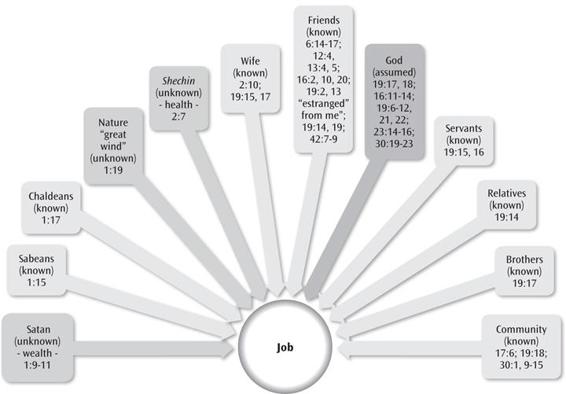
Following the rigid cause-and-effect mindset of Job’s friends regarding sin, judgment, and suffering, God was quickly reduced in their eyes to being merely a rewarder or a punisher. But this does not explain human existence in a fallen world. How would one explain the life of Joseph (Gn 37–38), Jesus (the Gospels), Lazarus (Lk 16:20-25), or the righteous poor widow (Mk 12:41-44)? The pressure was building in Job’s life by way of known and unknown aggression. The chart “Development of Aggression toward Job” portrays the many individuals and groups with whom Job had contact, and illustrates the many-sided attacks and accusations he faced. In light of these “enemies” massed against him, it becomes easier to see why Job retreated into a fortress of self-defense and self-justification.
VI. The Speeches of Elihu (32:1–37:24)
A. His First Speech about Job, His Friends, and God’s Work (32:1–33:33)
32:1-5. Job’s three so-called friends had heard enough from Job, and they agreed the main problem was that Job was proud and righteous in his own eyes. This was a serious flaw in Job’s character, as far as they were concerned, especially given their certainty that he was guilty of sinning and then trying to deny it. At least one more friend by the name of Elihu had listened in on these debates. He was identified as a descendant of Barachel the Buzite. Nahor, a brother of Abraham, and his wife Milcah had several sons including Uz and Buz. It is possible that Elihu’s ancestor Barachel, a Buzite, was a descendant of this Buz, but it is impossible to be certain. Previously this silent younger friend of Job had listened with growing anger, first toward Job, because he justified himself before God (v. 3), the same charge as the three others leveled against Job (v. 1). Elihu was exasperated by Job’s ponderous assertions of self-righteousness and arrogance toward God. But Elihu was also furious with Eliphaz, Bildad, and Zophar because, despite their flimsy arguments and faulty reasoning, they had droned on with lengthy addresses that had not silenced Job or provided any proof of their accusations (vv. 4-5).
Some scholars have suggested Elihu as the most logical author of Job. Shimon Bakon suggests, “It would be a most gratifying guess that it is Elihu … who is the enigmatic author of Job. … Elihu is the only one of all the main characters called by a full name; his speeches tie together the different parts of the book into an organic entity that gives it a distinct expression to one of the main themes in the book of Job—to suffer for the sake of purification” (“The Enigma of Elihu,” Dor le Dor 12 [1984]: 228).
32:6-14. Despite his burning anger, Elihu began by acknowledging his “junior” status in the presence of his elders. He even described himself as shy and afraid to speak up because he thought that wisdom would come from the three older men (vv. 6-7). But he confronted Job and the three friends with the reminder that being older did not guarantee that wisdom would be understood or used, because it came from the breath of the Almighty (vv. 8-9). So Elihu said, Listen to me (v. 10). “In view of his daring assertion that his elders were ignorant, he found it necessary to plead for a hearing” (Zuck, Job, 143). Elihu said again that the three friends had failed to refute Job (cf. v. 3), concluding that they lacked wisdom from God. But since Elihu had such wisdom, he claimed, he would argue against Job using that wisdom (vv. 11-14).
32:15-22. Elihu felt compelled to speak up because the other three men had run out of words in their attempt to prove Job was a sinner who deserved his fate (vv. 15-16). But Elihu had some ideas and opinions of his own to share, and he was ready, full of words, and eager to speak (vv. 17-18). He was so pent up, in fact, that he felt as if his insides would burst like fermenting wine bursting new wineskins if he kept silent any longer. He had to speak to get relief (vv. 19-20). Elihu also piously claimed that what he was about to say was completely fair and impartial, devoid of bias or flattery, of which he claimed he was incapable (vv. 21-22). As Zuck notes, “[Elihu’s] anger had not caused him to lose his sense of self-importance” (Job, 144).
33:1-7. In his first speech, Elihu sought to assure Job that what he was about to say came from a motive of uprightness, and from a mouth that would speak knowledge sincerely (vv. 1-3), perhaps suggesting that the other three men had not been sincere in their words. Elihu put himself on the same level as Job by acknowledging that he too was created by God (v. 4). Despite Elihu’s challenge that Job refute him if possible, and array himself for battle, Elihu’s desire was that Job would not be terrified by his arguments (since he was also a creature of God’s making, like Job, v. 6) or feel pressured by him (v. 7).
33:8-18. Elihu then said he had heard all of Job’s declarations of innocence. He could even quote Job’s words back to him, including Job’s charge that God had made up charges against Job and treated him like an enemy and a prisoner, watching him closely to seize the opportunity to charge him with wrongdoing (vv. 8-11). But Elihu declared Job was wrong in saying that God was against him (v. 12). Then he launched a strong rebuttal of Job. God does speak, Elihu asserted, even using dreams, all in an effort to keep man from pride, which would lead to his destruction (vv. 14-18). Eliphaz claimed that a dream provided the authoritative content with which to confront Job. Job claimed he had been terrified with nightmares from God. Elihu’s point is that God used dreams to speak to people but, by implication, Job had failed to hear His message. The primary contents of the dreams from God included the need to avoid sin (vv. 17-18).
33:19-22. Besides communicating through dreams, God also communicates through sickness. Here Elihu used an illustration that “struck nearer to home for Job” (Alden, Job, 328). He had experienced continued pain on his bed and unceasing complaint in his bones (v. 19), to the point that he not only had lost interest in eating, but his body revolted at the sight of even his favorite food (v. 20; cf. 3:24; 6:7). Verse 21 also describes the wasting disease afflicting Job, which he felt more than once was bringing him close to death (v. 22).
33:23-28. Here Elihu offered a word of hope in the form of an angel who may intercede for the afflicted person and deliver him from death through the payment of a ransom (vv. 23-24), whether “the repentance of the sick person or a gracious atonement” (Zuck, Job, 147). The sufferer who is ransomed in this way will regain his youthful vigor, his physical health, and undergo a spiritual renewal so that he can pray again and sing (vv. 25-27) because God has redeemed his life from going down into the pit of death (v. 28).
33:29-33. God’s purpose in this restoration is to reestablish the sufferer’s fellowship with Him. Elihu concluded his first speech by pleading with Job to listen to him, because he wanted to justify Job and because he had wisdom to offer.
Elihu’s theology differed slightly from those of Job’s three friends. They saw suffering as a result of God’s retribution for one’s sin. But Elihu asserted that suffering can be instructive, calling attention to one’s sins, and can serve as a preventive measure whereby one is warned and can escape death. Illness, said Elihu, is designed by God to woo people back to Him (Then he will pray to God, and He will accept him, v. 26). This wooing could be mediated through angelic beings in Elihu’s thinking (v. 23). As did Job’s three friends, Elihu connected suffering with sin. But unlike them, he saw a more tender, restorative purpose in it than they did. And as Job’s friends did, Elihu misunderstood the situation as it related to Job, who was not guilty of sin that warranted such suffering.
B. His Second Speech (34:1-37)
34:1-9. In his second speech, Elihu answered Job’s accusations that God was unjust. Verses 1-15 are addressed to Job’s three friends, and vv. 16-37 are spoken to Job (the “you” is singular). Elihu asked again for a hearing from the group and called on them to decide, based on what he had to say, whether Job was right or wrong in charging God with being unjust toward him (vv. 1-4). Elihu then quoted Job’s basic defense (vv. 5-6), and took the side of the friends by saying that he drinks up derision like water (v. 7), similar to the charge Eliphaz had made in 15:16. Elihu criticized Job for being irreverent, and later for being spiritually ignorant (vv. 34-37). He also accused Job of keeping company with the workers of iniquity and walking with wicked men (v. 8). Elihu offered no proof of that charge, but he was right in repeating Job’s contention that it had done him no good to maintain his integrity before God (v. 9). Elihu reproved Job for his claim that no tangible good comes from one’s relationship with God (see Job’s earlier comments in 21:15), and in chap. 35 gave a lengthy response to the allegation (see the comments there).
34:10-15. Sounding like Bildad, Elihu defended God’s justice. It was unthinkable that God … the Almighty would do wickedness or do wrong (v. 10). He does not pervert justice. Elihu maintained that God is just in His dealings with humankind (v. 11), is answerable to no one because of His sovereign authority over the earth (vv. 12-13), and has the right to sustain life or to take it away as He determines (vv. 14-15).
34:16-30. God is righteous and impartial, showing no favoritism to a king, to nobles, or to the rich, because they are all the creations of His hands whom He can remove in a moment. God does not need the aid of a human hand to carry out His judgments (vv. 16-20). In His omniscience He sees everything everyone does (v. 21); there is no darkness dark enough or shadow deep enough for the workers of iniquity to hide themselves from God’s all-seeing eyes. He can judge righteously in an instant without having to investigate a matter further or bring the person into His court (vv. 23-24). Evildoers should take warning, because God can overthrow them either in the night, when others do not see them, or in a public place where their punishment can be seen (vv. 25-26). God judges the wicked because they turned away from following Him and had no regard for any of His ways (v. 27). As a result of their arrogance in thinking God would not see or punish them, the wicked proceeded to oppress the poor and the afflicted, who cried out to God for justice (v. 28). But even if God keeps silent when people are downtrodden without cause (as Job accused Him of doing to him), that does not give Job the right to condemn Him (vv. 29-30).
34:31-37. In these verses, Elihu applied the attributes of God he presented in vv. 10-30 to Job and his situation. Elihu presented Job with a hypothetical prayer he could pray as a way of admitting to God that he had committed iniquity (vv. 31-32). Elihu then gave Job an indirect ultimatum: it was up to Job, and no one else, to let go of his insistence on his innocence and submit to God’s evaluation of him (v. 33). Elihu contended that Job was speaking without knowledge and without wisdom (v. 35) and was being rebellious against God who is all-powerful and sovereign. Far from being wise, Job needed to be judged to the limit—“a cruel statement [that] sounds like Zophar’s cutting words that God was not giving [Job] all the punishment he deserved” (Zuck, Job, 151). Job had taken a wrong turn in his theological thinking and, in Elihu’s opinion, needed to confess it. Like his three older friends, Elihu felt Job had lied about his innocence. He strived to defend God based on an inaccurate knowledge of Job’s situation—which started with the dispute in heaven and not with his own gross sin.
C. His Third Speech (35:1-16)
35:1-8. In this paragraph Elihu continued (cf. 34:9) his response to Job’s insistence that a relationship with God brings no benefits (cf. 21:15). Elihu’s response was that: “(1) God is supreme, and thus He is not affected by or dependent on man’s innocence or sin, and (2) God’s lack of response to Job’s cries was because of his pride” (Zuck, Job, 152–53). Elihu charged Job with being inconsistent. Job claimed to be righteous (v. 2). But a person who was truly righteous would not say there is no profit in seeking to live righteously before God. Elihu used the same approach he had used earlier, quoting Job (vv. 2-3) and then refuting his logic (vv. 4-8). It did not make sense for Job to claim that he was righteous before God, and then turn around and argue that being righteous in God’s sight brought him no advantage. But as noted above, God remains essentially unscathed by human actions, whether good or evil. He judges all impartially. An evil person cannot scare God into treating him well (v. 6), nor can anyone bribe God to be kind to him (v. 7). God has impartially and objectively determined that people “get what they deserve,” whether wickedness for wicked people (by implication, Job) or righteous treatment for righteous people (v. 8). Human attempts to intimidate or bribe God have no influence whatsoever with Him.
35:9-13. According to Elihu, people tend to cry for help to God when they suffer. But He does not always answer these cries, he continued, because they were just pleas for deliverance from trouble instead of a true prayer of humility to God. Then Elihu enumerated three benefits God gives to those who trust in Him (vv. 10b-11). First, He gives songs in the night, suggesting how a believer can find true comfort even in the midst of trouble. Second, He teaches people more than He teaches the animals. Third, He makes humans wiser than the birds. As Alden points out, “These two sentences [in v. 11] are not very profound, but they are one more hint of the upcoming revelation of God, who will interrogate Job about the ‘beasts of the earth’ and the ‘birds of the air’ (38:39–39:27)” (Job, 345).
Elihu continued his subject of unanswered prayer by saying that God did not respond to the prayers of the oppressed because they were offered in the pride of evil men (v. 12), possibly demanding that God provide relief for them. This was no doubt an indirect reference to Job, whom his friends saw as a proud protestor crying out to God not in humility and repentance, but in arrogant pride demanding a hearing and an acquittal from the Almighty.
35:14-16. Such prayers from someone who said God had been unfair to him would much less be answered. Elihu advised Job to wait for God to rule on his case. Elihu believed that Job babbled on without knowledge of what he was talking about (cf. 34:35) and therefore, it was time for him to be silent and see what God would say. In v. 15, Elihu responded to Job’s assertion in 21:14-21 that God does not punish the wicked as evidenced by their easy lives. As he said in 35:1-8, God does judge the unrighteous, for His impartiality requires it. In v. 16, Elihu may have turned to Job’s friends in a sort of aside to give his opinion of Job’s words (they are empty and ignorant). This charge “was Elihu’s chance to turn this phrase against Job, and he did, although Job had not said anything since Elihu began speaking one hundred verses ago. Thus Elihu showed himself to be of the same mold as the other three” (Alden, Job, 347).
D. His Fourth Speech (36:1–37:24)
36:1-4. In his final speech, Elihu claimed to speak with the authority of God (v. 2), asserting that there is an advantage to living a righteous life. Alden calls this “a new tack,” and says,
[Elihu’s] tone smacks of arrogance, a sin he indirectly accused Job of in 35:12. Insofar as he went on to speak of God’s greatness, his veracity cannot be questioned, but scattered throughout the speech are innuendoes that indicate his assessment of Job’s problems has not changed. (Job, 347)
Elihu’s arrogance is on display in his declaration, One who is perfect in knowledge is with you (v. 4).
36:5-11. Elihu emphasized God’s strength, mercy, and justice, the latter seen in judging the wicked (v. 6), something which Job had questioned. God not only keeps His eyes on the righteous, but exalts them like kings (v. 7). If they encounter hardship, it is because of their sin, but those hardships are God’s means for providing spiritual instruction for them so that they will repent and find full restoration (vv. 8-11). Once again, Elihu’s view of suffering is much more positive than that of the three older friends. It can be remedial and redemptive, not just retributive, and those who return to God and serve Him will benefit from such action (see also vv. 15-16). His statement that the righteous can respond to God’s chastening by repenting of their transgressions (v. 9) and evil (v. 10), and enjoying His renewed blessing, was clearly meant for Job’s ears. The other three friends must have been nodding in agreement, since their relentless message to Job was to confess his sins and regain God’s favor.
36:12-16. Elihu also presented the alternative to repentance and restoration of God’s blessing for those who have sinned: death by the sword, dying young, and without knowledge (v. 12), that is, without ever learning the lessons God had for them in their suffering. This was another warning aimed at Job, and a not-so-subtle call for him to repent while there was still time. Elihu cautioned Job not to react to his trials as the godless do, becoming angry at God but not crying out to Him for help in their distress, dying in youth in shameful circumstances (vv. 13-14). Yet He relieves the afflicted, enabling the oppressed to obey (opens their ear). And Elihu said God gave Job a broad place (that is, a life with blessings) and food in abundance (vv. 15-16).
36:17-25. At this point, Elihu began to apply vv. 1-16 to Job. Verse 17 is notoriously difficult. The NET translates it, “But now you are preoccupied with the judgment due the wicked, judgment and justice take hold of you” (see also the HCSB). It is possible that the Hebrew means, “You are full of the wicked person’s judgment”—that is, often you have judged others as an unrighteous person would judge them when you executed your magisterial tasks. As a result, God’s judgment has justly come together and landed upon Job. The ransom of v. 18 is often translated “bribe” (see 1Sm 12:3; Am 5:12; Pr 6:35), and Elihu was probably warning Job not to allow even a large bribe to deter him from full repentance and restoration with God. The reason is that riches are not a buffer to distress (v. 19). Elihu’s final warning to Job is do not turn to evil, which he believed Job had preferred by complaining about his suffering rather than repenting and finding God’s restoration. Instead of stubbornly clinging to his claims of innocence, Job should turn to God and learn from Him rather than accusing Him of wrongdoing in the way He was dealing with Job (v. 23). Elihu also said that Job needed to exalt God’s works, about which godly people sing praises, and which all men have seen, even if from afar (vv. 24-25).
36:26-33. Beginning with 36:26 and continuing to the end of his speech in 37:24, Elihu turned from considering Job’s plight to the majesty of God. God is exalted and infinite. He controls all aspects of nature, including evaporation of rain water, clouds, thunder, and lightning, and He provides food for mankind. Some commentators see in these closing verses a prelude to the storm that speaks of God’s power, and out of which He will soon speak to Job (cf. 38:1). Alden says, “[T]he storm is evidence of divine power. Awesome in its power, it speaks to the difference between God’s control over the elements and human inability to cope with them when they are stirred up” (Job, 357). God’s greatness should lead people, including Job, to revere Him and not reject Him. In this section Elihu foreshadows much of what God will say about Himself and His governance of the world in chaps. 38–41.
37:1-13. Elihu continued his vivid word picture of a storm, which speaks so eloquently of God’s sovereignty in nature: thunder, lightning, snow, rain, storms, cold, and ice. The thought of God’s overwhelming majesty and power caused Elihu’s heart to palpitate and leap from its place in fear and awe (v. 1). When God unleashes His thunder and lightning, people must stop their work (v. 7) and seek shelter, knowing that the storm is the work of God, and the animals retreat to their dens (v. 8). God sends these phenomena of nature both for correction and for lovingkindness (v. 13), as He sees fit. As people focus on God’s power apparent in creation, they will adopt the correct attitude of reverence and submission to him, according to Elihu’s theology.
37:14-20. In vv. 1-13 Elihu spoke of God’s work in nature in the winter. Now he spoke of God’s sovereignty in the summer: lightning, clouds, south wind, skies bright like a mirror. Once again, Elihu paused to call for Job’s attention so he could apply his words to the sufferer. As long-winded as Elihu had been, his advice in v. 14b, Stand and consider the wonders of God, was ultimately what Job would have to do. It is also good advice for God’s people in any age under any circumstances. All believers need to be reminded that they are the work of the great God who, in His grace, has chosen to bestow His love and favor on them. The darkness here (v. 19) probably refers to the moral and intellectual dimness that besets humanity, rendering a legal argument against God futile. Verse 20 could be paraphrased, “Should someone say to God, ‘Listen up’? If someone does that, any audience he would have with God would result in him being devoured.”
37:21-24. These are Elihu’s final words, and with them the arguments of Job’s four visitors are ended. God’s awesome majesty is seen in the skies and the north. God stretches out the clouds in the sky (v. 18), but also brings the wind to clear the skies so the sun, moon, and stars can be seen (v. 21). But God cannot be seen, and therefore no one can find Him. He is both powerful and just. Therefore people should fear Him and put away pride, a final call to Job to abandon his stubborn refusal to admit his sin and bow humbly before the Lord in confession and repentance.
Did Elihu’s speeches advance the case against Job or deepen his understanding of God and His ways? Neither the other three men, nor Elihu persuaded Job to relinquish his position, although most commentators acknowledge that Elihu went deeper into the character and ways of God than did the older men—by pointing out that suffering can be a teaching tool leading to healing and restoration instead of simply being retributive. Zuck says,
Elihu thus prepared the way for God to speak. Although he stressed aspects of suffering and of the character of God beyond those mentioned by [the other men], he did not have total insight into Job’s situation. In fact … no man could. It was therefore necessary that God speak. (Job, 162)
VII. God Speaks to Job (38:1–42:17)
Perhaps the most fascinating portion of Scripture on general revelation is Job 38–41, because God was using it to address Job’s arguments, accusations, and questions.
Gordon R. Lewis and Bruce A. Demarest write:
General revelation refers to the disclosure of God in nature, in providential history and in the moral law in the heart, whereby all people at all times and places gain a rudimentary understanding of the Creator and His moral demand. (Integrative Theology [Grand Rapids, MI: Zondervan, 1987], 1:61)
In Jb 38–41, Job found himself in God’s “interrogation room” of the universe. After asking Job more than 60 rhetorical questions on many aspects of general revelation, God finally brought Job to silence. What exactly can be said about how God used general revelation in this particular passage of Scripture? Can the reason for this extensive barrage of interrogative statements be discerned? Do we learn anything substantial about the proper use and understanding of the place of general revelation? What is God doing with general revelation in His response to Job? What did Job comprehend, and what answers did God provide? Roland E. Murphy notes, “It has been well-said that when the Lord ‘replies’ to Job, He lets nature do the talking (Job 38–41)” (Tree of Life [New York: Doubleday, 1990], 3–4).
A survey of the positions on this section of Job immediately places the reader in a torrential rainstorm of material. One is reminded of the conclusion of the Czechoslovakian scholar, Milos Bic, when he stated almost 45 years ago, “There is an unmanageable mass of literature on the book of Job” (Review of Alfred Jepsen: Das Buch Hiob und seine Deutung [Berlin: Evangelische Verlogsanstalt, 1963], 46–47). As one examines the views concerning the “Speeches of Yahweh,” Bic’s conclusion has been seen as valid. Leo G. Perdue cogently states, “While the ‘Speeches from the Whirlwind’ (38–42:6) provide the climax of the poetic book, no consensus of their interpretation has emerged” (Wisdom in Revolt [Sheffield: Almond Press, 1991], 196). James G. Williams helpfully notes, “There has been an explosion of interpretations of Job in the modern Western world. Most interpreters will agree on one thing: the theophany or addresses of God in Job 38–41 provide the key to the book” (“The Theophany of Job,” in Sitting with Job: Selected Studies on the Book of Job, ed. Roy B. Zuck [Grand Rapids, MI: Baker Book House, 1992], 359). Based on the structure of the book of Job and that Jb 28 is the apex of the book with its wisdom theme, Williams is not fully correct, but Jb 38–41 is an important factor in understanding the account as it supports the central apex in Jb 28.
Yahweh’s questions are designed to expose the impotence of all rival deities and individuals. The addresses were a defense against Job’s accusations. As Job pressed God for an answer in the preceding chapters, his attitude became sinful as he began to view his affliction as a travesty by God. Therefore Yahweh asked questions to bring Job to realize his ignorance and God’s wise omniscience and omnipotence in all the affairs of nature and humanity. Job needed to repent before God, based on what had been revealed.
Parsons points out that
a main function of the Lord’s speeches is to show the absurdity of Job’s attempt to manipulate God by a “lawsuit,” which assumed that his relationship to God is a juridical one…. In 40:8-14, God demonstrated the fallacy of Job’s impugning His justice in order to vindicate himself. (Parsons, “Structure and Purpose,” 149)
Initially, Job was a great spiritual example as he responded to his losses. However, as the months wore on (7:2; 29:3), the afflictions and disasters started to take their toll. He became worn down physically, mentally, emotionally, and even spiritually. Job started out as a strong spiritual example, but over time cracks began to appear in his theological mindset as he questioned, challenged, and wrongfully accused God of being unjust, uncaring, and malicious.
The Yahweh Speeches (hereafter referred to as YS for brevity) are filled with rhetorical questions. Michael Fox explains:
God is not quizzing Job…. Rather, God is saying to Job, “You know very well that I and I alone created order and maintain it in the world, and I know that you know and you know that I know you know” (“Job 38 and God’s Rhetoric,” Semeia 19 [1981]: 58–59)
How have the YS fared in the interpreter’s fire over the past 2,000 years? There are two millennia of Jewish and Christian interpretations of this interesting but perplexing section of the book of Job, and their significance is debated. The following are several of the major views commentators have taken on the YS of Jb 38–41. No one position captures every feature, and some positions are stronger than others. But each of the five views listed below has something to commend it, along with its limitations.
1. The Grand Paradox Viewpoint. Yahweh’s actions are paradoxical and indiscernible by humans; therefore the only way out of this dilemma is to align with Yahweh and hope for the best. The YS demonstrate a host of paradoxes, from simple to complex, that bring Job to a dead end in seeking to understand God. Perdue notes,
God’s actions in the world are paradoxical: He nurtures but limits the Yam [the sea], checks the power of death by the recurring of birth, and feeds the offspring of eagles with the dead flesh of other creatures. In a world of paradoxes, Job’s speeches rooted in the idea of retribution make no sense and thus are dismissed. (Wisdom in Revolt, 197)
It is impossible and ridiculous to judge Yahweh’s actions or to try to figure Him out. The numerous references throughout Job to the inscrutable ways of God testify to the thesis that His ways are past finding out. Job’s experience, and the rigid view of God’s retribution proposed by his three friends—which Job demonstrated to be untenable—prove that God’s sovereign will cannot be reduced to a humanly created formula.
2. The Maintenance-Mode Viewpoint. Yahweh maintains justice in creation and history despite the presence of chaos and imperfection. The YS portray Yahweh as in the maintenance-mode concerning moral order in the universe, thus giving Job an indirect response to his questions.
Robert Gordis states, “The vivid and joyous description of nature is not an end in itself: it underscores the insight that nature is not merely a mystery, but is also a miracle, a cosmos, a thing of beauty. From this flows the basic conclusion at which the poet has arrived: just as there is order and harmony in the natural world, though imperfectly grasped by man, so there is order and meaning in the moral sphere, though often incomprehensible to man….” (The Book of Job, 133).
There is no question that God maintains moral order in His universe, although this view does not seem to speak to the issue of how mankind should respond to the revelation of God’s purpose in creation and in history.
3. The Lawsuit Viewpoint. Yahweh responded to Job in the context of a courtroom atmosphere since Job had leveled charges against God’s management of his life and the universe. The YS stand as the testimony of Yahweh, the defendant, in the lawsuit brought by Job. Sylvia H. Scholnick states:
As many scholars have recognized, the poet chooses the court of justice as the setting for the dialogue between Job and his friends. He dramatizes the hero’s search for an acceptable definition of the meaning of divine justice by structuring the work around a lawsuit which the man from Uz initiates against God. The case is comprised of several interwoven complaints. But when God speaks from the whirlwind, the setting of the drama appears to shift to what Alter calls the “arena of creation.” (“Poetry in the Courtroom: Job 38–41,” in Directions in Hebrew Poetry, ed. Elaine Follis [Sheffield: JSOT Press, 1987], 185–86)
This is a very common view of the YS, and one for which strong evidence appears in the text. That Yahweh twice used the “gird up your loins” metaphor of a challenge in 38:3 and 40:7 supports the lawsuit viewpoint. Job had repeatedly pled for a hearing before God, and said he had marshaled his arguments so as to win a “not guilty” verdict from the Almighty. So this viewpoint has the strength of offering a fitting conclusion to Job’s case, although God did not respond in the way Job or his friends thought He would. Job was not called to testify!
4. The Legal Challenge Viewpoint. The book of Job is similar to a challenge motif concerning who is “god,” whether Yahweh or the gods of the nations. The questions in the YS are designed to expose the impotence of all rival deities. In Job the opposing parties are Yahweh and Job; therefore the YS are a defense against Job’s accusations. Henry L. Rowold noted that “the questions in Job 38–41, as in Is 40–66, do not seek information. Instead they are challenges to the opponent” (“Leviathan and Job in Job 41:2-3,” Journal of Biblical Literature 105 [March 1986]: 104–9). This lawsuit format is not a covenant court trial (rib) in which Yahweh prosecutes His people for breach of covenant. Instead it is a challenge to an opponent. This view takes a different approach to the legal argument of Jb 38–41 in that Job’s situation is not the issue.
5. The Lawsuit/Lament Viewpoint. The book of Job is in the form of an expanded lament and lawsuit. The YS are the “salvation oracle” to the individual in need of help or deliverance. Claus Westermann states:
The full significance of God’s answering Job becomes apparent only when viewed against the background of the book’s structure. We have seen how the element of a summons to a lawsuit is contained in the wish that God might answer Job. Here converge two lines that have run through the whole book so far: the legal proceedings and the lament. In line with the legal proceedings, Job, who was accused by the friends of being a transgressor, appeals to that higher court which is at the same time, however, the very opponent he summons to a lawsuit. In line with the lament, that point is now reached at which, in the genre of the lament psalm, the answer of God is expected…. (The Structure of the Book of Job, trans. Charles A. Muenchow [Minneapolis: Fortress, 1981], 105–6)
J. E. Hartley adds, “The Yahweh Speeches thus relate to the two dominant elements in Job’s speeches, lament and lawsuit…. As a result Yahweh wins the lawsuit by reducing Job to silence. As for lament, Yahweh delivers to Job a word of hope, similar to an oracle of salvation” (The Book of Job, 489). Proponents of this view note that Job cried for litigation, not deliverance. The lament and lawsuit elements of Job’s speeches have been noted throughout this work, and they are clearly two key motifs. Whether the YS constitute a “salvation oracle” is open to debate.
6. The Traditional Viewpoint. Yahweh is the sovereign Creator and Master of the universe; therefore questioning or arguing with Him is ridiculous, but repenting and praising Him are in order. The YS illustrate these two essential ideas: Yahweh is Creator and Master of the universe. If these two ideas are true, then Job needs to adjust his attitude if he truly wishes to be correct about his notion of what is going on in his situation as it concerns the Almighty. Included in this adjustment is the need he had, not only to correct his attitudes about God, but also to embrace and accept what God had ordained for his life. Lewis and Demarest summarize, “The vast expanse … clearly reflects the infinite Mind that created and orders all these phenomena… . Through the medium of a magnificent cosmos the observer plainly perceives the reality of the God who made and who upholds all that is” (Integrative Theology, 1:67). This view may have the most to commend it in terms of bringing together the various elements of the YS.
Bullock notes concerning the YS,
Significantly, the answer to the question “Why do the innocent suffer?” is nowhere spelled out in the God Speeches. The Lord did not accommodate Himself to so simplistic a formulation of so profound a mystery. Job had begun with the challenge that God explain his own personal dilemma…. [But] the Lord’s answer was phrased almost altogether in universal terms. (An Introduction to the Old Testament Poetic Books, 107)
A. God’s First Speech about His Knowledge (38:1–40:2)
38:1-3. When God finally responded to Job, He answered … out of the whirlwind. This may have been frightening to Job. The word darkens means “to distort something, to place something in a false or bad light.” Counsel means “a plan, design, purposeful scheme.” Without knowledge suggests that there is no way Job could have known all the facts about God’s confrontation with Satan. Job’s comments about God were thus based upon ignorance of God’s plans and actions, and yet Job’s comments had put God and His providential rule of the universe in a bad light. God challenged Job, gird up your loins like a soldier and get ready for an intellectual and spiritual battle! God was ready to do battle (9:34; 10:2-9; 23:3-9; 31:35), and He was up to the challenges of his human contender, Job. God said He would ask Job, and ironically, He challenged him to instruct Him. “Job the plaintiff had suddenly become the defendant!” (Zuck, Job, 165).
38:4–39:30. Although God had told Job to be prepared to answer Him, He began immediately with a tremendous series of questions for which Job had no answer at all. God questioned Job about his relationship to the physical universe, here inanimate creation. God asked him about the creation of the earth (vv. 4-7); the origin and limits of the sea (vv. 8-11); Job’s ability to cause the sun to rise each morning (vv. 12-15); the hidden aspects of creation not visible to humankind (vv. 16-18); the location and properties of the sun (vv. 19-20); the spasmodic tendencies of the weather (vv. 22-30); how the stars operate (vv. 31-33); and details related to droughts (vv. 34-38).
God also questioned Job about his comprehension of the mechanical function of these aspects of the creation (vv. 4, 18, 20-21, and 33). If Job could not answer these questions, he had no right to question God’s design of the universe. In addition, vv. 10-11, 12-15, 26-27, and 37-38 emphasize God’s goodness as advertised in creation. Job had questioned and doubted God’s wisdom and knowledge in how He ran the world, especially in light of Job’s undeserved suffering. Job also questioned God’s goodness. Here, in chap. 38, using numerous features of inanimate creation, God refuted Job’s allegations by asking him to account for where he was when God created or determined the various elements of the natural world where Job resided. So God put Job to the test. “Job, can you pass this rhetorical quiz? Answer if you are able.” The 18 questions in this quiz, which continues all the way to the end of chap. 39 are not only impressive, but unanswerable by any human being.
1. Where were you when I designed and built the earth? (38:4-6)
2. Where were you when the sons of God sang about it? (38:7)
3. Where were you when I set the oceans and their boundaries? (38:8-11)
4. Have you ever commanded … the dawn to appear? (38:12-15)
5. Have you ever explored the depths of the oceans? (38:16-18)
6. Have you understood the expanse of the earth? (38:18)
7. Do you know where light and darkness dwell? (38:19-21)
8. Do you know where snow and hail are stored? (38:22-24)
9. Do you know about thunderbolts, rain … ice … frost? (38:25-30)
10. Do you control each constellation and its orbit? (38:31-33)
11. Do you cause rain and lightnings and give people wisdom? (38:34-38)
12. Do you feed lions and their cubs or the ravens and their young? (38:39-41)
13. Do you know when mountain goats and deer are born? (39:1-4)
14. Did you loose the wild donkey and care for each one? (39:5-8)
15. Do you control the wild ox or does he obey you? (39:9-12)
16. Did you give the female ostrich low intelligence? (39:13-18)
17. Did you give the war horse abilities for battle? (39:19-25)
18. Did you give the hawk and the eagle incredible eyesight? (39:26-30)
In the second part of God’s quizzing of Job, He interrogated him about his relationship to and knowledge of animate creation (questions 12-18). As noted above, God asked Job about lions (38:39-40); ravens (38:41); mountain goats (39:1-4); wild donkeys (39:5-8); wild oxen (39:9-12); the ostrich (39:13-18); the horse (39:19-25) and predatory birds (39:26-30). It would be impossible for Job to know much about “what makes these animals tick,” their skills, behavior, instincts. But God knows about these creatures. Furthermore, the description of each animal also includes a description God’s goodness to the animal—either by providing what these animals need to stay alive (for example, lions and ravens in 38:39-41; the hawk and eagle in 39:26-30), or by giving these animals the physical dexterity necessary to live (the mountain goat’s inherent toughness in 39:1-4; the horse’s strength and speed in 39:19-25).
40:1-2. These verses are Job’s first response to God. God asked Job, Will the faultfinder contend with the Almighty? (vv. 1-2), that is, “Will you continue to indict me for injustice?” (Zuck, Job, 175). Faultfinder means “one who reproaches or scorns, who censors” another. It is a noun related to a verb that means “to admonish” or “correct.”
B. Job’s Response to God’s First Speech (40:3-5)
40:3-5. In 10:2 and 23:6, Job accused God of contending with him unjustly, and thus reproached Him. But in the first encounter with God, Job saw God’s skill, knowledge, power, and goodness in nature. How could he then continue to find fault with God? Job was deficient in his knowledge of God’s ways and incompetent to control the universe, so how could Job presume to expect God to give an account of His actions to him? Reproves is a legal term that means “to incriminate, criticize, make a charge against” another. Job had no right to do this against God since he was God’s inferior.
Faced with God’s question for which he had no answer, Job wisely chose silence (vv. 3-5). He was ashamed because he realized he had already said too much in charging God with treating him unjustly. Admitting that he could not instruct God (cf. 38:3), Job confessed, I am insignificant, meaning “light” or “slight.” In essence Job stated, “In comparison to you, God, I am a nobody!” Job’s former self-confidence and pride (see 13:22) are now shriveled into humility, for he said, What can I reply to You? In 31:37, Job said that he would act like a prince and approach God with no thought of bowing to Him (Jb 31:37). But here he is put in his proper place. I lay my hand on my mouth indicates that Job realized he needed to remain silent before God. He had spoken critically of God on more than one occasion (Once I have spoken … Even twice), but now realized he must say nothing more. Nevertheless, however much Job was humbled at this point, he was not as yet repentant. To bring him to that point, God would interrogate him.
C. God’s Second Speech about His Power (40:6–41:34)
God made His second speech to Job, again out of the storm (40:6). In a pattern similar to the first speech, God challenged and questioned Job, and Job responded.
40:6-9. God shouted to Job from the storm, Now gird up your loins like a man (40:6-7) to face His interrogation, a repetition of God’s challenge in 38:3. God’s justice, which Job had questioned previously (see, e.g., 9:24), is touched on briefly by God. Annul means “to break, dissolve, destroy.” Job had blamed God for being unjust in his misfortune. But any mortal’s alleged superiority that would enable him to criticize God for His apparent lack of justice must be accompanied by a similar superiority of power (v. 9). God challenged Job to assume the role of Deity. But it is apparent that God has no equals in power, especially not in Job. Job is not only inferior to God, he is not even remotely God’s equal (v. 9). He does not have the strength (arm) or voice (thunder) needed to contend with Him. Job had no choice but to stand silently while the thunder of God’s voice broke over him.
40:10-14. Continuing the idea of Job’s inferiority stated in v. 9, God challenged him to run the universe better than God did. God’s assignment to Job was to bring down the wicked and proud by unleashing his anger, humiliating them just by looking at them, demolishing them, burying them. If Job could do this, which Job had accused God of neglecting (see 21:7-26), God would praise Job as one superior to Him, and Job could justify himself. But humankind cannot do this. Therefore, one must simply depend on God, even though people cannot comprehend God’s ways. As Zuck states,
Because Job was unable to assume God’s managerial responsibilities over the wicked, it became clear that he could not save himself. Hence it follows that man, dependent on God, must not question Him, even though he cannot fully comprehend His ways. (Job, 177)
40:15-24. Job had impugned God’s justice (9:24, as noted above; cf. also 10:3; 12:6, 16:11), and challenged His sovereignty by saying he would happily go to court with God and present a case against Him—and win (cf. 13:3; 23:1-7, 10). Here God addressed those very aspects of His nature, challenging Job to find any fault with His justice and, by implication, present his challenge if he thought there was any way he could contend successfully with God.
The ancients were well aware of the Canaanite and Chaldean creation myths—epics and symbols of the enemies of the stability in the cosmos and the chaos they could inflict. As Dyrness explains, “Old Testament writers borrowed Canaanite and Babylonian mythical elements to use them in their picture of the world” (Themes in the Old Testament Theology, 69). God could cut or dismember Rahab, the personification of the raging sea (Jb 26:12; 38:8-11), and could pierce through the mythic dragon (Is 51:9; cf. Rv 12:7-9). Nevertheless, for the following reasons, Zuck suggests that it is more likely that the Behemoth and the Leviathan, described in this section, were actual beasts and not merely mythological (Job, 177–78). (1) In His speech, God declared that He had made Behemoth (40:15) and Leviathan (41:1). (2) The descriptions of these animals’ anatomies are so precise that they appear to be real. (3) Mythical animals were based on actual animals, albeit with exaggerated or added features. (4) All the animals God listed in His first speech were real. (5) The Bible speaks of both Behemoth and Leviathan in other parts of the Bible without any mythological connotations (Ps 104:26; Jl 1:20).
As to the significance of God’s citing these animals, Zuck states, “The purpose in this zoom-lens photography of Behemoth (40:15-24) and Leviathan (chap. 41) was the same as in the first speech: to impress Job with his feeble puniness in contrast to God’s majestic power” (Zuck, Job, 177).
Attempts to identify Behemoth have run the gamut. This creature has been identified as the elephant (Aquinas), the buffalo (Couroye), or the hippopotamus (Archer; Zuck), but none of these fits all the description of this creature. Some believe it was a creature that is now extinct, or as mentioned above, mythic (Alden, Job, 395–96). Whatever the identity of this animal, its impressiveness is beyond doubt. God called it first in His ways, probably in reference to its size and strength. Verse 19b could refer to the Behemoth being so large and powerful that only his maker could approach him with the idea of engaging him in combat or trying to subdue him.
41:1-34. Some believe the Leviathan to be a mythical monster identical to Lotan mentioned in texts at Ugarit among the Canaanites. Baal, the Canaanite storm god, is reported to have killed the crooked serpent with seven heads (cf. Ps. 74:13-14; Is 27:1-3). More likely, the Canaanites created their mythic Leviathan from some sort of real animal. Like Behemoth, the identity of Leviathan baffles interpreters. It has been called a whale (Aquinas), dinosaur (Whitcomb), or crocodile (Archer; Zuck). But in the list of the characteristics of both creatures below, none of these identifications fully satisfies the descriptions. It is popular to argue that both animals are dinosaurs, but this is unlikely.
In vv. 10b-11, God inserted a question to Job in the middle of His description of Leviathan. He challenged Job to stand before Him in light of His greatness, which of course Job could not do. Job had come to realize the truth of God’s declaration, Whatever is under the whole heaven is Mine, including Job and his circumstances. Job had declared more than once that he would be ready to present his defense if God would give him the opportunity. But now that Job had that opportunity, he had nothing to say!
The description of Leviathan continues in v. 12. Those who favor the dinosaur view are somewhat inconsistent in how they view the characteristics with which they are described. They view some of the features as literal (the Leviathan’s mouth is ringed with fierce teeth, 41:14), but view others as being figurative (his breath can ignite coals, 41:21). It is preferable to view these as creatures that would prove vastly inferior to God. However, Leviathan was so terrifying that all other creatures, including man, cowered in terror before him (v. 22).
The animals that God described to Job in chaps. 38–41 were “a grand zoological exhibition to help Job sense that because he had nothing to do with making, sustaining, or even subduing them, it was unthinkable that he could question their Creator” (Zuck, Job, 183). Job met God’s final challenge with contrition and regret that he had said as much as he did (Alden, Job, 392). In 40:15–41:34 Job was confronted with two ferocious beasts that only God could create and control. Just as Job would tremble in fear in the presence of these creatures, he was wise to tremble in fear and submission to God.
D. Job’s Repentance before God (42:1-6)
42:1-6. In Job’s second response to God, he acknowledged that God is sovereign, and he confessed that he had contended with God in ignorance (vv. 1-3). He recognized his need to be instructed by God (not for him to teach God anything). Then he admitted that what he now knew about God compared with what he knew before was like a contrast between hearing someone and then seeing that individual in person (v. 5). So he repented in dust and ashes (v. 6).
It would be natural to ask, “Why does God speak to Job without answering his questions directly?” Nowhere does God offer an explanation about the cosmic challenge made by the devil. Why is this? In response, David McKenna writes,
The answer is that Job is casting a dark shadow between his mind and God’s mind with the why of ethical questions about his suffering, which the human mind cannot comprehend or understand. We lack the perspective of God’s view in creating the universe, controlling its forces, and caring about its creatures. Job needs to learn that the issue is not ethical, the question is not why, and the need is not understanding. The issue is spiritual, the question is who, and the need is trust. (Job, CCSOT, vol. 12 [Waco, TX: Word, 1986], 293)
When believers face the kinds of suffering that Job faced, it is not answers to intellectual questions that are really necessary. The tendency is to ask, “Why did this tragedy happen?” Yet the answer is not what is truly sought. Believers want their sons or daughters or spouses back, their marriages restored, their financial losses reversed, or their bodies healed. The answer to the question would not satisfy. But a deepened sense of God’s love, sustaining tenderness, sovereign goodness, and gladsome presence will steady us. John Piper writes,
Pain and loss are bitter providences. Who has lived long in this world of woe without weeping, sometimes until the head throbs and there are no more tears to lubricate the convulsing of our amputated love? But Oh, the folly of trying to lighten the ship of suffering by throwing God’s governance overboard. The very thing the tilting ship needs in the storm is the ballast of God’s good sovereignty, not the … [casting off] of [this] deep and precious truth. What makes the crush of calamity sufferable is not that God shares our shock, but that his bitter providences are laden with the bounty of love. (Misery of Job and the Mercy of God [Wheaton: Crossway, 2002], 8–9)
E. Job’s Restoration by God (42:7-17)
42:7-17. Walther Eichrodt faults Job’s friends for believing in what he refers to as “a mechanical doctrine of retribution” (Theology of the Old Testament [Philadelphia: Westminster Press, 1967], 2:88). Yes, some suffering is a result of personal sin, but there are other reasons for its occurrence in the life of a believer or unbeliever. One purpose for suffering is that the glory of God might be displayed both in the life of the sufferer and to others, as Jesus said concerning the man born blind (Jn 9:3, cf. commentary above for Jb 9:25-35). It is instructive that in this case, the man’s blindness also became the vehicle for leading him to faith in Christ. Elihu’s speeches also pointed out that God sometimes uses suffering in the life of a believer to bring about repentance and restoration.
God told Eliphaz the Temanite that He was angry with him and his two friends because they misrepresented Him to Job. Eliphaz was singled out probably because he was the eldest and spoke first. Although the three men had related many truths about God, they also mistakenly insisted that God always sent suffering in retribution for sin, limiting His sovereignty and reducing Him to a Deity who always acts in predictable ways. In this way they had not spoken … what is right of God (v. 7), as Job had done. Twice in these verses, God affirmed that Job had spoken … right about Him. How did Job earn this commendation, since he had accused God of being unjust to him? The answer seems to be that God saw “the thoughts and intents of Job’s heart” (Alden, Job, 412), knowing that Job was innocent of sin. Also note that Job repented of anything he had said that impugned God’s goodness. The three friends apparently repented only after God commanded them to sacrifice seven bulls and seven rams as a burnt offering in the presence of Job for their sins and to ask Job to pray for them.
God accepted Job and did not judge his friends for their folly. They did as the Lord told them, and Job was restored to fellowship with God and to even more prosperity than he had known before his trials.
Job’s siblings came and comforted him and gave him … money and each a ring of gold. Though they apparently had done nothing before to comfort Job, at least his extended family responded then with acts of mercy.
The LORD blessed Job’s latter years more than the earlier years of his life with 14,000 sheep … 6,000 camels … 1,000 yoke of oxen, and 1,000 female donkeys, exactly twice what he had before (1:3). Job and his wife also had seven more sons and three more daughters, and Job lived to see his offspring to the fourth generation.
Since he lived 140 years after his calamities, and since he was probably 40 or 50 years of age when the calamities struck, he lived close to 200 years; he died … full of days. It is also possible that Job was closer to 70 years of age when he lost everything, which would make his remaining 140 years twice what he had lived before, in accordance with God’s twofold blessing (cf. v. 10). Interestingly, Eliphaz had prophesied Job’s longevity and it came true—but not for the reason Eliphaz suggested. He had said to Job, “You will come to the grave in full vigor, like the stacking of grain in its season” (5:26), providing that Job would acknowledge and repent of his sin. Job’s long life put him the company of the great patriarch Abraham, who also died “in a ripe old age, an old man and satisfied with life” (Gn 25:8).
Some readers of Job might conclude that God’s goodness to Job was a reward for his upright behavior. But it is important to understand that “God was freely bestowing His goodness, not obligingly rewarding Job’s piety” (Zuck, Job, 188). Job’s latter blessings were not in payment of a debt that God owed to him. That idea brings one closer to the mechanical view of God’s actions that Job’s three friends propounded, that God always rewards piety with blessings just as He always punishes sin with calamity, because He cannot do otherwise.
But that idea was shown to fall far short of God’s infinite, incomparable, and often (to humans) incomprehensible wisdom, which is on display throughout the book of Job. Delitzsch states,
This is the twofold point of view from which the suffering of Job was to be regarded. It was designed, first of all, that Job should prove himself in opposition to Satan, in order to overcome him; and since Job does not pass through the trial entirely without sinning, it has the effect at the same time of purifying and perfecting him. In both respects, the history of Job is a passage from the history of God’s own conflict with the evil one, which is the substance of the history of redemption, and ends in the triumph of the divine love. (Biblical Commentary on the Book of Job, 1:32)
Here are several truths based on Job that apply to believers today.
1. Believers’ service for God should never depend on what they receive from Him. Many believers in the affluent Western world believe that God guarantees our enjoyment of life. However, the book of Job is a large banner against the health-and-wealth theology of the 21st century.
2. In times of severe suffering sometimes a believer cannot trust the counsel of closest friends and even his spouse, for they may not be thinking properly. Job’s wife had suffered most of the same losses Job experienced, but her advice was inappropriate.
3. Believers often go to the wrong sources for counsel and help. Advice from television talk shows, movies, novels, wayward friends, and a secular society often usurp the wisdom of God and His Word. When believers experience suffering, they should be sure Jb 28 is in proper focus.
4. Suffering believers need not be afraid to counter their friends, relatives, or spouses when receiving foolish advice from them. Several of Job’s claims have become solid advice for the ages (1:21; 2:9; 14:14: 19:23-27; 31:6; 42:1-6). Margaret Clarkson makes an excellent point when she states,
A new error is deceiving many evangelicals and leaving a trail of destruction. Though promoted as truth, it distorts biblical teaching. The myth is that salvation is accompanied by instant health. Christians experiencing anything less either lack faith, are out of God’s will, or maybe are not really Christians. (Clarkson, “It’s No Sin to Be Sick,” Moody Monthly, November 1978, 52)
She notes that promoters of this view tell their audiences that Jesus wants everyone well, and that their pain can be eliminated by an instant miracle if they have enough faith.
5. The Bible mentions over 30 reasons that believers suffer in this life. A major problem with the counsel of Job’s friends is that they focused on too few categories.
6. Though Satan is not omniscient, he knows everyone’s name and where each person lives. He is skilled in tripping up people, but God sets boundaries on what he can do to believers. His works are bound under God’s sovereignty, and he is a spiritual loser, as seen in his failed strategy against Job.
7. Because each person has a nervous system, physical suffering and pain will be part of human existence in this fallen world. Even Jesus participated in pain, suffering, and physical death.
8. Being righteous and having integrity does not mean that anyone is perfect or without any fault. The book of Job is clear that Job did sin, but he did not curse God to His face as Satan had predicted. In fact at the end of the account he confessed to God that he had sinned in several different ways (42:2-3). Believers today are not perfect, and yet they should be careful not to accuse God of wrongdoing.
9. The spiritual health of believers is not determined by their wealth or poverty. The book of Job makes clear that wealth and poverty are products of God’s divine sovereignty.
10. Believers may ask God for answers without sinning. Job was entirely justified to ask God why He was allowing all this evil to befall him. He only sinned when he began to demand answers from God, as if God were answerable to him.
11. Suffering can help lead believers to deeper levels of spiritual maturity and can strengthen their integrity before God. Job, although righteous at the outset of the book, grew spiritually because of the suffering he endured. He became even more godly.
12. Suffering can strengthen the believer’s resolve to remain faithful to the Lord, regardless of the circumstances. Job was stretched and came to the brink. Yet he refused to curse God and die. Therefore, his resolve was strengthened for his spiritual good.
The message of the book of Job is frequently understood to be an explanation of suffering in this life. Yet the book never does explain suffering. Instead it emphasizes the sovereignty of God and the need for all sufferers to submit to that sovereignty. Furthermore, God’s sovereignty is not depicted as ruthless or capricious. He is loving and caring and knows what He is doing—He just does not reveal His purposes to suffering believers. A truly righteous sufferer will ultimately come to trust the Eternal Just One to know what He is doing, and with Job, to declare, “Though He slay me, I will hope in Him.”
BIBLIOGRAPHY
Alden, Robert L. Job. New American Commentary. Nashville: Broadman & Holman, 1993.
Andersen, Francis. Job: An Introduction and Commentary. Tyndale Old Testament Commentary. Downers Grove, IL: InterVarsity, 1976.
Bullock, C. Hassell. An Introduction to the Old Testament Poetic Books. Chicago: Moody, 1979.
Clines, David J. A. Job 21–37. Word Biblical Commentary. Dallas: Word, 2006.
__________. Job 38–42. Word Biblical Commentary. Dallas: Word, 2006.
Delitzsch, Franz. Biblical Commentary on the Book of Job, 3 vols. Translated by F. Bolton. Grand Rapids, MI: Eerdmans, 1949.
Gordis, Robert. The Book of Job: Commentary, New Translation, and Special Studies. New York: Jewish Theological Seminary of America, 1978.
Hartley, J. E. The Book of Job. New International Commentary on the Old Testament. Grand Rapids, MI: Eerdmans, 1988.
McKenna, David. Job. The Communicator’s Commentary Series: Old Testament, vol. 12. Waco, TX: Word, 1986.
Rowley, H. H. Job. The Century Bible. New York: Thomas Nelson, 1970.
Smick, Elmer B. “Job,” In The Expositor’s Bible Commentary, vol. 4, rev. ed. Edited by Tremper Longman III and David. E. Garland. Grand Rapids, MI: Zondervan, 2010.
Zuck, Roy B. Job. Chicago: Moody, 1978.
________, ed. Sitting with Job: Selected Studies on the Book of Job. Grand Rapids, MI: Baker, 1992.
