Author. Jeremiah the prophet was, as early tradition maintains, the author of this book. It is an extensive collection of the prophet’s oracles opening with “The words of Jeremiah” (1:1) and stating, just before the historical epilogue of the book, “Thus far are the words of Jeremiah” (51:64). Thus, the book contains the words Jeremiah received from the Lord and includes the writings of Baruch ben Neriah, Jeremiah’s companion and scribe (36:4), to whom the prophet dictated some of his messages (36:32).
Perhaps Jeremiah, at different stages of his ministry, collected his prophecies and rearranged them in a definite pattern (cf. 25:13; 30:2; 36:2, 32). Maybe he completed the final form after he was taken hostage to Egypt (cf. 51:64), or possibly Baruch could have collected and organized Jeremiah’s writings, adding chap. 52 (from 2Kg 24:18–25:30) after Jeremiah’s death.
The text clearly states the book is “The words of Jeremiah,” and it is by and about “Jeremiah the son of Hilkiah” (Jr 1:1). He was the foremost prophet of Judah during the dark days just prior to the Babylonian destruction and captivity. His heart was broken over Jerusalem’s sin and the judgment they had brought upon themselves, and his great sorrow earned him the title “the weeping prophet” (9:1). His book is the most autobiographical and spiritually transparent of the prophetic writings. Despite his circumstances and sorrow, Jeremiah had unwavering confidence in God’s faithfulness to His people (3:23).
Jeremiah is a common name, found nine times in the OT (eg., 2Kg 23:31; 24:18; 1Ch 5:23; 12:4, 10, 13; Neh 10:2; 12:1; Jr 35:3); but this prophet is the most significant person of that name. The meaning of the name is possibly uncertain, perhaps: “the Lord throws” in the sense of laying a foundation; or “The Lord establishes.”
Jeremiah was from a priestly family, as were Moses (Ex 6:16-20), Ezekiel (Ezk 1:3), and Zechariah (Zch 1:1). Anathoth, a small village about three miles northeast of Jerusalem, was his hometown, and his father was Hilkiah, a Levite (Jr 1:1; Jos 21:15-19; 1Kg 2:26). Hilkiah was likely a descendant of Abiathar, the sole survivor of the priests of Nob (1Sm 22:20), who later was exiled by Solomon to Anathoth (1Kg 2:26). His father was probably not the same Hilkiah who discovered the law in the temple during the reign of Josiah (cf. 2Kg 22:3-14), since he was not living in Jerusalem, and because this key event is not mentioned in relation to him.
Although from a priestly family, Jeremiah does not seem to have served as a priest. But he was called to be a prophet when he was “a youth” or a young man, probably under 25, calculated from the time he began his ministry (Jr 1:6-2). The Lord commanded him not to marry, as an object lesson to the nation of the impending disaster (16:1-2). His ministry extended from the 13th year of the reign of Josiah (1:2) to the reign of Zedekiah, “until the exile” (1:3). Thus he prophesied from about 627 BC till at least 582 BC, after the fall of Jerusalem. He continued to minister to the survivors in Jerusalem and in Egypt, where he was taken against his wishes, after Gedaliah’s murder (41:2). He wrote his final prophecies in Egypt (chaps. 43–44), and according to tradition he died there by stoning.
Throughout his ministry, Jeremiah was hated, persecuted, and imprisoned for his message. He declared Jerusalem would fall to the Babylonians, as a judgment from the Lord and advised surrender to Nebuchadnezzar (18:18; 37:15; 38; 40:1). After the fall of Jerusalem, he delivered God’s message for the remnant to stay in Judah and not go to Egypt, but he was ridiculed and ignored. Jeremiah was a man of outstanding courage, who boldly and unwaveringly proclaimed the Lord’s message despite almost total national opposition.
Date. Jeremiah began to prophecy during the 13th year of Josiah in 627 BC (1:2) and continued past the fall of Jerusalem in 582 BC. Thus, like Moses, he prophesied 40 years. He was a contemporary of Zephaniah, Habakkuk, Daniel, and Ezekiel. There were three phases of his prophetic ministry: (1) while Judah was under the threat of Assyria and Egypt, 627–605 BC; (2) while Babylon was threatening and laying siege to Judah, including the fall of Jerusalem, 605–586 BC; (3) while staying with the survivors in Jerusalem until the assassination of Gedaliah, and then forced to go with the exiles to Egypt, where he died 585–580(?) BC.
Recipients. During Jeremiah’s ministry his primary audience was Judah and Jerusalem. He spoke to the population in general (2:2; 3:17; 7:2; 18:11); and also directly addressed Judah’s kings (13:18; 21:3, 11; 22:1-2, 11, 18, 24); her priests (20:3-6); and her prophets (23:9; 28:15). In addition, Jeremiah served as God’s messenger to those nations surrounding Judah responsible for persecuting her (chaps. 46–51). The book in its final form, as gathered by Baruch, addressed the faithful remnant of Israel in captivity. However, the writer of Scripture knew the message was profitable for all who read it (2Tm 3:16).
Purpose and Themes. The purpose of Jeremiah is to encourage repentance and faith by revealing the Lord’s faithfulness to His promises both to discipline and restore Israel. Judgment, based on the holiness of the Lord, is one of the pervading themes of the book, but a parallel theme is the call to repentance and restoration (Jr 7:1-11, 23; 9:12-16, 23-24; 19:1-4).
The promise of restoration goes beyond the immediate return from Babylon after the 70-year captivity (29:10). The phrase “days are coming” (see comments on 16:14-15 and 31:27-40) looks forward to the reign of Messiah, the Righteous Branch, on the earth in the millennial kingdom (23:3-6; 30:1-9; 33:14-15).
An outstanding emphasis in Jeremiah’s ministry is the priority of a right relationship with the Lord, in contrast to external religious practices (4:4; 7:21-26; 11:1-13). The people of Jerusalem were outwardly religious, but they were following false prophets, not the Word of the Lord (7:28; 14:13-16). It was essential to have a circumcised heart that promoted genuine worship and obedience, in addition to physical circumcision, and other outward practices of obedience (9:23-26).
In addition to the holiness and righteousness of God as seen in His judgments, Jeremiah presented the Lord as: Creator (5:22; 10:12-16; 27:5; 31:35-37; 32:17; 51:15-19); the all powerful LORD of hosts (9:7; 10:6; 27:5; 31:35; 32:17, 27); everywhere present (23:23-24); Savior and Redeemer (3:23; 14:8; 31:11; 50:34), and loving and compassionate (12:15; 30:18; 31:3, 13). The Lord will always be faithful to His covenant with Israel, His chosen people, who are His inheritance (10:16; 12:14-15; 31:35-37; 33:14-21; 51:5). God is the LORD the God of Israel (11:3; 19:3; 24:5) and of the nations (5:15; 10:6-7; 18:7-10; 25:17-28; chaps. 46–51).
Jeremiah introduced the new covenant in his “Book of Consolation” (chaps. 30–33), using the formulaic expression “days are coming” and showing his readers the future. These chapters portray the Messianic restoration of Israel and Judah (chap. 30). They present the future change in God’s relationship with His people: It will not be on the basis of the Sinai/Mosaic covenant but instead a new covenant inaugurated by the Messiah (31:31-34; Lk 22:20).
Although Messianic prophecy is not as prominent in Jeremiah as it is in Isaiah, Daniel, or Zechariah, the Messianic hope is essential in Jeremiah. He described events that will occur “in those days”: (1) Jerusalem will be called “The Throne of the Lord” (Jr 3:14-17) and the Lord’s presence there will replace that of the ark of the covenant; (2) the righteous Branch of David (23:1-5; 33:15) “shall reign as king … and do justice and righteousness in the land”; (3) the deity of the Messiah is seen in 23:6 because “He will be called ‘The LORD our righteousness’”; (4) He will bring in the new covenant (31:31-34), which will fulfill God’s covenant with Abraham (Gn 12:1-3; 17:1-8), Moses and Israel (Dt 28-30), and David (2Sm 7:1-17).
Jeremiah has been an accepted book of the canon, first in the Jewish Scriptures before the advent of the Messiah Jesus, then in the complete Scriptures of the OT and NT.
The Hebrew canon is divided into three main sections: Law (Torah), Prophets (Nevi’im), and Writings (Ketuvim). An acronym formed from the first Hebrew letter of each section results in the Hebrew word for the OT: the Tanakh, (TaNaK). The Prophets are divided into the Former Prophets (Joshua, Judges, Samuel, Kings) and the Latter Prophets (Major and Minor Prophets).
In many ancient Hebrew manuscripts, as noted in the Talmud (Baba Bathra 14b), Jeremiah is the first book of the Major Prophets, so the Hebrew order is Jeremiah, Ezekiel and Isaiah. The location of Jeremiah in the Hebrew canon explains Matthew’s phrase, “that which was spoken through Jeremiah the prophet was fulfilled” (Mt 27:9), when the verse quoted is from Zechariah, not Jeremiah. As the first book of the Major Prophets, Jeremiah could be used to represent all of the prophets. Using the first book of a section to represent all the books of that section was a common Jewish practice. Matthew was using this method of taking the first book of a section, Jeremiah in the Prophets, to identify the whole group of prophets and quoting Zechariah. A paraphrase of Mt 27:9 would be, “as it was spoken by the prophets.” In addition, this is what Jesus did when He used the word “Psalms” to represent the entire section of the Writings (Lk 24:44), because Psalms is the first book of the Writings. There Jesus was saying that the whole Tanakh, Law, Prophets, and Psalms (Writings), spoke of Him (Lk 24:44-46). English and Greek versions of the OT, as well as contemporary Jewish Bibles, Tanakh (JPS), place Jeremiah after Isaiah and before Lamentations and Ezekiel.
Unlike Ezekiel or Isaiah, whose prophecies are chronological, Jeremiah’s messages are not chronological, but are arranged more by emphasis, developing the theme of God’s judgment. The judgment on Judah is the theme of chaps. 2–45; the judgment on the Gentile nations is the theme of chaps. 46–51. The book ends with a supplement, not written by Jeremiah, almost identical to 2Kg 24:18–25:30, recording events at the end of the exile. Jehoiachin’s release foreshadowed God’s promises of restoration and blessing for Israel. The promised Redeemer had not yet come, but His coming was certain.
The book includes narrative, poetry, sermons, addresses, and parables. Object lessons are a major teaching tool of Jeremiah: the linen belt (chap. 13); the potter’s clay (chap. 18); the baskets of figs (chap. 24); the yoke (chap. 27); and the large stones in the Egyptian delta city of Tahpanhes (chap. 43). Jeremiah’s life itself was used by the Lord as a daily illustration to Judah (13:1-14; 14:1-9; 16:1-9; 18:1-8; 19:1-13; 24:1-10; 27:1-11; 32:6-15; 43:8-13).
Background. During the years of Jeremiah’s ministry, Judah was caught in a three-cornered international crisis as Assyria, Egypt, and Babylon struggled for world dominion. These historical events formed the backdrop to Judah’s situation and Jeremiah’s messages.
Internally, Judah experienced her final spiritual renewal in Josiah’s reign (622 BC; 2Kg 22:3–23:25). Prompted by the discovery of a copy of the Mosaic law in the temple in his 18th year as king, Josiah worked to rid the nation of the idolatry that had taken root during the 55-year reign of wicked King Manasseh (2Kg 21:1-9). Josiah succeeded in removing the outward forms of idolatry, but his efforts did not reach the hearts of his people. After Josiah’s untimely death, Judah returned to idolatry.
Internationally, the Assyrian Empire had taken the northern kingdom of Israel captive in 721 BC (2Kg 17) and had dominated the ancient Near East for centuries. At the outset of Jeremiah’s ministry, it was on the brink of collapse. Babylon, a new force in the region, had destroyed the Assyrian capital city, Nineveh, in 612 BC. A realignment of power was on the horizon.
Egypt, which had long been in decline, now saw an opportunity for expansion in Assyria’s weakness. If Assyria could be kept as a buffer state to halt Babylon’s advances, Egypt hoped to reclaim her former kingdom, including Judah. So Egypt allied with Assyria against Babylon, expecting to dominate a weakened Assyria and block Babylon’s advances.
King Josiah wanted to stop the alignment of Egypt and Assyria, seeing that allegiance as a threat to Judah. A decisive battle took place on the plain of Megiddo between Egypt and Judah, where Josiah was killed and Judah was defeated (2Ch 35:20-24). Meanwhile, Babylon was growing stronger and Assyria ceased to be a major empire.
Egypt assumed control of the area after Judah’s defeat. Pharaoh Neco deposed King Jehoahaz, (Josiah’s son) then plundered the treasuries of Judah and appointed Jehoiakim, another son of Josiah, as Egypt’s vassal king (2Kg 23:34-35).
Babylon and Egypt wrestled for power, but Babylon’s defeat of Egypt at Carchemish (605 BC; Jr 46:2) signaled the end of Egyptian military supremacy in the region. Jehoiakim became a vassal king under Babylon as Nebuchadnezzar solidified his rule in the area by appointing kings and taking hostages to assure continued loyalty. At this time, Nebuchadnezzar took Daniel and the other select young men captive (Dn 1:1-6). Judah remained a vassal state of Babylon until 605 BC, when Nebuchadnezzar made another advance through Judah, engaged Egypt in battle, but was defeated by Egypt.
The World of Jeremiah and Ezekiel
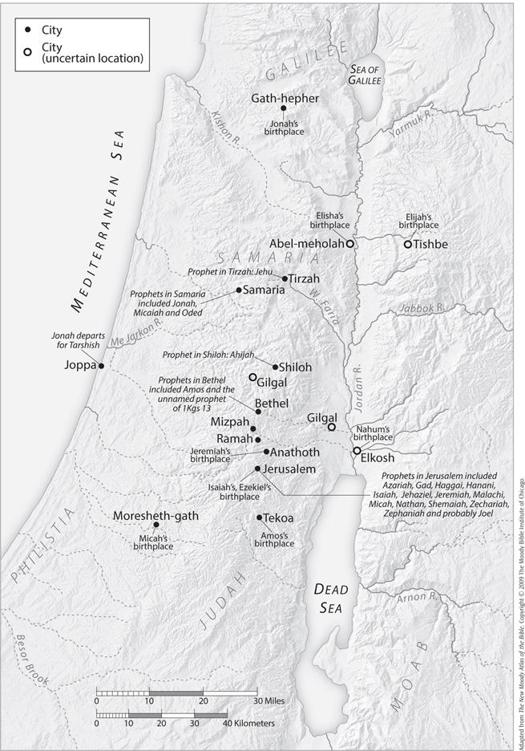
Thinking the Egyptian-Babylonian balance of power was shifting, Jehoiakim switched allegiance back to support Egypt (cf. 2Kg 24:1). This was a disastrous decision. By 597 BC Jerusalem was under Babylonian attack for her rebellion. Jehoiakim died during the Babylonian assault, and Jehoiachin, his son, became king.
Nebuchadnezzar looted the city and took the chief individuals captive. After a three-month reign, Jehoiachin was deported to Babylon along with 10,000 leaders, skilled laborers, and soldiers (cf. 2Kg 24:12-16). This was probably when the prophet Ezekiel was taken to Babylon, where five years later he began his prophetic ministry.
Zedekiah was placed on the throne by Nebuchadnezzar as Judah’s vassal king. His 11-year reign was marred by spiritual decline and political instability (2Kg 23:26). With the enthronement of Pharaoh Hophra in Egypt (588 BC) Judah was once again enticed to revolt against Babylon (2Kg 24:1-4). This was a fatal mistake.
Nebuchadnezzar determined to make an example of Jerusalem to show the awful consequences of rebelling against Babylon. Nebuchadnezzar’s response was swift and brutal. The army of Babylon surrounded Jerusalem and began a long siege (2Kg 24:20–25:1; Jr 52:3-4). From 588 to 586 BC Babylon’s army ground away at Jerusalem’s defenses (2Kg 25). Quickly Egypt, Judah’s ally, was defeated and Judah was alone in her defense. One by one, the cities of Judah were crushed (Jr 34:6-7) until only Jerusalem remained before the mighty Babylonian war machine.
As the army of Jerusalem fought to defend her walls and gates against the sword, inside the city was swept with disease and famine (14:12) so severe that mothers ate their own children (19:9; Lm 2:20; 4:10). Idolatry flourished as people cried out to any and every god for deliverance (7:30; 10:1-16), but they refused to turn to listen to Jeremiah and his message from the Lord God. Paranoia gripped the people until they were willing to kill God’s prophet as a traitor and spy just because he spoke the truth (37–38).
The 30-month siege ended in August 586 BC when the walls were breached (2Kg 25:2-4) and on August 14, 586 BC the destruction of the city began (2Kg 25:8-10). The temple, the king’s palace, and all other major buildings in Jerusalem were burned and the walls of the city torn down (Jr 52:13). The majority of the survivors of the siege were carried into Babylon for the 70-year exile (2Ch 36:21; Jr 25:11; 29:10; 39:9). Jeremiah was an eyewitness to all of these tragic events (39:1-14; 52:12-14).
The main link between Jeremiah and the NT is the new covenant (31:31-34; Lk 22:20; 1Co 11:25; 2Co 3:6; Heb 8:8-12; 10:16-17). However, the NT alludes to Jeremiah dozens of times with explicit and implicit references to his prophecy, e.g., Mt 2:17-18 (Jr 31:15); Mt 21:13, Mk 11:17, Lk 19:4 (Jr 7:11); Rm 11:27 (Jr 31:33); Heb 8:8-13 (Jr 31:31-34).
The Septuagint (LXX) is the ancient Greek translation of the Jewish Scriptures, made in Alexandria, Egypt by a team (according to tradition) of 70 rabbis in the intertestamental period (third and second centuries BC). It was translated for the large Hellenistic Jewish community that spoke Greek, not Hebrew.
Jeremiah, of all the OT canon, shows the most striking divergences between the Greek LXX and the Hebrew Masoretic Text (MT). The LXX of Jeremiah is about one-eighth shorter than the MT of Jeremiah (about 2,700 words), and the chapters in the LXX are in a different sequence. Discoveries at Qumran among the Dead Sea Scrolls (DSS) have revealed manuscript fragments from both the proto-masoretic text and the Hebrew text that lay behind the LXX.
According to Gleason Archer, the divergent traditions stem from the development of the book of Jeremiah. He proposes (and the book of Jeremiah itself seems to indicate) that scrolls of Jeremiah’s writings were circulated during the time of the prophet’s ministry (36:32). Furthermore, Jeremiah dictated to Baruch, his scribe (36:4), all the words of the scroll Jekoiakim had burned and added “many similar words” (36:32). It is reasonable to assume that, to this earlier composition, Jeremiah continued to add the messages given him by the Lord during the reign of Zedekiah and after the fall of Jerusalem. Thus, it is likely that the prophet himself composed an earlier, shorter, edition of his own book. This version was available in the prophet’s own lifetime and likely circulated in Egypt where he was living after the fall of Jerusalem. This could be the basis of the LXX translation.
After Jeremiah’s death, it appears Baruch gathered and edited Jeremiah’s work and made a more comprehensive collection of the prophet’s writings. He rearranged the material in the current order and added the text of 2Kg 24–25 as a conclusion to the book. This became the final composition of the book of Jeremiah. As Archer concludes: “The MT doubtless preserves this posthumous edition of Baruch” (Gleason Archer, Jr., A Survey of Old Testament Introduction [Chicago: Moody Publishers, 2007], 342).
In the final analysis, the Masoretic text contains the canonical version of the book of Jeremiah. C. Hassell Bullock notes that although “the LXX readings may occasionally be preferred over the Hebrew, the opposite is more often the case.” If the LXX translator used an earlier edition of Jeremiah, “it was not superior to the Hebrew” Masoretic version (C. Hassell Bullock, An Introduction to the Old Testament Prophetic Books [Chicago: Moody, 1986], 206).
COMMENTARY ON JEREMIAH
I. Introduction to the Book of Jeremiah (1:1-19)
Jeremiah is introduced as the prophet at the opening of the book. His background and call into the prophetic ministry set the stage for his prophecies and eyewitness account of the fall of Jerusalem recorded in the book.
A. The Prophet’s Background (1:1-3)
1:1-3. Jeremiah was the son of Hilkiah, a Levitical priest. The name Hilkiah (“portion of the Lord”) was a common OT name for priests or Levites (2Kg 22:2-14; 1Ch 6:45-46; 26:10-11; 2Ch 34:9-22; Neh 12:7). Jeremiah’s hometown was Anathoth, a Levitical city in the land of Benjamin, about three miles northeast of Jerusalem. Solomon exiled Abiathar the priest to Anathoth for supporting Adonijah as David’s successor (Jos 21:15-19; 1Kg 1:7; 2:26-27).
There is no mention of Jeremiah serving as a priest; he was called as a prophet when the word of the LORD came to him. This phrase is a typical introduction of divine calling (cf. Ezk 1:3; Jnh 1:1; Hg 1:1; Zch 1:1) of a prophet, someone through whom God spoke directly to His people.
The Lord called Jeremiah in the thirteenth year of the reign of Josiah, … king of Judah, the last righteous king of Judah (2Kg 22). Josiah became king in 640 BC, so Jeremiah received his call as prophet in 627 BC.
Jeremiah continued as God’s spokesman in the days of Jehoiakim, the son of Josiah, who did evil in the sight of the Lord (2Kg 22:32), down to the fifth month of the eleventh year of King Zedekiah, Judah’s last king, who reigned 597–586 BC, until the exile of Jerusalem in the fifth month (July–August 586 BC). Thus Jeremiah’s ministry lasted at least 41 years during the reign of five kings of Judah: Josiah, Jehoahaz, Jehoiakim, Jehoiachin, and Zedekiah. The phrase until the exile refers only to Jeremiah’s ministry to the nation of Judah, until the exile of Jerusalem, but does not mean his ministry ended with the fall of the city in the fifth month, ninth of Av in the Jewish calendar, August 14, 586 BC (2Kgs 25:3-10). Jeremiah continued to minister to the remnant who remained in Jerusalem (Jr 39:11–44:30) after the fall. Following the assassination of Gedaliah (41:1-3), he went with the exiles to Egypt (43:7) and continued to speak for the Lord there (44:1-30).
B. The Prophet’s Call (1:4-10)
1:4-5. God revealed His choice of Jeremiah: Before I formed you in the womb (Ps 139: 13-16). Before Jeremiah was born God knew (yada‘) him. This is not just general knowledge, but indicates the sense of close relationship, and includes the idea of being “chosen” (Am 3:2) and having God’s protection or God “watching over” him (Ps 1:6). God had set him apart, consecrated him to be His spokesman to Israel. Consecration describes being set apart for holy service and is used to describe the Sabbath and the tabernacle and its furnishing (Ex 16:23; 20:8; 30:30; 40:9). This message would give Jeremiah courage and motivation for God’s task.
Jeremiah was appointed, commissioned, as a prophet to the nations. Though Jeremiah proclaimed God’s word to Judah (chaps. 2–45), his ministry as God’s spokesman extended to the Gentile nations (chaps. 46–51).
1:6. Jeremiah’s response of alas, an exclamation of pain or sorrow, indicates his self-doubt when God called him, articulated by two protests. First, Jeremiah objected: I do not know how to speak, similar to Moses’ response to the Lord at the burning bush (Ex 4:10). Jeremiah was not claiming that he was mute, but that he lacked the ability to be God’s spokesman. Second, he objected that he was a youth, a word used of infants as well as young men (Ex 2:6; 1Sm 4:21; Gn 14:24). Jeremiah’s exact age is not given, but his objections, and the length of his ministry, indicate that he was in his late teens or early twenties at the time of his calling. By using the term youth he emphasized his lack of experience and his feeling unprepared to be God’s spokesman.
1:7-10. God answered Jeremiah’s objections in three ways. First, the Lord stressed Jeremiah’s call to be a faithful messenger, to go everywhere I send you, obey all that I command, and speak the Lord’s message. Second, God told Jeremiah do not be afraid of them (the people) to whom he was sent because He promised to be with him and deliver Jeremiah even when people tried to kill him (cf. 11:18-23; 12:6; 20:1-2; 26:11; 36:15-56; 37:4-6). Third, God showed Jeremiah that He was the source of the message. The LORD stretched out His hand and touched my mouth (perhaps in a vision; cf. Ezk 1:1). This visible manifestation of God was His object lesson to tell Jeremiah that the Lord Himself would put His words in Jeremiah’s mouth. God would provide the very words he would speak and the exact protection he would need.
God graciously taught Jeremiah, and all believers, that He specializes in using ordinary people to accomplish His extraordinary work. The Lord will use people who: (1) trust Him in spite of fears; (2) obey Him in spite of inexperience; and (3) proclaim His Word in spite of feelings of inadequacy.
God then repeated Jeremiah’s calling, I have appointed you this day, and summarized the content of His message. It would be a message of judgment and blessing to nations and kingdoms, using two metaphors to describe his mission (cf. Jr 31:28). First, he compared Jeremiah to a farmer who would pluck up (announce judgment), then plant, (announce blessing). Next, He compared Jeremiah to a carpenter who would break down, destroy, and overthrow, announcing judgment—then build, announcing blessing.
C. The Prophet’s Confirming Visions (1:11-16)
God gave Jeremiah two visions to confirm his calling. The first (vv. 11-12) focused on the nature of the message, and the second (vv. 13-16) on the content of the message.
1. The Blossoming Almond Branch (1:11-12)
1:11-12. The Lord’s first confirming vision was a rod (branch) of an almond tree. The Hebrew word for “almond tree” (saqed) is from the word meaning to “watch” or “to wake” (saqad) because in Israel the almond is the first tree to bud and awaken in January as the first sign of spring. The almond branch represented God, who was watching over His word to perform it. The vision of the “awake tree” reminded Jeremiah that God was awake (Ps 121:4) and watching over His message to bring it to pass.
2. The Boiling Pot (1:13-16)
1:13. The Lord’s second confirming vision was of a boiling pot, literally a “blown upon” kettle, indicating a wind blowing on the fire to keep the caldron’s contents boiling. The pot was facing away from the north, so that its contents were about to be spilled out toward the south.
1:14-15. This tilting represented evil about to break forth on all the inhabitants of the land. God was summoning kingdoms of the north to punish Jerusalem and Judah. This refers to the coming invasion of Babylon and her allies (cf. 25:8-9). Although Babylon was located in the east geographically, the invading armies followed the routes along the Euphrates River in their march to Judah. So the enemy did approach from the north (cf. 4:6; 6:1, 22; 10:22; 13:20; 15:12).
When they conquered the city, Babylon would set his throne at the entrance of the gates of Jerusalem, thus replacing Judah’s royal authority (43:10; 49:38). Babylon took all the cities of Judah, not just Jerusalem.
1:16. The Lord’s judgments fell on Judah for idolatry; they offered sacrifices to other gods, worshiped the works of their own hands, and had forsaken God (Dt 28). The judgment of Judah was a fulfillment of the blessings and cursings laid out when they entered the land of Israel (Dt 28).
D. The Prophet’s Challenge (1:17-19)
1:17-19. Once his call was clear, God challenged Jeremiah to gird up his loins, a picture of tying up the long garments to be able to move quickly and to get ready for the task (cf. Ex 21:11; 2Kg 4:29; 9:1; Lk 12:25; Eph 6:14; 1Pt 1:13). God pictures His strength in three ways. First, He gave Jeremiah the needed strength to arise, to stand up against the people of Judah and not be dismayed (afraid). Next, through God’s enablement Jeremiah would be as strong as a fortified city and as a pillar of iron and as walls of bronze. Jeremiah could be confident that his enemies would not overcome him. By God’s power he could withstand those who attacked him and his message from the Lord. Finally, God assured him that He was with Jeremiah to deliver him. There is no greater assurance of victory than to know the Lord is standing with us.
II. Prophecies Concerning Judah (2:1–45:5)
This section begins with Jeremiah’s 13 oracles of divine judgment against Judah (chaps. 2–25), usually introduced with the phrase “the word of the LORD came” or “the LORD said” (e.g., 2:1; 3:6; 7:1). Following the messages of judgment, Jeremiah recorded the rejection of his message and the ensuing conflict (chaps. 26–29). The judgment of Judah was sealed, but before Jeremiah chronicled the execution of that judgment, he inserted God’s message of future comfort for Israel and Judah in what is often called the Book of Consolation (chaps. 30–33). Though Judah would go into captivity, God would never abandon His chosen people. He gave the hope of the new covenant and the certainty that He would fulfill the good word He had spoken concerning the house of Israel and Judah. After the message of hope, Jeremiah then recorded the fall of Judah to Babylon (chaps. 34–45), and God’s judgment pronounced by Jeremiah was fulfilled.
A. Divine Judgment on Judah (2:1–25:38)
1. Jeremiah’s Nine General Prophecies of Judgment (2:1–20:18)
Jeremiah’s nine general prophecies of judgment begin this opening section of prophecies concerning Judah.
a. First Prophecy of Judgment—Jerusalem’s Faithlessness (2:1–3:5)
2:1-3. Jerusalem, as a representative of the whole nation, was confronted with her waywardness. For emphasis, Jerusalem’s sinful condition was contrasted with her former devotion to the Lord. The Hebrew word for devotion (chesed) refers to the most intimate degree of loyalty, love, and faithfulness that can exist between two people or between an individual and the Lord. In Israel’s early history, in her youth, she was following after the Lord in the wilderness (the exodus), and holy to the LORD, set apart for His service. Despite Israel’s grumbling, she was the chosen nation, the first of His harvest, dedicated to the Lord (Lv 23:9-14). Anyone who ate of it was as guilty as those who ate of the first fruits dedicated to the Lord, and evil came upon them. They were judged for their mistreatment of Israel (Gn 12:3; Ex 17:8-16).
2:4-6a. The faithfulness of Jacob (a synonym for Israel) did not last. They went far from [God] and walked after emptiness (hebel, “worthlessness, uselessness, vanity”; the word is often used for idols and is used in Ecclesiastes 30 times for the vanity of life without God). These people became empty, like the objects of their worship, for whatever we worship shapes our lives. They followed empty idols (2:5, 8, 11; 8:19; 10:8, 14-15; 14:22; 16:19; 18:15; 51:17-18) forgetting the LORD who brought them out of … Egypt.
2:6b-8. The Lord had brought them from Egypt and the wilderness deserts, pits, drought, and darkness to the fruitful land, a synonym for the land of Israel (cf. 4:26; 48:33). The Lord identified the country of Israel as My land, and He holds the deed to it as the God of Israel. It is His inheritance. According to Walter Elwell, in the theological sense, to inherit means to “receive an irrevocable gift” with an emphasis on the special relationship between the benefactor and the recipients (Walter Elwell, “Inheritance,” in The Evangelical Dictionary of Biblical Theology [Grand Rapids, MI: Baker, 1996], 374). God has made Israel His inheritance, and He has a unique, permanent relationship with the land of Israel and the people of Israel as indicated throughout Scripture (3:18; 10:16; 16:18; Lv 25:23; Dt. 32:9; 1Sm 10:1; 2Sm 21:3; Pss 78:54, 71; 94:14; Is 19:25; Zch 2:12; 9:16). But the land was defiled, made an abomination, ceremonially unclean with idolatry (Jr 3:1; 16:18; Lv 4:12).
Jeremiah singled out the three groups who failed in their leadership duties, and he exposed their lack of obedience (2:8). First, the priests did not say, Where is the LORD? They should have instructed the people, but they did not know God themselves; “know” indicated intimate, personal knowledge, not just intellectual information.
Second, the rulers, (literally “the shepherds,” meaning the political and civil leadership, including the king), also transgressed. Ironically the ones who were to lead Judah were in rebellion against the One who had appointed them to the task of leadership.
Third, the prophets, who should have been giving the word of the Lord, now prophesied by Baal, the chief deity of the Phoenicians and Canaanites. Jeremiah constantly warned against Baal worship (7:9; 11:13; 12:16; 19:5; 23:13, 27; 32:29, 34). Baal was the male deity (Asherah, the female deity in the Baal cult) and was worshiped for fertility, crops, and rain. Worship of Baal was on high places or in temples with ritual, incense, animal, and even human sacrifices (1Kg 16:31-33; Jr 19:5; 32:35). Israel was constantly lured into this pagan worship rather than staying true to the Lord and therefore suffered dire consequences (1Kg 18:18-40; 2Kg 10:18-28; 21:1-3). Their false teaching led Israel astray as they walked after things that did not profit (Jdg 2:11-13).
2:9-12. Jeremiah used the image of a court case to focus on the seriousness of Israel’s sin. God would yet contend (used twice, or “bring charges” or “I will bring a case against you,” HCSB) with Israel. This is a legal term for presenting a lawsuit (Hs 4:1-4; Mc 6:1-2).
Jeremiah asked for an investigation from as far away as the coastlands of Kittim (the ancient name for Cyprus, but it came to be used for the lands around the Mediterranean Sea in general, and in Dn 11:30 it refers to the Romans) in the west to Kedar (Arabia) in the east. The rhetorical question: Has a nation changed gods when they were not gods? clearly expects a negative answer and points out the foolishness of Judah’s actions. Idolatrous nations surrounding Israel were more faithful to their false gods than Israel had been to the true God. Israel had changed their glory, the True and Living God, for dead idols, that which does not profit, that which is worthless, without the slightest benefit (see comments on Rm 1:18-24 for an allusion to this, where Paul targets both Gentiles and even the Jewish people).
2:13. God’s people had committed two evils. The first was a sin of omission: She had forsaken God, the fountain of living waters. Her second sin was one of commission: She replaced her true God with idols, described as broken cisterns, they had hewn (cut, carved) for themselves. Cisterns were large pits dug into the rock with walls sealed with plaster. They were used to collect and store rainwater. The stored water could become brackish, and during droughts, cisterns often dried up. Cisterns could develop cracks in their walls, and the water would leak out. Jeremiah compared Israel’s actions to a man abandoning a fountain of living waters, a fresh, plentiful, reliable stream, to go to broken cisterns that would hold no water. To turn from a dependable, pure stream of fresh running water to a broken, brackish cistern was idiotic. Yet that is what Judah did when she turned from the living God to worship idols.
2:14-16. Another rhetorical question highlighted Judah’s apostasy and its consequences: Is Israel a slave? She could no longer live as a free person, but as a slave, purchased in the market or a homeborn servant. She became prey to other nations, and her land was a waste because of foreign invaders who here were compared to lions. Her cities were destroyed and without inhabitant.
The Egyptian cities of Memphis and Tahpanhes (Ezk 30:13, 16, 18) could refer to Pharaoh Shishak’s invasion of Judah in 925 BC (1Kg 14:25-26) or more likely to the more recent event of Pharaoh Neco’s killing of King Josiah in the battle at Megiddo (609 BC; 2Kg 23:29-30). Either way, Egypt had triumphed over Judah or had shaved the crown of Judah’s head, a figure of mourning, disgrace, and devastation (cf. Jr 47:5; 48:37).
2:17-19. Judah had not only been forsaking the LORD for false gods, she had also forsaken the protection of the Lord. He had led her in the way, but now Judah made false alliances with Egypt and Assyria to guarantee her safety (cf. v. 36; Ezk 23; Hs 7:11). Like the broken cisterns (Jr 2:13), the waters of the Nile or Euphrates, referring to those alliances, could not protect Judah from her enemy or her sin. Only after she received her judgment would Judah realize how evil and bitter it was to forsake the LORD.
2:20. Judah’s spiritual apostasy was pictured as spiritual adultery, acting like a harlot. Jeremiah painted four verbal pictures of Judah’s wayward state and insatiable lust for false gods (vv. 20-28). First, Judah was rebellious, breaking her bonds with the Lord. It would be better to translate the opening of the verse according to the LXX: For long ago [you] (not “I”) broke your yoke (NIV; NET Bible), implying that Israel had thrown off all restraint. This translation is clarified by Judah’s statement: I will not serve! Israel broke away, tore off, the yoke that bound her to the Lord. “The yoke of the law” is a common rabbinic phrase to indicate obedience to the Lord (cf. Mt 11:29). Instead of worshiping the Lord, she followed heathen practices of worship (cf. 3:2; Ezk 6:1-7, 13) on every high hill, frequently called “high places,” where she had lain down as a harlot. Spiritually, Judah was acting like a prostitute giving herself to foreign gods, and committing spiritual adultery against the Lord.
2:21. Second, Judah is pictured as a choice vine from faithful seed that God had planted. Often described as God’s vine (Is 5:1-7; Ezk 15). Judah had transformed herself by choosing to forsake God, follow idols, and turn herself into a degenerate, foreign vine incapable of producing any good fruit.
2:22. Third, Judah had a stain of iniquity that could not be washed away, even with lye, a strong mineral cleaner, or much soap, a strong vegetable alkali. Her iniquity was ingrained.
2:23-25. Fourth, Judah is likened to animals in heat: a swift young camel running fast, entangling and tripping up, running after a mate, and a wild donkey in heat ready to breed, who sniffs the wind in her passion, seeking mates. Judah likewise vigorously pursued her false gods and could not be restrained in her passion for the idols of strangers.
2:26-28. Israel was shamed by her pursuit of false gods who could not help her, just as a thief is shamed when he is discovered. She declared a tree and a stone to be her creator: You are my father … You gave me birth. Yet when trouble came, Israel cried to God, Arise and save us! Her idols were powerless to help, although Judah had as many idols as the number of her cities (cf. 11:13).
2:29-31. Judah eventually became so spiritually irresponsible that she dared to contend with God. Earlier God had brought charges against Judah. Now she brought charges against Him (cf. 2:9). God’s judgment was necessary to curb their transgression, but His chastening (discipline, correction) was in vain. The people still refused to respond. They even killed (your sword has devoured) the prophets. When Jesus wept over Jerusalem (Mt 23:37), He said “Jerusalem, who kills the prophets,” referring to Israel’s sad history of rejecting and even killing the messengers the Lord sent to bring the nation back to Him. Likewise, Jeremiah pled, O generation, heed the word of the LORD, but they would not come to the Lord and instead proclaimed their freedom to roam away from Him.
2:32-33. Judah’s unreliability was evident when she forgot God’s past goodness. This sin is introduced by another rhetorical question: Can a virgin forget her ornaments, or a bride her attire? Certainly a woman going to be married would never forget her wedding ornaments (jewelry), or wedding attire (her dress); but Judah had forgotten the Lord for a long time, days without number. She did not remember who had adorned her and set her apart from the other nations. Judah had become so skilled at illicit love that even wicked women have been taught secrets of seduction from her.
2:34-37. Judah also displayed her irresponsibility in acts of injustice and murder by spilling the lifeblood of the innocent poor. Perhaps this is a reference to the murder of the prophets (cf. 26:20-23) or taking advantage of the poor in the land (Is 3:14; Am 4:1-5). Though her clothes (skirts) were covered in blood of the guiltless, she claimed, I am innocent. Had the poor been found breaking in to another’s house to find provisions and had then been killed, the one responsible for the death would be guiltless (Ex 22:2). But the ones Judah killed were the innocent poor. These murderers were destined for judgment because they said, I have not sinned.
Another indication of Judah’s inconsistency was her fickle foreign policy, constantly changing [her] way in making alliances with Egypt (Ezk 23) and Assyria (2Kg 16:7-9; Is 7:13-25). But because the Lord had rejected these nations, Judah would not prosper with them. She could not be helped by them.
3:1-5. The spiritual harlotry of Judah is exposed by Jeremiah and linked to the Mosaic law. If a couple divorced and the wife married another man, and then was divorced or widowed from her second husband, she was prohibited from ever remarrying her first husband (Dt 24:1-4). This law seemed to have been given to protect the sanctity of marriage by discouraging hasty divorce. Judah had separated from her husband, the Lord, and had been a harlot with many lovers. Judah had been unfaithful in marriage to the Lord and had no right to turn to Him or expect Him to still return to her. Her unfaithfulness was evident in that the land was completely polluted with idols, and she had sat as a harlot by the roads (cf. Gn 38:13-14, 20-21)—an image of a cult prostitute. However, God’s faithfulness to His word is greater than Judah’s unfaithfulness to Him, as Jeremiah later recorded God’s promise of Israel’s national restoration under the new covenant (cf. Jr 3:18; 31:33-33).
God judged Judah by withholding showers and spring rain (Dt 28:23-34; Jr 14), yet Judah refused to be ashamed. Although Judah called God My Father, and the friend of my youth, her words were hypocritical and manipulative, not repentant, because she continued to do evil things.
b. Second Prophecy of Judgment—Judah’s Call to Repentance in Light of Coming Judgment (3:6–6:30)
Jeremiah was given this prophecy to call Judah to repentance during the days of Josiah, probably before the discovery of the law in 621 BC (cf. 11:1-8).
(1) The Summons to Repent (3:6–4:4)
3:6-11. The prophecy is built around the story of two sisters—Israel and Judah (cf. Ezk 23). The northern kingdom, Israel, was faithless and a harlot on every high hill, under every green tree. God waited for her to return to Him, but she did not and Judah, her treacherous sister, observed her behavior.
God sent her (Israel) away into captivity to Assyria (2Kg 17:5-20; 722 BC). Judah did not learn from Israel, but she went and was a harlot also. Judah became even worse than Israel by committing the same sins, but in deception (hypocrisy) pretending to follow the Lord.
The northern kingdom practiced a form of false worship of the Lord, instituted by their first king, Jeroboam (1Kg 12:25-33). They worshipped golden calves and did not go to Jerusalem to offer sacrifices. Yet Judah pretended to be faithful to the Lord, and followed the sacrificial system in Jerusalem, but practiced idolatry at the same time. God called faithless Israel … more righteous than treacherous Judah (Ezk 16:51-52; 23:11).
3:12-15. At this point in his message about condemnation because of sin, Jeremiah paused to offer a proclamation of hope and repentance to the north (the northern kingdom). If Israel would return (repent) to her God (7:3; 26:13), He would not look upon her in anger but would extend mercy. The term “return” literally means “to turn back” “to turn around” (shuv), and is a technical term that means “to repent.” First used in Dt 4:30 and throughout the Pentateuch as a call to come back to the Lord, it is a common phrase in Jeremiah (Jr 3:12, 14, 22; 4:1; 8:5; 15:19; 24:7).
If they repented, God promised to gather a remnant from the north (one from a city and two from a family) and bring them to Zion, Jerusalem. This remnant would have shepherds (cf. 10:21; 22:22; 23:1-2, 4) who would provide leadership after God’s own heart.
3:16-18. Using the phrase in those days, an eschatological term that often introduces prophecies about more remote future events (cf. 16:14-16; 23:5-6; 30:3, 24; 31:17, 31), Jeremiah described Israel’s end-time restoration. Then Judah and Israel will be reunited (after having been divided since 931 BC) as a nation serving the Lord (31:31-33).
Further describing end-time circumstances, Jeremiah predicted that in the messianic kingdom the ark of the covenant, lost at the destruction of the temple (586 BC), would not come to mind or be missed. Rather, the very Throne of the LORD (Ezk 43:7) will be present with Messiah also ruling in Jerusalem as King (Zch 14:16-19), extending His dominion over all nations. In the kingdom there will be complete obedience to King Messiah, and no one of an evil heart will be found there. Judah will walk with … Israel and all the nations will be gathered to worship there in the land of Israel, which God gave Israel’s fathers (Abraham, Isaac, and Jacob; Gn 15:18) as an inheritance.
3:19-20. Although the Lord wanted to bless the house of Israel like sons and give them a beautiful inheritance, they were unwilling to return to Him. Instead, they acted like a treacherous woman unfaithful to her lover (rayah, “faithful companion, imitate friend” not sexual partner) indicating the breach of a committed matrimonial relationship.
3:21-25. The voice of weeping and the supplications of repentance will be prompted because they perverted their way and because they had forgotten the LORD their God. In Jeremiah’s ideal picture of repentance the nation would finally realize the depth of the pit into which they had fallen. God would respond to the cry by offering to heal their faithlessness if she would return.
Verses 22c-25 are an indication of the sort of repentance God wanted to see from Israel. Israel was to come to the LORD … God, admitting that the shameful thing (idolatry) has consumed them. She must confess that she sinned against the LORD. This heartfelt confession of sin did not seem to occur in Jeremiah’s day. Instead it still awaits the future repentance of the nation when the Messiah returns as King (Zch 12:10–13:1).
4:1-4. While God promised to respond if Israel and Judah would return to Him, their repentance had to be genuine. They had to remove their idols and stop pursuing false gods. He pictured this in two ways. First, Jeremiah used the metaphor of farming to show the need to prepare their hearts, break up your fallow ground, a field that has been unplanted, but do not sow among thorns. The second metaphor, remove the foreskins of your heart, is a reference to circumcision, the sign of the Abrahamic covenant, the symbol of the Jewish people’s relationship with God (Gn 17:9-14). Though circumcised physically, the men of Judah needed to circumcise their hearts so that their inward condition matched their outward profession (Dt 10:16; 30:6; Jr 9:35-56; Rm 2:28-29). If Judah did not repent, God vowed that His wrath would burn against them because of their evil deeds.
(2) The Warning of Coming Judgment (4:5-31)
4:5-9. Judgment was certain, so it was time to blow the trumpet of warning and go into the fortified cities for defense because the judgment was coming from the north … great destruction. The approaching army of Babylon was like a lion that would destroy the land because of the fierce anger of the LORD. Certainty of the coming destruction would cause the people to mourn: put on sackcloth, lament and wail. Fear would paralyze the leadership of the people, the king, princes, priests, and prophets (cf. 2:26; 4:9; 8:11) as they watched the annihilation of their country. Yet the destruction would come in part because of their own leadership failure (cf. 2:8).
4:10. This verse is one of the most challenging in the book to interpret. Jeremiah claimed that God had deceived this people by promising they would have peace when in fact a sword was at their throats. It is better to understand that Jeremiah was complaining that God had ordained the false prophets to proclaim their message of peace (cf. 6:14; 14:13-14; 23:16-17). Scripture is clear that it is not in God’s nature to lie (cf. Nm 23:19). But God is sovereign over all that happens in creation, even the false prophecies given by the deceptive teachers and leaders, though He is never blamed for the moral guilt of their sin, while people are (see comments on Rm 9:13-23). God ordained the deception of the false teachers as one of the rungs in the ladder leading up to the judgment they deserved for abandoning the Lord. In fact God’s true prophets had been predicting judgment, not peace (cf. Jr 1:14-16; Mc 3:9-12; Hab 1:5-11; Zph 1:4-13). Only the false prophets had been proclaiming peace. Thus, it is better to understand Jeremiah’s complaint that God, in His providence, ordained these false prophets to proclaim their false message.
4:11-14. Jeremiah gives two pictures of the coming invasion of Judah. First, the invading armies are pictured as a scorching wind that blows in from the wilderness, the desert (Ezk 17:10; 19:12). This wind does not cool, and it cannot be used to winnow because it is too strong and would blow the grain away with the chaff. Instead, this scorching wind withers vegetation (Gn 41:6) and causes extreme discomfort (Jnh 4:8). Second, the advance of Babylon’s army is pictured as an approaching storm of clouds sweeping into Judah, and their chariots as a whirlwind pulled by horses as fast as eagles. Both images are of rapid, powerful invasion (Jr 4:13-14).
In light of Judah’s certain destruction God again graciously called the people to repentance. If they were to wash the evil from their heart they would be saved (delivered) from judgment.
4:15-18. A voice, a messenger from Dan, the northernmost tribe of Israel and from Mount Ephraim, 35 miles north of Jerusalem, would signal the approach of Babylon’s army. These areas would be the first to see the besiegers approach, and their watchmen would sound the alarm. God sent Babylon to punish the cities of Judah because she had rebelled against Him.
4:19-22. Jeremiah cried out in anguish at the news of the coming invasion. His heart pounded, and he could not be silent because he heard the coming alarm of war. The repetition disaster on disaster indicated the seriousness of the coming events, pictured as tents devastated in an instant. God said, My people are foolish, because they did not know Him. In an ironic reversal of wisdom living, the people were shrewd, skilled to do evil, but ignorant in knowing good (cf. Pr 1:2-3).
4:23-28. Jeremiah compared the coming judgment to a cosmic disaster. The description of the land as formless and void evokes images from the creation account, the chaos that preceded God’s work in creation (Gn 1:1-2). Jeremiah indicated that no aspect of life would remain untouched: heavens, mountains, man, birds, land, and cities. Jeremiah pictured the land as barren as it had been before the formation of the earth (Gn 1:11-13, 20-26).
The imagery was so stark that some might think He would totally destroy Israel. To guard against this misunderstanding, God qualified His statement: Yet I will not execute a complete destruction (Jr 4:27; cf. 5:18). Though the whole earth shall mourn as He judged the people, and the Lord would not change [His] mind (4:28), yet Israel as a people and a nation would not be eradicated (31:35-37).
4:29-31. Jeremiah warned that when the armies of horseman and bowman marched to attack, people in every city would flee for safety, hiding in thickets and among the rocks. Then addressing Jerusalem’s leaders collectively as the desolate one, Jeremiah challenged their plan for dealing with Babylon. These Jewish leaders thought if they would figuratively dress as a harlot (in scarlet with jewels of gold, and cosmetic paint on their eyes) they might seduce, or politically persuade, Babylon to prevent their attack (cf. Ezk 16:26-29; 23:40-41). But it was in vain; her former lovers (allies) now despise[d] her.
As the Babylonians pressed their attack, the daughter of Zion (the people of Jerusalem) cried out in anguish like a woman in labor (cf. Is 13:8; 21:3; 26:17; Jr 6:24; 13:21; 22:23; 30:6; 48:41; 49:22, 24; 50:43; Mc 4:9-10). She stretched out her hands for help that never came as she died at the hands of murderers.
(3) The Reasons for Coming Judgment (5:1-31)
In chap. 4, Jeremiah described the inevitability and reasons for the coming judgment. Here he has presented the extensiveness of the sin in Judah for which God would judge them.
5:1-3. Judah faced judgment because every person was guilty. Jeremiah was challenged to look through the streets of Jerusalem for just one man who did justice. But unlike Abraham looking for a righteous person in Sodom, Jeremiah could not find even one (Gn 18:26-32). They all refused correction, had hearts harder than rock toward God, and refused to repent.
5:4-6. Jeremiah thought perhaps only the poor—the foolish or uneducated masses did not know the way of the LORD. He decided if he went to the great, the leaders, they would know the way of the LORD. Sadly, the leaders had joined the people (cf. 2:8) and had broken off the yoke of service to God (cf. 2:20). So God would judge leaders and followers alike for their sin, using the image of three wild animals (the lion, the wolf, and the leopard) to symbolize the coming ravages of the Babylonian attack on Judah.
5:7-9. God asked Judah two rhetorical questions. First, Why should I pardon you (Judah)? (v. 7). Second, Shall I not punish these people? (v. 9). Between the two questions, Judah’s character is described in a way that made the answers obvious. God could not forgive Judah because she had forsaken Him and sworn by false gods, committing spiritual adultery. Though God had provided for them, the people were acting like lusty horses, each of whom went after his neighbor’s wife. God would not pardon, but would punish Judah for her idolatry and adultery.
5:10-19. God’s choice vine, Judah, had become a wild vine (2:21), so God called His invaders to go up through Judah’s vine rows and strip away the branches.
The people refused to believe that God would ever destroy Jerusalem, saying misfortune will not come on us (v. 12). The people said that the prophets—Jeremiah, Ezekiel, and others who were predicting doom—were just full of wind (v. 13). They did not believe judgment would ever fall on them or their city, Jerusalem. Yet Jeremiah’s words became fire, and the people were as wood to be consumed in judgment (v. 14).
God would bring a nation (Babylon) from afar against Judah—a nation whose language the Judahites did not know (v. 15). Similarly, Isaiah had earlier predicted that Judah would know they were under judgment when the Assyrians arrived, speaking a language they did not know (Is 28:11; cf. 1Co 14:21). These warriors would devour the harvest, children, livestock, vines, and fig trees and would demolish the mighty fortified cities that Judah trusted for protection (Jr 5:16-17).
Yet again God emphasized that He would not destroy Judah completely (cf. 4:27) but would preserve a remnant. When these captives would ask, Why has God done all this to us? Jeremiah was told to say, “Because you had forsaken God to serve foreign gods in your own land.” Therefore God would have them serve strangers (the Babylonians) in a foreign land (v. 19). His punishment fit their sin.
5:20-31. The house of Jacob, namely Judah, was willfully ignorant, foolish, and senseless. Though she had eyes and ears, she did not see or hear (i.e., comprehend) the true character of God (cf. Ezk 12:2). She refused to fear God (cf. Pr 1:7). Even the sea remains within its boundary (cf. Jb 38:10; Ps 104:9), yet the people of Judah refused to stay within God’s covenant limits. Instead they turned aside. They did not acknowledge God’s gracious hand at work—He who gives rain in its season and appoints the weeks of … harvest (Jr 5:23-25).
Specifically, the people were fat and sleek (rich and powerful), excelling in wickedness, waiting to take advantage (set a trap) of the poor. They refused to help the orphan … or defend the rights of the poor (vv. 26-27). The prophets, who were to proclaim God’s word of truth, were prophesying falsely, and the priests who were to instruct the people in the ways of God, were instead ruling on their own authority (cf. 2:8). Rather than resisting this poor leadership, the people love[d] it. All the elements of society preferred wickedness to righteousness (vv. 26-31).
(4) The Certainty of Coming Judgment (6:1-30)
6:1-3. Warning of coming danger was given in two ways. First, a trumpet of alarm would announce an impending attack (cf. 4:5-6). The people of Benjamin, Jeremiah’s home area (cf. 1:1) just north of Jerusalem, were to flee … from the midst Jerusalem for safety instead of going into the walled city. It would be safer to be outside the city than inside it. The warning trumpet would be sounded at Tekoa, about 11 miles southeast of Jerusalem (cf. Am 1:1). The second type of warning was signal fires at Beth-haccerem, a vantage point midway between Jerusalem and Bethlehem, lit to warn people to flee. Jerusalem would be destroyed so completely that shepherds would pitch their tents and pasture their herds on its site. This extensive destruction was confirmed by Nehemiah (cf. Neh 1:3; 2:3, 11-17).
6:4-9. As the enemy gathered against Jerusalem, they were prepared (eager) to attack at noon or even by night. Most armies would wait until daybreak to begin, but the Babylonians decided to begin their attack that night. The LORD of hosts directed the soldiers of Babylon as they built siege ramps to breach the city’s defenses (cf. Ezk 4:1-2).
Jerusalem had to be punished because of her sin. Her wickedness poured forth like fresh waters from a well. Unless she would heed the warnings and repent, she would become a desolation. God would have Babylon thoroughly glean (Lv 19:10; Ru 2:2, 7) the remnant of Israel; when grapes were picked some were left either inadvertently or purposefully on the vine for use by the poor, but Babylon would pass over the land again to be sure none were left, as one would pick all the grapes from a vine. The attack would be merciless.
6:10-15. Behold their ears are closed, literally uncircumcised (cf. 4:4), not open to hearing the word of the Lord, and they cannot listen. Jeremiah responded in amazement to Judah’s unbelief—that no one would listen to him as he tried to warn them of the coming calamity.
This is the first of more than three dozen times Jeremiah recorded that the people did not listen to (i.e., disobeyed) God’s word. It was a reproach to them and they had no delight in it. Jeremiah was weary of holding in God’s message of … wrath, and had to pour it out for everyone to hear (cf. 20:9). God vowed that His wrath would be felt by all—from the children to the very old.
Both the prophet and the priest … dealt falsely, and the nation was injured by their bad leadership. The brokenness, or wound (v. 14) refers to the people’s spiritual condition and its physical effects (cf. 8:11, 22; 10:19; 14:17; 15:18; 30:12, 14, 17). The false prophets were proclaiming, peace, peace, but there [was] no peace (cf. 8:11; 23:17). God’s message was not of peace, but of judgment. These charlatans were not even ashamed and did not even know how to blush when their sin was exposed. God would punish them because they led Judah astray.
6:16. Judah had strayed from the ancient paths of God’s righteousness (cf. 31:21; Is 30:18-21). The Lord urged her to follow the good way and walk in it (Jr 7:23) to find rest for their souls. This important idea is by quoted by Jesus in Mt 11:29 (see comments there).
6:17-21. Because they would not listen (v. 17) to God’s instruction and rejected God’s law, they brought disaster upon themselves. They were reaping the fruit of their plans (v. 19). Judah had rejected God’s law, thinking she could substitute rituals for sincere obedience. God rejected faithless sacrifices made with frankincense imported from Sheba, in southwest Arabia (1Kg 10:1-13; Ezk 27:22) and of sweet cane (Ex 30:23; Sg 4:14), an ingredient in anointing oil imported from a distant land, perhaps India. The elaborate burnt offerings, divorced from genuine love for God, were sacrifices … not pleasing to Him (Jr 6:20).
6:22-26. Jeremiah warned against the foe coming from the north who would be cruel and show no mercy (Hab 1:6-11), as he concluded his second message. Their target was you, O daughter of Zion! (people of Jerusalem). This report would bring anguish, like the pain of childbirth, and grief (cf. Jr 4:31). The people would be afraid to go into the field, or on the road, because the enemy has a sword. They should stay home and mourn for their sin and for the coming disaster—mourning as for an only son, with bitter lamentation (v. 26).
6:27-30. Jeremiah was appointed as an assayer and a tester, not of metal ore, but to test the moral quality of God’s people. They were found to be corrupt, and the refining efforts were useless. The wicked were not separated out. The smelting process separated silver from lead, so like impure, rejected silver, … the LORD … rejected them. The nation refused God’s call to return to Him, so judgment was inevitable.
c. Third Prophecy of Judgment—Judgment on False Religion and Its Punishment (7:1–10:25)
Jeremiah’s “Temple Address” focuses on God’s judgment on the people for their false religion. They believed that God’s punishment would never extend to Jerusalem or to them (cf. 5:12-13) because the temple was in Jerusalem and, they believed, God would never allow it to be destroyed (notice the repetition “the temple of the LORD” in 7:4). The Temple Address shattered this false hope and exposed the festering sore of idolatry that was producing spiritual gangrene in the people. The events in chap. 26 indicate the people’s response to this message.
(1) The Temple Address: Judah’s False Worship (7:1–8:3)
7:1-7. God summoned Jeremiah to go to the gate of the temple, the LORD’s house, and proclaim His message to all who enter by these gates to worship the LORD. The message was designed to help the people amend (“to make pleasing,” “to do right”) their ways, and Jeremiah gave three specific actions to assist them (vv. 1-7). The first two concern interpersonal relationships, and the third related to the Lord. First, the people should not oppress the helpless in society, the alien, the orphan, or the widow (cf. Dt 14:19; 16:11; 24:19; Ps 94:6). Second, they were not to shed innocent blood (cf. Dt 19:19-13; 21:1-9). Third, they were to stop idolatry and not to walk after other gods. The blessing of obedience would be permission to dwell … in the land peacefully. Here the land of Israel is described as God’s gift to Israel, having given it to your fathers forever and ever. The phrase forever and ever (min olam v’ad olam) is the strongest expression in Hebrew to describe perpetuity and eternality. It is generally used of God’s nature and character (e.g., 1Ch 16:36; Pss 90:2; 103:17). The only exceptions to this general usage are found in this verse and Jr 25:5, describing God’s gift of the land of Israel to the people of Israel as being “from everlasting to everlasting.”
7:8-15. Jeremiah warned that Judah’s trust in deceptive words would not help. Her hypocrisy was being spotlighted. She felt so secure because of the presence of the temple that she believed she was safe, saying, We are delivered! Yet they practiced all these abominations. This catalog of disobedience includes fully half of the Ten Commandments (cf. Hs 4:2). They steal, murder, … commit adultery and swear falsely, … offer sacrifices to Baal and walk after other gods (Jr 7:9). Her vileness had actually turned this house, which is called by My name, into a den of robbers. This problem arose in NT times, and Jesus quoted this passage when He observed inappropriate activity in the temple (cf. comments on Mt 21:12-13).
What Judah failed to realize was that God had seen it and was aware of all her deeds. The people presumptuously trusted in the temple building for protection (repeated three times in v. 4 to emphasize their belief) rather than trusting in the God of the temple and obeying Him. The temple (v. 14) was called by My name, (cf. vv. 10, 12, 30) in the sense that it was a symbol of God’s presence (His name refers to His revealed attributes).
Judah was told to remember what God did to Shiloh, where the tabernacle had dwelt (Jos 18:1; Jdg 18:31; 1Sm 4:3-4). Because of Israel’s wickedness, that city was destroyed (cf. 2Kgs 17:5-20). If Judah did not repent, the Babylonians would destroy her just as the Assyrians had taken Israel, the northern kingdom, in 722 BC.
7:16-20. Judah’s sin was so serious that God told Jeremiah do not pray, do not lift up cry or prayer, do not intercede for her because He would not hear (cf. 11:14; 14:11-12). This does not mean that the Lord literally was incapable of hearing Jeremiah’s prayer. The Lord hears everything. The point was that Jeremiah’s pleas were futile because God had determined not to answer Jeremiah’s prayer on behalf of sinful Judah.
Throughout Judah, whole families (children, fathers, women) were uniting in pagan worship. They prepared cakes of bread (flat cakes possibly formed into the image of the goddess, cf. 44:17-19, 25) for the queen of heaven (cf. 44:17-19, 25). This pagan goddess is possibly Ishtar, the Babylonian goddess of love, sexuality, and fertility, who is also identified with Astarte, the Canaanite high goddess of sexual love and fertility. Israelites adopted her worship at the time of the conquest, and it continued through the monarchy (Jdg 2:13; 1Kg 11:5). The worship of Ishtar/Astarte included temple prostitution, lewd sexual promiscuity, sacrificial libations, and offerings of food. The Lord admonished the Jewish people because they would pour out drink offerings (wine) to other gods (cf. Jr 19:13). Yet such idolatrous rituals were only harming those who participated in them. Their false worship did not damage God. The people would bear the consequences of their actions when God’s anger and wrath would be poured out on all Judah, on both man and beast.
7:21-26. Although the people of Judah offered all the technically correct burnt offerings in the temple, they failed to understand God’s most important command given at Sinai in the day He brought them out of … Egypt. God commanded them to obey His voice and walk in all the way He commanded (cf. 6:16). Tragically, Israel did not obey or pay attention (incline their ear) to this command, and instead walked in their own counsels. Since the time of the exodus, when their ancestors came out of the land of Egypt until Jeremiah’s day, God continually sent [His] servants, the prophets like Jeremiah, to warn the people, but they did not listen (cf. 25:4-7).
7:27-31. God told Jeremiah the people will not listen to him. So Jeremiah was to go into mourning: cut off his hair (cf. Jb 1:20; Jr 48:37; Ezk 7:18), and take up a lamentation (qindh, “a funeral dirge”) for the nation. He was to begin mourning because the destruction of Judah was certain, for the LORD has rejected and forsaken the generation because of His wrath against their evil actions. Specifically, they had set their detestable things, idols, in the temple itself, the house which is called by My name, to defile it (cf. Jr 7:14; Ezk 8:3-18).
Outside the city they built the high places of Topheth (cf. Jr 14) in the valley of the son[s] of Hinnom (cf. 19:2, 6; 32:35; the Valley of Ben-hinnom) in worship of Molech the Phoenician god. Molech had the most evil of worship rituals of any god in history, demanding parents to burn their sons and their daughters alive in the fire in a brass statue of the god as child sacrifice. This cruel practice was specifically forbidden by God (cf. Lv 18:21; 20:2-5) but practiced by some of the evil kings of Israel and Judah (cf. 2Kg 16:2-3; 21:6; 23:10; Jr 19:5). Worship of Molech was often combined with Baal worship (19:5; 32:35).
The word Topheth is possibly a word for a “cookstove” or “oven.” The place of sacrifice was a fire pit, or a metal idol with outstretched arms, into which the living children were sacrificed. The Valley of Hinnom (Hb., ge’-hi’nom) is immediately south and west of Jerusalem, and in this valley the refuse of the city was burned. In Greek times the valley was called “Gehenna” (gehennah), and the name became synonymous with the picture of the fiery corruption of hell because of the children burned alive in sacrifice there to Molech (cf. comments on Mt 18:7-10; 2Pt 2:4).
The horror of child sacrifice was so abhorrent to the Lord, He explicitly said concerning it, I did not command, and it did not come into My mind (cf. 32:35). This expression does not mean that the Lord is not all knowing but rather that He totally disapproved of this wickedness. Compounding the phrases not command and did not come into My mind emphasizes God’s loathing of the abhorrent practice of child sacrifice.
7:32-34. God declared that the name of this place would be changed to valley of the Slaughter because of the number of dead bodies that would be burned after the destruction of Jerusalem. The prediction about birds and beasts eating the carcasses affirms the judgment of the Mosaic covenant for disobedience (cf. Dt 28:26). To remain unburied was an abomination in the Jewish community (cf. 2Kg 9:10, 30-37). Joy and gladness would cease, and the land will become a ruin (cf. Jr 16:9; 25:10).
8:1-3. The bones of the kings of Judah and the bones of its princes who worshiped the host of heaven, pagan gods, would be removed from their graves and exposed to the sun and moon, which they [had] loved, and they would not be buried again, but will be like dung on the face of the ground (cf. 25:33). The remnant who survived the fall of Jerusalem would be driven away and would have chosen death over life in exile.
(2) The Temple Address: God’s Retribution on the People (8:4–10:25)
This poetic section of the Lord’s message highlights Judah’s spiritual condition and her attitude toward her sin.
8:4-7. God posed a series of questions to expose Judah’s refusal to turn back to Him. When people fall do they not try to get up again? When a person turns away from the right path, will he not turn around (repent)? People should learn from instruction, but Jerusalem turned away in continual apostasy … and refuse[d] to return.
They refused to acknowledge any wrongdoing. No man repented … everyone turned to his own way. She pursued her own ways with determination like a horse charging into … battle. Even birds, stork, turtledove, swift, and thrush, know the time of their migration, but Judah did not know that it was time to return to her God. She had less wisdom than a bird!
8:8-12. God asked Judah another question to point out her foolishness: How can you say, We are wise? Judah felt superior in her wisdom to other nations because she had the law of the LORD. Unfortunately false scribes had twisted that law and made it into a lie. Their rejection of the word of the LORD would bring judgment (cf. Dt 28:30-45) on everyone, from the least to the greatest.
The leaders treated the brokenness of God’s people superficially. They would dress (or bandage) the wound (cf. Jr 8:22 and comments on 6:14) as if it were not serious when in fact it was terminal. They proclaimed peace, peace, but there [was] no peace (vv. 10b-12 repeats the message the prophet had given in 6:12-15; cf. comments there). The truth was repeated for emphasis.
8:13-17. God would punish the nation by taking from them the blessings of the harvest, grapes and figs that He had earlier given them. When God’s judgment began, the people would flee in panic into the fortified cities. They would realize they were doomed by the Lord because they had sinned against Him. Their hopes for peace and healing were replaced by terror.
The snorting of (the enemy) horses was heard from Dan in the north (cf. 4:15), moving across the whole land to come to devour … the city and its inhabitants. God sent the Babylonians, compared to serpents, to bite the Judahites without a remedy (no charm).
8:18–9:2. Jeremiah cried out to the Lord with sorrow … beyond healing, and his heart was faint at the suffering of his people. He implored God to listen to the cry of his people who had been deported to a distant land. In anguish they questioned if their King, the LORD, was not in Zion. God responded that Jerusalem’s destruction was brought about by their sin, not by His absence. God brought the army of Babylon because Judah had provoked Him to anger with their graven images and foreign idols.
Judah continued to rebel, although God gave her every opportunity to repent. The people realized the seasons were passing (the Babylonian siege lasted 30 months), and they were not saved. They failed to repent and take God’s provision for deliverance from judgment when it had been available, now they were without hope.
Jeremiah’s reaction to Judah’s fate was sadness and despair. He so identified with his people that he was crushed by their certain destruction. In vain he sought for balm from Gilead to heal the wound of his people (cf. v. 11 and comments on 6:14). “Balm” was the resin of the storax tree that was used medicinally. Gilead, east of the Jordan River, was famous for its healing balm (cf. Gn 37:25; Jr 46:11; 51:8; Ezk 27:17). He longed for the health of the daughter of my people to be restored.
Jeremiah is known as the “weeping prophet” because of the tears he cried over the sin and fate of his people (cf. Jr 13:17; 14:17). The grief caused Jeremiah to wish his eyes would become a fountain of tears so he could weep continually (day and night) for those who had been slain. He spoke of the Jewish people with tender sympathy, while recognizing their sin. An isolated lodging place in the desert was preferable to living with the unfaithful people of Judah.
9:3-6. God commanded truth (Ex 20:16), but in Judah lying was a way of life. They would bend their tongue like their bow, using deception like a weapon, so that lies and not truth prevailed in the land. No one could be trusted, and all refused to know the Lord.
9:7-9. Because of Judah’s deceit, God sought to refine and assay (test) her because of her sin (cf. 6:28-30; Is 48:10; Ezk 22:18-22). Metal was heated in a crucible to melt it and test its purity. Likewise, God would place Judah in the crucible of judgment to test her integrity and deal with her deceit. God rhetorically asked Jeremiah if He should not punish their sin and avenge Himself on the nation.
9:10-16. Jeremiah was weeping and wailing, crying silently and aloud, over the condition of the land laid waste and untraveled, and Jerusalem a heap of ruins (cf. 10:22; 49:33; 51:37) because of the Babylonian attack. God asked the wise men of Judah to explain why was the land ruined, laid waste. The Lord replied with the obvious, because they have forsaken My Law and had followed the Baals (see comments on 2:23). This was why God would scatter them among the nations (cf. 13:24; 18:17; 30:11; 46:38; Dt 28:64) and why many in Judah would be killed by the sword (cf. Ezk 5:2, 12). But the Lord is faithful, and would not annihilate them completely because of His faithfulness to His people (cf. Jr 5:10; 31:35-37).
Although the Lord is faithful to preserve a remnant of His people, yet Jerusalem will certainly be judged and suffer the dire consequences of the city’s sin. Not only did Jeremiah weep; in the next section, the Lord calls for the people, mourning women, to join in the lamentation for the nation’s sin and the coming ruin.
9:17-24. This section contains three separate pronouncements from the Lord, each beginning with the phrase, Thus says the LORD. In the first section (vv. 17-21), God called for the mourning women, professional mourners (cf. 2Ch 35:25; Ec 12:5; Am 5:16), to lament for Jerusalem. The content of their lament was the word of the LORD … the word of His mouth, which they should then teach their daughters. This funeral dirge happened because death had cut off (killed) children and the young men.
In the second pronouncement (v. 22) God pictured the severity of the massacre by Babylon. The corpses of men will fall like dung in a field, or like sheaves of grain behind a reaper, so that unburied bodies would be everywhere (cf. 7:32-34). The Lord revealed this picture of certain future destruction of Judah by the armies of Babylon.
The third declaration (vv. 23-24) showed the response God expected from the people. The people were not to boast of their own wisdom or personal might or riches. Instead a person should boast only in the fact that he understands and knows the Lord (cf. 1Co 1:29-31). Again the word “know” (yada‘) pictured an intimate knowledge of God (cf. Jr 1:5). God wanted the people to be intimately acquainted with His lovingkindness, justice and righteousness. Lovingkindness (chesed) refers to God’s loyal love (cf. 31:3; 33:11; Lm 3:22). God would stand by His commitment to His people, even in the midst of their sin. Justice (mispoṭ) is a broad term that pointed to governing justly, with fairness and equity. God would vindicate the innocent and punish the guilty. Righteousness (akqah) conveys the idea of conforming to a standard or norm. God’s standards of conduct were supposed to be Israel’s norm.
9:25-26. A theme of Jeremiah is the contrast between external religious practice and internal righteousness. If personal achievement or ability would not please God (v. 23), neither would outward conformity to religious rituals (being circumcised only in the flesh) without a right heart of true obedience (being uncircumcised in the heart, i.e., without sincere trust in and obedience to the Lord; cf. 4:4). The uncircumcised Gentile nations of Egypt, Edom, Ammon, and Moab were compared to faithless Judah and all the house of Israel who were similarly uncircumcised of heart. Judah’s idolatrous, evil actions exposed the fact that although their foreskin was circumcised in obedience to the Abrahamic covenant (Gn 17:1-14), they indicated by their behavior that they were uncircumcised … in heart (cf. Jr 4:4). The apostle Paul also wrote that circumcision of the heart made Jewish people into true Jews (Rm 2:25-29, see comments there).
10:1-16. The series of Temple Messages concludes with a poetic section contrasting the vast difference between idols and the living God. It is a parenthetical address on the greatness of God before the judgment of God continues.
10:1-5. The poetic section begins as the LORD speaks to the whole house of Israel, both the northern kingdom already in exile and Judah, soon to be in exile, and explains the foolishness of idolatry. Israel was not supposed to learn the way of the nations, nor was she to be terrified by the signs in the heavens, as were the nations. “Signs” such as eclipses or comets were thought to be omens from the gods.
Such idolatrous practices were a delusion (hebel, “breath,” “vanity,” cf. Ec 1:2) because these gods were created by their worshipers (cf. Is 40:18-20). A person would cut from the forest a tree, then a craftsman would carve and decorate it with silver and with gold and fasten it with nails … so it will not totter. The Lord compared idols to a lifeless scarecrow in a cucumber field. It cannot speak to give knowledge and cannot walk, but has to be carried around and can do neither harm nor good. So Israel is exhorted to not fear them.
10:6-7. In contrast to idols, there is a burst of praise for God: there is none like You, O LORD. The uniqueness of God is an important theme in Scripture (cf. v. 7; Ex 15:11; Dt 33:26; Ps 86:8, 10; Is 40:18, 25). God alone is great and should be feared, for the Lord is King of the nations, that is, He is the King of kings (cf. Pss 47:8-9; 96:10).
10:8-9. The stupid and foolish wooden idols (10:15) were decorated with silver … from Tarshish and gold from Uphaz. Tarshish was a city probably in southern Spain, and the name was a technical term for a “mineral-bearing land” (Jnh 1:3; Ezk 27:12). Uphaz is mentioned only here and is either unknown or possibly a textual variant for Ophir, possibly a region in Arabia known for its gold (cf. 1Kg 9:28; Jb 22:24; Ps 45:9), though certain identification is impossible.
10:10-11. Unlike gold-plated wooden idols, the LORD is the true God, genuine in contrast with the false idols. He is the living God and the everlasting King, but they were lifeless, not speaking, not walking (cf. v. 5), and temporary, carved into existence by craftsmen and destined to decay. Idols were powerless and harmless (cf. v. 5), but by His wrath the earth quakes, and the nations cannot endure His indignation.
Aramaic, a language similar to Hebrew, was the trade language of the day. Verse 11 is the only Aramaic verse in Jeremiah. Probably it is in Aramaic because it was directed to the pagan idolaters surrounding Israel. The message to these idolaters, in a language they could understand, was that their false gods did not make the heavens and the earth and were temporary, sure to perish from the earth.
10:12-15. In distinction from the powerless idols, the Lord is Creator who made the earth by His power (vv. 12-13). He established the world by His wisdom … and … stretched out the heavens (10:12-16 is virtually the same as 51:15-19). This focus on the awesome nature of a thunderstorm with its clouds, lightening, and wind illustrates the continuing power of God (cf. Jb 38:22; Pss 33:7; 5:7).
In comparison with the Creator, every goldsmith who made idols would be put to shame by his idols, which are worthless, a work of mockery (“errors and delusion”). These idols and their makers will be judged and will perish.
10:16. In contrast, the Lord is not like these lifeless idols; they can make nothing! The Creator is the portion of Jacob (cf. Jr 51:19). A “portion” (heleq “share”) usually referred to something allotted to an individual (cf. Gn 14:24; Lv 6:17; 1Sm 1:5). God, in a sense, belonged to Israel. But at the same time Israel belonged to God. She was, and remains, His inheritance, and He was her inheritance. God is also the Maker of all (cf. Gn 1:1; Jb 4:17; 32:22; 35:10; Ps 121:2; Ec 11:5) including Israel, His chosen people, the tribe of His inheritance (Dt 4:20).
This parenthetical portion (vv. 1-16) contrasting the living God and the everlasting King (v. 10) with the worthless (v. 15) idols concludes by a proclamation of who God is: The LORD of hosts is His name, a title of God often connected with His power as Creator and Redeemer (cf. Jr 31:35; 32:18; 50:34; Is 54:5; Am 4:13).
10:17-22. The Temple Address goes on to describe Jerusalem’s coming destruction and exile. The people under siege were to pick up their bundle, indicating their meager belongings, because God was slinging out the inhabitants of the land (cf. Ezk 12:3-16) so they would be found by the Babylonians.
The people responded in anguish: Woe is me. The wound she had suffered was incurable (cf. Jr 6:14). Jerusalem, the mighty, fortified city was pictured as a tent that had collapsed. Her sons were deported, and there was no one to stretch out the tent again.
The shepherds (ro’im, “leaders”; cf. 2:8) who were to guide the flock had failed because they had not sought the LORD and the flock was scattered (cf. 23:1-2; Ezk 34:1-10). The attack from the north (cf. Jr 4:5) would make the cities of Judah a desolation, a haunt of jackals (cf. 9:11).
10:23-25. The Temple Address concludes with Jeremiah’s prayer acknowledging God’s control: I know, O LORD that a man’s way, a person’s life, cannot be considered his own, not in himself, nor is he free to direct his steps. God is in command, and only those who let God direct their ways will be truly blessed (cf. Pr 3:5-6; 16:9; 20:24; Ps 37:23).
Judah’s judgment was unavoidable, therefore compassionate Jeremiah pleaded that it might come only with God’s justice and not with His anger. He asked for God’s patience and leniency in dispersing judgment lest the nation be reduced to nothing. By saying me (v. 24), Jeremiah was identifying with and representing Judah. Then Jeremiah asked that God’s judgment of Judah be accompanied by His wrath on the nations, who refused to call on God’s name, and had devoured and consumed God’s covenant people, Jacob.
d. Fourth Prophecy of Judgment—The Broken Covenant (11:1–12:17)
Jeremiah’s fourth general prophecy of judgment focused on Judah’s sin of breaking covenant with her God. Though the message does not contain a chronological marker, several points help date the events described in the passage at around 621 BC, six years after Jeremiah’s ministry began. The temple was being repaired by King Josiah that year, as part of his reforms, and a copy of the law was discovered in the renovation (cf. 2Ch 34:14-33). Several of Jeremiah’s references allude to this discovery of God’s law and the realization of the broken covenant (cf. Jr 11:3-5). Jeremiah called on the people to obey the words of the covenant that Josiah read to them (11:6; 2Ch 34:19-32).
(1) The Violation of the Covenant (11:1-17)
11:1-5. The word came to Jeremiah from the LORD to hear the words of this covenant and speak to … Judah and … Jerusalem. The covenant was the Sinai (Mosaic) covenant, which God gave when he brought them out of the land of Egypt. God commanded obedience, saying, Listen to My voice (cf. Dt 28). God reminded them of His promise to give them a land flowing with milk and honey, a common description of Israel, picturing agricultural prosperity (cf. Jr 32:22; Ex 3:8, 17; 33:3: Lv 20:24; Nm 13:27; Dt 6:3; Jos 5:6; Ezk 20:6, 15). Jeremiah replied Amen, O LORD, reflecting the “amens” given at the conclusion of each of the curses recorded in Dt 27:15-26.
11:6-11. Jeremiah called the people to hear the words of this covenant and do them. He also reminded them of their past failure: Yet they did not obey. Though God had persistently warned them to listen to His voice they refused to hear His words and both Israel and Judah had broken the Sinai covenant. Therefore, He would be bringing disaster on them, all the curses of the covenant (cf. Dt 27:15-26) to which they had said, “Amen.” Israel’s history was one of rebellion and correction. The book of Jeremiah is an outworking of the judgments for disobedience to this covenant.
11:12-13. With disaster on the way, the people would go and cry to the gods to whom they burn incense. They would seek help from the idols, but idols will not save them (cf. 10:1-16). Now it was too late to plead with God, for He would not listen to them (cf. 7:16). Though Josiah tried to rid the land of idolatry (2Ch 34:33), the incense altars devoted to Baal (cf. Jr 11:17) were still as numerous as the streets of Jerusalem.
11:14-17. Again Jeremiah was told do not pray for this people because their sin was so pervasive (cf. 7:16; 11:11; 14:11). Although God called Judah, My beloved (v. 15), the nation’s wickedness took away their right to be in God’s house, the temple. With many vile deeds of spiritual hypocrisy Judah continued to offer sacrificial flesh, while refusing to genuinely love and obey the Lord. She thought this feigned obedience would prevent disaster, so she could continue to rejoice. The Lord called Judah a green olive tree (v. 16) described as beautiful in fruit and form. But His judgment would be like a tumult, the noise made by an attacking army (cf. Is 13:4; Ezk 1:24). God kindled fire, to set Judah aflame and make her branches … worthless (cf. Ezk 31:12). Judgment would fall because of the evil of Israel and Judah when they offered sacrifices to Baal (v. 17).
(2) The Consequences of Violating the Covenant (11:18–12:17)
11:18-23. Instead of heeding Jeremiah’s warning, the people of Anathoth (his hometown, cf. 1:1) tried once again to kill him (cf. 1:8, 17-19). He was like a gentle lamb led to the slaughter, unaware of their plot against him. They did not want to hear him prophesy in the name of the LORD.