EXODUS
TO THE READER
EDITION OF THE GREEK TEXT
The NETS translation of the book of Exodus has followed the edition of the Greek text prepared by John William Wevers (Septuaginta: Vetus Testamentum Graecum Auctoritate Academiae Scientiarum Gottingensis editum II.1: Exodus [Göttingen: Vandenhoeck & Ruprecht, 1991]).
This English translation has not altered Wevers’ edited Greek text of Exodus, except infrequently in relation to punctuation. Whereas one might argue for modifications in selected texts, it seemed prudent to adhere to the Göttingen edition and to postpone discussion of possible changes to Wevers’ edition and treat them in the commentary on the NETS translation of Exodus under preparation.
In the account of the tabernacle (Hebrew [MT] 28.23–28; 36.8–34; 37.10b–15, 17–27), in those contexts where the Greek translation omits material in the Hebrew as we know it, Wevers inserted the Greek text as Origen constructed it. However, because these insertions are not part of the original translation, an English translation of Origen’s text appears indented and in smaller typeface in the appropriate places.
TRANSLATION PROFILE OF THE GREEK
General Character
The material found in Exodus consists of narrative, poetry, legal formulation and instructions for building and operating the tabernacle. The Greek translator generally adhered closely to a form of the Hebrew text similar to the MT. From time to time, however, the Greek is longer,1 shorter2 or ordered differently.3 Reasons for such variation are not always clear, and each context requires careful evaluation. For the most part, however, the translator sought to provide a word-for-word rendering. The terms “interlinearity” or “isomorphism” appropriately describe how the translator seems to have proceeded.4
While the Greek is often stilted, it normally conveys the sense of the Hebrew text well, and the translator uses various approaches to bring liveliness to the text. For example, in some contexts where the same Hebrew term is used repeatedly, the translator selected different Greek terms as glosses for the same Hebrew. An interesting example is found in the genealogies of chapter 6.
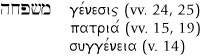
In this case the translator, presumably because he has already used a preferred term to represent one Hebrew lexeme, then selected a second Greek term to represent  . So within the space of ten verses we find three different terms rendering
  . Another example would be in 2.7 where the MT reads
  (“nurse”) and
  (“to nurse”), using the same Hebrew root. The translator chose the participle
  (“a nursing woman”) and
  (“she shall suckle”), two distinct terms, to gloss the same Hebrew root. This kind of lexical variation in the Greek translation occurs quite regularly, even as the translator is careful to preserve general, interlinear correspondence in his translation.
In the Hebrew narrative of Exodus the waw-conjunctive occurs frequently. The translator of Exodus normally used  as the Greek equivalent. However, where a change in subject occurs or some other emphasis may be warranted, he selected
  . Aejmelaeus observes that in the case of the translation of Exodus “[c]oordination of clauses by
  has been rendered by the use of various literal and free renderings, but total omission of —disregarding the apodotic cases—is found in less than 3% of the cases, of which 3% some cases may even depend upon a difference in the Vorlage.”5 So the places where the translator failed to render the conjunction are rather infrequent. The translator was equally careful to render pronouns in his Hebrew text.
In the case of word order the translator tended to follow his Hebrew text, but not always slavishly. For example, in Hebrew the pronominal formations normally are attached to nouns as suffixes. We should expect the translator to place the pronoun in Greek following the noun, imitating the Hebrew order, if adherence to Hebrew word order was a significant issue. Non-translation Greek tends to place them in front. In Greek Exodus we discover that about 30 (out of approximately 350) cases are pre-posed, a proportion that is unusually high among the various Septuagint translators.
The aorist form of the verb is the most common rendering chosen by the translator for the Hebrew verb, reflecting the large number of suffixed forms or waw () + prefixed forms (in narrative). However, he does not hesitate to employ other Greek tense forms should that convey more adequately his understanding of the sense of his Hebrew text. An interesting example of this is found in 1.12–14. In the comparative clause structure of v. 12 the translator rendered the imperfect aspect of the Hebrew verbs well by the Greek imperfect form (“But as much as they were humbling them, by so much the more they kept becoming more numerous and stronger”). Each of the verbs that follow (vv. 12b–14) continues to use Greek imperfect forms. This tense form fit the context well, because at this point in the story the narrative reports the worsening condition of the Israelite people as they were oppressed. We also observe in this same context the translator’s use of lexical variation for the same Hebrew term:

And further his repeated use of similar formations (in this case  - compounds), presumably for literary effect, may be noted:
v. 13–14  .
.
After his extensive study of the Septuagint of Exodus, Wevers comments that “the dominant characteristic of Exod as a translation document is its expansionist character. On the whole Exod expands far more than contracts.”6 This tendency appears in many different forms. For example, the translator is careful to define Aaron as Moyses’ brother even when this is not present in the source text (cf. 7.7, 9, 19; 8.5). At 25.6(17) the translator defined the  , the gold plate placed at the top of the ark, as a “cover” (
 ), a term that has no equivalent in the Hebrew text.
Other examples could be added, but the tendency is clear. There is no indication that such clarifications are based on a different Hebrew text. Rather, these additions probably represent the translator’s efforts to ensure that his understanding of the source text would be communicated clearly and explicitly in Greek to the reader.
Of Stereotypes, Calques and Isolates
As the translator proceeded in his work, choosing appropriate terms in the target language to render adequately and contextually the sense of the source text taxed his ability. In Exodus the translator was sensitive to the Hebrew context and so did not hesitate to choose different Greek terms so that the Hebrew sense, as he understood it, would be conveyed adequately. Once he connected a Greek term semantically with a Hebrew term, he tended to continue with this equivalency, unless the context led him to gloss the source text in a different way. For example, the usual rendering of  in Exodus is
  , whereas
  normally renders
  . However, in one case (31.12, where there is no textual variant in the Septuagint tradition)
  renders
  , and out of the three hundred occurrences of
  , it translates
  about seventeen times.
  would seem to constitute the default rendering of
  . It is not clear why variation from the default occurs, but it indicates that the translator exercised some freedom. As we have noted previously, we discover lexical variation in contexts where we would expect the usual Greek equivalent because the same Hebrew term is repeated.
Sometimes a Hebrew term will have several distinctive meanings, but the translator will use one Greek term whose semantic content only covers one of the meanings expressed by the Hebrew term. In such cases if the translator sticks with the usual equivalent, then it may create some tension in the context. An examination of the use of  as the usual equivalent for
  (eleven times) and
  (three times) provides an interesting example.
  indicates both sin and the ritual associated with removing sin (i.e., sin offering). NRSV, for instance, renders it as “sin offering” at 29.14, 36; 30.10, but in all other contexts it uses “sin” (10.17; 32.21, 30, 31, 32, 34; 34.7, 9). The standard sense of
  is “failure, fault or sin.” It does not carry the sense of “sin offering.” When the translator uses
  as the stereotypical gloss for
  , the Greek term no longer makes sense in those contexts where
  signifies “sin offering.” In 29.36 where Moyses is instructed every day to “offer a bull as a sin offering for atonement” (NRSV), the Septuagint reads
  (“and the young calf for the sin you shall do on the day of the purification” [NETS]). In these contexts
  becomes an isolate, i.e., being the default rendering for
  but not rendering the contextualized meaning of this Hebrew term in the context of the source language, leading to semantic tension in the Greek context (on isolates, see “TO THE READER OF NETS”).
If we move further along this lexical continuum, the calque represents the point on the semantic scale where the semantic range of the Hebrew term dominates that of the chosen Greek gloss. The use of  (27.21; 31.7; 39.15) as the standard equivalent for
  is a well-known example. Others commonly found in the Septuagint also occur in Exodus—
 for
for  and
and  for
for  .
.
At times the translator has recourse to transliteration as his only viable strategy. Some of these become standard Greek terms. These would include  (Sabbata),
  (passover),
  (Man),
  (cheroub/cheroubim) and terms of measurement such as
  and
and  .
.
THE NETS TRANSLATION OF EXODUS
Selected Words and Phrases
1. The Bread of Presentation The translator rendered variously the bread that God commands to be placed on the table outside the most holy part of the tent of witness, the bread of the presence. In the first three Exodus contexts where these ritual loaves are discussed, as God gives instructions to Moyses for the construction of the tent of witness and Moyses has it built, the MT has  (25.30) or
  (35.13; 39.36). The Septuagint renderings are various:

In Ex 40.23 (LXX 40.21) as the writer describes the placement of the table in the constructed tent of witness, the bread is placed on it but defined as  (lit. “an arrangement of bread”). NRSV renders the sentence “and set the bread in order on it.” This clause is rendered by the translator:

and he presented on it loaves of presentation before the Lord (NETS) (and he set the bread in order on it before the LORD) (NRSV)
The translator did not consider the Hebrew expression to be a technical, cultic phrase, or if he did, either he felt no compulsion to render it consistently or he did not have readily to hand a Greek equivalent that had become normative for Greek-speaking Jews in Alexandria. The rendering that becomes somewhat standard (used in Supplements [Chronicles] for example), i.e.,  , only occurs in the Pentateuch at Exodus at 40.21(23) and possibly 39.18(36). We do not know for sure whether the original translator devised the phrase that comes to represent the “loaves of presentation” in Greek, since it is not clear if the same person translated Ex 1–34 and 35–40. What the translator does present consistently is that these loaves were placed “before the Lord.”
2. Divine Name and General Term for Deity
The usual rendering of the tetragrammaton ( ) in Exodus is
  , as in the other sections of the Septuagint. Four times (3.4; 13.19; 18.1; 20.1), however, the translator uses to render
  . Why the translator glossed
  with is not altogether clear, but the variation does not seem to be textually based. as a translation of the tetragrammaton renders the qere of the Hebrew text (i.e., what the vowel marks indicate,
  ), not the kethibh (i.e., what the consonants indicate).
Several times (4.10, 13; 5.22; 15.17; 32.22) when the author addresses God as  (“Lord” or “Master”), the translator renders it as . In these cases renders the Hebrew term appropriately. In ten contexts the translation has with no equivalent in the MT. Sometimes the addition seems to be for clarification (8.28; 17.15; 24.1, 16; 32.31; 34.10; 35.3; 39.12), and in the other instance the translator has apparently chosen to represent the meaning of the Hebrew text in a different way (16.32).
In 4.24 the translator has opted for  to render
  . Perhaps the translator did not want to attribute directly to “the Lord” this attempt on Moyses’ life. Several times the double term
 ) was rendered by alone (8.10; 9.30), and
  alone was rendered by
  (12.31; 13.5, 11). Whether these anomalies were textually based or occurred for some other reason is uncertain.
In the Septuagint of Exodus normally lacks a definite article (about 354 times in Wevers’ edition), which would indicate that the translator considered it primarily a proper name.7 There are fifteen occasions when the translator used the definite article with to represent  . There does not appear to be any specific pattern.
 usually translates
  (about 129 times in Exodus). However, in 41 contexts it rendered
  (almost a quarter of the occurrences of
  ). The only occurrence of
  ) (6.3, preposed by the preposition
  ) is rendered as
  (“being their God,” NETS). Several times (3.18 [2x ]; 5.3b) the translator rendered the combined
  by
by  alone. Perhaps the translator thought that the use of
  would not be appropriate because of the way God’s personal name was being revealed to Israel (3.18), or perhaps, because Moyses was making his first appeal to Pharao (5.3b), the more generic term seemed appropriate. There are also several contexts where the Hebrew text has
  as the reference to God, and the translator normally used
  as his gloss. In a number of contexts apparently has no Hebrew equivalent, usually in conjunction with cases of to render
  .
.
The translator’s use of , the general term for deity (including non-Israelite deities), was more diverse than his use of his equivalent for the proper name of Israel’s God. In NETS Exodus is rendered as ‘G/god’ and as ‘L/lord.’ The capitalized forms refer to Israel’s deity.
In Ex 3.13–14, when God appears to Moyses through the burning bush, Moyses asks God to tell him his name. The translator rendered the difficult Hebrew as  (“I am The One Who Is,” NETS8). The translator repeated (14b) this expression (
 ) as the name for the God of Israel, who has sent Moyses. The similar form of
  (proper name) and
  (first person singular, prefix form of the Qal stem of
  = “to be”) and the corresponding etiology cannot be duplicated in Greek. The translator opted to translate the expression, not to transliterate it in this context.
3. Pharao’s “Hardness of Heart”
In Exodus one of the most provocative issues is the way in which Israel’s God interacts with Pharao. As God acts to extricate Israel from her bondage in Egypt, he influences Pharao’s behavior. His motive is explained in 14.4: “I will harden Pharaoh’s heart . . . so that I will gain glory for myself over Pharaoh and all his army; and the Egyptians shall know that I am the LORD” (NRSV). Three Hebrew verbs are used to express this concept and the translator is quite consistent, if not stereotyped, in his renderings, with the exception of 7.13.
In these choices the translator sought to reflect the different emphases in the Hebrew terms—heaviness or weightiness in the equivalence of  for
for  and hardness in the equivalence of
  for
for  . However, the equivalence of and
  for
for  (“make strong, strengthen”) is notable, but for different reasons. In the case of , the semantic overlap in Exodus with
  focuses on the idea of firmness = stubbornness. The Hebrew term generally means, “to be strong or firm” and in the Piel form “to make strong or firm.” When related to the noun
  (“heart”), it signifies positively devotion (a firm conviction), but negatively stubbornness. represents the latter in Exodus as it defines Pharao’s response to God’s activities through the plagues or the catastrophe at the Red Sea. If the evidence in LSJ is correct and complete, this usage of the verb to signify stubbornness may have emerged initially in the Septuagint of Exodus.11
The singular use of  at 7.13 as the rendering of
  with the sense of “prevail” is also interesting (“and the heart of Pharao prevailed, and he did not listen to them” [NETS]). Wevers suggests that “presumably Exod here used
  to set the scene of the struggle between the divine signs and the stubborn heart of Pharaoh.”12 In other words the translator purposely changed the stereotypical rendering of
  by to
by to  , probably to emphasize this aspect of contest. In this context God performs the first sign through Moyses and Aaron to convince Pharao to release Israel (the rod becoming a dragon) (7.8–13), and it follows the explanation that God provides to Moyses concerning the series of events that is about to unfold and result in Israel’s release. Only in this context (7.1–13) do we find all three terms
  used to define God’s influence on Pharao and Pharao’s response to Moyses’ demands as God’s representative.
4. “Seeing God”
Exodus is unusual in the narratives of the Old Testament with respect to the number of times when people, either individually or as a group, ask to “see God” or are permitted by God’s initiative to see him. In addition to the times that Moyses is invited up onto Mount Sina in order to meet with God (Moyses’ face is shining after he meets with God), the pillar of cloud and fire or the cloud that descended over the newly erected tabernacle signify the presence of God with Israel, all of which reflect this emphasis upon seeing, meeting, or in some other way directly interacting with God.
Where the Hebrew text states that people “see God,” the translator employs various means to express a theologically sensitive rendering, presumably preserving the theological principle that no person can see God and live. At 3.6 the comparative texts and translations read:

This singular use of  in Exodus as the rendering of
  here indicates that the translator was avoiding the implication that Moyses actually “looked at,” i.e., saw, God. Wevers also notes that the preposition
  “enhances the avoidance of directly looking at God.”13
After God completes his revelation of Israel’s covenantal obligations, he invites the Israelite leadership to ascend Sina and worship (24.1–2). The narrative describes this encounter (24.9–11) as an occasion when the chief men of Israel “saw the God of Israel . . . they beheld God” (NRSV). In fact they celebrated by eating a sacred meal in God’s presence. The comparative texts and translations read:

The Septuagint translator would only admit that Israel’s leaders saw “the place . . . where the God of Israel stood,” but not that human beings saw God. He described this place in the following manner: “that which was beneath his feet, like something made from lapis lazuli brick and like the appearance of the firmament of heaven in purity.” This note in the narrative may have influenced his choice to emphasize the “place” of God. The Hebrew text (v. 11) notes the expectation that seeing God should result in calamity, but God graciously restrains himself. No one is harmed through this experience. “Not even one . . . perished,” the Septuagint notes.
The other primary context comes in Ex 33–34 as Moyses intercedes with God, seeking Israel’s preservation from God’s threatened judgment after the golden calf episode. When God promises to relent and to continue with his program to bring Israel to the land of Chanaan, Moyses asks for some visible sign that God will stand by his word. Moyses boldly asks to see God. “Show me your glory!” he demands (33.18). The risk in his demand becomes explicit as the narrator records God’s warning that “you cannot see my face; for no one shall see me and live” (33.20). Yet God makes an accommodation for Moyses’ sake. While many things in this narrative context deserve comment, I will focus on 33.23.

The translator removes any suggestion that Moyses might see any significant part of God, only his “hind parts.”
The translator’s handling of these contexts would suggest that his theological framework governed his rendering, as he sought to follow the principle (33.20) that “no one shall see me [God] and live,” at the same time dealing with segments in the narrative of Exodus that affirmed that some in Israel did see God and continued to live.
Perhaps connected with this phenomenon is the way in which the translator renders the Hebrew root  , which means “to appoint, meet.” When it occurs in the description of the ark and the use of the propitiatory or the tabernacle itself, God affirms to Israel that “there I will meet with you” (25.21; 29.42, 43; 30.6, 36). However, in each of these settings the translator “quite intentionally”14 understood this root as the verb
  , which means “to know.”
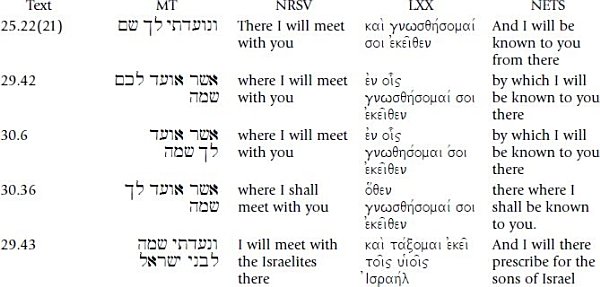
It is improbable that in all four instances the translator misread his source text or that he read a source at variance with MT. More likely, they bespeak theological sensitivity about divine involvement in human agency. The translator emphasized that God revealed himself, and this is how a “meeting” was to be understood between God and human beings. The use of  in 29.43 reinforces this idea that God’s meeting was the occasion when his commands were communicated.
5. The Ten Commandments
The translator’s rendering of the traditionally named “ten commandments” (Ex 20.1–17) was very close to the Hebrew text as we have it today. However, characteristically the Greek text is expansionist:
Further, there are several texts in which the order of materials is different:
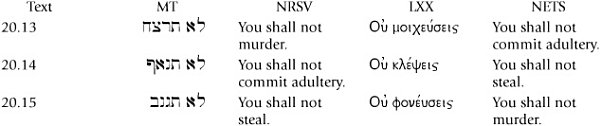
Whether the different order is due to textual or other reasons is not possible to determine at this point. One other word order change worth noting occurs in 20.17. The Septuagint places the neighbor’s wife first before the neighbor’s house, in contrast to the Hebrew text that places the house first, followed by the wife. Why such a reordering occurs remains a matter of speculation.
The terminology referring to the various commands that God gives to Israel tends to be stereotyped in translation. The exceptions are the term  , which is rendered by four different terms, and
  , which was translated primarily by
  , but once by
  . What nuance carried that made it the right choice for the translator in 20.6 is uncertain.
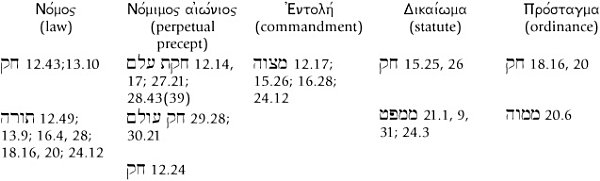
The use of the adjective  in the singular as a substantive
  ,16 although infrequently documented in the third century BCE, became the stereotyped rendering for (
 in Exodus, reflecting the singular form of the Hebrew terms.
6. The Peoples of Chanaan
When God talks about fulfilling his promise to Abraam, Isaak and Iakob in Exodus, the land to which he will lead them is defined as belonging to specific people. In the Greek Pentateuch seven different groups are specified consistently:

Consistently (apart from 23.28)  has been added at some point (position 4, 5 or 6) in the list, although it does not occur in the translator’s Hebrew text.
7. Specific Texts
In Ex 25–31 Moyses receives instructions for building the tabernacle. After the event of the Golden Calf (32–34), Moyses proceeds with the construction of the “tent of witness” (35–40). Undoubtedly the account describing the construction of the tabernacle  , “tent of witness,” or
  “tent,” presents the greatest problem in Exodus to understanding the translation process.
The Greek text, when compared to the MT, is much shorter and puts various materials in a different order. Further, some indicators suggest that either the translator responsible for at least part of chapters 35–40 was different from the translator of chapters 1–34 or a later editor has substantially altered the initial translation for some reason.
Generally speaking the Greek translation describes the production of the priestly vestments (36.8–40) and then the construction of the tabernacle and its equipment (37.1–39.11), whereas the Hebrew text begins with the construction of the tabernacle and its equipment (36.8–38.31) and then describes the priestly vestments (39). But the alterations in the translation are sometimes surprising. The Greek text does not describe the making of the incense altar, for example. It abbreviates significantly passages related to the lampstand and the table of the presence. Detailed charts comparing the Hebrew and Greek texts can be found in various treatments of this problem.17 Midrashic explanation that is not found in the Hebrew text occurs at one point. The bronze for the bronze altar is said to be taken “from the bronze fire-pans that belonged to the men who revolted with the gathering of Kore” (38.22).18
Various hypotheses have been proposed to explain why these major differences emerged in the tradition:
1. The translator had a Hebrew text different from that which we have today, and this accounts for the variation in the Greek text. However, no Hebrew text yet discovered seems to match the Greek translation.
2. For some reason the translator of chapters 1–34 did not complete the translation and another person finished the task, who used a different translation process, while consulting the earlier material. Detailed studies of translation technique expressed in these respective sections, however, indicate only minor variations in translation techniques between these sections of Exodus, apart from chapter 38.
3. One person did the original translation of Exodus following the order of the Hebrew text as we know it, but because he misunderstood the text, or for some other reasons, he created inconsistencies in his translation. A later reviser has edited this original work, adding some materials particularly in chapter 38 and being responsible for a major rearrangement of the Greek text.
4. The original translator is responsible for the current Greek text and used specific principles as the basis for his unique account, which is a “well-planned, well-constructed account which when read by itself and without prejudice usually makes good sense.”19
At this point we might suggest that the most recent comprehensive studies (1) see no need to postulate a different Hebrew text throughout chapters 35–40, (2) discern a large degree of consistency in the fundamental translation technique used throughout Greek Exodus, but (3) detect enough difference between 1–34 and 35–40 to indicate another hand may be at work in some way in the final chapters of the translation, and (4) proceed from the assumption that the original translation of 35–40 was created to make sense to the translator and his presumed audience. We have little data to inform us about the sociological aspects of translation in antiquity and in particular biblical translation. Whether it was acceptable to abbreviate portions of sacred text and make major rearrangements in the structure of the narrative remains debated. However, the fact remains, whether we postulate one translator for Ex 1–40 or several translators or editors, we have a Greek translation for this section that is quite different, being much shorter and ordered differently, from the Hebrew text that we possess today.
EDITORIAL DETAIL
NETS Exodus normally has followed the punctuation proposed in Wevers’ edited text. In terms of versification, where the Septuagint differs from that of the NRSV, the NRSV versification is noted in parenthesis (cf. 18.18; 21.16, 17).
BIBLIOGRAPHICAL NOTE
In addition to the standard grammars and lexica, I have received considerable assistance from the works by John William Wevers, particularly his Notes on the Greek Text of Exodus (1990) and his Text History of the Greek Exodus (1992). The translation and commentary by Alain le Boulluec and Pierre Sandevoir in L’Exode BA (1989) has been helpful in many instances. The earlier translation by Brenton has also provided assistance from time to time.
Wevers’ discussion of the Tabernacle section, as well as those by David Gooding in The Account of the Tabernacle: Translation and Textual Problem of the Greek Exodus (1959) and Martha Wade in Consistency of Translation Techniques in the Tabernacle Accounts of Exodus in the Old Greek (2003), have provided significant methodological and textual suggestions.
I must also acknowledge the assistance of Albert Pietersma, who provided editorial guidance and helped to resolve many translation issues.
LARRY J. PERKINS
1 These are the names of the sons of Israel who had entered into Egypt with Iakob their father. Each with their whole household went in: 2Rouben, Symeon, Leui, Ioudas, 3Issachar, Zaboulon and Beniamin, 4Dan and Nephthali, Gad and Aser. 5But Ioseph was in Egypt. Now all souls from Iakob were seventy-five. 6Then Ioseph died, and all his brothers and all that generation. 7But the sons of Israel increased and multiplied and became common and were growing very, very strong. Now the land kept multiplying them.
8 Now another king arose over Egypt, who did not know Ioseph. 9Now he said to his nation, “Look, the race of the sons of Israel is a great multitude and is becoming stronger than we. 10Come then, let us deal shrewdly with them, lest it be multiplied, and, whenever war happens to us, these also shall be added to the opponents, and after going to war against us, they shall depart from the land.” 11And he set over them overseers of tasks in order to afflict them in the tasks. And they built fortified cities for Pharao, both Pithom and Ramesses and On, which is Heliopolisa. 12But as much as they were humbling them, by so much the more they kept becoming more numerous and stronger, and the Egyptians were disgusted with the sons of Israel. 13And the Egyptians were oppressing the sons of Israel forcefully 14and were grievously afflicting their life by the hard tasks in clay and brick making and all the tasks in the plains, according to all the tasks in which they were enslaving them with force.
15 And the king of the Egyptians spoke to the Hebrews’ midwives, to one of them whose name was Sepphora, and the name of the second was Phoua, 16and he said, “Whenever you act as midwives to the Hebrew women and they should be at the birthing stage, if then it be male, kill it, but if female, preserve it alive.” 17But the midwives feared God, and they did not do as the king of Egypt instructed them and tried to keep the males alive. 18Then the king of Egypt summoned the midwives and said to them, “Why is it that you have done this thing and tried to keep the males alive?” 19The midwives then said to Pharao, “The Hebrew women are not like the women of Egypt, for they give birth before the midwives go in to them,” and they were already giving birth. 20Now God was dealing well with the midwives, and the people kept on multiplying and becoming very strong. 21Because the midwives were fearing God, they made families for themselves. 22Then Pharao instructed all his people, saying, “Every male that might be born to the Hebrews, throw into the river, and every female, keep it alive.”
2 Now there was a certain man from the tribe of Leui who took one of the daughters of Leui and married her. 2And she conceived and bore a male child. Now when they saw it was handsome, they sheltered it for three months. 3But when they could hide it no longer, its mother took a basket and plastered it with a mixture of pitch and tar, and she put the child in it and placed it in the marsh beside the river. 4And his sister was watching from a distance to learn what would happen to him.
5 Now Pharao’s daughter came down to the river to bathe, and her attendants were walking beside the river. And when she saw the basket in the marsh, she sent her attendant, and she picked it up. 6Now when she opened it, she saw a child crying in the basket, and Pharao’s daughter spared it and said, “This is one of the Hebrews’ children.” 7And his sister said to Pharao’s daughter, “Do you wish that I summon for you a nursing woman from the Hebrews, and she shall suckle the child for you?” 8Then she, Pharao’s daughter, said to her, “Go!” But the girl went and summoned the child’s mother. 9And Pharao’s daughter said to her, “Take care of this child for me, and suckle it for me, and I will give you your pay.” Then the woman took the child and kept suckling it. 10Now when the child grew up, she brought it to Pharao’s daughter, and it became to her for a son. And she named his name Moyses, saying, “I drew him out of the water.”
11 Now it came to pass in the course of those many days, when he had fully grown, Moyses went out to his brothers, the sons of Israel. And as he observed their toil, he saw an Egyptian man beating some Hebrew from his own brothers, the sons of Israel. 12Now when he looked around this way and that, he saw no one, and he struck the Egyptian and hid him in the sand. 13Now when he went out on the next day, he saw two Hebrew men fighting, and he said to the one who was in the wrong, “Why do you beat your fellow?” 14But he said, “Who appointed you ruler and judge over us? You do not intend to kill me, do you, in the same way you killed the Egyptian yesterday?” Then Moyses was afraid and said, “Has this matter perhaps become so well known?” 15Now Pharao heard about this matter, and he was seeking to kill Moyses.
Then Moyses withdrew from Pharao’s presence and settled in the land of Madian. Now when he came into the land of Madian, he sat upon the well. 16Now the priest of Madian had seven daughters who were tending their father’s sheep. So when they arrived, they were drawing water until they filled the receptacles in order to water their father’s sheep. 17But when the shepherds arrived, they were driving them away. But Moyses got up and rescued them and drew water for them and watered their sheep. 18Now they arrived back to Ragouel, their father, and he said to them, “Why is it that you were quick to arrive today?” 19And they said, “An Egyptian man rescued us from the shepherds and drew water for us and watered the sheep.” 20And he said to his daughters, “And where is he? And for what reason have you left this man behind like this? Invite him then in order that he might eat bread.” 21Now Moyses stayed with the man, and he gave Sepphora, his daughter, to Moyses for a wife. 22Now when she became pregnant, the woman bore a son, and Moyses called his name Gersam, saying, “Because I am a resident alien in a foreign land.”
23 Now after those many days the king of Egypt died, and the sons of Israel groaned from the tasks and cried out, and their cry rose up to God from the tasks. 24And God listened to their groaning, and God remembered his covenant with Abraam and Isaak and Iakob. 25And God looked upon the sons of Israel, and he became known to them.
3 And Moyses was tending the sheep of Iothor, his father-in-law, the priest of Madian, and he led the sheep beyond the wilderness and came to the mountain, Choreb. 2Now an angel of the Lord appeared to him in a fire of flame out of the bush, and he saw that the bush was burning with fire, but the bush was not burning up. 3Then Moyses said, “When I pass by, I will look at this great sight, why it is that the bush is not burning up.” 4Now when the Lord saw that he was drawing near to see, the Lord called him from the bush, saying, “Moyses, Moyses.” And he said, “What is it?” 5And he said, “Do not come near here! Loose the sandal from your feet! For the place on which you are standing is holy ground.” 6And he said to him, “I am the God of your father, God of Abraam and God of Isaak and God of Iakob.” And Moyses turned his face away, for he was being reverent to look down before God.
7 Then the Lord said to Moyses, “When I looked, I saw the affliction of my people in Egypt, and I have heard their cry on account of the taskmasters. For I know their pain. 8And I came down to deliver them from the hand of the Egyptians and to bring them out of that land and to bring them into a good and spacious land, into a land flowing with milk and honey, into the place of the Chananites and Chettites and Amorrites and Pherezites and Heuites and Gergesites and Iebousites. 9And now, look, the cry of the sons of Israel has come to me, and I have seen the oppression with which the Egyptians oppress them. 10And now come, let me send you to Pharao, king of Egypt, and you will bring my people, the sons of Israel, out of the land of Egypt. 11And Moyses said to God, “Who am I that I should go to Pharao, king of Egypt, and that I should bring the sons of Israel out of the land of Egypt?” 12But God spoke to Moyses, saying, “I will be with you, and this shall be the sign for you that I am sending you: when you have brought my people out of Egypt, you shall also serve God at this mountain.”
13 And Moyses said to God, “Look, I shall come to the sons of Israel and shall say to them, ‘The God of your fathers has sent me to you’; they will ask me, ‘What is his name?’ What shall I say to them?” 14And God said to Moyses, “I am The One Who Is.” And he said, “Thus shall you say to the sons of Israel, ‘The One Who Is has sent me to you.’ “15And God said again to Moyses, “Thus you shall say to the sons of Israel, ‘The Lord, the God of your fathers, God of Abraam and God of Isaak and God of Iakob, has sent me to you.’
This is an everlasting name of mine
and a memorial of generations to
generations.
16 “Therefore, go, and assemble the elders’ council of the sons of Israel, and you shall say to them, ‘The Lord, the God of your fathers, has appeared to me, God of Abraam and God of Isaak and God of Iakob, saying, “With concern I have concerned myself with you and what has happened to you in Egypt.” 17And I said, “I will bring you up from the affliction of the Egyptians into the land of the Chananites and Chettites and Heuites and Amorrites and Pherezites and Gergesites and Iebousites, into a land flowing with milk and honey.”’ 18And they will listen to your voice, and you and the elders’ council of Israel shall go in to Pharao, king of Egypt, and you shall say to him, ‘The God of the Hebrews has summoned us. Therefore, let us go a three days’ journey into the wilderness so that we may sacrifice to our God.’ 19Now I know that Pharao, king of Egypt, will not permit you to go, except with a mighty hand. 20And when I stretch out my hand, I will strike the Egyptians with all my wonders that I will perform among them, and after these things he will send you away. 21And I will give favor to this people before the Egyptians. Now whenever you depart, you will not go away empty-handed. 22But a woman will ask from a neighbor and tent mate of hers silver and gold articles and clothing, and you shall put them on your sons and on your daughters, and you shall plunder the Egyptians.”
4 Then Moyses answered and said, “If then they should not believe me or listen to my voice, for they will say, ‘God has not appeared to you!’ what shall I say to them?” 2Then the Lord said to him, “What is this in your hand?” And he said, “A rod.” 3And he said, “Throw it on the ground!” And he threw it on the ground, and it became a snake, and Moyses fled from it. 4And the Lord said to Moyses, “Stretch out your hand, and seize the tail! (then he stretched out his hand and seized the tail, and it became a rod in his hand) 5—so that they may believe you, that the Lord, the God of their fathers, God of Abraam and God of Isaak and God of Iakob, has appeared to you.”
6 Now the Lord said to him again, “Put your hand into your bosom!” And he put the hand into his bosom, and he brought his hand out of his bosom, and his hand became as snow. 7And he said, “Again put your hand into your bosom!” And he put the hand into his bosom and brought it out of his bosom, and again it was restored to the color of his flesh. 8“Now if they should not believe you or listen to the voice of the first sign, they will believe you because of the voice of the last sign. 9And it will be if they should not believe you for these two signs or listen to your voice, you shall take some of the river’s water and pour it on the dry ground, and the water, whatever you take from the river, will be blood on the dry ground.”
10 But Moyses said to the Lord, “Please, Lord, I am incompetent—before yesterday or the third day or since you began to speak to your attendant. I am weak-voiced and slow-tongued.” 11Then the Lord said to Moyses, “Who gave a mouth to a person, and who made him deaf and mute, seeing and blind? Is it not I, the Lord God? 12And now go, and I will open your mouth and teach you what you are going to speak.” 13And Moyses said, “Please, Lord, appoint another capable person, whom you will send.” 14And enraged with anger towards Moyses the Lord said, “Look, is not Aaron your brother, the Leuite? I know that when he speaks, he will speak for you. And look, he will come out to meet you, and when he sees you, he will be glad in himself. 15And you shall speak to him and put my words in his mouth. And I will open your mouth and his mouth and will teach you what you shall do. 16And he shall speak for you to the people, and he shall be your mouth, but you shall be to him the things pertaining to God. 17And this rod, which was turned into a snake, you shall take in your hand, with which you shall perform the signs with it.”
18 Now Moyses went and returned to Iothor, his father-in-law, and said, “I shall go and return to my brothers in Egypt and see whether they are still living.” And Iothor said to Moyses, “Go in health.” Now after those many days the king of Egypt had died. 19And the Lord said to Moyses in Madian, “Go! Return to Egypt! For all those who were seeking your soul are dead.” 20Then Moyses took his wife and children and put them on draft animals, and he went back to Egypt. And Moyses took the rod from God in his hand.
21 And the Lord said to Moyses, “As you go and return to Egypt, see, all the wonders which I put in your hands, you shall perform them before Pharao. But I will harden his heart, and he will not send the people away. 22Then you shall say to Pharao, ‘This is what the Lord says, “My firstborn son is Israel.” 23And I said to you, “Send my people away so that they might serve me.” Now then, if you are unwilling to send them away, see then, I will kill your firstborn son.’”
24 Now it happened on the way at the lodging, an angel of the Lord met him and was seeking to kill him. 25And Sepphora took a pebble and circumcised the foreskin of her son, and she fell at his feet and said, “The blood of the circumcision of my child is staunched.” 26And he went away from him, because she said, “The blood of the circumcision of my child is staunched.”
27 And the Lord said to Aaron, “Go into the wilderness for a meeting with Moyses.” And he went and met him at the mountain of God, and they kissed one another. 28And Moyses reported to Aaron all the words of the Lord that he sent and all the signs that he commanded him. 29Then Moyses and Aaron went and assembled the elders’ council of the sons of Israel. 30And Aaron spoke all these words that God had spoken to Moyses and performed the signs before the people. 31And the people believed and were glad because God had observed the sons of Israel and because he had seen their oppression. Then the people bowed down and did obeisance.
5 And after these things Moyses and Aaron went in to Pharao and said to him, “This is what the Lord, the God of Israel, says, ‘Send away my people so that they may celebrate a feast to me in the wilderness.’ “2And Pharao said, “Who is this whose voice I shall listen to so that I send away the sons of Israel? I do not know the Lord, and I am not sending Israel away!” 3And they say to him, “The God of the Hebrews has summoned us. We will travel then a three days’ journey into the wilderness in order to sacrifice to our God, lest death or murder meet us.” 4And the king of Egypt said to them, “Moyses and Aaron, why are you diverting my people from their tasks? Each of you, go back to his tasks.” 5And Pharao said, “Look, the people of the land now are very numerous. Therefore, let us not give them relief from their tasks.” 6Then Pharao instructed the people’s taskmasters and recorders, saying, 7“No longer will straw continue to be given to the people for brick-making, as it was yesterday and the third day. Let them go themselves and gather straw for themselves. 8And the levy of brick-making that they themselves make each day, you shall impose on them; you shall not remove anything. For they have spare time! For this reason they have cried out, saying, ‘Let us go and offer sacrifice to our God.’ 9Let the tasks of these people be made heavy, and let them be preoccupied with these things and let them not be preoccupied by empty words.”
10 Then the taskmasters and recorders kept urging them on and telling the people, saying, “This is what Pharao says, ‘I am no longer giving you straw. 11As you yourselves go, gather for yourselves straw wherever you may find it, for nothing is being removed from your levy.’ “12And the people were scattered in the whole of Egypt to gather stubble for straw. 13Now the taskmasters kept urging them on, saying, “Complete the customary tasks daily even as when the straw was being given to you.” 14And the recorders of the race of the sons of Israel, who had been set over them by the overseers of Pharao, were beaten, saying, “Why did you not finish your levies of brick-making, just as yesterday and the third day, also today?”
15 Then the recorders of the sons of Israel, they came in and cried out to Pharao, saying, “Why are you acting like this to your domestics? 16Straw is not being given to your domestics, and they tell us to make the brick, and look, your servants have been beaten. So you will treat your people unjustly.” 17And he said to them, “You have spare time; you are men of leisure! For this reason you say, ‘Let us go; let us offer sacrifice to our God.’ 18Now then, go, and get to work! For the straw shall not be given to you, and you shall deliver the levy of brick-making.” 19Now the recorders of the sons of Israel were seeing themselves in difficulties, because they were saying, “You shall not come short of the customary amount of brick-making daily.” 20Now they met Moyses and Aaron coming to meet them, as they were going out from Pharao, 21and they said to them, “May God see you and judge, because you have made our smell loathsome before Pharao and before his attendants, to put a sword into his hands to kill us.”
22 Then Moyses turned to the Lord and said, “Lord, why did you harm this people? And why have you sent me? 23Even from the time when I have gone in to Pharao to speak in your name, he has harmed this people, and you have not delivered your people.”
6 And the Lord said to Moyses, “Now you shall see what I will do to Pharao. For by a mighty hand he will send them away, and by a raised arm he will drive them out of his land.”
2 Then God spoke to Moyses and said to him, “I am the Lord, 3and I appeared to Abraam and Isaak and Iakob, being their God, and my name, Lord, I did not make known to them. 4Also, I established my covenant with them in order to give them the land of the Chananites, the land of their sojourning, in which they also lived as sojourners on it. 5And I listened to the groaning of the sons of Israel, those whom the Egyptians are making into slaves, and I remembered your covenant. 6Go! Tell the sons of Israel, saying, ‘I am the Lord, and I will bring you out from the domination of the Egyptians, and I will deliver you from slavery, and I will redeem you by a raised arm and great judgment. 7And I will take you for myself, as my people, and I will be your God, and you shall know that I am the Lord, your God, who brought you out from the oppression of the Egyptians. 8And I will bring you into the land for which I stretched out my hand to give it to Abraam and Isaak and Iakob, and I will give it to you by allotment. I am the Lord.’ “9Then Moyses spoke in this way to the sons of Israel, and they did not listen to Moyses because of discouragement and the hard tasks.
10 Then the Lord spoke to Moyses, saying, 11“Go in, tell Pharao, king of Egypt, to send away the sons of Israel from his land.” 12Then Moyses spoke before the Lord, saying, “Look, the sons of Israel did not listen to me, and how will Pharao listen to me? Now, I am without eloquence.” 13But the Lord spoke to Moyses and Aaron and gave them instructions for Pharao, king of Egypt, that he send the sons of Israel away from the land of Egypt.
14 And these are the chiefs of the households of their ancestral lineages: sons of Rouben, firstborn of Israel: Henoch and Phallous, Hasron and Char-mi. This is the family of Rouben. 15And sons of Symeon: Iemouel and Iamin and Oad and Iachin and Saar and Saoul, the son of the Phoenician. These are the paternal lineages of the sons of Symeon. 16And these are the names of the sons of Leui according to their families: Gedson and Kaath and Merari. And the years of Leui’s life were one hundred thirty-seven. 17And these are sons of Gedson: Lobeni and Semei, households of their paternal lineage. 18And sons of Kaath: Amram and Isaar, Chebron and Oziel. And the years of Kaath’s life were one hundred thirty years. 19And sons of Merari: Mooli and Omousi. These are the households of Leui’s ancestral lineages according to their families. 20And Amram took Iochabed, the daughter of his father’s brother, for his own wife, and she bore him both Aaron and Moyses and Mariam, their sister. Now the years of Amram’s life were one hundred thirty-six years. 21And sons of Isaar: Kore and Napheg and Zechri. 22And sons of Oziel: Misael and Elisaphan and Setri. 23Now Aaron took Elisabe, daughter of Aminadab, sister of Naasson, for his wife, and she bore him Nadab and Abioud and Eleazar and Ithamar. 24And sons of Kore: Asir and Elkana and Abiasaph. These are the generations of Kore. 25And Eleazar, Aaron’s son, took one of the daughters of Phoutiel for his wife, and she bore him Phinees. These are the heads of the ancestral line-age of the Leuites, according to their generations.
26 This is Aaron and Moyses whom God told to bring the sons of Israel out of the land of Egypt with their host. 27These are the ones negotiating with Pharao, king of Egypt, and they brought the sons of Israel out of Egypt—Aaron himself and Moyses.
28 On the day in which the Lord spoke to Moyses in the land, Egypt, 29the Lord spoke to Moyses, saying, “I am the Lord. Say to Pharao, king of Egypt, what I am saying to you.” 30And Moyses said before the Lord, “Look, I am weak-voiced, and how will Pharao listen to me?”
7 And the Lord spoke to Moyses, saying, “Look, I have given you as a god to Pharao, and Aaron, your brother, shall be your prophet. 2Now you shall speak to him all things that I command you, and Aaron, your brother, shall tell Pharao so that he sends the sons of Israel away from his land. 3But I will harden Pharao’s heart, and I will multiply my signs and wonders in the land, Egypt. 4And Pharao shall not listen to you, and I will lay my hand upon Egypt, and I will bring out with my host my people, the sons of Israel, from the land of Egypt with great vengeance. 5And all the Egyptians shall know that I am the Lord, when I stretch out the hand against Egypt, and I shall bring the sons of Israel out from their midst.” 6And Moyses and Aaron did just as the Lord commanded them; so they did. 7Now Moyses was eighty years old, but Aaron, his brother, was eighty-three years old, when he spoke to Pharao.
8 And the Lord spoke to Moyses and Aaron, saying, 9“And if Pharao should speak to you, saying, ‘Give us a sign or wonder,’ you also shall say to Aaron, your brother, ‘Take the rod, and throw it upon the ground before Pharao and before his attendants, and it will be a dragon.’ “10Now Moyses and Aaron went in before Pharao and his attendants and did so just as the Lord commanded them. And Aaron threw down the rod before Pharao and before his attendants, and it became a dragon. 11And Pharao summoned the experts of Egypt and the sorcerers, and they also, the enchanters of the Egyptians, did likewise by their magical potions. 12And each one threw down his rod, and they became dragons, and the rod of Aaron swallowed the rods of those people. 13And the heart of Pharao prevailed, and he did not listen to them, just as the Lord spoke to them.
14 Now the Lord said to Moyses, “The heart of Pharao is weighed down so as not to send away the people. 15Go to Pharao in the morning. Look, he himself is going out to the water, and you shall stand, meeting him on the bank of the river, and the rod that was turned into a snake you shall take in your hand. 16And you shall say to him, ‘The Lord, the God of the Hebrews, has sent me to you, saying, “Send away my people so that they may serve me in the wilderness.” And look, you did not listen up to this point. 17This is what the Lord says, “By this you shall know that I am the Lord. Look, with the rod that is in my hand I am about to strike upon the water that is in the river, and it shall turn to blood. 18And the fish that are in the river shall die, and the river shall stink, and the Egyptians shall be unable to drink water from the river.” ‘“19Now the Lord said to Moyses, “Say to Aaron, your brother, ‘Take your rod, and stretch out the hand over the waters of Egypt and over their rivers and over their canals and over their marshes and over all their accumulated water, and they shall be blood.’ “And blood occurred in all the land of Egypt, both in things made from wood and things made from stone.
20 And Moyses and Aaron did so just as the Lord commanded them, and Aaron lifted it up and with his rod struck the water that was in the river before Pharao and before his attendants, and all the water in the river turned into blood. 21And the fish in the river died, and the river stank, and the Egyptians could not drink water from the river, and there was blood in the whole land of Egypt. 22But also the Egyptians’ enchanters did likewise with their magical potions. And Pharao’s heart was hardened, and he did not listen to them, just as the Lord said. 23And Pharao turned and went into his house, and he did not put his mind even to this. 24Now all the Egyptians dug around the river so that they might drink water, and they could not drink water from the river.
25 And seven days were completed after the Lord struck the river.
8 Then the Lord said to Moyses, “Go in to Pharao, and you will say to him, ‘This is what the Lord says: Send away my people so that they may serve me. 2But if you are unwilling to send them away, look, I am going to strike all your borders with frogs. 3And the river shall vomit frogs, and when they come up, they shall enter into your houses and into the secret places of your bedrooms and upon your beds and into the houses of your attendants and your people and in your bread dough and in your ovens. 4And upon you and upon your attendants and upon your people the frogs shall come up.’ “5Then the Lord said to Moyses, “Say to Aaron, your brother, ‘Stretch out by hand your rod over the rivers and over the canals and over the marshes, and bring up the frogs.’ “6And Aaron stretched out the hand over the waters of Egypt and brought up the frogs. And the frog was made to come up and covered the land of Egypt. 7But also the Egyptians’ enchanters did likewise with their magical potions, and they brought up frogs on the land of Egypt.
8 Then Pharao called Moyses and Aaron and said, “Pray on my behalf to the Lord, and let him take away the frogs from me and from my people, and I will send away the people, and they may sacrifice to the Lord.” 9Then Moyses said to Pharao, “Arrange for me when I should pray for you and for your attendants and your people, to remove the frogs from you and from your people and out of your houses—only in the river shall they remain.” 10And he said, “Tomorrow.” He said, therefore, “As you have said so that you may know that there is no other except the Lord. 11And the frogs shall be taken away from you and out of your houses and out of your villages and from your attendants and from your people—only in the river shall they remain.” 12Then Moyses and Aaron went out from Pharao, and Moyses cried to the Lord about the curtailing of the frogs, as he had arranged with Pharao. 13And the Lord did just as Moyses said, and the frogs died from the houses and from the villages and from the fields. 14And they gathered them in heaps and heaps, and the land stank. 15But when Pharao saw that respite had occurred, his heart was weighed down, and he did not listen to them, just as the Lord said.
16 Then the Lord said to Moyses, “Say to Aaron: ‘Stretch out by hand your rod, and strike the levees of earth, and there shall be gnats both on people and on quadrupeds and on the whole land of Egypt.’ “17Aaron, therefore, stretched out by hand the rod and struck the levees of the earth, and the gnats were both on people and on quadrupeds, and in every levee of the earth, the gnats were in all the land of Egypt. 18But also the enchanters did likewise with their magical potions to produce the gnat, and they could not. And the gnats were both on people and on quadrupeds. 19The enchanters, therefore, said to Pharao, “This is the finger of God!” And Pharao’s heart was hardened, and he did not listen to them, just as the Lord said.
20 Then the Lord said to Moyses, “Rise early in the morning, and stand before Pharao. Look, he himself will go out to the water, and you will say to him, ‘This is what the Lord says: Send away my people so that they may serve me. 21But if you should be unwilling to send away my people, look, I am going to send against you and against your attendants and against your people and against your houses the dog-fly, and the Egyptians’ houses shall be filled with the dog-fly, even into the land which they are on. 22And I will distinguish gloriously on that day the land of Gesem, which my people are on, whereon the dog-fly shall not be, so that you may know that I am the Lord, the Lord of all the landa. 23And I will put a distinction between my people and between your people. Now on the morrow this sign shall be upon the land.’ “24And the Lord did so, and the dog-fly came in great numbers into the houses of Pharao and into the houses of his attendants and into the whole land of Egypt, and the land was ruined as a result of the dog-fly.
25 Then Pharao summoned Moyses and Aaron, saying, “Go, and sacrifice to your God in the land!” 26And Moyses said, “It cannot be so! For we would sacrifice to the Lord our God the abominations of the Egyptians. For if we should sacrifice the abominations of the Egyptians before them, we will be stoned. 27A three days’ journey we will go into the wilderness, and we will sacrifice to the Lord, our God, according as he told us.” 28And Pharao said, “I will send you away—and sacrifice to the Lord, your God, in the wilderness, but not far shall you proceed to go. Pray, therefore, for me to the Lord.” 29Then Moyses said, “Right now I will go out from you, and I will pray to God, and the dog-fly will depart from you and from your attendants and your people tomorrow. Do not add anymore, Pharao, to deceiving, so as not to send away the people to sacrifice to the Lord.”
30 Then Moyses went out from Pharao and prayed to God. 31Now the Lord did as Moyses said, and he took away the dog-fly from Pharao and from his attendants and from his people, and not one remained. 32And Pharao made his heart heavy also on this occasion, and he was unwilling to send away the people.
9 Then the Lord said to Moyses, “Go in to Pharao, and you shall say to him, ‘This is what the Lord, the God of the Hebrews, says: Send away my people so that they may serve me. 2Yet if you are unwilling to send away my people, but still hold on to them, 3look, the hand of the Lord will be on your animals on the plains, both on the horses and on the draft animals and on the camels and cattle and sheep—a very great death. 4And I will distinguish gloriously between the animals of the Egyptians and between the animals of the sons of Israel. Not a thing from all the sons of Israel shall die.’ “5And God gave a limit, saying, “Tomorrow the Lord will do this thing on the land.” 6And the Lord did this thing on the next day, and all the Egyptians’ animals died, but from the animals of the sons of Israel nothing died. 7But when Pharao saw that nothing from the animals of the sons of Israel died, Pharao’s heart became heavy, and he did not send away the people.
8 Then the Lord spoke to Moyses and Aaron, saying, “You take handfuls of furnace soot, and let Moyses scatter it toward heaven before Pharao and before his attendants. 9And let it become a dust cloud over all the land of Egypt, and there shall be upon humans and quadrupeds festering sores, oozing blisters, both on humans and on quadrupeds and in all the land of Egypt.” 10And he took the furnace soot before Pharao, and Moyses scattered it toward heaven, and festering sores, oozing blisters occurred both on humans and on quadrupeds. 11And the magicians were unable to stand before Moyses because of the festering sores. For the festering sores occurred on the magicians and in the whole land of Egypt. 12But the Lord hardened Pharao’s heart, and he did not listen to them, according as the Lord instructed Moyses.
13 Then the Lord said to Moyses, “Rise early in the morning, and stand before Pharao, and you shall say to him, ‘This is what the Lord says, the God of the Hebrews: Send away my people so that they may serve me. 14For at the present time I am sending out all my encounters into the heart of you and your attendants and your people so that you may know that there is no other like me in all the landa. 15For if now I sent my hand, I would strike you and your people with death, and you would be destroyed from the landa. 16And for this reason you have been spared in order that I might display in you my power and in order that my name might be proclaimed in all the landa. 17Still then you hold on to my people so as not to send them away. 18Look, I am about to rain at this hour tomorrow very abundant hail, such as has not occurred in Egypt from the day which it was founded until this day. 19Now, therefore, hurry to gather your animals and whatever belongs to you on the plain. For all the humans and animals, whatever should be found on the plains and should not enter into a dwelling, but the hail should fall upon them, shall die.’ “20The one among Pharao’s attendants who feared the word of the Lord gathered his animals into dwellings. 21But whoever did not pay attention with his mind to the word of the Lord left the animals on the plain.
22 Then the Lord said to Moyses, “Stretch out your hand toward heaven, and there shall be hail on the whole land of Egypt, both on humans and animals and on all herbage which is on the land.” 23Then Moyses stretched out his hand towards heaven, and the Lord gave sounds and hail, and fire ran about on the land, and the Lord rained hail on the whole land of Egypt. 24Now there was hail and fire flashing in the hail. Now the hail was very, very abundant, such as had not occurred in Egypt from the time when a people had come into being upon it. 25Then hail struck in all the land of Egypt from human to animal, and all herbage on the plain the hail struck, and all the trees on the plains the hail crushed. 26Only in the land, Gesem, where the sons of Israel were, the hail did not occur.
27 Then Pharao sent and summoned Moyses and Aaron and said to them, “Now I have sinned. The Lord is just but I and my people are impious. 28Therefore pray for me to the Lord, and let him put a stop to God’s sounds and hail and fire, and I will send you away, and you will no longer continue to stay.” 29And Moyses said to him, “As soon as I leave the city, I will spread out my hands to the Lord, and the sounds will stop, and the hail and the rain will be no more so that you may know that the landa is the Lord’s. 30Both you and your attendants
—I know that you have not yet come to fear the Lord.” 31Now the flax and the barley were ruined. For the barley was ripe, and the flax was going to seed. 32But the wheat and the spelt were not ruined, for they were late. 33Then Moyses went out from Pharao outside of the city, and he spread out hands to the Lord, and the sounds ceased, and the hail, and the rain no longer dripped on the land. 34Now when Pharao saw that the rain had ceased, and the hail and the sounds, he continued to sin and made his heart and that of his attendants heavy. 35And the heart of Pharao was hardened, and he did not send away the sons of Israel, according as the Lord said to Moyses.
10 Then the Lord spoke to Moyses, saying, “Go in to Pharao. For I made his heart and that of his attendants heavy in order that one after another these signs might come upon them, 2that you may recount in the ears of your children and to the children of your children how I mocked the Egyptians, and my signs that I did among them, and you will know that I am Lord.”
3 Then Moyses and Aaron went in before Pharao and said to him, “This is what the Lord, the God of the Hebrews, says, ‘For how long are you unwilling to respect me? Send away my people so that they may serve me! 4But if you are not willing to send away my people, look, I am bringing during this hour tomorrow a grasshopper swarm upon all your borders. 5And it shall cover the face of the land, and you will not be able to see the land, and it shall devour all the rest that remains that the hail left for you, and it shall devour every tree that grows for you on the land. 6And your houses and the houses of your attendants and all the houses in all the land of Egypt shall be filled, something that your fathers or their grandfathers have never seen, from the day when they came on the landa until this day.’ “And Moyses turned away and went out from Pharao.
7 Then the attendants of Pharao say to him, “For how long will this be a stumbling-block for us? Send away the people so that they may serve the Lord their God. Or do you wish to know that Egypt lies in ruins?” 8And they brought back both Moyses and Aaron to Pharao, and he said to them, “Go! Serve the Lord your God. But who and who are those that are going?” 9And Moyses says, “With the young and old men we will go, with our sons and daughters and sheep and cattle, for it is the Lord our God’s feast.” 10And he said to them, “Let the Lord so be with you. According as I send you, I should not also send your chattels, should I? Take note that wickedness lies before you. 11Not so! But let the men go, and you serve God! For this you yourselves are asking.” Then they thrust them out from the presence of Pharao.
12 Then the Lord said to Moyses, “Stretch out the hand on the land of Egypt, and let the grasshopper come up on the land, and it will devour all the herbage of the land and all the fruit of the trees, which the hail left behind.” 13And Moyses lifted up the rod towards heaven, and the Lord brought up a south wind upon the land that whole day and whole night. The morning came, and the south wind took up the grasshopper 14and brought it up on all the land of Egypt, and a great many settled on all the borders of Egypt. A grasshopper such as this had not occurred before it, and after it there shall not be such. 15And it covered the face of the land, and the land was ruined. And it devoured all the herbage of the land and all the fruit of the trees, which was left from the hail. Nothing green was left on the trees and on all the herbage of the plain in the whole land of Egypt. 16Then Pharao hastened to summon Moyses and Aaron, saying, “I have sinned before the Lord your God and against you. 17Therefore bear with my sin now again, and pray to the Lord your God, and let him take away from me this death.” 18So Moyses went out from Pharao and prayed to God. 19And the Lord turned a violent wind from the sea, and it took up the grasshopper and threw it into the Red Sea, and not one grasshopper was left in the whole land of Egypt. 20And the Lord hardened Pharao’s heart, and he did not send away the sons of Israel.
21 Then the Lord said to Moyses, “Stretch out the hand towards heaven, and let there be darkness over the land of Egypt, palpable darkness.” 22So Moyses stretched out the hand toward heaven, and there was darkness, gloom, hurricane, on all the land of Egypt for three days. 23And no one saw his brother, and no one rose up from his bed for three days. But for all the sons of Israel there was light in all places where they were dwelling. 24And Pharao summoned Moyses and Aaron, saying, “Go! Serve the Lord your God. Only leave behind the sheep and cattle. And let your chattels depart with you.” 25And Moyses said, “But you also will give us whole burnt offerings and sacrifices that we shall make to the Lord our God, 26and our animals will go with us, and we shall not leave behind a hoof. For from them we shall take to serve the Lord our God. But we do not know how we should worship the Lord our God until we go there.” 27But the Lord hardened Pharao’s heart, and he was unwilling to send them away. 28And Pharao says, “Depart from me; watch out that yet again you see my face. Now on whatever day you should appear to me, you shall die!” 29Then Moyses says, “You have spoken! I shall no longer appear to you in person.”
11 Then the Lord said to Moyses, “Still one plague I will bring upon Pharao and upon Egypt, and after these things he will send you away from here. Now whenever he sends you away, with everything he will expel you with expulsion. 2Speak then secretly to the ears of the people, and let each one ask from his neighbor and a woman from her neighbor silver and gold articles and clothing.” 3Now the Lord gave favor to his people before the Egyptians, and they supplied them. And the man Moyses became very great before the
Egyptians and before Pharao and before all his attendants.
4 And Moyses said, “This is what the Lord says: Around midnight I am going to enter into the midst of Egypt, 5and every firstborn in the land, Egypt, shall die, from the firstborn of Pharao, who sits on the throne, to the firstborn of the female slave by the millstone and to the firstborn of every animal. 6And there will be a great cry throughout the whole land of Egypt, such as has not been and such as will not again be repeated. 7But among all the sons of Israel a dog will not snarl with his tongue from human being to animal in order that you might know by what means the Lord shall distinguish gloriously between the Egyptians and Israel. 8And all these servants of yours shall come down to me and do obeisance before me, saying, ‘Leave, you and all your people, whom you are leading away,’ and after these things I will go out.” Then Moyses went out from Pharao with wrath.
9 Then the Lord said to Moyses, “Pharao will not listen to you in order that I may multiply my signs and wonders in the land, Egypt.” 10So Moyses and Aaron did all these signs and wonders in the land, Egypt, before Pharao. But the Lord hardened Pharao’s heart, and he was unwilling to send away the sons of Israel from the land of Egypt.
12 Then the Lord spoke to Moyses and Aaron in the land, Egypt, saying: 2This month shall be for you the beginning of months; it is first for you among the months of the year. 3Speak to the whole congregation of the sons of Israel, saying, “On the tenth of this month let them take, each person, a sheep according to the paternal houses, a sheep for each household. 4But if those in the household are too few so that they are not enough for a sheep, he shall join with himself his nearby neighbor according to the number of souls; you, each one, shall number together that which is sufficient for a sheep. 5You shall have a perfect sheep, a one-year-old male. You shall take from the lambs and kids. 6And it shall be kept for you until the fourteenth of this month, and all the multitude of the congregation of the sons of Israel shall slay it towards evening. 7And they shall take some of the blood and shall put it on the two doorposts and on the lintel in the houses whichever they eat them in. 8And they shall eat the meat this night, roasted in fire, and they shall eat unleavened bread with bitter herbs. 9You shall not eat from it raw or boiled in water but rather roasted in fire, head with the feet and inner organs. 10You shall not leave any of it until morning, and you shall not break a bone of it. But that which remains from it until morning, you shall burn with fire. 11Now in this way you shall eat it: your loins girded and your sandals on your feet and your staves in your hands. And you shall eat it with haste—it is the Lord’s pascha. 12And I will pass through in the land, Egypt, on this night, and I will strike down every firstborn in the land, Egypt, from human being to animal, and on all the gods of the Egyptians I will execute vengeance. I am the Lord. 13And the blood shall be for you as a sign on the houses, there where you are, and I will see the blood, and I will protect you, and there shall not be a plague among you to destroy, whenever I strike in the land, Egypt.
14 And this day shall be a memorial for you, and you shall celebrate it as a feast to the Lord throughout your generations. You shall celebrate it as a perpetual precept. 15For seven days you shall eat unleavened bread, but from the first day you shall remove leaven from your houses. Everyone, whoever eats leaven, that soul shall be destroyed from Israel, from the first day until the seventh day. 16And the first day shall be called holy, and the seventh day shall be designated holy for you. No work of service shall be done on them, except what shall be done for every soul; this only shall be done for you. 17And you shall keep this commandment. For on this day I will bring your host out of the land of Egypt, and you shall make this day throughout your generations a perpetual precept. 18When the first month begins, on the fourteenth day, from the evening you shall eat unleavened bread until the twenty-first day of the month until the evening. 19For seven days leaven shall not be found in your houses. Everyone, whoever eats something leavened, that soul shall be destroyed from the congregation of Israel both among the giorasa and the natives of the land. 20Anything leavened you shall not eat; in every habitation of yours you shall eat unleavened bread.”
21 Then Moyses summoned the entire elders’ council of Israel and said to them, “When you go away, take for yourselves a sheep according to your families and sacrifice the pascha. 22And you shall take a bunch of hyssop, and dipping from the blood by the door, you shall also touch the lintel and on both doorposts, from the blood that is by the door. But you, each one, shall not go out the door of his house until morning. 23And the Lord will pass by to strike the Egyptians, and he will see the blood upon the lintel and on both doorposts, and the Lord will pass by the door, and he will not allow the destroyer to enter into your houses to strike. 24And you shall keep this word as a precept for yourself and your sons forever. 25Now when you come into the land whichever the Lord gives you, according as he said, you shall observe this service. 26And it shall be if your sons shall say to you, ‘What is this service?’ 27then you shall say to them, ‘This pascha is a sacrifice to the Lord who protected the houses of the sons of Israel in Egypt when he struck the Egyptians, but our houses he preserved.’ “And the people bent down and did obeisance.
28 And when they went away, the sons of Israel did as the Lord commanded Moyses and Aaron; so they did.
29 Now it happened during the middle of the night that the Lord struck every firstborn in the land, Egypt, from the firstborn of Pharao who sits upon the throne, to the firstborn of the female captive who is in the pit, even to the firstborn of every animal. 30And Pharao arose during the night and all his attendants and all the Egyptians, and there was a great cry in all the land of Egypt. For there was not a house which had no dead person in it. 31And Pharao summoned Moyses and Aaron during the night and he said to them, “Arise, and go out from my people, both you and the sons of Israel. Go! Serve the Lord your God according as you say. 32Take both your sheep and cattle, and get going, but bless me too.”
33 And the Egyptians were forcing the people, to throw them out of the land quickly. For they said, “We are all dying!” 34Now the people took the dough before it was leavened, their kneaded mixtures wrapped in their clothes on their shoulders. 35And the sons of Israel did as Moyses instructed them and asked from the Egyptians silver and gold articles and clothing. 36And the Lord gave favor to his people before the Egyptians, and they supplied them, and they plundered the Egyptians.
37 Now the sons of Israel marched from Ramesses to Sokchotha; the men were about six hundred thousand foot soldiers, apart from the chattels. 38And a great, mixed crowd went up with them, and sheep and oxen, even a great many animals. 39And they baked the dough that they brought from Egypt, unleavened bread baked in ashes, for it was not leavened. For the Egyptians had thrown them out, and they were unable to remain, nor did they make provision for themselves for the journey.
40 Now the residence of the sons of Israel during which they dwelt in the land, Egypt, and in the land of Chanaan was four hundred and thirty years. 41And it happened after four hundred and thirty years that all the host of the Lord went out from the land of Egypt during the night. 42It is a vigil for the Lord so that he might bring them out of the land of Egypt. That night is this vigil for the Lord so that it might be for all the sons of Israel throughout their generations.
43 Then the Lord spoke to Moyses and Aaron, saying: This is the law of the pascha. No alien shall eat of it. 44And every domestic of anyone or purchased slave you shall circumcise him, and then he shall eat of it. 45A resident alien or hired person shall not eat of it. 46In one house it shall be eaten; you shall not take any of the meat outside of the house, and you shall not break a bone of it. 47The entire congregation of the sons of Israel shall do this. 48But if any guest should draw near to you to keep the pascha to the Lord, you shall circumcise every male of his, and then he shall draw near to keep it, and he shall be like a native of the land. No uncircumcised person shall eat of it. 49There shall be one law for the local inhabitant and for the guest among you who has drawn near.
50 And the sons of Israel did just as the Lord commanded Moyses and Aaron for them; so they did. 51And it happened on that day the Lord brought the sons of Israel out of the land of Egypt together with their host.
13 Then the Lord spoke to Moyses, saying: 2Consecrate to me every firstborn, first-produced, opening every womb among the sons of Israel, from human being to animal. It’s mine!
3 Then Moyses said to the people, “Keep remembering this day in which you came out of Egypt, from a house of slavery. For by a mighty hand the Lord brought you out from there. And leaven shall not be eaten. 4For on this very day you are going out in the month of the new things. 5And it shall be whenever the Lord your God brings you into the land of the Chananites and Chettites and Heuites and Gergesites and Amorrites and Pherezites and Iebousites, which he swore to your fathers to give you, a land flowing with milk and honey, you shall also perform this service in this month. 6For six days you shall eat unleavened bread, but on the seventh day there is the Lord’s feast. 7Unleavened bread you shall eat for the seven days. Anything leavened shall not be seen among you, nor shall you possess leaven in all your borders. 8And you shall tell your son on that day, saying, ‘For this reason the Lord God acted for me when I was going out of Egypt.’ 9And it shall be a sign for you on your hand and a memorial before your eyes in order that the law of the Lord might be in your mouth. For with a mighty hand the Lord brought you out of Egypt. 10And you shall keep this law according to the times of the seasons from days to days.
11 “And it shall be whenever the Lord your God brings you into the land of the Chananites, in the manner which he swore to your fathers, and he gives it to you, 12you shall also set apart everything opening the womb, the males, for the Lord. Everything opening the womb from the herds or among your animals, whatever belongs to you, you shall consecrate the males to the Lord. 13Everything opening the womb of a donkey you will exchange for a sheep. But if you do not make an exchange, you shall redeem it. Every firstborn of a human being among your sons you shall redeem. 14Now if your son should ask you afterward, saying, ‘What is this?’ you shall also say to him, ‘With a mighty hand the Lord brought us out of the land of Egypt, from a house of slavery. 15But when Pharao hardened against sending us away, he killed every firstborn in the land, Egypt, from the firstborn of human beings to the firstborn of animals. Therefore, I am sacrificing to the Lord everything opening the womb, the males, and I will redeem every firstborn of my sons.’ 16And it shall be for a sign on your hand and immovable before your eyes. For with a mighty hand the Lord brought you out of Egypt.”
17 Now when Pharao sent away the people, God did not lead them the way of the land of the Phylistiim, because it was near. For God said, “Lest there be regret by the people when they see war and they return to Egypt.” 18And God led the people a roundabout way towards the wilderness, towards the Red Sea. Now in the fifth generation the sons of Israel went up out of the land of Egypt. 19And Moyses took the bones of Ioseph with him. For Ioseph made the sons of Israel swear an oath, saying, “With a concern the Lord will concern himself with you, and you shall bring my bones there with you.” 20Then the sons of Israel, when they departed from Sokchoth, camped at Othom on the edge of the wilderness. 21Now God was leading them, by day by a pillar of cloud to show them the way but during the night by a pillar of fire. 22The pillar of cloud during the day and the pillar of fire by night did not depart from before all the people.
14 And the Lord spoke to Moyses, saying: 2Speak to the sons of Israel, and when they turn back, let them camp opposite the village between Magdolos and between the sea, opposite Beelsepphon. Before them you shall camp by the sea. 3And Pharao will say to his people, “These sons of Israel are wandering in the land. For the wilderness has closed in on them.” 4Now I will harden Pharao’s heart, and he will pursue after them. And I will be glorified in Pharao and in all his army, and all the Egyptians shall know that I am the Lord. And they did so.
5 And it was reported to the king of the Egyptians that the people had escaped. And the heart of Pharao and his attendants was turned against the people, and they said, “What is this we have done, sending away the sons of Israel so they are not subject to us?” 6Then Pharao hitched up his chariots and led away all his people together with him, 7and he took six hundred choice chariots and all the cavalry of the Egyptians and the third-ranked officers over all of them. 8And the Lord hardened the heart of Pharao, king of Egypt, and he pursued after the sons of Israel. Now the sons of Israel were leaving with a high hand. 9And the Egyptians pursued after them and found them encamped by the sea, and all the cavalry and chariots of Pharao and the horsemen and his army were opposite the village, opposite Beelsepphon.
10 And Pharao advanced. And when they looked up, the sons of Israel saw with their eyes, and the Egyptians encamped behind them, and they were very afraid. Then the sons of Israel cried out to the Lord. 11And they said to Moyses, “Because there were not graves in the land, Egypt did you bring us out to put us to death in this wilderness? What is this you have done to us, bringing us out of Egypt? 12Was this not the matter that we told you in Egypt, saying, ‘Leave us alone in order that we might be subject to the Egyptians?’ For it was better for us to be subject to the Egyptians than to die in this wilderness.” 13But Moyses said to the people, “Take courage! Stand, and see the deliverance from God that he will perform for you today. For as you have seen the Egyptians today, you shall not ever again see them time without end. 14The Lord will fight for you, and you will be quiet.”
15 Then the Lord said to Moyses, “Why are you crying out to me? Speak to the sons of Israel, and let them break camp. 16And you, raise your rod, and stretch out your hand over the sea, and break it apart, and let the sons of Israel enter into the midst of the sea on what was dry. 17And look, I will harden the heart of Pharao and all the Egyptians, and they will enter in after them. And I will be glorified in Pharao and in all his army and in his chariots and in his horses. 18And all the Egyptians shall know that I am the Lord, as I am being glorified in Pharao and in his chariots and his horses.”
19 Then the angel of God, who was going before the camp of the sons of Israel, rose up and went behind. Now the pillar of cloud also rose up from before them and stood behind them. 20And it went in between the camp of the Egyptians and between the camp of Israel. And there was darkness and gloom, and the night elapsed, and they did not mix together with one another during the whole night.
21 But Moyses stretched out the hand over the sea, and the Lord drew off the sea by a strong south wind during the whole night, and he made the sea dry, and the water was divided. 22And the sons of Israel entered into the midst of the sea on the dry ground, and the water became a wall for them on the right and a wall on the left. 23Then the Egyptians pursued, and all the cavalry of Pharao and the chariots and the riders went in after them into the midst of the sea. 24And it happened in the early morning watch that the Lord looked at the camp of the Egyptians in the pillar of fire and cloud, and he threw the camp of the Egyptians into disarray. 25And he bound together the axles of their chariots and led them violently. And the Egyptians said, “Let us flee from Israel! For the Lord fights the Egyptians for them!”
26 Then the Lord said to Moyses, “Stretch out your hand over the sea, and let the water return and cover up the Egyptians, both the chariots and the riders.” 27So Moyses stretched out the hand over the sea, and the water returned near day to its place. Now the Egyptians fled under the water, and the Lord shook off the Egyptians in the middle of the sea. 28And when the water had returned, it covered the chariots and riders and all the host of Pharao that had entered after them into the sea. Not even one of them remained! 29But the sons of Israel went across dry ground in the midst of the sea, and the water was for them a wall on the right and a wall on the left.
30 And the Lord rescued Israel in that day from the hand of the Egyptians. And Israel saw the Egyptians dead along the shore of the sea. 31So Israel saw the great hand, which things the Lord had done to the Egyptians. And the people feared the Lord and trusted God and Moyses, his attendant.
15 Then Moyses and the sons of Israel sang
this song to God and spoke, saying,
“Let us sing to the Lord, for gloriously he
has glorified himself;
horse and rider he threw into the sea.
2 Helper and defender he has become to me,
for deliverance;
this is my God, and I will glorify him;
my father’s God, and I will exalt him.
3 The Lord, when he shatters wars,
the Lord is his name.
4 “The chariots of Pharao and his host he
threw into the sea;
choice riders, third-ranked officers, he
drowned in the Red Sea.
5 With open sea he covered them;
they sank down into the deep like stone.
6 Your right hand, O Lord, has been glorified
in power;
your right hand, O Lord, crushed
enemies.
7 And in the abundance of your glory you
shattered the adversaries;
you sent your anger, and it consumed
them like stubble.
8 And through the breath of your wrath the
water separated;
the waters were congealed like a wall;
the waves were congealed in the midst of
the sea.
9 The enemy said, ‘In pursuit I will overtake;
I will divide spoils; I will satisfy my soul;
I will destroy with my dagger; my hand
shall dominate.’
10 You sent your breatha; the sea covered them;
they sank like lead in violent water.
11 “Who is like you among the gods, O Lord?
Who is like you, glorified among holy
ones,
awesome in glorious deeds, doing
wonders?
12 You extended your right hand;
the earth swallowed them.
13 “You led by your righteousness this people
of yours whom you redeemed;
you summoned by your power into your
holy abode.
14 Nations heard and became angry;
pangs seized those dwelling among the
Phylistiim.
15 Then leaders of Edom made haste.
And rulers of the Moabites, trembling
seized them;
all those inhabiting Chanaan melted
away.
16 May fear and trembling fall upon them;
by the greatness of your arm let them be
turned into stone
until your people should pass by, O Lord,
until this people of yours, whom you
acquired, should pass by.
17 Lead them in, and plant them in the
mountain of your inheritance,
in your prepared dwelling place that you
made, O Lord,
a holy precinct, O Lord, that your hands
prepared.
18 The Lord, ruling forever and ever and
beyond.”
19 Because the cavalry of Pharao together with chariots and riders went into the sea, the Lord also brought the water of the sea upon them, but the sons of Israel walked through dry land in the midst of the sea.
20 Then Mariam, the prophetess, the sister of Aaron, took the tambourine in her hand, and all the women went out after her with tambourines and dances. 21And Mariam took their lead, saying:
“Let us sing to the Lord, for gloriously he has glorified himself.
Horse and rider he threw into the sea.”
22 Then Moyses removed the sons of Israel from the Red Sea and led them into the wilderness of Sour. And they were journeying for three days in the wilderness and were not finding water to drink. 23And they came to Merra and could not drink water from Merra, for it was bitter. Therefore the name of that place was called Bitterness. 24And the people were complaining against Moyses, saying, “What shall we drink?” 25Then Moyses cried to the Lord, and the Lord showed him wood, and he threw it into the water, and the water became sweet. There he set for him statutes and judgments, and there he tested him. 26And he said, “If you by paying attention listen to the voice of the Lord, your God, and do before him pleasing things, and give ear to his commandments, and keep all his statutes, every disease which I brought upon the Egyptians, I will not bring upon you. For I am the Lord who heals you.”
27 And they came to Ailim, and twelve springs of water and seventy date palm trunks were there. And they camped there by the waters.
16 And they set out from Ailim, and the entire congregation of the sons of Israel came to the wilderness of Sin, which is between Ailim and between Sina. And on the fifteenth day, in the second month, after they had gone out from the land of Egypt, 2the entire congregation of the sons of Israel was complaining against Moyses and Aaron, 3and the sons of Israel said to them, “If only we had died, struck by the Lord, in the land, Egypt, when we sat at the cauldrons of meat and were eating bread to the full, because you led us out into this wilderness to kill all this congregation by famine.”
4 Then the Lord said to Moyses, “Look, I am going to rain bread from heaven for you, and the people shall go out, and they shall collect the day’s portion for a day so that I might test them whether they will walk by my law or not. 5And it shall be on the sixth day, and they shall prepare whatever they bring in, and it shall be double whatever they gather together daily for a day.” 6Then Moyses and Aaron said to the entire congregation of the sons of Israel, “At evening you shall know that the Lord brought you out of the land of Egypt, 7and in the morning you shall see the glory of the Lord, when he heard your complaining against God. But we, what are we that you complain against us?” 8And Moyses said, “When the Lord gives you meat in the evening to eat and bread in the morning to the full, because the Lord heard your complaining which you complain against us, then we, what are we? For not against us is your complaining, but rather against God.”
9 And Moyses said to Aaron, “Say to the entire congregation of the sons of Israel: Draw near before God. For he has heard your complaining.” 10And when Aaron was speaking to the entire congregation of the sons of Israel, they also turned about towards the wilderness, and the glory of the Lord appeared in a cloud. 11And the Lord spoke to Moyses, saying, 12“I have heard the complaining of the sons of Israel. Speak to them, saying: Towards evening you shall eat meat, and in the morning you shall be filled with bread. And you shall know that I am the Lord, your God.”
13 So evening came, and quaila came up and covered the camp. Then morning came, when the dew was lifting around the camp, 14and look, upon the surface of the wilderness was something fine like coriander, white like frost on the ground. 15And when they saw it, the sons of Israel said one to the other, “What is this?” For they did not know what it was. Then Moyses said to them, “This is the bread that the Lord has given you to eat. 16This is the word that the Lord instructed, ‘Each person, gather from it for those appropriate; a gomorb per head, according to the number of your souls, each of you with your tent mates collect.’ “17And the sons of Israel did so, and they collected, the one much and the other less. 18And they measured by the gomorb. The one with much did not have excess, and the one with less did not have too little. Each person collected for those appropriate at his own home. 19Then Moyses said to them, “Let no one leave any of it to the morning.” 20And they did not listen to Moyses, but certain ones left some of it to the morning. And it bred worms and stank, and Moyses was irritated with them. 21And they collected it morning by morning, each person that which was appropriate for him. But when the sun grew hot, it melted.
22 But it happened on the sixth day, they collected double what was required, two gomorsb for one person. And all the leaders of the congregation went in and reported to Moyses. 23And Moyses said to them, “This is the word that the Lord spoke: Tomorrow is Sabbata, a rest holy to the Lord. Whatever you bake, bake, and whatever you boil, boil. And all the excess, leave it in storage until the morning.” 24And they left some of it until the morning, according as Moyses instructed them. And it did not stink, nor was there a worm in it. 25And Moyses said, “Eat today! For today is Sabbata to the Lord. It will not be found on the plain. 26Six days you will collect, but on the seventh day is Sabbata. There will be none in it.”
27 And it happened on the seventh day, certain of the people went out to collect, and they found none. 28Then the Lord said to Moyses, “For how long are you unwilling to listen to my commandments and my law? 29See! For the Lord has given you this day, the sabbaths. Therefore he gave you on the sixth day bread for two days. Sit, each person, in your houses; let no one go out from his place on the seventh day.” 30And the people sab-batized on the seventh day.
31 And the sons of Israel called its name Man. Now it was white like coriander seed, but its taste was like cake with honey. 32Then Moyses said, “This is the word that the Lord instructed: Fill the gomorb with Man for deposit for your generations in order that they might see the bread that you ate in the wilderness, how the Lord brought you out from the land of Egypt.” 33And Moyses said to Aaron, “Take one golden jar, and place in it the gomorb full of Man, and you will put it away before God for preservation for your generations.” 34As the Lord instructed Moyses, Aaron also put it away before the witness for preservation. 35Now the sons of Israel ate Man for forty years until they came into inhabited land. They ate Man until they came near to the region of Phoenicia. 36Now the gomorb was a tenth of three measures.
17 And the entire congregation of the sons of Israel set out from the wilderness of Sin according to their encampments by the word of the Lord, and they camped at Raphidin. But there was not water for the people to drink. 2And the people were railing against Moyses, saying, “Give us water so that we may drink!” And Moyses said to them, “Why are you railing at me, and why are you testing the Lord?” 3But the people thirsted there for water, and the people kept complaining against Moyses, saying, “Why is it that you brought us up from Egypt to kill us and our children and animals with thirst?” 4Then Moyses cried out to the Lord, saying, “What shall I do with this people? A little while yet and they will stone me!” 5And the Lord said to Moyses, “Go on ahead of this people,, but take with you some of the elders of the people and the rod with which you struck the river take in your hand, and go. 6I here have taken my stand, before you came, on the rock at Choreb. And you shall strike the rock, and water will come out of it, and the people will drink.” And Moyses did so before the sons of Israel. 7And he called the name of that place Testing and Raillery because of the railing of the sons of Israel and because they tested the Lord, saying, “Is the Lord among us or not?”
8 Then Amalek came and was fighting Israel at Raphidin. 9And Moyses said to Iesous, “Choose for yourself capable men, and go forth, and set up in battle array with Amalek tomorrow. And look, I stand on top of the hill, and the rod of God is in my hand.” 10And Iesous did as Moyses said to him and set up in battle array with Amalek, and Moyses and Aaron and Hor went up onto the top of the hill. 11And it happened whenever Moyses held up his hands, Israel was prevailing, and whenever he lowered his hands, Amalek was prevailing. 12But Moyses’ hands were heavy. And they took a stone and put it under him, and he sat on it. And Aaron and Hor kept supporting his hands, here one and there one. And the hands of Moyses were supported until the setting of the sun. 13And Iesous routed Amalek and all his people by slaughter of dagger.
14 Then the Lord said to Moyses, “Write this down for a memorial in a book, and put into the ears of Iesous that with a wipe out I will wipe out the memorial of Amalek from what is beneath heaven. 15And Moyses built an altar to the Lord and called its name “The Lord is my refugea,” 16because by a secret hand the Lord fights against Amalek from generations to generations.
18 Now Iothor, the priest of Madian, Moyses’ father-in-law, heard all that the Lord did to Israel, his own people. For the Lord brought Israel out from Egypt. 2Now Iothor, Moyses’ father-in-law, took Sepphora, Moyses’ wife, after her dismissal, 3and his two sons. The name of one of them was Gersam (saying, “I was a resident alien in a foreign land”), 4and the name of the second, Eliezer (“for the God of my father was my help, and he delivered me from the hand of Pharao”). 5And Iothor, Moyses’ father-in-law, and the sons and wife came to Moyses in the wilderness, where he encamped at the mountain of God. 6And it was reported to Moyses, saying, “Look, Iothor, your father-in-law, is coming to you, and your wife and two sons with him.” 7And Moyses went out for a meeting with his father-in-law, and he did obeisance before him and kissed him, and they greeted one another. And he led him into the tent. 8And Moyses recounted to his father-in-law all that the Lord did to Pharao and the Egyptians for the sake of Israel and all the hardship that happened to them in the way and that the Lord delivered them from the hand of Pharao and from the hand of the Egyptians. 9Now Iothor was amazed at all the good things that the Lord did to them, thatb he delivered them from the hand of the Egyptians and from the hand of Pharao.
10 And Iothor said, “Blessed be the Lord, because he delivered his people from the hand of the Egyptians and from the hand of Pharao. 11Now I know that the Lord is great beyond all the gods, on account of this that they attacked them.” 12And Iothor, Moyses’ father-in-law, took whole burnt offerings and sacrifices to God. And Aaron and all the elders of Israel came to eat bread together with Moyses’ father-in-law before God.
13 And it happened after the morrow Moyses sat down to judge the people. Now all the people had stood near Moyses from morning to evening. 14And when Iothor saw all that he was doing for the people, he says, “What is this that you are doing to the people? Why do you sit alone, but all the people stand near you from morning to evening?” 15And Moyses says to his father-in-law, “Because the people come to me to seek judgment from God. 16For whenever a dispute happens to them and they come to me, I decide for each person, and I teach them the ordinances of God and his law.” 17Then Moyses’ father-in-law said to him, 18“You are dealing with this thing incorrectly! (18)You will be destroyed with unbearable destruction, both you and all this people who are with you. This matter is too heavy for you—you will be unable to do it alone. 19Now then listen to me, and I will advise you, and God will be with you. You be for the people the things pertaining to God, and you shall bring their cases to God, 20and you shall attest to them the ordinances of God and his law, and you shall show them the ways that they shall walk in and the works that they shall do. 21And you, search for yourself from all the people capable, god-fearing men, righteous men, who hate arrogance, and you shall set them over them as officers of thousands and officers of hundreds and officers of fifties and officers of tens, 22and they shall judge the people every season. Now the burdensome matter they shall bring to you, but the smaller matters of judgment they themselves shall judge, and they will make it easier for you, and they will help you. 23If you do this thing, God will strengthen you, and you will be able to stand, and all this people will go to their own place with peace.”
24 Now Moyses listened to the voice of his father-in-law and did what he said to him. 25And Moyses chose capable men from all Israel and made them over them officers of thousands and officers of hundreds and officers of fifties and officers of tens. 26And they were judging the people every season. Now the burdensome matter they were bringing to Moyses, but every smaller matter they themselves were judging. 27Then Moyses sent away his own father-in-law, and he went away to his country.
19 Now in the third month of the departure of the sons of Israel from the land of Egypt on this day they came into the wilderness of Sina. 2And they departed from Raphidin and came into the wilderness of Sina, and Israel camped there opposite the mountain. 3And Moyses went onto the mountain of God, and God called him from the mountain, saying, “This is what you shall say to the house of Iakob and report to the sons of Israel: 4You yourselves have seen what I have done to the Egyptians, and I took you up as though on eagles’ wings, and I brought you to myself. 5And now if by paying attention you listen to my voice and keep my covenant, you shall be for me a people special above all nations. For all the earth is mine. 6And you shall be for me a royal priesthood and a holy nation. These words you shall say to the sons of Israel.”
7 And Moyses went and called the elders of the people and set before them all these words that God instructed him. 8And all the people with one accord answered and said, “All that God said we will do and heed.” Then Moyses carried the words of the people up to God. 9Now the Lord said to
Moyses, “Look, I am coming to you in a pillar of cloud in order that the people may listen while I speak to you and they may trust you forever.”
And Moyses reported the words of the people to the Lord. 10And the Lord said to Moyses, “When you go down, testify solemnly to the people, and purify them today and tomorrow, and let them wash their clothes, 11and be prepared for the third day. For on the third day the Lord will come down upon the mountain Sina before all the people. 12And you shall set limits for the people round about, saying, ‘Be on your guard against going onto the mountain and grazing it at all. Everyone who touches the mountain shall die by death. 13A hand shall not touch it. For he shall be stoned with stones or shot with an arrow. Whether animal or whether human, it shall not live.’ Whenever the sounds and the trumpets and the cloud leave the mountain, they shall come up on the mountain.” 14And Moyses went down from the mountain to the people and consecrated them, and they washed their clothes. 15And he said to the people, a”Prepare for three days. Do not go near a womana.”
16 And it happened on the third day, when it was toward dawn, sounds and lightning and dark cloud were occurring upon the mountain Sina; the sound of the trumpet was ringing loudly, and all the people in the camp were terrified. 17And Moyses led the people out from the camp for a meeting with God, and they stood near, below the mountain. 18Now the mountain Sina was smoking in its entirety, because God had come down upon it in fire, and the smoke was rising up like the smoke of a furnace. And all the people were very astonished. 19Now the sounds of the trumpet, increasing, became much stronger. Moyses was speaking, and God answered him with sound. 20And the Lord came down upon the mountain Sina onto the top of the mountain, and the Lord called Moyses onto the top of the mountain, and Moyses went up. 21And God spoke to Moyses, saying, “Go down, testify solemnly to the people lest they come near to God to observe and a multitude of them should fall. 22And let the priests who approach God be consecrated, lest the Lord do away with some of them. 23And Moyses said to God, “The people will be unable to climb up to the mountain Sina. For you have testified solemnly to us, saying, ‘Set a limit to the mountain, and keep it holy.’ “24Then the Lord said to him, “Go; descend, and you and Aaron with you come up. But do not let the priests and people use force to come up to God, lest the Lord destroy some of them.” 25So Moyses went down to the people and spoke to them.
20 And the Lord spoke all these words, saying: 2I am the Lord your God who brought you out of the land of Egypt, out of a house of slavery. 3You shall not have other gods besides me.
4 You shall not make for yourself an idol or likeness of anything whatever is in heaven above and whatever is in the earth beneath and whatever is in the waters beneath the earth. 5You shall not do obeisance to them, nor are you to serve them, for I am the Lord your God, a jealous god, repaying sins of fathers upon children up to the third and fourth generation to those who hate me, 6and doing mercy unto thousands, for those who love me and keep my ordinances.
7 You shall not take the name of the Lord your God in vain. For the Lord will never acquit the one who takes his name in vain.
8 Remember the day of the sabbaths to consecrate it. 9For six days you shall labor and do all your labor, 10but on the seventh day there is Sabbata to the Lord your God. You shall not do in it any labor, you and your son and your daughter, your male slave and your female slave, your ox and your draft animal and any animal of yours and the guest who resides among you. 11For in six days the Lord made the heaven and the earth and the sea and all things in them, and he rested on the seventh day. For this reason the Lord blessed the seventh day and consecrated it.
12 Honor your father and mother so that it may be well with you and so that you may be long-lived on the good land that the Lord your God is giving you.
13 You shall not commit adultery.
14 You shall not steal.
15 You shall not murder.
16 You shall not testify falsely against your neighbor with false witness.
17 You shall not covet your neighbor’s wife; you shall not covet your neighbor’s house or his field or his male slave or his female slave or his ox or his draft animal or any animal of his or whatever belongs to your neighbor.
18 And all the people were perceiving the sound and the flashes and the sound of the trumpet and the mountain smoking. Now all the people were afraid and stood at a distance. 19And they said to Moyses, “You speak to us, and do not let God speak to us, lest we die.” 20And Moyses says to them, “Take courage! For in order to test you God has come to you in order that his fear might be in you so that you do not sin.” 21Now the people were standing at a distance, but Moyses went into the darkness where God was.
22 And the Lord said to Moyses: This is what you shall say to the house of Iakob and report to the sons of Israel, “You have seen what I have spoken from heaven to you. 23You shall not make for yourselves silver gods, and gold gods you shall not make for yourselves. 24An altar of earth you shall make for me, and you shall sacrifice on it your whole burnt offerings and deliverance offerings, your sheep and your bull calves in every place, there where I pronounce my name, and I will come to you and bless you. 25But if you make an altar of stones for me, you shall not build them cut. For you have placed the tool upon it, and it has been defiled. 26You shall not go up by steps onto my altar so that you do not reveal your shame upon it.
21 And these are the statutes that you shall set before them:
2 If you buy a Hebrew servant, for six years he shall be subject to you. But in the seventh year he shall go away a free person without obligation. 3If he comes in single, he shall also go out single. But if a wife enters together with him, the wife also shall go out with him. 4But if the master gives him a wife and she bears him sons or daughters, the wife and children shall be his master’s, but he shall go out single. 5Now if the servant says in response, “I have come to love my master and wife and children; I am not departing a free person,” 6his master shall lead him to the tribunal of God, and then he shall lead him to the door at the doorpost, and his master shall pierce his ear with a small awl, and he shall be subject to him forever.
7 Now if someone sells his own daughter as a domestic slave, she shall not go away in the same way as slave women depart. 8If she, whom he betrothed to himself, does not please her master, he shall cause her to be redeemed. But to a foreign nation the master is not to sell her, because he has broken faith with her. 9Now if he betroths her to his son, he shall deal with her according to the statute of daughters. 10And if he takes another to him, he shall not withhold her necessities and clothing and marital rights. 11But if he does not do for her these three things, she shall go out without obligation, without silver.
12 Now if someone strikes someone and he dies, let him be put to death with death. 13But the one who acts unwittingly, but God delivered him into his hands—I will give you a place, there where the killer shall flee. 14Now if someone attacks his neighbor to kill him treacherously and he flees, from my altar you shall take him to put him to death.
15 Let the one who strikes his father or his mother be put to death with death.
16(17) Let the one who insults his father or his mother end with death.
17(16) Whoever steals any of the sons of Israel and, having gained control over him, sells him, and he be found with him, let him end with death.
18 Now if two men rail at one another and one strikes his neighbor with a stone or fist and he does not die but he be laid upon his bed, 19if the person arises and walks around outside on a rod, the striker shall not be liable, except for his loss of employment he shall pay compensation and for medical treatment.
20 Now if someone strikes his male slave or his female slave with a rod and he dies under his hands, let him justly be punished. 21But if he survives one day or two, he shall not be punished, for he is his silver.
22 Now if two men fight and strike a pregnant woman and her child comes forth not fully formed, he shall be punished with a fine. According as the husband of the woman might impose, he shall pay with judicial assessment. 23But if it is fully formed, he shall pay life for life, 24eye for eye, tooth for tooth, hand for hand, foot for foot, 25burn for burn, wound for wound, stripe for stripe.
26 Now if someone strikes the eye of his male domestic or the eye of his female attendant and cause blindness, he shall send them away free in exchange for their eye. 27Now if he knocks out the tooth of a male domestic or the tooth of his female attendant, he shall send them away free in exchange for their tooth.
28 Now if a bull gores a man or a woman and he dies, the bull shall be stoned with stones, and its meat shall not be eaten, but the owner of the bull shall not be liable. 29But if the bull was prone to gore before yesterday and before the third day and they warn its owner and he does not restrain it and it kills a man or a woman, the bull shall be stoned, and its owner shall die as well. 30And if a ransom is imposed upon him, he shall pay a ransom for his life, whatever they impose upon him. 31But if it gores a son or a daughter, according to this statute they shall deal with hima. 32And if the bull gores a male servant or female servant, he shall give to their master thirty didrachmas of silver, and the bull shall be stoned.
33 Now if someone opens a pit or hews a pit and does not cover it and a calf or donkey falls in there, 34the owner of the pit shall pay compensation. He shall give silver to their owner, but that which is dead shall be his.
35 Now if someone’s bull gores the neighbor’s bull and it dies, they shall sell the living bull and divide its silver, and the dead bull they shall divide. 36But if it is known that the bull was prone to goring before yesterday and before the third day and they warn its owner and he does not restrain it, he shall pay compensation, bull for bull, but the one that died shall be his.
22 Now if anyone steals a calf or sheep and slaughters or sells it, he shall pay five calves in compensation for the bull calf and four sheep for the sheep.
2 Now if the thief is found at the point of break-in and, being beaten, dies, it is not homicide in his case. 3Now if the sun has risen upon him, he is guilty. He shall die in exchange. Now if he does not have anything let him be sold for the theft. 4Now if he is caught and the stolen item from donkey to sheep is found in his hand alive, he shall compensate them double.
5 Now if someone grazes a field or vineyard and leaves his animal to graze another field, he shall pay compensation from his field according to its yield. But if he should graze all the field, the best of his field or the best of his vineyard he shall pay in compensation.
6 Now if fire breaks out and finds thorns and burns a threshing floor or ears of grain or a plain, the one who started the fire shall pay compensation.
7 Now if someone gives to a neighbor silver or goods to guard and it is stolen from the person’s house, if the thief be found, he shall pay double in compensation. 8But if the thief is not found, the owner of the house shall draw near before God and swear that surely he himself has not acted wickedly against the entire deposit of the neighbor.
9 With regard to any specific injustice concerning calf and draft animal and sheep and garment and any loss which is alleged, whatever in fact it might be, the trial of both parties shall come before God, and the one convicted by God shall pay double in compensation to his neighbor.
10 Now if someone gives the neighbor a draft animal or sheep or calf or any animal to guard and it breaks a limb or dies or becomes captive and no one knows, 11there shall be an oath of God between both parties that surely he has not acted wickedly against the entire deposit of the neighbor, and so his owner shall accept, and he shall not at all make compensation. 12But if it is stolen from him, he shall pay compensation to the owner. 13And if it becomes prey to wild beasts, he shall take him to the prey and shall not pay compensation.
14 Now if someone asks from the neighbor and it breaks a limb or dies and the owner is not with it, he shall pay compensation. 15But if the owner is with it, he shall not pay compensation. But if he be one who hired it, it shall be his in lieu of his hire.
16 Now if someone leads astray an unbetrothed virgin and lies with her, with a bride price he shall pay the bridal price for her as a wife for him. 17But if her father by refusing refuses and does not wish to give her to him as a wife, he shall pay silver as compensation to the father, as much as the bride price for virgins is.
18 You shall not keep sorcerers alive.
19 Everything lying with an animal, you shall with death kill them.
20 The one who sacrifices to the gods, except to the Lord alone, shall be destroyed.
21 And you shall not harm a guest, nor shall you oppress him, for you were guests in the land, Egypt. 22Every widow and orphan you shall not harm. 23But if you harm them with harm, and crying out, they call out to me, I will by paying attention listen to their voice, 24and I will be enraged with anger and will kill you with the dagger, and your wives shall be widows, and your children orphans.
25 Now if you lend silver to a poor brother near you, you shall not press him; you shall not apply interest to him. 26And if, as pledge, you take in pledge the neighbor’s garment, before the setting of the sun you shall restore it. 27For this is his cloak; this alone is the garment for his shame. In what shall he sleep? If then he should cry out to me, I will listen to him, for I am merciful.
28 You shall not revile gods, and you shall not speak ill of your people’s rulers.
29 First fruits of your threshing floor and press you shall not hold back.
The firstborn of your sons you shall give to me. 30You shall do the same with your bull calf and your sheep and your draft animal. For seven days it shall be under its mother, but on the eighth day you shall restore it to me.
31 And you shall be my holy men, and meat torn by animals you shall not eat. Throw it to the dog!
23 You shall not accept a groundless report. You shall not consent with the unjust person to be an unjust witness. 2You shall not be with the majority for wrongdoing. You shall not associate with a crowd to turn side with the majority so as to turn aside a trial. 3And a poor person you shall not pity in a trial.
4 Now if you meet your enemy’s ox or his draft animal when they go astray, you shall turn back and restore them to him.
5 Now if you see your enemy’s draft animal fallen under its load, you shall not pass it by, but you shall raise it together with him.
6 You shall not pervert judgment of a poor man in his trial. 7From every unjust thing said you shall keep away. An innocent and just person you shall not kill, and you shall not acquit the impious person for the sake of bribes. 8And you shall not take bribes. For bribes blind the eyes of those who see and corrupt just matters.
9 And you shall not oppress a guest. For you know the life of a guest. For you yourselves were guests in the land, Egypt.
10 For six years you shall sow your land and gather its produce. 11But in the seventh year you shall make it rest and leave it, and the poor of your nation shall eat, and that which is left over the wild animals shall eat. So shall you do with your vineyard and your olive grove.
12 Six days you shall do your tasks, but on the seventh day you shall rest in order that your ox and your draft animal might rest and that the son of your female servant and the guest might be refreshed. 13All that I have spoken to you, observe. And you shall not recall a name of other gods; neither shall it be heard from your mouth.
14 Three times during the year hold a feast for me. 15Take heed to keep the feast of unleavened bread. Seven days you shall eat unleavened bread, just as I commanded you according to the time of the month of the new things. For in it you came out of Egypt.
You shall not appear before me empty-handed.
16 And you shall make a feast of the harvest of first products of your labors, whichever you sowed in your field, and a feast of completion at the end of the year at the gathering of your labors that are from your field. 17Three times during the year every male of yours shall appear before the Lord your God.
18 For whenever I cast out nations from before you and enlarge your borders, you shall not offer the blood of my sacrifice near leaven, nor shall the fat of my feast lie until morning.
19 The first fruits of the first products of your land you shall bring into the house of the Lord your God.
You shall not boil a lamb in its mother’s milk.
20 And look, I am sending my angel in front of you in order to guard you on the way in order to bring you into the land that I prepared for you. 21Mind yourself, and listen to him, and do not disobey him. For he shall not hold you in undue awe, for my name is upon him.
22 If by paying attention you listen to my voice and do all that I tell you, I will be an enemy to your enemies and will resist those who resist you.
23 For my angel will go, leading you, and will bring you in to the Amorrite and Chettite and Pherezite and Chananite and Gergesite and Heuite and Iebousite, and I will destroy them. 24You shall not do obeisance to their gods nor serve them. You shall not act according to their practices, but with demolition shall demolish and by smashing shall smash their steles. 25And you shall serve the Lord your God, and I will bless your bread and your wine and your water, and I will turn away sickness from you. 26There shall not be a childless or barren woman in your land. I will fulfill the number of your days. 27And I will send fear, leading you, and I will confound all the nations, those into which you are entering, and I will make all your adversaries fugitives. 28And I will send hornets before you, and it shall drive out the Amorrites and the Heuites and the Chananites and the Chettites from you. 29I will not drive them out in one year, lest the land become desolate and the wild animals of the land become many against you. 30Little by little I will drive them out from you until you are increased and inherit the land. 31And I will set your boundaries from the Red Sea until the Sea of the Phylistiim and from the wilderness until the great river Euphrates. And I will surrender into your hands those dwelling in the land, and I will drive them out from you. 32You shall not make a covenant with them and their gods. 33And they shall not dwell in your land, lest they make you sin against me. For if you are subject to their gods, these people shall be an obstacle for you.
24 And he said to Moyses, “Come up to the Lord, you and Aaron and Nadab and Abioud and seventy of Israel’s elders, and they shall do obeisance to the Lord from afar. 2And Moyses alone shall come near to God, but they themselves shall not come near. And the people shall not come up together with them.”
3 And Moyses went in and recounted to the people all God’s words and statutes. And all the people answered with one voice, saying, “All the words that the Lord has spoken we will do and heed.” 4And Moyses wrote all the words of the Lord. Now, early in the morning, Moyses constructed an altar at the foot of the mountain and twelve stones for the twelve tribes of Israel. 5And he sent the young men of the sons of Israel, and they offered whole burnt offerings and sacrificed a sacrifice of deliverance to God, bull-calves. 6Now, taking half of the blood, Moyses poured it into bowls, and half of the blood he poured out towards the altar. 7And taking the book of the covenant, he read in the ears of the people, and they said, “All that the Lord has said we will do and heed.” 8Then Moyses, taking the blood, scattered it over the people and said, “Look, the blood of the covenant that the Lord made with you concerning all these words.”
9 And Moyses and Aaron and Nadab and Abioud and seventy of the elders’ council of Israel went up. 10And they saw the place, there where the God of Israel stood, and that which was beneath his feet, like something made from lapis lazuli brick and like the appearance of the firmament of heaven in purity. 11And not even one of the chosen of Israel perisheda. And they appeared in the place of God and were eating and drinking.
12 And the Lord said to Moyses, “Come up to me into the mountain, and be there. And I will give you the stone tablets, the law and the commandments that I wrote to legislate for them.” 13And Moyses rose up, and Iesous who assisted him, and went up into the mountain of God. 14And they said to the elders, “Wait quietly here until we return to you. And look, Aaron and Hor are with you. If a case arises for someone, let them go to them.”
15 And Moyses and Iesous went up into the mountain, and the cloud covered the mountain. 16And God’s glory descended upon the mountain, Sina, and the cloud covered it for six days, and the Lord called Moyses on the seventh day from the midst of the cloud. 17Now the appearance of the Lord’s glory was like a flaming fire on the top of the mountain before the sons of Israel. 18And Moyses entered into the midst of the cloud and went up into the mountain, and he was there on the mountain for forty days and forty nights.
25 And the Lord spoke to Moyses, saying: 2Speak to the sons of Israel, and take for me first fruits from all those to whom it seems good in their heart, and you shall receive my first fruits. 3And this is the first fruits that you shall take from them: gold, silver, bronze, 4blue, purple, double scarlet and twisted linen and goat’s hair 5and red-dyed rams’ skins and blue skins and decay-resistant wood 6(7)and stones of sardius and stones for engraving for the shoulder-strap and the full-length robe. 7(8)And you shall make a holy precinct for me, and I shall appear among you. 8(9)And you shall make for me according to all that I show you on the mountain—the pattern of the tent and the pattern of all its furnishings. So you shall make.
9(10) And you shall make an ark of witness from decay-resistant wood, the length two and a half cubits and the width a cubit and a half and the height a cubit and a half. 10(11)And you shall gold-plate it with pure gold. Outside and inside you shall gild it, and you shall make for it twisted gold moldings around. 11(12)And you shall cast four gold rings for it and put them on the four sides, two rings on the one side and two rings on the second side. 12(13)And you shall make carrying-poles from decay-resistant wood and gold-plate them with gold. 13(14)And you shall put the carrying-poles into the rings on the sides of the ark to lift the ark with them. 14(15)In the rings of the ark the carrying-poles shall be fixed. 15(16)And you shall deposit in the ark the witnesses, whichever I give you.
16(17) And you shall make a propitiatory as a cover of pure gold, the length two and a half cubits and the width one and a half cubits. 17(18)And you shall make two cheroubim engraved in gold, and you shall position them at both sides of the propitiatory. 18(19)They shall be made—one cheroub on this side and one cheroub on the second side of the propitiatory. And you shall make the two cheroubim on the two sides. 19(20)The cheroubim shall be stretching the wings above, overshadowing with their wings the propitiatory and their faces towards one another. Towards the propitiatory shall the faces of the cheroubim be. 20(21)And you shall place the propitiatory on the ark above, and in the ark you shall deposit the witnesses, whichever I give you. 21(22)And I will be known to you from there, and I will speak to you from above the propitiatory in between the two cheroubim that are on the ark of witness, even in accord with all that I may command you for the sons of Israel.
22(23) And you shall make a table of pure gold, the length two cubits and the width one cubit and the height a cubit and a half. 23(24)And you shall make for it twisted gold moldings around, (25)and you shall make for it a rim, a handbreadth all around. 24And you shall make a twisted molding for the rim around. 25(26)And you shall make four gold rings, and you shall place the rings on the four parts of its feet (27)under the rim. 26And the rings shall be for sheaths for the carrying-poles so as to lift the table with them. 27(28)And you shall make the carrying-poles from decay-resistant wood, and you shall gold-plate them with pure gold, and the table shall be lifted by them. 28(29)And you shall make its bowls and censers and libation cups and ladles, those with which you shall pour a libation. Of pure gold you shall make them. 29(30)And you shall place upon the table facing loaves, in front of me always.
30(31) And you shall make a lampstand from pure gold. You shall make the lampstand engraved. Its stem and branches and bowls and budsa and lilies shall be part of it. 31(32)Now six branches going out sideways, three branches of the lamp-stand out of its one side and three branches of the lampstand out of the second side. 32(33)And three bowls shaped like nuts on one branch, a bud and a lily. So for the six branches that go out from the lampstand. 33(34)And on the lampstand four bowls shaped like nuts, its buds and lilies. 34(35)A bud under two branches of it and a bud under four branches of it; so for the six branches that go out from the lampstand. 36Let the buds and branches be part of it, the whole engraved from one piece of pure gold. 37And you shall make its seven lamps, and you shall position the lamps, and they shall shine from the one face. 38And its oil vessel and its underlaysb you shall make from pure gold. 39All these vessels shall be a talent of pure gold. 40See to it that you make them according to the pattern that has been shown to you on the mountain.
26 And you shall make the tent with ten curtains from twisted linen and blue and purple and twisted scarlet. With cheroubim by the work of a weaver you shall make them. 2The length of the one curtain shall be twenty-eight cubits and a width of four cubits shall be the one curtain. The same measure shall be for all the curtains. 3Now five curtains shall be joined from one another, one from the other, and five curtains shall be joined one from the other. 4And you shall make for them blue loops at the edge of one curtain from the one side for the coupling, and likewise you shall make at the edge of the outer curtain for the second coupling. 5Now you shall make fifty loops for the one curtain and shall make fifty loops from the side of the curtain at the coupling of the second, facing, corresponding to one another, for each one. 6And you shall make fifty golden clasps and shall join the curtains one to the other with the clasps, and the tent shall be one.
7 And you shall make goat-hair skins as a covering over the tent. Eleven skins you shall make them. 8The length of one skin shall be thirty cubits, and the width of one skin shall be four cubits. The same measure shall be for the eleven skins. 9And you shall join the five skins together and the six skins together. And you shall fold double the sixth skin at the front of the tent. 10And you shall make fifty loops on the edge of the one skin in the middle for the coupling, and fifty loops you shall make on the edge of the second adjoining skin.
11 And you shall make fifty bronze clasps and attach the clasps from the loops and join the skins, and there shall be one. 12And you shall clay downc the excess in the skins of the tent. The half skin that remains you shall let hang down. The excess of the skins of the tent you shall let hang down behind the tent. 13A cubit from this side and a cubit from that side from the remainder of the skins from the length of the skins of the tent shall be covering over the sides of the tent on each side in order to cover it. 14And you shall make a covering for the tent, red-dyed rams’ skins and blue-dyed skins as coverings above.
15 And you shall make pillars for the tent from decay-resistant wood. 16Ten cubits you shall make one pillar and a cubit and a half the width of one pillar. 17Two hooks for one pillar corresponding one to the other; likewise you shall make for all the pillars of the tent. 18And you shall make pillars for the tent, twenty pillars for the side towards the north. 19And forty silver bases you shall make for the twenty pillars, two bases for the one pillar for both its ends and two bases for the one pillar for both its ends. 20And the second side towards the south, twenty pillars. 21And their forty silver bases, two bases for the one pillar for both its ends and two bases for the one pillar for both its ends. 22And at the back of the tent for the part towards the sea, you shall make six pillars. 23And two pillars you shall make on the corners of the tent aat the backa. 24And they shall be even from the bottom up, and bin the same wayb they shall be even from the capitals to one coupling. Likewise you shall do for both; let them be for the two corners. 25And there shall be eight pillars, and their bases shall be silver, sixteen, two bases for the one pillar and two bases for the one pillar for both its ends.
26 And you shall make bars from decay-resistant wood, five for one pillar on the one side of the tent. 27And five bars for the pillar at the second side of the tent and five Bars for the rear pillar, for the side of the tent towards the sea. 28And the middle bar in the middle of the pillars—let it reach from the one side to the other side. 29And the pillars you shall gold-plate with gold, and gold rings you shall make into which you shall insert the bars, and you shall gold-plate the bars with gold. 30And you shall erect the tent according to the pattern shown to you on the mountain.
31 And you shall make a veil from blue and purple and twisted scarlet and spun linen. A woven work you shall make it, with cheroubim. 32And you shall set it on four, decay-resistant pillars gilded with gold. And their capitals shall be gold, and their four bases silver. 33And you shall place the veil on the pillars, and you shall carry there inside the veil the ark of witness. And the veil shall divide for you between the holy and between the holy of holies. 34And you shall conceal by the veil the ark of witness in the holy of holies. 35And you shall place the table outside of the veil, and the lamp-stand opposite the table on the side of the tent towards the south, and the table you shall place on the side of the tent toward the north.
36 And you shall make a hanging of blue and purple and twisted scarlet and twisted linen, a work of an embroiderer. 37And you shall make for the veil five pillars and gild them with gold, and their capitals shall be gold, and you shall cast five bronze bases for them.
27 And you shall make an altar from decay-resistant wood, the length of five cubits and the width of five cubits. The altar shall be square, and its height of three cubits. 2And you shall make horns on the four corners. The horns shall be part of it, and you shall cover them with bronze. 3And you shall make a rim for the altar, and its cover and its saucers and its meat hooks and its fire-pan and all its utensils you shall make of bronze. 4And you shall make for it a bronze hearth with grid work, and you shall make for the hearth four bronze rings on the four sides. 5And you shall place them under the altar’s hearth beneath. Now the hearth shall extend unto the middle of the altar. 6And you shall make poles for the altar from decay-resistant wood, and you shall bronze-plate them with bronze. 7And you shall insert the poles into the rings, and let the poles be down at the sides of the altar when lifting it. 8Hollow, with planks, you shall make it. According to that which was shown to you on the mountain, so you shall make it.
9 And you shall make a courtyard for the tent. For the side towards the southwest the courtyard’s hangings shall be from twisted linen, a length of a hundred cubits on one side. 10And their pillars shall be twenty, and their bases twenty, bronze, and their hooks and bands silver. 11Likewise for the side towards the east there shall be hangings, a length of a hundred cubits, and their pillars shall be twenty, and their bases twenty, bronze, and the hooks and bands of the pillars and the bases silver-plated with silver. 12Now the width of the courtyard opposite the sea, hangings of fifty cubits; their pillars shall be ten, and their bases ten. 13And the width of the courtyard towards the south, hangings of fifty cubits; their pillars shall be ten, and their bases ten. 14And the height of the hangings for one side shall be fifteen cubits; their pillars shall be three, and their bases three. 15And the second side, the height of the hangings shall be fifteen cubits; their pillars shall be three, and their bases three. 16And for the gate of the courtyard there shall be a covering, the height of twenty cubits, with embroidery of needlework from blue and purple and twisted scarlet and twisted linen; their pillars shall be four, and their bases four. 17All the pillars of the courtyard surrounding shall be silver-plated with silver, and their capitals silver, and their bases bronze. 18Now the length of the courtyard shall be a hundred by a hundred and width fifty-by-fifty, and height of five cubits, from twisted linen, and their bases bronze. 19And all the equipment and all the utensils and the pegs of the courtyard shall be bronze.
20 And you, instruct the sons of Israel, and let them take for you oil from olives, refined, pure, pressed, for light in order that the lamp might burn continuously. 21In the tent of witness outside of the veil that is over the covenant, Aaron and his sons shall burn it from evening until morning before the Lord. This is a perpetual precept for your descendants from the sons of Israel.
28 And you, bring near to yourself both Aaron, your brother, and his sons from the sons of Israel to serve me as priests—Aaron and Nadab and Abioud and Eleazar and Ithamar, sons of Aaron. 2And you shall make a holy vestment for Aaron, your brother, for honor and glory. 3And you, tell all those skilled in mind, whom I have filled with the spirit of perception, and they shall make the holy vestment of Aaron for the holy place, in whichc he shall serve me as priest. 4And these are the vestments that they shall make—the chest piece and the shoulder-strap and the full-length robe and tasseled tunic and turban and sash. And they shall make holy vestments for Aaron and his sons to serve me as priests. 5And they shall take the gold and the blue and the purple and the scarlet and the linen.
6 And they shall make the shoulder-strap from twisted linen, woven work of an embroiderer. 7There shall be two shoulder-straps for it, joined one to the other, attached at the two sides. 8And the weba of the shoulder-straps, which is on it, in accordance with its fabrication, shall be of gold and blue and purple and spun scarlet and twisted linen. 9And you shall take two emerald stones and shall engrave on them the names of the sons of Israel, 10six names on the one stone and the six remaining names on the second stone, according to their generations. 11With the work of the gem-cutter’s craft, engraving of a seal, you shall engrave the two stones with the names of the sons of Israel. 12And you shall set the two stones on the shoulders of the shoulder-strap. Stones of remembrance they shall be for the sons of Israel. And Aaron shall bear the names of the sons of Israel before the Lord on his two shoulders, a remembrance for them. 13And you shall make small shields of pure gold. 14And you shall make two tassels from pure gold, intermingled with flowers, a work of braiding, and you shall place the braided tassels on the small shields on their shoulder-straps on the front sides.
15 And you shall make an oracle of judgments, work of an embroiderer; according to the shape of the shoulder-strap you shall make it; from gold and blue and purple and twisted scarlet and twisted linen (16)you shall make it. 16It shall be square, doubled: the length a spanb and the width a span. 17And you shall interweave in it a four-rowed, stone-holding web. A row of stones shall be sardius, topaz and emerald, the first row, 18and the second row carbuncle and lapis lazuli and jasper, 19and the third row ligurion and agate and amethyst, 20and the fourth row chrysolitec and beryl and onyx, covered around by gold, bounded up together in gold; let them be according to their row. 21And let the stones be from the names of the sons of Israel, twelve corresponding to their names; let them be engraving of seals, each corresponding to the name for the twelve tribes. 22And you shall make on the oracle plaited tassels, chain work of pure gold.
[23]And you shall make on the oracle two gold rings, and you shall put the two rings on the two ends of the oracle. [24]And you shall put the two gold chain works on the two rings towards the ends of the oracle. [25]And the two ends of the two chains you shall put on the two bands, and you shall put them on the shoulders of the shoulder-strap on the front of its face. [26]And you shall make two gold rings, and you shall put them on the two ends of the oracle on the edge of it that is towards the inside before the shoulder-strap. [27]And you shall make two gold rings, and you shall put them on the two shoulders of the shoulder-strap beneath, proportionately from the front at its joining above the contrivance of the shoulder-strap. [28]And they shall join the oracle from its ring to the ring of the shoulder-strap by the blue thread in order that it might be on the contrivance of the shoulder-strap, and the oracle shall never be separated from the shoulder-strap.
23(29) And Aaron shall take the names of the sons of Israel on the oracle of judgment on his chest, das he enters into the holy place, a remembrance before Godd. 24And you shall place on the oracle of judgment the tassels; you shall place the chains on both sides of the oracle. 25And the two little shields you shall place upon both the shoulders of the shoulder-strap in the front. 26(30)And you shall place in the oracle of judgment the “disclosure” and the “truth,” and it shall be on the chest of Aaron whenever he enters into the holy place before the Lord, and Aaron shall bear the judgments of the sons of Israel on his chest before the Lord always.
27(31) And you shall make a foot-length undergarment entirely blue. 28(32)And its collar shall be in the middle, having a border around the collar, work of a weaver, with the binding interwoven with it, lest it be torn. 29(33)And you shall make on the hem of the undergarment below little pomegranates, as a flowering pomegranate tree, from blue and purple and spun scarlet and twisted linen, upon the hem of the undergarment around, and the same form, little gold pomegranates and bells between them round about. 30(34)Beside a little golden pomegranate, a bell and a blossom on the hem of the undergarment around. 31(35)And its sound shall be heard for Aaron in his ministering, as he enters into the holy place before the Lord and comes out, lest he die.
32(36) And you shall make a pure gold thin plate and shall put in relief in it the relief of the seal “Holiness of the Lord.” 33(37)And you shall place it on twisted blue, and it shall be on the headdress. It shall be at the front of the headdress. 34(38)And it shall be on the forehead of Aaron, and Aaron shall take away the sins of the holy things, whichever the sons of Israel have consecrated, every donation of their holy things. And it shall be on Aaron’s forehead always, making them acceptable before the Lord.
35(39) And the fringes of the tunics shall be of linen. And you shall make a linen turban, and a sash you shall make, work of an embroiderer.
36(40) And for the sons of Aaron you shall make tunics and sashes, and you shall make turbans for them for honor and glory. 37(41)And you shall put them on Aaron, your brother, and his sons with him. And you shall anoint them and fill their hands and consecrate them so that they may serve me as priests. 38(42)And you shall make for them linen drawers to hide the shame of their flesh; from hip to thighs they shall be. 39(43)And Aaron and his sons shall wear them, whenever they enter the tent of witness or whenever they come near to the altar of the holy place to minister, and they shall not bring onto themselves sin, lest they die: a perpetual precept for him and his seed after him.
29 And these are things that you shall make for them to consecrate them so that they serve me as priests. You shall take one young calf from the cattle and two rams without blemish 2and unleavened loaves kneaded with oil and unleavened cakes coated with oil. You shall make them with fine flour from wheat. 3And you shall place them upon one reed basket and bring them near on the reed basket, and the young bull and the two rams. 4And Aaron and his sons you shall bring near to the doors of the tent of witness and wash them with water. 5And taking the vestments, you shall clothe Aaron, your brother, with both the full-length robe and the shoulder-strap and the oracle, and you shall join together the oracle to the shoulder-strap for him. 6And you shall place the headdress on his head and place the thin plate “Holiness” on the headdress. 7And you shall take some of the oil of anointing and pour it upon his head and anoint him. 8And his sons you shall bring near and clothe them with tunics 9and gird them with the sashes and put on them the turbans, and they shall have a priesthood to me forever. And you shall validate the hands of Aaron and the hands of his sons.
10 And you shall bring near the calf to the doors of the tent of witness, and Aaron and his sons shall place their hands on the head of the calf before the Lord by the doors of the tent of witness. 11And you shall slaughter the calf before the Lord by the doors of the tent of witness. 12And you shall take from the blood of the calf and place on the horns of the altar with your finger. Then all the remaining blood you shall pour beside the base of the altar. 13And you shall take all the fat upon the intestines and the lobe of the liver and the two kidneys and the fat on them and place on the altar. 14But the flesh of the calf and the skin and the excrement you shall burn with fire outside the camp, for it is of sin.
15 And the one ram you shall take, and Aaron and his sons shall place their hands on the head of the ram. 16And you shall slaughter it, and taking the blood, you shall pour it against the altar round about. 17And the ram you shall divide limb by limb and wash the entrails and feet with water and place on the divided parts with the head. 18And you shall offer up the whole ram on the altar as a whole burnt offering to the Lord for an odor of fragrance. It is a sacrifice for the Lord.
19 And you shall take the second ram, and Aaron and his sons shall place their hands on the head of the ram. 20And you shall slaughter it and take some of its blood and place on the lobe of Aaron’s right ear and on the tip of the right hand and on the tip of the right foot and on the lobes of his sons’ right ears and on the tips of their right hands and on the tips of their right feet. 21And you shall take from the blood that is from the altar and from the oil of anointing and sprinkle on Aaron and on his vestment and his sons and the vestments of his sons with him. And he shall be consecrated, and his vestment and his sons and the vestments of his sons with him. But the blood of the ram you shall pour against the altar round about.
22 And you shall take from the ram its fat and the fat covering the intestines and the lobe of the liver and the two kidneys and the fat on them and the right shoulder—for this is validation—23and a loaf, one from oil, and a cake, one from the reed basket of unleavened things placed before the Lord, 24and you shall place all these things on the hands of Aaron and on the hands of his sons, and you shall deduct them as an advance deduction before the Lord. 25And you shall take these things from their hands and offer up on the altar of the whole burnt offering for an odor of fragrance before the Lord. It is a sacrifice for the Lord.
26 And you shall take the breast from the ram of validation, which is for Aaron, and set it apart as something set apart before the Lord, and it shall be for you for a share. 27And you shall consecrate the breast as something set apart, and the shoulder of the advance deduction, which has been set apart and which has been deducted in advance from the ram of validation from Aaron and from his sons. 28And it shall be for Aaron and his sons a perpetual precept from the sons of Israel. For this is an advance deduction, and it shall be an advance deduction from the sons of Israel from the victims of deliverance, an advance deduction for the Lord.
29 And the vestment of the holy place that is for Aaron shall be for his sons after him, for them to be anointed in them and to validate their hands. 30For seven days the priest who replaces him from his sons shall wear these things, who shall enter into the tent of witness to minister in the holy things.
31 And you shall take the ram of validation and boil the flesh in a holy place. 32And Aaron and his sons shall eat the flesh of the ram and the loaves in the reed basket beside the doors of the tent of witness. 33They shall eat these things that they have been consecrated by, to validate their hands, to consecrate them, and an alien shall not eat from these things, for they are holy. 34But if there should remain any of the flesh of the sacrifice of validation and of the loaves until morning, you shall burn the leftovers with fire. It shall not be eaten, for it is something made holy.
35 And you shall do to Aaron and his sons thus according to all things that I commanded you. For seven days you shall validate their hands. 36And the young calf for the sin you shall do on the day of the purification, and you shall purify the altar when you perform consecration for it, and you shall anoint it so that you consecrate it. 37For seven days you shall purify the altar and consecrate it, and the altar shall be holy of the holy. Everyone who touches the altar shall be consecrated.
38 And these are things that you shall do on the altar: two yearling lambs without blemish each day upon the altar perpetually, an offering in perpetuity. 39The one lamb you shall do in the morning, and the second lamb you shall do in the evening. 40And a tenth of fine flour mixed with beaten oil, the fourth of a hina, and a libation, the fourth of a hina of wine, with the one lamb. 41And the second lamb you shall do in the evening. In accordance with the morning sacrifice and in accordance with its libation you shall do, an odor of fragrance, an offering for the Lord, 42a sacrifice in perpetuity throughout your generations, at the doors of the tent of witness before the Lord, by which I will be known to you there so as to speak to you. 43And I will there prescribe for the sons of Israel, and I will be regarded as holy by my glory. 44And I will consecrate the tent of witness and the altar, and Aaron and his sons I will consecrate to serve me as priests. 45And I will be invoked among the sons of Israel and will be their god. 46And they will know that I am the Lord their God who brought them from the land of Egypt, to be invoked by them and to be their god.
30 And you shall make an altar of incense from decay-resistant wood. 2And you shall make it a cubit long and a cubit wide. It shall be square and two cubits high. Its horns shall be part of it. 3And you shall gold-plate them with pure gold, its hearth and its sides round about and its horns, and you shall make for it a twisted gold molding round about. 4And two pure gold rings you shall make for it below its twisted molding; on the two sides you shall make them at the two flanks. And they shall be housings for the sticks to carry it by them. 5And you shall make sticks from decay-resistant wood and gold-plate them with gold. 6And you shall place it in front of the veil that is over the ark of witnesses by which I will be known to you there. 7And Aaron will burn on it mixed, finely ground incense. Morning by morning, whenever he prepares the lamps, he will burn incense on it. 8And whenever Aaron lights the lamps in the evening, he will burn incense on it—incense of perpetuity always before the Lord for their generations. 9And you shall not offer on it other incense, offering, sacrifice, and a libation you shall not pour on it. 10And Aaron will make atonement on its horns once in the year. By means of the blood of the purification of sins, the atonement, once in the year he will purify it for their generations. It is a holy of holies for the Lord.
11 And the Lord spoke to Moyses, saying: 12If you take the count of the sons of Israel in their review, they each shall also give a ransom for his soul to the Lord, and there shall not be damage among them in their review. 13And this is what they shall give, as many as pass along the review: the half of the didrachma, which is according to the holy didrachma. The didrachma is twenty obols. Now the half of the didrachma is a tax for the Lord. 14Everyone who passes along for the review from twenty years and upward shall give the tax to the Lord. 15The wealthy person will not increase, and the poor person will not decrease the half of the didrachma when giving the tax to the Lord to make atonement for your souls. 16And you shall take the silver of the tax from the sons of Israel and give it for the labor cost of the tent of witness, and for the sons of Israel it shall be a remembrance before the Lord to make atonement for your souls.
17 And the Lord spoke to Moyses, saying: 18Make a bronze washbasin and a bronze base for it for washing. And you shall put it between the tent of witness and between the altar, and you shall pour water into it. 19And Aaron and his sons will wash from it their hands and their feet with water. 20Whenever they enter into the tent of witness, they will wash with water and will not die, or whenever they come near to the altar to minister and to offer the whole burnt offerings to the Lord, 21they will wash their hands and their feet with water, lest they die. And it will be for them a perpetual precept, for him and his generations after him.
22 And the Lord spoke to Moyses, saying: 23And you, take spices, the flower of choice myrrh, five hundred shekels and sweet-smelling cinnamon, half of this, two hundred and fifty and sweet-smelling cane, two hundred and fifty 24and five hundred sanctuary shekels of iris and a hina of oil from olives. 25And you shall make it a holy anointing oil, aromatic perfume by the craft of a perfumer; it shall be a holy anointing oil. 26And you shall anoint from it the tent of witness and the ark of witness 27and the lampstand and all its utensils and the altar of incense 28and the altar of the whole burnt offerings and all its utensils, and the table and all its utensils, and the washbasin and its base. 29And you shall consecrate them, and they shall be holy of holies. Everyone who touches them shall be consecrated. 30And Aaron and his sons you shall anoint and shall consecrate them to serve me as priests. 31And to the sons of Israel you shall speak, saying, “Oil, holy unguent of anointing, shall this be for you throughout your generations. 32On the flesh of a person it shall not be poured, and according to this mixture there shall not be made for yourselves such as this. It is holy, and it shall be to you something made holy. 33Whoever makes such as this and whoever gives of it to an alien shall be destroyed from his people.”
34 And the Lord said to Moyses: Take for yourself spices—oil of myrrh, onycha, galbanum that is sweet and translucent frankincense, each shall be in equal proportion. 35And they will make it incense, perfumed work of a perfumer, mixed, pure, holy work. 36And you shall beat some of it small and place it before the witnesses in the tent of witness, there where I shall be known to you. It shall be a holy of holies for you. 37Incense according to this mixture you shall not make for yourselves. It is to you something made holy to the Lord. 38Whoever makes such as this, so as to be scented with it, shall perish from his people.
31 And the Lord spoke to Moyses, saying: 2Look, I have summoned by name Beseleel the son of Ouri son of Hor of the tribe of Ioudas, 3and I have filled him with a divine spirit of skill and intelligence and knowledge in every work, 4to be designing and to construct, to fashion the gold and the silver and the bronze and the blue and the purple and the spun scarlet and the twisted linen 5and the stone works and for the works crafted from wood, to fashion according to all the works. 6And I have appointed him and Eliab the son of Achisamach from the tribe of Dan, and to everyone intelligent at heart I have given intelligence, and they shall make all things that I instructed you—7the tent of witness and the ark of the covenant and the propitiatory that is on it and the furnishings of the tent 8and the altars and the table and all its utensils and the pure lampstand and all its utensils 9and the washbasin and its base 10and Aaron’s ministry vestments and the vestments of his sons to serve me as priests 11and the oil of anointing and the incense of the mixture for the sanctuary—according to all that I commanded you, they shall do.
12 And the Lord spoke to Moyses, saying: 13And you, instruct the sons of Israel, saying, “Observe and keep my sabbaths! For it is a sign with me and among you for your generations in order that you may know that I am the Lord who consecrates you. 14And you shall keep the sabbaths, because this is holy for you. The one who profanes it shall with death be put to death. Everyone who will do work in it, that soul shall be destroyed from among his people. 15For six days you shall do works, but on the seventh day there is Sabbata, a rest holy to the Lord. Everyone who does work on the seventh day shall be put to death. 16And the sons of Israel will keep the sabbaths to observe them throughout their generations, an everlasting covenant 17with me and the sons of Israel.” It is an everlasting sign because in six days the Lord made the heaven and the earth, and on the seventh day he stopped and rested.
18 And he gave Moyses, when he stopped speaking to him on the mountain, Sina, the two tablets of witness, stone tablets written by the finger of God.
32 And when the people saw that Moyses delayed to come down from the mountain, the people gathered together beforea Aaron and say to him, “Get up, and make us gods who will go before us. For this Moyses, the man who brought us out from the land of Egypt, we do not know what has happened to him.” 2And Aaron says to them, “Remove the gold earrings in the ears of your wives and daughters, and bring them to me.” 3And all the people removed the gold earrings in their ears and brought them to Aaron. 4And he received from their hands and formed them with an engraving tool and made them a molten calf and said, “These are your gods, Israel, who brought you up from the land of Egypt.” 5And when Aaron saw, he built an altar before it, and Aaron proclaimed, saying, “The Lord’s feast tomorrow!” 6And early the next day, he brought up whole burnt offerings and offered a sacrifice of deliverance, and the people sat down to eat and drink, and they arose to play.
7 And the Lord spoke to Moyses, saying, “Go! Descend quickly from here, for your people have acted lawlessly, whom you brought out of the land of Egypt. 8They have deviated quickly from the way that you commanded them. They made for themselves a calf and did obeisance to it and offered sacrifices to it, and they said, 9‘These are your gods, Israel, who brought you up from the land of Egypt.’ 10And now allow me, and, enraged with anger against them, I will destroy them and make you into a great nation.”
11 And Moyses prayed before the Lord his God and said, “Why, Lord, are you enraged with anger against your people whom you brought out of the land of Egypt with great power and an uplifted arm? 12Lest the Egyptians should speak, saying, ‘With evil intent he led them out to kill them in the mountains and to destroy them utterly from the earth,’ stop the anger of your rage, and be propitious at the wickedness of your people, 13remembering Abraam and Isaak and Iakob, your domestics, to whom you swore by yourself and spoke to them, saying, ‘I will greatly multiply your seed as the stars of the sky in number,’ and all this land that you said you would give to their seed, and they will possess it forever.” 14And the Lord was propitiated concerning the harm that he said he would do to his people.
15 And Moyses turned and went down from the mountain, and the two tablets of witness were in his hands, stone tablets written on both their sides; on this side and that side they were written. 16And the tablets were God’s work, and the writing, God’s writing, was engraved in the tablets. 17And when Iesous heard the sound of the people shouting, he says to Moyses, “The sound of war is in the camp!” 18And he says,
“It is not the sound of those taking the lead
by force
or the sound of those taking the lead in a
rout,
but the sound of those taking the lead in
wine I hear.”
19Now when he was drawing near to the camp, he sees the calf and the dancing, and being enraged with anger, Moyses threw from his hands the two tablets and shattered them beneath the mountain. 20And taking the calf that they made, he burnt it with fire and ground it small and scattered it on the water and made the sons of Israel drink it.
21 And Moyses said to Aaron, “What did this people do to you that you brought upon them great sin?” 22And Aaron said to Moyses, “Do not be enraged, lord. For you know the impulse of this people. 23For they say to me, ‘Make us gods who will go before us. For this Moyses, the man who brought us out from the land of Egypt, we do not know what has happened to him.’ 24And I said to them, ‘If gold things belong to anyone, take them off!’ and they gave them to me, and I threw them into the fire, and this calf came out!”
25 And when Moyses saw the people, that it had scattered—for Aaron scattered them, an object of gloating to their opponents—26then Moyses stood at the gate of the camp and said, “Who is with the Lord? Let him come to me!” Then all the sons of Leui gathered to him. 27And he says to them, “This is what the Lord, the God of Israel, says, ‘Each one put his own sword on his thigh, and go through, and return from gate to gate through the camp, and each one kill his brother, and each one his neighbor, and each one the one nearest to him.’ “28And the sons of Leui did according as Moyses said to them, and there fell from the people on that day about three thousand men. 29And Moyses said to them, “You filled your hands today for the Lord, each one by the son or by the brother, for a blessing to be bestowed upon you.”
30 And it happened on the next day that Moyses said to the people, “You have sinned a great sin, and now I will go up to God in order that I might make atonement for your sin.” 31Then Moyses turned to the Lord and said, “I beg, O Lord. This people has sinned a great sin and made for themselves gold gods. 32And now, if you shall forgive them the sin, forgive. But if not, erase me from your book that you have written.” 33And the Lord said to Moyses, “If anyone has sinned before me, I will erase him from my book. 34But now go, and lead this people to the place that I told you. Look, my angela will go before your face. But on whichever day I concern myself, I will bring upon them their sin.”
35 And the Lord struck the people for the making of the calf that Aaron made.
33 And the Lord said to Moyses, “Go, ascend from here, you and your people, whom you brought out of the land of Egypt, into the land that I swore to Abraam, Isaak and Iakob, saying, ‘To your seed I will give it.’ 2And I will send along my angela before you, and he will cast out the Amorrite and Chettite and Pherezite and Gergesite and Heuite and Iebousite. 3And he will lead you into a land flowing with milk and honey. For I shall never go up together with you because you are a stiff-necked people, lest I exterminate you in the way.”
4 And when the people heard this grievous statement, they mourned in mournful ways. 5And the Lord said to the sons of Israel, “You are a stiff-necked people. Watch, lest I bring another plague upon you and exterminate you. Now then, take off the vestments of your glory and the ornamentation, and I will show you what I will do to you.” 6And the sons of Israel removed their ornamentation and finery fromb the mountain of Choreb.
7 And Moyses took his tent and pitched it outside the camp, far from the camp, and it was called “tent of witness.” And it happened that everyone who was seeking the Lord would go out to the tent outside the camp. 8And when Moyses would go into the tent, all the people stood, watching, each one at the doors of his tent, and they would pay attention as Moyses went away until he entered into the tent. 9And whenever Moyses entered into the tent, the pillar of cloud would descend and stand at the doors of the tent and would speak to Moyses. 10And all the people would see the pillar of cloud standing at the doors of the tent, and all the people stood and did obeisance each one at the door of his tent. 11And the Lord spoke to Moyses face to face, as if someone should speak to his own friend. And he would return to the camp, but his attendant, Iesous son of Naue, a young man, would not go out of the tent.
12 And Moyses said to the Lord, “Look, you say to me, ‘Lead up this people!’ but you did not disclose to me whom you would send along with me. And you said to me, ‘I have known you above all others, and you have favor with me.’ 13If then I have found favor before you, disclose yourself to me. Let me see you recognizably in order that I might find favor before you and in order that I might know that this nation is your people.” 14And he says, “I myself will go before you, and I will give you rest.” 15And he says to him, “If you yourself do not go, do not lead me up from here. 16And how shall it be truly known that I have found favor with you, both I and your people, other than if you go along with us? And we shall be glorified, both I and your people, above all the nations that are on the earth.”
17 Then the Lord said to Moyses, “Even this word that you have spoken, I will do for you. For you have found favor before me, and I know you above all others.” 18And he says, “Show me your own glory!” 19And he said, “I will pass by before you in my glory, and I will call by my name “Lord” before you. And I will have mercy on whomever I have mercy, and I will have compassion on whomever I have compassion.” 20And he said, “You shall not be able to see my face. For a person shall never see my face and live.” 21And the Lord said, “Look, a place is near me. You shall stand on the rock. 22Now, whenever my glory passes by, then I will put you in a hole of the rock, and I will cover you with my hand until I pass by. 23And I will take my hand away, and then you shall see my hind parts, but my face will not appear to you.”
34 And the Lord said to Moyses, “Cut for yourself two stone tablets, just like the first ones, and ascend to me onto the mountain, and I will write upon the tablets the words that were on the first tablets that you shattered, 2and be prepared for the morning, and you shall come up onto the mountain, Sina, and shall stand there for me on the top of the mountain. 3And let no one come up with you or be seen in all the mountain. And do not let the sheep and the cattle graze near that mountain.” 4And he cut two stone tablets, just like the first ones. And when it was early in the morning, Moyses went up onto the mountain, Sina, just as the Lord instructed him. And Moyses took with him the two stone tablets. 5And the Lord descended in a cloud, and he stood beside him there, and he called in the name of the Lord. 6And the Lord passed by before his face, and he called,
“The Lord, the Lord God is compassionate
and merciful,
patient and very merciful and truthful
7 and preserving righteousness and doing
mercy for thousands,
taking away acts of lawlessness and of
injustice and sins,
and he will not acquit the guilty person,
bringing lawless acts of fathers upon
children and upon children of
children,
upon the third and fourth generation.”
8And quickly, bowing down to the earth, Moyses did obeisance 9and said, “If I have found favor before you, let my Lord go together with us. For the people are stiff-necked, and you shall take away our sins and lawless acts, and we will be yours.”
10 And the Lord said to Moyses: Look, I am making a covenant with you. Before all your people I shall do glorious things that have not happened in all the earth and in any nation. And all the people among whom you are will see the works of the Lord because the things that I will do for you are awesome.
11 Mind all the things that I command you. Look, I am casting out from before you the Amorrite and Chananite and Chettite and Pherezite and Heuite and Gergesite and Iebousite. 12Mind yourself, lest you make a covenant with those dwelling on the land that you are entering into, lest it become a stumbling block for you. 13Their altarsa you shall tear down, and their steles you shall break, and their groves you shall cut down, and the cast images of their gods you shall burn with fire. 14For you shall not do obeisance before another god. For the Lord God, a jealous name, is a jealous God, 15lest you make a covenant with those dwelling on the land and they go fornicating after their gods and they sacrifice to their gods and invite you and you should eat their sacrifices 16and you should take from their daughters for your sons and from your daughters you should give to their sons and your daughters go fornicating after their gods and they lead your sons to fornicate after their gods.
17 And you shall not make for yourself molten gods.
18 And the feast of unleavened bread you shall keep. Seven days you shall eat unleavened bread, according as I have commanded you, during the time in the month of the new things. For in the month of the new things you came out of Egypt.
19 All that opens the womb, the males are mine, firstborn of a cow and firstborn of a sheep. 20And you shall redeem the firstborn of a draft animal with a sheep. Now if you do not redeem it, you shall give a price. Every firstborn of your sons you shall redeem.
You shall not appear before me empty-handed.
21 Six days you shall work, but on the seventh day you shall rest. In seedtime and harvest you shall rest. 22And a feast of weeks you shall make for me during the beginning of the wheat harvest, and a feast of gathering in the middle of the year. 23Three times per year every male of yours shall appear before the Lord, the God of Israel. 24For whenever I cast out the nations from before you and enlarge your borders, no one shall desire your land whenever you go up to appear before the Lord your God three times per year.
25 You shall not slaughter the blood of my sacrifices near leaven, and sacrifices of a feast of pascha shall not lie until morning.
26 The first products of your land you shall bring into the house of the Lord your God.
You shall not boil a lamb in its mother’s milk.
27 And the Lord said to Moyses: Write for yourself these words. For on the basis of these words I have made a covenant with you and Israel. 28And Moyses was there before the Lord for forty days and forty nights. He did not eat bread and he did not drink water. And he wrote these words on the tablets of the covenant, the Ten Words.
29 And as Moyses was descending from the mountain, the two tablets also were in Moyses’ hands. Now as he was descending from the mountain, Moyses did not know that the appearance of the skin of his face was charged with glory while he was speaking to him. 30And Aaron and all the elders of Israel saw Moyses, and the appearance of the skin of his face was charged with glory, and they were afraid to come near to him. 31And Moyses called them, and Aaron and all the rulers of the congregation turned to him, and Moyses spoke to them. 32And after these things all the sons of Israel drew near to him, and he commanded them all the things that the Lord said to him on the mountain, Sina. 33And when he stopped speaking to them, he placed a covering over his face. 34But whenever Moyses would enter in before the Lord to speak with him, he would remove the covering until coming out. And when he came out, he would tell all the sons of Israel what the Lord commanded him. 35And the sons of Israel saw the face of Moyses that it was charged with glory, and Moyses put a covering over his face until he went in to converse with him.
35 And Moyses assembled the entire congregation of the sons of Israel and said to them: These are the words that the Lord said to do them:
2 Six days you shall do works, but on the seventh day there is a rest, something holy, Sabbata, a repose for the Lord. Let everyone who does work in it die! 3You shall not kindle a fire in any settlement of yours on the day of the sabbaths. I am the Lord.
4 And Moyses spoke to the entire congregation of the sons of Israel, saying: This is the matter that the Lord instructed, saying: 5Take from among yourselves an advance deduction for the Lord. Everyone who is disposed in heart will bring the first fruits to the Lord, gold, silver, bronze, 6blue, purple, double spun scarlet and twisted linen and goats’ hair 7and red-dyed rams’ skins and blue skins and decay-resistant wood 8(9)and stones of sardius and stones for engraving for the shoulder-strap and the full-length robe.
9(10) And let everyone among you skilled in mind come and fashion all the things that the Lord instructed—10(11)the tent and the wrappings and the coverings and the hooks and the bars and the pillars 11(12)and the ark of witness and its carrying-poles and its propitiatory and the veil 12(13)and the hangings of the court and its pillars 13(14)and the stones of emerald 14(15)and the incense and the oil of the anointing 15(16)and the table and all its utensils 16(17)and the lampstand of the light and all its utensils 17(18)and the altar and all its utensils 18(19)and the holy vestments of Aaron, the priest, and the vestments that they will minister in 19and the tunics of the priesthood for the sons of Aaron (15)and the oil of the anointing and the incense of the mixture.
20 And the entire congregation of the sons of Israel went away from Moyses. 21And each one whose heart was inclining brought, and to whose mind it seemed good, they brought an advance deduction for the Lord for all the works of the tent of witness and for all its labor costs and for all the vestments of the holy place. 22And the men brought from their wives. Everyone to whose mind it seemed good brought seals and earrings and finger-rings and hair clasps and bracelets, every gold implement, and all, as many as brought advance deductions of gold for the Lord. 23And with whom was found linen and blue skins and red-dyed rams’ skin, they brought. 24And everyone who deducted in advance an advance deduction, silver and bronze, they brought advance deductions to the Lord, and among whom decay-resistant wood was found for all the works of construction, they brought. 25And every woman skilled in mind to spin with hands, they brought spun things, the blue and the purple and the scarlet and the linen. 26And all the women to whose mind it seemed good, with skill spun the goat’s hair. 27And the rulers brought the stones of emerald and the stones for setting into the shoulder-strap and into the oracle 28and the mixtures and the oil of the anointing and the mixture of the incense. 29And every man and woman whose mind was impelling them to enter in and do all the works that the Lord instructed to do them through Moyses—the sons of Israel brought an advance deduction for the Lord.
30 And Moyses said to the sons of Israel: Look, God has called by name Beseleel the son of Ouri son of Hor from the tribe of Ioudas 31and has filled him with a divine spirit of skill and intelligence and knowledge of all things 32to construct according to all the works of construction, to form the gold and the silver and the bronze 33and to work the stone and to fashion the wood and to make by every work of skill 34and to instruct as well he gave him in his mind, both to him and to Eliab the son of Achisamach from the tribe of Dan. 35And he filled them with skill and intelligence of mind to understand all things, to make the works of the holy place and to weave the woven and the embroidered things with the scarlet and the linen, to make every work of construction, of embroidery.
36 And Beseleel and Eliab and everyone skilled in mind, to whom were given skill and knowledge in them to know how to make all the works according to the holy things that are fitting, did according to all that the Lord instructed.
2 And Moyses called Beseleel and Eliab and all those having the skill, to whom God gave knowledge in their heart, and all those who freely desired, to make a start on the works so as to complete them, 3and they received from Moyses all the advance deductions that the sons of Israel brought for all the works of the holy place to make them, and they were still receiving the things being offered from those who were bringing morning by morning. 4And all the skilled who were making the works of the holy place, each one according to his work that they were fashioning, were drawing near 5and said to Moyses, “The people are bringing much beyond the works that the Lord has instructed to do.” 6And Moyses ordered and proclaimed in the camp, saying, “Let man and woman no longer work for the first fruits of the holy place.” And the people were prevented from offering any more. 7And the works were sufficient for the equipment, to make it, and they had a surplus.
8 And every skilled person among those working made (39.1)the vestments of the holy places that belonged to Aaron, the priest, according as the Lord instructed Moyses.
9(2) And they made the shoulder-strap from gold and blue and purple and spun scarlet and twisted linen. 10(3)And the leaves of gold were cut up as hairs so as to weave together with the blue and the purple and with the spun scarlet and with the twisted linen. They made it a woven work, 11(4)shoulder pieces joined from both sides, (5)a work woven into one another by mutual twisting of each part. 12From it they made in accord with its making, from gold and blue and purple and spun scarlet and twisted linen, according as the Lord instructed Moyses.
13(6) And they prepared both stones of emerald, having been fastened and set about with gold, inscribed and engraved with the engraving of a seal with the names of the sons of Israel, 14(7)and he set them on the shoulders of the shoulder-strap, stones of remembrance of the sons of Israel, according as the Lord instructed Moyses.
15(8) And they made an oracle, a work woven with embroidery, like the work of the shoulder-strap, from gold and blue and purple and spun scarlet and twisted linen. 16(9)They made the oracle square, doubled: the length of a span and the width of a span, doubled. 17(10)And there was interwoven in it a woven piece, set with stones, with four rows. A row of stones—sardius and topaz and emerald—was the one row. 18(11)And the second row—ruby and lapis lazuli and jasper. 19(12)And the third row—ligurion and agate and amethyst. 20(13)And the fourth row—chrysolitea and beryl and onyx, set in gold and bound in gold. 21(14)And the stones were of the names of the sons of Israel, twelve corresponding to their names, engraved seals, each with its own name for the twelve tribes. 22(15)And they made on the oracle plaited tassels, a work of braiding, from pure gold. 23(16)And they made two small gold shields and two gold rings. 24And they put the two gold rings on both corners of the oracle. 25(17)And they put the braids of gold on the rings on both sides of the oracle (18)and onto the two couplings, the two braids. 26And they put them on the two small shields and put them on the shoulders of the shoulder-strap opposite in front. 27(19)And they made two gold rings and put them on the two wings, at the extremity of the oracle, on the extremity of the rear of the shoulder-strap inward. 28(20)And they made two gold rings and put them on both shoulders of the shoulder-strap below it, in front beneath the coupling, above the woven strap of the shoulder-strap. 29(21)And he fastened the oracle by the rings on it to the rings of the shoulder-strap, being held together by the blue, having been interwoven into the woven work of the shoulder-strap, lest the oracle be loosened from the shoulder-strap, according as the Lord instructed Moyses.
30(22) And they made the undergarment beneath the shoulder-strap, a woven work entirely blue. 31(23)Now the collar of the undergarment was in the middle interwoven, plaited together, having an indestructible border around the collar. 32(24)And they made on the hem of the undergarment below little pomegranates as of a flowering pomegranate tree, from blue and purple and spun scarlet and twisted linen. 33(25)And they made gold bells and put the bells on the hem of the undergarment all around between the little pomegranates. 34(26)A gold bell and a little pomegranate were on the hem of the undergarment all around in order to minister, according as the Lord instructed Moyses.
35(27) And they made linen tunics, a woven work, for Aaron and his sons. 36(28)And the turbans from linen and the headdress from linen and the drawers from twisted linen. 37(29)And their sashes from linen and blue and purple and spun scarlet, a work of an embroiderer, in the same manner as the Lord instructed Moyses. 38(30) And they made the thin gold plate, something set apart of the holy place, of pure gold. 39And he wrote letters on it, put in relief like a seal, “Holiness to the Lord.” 40(31)And they put on the border something blue so that it lay on the headdress above, in the same manner as the Lord instructed Moyses.
37 (36.8b) And they made for the tent ten curtains. 2(9)Twenty-eight cubits was the length of the one curtain. All were the same. And the width of the one curtain was four cubits.
[36.8]The work of the tent of ten curtains from twisted linen and blue and purple and twisted scarlet; he made them with cheroubim, by the work of a weaver. [9]A length of the one curtain was twenty-eight cubits, and a width of four cubits was the one curtain; the measurement was the same for all the curtains [10]and the five curtains joining one from the other and five curtains joining one from the other. [11]And he made blue loops on the edge of the one curtain from the side for the coupling. And thus he did on the edge of the outer curtain for the second coupling. [12]Now fifty loops he made for the one curtain, and fifty loops he made from the side of the curtain according to the coupling of the second. The loops were opposite to one another for each one. [13]And he made fifty gold clasps, and he joined together the curtains, one to the other with the clasps. And the tent became one. [14]And he made hairy skins as a cover over the tent. Eleven skins he made them. [15]The length of the one skin was thirty cubits and the width of the one skin was four cubits; the measurement was the same for the eleven skins. [16]And he joined the five skins together and the six skins together. [17]And he made fifty loops on the edge of the skin in between as a coupling, and fifty loops he made on the edge of the adjoining second skin. [18]And he made fifty bronze clasps, and he joined the tent to be one. [19]And he made red-dyed skins of rams as a covering for the tent and blue skins above as an outer covering. [20]And he made the pillars for the tent from decay-resistant wood, standing. [21]The length of the pillar was ten cubits, and the width of the one pillar was a cubit and half a cubit. [22]Two hooks for the one pillar opposite one to the other; thus he made all the pillars of the tent. [23]And he made the pillars of the tent twenty pillars on the side towards the south southward. [24]And forty silver bases he made for the twenty pillars, two bases for the one pillar for both its parts and two bases for the one pillar for both its parts. [25]Now for the second side of the tent towards the north he made twenty pillars [26]and their forty silver bases, two bases for the one pillar and two bases for the one pillar. [27]And on the back parts of the tent seaward he made six pillars. [28]And two pillars he made on the corners of the tent on the backsides. [29]And they were even beneath, and in the same way they were even at their capitals for one connection. Thus he did for the two, for both corners. [30]And there were eight pillars and their silver bases, sixteen bases, two bases for the one pillar and two bases for the one pillar. [31]And he made five bars from decay-resistant wood for the pillar on the one side of the tent. [32]And five bars for the pillar on the second side of the tent and five bars for the rear pillar of the tent towards the sea. [33]And he made the middle bar reaching between the pillars from side to side. [34]And the pillars he gold-plated with gold, and their rings he made of gold into which he inserted the bars, and he gold-plated the bars with gold.
3(35)And they made the veil from blue and purple and spun scarlet and twisted linen, a woven work with cheroubim. 4(36)And they put it on four decay-resistant pillars gold-plated with gold, and their capitals were gold, and their four bases silver. 5(37)And they made the veil of the door of the tent of witness from blue and purple and spun scarlet and twisted linen, a woven work with cheroubim. 6(38)And its five pillars and their clasps and their capitals and their bands they gold-plated with gold, and their five bases were bronze.
7(38.9) And they made the courtyard. The hangings of the courtyard towards the southwest were from twisted linen, a hundred by a hundred. 8(10)And their pillars were twenty, and their bases twenty. 9(11)And the side towards the north was a hundred by a hundred, and their pillars were twenty, and their bases twenty. 10(12)And the side towards the sea, curtains were fifty cubits. Their pillars were ten, and their bases ten. 11(13)And the side towards the east was fifty cubits; (14)there were hangings of fifteen cubits to the rear, 12and their pillars were three, and their bases three. 13(15)And on the second rear part here and there by the gate of the courtyard there were curtains of fifteen cubits, and their pillars were three and their bases three. 14(16)All the curtains of the courtyard were from twisted linen. 15(17)And the bases of the pillars were bronze, and their hooks were silver, and their capitals were silver-plated with silver, and the pillars were silver-plated with silver, all the pillars of the courtyard. 16(18)And the veil of the gate of the courtyard was a work of an embroiderer from blue and purple and spun scarlet and twisted linen; the length was twenty cubits, and the height and width were five cubits, equal to the hangings of the courtyard. 17(19)And their four pillars and their four bases were bronze, and their hooks were silver, and their capitals were silver-plated with silver. 18(20)And they were silver-plated with silver, and all the pegs of the courtyard around were bronze.
19(21) And this was the arrangement of the tent of witness, as it was instructed to Moyses, for the ministry of the Leuites through Ithamar the son of Aaron, the priest. 20(22)And Beseleel the son of Ouri from the tribe of Ioudas made according as the Lord instructed Moyses, 21(23)and Eliab the son of Achisamach from the tribe of Dan, who constructed the woven things and the needlework and the embroidered things, to weave with scarlet and linen.
38 (37.1)And Beseleel made the ark. 2(2)And he gold-plated it with pure gold inside and outside and made for it gold molding all around. 3(3)And he cast for it four gold rings, two on the one side and two on the second side, 4(5)wide enough for the staves so as to carry it by them. 5(6)And he made the propitiatory above the ark from pure gold, 6(7)and two gold cheroubim, 7(8)one cheroub on the one end of the propitiatory and one cheroub on the second end of the propitiatory, 8(9)overshadowing with their wings the propitiatory.
9(10, 11) And he made the presentation table of pure gold. 10(13)And he cast for it four gold rings, two on the one side and two on the second side, wide enough so as to carry with the staves in them. 11(15)And the staves of the ark and the table he made and gold-plated them with gold.
[37.10b]From decay-resistant wood. Its length two cubits and its width a cubit and its height a cubit and a half. [11]He gold-plated it with pure gold, and he made for it gold molding around. [12]And he made for it a rim, a handbreadth around. And he made gold molding for its rim around it. [13]And he made for it four gold rings, and he put the rings on the four sides, which are part of its four feet, [14]under the rim. And the rings were for sheaths for its poles, so as to carry the table. [15]And he made the poles from decay-resistant wood, and he gold-plated them with gold, so as to carry the table.
12(16)And he made the utensils of the table, both the bowls and the censers and the ladles and the libation bowls, those with which he would pour a libation, of gold.
13(17) And he made the lampstand, which gives light, of gold, 14firm, the stem (18)and the branches on both of its sides, 15from its branches the buds projecting, three from this one and three from that one, equal to one another, 16(19-22)and their lamp-holders, which are on the ends, almond-like out of them, and the sockets out of them in order that the lamps might be on them, and the seventh socket on the end of the lamp-holder on the top above, firm, completely gold, 17(23)and seven lamps on it of gold and its snuffers of gold and its pouring vessels of gold.
[37.17]From pure gold he made the lampstand engraved, its stem and its branches and its mixing bowls and its buds and its lilies; they were part of it. [18]Now, there were six branches going out from its sides, three branches of the lampstand from its one side and three branches of the lampstand from its second side. [19]Three mixing bowls, shaped like nuts, on the one branch a bud and a lily, and three mixing bowls shaped like nuts, on the one branch a bud and a lily. Thus for the six branches that go out from the lamp-stand. [20]And on the lampstand were four mixing bowls shaped like nuts, its buds and its lilies. [21]The bud was under the two branches of it, for the six branches that go out from it. [22]Their buds and their branches were part of it. The whole was engraved from one piece of pure gold. [23]And he made its seven lamps and its snuffers and its pouring vessels from pure gold. [24]A talent of pure gold he made it and all its utensils. [25]This man made the gold altar from decay-resistant wood. Its length was five cubits and its width, five cubits, square, and its height three cubits. He made its horns. [26]And he gold-plated them with pure gold, its top and its sides around and its horns, and he made for it gold molding around it. [27]And two gold rings he made for it under its molding on its two sides beneath both its sides, for sheaths for the poles in order to carry it by them. [28]And he made the poles decay-resistant wood, and he gold-plated them with gold.
18This one silver-plated the pillars with silver, and he cast gold rings for the pillars and gilded the bars with gold and gold-plated the pillars of the veil with gold, and he made the hooks of gold. 19This one made also the clasps of the tent of gold and the clasps of the courtyard and clasps to spread out the covering above of bronze. 20This one cast the silver capitals of the tent and the bronze capitals of the door of the tent and for the gate of the courtyard. And he made silver hooks on the pillars. This one silver-plated them. 21(38.20)This one made both the pegs of the tent and the pegs of the courtyard of bronze.
22(1-2) This one made the bronze altar from the bronze fire-pans that belonged to the men who revolted with the gathering of Kore. 23(3)This one made all the utensils of the altar, both its base and the fire-pan and the saucers and the meat hooks, of bronze. 24(4)This one made for the altar an appendage, a latticed work beneath the fire-pan under it, as far as its middle, (5)and he set on it four rings on the four sides of the appendage of the altar, of bronze, wide enough for the bars so as to carry the altar by them.
25(37.29) This one made the holy oil of anointing and the mixture of the incense, a pure work of a perfumer.
26(38.8) This one made the bronze washbasin and its bronze base from the mirrors of the women who fasted, who fasted by the doors of the tent of witness, in the day he pitched it. 27(40.30,31)And he made the washbasin in order that Moyses and Aaron and his sons might wash from it their hands and feet. (32)When they went into the tent of witness or whenever they approached the altar to minister, they would wash from it, according as the Lord instructed Moyses.
39 (38.24)All the gold that was fashioned into the works according to all the workmanship of the holy things was part of the gold of the first fruit: twenty-nine talents and seven hundred and thirty shekels according to the holy shekel of gold. 2(25)And an advance deduction of silver from the registered men of the congregation was a hundred talents and one thousand and seven hundred and seventy-five shekels, (26)one drachma per head, half a shekel according to the holy shekel, 3everyone passing by the registration from twenty years and upward, about six hundred thousand and three thousand and five hundred and fifty. 4(27)And the hundred talents of silver were for the casting of the capitals of the tent and for the capitals of the veil, 5one hundred capitals for the hundred talents, a talent for a capital. 6(28)And the one thousand and seven hundred and seventy-five shekels they made into pillars’ hooks, and he gold-plated their capitals, and he decorated them. 7(29)And the bronze of the advance deduction was seventy talents and two thousand and four hundred shekels. 8(30a)And he made from it the bases of the door of the tent of witness 9and the bases of the courtyard all around and the bases of the gate of the courtyard and the pegs of the tent and the pegs of the courtyard all around 10(30b)and the bronze appendage of the altar and all the utensils of the altar (39.32)and all the equipment of the tent of witness. 11And the sons of Israel made according as the Lord instructed Moyses; so they made.
12 Now the remaining gold of the advance deduction they made into utensils to minister with them before the Lord. 13(39.1)And the remaining blue and purple and scarlet they made into ministry vestments for Aaron, so as to minister with them in the holy place.
14(39.33) And they brought the vestments to Moyses and the tent and its utensils and the bases and its bars and the pillars 15(35)and the ark of the covenant and its staves 16(38)and the altar and all its utensils and the oil of the anointing and the incense of the mixture (37)and the pure lampstand 17and its lamps, lamps for burning, and the oil for the light 18(36)and the table of presentation and all its utensils and the presentation loaves 19(41)and the vestments of the holy place, that are Aaron’s and the vestments of his sons for the priesthood, 20(40)and the hangings of the courtyard and its pillars and bases and the veil of the door of the tent and of the gate of the courtyard 21and all the utensils of the tent and all its equipment (34)and the prepared hides, the red-dyed rams’ skins and the coverings, blue skins and the covers for the rest (40)and the pegs and all the equipment for the works of the tent of witness. 22(42)As the Lord instructed Moyses, so the sons of Israel made all the preparation. 23(43)And Moyses saw all the works, and they had made them in the way the Lord instructed Moyses; so they made them. And Moyses blessed them.
40 And the Lord spoke to Moyses, saying: 2In day one of the first month at the new moon, you shall set up the tent of witness, 3and you shall position the ark of witness and shall protect the ark with the veil, 4and you shall bring in the table and present its presentation and shall bring in the lampstand and put on its lamps, 5and you shall position the gold altar to burn incense before the ark and shall put the covering of the veil on the door of the tent of witness, 6and the altar of the offerings you shall position near the doors of the tent of witness and shall set the courtyard around it. 7(9)And you shall take the oil of the anointing and shall anoint the tent and all the things in it and shall consecrate it and all its utensils, and they shall be holy. 8(10)And you shall anoint the altar of the offerings and all its utensils, 9and you shall consecrate the altar, and the altar shall be a holy of holies. 10(12)And you shall bring Aaron and his sons near to the doors of the tent of witness and wash them with water, 11(13)and you shall put the holy vestments on Aaron and shall anoint him and consecrate him, and he shall serve me as priest. 12(14)And his sons you shall bring near and shall put tunics on them, 13(15)and you shall anoint them in the same way you anointed their father, and they shall serve me as priests, and it shall be so that their anointing for priesthood is forever for their generations. 14(16)And Moyses did all the things that the Lord commanded him; so he did.
15(17) And it happened in the first month in the second year when they came out from Egypt, at the new moon, the tent was set up, 16(18)and Moyses set up the tent and put on the capitals and inserted the bars and set up the pillars, 17(19)and he stretched out the curtains over the tent and put on the covering of the tent over it above, according as the Lord instructed Moyses. 18(20)And taking the witnesses, he put them into the ark and put the staves under the ark, 19(21)and he brought the ark into the tent and put on the covering of the veil and protected the ark of witness, just as the Lord instructed Moyses. 20(22)And he positioned the table in the tent of witness on the side of the tent of witness towards the north, outside the veil of the tent, 21(23)and he presented on it loaves of presentation before the Lord, just as the Lord instructed Moyses. 22(24)And he positioned the lampstand in the tent of witness, towards the side of the tent towards the south, 23(25)and he put on its lamps before the Lord, just as the Lord instructed Moyses. 24(26)And he positioned the gold altar in the tent of witness in front of the veil, 25(27)and he burnt on it the incense of the mixture, according as the Lord instructed Moyses. 26(29)And the altar of the offerings he placed near the doors of the tent of witness, 27(33)and he set up the courtyard around the tent and the altar, and Moyses finished all the works.
28(34) And the cloud covered the tent of witness, and the tent was filled with the glory of the Lord. 29(35)And Moyses was unable to enter into the tent of witness, because the cloud was overshadowing it, and the tent was filled with the glory of the Lord. 30(36)Now whenever the cloud lifted from the tent, the sons of Israel moved camp with their household stuff. 31(37)But if the cloud did not lift, they did not move camp until the day in which the cloud lifted. 32(38)For cloud was over the tent by day and fire was over it by night before all Israel in all their journeyings.
 to refer to a human “lord, owner, master,” the translator consistently uses an article with the noun to indicate that it is not being used as a proper name (21.4[2x], 5, 6[2x], 8, 32). This same convention is used to represent
  (21.28, 29[2x], 34[2x]; 22.8, 11, 12, 14, 15). There is no Hebrew equivalent to the usage at 21.36 but the Greek text uses the definite article (
 ).
). , and Rahlfs opted for this as the original text. Wevers disagrees, arguing that the variation occurs because of homonymity, which only occurs between these verbs in the perfect form. Because βαρέω does not occur elsewhere in Exodus (nor in the Septuagint other than as a variant at 2 Makk 13.9) and
  is the usual rendering for
  in Exodus, when it has this sense, Wevers opts for
  as the original reading.
 does signify stubbornness as early as Plato’s writings, and so the extension of the cognate verb to signify this would not be exceptional, if this is in fact what the translation of Exodus initiated. See LSJ, 1612.
 ,” in TDNT IV, 1088 notes “As a noun
  is ‘what is right and fair’; P.landanae (1912/14), 16,8.”