LAMENTATIONS
TO THE READER
EDITION OF THE GREEK TEXT
The basis for the NETS translation of Lamentations is the critical edition of the Greek text established by Joseph Ziegler for the Göttingen Septuagint Series (J. Ziegler, Septuaginta: Vetus Testamentum Graecum Auctoritate Societatis Litterarum Gottingensis editum XV: Ieremias Baruch Threni Epistula Ieremiae [Göttingen: Vandenhoeck & Ruprecht, 1957]).
I have departed from the critical text of Ziegler in four instances. First are the alphabetic labels. The Hebrew book of Lamentations is comprised of five poems. The first four are alphabetic acrostics: each verse (or triplet of verses in the case of chapter 3) begins with a successive letter of the Hebrew alphabet. While the fifth poem is not an acrostic per se, the number of lines (22) does correspond to the Hebrew alphabet. This acrostic structure is clearly represented not only in the Hebrew manuscript tradition by spacing techniques but also in the Greek (as well as in the Peshitta and Vulgate) tradition by including the Hebrew alphabet letters in Greek transcription as discrete labels heading each unit. Neither Alfred Rahlfs’ Handausgabe (1935) nor Joseph Ziegler’s critical edition recognizes these alphabetic labels as original text. Albert Pietersma has recently shown that they are indeed from the hand of the translator.1 The alphabetic labels, therefore, are included in the NETS translation.
Second, neither the lemma of Rahlfs’ or Ziegler’s text includes 3.22–24 as original text. This is the entire  strophe. Since the endings of v. 21 and v. 24 are virtually identical (in both Hebrew and Greek), the omission might be blamed on an error of parablepsis due to homoioteleuton.

Pietersma has argued cogently, however, that the parablepsis occurred in the textual transmission of the Greek text and that the verses were part of the original translation.2 The missing text may be gleaned from Ziegler’s apparatus as follows:
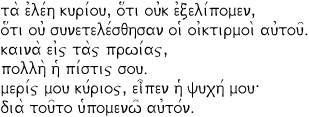
Third, neither Rahlfs’ nor Zeigler’s lemma have anything corresponding to 3.29. Certain witnesses in the textual transmission of the Septuagint do have the verse as follows:
fin. Or. II 176] + (29)  (+
(+  407)
407)  (+
(+  -538 Tht. Ambr. Spec.) O-Qmg L'-538 87mg-91mg-239 Arm Tht. Ambr. V 204. 206 Spec.
The omission of the line was doubtless caused by parablepsis due to homoioarcton. While the omission might be blamed on either pre-Greek transmission or on the translator, since both vv. 29 and 30 begin with  , it is also possible that the parablepsis occurred in the textual transmission of the Greek. Both Rahlfs and Ziegler no doubt thought the entire line hexaplaric and therefore secondary. Moreover, Ziegler boldly attributes the text to Symmachus, though no manuscript attributes it to one of the Three. Indeed, support for the inference that the line is hexaplaric is weak. Text extant in Hebrew but not in Origen’s Old Greek was added to his Fifth Column from one of the Three, usually Theodotion. Material in the Hexaplaric Text that clearly cannot be connected with the Three, as is the case here, is almost certainly Old Greek. Origen himself stated that for Lamentations, versions from Aquila and Theodotion were not extant, only those from the Septuagint and Symmachus (see Ziegler, p. 467). This statement, however, is only partially supported by evidence elsewhere: fragments attributed to Aquila are extant for Lamentations, but none attributed to Theodotion is found. Therefore one cannot on the basis of this statement automatically assign marginal materials lacking attribution to Symmachus. Ziegler’s attempt to attribute 3.29 to Symmachus is not convincing; the translation technique may well fit Theodotion or Aquila but not the style of Symmachus. Note, for example, the rendering of
  by
by  . In 2.10b, the only other occurrence of
  in Lamentations, we have the similar term
  . This pattern is similar to Theodotion in Iob (
 14.8b, 19b; 17.16b; 19.25b; 20.11b; 22.24a; 28.6b;
  39.14b), but uncharacteristic of Symmachus. Where Symmachus can be distinguished from Old Greek, Aquila and Theodotion, he has
  only in Iob 41.25, never
  , and uses alternative equivalents like
  in Iob 5.6; 40.13; Ps 21(22).30; 29(30).10. An unanswered question is whether or not our Old Greek text of Lamentations is the work of Theodotion. Either Theodotion did not render or revise this book, or he did, and all evidence is now lost, or the Old Greek text we now have is from Theodotion. The external evidence for 3.29 does look suspiciously recensional, but interestingly, most of the support is from witnesses that have also preserved 3.22–24, although support is not as widespread. True, a full citation of 3.27–29 by Origen (Contra Celsum 7.25) does not have the line in question, but it is possible that the parablepsis occurred before Origen’s time. The case is by no means as straightforward as that of 3.22–24 and external evidence weaker, but it is easier to imagine the mistake being made in the transmission of the Greek text than being made by the original translator. The text will be included, but enclosed within square brackets to indicate uncertainty.

Fourth is the case of 3.42. The editions of Rahlfs and Ziegler are as follows, including Apparatus I of Ziegler and the Masoretic Text:

42 init.]  O -Qmg L' c Aethp Tht. PsCypr. paen. p. 19 = MT |
  Tht. = Bar. 212 Dan. 95 15 Ps. 1056 Regn. III 847: Thack. p. 234;
  ex Ier. 325 Ps. 1056 Neh. 92.
  544 Aeth Tht. = MT; > L PsCypr. |
  Q-130-239-534 (tr. post
  ) PsCypr.] > rel.: homoiot. |
  O-Qmg L' c-239 Tht. PsCypr. = MT
 [42]
[42]
This problem can best be resolved by careful consideration of translation technique. Clearly 
 renders
  in the parent text. Less clear, however, are the original renderings of the first two predications. Leaving 3.42 aside for the moment, all instances of the verb
  are rendered solely by
  (1.8a; 5.7a, 16b). The noun
  occurs twice in the parent text and in both instances is translated by
  (1.8a; 3.39). The
  occurs three times in the Hebrew and is twice rendered by
  (4.6a, 13a), once by
  4.22b. The verb
  occurs only in 3.42, but the noun is found three times in the parent text and is rendered by
  in 1.5b, by
  in 1.14a and by
  in 1.22b. The parent text has three instances of the verb
  and all are rendered by
  (1.18a, 20bbis). In addition, the adjective
  is translated by
  in 1.4c and the noun
  by
by  in 3.15.
  also renders Hebrew
  in 3.20[19 MT], but
  is employed for the other instance of this word in 3.15. To complete the picture, note that the noun
  is rendered by
  three times, (4.6a, 22a, 22b), by
  once (5.7b) and by
  twice (2.14b; 4.13a). While the Greek translator of Lamentations is not absolutely rigid in his equivalents for Hebrew terms for “sin,” the degree of stereotyping is high. Normally words from the
  - root are employed for words in Hebrew from
  , words from
  are rendered by lexemes from the
  - root, and
  is rendered by
  and
and  . The translator tries to distinguish the nouns
  and
and  by employing
  for the former and
  for the latter. The use of
  in 4.22a for
  is what motivates the use of
  as an alternative for
  in 4.22b. The rendering of lexemes from
  by words from the
  - root is stereotypical.
If Rahlfs is right,  would be rendered by
  and
and  by
by  , uniquely in both cases. Neither is likely in terms of translation technique. Ziegler is an advance on Rahlfs, since he correctly includes
  , omitted due to parablepsis. Ziegler is also aware that 3.42 is a confession of sin that is somewhat typical in the Old Testament and attributes variants largely in the L group (Lucianic recension) to the influence of parallel passages. Unfortunately, he did not pursue this tack far enough. Almost certainly,
  is the rendering of the Greek translator for
  and
and  is due to harmonization from parallel passages along with the loss of
  through parablepsis.
There is also no good reason to exclude the pronouns  and
and  as hexaplaric just because they are in the Hexaplaric Group and equal MT. First, there is no textual testimony to indicate that they were introduced from the Three. Second, in terms of translation technique, the independent first and second person pronouns are always rendered by pronouns in Greek elsewhere by the Greek translator (
 1.16a[15cMT], 21a; 3:1, 63;
 5.19a), and the third person pronouns are usually so
  by
by  in 3.10, by
  in 1.18a;
  by
by  in 1.4c, 8c and zero in 1.3b;
  by
by  in 1.19a). It is therefore out of character for the Greek translator not to render
  and
and  in 3.42. Thus, we consider the following to be the original text:
  ,
,  .
.
TRANSLATION PROFILE OF THE GREEK
Greek Lamentations is chiefly characterized by formal equivalence to the source language, i.e., Hebrew. More particularly, it belongs to a group of both translations and revisions known as the  tradition, due to its standard rendering of
  by
by  . D. Barthélemy first identified the tradition in his Les Devanciers d’Aquila (1963).3 He delineated nine key chief characteristics of members of the tradition. The chart below lists the traits and marks their presence (P) or inapplicability (NA) in the case of Greek Lamentations.
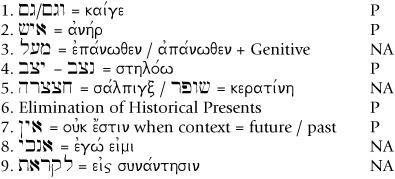
Brief comments on patterns present in the Greek Lamentations are necessary.
1)  for
for 
 does not occur) is well attested: 1.8c; 2.9c; 3.8; 4.3a, 15b, 21b.
2)  for
for  appears in 3.33, but not as a distributive.
3)  is rendered twice. In 2.4a
  is translated
  . Thus the equivalent is
  , and the Hebrew parent text appears to be read as Hiphil rather than Niphal.4 In 3.12
  is rendered by
  me and is therefore true to pattern.
4) Since in only one instance (4.19a = MT 18b) does a Greek present appear, it can safely be said that the translator was not in the habit of using historical presents.
5) The pseudo-verbal  is glossed six times as
  (1.9b, 17a, 21a; 2.9b; 4.4b; 5.8b), once as
  (1.7c), and three times as
  (1.2b; 5.3a, 7a). Once
  is rendered by
  (3.49). 1.21a is not in a succession of aorists and can be eliminated.
In sum, only three of the five patterns provide strong support that the Greek Lamentations belongs to the  tradition.
Other scholars have proposed patterns additional to these nine, but they are not as crucial or significant.5 It is clear that some relationship exists between Greek Lamentations and other texts in the  tradition, but it is not systematic.6
For the purposes of NETS it is useful to note that the approach of the translator to his task is one where faithfulness is defined and measured by a degree of quantitative alignment between Greek translation and Hebrew original. The Greek translation of Ruth is similar.
THE NETS TRANSLATION OF LAMENTATIONS
In accordance with NETS policy this translation makes an attempt at reflecting the style of the Greek.
Though ungrammatical English has been avoided, less than felicitous English may be expected. Formal equivalence is frequently given higher priority than idiomatic English.
The attempt to follow a model of translation similar to that of the Greek translator has occasionally created clashes with the NRSV. For example, in 3.33 NRSV has a free and idiomatic rendering of the Hebrew text: “for he does not willingly afflict or grieve anyone.” Greek Lamentations renders the same Hebrew in extreme literalism. Some differences between NETS and NRSV are due to the fact that the Greek translator interprets the Hebrew differently; others reflect a difference in translational approach between the two.
On occasion the gender inclusive language policy of NRSV had to be abandoned in order to reflect the Greek adequately. For example, according to the approach of the Greek translator,  is rendered by
  (3.36, 39) and
  by
by  (3.33). This enables the Greek reader to track the differences between the two words in the parent text. In NETS, while gender inclusive renderings may be maintained for
  ,
,  is gender specific in Greek and is translated accordingly in English. There are also instances where gender inclusive language has been achieved by converting generic masculine singular pronouns and verbs to common gender plural pronouns and verbs or by altering active constructions to passive. Sometimes this so alters the formal equivalence between NRSV and the Hebrew that the formal equivalence between the Greek and the Hebrew cannot be fairly represented this way. 3.35 and 36 may illustrate the attempt in NETS to represent the exact way in which the Greek reproduces the Hebrew text.
EDITORIAL POLICY
While the Greek translator does not always read the beginning and ending of sentences or connections between clauses in the Hebrew in the same way as NRSV, in essence the same versification is used. Differences can be indicated by different grammar and punctuation.
BIBLIOGRAPHICAL NOTE
NETS is for the most part a completely fresh translation of the Greek adapted to NRSV. Occasionally, the translation of Brenton was consulted and found to be useful. The doctoral dissertation of I. Assan-Dhote7 was graciously sent to me by the author, but unfortunately not until the Fall of 2000 when all research for the NETS Lamentations was virtually complete. It is interesting to note that she connects the Greek Lamentations with Theodotion, but her analysis of translation technique is not exhaustive.
PETER J. GENTRY
And it happened, after Israel was taken captive and Ierousalem was laid waste, Ieremias sat weeping and gave this lament over Ierousalem and said:
alph
1 How the city sat alone,
she who was full of peoples!
She has become like a widow—
multiplied among the nations!
A ruler among the countries,
she has become tribute.
beth
2 Weeping she wept in the night,
and her tears were on her cheeks;
of all those who love her
there is no one to comfort her.
All that were her friends dealt treacherously
with her;
they became enemies to her.
gimel
3 Judea was deported froma her humiliation
and froma greatness of her slavery;
she sat among nations;
she has found no rest;
all those pursuing her have overtaken her
among her oppressors.
daleth
4 Roads to Sion mourn
because there is none that comes to a
feast;
all her gates are obliterated;
her priests groan; her young girls are being led away,
and she, being embittered in herself.
he
5 Those that oppress her have become
head,
and her enemies kept flourishing,
because the Lord humbled her
for the multitude of her impieties;
her babes went away in captivity
before an oppressor.
ouau
6 And from daughter Sion ahas departeda
all her majesty.
Her rulers became like rams
that find no pasture,
and they were going in no strength
before a pursuer.
zai
7 Ierousalem remembered
days of her humiliation
and her rebuffs.
As for all her desired objects
that were from days of old—
when her people fell into the
hands of an oppressor,
then there was no one to help her.
When her enemies saw,
they laughed at her being settled.
heth
8 Ierousalem sinned sin,
so she became ashaken;
all those that honored her humiliated her,
for they saw her shame;
indeed, while she herself is groaning,
she also turned her face away.
teth
9 Her uncleanness bwas fromb her feet;
she did not remember her extremities.
And she brought down
things of great size;
there is no one to comfort her.
“O Lord, look at my humiliation,
for an enemy became great!”
ioth
10 An oppressor spread out his hand
over all her desired objects;
for she saw nations enter
into her holy precinct,
with reference to whom you commanded
that they not enter into your assembly.
chaph
11 All her people are groaning
as they search for bread;
they gave her desired objects
for food to restore life.
Look, O Lord, and see
that I have become one dishonored.
labd
12 It is nothing to you,
all you who pass along the road!
Turn, and see if there is a sorrow
like my sorrow, which has happened;
the Lord humbled me
on the day of the wrath of his anger.
mem
13 From his height he sent fire in my bones;
he brought it down;
he spread a net for my feet;
he turned me backwards;
he gave me as onec put away,
suffering pain all day long.
noun
14 He was kept awake over all my impious
deeds;
by my hands they were plaited
together;
they came up upon my neck;
my strength became weak;
because the Lord gave them in my hands,
I shall not be able to stand.
samch
15 The Lord removed
all my strong men from my midst;
he proclaimed a season against me
to crush my choice men;
the Lord trod the wine vat
for virgin daughter Iouda.
(16) For these things I weep.
ain
16 My eye has brought down water,
because the one to comfort me is far
from me,
the one to restore my life;
my sons became put away,
for an enemy prevailed.
pe
17 Sion spread out her hands;
there is no one to comfort her;
the Lord commanded regarding Iakob;
around him are those oppressing him.
Ierousalem became as onec
dsitting apartd among them.
sade
18 The Lord is in the right,
because I have made his mouth bitter.
Hear then, all you peoples,
and behold my sorrow;
my young women and my young men
went away in captivity. koph
19 I called to my lovers,
but they deceived me;
my priests and my elders
failed in the city,
because they sought food for themselves
to restore their life,
and they did not find it.
res
20 See, O Lord, that I am distressed;
my stomach churned;
my heart was turned in me,
because I have embittered, when
embittering.
Outside a dagger made childless,
just as death at home.
sen
21 Hear then, because I am groaning;
there is no one to comfort me.
All my enemies heard of my troubles,
and they rejoiced that you have acted.
You brought on the day; you proclaimed the
time,
and they became just like me.
thau
22 May all their evil doing come before
you,
and glean every grape of theirs
as you gleaned in connection
with all my sins,
for my groanings are many
and my heart is grieved.
alph
2 How the Lord brought gloom in his anger
over daughter Sion!
He has thrown down from heaven
to earth the splendor of Israel.
And he did not remember the footstool of
his feet
beth
2 in the day of his anger.
(2) The Lord has drowned without sparing
all the beauties of Iakob;
in his wrath he broke down
the strongholds of daughter Iouda;
he glued thema to the ground;
he profaned her king and her rulers.
gimel
3 He broke off in the anger of his wrath
every horn of Israel;
he turned back his right hand
from before the enemy,
and he kindled in Iakob a flame like
fire,
and it consumed all things around.
daleth
4 He bent his bow as an enemy;
he fixed firm his right hand as an
opponent,
and he killed all that my eyes desired
in the tent of daughter Sion;
he poured out his wrath like fire.
he
5 The Lord became like an enemy;
he drowned Israel;
he drowned her bastions;
he laid in ruins its strongholds,
and he multiplied in daughter Iouda
a woman humiliated and humbled.
ouau
6 And he tore down his covert like a vine;
he ruined his feast;
the Lord made feast and
sabbath to be forgotten in Sion,
and he provoked in the indignation of his
anger
king and priest and ruler.
zai
7 The Lord rejected his altar;
he shook off his holy precinct;
he crushed by the hand of an
enemy the wall of her bastions;
they gave forth a cry in the house of the
Lord
as on a feast day.
heth
8 And the Lord returned to lay in ruins
the wall of daughter Sion;
he stretched out a measuring line;
he did not turn back his hand from
drowning,
and the outer wall mourned,
and the wall became weak along with it.
teth
9 Her gates were stuck in the ground;
he destroyed and shattered her bars,
her king and her rulers among the nations.
There is no law;
indeed, her prophets did not
see a vision from the Lord.
ioth
10 They sat on the ground;
elders of daughter Sion were silent;
they brought up dust on their head;
they girded themselves with sackcloth;
they brought down to the ground
leading young women of Ierousalem.
chaph
11 My eyes failed in tears;
my stomach churned; my honor was poured out on the ground
because of the fracture of the daughter of
my people,
as infant and suckling fail
in city squares.
labd
12 To their mothers they said,
“Where is bread and wine?”
as they faint like the wounded
in city squares,
as their life is poured out
into their mothers’ bosom.
mem
13 What witness shall I bear of you,
or to what shall I compare you,
O daughter Ierousalem?
With what shall I equate you and comfort
you,
O virgin daughter Sion?
For the cup of your ruin was made great;
who will heal you?
noun
14 Your prophets saw for you
what is worthless and foolishness,
and they did not expose your injustice,
to turn your captivity around;
and they saw for you worthless messages—
and banishments!
samch
15 All who pass along the road
clapped their hands at you;
they hissed and wagged their head
at daughter Ierousalem:
“Is this the city, of which they say,
‘Crown of splendor, Joy of all the
earth?’“
ain
16 All your enemies opened
their mouth against you;
they hissed and gnashed their teeth;
they cried, “We have swallowed her!
Only, this is the day
that we were expecting;
we have found it; we have seen!”
pe
17 The Lord has done what he purposed;
he has carried out his words,
what he commanded from ancient days;
he demolished and did not spare,
and he has made the enemy rejoice over you;
he exalted the horn of the one oppressing
you.
sade
18 Their heart cried out to the Lord:
O walls of Sion!
Bring down tears like wadis day and night!
Give yourself no calming down!
May your eye not be silent, O daughter!
koph
19 Arise, give a cry of joy in the night
at the beginnings of your watch!
Pour out like water your heart
before the presence of the Lord!
Lift your hands to him
for the life of your babes
who faint with hunger at the
beginning of all exits.
res
20 Look, Lord, and consider
for whom have you gleaned grapes thus.
Will women eat the fruit of their womb?
A butchera made a gleaning.
Will you kill in the holy precinct of the
Lord
priest and prophet?
sen
21 Young child and old man fell asleep
on the ground in the exits;
my young women and my young men
fell by the sword;
in the day of your anger you killed;
you slaughtered them; you did not spare.
thau
22 He invited my sojournings from all around
as to a feast day,
and on the day of the anger of the Lord
there was no one saved and left behind,
as Ib prevailed and multiplied all my
enemies.
alph
3 I am the man who sees poverty
by the rod of his wrath;
2 he took me along and led me away
into darkness and not light;
3 only, against me he turned his hand
all day long.
beth
4 He made my flesh and my skin old;
he shattered my bones;
5 he builtc up against me and encircled my
head,
and it became exhausted;
6 he made me sit in dark places
like the dead of long ago.
gimel
7 He builtc up against me, and I shall not go out;
he made my brass heavy;
8 indeed, because I shall cry out and shout for
help, he shut out my prayer;
9 he builta up my ways; he fenced in my
paths;
he troubled me.
daleth
10 He is to me a she-bear lying in wait,
a lion in hiding;
11 he pursued a runaway and pulled me down;
he made me oneb put away;
12 he bent his bow and set me up
as a target for an arrow.
he
13 He made sons of his quiver enter
in my kidneys;
14 I became a laughingstock to all my people,
their strummingc all day long;
15 he has fed me with bitterness;
he has made me drunk with gall.
ouau
16 And he broke out my teeth with a pebble;
he fed me tidbits of ashes.
17 And he thrust my soul away from peace;
I forgot good things.
18 And I said, “My victory perished,
and my hope from the Lord.”
zai
19 I remembered from my poverty and out of
my persecution;
20 bitterness and gall (20)my soul will
remember
and will dtalk idly atd me;
21 I will place it in my heart;
therefore I will wait.
heth
22 The mercies of the Lord are
that we have not expired,
that his compassion has not come to an
end.
23 They are new in the early mornings;
great is your faithfulness.
24 “The Lord is my portion,” said my soul,
“therefore I will wait for him.”
teth
25 The Lord is good to those who wait for him,
to the soul that will seek him.
26 A good thing it is—and ite will wait
and be quiet for the salvation of the Lord.
27 It is a good thing for a man
when he bears a yoke in his youth.
ioth
28 He will sit alone and be silent,
because he raised it on himself;
[29 he will give his mouth in a heap of earth,
if perhaps there is hope;]
30 he will give a cheek to him that smites it;
he will be fed with insults.
chaph
31 For the Lord will not reject forever;
32 for he who humbled will have compassion,
according to the abundance of his mercy;
33 for he did not answer from his heart,
and he abased a man’s sons:
labd
34 to abase under his feet all the prisoners of
the land,
35 to turn aside a man’s case in the presence of
the Most High,
36 to condemn a person when he goes to
law—did not the Lord see?
mem
37 Who is this that spoke, and it happened?
Did the Lord not command it?
38 Will bad and good not come
from the mouth of the Most High?
39 Why will any person alive grumble,
a man, concerning his sin?
noun
40 Our way was investigated and examined,
and so let us return to the Lord.
41 Let us take up our hearts in our hands
to a high one in heaven.
42 Wef have acted impiously,
and we embittered youg,
and you were not appeased.
samch
43 You covered us over in wrath
and pursued us;
you killed; you did not spare.
44 You covered yourself with a cloud
on account of prayer;
45 you set us in the midst of the peoples
to make me stoop and be rejected.
pe
46 All our enemies opened their mouth against
us.
47 Fear and a pit have come upon us,
lifting up and destruction.
48 My eye will bring down emissions of water
for the fracture of the daughter of my
people.
ain
49 My eye was exhausted, and I will not be
silent
so that there will be no calming down
50 until the Lord stoops down
and looks from heaven.
51 My eye will gleanh my soul
more than all daughters of the city. sade
52 Hunting my enemies hunted me
like a sparrow, without cause;
53 they condemned my life to death in a
cistern
and placed a stone over me;
54 water flowed over my head;
I said, “I am rejected.”
koph
55 I called on your name, O Lord,
from the lowest cistern;
56 you heard my voice:
“Do not cover your ears to my plea!”
57 You came near to help me
in the day when I called on you;
you said to me, “Do not fear!”
res
58 You adjudicated the causes of my soul,
O Lord;
you have redeemed my life.
59 You saw my troubles, O Lord;
you judged my case.
60 You saw all their revenge,
all their schemes against me.
sen
61 You have heard their insults,
all their schemes against me,
62 lips of my opponents
and their machinations against me all
day long.
63 Consider their sitting and their rising:
I am their strumminga.
thau
64 You shall render a repayment to them,
O Lord,
according to the works of their hands;
65 you shall repay to them a shielding of
heart,
your hardship for them.
66 You shall pursue in anger and exterminate
them
beneath the sky, O Lord.
alph
4 How gold will grow dim;
the good silver will be altered!
Consecrated stones were poured out
at the beginning of all exits.
beth
2 The precious sons of Sion who
were lifted up with gold—
how they were reckoned as earthen pots,
works of a potter’s hands.
gimel
3 Indeed, dragons bared their breasts;
their whelps sucked;
the daughters of my people are incorrigible,
like an ostrich in the wilderness.
daleth
4 The tongue of the suckling
stuck to its throat with thirst;
babes begged for food; there was
no one to break it up for them.
5 Those who eat delicacies
were put away in the exits;
those nursed in scarlet
wrapped themselves in dung.
ouau
6 And the lawlessness of the daughter of my
people was great,
beyond the lawlessness of Sodoma,
which was overthrown, as it were, with
haste,
and they did not labor their hands with
her.
zai
7 Her Nazirites were pronouncedb purer than
snow;
they shone brighter than milk;
they were made redder than stones;
their branchc was of lapis lazuli.
heth
8 Their appearance was darker than soot;
they were not recognized in the exits;
their skin had stiffened on their bones;
they were withered; they became like
wood.
teth
9 The wounded from the sword were more
noble
than the wounded from hunger;
they walked, stabbedd,
eapart frome the produce of the fields.
ioth
10 Hands of compassionate women
boiled their children;
they became their food in the
fracture of the daughter of my people.
chaph
11 The Lord completed his wrath;
he poured out the anger of his wrath
and kindled a fire in Sion,
and it consumed her foundations.
labd
12 The kings of the earth did not believe,
none of the inhabitants of the world,
that enemy and oppressor would enter
through the gates of Ierousalem. mem
13 It was due to the sins of her prophets,
the injustices of her priests,
those who shed the blood of the righteous
in the midst of her.
noun
14 Her watchers were shaken in the exits;
they were defiled with blood.
Since they could not help it,
they touch their garments.
samch
15 Away from the unclean! Call them!
Away! Away! Do not touch!
For they were set ablaze; indeed they were
shaken.
Say among the nations,
“They will by no means add to live as
resident aliens.”
ain
16 The presence of the Lord is their portion;
he will not add to look upon them;
they did not receive the person of the
priests;
they granted no mercy to the elders.
pe
17 While we were still alive, our eyes failed;
our eyes failed regarding help for us,
vainly;
while we were looking steadily,
sade
18 we looked steadily to a nation
that does not save.
(18) We hunted our asmall onesa
so that they might not walk in our
squares.
koph
19 Our time has drawn near;
our days have been fulfilled;
our time is at hand.
(19) Our pursuers were swifter than eagles in the
sky;
they clung to usb on the mountains;
they lay in wait for us in the wilderness.
res
20 The Lord’s anointed, the breath of our face,
was captured by their destructionsc—
of whom we said,
“In his shade we shall live among the
nations.”
sen
21 Rejoice, and be glad, O daughter Idumea,
you who live in the land;
indeed, the cup of the Lord will pass to you;
you will become drunk and spill.
thau
22 Your lawlessness is ended, O Daughter Sion;
he will not add to exile you;
he visited your lawlessness, O Daughter
Edom;
he uncovered your impious deeds.
5 Remember, O Lord, what has befallen us.
Look, and see our disgrace!
2 Our inheritance has been turned over to
foreigners,
our homes to strangers.
3 We have become orphans; there is no
father;
our mothers are like widows.
4 Since our days, our wood came by exchange.
5 We were pursued dupon our neckd;
we grew weary; we were given no rest.
6 Egypt egave a hande,
Assour, for repletion of bread.
7 Our fathers sinned; they are no more,
and we were subject to their lawless
deeds.
8 Slaves became our masters;
there is no one to redeem from their
hand.
9 We shall bring in our bread by our lives,
away from before the sword of the
wilderness.
10 Our skin became dark like an oven
from before the squalls of hunger.
11 They humbled women in Sion,
virgins in the cities of Iouda.
12 Rulers were hung up by their hands;
elders were not held in honor.
13 Choice men took up the millstone,
and young men became weak with wood.
14 Old men ceased from the city gate,
choice men from their tunesf.
15 The joy of our hearts ceased;
our dance was turned to mourning.
16 The crown on our head fell;
woe indeed to us, for we have sinned.
17 Because of this our heart became grief
stricken;
because of these things our eyes grew
dark,
18 for Mount Sion, because it was obliterated.
Foxes passed through it.
19 But you, O Lord, will dwell forever;
your throne is for generation and
generation.
20 Why will you regarding to victory forget us?
Why will you forsake us throughout
length of days?
21 Turn us back, O Lord, to you, and we shall
turn back,
and renew our days as before.
22 For rejecting you have rejected us;
you have become exceedingly angry
with us.