SOME SCHOLARS HAVE REGARDED ACTS as the most important book in the New Testament,1 or at least as its pivotal book, coming as it does between the Gospels and the letters.2 It records the origin and growth of the Christian movement, telling us how the first believers lived out Christianity. It describes its message and ministry, and its life—including its triumphs and trials, the passions that drove it, and the source of the power that energized it. Any Christian wanting to know how to be a disciple of Christ in this world should turn to Acts to know how the first Christians lived. A recent topical study of Acts was therefore appropriately entitled The Master Plan of Discipleship.3 Furthermore, Acts is a deeply inspiring book. Martyn Lloyd-Jones, who calls it “that most lyrical of books,” writes: “Live in that book, I exhort you: it is a tonic, the greatest tonic I know in the realm of the Spirit.”4
This introduction to Acts will concentrate on issues I have deemed as important to a commentary on Acts that focuses on application. For more detailed discussions on topics that usually appear in introductions, the reader is directed to the many excellent commentaries available (cf. the bibliography).
Authorship and Date of Writing
THE EXTERNAL EVIDENCE available for the authorship of Acts, gleaned from the writings of the church in the first few centuries, is unanimous that the author was Luke. When we look for internal evidence (found in Scripture itself), we note that Acts is linked closely with the third Gospel, which indicates common authorship. Both are addressed to the same person, Theophilus (Luke 1:3; Acts 1:1). Acts begins by summarizing the contents of a “first book,” whose contents correspond with the Gospel of Luke. Longenecker says, “Stylistically and structurally the Gospel of Luke and the Acts of the Apostles are so closely related that they have to be assigned to the same author.”5
However, both Acts and the third Gospel have been written anonymously. But Acts is unique in that it contains ninety-seven verses during Paul’s journeys where the third person is replaced by the first person plural—the so-called “we passages,” which claim to be the observations of an eyewitness. Claims that this was a literary device used for effect—especially that the first person plural was commonly used for accounts of sea travel—have been adequately countered elsewhere.6 Note, for example, how several other sea voyages are narrated in Acts in the third person.7 We know from Paul’s letters that Luke was his companion in Rome (Col. 4:14; 2 Tim. 4:11; Philem. 24). When we realize that the tradition that Luke wrote the third Gospel and Acts goes at least as far back as the early second century and that the church in the early centuries was unanimous about the fact Luke wrote the two books, we are inclined to accept the traditional interpretation. As Ward Gasque says, “If Luke did not write the Third Gospel and Acts, it is difficult to explain how the tradition connecting his name with these documents ever arose, since he is otherwise an insignificant figure in the early Church.”8
Luke writes in good literary Greek, which has led to the conclusion that he must have been well educated. He was probably a Gentile, though this claim has been challenged. While there is no unanimity about where he came from, a strong early tradition connects him with Antioch of Pisidia.9 Paul refers to him as “our dear friend Luke, the doctor” (Col. 4:14) and shows Luke as faithfully sticking with him at a time when most other Christians had shunned him, that is, during his second imprisonment in Rome (2 Tim. 4:11).
Scholars have placed the date of writing of Acts from early to mid-60s of the first century to much later in the century (some estimates go as far as the late second century).10 The most evident point used in support of an earlier date is the fact that the book ends so abruptly with events that should be dated around the early 60s.
Acts As Historical Document
WE HAVE COMPARATIVELY longer discussions on historical issues than would be expected in a commentary of this type. This is because the pluralistic mood that is prevalent today, with its radically new understanding of the gospel as being on equal footing with other ideologies, can be sustained by “Christians” only if they deny the historical reliability of the New Testament records.11 As this seems to be common in some circles today, I felt that it was relevant on occasion to occupy myself with historical matters. I wish for my readers to sense that the book of Acts is rooted in concrete history, as I believe that influences the way we approach the study and application of the truths contained in Scripture.
The prologue of the Gospel of Luke, which applies to Acts as well, indicates that Luke intended to write an account that was historically accurate (Luke 1:1–4). Yet from the end of the nineteenth century, the “Tübingen school” associated with F. C. Bauer, which was skeptical of the historical value of the biblical documents and dominated biblical scholarship, viewed Acts as a late second-century document that contained an idealized fictional account of the early church. This was the heyday of the liberal movement, which was antisupernatural and discounted the historicity of records of miraculous events in the New Testament. Today, while there is no consensus on the dating of Acts, it is generally placed much earlier than the late second century. There are three basic ways of looking at the historicity of Acts among scholars today.
Theology, Not History
THERE HAS BEEN a welcome emphasis on the theology of Luke in recent times, especially because many commentaries of an earlier era focused so much on the history that they paid little attention to the theology of Acts. It is clear that Luke had a theological aim along with a historical one in his choice of material. For example, though the ministry in Derbe yielded “a large number of disciples” (14:21), there is only a single sentence about Paul’s ministry there. The ministry in Athens yields a correspondingly less number of converts—only “a few” (17:34)—but it occupies nineteen verses (17:16–34). This contrast suggests that Luke chose the material he stressed in his account depending on the subject matter rather than merely using earthly indicators of success. He selected certain events because of the value they had in communicating the truths he wanted to emphasize.
Unfortunately, some of those who have focused on the theology of Acts, such as Ernst Haenchen and Hans Conzelmann, deny the historical value of Acts.12 They have pointed to the supposed contradictions among the Gospels and between Paul’s letters and Acts, as well as to alleged historical inaccuracies, in stating their case for rejecting the trustworthiness of Acts.
History and Theology
WE CAN BE thankful that many recent studies have focused on the theological message of Acts without denying its historical value. Works with this emphasis include the commentaries emphasizing structure by David Gooding and Robert Tannehill,13 and the studies of the theology of Luke-Acts by Howard Marshall, Roger Stronstad, and Harold Dollar.14 This approach to Acts can be called “theological history”—a narrative of interrelated events from a given place and time, chosen to communicate theological truths. This commentary likewise does not place false dichotomies between theology and history. It views God as acting in the arena of history and through that revealing his ways and his will to his people.
The Scottish scholar Sir William Ramsay (1851–1939) did much to shift scholarly thinking in the direction of a positive view of the historical trustworthiness of Acts. Ramsay was a lecturer in classical art and archaeology at Oxford University when he went to Asia Minor for archaeological work. While there, he went through a remarkable change of convictions, which he chronicles in his book The Bearing of Recent Discovery on the Trustworthiness of the New Testament.
Ramsay found no trustworthy maps of the New Testament era, so he had to make his own. This forced him to read the original sources, such as Christian inscriptions and “the Acts of the Apostles [which] had to be read anew.” He reported that he “began to do so without expecting any information of value regarding the condition of Asia Minor at the time when Paul was living.” This was because he had accepted the current view that Acts “was written during the second half of the second century by an author who wished to influence the minds of the people in his own time by a highly wrought and imaginative description of the early church.”15
When Ramsay came to Acts 14:6,16 he thought he had found a predictable error by the author. It read, “They . . . fled [from Iconium] to the Lycaonian cities of Lystra and Derbe and to the surrounding country.” The common view among scholars at the time, based on material by Cicero and Pliny the Elder from about a century before the New Testament era, was that Iconium was a city in Lycaonia. Ramsay thought that the author of Acts had used Xenophon to obtain the idea that Iconium was in Phrygia (from his popular Anabasis, written four hundred years before the events recorded in Acts). Ramsay assumed that Luke, not knowing about the region, took this information and transposed it to the first century, by which time the boundaries had shifted so that it was no longer true. It was, says Ramsay, like “speaking of going from Richmond to Virginia or from London to England. The expression does not ring true.”17
But as Ramsay investigated the matter further, he found out that Acts was entirely correct. In the first century Iconium was indeed a city in Phrygia, not Lycaonia. He notes too that the author of Acts mentioned that the people of Lystra spoke “in the Lycaonian language” (14:11), which would have meant a change from the language spoken in Iconium. Inscriptions demonstrated that Phrygian was spoken in Iconium until the end of the second century. Ramsay realized that this historical comment had been inserted into Acts because the contrast had struck Paul, who had undoubtedly mentioned it to Luke.18 Ramsay goes on to note the description of the gods of the people of Lystra as Zeus and Hermes (14:12), and through his research realized that “Zeus and Hermes were commonly regarded in that region as associated gods.”19
Ramsay was impressed! He began to realize that Acts might be a valuable source of historical information. He titles the chapter describing what happened to him through this study of Acts 14, “The First Change of Judgment.”20 In a subsequent chapter entitled “General Impression of Trustworthiness in the Acts,” Ramsay writes:
The more I have studied the narrative of Acts and the more I have learned year after year about Graeco-Roman society and thoughts and fashions, and organization in those provinces, the more I admire and the better I understand. I set out to look for truth in the borderland where Greece and Asia meet, and found it here. You may press the words of Luke in a degree beyond any other historian’s, and they stand the keenest scrutiny and the hardest treatment, provided always that the critic knows the subject and does not go beyond the limits of science and justice.21
Between 1893 and 1915 Ramsay wrote ten books on Paul and Luke. The most famous of these was his magnum opus, entitled St. Paul: Traveller and Roman Citizen (published first in 1895), which charted the entire life of the apostle.22 Scot McKnight says of this book, “Here the real Paul seems to grab the reader and takes the reader with him throughout his journeys.”23 One should note that the historicity of Acts has been defended throughout the twentieth century in books written by classicists or historians who have achieved fame in the field of New Testament studies. The following names come to mind: classics lecturer turned New Testament scholar, F. F. Bruce; classics professor from New Zealand, E. M. Blaiklock;24 Oxford historian A. N. Sherwin-White;25 and classics schoolteacher turned New Testament researcher from England, Colin Hemer.26 The latest to join this distinguished list is a brilliant historian from Russia, Irina Levinskaya.27
Drama and Adventure
THE THIRD SIGNIFICANT approach to Acts, represented by R. I. Prevo, claims that Acts is like a popular novel or a historical romance. It is said to aim at edification in an entertaining form; many features are there simply to enhance the readers enjoyment and delight.28 The resemblances of Acts to ancient novels has long been noted,29 and there is no doubt that Luke wrote in a lively and entertaining way. A recent study has observed that “the story of Paul’s sea journey and shipwreck in Acts 27 is rich in nautical detail and high adventure that seems to serve no other purpose than to heighten the drama and the suspense.”30 However, that should not cause us to discount the historical trustworthiness of Acts.
Howard Marshall has given four pointed criticisms of this approach. (1) Acts is part of a twofold work, and the Gospel of Luke and Acts follow a similar method and style. But the Gospel is clearly not a historical novel. (2) Could Luke have got away with writing a novel of the early church so soon after the events? Such inventions usually belong to a later generation. (3) Large sections of Acts cannot be considered in the category of historical novel writing; they have different concerns. (4) The features of novels found in Acts also appear in good history too.31 Having said that, we add that we should not lose sight of the features of delight, drama, and adventure that characterize this book. Even now, whenever I think of Paul’s voyage and shipwreck, I get an eerie feeling because of the impact that vivid chapter has had on me.
Paul in Acts and the Epistles
A MAJOR OBJECTION to the view that the author of Acts was a close companion of Paul is the claim that the apostle as portrayed in Acts is very different to the one who emerges from his letters. The letters show him in constant conflict with those who resisted the free admission of the Gentiles to the church, whereas in Acts the problem is largely settled in chapter 15 and not mentioned again. Furthermore, Paul’s acceptance of the rules laid down by the Jerusalem Council, his circumcision of Timothy, and his undertaking of a rite of purification in Jerusalem are considered incompatible with themes found in Galatians. Finally, the strong emphasis on the atoning death of Christ and justification by faith that is found in the Paul of the letters is said to be missing in the Paul of Acts.
Let me respond to this briefly by saying that the purposes and occasions of Acts and the letters are different. We usually look at the Paul in the letters as a theologian responding to needs in the churches. In Acts, however, we see him as a missionary, a charismatic founder of Christian communities. Such differences help explain the different emphases. The apostle did not object to circumcision as a Jewish rite, so he had the half-Jew Timothy circumcised in order to enhance his credibility in ministry.32 But when circumcision was presented as a means of salvation, he strongly opposed it. His decision to participate in a purificatory rite in the Jerusalem temple is in keeping with his teaching in the letters about becoming a Jew in order to win the Jews (1 Cor. 9:20).33
Paul was indeed uncompromising when it came to the fundamental principles of the faith, such as salvation by faith alone. But where these principles were not affected, he was willing to adapt himself to his audience. While justification by faith in Christ and the message of the cross are not given as much emphasis in the summaries of his speeches that Luke records as they receive in the letters, these teachings are always implied and sometimes explicitly stated.34
While we should recognize that the purposes for writing and the theological emphases of Luke and Paul differ, we do not need to imply that they contradict each other. For a complete picture of who Paul was, we must look at both his letters and the historical description of his life in Acts, just as we must do if we want a reliable biography about any famous author. Looking at only one specific type of literature will not serve as comprehensive guide to the life and thinking of an individual.
The Speeches of Acts
SPEECHES PLAYED AN important role in the history books of the period before and during the first century, “often constituting 20 to 35 percent of the narrative.”35 Rhetoric, or the art of persuasion, was considered primary to education in the first-century Greco-Roman world. As Conrad Gempf explains, “Rhetoric was, to the ancients, power, whether for good or for ill. In the Graeco-Roman world, speaking was central to success.” Thus in ancient history books, “speeches are not mere commentary on events nor accompaniment to events: speeches must be seen as events in their own right.” In other words, “ancient historians tended to focus on battles and speeches as the events that shaped history.”36 So it is not surprising to find that Acts has thirty-two speeches (excluding short statements), which make up 25 percent of the narrative.37
The speeches in Acts have been the subject of much study and discussion since the 1920s, when scholars like Henry Cadbury and Martin Dibelius treated them as creations of Luke intended to buttress the “history” that he was presenting.38 The writings of some early historians, such as Thucydides and Josephus, who clearly invented materials for the speeches they recorded, were taken as typical of Hellenistic historiography—a style that was then projected to Luke. It was in response to this challenge that a young Scottish classics scholar, F. F. Bruce, gave a now-famous lecture, “The Speeches in the Acts of the Apostles,” in 1942.39 It gave him a name as a New Testament scholar, a field he later made his vocation with great distinction.
Responses to the scholarly discounting of the historical value of Acts continued, climaxing in a major work by another classicist turned New Testament scholar, Colin J. Hemer, who died in 1987 (before the last three chapters of his monumental work, The Book of Acts in the Setting of Hellenistic History, was completed). His treatment on the speeches of Acts was pieced together by the editor of this posthumous publication, Conrad Gempf, and included as an appendix. It defends the basic historicity of the speeches while conceding that what we get are not verbatim reports. Hemer said, “The brief summary paragraphs we possess do not purport to reproduce more than perhaps a précis of the distinctive highlights.”40
The editor of Hemer’s work, Conrad Gempf, has, in a separate publication, elaborated on the nature of reporting speeches in ancient historiography. He has shown that simply because a speech fits in with the historian’s purposes and convictions does not necessarily mean it has been invented by the historian. Historians may report speeches colorfully and rhetorically according to their own style, but that does make them unfaithful records of what took place. Gempf’s conclusion is that just as good ancient historians recorded speeches in ways that, according to their standards, were historically appropriate and faithful representations of the events, it is probable that the author of Luke-Acts did the same.41
In this commentary we will approach the speeches as recording essentially what was said by those alleged to have given them. They are most certainly summaries and paraphrases of much longer talks, and they faithfully report what was said. Through them we receive an understanding of how the leaders of the church faced their evangelistic, apologetic, pastoral, and theological challenges, and of how the opponents of Christianity and the Jewish and Gentile leaders of the day responded to Christianity.
Major Themes of Acts
JESUS’ STATEMENT OF the Great Commission in Acts 1:8 is the key text in this book, highlighting the two main themes of Acts: the Holy Spirit and witness. Jesus’ disciples will become witnesses only after the Holy Spirit comes on them. Jesus then gives the geographical sequence in which the task of witness will be carried out—they will begin with Jerusalem, then move to Judea and Samaria, and culminate with witness to the ends of the earth. This sequence provides an outline for the book of Acts (see below).
In this section I will only lightly describe the various themes that gain prominence in the book of Acts. The reader is directed to the Subject Index at the back for a summary of the points highlighted in this commentary.
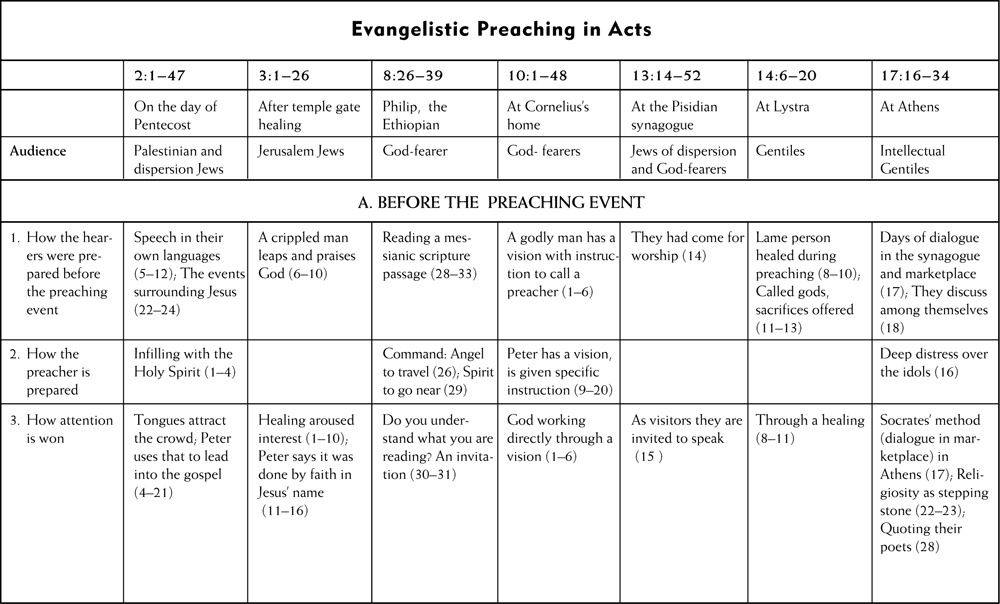
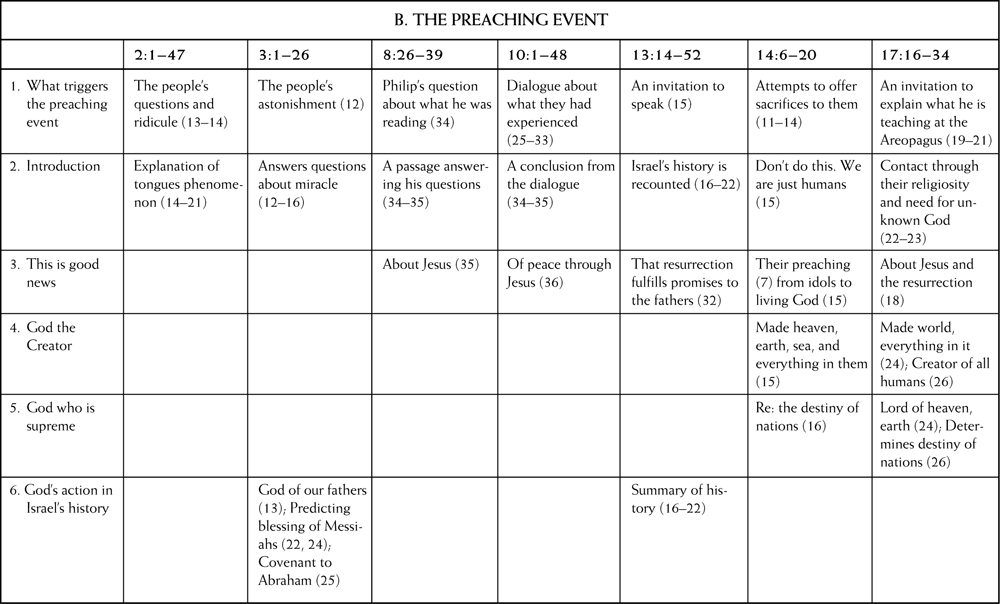
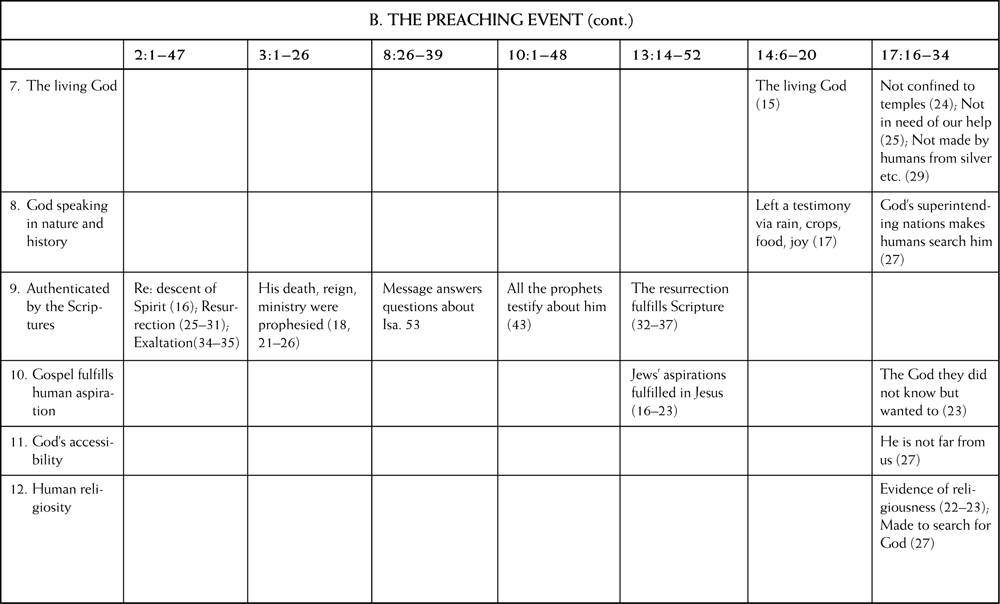
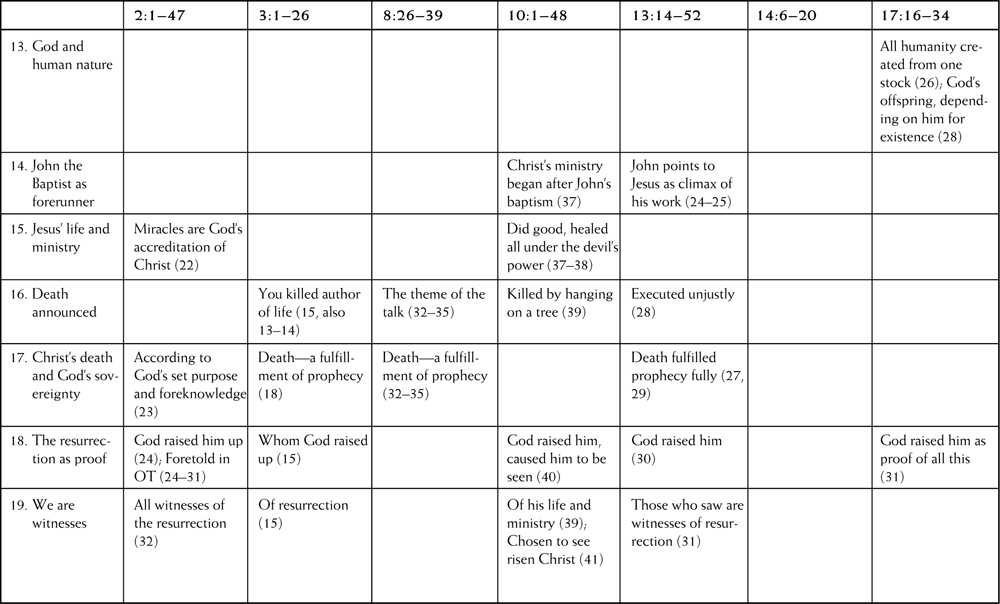
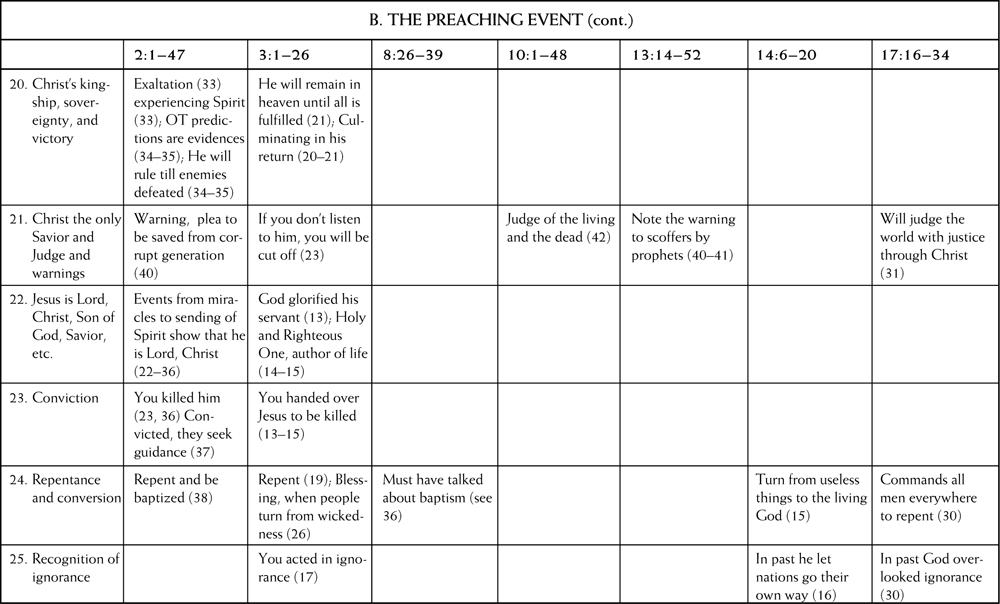
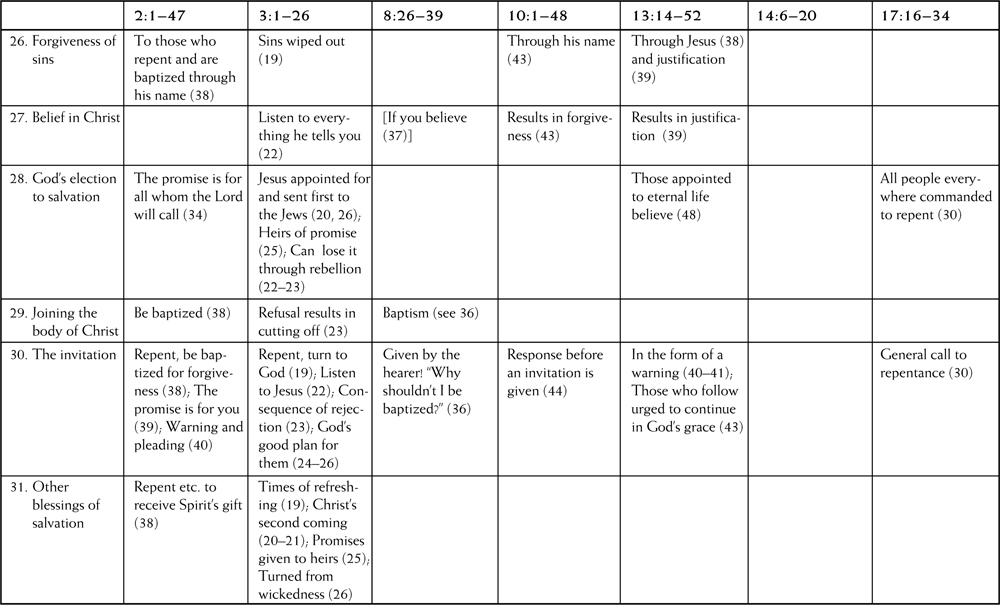
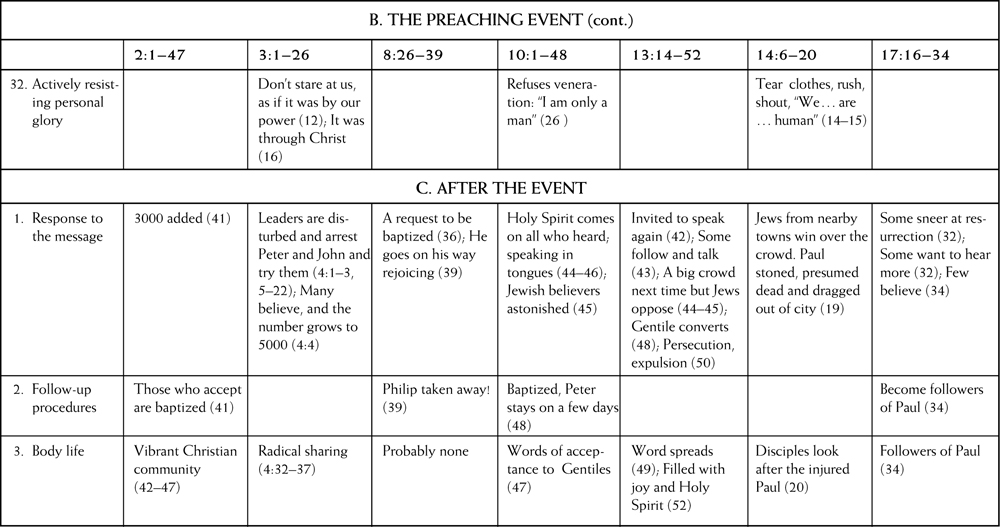
The priority of evangelism. From chapter 1, where the Great Commission is recorded (1:8), right up to the end of the book, the great activity that dominates this book is evangelism. An interesting realization dawned on me as I was coming to the end of this commentary: The two major methods used in evangelism in Acts were the winning of attention through miracles and apologetics. All the messages recorded in Acts had a strong apologetic content. The evangelists sought to show that Christianity withstood the questions that the people were asking, and the records of the speeches indicate that their evangelism was strongly content-oriented. The chart on “Evangelistic Preaching in Acts” gives a summary of the methods and message of the first evangelists.
The power of the Holy Spirit. Many have felt that Acts should be called “The Acts of the Holy Spirit.” The first chapter records the promise of the Holy Spirit (1:4–5, 8), the second his descent, and the rest of the book his work in and through the church.
Community life. Acts presents a vibrant community that was passionate about mission, with the members caring for each other, pursuing holiness, and dealing with matters that affected its unity. In the description of community we also see Luke’s characteristic concern for the poor (which is more pronounced in his Gospel).
Teaching. Not only is teaching presented as something done with Christians, in Acts it is also part of the evangelistic process.
Prayer. Fourteen of the first fifteen chapters of Acts (ch. 5 excepted) and many of the later chapters mention prayer; in Acts, as in Luke’s Gospel, prayer is a key theme.42
Breaking human barriers in Christ. In keeping with the geographical order presented in the Great Commission (1:8), Luke shows how the gospel spread from Jerusalem to Judea and Samaria and to the ends of the earth. In this process Gentiles are saved; he describes the way the church handled that witness as well as other social differences among Christians, leaving us with the strong impression that human barriers were broken in the early church and giving us reasons why that is so.
The place of suffering. Like much of the rest of the New Testament, there is much reflection on suffering in Acts. Here the suffering faced by the church is mostly on account of opposition to the gospel.
The sovereignty of God. Allied to the emphasis on suffering is the underlying theme that God is working out his sovereign purposes even through suffering. This is the dominant theme of the passage that describes the church’s reaction to the first experience of suffering (4:23–31).
The Jewish reaction to the gospel. A surprising amount of space is given to attempts of the church to evangelize the Jews and to Paul’s perseverance with this task in spite of many disappointments. Acts begins with the apostles’ asking Jesus when he will restore the kingdom to Israel (1:6) and ends with an affirmation that because of the hardness of the hearts of the Jews, the gospel is being taken to the Gentiles (28:25–28).
The legal status of Christianity. Luke is eager to give the impression that the Roman authorities did not consider Christianity to be a dangerous or illegal movement. Acts also contains examples of the eloquent defense of the Christians faith before the state.
Applying the Book of Acts Today
WE SAID THAT Luke had both a theological aim and a historical one in writing Acts, and that the events he chose to stress were chosen because of the value they had in presenting truths he wanted to communicate. Our task is to find those truths and to see what abiding principles we can glean from them that we can apply to our thoughts, lives, and ministries today. How do we go about gleaning abiding principles from these stories?
One method that is popular today is allegorizing—seeing consistent spiritual parallels to the incidents presented and looking for what is sometimes called the “deeper meaning” of the text. This was a common method of interpretation in the early church and is often associated with the church father Origen. For example, the three stages of Lazarus following his death have been taken to be teaching three stages of a Christian’s spiritual life (see John 11). (1) His stage in the tomb as a corpse represents the unregenerate stage. (2) His stage after being raised from the dead but before he is freed from the bondage of his grave clothes represents the carnal stage. (3) The stage after being loosed from the grave clothes represents the spiritual stage.
Though such allegorizing is an effective means of communicating truth, it may not be the intention of the author of the passage. True, sometimes the author intended the allegorical method of interpreting truth, as in the allegory of the vine and the branches (John 15:1–8). But usually that intention is clear from the words of the passage itself. If the author does not intend his passage to be used in this way, then, if we use allegorical method, we are simply using it to illustrate some truths. These truths may be valid, but only because they come from somewhere else in Scripture. This method is not the way to get at the teaching intended by the author of Acts.
Others suggest that unless a narrative passage explicitly teaches a principle to follow, we should not use it in a normative way.43 Gordon Fee helpfully distinguishes between concluding from a passage that “we must do this,” when we should be saying that “we may do this.”44 However, out of the belief that “all Scripture is God-breathed and is useful for teaching, rebuking, correcting and training in righteousness” (2 Tim. 3:16), I believe we can go beyond this general approach to glean normative truth from the narratives of Acts even if a specific proposition is missing.45 Note, for example, Paul’s comments regarding God’s judgment on Israel during Old Testament times: “Now these things occurred as examples to keep us from setting our hearts on evil things as they did. . . . These things happened to them as examples and were written down as warnings for us” (1 Cor. 10:6, 11). To Paul, Old Testament history was a collection of revelatory happenings, that is, events used by God to reveal his nature and purpose to humanity. In keeping with this principle, in Romans 4 and Galatians 3 Paul used God’s dealings with Abraham to construct his theology of justification by faith and not works.
Sometimes what we have in narrative passages are examples to inspire us. Hebrews 11 uses Old Testament figures as inspiring examples of persevering faith for us to follow. Paul specifically asked the readers of his letters to follow his example (1 Cor. 4:6; 11:1; Phil. 3:17). For example, “Take note of those who live according to the pattern we gave you” (Phil. 3:17). Acts is the place from which to receive that pattern. We believe that through the lives and ministries of the apostles, God acted in ways that reveal his will and his ways to humanity.
We must, of course, be cautious about how we use this principle. We must carefully distinguish principles that are normative and those that are specific to certain situations and therefore not applicable to all situations. Take, for example, Gamaliel’s advice to leave the Christians alone because if Christianity is not of God, it will fail; and if it is of God, the Jewish leaders cannot stop it (Acts 5:38–39). God certainly used this advice to the advantage of the church, but it is not a principle always to be followed. If we did so, we could end up accepting as from God the growth of Islam, Sai Bäba’s cult, and the Jehovah’s Witnesses!
Or again: Klein, Blomberg and Hubbard point to the different models of church government and organization found in Acts. They show how “Congregationalists, Presbyterians, and Episcopalians all legitimately point to passages in Acts to support their views of church structure and leadership.”46 This should tell us that different styles of leadership and structure are acceptable within the body of Christ and that we should look for the most appropriate one that does not break biblical principles. In doing this, we will look for models as practiced in the early church and recorded in Acts that suit our particular situation.
In other words, we must be careful about how we apply the narratives of Acts. One important key is to look for Luke’s purpose for including an event in Acts. If we find a theme given special attention in Acts, then we may be able to find a pattern emerging that can give us normative principles. For this reason we will sometimes go into greater depth in the “Bridging Contexts” sections in order to establish the normativeness of a principle. We will refer to other incidents and statements in Acts, and perhaps elsewhere in Scripture, to substantiate that normativeness.
Acts as a Radical Challenge to Today’s Church
CONTEMPORARY CHRISTIANS WHO read Acts with an open mind will find themselves challenged with pointed applications by what happened in the early church. I will mention only a few here (see the Subject Index for elaboration of these points).
• To a society where individualism reigns and where the church also seems to have adopted a style of community life that “guards the privacy of the individual,” the early church presents a radical community where the members held all things in common.
• To a society where selfishness is sometimes admired and each one is left to fend for himself or herself, Acts presents a group of Christians who were so committed to Christ and the cause of the gospel that they were willing to sacrifice their desires for the good of others.
• To a society where pluralism defines truth as something subjective and personal, Acts presents a church that based its life on certain objective facts about God and Christ—facts that were not only personally true but also universally valid and therefore had to be presented to the entire world.
• To a society that denies absolute truth and therefore shuns apologetics and persuasion in evangelism in favor of dialogue, Acts presents a church that persuaded people until they were convinced of the truth of the gospel. Instead of aiming at mutual enrichment as the main aim of interreligious encounter, as many do today, the early church proclaimed Christ as supreme Lord with conversion in view.
• In an age where specialization has hit evangelism so much that we rarely find churches that emphasize healing also emphasizing apologetics, Acts presents a church where the same individuals performed healings and preached highly reasoned, apologetic messages.
• In an age when many churches spend so much time, money, and energy on self-preservation and improvement, Acts presents churches that released their most capable people for reaching the lost.
• In an age where many churches look to excellence in techniques to bring success, Acts presents a church that depended on the Holy Spirit and gave top priority to prayer and moral purity.
• In an age when many avenues are available to avoid suffering and therefore many Christians have left out suffering from their understanding of the Christian life, Acts presents a church that took on suffering for the cause of Christ and considered it a basic ingredient of discipleship.