Chronicles 13–17
1DAVID CONFERRED WITH each of his officers, the commanders of thousands and commanders of hundreds. 2He then said to the whole assembly of Israel, “If it seems good to you and if it is the will of the LORD our God, let us send word far and wide to the rest of our brothers throughout the territories of Israel, and also to the priests and Levites who are with them in their towns and pasturelands, to come and join us. 3Let us bring the ark of our God back to us, for we did not inquire of it during the reign of Saul.” 4The whole assembly agreed to do this, because it seemed right to all the people.
5So David assembled all the Israelites, from the Shihor River in Egypt to Lebo Hamath, to bring the ark of God from Kiriath Jearim. 6David and all the Israelites with him went to Baalah of Judah (Kiriath Jearim) to bring up from there the ark of God the LORD, who is enthroned between the cherubim—the ark that is called by the Name.
7They moved the ark of God from Abinadab’s house on a new cart, with Uzzah and Ahio guiding it. 8David and all the Israelites were celebrating with all their might before God, with songs and with harps, lyres, tambourines, cymbals and trumpets.
9When they came to the threshing floor of Kidon, Uzzah reached out his hand to steady the ark, because the oxen stumbled. 10The LORD’s anger burned against Uzzah, and he struck him down because he had put his hand on the ark. So he died there before God.
11Then David was angry because the LORD’s wrath had broken out against Uzzah, and to this day that place is called Perez Uzzah.
12David was afraid of God that day and asked, “How can I ever bring the ark of God to me?” 13He did not take the ark to be with him in the City of David. Instead, he took it aside to the house of Obed-Edom the Gittite. 14The ark of God remained with the family of Obed-Edom in his house for three months, and the LORD blessed his household and everything he had.
14:1Now Hiram king of Tyre sent messengers to David, along with cedar logs, stonemasons and carpenters to build a palace for him. 2And David knew that the LORD had established him as king over Israel and that his kingdom had been highly exalted for the sake of his people Israel.
3In Jerusalem David took more wives and became the father of more sons and daughters. 4These are the names of the children born to him there: Shammua, Shobab, Nathan, Solomon, 5Ibhar, Elishua, Elpelet, 6Nogah, Nepheg, Japhia, 7Elishama, Beeliada and Eliphelet.
8When the Philistines heard that David had been anointed king over all Israel, they went up in full force to search for him, but David heard about it and went out to meet them. 9Now the Philistines had come and raided the Valley of Rephaim; 10so David inquired of God: “Shall I go and attack the Philistines? Will you hand them over to me?”
The LORD answered him, “Go, I will hand them over to you.”
11So David and his men went up to Baal Perazim, and there he defeated them. He said, “As waters break out, God has broken out against my enemies by my hand.” So that place was called Baal Perazim. 12The Philistines had abandoned their gods there, and David gave orders to burn them in the fire.
13Once more the Philistines raided the valley; 14so David inquired of God again, and God answered him, “Do not go straight up, but circle around them and attack them in front of the balsam trees. 15As soon as you hear the sound of marching in the tops of the balsam trees, move out to battle, because that will mean God has gone out in front of you to strike the Philistine army.” 16So David did as God commanded him, and they struck down the Philistine army, all the way from Gibeon to Gezer.
17So David’s fame spread throughout every land, and the LORD made all the nations fear him.
15:1After David had constructed buildings for himself in the City of David, he prepared a place for the ark of God and pitched a tent for it. 2Then David said, “No one but the Levites may carry the ark of God, because the LORD chose them to carry the ark of the LORD and to minister before him forever.”
3David assembled all Israel in Jerusalem to bring up the ark of the LORD to the place he had prepared for it. 4He called together the descendants of Aaron and the Levites:
5From the descendants of Kohath,
Uriel the leader and 120 relatives;
6from the descendants of Merari,
Asaiah the leader and 220 relatives;
7from the descendants of Gershon,
Joel the leader and 130 relatives;
8from the descendants of Elizaphan,
Shemaiah the leader and 200 relatives;
9from the descendants of Hebron,
Eliel the leader and 80 relatives;
10from the descendants of Uzziel,
Amminadab the leader and 112 relatives.
11Then David summoned Zadok and Abiathar the priests, and Uriel, Asaiah, Joel, Shemaiah, Eliel and Amminadab the Levites. 12He said to them, “You are the heads of the Levitical families; you and your fellow Levites are to consecrate yourselves and bring up the ark of the LORD, the God of Israel, to the place I have prepared for it. 13It was because you, the Levites, did not bring it up the first time that the LORD our God broke out in anger against us. We did not inquire of him about how to do it in the prescribed way.” 14So the priests and Levites consecrated themselves in order to bring up the ark of the LORD, the God of Israel. 15And the Levites carried the ark of God with the poles on their shoulders, as Moses had commanded in accordance with the word of the LORD.
16David told the leaders of the Levites to appoint their brothers as singers to sing joyful songs, accompanied by musical instruments: lyres, harps and cymbals.
17So the Levites appointed Heman son of Joel; from his brothers, Asaph son of Berekiah; and from their brothers the Merarites, Ethan son of Kushaiah; 18and with them their brothers next in rank: Zechariah, Jaaziel, Shemiramoth, Jehiel, Unni, Eliab, Benaiah, Maaseiah, Mattithiah, Eliphelehu, Mikneiah, Obed-Edom and Jeiel, the gatekeepers.
19The musicians Heman, Asaph and Ethan were to sound the bronze cymbals; 20Zechariah, Aziel, Shemiramoth, Jehiel, Unni, Eliab, Maaseiah and Benaiah were to play the lyres according to alamoth, 21and Mattithiah, Eliphelehu, Mikneiah, Obed-Edom, Jeiel and Azaziah were to play the harps, directing according to sheminith. 22Kenaniah the head Levite was in charge of the singing; that was his responsibility because he was skillful at it.
23Berekiah and Elkanah were to be doorkeepers for the ark. 24Shebaniah, Joshaphat, Nethanel, Amasai, Zechariah, Benaiah and Eliezer the priests were to blow trumpets before the ark of God. Obed-Edom and Jehiah were also to be doorkeepers for the ark.
25So David and the elders of Israel and the commanders of units of a thousand went to bring up the ark of the covenant of the LORD from the house of Obed-Edom, with rejoicing. 26Because God had helped the Levites who were carrying the ark of the covenant of the LORD, seven bulls and seven rams were sacrificed. 27Now David was clothed in a robe of fine linen, as were all the Levites who were carrying the ark, and as were the singers, and Kenaniah, who was in charge of the singing of the choirs. David also wore a linen ephod. 28So all Israel brought up the ark of the covenant of the LORD with shouts, with the sounding of rams’ horns and trumpets, and of cymbals, and the playing of lyres and harps.
29As the ark of the covenant of the LORD was entering the City of David, Michal daughter of Saul watched from a window. And when she saw King David dancing and celebrating, she despised him in her heart.
16:1They brought the ark of God and set it inside the tent that David had pitched for it, and they presented burnt offerings and fellowship offerings before God. 2After David had finished sacrificing the burnt offerings and fellowship offerings, he blessed the people in the name of the LORD. 3Then he gave a loaf of bread, a cake of dates and a cake of raisins to each Israelite man and woman.
4He appointed some of the Levites to minister before the ark of the LORD, to make petition, to give thanks, and to praise the LORD, the God of Israel: 5Asaph was the chief, Zechariah second, then Jeiel, Shemiramoth, Jehiel, Mattithiah, Eliab, Benaiah, Obed-Edom and Jeiel. They were to play the lyres and harps, Asaph was to sound the cymbals, 6and Benaiah and Jahaziel the priests were to blow the trumpets regularly before the ark of the covenant of God.
7That day David first committed to Asaph and his associates this psalm of thanks to the LORD:
8Give thanks to the LORD, call on his name;
make known among the nations what he has done.
9Sing to him, sing praise to him;
tell of all his wonderful acts.
10Glory in his holy name;
let the hearts of those who seek the LORD rejoice.
11Look to the LORD and his strength;
seek his face always.
12Remember the wonders he has done,
his miracles, and the judgments he pronounced,
13O descendants of Israel his servant,
O sons of Jacob, his chosen ones.
14He is the LORD our God;
his judgments are in all the earth.
15He remembers his covenant forever,
the word he commanded, for a thousand generations,
16the covenant he made with Abraham,
the oath he swore to Isaac.
17He confirmed it to Jacob as a decree,
to Israel as an everlasting covenant:
18“To you I will give the land of Canaan
as the portion you will inherit.”
19When they were but few in number,
few indeed, and strangers in it,
20they wandered from nation to nation,
from one kingdom to another.
21He allowed no man to oppress them;
for their sake he rebuked kings:
22“Do not touch my anointed ones;
do my prophets no harm.”
23Sing to the LORD, all the earth;
proclaim his salvation day after day.
24Declare his glory among the nations,
his marvelous deeds among all peoples.
25For great is the LORD and most worthy of praise;
he is to be feared above all gods.
26For all the gods of the nations are idols,
but the LORD made the heavens.
27Splendor and majesty are before him;
strength and joy in his dwelling place.
28Ascribe to the LORD, O families of nations,
ascribe to the LORD glory and strength,
29ascribe to the LORD the glory due his name.
Bring an offering and come before him;
worship the LORD in the splendor of his holiness.
30Tremble before him, all the earth!
The world is firmly established; it cannot be moved.
31Let the heavens rejoice, let the earth be glad;
let them say among the nations, “The LORD reigns!”
32Let the sea resound, and all that is in it;
let the fields be jubilant, and everything in them!
33Then the trees of the forest will sing,
they will sing for joy before the LORD,
for he comes to judge the earth.
34Give thanks to the LORD, for he is good;
his love endures forever.
35Cry out, “Save us, O God our Savior;
gather us and deliver us from the nations,
that we may give thanks to your holy name,
that we may glory in your praise.”
36Praise be to the LORD, the God of Israel,
from everlasting to everlasting.
Then all the people said “Amen” and “Praise the LORD.”
37David left Asaph and his associates before the ark of the covenant of the LORD to minister there regularly, according to each day’s requirements. 38He also left Obed-Edom and his sixty-eight associates to minister with them. Obed-Edom son of Jeduthun, and also Hosah, were gatekeepers.
39David left Zadok the priest and his fellow priests before the tabernacle of the LORD at the high place in Gibeon 40to present burnt offerings to the LORD on the altar of burnt offering regularly, morning and evening, in accordance with everything written in the Law of the LORD, which he had given Israel. 41With them were Heman and Jeduthun and the rest of those chosen and designated by name to give thanks to the LORD, “for his love endures forever.” 42Heman and Jeduthun were responsible for the sounding of the trumpets and cymbals and for the playing of the other instruments for sacred song. The sons of Jeduthun were stationed at the gate.
43Then all the people left, each for his own home, and David returned home to bless his family.
17:1After David was settled in his palace, he said to Nathan the prophet, “Here I am, living in a palace of cedar, while the ark of the covenant of the LORD is under a tent.”
2Nathan replied to David, “Whatever you have in mind, do it, for God is with you.”
3That night the word of God came to Nathan, saying:
4“Go and tell my servant David, ‘This is what the LORD says: You are not the one to build me a house to dwell in. 5I have not dwelt in a house from the day I brought Israel up out of Egypt to this day. I have moved from one tent site to another, from one dwelling place to another. 6Wherever I have moved with all the Israelites, did I ever say to any of their leaders whom I commanded to shepherd my people, “Why have you not built me a house of cedar?”’
7“Now then, tell my servant David, ‘This is what the LORD Almighty says: I took you from the pasture and from following the flock, to be ruler over my people Israel. 8I have been with you wherever you have gone, and I have cut off all your enemies from before you. Now I will make your name like the names of the greatest men of the earth. 9And I will provide a place for my people Israel and will plant them so that they can have a home of their own and no longer be disturbed. Wicked people will not oppress them anymore, as they did at the beginning 10and have done ever since the time I appointed leaders over my people Israel. I will also subdue all your enemies.
“‘I declare to you that the LORD will build a house for you: 11When your days are over and you go to be with your fathers, I will raise up your offspring to succeed you, one of your own sons, and I will establish his kingdom. 12He is the one who will build a house for me, and I will establish his throne forever. 13I will be his father, and he will be my son. I will never take my love away from him, as I took it away from your predecessor. 14I will set him over my house and my kingdom forever; his throne will be established forever.’”
15Nathan reported to David all the words of this entire revelation.
16Then King David went in and sat before the LORD, and he said:
“Who am I, O LORD God, and what is my family, that you have brought me this far? 17And as if this were not enough in your sight, O God, you have spoken about the future of the house of your servant. You have looked on me as though I were the most exalted of men, O LORD God.
18“What more can David say to you for honoring your servant? For you know your servant, 19O LORD. For the sake of your servant and according to your will, you have done this great thing and made known all these great promises.
20“There is no one like you, O LORD, and there is no God but you, as we have heard with our own ears. 21And who is like your people Israel—the one nation on earth whose God went out to redeem a people for himself, and to make a name for yourself, and to perform great and awesome wonders by driving out nations from before your people, whom you redeemed from Egypt? 22You made your people Israel your very own forever, and you, O LORD, have become their God.
23“And now, LORD, let the promise you have made concerning your servant and his house be established forever. Do as you promised, 24so that it will be established and that your name will be great forever. Then men will say, ‘The LORD Almighty, the God over Israel, is Israel’s God!’ And the house of your servant David will be established before you.
25“You, my God, have revealed to your servant that you will build a house for him. So your servant has found courage to pray to you. 26O LORD, you are God! You have promised these good things to your servant. 27Now you have been pleased to bless the house of your servant, that it may continue forever in your sight; for you, O LORD, have blessed it, and it will be blessed forever.”
Original Meaning
First Stage of the Ark’s Return (13:1–14)
THE OPENING SECTION of the Chronicler’s ark narrative records the decision to retrieve the ark of God from Kiriath Jearim (13:1–4). These verses introduce the story of the ark’s eventual entry into Jerusalem and have no parallel in the Samuel account. The latter portion of this literary unit describes the journey of the ark from the house of Abinadab of Kiriath Jearim (or Baalah) to the threshing floor of Kidon (13:5–14). This account of the transfer of the ark is taken from 2 Samuel 6:2–11 with some variation. Three smaller units may be observed in this section: the journey of all Israel to Kiriath Jearim (13:5–6), the transportation of the ark in a processional (13:7–11), and the temporary deposit of the ark at the house of Obed-Edom (13:12–14).
 The Ark of the Covenant
The Ark of the Convenant was the centerpiece of the Israelite religion, a box covered with gold, 44 inches long by 26.4 inches wide and high, with carrying poles for hte wilderness journey to the promised land. Centered within the Tabernacle (portabl temple) it was later placed within Solomon’s permanent temple.
The atonement cover was regarded as the throne of God “enthroned between the cherubim” (Ps. 80:1, Ps. 99:1, Isa. 37:16, 1 Sam. 4:4) and was the meeting place between God and man (Ex. 25:22).
Cherubim “wings spread upward” are here viewed as wings veiling or enclosing the holy space, completely “overshadowing”, NOT extended upward as wings in flight.
The Ark contained the stone tablets of the Decalogue (the “Ten Commandments”) prompting the name “Ark of the Covenant” (Deut. 10:5). The tablets of God’s law delivered to Moses at Mount Sinai functioned as the constitution for the Israelite nation. Later a jar of manna from the desert wandering (Ex. 16:33), and Aaron’s rod (Num 17:10) were stored in the Ark as symbols of God’s deliverance.
infographic
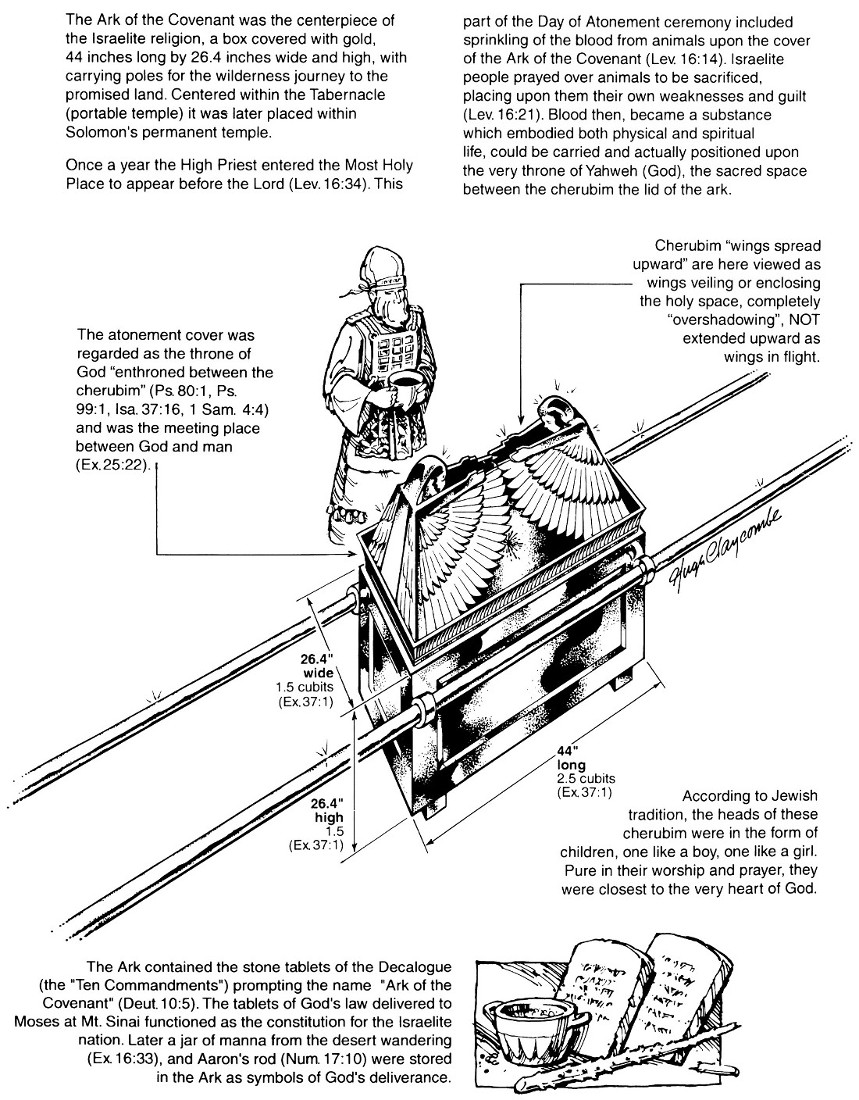
Fig. 7. The Ark of the Covenant
We must recall that the ark of the covenant had been captured in battle by the Philistines when the Israelites foolishly assumed the symbol of God’s presence at the vanguard of the army would guarantee a military victory (1 Sam. 4:11). Not long after their capture of the ark, the Philistines returned the sacred chest to the Israelites to stay the plagues the Lord inflicted on them (1 Sam. 5). The ark of God was returned to Beth Shemesh, but only briefly. God struck dead seventy of the villagers for their irreverence in peeking into the contents of the covenant box (6:19). Terrified, the leaders of Beth Shemesh sent the ark to Kiriath Jearim, where it was housed by Abinadab and guarded by his son Eleazar (7:1). It is at this point that the Chronicler picks up the story.
The book of 2 Samuel treats the transfer of the ark of God as a military event initially (2 Sam. 6:1). The Chronicler adds the details that David consults not only with his military leaders but also the religious leadership of Israel (priests and Levites) and the general populace (1 Chron. 13:2). The thirty thousand chosen to escort the ark (2 Sam. 6:1) are apparently representative of “all Israel” for the Chronicler (1 Chron. 13:5). The unity of “all Israel” under King David is a key theme in Chronicles; here it connects the preceding section (chs. 10–12) with the ark narrative (chs. 13–17).
David’s call to “bring the ark of our God back to us” connotes a spiritual journey as much as it denotes a geographical one (13:3a). The site of Kiriath Jearim was located in the tribe of Judah (13:6), so the issue is not the physical presence of the ark of God. Japhet correctly discerns that David in fact admonishes the people in a spiritual sense: “Let us make the ark ‘ours.’”5 She substantiates her interpretation by the appeal to once again “inquire” of the ark, as it was neglected during Saul’s reign (13:3b). The issue for Israel is the role of the ark “in God’s worship, as an object of ‘seeking.’”6 The word “inquire” (drš) displays a wide range of meaning, including “seeking” God in the sense of “worship” (e.g., 2 Chron. 17:3). The full conclusion of the installation of the ark, as Japhet reminds us, “is not seen in its placement ‘inside the tent’ (1 Chron. 16:1//2 Sam. 6:17), but in the establishment of a permanent liturgy of worship before it” (described in 1 Chron. 16).7
Implicit in David’s summons to restore the ark to its proper place in Israelite worship is the cause-and-effect link between Saul’s demise and Israel’s defeat by the Philistines and the neglect of the ark of God (13:3c). In fact, the writer probably intends his audience to recall the earlier theological assessment of King Saul as one who did not “inquire” (drš) of Yahweh (10:14). That sober reminder alone may have been enough to motivate the assembly of Israel to decide that “to return the ark” is the right thing to do (13:4).
Affirming the prominent theme of Israelite unity under King David, the Chronicler indicates in threefold repetition that “all the Israelites” participate with King David in the processional to return the ark of God (13:5, 6, 8). This phrase interprets the “thirty thousand men” chosen out of Israel to accompany the ark in the Samuel parallel as a throng representative of “all Israel” (cf. 2 Sam. 6:1).
The Chronicler’s elaboration on the extent to which this multitude represents the breadth of the territory of Israel is noteworthy (13:5). Typically, the Old Testament boundaries or geographical poles for the land of Israel are Dan in the north and Beersheba in the south (cf. 21:2). The Chronicler’s extreme definition of the borders of Israel extending from the Shihor River in Egypt (or the Nile) to Lebo Hamath (the city at the entrance to the territory of Hamath in Syria some forty-five miles north of Damascus) occurs elsewhere in the Old Testament only in Joshua 13:2–5. There the Shihor River and Lebo Hamath are the “bookends” for the territories still unconquered by the Hebrews prior to Joshua’s death. The Chronicler may be making two statements in his appeal to the precursor text in Joshua: (1) The rarely used geographical description maximizes the sweeping extent of David’s support; (2) it may offer commentary on Joshua 13:2–5 in the sense that under King David the conquest of Canaan is finally completed.
The point of departure for the processional transferring the ark of God to the central shrine in Jerusalem is Kiriath Jearim (1 Chron. 13:5). The city was a border town between Judah and Benjamin located approximately eight miles west of Jerusalem. The site was also known as Kiriath Baal and Baalah (Josh. 15:9; 18:14, 15; cf. 2 Sam. 6:2).
The portrayal of Yahweh as “the LORD, who is enthroned between the cherubim” (13:6) is an infrequent but powerful image of the God of the Hebrews (cf. 1 Sam. 4:4; 2 Kings 19:15). The idea of the mysterious and majestic presence of God enthroned between the cherubim of the ark of the covenant is based on the understanding that this is where God meets his people (Ex. 25:22). The idea behind God’s “meeting” with Israel is comparable to that of a king holding audience with subjects—hence, the ark represented the throne of God on earth. The psalmist associates the enthronement of God between the cherubim of the ark with his sovereign rule of the nations (Ps. 99:1). Clearly, he wants to impress on his audience the fact that Yahweh is not a local deity after the fashion of the gods and goddesses of the pantheons of Israel’s neighbors. Rather, the Lord Almighty is a universal deity, and his rule encompasses all of creation.
The NIV’s expression, “the ark that is called by the Name,” is interpretive (13:6d). The literal clause, “where [the] Name is called” is cryptic. Some commentators suggest the expression is a later addition to the text.8 If Chronicles preserves a better version of original Hebrew text than Samuel, then the expression should be retained as original and probably signifies that the ark and the shrine housing it are the “local” manifestations of the divine presence—the “house” or residence of God, so to speak (cf. Deut. 12:11; 1 Kings 8:29).
There are numerous divergences between 2 Samuel 6:2–11 and 1 Chronicles 13:6–14. For instance, the MT of 2 Samuel 6:5 reads “celebrating before the LORD with all kinds of instruments made of pine” (see NIV text note). As a second example, the site of Uzzah’s tragic death is the “threshing floor of Kidon” (1 Chron. 13:9), whereas the place name in Samuel is Nacon (2 Sam. 6:6); other witnesses identify the site as Nodan (4QSama) or Nodab (LXXb). Williamson has noted these variants are of textual interest in the reconstruction of the original MT, but that reading theological significance into them is unwarranted.9
The deadly mishap involving Uzzah (13:9) dramatically and immediately changes the mood surrounding the transfer of the ark of the covenant. The festive enthusiasm and joyous celebration of the procession suddenly turn into confusion, despair, and mourning. Interestingly, the Chronicler avoids all comment on the response of the Israelites participating in the event. What is clear is that Uzzah is struck down and killed by the Lord (13:10). King David’s response of both anger and fear to the tragedy is also readily reported (13:11–12). David’s visceral reaction seems to be based on the assumption that Uzzah is an innocent victim and that God has capriciously shown his disapproval for the enterprise of transferring the ark.
The death of Uzzah resulting in the bungled transfer of the ark of the covenant is one of two failures of King David reported by the Chronicler (the other is the census-taking, 1 Chron. 21). In part, the explanation for David’s failure is found in the repeated phrase “before God” (13:8, 10). David and Israel overlook the role of the ark as the “vehicle of God’s presence in the midst of his people.”10 The awesome power and dreadful holiness of God have somehow been forgotten. Perhaps the euphoria of the celebration has dulled the “theological senses” of both king and people. The physical separation of the ark from the sacred shrine still located in Gibeon (cf. 1 Chron. 16:39; 21:29–30) may have contributed to an unhealthy familiarity with this piece of sacred furniture normally viewed but once a year by the high priest.
Whatever the reason, the fatal experience of Nadab and Abihu’s profane behavior “before the LORD” has faded from memory (cf. Lev. 10:1–3). God is a consuming fire, and he will show himself holy before all people, even in the stumbling of oxen pulling a cart at the threshing floor of Kidon (cf. Ex. 24:17; Deut. 4:24; Heb. 12:29). The Chronicler’s repetition of the word “break out” (prṣ) in this section of the narrative seems to draw attention to this terrifying dimension of God’s character—perhaps as a necessary reminder to his audience (cf. 13:11; 14:11; 15:13).
A more complete explanation of David’s failure ensues in the subsequent narrative, phase two of the transfer of the ark to Jerusalem. Here we learn that King David fails to “inquire” of the Lord as to the proper procedure for transporting the ark (15:13). According to Mosaic law, only the Levites were to carry the holy things of the tabernacle, and even they were not to touch the holy vessels against the threat of death (Num. 4:15). Accordingly, David orders the consecration of the priests to transport the ark by means of the carrying poles prescribed by pentateuchal law (1 Chron. 15:2–24; cf. Ex. 25:14). Ironically, David’s neglect to inquire of the Lord mimics that of King Saul’s (1 Chron. 10:14). Unlike Saul’s habitual neglect of God, however, David’s lapse is temporary and is remedied by his later entreaty for divine instruction in the transfer of the ark.
Selman has suggested King David and the other leaders are influenced by the Philistines and their use of a “new cart” to restore the ark to the Israelites, thus unwittingly perpetuating a pagan superstition (13:7; cf. 1 Sam. 6:7).11 This may have indeed been the case. But it is not the central issue in understanding the outbreak of God’s wrath and the slaying of Uzzah. According to Japhet, the touching of sacred objects was a sacrilege (see Num. 4:15). Consequently, “a sin of this kind is objective and absolute, the aspects of volition, intent, and moral consideration playing no role.”12 God’s response to such desecration of the holy is consistent with the Chronicler’s report (e.g., Num. 15:35; Josh. 7:25; 1 Sam. 6:19). Japhet further characterizes Uzzah’s sin as one of disbelief and mistrust in the power of God, since it is for God and not human beings to protect the ark (the essential lesson of Shiloh, 1 Sam. 4–6).13
David’s refusal to press on with his quest to transfer the ark to Jerusalem marks two important character traits of this beloved shepherd-king (13:13–14). (1) His disposition to deposit the ark at the nearest convenient location indicates his submission to God’s will (cf. Ps. 40:8). (2) Whether out of abject fear or outright reverence, David refuses to manipulate God for personal advantage through control of the sacred symbol of divine presence (cf. Ps. 40:6; 51:6).
There is some question as to the identity of Obed-Edom. Some commentators have suggested he is a Philistine since he is associated with Gath (13:13; “Gittite” is related to Gath) and that David deliberately warehouses the ark with a “foreigner” as a sort of “guinea pig” to ensure that God’s wrath has indeed subsided.14 Others equate him with the Obed-Edom named by the Chronicler among the Levitical gatekeepers (15:18, 21).15 There is no doubt, however, about the purpose of the Chronicler’s report of God’s blessing on the house of Obed-Edom for those three months the ark resides in his keeping. David and all Israel (as well as the Chronicler’s audience) need to know that the transgression against God was not the transfer of the ark itself but the faulty way in which it was carried out. God demands proper “means” to achieve good and right “ends.”
King David’s Fame Spreads (14:1–17)
Bridging Contexts
THE TABERNACLE or tent-shrine described in detail in Exodus 25–40 was designed to symbolize the active presence of God among his people. In fact, Exodus 25:8 specifies the basic purpose of this portable worship center as one of giving God an “address” in the Israelite community: “Then have them make a sanctuary for me, and I will dwell among them.”
This sanctuary was also called the Tent of Meeting, because it was there that God convened his assemblies with Israel. The Levitical priesthood was ordained to represent the people before God and to mediate the divine presence in the covenant community. In one sense, God’s presence associated with the tabernacle and symbolized in the cloud of glory that resided there (Ex. 40:34–38) was part of the developing “Immanuel theology” of the Old Testament. This progressive revelation of an incarnational divine presence aimed at restoring the intimate fellowship enjoyed by God and humanity in the pre-Fall garden experience. The “Immanuel theology” of the Old Testament was ultimately fulfilled in Jesus Christ (John 1:14; cf. Isa. 7:14).
King Solomon’s prayer of dedication for the Jerusalem temple echoes this theme: “I have indeed built a magnificent temple for you, a place for you to dwell forever” (1 Kings 8:13). Interestingly, the parallel passage in Chronicles describes the function of the temple as a repository or resting place for the ark of the covenant—the very “footstool of our God” (1 Chron. 28:2). Thus, the ark was both “throne” and “footstool” of Yahweh (cf. 2 Kings 19:15). The Chronicler appropriately identifies the ark of the covenant as God’s footstool because his divine presence was specifically associated with this piece of tabernacle furniture as the place where God met with his people: “There, above the cover [of the ark of the Testimony] between the two cherubim that are over the ark of the Testimony, I will meet with you” (Ex. 25:22).
Practically speaking during biblical times, the royal footstool supported a king’s feet as he sat on his throne. According to Fabry, the installation of a royal throne and its footstool in a city or territory was also the equivalent of establishing residence and confirmed the ruler’s permanent sovereignty in that domain.43 The portrayal of a king seated on his throne with feet resting on the footstool represented, through symbol, the reality of royal authority in that city or region and the peace and prosperity enjoyed by the loyal subjects of the kingdom. In addition, the footstool was a sign of humility and servitude on the part of the conquered peoples within that king’s realm.
By logical extension from the particular to the universal, the footstool motif associated with the ark of the covenant prescribed the realm of God moving outward in an ever-expanding circle. The jurisdiction of God included the Jerusalem temple housing the ark (Ps. 132:7), but extended to Mount Zion or the city of David where the temple was eventually built (Lam. 2:1), and ultimately reached out to the whole earth (Isa. 66:1).
Belief strives for embodiment in conventional and tangible modes of expression. For this reason, symbolism has been a part of biblical religion from its beginnings because it is the vehicle of revelation and the language of faith. As vehicles of revelation, symbols summarize and interpret human experience and interaction with God. As part of the language of faith, symbols interpret the holy, the eternal, and the grace and righteousness of God.
Schaper understands symbolism as an object, act, or word that stands for, suggests, or represents something else.44 Thus, a sign is something practical and visible that essentially conveys information leading to personal action. For instance, the fish is a religious sign in that as a badge or emblem it conveys information about one’s identity as a Christian. Kooy has attempted to more precisely distinguish between sign and symbol in the Old Testament: “The religious symbol points beyond itself to reality, participating in its power, and makes intelligible its meaning. As such it goes beyond a sign or an image.”45 For example, the dove is a religious symbol since it incarnates the reality of the Holy Spirit (cf. Matt. 3:16). In other words, the sign may represent reality, whereas the symbol embodies it.
As ancient Israel’s most beloved poet, King David is well acquainted with the value of symbolic language. He understands the power inherent in word pictures for communicating theological truths, whether the sterling character of God (Ps. 18:1–2, 25, 30–31) or the faltering faith of the righteous (51:7–8). For David, the procession of the ark of the covenant into Jerusalem for eventual installation in a central sanctuary is both sign and symbol. As a sign, the ark of covenant serves both as a reminder of Israel’s Exodus experience and as a testimony of God’s holy presence among his people. The return of that sign of divine immanence to the religious life of Israel will stir the people to action—of once again recognizing Yahweh’s kingship by affirming their allegiance to him and demonstrating their loyalty to him by complying with the stipulations of his covenant.
As a symbol, the ark of the covenant embodies the theological truth of God’s residency in the midst of Israel. More important, the footstool motif associated with the ark validates the reality of Yahweh’s sovereign rule over creation and thus becomes an emblem of Israel’s submission and loyalty to God as king. Based on the instructions of the prophet-priest Samuel, David knows that kingship in Israel can only succeed as the people acknowledge God’s presence in their midst by the response of obedience to his commandments (1 Sam. 12:14–15). For King David, the processional celebrating the entry of the ark of the covenant into Jerusalem is a grand object lesson that dramatically portrays the vital relationship between the recognition of God’s presence and God’s rule.
Contemporary Significance
Contemporary Significance
THE VALUE OF SYMBOLS. In an important book addressing communication theory and practice, Pierre Babin has analyzed the impact of technology on religious communication in this age of electronic media. He has identified two types of language: the conceptual and the symbolic. Conceptual language may be defined as that form of communication “that provides an abstract, limited, and fixed representation of reality.”46 Symbolic language is “full of resonances and rhythms, stories and images, and suggestions and connections.”47
The rise of the media civilization is changing “our historical times into psychological times, and … those obliged to receive communication into those interested in receiving it.”48 This paradigm shift from conceptual to symbolic language has awakened an “interiority” in contemporary (postmodern) society that places an emphasis on feelings, imagination, and experience. Babin concludes his study of religious communication by prophetically calling the Christian church to rediscover the value of symbolic language for the sake of religious education in this postmodern electronic age.
Babin suggests two special ways the church might develop religious education in this audiovisual age: the way of beauty and the symbolic way.49 The way of beauty is the development of a religious sensitivity to God’s perfection that results in the spiritual experience of recognizing his goodness and beauty in the whole of creation—“the fullness of the cross that joins earth to heaven.”50
Rather than offer explanation, the symbolic way employs the language of images and stories to free the spirit and move the heart. Symbolic language is more important for “the effect it produces on us … arousing a longing for hidden treasure.”51 Finally, Babin stresses the need for incorporating both conceptual and symbolic language in religious education. What he has called stereo catechesis must appeal to the heart and human feelings as well as inform the intellect and human reason. Only in this way can an orthodox knowledge and practice of the Bible be infused with a truly converted heart.
According to Robert Webber, the paradigm shift in communications from conceptual language to symbolic language described by Babin also has profound implications for worship in the Christian church. As he carefully notes:
The role of symbolism in a postmodern world is not to re-create the ceremonial symbolism of the medieval era, but to understand and apply the symbolism of atmosphere such as the sense of awe and reverence, to recover the beauty of space and the symbolic actions of worship, and to restore the sounds of music and the sights of the arts.52
Elevating the known to the unknown through symbolic language and action transports the worshiper into the mystery of the transcendent. In the terminology of art history, this mediation of God’s presence and truth through symbol is one way artistic expression communicates divine “intervention” in the natural order.
Historically, ancient and modern societies have employed symbolic representation in artistic expression for several purposes, including:
• intervention—art as a means of representing supernatural powers, unseen spiritual forces, and the mystery of religious thought and experience, thus serving as a bridge to other dimensions of reality
• affiliation—art as a means of defining family and community relationships and to legitimize the right to rule of the leadership class(es) in a society
• documentation—art as a means of memorializing momentous events and recording significant traditions (e.g., creation stories, adventures of heroes, and exploits of the deities)
• aesthetic contemplation—art as a means of enhancing the physical environment and stimulating emotion, intuition, and imagination through a sense of beauty.53
The community of faith in ancient Israel and the early Christian church used signs and symbols in much the same way. By sign we mean a practical and visible representation of reality, whether a spiritual quality or characteristic, a biblical doctrine or truth, or even a key biblical figure. A sign conveys information that leads to personal action. For example, the sign of Christian baptism points to the theological idea of the “virtual” death, burial, and resurrection of the believer in Jesus Christ (cf. Rom. 6:3–4).
A symbol may be understood as a visual representation of an idea or a reality beyond or more than itself. The religious symbol points to a spiritual reality outside of itself, participates in its power, and makes intelligible its meaning. Genuine religious symbols are divinely created in the sense that they find their origin in Scripture. For example, the dove is a symbol of the reality of the empowering Holy Spirit (Matt. 3:16), and the sacrificial lamb is a symbol of the reality of the redemptive nature of Jesus Christ’s life and ministry (John 1:29; Rev. 5:6). The biblical appropriation of artistic representation in sign and symbol for the purposes of intervention, affiliation, documentation, and aesthetic contemplation are summarized below.
Intervention. The images associated with God’s intervention in the created order recorded in the Bible serve various purposes, such as revealing his nature, character, and work; acknowledging the existence of an unseen spiritual reality; indicating the pervasive effects of the Fall in creation; representing the mystery of life, death, and the future; validating God’s redemptive plan for all creation; and demonstrating his supremacy over all dimensions of reality.
Specific examples of the symbolic representation of divine intervention in Scripture include the sign of the rainbow (as a reminder of divine judgment and a promise of divine mercy, Gen. 9:13–16), the ark of the covenant (pointing to the presence of God in Israel, Ex. 25:10–22), the Sabbath day (as a marker of God’s holiness, 31:12–18), angels (as agents of divine protection, revelation, etc., 32:34; Matt. 1:20), the temple (as a house of prayer, 1 Kings 8:35–36; Matt. 21:13), Elijah the prophet (as the forerunner of Messiah, Mal. 4:5; Matt. 16:14), the dove (signifying the Spirit of God, Matt. 3:16), and the cross itself (as an emblem of self-denial and divine redemption, Matt. 10:38; 1 Cor. 1:17–18).
Affiliation. Affiliation is generally understood as a personal decision to associate as a member in a group or be received in close connection to a club or join an organization. The gospel of Jesus Christ calls people into affiliation with him as the Son of God and the church he continues to build throughout the world (cf. Matt. 16:18). This affiliation with the Christian church is demonstrated in a number of ways:
• becoming a disciple (lit., a follower of an [itinerant] teacher who obeys that person’s teachings and in some cases gives up family and material possessions to travel with the teacher and practice his ways; cf. Mark 1:16–18)
• public witness or testimony confessing one’s allegiance to Christ as a disciple (cf. Peter’s confession, Matt. 16:16)
• the act of baptism (Matt. 28:19; Acts 2:41; Rom. 6:3–4) and other acts such as giving, prayer, and fasting (cf. Matt. 6:1–18)
• eating at the table of the Lord, breaking the bread and drinking the cup (1 Cor. 10:16–17).
Historically, the Christian church has used a variety of symbolic activities and visual representations to signify the membership or affiliation of believers. For example, wearing a white robe during Christian baptism signifies the cleansing of the believer of sin and guilt (cf. Rev. 3:4–5), giving the new believer a Christian name or even a white stone serves as a token of membership in the local church and the body of Christ universal (cf. Rev. 2:17), and gathering for the “breaking of bread” or eating the sacramental meal on a regular basis is a proclamation of the gospel of Jesus Christ (1 Cor. 11:23–26).
During times of persecution the church resorted to secret marks of identification and affiliation (e.g., the sign of the fish used as a motto or badge of identification, attesting initiation and membership in the church of Jesus Christ). The signs and symbols associated with the rituals of affiliation or membership in the church indicate fellowship in a community of like-minded people. The visual representations of affiliation reinforce a sense of belonging that includes mutual care and support, a new identity as a new creation in Christ, a new loyalty, initiation into a new family with responsibilities and obligations, and a new direction and purpose in life.
Documentation and instruction. Documentation through symbolic representation is a means of memorializing God’s activity in human history. It is difficult to separate documentation and instruction in the biblical use of signs and symbols. By instruction we mean the use of visual images to teach biblical truth to those unable to read. This was especially true in the early church, when Christian symbols were a universal “sign language” facilitating literacy and communication across language and dialect barriers.
The use of sign and symbol was also important as a pedagogical device complementing oral and written teaching about God and spiritual truth through visual images. These images have the ability to elucidate and to compress truth into a simple and meaningful whole, in a form readily grasped and retained. The developments in educational theory emphasizing learning styles confirm the value of symbols for making an insight permanent because of the mnemonic qualities inherent in visual images.
For example, the Passover ceremony included the images of a lamb, unleavened bread, and doorposts dabbed with blood as memorials of God’s activity in Hebrew history (Ex. 12). In addition, written instruction accompanied the symbols of the Exodus to carefully explain the meaning of the event theologically (13:1–13). Finally, a question-and-answer catechism designed to school the next generation in the deeds and words of God concluded the Passover ceremony (13:14–16). Not surprisingly, a similar pattern of image + word + catechism may be identified in the ceremony of the bread and the cup of the Lord’s table (1 Cor. 11:17–34).
Aesthetic contemplation. The word “aesthetic” means “having a sense or appreciation of the beautiful” or “characterized by a love of beauty.” The use of visual images is one means to enhance the environment of worship and stimulate emotion, intuition, and imagination through a sense of beauty. Artistic expression is linked to worship in the Old Testament in connection with the Mosaic tabernacle and later the temple of Solomon (Ex. 31:1–11; 1 Kings 6:14–36). In the New Testament, artistic expression is linked to worship especially in the depiction of heavenly worship in the book of Revelation (Rev. 21:9–27).
The arts generally, and artistic expression in sign and symbol specifically, bridge the natural and the spiritual world. The arts permit humanity as creatures of God to explore and express the mystery of God’s transcendence and immanence as Creator and Redeemer (cf. Ps. 96:11–12; 97:5–6; Isa. 55:12).
Dangers associated with symbols. Church history testifies to the fact that the Christian utilization of symbolic representation through artistic expression poses certain risks. At times the distinction between the worship of God and the reverence shown images and objects often has been blurred in Christian practice.
• Chief among these risks are idolatry or the worship of a physical object as a god (cf. Ex. 20:3–5).
• A second risk is iconolatry, or the worship of images or icons (i.e., a flat, one-dimensional pictorial representation of Christ, another biblical figure, or later Christian saints in the formal Byzantine style).
• Another risk is misdirected veneration, the practice of honoring or showing reverential respect to an icon or an image with a ritual act of devotion. For example, in the Roman Catholic tradition reverence is paid to relics of the saints, in Orthodox traditions icons are venerated, and in some liturgical Protestant circles the worship processional includes the “Veneration of the Book” (i.e., the Bible). Unfortunately during church history, the lines between “veneration” and “worship” have been too easily blurred at times.
• Finally, at the level of popular culture, the overuse of Christian symbols as trendy adornment and decoration or for “bumper sticker” evangelism trivializes biblical truth and robs the symbol of its coded meaning.
Toward revaluing sign and symbol. The Christian church broadly speaking, and the evangelical church in particular, must begin to reconsider alternative forms of religious communication for worship, instruction, and evangelism that include sign and symbol or “symbolic language” as “modernism” gives way to “postmodernism.” The descriptive thoughts below are offered by way of summary as prompts for stimulating further thought and discussion, leading to more prescriptive responses to this thesis:
1. Sign and symbol are reemerging as important forms of communication in the Christian church as a result of the shift in our culture from conceptual to symbolic forms of communication.
2. Sign and symbol have a long history in the Christian church as a means for signifying affiliation, expressing divine intervention, complementing documentation and instruction, and aiding aesthetic contemplation.
3. Sign and symbol constitute indirect forms of communication. This nonverbal language is designed to complement, not replace, direct forms of communication (the spoken or printed word) in the church.
4. Artistic expression has not escaped the effects of the Fall. Note the risks associated with the use of sign and symbol outlined above. The Christian church and the Christian must continually consider and critically evaluate the role of sign and symbol as used in worship, instruction, and evangelism.
5. Sign and symbol may be effectively employed in the Christian church not only in worship but also in instruction (preaching and teaching) and evangelism.
6. Sign and symbol (including the symbolic use of colors) are readily connected to the cycles of Advent, Epiphany, Lent, Easter, Ascension, and Pentecost in the Christian year.
Belief strives for embodiment in conventional and tangible modes of expression. For the sake of imparting the legacy of Christian worship, instruction, and evangelism to the generations now being raised in this age of technology and visual media culture, the church must rediscover the value of symbolic communication.
Original Meaning
First Stage of the Ark’s Return (13:1–14)
THE OPENING SECTION of the Chronicler’s ark narrative records the decision to retrieve the ark of God from Kiriath Jearim (13:1–4). These verses introduce the story of the ark’s eventual entry into Jerusalem and have no parallel in the Samuel account. The latter portion of this literary unit describes the journey of the ark from the house of Abinadab of Kiriath Jearim (or Baalah) to the threshing floor of Kidon (13:5–14). This account of the transfer of the ark is taken from 2 Samuel 6:2–11 with some variation. Three smaller units may be observed in this section: the journey of all Israel to Kiriath Jearim (13:5–6), the transportation of the ark in a processional (13:7–11), and the temporary deposit of the ark at the house of Obed-Edom (13:12–14).
The Ark of the Covenant
The Ark of the Convenant was the centerpiece of the Israelite religion, a box covered with gold, 44 inches long by 26.4 inches wide and high, with carrying poles for hte wilderness journey to the promised land. Centered within the Tabernacle (portabl temple) it was later placed within Solomon’s permanent temple.
The atonement cover was regarded as the throne of God “enthroned between the cherubim” (Ps. 80:1, Ps. 99:1, Isa. 37:16, 1 Sam. 4:4) and was the meeting place between God and man (Ex. 25:22).
Cherubim “wings spread upward” are here viewed as wings veiling or enclosing the holy space, completely “overshadowing”, NOT extended upward as wings in flight.
The Ark contained the stone tablets of the Decalogue (the “Ten Commandments”) prompting the name “Ark of the Covenant” (Deut. 10:5). The tablets of God’s law delivered to Moses at Mount Sinai functioned as the constitution for the Israelite nation. Later a jar of manna from the desert wandering (Ex. 16:33), and Aaron’s rod (Num 17:10) were stored in the Ark as symbols of God’s deliverance.
infographic
Fig. 7. The Ark of the Covenant
We must recall that the ark of the covenant had been captured in battle by the Philistines when the Israelites foolishly assumed the symbol of God’s presence at the vanguard of the army would guarantee a military victory (1 Sam. 4:11). Not long after their capture of the ark, the Philistines returned the sacred chest to the Israelites to stay the plagues the Lord inflicted on them (1 Sam. 5). The ark of God was returned to Beth Shemesh, but only briefly. God struck dead seventy of the villagers for their irreverence in peeking into the contents of the covenant box (6:19). Terrified, the leaders of Beth Shemesh sent the ark to Kiriath Jearim, where it was housed by Abinadab and guarded by his son Eleazar (7:1). It is at this point that the Chronicler picks up the story.
The book of 2 Samuel treats the transfer of the ark of God as a military event initially (2 Sam. 6:1). The Chronicler adds the details that David consults not only with his military leaders but also the religious leadership of Israel (priests and Levites) and the general populace (1 Chron. 13:2). The thirty thousand chosen to escort the ark (2 Sam. 6:1) are apparently representative of “all Israel” for the Chronicler (1 Chron. 13:5). The unity of “all Israel” under King David is a key theme in Chronicles; here it connects the preceding section (chs. 10–12) with the ark narrative (chs. 13–17).
David’s call to “bring the ark of our God back to us” connotes a spiritual journey as much as it denotes a geographical one (13:3a). The site of Kiriath Jearim was located in the tribe of Judah (13:6), so the issue is not the physical presence of the ark of God. Japhet correctly discerns that David in fact admonishes the people in a spiritual sense: “Let us make the ark ‘ours.’”5 She substantiates her interpretation by the appeal to once again “inquire” of the ark, as it was neglected during Saul’s reign (13:3b). The issue for Israel is the role of the ark “in God’s worship, as an object of ‘seeking.’”6 The word “inquire” (drš) displays a wide range of meaning, including “seeking” God in the sense of “worship” (e.g., 2 Chron. 17:3). The full conclusion of the installation of the ark, as Japhet reminds us, “is not seen in its placement ‘inside the tent’ (1 Chron. 16:1//2 Sam. 6:17), but in the establishment of a permanent liturgy of worship before it” (described in 1 Chron. 16).7
Implicit in David’s summons to restore the ark to its proper place in Israelite worship is the cause-and-effect link between Saul’s demise and Israel’s defeat by the Philistines and the neglect of the ark of God (13:3c). In fact, the writer probably intends his audience to recall the earlier theological assessment of King Saul as one who did not “inquire” (drš) of Yahweh (10:14). That sober reminder alone may have been enough to motivate the assembly of Israel to decide that “to return the ark” is the right thing to do (13:4).
Affirming the prominent theme of Israelite unity under King David, the Chronicler indicates in threefold repetition that “all the Israelites” participate with King David in the processional to return the ark of God (13:5, 6, 8). This phrase interprets the “thirty thousand men” chosen out of Israel to accompany the ark in the Samuel parallel as a throng representative of “all Israel” (cf. 2 Sam. 6:1).
The Chronicler’s elaboration on the extent to which this multitude represents the breadth of the territory of Israel is noteworthy (13:5). Typically, the Old Testament boundaries or geographical poles for the land of Israel are Dan in the north and Beersheba in the south (cf. 21:2). The Chronicler’s extreme definition of the borders of Israel extending from the Shihor River in Egypt (or the Nile) to Lebo Hamath (the city at the entrance to the territory of Hamath in Syria some forty-five miles north of Damascus) occurs elsewhere in the Old Testament only in Joshua 13:2–5. There the Shihor River and Lebo Hamath are the “bookends” for the territories still unconquered by the Hebrews prior to Joshua’s death. The Chronicler may be making two statements in his appeal to the precursor text in Joshua: (1) The rarely used geographical description maximizes the sweeping extent of David’s support; (2) it may offer commentary on Joshua 13:2–5 in the sense that under King David the conquest of Canaan is finally completed.
The point of departure for the processional transferring the ark of God to the central shrine in Jerusalem is Kiriath Jearim (1 Chron. 13:5). The city was a border town between Judah and Benjamin located approximately eight miles west of Jerusalem. The site was also known as Kiriath Baal and Baalah (Josh. 15:9; 18:14, 15; cf. 2 Sam. 6:2).
The portrayal of Yahweh as “the LORD, who is enthroned between the cherubim” (13:6) is an infrequent but powerful image of the God of the Hebrews (cf. 1 Sam. 4:4; 2 Kings 19:15). The idea of the mysterious and majestic presence of God enthroned between the cherubim of the ark of the covenant is based on the understanding that this is where God meets his people (Ex. 25:22). The idea behind God’s “meeting” with Israel is comparable to that of a king holding audience with subjects—hence, the ark represented the throne of God on earth. The psalmist associates the enthronement of God between the cherubim of the ark with his sovereign rule of the nations (Ps. 99:1). Clearly, he wants to impress on his audience the fact that Yahweh is not a local deity after the fashion of the gods and goddesses of the pantheons of Israel’s neighbors. Rather, the Lord Almighty is a universal deity, and his rule encompasses all of creation.
The NIV’s expression, “the ark that is called by the Name,” is interpretive (13:6d). The literal clause, “where [the] Name is called” is cryptic. Some commentators suggest the expression is a later addition to the text.8 If Chronicles preserves a better version of original Hebrew text than Samuel, then the expression should be retained as original and probably signifies that the ark and the shrine housing it are the “local” manifestations of the divine presence—the “house” or residence of God, so to speak (cf. Deut. 12:11; 1 Kings 8:29).
There are numerous divergences between 2 Samuel 6:2–11 and 1 Chronicles 13:6–14. For instance, the MT of 2 Samuel 6:5 reads “celebrating before the LORD with all kinds of instruments made of pine” (see NIV text note). As a second example, the site of Uzzah’s tragic death is the “threshing floor of Kidon” (1 Chron. 13:9), whereas the place name in Samuel is Nacon (2 Sam. 6:6); other witnesses identify the site as Nodan (4QSama) or Nodab (LXXb). Williamson has noted these variants are of textual interest in the reconstruction of the original MT, but that reading theological significance into them is unwarranted.9
The deadly mishap involving Uzzah (13:9) dramatically and immediately changes the mood surrounding the transfer of the ark of the covenant. The festive enthusiasm and joyous celebration of the procession suddenly turn into confusion, despair, and mourning. Interestingly, the Chronicler avoids all comment on the response of the Israelites participating in the event. What is clear is that Uzzah is struck down and killed by the Lord (13:10). King David’s response of both anger and fear to the tragedy is also readily reported (13:11–12). David’s visceral reaction seems to be based on the assumption that Uzzah is an innocent victim and that God has capriciously shown his disapproval for the enterprise of transferring the ark.
The death of Uzzah resulting in the bungled transfer of the ark of the covenant is one of two failures of King David reported by the Chronicler (the other is the census-taking, 1 Chron. 21). In part, the explanation for David’s failure is found in the repeated phrase “before God” (13:8, 10). David and Israel overlook the role of the ark as the “vehicle of God’s presence in the midst of his people.”10 The awesome power and dreadful holiness of God have somehow been forgotten. Perhaps the euphoria of the celebration has dulled the “theological senses” of both king and people. The physical separation of the ark from the sacred shrine still located in Gibeon (cf. 1 Chron. 16:39; 21:29–30) may have contributed to an unhealthy familiarity with this piece of sacred furniture normally viewed but once a year by the high priest.
Whatever the reason, the fatal experience of Nadab and Abihu’s profane behavior “before the LORD” has faded from memory (cf. Lev. 10:1–3). God is a consuming fire, and he will show himself holy before all people, even in the stumbling of oxen pulling a cart at the threshing floor of Kidon (cf. Ex. 24:17; Deut. 4:24; Heb. 12:29). The Chronicler’s repetition of the word “break out” (prṣ) in this section of the narrative seems to draw attention to this terrifying dimension of God’s character—perhaps as a necessary reminder to his audience (cf. 13:11; 14:11; 15:13).
A more complete explanation of David’s failure ensues in the subsequent narrative, phase two of the transfer of the ark to Jerusalem. Here we learn that King David fails to “inquire” of the Lord as to the proper procedure for transporting the ark (15:13). According to Mosaic law, only the Levites were to carry the holy things of the tabernacle, and even they were not to touch the holy vessels against the threat of death (Num. 4:15). Accordingly, David orders the consecration of the priests to transport the ark by means of the carrying poles prescribed by pentateuchal law (1 Chron. 15:2–24; cf. Ex. 25:14). Ironically, David’s neglect to inquire of the Lord mimics that of King Saul’s (1 Chron. 10:14). Unlike Saul’s habitual neglect of God, however, David’s lapse is temporary and is remedied by his later entreaty for divine instruction in the transfer of the ark.
Selman has suggested King David and the other leaders are influenced by the Philistines and their use of a “new cart” to restore the ark to the Israelites, thus unwittingly perpetuating a pagan superstition (13:7; cf. 1 Sam. 6:7).11 This may have indeed been the case. But it is not the central issue in understanding the outbreak of God’s wrath and the slaying of Uzzah. According to Japhet, the touching of sacred objects was a sacrilege (see Num. 4:15). Consequently, “a sin of this kind is objective and absolute, the aspects of volition, intent, and moral consideration playing no role.”12 God’s response to such desecration of the holy is consistent with the Chronicler’s report (e.g., Num. 15:35; Josh. 7:25; 1 Sam. 6:19). Japhet further characterizes Uzzah’s sin as one of disbelief and mistrust in the power of God, since it is for God and not human beings to protect the ark (the essential lesson of Shiloh, 1 Sam. 4–6).13
David’s refusal to press on with his quest to transfer the ark to Jerusalem marks two important character traits of this beloved shepherd-king (13:13–14). (1) His disposition to deposit the ark at the nearest convenient location indicates his submission to God’s will (cf. Ps. 40:8). (2) Whether out of abject fear or outright reverence, David refuses to manipulate God for personal advantage through control of the sacred symbol of divine presence (cf. Ps. 40:6; 51:6).
There is some question as to the identity of Obed-Edom. Some commentators have suggested he is a Philistine since he is associated with Gath (13:13; “Gittite” is related to Gath) and that David deliberately warehouses the ark with a “foreigner” as a sort of “guinea pig” to ensure that God’s wrath has indeed subsided.14 Others equate him with the Obed-Edom named by the Chronicler among the Levitical gatekeepers (15:18, 21).15 There is no doubt, however, about the purpose of the Chronicler’s report of God’s blessing on the house of Obed-Edom for those three months the ark resides in his keeping. David and all Israel (as well as the Chronicler’s audience) need to know that the transgression against God was not the transfer of the ark itself but the faulty way in which it was carried out. God demands proper “means” to achieve good and right “ends.”
King David’s Fame Spreads (14:1–17)
Bridging Contexts
THE TABERNACLE or tent-shrine described in detail in Exodus 25–40 was designed to symbolize the active presence of God among his people. In fact, Exodus 25:8 specifies the basic purpose of this portable worship center as one of giving God an “address” in the Israelite community: “Then have them make a sanctuary for me, and I will dwell among them.”
This sanctuary was also called the Tent of Meeting, because it was there that God convened his assemblies with Israel. The Levitical priesthood was ordained to represent the people before God and to mediate the divine presence in the covenant community. In one sense, God’s presence associated with the tabernacle and symbolized in the cloud of glory that resided there (Ex. 40:34–38) was part of the developing “Immanuel theology” of the Old Testament. This progressive revelation of an incarnational divine presence aimed at restoring the intimate fellowship enjoyed by God and humanity in the pre-Fall garden experience. The “Immanuel theology” of the Old Testament was ultimately fulfilled in Jesus Christ (John 1:14; cf. Isa. 7:14).
King Solomon’s prayer of dedication for the Jerusalem temple echoes this theme: “I have indeed built a magnificent temple for you, a place for you to dwell forever” (1 Kings 8:13). Interestingly, the parallel passage in Chronicles describes the function of the temple as a repository or resting place for the ark of the covenant—the very “footstool of our God” (1 Chron. 28:2). Thus, the ark was both “throne” and “footstool” of Yahweh (cf. 2 Kings 19:15). The Chronicler appropriately identifies the ark of the covenant as God’s footstool because his divine presence was specifically associated with this piece of tabernacle furniture as the place where God met with his people: “There, above the cover [of the ark of the Testimony] between the two cherubim that are over the ark of the Testimony, I will meet with you” (Ex. 25:22).
Practically speaking during biblical times, the royal footstool supported a king’s feet as he sat on his throne. According to Fabry, the installation of a royal throne and its footstool in a city or territory was also the equivalent of establishing residence and confirmed the ruler’s permanent sovereignty in that domain.43 The portrayal of a king seated on his throne with feet resting on the footstool represented, through symbol, the reality of royal authority in that city or region and the peace and prosperity enjoyed by the loyal subjects of the kingdom. In addition, the footstool was a sign of humility and servitude on the part of the conquered peoples within that king’s realm.
By logical extension from the particular to the universal, the footstool motif associated with the ark of the covenant prescribed the realm of God moving outward in an ever-expanding circle. The jurisdiction of God included the Jerusalem temple housing the ark (Ps. 132:7), but extended to Mount Zion or the city of David where the temple was eventually built (Lam. 2:1), and ultimately reached out to the whole earth (Isa. 66:1).
Belief strives for embodiment in conventional and tangible modes of expression. For this reason, symbolism has been a part of biblical religion from its beginnings because it is the vehicle of revelation and the language of faith. As vehicles of revelation, symbols summarize and interpret human experience and interaction with God. As part of the language of faith, symbols interpret the holy, the eternal, and the grace and righteousness of God.
Schaper understands symbolism as an object, act, or word that stands for, suggests, or represents something else.44 Thus, a sign is something practical and visible that essentially conveys information leading to personal action. For instance, the fish is a religious sign in that as a badge or emblem it conveys information about one’s identity as a Christian. Kooy has attempted to more precisely distinguish between sign and symbol in the Old Testament: “The religious symbol points beyond itself to reality, participating in its power, and makes intelligible its meaning. As such it goes beyond a sign or an image.”45 For example, the dove is a religious symbol since it incarnates the reality of the Holy Spirit (cf. Matt. 3:16). In other words, the sign may represent reality, whereas the symbol embodies it.
As ancient Israel’s most beloved poet, King David is well acquainted with the value of symbolic language. He understands the power inherent in word pictures for communicating theological truths, whether the sterling character of God (Ps. 18:1–2, 25, 30–31) or the faltering faith of the righteous (51:7–8). For David, the procession of the ark of the covenant into Jerusalem for eventual installation in a central sanctuary is both sign and symbol. As a sign, the ark of covenant serves both as a reminder of Israel’s Exodus experience and as a testimony of God’s holy presence among his people. The return of that sign of divine immanence to the religious life of Israel will stir the people to action—of once again recognizing Yahweh’s kingship by affirming their allegiance to him and demonstrating their loyalty to him by complying with the stipulations of his covenant.
As a symbol, the ark of the covenant embodies the theological truth of God’s residency in the midst of Israel. More important, the footstool motif associated with the ark validates the reality of Yahweh’s sovereign rule over creation and thus becomes an emblem of Israel’s submission and loyalty to God as king. Based on the instructions of the prophet-priest Samuel, David knows that kingship in Israel can only succeed as the people acknowledge God’s presence in their midst by the response of obedience to his commandments (1 Sam. 12:14–15). For King David, the processional celebrating the entry of the ark of the covenant into Jerusalem is a grand object lesson that dramatically portrays the vital relationship between the recognition of God’s presence and God’s rule.
Contemporary Significance
Contemporary Significance
THE VALUE OF SYMBOLS. In an important book addressing communication theory and practice, Pierre Babin has analyzed the impact of technology on religious communication in this age of electronic media. He has identified two types of language: the conceptual and the symbolic. Conceptual language may be defined as that form of communication “that provides an abstract, limited, and fixed representation of reality.”46 Symbolic language is “full of resonances and rhythms, stories and images, and suggestions and connections.”47
The rise of the media civilization is changing “our historical times into psychological times, and … those obliged to receive communication into those interested in receiving it.”48 This paradigm shift from conceptual to symbolic language has awakened an “interiority” in contemporary (postmodern) society that places an emphasis on feelings, imagination, and experience. Babin concludes his study of religious communication by prophetically calling the Christian church to rediscover the value of symbolic language for the sake of religious education in this postmodern electronic age.
Babin suggests two special ways the church might develop religious education in this audiovisual age: the way of beauty and the symbolic way.49 The way of beauty is the development of a religious sensitivity to God’s perfection that results in the spiritual experience of recognizing his goodness and beauty in the whole of creation—“the fullness of the cross that joins earth to heaven.”50
Rather than offer explanation, the symbolic way employs the language of images and stories to free the spirit and move the heart. Symbolic language is more important for “the effect it produces on us … arousing a longing for hidden treasure.”51 Finally, Babin stresses the need for incorporating both conceptual and symbolic language in religious education. What he has called stereo catechesis must appeal to the heart and human feelings as well as inform the intellect and human reason. Only in this way can an orthodox knowledge and practice of the Bible be infused with a truly converted heart.
According to Robert Webber, the paradigm shift in communications from conceptual language to symbolic language described by Babin also has profound implications for worship in the Christian church. As he carefully notes:
The role of symbolism in a postmodern world is not to re-create the ceremonial symbolism of the medieval era, but to understand and apply the symbolism of atmosphere such as the sense of awe and reverence, to recover the beauty of space and the symbolic actions of worship, and to restore the sounds of music and the sights of the arts.52
Elevating the known to the unknown through symbolic language and action transports the worshiper into the mystery of the transcendent. In the terminology of art history, this mediation of God’s presence and truth through symbol is one way artistic expression communicates divine “intervention” in the natural order.
Historically, ancient and modern societies have employed symbolic representation in artistic expression for several purposes, including:
• intervention—art as a means of representing supernatural powers, unseen spiritual forces, and the mystery of religious thought and experience, thus serving as a bridge to other dimensions of reality
• affiliation—art as a means of defining family and community relationships and to legitimize the right to rule of the leadership class(es) in a society
• documentation—art as a means of memorializing momentous events and recording significant traditions (e.g., creation stories, adventures of heroes, and exploits of the deities)
• aesthetic contemplation—art as a means of enhancing the physical environment and stimulating emotion, intuition, and imagination through a sense of beauty.53
The community of faith in ancient Israel and the early Christian church used signs and symbols in much the same way. By sign we mean a practical and visible representation of reality, whether a spiritual quality or characteristic, a biblical doctrine or truth, or even a key biblical figure. A sign conveys information that leads to personal action. For example, the sign of Christian baptism points to the theological idea of the “virtual” death, burial, and resurrection of the believer in Jesus Christ (cf. Rom. 6:3–4).
A symbol may be understood as a visual representation of an idea or a reality beyond or more than itself. The religious symbol points to a spiritual reality outside of itself, participates in its power, and makes intelligible its meaning. Genuine religious symbols are divinely created in the sense that they find their origin in Scripture. For example, the dove is a symbol of the reality of the empowering Holy Spirit (Matt. 3:16), and the sacrificial lamb is a symbol of the reality of the redemptive nature of Jesus Christ’s life and ministry (John 1:29; Rev. 5:6). The biblical appropriation of artistic representation in sign and symbol for the purposes of intervention, affiliation, documentation, and aesthetic contemplation are summarized below.
Intervention. The images associated with God’s intervention in the created order recorded in the Bible serve various purposes, such as revealing his nature, character, and work; acknowledging the existence of an unseen spiritual reality; indicating the pervasive effects of the Fall in creation; representing the mystery of life, death, and the future; validating God’s redemptive plan for all creation; and demonstrating his supremacy over all dimensions of reality.
Specific examples of the symbolic representation of divine intervention in Scripture include the sign of the rainbow (as a reminder of divine judgment and a promise of divine mercy, Gen. 9:13–16), the ark of the covenant (pointing to the presence of God in Israel, Ex. 25:10–22), the Sabbath day (as a marker of God’s holiness, 31:12–18), angels (as agents of divine protection, revelation, etc., 32:34; Matt. 1:20), the temple (as a house of prayer, 1 Kings 8:35–36; Matt. 21:13), Elijah the prophet (as the forerunner of Messiah, Mal. 4:5; Matt. 16:14), the dove (signifying the Spirit of God, Matt. 3:16), and the cross itself (as an emblem of self-denial and divine redemption, Matt. 10:38; 1 Cor. 1:17–18).
Affiliation. Affiliation is generally understood as a personal decision to associate as a member in a group or be received in close connection to a club or join an organization. The gospel of Jesus Christ calls people into affiliation with him as the Son of God and the church he continues to build throughout the world (cf. Matt. 16:18). This affiliation with the Christian church is demonstrated in a number of ways:
• becoming a disciple (lit., a follower of an [itinerant] teacher who obeys that person’s teachings and in some cases gives up family and material possessions to travel with the teacher and practice his ways; cf. Mark 1:16–18)
• public witness or testimony confessing one’s allegiance to Christ as a disciple (cf. Peter’s confession, Matt. 16:16)
• the act of baptism (Matt. 28:19; Acts 2:41; Rom. 6:3–4) and other acts such as giving, prayer, and fasting (cf. Matt. 6:1–18)
• eating at the table of the Lord, breaking the bread and drinking the cup (1 Cor. 10:16–17).
Historically, the Christian church has used a variety of symbolic activities and visual representations to signify the membership or affiliation of believers. For example, wearing a white robe during Christian baptism signifies the cleansing of the believer of sin and guilt (cf. Rev. 3:4–5), giving the new believer a Christian name or even a white stone serves as a token of membership in the local church and the body of Christ universal (cf. Rev. 2:17), and gathering for the “breaking of bread” or eating the sacramental meal on a regular basis is a proclamation of the gospel of Jesus Christ (1 Cor. 11:23–26).
During times of persecution the church resorted to secret marks of identification and affiliation (e.g., the sign of the fish used as a motto or badge of identification, attesting initiation and membership in the church of Jesus Christ). The signs and symbols associated with the rituals of affiliation or membership in the church indicate fellowship in a community of like-minded people. The visual representations of affiliation reinforce a sense of belonging that includes mutual care and support, a new identity as a new creation in Christ, a new loyalty, initiation into a new family with responsibilities and obligations, and a new direction and purpose in life.
Documentation and instruction. Documentation through symbolic representation is a means of memorializing God’s activity in human history. It is difficult to separate documentation and instruction in the biblical use of signs and symbols. By instruction we mean the use of visual images to teach biblical truth to those unable to read. This was especially true in the early church, when Christian symbols were a universal “sign language” facilitating literacy and communication across language and dialect barriers.
The use of sign and symbol was also important as a pedagogical device complementing oral and written teaching about God and spiritual truth through visual images. These images have the ability to elucidate and to compress truth into a simple and meaningful whole, in a form readily grasped and retained. The developments in educational theory emphasizing learning styles confirm the value of symbols for making an insight permanent because of the mnemonic qualities inherent in visual images.
For example, the Passover ceremony included the images of a lamb, unleavened bread, and doorposts dabbed with blood as memorials of God’s activity in Hebrew history (Ex. 12). In addition, written instruction accompanied the symbols of the Exodus to carefully explain the meaning of the event theologically (13:1–13). Finally, a question-and-answer catechism designed to school the next generation in the deeds and words of God concluded the Passover ceremony (13:14–16). Not surprisingly, a similar pattern of image + word + catechism may be identified in the ceremony of the bread and the cup of the Lord’s table (1 Cor. 11:17–34).
Aesthetic contemplation. The word “aesthetic” means “having a sense or appreciation of the beautiful” or “characterized by a love of beauty.” The use of visual images is one means to enhance the environment of worship and stimulate emotion, intuition, and imagination through a sense of beauty. Artistic expression is linked to worship in the Old Testament in connection with the Mosaic tabernacle and later the temple of Solomon (Ex. 31:1–11; 1 Kings 6:14–36). In the New Testament, artistic expression is linked to worship especially in the depiction of heavenly worship in the book of Revelation (Rev. 21:9–27).
The arts generally, and artistic expression in sign and symbol specifically, bridge the natural and the spiritual world. The arts permit humanity as creatures of God to explore and express the mystery of God’s transcendence and immanence as Creator and Redeemer (cf. Ps. 96:11–12; 97:5–6; Isa. 55:12).
Dangers associated with symbols. Church history testifies to the fact that the Christian utilization of symbolic representation through artistic expression poses certain risks. At times the distinction between the worship of God and the reverence shown images and objects often has been blurred in Christian practice.
• Chief among these risks are idolatry or the worship of a physical object as a god (cf. Ex. 20:3–5).
• A second risk is iconolatry, or the worship of images or icons (i.e., a flat, one-dimensional pictorial representation of Christ, another biblical figure, or later Christian saints in the formal Byzantine style).
• Another risk is misdirected veneration, the practice of honoring or showing reverential respect to an icon or an image with a ritual act of devotion. For example, in the Roman Catholic tradition reverence is paid to relics of the saints, in Orthodox traditions icons are venerated, and in some liturgical Protestant circles the worship processional includes the “Veneration of the Book” (i.e., the Bible). Unfortunately during church history, the lines between “veneration” and “worship” have been too easily blurred at times.
• Finally, at the level of popular culture, the overuse of Christian symbols as trendy adornment and decoration or for “bumper sticker” evangelism trivializes biblical truth and robs the symbol of its coded meaning.
Toward revaluing sign and symbol. The Christian church broadly speaking, and the evangelical church in particular, must begin to reconsider alternative forms of religious communication for worship, instruction, and evangelism that include sign and symbol or “symbolic language” as “modernism” gives way to “postmodernism.” The descriptive thoughts below are offered by way of summary as prompts for stimulating further thought and discussion, leading to more prescriptive responses to this thesis:
1. Sign and symbol are reemerging as important forms of communication in the Christian church as a result of the shift in our culture from conceptual to symbolic forms of communication.
2. Sign and symbol have a long history in the Christian church as a means for signifying affiliation, expressing divine intervention, complementing documentation and instruction, and aiding aesthetic contemplation.
3. Sign and symbol constitute indirect forms of communication. This nonverbal language is designed to complement, not replace, direct forms of communication (the spoken or printed word) in the church.
4. Artistic expression has not escaped the effects of the Fall. Note the risks associated with the use of sign and symbol outlined above. The Christian church and the Christian must continually consider and critically evaluate the role of sign and symbol as used in worship, instruction, and evangelism.
5. Sign and symbol may be effectively employed in the Christian church not only in worship but also in instruction (preaching and teaching) and evangelism.
6. Sign and symbol (including the symbolic use of colors) are readily connected to the cycles of Advent, Epiphany, Lent, Easter, Ascension, and Pentecost in the Christian year.
Belief strives for embodiment in conventional and tangible modes of expression. For the sake of imparting the legacy of Christian worship, instruction, and evangelism to the generations now being raised in this age of technology and visual media culture, the church must rediscover the value of symbolic communication.
Original Meaning
Second Stage of the Ark’s Transfer: The Processional into Jerusalem (15:25–16:3)
THE CHRONICLER’S NARRATIVE now returns to the Samuel parallel (2 Sam. 6:12–16), with some variation. Notable in Chronicles is the emphasis on the priests and Levites in the logistics of the transfer of the ark. Chronicles also underscores the corporate effort of “all Israel” in the processional (1 Chron. 15:28; 16:3), whereas the perspective in Samuel is that of a heroic act on the part of King David (2 Sam. 6:12). The divine “help” afforded David (1 Chron. 15:26; cf. 12:18) is now extended to the Levitical corps as confirmation that this time the plans for the transfer of the ark are truly sanctioned by God.
David’s priestly role in the processional is tacitly approved by the detailed reference to the king’s garb: a linen robe and linen ephod (15:27; a vest or apron-like over-garment, like that of the Levites, cf. Ex. 39:27–29). Reflection on the event may have provided the impetus for David’s psalm referencing the priesthood of Melchizedek (Ps. 110:4). Perhaps it is this experience that prompts the appointment of his sons as “priests” of some sort (cf. 2 Sam. 8:18).
By contrast, David earns the disapproval of his wife Michal (15:29), Saul’s daughter. She “despises” (bzh) him for his joyous abandon in celebrating the transfer of the ark of God—to her own detriment, for as a result of rebuking the king, she is barren (2 Sam. 6:23). According to Selman, Michal is out of sympathy with David’s and all Israel’s concern for the ark.26 In one sense she represents the last vestige of King Saul’s “unfaithfulness,” and her story provides yet further justification for God’s rejection of Saul’s dynasty.
This portion of the account concludes with the successful installation of the ark of God in a tent, a temporary structure erected by David for housing the ark until a permanent shrine can be built. The Jerusalem tent is not to be confused with the Mosaic tabernacle, apparently located at Gibeon during David’s reign (cf. 16:39; 21:29).27
The “burnt offerings” (16:2) are sacrifices for sin and demonstrate dedication to God (cf. Lev. 1). The “fellowship offerings” signify the completion of a vow (David’s vow to honor the Lord by attending to the ark, 1 Chron. 13:3; cf. Ps. 132) and thankfulness on the part of all Israel for the blessings of God in sustaining the nation and establishing David as king (cf. Lev. 3). The communal blessing and ritual meal are part of a covenant-renewal ceremony in the biblical world (cf. Ex. 24:11). By installing the ark in Jerusalem, David is reestablishing God’s rule over Israel and Israel’s loyalty to Yahweh’s covenant with his chosen people. The relationship between God and Israel, the relationship of Israelite to Israelite, and the relationship of Israel to the nations are once again restored under the umbrella of the Mosaic covenant.
Yahweh Enthroned on Israel’s Praise (16:4–43)
Bridging Contexts
THE TABERNACLE or tent-shrine described in detail in Exodus 25–40 was designed to symbolize the active presence of God among his people. In fact, Exodus 25:8 specifies the basic purpose of this portable worship center as one of giving God an “address” in the Israelite community: “Then have them make a sanctuary for me, and I will dwell among them.”
This sanctuary was also called the Tent of Meeting, because it was there that God convened his assemblies with Israel. The Levitical priesthood was ordained to represent the people before God and to mediate the divine presence in the covenant community. In one sense, God’s presence associated with the tabernacle and symbolized in the cloud of glory that resided there (Ex. 40:34–38) was part of the developing “Immanuel theology” of the Old Testament. This progressive revelation of an incarnational divine presence aimed at restoring the intimate fellowship enjoyed by God and humanity in the pre-Fall garden experience. The “Immanuel theology” of the Old Testament was ultimately fulfilled in Jesus Christ (John 1:14; cf. Isa. 7:14).
King Solomon’s prayer of dedication for the Jerusalem temple echoes this theme: “I have indeed built a magnificent temple for you, a place for you to dwell forever” (1 Kings 8:13). Interestingly, the parallel passage in Chronicles describes the function of the temple as a repository or resting place for the ark of the covenant—the very “footstool of our God” (1 Chron. 28:2). Thus, the ark was both “throne” and “footstool” of Yahweh (cf. 2 Kings 19:15). The Chronicler appropriately identifies the ark of the covenant as God’s footstool because his divine presence was specifically associated with this piece of tabernacle furniture as the place where God met with his people: “There, above the cover [of the ark of the Testimony] between the two cherubim that are over the ark of the Testimony, I will meet with you” (Ex. 25:22).
Practically speaking during biblical times, the royal footstool supported a king’s feet as he sat on his throne. According to Fabry, the installation of a royal throne and its footstool in a city or territory was also the equivalent of establishing residence and confirmed the ruler’s permanent sovereignty in that domain.43 The portrayal of a king seated on his throne with feet resting on the footstool represented, through symbol, the reality of royal authority in that city or region and the peace and prosperity enjoyed by the loyal subjects of the kingdom. In addition, the footstool was a sign of humility and servitude on the part of the conquered peoples within that king’s realm.
By logical extension from the particular to the universal, the footstool motif associated with the ark of the covenant prescribed the realm of God moving outward in an ever-expanding circle. The jurisdiction of God included the Jerusalem temple housing the ark (Ps. 132:7), but extended to Mount Zion or the city of David where the temple was eventually built (Lam. 2:1), and ultimately reached out to the whole earth (Isa. 66:1).
Belief strives for embodiment in conventional and tangible modes of expression. For this reason, symbolism has been a part of biblical religion from its beginnings because it is the vehicle of revelation and the language of faith. As vehicles of revelation, symbols summarize and interpret human experience and interaction with God. As part of the language of faith, symbols interpret the holy, the eternal, and the grace and righteousness of God.
Schaper understands symbolism as an object, act, or word that stands for, suggests, or represents something else.44 Thus, a sign is something practical and visible that essentially conveys information leading to personal action. For instance, the fish is a religious sign in that as a badge or emblem it conveys information about one’s identity as a Christian. Kooy has attempted to more precisely distinguish between sign and symbol in the Old Testament: “The religious symbol points beyond itself to reality, participating in its power, and makes intelligible its meaning. As such it goes beyond a sign or an image.”45 For example, the dove is a religious symbol since it incarnates the reality of the Holy Spirit (cf. Matt. 3:16). In other words, the sign may represent reality, whereas the symbol embodies it.
As ancient Israel’s most beloved poet, King David is well acquainted with the value of symbolic language. He understands the power inherent in word pictures for communicating theological truths, whether the sterling character of God (Ps. 18:1–2, 25, 30–31) or the faltering faith of the righteous (51:7–8). For David, the procession of the ark of the covenant into Jerusalem for eventual installation in a central sanctuary is both sign and symbol. As a sign, the ark of covenant serves both as a reminder of Israel’s Exodus experience and as a testimony of God’s holy presence among his people. The return of that sign of divine immanence to the religious life of Israel will stir the people to action—of once again recognizing Yahweh’s kingship by affirming their allegiance to him and demonstrating their loyalty to him by complying with the stipulations of his covenant.
As a symbol, the ark of the covenant embodies the theological truth of God’s residency in the midst of Israel. More important, the footstool motif associated with the ark validates the reality of Yahweh’s sovereign rule over creation and thus becomes an emblem of Israel’s submission and loyalty to God as king. Based on the instructions of the prophet-priest Samuel, David knows that kingship in Israel can only succeed as the people acknowledge God’s presence in their midst by the response of obedience to his commandments (1 Sam. 12:14–15). For King David, the processional celebrating the entry of the ark of the covenant into Jerusalem is a grand object lesson that dramatically portrays the vital relationship between the recognition of God’s presence and God’s rule.
Contemporary Significance
Contemporary Significance
THE VALUE OF SYMBOLS. In an important book addressing communication theory and practice, Pierre Babin has analyzed the impact of technology on religious communication in this age of electronic media. He has identified two types of language: the conceptual and the symbolic. Conceptual language may be defined as that form of communication “that provides an abstract, limited, and fixed representation of reality.”46 Symbolic language is “full of resonances and rhythms, stories and images, and suggestions and connections.”47
The rise of the media civilization is changing “our historical times into psychological times, and … those obliged to receive communication into those interested in receiving it.”48 This paradigm shift from conceptual to symbolic language has awakened an “interiority” in contemporary (postmodern) society that places an emphasis on feelings, imagination, and experience. Babin concludes his study of religious communication by prophetically calling the Christian church to rediscover the value of symbolic language for the sake of religious education in this postmodern electronic age.
Babin suggests two special ways the church might develop religious education in this audiovisual age: the way of beauty and the symbolic way.49 The way of beauty is the development of a religious sensitivity to God’s perfection that results in the spiritual experience of recognizing his goodness and beauty in the whole of creation—“the fullness of the cross that joins earth to heaven.”50
Rather than offer explanation, the symbolic way employs the language of images and stories to free the spirit and move the heart. Symbolic language is more important for “the effect it produces on us … arousing a longing for hidden treasure.”51 Finally, Babin stresses the need for incorporating both conceptual and symbolic language in religious education. What he has called stereo catechesis must appeal to the heart and human feelings as well as inform the intellect and human reason. Only in this way can an orthodox knowledge and practice of the Bible be infused with a truly converted heart.
According to Robert Webber, the paradigm shift in communications from conceptual language to symbolic language described by Babin also has profound implications for worship in the Christian church. As he carefully notes:
The role of symbolism in a postmodern world is not to re-create the ceremonial symbolism of the medieval era, but to understand and apply the symbolism of atmosphere such as the sense of awe and reverence, to recover the beauty of space and the symbolic actions of worship, and to restore the sounds of music and the sights of the arts.52
Elevating the known to the unknown through symbolic language and action transports the worshiper into the mystery of the transcendent. In the terminology of art history, this mediation of God’s presence and truth through symbol is one way artistic expression communicates divine “intervention” in the natural order.
Historically, ancient and modern societies have employed symbolic representation in artistic expression for several purposes, including:
• intervention—art as a means of representing supernatural powers, unseen spiritual forces, and the mystery of religious thought and experience, thus serving as a bridge to other dimensions of reality
• affiliation—art as a means of defining family and community relationships and to legitimize the right to rule of the leadership class(es) in a society
• documentation—art as a means of memorializing momentous events and recording significant traditions (e.g., creation stories, adventures of heroes, and exploits of the deities)
• aesthetic contemplation—art as a means of enhancing the physical environment and stimulating emotion, intuition, and imagination through a sense of beauty.53
The community of faith in ancient Israel and the early Christian church used signs and symbols in much the same way. By sign we mean a practical and visible representation of reality, whether a spiritual quality or characteristic, a biblical doctrine or truth, or even a key biblical figure. A sign conveys information that leads to personal action. For example, the sign of Christian baptism points to the theological idea of the “virtual” death, burial, and resurrection of the believer in Jesus Christ (cf. Rom. 6:3–4).
A symbol may be understood as a visual representation of an idea or a reality beyond or more than itself. The religious symbol points to a spiritual reality outside of itself, participates in its power, and makes intelligible its meaning. Genuine religious symbols are divinely created in the sense that they find their origin in Scripture. For example, the dove is a symbol of the reality of the empowering Holy Spirit (Matt. 3:16), and the sacrificial lamb is a symbol of the reality of the redemptive nature of Jesus Christ’s life and ministry (John 1:29; Rev. 5:6). The biblical appropriation of artistic representation in sign and symbol for the purposes of intervention, affiliation, documentation, and aesthetic contemplation are summarized below.
Intervention. The images associated with God’s intervention in the created order recorded in the Bible serve various purposes, such as revealing his nature, character, and work; acknowledging the existence of an unseen spiritual reality; indicating the pervasive effects of the Fall in creation; representing the mystery of life, death, and the future; validating God’s redemptive plan for all creation; and demonstrating his supremacy over all dimensions of reality.
Specific examples of the symbolic representation of divine intervention in Scripture include the sign of the rainbow (as a reminder of divine judgment and a promise of divine mercy, Gen. 9:13–16), the ark of the covenant (pointing to the presence of God in Israel, Ex. 25:10–22), the Sabbath day (as a marker of God’s holiness, 31:12–18), angels (as agents of divine protection, revelation, etc., 32:34; Matt. 1:20), the temple (as a house of prayer, 1 Kings 8:35–36; Matt. 21:13), Elijah the prophet (as the forerunner of Messiah, Mal. 4:5; Matt. 16:14), the dove (signifying the Spirit of God, Matt. 3:16), and the cross itself (as an emblem of self-denial and divine redemption, Matt. 10:38; 1 Cor. 1:17–18).
Affiliation. Affiliation is generally understood as a personal decision to associate as a member in a group or be received in close connection to a club or join an organization. The gospel of Jesus Christ calls people into affiliation with him as the Son of God and the church he continues to build throughout the world (cf. Matt. 16:18). This affiliation with the Christian church is demonstrated in a number of ways:
• becoming a disciple (lit., a follower of an [itinerant] teacher who obeys that person’s teachings and in some cases gives up family and material possessions to travel with the teacher and practice his ways; cf. Mark 1:16–18)
• public witness or testimony confessing one’s allegiance to Christ as a disciple (cf. Peter’s confession, Matt. 16:16)
• the act of baptism (Matt. 28:19; Acts 2:41; Rom. 6:3–4) and other acts such as giving, prayer, and fasting (cf. Matt. 6:1–18)
• eating at the table of the Lord, breaking the bread and drinking the cup (1 Cor. 10:16–17).
Historically, the Christian church has used a variety of symbolic activities and visual representations to signify the membership or affiliation of believers. For example, wearing a white robe during Christian baptism signifies the cleansing of the believer of sin and guilt (cf. Rev. 3:4–5), giving the new believer a Christian name or even a white stone serves as a token of membership in the local church and the body of Christ universal (cf. Rev. 2:17), and gathering for the “breaking of bread” or eating the sacramental meal on a regular basis is a proclamation of the gospel of Jesus Christ (1 Cor. 11:23–26).
During times of persecution the church resorted to secret marks of identification and affiliation (e.g., the sign of the fish used as a motto or badge of identification, attesting initiation and membership in the church of Jesus Christ). The signs and symbols associated with the rituals of affiliation or membership in the church indicate fellowship in a community of like-minded people. The visual representations of affiliation reinforce a sense of belonging that includes mutual care and support, a new identity as a new creation in Christ, a new loyalty, initiation into a new family with responsibilities and obligations, and a new direction and purpose in life.
Documentation and instruction. Documentation through symbolic representation is a means of memorializing God’s activity in human history. It is difficult to separate documentation and instruction in the biblical use of signs and symbols. By instruction we mean the use of visual images to teach biblical truth to those unable to read. This was especially true in the early church, when Christian symbols were a universal “sign language” facilitating literacy and communication across language and dialect barriers.
The use of sign and symbol was also important as a pedagogical device complementing oral and written teaching about God and spiritual truth through visual images. These images have the ability to elucidate and to compress truth into a simple and meaningful whole, in a form readily grasped and retained. The developments in educational theory emphasizing learning styles confirm the value of symbols for making an insight permanent because of the mnemonic qualities inherent in visual images.
For example, the Passover ceremony included the images of a lamb, unleavened bread, and doorposts dabbed with blood as memorials of God’s activity in Hebrew history (Ex. 12). In addition, written instruction accompanied the symbols of the Exodus to carefully explain the meaning of the event theologically (13:1–13). Finally, a question-and-answer catechism designed to school the next generation in the deeds and words of God concluded the Passover ceremony (13:14–16). Not surprisingly, a similar pattern of image + word + catechism may be identified in the ceremony of the bread and the cup of the Lord’s table (1 Cor. 11:17–34).
Aesthetic contemplation. The word “aesthetic” means “having a sense or appreciation of the beautiful” or “characterized by a love of beauty.” The use of visual images is one means to enhance the environment of worship and stimulate emotion, intuition, and imagination through a sense of beauty. Artistic expression is linked to worship in the Old Testament in connection with the Mosaic tabernacle and later the temple of Solomon (Ex. 31:1–11; 1 Kings 6:14–36). In the New Testament, artistic expression is linked to worship especially in the depiction of heavenly worship in the book of Revelation (Rev. 21:9–27).
The arts generally, and artistic expression in sign and symbol specifically, bridge the natural and the spiritual world. The arts permit humanity as creatures of God to explore and express the mystery of God’s transcendence and immanence as Creator and Redeemer (cf. Ps. 96:11–12; 97:5–6; Isa. 55:12).
Dangers associated with symbols. Church history testifies to the fact that the Christian utilization of symbolic representation through artistic expression poses certain risks. At times the distinction between the worship of God and the reverence shown images and objects often has been blurred in Christian practice.
• Chief among these risks are idolatry or the worship of a physical object as a god (cf. Ex. 20:3–5).
• A second risk is iconolatry, or the worship of images or icons (i.e., a flat, one-dimensional pictorial representation of Christ, another biblical figure, or later Christian saints in the formal Byzantine style).
• Another risk is misdirected veneration, the practice of honoring or showing reverential respect to an icon or an image with a ritual act of devotion. For example, in the Roman Catholic tradition reverence is paid to relics of the saints, in Orthodox traditions icons are venerated, and in some liturgical Protestant circles the worship processional includes the “Veneration of the Book” (i.e., the Bible). Unfortunately during church history, the lines between “veneration” and “worship” have been too easily blurred at times.
• Finally, at the level of popular culture, the overuse of Christian symbols as trendy adornment and decoration or for “bumper sticker” evangelism trivializes biblical truth and robs the symbol of its coded meaning.
Toward revaluing sign and symbol. The Christian church broadly speaking, and the evangelical church in particular, must begin to reconsider alternative forms of religious communication for worship, instruction, and evangelism that include sign and symbol or “symbolic language” as “modernism” gives way to “postmodernism.” The descriptive thoughts below are offered by way of summary as prompts for stimulating further thought and discussion, leading to more prescriptive responses to this thesis:
1. Sign and symbol are reemerging as important forms of communication in the Christian church as a result of the shift in our culture from conceptual to symbolic forms of communication.
2. Sign and symbol have a long history in the Christian church as a means for signifying affiliation, expressing divine intervention, complementing documentation and instruction, and aiding aesthetic contemplation.
3. Sign and symbol constitute indirect forms of communication. This nonverbal language is designed to complement, not replace, direct forms of communication (the spoken or printed word) in the church.
4. Artistic expression has not escaped the effects of the Fall. Note the risks associated with the use of sign and symbol outlined above. The Christian church and the Christian must continually consider and critically evaluate the role of sign and symbol as used in worship, instruction, and evangelism.
5. Sign and symbol may be effectively employed in the Christian church not only in worship but also in instruction (preaching and teaching) and evangelism.
6. Sign and symbol (including the symbolic use of colors) are readily connected to the cycles of Advent, Epiphany, Lent, Easter, Ascension, and Pentecost in the Christian year.
Belief strives for embodiment in conventional and tangible modes of expression. For the sake of imparting the legacy of Christian worship, instruction, and evangelism to the generations now being raised in this age of technology and visual media culture, the church must rediscover the value of symbolic communication.