Chronicles 1–9
1SOLOMON SON OF David established himself firmly over his kingdom, for the LORD his God was with him and made him exceedingly great.
2Then Solomon spoke to all Israel—to the commanders of thousands and commanders of hundreds, to the judges and to all the leaders in Israel, the heads of families—3and Solomon and the whole assembly went to the high place at Gibeon, for God’s Tent of Meeting was there, which Moses the LORD’s servant had made in the desert. 4Now David had brought up the ark of God from Kiriath Jearim to the place he had prepared for it, because he had pitched a tent for it in Jerusalem. 5But the bronze altar that Bezalel son of Uri, the son of Hur, had made was in Gibeon in front of the tabernacle of the LORD; so Solomon and the assembly inquired of him there. 6Solomon went up to the bronze altar before the LORD in the Tent of Meeting and offered a thousand burnt offerings on it.
7That night God appeared to Solomon and said to him, “Ask for whatever you want me to give you.”
8Solomon answered God, “You have shown great kindness to David my father and have made me king in his place. 9Now, LORD God, let your promise to my father David be confirmed, for you have made me king over a people who are as numerous as the dust of the earth. 10Give me wisdom and knowledge, that I may lead this people, for who is able to govern this great people of yours?”
11God said to Solomon, “Since this is your heart’s desire and you have not asked for wealth, riches or honor, nor for the death of your enemies, and since you have not asked for a long life but for wisdom and knowledge to govern my people over whom I have made you king, 12therefore wisdom and knowledge will be given you. And I will also give you wealth, riches and honor, such as no king who was before you ever had and none after you will have.”
13Then Solomon went to Jerusalem from the high place at Gibeon, from before the Tent of Meeting. And he reigned over Israel.
14Solomon accumulated chariots and horses; he had fourteen hundred chariots and twelve thousand horses, which he kept in the chariot cities and also with him in Jerusalem. 15The king made silver and gold as common in Jerusalem as stones, and cedar as plentiful as sycamore-fig trees in the foothills. 16Solomon’s horses were imported from Egypt and from Kue—the royal merchants purchased them from Kue. 17They imported a chariot from Egypt for six hundred shekels of silver, and a horse for a hundred and fifty. They also exported them to all the kings of the Hittites and of the Arameans.
2:1Solomon gave orders to build a temple for the Name of the LORD and a royal palace for himself. 2He conscripted seventy thousand men as carriers and eighty thousand as stonecutters in the hills and thirty-six hundred as foremen over them.
3Solomon sent this message to Hiram king of Tyre:
“Send me cedar logs as you did for my father David when you sent him cedar to build a palace to live in. 4Now I am about to build a temple for the Name of the LORD my God and to dedicate it to him for burning fragrant incense before him, for setting out the consecrated bread regularly, and for making burnt offerings every morning and evening and on Sabbaths and New Moons and at the appointed feasts of the LORD our God. This is a lasting ordinance for Israel.
5“The temple I am going to build will be great, because our God is greater than all other gods. 6But who is able to build a temple for him, since the heavens, even the highest heavens, cannot contain him? Who then am I to build a temple for him, except as a place to burn sacrifices before him?
7“Send me, therefore, a man skilled to work in gold and silver, bronze and iron, and in purple, crimson and blue yarn, and experienced in the art of engraving, to work in Judah and Jerusalem with my skilled craftsmen, whom my father David provided.
8“Send me also cedar, pine and algum logs from Lebanon, for I know that your men are skilled in cutting timber there. My men will work with yours 9to provide me with plenty of lumber, because the temple I build must be large and magnificent. 10I will give your servants, the woodsmen who cut the timber, twenty thousand cors of ground wheat, twenty thousand cors of barley, twenty thousand baths of wine and twenty thousand baths of olive oil.”
11Hiram king of Tyre replied by letter to Solomon:
“Because the LORD loves his people, he has made you their king.”
12And Hiram added:
“Praise be to the LORD, the God of Israel, who made heaven and earth! He has given King David a wise son, endowed with intelligence and discernment, who will build a temple for the LORD and a palace for himself.
13“I am sending you Huram-Abi, a man of great skill, 14whose mother was from Dan and whose father was from Tyre. He is trained to work in gold and silver, bronze and iron, stone and wood, and with purple and blue and crimson yarn and fine linen. He is experienced in all kinds of engraving and can execute any design given to him. He will work with your craftsmen and with those of my lord, David your father.
15“Now let my lord send his servants the wheat and barley and the olive oil and wine he promised, 16and we will cut all the logs from Lebanon that you need and will float them in rafts by sea down to Joppa. You can then take them up to Jerusalem.”
17Solomon took a census of all the aliens who were in Israel, after the census his father David had taken; and they were found to be 153,600. 18He assigned 70,000 of them to be carriers and 80,000 to be stonecutters in the hills, with 3,600 foremen over them to keep the people working.
3:1Then Solomon began to build the temple of the LORD in Jerusalem on Mount Moriah, where the LORD had appeared to his father David. It was on the threshing floor of Araunah the Jebusite, the place provided by David. 2He began building on the second day of the second month in the fourth year of his reign.
3The foundation Solomon laid for building the temple of God was sixty cubits long and twenty cubits wide (using the cubit of the old standard). 4The portico at the front of the temple was twenty cubits long across the width of the building and twenty cubits high.
He overlaid the inside with pure gold. 5He paneled the main hall with pine and covered it with fine gold and decorated it with palm tree and chain designs. 6He adorned the temple with precious stones. And the gold he used was gold of Parvaim. 7He overlaid the ceiling beams, doorframes, walls and doors of the temple with gold, and he carved cherubim on the walls.
8He built the Most Holy Place, its length corresponding to the width of the temple—twenty cubits long and twenty cubits wide. He overlaid the inside with six hundred talents of fine gold. 9The gold nails weighed fifty shekels. He also overlaid the upper parts with gold.
10In the Most Holy Place he made a pair of sculptured cherubim and overlaid them with gold. 11The total wingspan of the cherubim was twenty cubits. One wing of the first cherub was five cubits long and touched the temple wall, while its other wing, also five cubits long, touched the wing of the other cherub. 12Similarly one wing of the second cherub was five cubits long and touched the other temple wall, and its other wing, also five cubits long, touched the wing of the first cherub. 13The wings of these cherubim extended twenty cubits. They stood on their feet, facing the main hall.
14He made the curtain of blue, purple and crimson yarn and fine linen, with cherubim worked into it.
15In the front of the temple he made two pillars, which together were thirty-five cubits long, each with a capital on top measuring five cubits. 16He made interwoven chains and put them on top of the pillars. He also made a hundred pomegranates and attached them to the chains. 17He erected the pillars in the front of the temple, one to the south and one to the north. The one to the south he named Jakin and the one to the north Boaz.
4:1He made a bronze altar twenty cubits long, twenty cubits wide and ten cubits high. 2He made the Sea of cast metal, circular in shape, measuring ten cubits from rim to rim and five cubits high. It took a line of thirty cubits to measure around it. 3Below the rim, figures of bulls encircled it—ten to a cubit. The bulls were cast in two rows in one piece with the Sea.
4The Sea stood on twelve bulls, three facing north, three facing west, three facing south and three facing east. The Sea rested on top of them, and their hindquarters were toward the center. 5It was a handbreadth in thickness, and its rim was like the rim of a cup, like a lily blossom. It held three thousand baths.
6He then made ten basins for washing and placed five on the south side and five on the north. In them the things to be used for the burnt offerings were rinsed, but the Sea was to be used by the priests for washing.
7He made ten gold lampstands according to the specifications for them and placed them in the temple, five on the south side and five on the north.
8He made ten tables and placed them in the temple, five on the south side and five on the north. He also made a hundred gold sprinkling bowls.
9He made the courtyard of the priests, and the large court and the doors for the court, and overlaid the doors with bronze. 10He placed the Sea on the south side, at the southeast corner.
11He also made the pots and shovels and sprinkling bowls.
So Huram finished the work he had undertaken for King Solomon in the temple of God:
12the two pillars;
the two bowl-shaped capitals on top of the pillars;
the two sets of network decorating the two bowl-shaped capitals on top of the pillars;
13the four hundred pomegranates for the two sets of network (two rows of pomegranates for each network, decorating the bowl-shaped capitals on top of the pillars);
14the stands with their basins;
15the Sea and the twelve bulls under it;
16the pots, shovels, meat forks and all related articles.
All the objects that Huram-Abi made for King Solomon for the temple of the LORD were of polished bronze. 17The king had them cast in clay molds in the plain of the Jordan between Succoth and Zarethan. 18All these things that Solomon made amounted to so much that the weight of the bronze was not determined.
19Solomon also made all the furnishings that were in God’s temple:
the golden altar;
the tables on which was the bread of the Presence;
20the lampstands of pure gold with their lamps, to burn in front of the inner sanctuary as prescribed;
21the gold floral work and lamps and tongs (they were solid gold);
22the pure gold wick trimmers, sprinkling bowls, dishes and censers; and the gold doors of the temple: the inner doors to the Most Holy Place and the doors of the main hall.
5:1When all the work Solomon had done for the temple of the LORD was finished, he brought in the things his father David had dedicated—the silver and gold and all the furnishings—and he placed them in the treasuries of God’s temple.
2Then Solomon summoned to Jerusalem the elders of Israel, all the heads of the tribes and the chiefs of the Israelite families, to bring up the ark of the LORD’s covenant from Zion, the City of David. 3And all the men of Israel came together to the king at the time of the festival in the seventh month.
4When all the elders of Israel had arrived, the Levites took up the ark, 5and they brought up the ark and the Tent of Meeting and all the sacred furnishings in it. The priests, who were Levites, carried them up; 6and King Solomon and the entire assembly of Israel that had gathered about him were before the ark, sacrificing so many sheep and cattle that they could not be recorded or counted.
7The priests then brought the ark of the LORD’s covenant to its place in the inner sanctuary of the temple, the Most Holy Place, and put it beneath the wings of the cherubim. 8The cherubim spread their wings over the place of the ark and covered the ark and its carrying poles. 9These poles were so long that their ends, extending from the ark, could be seen from in front of the inner sanctuary, but not from outside the Holy Place; and they are still there today. 10There was nothing in the ark except the two tablets that Moses had placed in it at Horeb, where the LORD made a covenant with the Israelites after they came out of Egypt.
11The priests then withdrew from the Holy Place. All the priests who were there had consecrated themselves, regardless of their divisions. 12All the Levites who were musicians—Asaph, Heman, Jeduthun and their sons and relatives—stood on the east side of the altar, dressed in fine linen and playing cymbals, harps and lyres. They were accompanied by 120 priests sounding trumpets. 13The trumpeters and singers joined in unison, as with one voice, to give praise and thanks to the LORD. Accompanied by trumpets, cymbals and other instruments, they raised their voices in praise to the LORD and sang:
“He is good;
his love endures forever.”
Then the temple of the LORD was filled with a cloud, 14and the priests could not perform their service because of the cloud, for the glory of the LORD filled the temple of God.
6:1Then Solomon said, “The LORD has said that he would dwell in a dark cloud; 2I have built a magnificent temple for you, a place for you to dwell forever.”
3While the whole assembly of Israel was standing there, the king turned around and blessed them. 4Then he said:
“Praise be to the LORD, the God of Israel, who with his hands has fulfilled what he promised with his mouth to my father David. For he said, 5‘Since the day I brought my people out of Egypt, I have not chosen a city in any tribe of Israel to have a temple built for my Name to be there, nor have I chosen anyone to be the leader over my people Israel. 6But now I have chosen Jerusalem for my Name to be there, and I have chosen David to rule my people Israel.’
7“My father David had it in his heart to build a temple for the Name of the LORD, the God of Israel. 8But the LORD said to my father David, ‘Because it was in your heart to build a temple for my Name, you did well to have this in your heart. 9Nevertheless, you are not the one to build the temple, but your son, who is your own flesh and blood—he is the one who will build the temple for my Name.’
10“The LORD has kept the promise he made. I have succeeded David my father and now I sit on the throne of Israel, just as the LORD promised, and I have built the temple for the Name of the LORD, the God of Israel. 11There I have placed the ark, in which is the covenant of the LORD that he made with the people of Israel.”
12Then Solomon stood before the altar of the LORD in front of the whole assembly of Israel and spread out his hands.
13Now he had made a bronze platform, five cubits long, five cubits wide and three cubits high, and had placed it in the center of the outer court. He stood on the platform and then knelt down before the whole assembly of Israel and spread out his hands toward heaven. 14He said:
“O LORD, God of Israel, there is no God like you in heaven or on earth—you who keep your covenant of love with your servants who continue wholeheartedly in your way. 15You have kept your promise to your servant David my father; with your mouth you have promised and with your hand you have fulfilled it—as it is today.
16“Now LORD, God of Israel, keep for your servant David my father the promises you made to him when you said, ‘You shall never fail to have a man to sit before me on the throne of Israel, if only your sons are careful in all they do to walk before me according to my law, as you have done.’ 17And now, O LORD, God of Israel, let your word that you promised your servant David come true.
18“But will God really dwell on earth with men? The heavens, even the highest heavens, cannot contain you. How much less this temple I have built! 19Yet give attention to your servant’s prayer and his plea for mercy, O LORD my God. Hear the cry and the prayer that your servant is praying in your presence. 20May your eyes be open toward this temple day and night, this place of which you said you would put your Name there. May you hear the prayer your servant prays toward this place. 21Hear the supplications of your servant and of your people Israel when they pray toward this place. Hear from heaven, your dwelling place; and when you hear, forgive.
22“When a man wrongs his neighbor and is required to take an oath and he comes and swears the oath before your altar in this temple, 23then hear from heaven and act. Judge between your servants, repaying the guilty by bringing down on his own head what he has done. Declare the innocent not guilty and so establish his innocence.
24“When your people Israel have been defeated by an enemy because they have sinned against you and when they turn back and confess your name, praying and making supplication before you in this temple, 25then hear from heaven and forgive the sin of your people Israel and bring them back to the land you gave to them and their fathers.
26“When the heavens are shut up and there is no rain because your people have sinned against you, and when they pray toward this place and confess your name and turn from their sin because you have afflicted them,
27then hear from heaven and forgive the sin of your servants, your people Israel. Teach them the right way to live, and send rain on the land you gave your people for an inheritance.
28“When famine or plague comes to the land, or blight or mildew, locusts or grasshoppers, or when enemies besiege them in any of their cities, whatever disaster or disease may come, 29and when a prayer or plea is made by any of your people Israel—each one aware of his afflictions and pains, and spreading out his hands toward this temple—30then hear from heaven, your dwelling place. Forgive, and deal with each man according to all he does, since you know his heart (for you alone know the hearts of men), 31so that they will fear you and walk in your ways all the time they live in the land you gave our fathers.
32“As for the foreigner who does not belong to your people Israel but has come from a distant land because of your great name and your mighty hand and your outstretched arm—when he comes and prays toward this temple, 33then hear from heaven, your dwelling place, and do whatever the foreigner asks of you, so that all the peoples of the earth may know your name and fear you, as do your own people Israel, and may know that this house I have built bears your Name.
34“When your people go to war against their enemies, wherever you send them, and when they pray to you toward this city you have chosen and the temple I have built for your Name, 35then hear from heaven their prayer and their plea, and uphold their cause.
36“When they sin against you—for there is no one who does not sin—and you become angry with them and give them over to the enemy, who takes them captive to a land far away or near; 37and if they have a change of heart in the land where they are held captive, and repent and plead with you in the land of their captivity and say, ‘We have sinned, we have done wrong and acted wickedly’; 38and if they turn back to you with all their heart and soul in the land of their captivity where they were taken, and pray toward the land you gave their fathers, toward the city you have chosen and toward the temple I have built for your Name; 39then from heaven, your dwelling place, hear their prayer and their pleas, and uphold their cause. And forgive your people, who have sinned against you.
40“Now, my God, may your eyes be open and your ears attentive to the prayers offered in this place.
41“Now arise, O LORD God, and come to your resting place,
you and the ark of your might.
May your priests, O LORD God, be clothed with salvation,
may your saints rejoice in your goodness.
42O LORD God, do not reject your anointed one.
Remember the great love promised to David your servant.”
7:1When Solomon finished praying, fire came down from heaven and consumed the burnt offering and the sacrifices, and the glory of the LORD filled the temple. 2The priests could not enter the temple of the LORD because the glory of the LORD filled it. 3When all the Israelites saw the fire coming down and the glory of the LORD above the temple, they knelt on the pavement with their faces to the ground, and they worshiped and gave thanks to the LORD, saying,
“He is good;
his love endures forever.”
4Then the king and all the people offered sacrifices before the LORD. 5And King Solomon offered a sacrifice of twenty-two thousand head of cattle and a hundred and twenty thousand sheep and goats. So the king and all the people dedicated the temple of God. 6The priests took their positions, as did the Levites with the LORD’s musical instruments, which King David had made for praising the LORD and which were used when he gave thanks, saying, “His love endures forever.” Opposite the Levites, the priests blew their trumpets, and all the Israelites were standing.
7Solomon consecrated the middle part of the courtyard in front of the temple of the LORD, and there he offered burnt offerings and the fat of the fellowship offerings, because the bronze altar he had made could not hold the burnt offerings, the grain offerings and the fat portions.
8So Solomon observed the festival at that time for seven days, and all Israel with him—a vast assembly, people from Lebo Hamath to the Wadi of Egypt. 9On the eighth day they held an assembly, for they had celebrated the dedication of the altar for seven days and the festival for seven days more. 10On the twenty-third day of the seventh month he sent the people to their homes, joyful and glad in heart for the good things the LORD had done for David and Solomon and for his people Israel.
11When Solomon had finished the temple of the LORD and the royal palace, and had succeeded in carrying out all he had in mind to do in the temple of the LORD and in his own palace, 12the LORD appeared to him at night and said:
“I have heard your prayer and have chosen this place for myself as a temple for sacrifices.
13“When I shut up the heavens so that there is no rain, or command locusts to devour the land or send a plague among my people, 14if my people, who are called by my name, will humble themselves and pray and seek my face and turn from their wicked ways, then will I hear from heaven and will forgive their sin and will heal their land. 15Now my eyes will be open and my ears attentive to the prayers offered in this place. 16I have chosen and consecrated this temple so that my Name may be there forever. My eyes and my heart will always be there.
17“As for you, if you walk before me as David your father did, and do all I command, and observe my decrees and laws, 18I will establish your royal throne, as I covenanted with David your father when I said, ‘You shall never fail to have a man to rule over Israel.’
19“But if you turn away and forsake the decrees and commands I have given you and go off to serve other gods and worship them, 20then I will uproot Israel from my land, which I have given them, and will reject this temple I have consecrated for my Name. I will make it a byword and an object of ridicule among all peoples. 21And though this temple is now so imposing, all who pass by will be appalled and say, ‘Why has the LORD done such a thing to this land and to this temple?’ 22People will answer, ‘Because they have forsaken the LORD, the God of their fathers, who brought them out of Egypt, and have embraced other gods, worshiping and serving them—that is why he brought all this disaster on them.’”
8:1At the end of twenty years, during which Solomon built the temple of the LORD and his own palace, 2Solomon rebuilt the villages that Hiram had given him, and settled Israelites in them. 3Solomon then went to Hamath Zobah and captured it. 4He also built up Tadmor in the desert and all the store cities he had built in Hamath. 5He rebuilt Upper Beth Horon and Lower Beth Horon as fortified cities, with walls and with gates and bars, 6as well as Baalath and all his store cities, and all the cities for his chariots and for his horses—whatever he desired to build in Jerusalem, in Lebanon and throughout all the territory he ruled.
7All the people left from the Hittites, Amorites, Perizzites, Hivites and Jebusites (these peoples were not Israelites), 8that is, their descendants remaining in the land, whom the Israelites had not destroyed—these Solomon conscripted for his slave labor force, as it is to this day. 9But Solomon did not make slaves of the Israelites for his work; they were his fighting men, commanders of his captains, and commanders of his chariots and charioteers. 10They were also King Solomon’s chief officials—two hundred and fifty officials supervising the men.
11Solomon brought Pharaoh’s daughter up from the City of David to the palace he had built for her, for he said, “My wife must not live in the palace of David king of Israel, because the places the ark of the LORD has entered are holy.”
12On the altar of the LORD that he had built in front of the portico, Solomon sacrificed burnt offerings to the LORD, 13according to the daily requirement for offerings commanded by Moses for Sabbaths, New Moons and the three annual feasts—the Feast of Unleavened Bread, the Feast of Weeks and the Feast of Tabernacles. 14In keeping with the ordinance of his father David, he appointed the divisions of the priests for their duties, and the Levites to lead the praise and to assist the priests according to each day’s requirement. He also appointed the gatekeepers by divisions for the various gates, because this was what David the man of God had ordered. 15They did not deviate from the king’s commands to the priests or to the Levites in any matter, including that of the treasuries.
16All Solomon’s work was carried out, from the day the foundation of the temple of the LORD was laid until its completion. So the temple of the LORD was finished.
17Then Solomon went to Ezion Geber and Elath on the coast of Edom. 18And Hiram sent him ships commanded by his own officers, men who knew the sea. These, with Solomon’s men, sailed to Ophir and brought back four hundred and fifty talents of gold, which they delivered to King Solomon.
9:1When the queen of Sheba heard of Solomon’s fame, she came to Jerusalem to test him with hard questions. Arriving with a very great caravan—with camels carrying spices, large quantities of gold, and precious stones—she came to Solomon and talked with him about all she had on her mind. 2Solomon answered all her questions; nothing was too hard for him to explain to her. 3When the queen of Sheba saw the wisdom of Solomon, as well as the palace he had built, 4the food on his table, the seating of his officials, the attending servants in their robes, the cupbearers in their robes and the burnt offerings he made at the temple of the LORD, she was overwhelmed.
5She said to the king, “The report I heard in my own country about your achievements and your wisdom is true. 6But I did not believe what they said until I came and saw with my own eyes. Indeed, not even half the greatness of your wisdom was told me; you have far exceeded the report I heard. 7How happy your men must be! How happy your officials, who continually stand before you and hear your wisdom! 8Praise be to the LORD your God, who has delighted in you and placed you on his throne as king to rule for the LORD your God. Because of the love of your God for Israel and his desire to uphold them forever, he has made you king over them, to maintain justice and righteousness.”
9Then she gave the king 120 talents of gold, large quantities of spices, and precious stones. There had never been such spices as those the queen of Sheba gave to King Solomon.
10(The men of Hiram and the men of Solomon brought gold from Ophir; they also brought algumwood and precious stones. 11The king used the algumwood to make steps for the temple of the LORD and for the royal palace, and to make harps and lyres for the musicians. Nothing like them had ever been seen in Judah.)
12King Solomon gave the queen of Sheba all she desired and asked for; he gave her more than she had brought to him. Then she left and returned with her retinue to her own country.
13The weight of the gold that Solomon received yearly was 666 talents, 14not including the revenues brought in by merchants and traders. Also all the kings of Arabia and the governors of the land brought gold and silver to Solomon.
15King Solomon made two hundred large shields of hammered gold; six hundred bekas of hammered gold went into each shield. 16He also made three hundred small shields of hammered gold, with three hundred bekas of gold in each shield. The king put them in the Palace of the Forest of Lebanon.
17Then the king made a great throne inlaid with ivory and overlaid with pure gold. 18The throne had six steps, and a footstool of gold was attached to it. On both sides of the seat were armrests, with a lion standing beside each of them. 19Twelve lions stood on the six steps, one at either end of each step. Nothing like it had ever been made for any other kingdom. 20All King Solomon’s goblets were gold, and all the household articles in the Palace of the Forest of Lebanon were pure gold. Nothing was made of silver, because silver was considered of little value in Solomon’s day. 21The king had a fleet of trading ships manned by Hiram’s men. Once every three years it returned, carrying gold, silver and ivory, and apes and baboons.
22King Solomon was greater in riches and wisdom than all the other kings of the earth. 23All the kings of the earth sought audience with Solomon to hear the wisdom God had put in his heart. 24Year after year, everyone who came brought a gift—articles of silver and gold, and robes, weapons and spices, and horses and mules.
25Solomon had four thousand stalls for horses and chariots, and twelve thousand horses, which he kept in the chariot cities and also with him in Jerusalem. 26He ruled over all the kings from the River to the land of the Philistines, as far as the border of Egypt. 27The king made silver as common in Jerusalem as stones, and cedar as plentiful as sycamore-fig trees in the foothills. 28Solomon’s horses were imported from Egypt and from all other countries.
29As for the other events of Solomon’s reign, from beginning to end, are they not written in the records of Nathan the prophet, in the prophecy of Ahijah the Shilonite and in the visions of Iddo the seer concerning Jeroboam son of Nebat? 30Solomon reigned in Jerusalem over all Israel forty years. 31Then he rested with his fathers and was buried in the city of David his father. And Rehoboam his son succeeded him as king.
Original Meaning
Solomon’s Kingship (1:1–17)
THE CHRONICLER RETURNS to the synoptic parallel found in 1 Kings as the historical source for retelling the story of Solomon’s kingship after the account of David’s preparations for the building of the temple. Specifically, the writer draws from three texts in presenting a prologue of sorts to Solomon’s reign:
2 Chron. 1:2–13a = 1 Kings 3:4–15
2 Chron. 1:13b = 1 Kings 4:1
2 Chron. 1:14–17 = 1 Kings 10:26–29
The Chronicler’s introduction, however, omits the palace intrigue found in 1 Kings 1–2. He undoubtedly assumes this background knowledge and commences his narrative with the king’s petition to God for the gift of wisdom (2 Chron. 1:10).
Solomon’s request for wisdom serves as a foil for the opening chapter and provides the framework for the entire literary unit (chs. 1–9). Instead of “wealth, riches or honor,” Solomon entreats Yahweh for wisdom and knowledge to govern God’s people effectively (1:11). Although he does not ask for these material blessings, God chooses to grant them to Solomon as a reward for his righteous prayer (1:12). The report of Solomon’s wealth found in 1 Kings 10:26–29 are placed as bookends encasing the story of David’s successor and the building of the Jerusalem temple (cf. 2 Chron. 1:14–17; 9:25–28). The emphasis of the opening chapter on wisdom and wealth as divine gifts mean they do not die with King Solomon. This is a cue to the postexilic Hebrew community that they too might acquire similar gifts from God through prayer.
Solomon’s Worship (1:1–6)
Solomon’s worship (1:1–6). It is important to keep in mind that 1–2 Chronicles is one book in the Hebrew Bible. This means links to preceding material are important to the original audience, who lack the benefit of “book, chapter, and verse.” The Chronicler provides those narrative connectors as the story shifts from the rule of King David to King Solomon by means of intertextuality (i.e., the demonstration of a literary interdependence between texts or documents through the repetition of words, phrases, and ideas). For instance, the reference to “all Israel” (1:2) hearkens back to the unity of God’s people under King David as Israel’s divinely appointed leader (cf. 1 Chron. 28:4; 29:21, 23, 25).
Solomon’s assembly at Gibeon (1:3) is clearly patterned after the account of David’s plans to relocate the ark of the covenant in Jerusalem (including references to the same Hebrew officials, worship by means of the bronze altar and the Tent of Meeting, and the repetition of the verb “to inquire of” the Lord, cf. 1 Chron. 13:1–6). The word picture describing Israel as “a people who are as numerous as the dust of the earth” (2 Chron. 1:9) echoes promises made to the patriarchs and serves to bridge the history of Israel’s monarchy with the story of those tribal ancestors (cf. Gen. 13:16; 28:14).
The Chronicler opens and closes his “photo album” of Solomon’s reign with a similar “snapshot”: the king firmly in control of the empire he has inherited from his father, David (1:1; cf. 9:26). The expression “established himself firmly” (Hithpael of ḥzq) may be an oblique reference to the steps taken by Solomon to secure the throne after his accession (including “showing kindness” to political assets and “striking down” political liabilities, cf. 1 Kings 2:5–46). The introductory verse also affirms Solomon as God’s choice for governing his people. Much like his father, God is “with” Solomon (2 Chron. 1:1b; cf. 1 Chron. 11:9; 17:8).
In a fashion similar to both David and Joshua, God makes King Solomon “exceedingly great” (1:1c [gdl]; cf. 1 Chron. 29:25; Josh. 3:7; 4:14). Implicitly, Solomon’s greatness is associated with the Jerusalem temple he will erect. Just as David desired to build a house for God and God instead “built” David’s dynasty, so too Solomon’s name is “exalted” in the process of establishing a sanctuary to exalt the name of Yahweh (cf. 2 Chron. 6:5, 7, 32–34). By more than coincidence, the Queen of Sheba confirms Solomon’s divine appointment in her praise of the God of Israel at the conclusion of the Chronicler’s review of Solomon’s kingship (9:8).
Solomon begins his rule over Israel with an act of public worship (1:1–6). In terms of biblical chronology, Solomon’s accession to David’s throne occurs around 970 B.C. The prayer and ritual sacrifice offered at Gibeon is symbolic of the new king’s primary task, as the acts of piety show Solomon to be a fitting candidate for building Yahweh’s temple. The worshipers convene at Gibeon (or Gibeah of God), a town with an adjacent worship center some five miles northwest of Jerusalem (1:3a). The Chronicler reminds his audience (and us as later readers of his history) of the importance of Gibeon, a flashback to the account of David’s transfer of the ark of the covenant to Jerusalem (1:3–5; cf. 1 Chron. 13–17). After a temporary shrine for the ark was established in Jerusalem, David appointed a group of priests and Levites to minister there before the Lord (1 Chron. 16:4–6). But the other priests and Levites remained stationed at Gibeon because “the tabernacle of the LORD [was located] at the high place” there (16:39).
The draw of Gibeon for the new king is more than simply its reputation as the site of the Mosaic portable shrine or “God’s Tent of Meeting” and the original altar associated with Israelite sacrificial ritual. The pilgrimage to Gibeon is a return to first things for Solomon, a reconnection with the ancient Hebrew religious traditions. This report is in keeping with the Chronicler’s interest in the theological principles informing Solomon’s reign.
One important connection to the past is the recognition that the construction of shrines or sanctuaries for Yahweh require gifts of wisdom and knowledge, such as those bestowed on the tabernacle artisans like Bezalel (1:5; cf. Ex. 31:3). Solomon’s petition for wisdom and knowledge (2 Chron. 1:10) is rooted in his worship experience before Bezalel’s bronze altar (actually acacia wood overlaid with bronze; cf. Ex. 38:1–2). It is clear that in identifying Solomon as a “second Bezalel,” the Chronicler understands the greatest demonstration of his wisdom to be the construction of the temple itself.
A second, more important touch point with the past is Solomon’s adherence to the law of Moses as represented by the sacrificial ritual and symbolized in the institution of the Tent of Meeting (1:6). Solomon’s worship at Gibeon is public testimony to the fact that the soon-to-be-built Jerusalem temple will carry on this ancient Mosaic tradition. The king’s presentation of burnt offerings on the altar in Gibeon stands as a witness to his intentions to keep his father’s charge to obey the laws of the Lord and thereby preserve the worship of his ancestors (cf. 1 Chron. 28:7–8). Interestingly, when God initiates a new phase of his redemptive plan for fallen creation, he sees to it that it is firmly grounded in the “ancient paths” of his revelation (Jer. 6:16).
The Chronicler’s version of Solomon’s worship at the high place of Gibeon (1:2–6) differs from that of the earlier parallel found in 1 Kings 3:4–5. Not only does Chronicles expand the report (from two to five verses), but the later version portrays the “high place” in a more favorable light than does Kings. The historian of 1–2 Kings takes a more pejorative view of high places theologically because they are associated with the false worship practices of the native Canaanites (cf. 1 Kings 3:3; 11:7). No doubt things have changed by the time of the Chronicler, which helps explain a differing theological perspective (idol worship at the high places is no longer a problem in postexilic Judah). Moreover, the Chronicler regards the high place of Gibeon as a legitimate worship center in its own right because the Tent of Meeting is located there (note 1 Kings 3:4, which identifies Gibeon as the “most important” high place for that reason).
Another contrast between the two narratives is the way in which Kings reports the event as if this were a private act of piety on Solomon’s part (1 Kings 3:4, “the king went to Gibeon”). Chronicles, however, records the event as an act of public worship by the king witnessed by a national assembly (2 Chron. 1:2–3). Clearly nothing in the Kings narrative precludes harmonizing the two reports. The Kings’ historian tended to focus his theological review on the character and deeds of the royal figure whereas the Chronicler’s concern tends toward observing the relationship of “all Israel” to the royal figure.
Both sources agree on the purpose of Solomon’s visit to Gibeon—the offering of ritual sacrifices as an act of worship to God (1:6; cf. 1 Kings 3:4). Chronicles includes the detail that “Solomon and the assembly inquired of him [i.e., the LORD] there” (2 Chron. 1:5). The verb “to inquire of [drš; lit., to seek] the LORD” is an important theme in Chronicles. It denotes an act of faith, and the goal or aim of this spiritual quest is generally to seek God’s direction and help at a crucial moment in one’s life (or even confirmation of an earlier divine word of instruction).5
The propensity “to inquire” of God is one measure of the faithfulness of the leaders of Israel (e.g., 1 Chron. 10:14; 2 Chron. 22:9). Curiously (and sadly) Selman observes that the term is not used of Solomon again, despite his exhortation in the prayer of dedication for the temple (2 Chron. 7:14).6 Isaiah’s admonition is still pertinent for the Chronicler’s audience (and the church today)—“Seek [drš] the LORD while he may be found; call on him while he is near” (Isa. 55:6).
Solomon’s Wisdom (1:7–13)
Solomon’s wisdom (1:7–13). The story of Solomon’s request for wisdom is more abbreviated than in 1 Kings 3:5–15. The “dream report” or “dream epiphany” is a new narrative subgenre in the Chronicler’s history, although Chronicles itself omits the fact that God’s appearance to Solomon occurs in a dream (cf. 1 Kings 3:5). The Chronicler seems to emphasize Solomon’s recognition of the theocratic ideal, that he as the Davidic king is God’s vice-regent because the people of Israel are “God’s people” (2 Chron. 1:10). This is the gist of the Chronicler’s message for his own audience. Israel is still God’s people after the return from the Exile, and God is still the de facto sovereign of Israel. The Chronicler reminds his generation that God is enthroned in Israel through the worship of his people and that the Davidic kingdom (as the precursor of the kingdom of God) will be established through the prayers of the righteous.
Solomon seeks God by means of ritual sacrifice (1:6) and prayer (1:8–10). Interestingly, in response to Solomon’s worship at Gibeon, God inquires of Solomon by asking him to request anything he wants—a blank check of sorts signed by God himself (1:7). This divine invitation prompts Solomon’s petition for wisdom (1:10). We must realize that Solomon is not approaching God as if he were a genie in a bottle or a cosmic slot machine. The righteous are free to petition God for the desires of their hearts, assuming this is done in a posture of faith and not of doubt or selfish motives (Ps. 37:3–4; Mal. 3:10; cf. Deut. 6:16). The New Testament both expands and clarifies this invitation to the righteous to ask anything of God because Jesus expressly teaches that the faithful may ask, and seek, and knock—and it will be given, they will find, it will be opened to them (Matt. 7:7–8; John 15:7).
Here Solomon is a model of how the righteous should pray because he first inquires or seeks God (implying he approaches God in good faith, 1:5). He then couches his prayer in the history of God’s “great kindness” to David (1:8), acknowledging that the Lord has indeed proven himself as a good God (cf. Ps. 25:7–8; 31:19; 34:8). Next, Solomon voices his humility and dependence on God in his rhetorical question, “Who is able to govern this great people of yours?” (2 Chron. 1:10). Beyond this, Solomon seeks spiritual blessing over material blessing in asking God for wisdom and knowledge to rule instead of personal wealth and riches (1:10–11).
Solomon responds to God’s invitation by first acknowledging the covenant promise made to David (1:8–9; cf. 1 Chron. 17). The repetition of David’s name indicates that he intends to continue that legacy. Solomon then rehearses God’s faithfulness in fulfilling covenant promises to Abraham and Jacob in making Israel “a people who are as numerous as the dust of the earth” (2 Chron. 1:9; cf. Gen. 13:16; 28:14). This recitation of Yahweh’s “covenant history” with Israel is a tacit declaration by Solomon that God indeed keeps his promises.
In his petition to “confirm” the promises made to his father (1:9), Solomon hearkens back to David’s prayer and, like his father, enjoins God to “do as you promised” (1 Chron. 17:23–24). Here we must understand that Solomon is not placing demands on God in his arrogance as David’s successor. Rather, he is simply asking God to be consistent with his character as one who “remembers his covenant forever” (cf. Ps. 111:5). With his request for “wisdom and knowledge” (2 Chron. 1:10), Solomon looks forward to the fulfillment of God’s promise to David since it is tied to the completion of the temple (6:17).
The words “wisdom” and “knowledge” (1:10) have replaced the more expansive “a discerning heart to govern your people and to distinguish between right and wrong” found in 1 Kings 3:9. These terms are used in combination elsewhere only of the academic training of Daniel and his three companions (Dan. 1:4, 17). These two words are essentially an equivalent expression of the phrases found in the Kings’ parallel since “wisdom” (ḥokmah) connotes both spiritual insight and moral discernment, and “knowledge” (maddaʿ ) relates to intellectual capacities. The Chronicler’s use of a postexilic term for “knowledge” may be another example of his updating the earlier source with language that has greater currency for his audience.
Both Kings and Chronicles agree on the purpose of Solomon’s request: able leadership “to govern” (špṭ; lit., “judge”) the people of Israel (1:10; cf. 1 Kings 3:9). Solomon asks for wisdom and knowledge and receives wealth, riches, and honor as a bonus (2 Chron. 1:11–12). Selman cites God’s gracious endowment of gifts on Solomon as an Old Testament example of God doing “immeasurably more than all we ask or imagine” (Eph. 3:20).7
After worshiping in Gibeon, Solomon returns to Jerusalem (1:13). The Chronicler omits Solomon’s worship before the ark of the covenant in Jerusalem and the feast he prepares for the royal court (see 1 Kings 3:15). Presumably, the writer desires to associate the gift of Solomon’s wisdom directly with the construction of the Jerusalem temple. The summary statement “and he reigned over Israel” (2 Chron. 1:13b) has its parallel in 1 Kings 4:1 and reconnects the Gibeon experience with Solomon’s efforts to establish himself as king in Israel. Clearly the Chronicler wants his audience to understand a cause-and-effect relationship between Solomon’s worship of God and his “firm rule” of Israel.
Solomon’s Wealth (1:14–17)
Solomon’s wealth (1:14–17). The third defining characteristic of King Solomon’s reign is his accumulation of unprecedented riches. The report of his wealth has its source in 1 Kings 10:26–29. As previously noted, this passage is repeated at the beginning and the end of the narrative summarizing Solomon’s kingship and thus depicts the king as the epitome of piety, wisdom, and riches (cf. 2 Chron. 9:25, 27–28). Apparently the Chronicler’s rationale for framing the story of Solomon with the description of the staggering wealth possessed by the king is to demonstrate God’s faithfulness in fulfilling his promise cited in 1:12. Implicit in the reference to the size of Solomon’s “bank account” is the idea of God’s favor resting on a faithful king, since divine blessing results from obedience to the stipulations of the Mosaic covenant. In this way the Chronicler affirms God’s “adoption” of the Davidic dynasty as “his son” (cf. 1 Chron. 17:13).
The Chronicler’s citation of the Kings’ parallel reveals a few changes from his source. For example, Chronicles adds “gold” (zahab) in 1:15 to complete the word pair with “silver” (kesep, although “gold” is found in the LXX and may suggest a different source behind the Chronicler’s work). Here the literary device of hyperbole conveys the idea that these precious metals are as common as the stones littering the landscape of Palestine and the imported cedar lumber is as ordinary as the ubiquitous sycamore-fig tree indigenous to the region.
The threefold measure of Solomon’s wealth includes “military hardware” (1:14), precious metals (1:15), and profits from international trade (1:16, of which horses and chariots are but one example). Solomon’s merchants broker a lucrative import-export trade in chariots and chariot horses between the Egyptians, Hittites, and Arameans (1:16–17). It seems likely that Kue (1:16) denotes a region of Asia Minor, suggesting Solomon as the “middle man” for the trading of horses from Asia Minor for chariots from Egypt.8
The reference to chariots and horses (1:14) signals a new era in Israelite military history in that the chariot is now among the weapons of the Hebrew arsenal. (Note that prior to the reign of Solomon Israel’s practice was to hamstring captured chariot horses and burn the chariots, indicating the Hebrews apparently possessed no “chariot technology”; cf. Josh. 11:9; 2 Sam. 8:4 = 1 Chron. 18:4. Although not discussed by the Chronicler, this would suggest David complied with the directive of Deut. 17:16, prohibiting the acquisition of great numbers of horses for military purposes, whereas Solomon was in violation of the Mosaic command.)9
Toward Bridging Contexts
Toward bridging contexts. King Solomon’s construction and dedication of the Jerusalem temple highlight several important theological continuities between the Old and New Testaments: the appropriate understanding God’s holiness and the liturgical use of “sacred space,” the role of sacred space in mediating God’s immanence and transcendence, the centrality of prayer in worship, the significance of “pilgrimage” in the life of faith, the relationship between the sacred place and religious instruction, and the idea that sacred space (and worship) brings order out of chaos. Second Chronicles 1, reporting Solomon’s prayer for the gift of wisdom, points toward the contemporary significance of the larger literary unit (chs. 1–9) by calling attention to the act of prayer, to the Jerusalem temple as the house of prayer, and to God who hears and answers the prayers of his people.
Construction of the Temple (2:1–5:1)
Bridging Contexts
IN THE LAST CHAPTER we learned that one of the Chronicler’s concerns was to demonstrate the continuity between the reigns of King David and King Solomon. His purpose was not to celebrate human achievement in the building of the Jerusalem temple. Rather, he sought to glorify God by accenting both divine sovereignty and divine faithfulness in fulfilling promises made to David (cf. 1 Chron. 17:10–12). This was an important reminder to a community that only a generation or two earlier had responded to Yahweh’s prophets with skepticism and contempt (cf. Mal. 1:1; 3:13–14). Yet, the more cynical living in postexilic Jerusalem might be less than impressed with this rehearsal of united kingdom history—that was then. The more pertinent question for the Chronicler’s audience may have been one along the lines of “what about God’s faithfulness to Israel—now?”
For this reason, the Chronicler is keen to display the theological continuity between David and Solomon and his own time. It is one thing for God to prove himself faithful to the ancestors of a bygone era, but quite another for him to make good on “Davidic covenant” and “new covenant” promises that at best lay dormant in the rubble of prophetic rhetoric or at worst were rendered null and void by the Babylonian exile. Surely God appeared to David and Solomon. But the Chronicler’s challenge is to illustrate that God’s faithfulness spans the intervening five centuries from the “golden age” of Israel to his own “tarnished” era. Yet, in the second temple, God has accomplished that very feat!
The historical transition from the first temple to the second temple provides numerous theological touchstones for the Chronicler. Three specific examples will be examined: the idea of sacred space, the polarity of divine immanence and divine transcendence, and the ancient Near Eastern motif of restoring order out of chaos by means of temple building. We must not lose sight of the fact that the Chronicler is both a historian and a preacher. This means Chronicles is both report and sermon. There is virtue in retelling the history of Israelite kingship for the Chronicler primarily as a “historian” rather than a “preacher.” This permits him to accomplish his agenda as a “meddling preacher” much more subtly by simply describing selectively the “facts” about Israel’s past in his effort to instruct, exhort, and admonish postexilic Judah. Given the emphasis on “story” and narrative theology in postmodern thought, we do well to learn a lesson from the Chronicler with respect to effective pulpit communication in the twenty-first century.
Sacred space. The story of Moses at the burning bush near Horeb, the mountain of God, is well known (Ex. 3:1–6). God himself visited this place in the form of the angel of the Lord, and because of Yahweh’s holy presence Moses was instructed to remove his sandals and to keep his distance. Terrified, Moses tried to hide his face from God—not an uncommon response to the divine presence of the Almighty (even the seraphs hid their face in God’s presence, Isa. 6:2). The story of Moses’ close encounter of the first kind with the God of his ancestors introduces us to the idea of “sacred space” in the Old Testament.
The theological concept of sacred space was not peculiar to the Hebrews in the ancient world. The Canaanites and other people groups also worshiped their deities at particular holy sites (Num. 21:28; 1 Kings 11:5–8). These sacrosanct locations were often associated with mountainous or elevated regions because the gods were believed to gather and hold sessions on the summit of the great mountain of assembly. By analogy, then, the Canaanite shrines were situated in the high places, above ordinary life and nearer the dwelling of the gods. The Chronicler’s retelling of the construction of Solomon’s temple, built on a “high place” (Mount Zion), gives us pause to consider the ancient Hebrew understanding of “sacred space.”
As the dramatic story of salvation history unfolds in the Old Testament, God at times chose to make himself known in special ways to those who seek him. Since human beings are finite, God accommodates this human limitation by disclosing features of his divine character and aspects of his divine will for humanity at specific geographical locations. Naturally, the creation story in Genesis offers a glimpse of this idealized relationship between the Creator and his creatures in their direct communication in the Garden of Eden (Gen. 3:8).
Sadly, those first humans doubted God’s goodness and succumbed to the tempter (Gen. 3:1–13). God’s judgment of their disobedience included curses making life more difficult and banishment from the Garden of Eden—the very presence of God (3:14–24). Yet in his mercy, God opted to overcome the sin barrier and restore the fractured relationship with humanity by occasionally revealing himself in a visible and/or auditory manner to his fallen creatures.
Such a divine manifestation initiated by God is called a theophany. These revelatory events took on a variety of forms, such as a voice (Gen. 4:9; 6:13), a dream (15:12), a flame in a bush (Ex. 3:2–6), the lightning and thunder on Mount Sinai (19:18–20), the pillar of cloud and fire in the desert wandering (40:34–38), and even the angel of the Lord in human form (Judg. 13:8–20). Typically, the actual physical and external details of these divine manifestations are somewhat obscure because the emphasis is on the person and character of God and his message to the ones who experience the visitation (e.g., Gen. 12:1–3).
The locations associated with the theophany were usually identified with a landmark denoting them as a sacred site because of God’s manifestation there. For example, altars built for worship at the places where God appeared served as landmarks (Gen. 12:8; 22:9). Other times stone pillars and stelae, or engraved standing stones, were erected to commemorate a place of divine revelation (e.g., Jacob’s stone pillar at Bethel, Gen. 35:14; the cairn of twelve stones at Gilgal, Josh 4:1–9; the plastered stela of the Ebal ceremony, Josh. 8:32). In some cases natural geographical features functioned as the landmark signifying the sacred site, as in the case of the oak trees at Shechem and Mamre (near Hebron, Gen. 12:6; 18:1).
The purpose of these landmarks designating a particular geographical location as sacred or holy was threefold. (1) The establishment of a permanent marker at the place of divine visitation served as both a worship response to God and a tangible witness confirming the theophany for the recipient. (2) Marking the site provided a geographical point of reference permitting a later return or pilgrimage to the place of divine revelation. (3) The landmark often became a teaching memorial by which the Israelites instructed successive generations in the knowledge of Yahweh’s covenant (e.g., Ex. 3:12; Josh. 4:20–24).
The most visibly dramatic and time-sustained theophany was the Israelite experience at Mount Sinai after the exodus from Egypt (Ex. 19–24). After the covenant ceremony enacted there, Mount Sinai (or Mount Horeb) became revered as the holy of mountain of God (19:9–25). This sacred place was associated with the awesome presence of God, seismic disturbances, and covenant lawgiving. Later, the Old Testament venerates the Lord God as the “One of Sinai” (Ps. 68:8) and commemorates the mountain site as the place where the earth shook during God’s initial visitation to Israel after the Exodus (Deut. 33:2).
The divine revelation delivered at Mount Sinai also included the provision of a permanent holy place or sacred space within the camp of the Israelites (Ex. 25–40). The tabernacle or Tent of Meeting was designed to be the very precinct where God would symbolically live with his people (25:8). His holy presence was associated specifically with the ark of the covenant (37:1–9). The cloud of glory and pillar of fire were visible symbols representing Yahweh’s sacred presence among his people (40:34–38). Since the tabernacle and the ark of the covenant were portable, the sacred place of the Lord’s presence could travel with the Hebrews on their desert trek to the land of covenant promise—Canaan.
Later divine revelation given at the covenant-renewal ceremony in Moab prior to the conquest of Canaan indicated that the sacred place of divine presence would not always be mobile. God announced clearly through Moses that once the Israelites possessed the land of the promise, he would choose a place where his Name would be permanently established in the midst of his people (Deut. 12:5, 11, 21). The sacred space associated with this future site was to be the place of worship for all the tribes of Israel. Until such time as the permanent location for Yahweh’s name had been secured, the travels of the tabernacle eventually gave sacred-space status to several sites: Mount Ebal and Mount Gerezim (Deut. 27:1–14), Shechem (Josh. 24:1), Shiloh (Judg. 18:31), and Gibeon (1 Chron. 16:39).
Finally, as we learn from the Chronicler’s retelling of David’s kingship, that permanent site for establishing the sacred place for Yahweh’s name was the threshing floor of Araunah the Jebusite (1 Chron. 21:18–26; cf. 2 Sam. 24:18–25). In keeping with the custom of erecting a landmark at the site of a theophany, an altar was built to respond to the visitation of the angel of the Lord (1 Chron. 21:18–19, 25–26). Fittingly, the characteristic of God revealed at the threshing floor became the hallmark of Solomon’s temple—the abode of Yahweh, who in mercy forgives sin. According to Allen, the theology of the temple is a “pastoral theology, for it comes to where people so often are and compassionately points the way back from failure.”47 The divine character trait portrayed in Solomon’s temple is that of God who takes sinners back and restores them.
The implications of the idea of sacred space for Hebrew worship may be as numerous as the list of holy sites that emerge from Old Testament religious history. Given the Chronicler’s attention to certain details in recounting the festival worship at Solomon’s temple, however, it seems that at least these five theological emphases constitute both instruction and exhortation to his own audience on the matter of “sacred space.”
(1) Inherent in the idea of sacred space is the reality of God’s holiness. Even as the visitation or manifestation of God to the righteous sanctified a particular location as sacred or holy, so too the worshiper was obligated to sanctify himself or herself in order to enter the presence of God. In some cases this preparation included physical activity (e.g., ritual washing, changing garments, animal sacrifice; cf. Ex. 19:9–16). But in every case this preparation was spiritual, hence the entrance psalms admonish that only those who have a pure heart (Ps. 24:3–6) and a blameless lifestyle (15:1–5) may stand in the sacred place. The Chronicler knows that right worship demands right preparation. Little has changed in the new covenant, as we are warned that without “holiness no one will see the Lord” (Heb. 12:14).
(2) The experience of the divine presence in time and space made pilgrimage a part of Israel’s religious life from the beginning, attested by the patriarchal journeys to holy sites like Bethel (Gen. 12:8; 31:13; 35:1, 8). A pilgrimage is defined as “a journey made to a sacred place as an act of devotion.” The pilgrimage as an act of worship was actually built into the Hebrew religious calendar in the form of the three annual festivals, when “all Israel” was to appear before the Lord (Ex. 23:17). The pilgrimage festivals were events of great joy and celebration in homage to the living God. They afforded an opportunity for the community to renew covenant vows, teach the next generation, and affirm the unity of the twelve tribes as the people of God.
In fact, it was the recollection of past pilgrimages to Zion’s temple with the faithful of Israel that helped renew the psalmist’s faith in the midst of deep distress (Ps. 42:4). The pilgrimage festivals were also designed to instill an attitude toward time and develop a worldview toward life that recognized every aspect of the human experience as a journey into God’s eschatological presence (Ps. 84:5, 10).
(3) The Hebrew practice of commemorating sacred places with landmarks contributed greatly to the covenant catechism of the next generation. These tangible markers affirmed the historical reality of God’s intervention in the natural order and functioned as teaching memorials for successive Israelite generations.
Unlike the religious myths of Israel’s neighbors, Yahweh of the Hebrews had disclosed covenant revelation and performed mighty acts of redemption for his people in history (e.g., the exodus from Egypt, Ex. 13:14–16; the entrance into Canaan, Josh. 4:4–7). The rehearsal of God’s work in history at designated sacred places taught essential truths about God (e.g., his holiness, his power; cf. Josh. 24:1–15) and the promises and obligations of his covenant relationship with Israel (Gen. 35:1–15). The active participation in the remembrance of Yahweh’s past words and deeds at the sacred site was intended to foster covenant obedience and instill a sense of loyalty in the community to its spiritual heritage.
(4) The idea of sacred space gave currency to site-specific worship because Israelite worship at these holy places fostered attitudes and responses of faithfulness on two difference planes. On the vertical level, individual and corporate worship at the sacred place encouraged loyalty to God. The act of worship at that location served as a reminder that God in his grace had met with his people on their terms—in time and space. The carefully preserved tradition of those past visitations encouraged obedience to God’s revelation and offered hope for yet another manifestation of the divine presence (cf. Deut. 4:21–40).
On the horizontal level, the act of worship at the sacred place strengthened the covenant bonding of the religious community. The corporate and public identification with Yahweh at the sacred place heightened awareness of the obligations for loyalty and service to each other as common members of the covenant community (cf. Ex. 23:1–9). If the Chronicler addresses an audience similar to that of Malachi (people breaking faith with God and each other, Mal. 1:13–14; 2:15–16), then his emphasis on place-specific worship (i.e., the Jerusalem temple) makes good sense as a component of his subtle catechism couched in the history of Israel.
(5) Perhaps most important, the idea of sacred space in the Old Testament restored the possibility of intimate fellowship once enjoyed by God and human beings. A key outcome of the covenant agreement between Yahweh and Israel and later between Yahweh and David was the presence of God “dwelling in the midst of his people” (Ex. 25:8; 2 Chron. 5:14). That presence first associated with the portable shrine of Moses and then housed in the permanent temple of Solomon was an important theological foreshadowing of that day when “Immanuel” himself would appear (Isa. 7:14; 9:7; 11:9). Through the incarnation of Jesus Christ, God ultimately reestablished his presence among the faithful of Israel, all nations, and all creation (John 1:14).
Divine immanence and transcendence. A second theological touchstone for the Chronicler in demonstrating God’s faithfulness to postexilic Judah is grounded in the mystery of God as both a transcendent and immanent deity. The prophet Isaiah captured the gist of this paradox when he affirmed in Isaiah 57:15:
For this is what the high and lofty One says—
he who lives forever, whose name is holy:
“I live in a high and holy place,
but also with him who is contrite and lowly in spirit,
to revive the spirit of the lowly
and to revive the heart of the contrite.”
This text harmoniously blends two opposite and distinct attributes of the Godhead. (1) God is “high and holy,” or transcendent. This means God is detached and self-existent from his creation. He is far removed from his creatures, including humanity, in his essential being. (2) Yet God is also immanent. This means he is near to and pervasively indwells everything he has created—the world, its creatures, and its processes. God is at one and the same time the external sovereign Creator and Judge of his world and the intimate indwelling One, holding all things together (Acts 17:24–28; Col. 1:15–17). As an aside, it is actually the divine attribute of God’s immanence discussed above that gives rise to the notion of “sacred place” in Old Testament.
Theologically, the visible symbol of sacred or holy space as represented by Solomon’s temple holds great value in mediating the paradox of divine immanence and divine transcendence to the community of faith. On the one hand, as Solomon himself prays, God is unique and immense so that the highest heavens cannot contain him (7:14, 18). The awesome holiness of God demands that the nation, the Levitical priesthood, and the objects that contribute to the worship of Yahweh be consecrated or sanctified for service (Lev. 11:44–45; 19:2). But on the other hand, Yahweh is not a distant and uncaring God, remotely stationed in the heavens. Rather, Yahweh is a most personal deity, who not only registers the birth and birthplace of all the peoples (Ps. 87:5–6) but also is the God of heaven who stoops down to help the poor and bring aid to the needy (Ps. 113:6–8).
These spiritual truths have profound implications for Israelite worship. Since God is everywhere present, the spontaneous and informal worship of the Lord of heaven knows no restriction of space or time. The righteous may rejoice in his presence continually (Ps. 16:8; 34:1). Such praise is infectious—as praising the splendor of the God of heaven generates hope that in turn elicits even more praise (71:8, 14–15). In fact, this continual praise and worship of God is the whole purpose of life (63:4; 119:175). This was the implicit exhortation in the Chronicler’s retelling of the story of Solomon’s temple: “This is the day the LORD has made; let us rejoice and be glad in it” (118:24).
Another point of contact between the first temple of Solomon and the second temple of postexilic Jerusalem for the Chronicler is the hazard of exchanging loyalty to Yahweh for loyalty to a sacred place. As Dyrness has observed, “the danger was always present that Israel would believe that God was limited to these [sacred] places.”48 God’s people had to learn continually and relearn that there is no necessary connection between Yahweh and the places where he revealed himself to his people. This meant that the holy or sanctified place of God’s visitation can never serve as a talisman or good-luck charm to avert either evil or divine judgment.
The prophet Jeremiah attacked the “temple theology” pedaled by the deluded priesthood and national leaders who understood God’s temple to guarantee Judah’s inviolability, regardless of the lives of the people. Jeremiah merely had to review Israelite history to substantiate his argument. God could dispense with the temple in Jerusalem as easily as he ruined Shiloh because of the wickedness of his people (Jer. 7:8–15; cf. 1 Sam. 4:1–11).
The prophet Ezekiel also countermanded this fallacious notion of sacred space in his chariot vision (Ezek. 1–3). There he disclosed that the very throne of God rested on a magnificent carriage, signifying his presence was not restricted to any one location (1:15–28). At the time, this was a vital message of encouragement to the captives in Babylonia because they needed to know that Yahweh was not “parked” in Jerusalem.
Whether Israelite theology in the Old Testament or Christian theology in light of the New Testament, the idea of sanctified or holy space can only be a vehicle for the demonstration of the divine mystery of God’s nearness and hiddenness. It can never serve as a visible or concrete reality of God’s revelation since that would make the sacred place (or sacred artifact) an object of reverence and worship—and an end in itself and thus a form of idolatry. R. K. Harrison comments that God demands conversion of mind and heart and actions as the basis of spiritual peace and security, not superstitious veneration of a stone building or a traditionally sacred site.49 This warning to those worshiping in the second temple is implicit in the Chronicler’s “sermonic” retelling of the story of Solomon’s temple.
Restoring order out of chaos. The initiative taken by David to build a temple for Yahweh and its completion by his successor Solomon fit a pattern of temple building by kings in the ancient world. Kapelrud has illustrated that elements of the temple-building motif in ancient Near Eastern literature have parallels in the biblical narratives treating the construction of the Mosaic tabernacle and the Solomonic temple (see the chart below).50
Temple Building Motif |
Mosaic Tabernacle |
Solomonic Temple |
1. A sanctuary is to be built |
Ex. 25:1–8 |
1 Chron. 28:11–21 |
2. The king visits a temple overnight |
Ex. 24:12–18 |
2 Chron. 1:2–7 |
3. The deity reveals the temple plans |
Ex. 25:8–30:38 |
1 Chron. 28:2–3, 11–19; 2 Chron. 1:7–12 |
4. The king announces intentions to build |
Ex. 35:4–10; 36:2–35 |
2 Chron. 2:1–10 |
5. A master builder and materials secured |
Ex. 31:1–6; 35:4–29 |
1 Chron. 22:14–15; 29:1–9; 2 Chron. 2:7–14 |
6. Sanctuary is finished according to plan |
Ex. 39:42–43 |
2 Chron. 5:1; 6:10 |
7. Offerings and dedication occur |
Ex. 40:9–11 |
2 Chron. 6:12–42; 7:4–7 |
8. The people assemble |
Ex. 39:32–33, 42–43 |
2 Chron. 5:2–13 |
9. The deity enters the sanctuary |
Ex. 40:34–35 |
2 Chron. 5:13–14; 7:1–3 |
10. The king is blessed and promised dominion |
— |
2 Chron. 7:12–18 |
Royal protocol in the ancient Near East required that a king newly ascended to power build a temple to his patron deity as an expression of thanksgiving for the role that deity played in installing him on the throne. Typically, the temple-building initiative was also seen as an opportunity for the king to invoke the blessing of the deity for a long and prosperous dynasty. Kapelrud’s study proves interesting because it provides yet another example of how the ancient Israelites were a product of their literary and cultural context. The custom of royal temple building in the ancient world as reported in the Bible is also a reminder of the complexities associated with the interface of divine revelation and human culture.
In this case, we have an illustration of God’s intracultural revelation (i.e., God’s choice to accommodate aspects of his revelation to the Israelites within the cultural conventions of their day), in contradistinction to his supracultural revelation (i.e., God’s choice to convey aspects of his divine revelation outside of cultural norms), such as the “cities of refuge” (a unique institution in the ancient world created for those guilty of accidental manslaughter, Num. 35:9–28; Josh. 20). More directly, the adaptation of Kapelrud’s study in the chart above indicates the interdependence of the tabernacle and temple-building narratives in the Old Testament.
Although Kapelrud’s essay provides helpful literary and historical background to the Chronicler’s temple-building narrative, it fails to address the theological purpose tied to the construction of a “sacred space” in the cultural context of the ancient world. In his analysis of ritual in the sociocultural context of the ancient world, Gorman has argued that “rituals serve as one means to effect restoration” when inappropriate actions have disrupted the world order of a given society.51 By ritual he means “a complex performance of symbolic acts, characterized by its formality, order, and sequence, which tends to take place in specific situations, and has as one of its central goals the regulation of the social order.”52 The “disruption of world order” in a society occurs when individual or group conduct violates established rules and norms for appropriate meaning and existence in that given cultural context. That is, the disruption of social order represents some sort of incongruity between the ideal defined by the society’s worldview and the reality of current behavior by one or more of the group members.
More concretely, the Israelites had a worldview or world order established by the principles and legislation codified in the Mosaic covenant ratified at Mount Sinai. Violations of the covenant stipulations were regarded as disruptions of the social order and were dealt with by rituals that both punished the offender and cleansed the community. This permitted the full restoration of the relationship between the Israelite people and their God, Yahweh. In terms of the Mosaic covenant, for instance, the ritual of the burnt offering addressed the disruption of the social order by atoning for sinful conduct by a member of the community (cf. Lev. 4:1–12). The ritual of the morning and evening sacrifices were essential acts of obedience for maintaining the community’s ongoing relationship with God (cf. Ex. 29:38–41).
By applying Gorman’s analysis to the cosmological level, we understand that God established a social order for the world in original creation that was disrupted by the fall of humanity. By enacting a series of covenants with humanity (each typically including legislation designed to shape worldview and ritual intended to maintain the covenant relationship), God graciously and systematically responded to the problem of human sin in order to redeem his fallen creation and restore order out of chaos. This divine reclamation program culminated in the person and work of Jesus Christ as the “Lamb of God, who takes away the sin of the word” (John 1:29). The restoration of God’s created order de facto coincides with the second advent of Jesus, when everything is made new (Rev. 21:5).
Thus, according to Gorman, ritual becomes one means of regulating social order, which may be done in one of two ways.53 (1) Ritual provides a means for maintaining the structures, processes, and relations of an already-existing sociocultural system. (2) Ritual serves to regulate the societal order when the normative structures, processes, and relations have been broken or ruptured. In other words, ritual may serve to either maintain or restore societal order. Ritual action in the Israelite society was centered in the tabernacle (and later the temple) and orchestrated by the Levitical priesthood. The priestly ritual system communicated theological truth about the state of being or status with reference to four interrelated areas of Hebrew society: the individual, the community or society, the cosmos or created order, and God himself.54
The ministry of the Levitical priesthood was vital to the health of the community because through their instruction and ritual actions the people were led into righteousness and away from sin (Mal. 2:5–9; cf. Deut. 33:10). In this way, covenant relationship with Yahweh was maintained and the community of God’s people enjoyed peace and the prosperity of his blessing.
As we recall from Gorman’s definition of ritual cited above, ritual is a complex performance of symbolic actions, and one of its chief goals is the regulation of social order. Furthermore, ritual is comprised of several basic elements, like ritual space and time, ritual objects and roles, ritual actions, and even ritual sounds and language. But how did the enactment of ritual actually maintain or restore societal order?
By analogy to the movement from chaos to cosmos in the creation account of Genesis 1–2, Gorman posits that ritual brings order to sociocultural systems by a similar principle. The “creation principle” facilitating the movement from chaos to cosmos in Genesis 1–2 is that of “order through separation.”55 The Bible depicts God’s creative activity as that of dividing between the various elements of creation and thereby prescribing order through a system of classification (e.g., God “separated” [bdl] the light from the darkness, 1:4).
The biblical worldview recognizes three distinct but interrelated orders of creation, each established by the speech of God: the cosmological (reflecting a system of identification), the societal (reflecting a system of meaning and value), and the religious (or the “cultic” for Gorman, reflecting a system of praxis). “Just as the cosmological order is achieved by acts of separation—the establishing of boundaries between different categories of created things—so also the societal and cultic orders achieve order through categorical distinctions.”56
God instructed the Israelite priesthood to maintain (or restore) societal and religious order by establishing boundaries or separating elements of creation in a similar fashion. Specifically, the priests were charged to “divide” or “distinguish” (bdl) between the holy and the common, between the clean and the unclean (Lev. 10:10–11). Applying the concepts of the holy, common, clean, and unclean to the physical, moral, and spiritual realms of life was basic to the ancient Israelite worldview. The purpose of these theological categories for ritual purity allowed the people to order their relationship to the natural world in such a way that they might fulfill the mandate to be “holy” as God is holy (Lev. 11:44–45). In fact, the basic intention of the book of Leviticus was to provide instruction for the community in “holy worship” (2 Chron. 1–10) and “holy living” (chs. 11–27) so that as the covenant people they might enjoy the blessing of Yahweh’s presence (cf. Lev. 26:1–13). The relationship of these concepts is illustrated in the chart below:
 Cycle of Sanctification
On the basis of Levitical law, everything in life was either holy or common for the Israelites. Those things determined common were subdivided into categories of clean and unclean. Clean things might become holy through the ritual of sanctification or unclean through the pollution of sin. Holy things could be profaned and become common or even unclean through sin. Unclean things could be cleansed and then consecrated or sanctified to be made holy through prescribed rituals.
diagram
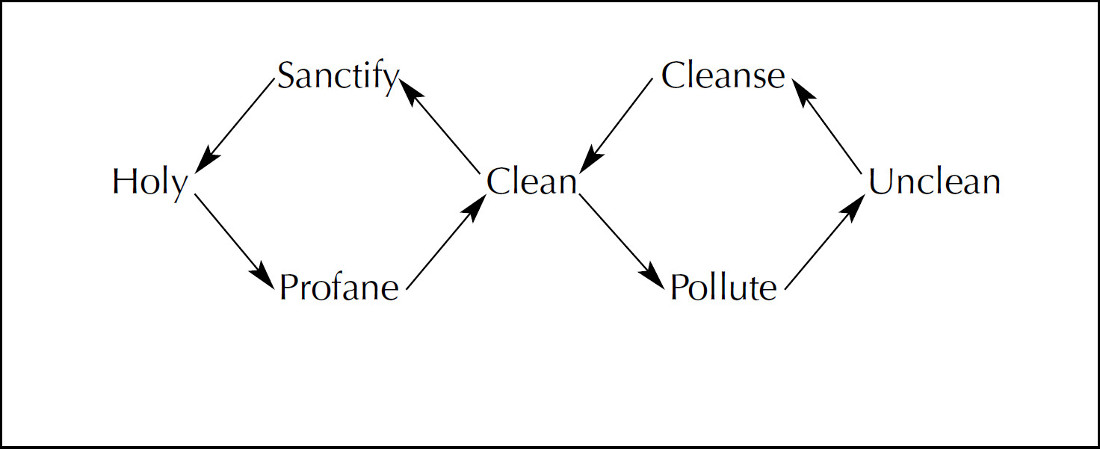
Fig. 10. Cycle of Sanctification
On the basis of Levitical law, everything in life was either holy or common for the Israelites. Those things determined common were subdivided into categories of clean and unclean. Clean things might become holy through the ritual of sanctification or unclean through the pollution of sin. Holy things could be profaned and become common or even unclean through sin. Unclean things could be cleansed and then consecrated or sanctified to be made holy through prescribed rituals.
As the central worship center for the nation of Israel, Solomon’s temple was an integral part of God’s design for maintaining order and/or restoring order in the social and religious life of his people. This was accomplished primarily in one of two ways, since the temple was the place for sacrifices (2 Chron. 2:6; 7:12) and a house of prayer (Isa. 56:7). In the next section we will examine how individual Christians and the Christian church corporately might learn how to “restore order out of chaos” in our contemporary context on the basis of the principles and practices associated with Solomon’s temple.
Contemporary Significance
Contemporary Significance
RESTORING ORDER OUT OF CHAOS. Recovering order out of chaos is still an issue in our society. You may be familiar with the expression “twenty-four-seven.” No, the numbers do not represent a new chain of convenience stores. They are not even a formula for a new household cleaner. The numerical phrase “twenty-four-seven” refers to the work schedule for many in the business world today. Whether to achieve status or remain competitive, many Americans are overworked and stressed to the point of exhaustion. Two-career families, jobs with long hours, greater responsibilities with less control, and technological advances that extend work into supposedly leisure time all contribute to the nationwide burnout.57 Given the globalization of the economy, some have expanded the formula to “twenty-four-seven-three-sixty-five” because staying in business or keeping up with the markets means there is no longer any “down time.”
The frenetic pace of American life has made all sorts of stress therapies fashionable, if not effective. Exotic remedies advertised as the answer to stress run the gamut from “A to Z,” from aroma therapy to zodiac analysis. Fantastic new products or highly specialized programs for coping with the stress of North American life are made available almost weekly. Regrettably, these ads promise more than they can deliver, and as a result the destructive consequences of our chaotic pace of life provide the sorry fodder for the daily newscasts. The broadcasters in our news media never lack for tragic stories of abuse, rape, aggravated assault, suicide, and murder caused by the venting of rage from pent-up stress. In fact, “rage” has now become part of our hyphenated vocabulary in America, be it “road-rage,” or “employee-rage,” or “classroom-rage,” or even “voter-rage.”58 Sadly, the Christian subculture has not escaped the curses that result from life spent on the “24×7 treadmill.” But the church possesses the key to unlock the shackles that bind humanity in service to the gods of time, production, and efficiency rather than to God.
The implicit and explicit biblical theology associated with Solomon’s temple provides helpful principles for restoring “order from chaos,” for recovering God’s design for “making the most of every opportunity” in these evil days (Eph. 5:16). We will examine three ways the “temple theology” of the Solomonic era might serve the church (individually and corporately) as an instrument for overturning the chaos of sin and reordering the world according to God’s ideal. (1) We will explore the relationship between the temple as “sacred space” and the importance of prayer in maintaining a vital relationship with God. (2) We will probe the idea of “sacred time” and “reset” our watches and clocks theologically speaking. (3) Finally, we will investigate how the “sacred actions” of worship help reorient us in the journey of life.
Sacred space: The daily office of prayer. The establishment of Solomon’s temple in Jerusalem brings a renewed emphasis on prayer to Israelite religious thought and life. Solomon’s prayer of dedication for the temple places great importance on prayer in maintaining Israel’s covenant relationship with God (cf. 1 Kings 8; 2 Chron. 6). Specific circumstances mentioned by Solomon providing the impetus for prayer either to maintain or to repair relationship with Yahweh include: prayers of personal supplication (2 Chron. 6:21), prayers of confession and repentance for sin (6:24, 26), petitions and intercessions concerning natural disasters and health afflictions (6:29), prayers of homage offered by the foreigner (6:32), petitions and intercessions offered during times of national emergency (e.g., war; 6:34), and prayers seeking restoration should sin cause Israel to be exiled from the land of covenant promise (6:39). Practically speaking, this made the temple a “house of prayer” for King Solomon (cf. 6:40).
Later Old Testament writers formalized this understanding of the temple as a “house of prayer for all nations,” not just for Israel (Isa. 56:7). Jesus himself recognized the temple as both his “Father’s house” (John 2:16) and a “house of prayer for all nations” when he cleared the temple of those who turned the sanctuary into a merchandise mart (Mark 11:17). Right relationship with God, whether Old or New Testament, is rooted in prayer prompted implicitly and explicitly by the revelation of God’s nature, character, and activity in history. Prayer is effective, not because of the righteousness of the suppliant (James 5:16) but because of the power possessed by the One to whom prayer is offered (cf. 5:15).
The prayers of the righteous in the Old Testament are not to be equated with the superstitious incantations and magical chants of Israel’s pagan neighbors (e.g., the prayers of the priests of Baal in 1 Kings 18:20–29). For the ancient Israelites prayer is always a personal encounter with God rooted in his divine self-revelation and covenant relationship with them as his people. Whether audible (Dan. 9:4) or silent (1 Sam. 1:13), prayer is direct communication with a responsive deity—a God in Zion who hears and answers prayers (Ps. 65:1–2). The teachings of Jesus on prayer to God as a loving Father in the Gospels confirm this Old Testament theology of prayer (cf. Matt. 6:6, 18, 30; 7:11).
Walter Leifeld is correct when he identifies the several aspects of prayer as overlapping with worship because they lead to the glory of God.59 Whether one expresses homage to God or discloses a need, both types of prayer demonstrate dependence on God and glorify him as the One who has either answered prayer in the past or has the compassion and ability to do so in the future. The distinct but related expressions of prayer may be delineated as follows:
• worship—ascribing God the glory due his name (Ps. 29:1–2)
• praise—preoccupation with who God is and what he has done (Ps. 135:1–7)
• thanksgiving—specifically acknowledging the goodness of God (Ps. 136:1)
• adoration—personal, loving worship (Ps. 73:25)
• devotion—prayer resulting in a vow (1 Sam. 1:11)
• communion—emphasizing relationship with God and two-way communication and fellowship in prayer (Ps. 5:3; 42:8; 94:19)
• confession—admitting sin and guilt individually or corporately before God, a necessary prerequisite for prayer and worship (Ezra 9:6–15; Neh. 9:1–3)
• petition or supplication—presenting personal needs, concerns, cares, complaints to God (1 Sam. 1:17; Ps. 20:5)
• intercession—petitioning for another individual or group (Ex. 32:11; 2 Sam. 12:16)
• imprecation—invoking the application of divine justice against God’s enemies in the form of a curse (Ps. 137:8)
The Old Testament mentions appointed times for prayer. Specifically, the Psalms speak of the faithful praying in the morning (Ps. 5:3), even before dawn (119:147). Elsewhere the psalmists utter prayers of lament in the morning, at noon, and in the evening (55:17). Perhaps this text served as Daniel’s inspiration for praying three times a day facing Jerusalem (Dan. 6:10). Also, it seems morning and evening prayers were common, patterned after the morning and evening sacrifices of the temple liturgy (1 Chron. 23:30; cf. 16:40). Finally, much like the apostle Paul’s injunction to “pray continually” (1 Thess. 5:17), the psalmist encouraged praying continually (Ps. 72:15; 105:4).
Several different prayer postures are mentioned in the Old Testament: standing (2 Chron. 20:5), kneeling with arms outstretched (1 Kings 8:54; note that Solomon begins his prayer in a standing position, 8:22), kneeling (Ezra 9:5), head bowed (Neh. 8:6), prostrate (Josh. 7:6), with uplifted hands (Ps. 28:2), and bowing with the face between the knees (1 Kings 18:42). As a result of Solomon’s prayer of dedication for Yahweh’s permanent sanctuary, the Temple Mount became the direction for prayer for the faithful outside Jerusalem (cf. 2 Chron. 6:20, 21, 26, 29).
Of particular interest to our study are the appointed prayer times or prayer cycles observed in Scripture. Prayer was no less important in maintaining a right relationship with God in the New Testament than it was in the Old Testament. The early church certainly understood this, so much so that prayer was one of the staples of early Christian worship (Acts 2:24). In fact, many of the Jewish Christians continued the discipline of attending daily prayers at the temple (e.g., Peter and John, Acts 3:1). During New Testament times, prayer services accompanied the morning and evening sacrificial rituals. This practice, in part, gave rise to the prayer-book tradition of morning and evening prayer.
In the fourth century, Basil of Caesarea drew up a set of monastic rules for Eastern Christianity that included eight daily appointments for prayer. Later Benedict of Nursia (ca. A.D. 530) developed a similar daily office of prayer for Western Christianity. The term daily office “refers to a variety of services of set prayers and readings that are said together through the day.”60 The daily cycle of prayer, whether in the early church or later monastic practice, was an attempt to heed the admonition of Scripture to “pray continually” (1 Thess. 5:17). Eventually a standardized observance of a daily cycle of prayer emerged in the tradition of the Christian church. The eightfold Western monastic cycle of the daily office (or liturgy of the hours), one example of this standardized prayer format, may be outlined as follows:
• vespers (at the end of the working day)
• compline (before bedtime)
• nocturns or vigils or matins (during the middle of the night)
• lauds (at daybreak)
• prime (shortly thereafter)
• terce (during the middle of the morning)
• sext (at noon)
• none (during the middle of the afternoon)
Both the prayers of the Eastern and Western monastic daily offices relied heavily on the Psalter. As Christianity gained respectability in the Constantinian world, monasticism replaced martyrdom as one means of separating true Christianity from the “christianized culture” of the Roman world. Unfortunately, monasticism began to set the tone for spiritual life and formation in the church. Most Christians were unable to devote themselves to lengthy services of communal daily prayer like the monastic orders. According to White, the people’s office of prayer in popular Christianity slipped out of sight during the medieval era, and daily prayer office became professionalized with the monks taking it over.61
Later, the idea of the daily prayer office was pared down to morning and evening prayer or rejected altogether by the Protestant Reformers. Interestingly, the Book of Common Prayer is a vestige of the morning and evening daily office, and it had the practical effect of guiding the laity in personal daily prayer as the complexities of English life (in 1545!) often prevented attendance at the communal prayer services held each day in the local churches. Given the renewed interest in church history and liturgical worship, however, the daily prayer office is finding its way back into the life of the church.62
I believe the Chronicler would approve of the observance of the daily office in the Christian church since he was accustomed to the daily cycle of temple worship. I too would advocate a return to the daily office of prayer in some form. We must concede that the logistical problems associated with the implementation of the corporate approach to the daily office by a local church on a sustained basis proves more problematic many times over in comparison to sixteenth-century England. But surprisingly, many local churches are now observing certain hours of the daily office on a weekly basis, especially the hours of vespers and compline.
Following the example of the prayer-book tradition, some kind of personal or familial adaptation of morning and evening prayers can easily be developed as one type of spiritual discipline. The special seasons of the church year also lend themselves readily to the hours of the daily office with certain modifications (e.g., some variation on lauds for the Easter Sunday sunrise service).
The call for a return to some form of the daily prayer office is not necessarily a call to monasticism, although monastic retreats are gaining in popularity in Christian circles. Neither is the corporate or personal observance of the daily office of prayer encouraged simply because “more is better” or because formality is more effective. Christian prayer is first and foremost a matter of heart and attitude, not vain repetitions (Ps. 25:4–7; cf. Matt. 6:5–6). Nor should the daily prayer office be construed as an attempt to achieve righteousness by works of human effort. The current “fashionablility” of pre-Reformation spirituality is also an insufficient reason for praying according to the daily office. Finally, praying according to the hours of the daily office should not be mistaken as some sort of badge of superspirituality.
Rather, exploring the Christian tradition of the daily office permits the Christian and the local Christian church to learn the ancient rhythm of prayer. Participation in the daily cycle of prayer hearkens back to the temple as the house of prayer and the idea that prayer is one means for recovering order out of chaos. Numerous reasons for a return to the daily office of prayer in some form may be advanced:
(1) Boers finds the daily office helpful as a “counterculture” discipline for Christians in a society “where many are formed by a weekly average of twenty-eight hours of television.”63
(2) The practice of the daily office in some form encourages Christians to pray more often and with greater regimen and organization.
(3) The daily office is another way for Christians to reconnect with the rich heritage of prayer in the Christian tradition. Praying the prayers of saints who have gone on before us deepens faith and adds to a sense of awe and wonder at the mystery of Christ and the gospel.
(4) Whether observed in a corporate or private setting, there is a certain communal aspect to the daily office because the Christian stands in solidarity with others who are praying at that same time.
(5) The daily office also has the practical effect of teaching the worshiper Scripture, since the prayers and readings of the liturgy of the hours are taken directly from the Old and New Testaments.
St. Benedict wrote of “singing Psalms in such a way that our minds are in harmony with our voices.” According to Boers, “the daily office can integrate life and prayer in just this way.”64 This kind of holistic spirituality is essential to the process of restoring God’s order in the midst of the chaos of our fallen world.
Sacred time: The church year. Solomon’s temple was a lavish reminder that God, through the Mosaic law, ordered Hebrew worship according to set times and seasons. In fact, Solomon’s letter to Hiram king of Tyre, requesting building materials and a master builder to supervise the construction project, mentions the four cycles of time appointed for Hebrew worship (2:4). Israelite personal and corporate worship was organized around a daily sequence (e.g., the morning and evening sacrifices, Ex. 29:39), a weekly sequence (e.g., the Sabbath, Ex. 20:8–11), a monthly sequence (e.g., the New Moon, Num. 10:10), and an annual sequence (e.g., the pilgrimage festivals, Ex. 23:14–19). Since the early church was comprised largely of Jewish Christians, these time cycles of Jewish worship naturally became a part of the New Testament record of Christian worship (e.g., Acts 2:46; 3:1; 13:14; 20:7).
Over the course of several centuries the Christian church has also ordered worship according to set cycles of time by developing a “church year” or liturgical calendar. The expression church year refers to the regular sequence of cycles, seasons, festivals, and fasts observed in the calendar of the Christian church. The succession of events is ordered independently from the civil calendar, although the church-year dates are reckoned according to the Julian calendar for the sake of convenience.65 The beginnings of a liturgical calendar in the Christian church can be traced to the third century A.D. The church year was largely patterned after the Jewish religious calendar, with the key events of Jesus Christ’s life and redemptive ministry replacing the Exodus and the Passover of Old Testament salvation history. Eventually the church year grew by accretion to include a complex rotation of church seasons and festivals.
The purpose of the church year is to sanctify time within the yearly experience of church life. The celebration of Christ’s life, teaching, death, resurrection, ascension, and sending of the Holy Spirit is intended to bring spiritual renewal to the church through “a vibrant reliving of the paschal mysteries.”66 Due to abuses that crept into the observance of the church year during the medieval period, the Reformers abandoned the practice. Today, the idea of a church year is foreign to many Protestant worshipers.
Naturally, abuse remains a potential in the celebration of the church year. The most common problem associated with the liturgical calendar is the dichotomy it invites between “sacred” and “secular” time. For example, the periods of time between the festival cycles in the church year are usually referred to as “ordinary time” or nonfestive time. These intervals are not considered special, nor do they demand the same intensity of spiritual participation. Here Jacques Ellul has addressed the gist of the problem: “Very quickly some days of the week … come to rank as sacred”67—and soon sacred-versus-secular distinctions blur the perception of time.
The Old Testament, however, knows no such distinction between sacred and secular time. All time is God’s gift to humanity (Ps. 31:15; 139:16; Isa. 60:22), and each season or cycle of time has its appropriate place within the divinely ordered sphere of human experience in time (Eccl. 3:1–9; Song 2:12; Hos. 10:12). For the ancient Israelite, in one sense each day was a special or sacred day because it could be used to fulfill creation’s purpose of worshiping and praising God (Ps. 34:11; 118:24; Isa. 43:7).
The Hebrew religious calendar did not mark special festival days and seasons in order to separate them as sacred from ordinary or nonfestive time. Rather, the Hebrew liturgical year marked all time in the annual cycle as sacred, with the special festival days and seasons celebrated as suprafestive times. The annual cycle of festivals in that religious calendar was a type of “time insurance,” guaranteeing the daily celebration of all time as God’s gift and the arena of divine activity.
Of special interest to this study is the idea of “festival time.” The divine mandate for the seasonal festivals is found in Leviticus 23 and 25. This Mosaic legislation actually constitutes ancient Israel’s religious calendar, bringing time under the domain of God’s rule. The major festivals appointed for celebration by special worship ceremonies included the Sabbath, the Passover and Feast of Unleavened Bread, the Offering of Firstfruits, the Festival of Weeks (or Pentecost), the Festival of Trumpets (or New Year’s Day), the Day of Atonement, the Festival of Booths (or Tabernacles), Sabbath Year, and the Year of Jubilee (see Appendix B: The Hebrew Religious Calendar).
The order of major festival times observed in the Israelite religious calendar reflects the seasonal rhythms of nature, since most of the ancient calendars were originally based on the agricultural cycles of planting and harvesting. Unlike their Canaanite counterparts, however, the Hebrew religious festivals and appointed sacred times “have been historicized—that is, they have received their content and meaning from the history of redemption.”68 In other words, the Hebrew religious calendar was not bound inextricably with the annual cycle of the agricultural seasons. Instead, it was linked to redemptive events in Israelite history, especially those connected with the Exodus.
The essential purpose of this religious calendar for ancient Israel was “a dramatic replay of [redemptive] history, done every year to bring home its meaning for the present.”69 It was designed both to instill and to affirm faith in God within the covenant community. This annual cycle reminded all Israel that it was the Lord God who delivered them from Egypt and established his covenant with them (Lev. 23:43).
Dyrness has identified additional purposes for the seasons of the Hebrew religious calendar:
• the annual reminder that all time belongs to God and all good gifts come from him
• the practice of obedience to God as Creator and Redeemer by acknowledging his good gifts in the rhythm of nature and the cycle of redemptive history
• the recognition of God’s dominion over nature and the demonstration (by reenactment) that God worked within time and history by means of specific events and the natural process to reveal his goodness and to deliver his people
• the expression of confidence in God that Israel’s life possessed a divine order, direction, and purpose
• the assurance that God would continue to show his goodness and deliver his people in the future70
The common denominator between the Christian church year and the Hebrew religious calendar is the ordering of time according to a redemptive schema. Here is yet another way in which “temple theology” informs Christian theology on the matter of restoring “order out of chaos.” This is especially true for the annual cycle of “festival time” in the two liturgical calendars, because the “feast” conquers chaos (the disorder and upheaval of the fallen world) and recovers kosmos (the divine order established in creation). There is a real sense in which the festival cycle of time overturns the world and recreates it according to the model of God’s original creation. There are several theological principles associated with festival time that contribute to this “re-creating” of the world order:
• celebrating God’s redemptive intervention in human history, so that the “feast” is a conscious rejection of all that is negative, an act of rebellion against the perverse and destructive power of evil and against death and the evil one
• emphasizing rejoicing and sharing and thus asserting the dignity and goodness of life bestowed on humanity as God’s gift and the value of the community of the faithful in the journey of life
• publicly affirming a higher order—God, good, and meaning and purpose in life as a result of God’s redemptive acts in history through Jesus Christ, so that festival time is a bold witness of hope to a hopeless world that the divine order will be restored and God’s righteousness will one day prevail
This being the case, I can only offer an “Amen!” to Robert Webber’s prophetic plea to the church (esp. the free-church movement in Protestantism) to find a place for “commemorative time” by observing the Christian year in some fashion. Webber’s apologetic is threefold: (1) the historical dimension of remaining faithful to the church’s long tradition of observing the Christian year; (2) the theological dimension of participating in commemorative time so that the power of the Christ-event is remembered, proclaimed, enacted, and celebrated in the worshiping community; and (3) the evangelistic dimension of governing time in the worshiping community by the birth, life, death, and resurrection of Jesus Christ in opposition to the secular community and its practice of observing time.71
I would simply add that experiencing commemorative time by observance of the church year brings perspective and synthesis to “clock time” (i.e., chronos) through the celebration of “event time” (i.e., kairos, i.e., moments of time and special occasions). What better way to restore order from chaos than to cease “serving time” in the enemy’s domain and to start “celebrating time” in God’s domain?
Sacred actions: The pilgrimage. One of the theological emphases derived from the idea of the temple as “sacred space” was that of the “pilgrimage.” In the Bridging Contexts section, we defined pilgrimage as “a journey made to a sacred place as an act of devotion.” The practice of journeying to sacred places by God’s faithful people was not limited to the Hebrew religion of Old Testament times. By the second century A.D. Christian pilgrimages to the Holy Land were popular. Retracing Jesus’ movements during his last week of life on earth (his Passion Week) by walking the Via Dolorosa in Jerusalem became especially significant. Later, travels to the graves of martyrs and saints, sites where miracles had been performed, and other holy cities (e.g., Rome, Canterbury) were added to the Christian tradition of pilgrimages.
The church encouraged pilgrimages as a means of penance, since travel in the ancient world was undertaken with considerable risk of hardship and personal sacrifice. The significance of the pilgrimage for Christianity was (unfortunately) demonstrated militarily with the medieval Crusades, ordered by the church to make the Holy Land free and safe for pilgrim travels.
Despite the views of prominent critics over the centuries of church history (e.g., John Chrysostom, Jerome [who made a pilgrimage to Jerusalem, by the way], and Erasmus), pilgrimages to the Holy Land and elsewhere remained an important feature of personal spirituality in many Christian traditions. Alternatives to these treks to specific sacred sites of Christianity have gained in popularity recently. These mock pilgrimages may include the re-creation of the Bethlehem advent scene or the stations of the Way of the Cross during the Easter season. The more liturgical Christian traditions view the worship processional as a reenactment of the pilgrimage to the temple on Mount Zion, while some Christians understand their weekly journey to their local church as a type of pilgrimage. In other instances, travels to local church reunions, anniversaries, baby dedications, or baptisms, or revisiting the site of one’s conversion or baptism prompts the same spiritual reflection and renewal associated with the more traditional pilgrimage experience.
More important to the New Testament writers is the equation of the Christian life with the pilgrimage of the Hebrew tradition. Even as Jacob considered his life a “sojourn” of 130 years (Gen. 47:9), so the life of faith is a pilgrimage to the heavenly country (Heb. 11:13–16). For this reason, the New Testament refers to Christians as “aliens and strangers” (1 Peter 2:11), whose citizenship is in heaven (Phil. 3:20). The psalmist had a similar understanding of the life of faith when he blessed all who set their hearts on the pilgrimage—literally in the celebration of the Hebrew festivals and metaphorically by embracing the hardships of daily living in the strength God provides (Ps. 84:5). Likewise, the Christian’s earthly life is but a long pilgrimage to that city whose maker and architect is God himself (Heb. 11:10).
Thus, Paul compares this spiritual pilgrimage of the Christian life to that of a soldier on a mission, who refuses to entangle himself in civilian affairs (2 Tim. 2:3–4). As a pilgrim or alien in this life, the Christian is called to be separated from the corruption of the world in order to live a righteous life before the ungodly to the glory of God (1 Peter 2:12).
In light of our study of Solomon’s temple, Paul’s rhetorical question to the Corinthians takes on new meaning: “Or didn’t you realize that your body is a sacred place, the place of the Holy Spirit?” (1 Cor. 6:19a, The Message). This is especially true when we recognize that Paul’s term for “temple” (Gk. naos) refers to the niche where the idol was displayed in the pagan Greek temples. Thus, Paul is essentially telling the Corinthians (and the contemporary reader of his letter) that the Christian is the “most holy place” in the “sacred space” of the temple sanctuary. For this reason, he asks:
Don’t you see that you can’t live however you please, squandering what God paid such a high price for? The physical part of you is not some piece of property that belongs to the spiritual part of you. God owns the whole works. So let people see God in and through your body. (1 Cor. 6:19b–20, The Message)
Original Meaning
Solomon’s Kingship (1:1–17)
THE CHRONICLER RETURNS to the synoptic parallel found in 1 Kings as the historical source for retelling the story of Solomon’s kingship after the account of David’s preparations for the building of the temple. Specifically, the writer draws from three texts in presenting a prologue of sorts to Solomon’s reign:
2 Chron. 1:2–13a = 1 Kings 3:4–15
2 Chron. 1:13b = 1 Kings 4:1
2 Chron. 1:14–17 = 1 Kings 10:26–29
The Chronicler’s introduction, however, omits the palace intrigue found in 1 Kings 1–2. He undoubtedly assumes this background knowledge and commences his narrative with the king’s petition to God for the gift of wisdom (2 Chron. 1:10).
Solomon’s request for wisdom serves as a foil for the opening chapter and provides the framework for the entire literary unit (chs. 1–9). Instead of “wealth, riches or honor,” Solomon entreats Yahweh for wisdom and knowledge to govern God’s people effectively (1:11). Although he does not ask for these material blessings, God chooses to grant them to Solomon as a reward for his righteous prayer (1:12). The report of Solomon’s wealth found in 1 Kings 10:26–29 are placed as bookends encasing the story of David’s successor and the building of the Jerusalem temple (cf. 2 Chron. 1:14–17; 9:25–28). The emphasis of the opening chapter on wisdom and wealth as divine gifts mean they do not die with King Solomon. This is a cue to the postexilic Hebrew community that they too might acquire similar gifts from God through prayer.
Solomon’s Worship (1:1–6)
Solomon’s worship (1:1–6). It is important to keep in mind that 1–2 Chronicles is one book in the Hebrew Bible. This means links to preceding material are important to the original audience, who lack the benefit of “book, chapter, and verse.” The Chronicler provides those narrative connectors as the story shifts from the rule of King David to King Solomon by means of intertextuality (i.e., the demonstration of a literary interdependence between texts or documents through the repetition of words, phrases, and ideas). For instance, the reference to “all Israel” (1:2) hearkens back to the unity of God’s people under King David as Israel’s divinely appointed leader (cf. 1 Chron. 28:4; 29:21, 23, 25).
Solomon’s assembly at Gibeon (1:3) is clearly patterned after the account of David’s plans to relocate the ark of the covenant in Jerusalem (including references to the same Hebrew officials, worship by means of the bronze altar and the Tent of Meeting, and the repetition of the verb “to inquire of” the Lord, cf. 1 Chron. 13:1–6). The word picture describing Israel as “a people who are as numerous as the dust of the earth” (2 Chron. 1:9) echoes promises made to the patriarchs and serves to bridge the history of Israel’s monarchy with the story of those tribal ancestors (cf. Gen. 13:16; 28:14).
The Chronicler opens and closes his “photo album” of Solomon’s reign with a similar “snapshot”: the king firmly in control of the empire he has inherited from his father, David (1:1; cf. 9:26). The expression “established himself firmly” (Hithpael of ḥzq) may be an oblique reference to the steps taken by Solomon to secure the throne after his accession (including “showing kindness” to political assets and “striking down” political liabilities, cf. 1 Kings 2:5–46). The introductory verse also affirms Solomon as God’s choice for governing his people. Much like his father, God is “with” Solomon (2 Chron. 1:1b; cf. 1 Chron. 11:9; 17:8).
In a fashion similar to both David and Joshua, God makes King Solomon “exceedingly great” (1:1c [gdl]; cf. 1 Chron. 29:25; Josh. 3:7; 4:14). Implicitly, Solomon’s greatness is associated with the Jerusalem temple he will erect. Just as David desired to build a house for God and God instead “built” David’s dynasty, so too Solomon’s name is “exalted” in the process of establishing a sanctuary to exalt the name of Yahweh (cf. 2 Chron. 6:5, 7, 32–34). By more than coincidence, the Queen of Sheba confirms Solomon’s divine appointment in her praise of the God of Israel at the conclusion of the Chronicler’s review of Solomon’s kingship (9:8).
Solomon begins his rule over Israel with an act of public worship (1:1–6). In terms of biblical chronology, Solomon’s accession to David’s throne occurs around 970 B.C. The prayer and ritual sacrifice offered at Gibeon is symbolic of the new king’s primary task, as the acts of piety show Solomon to be a fitting candidate for building Yahweh’s temple. The worshipers convene at Gibeon (or Gibeah of God), a town with an adjacent worship center some five miles northwest of Jerusalem (1:3a). The Chronicler reminds his audience (and us as later readers of his history) of the importance of Gibeon, a flashback to the account of David’s transfer of the ark of the covenant to Jerusalem (1:3–5; cf. 1 Chron. 13–17). After a temporary shrine for the ark was established in Jerusalem, David appointed a group of priests and Levites to minister there before the Lord (1 Chron. 16:4–6). But the other priests and Levites remained stationed at Gibeon because “the tabernacle of the LORD [was located] at the high place” there (16:39).
The draw of Gibeon for the new king is more than simply its reputation as the site of the Mosaic portable shrine or “God’s Tent of Meeting” and the original altar associated with Israelite sacrificial ritual. The pilgrimage to Gibeon is a return to first things for Solomon, a reconnection with the ancient Hebrew religious traditions. This report is in keeping with the Chronicler’s interest in the theological principles informing Solomon’s reign.
One important connection to the past is the recognition that the construction of shrines or sanctuaries for Yahweh require gifts of wisdom and knowledge, such as those bestowed on the tabernacle artisans like Bezalel (1:5; cf. Ex. 31:3). Solomon’s petition for wisdom and knowledge (2 Chron. 1:10) is rooted in his worship experience before Bezalel’s bronze altar (actually acacia wood overlaid with bronze; cf. Ex. 38:1–2). It is clear that in identifying Solomon as a “second Bezalel,” the Chronicler understands the greatest demonstration of his wisdom to be the construction of the temple itself.
A second, more important touch point with the past is Solomon’s adherence to the law of Moses as represented by the sacrificial ritual and symbolized in the institution of the Tent of Meeting (1:6). Solomon’s worship at Gibeon is public testimony to the fact that the soon-to-be-built Jerusalem temple will carry on this ancient Mosaic tradition. The king’s presentation of burnt offerings on the altar in Gibeon stands as a witness to his intentions to keep his father’s charge to obey the laws of the Lord and thereby preserve the worship of his ancestors (cf. 1 Chron. 28:7–8). Interestingly, when God initiates a new phase of his redemptive plan for fallen creation, he sees to it that it is firmly grounded in the “ancient paths” of his revelation (Jer. 6:16).
The Chronicler’s version of Solomon’s worship at the high place of Gibeon (1:2–6) differs from that of the earlier parallel found in 1 Kings 3:4–5. Not only does Chronicles expand the report (from two to five verses), but the later version portrays the “high place” in a more favorable light than does Kings. The historian of 1–2 Kings takes a more pejorative view of high places theologically because they are associated with the false worship practices of the native Canaanites (cf. 1 Kings 3:3; 11:7). No doubt things have changed by the time of the Chronicler, which helps explain a differing theological perspective (idol worship at the high places is no longer a problem in postexilic Judah). Moreover, the Chronicler regards the high place of Gibeon as a legitimate worship center in its own right because the Tent of Meeting is located there (note 1 Kings 3:4, which identifies Gibeon as the “most important” high place for that reason).
Another contrast between the two narratives is the way in which Kings reports the event as if this were a private act of piety on Solomon’s part (1 Kings 3:4, “the king went to Gibeon”). Chronicles, however, records the event as an act of public worship by the king witnessed by a national assembly (2 Chron. 1:2–3). Clearly nothing in the Kings narrative precludes harmonizing the two reports. The Kings’ historian tended to focus his theological review on the character and deeds of the royal figure whereas the Chronicler’s concern tends toward observing the relationship of “all Israel” to the royal figure.
Both sources agree on the purpose of Solomon’s visit to Gibeon—the offering of ritual sacrifices as an act of worship to God (1:6; cf. 1 Kings 3:4). Chronicles includes the detail that “Solomon and the assembly inquired of him [i.e., the LORD] there” (2 Chron. 1:5). The verb “to inquire of [drš; lit., to seek] the LORD” is an important theme in Chronicles. It denotes an act of faith, and the goal or aim of this spiritual quest is generally to seek God’s direction and help at a crucial moment in one’s life (or even confirmation of an earlier divine word of instruction).5
The propensity “to inquire” of God is one measure of the faithfulness of the leaders of Israel (e.g., 1 Chron. 10:14; 2 Chron. 22:9). Curiously (and sadly) Selman observes that the term is not used of Solomon again, despite his exhortation in the prayer of dedication for the temple (2 Chron. 7:14).6 Isaiah’s admonition is still pertinent for the Chronicler’s audience (and the church today)—“Seek [drš] the LORD while he may be found; call on him while he is near” (Isa. 55:6).
Solomon’s Wisdom (1:7–13)
Solomon’s wisdom (1:7–13). The story of Solomon’s request for wisdom is more abbreviated than in 1 Kings 3:5–15. The “dream report” or “dream epiphany” is a new narrative subgenre in the Chronicler’s history, although Chronicles itself omits the fact that God’s appearance to Solomon occurs in a dream (cf. 1 Kings 3:5). The Chronicler seems to emphasize Solomon’s recognition of the theocratic ideal, that he as the Davidic king is God’s vice-regent because the people of Israel are “God’s people” (2 Chron. 1:10). This is the gist of the Chronicler’s message for his own audience. Israel is still God’s people after the return from the Exile, and God is still the de facto sovereign of Israel. The Chronicler reminds his generation that God is enthroned in Israel through the worship of his people and that the Davidic kingdom (as the precursor of the kingdom of God) will be established through the prayers of the righteous.
Solomon seeks God by means of ritual sacrifice (1:6) and prayer (1:8–10). Interestingly, in response to Solomon’s worship at Gibeon, God inquires of Solomon by asking him to request anything he wants—a blank check of sorts signed by God himself (1:7). This divine invitation prompts Solomon’s petition for wisdom (1:10). We must realize that Solomon is not approaching God as if he were a genie in a bottle or a cosmic slot machine. The righteous are free to petition God for the desires of their hearts, assuming this is done in a posture of faith and not of doubt or selfish motives (Ps. 37:3–4; Mal. 3:10; cf. Deut. 6:16). The New Testament both expands and clarifies this invitation to the righteous to ask anything of God because Jesus expressly teaches that the faithful may ask, and seek, and knock—and it will be given, they will find, it will be opened to them (Matt. 7:7–8; John 15:7).
Here Solomon is a model of how the righteous should pray because he first inquires or seeks God (implying he approaches God in good faith, 1:5). He then couches his prayer in the history of God’s “great kindness” to David (1:8), acknowledging that the Lord has indeed proven himself as a good God (cf. Ps. 25:7–8; 31:19; 34:8). Next, Solomon voices his humility and dependence on God in his rhetorical question, “Who is able to govern this great people of yours?” (2 Chron. 1:10). Beyond this, Solomon seeks spiritual blessing over material blessing in asking God for wisdom and knowledge to rule instead of personal wealth and riches (1:10–11).
Solomon responds to God’s invitation by first acknowledging the covenant promise made to David (1:8–9; cf. 1 Chron. 17). The repetition of David’s name indicates that he intends to continue that legacy. Solomon then rehearses God’s faithfulness in fulfilling covenant promises to Abraham and Jacob in making Israel “a people who are as numerous as the dust of the earth” (2 Chron. 1:9; cf. Gen. 13:16; 28:14). This recitation of Yahweh’s “covenant history” with Israel is a tacit declaration by Solomon that God indeed keeps his promises.
In his petition to “confirm” the promises made to his father (1:9), Solomon hearkens back to David’s prayer and, like his father, enjoins God to “do as you promised” (1 Chron. 17:23–24). Here we must understand that Solomon is not placing demands on God in his arrogance as David’s successor. Rather, he is simply asking God to be consistent with his character as one who “remembers his covenant forever” (cf. Ps. 111:5). With his request for “wisdom and knowledge” (2 Chron. 1:10), Solomon looks forward to the fulfillment of God’s promise to David since it is tied to the completion of the temple (6:17).
The words “wisdom” and “knowledge” (1:10) have replaced the more expansive “a discerning heart to govern your people and to distinguish between right and wrong” found in 1 Kings 3:9. These terms are used in combination elsewhere only of the academic training of Daniel and his three companions (Dan. 1:4, 17). These two words are essentially an equivalent expression of the phrases found in the Kings’ parallel since “wisdom” (ḥokmah) connotes both spiritual insight and moral discernment, and “knowledge” (maddaʿ ) relates to intellectual capacities. The Chronicler’s use of a postexilic term for “knowledge” may be another example of his updating the earlier source with language that has greater currency for his audience.
Both Kings and Chronicles agree on the purpose of Solomon’s request: able leadership “to govern” (špṭ; lit., “judge”) the people of Israel (1:10; cf. 1 Kings 3:9). Solomon asks for wisdom and knowledge and receives wealth, riches, and honor as a bonus (2 Chron. 1:11–12). Selman cites God’s gracious endowment of gifts on Solomon as an Old Testament example of God doing “immeasurably more than all we ask or imagine” (Eph. 3:20).7
After worshiping in Gibeon, Solomon returns to Jerusalem (1:13). The Chronicler omits Solomon’s worship before the ark of the covenant in Jerusalem and the feast he prepares for the royal court (see 1 Kings 3:15). Presumably, the writer desires to associate the gift of Solomon’s wisdom directly with the construction of the Jerusalem temple. The summary statement “and he reigned over Israel” (2 Chron. 1:13b) has its parallel in 1 Kings 4:1 and reconnects the Gibeon experience with Solomon’s efforts to establish himself as king in Israel. Clearly the Chronicler wants his audience to understand a cause-and-effect relationship between Solomon’s worship of God and his “firm rule” of Israel.
Solomon’s Wealth (1:14–17)
Solomon’s wealth (1:14–17). The third defining characteristic of King Solomon’s reign is his accumulation of unprecedented riches. The report of his wealth has its source in 1 Kings 10:26–29. As previously noted, this passage is repeated at the beginning and the end of the narrative summarizing Solomon’s kingship and thus depicts the king as the epitome of piety, wisdom, and riches (cf. 2 Chron. 9:25, 27–28). Apparently the Chronicler’s rationale for framing the story of Solomon with the description of the staggering wealth possessed by the king is to demonstrate God’s faithfulness in fulfilling his promise cited in 1:12. Implicit in the reference to the size of Solomon’s “bank account” is the idea of God’s favor resting on a faithful king, since divine blessing results from obedience to the stipulations of the Mosaic covenant. In this way the Chronicler affirms God’s “adoption” of the Davidic dynasty as “his son” (cf. 1 Chron. 17:13).
The Chronicler’s citation of the Kings’ parallel reveals a few changes from his source. For example, Chronicles adds “gold” (zahab) in 1:15 to complete the word pair with “silver” (kesep, although “gold” is found in the LXX and may suggest a different source behind the Chronicler’s work). Here the literary device of hyperbole conveys the idea that these precious metals are as common as the stones littering the landscape of Palestine and the imported cedar lumber is as ordinary as the ubiquitous sycamore-fig tree indigenous to the region.
The threefold measure of Solomon’s wealth includes “military hardware” (1:14), precious metals (1:15), and profits from international trade (1:16, of which horses and chariots are but one example). Solomon’s merchants broker a lucrative import-export trade in chariots and chariot horses between the Egyptians, Hittites, and Arameans (1:16–17). It seems likely that Kue (1:16) denotes a region of Asia Minor, suggesting Solomon as the “middle man” for the trading of horses from Asia Minor for chariots from Egypt.8
The reference to chariots and horses (1:14) signals a new era in Israelite military history in that the chariot is now among the weapons of the Hebrew arsenal. (Note that prior to the reign of Solomon Israel’s practice was to hamstring captured chariot horses and burn the chariots, indicating the Hebrews apparently possessed no “chariot technology”; cf. Josh. 11:9; 2 Sam. 8:4 = 1 Chron. 18:4. Although not discussed by the Chronicler, this would suggest David complied with the directive of Deut. 17:16, prohibiting the acquisition of great numbers of horses for military purposes, whereas Solomon was in violation of the Mosaic command.)9
Toward Bridging Contexts
Toward bridging contexts. King Solomon’s construction and dedication of the Jerusalem temple highlight several important theological continuities between the Old and New Testaments: the appropriate understanding God’s holiness and the liturgical use of “sacred space,” the role of sacred space in mediating God’s immanence and transcendence, the centrality of prayer in worship, the significance of “pilgrimage” in the life of faith, the relationship between the sacred place and religious instruction, and the idea that sacred space (and worship) brings order out of chaos. Second Chronicles 1, reporting Solomon’s prayer for the gift of wisdom, points toward the contemporary significance of the larger literary unit (chs. 1–9) by calling attention to the act of prayer, to the Jerusalem temple as the house of prayer, and to God who hears and answers the prayers of his people.
Construction of the Temple (2:1–5:1)
Bridging Contexts
IN THE LAST CHAPTER we learned that one of the Chronicler’s concerns was to demonstrate the continuity between the reigns of King David and King Solomon. His purpose was not to celebrate human achievement in the building of the Jerusalem temple. Rather, he sought to glorify God by accenting both divine sovereignty and divine faithfulness in fulfilling promises made to David (cf. 1 Chron. 17:10–12). This was an important reminder to a community that only a generation or two earlier had responded to Yahweh’s prophets with skepticism and contempt (cf. Mal. 1:1; 3:13–14). Yet, the more cynical living in postexilic Jerusalem might be less than impressed with this rehearsal of united kingdom history—that was then. The more pertinent question for the Chronicler’s audience may have been one along the lines of “what about God’s faithfulness to Israel—now?”
For this reason, the Chronicler is keen to display the theological continuity between David and Solomon and his own time. It is one thing for God to prove himself faithful to the ancestors of a bygone era, but quite another for him to make good on “Davidic covenant” and “new covenant” promises that at best lay dormant in the rubble of prophetic rhetoric or at worst were rendered null and void by the Babylonian exile. Surely God appeared to David and Solomon. But the Chronicler’s challenge is to illustrate that God’s faithfulness spans the intervening five centuries from the “golden age” of Israel to his own “tarnished” era. Yet, in the second temple, God has accomplished that very feat!
The historical transition from the first temple to the second temple provides numerous theological touchstones for the Chronicler. Three specific examples will be examined: the idea of sacred space, the polarity of divine immanence and divine transcendence, and the ancient Near Eastern motif of restoring order out of chaos by means of temple building. We must not lose sight of the fact that the Chronicler is both a historian and a preacher. This means Chronicles is both report and sermon. There is virtue in retelling the history of Israelite kingship for the Chronicler primarily as a “historian” rather than a “preacher.” This permits him to accomplish his agenda as a “meddling preacher” much more subtly by simply describing selectively the “facts” about Israel’s past in his effort to instruct, exhort, and admonish postexilic Judah. Given the emphasis on “story” and narrative theology in postmodern thought, we do well to learn a lesson from the Chronicler with respect to effective pulpit communication in the twenty-first century.
Sacred space. The story of Moses at the burning bush near Horeb, the mountain of God, is well known (Ex. 3:1–6). God himself visited this place in the form of the angel of the Lord, and because of Yahweh’s holy presence Moses was instructed to remove his sandals and to keep his distance. Terrified, Moses tried to hide his face from God—not an uncommon response to the divine presence of the Almighty (even the seraphs hid their face in God’s presence, Isa. 6:2). The story of Moses’ close encounter of the first kind with the God of his ancestors introduces us to the idea of “sacred space” in the Old Testament.
The theological concept of sacred space was not peculiar to the Hebrews in the ancient world. The Canaanites and other people groups also worshiped their deities at particular holy sites (Num. 21:28; 1 Kings 11:5–8). These sacrosanct locations were often associated with mountainous or elevated regions because the gods were believed to gather and hold sessions on the summit of the great mountain of assembly. By analogy, then, the Canaanite shrines were situated in the high places, above ordinary life and nearer the dwelling of the gods. The Chronicler’s retelling of the construction of Solomon’s temple, built on a “high place” (Mount Zion), gives us pause to consider the ancient Hebrew understanding of “sacred space.”
As the dramatic story of salvation history unfolds in the Old Testament, God at times chose to make himself known in special ways to those who seek him. Since human beings are finite, God accommodates this human limitation by disclosing features of his divine character and aspects of his divine will for humanity at specific geographical locations. Naturally, the creation story in Genesis offers a glimpse of this idealized relationship between the Creator and his creatures in their direct communication in the Garden of Eden (Gen. 3:8).
Sadly, those first humans doubted God’s goodness and succumbed to the tempter (Gen. 3:1–13). God’s judgment of their disobedience included curses making life more difficult and banishment from the Garden of Eden—the very presence of God (3:14–24). Yet in his mercy, God opted to overcome the sin barrier and restore the fractured relationship with humanity by occasionally revealing himself in a visible and/or auditory manner to his fallen creatures.
Such a divine manifestation initiated by God is called a theophany. These revelatory events took on a variety of forms, such as a voice (Gen. 4:9; 6:13), a dream (15:12), a flame in a bush (Ex. 3:2–6), the lightning and thunder on Mount Sinai (19:18–20), the pillar of cloud and fire in the desert wandering (40:34–38), and even the angel of the Lord in human form (Judg. 13:8–20). Typically, the actual physical and external details of these divine manifestations are somewhat obscure because the emphasis is on the person and character of God and his message to the ones who experience the visitation (e.g., Gen. 12:1–3).
The locations associated with the theophany were usually identified with a landmark denoting them as a sacred site because of God’s manifestation there. For example, altars built for worship at the places where God appeared served as landmarks (Gen. 12:8; 22:9). Other times stone pillars and stelae, or engraved standing stones, were erected to commemorate a place of divine revelation (e.g., Jacob’s stone pillar at Bethel, Gen. 35:14; the cairn of twelve stones at Gilgal, Josh 4:1–9; the plastered stela of the Ebal ceremony, Josh. 8:32). In some cases natural geographical features functioned as the landmark signifying the sacred site, as in the case of the oak trees at Shechem and Mamre (near Hebron, Gen. 12:6; 18:1).
The purpose of these landmarks designating a particular geographical location as sacred or holy was threefold. (1) The establishment of a permanent marker at the place of divine visitation served as both a worship response to God and a tangible witness confirming the theophany for the recipient. (2) Marking the site provided a geographical point of reference permitting a later return or pilgrimage to the place of divine revelation. (3) The landmark often became a teaching memorial by which the Israelites instructed successive generations in the knowledge of Yahweh’s covenant (e.g., Ex. 3:12; Josh. 4:20–24).
The most visibly dramatic and time-sustained theophany was the Israelite experience at Mount Sinai after the exodus from Egypt (Ex. 19–24). After the covenant ceremony enacted there, Mount Sinai (or Mount Horeb) became revered as the holy of mountain of God (19:9–25). This sacred place was associated with the awesome presence of God, seismic disturbances, and covenant lawgiving. Later, the Old Testament venerates the Lord God as the “One of Sinai” (Ps. 68:8) and commemorates the mountain site as the place where the earth shook during God’s initial visitation to Israel after the Exodus (Deut. 33:2).
The divine revelation delivered at Mount Sinai also included the provision of a permanent holy place or sacred space within the camp of the Israelites (Ex. 25–40). The tabernacle or Tent of Meeting was designed to be the very precinct where God would symbolically live with his people (25:8). His holy presence was associated specifically with the ark of the covenant (37:1–9). The cloud of glory and pillar of fire were visible symbols representing Yahweh’s sacred presence among his people (40:34–38). Since the tabernacle and the ark of the covenant were portable, the sacred place of the Lord’s presence could travel with the Hebrews on their desert trek to the land of covenant promise—Canaan.
Later divine revelation given at the covenant-renewal ceremony in Moab prior to the conquest of Canaan indicated that the sacred place of divine presence would not always be mobile. God announced clearly through Moses that once the Israelites possessed the land of the promise, he would choose a place where his Name would be permanently established in the midst of his people (Deut. 12:5, 11, 21). The sacred space associated with this future site was to be the place of worship for all the tribes of Israel. Until such time as the permanent location for Yahweh’s name had been secured, the travels of the tabernacle eventually gave sacred-space status to several sites: Mount Ebal and Mount Gerezim (Deut. 27:1–14), Shechem (Josh. 24:1), Shiloh (Judg. 18:31), and Gibeon (1 Chron. 16:39).
Finally, as we learn from the Chronicler’s retelling of David’s kingship, that permanent site for establishing the sacred place for Yahweh’s name was the threshing floor of Araunah the Jebusite (1 Chron. 21:18–26; cf. 2 Sam. 24:18–25). In keeping with the custom of erecting a landmark at the site of a theophany, an altar was built to respond to the visitation of the angel of the Lord (1 Chron. 21:18–19, 25–26). Fittingly, the characteristic of God revealed at the threshing floor became the hallmark of Solomon’s temple—the abode of Yahweh, who in mercy forgives sin. According to Allen, the theology of the temple is a “pastoral theology, for it comes to where people so often are and compassionately points the way back from failure.”47 The divine character trait portrayed in Solomon’s temple is that of God who takes sinners back and restores them.
The implications of the idea of sacred space for Hebrew worship may be as numerous as the list of holy sites that emerge from Old Testament religious history. Given the Chronicler’s attention to certain details in recounting the festival worship at Solomon’s temple, however, it seems that at least these five theological emphases constitute both instruction and exhortation to his own audience on the matter of “sacred space.”
(1) Inherent in the idea of sacred space is the reality of God’s holiness. Even as the visitation or manifestation of God to the righteous sanctified a particular location as sacred or holy, so too the worshiper was obligated to sanctify himself or herself in order to enter the presence of God. In some cases this preparation included physical activity (e.g., ritual washing, changing garments, animal sacrifice; cf. Ex. 19:9–16). But in every case this preparation was spiritual, hence the entrance psalms admonish that only those who have a pure heart (Ps. 24:3–6) and a blameless lifestyle (15:1–5) may stand in the sacred place. The Chronicler knows that right worship demands right preparation. Little has changed in the new covenant, as we are warned that without “holiness no one will see the Lord” (Heb. 12:14).
(2) The experience of the divine presence in time and space made pilgrimage a part of Israel’s religious life from the beginning, attested by the patriarchal journeys to holy sites like Bethel (Gen. 12:8; 31:13; 35:1, 8). A pilgrimage is defined as “a journey made to a sacred place as an act of devotion.” The pilgrimage as an act of worship was actually built into the Hebrew religious calendar in the form of the three annual festivals, when “all Israel” was to appear before the Lord (Ex. 23:17). The pilgrimage festivals were events of great joy and celebration in homage to the living God. They afforded an opportunity for the community to renew covenant vows, teach the next generation, and affirm the unity of the twelve tribes as the people of God.
In fact, it was the recollection of past pilgrimages to Zion’s temple with the faithful of Israel that helped renew the psalmist’s faith in the midst of deep distress (Ps. 42:4). The pilgrimage festivals were also designed to instill an attitude toward time and develop a worldview toward life that recognized every aspect of the human experience as a journey into God’s eschatological presence (Ps. 84:5, 10).
(3) The Hebrew practice of commemorating sacred places with landmarks contributed greatly to the covenant catechism of the next generation. These tangible markers affirmed the historical reality of God’s intervention in the natural order and functioned as teaching memorials for successive Israelite generations.
Unlike the religious myths of Israel’s neighbors, Yahweh of the Hebrews had disclosed covenant revelation and performed mighty acts of redemption for his people in history (e.g., the exodus from Egypt, Ex. 13:14–16; the entrance into Canaan, Josh. 4:4–7). The rehearsal of God’s work in history at designated sacred places taught essential truths about God (e.g., his holiness, his power; cf. Josh. 24:1–15) and the promises and obligations of his covenant relationship with Israel (Gen. 35:1–15). The active participation in the remembrance of Yahweh’s past words and deeds at the sacred site was intended to foster covenant obedience and instill a sense of loyalty in the community to its spiritual heritage.
(4) The idea of sacred space gave currency to site-specific worship because Israelite worship at these holy places fostered attitudes and responses of faithfulness on two difference planes. On the vertical level, individual and corporate worship at the sacred place encouraged loyalty to God. The act of worship at that location served as a reminder that God in his grace had met with his people on their terms—in time and space. The carefully preserved tradition of those past visitations encouraged obedience to God’s revelation and offered hope for yet another manifestation of the divine presence (cf. Deut. 4:21–40).
On the horizontal level, the act of worship at the sacred place strengthened the covenant bonding of the religious community. The corporate and public identification with Yahweh at the sacred place heightened awareness of the obligations for loyalty and service to each other as common members of the covenant community (cf. Ex. 23:1–9). If the Chronicler addresses an audience similar to that of Malachi (people breaking faith with God and each other, Mal. 1:13–14; 2:15–16), then his emphasis on place-specific worship (i.e., the Jerusalem temple) makes good sense as a component of his subtle catechism couched in the history of Israel.
(5) Perhaps most important, the idea of sacred space in the Old Testament restored the possibility of intimate fellowship once enjoyed by God and human beings. A key outcome of the covenant agreement between Yahweh and Israel and later between Yahweh and David was the presence of God “dwelling in the midst of his people” (Ex. 25:8; 2 Chron. 5:14). That presence first associated with the portable shrine of Moses and then housed in the permanent temple of Solomon was an important theological foreshadowing of that day when “Immanuel” himself would appear (Isa. 7:14; 9:7; 11:9). Through the incarnation of Jesus Christ, God ultimately reestablished his presence among the faithful of Israel, all nations, and all creation (John 1:14).
Divine immanence and transcendence. A second theological touchstone for the Chronicler in demonstrating God’s faithfulness to postexilic Judah is grounded in the mystery of God as both a transcendent and immanent deity. The prophet Isaiah captured the gist of this paradox when he affirmed in Isaiah 57:15:
For this is what the high and lofty One says—
he who lives forever, whose name is holy:
“I live in a high and holy place,
but also with him who is contrite and lowly in spirit,
to revive the spirit of the lowly
and to revive the heart of the contrite.”
This text harmoniously blends two opposite and distinct attributes of the Godhead. (1) God is “high and holy,” or transcendent. This means God is detached and self-existent from his creation. He is far removed from his creatures, including humanity, in his essential being. (2) Yet God is also immanent. This means he is near to and pervasively indwells everything he has created—the world, its creatures, and its processes. God is at one and the same time the external sovereign Creator and Judge of his world and the intimate indwelling One, holding all things together (Acts 17:24–28; Col. 1:15–17). As an aside, it is actually the divine attribute of God’s immanence discussed above that gives rise to the notion of “sacred place” in Old Testament.
Theologically, the visible symbol of sacred or holy space as represented by Solomon’s temple holds great value in mediating the paradox of divine immanence and divine transcendence to the community of faith. On the one hand, as Solomon himself prays, God is unique and immense so that the highest heavens cannot contain him (7:14, 18). The awesome holiness of God demands that the nation, the Levitical priesthood, and the objects that contribute to the worship of Yahweh be consecrated or sanctified for service (Lev. 11:44–45; 19:2). But on the other hand, Yahweh is not a distant and uncaring God, remotely stationed in the heavens. Rather, Yahweh is a most personal deity, who not only registers the birth and birthplace of all the peoples (Ps. 87:5–6) but also is the God of heaven who stoops down to help the poor and bring aid to the needy (Ps. 113:6–8).
These spiritual truths have profound implications for Israelite worship. Since God is everywhere present, the spontaneous and informal worship of the Lord of heaven knows no restriction of space or time. The righteous may rejoice in his presence continually (Ps. 16:8; 34:1). Such praise is infectious—as praising the splendor of the God of heaven generates hope that in turn elicits even more praise (71:8, 14–15). In fact, this continual praise and worship of God is the whole purpose of life (63:4; 119:175). This was the implicit exhortation in the Chronicler’s retelling of the story of Solomon’s temple: “This is the day the LORD has made; let us rejoice and be glad in it” (118:24).
Another point of contact between the first temple of Solomon and the second temple of postexilic Jerusalem for the Chronicler is the hazard of exchanging loyalty to Yahweh for loyalty to a sacred place. As Dyrness has observed, “the danger was always present that Israel would believe that God was limited to these [sacred] places.”48 God’s people had to learn continually and relearn that there is no necessary connection between Yahweh and the places where he revealed himself to his people. This meant that the holy or sanctified place of God’s visitation can never serve as a talisman or good-luck charm to avert either evil or divine judgment.
The prophet Jeremiah attacked the “temple theology” pedaled by the deluded priesthood and national leaders who understood God’s temple to guarantee Judah’s inviolability, regardless of the lives of the people. Jeremiah merely had to review Israelite history to substantiate his argument. God could dispense with the temple in Jerusalem as easily as he ruined Shiloh because of the wickedness of his people (Jer. 7:8–15; cf. 1 Sam. 4:1–11).
The prophet Ezekiel also countermanded this fallacious notion of sacred space in his chariot vision (Ezek. 1–3). There he disclosed that the very throne of God rested on a magnificent carriage, signifying his presence was not restricted to any one location (1:15–28). At the time, this was a vital message of encouragement to the captives in Babylonia because they needed to know that Yahweh was not “parked” in Jerusalem.
Whether Israelite theology in the Old Testament or Christian theology in light of the New Testament, the idea of sanctified or holy space can only be a vehicle for the demonstration of the divine mystery of God’s nearness and hiddenness. It can never serve as a visible or concrete reality of God’s revelation since that would make the sacred place (or sacred artifact) an object of reverence and worship—and an end in itself and thus a form of idolatry. R. K. Harrison comments that God demands conversion of mind and heart and actions as the basis of spiritual peace and security, not superstitious veneration of a stone building or a traditionally sacred site.49 This warning to those worshiping in the second temple is implicit in the Chronicler’s “sermonic” retelling of the story of Solomon’s temple.
Restoring order out of chaos. The initiative taken by David to build a temple for Yahweh and its completion by his successor Solomon fit a pattern of temple building by kings in the ancient world. Kapelrud has illustrated that elements of the temple-building motif in ancient Near Eastern literature have parallels in the biblical narratives treating the construction of the Mosaic tabernacle and the Solomonic temple (see the chart below).50
Temple Building Motif |
Mosaic Tabernacle |
Solomonic Temple |
1. A sanctuary is to be built |
Ex. 25:1–8 |
1 Chron. 28:11–21 |
2. The king visits a temple overnight |
Ex. 24:12–18 |
2 Chron. 1:2–7 |
3. The deity reveals the temple plans |
Ex. 25:8–30:38 |
1 Chron. 28:2–3, 11–19; 2 Chron. 1:7–12 |
4. The king announces intentions to build |
Ex. 35:4–10; 36:2–35 |
2 Chron. 2:1–10 |
5. A master builder and materials secured |
Ex. 31:1–6; 35:4–29 |
1 Chron. 22:14–15; 29:1–9; 2 Chron. 2:7–14 |
6. Sanctuary is finished according to plan |
Ex. 39:42–43 |
2 Chron. 5:1; 6:10 |
7. Offerings and dedication occur |
Ex. 40:9–11 |
2 Chron. 6:12–42; 7:4–7 |
8. The people assemble |
Ex. 39:32–33, 42–43 |
2 Chron. 5:2–13 |
9. The deity enters the sanctuary |
Ex. 40:34–35 |
2 Chron. 5:13–14; 7:1–3 |
10. The king is blessed and promised dominion |
— |
2 Chron. 7:12–18 |
Royal protocol in the ancient Near East required that a king newly ascended to power build a temple to his patron deity as an expression of thanksgiving for the role that deity played in installing him on the throne. Typically, the temple-building initiative was also seen as an opportunity for the king to invoke the blessing of the deity for a long and prosperous dynasty. Kapelrud’s study proves interesting because it provides yet another example of how the ancient Israelites were a product of their literary and cultural context. The custom of royal temple building in the ancient world as reported in the Bible is also a reminder of the complexities associated with the interface of divine revelation and human culture.
In this case, we have an illustration of God’s intracultural revelation (i.e., God’s choice to accommodate aspects of his revelation to the Israelites within the cultural conventions of their day), in contradistinction to his supracultural revelation (i.e., God’s choice to convey aspects of his divine revelation outside of cultural norms), such as the “cities of refuge” (a unique institution in the ancient world created for those guilty of accidental manslaughter, Num. 35:9–28; Josh. 20). More directly, the adaptation of Kapelrud’s study in the chart above indicates the interdependence of the tabernacle and temple-building narratives in the Old Testament.
Although Kapelrud’s essay provides helpful literary and historical background to the Chronicler’s temple-building narrative, it fails to address the theological purpose tied to the construction of a “sacred space” in the cultural context of the ancient world. In his analysis of ritual in the sociocultural context of the ancient world, Gorman has argued that “rituals serve as one means to effect restoration” when inappropriate actions have disrupted the world order of a given society.51 By ritual he means “a complex performance of symbolic acts, characterized by its formality, order, and sequence, which tends to take place in specific situations, and has as one of its central goals the regulation of the social order.”52 The “disruption of world order” in a society occurs when individual or group conduct violates established rules and norms for appropriate meaning and existence in that given cultural context. That is, the disruption of social order represents some sort of incongruity between the ideal defined by the society’s worldview and the reality of current behavior by one or more of the group members.
More concretely, the Israelites had a worldview or world order established by the principles and legislation codified in the Mosaic covenant ratified at Mount Sinai. Violations of the covenant stipulations were regarded as disruptions of the social order and were dealt with by rituals that both punished the offender and cleansed the community. This permitted the full restoration of the relationship between the Israelite people and their God, Yahweh. In terms of the Mosaic covenant, for instance, the ritual of the burnt offering addressed the disruption of the social order by atoning for sinful conduct by a member of the community (cf. Lev. 4:1–12). The ritual of the morning and evening sacrifices were essential acts of obedience for maintaining the community’s ongoing relationship with God (cf. Ex. 29:38–41).
By applying Gorman’s analysis to the cosmological level, we understand that God established a social order for the world in original creation that was disrupted by the fall of humanity. By enacting a series of covenants with humanity (each typically including legislation designed to shape worldview and ritual intended to maintain the covenant relationship), God graciously and systematically responded to the problem of human sin in order to redeem his fallen creation and restore order out of chaos. This divine reclamation program culminated in the person and work of Jesus Christ as the “Lamb of God, who takes away the sin of the word” (John 1:29). The restoration of God’s created order de facto coincides with the second advent of Jesus, when everything is made new (Rev. 21:5).
Thus, according to Gorman, ritual becomes one means of regulating social order, which may be done in one of two ways.53 (1) Ritual provides a means for maintaining the structures, processes, and relations of an already-existing sociocultural system. (2) Ritual serves to regulate the societal order when the normative structures, processes, and relations have been broken or ruptured. In other words, ritual may serve to either maintain or restore societal order. Ritual action in the Israelite society was centered in the tabernacle (and later the temple) and orchestrated by the Levitical priesthood. The priestly ritual system communicated theological truth about the state of being or status with reference to four interrelated areas of Hebrew society: the individual, the community or society, the cosmos or created order, and God himself.54
The ministry of the Levitical priesthood was vital to the health of the community because through their instruction and ritual actions the people were led into righteousness and away from sin (Mal. 2:5–9; cf. Deut. 33:10). In this way, covenant relationship with Yahweh was maintained and the community of God’s people enjoyed peace and the prosperity of his blessing.
As we recall from Gorman’s definition of ritual cited above, ritual is a complex performance of symbolic actions, and one of its chief goals is the regulation of social order. Furthermore, ritual is comprised of several basic elements, like ritual space and time, ritual objects and roles, ritual actions, and even ritual sounds and language. But how did the enactment of ritual actually maintain or restore societal order?
By analogy to the movement from chaos to cosmos in the creation account of Genesis 1–2, Gorman posits that ritual brings order to sociocultural systems by a similar principle. The “creation principle” facilitating the movement from chaos to cosmos in Genesis 1–2 is that of “order through separation.”55 The Bible depicts God’s creative activity as that of dividing between the various elements of creation and thereby prescribing order through a system of classification (e.g., God “separated” [bdl] the light from the darkness, 1:4).
The biblical worldview recognizes three distinct but interrelated orders of creation, each established by the speech of God: the cosmological (reflecting a system of identification), the societal (reflecting a system of meaning and value), and the religious (or the “cultic” for Gorman, reflecting a system of praxis). “Just as the cosmological order is achieved by acts of separation—the establishing of boundaries between different categories of created things—so also the societal and cultic orders achieve order through categorical distinctions.”56
God instructed the Israelite priesthood to maintain (or restore) societal and religious order by establishing boundaries or separating elements of creation in a similar fashion. Specifically, the priests were charged to “divide” or “distinguish” (bdl) between the holy and the common, between the clean and the unclean (Lev. 10:10–11). Applying the concepts of the holy, common, clean, and unclean to the physical, moral, and spiritual realms of life was basic to the ancient Israelite worldview. The purpose of these theological categories for ritual purity allowed the people to order their relationship to the natural world in such a way that they might fulfill the mandate to be “holy” as God is holy (Lev. 11:44–45). In fact, the basic intention of the book of Leviticus was to provide instruction for the community in “holy worship” (2 Chron. 1–10) and “holy living” (chs. 11–27) so that as the covenant people they might enjoy the blessing of Yahweh’s presence (cf. Lev. 26:1–13). The relationship of these concepts is illustrated in the chart below:
Cycle of Sanctification
On the basis of Levitical law, everything in life was either holy or common for the Israelites. Those things determined common were subdivided into categories of clean and unclean. Clean things might become holy through the ritual of sanctification or unclean through the pollution of sin. Holy things could be profaned and become common or even unclean through sin. Unclean things could be cleansed and then consecrated or sanctified to be made holy through prescribed rituals.
diagram
Fig. 10. Cycle of Sanctification
On the basis of Levitical law, everything in life was either holy or common for the Israelites. Those things determined common were subdivided into categories of clean and unclean. Clean things might become holy through the ritual of sanctification or unclean through the pollution of sin. Holy things could be profaned and become common or even unclean through sin. Unclean things could be cleansed and then consecrated or sanctified to be made holy through prescribed rituals.
As the central worship center for the nation of Israel, Solomon’s temple was an integral part of God’s design for maintaining order and/or restoring order in the social and religious life of his people. This was accomplished primarily in one of two ways, since the temple was the place for sacrifices (2 Chron. 2:6; 7:12) and a house of prayer (Isa. 56:7). In the next section we will examine how individual Christians and the Christian church corporately might learn how to “restore order out of chaos” in our contemporary context on the basis of the principles and practices associated with Solomon’s temple.
Contemporary Significance
Contemporary Significance
RESTORING ORDER OUT OF CHAOS. Recovering order out of chaos is still an issue in our society. You may be familiar with the expression “twenty-four-seven.” No, the numbers do not represent a new chain of convenience stores. They are not even a formula for a new household cleaner. The numerical phrase “twenty-four-seven” refers to the work schedule for many in the business world today. Whether to achieve status or remain competitive, many Americans are overworked and stressed to the point of exhaustion. Two-career families, jobs with long hours, greater responsibilities with less control, and technological advances that extend work into supposedly leisure time all contribute to the nationwide burnout.57 Given the globalization of the economy, some have expanded the formula to “twenty-four-seven-three-sixty-five” because staying in business or keeping up with the markets means there is no longer any “down time.”
The frenetic pace of American life has made all sorts of stress therapies fashionable, if not effective. Exotic remedies advertised as the answer to stress run the gamut from “A to Z,” from aroma therapy to zodiac analysis. Fantastic new products or highly specialized programs for coping with the stress of North American life are made available almost weekly. Regrettably, these ads promise more than they can deliver, and as a result the destructive consequences of our chaotic pace of life provide the sorry fodder for the daily newscasts. The broadcasters in our news media never lack for tragic stories of abuse, rape, aggravated assault, suicide, and murder caused by the venting of rage from pent-up stress. In fact, “rage” has now become part of our hyphenated vocabulary in America, be it “road-rage,” or “employee-rage,” or “classroom-rage,” or even “voter-rage.”58 Sadly, the Christian subculture has not escaped the curses that result from life spent on the “24×7 treadmill.” But the church possesses the key to unlock the shackles that bind humanity in service to the gods of time, production, and efficiency rather than to God.
The implicit and explicit biblical theology associated with Solomon’s temple provides helpful principles for restoring “order from chaos,” for recovering God’s design for “making the most of every opportunity” in these evil days (Eph. 5:16). We will examine three ways the “temple theology” of the Solomonic era might serve the church (individually and corporately) as an instrument for overturning the chaos of sin and reordering the world according to God’s ideal. (1) We will explore the relationship between the temple as “sacred space” and the importance of prayer in maintaining a vital relationship with God. (2) We will probe the idea of “sacred time” and “reset” our watches and clocks theologically speaking. (3) Finally, we will investigate how the “sacred actions” of worship help reorient us in the journey of life.
Sacred space: The daily office of prayer. The establishment of Solomon’s temple in Jerusalem brings a renewed emphasis on prayer to Israelite religious thought and life. Solomon’s prayer of dedication for the temple places great importance on prayer in maintaining Israel’s covenant relationship with God (cf. 1 Kings 8; 2 Chron. 6). Specific circumstances mentioned by Solomon providing the impetus for prayer either to maintain or to repair relationship with Yahweh include: prayers of personal supplication (2 Chron. 6:21), prayers of confession and repentance for sin (6:24, 26), petitions and intercessions concerning natural disasters and health afflictions (6:29), prayers of homage offered by the foreigner (6:32), petitions and intercessions offered during times of national emergency (e.g., war; 6:34), and prayers seeking restoration should sin cause Israel to be exiled from the land of covenant promise (6:39). Practically speaking, this made the temple a “house of prayer” for King Solomon (cf. 6:40).
Later Old Testament writers formalized this understanding of the temple as a “house of prayer for all nations,” not just for Israel (Isa. 56:7). Jesus himself recognized the temple as both his “Father’s house” (John 2:16) and a “house of prayer for all nations” when he cleared the temple of those who turned the sanctuary into a merchandise mart (Mark 11:17). Right relationship with God, whether Old or New Testament, is rooted in prayer prompted implicitly and explicitly by the revelation of God’s nature, character, and activity in history. Prayer is effective, not because of the righteousness of the suppliant (James 5:16) but because of the power possessed by the One to whom prayer is offered (cf. 5:15).
The prayers of the righteous in the Old Testament are not to be equated with the superstitious incantations and magical chants of Israel’s pagan neighbors (e.g., the prayers of the priests of Baal in 1 Kings 18:20–29). For the ancient Israelites prayer is always a personal encounter with God rooted in his divine self-revelation and covenant relationship with them as his people. Whether audible (Dan. 9:4) or silent (1 Sam. 1:13), prayer is direct communication with a responsive deity—a God in Zion who hears and answers prayers (Ps. 65:1–2). The teachings of Jesus on prayer to God as a loving Father in the Gospels confirm this Old Testament theology of prayer (cf. Matt. 6:6, 18, 30; 7:11).
Walter Leifeld is correct when he identifies the several aspects of prayer as overlapping with worship because they lead to the glory of God.59 Whether one expresses homage to God or discloses a need, both types of prayer demonstrate dependence on God and glorify him as the One who has either answered prayer in the past or has the compassion and ability to do so in the future. The distinct but related expressions of prayer may be delineated as follows:
• worship—ascribing God the glory due his name (Ps. 29:1–2)
• praise—preoccupation with who God is and what he has done (Ps. 135:1–7)
• thanksgiving—specifically acknowledging the goodness of God (Ps. 136:1)
• adoration—personal, loving worship (Ps. 73:25)
• devotion—prayer resulting in a vow (1 Sam. 1:11)
• communion—emphasizing relationship with God and two-way communication and fellowship in prayer (Ps. 5:3; 42:8; 94:19)
• confession—admitting sin and guilt individually or corporately before God, a necessary prerequisite for prayer and worship (Ezra 9:6–15; Neh. 9:1–3)
• petition or supplication—presenting personal needs, concerns, cares, complaints to God (1 Sam. 1:17; Ps. 20:5)
• intercession—petitioning for another individual or group (Ex. 32:11; 2 Sam. 12:16)
• imprecation—invoking the application of divine justice against God’s enemies in the form of a curse (Ps. 137:8)
The Old Testament mentions appointed times for prayer. Specifically, the Psalms speak of the faithful praying in the morning (Ps. 5:3), even before dawn (119:147). Elsewhere the psalmists utter prayers of lament in the morning, at noon, and in the evening (55:17). Perhaps this text served as Daniel’s inspiration for praying three times a day facing Jerusalem (Dan. 6:10). Also, it seems morning and evening prayers were common, patterned after the morning and evening sacrifices of the temple liturgy (1 Chron. 23:30; cf. 16:40). Finally, much like the apostle Paul’s injunction to “pray continually” (1 Thess. 5:17), the psalmist encouraged praying continually (Ps. 72:15; 105:4).
Several different prayer postures are mentioned in the Old Testament: standing (2 Chron. 20:5), kneeling with arms outstretched (1 Kings 8:54; note that Solomon begins his prayer in a standing position, 8:22), kneeling (Ezra 9:5), head bowed (Neh. 8:6), prostrate (Josh. 7:6), with uplifted hands (Ps. 28:2), and bowing with the face between the knees (1 Kings 18:42). As a result of Solomon’s prayer of dedication for Yahweh’s permanent sanctuary, the Temple Mount became the direction for prayer for the faithful outside Jerusalem (cf. 2 Chron. 6:20, 21, 26, 29).
Of particular interest to our study are the appointed prayer times or prayer cycles observed in Scripture. Prayer was no less important in maintaining a right relationship with God in the New Testament than it was in the Old Testament. The early church certainly understood this, so much so that prayer was one of the staples of early Christian worship (Acts 2:24). In fact, many of the Jewish Christians continued the discipline of attending daily prayers at the temple (e.g., Peter and John, Acts 3:1). During New Testament times, prayer services accompanied the morning and evening sacrificial rituals. This practice, in part, gave rise to the prayer-book tradition of morning and evening prayer.
In the fourth century, Basil of Caesarea drew up a set of monastic rules for Eastern Christianity that included eight daily appointments for prayer. Later Benedict of Nursia (ca. A.D. 530) developed a similar daily office of prayer for Western Christianity. The term daily office “refers to a variety of services of set prayers and readings that are said together through the day.”60 The daily cycle of prayer, whether in the early church or later monastic practice, was an attempt to heed the admonition of Scripture to “pray continually” (1 Thess. 5:17). Eventually a standardized observance of a daily cycle of prayer emerged in the tradition of the Christian church. The eightfold Western monastic cycle of the daily office (or liturgy of the hours), one example of this standardized prayer format, may be outlined as follows:
• vespers (at the end of the working day)
• compline (before bedtime)
• nocturns or vigils or matins (during the middle of the night)
• lauds (at daybreak)
• prime (shortly thereafter)
• terce (during the middle of the morning)
• sext (at noon)
• none (during the middle of the afternoon)
Both the prayers of the Eastern and Western monastic daily offices relied heavily on the Psalter. As Christianity gained respectability in the Constantinian world, monasticism replaced martyrdom as one means of separating true Christianity from the “christianized culture” of the Roman world. Unfortunately, monasticism began to set the tone for spiritual life and formation in the church. Most Christians were unable to devote themselves to lengthy services of communal daily prayer like the monastic orders. According to White, the people’s office of prayer in popular Christianity slipped out of sight during the medieval era, and daily prayer office became professionalized with the monks taking it over.61
Later, the idea of the daily prayer office was pared down to morning and evening prayer or rejected altogether by the Protestant Reformers. Interestingly, the Book of Common Prayer is a vestige of the morning and evening daily office, and it had the practical effect of guiding the laity in personal daily prayer as the complexities of English life (in 1545!) often prevented attendance at the communal prayer services held each day in the local churches. Given the renewed interest in church history and liturgical worship, however, the daily prayer office is finding its way back into the life of the church.62
I believe the Chronicler would approve of the observance of the daily office in the Christian church since he was accustomed to the daily cycle of temple worship. I too would advocate a return to the daily office of prayer in some form. We must concede that the logistical problems associated with the implementation of the corporate approach to the daily office by a local church on a sustained basis proves more problematic many times over in comparison to sixteenth-century England. But surprisingly, many local churches are now observing certain hours of the daily office on a weekly basis, especially the hours of vespers and compline.
Following the example of the prayer-book tradition, some kind of personal or familial adaptation of morning and evening prayers can easily be developed as one type of spiritual discipline. The special seasons of the church year also lend themselves readily to the hours of the daily office with certain modifications (e.g., some variation on lauds for the Easter Sunday sunrise service).
The call for a return to some form of the daily prayer office is not necessarily a call to monasticism, although monastic retreats are gaining in popularity in Christian circles. Neither is the corporate or personal observance of the daily office of prayer encouraged simply because “more is better” or because formality is more effective. Christian prayer is first and foremost a matter of heart and attitude, not vain repetitions (Ps. 25:4–7; cf. Matt. 6:5–6). Nor should the daily prayer office be construed as an attempt to achieve righteousness by works of human effort. The current “fashionablility” of pre-Reformation spirituality is also an insufficient reason for praying according to the daily office. Finally, praying according to the hours of the daily office should not be mistaken as some sort of badge of superspirituality.
Rather, exploring the Christian tradition of the daily office permits the Christian and the local Christian church to learn the ancient rhythm of prayer. Participation in the daily cycle of prayer hearkens back to the temple as the house of prayer and the idea that prayer is one means for recovering order out of chaos. Numerous reasons for a return to the daily office of prayer in some form may be advanced:
(1) Boers finds the daily office helpful as a “counterculture” discipline for Christians in a society “where many are formed by a weekly average of twenty-eight hours of television.”63
(2) The practice of the daily office in some form encourages Christians to pray more often and with greater regimen and organization.
(3) The daily office is another way for Christians to reconnect with the rich heritage of prayer in the Christian tradition. Praying the prayers of saints who have gone on before us deepens faith and adds to a sense of awe and wonder at the mystery of Christ and the gospel.
(4) Whether observed in a corporate or private setting, there is a certain communal aspect to the daily office because the Christian stands in solidarity with others who are praying at that same time.
(5) The daily office also has the practical effect of teaching the worshiper Scripture, since the prayers and readings of the liturgy of the hours are taken directly from the Old and New Testaments.
St. Benedict wrote of “singing Psalms in such a way that our minds are in harmony with our voices.” According to Boers, “the daily office can integrate life and prayer in just this way.”64 This kind of holistic spirituality is essential to the process of restoring God’s order in the midst of the chaos of our fallen world.
Sacred time: The church year. Solomon’s temple was a lavish reminder that God, through the Mosaic law, ordered Hebrew worship according to set times and seasons. In fact, Solomon’s letter to Hiram king of Tyre, requesting building materials and a master builder to supervise the construction project, mentions the four cycles of time appointed for Hebrew worship (2:4). Israelite personal and corporate worship was organized around a daily sequence (e.g., the morning and evening sacrifices, Ex. 29:39), a weekly sequence (e.g., the Sabbath, Ex. 20:8–11), a monthly sequence (e.g., the New Moon, Num. 10:10), and an annual sequence (e.g., the pilgrimage festivals, Ex. 23:14–19). Since the early church was comprised largely of Jewish Christians, these time cycles of Jewish worship naturally became a part of the New Testament record of Christian worship (e.g., Acts 2:46; 3:1; 13:14; 20:7).
Over the course of several centuries the Christian church has also ordered worship according to set cycles of time by developing a “church year” or liturgical calendar. The expression church year refers to the regular sequence of cycles, seasons, festivals, and fasts observed in the calendar of the Christian church. The succession of events is ordered independently from the civil calendar, although the church-year dates are reckoned according to the Julian calendar for the sake of convenience.65 The beginnings of a liturgical calendar in the Christian church can be traced to the third century A.D. The church year was largely patterned after the Jewish religious calendar, with the key events of Jesus Christ’s life and redemptive ministry replacing the Exodus and the Passover of Old Testament salvation history. Eventually the church year grew by accretion to include a complex rotation of church seasons and festivals.
The purpose of the church year is to sanctify time within the yearly experience of church life. The celebration of Christ’s life, teaching, death, resurrection, ascension, and sending of the Holy Spirit is intended to bring spiritual renewal to the church through “a vibrant reliving of the paschal mysteries.”66 Due to abuses that crept into the observance of the church year during the medieval period, the Reformers abandoned the practice. Today, the idea of a church year is foreign to many Protestant worshipers.
Naturally, abuse remains a potential in the celebration of the church year. The most common problem associated with the liturgical calendar is the dichotomy it invites between “sacred” and “secular” time. For example, the periods of time between the festival cycles in the church year are usually referred to as “ordinary time” or nonfestive time. These intervals are not considered special, nor do they demand the same intensity of spiritual participation. Here Jacques Ellul has addressed the gist of the problem: “Very quickly some days of the week … come to rank as sacred”67—and soon sacred-versus-secular distinctions blur the perception of time.
The Old Testament, however, knows no such distinction between sacred and secular time. All time is God’s gift to humanity (Ps. 31:15; 139:16; Isa. 60:22), and each season or cycle of time has its appropriate place within the divinely ordered sphere of human experience in time (Eccl. 3:1–9; Song 2:12; Hos. 10:12). For the ancient Israelite, in one sense each day was a special or sacred day because it could be used to fulfill creation’s purpose of worshiping and praising God (Ps. 34:11; 118:24; Isa. 43:7).
The Hebrew religious calendar did not mark special festival days and seasons in order to separate them as sacred from ordinary or nonfestive time. Rather, the Hebrew liturgical year marked all time in the annual cycle as sacred, with the special festival days and seasons celebrated as suprafestive times. The annual cycle of festivals in that religious calendar was a type of “time insurance,” guaranteeing the daily celebration of all time as God’s gift and the arena of divine activity.
Of special interest to this study is the idea of “festival time.” The divine mandate for the seasonal festivals is found in Leviticus 23 and 25. This Mosaic legislation actually constitutes ancient Israel’s religious calendar, bringing time under the domain of God’s rule. The major festivals appointed for celebration by special worship ceremonies included the Sabbath, the Passover and Feast of Unleavened Bread, the Offering of Firstfruits, the Festival of Weeks (or Pentecost), the Festival of Trumpets (or New Year’s Day), the Day of Atonement, the Festival of Booths (or Tabernacles), Sabbath Year, and the Year of Jubilee (see Appendix B: The Hebrew Religious Calendar).
The order of major festival times observed in the Israelite religious calendar reflects the seasonal rhythms of nature, since most of the ancient calendars were originally based on the agricultural cycles of planting and harvesting. Unlike their Canaanite counterparts, however, the Hebrew religious festivals and appointed sacred times “have been historicized—that is, they have received their content and meaning from the history of redemption.”68 In other words, the Hebrew religious calendar was not bound inextricably with the annual cycle of the agricultural seasons. Instead, it was linked to redemptive events in Israelite history, especially those connected with the Exodus.
The essential purpose of this religious calendar for ancient Israel was “a dramatic replay of [redemptive] history, done every year to bring home its meaning for the present.”69 It was designed both to instill and to affirm faith in God within the covenant community. This annual cycle reminded all Israel that it was the Lord God who delivered them from Egypt and established his covenant with them (Lev. 23:43).
Dyrness has identified additional purposes for the seasons of the Hebrew religious calendar:
• the annual reminder that all time belongs to God and all good gifts come from him
• the practice of obedience to God as Creator and Redeemer by acknowledging his good gifts in the rhythm of nature and the cycle of redemptive history
• the recognition of God’s dominion over nature and the demonstration (by reenactment) that God worked within time and history by means of specific events and the natural process to reveal his goodness and to deliver his people
• the expression of confidence in God that Israel’s life possessed a divine order, direction, and purpose
• the assurance that God would continue to show his goodness and deliver his people in the future70
The common denominator between the Christian church year and the Hebrew religious calendar is the ordering of time according to a redemptive schema. Here is yet another way in which “temple theology” informs Christian theology on the matter of restoring “order out of chaos.” This is especially true for the annual cycle of “festival time” in the two liturgical calendars, because the “feast” conquers chaos (the disorder and upheaval of the fallen world) and recovers kosmos (the divine order established in creation). There is a real sense in which the festival cycle of time overturns the world and recreates it according to the model of God’s original creation. There are several theological principles associated with festival time that contribute to this “re-creating” of the world order:
• celebrating God’s redemptive intervention in human history, so that the “feast” is a conscious rejection of all that is negative, an act of rebellion against the perverse and destructive power of evil and against death and the evil one
• emphasizing rejoicing and sharing and thus asserting the dignity and goodness of life bestowed on humanity as God’s gift and the value of the community of the faithful in the journey of life
• publicly affirming a higher order—God, good, and meaning and purpose in life as a result of God’s redemptive acts in history through Jesus Christ, so that festival time is a bold witness of hope to a hopeless world that the divine order will be restored and God’s righteousness will one day prevail
This being the case, I can only offer an “Amen!” to Robert Webber’s prophetic plea to the church (esp. the free-church movement in Protestantism) to find a place for “commemorative time” by observing the Christian year in some fashion. Webber’s apologetic is threefold: (1) the historical dimension of remaining faithful to the church’s long tradition of observing the Christian year; (2) the theological dimension of participating in commemorative time so that the power of the Christ-event is remembered, proclaimed, enacted, and celebrated in the worshiping community; and (3) the evangelistic dimension of governing time in the worshiping community by the birth, life, death, and resurrection of Jesus Christ in opposition to the secular community and its practice of observing time.71
I would simply add that experiencing commemorative time by observance of the church year brings perspective and synthesis to “clock time” (i.e., chronos) through the celebration of “event time” (i.e., kairos, i.e., moments of time and special occasions). What better way to restore order from chaos than to cease “serving time” in the enemy’s domain and to start “celebrating time” in God’s domain?
Sacred actions: The pilgrimage. One of the theological emphases derived from the idea of the temple as “sacred space” was that of the “pilgrimage.” In the Bridging Contexts section, we defined pilgrimage as “a journey made to a sacred place as an act of devotion.” The practice of journeying to sacred places by God’s faithful people was not limited to the Hebrew religion of Old Testament times. By the second century A.D. Christian pilgrimages to the Holy Land were popular. Retracing Jesus’ movements during his last week of life on earth (his Passion Week) by walking the Via Dolorosa in Jerusalem became especially significant. Later, travels to the graves of martyrs and saints, sites where miracles had been performed, and other holy cities (e.g., Rome, Canterbury) were added to the Christian tradition of pilgrimages.
The church encouraged pilgrimages as a means of penance, since travel in the ancient world was undertaken with considerable risk of hardship and personal sacrifice. The significance of the pilgrimage for Christianity was (unfortunately) demonstrated militarily with the medieval Crusades, ordered by the church to make the Holy Land free and safe for pilgrim travels.
Despite the views of prominent critics over the centuries of church history (e.g., John Chrysostom, Jerome [who made a pilgrimage to Jerusalem, by the way], and Erasmus), pilgrimages to the Holy Land and elsewhere remained an important feature of personal spirituality in many Christian traditions. Alternatives to these treks to specific sacred sites of Christianity have gained in popularity recently. These mock pilgrimages may include the re-creation of the Bethlehem advent scene or the stations of the Way of the Cross during the Easter season. The more liturgical Christian traditions view the worship processional as a reenactment of the pilgrimage to the temple on Mount Zion, while some Christians understand their weekly journey to their local church as a type of pilgrimage. In other instances, travels to local church reunions, anniversaries, baby dedications, or baptisms, or revisiting the site of one’s conversion or baptism prompts the same spiritual reflection and renewal associated with the more traditional pilgrimage experience.
More important to the New Testament writers is the equation of the Christian life with the pilgrimage of the Hebrew tradition. Even as Jacob considered his life a “sojourn” of 130 years (Gen. 47:9), so the life of faith is a pilgrimage to the heavenly country (Heb. 11:13–16). For this reason, the New Testament refers to Christians as “aliens and strangers” (1 Peter 2:11), whose citizenship is in heaven (Phil. 3:20). The psalmist had a similar understanding of the life of faith when he blessed all who set their hearts on the pilgrimage—literally in the celebration of the Hebrew festivals and metaphorically by embracing the hardships of daily living in the strength God provides (Ps. 84:5). Likewise, the Christian’s earthly life is but a long pilgrimage to that city whose maker and architect is God himself (Heb. 11:10).
Thus, Paul compares this spiritual pilgrimage of the Christian life to that of a soldier on a mission, who refuses to entangle himself in civilian affairs (2 Tim. 2:3–4). As a pilgrim or alien in this life, the Christian is called to be separated from the corruption of the world in order to live a righteous life before the ungodly to the glory of God (1 Peter 2:12).
In light of our study of Solomon’s temple, Paul’s rhetorical question to the Corinthians takes on new meaning: “Or didn’t you realize that your body is a sacred place, the place of the Holy Spirit?” (1 Cor. 6:19a, The Message). This is especially true when we recognize that Paul’s term for “temple” (Gk. naos) refers to the niche where the idol was displayed in the pagan Greek temples. Thus, Paul is essentially telling the Corinthians (and the contemporary reader of his letter) that the Christian is the “most holy place” in the “sacred space” of the temple sanctuary. For this reason, he asks:
Don’t you see that you can’t live however you please, squandering what God paid such a high price for? The physical part of you is not some piece of property that belongs to the spiritual part of you. God owns the whole works. So let people see God in and through your body. (1 Cor. 6:19b–20, The Message)