Original Meaning
Is Colossians 1:15–20 an Early Christian Hymn?
WHILE A SPECIAL commissioner in Pontus-Bithynia, the younger Pliny wrote to Emperor Trajan asking advice on what to do about the Christians. He reported that they met “on a certain fixed day before it was light, when they sang in alternate verses a hymn to Christ as to a God” (Epistles 10.96; see Eph. 5:19; Col. 3:16). Most scholars contend that Paul has preserved a fragment of early Christian hymnody in 1:15–20.2 Interpreters, however, have reached no consensus about the supposed hymn’s structure, original author, background, purpose, or possible glosses by the author of Colossians.
I join the minority opinion that does not think that Paul took up a liturgical tradition and inserted it (with annotations) into his letter.3 Our passage is undeniably poetic, but I think it best to regard it as hymnic prose composed by Paul himself, perhaps drawing from traditional material. Although R. P. Martin argues that it is a liturgical hymn, he concedes that “religious speech tends to be in poetic form; and meditation upon the person and place of Jesus Christ in the Church’s life and in the experience of the believer is not expressed in a cold, calculating way, but becomes rhapsodic and ornate.”4 The Greek verb “to hymn” (hymno) initially meant simply “to praise,” and it was used for praise of something beyond humans.5
Paul was not writing this letter as a document to be studied in a seminar or interpreted in a commentary but as something he knew would be read aloud as part of the church’s worship. He could express his faith with majestic poetry.6 His letters reveal that he can write as prophet and psalmist, and he is a master of “the liturgical style, which soars high above the dusty street of everyday prose, which, almost in the language of the seer of another world, bears witness to the wonderful secret of that other world.”7 Since 1:12–14 also exhibits this elevated style, scholars disagree over the length of proposed liturgical material that the writer adopts. Some begin in verse 12; others, in verse 13. A more reasonable conclusion regards 1:12–23 as all springing from Paul hymning praise to his Redeemer.8 Enclosed by references to the redemption offered in Christ (1:14, 21–22), the poem fits the context well.
We should not read our modern assumptions about what constitutes a hymn into this passage. The many proposals for the hymn’s structure indicate, for example, that its metrical structure is not immediately obvious.9 Many have excised any words or phrases that do not fit their reconstruction of a hypothetical, more metrical pre-Pauline form.10 Such speculation, in my opinion, gets us nowhere. Not only is it unprovable, it also creates a strange scenario. If the hymn were familiar to the Colossians, Paul’s tinkering with it would be more likely to mystify rather than enlighten them.11 Wright critiques Schweizer’s notion that the community would recognize the opening words and join in reciting it, coupled with his theory that the author interpolated bits. “Nothing would be more calculated to puzzle a congregation than tampering with a hymn they are in the act of singing.”12
Since many consider this passage to contain primitive traditional material, they have also tried to trace its origins in the many-faceted philosophical world of Hellenism or the various streams of Judaism. None of this helps us interpret its meaning in Colossians. Learning the source of the paints on Vincent van Gogh’s palette when he painted “Sunflowers,” for example, does not help us appreciate more its representation of nature bursting with life.
Nevertheless, I am convinced that the Old Testament and pre-Christian Jewish reflection on Wisdom provided the seedbed that nourished the ideas in this passage.13 The best explanation for how such an august poem could come to birth is Burney’s theory that it derives from an intricate exposition of the opening words of the biblical creation account in Genesis 1:1, “In the beginning God created the heavens and the earth,” and from the poetic exaltation of Wisdom and her involvement in creation in Proverbs 8:22, “The Lord begat me as the beginning of his way, the antecedent of his works, of old” (Burney’s translation).14
The opening word of Genesis, “in the beginning” (br’šyt), is amplified by playing on three meanings of the Hebrew preposition be, “in,” “by,” and “for.” We are told that all things were created “in” (en) Christ, “by” (dia) Christ, and “for” (eis) Christ (1:16). The meanings of the Hebrew word r’šyt (“beginning,” “sum-total,” “head,” and “firstfruits”) are developed in the poem. Christ “is before all things” (beginning); “in him all things hold together” (sum total); “he is the head of the body”; and he is “the firstborn [firstfruits] from among the dead.” Christ therefore fulfills every possible meaning of the word br’šyt, the first word in the Bible.
In Proverbs 8:22–31, Wisdom is praised as the preexistent agent in God’s ordering and directing creation (see Sir. 1:4; Wis. 9:9). The poem asserts that Christ realizes and supersedes all the notions associated with Wisdom.15 Christ is God’s agent in creation, revelation, and redemption; and all of God’s purposes for the universe are accomplished through him.
Structure of the Passage
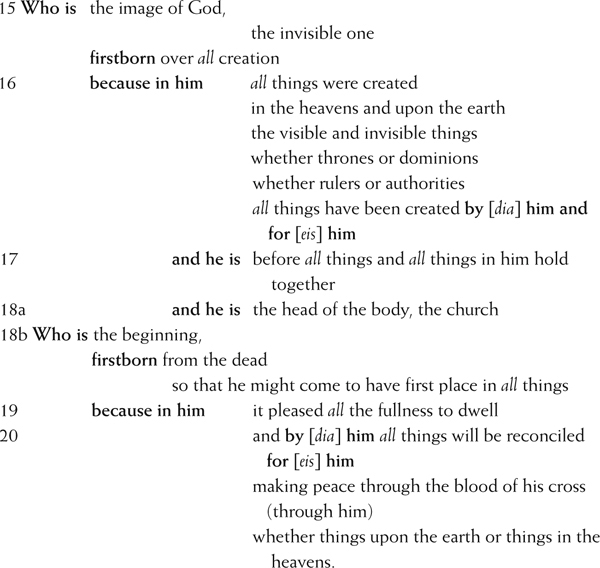
ANOTHER DISPUTED ISSUE concerns the structure of the poem. I divide it into two strophes.
15 Who is the image of God,
the invisible one
firstborn over all creation
16 because in him
all things were created
in the heavens and upon the earth
the visible and invisible things
whether thrones or dominions
whether rulers or authorities
all things have been created by [dia] him and for [eis] him
17 and he is before all things and all things in him hold together
18a and he is the head of the body, the church
18b Who is the beginning,
firstborn from the dead
so that he might come to have first place in all things
19 because in him
it pleased all the fullness to dwell
20 and by [dia] him all things will be reconciled for [eis] him
making peace through the blood of his cross (through him)
whether things upon the earth or things in the heavens.16
 16
16
The first strophe begins with the affirmation “who is” (1:15), followed by an explanation, “because” (1:16), and ending with another affirmation “and he is” (1:17). The second continues with another “and he is” affirmation (1:18a), followed by a “who is” affirmation (1:18b), and ending with an explanation “because” (1:19–20). The two strophes draw a parallel between the creation of all things and the new creation. Together they affirm that the Creator of all things in heaven and on earth is the one the Colossians know as their Redeemer. The key ideas come together in the middle (1:17–18a): Christ is preeminent over natural creation. He is not simply one among a number of spiritual powers; he is supreme. Christ is also preeminent over his new moral creation, the church. In Christ, his community experiences reconciliation to God as an accomplished fact and awaits the cosmic reconciliation of all things.17
Bridging Contexts
THANKSGIVING FOR OUR Lord Jesus Christ bursts forth in the highest praise and the highest Christology in this section. We may not be able to penetrate fully its theological depth, but we can appreciate its profundity. We will examine the poetic affirmation of Christ’s preexistence, incarnation, and universal rule as issues that need further attention for bridging the contexts.
The preexistent Christ. The poetic praise of Christ in 1:15–20 lauds him as the regent and reconciler of all creation. Caird asks a vital question, “How could claims of this magnitude be made about a man who died little more than thirty years ago, and who was remembered as a personal friend by men and women still living when the letter was written?”63 That is, how could anyone believe that Jesus of Nazareth was the image of the invisible God and preexistent agent of creation? It is easier to accept that this Jesus offered himself as a sacrifice for the world’s redemption on the cross than it is to believe that he was also active in creation.
The poem contains a paradox wrapped inside a mystery that has puzzled theologians for centuries. It affirms the complete humanity of Jesus, who shed his blood on a cross, and his full divinity, in whom the fullness of God dwells and by whom and for whom all things were created. Caird comments on how difficult it is “for creatures of space and time to say anything about eternity without misleadingly clothing it in temporal or spatial imagery. Appearing in the midst of time, Christ so fully represents and reveals the divine purpose and wisdom that only the language of eternity can do him justice.”64 Perhaps poetry is the only means that can express such truth. In trying to convey the idea of preexistence to our time and culture, however, we need to be mindful of some key issues.
(1) The qualities ascribed to Wisdom in Jewish tradition have influenced the poem’s language in glorifying Christ. This tradition regarded Wisdom as something far more than simply a savvy philosophy of life. Jewish writers portrayed the figure of Wisdom as the personification of God’s will, as the underlying principle of the universe, and as having the same essence as God, though separate from him.
Wisdom originates with God as the breath of his power, a pure emanation of his glory, a reflection of eternal light, a spotless mirror of his working, and an image of his goodness (Wis. 7:25–26; Sir. 1:1; 24:9). Wisdom pervades and penetrates all things (Wis. 7:24), renews all things (7:27), and orders all things well (8:1). Wisdom shares God’s throne (9:4; 1 Enoch 84:3), was with him from the beginning (Job 28:25–27; Wis. 9:9; Sir. 1:4), was the agent of creation (Prov. 3:19–20; 8:22–31; Wis. 8:4–6), and is the agent of providence (Wis. 1:7; 8:1, 4) and of revelation (7:26–27; 11:1). God sends Wisdom into the world (Bar. 3:37; Wis. 9:10–17; Sir. 24:8) to save (Wis. 10:1–21), and Wisdom returns to heaven again (1 Enoch 42:1–2). Wisdom seeks out humans and makes personal claims and promises (Prov. 1:20–33; 8:1–21; 9:4–6), is associated with the Spirit (Ex. 31:3; Isa. 11:2; Wis. 1:6; 7:7, 22; 9:17; Sir. 39:6), and is an agent of judgment (Wis. 1:8).65
The poem in Colossians affirms that Christ is the realization of everything attributed to Wisdom in this Jewish tradition and more. The “more” has to do with his incarnation. Wisdom had an ambiguous status between a rational principle that encompassed all truth everywhere and an ethereal individual being. Personified Wisdom “oscillates between being an attribute of God (a picturesque way of saying ‘God in his wisdom’) and the divine plan for human life which is incidentally the ground plan for the universe, capable of being identified with the Torah (Sirach 24:7–12, 23).”66 In this tradition, Wisdom was incarnate only in the Law. By contrast, Christ is a personal being who became fully human and shed his blood on a cross.
(2) The poem flows from creation to redemption, but we can understand creation only by moving back from redemption. Paul affirms that as redemption begins with Christ, so God’s purpose in creation began with Christ. We can witness God’s ultimate intention for creation in Christ’s redemptive death, which is the source of the new creation. The same creative power that triumphed on the cross in Christ created and sustains our world. “The cross firmly fixes the central event of the purposes of God for the whole creation in the terra firma of history”—in an event “located and dated in history.”67 It reveals the essence of God and shows that the Creator of all things is also the Redeemer of all things. The poem declares that God’s full presence and power that was in Christ’s reconciling work and in his resurrection was the same presence and power working in creation.
(3) What “is pre-existent is not Christ in person, but the power of God that came to be active in him.”68 Wright comments that the poem does not say that Jesus “pre-existed in human form,” but that it “was utterly appropriate for him, as the pre-existent one, to become man.” He explains with an analogy. If one says that Queen Elizabeth II was born in 1926, that does not mean that she was queen when she was born. It affirms that the one we now know as the queen was born then. Paul is saying something similar. The person we know as Jesus, the Messiah, was “God’s pre-existent agent” in creation.69 Wright contends that any idea of human preexistence would have been completely foreign to this world of thought.70 Instead, the passage asserts that Jesus is “the predestined human lord of the world”; he has appropriately “become what he always was.” “The pre-existent lord of the world has become the human lord of the world, and in so doing has reflected fully, for the eyes of the world to see, the God whose human image he has now come to bear.”71 Christ embodied God’s salvific purposes from before creation.
(4) Paul attributes to Jesus what the Old Testament attributes to God as Creator (see Ps. 96:5; 146:5–6; Isa. 40:12–31). Jesus does not displace the God of the Old Testament or become a second God; “he has made him known.”72 Wright argues that Paul “does not in this poem abandon the Jewish doctrines of monotheism and election. He redefines them.” It fits what Wright calls “christological monotheism” (see 1 Cor. 8:6). Paul modifies “Jewish monotheism so as to place Jesus Christ within the description, almost the definition, of the one God.”73 The poem, according to Wright, contains “a form of Jewish monotheism not before envisaged, in which the Messiah himself is the dwelling-place of the divine wisdom, the immanent presence of the transcendent God, the visible image of the invisible God.”74 This means that any who claim to know God and do not recognize God in Jesus Christ do not know the true God. Any who claim to hear God and do not hear God speaking in Jesus Christ are deaf to God’s message.
(5) Paul wanted to make clear that Christ, not Wisdom or the Law, is God’s agent in the world. All things were created for him and by him and are subject to him. According to Wright, the poem undermines the claims of Judaism. All they “hoped to gain by belief in the one God, whose Wisdom was given to them in the form of the Torah, is now to be gained through Christ.”75 The poem also exposes the error of dualism and polytheism: There is only one Creator-Redeemer God, not a countless horde of gods with differing powers and assignments.
The Christ of flesh and blood. Since the poem maintains that Christ reconciles all things to himself, it implies that all things were previously unreconciled. It assumes that the world is fallen and that sin has ravaged the image of God in humankind and embroiled the world in discord. Sin created a gulf between God and creation. The poem declares that Christ has bridged the chasm between God and humankind, between heaven and earth, by making God’s presence, power, love, and grace known to all creation. What is more, the life, death, and resurrection of Christ did not simply rectify the Fall but created in a human being the image that God had always intended to be in humankind.76
This reconciliation could not be achieved by intermediate beings, but only by the One whose love “moves the stars and leads the universe to its appointed goal” and whose love took on our flesh and died for us on the cross. Stewart explains why it could only be done in the Christ of flesh and blood: “Because he is himself highest and lowest, thoroughly historical, yet outside all the normal categories of men: which is precisely the truth for which at a later day and in a different form the Nicene theologians so vigorously contended.”77 The poem exalts Christ as the image of God and agent of creation but checks any extreme view that would magnify Jesus’ divine nature to the exclusion of his human nature.
How this could be done remains a mystery of our faith. C. S. Lewis remarks:
We cannot conceive how the Divine Spirit dwelled within the created and human spirit of Jesus: but neither can we conceive how His human spirit, or that of any man, dwells within his natural organism. What we can understand, if Christian doctrine is true, is that our own composite experience is not the sheer anomaly it might seem to be, but a faint image of the Divine incarnation itself—the same theme in a very minor key.
He goes on to say that it reveals
the power of the Higher, just in so far as it is truly higher, to come down, the power of the greater to include less. Thus solid bodies exemplify many truths of plane geometry, but plane figures are not truths of solid geometry; many inorganic propositions are true of organisms but no organic propositions are true of minerals; Montaigne became kittenish with his kitten but she never talked philosophy to him. Everywhere the great enters the little—its power to do so is almost the test of its greatness.78
We may never fully comprehend the miracle of the Incarnation, but it has enormous relevance for us today. (1) It reveals God’s true majesty. As Guthrie puts it:
He is not like a king who preserves his majesty and honor only by shutting himself up in the splendor of his palace, safely isolated from the misery of the poor peasants and the threat of his enemies outside the fortress. His majesty is the majesty of a love so great that he leaves the palace and his royal trappings to live among his subjects as one of them, sharing their condition even at the risk of vulnerability to the attack of his enemies. If we want to find this king, we will find him among the weak and lowly, his genuine majesty both revealed and hidden in his choosing to share their vulnerability, suffering, and guilt and powerlessness.79
(2) Revealing himself by hiding himself in human flesh and blood affirms the goodness of his creation. When people still consider the world of creation to be “a rotten ship in polluted waters (and good that it should sink),” this word needs to be heard.80 We have UFO cults making headlines when they commit mass suicide, gladly shedding what they called their bodily containers. They yearn to escape this world and evolve to a higher form of life—in this particular case, by hitching a ride on a space ship they believed was trailing the comet Hale-Bopp. Such beliefs may seem bizarre, but they reflect an age-old gnostic disdain for this material world and the human body. We find the same sentiments expressed in a passage from the Hermetic literature, which speaks of how to behold God fully:
But first you must tear off this garment which you wear,—this cloak of darkness, this web of ignorance, this [prop] of evil, this bond of corruption,—this living death, this conscious corpse, this tomb you carry about with you,—this robber in the house, this enemy who hates the things you seek after, and grudges you the things which you desire.81
In bridging the contexts, we must make clear that Christianity is a world-affirming religion, rightly understood. God’s creation is good, and salvation is not found by trying to escape the body. Paul’s poem in Colossians 1 declares that the Creator and Sustainer of the universe took on our flesh and blood and will reconcile this world to himself.
The universal Christ. Markus Barth asks, “Does it make sense to speak of a cosmic rule of Jesus Christ and of the reconciliation of all things, the whole universe, through him? Or are his person and work related only to the salvation of humankind?”82 Many scholars have argued that we must avoid cosmological statements about Jesus and should focus only on what his death means for the salvation of individuals, the church, and society. This view assumes that nature does not benefit from Christ’s work and that humanity has a monopoly on Christ’s divine mercy. Nature was simply the stage on which the drama of salvation was played out and does not take part in redemption. Barth contends that such a view is the legacy of two intellectual developments: Bultmann’s demythologization of the New Testament and his existential interpretation, and Kant’s view of the mechanical concept of nature, which assumes that nature is governed by general laws and that only the realm of spirit is governed by freedom.
Some years ago, J. B. Phillips made the case that we often considered our God to be too small. The same might be said about our Christ. Popular studies on the historical Jesus have made Christ even smaller, to the point of inconsequence. They have classified Jesus variously as a political revolutionary, a messianic schemer, a Galilean charismatic holy man, a wandering peasant, or a countercultural crusader. The Jesus of history usually comes out looking remarkably like the theological image of the historians. They leave little room for Christ’s divinity, let alone his universal rule.
Such views deviate significantly from Paul’s. For him, Christ was far more than a Jewish reformer. He is Lord over all creation (see Rom. 8:37–39; 1 Cor. 8:5–6; Phil. 2:10), who bore the fissure between God and creation in himself and united the whole universe. We cannot reduce him to simply a Mediterranean peasant who went about doing good and spouting pithy maxims without gutting the historic Christian confession that has sustained the church for centuries. Paul’s poem checks the extreme view that would understand Christ’s significance only in human terms while neglecting his divine nature and universal significance.
This hymn affirms that there is no sphere in creation over which Christ is not sovereign. Conjectures about intelligent life on other planets in this vast universe have escalated. The possible evidence of microbial traces in a “spud-sized meteorite” that smacked into the Antarctic and is purported to be from Mars feeds the speculation. If intelligent life exists elsewhere, they will not know Christ as Jesus of Nazareth; but Christian theology insists that they will know him as Lord. In raising this question, C. S. Lewis cited Alice Meynell’s poem, “Christ and the Universe”:
… in the eternities
Doubtless we shall compare together, hear
a million alien Gospels, in what guise
He trod the Pleiades, the Lyre, the Bear.83
Lewis questioned the word “doubtless,” but the point is well taken. Nothing falls outside the orbit of Christ’s rule. Such a Christology has ethical implications. If Christ reigns over all things and reconciles all things, then every aspect of our lives should come under his rule.
Contemporary Significance
HUMANS STILL ASK if there is a God and if this world has any purpose. Paul assumes in Romans 1:19–20 that humans may learn of God from the work of creation, but the key for understanding who God is and all that God has done, is doing, and will do is found in Christ.
Christology, cosmology, and praiseology. Perhaps the best way to try to capture the mystery of creation, incarnation, and redemption is in the poetry of our hymns. This poem shimmers in the exultant celebration of Christ’s creative and redemptive work. It praises who he is, what he has done, and what he will do. It forms the basis of Paul’s intercession and instruction in the letter, which is filled with exhortations to be thankful.
Unfortunately, we have become less skillful singers of praise to God and Christ and may have even forgotten how to speak the language of adoration. Those who have lost an immediate sense of God’s presence and glory tend to turn God into an object of study and the subject of theories instead of praise and adoration. Schweizer argues that “God is not an object that we could take in our hands in order to analyze it and describe it exactly. God is always God in action, and the life and death and resurrection of Jesus specifies this as action of love.”84 This love in action for us and all the world should evoke our amazement, our awe, and our praise.
Miller writes that “doxology celebrates human impossibilities that became God’s possibilities.”
In a world that assumes the status is quo, that things have to be the way they are and that we must not assume too much about improving them, the doxologies of God’s people are fundamental indicators that wonders have not ceased, that possibilities not yet dreamt of will happen, and that hope is an authentic stance.85
Being able to voice such praise to Christ is a sign of a secure and deeply rooted faith. We exult because we know that we do not live in a God-indifferent world. We also exult because we know that we have nothing to fear. God is with us through Christ, and God will deliver us in Christ. We need to cultivate more the spirit of praise we see in the psalmists (Ps. 8; 19; 33; 104) and in the New Testament’s poetic praise that glorifies Christ.
The supremacy of Christ. Although human nature has not changed, the modern world differs vastly from Paul’s world. Some today may wonder whether the Jesus who walked the dusty roads of Palestine years ago has any relevance for a modern world filled with the technological wonders of computers, instantaneous communication, nuclear power, and space stations. One boy asked in Sunday school, “If Jesus came back today, would he be able to understand computers?” This lad recognized that the world he knew was totally different from the world Jesus knew, but his question expressed a hidden fear that Jesus might be overwhelmed and lost in this modern age. He wanted assurance that Jesus could make a difference in such a world as today—that he is Lord over all this too.
Stewart’s comments are apropos:
This age tends to be more aware of the achievements of man than of the Word of God by which all achievements are judged; and more intimidated by the pressure of inexorable forces than emboldened by the exhilaration of the gospel.86
When we are so impressed with our own achievements and scientific genius, which can bring the tremendous forces of nature to heel and unleash them as well, Christ may indeed seem irrelevant. He can be easily dismissed as a fading relic of past religious piety, who has nothing to offer for the unprecedented issues facing us today. What does Christ have to say to a world in which humans have the power to clone animals and alter the genetic makeup of plants and animals? Stewart recognizes that Colossians answers these questions theologically and ethically. The letter affirms that only in Christ can we ever unveil the mystery of God’s purpose in our world. It also affirms that Christ is “the cohesive force of penetrating and supporting all creation.”87
The letter also has an ethical thrust. Paul insists that “life will ultimately work only one way—God’s way made manifest in the humanity of Jesus once and for all.”88 If we ignore that way or spurn it, we will face the same fate as the builders of the tower of Babel, who exalted themselves over their Creator. The only way we can ever make sense of life and find our own way in it is to recognize that Christ is the converging point of the transcendent God’s activity in the arena of human history. He is the interpretive key for understanding the meaning of creation, the purpose of life, and its goal (John 14:6).
Scientists continue their search for the “holy grail” of science, the “theory of everything,” the simple set of laws that explains every complex detail of our universe. This poem professes that, in a way, Christ is the theological “theory of everything.” He is the key who unlocks the meaning and purpose of the universe. But he is not a set of physics laws; he is a person, who has shown his love for us by giving his life. Wink writes that this passage gives the principle uniting the universe “a heart,” a “purpose,” and a “face.”89 Knowledge of him is also not confined to an elite circle of scientific geniuses. God did not wait for the advent of the scientific method to make known to humans his purposes and love. They have been made known through the cross of Christ and through his church, in which he reigns as head.
The hymn affirms that all things “hold together” in Christ, and this fact justifies our own attempts to bring order to the lives of individuals and to society as a whole. The hymn affirms that God will reconcile all things through Christ, and this fact blesses all our efforts to bring reconciliation to others. We identify ourselves with what God is doing in the world through Christ when we seek to become peacemakers. The hymn affirms that good will triumph over evil. When we give our lives to Christ, no matter what the cost, we know that we will triumph with him.
Does this world have any purpose? Like toddlers entering preschool and learning to cope with the rude awakening that they are not the center of the universe, we humans are learning that our home, earth, is not the center of created reality. We now know that our earth is a tiny planet in a minor solar system on the outskirts of a modest galaxy among billions of galaxies. Some have wrongly inferred from the earth’s physical insignificance that it must also be spiritually insignificant. How could a God care about what happens on such a minor planet in such a vast universe? Many have despaired that the more we have learned and theorized from scientific discoveries about our universe, the more meaningless it seems to be.
Scientists today describe the beginning of our universe as a “Big Bang,” in which the cosmos exploded in a blind scatter of inanimate lumps. Many accept on faith that life arose from an unsupervised, impersonal, unpredictable, and natural process of ordinary chemistry and physics on our planet, which coincidentally happened to possess the appropriate conditions. Some scientists, who claim to have cracked part of the cosmic code, attribute the advent of humans to the complex outcome of chance mutations. But even those who forcefully argue for such a view must continually remind themselves not to be fooled by any evidence to the contrary. Francis Crick, for example, admits, “Biologists must constantly keep in mind that what they see is not designed, but rather evolved.”90
Apart from any religious heritage that might influence people today, the internal evidence that this universe has any divine purpose is at best ambiguous. The more we learn, the less we see some divine pattern. Some have removed God completely from creation and live as if the only reality that matters is what they experience and what can be explained in scientific terms. Others have relegated God’s role to taking care of whatever afterlife there might be. The laws of nature have taken God’s place as the ruler of the world. Because science describes and analyzes these forces, people look more often to it for the answers to life. Science has become the sacral way of knowing and has replaced revelation as the final answer. Physicists and geneticists have become the new high priests of our knowledge. The answer they give is that we live in a mathematical universe captive to the meaningless dance of atoms and the chance alignment of DNA. Survival belongs to the fittest in a nonmoral, aspiritual struggle, which sanctions cruelty and ignores the weak.
Combined with this sense that life is only a fortuitous concourse of atoms is a fear that our world is a dangerous place. The mood of many today parallels the despair in Paul’s time. Many felt forsaken by God, although they had forsaken God first. The local gods seemed totally impotent before the might of Rome and seemed lost in Rome’s vast and growing empire. How could such people stem the tide of chaos that they believed was always threatening to engulf the world? The supreme gods who might have power to intercede were as far away as the emperor and just as indifferent to the fates of individuals. This sense of meaninglessness was frequently expressed in cosmic terms, but there remained a longing for salvation that would bring harmony to the world and deliverance from the collapse to come.
Today we may not fear the same things or express our fears in the same way, but most still believe that we live in a threatening world. Some forego any hope; others look for some kind of security to protect themselves. The ancient anxiety that the elements would disintegrate and tear everything into chaos parallels the modern fear of a nuclear holocaust or an asteroid striking the earth and blowing things to bits. Our anxiety is increased by the speed in which news of disasters around the corner and around the world appears instantaneously before our eyes—terrorist bombings, serial killings, drive-by shootings, church burnings, workplace massacres, gang wars, floods, tornadoes, hurricanes, earthquakes, and drought. This news reinforces the impression that the world is dark and dangerous. Random violence reinforces the belief that everything in the world is aimless. It becomes harder to believe that this creation, which seems to be going so sour, can be redeemed by its Creator and Sustainer, and easier to believe that no such Creator and Sustainer exists. To some it may seem that randomness rules, not Christ.
One wonders if we will ever put the “meta” back in physics. But the scientific search to know everything will reach a dead end. Jastrow, an agnostic astronomer, confesses as much in describing a scientist’s scaling the mountains of ignorance and now climbing the highest peak—the beginning of time. “As he pulls himself over the final rock, he is greeted by a band of theologians who have been sitting there for centuries.”91 Ferguson explains the irony: It is not that the theologians had it all explained for a long time but that they have been saying for centuries that “we are dealing with a mystery human beings will never be able to explain, and now the scientists, by dint of hard labour trying to find that explanation, have to their chagrin arrived at the same conclusion.”92
G. K. Chesterton admitted as much about his own search for the obvious:
I am the man who with utmost daring discovered what had been discovered before…. I freely confess all the idiotic ambitions of the end of the nineteenth century. I did, like all other solemn little boys, try to be in advance of the age. Like them I tried to be some ten minutes in advance of the truth. And I found that I was eighteen hundred years behind it.93
Knowledge can become error and blindness if it is not in Christ.
Christians are sustained in all this by their faith that God’s gracious purposes for this world are being worked out and will be worked out. A gracious and loving God will determine our destiny, not capricious and fluky chance. Paul affirms for us that the world is not a purposeless accident in the chemistry lab of the universe. But he also makes clear that we cannot understand God, creation, or God’s purpose for creation apart from Christ. If creation has been created by Christ and exists for Christ, then it is never meaningless. If we belong to Christ, then it means that we too have a place in the cosmic story. History is not just one thing after another; it has a purpose and is moving somewhere. Proof of this will never show up in a laboratory experiment, in pictures from the space telescopes, or in atomic microscopes.
We see through a glass darkly (cf. 1 Cor. 13:12), but science is an even darker glass for finding the meaning to life. It has unlocked many mysteries of life, but it can never unlock the mystery of life. Science can observe, describe, and analyze what is already there; but it cannot give answers to the question why. C. S. Lewis wrote, “In the whole history of the universe the laws of Nature have never produced a single event. They are the pattern to which every event must conform, provided only that it can be induced to happen.” A billiard ball hitting another billiard ball follows the laws of physics, but those laws did not set the ball in motion; someone with a cue did. “The laws are the pattern to which events conform: the source of the events must be sought elsewhere.”94 In other words, the meaning of the universe can only be found outside of creation. Christians can have some understanding of its purposes only because of their knowledge in Christ, who is beyond creation yet within it.
Christians need to make clear for our turn-of-the-century world with its technological wizardry and terrors, its great economic prosperity and economic despair, that our universe is not a godless and impersonal gaming house. Jesus Christ is its center, its origin, and its destiny.95 The “resurrection victory of God in Christ” is grounded “in the very fabric of the cosmos.”96 In spite of all appearances to the contrary, God still has plans for this shadowy, hellish earth, suffocated by hatred and violence, and he will accomplish the glorious purposes intended from the beginning. We are meant to be here, and God has not left this world to the caprice of impersonal forces.
The wrong concept of creation leads to the wrong view of humanity, sin, and salvation. Many moderns may feel less acutely some kind of cosmic defect than they do some defect in their own lives. Things may be going extremely well for them in their careers and their families, but they still sense that something is missing. In the movie “Love and Death,” two characters discuss their emptiness.
Boris: I feel a void at the center of my being.
Friend: What kind of void?
Boris: An empty void. I felt a full void a month ago, but it was just something I ate.97
Many feel this kind of void because they have no real relationship with the One who created them. They try to fill that emptiness with anything that promises fulfillment and to drown out the hiss of the vacuum that sucks all meaning from their lives with the clatter of aimless pursuits.
I have heard Fred Craddock use the conch shell as an illustration of our need for God. When you hold the shell up to your ear, it will always make the sound of the ocean until it is returned to the ocean. We too will always have that empty ring of a raging torrent within us until we return to God. As the psalmist declares, “As the deer pants for streams of water, so my soul pants for you, O God” (Ps. 42:1). Paul rejoices that God is not some absentee landlord but as near as the confession on our lips (Rom. 10:6–13).
He has the whole world in his hands. Christians may sing the song “He Has the Whole World in His Hands” heartily, but they may not believe it in their hearts. That is because we are inclined to emphasize only Christ’s work in redemption and think of salvation too individualistically—that it involves only me and my Lord. Another hymn sung heartily contains the line, “You ask me how I know he lives? He lives within in my heart.” That may be true, but we cannot reduce Christ’s reign to the confines of our own little existence as our personal spiritual director. Stewart writes, “You cannot have Christ in the heart and keep him out of the universe.”98 God’s salvation is universal in scope. God began with all creation and will end with all creation. Christ reigns supreme over all; the whole universe is held in his loving hand.
If Christ is Lord over all creation, then Christ is also Lord over every aspect of human life.99 This includes our social world, our Christian community, and our physical environment. Our forgiveness by God is part of God’s purpose for the whole cosmos to reconcile all creation to himself. God does not restrict this reconciliation to one segment of creation—humans. The whole creation groans and longs for the revealing of the sons of God (Rom. 8:15–29), when the world will be brought back to its “divinely created and determined order.”100
This redemption has ecological significance, and Christians are now becoming more aware of the need to become involved and in the forefront of such issues. The native American proverb that we do not inherit the land from our ancestors but borrow it from our children rings true. God’s word over Nineveh reveals a love for creation beyond just humans: “But Nineveh has more than a hundred and twenty thousand people who cannot tell their right hand from their left, and many cattle as well. Should I not be concerned about that great city?” (Jonah 4:11).
In The Brothers Karamazov, Father Zosima says:
Brothers … love all creation, the whole and every grain of sand in it. Love every leaf, every ray of God’s light. Love the animals, love the plants, love everything. If you love everything you will perceive the divine mystery in things. Once you perceive it, you will begin to comprehend it better every day. And you will come at last to love the whole world with an all-embracing love. Love the animals: God has given them the rudiments of thought and joy untroubled. Do not trouble it, don’t harass them, don’t deprive them of their happiness, don’t work against God’s intent. Man, do not pride yourself on superiority to the animals; they are without sin, and you with your greatness, defile the earth by your appearance on it, and leave traces of your foulness after you—alas, it is true of every one of us.101
God does not intend for us to escape, to rape, or to subdue creation as if it were an enemy. All creation is destined also to be reconciled in Christ, and we must treat it so.
Victory in the cross. The first half of the poem asserts that Christ is sovereign over all creation as the one in whom and for whom all things were created. The second half of the poem explains how Christ exercises his sovereignty by reconciling the world through shedding his blood on a cross. Pailin contrasts how children might understand sovereignty from observing them playing “king of the castle” on a mound of sand on a beach.
One child stands on top of the castle and taunts the others by proclaiming, “I’m king of the castle.” … Others then attempt to dethrone the king by scrambling on to the castle and supplanting the incumbent. The result is a melée in which there is much shoving and pushing during which most find that their reign at the top is precarious and brief. In the end, the game has to stop because the castle has been destroyed by the assaults upon it.102
The game shows what children assume it means to reign supreme, and it also provides a parable for our world. The struggle for ascendancy among the powers and individuals results in ruin. It contrasts dramatically with what we see in Christ and his cross. Christ wins his victory and is proclaimed king when he is lifted up on a cross.
Bonhoeffer says that God lets himself be pushed out of the world onto the cross. He is weak and powerless in the world, and that is precisely the way, the only way, in which he is with us and helps us. It gives us a glimpse of a divine plan so vast in scale that we can barely fathom it. It reveals the means to accomplish it, which is scandalous and foolish to the human mind. Part of the great mystery is that the Agent of creation and its Sustainer can be met in the humble and tiny group of Colossian Christians who form his body. This mystery is proclaimed by one who takes the role of a humble table servant and who is chained in prison and is afflicted with suffering. Paul understands that victory is won through suffering and giving life, not taking it.
For the beauty of the earth. In her review of three books by parents trying to deal with the tragic circumstances and excruciating pain of losing a child, Travis notes a common thread in the authors’ attempts to make sense of things. Trying to answer why such calamities occur, they assume that God either does not exist or is “an accomplice to murder.” The authors do not find a community or a religious or philosophic framework to help them make sense of things and to make the deaths more endurable. Rather, the antidote to their despair comes from “the reassurances of nature.” One writer is heartened by the “golden flower poking up through the ankle-deep snow.” Another “looks out over the hills into the sky,” thinking maybe his daughter is out there somewhere. A third sees that “the light behind the trees was spring light.” Travis concludes her review, “Each book ends with its author lost and alone in thoughts of his daughter, each man comforted by nature—but not by another human being.”103
Humans can detect something of God in nature (Acts 17:24–29), but they consistently have perverted what they learn by turning it into idolatry (Rom. 1:21–23). Without doubt, nature is filled with marvelous wonders, beautiful to behold. Everyone can probably think of some garden spot where the beauty of the earth radiates God’s glory. For me, it is the Rocky Mountains. The snow-capped peaks glisten; the air is crisp and the sky clear; the wild flowers bloom gloriously in meadows where elk and deer graze. The wind whistles through the pines, sometimes drowning out the chatter of squirrels and chipmunks. Coyotes howl regularly; a mother bear and her cubs occasionally make midnight visits. Mountain lions and bobcats are there even though they never make their presence known.
But I have also seen that same sky filled with smoke from forest fires. Elk have been shot by hunters; deer have been chased and lacerated by predators. My own dog has caught and killed chipmunks only to wonder what to do with the carcass; her instinct told her to chase and kill, but for no purpose. Landslides have buried campers under tons of rock. Nature may be beautiful; but it is also cold and impervious, offering little comfort in times of mourning. God’s evidence in nature is at best ambiguous; God can only be fully known through Christ.
Because creation is fallen, we can know God fully only through the process of redemption. We may be able to see God’s glory in nature, but we can also see its fallenness. Nature is not God. C. S. Lewis wrote, “Nature never taught me that there exists a God of glory and of infinite majesty. I had to learn that in other ways. But nature gave the word glory a meaning for me.”104
Nature may provide us with an image of glory, but it does not provide “a direct path” that leads to an increasing knowledge of God.
The path peters out almost at once. Terrors and mysteries, the whole depth of God’s counsels and the whole tangle of the history of the universe, choke it. We can’t get through; not that way. We must make a detour—leave the hills and woods and go back to our studies, to church, to our Bibles, to our knees. Otherwise the love of nature is beginning to turn into a nature religion. And then, even if it does not lead us to Dark Gods, it will lead us to a great deal of nonsense.105
Christians do not seek comfort from an impersonal creation but from a personal Creator, who also creates a community. The living Lord, who is the source of new life, is experienced in the worship and activity of his living church.
Redemption in Christ alone. The language of estrangement in 1:21 implies a relationship gone seriously awry. Sin makes a shambles of created harmony and gives battle to God’s restoration work. Above all, sin lays waste our critical relationship to God in an infinite variety of tangled ways. We are hostile in mind to God, malicious in our actions to everyone.
It is amazing how quickly sin can take control of something intended for good and corrupt it. The advent of computers have changed many lives for the better, but they have also been used by persons to spread more quickly and more widely malicious rumors, conspiracy theories, racial hatred, and deadly electronic viruses aimed at destroying data. Others have used them to entice young children with pornography or to recruit weak and wavering souls into mind-control cults. Attempts to control abuse with legislation are well-intended but never get to the root of the problem. Sin is not just what we do; it is who we are. Roberts, in his review of Plantinga’s excellent book on sin, perceptively observes:
The practices and ideas of modern psychologies have been so liberally and indiscriminately mixed with the Christian understanding of persons that many churches now propagate spiritualities quite alien to their own traditions. The practices and ideas of show business and marketing so dominate some congregations and public ministries that serious Christian ministry of word and sacrament looks fuddy-duddy, and a penitential, disciplined spirituality of grace looks morbid and certainly not cost-effective. Uniting both these polluters is the idea that all religion is (or ought to be) in service of us: It ought to make us wealthy, happy, amused, functional, creative, integrated, high in self-esteem.
One of the first concepts to get neutralized in this mushy mixture is that of sin—the idea that we regularly corrupt ourselves and our fellow human beings, that we have vandalized the beautiful order that God has placed in creation, that we are not just victims of wrong doing but, one and all, perpetrators of it, that we have offended God and cut ourselves off from his fellowship and blessings.106
The theme of human rebellion and sin is an unbroken scarlet thread that runs through the entire Bible to the foot of the cross. There it has been severed. Paul proclaims in the opening words of Colossians that Christ has brought hope to a desperate situation, rescue from darkness, and the forgiveness of sins, which separate us from God and from one another. Our response in faith to what Christ has done grounds us firmly in God’s grand purpose to remake us into what we were intended to be, holy and blameless.
Paul’s statement in 1:23 also contains an implicit warning, “if you continue in your faith.” If we understand that through Christ we gain a new relationship with God, we also recognize that relationships can never remain static. They either grow or die. We enter a new relationship when we marry. Most who have experienced marriage understand that a successful marriage takes work. We may remain in the state of marriage, but the relationship can die if we do not work at it. The same is true of our relationship with God. If we neglect it or flirt with other attractions, we endanger it.
Original Meaning
Is Colossians 1:15–20 an Early Christian Hymn?
WHILE A SPECIAL commissioner in Pontus-Bithynia, the younger Pliny wrote to Emperor Trajan asking advice on what to do about the Christians. He reported that they met “on a certain fixed day before it was light, when they sang in alternate verses a hymn to Christ as to a God” (Epistles 10.96; see Eph. 5:19; Col. 3:16). Most scholars contend that Paul has preserved a fragment of early Christian hymnody in 1:15–20.2 Interpreters, however, have reached no consensus about the supposed hymn’s structure, original author, background, purpose, or possible glosses by the author of Colossians.
I join the minority opinion that does not think that Paul took up a liturgical tradition and inserted it (with annotations) into his letter.3 Our passage is undeniably poetic, but I think it best to regard it as hymnic prose composed by Paul himself, perhaps drawing from traditional material. Although R. P. Martin argues that it is a liturgical hymn, he concedes that “religious speech tends to be in poetic form; and meditation upon the person and place of Jesus Christ in the Church’s life and in the experience of the believer is not expressed in a cold, calculating way, but becomes rhapsodic and ornate.”4 The Greek verb “to hymn” (hymno) initially meant simply “to praise,” and it was used for praise of something beyond humans.5
Paul was not writing this letter as a document to be studied in a seminar or interpreted in a commentary but as something he knew would be read aloud as part of the church’s worship. He could express his faith with majestic poetry.6 His letters reveal that he can write as prophet and psalmist, and he is a master of “the liturgical style, which soars high above the dusty street of everyday prose, which, almost in the language of the seer of another world, bears witness to the wonderful secret of that other world.”7 Since 1:12–14 also exhibits this elevated style, scholars disagree over the length of proposed liturgical material that the writer adopts. Some begin in verse 12; others, in verse 13. A more reasonable conclusion regards 1:12–23 as all springing from Paul hymning praise to his Redeemer.8 Enclosed by references to the redemption offered in Christ (1:14, 21–22), the poem fits the context well.
We should not read our modern assumptions about what constitutes a hymn into this passage. The many proposals for the hymn’s structure indicate, for example, that its metrical structure is not immediately obvious.9 Many have excised any words or phrases that do not fit their reconstruction of a hypothetical, more metrical pre-Pauline form.10 Such speculation, in my opinion, gets us nowhere. Not only is it unprovable, it also creates a strange scenario. If the hymn were familiar to the Colossians, Paul’s tinkering with it would be more likely to mystify rather than enlighten them.11 Wright critiques Schweizer’s notion that the community would recognize the opening words and join in reciting it, coupled with his theory that the author interpolated bits. “Nothing would be more calculated to puzzle a congregation than tampering with a hymn they are in the act of singing.”12
Since many consider this passage to contain primitive traditional material, they have also tried to trace its origins in the many-faceted philosophical world of Hellenism or the various streams of Judaism. None of this helps us interpret its meaning in Colossians. Learning the source of the paints on Vincent van Gogh’s palette when he painted “Sunflowers,” for example, does not help us appreciate more its representation of nature bursting with life.
Nevertheless, I am convinced that the Old Testament and pre-Christian Jewish reflection on Wisdom provided the seedbed that nourished the ideas in this passage.13 The best explanation for how such an august poem could come to birth is Burney’s theory that it derives from an intricate exposition of the opening words of the biblical creation account in Genesis 1:1, “In the beginning God created the heavens and the earth,” and from the poetic exaltation of Wisdom and her involvement in creation in Proverbs 8:22, “The Lord begat me as the beginning of his way, the antecedent of his works, of old” (Burney’s translation).14
The opening word of Genesis, “in the beginning” (br’šyt), is amplified by playing on three meanings of the Hebrew preposition be, “in,” “by,” and “for.” We are told that all things were created “in” (en) Christ, “by” (dia) Christ, and “for” (eis) Christ (1:16). The meanings of the Hebrew word r’šyt (“beginning,” “sum-total,” “head,” and “firstfruits”) are developed in the poem. Christ “is before all things” (beginning); “in him all things hold together” (sum total); “he is the head of the body”; and he is “the firstborn [firstfruits] from among the dead.” Christ therefore fulfills every possible meaning of the word br’šyt, the first word in the Bible.
In Proverbs 8:22–31, Wisdom is praised as the preexistent agent in God’s ordering and directing creation (see Sir. 1:4; Wis. 9:9). The poem asserts that Christ realizes and supersedes all the notions associated with Wisdom.15 Christ is God’s agent in creation, revelation, and redemption; and all of God’s purposes for the universe are accomplished through him.
Structure of the Passage
ANOTHER DISPUTED ISSUE concerns the structure of the poem. I divide it into two strophes.
15 Who is the image of God,
the invisible one
firstborn over all creation
16 because in him
all things were created
in the heavens and upon the earth
the visible and invisible things
whether thrones or dominions
whether rulers or authorities
all things have been created by [dia] him and for [eis] him
17 and he is before all things and all things in him hold together
18a and he is the head of the body, the church
18b Who is the beginning,
firstborn from the dead
so that he might come to have first place in all things
19 because in him
it pleased all the fullness to dwell
20 and by [dia] him all things will be reconciled for [eis] him
making peace through the blood of his cross (through him)
whether things upon the earth or things in the heavens.16
16
The first strophe begins with the affirmation “who is” (1:15), followed by an explanation, “because” (1:16), and ending with another affirmation “and he is” (1:17). The second continues with another “and he is” affirmation (1:18a), followed by a “who is” affirmation (1:18b), and ending with an explanation “because” (1:19–20). The two strophes draw a parallel between the creation of all things and the new creation. Together they affirm that the Creator of all things in heaven and on earth is the one the Colossians know as their Redeemer. The key ideas come together in the middle (1:17–18a): Christ is preeminent over natural creation. He is not simply one among a number of spiritual powers; he is supreme. Christ is also preeminent over his new moral creation, the church. In Christ, his community experiences reconciliation to God as an accomplished fact and awaits the cosmic reconciliation of all things.17
Bridging Contexts
THANKSGIVING FOR OUR Lord Jesus Christ bursts forth in the highest praise and the highest Christology in this section. We may not be able to penetrate fully its theological depth, but we can appreciate its profundity. We will examine the poetic affirmation of Christ’s preexistence, incarnation, and universal rule as issues that need further attention for bridging the contexts.
The preexistent Christ. The poetic praise of Christ in 1:15–20 lauds him as the regent and reconciler of all creation. Caird asks a vital question, “How could claims of this magnitude be made about a man who died little more than thirty years ago, and who was remembered as a personal friend by men and women still living when the letter was written?”63 That is, how could anyone believe that Jesus of Nazareth was the image of the invisible God and preexistent agent of creation? It is easier to accept that this Jesus offered himself as a sacrifice for the world’s redemption on the cross than it is to believe that he was also active in creation.
The poem contains a paradox wrapped inside a mystery that has puzzled theologians for centuries. It affirms the complete humanity of Jesus, who shed his blood on a cross, and his full divinity, in whom the fullness of God dwells and by whom and for whom all things were created. Caird comments on how difficult it is “for creatures of space and time to say anything about eternity without misleadingly clothing it in temporal or spatial imagery. Appearing in the midst of time, Christ so fully represents and reveals the divine purpose and wisdom that only the language of eternity can do him justice.”64 Perhaps poetry is the only means that can express such truth. In trying to convey the idea of preexistence to our time and culture, however, we need to be mindful of some key issues.
(1) The qualities ascribed to Wisdom in Jewish tradition have influenced the poem’s language in glorifying Christ. This tradition regarded Wisdom as something far more than simply a savvy philosophy of life. Jewish writers portrayed the figure of Wisdom as the personification of God’s will, as the underlying principle of the universe, and as having the same essence as God, though separate from him.
Wisdom originates with God as the breath of his power, a pure emanation of his glory, a reflection of eternal light, a spotless mirror of his working, and an image of his goodness (Wis. 7:25–26; Sir. 1:1; 24:9). Wisdom pervades and penetrates all things (Wis. 7:24), renews all things (7:27), and orders all things well (8:1). Wisdom shares God’s throne (9:4; 1 Enoch 84:3), was with him from the beginning (Job 28:25–27; Wis. 9:9; Sir. 1:4), was the agent of creation (Prov. 3:19–20; 8:22–31; Wis. 8:4–6), and is the agent of providence (Wis. 1:7; 8:1, 4) and of revelation (7:26–27; 11:1). God sends Wisdom into the world (Bar. 3:37; Wis. 9:10–17; Sir. 24:8) to save (Wis. 10:1–21), and Wisdom returns to heaven again (1 Enoch 42:1–2). Wisdom seeks out humans and makes personal claims and promises (Prov. 1:20–33; 8:1–21; 9:4–6), is associated with the Spirit (Ex. 31:3; Isa. 11:2; Wis. 1:6; 7:7, 22; 9:17; Sir. 39:6), and is an agent of judgment (Wis. 1:8).65
The poem in Colossians affirms that Christ is the realization of everything attributed to Wisdom in this Jewish tradition and more. The “more” has to do with his incarnation. Wisdom had an ambiguous status between a rational principle that encompassed all truth everywhere and an ethereal individual being. Personified Wisdom “oscillates between being an attribute of God (a picturesque way of saying ‘God in his wisdom’) and the divine plan for human life which is incidentally the ground plan for the universe, capable of being identified with the Torah (Sirach 24:7–12, 23).”66 In this tradition, Wisdom was incarnate only in the Law. By contrast, Christ is a personal being who became fully human and shed his blood on a cross.
(2) The poem flows from creation to redemption, but we can understand creation only by moving back from redemption. Paul affirms that as redemption begins with Christ, so God’s purpose in creation began with Christ. We can witness God’s ultimate intention for creation in Christ’s redemptive death, which is the source of the new creation. The same creative power that triumphed on the cross in Christ created and sustains our world. “The cross firmly fixes the central event of the purposes of God for the whole creation in the terra firma of history”—in an event “located and dated in history.”67 It reveals the essence of God and shows that the Creator of all things is also the Redeemer of all things. The poem declares that God’s full presence and power that was in Christ’s reconciling work and in his resurrection was the same presence and power working in creation.
(3) What “is pre-existent is not Christ in person, but the power of God that came to be active in him.”68 Wright comments that the poem does not say that Jesus “pre-existed in human form,” but that it “was utterly appropriate for him, as the pre-existent one, to become man.” He explains with an analogy. If one says that Queen Elizabeth II was born in 1926, that does not mean that she was queen when she was born. It affirms that the one we now know as the queen was born then. Paul is saying something similar. The person we know as Jesus, the Messiah, was “God’s pre-existent agent” in creation.69 Wright contends that any idea of human preexistence would have been completely foreign to this world of thought.70 Instead, the passage asserts that Jesus is “the predestined human lord of the world”; he has appropriately “become what he always was.” “The pre-existent lord of the world has become the human lord of the world, and in so doing has reflected fully, for the eyes of the world to see, the God whose human image he has now come to bear.”71 Christ embodied God’s salvific purposes from before creation.
(4) Paul attributes to Jesus what the Old Testament attributes to God as Creator (see Ps. 96:5; 146:5–6; Isa. 40:12–31). Jesus does not displace the God of the Old Testament or become a second God; “he has made him known.”72 Wright argues that Paul “does not in this poem abandon the Jewish doctrines of monotheism and election. He redefines them.” It fits what Wright calls “christological monotheism” (see 1 Cor. 8:6). Paul modifies “Jewish monotheism so as to place Jesus Christ within the description, almost the definition, of the one God.”73 The poem, according to Wright, contains “a form of Jewish monotheism not before envisaged, in which the Messiah himself is the dwelling-place of the divine wisdom, the immanent presence of the transcendent God, the visible image of the invisible God.”74 This means that any who claim to know God and do not recognize God in Jesus Christ do not know the true God. Any who claim to hear God and do not hear God speaking in Jesus Christ are deaf to God’s message.
(5) Paul wanted to make clear that Christ, not Wisdom or the Law, is God’s agent in the world. All things were created for him and by him and are subject to him. According to Wright, the poem undermines the claims of Judaism. All they “hoped to gain by belief in the one God, whose Wisdom was given to them in the form of the Torah, is now to be gained through Christ.”75 The poem also exposes the error of dualism and polytheism: There is only one Creator-Redeemer God, not a countless horde of gods with differing powers and assignments.
The Christ of flesh and blood. Since the poem maintains that Christ reconciles all things to himself, it implies that all things were previously unreconciled. It assumes that the world is fallen and that sin has ravaged the image of God in humankind and embroiled the world in discord. Sin created a gulf between God and creation. The poem declares that Christ has bridged the chasm between God and humankind, between heaven and earth, by making God’s presence, power, love, and grace known to all creation. What is more, the life, death, and resurrection of Christ did not simply rectify the Fall but created in a human being the image that God had always intended to be in humankind.76
This reconciliation could not be achieved by intermediate beings, but only by the One whose love “moves the stars and leads the universe to its appointed goal” and whose love took on our flesh and died for us on the cross. Stewart explains why it could only be done in the Christ of flesh and blood: “Because he is himself highest and lowest, thoroughly historical, yet outside all the normal categories of men: which is precisely the truth for which at a later day and in a different form the Nicene theologians so vigorously contended.”77 The poem exalts Christ as the image of God and agent of creation but checks any extreme view that would magnify Jesus’ divine nature to the exclusion of his human nature.
How this could be done remains a mystery of our faith. C. S. Lewis remarks:
We cannot conceive how the Divine Spirit dwelled within the created and human spirit of Jesus: but neither can we conceive how His human spirit, or that of any man, dwells within his natural organism. What we can understand, if Christian doctrine is true, is that our own composite experience is not the sheer anomaly it might seem to be, but a faint image of the Divine incarnation itself—the same theme in a very minor key.
He goes on to say that it reveals
the power of the Higher, just in so far as it is truly higher, to come down, the power of the greater to include less. Thus solid bodies exemplify many truths of plane geometry, but plane figures are not truths of solid geometry; many inorganic propositions are true of organisms but no organic propositions are true of minerals; Montaigne became kittenish with his kitten but she never talked philosophy to him. Everywhere the great enters the little—its power to do so is almost the test of its greatness.78
We may never fully comprehend the miracle of the Incarnation, but it has enormous relevance for us today. (1) It reveals God’s true majesty. As Guthrie puts it:
He is not like a king who preserves his majesty and honor only by shutting himself up in the splendor of his palace, safely isolated from the misery of the poor peasants and the threat of his enemies outside the fortress. His majesty is the majesty of a love so great that he leaves the palace and his royal trappings to live among his subjects as one of them, sharing their condition even at the risk of vulnerability to the attack of his enemies. If we want to find this king, we will find him among the weak and lowly, his genuine majesty both revealed and hidden in his choosing to share their vulnerability, suffering, and guilt and powerlessness.79
(2) Revealing himself by hiding himself in human flesh and blood affirms the goodness of his creation. When people still consider the world of creation to be “a rotten ship in polluted waters (and good that it should sink),” this word needs to be heard.80 We have UFO cults making headlines when they commit mass suicide, gladly shedding what they called their bodily containers. They yearn to escape this world and evolve to a higher form of life—in this particular case, by hitching a ride on a space ship they believed was trailing the comet Hale-Bopp. Such beliefs may seem bizarre, but they reflect an age-old gnostic disdain for this material world and the human body. We find the same sentiments expressed in a passage from the Hermetic literature, which speaks of how to behold God fully:
But first you must tear off this garment which you wear,—this cloak of darkness, this web of ignorance, this [prop] of evil, this bond of corruption,—this living death, this conscious corpse, this tomb you carry about with you,—this robber in the house, this enemy who hates the things you seek after, and grudges you the things which you desire.81
In bridging the contexts, we must make clear that Christianity is a world-affirming religion, rightly understood. God’s creation is good, and salvation is not found by trying to escape the body. Paul’s poem in Colossians 1 declares that the Creator and Sustainer of the universe took on our flesh and blood and will reconcile this world to himself.
The universal Christ. Markus Barth asks, “Does it make sense to speak of a cosmic rule of Jesus Christ and of the reconciliation of all things, the whole universe, through him? Or are his person and work related only to the salvation of humankind?”82 Many scholars have argued that we must avoid cosmological statements about Jesus and should focus only on what his death means for the salvation of individuals, the church, and society. This view assumes that nature does not benefit from Christ’s work and that humanity has a monopoly on Christ’s divine mercy. Nature was simply the stage on which the drama of salvation was played out and does not take part in redemption. Barth contends that such a view is the legacy of two intellectual developments: Bultmann’s demythologization of the New Testament and his existential interpretation, and Kant’s view of the mechanical concept of nature, which assumes that nature is governed by general laws and that only the realm of spirit is governed by freedom.
Some years ago, J. B. Phillips made the case that we often considered our God to be too small. The same might be said about our Christ. Popular studies on the historical Jesus have made Christ even smaller, to the point of inconsequence. They have classified Jesus variously as a political revolutionary, a messianic schemer, a Galilean charismatic holy man, a wandering peasant, or a countercultural crusader. The Jesus of history usually comes out looking remarkably like the theological image of the historians. They leave little room for Christ’s divinity, let alone his universal rule.
Such views deviate significantly from Paul’s. For him, Christ was far more than a Jewish reformer. He is Lord over all creation (see Rom. 8:37–39; 1 Cor. 8:5–6; Phil. 2:10), who bore the fissure between God and creation in himself and united the whole universe. We cannot reduce him to simply a Mediterranean peasant who went about doing good and spouting pithy maxims without gutting the historic Christian confession that has sustained the church for centuries. Paul’s poem checks the extreme view that would understand Christ’s significance only in human terms while neglecting his divine nature and universal significance.
This hymn affirms that there is no sphere in creation over which Christ is not sovereign. Conjectures about intelligent life on other planets in this vast universe have escalated. The possible evidence of microbial traces in a “spud-sized meteorite” that smacked into the Antarctic and is purported to be from Mars feeds the speculation. If intelligent life exists elsewhere, they will not know Christ as Jesus of Nazareth; but Christian theology insists that they will know him as Lord. In raising this question, C. S. Lewis cited Alice Meynell’s poem, “Christ and the Universe”:
… in the eternities
Doubtless we shall compare together, hear
a million alien Gospels, in what guise
He trod the Pleiades, the Lyre, the Bear.83
Lewis questioned the word “doubtless,” but the point is well taken. Nothing falls outside the orbit of Christ’s rule. Such a Christology has ethical implications. If Christ reigns over all things and reconciles all things, then every aspect of our lives should come under his rule.
Contemporary Significance
HUMANS STILL ASK if there is a God and if this world has any purpose. Paul assumes in Romans 1:19–20 that humans may learn of God from the work of creation, but the key for understanding who God is and all that God has done, is doing, and will do is found in Christ.
Christology, cosmology, and praiseology. Perhaps the best way to try to capture the mystery of creation, incarnation, and redemption is in the poetry of our hymns. This poem shimmers in the exultant celebration of Christ’s creative and redemptive work. It praises who he is, what he has done, and what he will do. It forms the basis of Paul’s intercession and instruction in the letter, which is filled with exhortations to be thankful.
Unfortunately, we have become less skillful singers of praise to God and Christ and may have even forgotten how to speak the language of adoration. Those who have lost an immediate sense of God’s presence and glory tend to turn God into an object of study and the subject of theories instead of praise and adoration. Schweizer argues that “God is not an object that we could take in our hands in order to analyze it and describe it exactly. God is always God in action, and the life and death and resurrection of Jesus specifies this as action of love.”84 This love in action for us and all the world should evoke our amazement, our awe, and our praise.
Miller writes that “doxology celebrates human impossibilities that became God’s possibilities.”
In a world that assumes the status is quo, that things have to be the way they are and that we must not assume too much about improving them, the doxologies of God’s people are fundamental indicators that wonders have not ceased, that possibilities not yet dreamt of will happen, and that hope is an authentic stance.85
Being able to voice such praise to Christ is a sign of a secure and deeply rooted faith. We exult because we know that we do not live in a God-indifferent world. We also exult because we know that we have nothing to fear. God is with us through Christ, and God will deliver us in Christ. We need to cultivate more the spirit of praise we see in the psalmists (Ps. 8; 19; 33; 104) and in the New Testament’s poetic praise that glorifies Christ.
The supremacy of Christ. Although human nature has not changed, the modern world differs vastly from Paul’s world. Some today may wonder whether the Jesus who walked the dusty roads of Palestine years ago has any relevance for a modern world filled with the technological wonders of computers, instantaneous communication, nuclear power, and space stations. One boy asked in Sunday school, “If Jesus came back today, would he be able to understand computers?” This lad recognized that the world he knew was totally different from the world Jesus knew, but his question expressed a hidden fear that Jesus might be overwhelmed and lost in this modern age. He wanted assurance that Jesus could make a difference in such a world as today—that he is Lord over all this too.
Stewart’s comments are apropos:
This age tends to be more aware of the achievements of man than of the Word of God by which all achievements are judged; and more intimidated by the pressure of inexorable forces than emboldened by the exhilaration of the gospel.86
When we are so impressed with our own achievements and scientific genius, which can bring the tremendous forces of nature to heel and unleash them as well, Christ may indeed seem irrelevant. He can be easily dismissed as a fading relic of past religious piety, who has nothing to offer for the unprecedented issues facing us today. What does Christ have to say to a world in which humans have the power to clone animals and alter the genetic makeup of plants and animals? Stewart recognizes that Colossians answers these questions theologically and ethically. The letter affirms that only in Christ can we ever unveil the mystery of God’s purpose in our world. It also affirms that Christ is “the cohesive force of penetrating and supporting all creation.”87
The letter also has an ethical thrust. Paul insists that “life will ultimately work only one way—God’s way made manifest in the humanity of Jesus once and for all.”88 If we ignore that way or spurn it, we will face the same fate as the builders of the tower of Babel, who exalted themselves over their Creator. The only way we can ever make sense of life and find our own way in it is to recognize that Christ is the converging point of the transcendent God’s activity in the arena of human history. He is the interpretive key for understanding the meaning of creation, the purpose of life, and its goal (John 14:6).
Scientists continue their search for the “holy grail” of science, the “theory of everything,” the simple set of laws that explains every complex detail of our universe. This poem professes that, in a way, Christ is the theological “theory of everything.” He is the key who unlocks the meaning and purpose of the universe. But he is not a set of physics laws; he is a person, who has shown his love for us by giving his life. Wink writes that this passage gives the principle uniting the universe “a heart,” a “purpose,” and a “face.”89 Knowledge of him is also not confined to an elite circle of scientific geniuses. God did not wait for the advent of the scientific method to make known to humans his purposes and love. They have been made known through the cross of Christ and through his church, in which he reigns as head.
The hymn affirms that all things “hold together” in Christ, and this fact justifies our own attempts to bring order to the lives of individuals and to society as a whole. The hymn affirms that God will reconcile all things through Christ, and this fact blesses all our efforts to bring reconciliation to others. We identify ourselves with what God is doing in the world through Christ when we seek to become peacemakers. The hymn affirms that good will triumph over evil. When we give our lives to Christ, no matter what the cost, we know that we will triumph with him.
Does this world have any purpose? Like toddlers entering preschool and learning to cope with the rude awakening that they are not the center of the universe, we humans are learning that our home, earth, is not the center of created reality. We now know that our earth is a tiny planet in a minor solar system on the outskirts of a modest galaxy among billions of galaxies. Some have wrongly inferred from the earth’s physical insignificance that it must also be spiritually insignificant. How could a God care about what happens on such a minor planet in such a vast universe? Many have despaired that the more we have learned and theorized from scientific discoveries about our universe, the more meaningless it seems to be.
Scientists today describe the beginning of our universe as a “Big Bang,” in which the cosmos exploded in a blind scatter of inanimate lumps. Many accept on faith that life arose from an unsupervised, impersonal, unpredictable, and natural process of ordinary chemistry and physics on our planet, which coincidentally happened to possess the appropriate conditions. Some scientists, who claim to have cracked part of the cosmic code, attribute the advent of humans to the complex outcome of chance mutations. But even those who forcefully argue for such a view must continually remind themselves not to be fooled by any evidence to the contrary. Francis Crick, for example, admits, “Biologists must constantly keep in mind that what they see is not designed, but rather evolved.”90
Apart from any religious heritage that might influence people today, the internal evidence that this universe has any divine purpose is at best ambiguous. The more we learn, the less we see some divine pattern. Some have removed God completely from creation and live as if the only reality that matters is what they experience and what can be explained in scientific terms. Others have relegated God’s role to taking care of whatever afterlife there might be. The laws of nature have taken God’s place as the ruler of the world. Because science describes and analyzes these forces, people look more often to it for the answers to life. Science has become the sacral way of knowing and has replaced revelation as the final answer. Physicists and geneticists have become the new high priests of our knowledge. The answer they give is that we live in a mathematical universe captive to the meaningless dance of atoms and the chance alignment of DNA. Survival belongs to the fittest in a nonmoral, aspiritual struggle, which sanctions cruelty and ignores the weak.
Combined with this sense that life is only a fortuitous concourse of atoms is a fear that our world is a dangerous place. The mood of many today parallels the despair in Paul’s time. Many felt forsaken by God, although they had forsaken God first. The local gods seemed totally impotent before the might of Rome and seemed lost in Rome’s vast and growing empire. How could such people stem the tide of chaos that they believed was always threatening to engulf the world? The supreme gods who might have power to intercede were as far away as the emperor and just as indifferent to the fates of individuals. This sense of meaninglessness was frequently expressed in cosmic terms, but there remained a longing for salvation that would bring harmony to the world and deliverance from the collapse to come.
Today we may not fear the same things or express our fears in the same way, but most still believe that we live in a threatening world. Some forego any hope; others look for some kind of security to protect themselves. The ancient anxiety that the elements would disintegrate and tear everything into chaos parallels the modern fear of a nuclear holocaust or an asteroid striking the earth and blowing things to bits. Our anxiety is increased by the speed in which news of disasters around the corner and around the world appears instantaneously before our eyes—terrorist bombings, serial killings, drive-by shootings, church burnings, workplace massacres, gang wars, floods, tornadoes, hurricanes, earthquakes, and drought. This news reinforces the impression that the world is dark and dangerous. Random violence reinforces the belief that everything in the world is aimless. It becomes harder to believe that this creation, which seems to be going so sour, can be redeemed by its Creator and Sustainer, and easier to believe that no such Creator and Sustainer exists. To some it may seem that randomness rules, not Christ.
One wonders if we will ever put the “meta” back in physics. But the scientific search to know everything will reach a dead end. Jastrow, an agnostic astronomer, confesses as much in describing a scientist’s scaling the mountains of ignorance and now climbing the highest peak—the beginning of time. “As he pulls himself over the final rock, he is greeted by a band of theologians who have been sitting there for centuries.”91 Ferguson explains the irony: It is not that the theologians had it all explained for a long time but that they have been saying for centuries that “we are dealing with a mystery human beings will never be able to explain, and now the scientists, by dint of hard labour trying to find that explanation, have to their chagrin arrived at the same conclusion.”92
G. K. Chesterton admitted as much about his own search for the obvious:
I am the man who with utmost daring discovered what had been discovered before…. I freely confess all the idiotic ambitions of the end of the nineteenth century. I did, like all other solemn little boys, try to be in advance of the age. Like them I tried to be some ten minutes in advance of the truth. And I found that I was eighteen hundred years behind it.93
Knowledge can become error and blindness if it is not in Christ.
Christians are sustained in all this by their faith that God’s gracious purposes for this world are being worked out and will be worked out. A gracious and loving God will determine our destiny, not capricious and fluky chance. Paul affirms for us that the world is not a purposeless accident in the chemistry lab of the universe. But he also makes clear that we cannot understand God, creation, or God’s purpose for creation apart from Christ. If creation has been created by Christ and exists for Christ, then it is never meaningless. If we belong to Christ, then it means that we too have a place in the cosmic story. History is not just one thing after another; it has a purpose and is moving somewhere. Proof of this will never show up in a laboratory experiment, in pictures from the space telescopes, or in atomic microscopes.
We see through a glass darkly (cf. 1 Cor. 13:12), but science is an even darker glass for finding the meaning to life. It has unlocked many mysteries of life, but it can never unlock the mystery of life. Science can observe, describe, and analyze what is already there; but it cannot give answers to the question why. C. S. Lewis wrote, “In the whole history of the universe the laws of Nature have never produced a single event. They are the pattern to which every event must conform, provided only that it can be induced to happen.” A billiard ball hitting another billiard ball follows the laws of physics, but those laws did not set the ball in motion; someone with a cue did. “The laws are the pattern to which events conform: the source of the events must be sought elsewhere.”94 In other words, the meaning of the universe can only be found outside of creation. Christians can have some understanding of its purposes only because of their knowledge in Christ, who is beyond creation yet within it.
Christians need to make clear for our turn-of-the-century world with its technological wizardry and terrors, its great economic prosperity and economic despair, that our universe is not a godless and impersonal gaming house. Jesus Christ is its center, its origin, and its destiny.95 The “resurrection victory of God in Christ” is grounded “in the very fabric of the cosmos.”96 In spite of all appearances to the contrary, God still has plans for this shadowy, hellish earth, suffocated by hatred and violence, and he will accomplish the glorious purposes intended from the beginning. We are meant to be here, and God has not left this world to the caprice of impersonal forces.
The wrong concept of creation leads to the wrong view of humanity, sin, and salvation. Many moderns may feel less acutely some kind of cosmic defect than they do some defect in their own lives. Things may be going extremely well for them in their careers and their families, but they still sense that something is missing. In the movie “Love and Death,” two characters discuss their emptiness.
Boris: I feel a void at the center of my being.
Friend: What kind of void?
Boris: An empty void. I felt a full void a month ago, but it was just something I ate.97
Many feel this kind of void because they have no real relationship with the One who created them. They try to fill that emptiness with anything that promises fulfillment and to drown out the hiss of the vacuum that sucks all meaning from their lives with the clatter of aimless pursuits.
I have heard Fred Craddock use the conch shell as an illustration of our need for God. When you hold the shell up to your ear, it will always make the sound of the ocean until it is returned to the ocean. We too will always have that empty ring of a raging torrent within us until we return to God. As the psalmist declares, “As the deer pants for streams of water, so my soul pants for you, O God” (Ps. 42:1). Paul rejoices that God is not some absentee landlord but as near as the confession on our lips (Rom. 10:6–13).
He has the whole world in his hands. Christians may sing the song “He Has the Whole World in His Hands” heartily, but they may not believe it in their hearts. That is because we are inclined to emphasize only Christ’s work in redemption and think of salvation too individualistically—that it involves only me and my Lord. Another hymn sung heartily contains the line, “You ask me how I know he lives? He lives within in my heart.” That may be true, but we cannot reduce Christ’s reign to the confines of our own little existence as our personal spiritual director. Stewart writes, “You cannot have Christ in the heart and keep him out of the universe.”98 God’s salvation is universal in scope. God began with all creation and will end with all creation. Christ reigns supreme over all; the whole universe is held in his loving hand.
If Christ is Lord over all creation, then Christ is also Lord over every aspect of human life.99 This includes our social world, our Christian community, and our physical environment. Our forgiveness by God is part of God’s purpose for the whole cosmos to reconcile all creation to himself. God does not restrict this reconciliation to one segment of creation—humans. The whole creation groans and longs for the revealing of the sons of God (Rom. 8:15–29), when the world will be brought back to its “divinely created and determined order.”100
This redemption has ecological significance, and Christians are now becoming more aware of the need to become involved and in the forefront of such issues. The native American proverb that we do not inherit the land from our ancestors but borrow it from our children rings true. God’s word over Nineveh reveals a love for creation beyond just humans: “But Nineveh has more than a hundred and twenty thousand people who cannot tell their right hand from their left, and many cattle as well. Should I not be concerned about that great city?” (Jonah 4:11).
In The Brothers Karamazov, Father Zosima says:
Brothers … love all creation, the whole and every grain of sand in it. Love every leaf, every ray of God’s light. Love the animals, love the plants, love everything. If you love everything you will perceive the divine mystery in things. Once you perceive it, you will begin to comprehend it better every day. And you will come at last to love the whole world with an all-embracing love. Love the animals: God has given them the rudiments of thought and joy untroubled. Do not trouble it, don’t harass them, don’t deprive them of their happiness, don’t work against God’s intent. Man, do not pride yourself on superiority to the animals; they are without sin, and you with your greatness, defile the earth by your appearance on it, and leave traces of your foulness after you—alas, it is true of every one of us.101
God does not intend for us to escape, to rape, or to subdue creation as if it were an enemy. All creation is destined also to be reconciled in Christ, and we must treat it so.
Victory in the cross. The first half of the poem asserts that Christ is sovereign over all creation as the one in whom and for whom all things were created. The second half of the poem explains how Christ exercises his sovereignty by reconciling the world through shedding his blood on a cross. Pailin contrasts how children might understand sovereignty from observing them playing “king of the castle” on a mound of sand on a beach.
One child stands on top of the castle and taunts the others by proclaiming, “I’m king of the castle.” … Others then attempt to dethrone the king by scrambling on to the castle and supplanting the incumbent. The result is a melée in which there is much shoving and pushing during which most find that their reign at the top is precarious and brief. In the end, the game has to stop because the castle has been destroyed by the assaults upon it.102
The game shows what children assume it means to reign supreme, and it also provides a parable for our world. The struggle for ascendancy among the powers and individuals results in ruin. It contrasts dramatically with what we see in Christ and his cross. Christ wins his victory and is proclaimed king when he is lifted up on a cross.
Bonhoeffer says that God lets himself be pushed out of the world onto the cross. He is weak and powerless in the world, and that is precisely the way, the only way, in which he is with us and helps us. It gives us a glimpse of a divine plan so vast in scale that we can barely fathom it. It reveals the means to accomplish it, which is scandalous and foolish to the human mind. Part of the great mystery is that the Agent of creation and its Sustainer can be met in the humble and tiny group of Colossian Christians who form his body. This mystery is proclaimed by one who takes the role of a humble table servant and who is chained in prison and is afflicted with suffering. Paul understands that victory is won through suffering and giving life, not taking it.
For the beauty of the earth. In her review of three books by parents trying to deal with the tragic circumstances and excruciating pain of losing a child, Travis notes a common thread in the authors’ attempts to make sense of things. Trying to answer why such calamities occur, they assume that God either does not exist or is “an accomplice to murder.” The authors do not find a community or a religious or philosophic framework to help them make sense of things and to make the deaths more endurable. Rather, the antidote to their despair comes from “the reassurances of nature.” One writer is heartened by the “golden flower poking up through the ankle-deep snow.” Another “looks out over the hills into the sky,” thinking maybe his daughter is out there somewhere. A third sees that “the light behind the trees was spring light.” Travis concludes her review, “Each book ends with its author lost and alone in thoughts of his daughter, each man comforted by nature—but not by another human being.”103
Humans can detect something of God in nature (Acts 17:24–29), but they consistently have perverted what they learn by turning it into idolatry (Rom. 1:21–23). Without doubt, nature is filled with marvelous wonders, beautiful to behold. Everyone can probably think of some garden spot where the beauty of the earth radiates God’s glory. For me, it is the Rocky Mountains. The snow-capped peaks glisten; the air is crisp and the sky clear; the wild flowers bloom gloriously in meadows where elk and deer graze. The wind whistles through the pines, sometimes drowning out the chatter of squirrels and chipmunks. Coyotes howl regularly; a mother bear and her cubs occasionally make midnight visits. Mountain lions and bobcats are there even though they never make their presence known.
But I have also seen that same sky filled with smoke from forest fires. Elk have been shot by hunters; deer have been chased and lacerated by predators. My own dog has caught and killed chipmunks only to wonder what to do with the carcass; her instinct told her to chase and kill, but for no purpose. Landslides have buried campers under tons of rock. Nature may be beautiful; but it is also cold and impervious, offering little comfort in times of mourning. God’s evidence in nature is at best ambiguous; God can only be fully known through Christ.
Because creation is fallen, we can know God fully only through the process of redemption. We may be able to see God’s glory in nature, but we can also see its fallenness. Nature is not God. C. S. Lewis wrote, “Nature never taught me that there exists a God of glory and of infinite majesty. I had to learn that in other ways. But nature gave the word glory a meaning for me.”104
Nature may provide us with an image of glory, but it does not provide “a direct path” that leads to an increasing knowledge of God.
The path peters out almost at once. Terrors and mysteries, the whole depth of God’s counsels and the whole tangle of the history of the universe, choke it. We can’t get through; not that way. We must make a detour—leave the hills and woods and go back to our studies, to church, to our Bibles, to our knees. Otherwise the love of nature is beginning to turn into a nature religion. And then, even if it does not lead us to Dark Gods, it will lead us to a great deal of nonsense.105
Christians do not seek comfort from an impersonal creation but from a personal Creator, who also creates a community. The living Lord, who is the source of new life, is experienced in the worship and activity of his living church.
Redemption in Christ alone. The language of estrangement in 1:21 implies a relationship gone seriously awry. Sin makes a shambles of created harmony and gives battle to God’s restoration work. Above all, sin lays waste our critical relationship to God in an infinite variety of tangled ways. We are hostile in mind to God, malicious in our actions to everyone.
It is amazing how quickly sin can take control of something intended for good and corrupt it. The advent of computers have changed many lives for the better, but they have also been used by persons to spread more quickly and more widely malicious rumors, conspiracy theories, racial hatred, and deadly electronic viruses aimed at destroying data. Others have used them to entice young children with pornography or to recruit weak and wavering souls into mind-control cults. Attempts to control abuse with legislation are well-intended but never get to the root of the problem. Sin is not just what we do; it is who we are. Roberts, in his review of Plantinga’s excellent book on sin, perceptively observes:
The practices and ideas of modern psychologies have been so liberally and indiscriminately mixed with the Christian understanding of persons that many churches now propagate spiritualities quite alien to their own traditions. The practices and ideas of show business and marketing so dominate some congregations and public ministries that serious Christian ministry of word and sacrament looks fuddy-duddy, and a penitential, disciplined spirituality of grace looks morbid and certainly not cost-effective. Uniting both these polluters is the idea that all religion is (or ought to be) in service of us: It ought to make us wealthy, happy, amused, functional, creative, integrated, high in self-esteem.
One of the first concepts to get neutralized in this mushy mixture is that of sin—the idea that we regularly corrupt ourselves and our fellow human beings, that we have vandalized the beautiful order that God has placed in creation, that we are not just victims of wrong doing but, one and all, perpetrators of it, that we have offended God and cut ourselves off from his fellowship and blessings.106
The theme of human rebellion and sin is an unbroken scarlet thread that runs through the entire Bible to the foot of the cross. There it has been severed. Paul proclaims in the opening words of Colossians that Christ has brought hope to a desperate situation, rescue from darkness, and the forgiveness of sins, which separate us from God and from one another. Our response in faith to what Christ has done grounds us firmly in God’s grand purpose to remake us into what we were intended to be, holy and blameless.
Paul’s statement in 1:23 also contains an implicit warning, “if you continue in your faith.” If we understand that through Christ we gain a new relationship with God, we also recognize that relationships can never remain static. They either grow or die. We enter a new relationship when we marry. Most who have experienced marriage understand that a successful marriage takes work. We may remain in the state of marriage, but the relationship can die if we do not work at it. The same is true of our relationship with God. If we neglect it or flirt with other attractions, we endanger it.
Original Meaning
Remaining Firm and Established in the Faith (1:21–23)
COLOSSIANS 1:21–23 CONCLUDES the opening thanksgiving section. The key words “faith,” “hope,” and “heard” (1:23) are repeated from the opening verses (1:4–6). These verses also restate the theme in 1:12–14, that redemption comes in Christ. Thus, this theme encases the poem in 1:15–20.56 These concluding words of the thanksgiving recall the believers’ past (“once,” 1:21), present (“now,” 1:22), and future (“if,” 1:23). They also declare the means of their redemption (“he has reconciled,” 1:22), its effects (“holy,” “without blemish,” and “free from accusation,” 1:22), and the extent of its impact (“to every creature under heaven,” 1:23).57
This conclusion also contains a warning. If believers are to be holy, without blemish, and free from accusation in the future, they must remain steadfast in the faith in the present. They cannot take their new status for granted, be nonchalant about its responsibilities, or be fooled into thinking that other avenues to God exist. Christ alone offers the solution to human alienation in the world.
The word “alienated” (1:21) implies isolation, loneliness, and a deep sense of not belonging. The phrase “from God” is not in the Greek text but fits a Jewish perspective that all Gentiles by definition lived apart from the one true God. It clarifies the heart of the problem besetting all humans (see Eph. 4:18). Humans have worshiped false gods and have become enslaved to sin so that the ways of the true God seem alien. Being “enemies in your minds” (cf. Rom. 5:10; 8:17) does not limit the hostility only to the intellectual aspect of our lives. When we are out of relationship with God, it mars our entire life. Thoughts and behavior are intertwined. Chronic sinful behavior twists the mind so that it becomes even more at enmity with God, and the twisted mind hurtles us into ever greater depravity. The depraved mind then commends evil behavior as good or natural or as an alternative lifestyle. It produces and condones fear and suspicion of others and an urge to hurt and destroy them. Those who become enemies of God become Sin’s lackeys, and Sin inflicts only ruin on them as their lives spiral out of control.
Reconciliation in Christ breaks the cycle of sin, heals the ruptured relationship with God, and brings us into accord with God’s holy character and purpose (1:22). By referring to “Christ’s physical body” (lit., “the body of his flesh”), Paul reemphasizes that the one who is fully identified with God (1:19; 2:9) is fully identified with sinful humanity. He shared our life, experienced our suffering, bore our sin, and endured the full brunt of the consequences of our sin, namely, death (Rom. 5:10a). Those who are members of Christ’s body find their sin already canceled by his death (3:14–15) and the dominion of darkness with its menacing powers and authorities already defeated (3:15).
The imagery of being “without blemish” comes from the world of sacrifice. Animals offered in sacrifice to God had to be unblemished. Caird reminds us that “when a man offered an animal in sacrifice, he laid his hand on it in order to identify himself with his offering and to express his aspirations to be himself holy and unblemished.”58 Paul, however, believes that this aspiration has become a reality. Through the sacrifice of Christ, who knew no sin, we blameworthy sinners have become “the righteousness of God” (2 Cor. 5:21). This leads to the law court imagery. When we are presented before the judgment seat of God, no accusation will be raised against us. In Christ we will be irreproachable.
Paul emphasizes that Christ has accomplished this perfection for us; it does not come from our own striving. But God’s goal of making us a holy and blameless people in Christ is still a work in progress, and it requires some response on our part. Christians need to recognize that they have been reconciled to God to live a life that God approves. Moule thoughtfully expresses the truth of the New Testament doctrine of reconciliation: “Christ does for us what we could not do for ourselves; but we must do, for our part, what he will not do for us. He ‘offers’ us to God, but it is none the less our own offering.”59
The promise of blamelessness is, therefore, not unconditional. If the Colossians allow outsiders to dislodge them from their foundation in the gospel—what they had heard and received from Epaphras—they will find themselves removed from their hope. Therefore, they need to be planted ever more deeply in the faith that they first heard preached and which is preached throughout the world, lest they become like the seed in the shallow earth that bursts into bloom but then quickly withers and dies under persecution (Mark 4:16–17).60
In concluding his thanksgiving, Paul expresses his deepest conviction that God’s plan for the world, kept secret from the dawn of history until now, has at last been disclosed in Christ.61 “[It] has been proclaimed to every creature under heaven”—an expression that echoes Old Testament language (see Rom. 10:18 = Ps. 19:4) but which Paul does not intend it literally.62 It means that the gospel is not obscure or some secret mystery. This verse also defines the scope of the church’s mission field: The gospel is to go out to everyone everywhere.
Bridging Contexts
THANKSGIVING FOR OUR Lord Jesus Christ bursts forth in the highest praise and the highest Christology in this section. We may not be able to penetrate fully its theological depth, but we can appreciate its profundity. We will examine the poetic affirmation of Christ’s preexistence, incarnation, and universal rule as issues that need further attention for bridging the contexts.
The preexistent Christ. The poetic praise of Christ in 1:15–20 lauds him as the regent and reconciler of all creation. Caird asks a vital question, “How could claims of this magnitude be made about a man who died little more than thirty years ago, and who was remembered as a personal friend by men and women still living when the letter was written?”63 That is, how could anyone believe that Jesus of Nazareth was the image of the invisible God and preexistent agent of creation? It is easier to accept that this Jesus offered himself as a sacrifice for the world’s redemption on the cross than it is to believe that he was also active in creation.
The poem contains a paradox wrapped inside a mystery that has puzzled theologians for centuries. It affirms the complete humanity of Jesus, who shed his blood on a cross, and his full divinity, in whom the fullness of God dwells and by whom and for whom all things were created. Caird comments on how difficult it is “for creatures of space and time to say anything about eternity without misleadingly clothing it in temporal or spatial imagery. Appearing in the midst of time, Christ so fully represents and reveals the divine purpose and wisdom that only the language of eternity can do him justice.”64 Perhaps poetry is the only means that can express such truth. In trying to convey the idea of preexistence to our time and culture, however, we need to be mindful of some key issues.
(1) The qualities ascribed to Wisdom in Jewish tradition have influenced the poem’s language in glorifying Christ. This tradition regarded Wisdom as something far more than simply a savvy philosophy of life. Jewish writers portrayed the figure of Wisdom as the personification of God’s will, as the underlying principle of the universe, and as having the same essence as God, though separate from him.
Wisdom originates with God as the breath of his power, a pure emanation of his glory, a reflection of eternal light, a spotless mirror of his working, and an image of his goodness (Wis. 7:25–26; Sir. 1:1; 24:9). Wisdom pervades and penetrates all things (Wis. 7:24), renews all things (7:27), and orders all things well (8:1). Wisdom shares God’s throne (9:4; 1 Enoch 84:3), was with him from the beginning (Job 28:25–27; Wis. 9:9; Sir. 1:4), was the agent of creation (Prov. 3:19–20; 8:22–31; Wis. 8:4–6), and is the agent of providence (Wis. 1:7; 8:1, 4) and of revelation (7:26–27; 11:1). God sends Wisdom into the world (Bar. 3:37; Wis. 9:10–17; Sir. 24:8) to save (Wis. 10:1–21), and Wisdom returns to heaven again (1 Enoch 42:1–2). Wisdom seeks out humans and makes personal claims and promises (Prov. 1:20–33; 8:1–21; 9:4–6), is associated with the Spirit (Ex. 31:3; Isa. 11:2; Wis. 1:6; 7:7, 22; 9:17; Sir. 39:6), and is an agent of judgment (Wis. 1:8).65
The poem in Colossians affirms that Christ is the realization of everything attributed to Wisdom in this Jewish tradition and more. The “more” has to do with his incarnation. Wisdom had an ambiguous status between a rational principle that encompassed all truth everywhere and an ethereal individual being. Personified Wisdom “oscillates between being an attribute of God (a picturesque way of saying ‘God in his wisdom’) and the divine plan for human life which is incidentally the ground plan for the universe, capable of being identified with the Torah (Sirach 24:7–12, 23).”66 In this tradition, Wisdom was incarnate only in the Law. By contrast, Christ is a personal being who became fully human and shed his blood on a cross.
(2) The poem flows from creation to redemption, but we can understand creation only by moving back from redemption. Paul affirms that as redemption begins with Christ, so God’s purpose in creation began with Christ. We can witness God’s ultimate intention for creation in Christ’s redemptive death, which is the source of the new creation. The same creative power that triumphed on the cross in Christ created and sustains our world. “The cross firmly fixes the central event of the purposes of God for the whole creation in the terra firma of history”—in an event “located and dated in history.”67 It reveals the essence of God and shows that the Creator of all things is also the Redeemer of all things. The poem declares that God’s full presence and power that was in Christ’s reconciling work and in his resurrection was the same presence and power working in creation.
(3) What “is pre-existent is not Christ in person, but the power of God that came to be active in him.”68 Wright comments that the poem does not say that Jesus “pre-existed in human form,” but that it “was utterly appropriate for him, as the pre-existent one, to become man.” He explains with an analogy. If one says that Queen Elizabeth II was born in 1926, that does not mean that she was queen when she was born. It affirms that the one we now know as the queen was born then. Paul is saying something similar. The person we know as Jesus, the Messiah, was “God’s pre-existent agent” in creation.69 Wright contends that any idea of human preexistence would have been completely foreign to this world of thought.70 Instead, the passage asserts that Jesus is “the predestined human lord of the world”; he has appropriately “become what he always was.” “The pre-existent lord of the world has become the human lord of the world, and in so doing has reflected fully, for the eyes of the world to see, the God whose human image he has now come to bear.”71 Christ embodied God’s salvific purposes from before creation.
(4) Paul attributes to Jesus what the Old Testament attributes to God as Creator (see Ps. 96:5; 146:5–6; Isa. 40:12–31). Jesus does not displace the God of the Old Testament or become a second God; “he has made him known.”72 Wright argues that Paul “does not in this poem abandon the Jewish doctrines of monotheism and election. He redefines them.” It fits what Wright calls “christological monotheism” (see 1 Cor. 8:6). Paul modifies “Jewish monotheism so as to place Jesus Christ within the description, almost the definition, of the one God.”73 The poem, according to Wright, contains “a form of Jewish monotheism not before envisaged, in which the Messiah himself is the dwelling-place of the divine wisdom, the immanent presence of the transcendent God, the visible image of the invisible God.”74 This means that any who claim to know God and do not recognize God in Jesus Christ do not know the true God. Any who claim to hear God and do not hear God speaking in Jesus Christ are deaf to God’s message.
(5) Paul wanted to make clear that Christ, not Wisdom or the Law, is God’s agent in the world. All things were created for him and by him and are subject to him. According to Wright, the poem undermines the claims of Judaism. All they “hoped to gain by belief in the one God, whose Wisdom was given to them in the form of the Torah, is now to be gained through Christ.”75 The poem also exposes the error of dualism and polytheism: There is only one Creator-Redeemer God, not a countless horde of gods with differing powers and assignments.
The Christ of flesh and blood. Since the poem maintains that Christ reconciles all things to himself, it implies that all things were previously unreconciled. It assumes that the world is fallen and that sin has ravaged the image of God in humankind and embroiled the world in discord. Sin created a gulf between God and creation. The poem declares that Christ has bridged the chasm between God and humankind, between heaven and earth, by making God’s presence, power, love, and grace known to all creation. What is more, the life, death, and resurrection of Christ did not simply rectify the Fall but created in a human being the image that God had always intended to be in humankind.76
This reconciliation could not be achieved by intermediate beings, but only by the One whose love “moves the stars and leads the universe to its appointed goal” and whose love took on our flesh and died for us on the cross. Stewart explains why it could only be done in the Christ of flesh and blood: “Because he is himself highest and lowest, thoroughly historical, yet outside all the normal categories of men: which is precisely the truth for which at a later day and in a different form the Nicene theologians so vigorously contended.”77 The poem exalts Christ as the image of God and agent of creation but checks any extreme view that would magnify Jesus’ divine nature to the exclusion of his human nature.
How this could be done remains a mystery of our faith. C. S. Lewis remarks:
We cannot conceive how the Divine Spirit dwelled within the created and human spirit of Jesus: but neither can we conceive how His human spirit, or that of any man, dwells within his natural organism. What we can understand, if Christian doctrine is true, is that our own composite experience is not the sheer anomaly it might seem to be, but a faint image of the Divine incarnation itself—the same theme in a very minor key.
He goes on to say that it reveals
the power of the Higher, just in so far as it is truly higher, to come down, the power of the greater to include less. Thus solid bodies exemplify many truths of plane geometry, but plane figures are not truths of solid geometry; many inorganic propositions are true of organisms but no organic propositions are true of minerals; Montaigne became kittenish with his kitten but she never talked philosophy to him. Everywhere the great enters the little—its power to do so is almost the test of its greatness.78
We may never fully comprehend the miracle of the Incarnation, but it has enormous relevance for us today. (1) It reveals God’s true majesty. As Guthrie puts it:
He is not like a king who preserves his majesty and honor only by shutting himself up in the splendor of his palace, safely isolated from the misery of the poor peasants and the threat of his enemies outside the fortress. His majesty is the majesty of a love so great that he leaves the palace and his royal trappings to live among his subjects as one of them, sharing their condition even at the risk of vulnerability to the attack of his enemies. If we want to find this king, we will find him among the weak and lowly, his genuine majesty both revealed and hidden in his choosing to share their vulnerability, suffering, and guilt and powerlessness.79
(2) Revealing himself by hiding himself in human flesh and blood affirms the goodness of his creation. When people still consider the world of creation to be “a rotten ship in polluted waters (and good that it should sink),” this word needs to be heard.80 We have UFO cults making headlines when they commit mass suicide, gladly shedding what they called their bodily containers. They yearn to escape this world and evolve to a higher form of life—in this particular case, by hitching a ride on a space ship they believed was trailing the comet Hale-Bopp. Such beliefs may seem bizarre, but they reflect an age-old gnostic disdain for this material world and the human body. We find the same sentiments expressed in a passage from the Hermetic literature, which speaks of how to behold God fully:
But first you must tear off this garment which you wear,—this cloak of darkness, this web of ignorance, this [prop] of evil, this bond of corruption,—this living death, this conscious corpse, this tomb you carry about with you,—this robber in the house, this enemy who hates the things you seek after, and grudges you the things which you desire.81
In bridging the contexts, we must make clear that Christianity is a world-affirming religion, rightly understood. God’s creation is good, and salvation is not found by trying to escape the body. Paul’s poem in Colossians 1 declares that the Creator and Sustainer of the universe took on our flesh and blood and will reconcile this world to himself.
The universal Christ. Markus Barth asks, “Does it make sense to speak of a cosmic rule of Jesus Christ and of the reconciliation of all things, the whole universe, through him? Or are his person and work related only to the salvation of humankind?”82 Many scholars have argued that we must avoid cosmological statements about Jesus and should focus only on what his death means for the salvation of individuals, the church, and society. This view assumes that nature does not benefit from Christ’s work and that humanity has a monopoly on Christ’s divine mercy. Nature was simply the stage on which the drama of salvation was played out and does not take part in redemption. Barth contends that such a view is the legacy of two intellectual developments: Bultmann’s demythologization of the New Testament and his existential interpretation, and Kant’s view of the mechanical concept of nature, which assumes that nature is governed by general laws and that only the realm of spirit is governed by freedom.
Some years ago, J. B. Phillips made the case that we often considered our God to be too small. The same might be said about our Christ. Popular studies on the historical Jesus have made Christ even smaller, to the point of inconsequence. They have classified Jesus variously as a political revolutionary, a messianic schemer, a Galilean charismatic holy man, a wandering peasant, or a countercultural crusader. The Jesus of history usually comes out looking remarkably like the theological image of the historians. They leave little room for Christ’s divinity, let alone his universal rule.
Such views deviate significantly from Paul’s. For him, Christ was far more than a Jewish reformer. He is Lord over all creation (see Rom. 8:37–39; 1 Cor. 8:5–6; Phil. 2:10), who bore the fissure between God and creation in himself and united the whole universe. We cannot reduce him to simply a Mediterranean peasant who went about doing good and spouting pithy maxims without gutting the historic Christian confession that has sustained the church for centuries. Paul’s poem checks the extreme view that would understand Christ’s significance only in human terms while neglecting his divine nature and universal significance.
This hymn affirms that there is no sphere in creation over which Christ is not sovereign. Conjectures about intelligent life on other planets in this vast universe have escalated. The possible evidence of microbial traces in a “spud-sized meteorite” that smacked into the Antarctic and is purported to be from Mars feeds the speculation. If intelligent life exists elsewhere, they will not know Christ as Jesus of Nazareth; but Christian theology insists that they will know him as Lord. In raising this question, C. S. Lewis cited Alice Meynell’s poem, “Christ and the Universe”:
… in the eternities
Doubtless we shall compare together, hear
a million alien Gospels, in what guise
He trod the Pleiades, the Lyre, the Bear.83
Lewis questioned the word “doubtless,” but the point is well taken. Nothing falls outside the orbit of Christ’s rule. Such a Christology has ethical implications. If Christ reigns over all things and reconciles all things, then every aspect of our lives should come under his rule.
Contemporary Significance
HUMANS STILL ASK if there is a God and if this world has any purpose. Paul assumes in Romans 1:19–20 that humans may learn of God from the work of creation, but the key for understanding who God is and all that God has done, is doing, and will do is found in Christ.
Christology, cosmology, and praiseology. Perhaps the best way to try to capture the mystery of creation, incarnation, and redemption is in the poetry of our hymns. This poem shimmers in the exultant celebration of Christ’s creative and redemptive work. It praises who he is, what he has done, and what he will do. It forms the basis of Paul’s intercession and instruction in the letter, which is filled with exhortations to be thankful.
Unfortunately, we have become less skillful singers of praise to God and Christ and may have even forgotten how to speak the language of adoration. Those who have lost an immediate sense of God’s presence and glory tend to turn God into an object of study and the subject of theories instead of praise and adoration. Schweizer argues that “God is not an object that we could take in our hands in order to analyze it and describe it exactly. God is always God in action, and the life and death and resurrection of Jesus specifies this as action of love.”84 This love in action for us and all the world should evoke our amazement, our awe, and our praise.
Miller writes that “doxology celebrates human impossibilities that became God’s possibilities.”
In a world that assumes the status is quo, that things have to be the way they are and that we must not assume too much about improving them, the doxologies of God’s people are fundamental indicators that wonders have not ceased, that possibilities not yet dreamt of will happen, and that hope is an authentic stance.85
Being able to voice such praise to Christ is a sign of a secure and deeply rooted faith. We exult because we know that we do not live in a God-indifferent world. We also exult because we know that we have nothing to fear. God is with us through Christ, and God will deliver us in Christ. We need to cultivate more the spirit of praise we see in the psalmists (Ps. 8; 19; 33; 104) and in the New Testament’s poetic praise that glorifies Christ.
The supremacy of Christ. Although human nature has not changed, the modern world differs vastly from Paul’s world. Some today may wonder whether the Jesus who walked the dusty roads of Palestine years ago has any relevance for a modern world filled with the technological wonders of computers, instantaneous communication, nuclear power, and space stations. One boy asked in Sunday school, “If Jesus came back today, would he be able to understand computers?” This lad recognized that the world he knew was totally different from the world Jesus knew, but his question expressed a hidden fear that Jesus might be overwhelmed and lost in this modern age. He wanted assurance that Jesus could make a difference in such a world as today—that he is Lord over all this too.
Stewart’s comments are apropos:
This age tends to be more aware of the achievements of man than of the Word of God by which all achievements are judged; and more intimidated by the pressure of inexorable forces than emboldened by the exhilaration of the gospel.86
When we are so impressed with our own achievements and scientific genius, which can bring the tremendous forces of nature to heel and unleash them as well, Christ may indeed seem irrelevant. He can be easily dismissed as a fading relic of past religious piety, who has nothing to offer for the unprecedented issues facing us today. What does Christ have to say to a world in which humans have the power to clone animals and alter the genetic makeup of plants and animals? Stewart recognizes that Colossians answers these questions theologically and ethically. The letter affirms that only in Christ can we ever unveil the mystery of God’s purpose in our world. It also affirms that Christ is “the cohesive force of penetrating and supporting all creation.”87
The letter also has an ethical thrust. Paul insists that “life will ultimately work only one way—God’s way made manifest in the humanity of Jesus once and for all.”88 If we ignore that way or spurn it, we will face the same fate as the builders of the tower of Babel, who exalted themselves over their Creator. The only way we can ever make sense of life and find our own way in it is to recognize that Christ is the converging point of the transcendent God’s activity in the arena of human history. He is the interpretive key for understanding the meaning of creation, the purpose of life, and its goal (John 14:6).
Scientists continue their search for the “holy grail” of science, the “theory of everything,” the simple set of laws that explains every complex detail of our universe. This poem professes that, in a way, Christ is the theological “theory of everything.” He is the key who unlocks the meaning and purpose of the universe. But he is not a set of physics laws; he is a person, who has shown his love for us by giving his life. Wink writes that this passage gives the principle uniting the universe “a heart,” a “purpose,” and a “face.”89 Knowledge of him is also not confined to an elite circle of scientific geniuses. God did not wait for the advent of the scientific method to make known to humans his purposes and love. They have been made known through the cross of Christ and through his church, in which he reigns as head.
The hymn affirms that all things “hold together” in Christ, and this fact justifies our own attempts to bring order to the lives of individuals and to society as a whole. The hymn affirms that God will reconcile all things through Christ, and this fact blesses all our efforts to bring reconciliation to others. We identify ourselves with what God is doing in the world through Christ when we seek to become peacemakers. The hymn affirms that good will triumph over evil. When we give our lives to Christ, no matter what the cost, we know that we will triumph with him.
Does this world have any purpose? Like toddlers entering preschool and learning to cope with the rude awakening that they are not the center of the universe, we humans are learning that our home, earth, is not the center of created reality. We now know that our earth is a tiny planet in a minor solar system on the outskirts of a modest galaxy among billions of galaxies. Some have wrongly inferred from the earth’s physical insignificance that it must also be spiritually insignificant. How could a God care about what happens on such a minor planet in such a vast universe? Many have despaired that the more we have learned and theorized from scientific discoveries about our universe, the more meaningless it seems to be.
Scientists today describe the beginning of our universe as a “Big Bang,” in which the cosmos exploded in a blind scatter of inanimate lumps. Many accept on faith that life arose from an unsupervised, impersonal, unpredictable, and natural process of ordinary chemistry and physics on our planet, which coincidentally happened to possess the appropriate conditions. Some scientists, who claim to have cracked part of the cosmic code, attribute the advent of humans to the complex outcome of chance mutations. But even those who forcefully argue for such a view must continually remind themselves not to be fooled by any evidence to the contrary. Francis Crick, for example, admits, “Biologists must constantly keep in mind that what they see is not designed, but rather evolved.”90
Apart from any religious heritage that might influence people today, the internal evidence that this universe has any divine purpose is at best ambiguous. The more we learn, the less we see some divine pattern. Some have removed God completely from creation and live as if the only reality that matters is what they experience and what can be explained in scientific terms. Others have relegated God’s role to taking care of whatever afterlife there might be. The laws of nature have taken God’s place as the ruler of the world. Because science describes and analyzes these forces, people look more often to it for the answers to life. Science has become the sacral way of knowing and has replaced revelation as the final answer. Physicists and geneticists have become the new high priests of our knowledge. The answer they give is that we live in a mathematical universe captive to the meaningless dance of atoms and the chance alignment of DNA. Survival belongs to the fittest in a nonmoral, aspiritual struggle, which sanctions cruelty and ignores the weak.
Combined with this sense that life is only a fortuitous concourse of atoms is a fear that our world is a dangerous place. The mood of many today parallels the despair in Paul’s time. Many felt forsaken by God, although they had forsaken God first. The local gods seemed totally impotent before the might of Rome and seemed lost in Rome’s vast and growing empire. How could such people stem the tide of chaos that they believed was always threatening to engulf the world? The supreme gods who might have power to intercede were as far away as the emperor and just as indifferent to the fates of individuals. This sense of meaninglessness was frequently expressed in cosmic terms, but there remained a longing for salvation that would bring harmony to the world and deliverance from the collapse to come.
Today we may not fear the same things or express our fears in the same way, but most still believe that we live in a threatening world. Some forego any hope; others look for some kind of security to protect themselves. The ancient anxiety that the elements would disintegrate and tear everything into chaos parallels the modern fear of a nuclear holocaust or an asteroid striking the earth and blowing things to bits. Our anxiety is increased by the speed in which news of disasters around the corner and around the world appears instantaneously before our eyes—terrorist bombings, serial killings, drive-by shootings, church burnings, workplace massacres, gang wars, floods, tornadoes, hurricanes, earthquakes, and drought. This news reinforces the impression that the world is dark and dangerous. Random violence reinforces the belief that everything in the world is aimless. It becomes harder to believe that this creation, which seems to be going so sour, can be redeemed by its Creator and Sustainer, and easier to believe that no such Creator and Sustainer exists. To some it may seem that randomness rules, not Christ.
One wonders if we will ever put the “meta” back in physics. But the scientific search to know everything will reach a dead end. Jastrow, an agnostic astronomer, confesses as much in describing a scientist’s scaling the mountains of ignorance and now climbing the highest peak—the beginning of time. “As he pulls himself over the final rock, he is greeted by a band of theologians who have been sitting there for centuries.”91 Ferguson explains the irony: It is not that the theologians had it all explained for a long time but that they have been saying for centuries that “we are dealing with a mystery human beings will never be able to explain, and now the scientists, by dint of hard labour trying to find that explanation, have to their chagrin arrived at the same conclusion.”92
G. K. Chesterton admitted as much about his own search for the obvious:
I am the man who with utmost daring discovered what had been discovered before…. I freely confess all the idiotic ambitions of the end of the nineteenth century. I did, like all other solemn little boys, try to be in advance of the age. Like them I tried to be some ten minutes in advance of the truth. And I found that I was eighteen hundred years behind it.93
Knowledge can become error and blindness if it is not in Christ.
Christians are sustained in all this by their faith that God’s gracious purposes for this world are being worked out and will be worked out. A gracious and loving God will determine our destiny, not capricious and fluky chance. Paul affirms for us that the world is not a purposeless accident in the chemistry lab of the universe. But he also makes clear that we cannot understand God, creation, or God’s purpose for creation apart from Christ. If creation has been created by Christ and exists for Christ, then it is never meaningless. If we belong to Christ, then it means that we too have a place in the cosmic story. History is not just one thing after another; it has a purpose and is moving somewhere. Proof of this will never show up in a laboratory experiment, in pictures from the space telescopes, or in atomic microscopes.
We see through a glass darkly (cf. 1 Cor. 13:12), but science is an even darker glass for finding the meaning to life. It has unlocked many mysteries of life, but it can never unlock the mystery of life. Science can observe, describe, and analyze what is already there; but it cannot give answers to the question why. C. S. Lewis wrote, “In the whole history of the universe the laws of Nature have never produced a single event. They are the pattern to which every event must conform, provided only that it can be induced to happen.” A billiard ball hitting another billiard ball follows the laws of physics, but those laws did not set the ball in motion; someone with a cue did. “The laws are the pattern to which events conform: the source of the events must be sought elsewhere.”94 In other words, the meaning of the universe can only be found outside of creation. Christians can have some understanding of its purposes only because of their knowledge in Christ, who is beyond creation yet within it.
Christians need to make clear for our turn-of-the-century world with its technological wizardry and terrors, its great economic prosperity and economic despair, that our universe is not a godless and impersonal gaming house. Jesus Christ is its center, its origin, and its destiny.95 The “resurrection victory of God in Christ” is grounded “in the very fabric of the cosmos.”96 In spite of all appearances to the contrary, God still has plans for this shadowy, hellish earth, suffocated by hatred and violence, and he will accomplish the glorious purposes intended from the beginning. We are meant to be here, and God has not left this world to the caprice of impersonal forces.
The wrong concept of creation leads to the wrong view of humanity, sin, and salvation. Many moderns may feel less acutely some kind of cosmic defect than they do some defect in their own lives. Things may be going extremely well for them in their careers and their families, but they still sense that something is missing. In the movie “Love and Death,” two characters discuss their emptiness.
Boris: I feel a void at the center of my being.
Friend: What kind of void?
Boris: An empty void. I felt a full void a month ago, but it was just something I ate.97
Many feel this kind of void because they have no real relationship with the One who created them. They try to fill that emptiness with anything that promises fulfillment and to drown out the hiss of the vacuum that sucks all meaning from their lives with the clatter of aimless pursuits.
I have heard Fred Craddock use the conch shell as an illustration of our need for God. When you hold the shell up to your ear, it will always make the sound of the ocean until it is returned to the ocean. We too will always have that empty ring of a raging torrent within us until we return to God. As the psalmist declares, “As the deer pants for streams of water, so my soul pants for you, O God” (Ps. 42:1). Paul rejoices that God is not some absentee landlord but as near as the confession on our lips (Rom. 10:6–13).
He has the whole world in his hands. Christians may sing the song “He Has the Whole World in His Hands” heartily, but they may not believe it in their hearts. That is because we are inclined to emphasize only Christ’s work in redemption and think of salvation too individualistically—that it involves only me and my Lord. Another hymn sung heartily contains the line, “You ask me how I know he lives? He lives within in my heart.” That may be true, but we cannot reduce Christ’s reign to the confines of our own little existence as our personal spiritual director. Stewart writes, “You cannot have Christ in the heart and keep him out of the universe.”98 God’s salvation is universal in scope. God began with all creation and will end with all creation. Christ reigns supreme over all; the whole universe is held in his loving hand.
If Christ is Lord over all creation, then Christ is also Lord over every aspect of human life.99 This includes our social world, our Christian community, and our physical environment. Our forgiveness by God is part of God’s purpose for the whole cosmos to reconcile all creation to himself. God does not restrict this reconciliation to one segment of creation—humans. The whole creation groans and longs for the revealing of the sons of God (Rom. 8:15–29), when the world will be brought back to its “divinely created and determined order.”100
This redemption has ecological significance, and Christians are now becoming more aware of the need to become involved and in the forefront of such issues. The native American proverb that we do not inherit the land from our ancestors but borrow it from our children rings true. God’s word over Nineveh reveals a love for creation beyond just humans: “But Nineveh has more than a hundred and twenty thousand people who cannot tell their right hand from their left, and many cattle as well. Should I not be concerned about that great city?” (Jonah 4:11).
In The Brothers Karamazov, Father Zosima says:
Brothers … love all creation, the whole and every grain of sand in it. Love every leaf, every ray of God’s light. Love the animals, love the plants, love everything. If you love everything you will perceive the divine mystery in things. Once you perceive it, you will begin to comprehend it better every day. And you will come at last to love the whole world with an all-embracing love. Love the animals: God has given them the rudiments of thought and joy untroubled. Do not trouble it, don’t harass them, don’t deprive them of their happiness, don’t work against God’s intent. Man, do not pride yourself on superiority to the animals; they are without sin, and you with your greatness, defile the earth by your appearance on it, and leave traces of your foulness after you—alas, it is true of every one of us.101
God does not intend for us to escape, to rape, or to subdue creation as if it were an enemy. All creation is destined also to be reconciled in Christ, and we must treat it so.
Victory in the cross. The first half of the poem asserts that Christ is sovereign over all creation as the one in whom and for whom all things were created. The second half of the poem explains how Christ exercises his sovereignty by reconciling the world through shedding his blood on a cross. Pailin contrasts how children might understand sovereignty from observing them playing “king of the castle” on a mound of sand on a beach.
One child stands on top of the castle and taunts the others by proclaiming, “I’m king of the castle.” … Others then attempt to dethrone the king by scrambling on to the castle and supplanting the incumbent. The result is a melée in which there is much shoving and pushing during which most find that their reign at the top is precarious and brief. In the end, the game has to stop because the castle has been destroyed by the assaults upon it.102
The game shows what children assume it means to reign supreme, and it also provides a parable for our world. The struggle for ascendancy among the powers and individuals results in ruin. It contrasts dramatically with what we see in Christ and his cross. Christ wins his victory and is proclaimed king when he is lifted up on a cross.
Bonhoeffer says that God lets himself be pushed out of the world onto the cross. He is weak and powerless in the world, and that is precisely the way, the only way, in which he is with us and helps us. It gives us a glimpse of a divine plan so vast in scale that we can barely fathom it. It reveals the means to accomplish it, which is scandalous and foolish to the human mind. Part of the great mystery is that the Agent of creation and its Sustainer can be met in the humble and tiny group of Colossian Christians who form his body. This mystery is proclaimed by one who takes the role of a humble table servant and who is chained in prison and is afflicted with suffering. Paul understands that victory is won through suffering and giving life, not taking it.
For the beauty of the earth. In her review of three books by parents trying to deal with the tragic circumstances and excruciating pain of losing a child, Travis notes a common thread in the authors’ attempts to make sense of things. Trying to answer why such calamities occur, they assume that God either does not exist or is “an accomplice to murder.” The authors do not find a community or a religious or philosophic framework to help them make sense of things and to make the deaths more endurable. Rather, the antidote to their despair comes from “the reassurances of nature.” One writer is heartened by the “golden flower poking up through the ankle-deep snow.” Another “looks out over the hills into the sky,” thinking maybe his daughter is out there somewhere. A third sees that “the light behind the trees was spring light.” Travis concludes her review, “Each book ends with its author lost and alone in thoughts of his daughter, each man comforted by nature—but not by another human being.”103
Humans can detect something of God in nature (Acts 17:24–29), but they consistently have perverted what they learn by turning it into idolatry (Rom. 1:21–23). Without doubt, nature is filled with marvelous wonders, beautiful to behold. Everyone can probably think of some garden spot where the beauty of the earth radiates God’s glory. For me, it is the Rocky Mountains. The snow-capped peaks glisten; the air is crisp and the sky clear; the wild flowers bloom gloriously in meadows where elk and deer graze. The wind whistles through the pines, sometimes drowning out the chatter of squirrels and chipmunks. Coyotes howl regularly; a mother bear and her cubs occasionally make midnight visits. Mountain lions and bobcats are there even though they never make their presence known.
But I have also seen that same sky filled with smoke from forest fires. Elk have been shot by hunters; deer have been chased and lacerated by predators. My own dog has caught and killed chipmunks only to wonder what to do with the carcass; her instinct told her to chase and kill, but for no purpose. Landslides have buried campers under tons of rock. Nature may be beautiful; but it is also cold and impervious, offering little comfort in times of mourning. God’s evidence in nature is at best ambiguous; God can only be fully known through Christ.
Because creation is fallen, we can know God fully only through the process of redemption. We may be able to see God’s glory in nature, but we can also see its fallenness. Nature is not God. C. S. Lewis wrote, “Nature never taught me that there exists a God of glory and of infinite majesty. I had to learn that in other ways. But nature gave the word glory a meaning for me.”104
Nature may provide us with an image of glory, but it does not provide “a direct path” that leads to an increasing knowledge of God.
The path peters out almost at once. Terrors and mysteries, the whole depth of God’s counsels and the whole tangle of the history of the universe, choke it. We can’t get through; not that way. We must make a detour—leave the hills and woods and go back to our studies, to church, to our Bibles, to our knees. Otherwise the love of nature is beginning to turn into a nature religion. And then, even if it does not lead us to Dark Gods, it will lead us to a great deal of nonsense.105
Christians do not seek comfort from an impersonal creation but from a personal Creator, who also creates a community. The living Lord, who is the source of new life, is experienced in the worship and activity of his living church.
Redemption in Christ alone. The language of estrangement in 1:21 implies a relationship gone seriously awry. Sin makes a shambles of created harmony and gives battle to God’s restoration work. Above all, sin lays waste our critical relationship to God in an infinite variety of tangled ways. We are hostile in mind to God, malicious in our actions to everyone.
It is amazing how quickly sin can take control of something intended for good and corrupt it. The advent of computers have changed many lives for the better, but they have also been used by persons to spread more quickly and more widely malicious rumors, conspiracy theories, racial hatred, and deadly electronic viruses aimed at destroying data. Others have used them to entice young children with pornography or to recruit weak and wavering souls into mind-control cults. Attempts to control abuse with legislation are well-intended but never get to the root of the problem. Sin is not just what we do; it is who we are. Roberts, in his review of Plantinga’s excellent book on sin, perceptively observes:
The practices and ideas of modern psychologies have been so liberally and indiscriminately mixed with the Christian understanding of persons that many churches now propagate spiritualities quite alien to their own traditions. The practices and ideas of show business and marketing so dominate some congregations and public ministries that serious Christian ministry of word and sacrament looks fuddy-duddy, and a penitential, disciplined spirituality of grace looks morbid and certainly not cost-effective. Uniting both these polluters is the idea that all religion is (or ought to be) in service of us: It ought to make us wealthy, happy, amused, functional, creative, integrated, high in self-esteem.
One of the first concepts to get neutralized in this mushy mixture is that of sin—the idea that we regularly corrupt ourselves and our fellow human beings, that we have vandalized the beautiful order that God has placed in creation, that we are not just victims of wrong doing but, one and all, perpetrators of it, that we have offended God and cut ourselves off from his fellowship and blessings.106
The theme of human rebellion and sin is an unbroken scarlet thread that runs through the entire Bible to the foot of the cross. There it has been severed. Paul proclaims in the opening words of Colossians that Christ has brought hope to a desperate situation, rescue from darkness, and the forgiveness of sins, which separate us from God and from one another. Our response in faith to what Christ has done grounds us firmly in God’s grand purpose to remake us into what we were intended to be, holy and blameless.
Paul’s statement in 1:23 also contains an implicit warning, “if you continue in your faith.” If we understand that through Christ we gain a new relationship with God, we also recognize that relationships can never remain static. They either grow or die. We enter a new relationship when we marry. Most who have experienced marriage understand that a successful marriage takes work. We may remain in the state of marriage, but the relationship can die if we do not work at it. The same is true of our relationship with God. If we neglect it or flirt with other attractions, we endanger it.