Original Meaning
Preparation for Prayer (9:1–4a)
As IS TYPICAL of the book of Daniel, the chapter begins with a chronological notice. It is the first year of Darius, “who was made ruler over the Babylonian kingdom” (v.1). This Darius had forcibly replaced Belshazzar (coregent of Nabonidus) on the throne and was likely a subordinate ruler of Cyrus of Persia (for an extended discussion of the question of the identity of Darius the Mede, see comments on ch. 6).
The significance of the mention of Darius’s first year (539 B.C.) was that this was the year in which the Persians defeated the Babylonians, whose empire, under Nebuchadnezzar, had defeated and exiled Judah some decades before. Darius’s first year as king of Babylon would have coincided with the first year of Cyrus as the great king of the Persian empire—also the year, therefore, that witnessed the decree to allow some Judeans to return to their homeland.
Daniel’s prayer seems to have taken place in anticipation of this decree. His witness to the fall of Babylon may have caused him to turn to the Scriptures with new eyes.
Rarely do we see such an explicit reference from one biblical book to another as we see here with Daniel’s appeal to Jeremiah. Some scholars are unwilling to speak of a closed prophetic canon or an authoritative Scripture at this point,5 but it is certainly hard to avoid the implication of the latter. What Jeremiah has written, after all, is referred to as the “word of the LORD.” Here we see the equation between the prophet’s words and the word of the one who commissioned him. Reading Jeremiah’s words sets off Daniel’s passionate appeal in verses 4–19.
But what did Daniel read in Jeremiah? Though verse numbers are not given, Daniel certainly had passages like Jeremiah 25:11–12; 29:10 in mind:
This whole country will become a desolate wasteland, and these nations will serve the king of Babylon seventy years.
“But when the seventy years are fulfilled, I will punish the king of Babylon and his nation, the land of the Babylonians, for their guilt,” declares the LORD, “and will make it desolate forever.”
This is what the LORD says, “When seventy years are completed for Babylon, I will come to you and fulfill my gracious promise to bring you back to this place.”
In essence these passages teach that the king of Babylon will dominate the ancient Near East (including Judah) for seventy years, after which time Babylon itself will come to an end. In the first year of Darius, Babylon has come to an end as a world power, being replaced by Persia. Daniel recognizes this as the time when the Exile may come to an end.
Note that seventy years, counting backward from 539, is 609 B.C. What happened in 609? As far as Judah and the Exile is concerned—nothing.6 The first incursion we know about is the one mentioned in Daniel 1:1–2, dated to around 605 B.C. Is seventy years a round number for the period of 605 to 539? Perhaps. However, seventy also suggests a symbolic number being seven multiplied by ten, two numbers of completeness.7 Seventy may also be seen as the approximate or symbolic number for a lifetime.8
The interpretation of this number becomes even more complex, however, when we examine two later biblical books as they reflect on Jeremiah’s prophecy of seventy years of exile. (1) Second Chronicles 36:20–22 also refers to Jeremiah’s seventy years. The Chronicler draws an interesting connection to the Sabbath rests of the land. Leviticus 25:1–7 and 26:31–35, 43 command the Israelites to allow their land to rest every seven years, which apparently they rarely, if ever, did. He then interprets the Exile as a divinely imposed period to make up for the seventy missed sabbatical years. But more telling for our interpretation of Daniel 9, it appears as if the Chronicler understood the seventy years to begin in 586 B.C., the year in which Nebuchadnezzar destroyed the temple and completed the deportation process. He also understood the Exile to end in 539 B.C. with Cyrus’s decree, thus clearly taking the number symbolically.
(2) The other relevant passage is Zechariah 1:12, where the prophet reports the plaintive cry of an angel who asks: “How long will you withhold mercy from Jerusalem and from the towns of Judah, which you have been angry with these seventy years?” According to Zechariah the seventy years are apparently still in process in 519 B.C. (the second year of a later Darius).
When we compare these passages and reflect on the number itself, we reach the conclusion that the number is not literal, nor even referring to one specific period of time. This should not concern us; it is the predominant way in which numbers are used in apocalyptic. The recognition of this fact should also prepare us for the even more extravagant use of numbers later in the chapter.
In any case, it is with a scripturally inspired sense that the Exile is coming to a close that Daniel turns to the Lord in prayer. It is significant that only in the context of this prayer is the covenant name Yahweh (“LORD” in NIV) used. This is appropriate in a prayer that appeals to God’s covenant promises to forgive and restore his people on the basis of their confession.
Daniel’s preparation for prayer indicates the kind of prayer that will follow. He fasts and puts on sackcloth and ashes, all of which are actions that indicate his deep sorrow and grief. Towner is right to identify the following prayer as a “prose prayer of penitence” and to cite its close connections with prayers found in Ezra 9:6–15; Nehemiah 1:5–11 and 9:6–37. They are “all penitential in character and all containing elements of ascription, confession, and petition.”9
Bridging Contexts
DANIEL 9 BEGINS with Scripture reading, which leads to prayer that results in divine revelation. Daniel’s reading of Jeremiah’s letter moves him to acknowledge and ask forgiveness for the sins of God’s people. The prayer, in turn, brings Gabriel to Daniel with a message from God.
The relationship between God’s Word and prayer. Before turning our focus to the content of the prayer and revelation, let’s pause for a moment on the dynamic of Daniel’s communication with God. We get a rare Old Testament glimpse of Scripture reading in relationship to prayer. How do human beings communicate with God? Daniel 9 provides an illustration. God speaks to us through the words of his representatives, the prophets—in this case the writings of Jeremiah. Though dead and gone by this time, Jeremiah’s written word still speaks God’s word to his people. Daniel hears God’s words in Jeremiah and responds through prayer. God then sends Gabriel with yet further revelation.
The principle is clear, though its contemporary application awaits the next section: God speaks to his people in his written and spoken Word. This principle is simple on the surface, but is really at the heart of biblical religion and contrasts with modern ideas of Christianity. Since the nineteenth-century philosophers Feuerbach and Nietzsche, it has commonly been believed that the God of Christianity is the product of human imagination. Human beings desire a God, so they have constructed him in their own image. The Bible, however, claims to be the revelation of God to human beings. God uses human language to make his existence and nature known to us. In the Bible, he makes his will known to his people. Daniel understands this as he meditates on Jeremiah’s letter.
The six themes of Daniel 7–12, reviewed. While the form of Daniel 9—a prayer of repentance—is unique to its context, the surrounding chapters focus on apocalyptic visions of the future, whose content, especially when the divine revelation at the end is taken into account, shares themes with the preceding and following chapters. In the section “The Nature of Apocalyptic Literature” in the Original Meaning section of chapter 7, we identified the six themes that reverberate throughout the second half of the book of Daniel, together supporting the overarching thesis of the book of Daniel: In spite of present appearances, God is in control and will win the victory.
(1) Human evil is horrible, particularly as it is concentrated in the state. This theme has certainly been in the forefront of the previous two chapters. Chapter 9 sees a shift of focus that has attracted the attention of previous interpreters. Throughout Daniel, the pagan nations, like Babylonia and Persia, have been seen as renegades from God. In Daniel’s prayer, Israel too is named as rebel and transgressor. The suffering of God’s people is ultimately the result of their own sin.
(2) A specific time of deliverance is announced. Gabriel’s response to Daniel’s prayer is an extended announcement of the time of deliverance. As we discussed at length in the previous chapter, the numbers given in reference to the time of the fulfillment of prophecy or the end are wrongly understood as a kind of apocalyptic calendar. They rather give the sense of a definite end to suffering, a time known and determined by God himself and not revealed to human beings. The numbers are ultimately symbolic and impossible of conversion to an absolute date.
In our interpretation of the “seventy ‘sevens’” in the preceding section, we noted the futile search for an interpretation of these numbers to fit with our understanding of history. Attempts to correlate these years, understood as 490 years, with the date of Antiochus Epiphanes, Jesus Christ’s first coming, his second coming, or any of the countless other special redemptive events that have caught interpreters’ attention, have been unpersuasive to any but a few devoted followers. Such futile efforts work against the purpose of these texts, which is to point to God’s determined timing of the end of sin and suffering without revealing the exact timing.
(3) Repentance leads to deliverance. Evil is the result of resisting the way of God. Sin produces suffering. God is revealed as a holy God in this book, who judges those who sin. But he is also a gracious God, who forgives those who come to him and confess their sins. Acknowledgment of sin and confession—in a word, repentance—leads to deliverance or restoration. This theme has been earmarked for special discussion in this chapter; we will reserve further comment until we finish our survey of the six themes.
(4) A cosmic war stands behind human conflict. This theme takes on major proportions in Daniel 10, but even here we get a glimpse of the supernatural universe that lies behind human history. Daniel prays to God, who in response sends an angel with his answer. In the next chapter we will see that these angels, even as they come with answers to prayer, are involved in a conflict with other supernatural powers (see comments on ch. 10).
(5) Judgment is certain for those who resist God and oppress his people. Even though the evil of God’s people is stressed in Daniel 9, the evil power that oppresses them does not escape condemnation and judgment. As we have commented above, the language of the “seventy ‘sevens’” is difficult, and at times even the basic characters of the prophecy are unclear. However, no doubt attends the revelation that the period of time culminates in the destruction of the final embodiment of evil, who sets up “an abomination that causes desolation” (9:27). God wins out in the end.
(6) Equally true is the fact that God’s people, downtrodden in the present, will experience new life in the fullest sense. Daniel’s prayer describes the covenant people as sinful and distant from God. Their sin has resulted in the judgment of the Exile. His prayer, however, is motivated by the hope of restoration that Jeremiah’s prophecy instilled in his heart. He longs for that time of deliverance. It is with a message of life that Gabriel comes to Daniel. We have seen under the previous point that the message includes punishment for those who resist God to the end, but it also talks about the restoration of God’s people. The “seventy ‘sevens,’” after all, have as their purpose “to finish transgression, to put an end to sin, to atone for wickedness, to bring in everlasting righteousness, to seal up vision and prophecy and to anoint the most holy.”
Repentance and forgiveness. We have reserved chapter 9 for a fuller discussion of the third important theme of the last half of Daniel: repentance that leads to deliverance. Daniel prays a prayer of confession that apologizes for the past sins of his people, with the hope that God will hear his prayer and begin the process of forgiveness and reconciliation. In this section, we will explore more deeply the theological dynamics that fueled Daniel’s hope.
At the heart of Daniel’s prayer stands one of the most potent and pervasive theological themes of the Old Testament: the covenant. Its sudden appearance in Daniel 9 has led some commentators, as we have seen, to question whether Daniel’s prayer is a foreign intrusion into the book. However, the covenant is such an important concept among the Old Testament people of God of whatever period that it is more surprising when it is absent. It is so pervasive an idea that it often lurks in the background, surfacing only at strategic moments. Daniel 9 is such a strategic moment.
The apocalyptic visions of the latter half of this book envision a deliverance for God’s people from the oppression that began with Nebuchadnezzar’s incursion into Judah (see 1:1–2). Israel’s culpability for this turn of events is strongly implied in the language used there for the process of domination and exile that began at that moment “the Lord delivered Jehoiakim king of Judah into his hand.” Behind this simple statement stands the judgment of God, based on the curses of the covenant.
We will first explain the concept of covenant more carefully—an English word often used to translate the Hebrew word berit. This word is not a part of our everyday vocabulary, but it still has a vital life as a legal term. It is a legal expression for a relationship where commitments are made and sanctioned by law, which have the force of penalties for noncompliance. In many ways, covenant is a good translation equivalent for the biblical idea. More recent evidence from the ancient Near East, however, allows us to understand this legal term more precisely. The legal relationship is best recognized as a political treaty. In other words, in the covenant/treaty God is the Great King, who enters into a political treaty with his servant people Israel.
This understanding was reached by the awareness that certain key texts describing the covenant relationship between God and Israel bear a similar structure and reveal similar content to ancient Near Eastern treaties, particularly those found in the Hittite capital of Boghazkoi.13 This structure illuminates the theological principle at work in Daniel 9. As we describe the six parts of a covenant/treaty document, we will illustrate them from the book of Deuteronomy. Deuteronomy is not a treaty per se, but rather a sermon that describes the treaty relationship. Thus, it follows the outline only roughly, yet close enough to see that the concept is fairly applied to Deuteronomy. Using this biblical book as our paradigm covenant has the further advantage that the Mosaic covenant is the one that lies most directly behind Daniel’s prayer.
The book of Deuteronomy follows the typical pattern of a treaty between the king of a powerful nation and the king of a relatively modest nation. This type of relationship is called a vassal treaty (as opposed to a treaty of equals, called a parity treaty) and has at least six standard elements:
- Introduction. An ancient Near Eastern vassal treaty began with the introduction of the two parties involved. In Deuteronomy 1 we do not have the actual treaty document, but we have an account of the ritual that affirms it. Clearly the two parties are God, who is the Great King, and the people of Israel, who are his servant people (Deut. 1:1–5).
- Historical review. An ancient treaty often began with a review of the history of the relationship between the two parties. In secular treaties, the great king would lay it on thick by telling the vassal king how wonderful he had been to the weaker nation and how ungrateful the other king had been to him. In Deuteronomy, of course, the historical remembrance is more than manipulative political ideology. It is the truth. God has been overwhelmingly gracious to Israel. From the Red Sea crossing to the moment forty years later when they stand poised to enter the Promised Land, God has taken care of his people (Deut. 1:9–3:27).
- Law-giving. After the gracious relationship between God and Israel has been firmly established, God gives them the law. This, too, follows the pattern of the ancient Near Eastern treaties, in which the present obligations of the law sprang from the relationship of the past. In Deuteronomy, though not in all biblical covenants, the law takes up the lion’s share of the content (Deut. 4:1–26:19). Perhaps the reason for this is Moses’ concern that Israel has been so disobedient in the desert.
The important theological point is that God delivers the law only after he has established his relationship with Israel. His law is not the cause of the relationship but the way in which the relationship will be continued and enriched. This is what we mean by saying the laws come in the context of grace. To make sure that Israel gets its priorities straight, the Ten Commandments begin with this reminder, “I am the LORD your God, who brought you out of Egypt, out of the land of slavery” (Deut. 5:6; cf. Ex. 20:2). God has graciously acted on their behalf, prior to anything they can do to earn his benevolence.
- Rewards and consequences. Next Deuteronomy stipulates consequences for disobedience. In ancient Near Eastern treaties, the great king would inform the vassal that wonderful rewards would follow obedience to his laws, while punishment would surely reach the one who disobeyed. In a similar manner, conditions are attached to Israel’s response—either blessings or curses (Deut. 27:1–28:68). These blessings and curses make their presence felt throughout the canon of the Old Testament. Samuel and Kings in particular view the Exile as a result of breaking the laws of Deuteronomy, which has thus brought on the dreaded curses. Deuteronomy 28:64 is an ominous anticipation of that horrible period of Israel’s history when God promises disobedient Israel that he will “scatter [them] among all nations.”
- Witnesses. A treaty, being at heart a legal document, needs witnesses. In the ancient Near Eastern treaties, the gods and goddesses of therespective nations often served in this capacity. For Israel, the witness is God’s creation, heaven and earth itself (Deut. 30:19–20).
- Review and succession. To complete the picture of the treaty or covenant in Old Testament times, we must mention the concern for the treaty text itself (e.g., where it should be placed) and for a regular reading of the document, as well as the provision for the succession of kings, especially in the vassal country. Treaties looked beyond the present to the future. Scribes made two copies of the treaty and usually placed them in the most important temples of the two nations entering the relationship.
This procedure wasn’t necessary in the divine-human covenant, though it has been suggested that the two tablets of the law are actually two copies. In either case, the law is written and placed in the most sacred spot possible—the ark of the covenant. Every seven years, during the Feast of the Tabernacles, the priests are to read the law so the people can reaffirm their allegiance to it (Deut. 31:9–13).
In other words, the covenant provides the reason why the Israelites are suffering at the hands of the Babylonians. They have broken the law and are suffering the consequences of the curses, which includes removal from the Promised Land and exile to a foreign land. A prime example from the curse section of the book of Deuteronomy (28:64–68) is quoted above. But that is not the end of the story. Also quoted above is 1 Kings 8:46–51, which talks about the possibility of restoration. This hope also grows from the book of Deuteronomy, which envisions in 30:1–10 a time when the sins of the people have triggered the curses of the covenant. However, thanks to God’s grace, the story does not end for God’s people at that point:
When all these blessings and curses I have set before you come upon you and you take them to heart wherever the LORD your God disperses you among the nations, and when you and your children return to the LORD your God and obey him with all your heart and with all your soul according to everything I command you today, then the LORD your God will restore your fortunes and have compassion on you and gather you again from all the nations where he scattered you. Even if you have been banished to the most distant land under the heavens, from there the LORD your God will gather you and bring you back. He will bring you to the land that belonged to your fathers, and you will take possession of it. He will make you more prosperous and numerous than your fathers. The LORD your God will circumcise your hearts and the hearts of your descendants, so that you may love him with all your heart and with all your soul, and live. The LORD your God will put all these curses on your enemies who hate and persecute you. You will again obey the LORD and follow all his commands I am giving you today. Then the LORD your God will make you most prosperous in all the work of your hands and in the fruit of your womb, the young of your livestock and the crops of your land. The LORD will again delight in you and make you prosperous, just as he delighted in your fathers, if you obey the LORD your God and keep his commands and decrees that are written in this Book of the Law and turn to the LORD your God with all your heart and with all your soul.
Daniel’s prayer is founded on the Deuteronomic covenant. He understands the present situation as the result of the breaking of the law and the consequent curses. But he also understands that the road to recovery is through repentance, which involves full acknowledgment of past transgression. There is no “forgive and forget" without confession here or anywhere in the Bible. Notice too that nowhere do we get the slightest evidence that Daniel has personally participated in the sins that led to the people’s present condition. Yet he does not say, “Forgive them, Lord.” Rather, he identifies with the people and cries out, “We have sinned and done wrong. We have been wicked and have rebelled; we have turned away from your commands and laws” (Dan. 9:5).
On the basis of a covenant relationship, Daniel turns to the Lord and confesses the sins of the people and includes himself among them. He acknowledges God’s righteousness in the Exile, but also turns to the Lord with the hope of repentance. Repentance is the road to reconciliation.
Contemporary Significance
HEARING GOD’S VOICE today. Daniel turned to the writings of Jeremiah to hear the voice of God. Here he heard God speak to him and the nation, and it motivated his response of prayer and repentance. God then spoke to him further through the agency of Gabriel, an angel. Where do we go to hear God speak today? Where does God reveal himself to us? The opening verses of the book of Hebrews (1:1–4) points us in the right direction:
In the past God spoke to our forefathers through the prophets at many times and in various ways, but in these last days he has spoken to us by his Son, whom he appointed heir of all things, and through whom he made the universe. The Son is the radiance of God’s glory and the exact representation of his being, sustaining all things by his powerful word. After he had provided purification for sins, he sat down at the right hand of the Majesty in heaven. So he became as much superior to the angels as the name he has inherited is superior to theirs.
Jesus is God’s fullest revelation of himself to us. He is God in human form. Where do we meet God in Jesus today? Most directly in the Bible. We should listen to Paul’s well-known advice to Timothy (2 Tim. 3:14–16):
Continue in what you have learned and have become convinced of, because you know those from whom you learned it, and how from infancy you have known the holy Scriptures, which are able to make you wise for salvation through faith in Christ Jesus. All Scripture is God-breathed and is useful for teaching, rebuking, correcting and training in righteousness, so that the man of God may be thoroughly equipped for every good work.
The difference between the time of Daniel and our own time is that we have a completed canon, Old and New Testament, which reveals God to us. We can see the pattern of God’s progressive revelation as it tells the story of redemption that culminates in Jesus Christ. That is why we insist on ultimately reading the Old Testament through the light of the New Testament. It is one Word of God, which culminates in the New. The brighter light of the New Testament often helps us see the Old Testament more clearly.
However, as we have done in this commentary, it is essential first to consider the teaching of the Old Testament on its own grounds first. We must ask the question what the original audience understood before we can legitimately push forward to the New Testament. Otherwise, we risk the danger of reading into the Old Testament what is not there or missing important elements of its teaching.
The new covenant in Jesus. As we bridge the horizon to the fuller revelation of the New Testament in Daniel 9, we first of all notice that the foundational concept of the covenant reaches its culmination in the teaching of Jesus. Daniel looked back to the Mosaic covenant, while Jesus speaks of a new covenant.
At the end of his life, just before going to the cross, Jesus shared a last meal with his disciples, at which he introduced a ritual we know as the “Lord’s Supper" or “communion.” This ritual is described in the following words in Matthew 26:26–30:
While they were eating, Jesus took bread, gave thanks and broke it, and gave it to his disciples, saying, “Take and eat; this is my body.”
Then he took the cup, gave thanks and offered it to them, saying, “Drink from it, all of you. This is my blood of the covenant, which is poured out for many for the forgiveness of sins. I tell you, I will not drink of this fruit of the vine from now on until that day when I drink it anew with you in my Father’s kingdom.”
When they had sung a hymn, they went out to the Mount of Olives.
Jesus thus seals a covenant with his twelve disciples. This should remind us of God’s covenant dealings in the Old Testament. As a matter of fact, Luke adds the word “new” before “covenant” (Luke 22:20), making an explicit connection with Jeremiah 31:31–33. Jesus’ language signifies continuity and discontinuity in the idea of the covenant as we move from the Old to the New Testament, and Jeremiah’s prophecy is an important transitional statement.
Jeremiah, as we have already seen, not only told the people about their coming punishment based on their breaking of the covenant law, but he also gave them the hope that their punishment would lead to their repentance and to the rescue of the remnant. The most notable instance of this is in the so-called Book of Consolation. Jeremiah 31:31–34 is at the heart of God’s message of hope:
“The time is coming,” declares the LORD, “when I will make a new covenant
with the house of Israel and with the house of Judah.
It will not be like the covenant I made with their forefathers
when I took them by the hand to lead them out of Egypt,
because they broke my covenant, though I was a husband to them,”
declares the LORD.
“This is the covenant I will make with the house of Israel after that time,” declares the LORD.
“I will put my law in their minds and write it on their hearts.
I will be their God and they will be my people.
No longer will a man teach his neighbor, or a man his brother, saying, “Know the LORD,”
because they will all know me, from the least of them to the greatest,”
declares the LORD.
Here we see a bridge between the Old Testament and the New, but one that suggests that there is both continuity and discontinuity. It is a covenant that has its foundations in the Old Testament covenants, but in some sense it is new.
What is new (i.e., what discontinuity is there) between the old covenant and the new? O. P. Robertson is correct to locate the necessity of discontinuity in the failure not of God or his covenant, but with the people. “The expulsion of the people of God from the land of promise at the time of the exile dramatizes their massive failure under the old covenant.”14 According to Jeremiah, the new covenant is internal, immediate, and intimate in comparison to the old covenant. These differences are not a difference in kind as much as in degree. It is perhaps more precise to say that the new covenant is more internal, immediate, and intimate than the old.
The passage from Jeremiah 31 just quoted indicates that the new covenant “boasts a unique feature in its power to transform its participants from within their hearts.”15 Further, there is no need for a teacher in the new covenant. Christians, as new covenant believers, know by experience that this promise does not imply that we know everything or that everything concerning God and his Word is clear to us. Nor does it mean that teachers and ministers should seek employment elsewhere. What it does mean is that no longer are human mediators of the covenant relationship needed. In the Old Testament, Moses, David, and many other leaders were the immediate recipients of the covenant relationship, and they in turn mediated it to the people. According to the New Testament, there is only one mediator and he is not merely human, he is Jesus Christ, Son of God (1 Tim. 2:5).
However, “new” in this case does not imply a complete break with the old. Robertson recognizes this and names the new covenant, the covenant of consummation. This highlights the fact that Jesus Christ does not abrogate or ignore the old covenants but rather fulfills them.
Space and time do not permit full justification of this point. Robertson does an excellent job showing how the new covenant relates to the old. He utilizes what we, his former students, used to call the “lazy V” diagram to indicate that the covenants are a function of progressive revelation, each building on the previous ones until they are consummated in Christ (see diagram on the following page).
The diagram visually represents the fact that Jesus fulfills the covenant with Abraham with its promises of descendants, land, and blessing for the nations (Gen. 12:1–3). Jesus Christ fulfills the covenant of law mediated by Moses, since he is the one who fulfills the conditions of the law. He also fulfills the covenant of the kingdom of David (2 Sam. 7), since he is David’s greater Son who sits on the throne of the heavenly kingdom, which was merely reflected by David’s political kingdom.
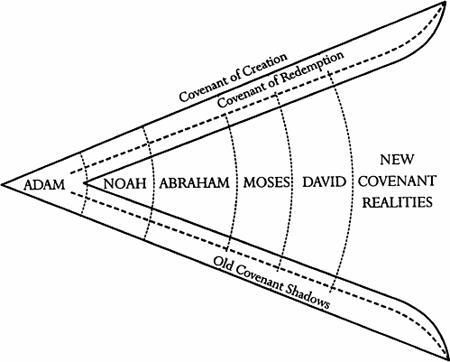
The Covenant Structure of Scripture16
But what is the role of the law in the new covenant? This is a complex and highly debated subject, which we neither can nor need to solve here except in general outline.17 Obeying the law has never been the route to establish a relationship with God. In the Old Testament, this is recognized by the fact that God rescued the Israelites from Egypt before giving them the law on Mount Sinai. The New Testament, particularly Paul, is clear that our salvation does not result from our obedience to the law (Gal. 3:10–11):
All who rely on observing the law are under a curse, for it is written: “Cursed is everyone who does not continue to do everything written in the Book of the Law.” Clearly no one is justified before God by the law, because, “The righteous will live by faith.”
However, the New Testament also indicates a continuing role for the law in such passages as James 1:22–25:
Do not merely listen to the word, and so deceive yourselves. Do what it says. Anyone who listens to the word but does not do what it says is like a man who looks at his face in a mirror and, after looking at himself, goes away and immediately forgets what he looks like. But the man who looks intently into the perfect law that gives freedom, and continues to do this, not forgetting what he has heard, but doing it—he will be blessed in what he does.
This language is reminiscent of the Old Testament teaching that those who keep the law will be blessed and those who do not will be cursed.
Again, this subject is complicated and the danger of a superficial understanding is great. For one thing, there is the question of how the Old Testament law functions in the New Testament. A full discussion would show that there is a continuity in principle, but not in the application found in the case law or in the penalties.18 Moreover, we need to remember that though there is strong teaching in Deuteronomy, the Prophets, Proverbs, and elsewhere that living a godly life leads to good results, there is also the teaching of Job, Ecclesiastes, and other books that keep us from reducing this to a facile formula. Good people do suffer in this life; bad people sometimes prosper. The New Testament indeed tells us that ultimate retribution does not take place in this life, but the next. However, to use one example, it is much more likely that you will have a good marriage if you do not commit adultery than if you do.
Jesus himself tells us that the law continues to play a crucial role in the new covenant (Matt. 5:17–20):
Do not think that I have come to abolish the Law or the Prophets; I have not come to abolish them but to fulfill them. I tell you the truth, until heaven and earth disappear, not the smallest letter, not the least stroke of a pen, will by any means disappear from the Law until everything is accomplished. Anyone who breaks one of the least of these commandments and teaches others to do the same will be called least in the kingdom of heaven, but whoever practices and teaches these commands will be called great in the kingdom of heaven. For I tell you that unless your righteousness surpasses that of the Pharisees and the teachers of the law, you will certainly not enter the kingdom of heaven.
The need for repentance. Yet as we all know, not only from the Bible but from our own experience, no one keeps the law perfectly. We have all broken the law. Breaking God’s law leads to rupture in relationships—both in our relationship with God and often in human relationships. Through our sin, we strain our ties with those who are close with us: spouse, friends, coworkers, Christian brothers and sisters.
We can see how this works in Daniel 9. Daniel recognized that Israel’s sin has ruptured its relationship with God. Historically, this break in relationship is represented by the Exile. Daniel prays to restore that relationship through a prayer of confession, apology, and repentance.
At the heart of the Christian religion stands repentance. It is not that our faith results from repentance, but repentance flows from faith in a God who forgives. Theologically, we may want to talk about how God initiates the movement toward repentance in our heart,19 but then we do not want to lose sight of the fact that our relationship with God, once broken, is restored through an act of repentance: “The time has come…. The kingdom of God is near. Repent and believe the good news” (Mark 1:15).
God requires acknowledgment of our sin in the context of restoring a relationship with us. And repentance does not stop after someone becomes a Christian. We must continue to acknowledge our inadequacies and rebellion in our relationship with God.
Before we go any further, we must square this point with a fundamental teaching of the New Testament. While we must repent of our sins, again our relationship with God is not based on our ability either to keep the law or even to keep up with our daily repentance. Why? Because our faith is not built on our good works or obedience, but rather on the work of Jesus Christ. He is the perfect lawkeeper. He is the only one who never broke the law, but he is also the one who died on the cross because of sin. In fulfillment of Old Testament sacrificial practice, Jesus is our substitute.
In the Old Testament period, an animal sacrifice accompanied the act of repentance. By sacrificing an animal, the Israelites acknowledged the depth of their sin. The animal died in their place. The New Testament teaches us that our repentance does not need an animal sacrifice because Jesus our high priest offered “one sacrifice for sins,” and by this one sacrifice “he has made perfect forever those who are being made holy” (Heb. 10:12–14).
Jesus’ death and resurrection is the foundation of our faith, not our repentance; but God calls us to repent of our sins to maintain a good relationship with him. As Paul states it, “godly sorrow [over some infraction] brings repentance that leads to salvation” (2 Cor. 7:10). Daniel displayed this sorrow in the light of the sin of God’s people, which moved him to repentance and restoration with God. Paul describes the same principle to the Corinthians and through them to us.
Repentance not only restores the divine-human relationship, but it is also at the heart of reconciliation among God’s human creatures. Let’s pause again before expanding on this thought to make explicit why we treated the role of repentance in the divine-human relationship first. The Bible teaches time and again that human relationships can only be truly restored on the basis of a restored relationship with God. We see the two intertwined as early as the Garden of Eden (Gen. 2–3). Adam and Eve enjoyed a perfectly intimate relationship with one another in the Garden as long as they worshiped God. However, the story of the Fall is the story of mistrust and rebellion against God, which resulted not only in estrangement from God but also alienation from one another.
David demonstrates how distance from God produces a break in human relationships. In David’s sin with Bathsheba, he violently tore human relationships as he slept with a married woman and then saw to it that her husband died in battle (2 Sam. 11). David tried to cover up his sin, but God sent Nathan the prophet to confront him with it. Psalm 51 is David’s prayer of repentance (and indeed is one of a number of model prayers of repentance found in the Psalter). Here is how that psalm begins (Ps. 51:1–4):
Have mercy on me, O God, according to your unfailing love;
according to your great compassion blot out my transgressions.
Wash away all my iniquity and cleanse me from my sin.
For I know my transgressions, and my sin is always before me.
Against you, you only, have I sinned and done what is evil in your sight….
Taken on its own, these verses are shocking. What could David mean that he sinned only against God? Tell that to Uriah in his grave. But in an important sense David is right. Our sins against other human beings are first and foremost sins against God, in whose image all human beings have been created.
Nonetheless, our acts and statements of repentance must go beyond a prayer, to the offended person. To restore a broken relationship often requires first a broken and humble heart. Jack Miller tells a powerful story of repentance in his book Come Back, Barbara.20 It is the story of a daughter who rebels against her upbringing by disowning God and rejecting her parents. Jack describes Barbara as turning her back on her spiritual heritage by pursuing a glamorous lifestyle of money, pleasure, and drugs. The story of the return of this prodigal daughter is a stirring one, one that climaxes with Barbara’s acknowledgment of her rebellion and a return to God and family through faith and repentance.
Today, Barbara is a leader in New Life Church in Philadelphia, the church her now-deceased father founded a couple of decades ago. Jack Miller was my pastor for a number of years before his death, and his ministry had as one of its major themes the need for daily repentance in our relationship with God and with one another. His prescription for Christian living did not devolve to become a formulaic asking of forgiveness for every little offense against another. Indeed, overt repentance can at times be a bigger offense than the original offense. I remember a friend of mine becoming convinced that she had to ask the forgiveness of everyone she had ever sinned against in the past twenty years of her life. She dutifully called her parents, her friends, former boyfriends, and acquaintances. By doing this, she brought herself some measure of relief, but she succeeded in dredging up old emotions that had been resolved long before. Wisdom is needed to know how to proceed in the matter of past offenses.
But repentance goes even further than just between individuals. Walter Wink’s recent contribution to his “Powers” series emphasizes that whole societies may find it necessary to repent in order to achieve some measure of reconciliation. As he strongly states it, “human societies could not exist without forgiveness and the public acts of contrition and confession that make reconciliation possible.”21
Perhaps the most dramatic example that Wink provides is the process happening in South Africa at the time of this writing. South Africa witnessed for many decades the brutal oppression of the black majority at the hands of the white minority in the form of the insidious institution of apartheid. Now, however, South Africa has achieved a large measure of democracy, and the black majority finds itself in positions of power. One might expect (and justice might insist) in such a situation that the powers of vengeance would immediately engulf the society in a bloodbath, but that is not what has happened. On the contrary, grace is being displayed in such institutions as the Truth and Reconciliation Commission, established in 1995. This commission announced a period of time during which individuals who committed atrocities can come forward and make a full disclosure of their crimes with the promise of amnesty in most cases and in the court of law.
The principle is biblical. There is no reconciliation without confession. After the set period of time, the offenders who do not come forward will be prosecuted to the full extent of the law, but repentance brings restoration. True, the commission is not God. Its work is imperfect. For one thing, some who seek amnesty come forward and disclose without contrition. And certainly the commission cannot insist that the families of victims embrace those who even sincerely repent of their crimes of hate. But it is a promising sign, this measure of societal repentance, which, as Wink’s narrative illustrates, has produced many moving individual stories.
1. See the discussion on pages 157–59. If Darius is not the Babylonian throne name for Cyrus, he is likely ruling at the behest of this Persian emperor.
2. As in Hartman and DiLella, The Book of Daniel, 245–46.
3. Towner, Daniel, 129–39.
4. M. Kline, Treaty of the Great King (Grand Rapids: Eerdmans, 1963); J. Niehaus, God at
Sinai (Grand Rapids: Zondervan, 1995).
5. For instance, Collins, Daniel, 348.
6. R. E. Winkle, “Jeremiah’s Seventy Weeks for Babylon: A Reassessment, Part II: The Historical Data,” AUSS 25 (1987): 289–99, is an unsuccessful attempt to place the start at events in 609 B.C.
7. “Numbers,” in The Dictionary of Biblical Imagery (Downers Grove, Ill.: InterVarsity, 1998).
8. W. L. Holladay, Jeremiah I: A Commentary on the Book of the Prophet Jeremiah (Hermeneia; Philadelphia: Fortress, 1985), 668–69.
9. Towner, Daniel, 130.
10. Or perhaps, as suggested in the previous paragraph, the seventy “sevens” are seen as prolonging the just completed seventy-year Exile.
11. Collins, Daniel, 353.
12. A close reading shows an ambiguous relationship between the first seven “sevens” and the next sixty-two. The NIV (see also the NJB and NLT) reads the two periods together as stretching from the decree to the appearance of the Anointed One, motivated no doubt in part by a desire to associate the Anointed One with Christ. Other versions and interpreters understand the two periods as separate, with the Anointed One appearing after the first seven “sevens”’ (cf. NRSV; REB; NAB).
13. Several ancient Near Eastern treaties may be found in English translation in ANET, 201–6, 529–35.
14. O. P. Robertson, The Christ of the Covenants (Phillipsburg, N.J.: Presbyterian and Reformed, 1980), 271.
15. Ibid., 276.
16. From O. P. Robertson, The Christ of the Covenants (Grand Rapids: Baker, 1980), 62.
17. For further discussion, see T. Longman III, Reading the Bible with Heart and Mind (Colorado Springs: NavPress, 1997), 113–28.
18. A helpful discussion may be found in B. K. Waltke, “Theonomy in Relation to Dispensational and Covenant Theologies,” Theonomy: A Reformed Critique ed. W. Barker and R. Godfrey (Grand Rapids: Zondervan, 1990), 59–87.
19. As Wink, When the Powers Fall, 18, puts it: “We can repent, in fact, precisely because God has already forgiven us.”
20. J. Miller and B. Miller Juliani, Come Back, Barbara, 2d ed. (Phillipsburg, N.J.: Presbyterian and Reformed, 1997).
21. Wink, When the Powers Fall, 14.
Original Meaning
Preparation for Prayer (9:1–4a)
As IS TYPICAL of the book of Daniel, the chapter begins with a chronological notice. It is the first year of Darius, “who was made ruler over the Babylonian kingdom” (v.1). This Darius had forcibly replaced Belshazzar (coregent of Nabonidus) on the throne and was likely a subordinate ruler of Cyrus of Persia (for an extended discussion of the question of the identity of Darius the Mede, see comments on ch. 6).
The significance of the mention of Darius’s first year (539 B.C.) was that this was the year in which the Persians defeated the Babylonians, whose empire, under Nebuchadnezzar, had defeated and exiled Judah some decades before. Darius’s first year as king of Babylon would have coincided with the first year of Cyrus as the great king of the Persian empire—also the year, therefore, that witnessed the decree to allow some Judeans to return to their homeland.
Daniel’s prayer seems to have taken place in anticipation of this decree. His witness to the fall of Babylon may have caused him to turn to the Scriptures with new eyes.
Rarely do we see such an explicit reference from one biblical book to another as we see here with Daniel’s appeal to Jeremiah. Some scholars are unwilling to speak of a closed prophetic canon or an authoritative Scripture at this point,5 but it is certainly hard to avoid the implication of the latter. What Jeremiah has written, after all, is referred to as the “word of the LORD.” Here we see the equation between the prophet’s words and the word of the one who commissioned him. Reading Jeremiah’s words sets off Daniel’s passionate appeal in verses 4–19.
But what did Daniel read in Jeremiah? Though verse numbers are not given, Daniel certainly had passages like Jeremiah 25:11–12; 29:10 in mind:
This whole country will become a desolate wasteland, and these nations will serve the king of Babylon seventy years.
“But when the seventy years are fulfilled, I will punish the king of Babylon and his nation, the land of the Babylonians, for their guilt,” declares the LORD, “and will make it desolate forever.”
This is what the LORD says, “When seventy years are completed for Babylon, I will come to you and fulfill my gracious promise to bring you back to this place.”
In essence these passages teach that the king of Babylon will dominate the ancient Near East (including Judah) for seventy years, after which time Babylon itself will come to an end. In the first year of Darius, Babylon has come to an end as a world power, being replaced by Persia. Daniel recognizes this as the time when the Exile may come to an end.
Note that seventy years, counting backward from 539, is 609 B.C. What happened in 609? As far as Judah and the Exile is concerned—nothing.6 The first incursion we know about is the one mentioned in Daniel 1:1–2, dated to around 605 B.C. Is seventy years a round number for the period of 605 to 539? Perhaps. However, seventy also suggests a symbolic number being seven multiplied by ten, two numbers of completeness.7 Seventy may also be seen as the approximate or symbolic number for a lifetime.8
The interpretation of this number becomes even more complex, however, when we examine two later biblical books as they reflect on Jeremiah’s prophecy of seventy years of exile. (1) Second Chronicles 36:20–22 also refers to Jeremiah’s seventy years. The Chronicler draws an interesting connection to the Sabbath rests of the land. Leviticus 25:1–7 and 26:31–35, 43 command the Israelites to allow their land to rest every seven years, which apparently they rarely, if ever, did. He then interprets the Exile as a divinely imposed period to make up for the seventy missed sabbatical years. But more telling for our interpretation of Daniel 9, it appears as if the Chronicler understood the seventy years to begin in 586 B.C., the year in which Nebuchadnezzar destroyed the temple and completed the deportation process. He also understood the Exile to end in 539 B.C. with Cyrus’s decree, thus clearly taking the number symbolically.
(2) The other relevant passage is Zechariah 1:12, where the prophet reports the plaintive cry of an angel who asks: “How long will you withhold mercy from Jerusalem and from the towns of Judah, which you have been angry with these seventy years?” According to Zechariah the seventy years are apparently still in process in 519 B.C. (the second year of a later Darius).
When we compare these passages and reflect on the number itself, we reach the conclusion that the number is not literal, nor even referring to one specific period of time. This should not concern us; it is the predominant way in which numbers are used in apocalyptic. The recognition of this fact should also prepare us for the even more extravagant use of numbers later in the chapter.
In any case, it is with a scripturally inspired sense that the Exile is coming to a close that Daniel turns to the Lord in prayer. It is significant that only in the context of this prayer is the covenant name Yahweh (“LORD” in NIV) used. This is appropriate in a prayer that appeals to God’s covenant promises to forgive and restore his people on the basis of their confession.
Daniel’s preparation for prayer indicates the kind of prayer that will follow. He fasts and puts on sackcloth and ashes, all of which are actions that indicate his deep sorrow and grief. Towner is right to identify the following prayer as a “prose prayer of penitence” and to cite its close connections with prayers found in Ezra 9:6–15; Nehemiah 1:5–11 and 9:6–37. They are “all penitential in character and all containing elements of ascription, confession, and petition.”9
Bridging Contexts
DANIEL 9 BEGINS with Scripture reading, which leads to prayer that results in divine revelation. Daniel’s reading of Jeremiah’s letter moves him to acknowledge and ask forgiveness for the sins of God’s people. The prayer, in turn, brings Gabriel to Daniel with a message from God.
The relationship between God’s Word and prayer. Before turning our focus to the content of the prayer and revelation, let’s pause for a moment on the dynamic of Daniel’s communication with God. We get a rare Old Testament glimpse of Scripture reading in relationship to prayer. How do human beings communicate with God? Daniel 9 provides an illustration. God speaks to us through the words of his representatives, the prophets—in this case the writings of Jeremiah. Though dead and gone by this time, Jeremiah’s written word still speaks God’s word to his people. Daniel hears God’s words in Jeremiah and responds through prayer. God then sends Gabriel with yet further revelation.
The principle is clear, though its contemporary application awaits the next section: God speaks to his people in his written and spoken Word. This principle is simple on the surface, but is really at the heart of biblical religion and contrasts with modern ideas of Christianity. Since the nineteenth-century philosophers Feuerbach and Nietzsche, it has commonly been believed that the God of Christianity is the product of human imagination. Human beings desire a God, so they have constructed him in their own image. The Bible, however, claims to be the revelation of God to human beings. God uses human language to make his existence and nature known to us. In the Bible, he makes his will known to his people. Daniel understands this as he meditates on Jeremiah’s letter.
The six themes of Daniel 7–12, reviewed. While the form of Daniel 9—a prayer of repentance—is unique to its context, the surrounding chapters focus on apocalyptic visions of the future, whose content, especially when the divine revelation at the end is taken into account, shares themes with the preceding and following chapters. In the section “The Nature of Apocalyptic Literature” in the Original Meaning section of chapter 7, we identified the six themes that reverberate throughout the second half of the book of Daniel, together supporting the overarching thesis of the book of Daniel: In spite of present appearances, God is in control and will win the victory.
(1) Human evil is horrible, particularly as it is concentrated in the state. This theme has certainly been in the forefront of the previous two chapters. Chapter 9 sees a shift of focus that has attracted the attention of previous interpreters. Throughout Daniel, the pagan nations, like Babylonia and Persia, have been seen as renegades from God. In Daniel’s prayer, Israel too is named as rebel and transgressor. The suffering of God’s people is ultimately the result of their own sin.
(2) A specific time of deliverance is announced. Gabriel’s response to Daniel’s prayer is an extended announcement of the time of deliverance. As we discussed at length in the previous chapter, the numbers given in reference to the time of the fulfillment of prophecy or the end are wrongly understood as a kind of apocalyptic calendar. They rather give the sense of a definite end to suffering, a time known and determined by God himself and not revealed to human beings. The numbers are ultimately symbolic and impossible of conversion to an absolute date.
In our interpretation of the “seventy ‘sevens’” in the preceding section, we noted the futile search for an interpretation of these numbers to fit with our understanding of history. Attempts to correlate these years, understood as 490 years, with the date of Antiochus Epiphanes, Jesus Christ’s first coming, his second coming, or any of the countless other special redemptive events that have caught interpreters’ attention, have been unpersuasive to any but a few devoted followers. Such futile efforts work against the purpose of these texts, which is to point to God’s determined timing of the end of sin and suffering without revealing the exact timing.
(3) Repentance leads to deliverance. Evil is the result of resisting the way of God. Sin produces suffering. God is revealed as a holy God in this book, who judges those who sin. But he is also a gracious God, who forgives those who come to him and confess their sins. Acknowledgment of sin and confession—in a word, repentance—leads to deliverance or restoration. This theme has been earmarked for special discussion in this chapter; we will reserve further comment until we finish our survey of the six themes.
(4) A cosmic war stands behind human conflict. This theme takes on major proportions in Daniel 10, but even here we get a glimpse of the supernatural universe that lies behind human history. Daniel prays to God, who in response sends an angel with his answer. In the next chapter we will see that these angels, even as they come with answers to prayer, are involved in a conflict with other supernatural powers (see comments on ch. 10).
(5) Judgment is certain for those who resist God and oppress his people. Even though the evil of God’s people is stressed in Daniel 9, the evil power that oppresses them does not escape condemnation and judgment. As we have commented above, the language of the “seventy ‘sevens’” is difficult, and at times even the basic characters of the prophecy are unclear. However, no doubt attends the revelation that the period of time culminates in the destruction of the final embodiment of evil, who sets up “an abomination that causes desolation” (9:27). God wins out in the end.
(6) Equally true is the fact that God’s people, downtrodden in the present, will experience new life in the fullest sense. Daniel’s prayer describes the covenant people as sinful and distant from God. Their sin has resulted in the judgment of the Exile. His prayer, however, is motivated by the hope of restoration that Jeremiah’s prophecy instilled in his heart. He longs for that time of deliverance. It is with a message of life that Gabriel comes to Daniel. We have seen under the previous point that the message includes punishment for those who resist God to the end, but it also talks about the restoration of God’s people. The “seventy ‘sevens,’” after all, have as their purpose “to finish transgression, to put an end to sin, to atone for wickedness, to bring in everlasting righteousness, to seal up vision and prophecy and to anoint the most holy.”
Repentance and forgiveness. We have reserved chapter 9 for a fuller discussion of the third important theme of the last half of Daniel: repentance that leads to deliverance. Daniel prays a prayer of confession that apologizes for the past sins of his people, with the hope that God will hear his prayer and begin the process of forgiveness and reconciliation. In this section, we will explore more deeply the theological dynamics that fueled Daniel’s hope.
At the heart of Daniel’s prayer stands one of the most potent and pervasive theological themes of the Old Testament: the covenant. Its sudden appearance in Daniel 9 has led some commentators, as we have seen, to question whether Daniel’s prayer is a foreign intrusion into the book. However, the covenant is such an important concept among the Old Testament people of God of whatever period that it is more surprising when it is absent. It is so pervasive an idea that it often lurks in the background, surfacing only at strategic moments. Daniel 9 is such a strategic moment.
The apocalyptic visions of the latter half of this book envision a deliverance for God’s people from the oppression that began with Nebuchadnezzar’s incursion into Judah (see 1:1–2). Israel’s culpability for this turn of events is strongly implied in the language used there for the process of domination and exile that began at that moment “the Lord delivered Jehoiakim king of Judah into his hand.” Behind this simple statement stands the judgment of God, based on the curses of the covenant.
We will first explain the concept of covenant more carefully—an English word often used to translate the Hebrew word berit. This word is not a part of our everyday vocabulary, but it still has a vital life as a legal term. It is a legal expression for a relationship where commitments are made and sanctioned by law, which have the force of penalties for noncompliance. In many ways, covenant is a good translation equivalent for the biblical idea. More recent evidence from the ancient Near East, however, allows us to understand this legal term more precisely. The legal relationship is best recognized as a political treaty. In other words, in the covenant/treaty God is the Great King, who enters into a political treaty with his servant people Israel.
This understanding was reached by the awareness that certain key texts describing the covenant relationship between God and Israel bear a similar structure and reveal similar content to ancient Near Eastern treaties, particularly those found in the Hittite capital of Boghazkoi.13 This structure illuminates the theological principle at work in Daniel 9. As we describe the six parts of a covenant/treaty document, we will illustrate them from the book of Deuteronomy. Deuteronomy is not a treaty per se, but rather a sermon that describes the treaty relationship. Thus, it follows the outline only roughly, yet close enough to see that the concept is fairly applied to Deuteronomy. Using this biblical book as our paradigm covenant has the further advantage that the Mosaic covenant is the one that lies most directly behind Daniel’s prayer.
The book of Deuteronomy follows the typical pattern of a treaty between the king of a powerful nation and the king of a relatively modest nation. This type of relationship is called a vassal treaty (as opposed to a treaty of equals, called a parity treaty) and has at least six standard elements:
- Introduction. An ancient Near Eastern vassal treaty began with the introduction of the two parties involved. In Deuteronomy 1 we do not have the actual treaty document, but we have an account of the ritual that affirms it. Clearly the two parties are God, who is the Great King, and the people of Israel, who are his servant people (Deut. 1:1–5).
- Historical review. An ancient treaty often began with a review of the history of the relationship between the two parties. In secular treaties, the great king would lay it on thick by telling the vassal king how wonderful he had been to the weaker nation and how ungrateful the other king had been to him. In Deuteronomy, of course, the historical remembrance is more than manipulative political ideology. It is the truth. God has been overwhelmingly gracious to Israel. From the Red Sea crossing to the moment forty years later when they stand poised to enter the Promised Land, God has taken care of his people (Deut. 1:9–3:27).
- Law-giving. After the gracious relationship between God and Israel has been firmly established, God gives them the law. This, too, follows the pattern of the ancient Near Eastern treaties, in which the present obligations of the law sprang from the relationship of the past. In Deuteronomy, though not in all biblical covenants, the law takes up the lion’s share of the content (Deut. 4:1–26:19). Perhaps the reason for this is Moses’ concern that Israel has been so disobedient in the desert.
The important theological point is that God delivers the law only after he has established his relationship with Israel. His law is not the cause of the relationship but the way in which the relationship will be continued and enriched. This is what we mean by saying the laws come in the context of grace. To make sure that Israel gets its priorities straight, the Ten Commandments begin with this reminder, “I am the LORD your God, who brought you out of Egypt, out of the land of slavery” (Deut. 5:6; cf. Ex. 20:2). God has graciously acted on their behalf, prior to anything they can do to earn his benevolence.
- Rewards and consequences. Next Deuteronomy stipulates consequences for disobedience. In ancient Near Eastern treaties, the great king would inform the vassal that wonderful rewards would follow obedience to his laws, while punishment would surely reach the one who disobeyed. In a similar manner, conditions are attached to Israel’s response—either blessings or curses (Deut. 27:1–28:68). These blessings and curses make their presence felt throughout the canon of the Old Testament. Samuel and Kings in particular view the Exile as a result of breaking the laws of Deuteronomy, which has thus brought on the dreaded curses. Deuteronomy 28:64 is an ominous anticipation of that horrible period of Israel’s history when God promises disobedient Israel that he will “scatter [them] among all nations.”
- Witnesses. A treaty, being at heart a legal document, needs witnesses. In the ancient Near Eastern treaties, the gods and goddesses of therespective nations often served in this capacity. For Israel, the witness is God’s creation, heaven and earth itself (Deut. 30:19–20).
- Review and succession. To complete the picture of the treaty or covenant in Old Testament times, we must mention the concern for the treaty text itself (e.g., where it should be placed) and for a regular reading of the document, as well as the provision for the succession of kings, especially in the vassal country. Treaties looked beyond the present to the future. Scribes made two copies of the treaty and usually placed them in the most important temples of the two nations entering the relationship.
This procedure wasn’t necessary in the divine-human covenant, though it has been suggested that the two tablets of the law are actually two copies. In either case, the law is written and placed in the most sacred spot possible—the ark of the covenant. Every seven years, during the Feast of the Tabernacles, the priests are to read the law so the people can reaffirm their allegiance to it (Deut. 31:9–13).
In other words, the covenant provides the reason why the Israelites are suffering at the hands of the Babylonians. They have broken the law and are suffering the consequences of the curses, which includes removal from the Promised Land and exile to a foreign land. A prime example from the curse section of the book of Deuteronomy (28:64–68) is quoted above. But that is not the end of the story. Also quoted above is 1 Kings 8:46–51, which talks about the possibility of restoration. This hope also grows from the book of Deuteronomy, which envisions in 30:1–10 a time when the sins of the people have triggered the curses of the covenant. However, thanks to God’s grace, the story does not end for God’s people at that point:
When all these blessings and curses I have set before you come upon you and you take them to heart wherever the LORD your God disperses you among the nations, and when you and your children return to the LORD your God and obey him with all your heart and with all your soul according to everything I command you today, then the LORD your God will restore your fortunes and have compassion on you and gather you again from all the nations where he scattered you. Even if you have been banished to the most distant land under the heavens, from there the LORD your God will gather you and bring you back. He will bring you to the land that belonged to your fathers, and you will take possession of it. He will make you more prosperous and numerous than your fathers. The LORD your God will circumcise your hearts and the hearts of your descendants, so that you may love him with all your heart and with all your soul, and live. The LORD your God will put all these curses on your enemies who hate and persecute you. You will again obey the LORD and follow all his commands I am giving you today. Then the LORD your God will make you most prosperous in all the work of your hands and in the fruit of your womb, the young of your livestock and the crops of your land. The LORD will again delight in you and make you prosperous, just as he delighted in your fathers, if you obey the LORD your God and keep his commands and decrees that are written in this Book of the Law and turn to the LORD your God with all your heart and with all your soul.
Daniel’s prayer is founded on the Deuteronomic covenant. He understands the present situation as the result of the breaking of the law and the consequent curses. But he also understands that the road to recovery is through repentance, which involves full acknowledgment of past transgression. There is no “forgive and forget" without confession here or anywhere in the Bible. Notice too that nowhere do we get the slightest evidence that Daniel has personally participated in the sins that led to the people’s present condition. Yet he does not say, “Forgive them, Lord.” Rather, he identifies with the people and cries out, “We have sinned and done wrong. We have been wicked and have rebelled; we have turned away from your commands and laws” (Dan. 9:5).
On the basis of a covenant relationship, Daniel turns to the Lord and confesses the sins of the people and includes himself among them. He acknowledges God’s righteousness in the Exile, but also turns to the Lord with the hope of repentance. Repentance is the road to reconciliation.
Contemporary Significance
HEARING GOD’S VOICE today. Daniel turned to the writings of Jeremiah to hear the voice of God. Here he heard God speak to him and the nation, and it motivated his response of prayer and repentance. God then spoke to him further through the agency of Gabriel, an angel. Where do we go to hear God speak today? Where does God reveal himself to us? The opening verses of the book of Hebrews (1:1–4) points us in the right direction:
In the past God spoke to our forefathers through the prophets at many times and in various ways, but in these last days he has spoken to us by his Son, whom he appointed heir of all things, and through whom he made the universe. The Son is the radiance of God’s glory and the exact representation of his being, sustaining all things by his powerful word. After he had provided purification for sins, he sat down at the right hand of the Majesty in heaven. So he became as much superior to the angels as the name he has inherited is superior to theirs.
Jesus is God’s fullest revelation of himself to us. He is God in human form. Where do we meet God in Jesus today? Most directly in the Bible. We should listen to Paul’s well-known advice to Timothy (2 Tim. 3:14–16):
Continue in what you have learned and have become convinced of, because you know those from whom you learned it, and how from infancy you have known the holy Scriptures, which are able to make you wise for salvation through faith in Christ Jesus. All Scripture is God-breathed and is useful for teaching, rebuking, correcting and training in righteousness, so that the man of God may be thoroughly equipped for every good work.
The difference between the time of Daniel and our own time is that we have a completed canon, Old and New Testament, which reveals God to us. We can see the pattern of God’s progressive revelation as it tells the story of redemption that culminates in Jesus Christ. That is why we insist on ultimately reading the Old Testament through the light of the New Testament. It is one Word of God, which culminates in the New. The brighter light of the New Testament often helps us see the Old Testament more clearly.
However, as we have done in this commentary, it is essential first to consider the teaching of the Old Testament on its own grounds first. We must ask the question what the original audience understood before we can legitimately push forward to the New Testament. Otherwise, we risk the danger of reading into the Old Testament what is not there or missing important elements of its teaching.
The new covenant in Jesus. As we bridge the horizon to the fuller revelation of the New Testament in Daniel 9, we first of all notice that the foundational concept of the covenant reaches its culmination in the teaching of Jesus. Daniel looked back to the Mosaic covenant, while Jesus speaks of a new covenant.
At the end of his life, just before going to the cross, Jesus shared a last meal with his disciples, at which he introduced a ritual we know as the “Lord’s Supper" or “communion.” This ritual is described in the following words in Matthew 26:26–30:
While they were eating, Jesus took bread, gave thanks and broke it, and gave it to his disciples, saying, “Take and eat; this is my body.”
Then he took the cup, gave thanks and offered it to them, saying, “Drink from it, all of you. This is my blood of the covenant, which is poured out for many for the forgiveness of sins. I tell you, I will not drink of this fruit of the vine from now on until that day when I drink it anew with you in my Father’s kingdom.”
When they had sung a hymn, they went out to the Mount of Olives.
Jesus thus seals a covenant with his twelve disciples. This should remind us of God’s covenant dealings in the Old Testament. As a matter of fact, Luke adds the word “new” before “covenant” (Luke 22:20), making an explicit connection with Jeremiah 31:31–33. Jesus’ language signifies continuity and discontinuity in the idea of the covenant as we move from the Old to the New Testament, and Jeremiah’s prophecy is an important transitional statement.
Jeremiah, as we have already seen, not only told the people about their coming punishment based on their breaking of the covenant law, but he also gave them the hope that their punishment would lead to their repentance and to the rescue of the remnant. The most notable instance of this is in the so-called Book of Consolation. Jeremiah 31:31–34 is at the heart of God’s message of hope:
“The time is coming,” declares the LORD, “when I will make a new covenant
with the house of Israel and with the house of Judah.
It will not be like the covenant I made with their forefathers
when I took them by the hand to lead them out of Egypt,
because they broke my covenant, though I was a husband to them,”
declares the LORD.
“This is the covenant I will make with the house of Israel after that time,” declares the LORD.
“I will put my law in their minds and write it on their hearts.
I will be their God and they will be my people.
No longer will a man teach his neighbor, or a man his brother, saying, “Know the LORD,”
because they will all know me, from the least of them to the greatest,”
declares the LORD.
Here we see a bridge between the Old Testament and the New, but one that suggests that there is both continuity and discontinuity. It is a covenant that has its foundations in the Old Testament covenants, but in some sense it is new.
What is new (i.e., what discontinuity is there) between the old covenant and the new? O. P. Robertson is correct to locate the necessity of discontinuity in the failure not of God or his covenant, but with the people. “The expulsion of the people of God from the land of promise at the time of the exile dramatizes their massive failure under the old covenant.”14 According to Jeremiah, the new covenant is internal, immediate, and intimate in comparison to the old covenant. These differences are not a difference in kind as much as in degree. It is perhaps more precise to say that the new covenant is more internal, immediate, and intimate than the old.
The passage from Jeremiah 31 just quoted indicates that the new covenant “boasts a unique feature in its power to transform its participants from within their hearts.”15 Further, there is no need for a teacher in the new covenant. Christians, as new covenant believers, know by experience that this promise does not imply that we know everything or that everything concerning God and his Word is clear to us. Nor does it mean that teachers and ministers should seek employment elsewhere. What it does mean is that no longer are human mediators of the covenant relationship needed. In the Old Testament, Moses, David, and many other leaders were the immediate recipients of the covenant relationship, and they in turn mediated it to the people. According to the New Testament, there is only one mediator and he is not merely human, he is Jesus Christ, Son of God (1 Tim. 2:5).
However, “new” in this case does not imply a complete break with the old. Robertson recognizes this and names the new covenant, the covenant of consummation. This highlights the fact that Jesus Christ does not abrogate or ignore the old covenants but rather fulfills them.
Space and time do not permit full justification of this point. Robertson does an excellent job showing how the new covenant relates to the old. He utilizes what we, his former students, used to call the “lazy V” diagram to indicate that the covenants are a function of progressive revelation, each building on the previous ones until they are consummated in Christ (see diagram on the following page).
The diagram visually represents the fact that Jesus fulfills the covenant with Abraham with its promises of descendants, land, and blessing for the nations (Gen. 12:1–3). Jesus Christ fulfills the covenant of law mediated by Moses, since he is the one who fulfills the conditions of the law. He also fulfills the covenant of the kingdom of David (2 Sam. 7), since he is David’s greater Son who sits on the throne of the heavenly kingdom, which was merely reflected by David’s political kingdom.
The Covenant Structure of Scripture16
But what is the role of the law in the new covenant? This is a complex and highly debated subject, which we neither can nor need to solve here except in general outline.17 Obeying the law has never been the route to establish a relationship with God. In the Old Testament, this is recognized by the fact that God rescued the Israelites from Egypt before giving them the law on Mount Sinai. The New Testament, particularly Paul, is clear that our salvation does not result from our obedience to the law (Gal. 3:10–11):
All who rely on observing the law are under a curse, for it is written: “Cursed is everyone who does not continue to do everything written in the Book of the Law.” Clearly no one is justified before God by the law, because, “The righteous will live by faith.”
However, the New Testament also indicates a continuing role for the law in such passages as James 1:22–25:
Do not merely listen to the word, and so deceive yourselves. Do what it says. Anyone who listens to the word but does not do what it says is like a man who looks at his face in a mirror and, after looking at himself, goes away and immediately forgets what he looks like. But the man who looks intently into the perfect law that gives freedom, and continues to do this, not forgetting what he has heard, but doing it—he will be blessed in what he does.
This language is reminiscent of the Old Testament teaching that those who keep the law will be blessed and those who do not will be cursed.
Again, this subject is complicated and the danger of a superficial understanding is great. For one thing, there is the question of how the Old Testament law functions in the New Testament. A full discussion would show that there is a continuity in principle, but not in the application found in the case law or in the penalties.18 Moreover, we need to remember that though there is strong teaching in Deuteronomy, the Prophets, Proverbs, and elsewhere that living a godly life leads to good results, there is also the teaching of Job, Ecclesiastes, and other books that keep us from reducing this to a facile formula. Good people do suffer in this life; bad people sometimes prosper. The New Testament indeed tells us that ultimate retribution does not take place in this life, but the next. However, to use one example, it is much more likely that you will have a good marriage if you do not commit adultery than if you do.
Jesus himself tells us that the law continues to play a crucial role in the new covenant (Matt. 5:17–20):
Do not think that I have come to abolish the Law or the Prophets; I have not come to abolish them but to fulfill them. I tell you the truth, until heaven and earth disappear, not the smallest letter, not the least stroke of a pen, will by any means disappear from the Law until everything is accomplished. Anyone who breaks one of the least of these commandments and teaches others to do the same will be called least in the kingdom of heaven, but whoever practices and teaches these commands will be called great in the kingdom of heaven. For I tell you that unless your righteousness surpasses that of the Pharisees and the teachers of the law, you will certainly not enter the kingdom of heaven.
The need for repentance. Yet as we all know, not only from the Bible but from our own experience, no one keeps the law perfectly. We have all broken the law. Breaking God’s law leads to rupture in relationships—both in our relationship with God and often in human relationships. Through our sin, we strain our ties with those who are close with us: spouse, friends, coworkers, Christian brothers and sisters.
We can see how this works in Daniel 9. Daniel recognized that Israel’s sin has ruptured its relationship with God. Historically, this break in relationship is represented by the Exile. Daniel prays to restore that relationship through a prayer of confession, apology, and repentance.
At the heart of the Christian religion stands repentance. It is not that our faith results from repentance, but repentance flows from faith in a God who forgives. Theologically, we may want to talk about how God initiates the movement toward repentance in our heart,19 but then we do not want to lose sight of the fact that our relationship with God, once broken, is restored through an act of repentance: “The time has come…. The kingdom of God is near. Repent and believe the good news” (Mark 1:15).
God requires acknowledgment of our sin in the context of restoring a relationship with us. And repentance does not stop after someone becomes a Christian. We must continue to acknowledge our inadequacies and rebellion in our relationship with God.
Before we go any further, we must square this point with a fundamental teaching of the New Testament. While we must repent of our sins, again our relationship with God is not based on our ability either to keep the law or even to keep up with our daily repentance. Why? Because our faith is not built on our good works or obedience, but rather on the work of Jesus Christ. He is the perfect lawkeeper. He is the only one who never broke the law, but he is also the one who died on the cross because of sin. In fulfillment of Old Testament sacrificial practice, Jesus is our substitute.
In the Old Testament period, an animal sacrifice accompanied the act of repentance. By sacrificing an animal, the Israelites acknowledged the depth of their sin. The animal died in their place. The New Testament teaches us that our repentance does not need an animal sacrifice because Jesus our high priest offered “one sacrifice for sins,” and by this one sacrifice “he has made perfect forever those who are being made holy” (Heb. 10:12–14).
Jesus’ death and resurrection is the foundation of our faith, not our repentance; but God calls us to repent of our sins to maintain a good relationship with him. As Paul states it, “godly sorrow [over some infraction] brings repentance that leads to salvation” (2 Cor. 7:10). Daniel displayed this sorrow in the light of the sin of God’s people, which moved him to repentance and restoration with God. Paul describes the same principle to the Corinthians and through them to us.
Repentance not only restores the divine-human relationship, but it is also at the heart of reconciliation among God’s human creatures. Let’s pause again before expanding on this thought to make explicit why we treated the role of repentance in the divine-human relationship first. The Bible teaches time and again that human relationships can only be truly restored on the basis of a restored relationship with God. We see the two intertwined as early as the Garden of Eden (Gen. 2–3). Adam and Eve enjoyed a perfectly intimate relationship with one another in the Garden as long as they worshiped God. However, the story of the Fall is the story of mistrust and rebellion against God, which resulted not only in estrangement from God but also alienation from one another.
David demonstrates how distance from God produces a break in human relationships. In David’s sin with Bathsheba, he violently tore human relationships as he slept with a married woman and then saw to it that her husband died in battle (2 Sam. 11). David tried to cover up his sin, but God sent Nathan the prophet to confront him with it. Psalm 51 is David’s prayer of repentance (and indeed is one of a number of model prayers of repentance found in the Psalter). Here is how that psalm begins (Ps. 51:1–4):
Have mercy on me, O God, according to your unfailing love;
according to your great compassion blot out my transgressions.
Wash away all my iniquity and cleanse me from my sin.
For I know my transgressions, and my sin is always before me.
Against you, you only, have I sinned and done what is evil in your sight….
Taken on its own, these verses are shocking. What could David mean that he sinned only against God? Tell that to Uriah in his grave. But in an important sense David is right. Our sins against other human beings are first and foremost sins against God, in whose image all human beings have been created.
Nonetheless, our acts and statements of repentance must go beyond a prayer, to the offended person. To restore a broken relationship often requires first a broken and humble heart. Jack Miller tells a powerful story of repentance in his book Come Back, Barbara.20 It is the story of a daughter who rebels against her upbringing by disowning God and rejecting her parents. Jack describes Barbara as turning her back on her spiritual heritage by pursuing a glamorous lifestyle of money, pleasure, and drugs. The story of the return of this prodigal daughter is a stirring one, one that climaxes with Barbara’s acknowledgment of her rebellion and a return to God and family through faith and repentance.
Today, Barbara is a leader in New Life Church in Philadelphia, the church her now-deceased father founded a couple of decades ago. Jack Miller was my pastor for a number of years before his death, and his ministry had as one of its major themes the need for daily repentance in our relationship with God and with one another. His prescription for Christian living did not devolve to become a formulaic asking of forgiveness for every little offense against another. Indeed, overt repentance can at times be a bigger offense than the original offense. I remember a friend of mine becoming convinced that she had to ask the forgiveness of everyone she had ever sinned against in the past twenty years of her life. She dutifully called her parents, her friends, former boyfriends, and acquaintances. By doing this, she brought herself some measure of relief, but she succeeded in dredging up old emotions that had been resolved long before. Wisdom is needed to know how to proceed in the matter of past offenses.
But repentance goes even further than just between individuals. Walter Wink’s recent contribution to his “Powers” series emphasizes that whole societies may find it necessary to repent in order to achieve some measure of reconciliation. As he strongly states it, “human societies could not exist without forgiveness and the public acts of contrition and confession that make reconciliation possible.”21
Perhaps the most dramatic example that Wink provides is the process happening in South Africa at the time of this writing. South Africa witnessed for many decades the brutal oppression of the black majority at the hands of the white minority in the form of the insidious institution of apartheid. Now, however, South Africa has achieved a large measure of democracy, and the black majority finds itself in positions of power. One might expect (and justice might insist) in such a situation that the powers of vengeance would immediately engulf the society in a bloodbath, but that is not what has happened. On the contrary, grace is being displayed in such institutions as the Truth and Reconciliation Commission, established in 1995. This commission announced a period of time during which individuals who committed atrocities can come forward and make a full disclosure of their crimes with the promise of amnesty in most cases and in the court of law.
The principle is biblical. There is no reconciliation without confession. After the set period of time, the offenders who do not come forward will be prosecuted to the full extent of the law, but repentance brings restoration. True, the commission is not God. Its work is imperfect. For one thing, some who seek amnesty come forward and disclose without contrition. And certainly the commission cannot insist that the families of victims embrace those who even sincerely repent of their crimes of hate. But it is a promising sign, this measure of societal repentance, which, as Wink’s narrative illustrates, has produced many moving individual stories.
1. See the discussion on pages 157–59. If Darius is not the Babylonian throne name for Cyrus, he is likely ruling at the behest of this Persian emperor.
2. As in Hartman and DiLella, The Book of Daniel, 245–46.
3. Towner, Daniel, 129–39.
4. M. Kline, Treaty of the Great King (Grand Rapids: Eerdmans, 1963); J. Niehaus, God at
Sinai (Grand Rapids: Zondervan, 1995).
5. For instance, Collins, Daniel, 348.
6. R. E. Winkle, “Jeremiah’s Seventy Weeks for Babylon: A Reassessment, Part II: The Historical Data,” AUSS 25 (1987): 289–99, is an unsuccessful attempt to place the start at events in 609 B.C.
7. “Numbers,” in The Dictionary of Biblical Imagery (Downers Grove, Ill.: InterVarsity, 1998).
8. W. L. Holladay, Jeremiah I: A Commentary on the Book of the Prophet Jeremiah (Hermeneia; Philadelphia: Fortress, 1985), 668–69.
9. Towner, Daniel, 130.
10. Or perhaps, as suggested in the previous paragraph, the seventy “sevens” are seen as prolonging the just completed seventy-year Exile.
11. Collins, Daniel, 353.
12. A close reading shows an ambiguous relationship between the first seven “sevens” and the next sixty-two. The NIV (see also the NJB and NLT) reads the two periods together as stretching from the decree to the appearance of the Anointed One, motivated no doubt in part by a desire to associate the Anointed One with Christ. Other versions and interpreters understand the two periods as separate, with the Anointed One appearing after the first seven “sevens”’ (cf. NRSV; REB; NAB).
13. Several ancient Near Eastern treaties may be found in English translation in ANET, 201–6, 529–35.
14. O. P. Robertson, The Christ of the Covenants (Phillipsburg, N.J.: Presbyterian and Reformed, 1980), 271.
15. Ibid., 276.
16. From O. P. Robertson, The Christ of the Covenants (Grand Rapids: Baker, 1980), 62.
17. For further discussion, see T. Longman III, Reading the Bible with Heart and Mind (Colorado Springs: NavPress, 1997), 113–28.
18. A helpful discussion may be found in B. K. Waltke, “Theonomy in Relation to Dispensational and Covenant Theologies,” Theonomy: A Reformed Critique ed. W. Barker and R. Godfrey (Grand Rapids: Zondervan, 1990), 59–87.
19. As Wink, When the Powers Fall, 18, puts it: “We can repent, in fact, precisely because God has already forgiven us.”
20. J. Miller and B. Miller Juliani, Come Back, Barbara, 2d ed. (Phillipsburg, N.J.: Presbyterian and Reformed, 1997).
21. Wink, When the Powers Fall, 14.
Original Meaning
God’s Punishment (9:11–14)
IN THE NEXT section of his prayer, Daniel draws a direct connection between the sin of the people and their present suffering. We cited above two of the curses Daniel has in mind, but there are more (see Deut. 27–28). Between the Law of Moses and the Prophets, God’s people had no excuse. They knew what the consequences of their actions would be. But somehow they rationalized it. Perhaps they grew presumptuous because of God’s long patience with them. They would sin without immediate punishment, so they began to doubt that God would really follow through with his threats. Jeremiah 7:1–29, the so-called “temple sermon” of Jeremiah, charges Israel with presumption because of the presence of the temple in the city. They wrongly reasoned that if God’s residence was the temple, there would be no way that an enemy, even one as mighty as Babylon, could defeat their city. They were safe as long as God lived in Jerusalem, and since the temple was immovable, they were safe forever.
What they did not consider was the possibility that God would abandon his temple (Ezek. 9–11). They further did not reckon with the possibility God himself would turn against them and lead the Babylonian army into the streets of Jerusalem (Jer. 21:3–7). Indeed, the horror of the resulting destruction of Jerusalem reverberates through the biblical literature of the exilic period, as seen in Lamentations 2:2–5:
Without pity the Lord has swallowed up all the dwellings of Jacob;
in his wrath he has torn down the strongholds of the Daughter of Judah.
He has brought her kingdom and its princes down to the ground in dishonor.
In fierce anger he has cut off every horn of Israel.
He has withdrawn his right hand at the approach of the enemy.
He has burned in Jacob like a flaming fire that consumes everything around it.
Like an enemy he has strung his bow; his right hand is ready.
Like a foe he has slain all who were pleasing to the eye;
he has poured out his wrath like fire on the tent of the Daughter of Zion.
The Lord is like an enemy; he has swallowed up Israel.
He has swallowed up all her palaces and destroyed her strongholds.
He has multiplied mourning and lamentation for the Daughter of Judah.
The description in Lamentations goes on and on; we cannot fathom the horror that the faithful felt at the destruction of their beloved city and their temple.
Though horrible, however, Daniel does acknowledge again that God was right in what he had done. The destruction of Jerusalem and the Exile of Judah were not acts of an arbitrary God, but rather the consequences of the sinful attitudes and actions of God’s people, about which they were repeatedly warned.
Bridging Contexts
DANIEL 9 BEGINS with Scripture reading, which leads to prayer that results in divine revelation. Daniel’s reading of Jeremiah’s letter moves him to acknowledge and ask forgiveness for the sins of God’s people. The prayer, in turn, brings Gabriel to Daniel with a message from God.
The relationship between God’s Word and prayer. Before turning our focus to the content of the prayer and revelation, let’s pause for a moment on the dynamic of Daniel’s communication with God. We get a rare Old Testament glimpse of Scripture reading in relationship to prayer. How do human beings communicate with God? Daniel 9 provides an illustration. God speaks to us through the words of his representatives, the prophets—in this case the writings of Jeremiah. Though dead and gone by this time, Jeremiah’s written word still speaks God’s word to his people. Daniel hears God’s words in Jeremiah and responds through prayer. God then sends Gabriel with yet further revelation.
The principle is clear, though its contemporary application awaits the next section: God speaks to his people in his written and spoken Word. This principle is simple on the surface, but is really at the heart of biblical religion and contrasts with modern ideas of Christianity. Since the nineteenth-century philosophers Feuerbach and Nietzsche, it has commonly been believed that the God of Christianity is the product of human imagination. Human beings desire a God, so they have constructed him in their own image. The Bible, however, claims to be the revelation of God to human beings. God uses human language to make his existence and nature known to us. In the Bible, he makes his will known to his people. Daniel understands this as he meditates on Jeremiah’s letter.
The six themes of Daniel 7–12, reviewed. While the form of Daniel 9—a prayer of repentance—is unique to its context, the surrounding chapters focus on apocalyptic visions of the future, whose content, especially when the divine revelation at the end is taken into account, shares themes with the preceding and following chapters. In the section “The Nature of Apocalyptic Literature” in the Original Meaning section of chapter 7, we identified the six themes that reverberate throughout the second half of the book of Daniel, together supporting the overarching thesis of the book of Daniel: In spite of present appearances, God is in control and will win the victory.
(1) Human evil is horrible, particularly as it is concentrated in the state. This theme has certainly been in the forefront of the previous two chapters. Chapter 9 sees a shift of focus that has attracted the attention of previous interpreters. Throughout Daniel, the pagan nations, like Babylonia and Persia, have been seen as renegades from God. In Daniel’s prayer, Israel too is named as rebel and transgressor. The suffering of God’s people is ultimately the result of their own sin.
(2) A specific time of deliverance is announced. Gabriel’s response to Daniel’s prayer is an extended announcement of the time of deliverance. As we discussed at length in the previous chapter, the numbers given in reference to the time of the fulfillment of prophecy or the end are wrongly understood as a kind of apocalyptic calendar. They rather give the sense of a definite end to suffering, a time known and determined by God himself and not revealed to human beings. The numbers are ultimately symbolic and impossible of conversion to an absolute date.
In our interpretation of the “seventy ‘sevens’” in the preceding section, we noted the futile search for an interpretation of these numbers to fit with our understanding of history. Attempts to correlate these years, understood as 490 years, with the date of Antiochus Epiphanes, Jesus Christ’s first coming, his second coming, or any of the countless other special redemptive events that have caught interpreters’ attention, have been unpersuasive to any but a few devoted followers. Such futile efforts work against the purpose of these texts, which is to point to God’s determined timing of the end of sin and suffering without revealing the exact timing.
(3) Repentance leads to deliverance. Evil is the result of resisting the way of God. Sin produces suffering. God is revealed as a holy God in this book, who judges those who sin. But he is also a gracious God, who forgives those who come to him and confess their sins. Acknowledgment of sin and confession—in a word, repentance—leads to deliverance or restoration. This theme has been earmarked for special discussion in this chapter; we will reserve further comment until we finish our survey of the six themes.
(4) A cosmic war stands behind human conflict. This theme takes on major proportions in Daniel 10, but even here we get a glimpse of the supernatural universe that lies behind human history. Daniel prays to God, who in response sends an angel with his answer. In the next chapter we will see that these angels, even as they come with answers to prayer, are involved in a conflict with other supernatural powers (see comments on ch. 10).
(5) Judgment is certain for those who resist God and oppress his people. Even though the evil of God’s people is stressed in Daniel 9, the evil power that oppresses them does not escape condemnation and judgment. As we have commented above, the language of the “seventy ‘sevens’” is difficult, and at times even the basic characters of the prophecy are unclear. However, no doubt attends the revelation that the period of time culminates in the destruction of the final embodiment of evil, who sets up “an abomination that causes desolation” (9:27). God wins out in the end.
(6) Equally true is the fact that God’s people, downtrodden in the present, will experience new life in the fullest sense. Daniel’s prayer describes the covenant people as sinful and distant from God. Their sin has resulted in the judgment of the Exile. His prayer, however, is motivated by the hope of restoration that Jeremiah’s prophecy instilled in his heart. He longs for that time of deliverance. It is with a message of life that Gabriel comes to Daniel. We have seen under the previous point that the message includes punishment for those who resist God to the end, but it also talks about the restoration of God’s people. The “seventy ‘sevens,’” after all, have as their purpose “to finish transgression, to put an end to sin, to atone for wickedness, to bring in everlasting righteousness, to seal up vision and prophecy and to anoint the most holy.”
Repentance and forgiveness. We have reserved chapter 9 for a fuller discussion of the third important theme of the last half of Daniel: repentance that leads to deliverance. Daniel prays a prayer of confession that apologizes for the past sins of his people, with the hope that God will hear his prayer and begin the process of forgiveness and reconciliation. In this section, we will explore more deeply the theological dynamics that fueled Daniel’s hope.
At the heart of Daniel’s prayer stands one of the most potent and pervasive theological themes of the Old Testament: the covenant. Its sudden appearance in Daniel 9 has led some commentators, as we have seen, to question whether Daniel’s prayer is a foreign intrusion into the book. However, the covenant is such an important concept among the Old Testament people of God of whatever period that it is more surprising when it is absent. It is so pervasive an idea that it often lurks in the background, surfacing only at strategic moments. Daniel 9 is such a strategic moment.
The apocalyptic visions of the latter half of this book envision a deliverance for God’s people from the oppression that began with Nebuchadnezzar’s incursion into Judah (see 1:1–2). Israel’s culpability for this turn of events is strongly implied in the language used there for the process of domination and exile that began at that moment “the Lord delivered Jehoiakim king of Judah into his hand.” Behind this simple statement stands the judgment of God, based on the curses of the covenant.
We will first explain the concept of covenant more carefully—an English word often used to translate the Hebrew word berit. This word is not a part of our everyday vocabulary, but it still has a vital life as a legal term. It is a legal expression for a relationship where commitments are made and sanctioned by law, which have the force of penalties for noncompliance. In many ways, covenant is a good translation equivalent for the biblical idea. More recent evidence from the ancient Near East, however, allows us to understand this legal term more precisely. The legal relationship is best recognized as a political treaty. In other words, in the covenant/treaty God is the Great King, who enters into a political treaty with his servant people Israel.
This understanding was reached by the awareness that certain key texts describing the covenant relationship between God and Israel bear a similar structure and reveal similar content to ancient Near Eastern treaties, particularly those found in the Hittite capital of Boghazkoi.13 This structure illuminates the theological principle at work in Daniel 9. As we describe the six parts of a covenant/treaty document, we will illustrate them from the book of Deuteronomy. Deuteronomy is not a treaty per se, but rather a sermon that describes the treaty relationship. Thus, it follows the outline only roughly, yet close enough to see that the concept is fairly applied to Deuteronomy. Using this biblical book as our paradigm covenant has the further advantage that the Mosaic covenant is the one that lies most directly behind Daniel’s prayer.
The book of Deuteronomy follows the typical pattern of a treaty between the king of a powerful nation and the king of a relatively modest nation. This type of relationship is called a vassal treaty (as opposed to a treaty of equals, called a parity treaty) and has at least six standard elements:
- Introduction. An ancient Near Eastern vassal treaty began with the introduction of the two parties involved. In Deuteronomy 1 we do not have the actual treaty document, but we have an account of the ritual that affirms it. Clearly the two parties are God, who is the Great King, and the people of Israel, who are his servant people (Deut. 1:1–5).
- Historical review. An ancient treaty often began with a review of the history of the relationship between the two parties. In secular treaties, the great king would lay it on thick by telling the vassal king how wonderful he had been to the weaker nation and how ungrateful the other king had been to him. In Deuteronomy, of course, the historical remembrance is more than manipulative political ideology. It is the truth. God has been overwhelmingly gracious to Israel. From the Red Sea crossing to the moment forty years later when they stand poised to enter the Promised Land, God has taken care of his people (Deut. 1:9–3:27).
- Law-giving. After the gracious relationship between God and Israel has been firmly established, God gives them the law. This, too, follows the pattern of the ancient Near Eastern treaties, in which the present obligations of the law sprang from the relationship of the past. In Deuteronomy, though not in all biblical covenants, the law takes up the lion’s share of the content (Deut. 4:1–26:19). Perhaps the reason for this is Moses’ concern that Israel has been so disobedient in the desert.
The important theological point is that God delivers the law only after he has established his relationship with Israel. His law is not the cause of the relationship but the way in which the relationship will be continued and enriched. This is what we mean by saying the laws come in the context of grace. To make sure that Israel gets its priorities straight, the Ten Commandments begin with this reminder, “I am the LORD your God, who brought you out of Egypt, out of the land of slavery” (Deut. 5:6; cf. Ex. 20:2). God has graciously acted on their behalf, prior to anything they can do to earn his benevolence.
- Rewards and consequences. Next Deuteronomy stipulates consequences for disobedience. In ancient Near Eastern treaties, the great king would inform the vassal that wonderful rewards would follow obedience to his laws, while punishment would surely reach the one who disobeyed. In a similar manner, conditions are attached to Israel’s response—either blessings or curses (Deut. 27:1–28:68). These blessings and curses make their presence felt throughout the canon of the Old Testament. Samuel and Kings in particular view the Exile as a result of breaking the laws of Deuteronomy, which has thus brought on the dreaded curses. Deuteronomy 28:64 is an ominous anticipation of that horrible period of Israel’s history when God promises disobedient Israel that he will “scatter [them] among all nations.”
- Witnesses. A treaty, being at heart a legal document, needs witnesses. In the ancient Near Eastern treaties, the gods and goddesses of therespective nations often served in this capacity. For Israel, the witness is God’s creation, heaven and earth itself (Deut. 30:19–20).
- Review and succession. To complete the picture of the treaty or covenant in Old Testament times, we must mention the concern for the treaty text itself (e.g., where it should be placed) and for a regular reading of the document, as well as the provision for the succession of kings, especially in the vassal country. Treaties looked beyond the present to the future. Scribes made two copies of the treaty and usually placed them in the most important temples of the two nations entering the relationship.
This procedure wasn’t necessary in the divine-human covenant, though it has been suggested that the two tablets of the law are actually two copies. In either case, the law is written and placed in the most sacred spot possible—the ark of the covenant. Every seven years, during the Feast of the Tabernacles, the priests are to read the law so the people can reaffirm their allegiance to it (Deut. 31:9–13).
In other words, the covenant provides the reason why the Israelites are suffering at the hands of the Babylonians. They have broken the law and are suffering the consequences of the curses, which includes removal from the Promised Land and exile to a foreign land. A prime example from the curse section of the book of Deuteronomy (28:64–68) is quoted above. But that is not the end of the story. Also quoted above is 1 Kings 8:46–51, which talks about the possibility of restoration. This hope also grows from the book of Deuteronomy, which envisions in 30:1–10 a time when the sins of the people have triggered the curses of the covenant. However, thanks to God’s grace, the story does not end for God’s people at that point:
When all these blessings and curses I have set before you come upon you and you take them to heart wherever the LORD your God disperses you among the nations, and when you and your children return to the LORD your God and obey him with all your heart and with all your soul according to everything I command you today, then the LORD your God will restore your fortunes and have compassion on you and gather you again from all the nations where he scattered you. Even if you have been banished to the most distant land under the heavens, from there the LORD your God will gather you and bring you back. He will bring you to the land that belonged to your fathers, and you will take possession of it. He will make you more prosperous and numerous than your fathers. The LORD your God will circumcise your hearts and the hearts of your descendants, so that you may love him with all your heart and with all your soul, and live. The LORD your God will put all these curses on your enemies who hate and persecute you. You will again obey the LORD and follow all his commands I am giving you today. Then the LORD your God will make you most prosperous in all the work of your hands and in the fruit of your womb, the young of your livestock and the crops of your land. The LORD will again delight in you and make you prosperous, just as he delighted in your fathers, if you obey the LORD your God and keep his commands and decrees that are written in this Book of the Law and turn to the LORD your God with all your heart and with all your soul.
Daniel’s prayer is founded on the Deuteronomic covenant. He understands the present situation as the result of the breaking of the law and the consequent curses. But he also understands that the road to recovery is through repentance, which involves full acknowledgment of past transgression. There is no “forgive and forget" without confession here or anywhere in the Bible. Notice too that nowhere do we get the slightest evidence that Daniel has personally participated in the sins that led to the people’s present condition. Yet he does not say, “Forgive them, Lord.” Rather, he identifies with the people and cries out, “We have sinned and done wrong. We have been wicked and have rebelled; we have turned away from your commands and laws” (Dan. 9:5).
On the basis of a covenant relationship, Daniel turns to the Lord and confesses the sins of the people and includes himself among them. He acknowledges God’s righteousness in the Exile, but also turns to the Lord with the hope of repentance. Repentance is the road to reconciliation.
Contemporary Significance
HEARING GOD’S VOICE today. Daniel turned to the writings of Jeremiah to hear the voice of God. Here he heard God speak to him and the nation, and it motivated his response of prayer and repentance. God then spoke to him further through the agency of Gabriel, an angel. Where do we go to hear God speak today? Where does God reveal himself to us? The opening verses of the book of Hebrews (1:1–4) points us in the right direction:
In the past God spoke to our forefathers through the prophets at many times and in various ways, but in these last days he has spoken to us by his Son, whom he appointed heir of all things, and through whom he made the universe. The Son is the radiance of God’s glory and the exact representation of his being, sustaining all things by his powerful word. After he had provided purification for sins, he sat down at the right hand of the Majesty in heaven. So he became as much superior to the angels as the name he has inherited is superior to theirs.
Jesus is God’s fullest revelation of himself to us. He is God in human form. Where do we meet God in Jesus today? Most directly in the Bible. We should listen to Paul’s well-known advice to Timothy (2 Tim. 3:14–16):
Continue in what you have learned and have become convinced of, because you know those from whom you learned it, and how from infancy you have known the holy Scriptures, which are able to make you wise for salvation through faith in Christ Jesus. All Scripture is God-breathed and is useful for teaching, rebuking, correcting and training in righteousness, so that the man of God may be thoroughly equipped for every good work.
The difference between the time of Daniel and our own time is that we have a completed canon, Old and New Testament, which reveals God to us. We can see the pattern of God’s progressive revelation as it tells the story of redemption that culminates in Jesus Christ. That is why we insist on ultimately reading the Old Testament through the light of the New Testament. It is one Word of God, which culminates in the New. The brighter light of the New Testament often helps us see the Old Testament more clearly.
However, as we have done in this commentary, it is essential first to consider the teaching of the Old Testament on its own grounds first. We must ask the question what the original audience understood before we can legitimately push forward to the New Testament. Otherwise, we risk the danger of reading into the Old Testament what is not there or missing important elements of its teaching.
The new covenant in Jesus. As we bridge the horizon to the fuller revelation of the New Testament in Daniel 9, we first of all notice that the foundational concept of the covenant reaches its culmination in the teaching of Jesus. Daniel looked back to the Mosaic covenant, while Jesus speaks of a new covenant.
At the end of his life, just before going to the cross, Jesus shared a last meal with his disciples, at which he introduced a ritual we know as the “Lord’s Supper" or “communion.” This ritual is described in the following words in Matthew 26:26–30:
While they were eating, Jesus took bread, gave thanks and broke it, and gave it to his disciples, saying, “Take and eat; this is my body.”
Then he took the cup, gave thanks and offered it to them, saying, “Drink from it, all of you. This is my blood of the covenant, which is poured out for many for the forgiveness of sins. I tell you, I will not drink of this fruit of the vine from now on until that day when I drink it anew with you in my Father’s kingdom.”
When they had sung a hymn, they went out to the Mount of Olives.
Jesus thus seals a covenant with his twelve disciples. This should remind us of God’s covenant dealings in the Old Testament. As a matter of fact, Luke adds the word “new” before “covenant” (Luke 22:20), making an explicit connection with Jeremiah 31:31–33. Jesus’ language signifies continuity and discontinuity in the idea of the covenant as we move from the Old to the New Testament, and Jeremiah’s prophecy is an important transitional statement.
Jeremiah, as we have already seen, not only told the people about their coming punishment based on their breaking of the covenant law, but he also gave them the hope that their punishment would lead to their repentance and to the rescue of the remnant. The most notable instance of this is in the so-called Book of Consolation. Jeremiah 31:31–34 is at the heart of God’s message of hope:
“The time is coming,” declares the LORD, “when I will make a new covenant
with the house of Israel and with the house of Judah.
It will not be like the covenant I made with their forefathers
when I took them by the hand to lead them out of Egypt,
because they broke my covenant, though I was a husband to them,”
declares the LORD.
“This is the covenant I will make with the house of Israel after that time,” declares the LORD.
“I will put my law in their minds and write it on their hearts.
I will be their God and they will be my people.
No longer will a man teach his neighbor, or a man his brother, saying, “Know the LORD,”
because they will all know me, from the least of them to the greatest,”
declares the LORD.
Here we see a bridge between the Old Testament and the New, but one that suggests that there is both continuity and discontinuity. It is a covenant that has its foundations in the Old Testament covenants, but in some sense it is new.
What is new (i.e., what discontinuity is there) between the old covenant and the new? O. P. Robertson is correct to locate the necessity of discontinuity in the failure not of God or his covenant, but with the people. “The expulsion of the people of God from the land of promise at the time of the exile dramatizes their massive failure under the old covenant.”14 According to Jeremiah, the new covenant is internal, immediate, and intimate in comparison to the old covenant. These differences are not a difference in kind as much as in degree. It is perhaps more precise to say that the new covenant is more internal, immediate, and intimate than the old.
The passage from Jeremiah 31 just quoted indicates that the new covenant “boasts a unique feature in its power to transform its participants from within their hearts.”15 Further, there is no need for a teacher in the new covenant. Christians, as new covenant believers, know by experience that this promise does not imply that we know everything or that everything concerning God and his Word is clear to us. Nor does it mean that teachers and ministers should seek employment elsewhere. What it does mean is that no longer are human mediators of the covenant relationship needed. In the Old Testament, Moses, David, and many other leaders were the immediate recipients of the covenant relationship, and they in turn mediated it to the people. According to the New Testament, there is only one mediator and he is not merely human, he is Jesus Christ, Son of God (1 Tim. 2:5).
However, “new” in this case does not imply a complete break with the old. Robertson recognizes this and names the new covenant, the covenant of consummation. This highlights the fact that Jesus Christ does not abrogate or ignore the old covenants but rather fulfills them.
Space and time do not permit full justification of this point. Robertson does an excellent job showing how the new covenant relates to the old. He utilizes what we, his former students, used to call the “lazy V” diagram to indicate that the covenants are a function of progressive revelation, each building on the previous ones until they are consummated in Christ (see diagram on the following page).
The diagram visually represents the fact that Jesus fulfills the covenant with Abraham with its promises of descendants, land, and blessing for the nations (Gen. 12:1–3). Jesus Christ fulfills the covenant of law mediated by Moses, since he is the one who fulfills the conditions of the law. He also fulfills the covenant of the kingdom of David (2 Sam. 7), since he is David’s greater Son who sits on the throne of the heavenly kingdom, which was merely reflected by David’s political kingdom.
The Covenant Structure of Scripture16
But what is the role of the law in the new covenant? This is a complex and highly debated subject, which we neither can nor need to solve here except in general outline.17 Obeying the law has never been the route to establish a relationship with God. In the Old Testament, this is recognized by the fact that God rescued the Israelites from Egypt before giving them the law on Mount Sinai. The New Testament, particularly Paul, is clear that our salvation does not result from our obedience to the law (Gal. 3:10–11):
All who rely on observing the law are under a curse, for it is written: “Cursed is everyone who does not continue to do everything written in the Book of the Law.” Clearly no one is justified before God by the law, because, “The righteous will live by faith.”
However, the New Testament also indicates a continuing role for the law in such passages as James 1:22–25:
Do not merely listen to the word, and so deceive yourselves. Do what it says. Anyone who listens to the word but does not do what it says is like a man who looks at his face in a mirror and, after looking at himself, goes away and immediately forgets what he looks like. But the man who looks intently into the perfect law that gives freedom, and continues to do this, not forgetting what he has heard, but doing it—he will be blessed in what he does.
This language is reminiscent of the Old Testament teaching that those who keep the law will be blessed and those who do not will be cursed.
Again, this subject is complicated and the danger of a superficial understanding is great. For one thing, there is the question of how the Old Testament law functions in the New Testament. A full discussion would show that there is a continuity in principle, but not in the application found in the case law or in the penalties.18 Moreover, we need to remember that though there is strong teaching in Deuteronomy, the Prophets, Proverbs, and elsewhere that living a godly life leads to good results, there is also the teaching of Job, Ecclesiastes, and other books that keep us from reducing this to a facile formula. Good people do suffer in this life; bad people sometimes prosper. The New Testament indeed tells us that ultimate retribution does not take place in this life, but the next. However, to use one example, it is much more likely that you will have a good marriage if you do not commit adultery than if you do.
Jesus himself tells us that the law continues to play a crucial role in the new covenant (Matt. 5:17–20):
Do not think that I have come to abolish the Law or the Prophets; I have not come to abolish them but to fulfill them. I tell you the truth, until heaven and earth disappear, not the smallest letter, not the least stroke of a pen, will by any means disappear from the Law until everything is accomplished. Anyone who breaks one of the least of these commandments and teaches others to do the same will be called least in the kingdom of heaven, but whoever practices and teaches these commands will be called great in the kingdom of heaven. For I tell you that unless your righteousness surpasses that of the Pharisees and the teachers of the law, you will certainly not enter the kingdom of heaven.
The need for repentance. Yet as we all know, not only from the Bible but from our own experience, no one keeps the law perfectly. We have all broken the law. Breaking God’s law leads to rupture in relationships—both in our relationship with God and often in human relationships. Through our sin, we strain our ties with those who are close with us: spouse, friends, coworkers, Christian brothers and sisters.
We can see how this works in Daniel 9. Daniel recognized that Israel’s sin has ruptured its relationship with God. Historically, this break in relationship is represented by the Exile. Daniel prays to restore that relationship through a prayer of confession, apology, and repentance.
At the heart of the Christian religion stands repentance. It is not that our faith results from repentance, but repentance flows from faith in a God who forgives. Theologically, we may want to talk about how God initiates the movement toward repentance in our heart,19 but then we do not want to lose sight of the fact that our relationship with God, once broken, is restored through an act of repentance: “The time has come…. The kingdom of God is near. Repent and believe the good news” (Mark 1:15).
God requires acknowledgment of our sin in the context of restoring a relationship with us. And repentance does not stop after someone becomes a Christian. We must continue to acknowledge our inadequacies and rebellion in our relationship with God.
Before we go any further, we must square this point with a fundamental teaching of the New Testament. While we must repent of our sins, again our relationship with God is not based on our ability either to keep the law or even to keep up with our daily repentance. Why? Because our faith is not built on our good works or obedience, but rather on the work of Jesus Christ. He is the perfect lawkeeper. He is the only one who never broke the law, but he is also the one who died on the cross because of sin. In fulfillment of Old Testament sacrificial practice, Jesus is our substitute.
In the Old Testament period, an animal sacrifice accompanied the act of repentance. By sacrificing an animal, the Israelites acknowledged the depth of their sin. The animal died in their place. The New Testament teaches us that our repentance does not need an animal sacrifice because Jesus our high priest offered “one sacrifice for sins,” and by this one sacrifice “he has made perfect forever those who are being made holy” (Heb. 10:12–14).
Jesus’ death and resurrection is the foundation of our faith, not our repentance; but God calls us to repent of our sins to maintain a good relationship with him. As Paul states it, “godly sorrow [over some infraction] brings repentance that leads to salvation” (2 Cor. 7:10). Daniel displayed this sorrow in the light of the sin of God’s people, which moved him to repentance and restoration with God. Paul describes the same principle to the Corinthians and through them to us.
Repentance not only restores the divine-human relationship, but it is also at the heart of reconciliation among God’s human creatures. Let’s pause again before expanding on this thought to make explicit why we treated the role of repentance in the divine-human relationship first. The Bible teaches time and again that human relationships can only be truly restored on the basis of a restored relationship with God. We see the two intertwined as early as the Garden of Eden (Gen. 2–3). Adam and Eve enjoyed a perfectly intimate relationship with one another in the Garden as long as they worshiped God. However, the story of the Fall is the story of mistrust and rebellion against God, which resulted not only in estrangement from God but also alienation from one another.
David demonstrates how distance from God produces a break in human relationships. In David’s sin with Bathsheba, he violently tore human relationships as he slept with a married woman and then saw to it that her husband died in battle (2 Sam. 11). David tried to cover up his sin, but God sent Nathan the prophet to confront him with it. Psalm 51 is David’s prayer of repentance (and indeed is one of a number of model prayers of repentance found in the Psalter). Here is how that psalm begins (Ps. 51:1–4):
Have mercy on me, O God, according to your unfailing love;
according to your great compassion blot out my transgressions.
Wash away all my iniquity and cleanse me from my sin.
For I know my transgressions, and my sin is always before me.
Against you, you only, have I sinned and done what is evil in your sight….
Taken on its own, these verses are shocking. What could David mean that he sinned only against God? Tell that to Uriah in his grave. But in an important sense David is right. Our sins against other human beings are first and foremost sins against God, in whose image all human beings have been created.
Nonetheless, our acts and statements of repentance must go beyond a prayer, to the offended person. To restore a broken relationship often requires first a broken and humble heart. Jack Miller tells a powerful story of repentance in his book Come Back, Barbara.20 It is the story of a daughter who rebels against her upbringing by disowning God and rejecting her parents. Jack describes Barbara as turning her back on her spiritual heritage by pursuing a glamorous lifestyle of money, pleasure, and drugs. The story of the return of this prodigal daughter is a stirring one, one that climaxes with Barbara’s acknowledgment of her rebellion and a return to God and family through faith and repentance.
Today, Barbara is a leader in New Life Church in Philadelphia, the church her now-deceased father founded a couple of decades ago. Jack Miller was my pastor for a number of years before his death, and his ministry had as one of its major themes the need for daily repentance in our relationship with God and with one another. His prescription for Christian living did not devolve to become a formulaic asking of forgiveness for every little offense against another. Indeed, overt repentance can at times be a bigger offense than the original offense. I remember a friend of mine becoming convinced that she had to ask the forgiveness of everyone she had ever sinned against in the past twenty years of her life. She dutifully called her parents, her friends, former boyfriends, and acquaintances. By doing this, she brought herself some measure of relief, but she succeeded in dredging up old emotions that had been resolved long before. Wisdom is needed to know how to proceed in the matter of past offenses.
But repentance goes even further than just between individuals. Walter Wink’s recent contribution to his “Powers” series emphasizes that whole societies may find it necessary to repent in order to achieve some measure of reconciliation. As he strongly states it, “human societies could not exist without forgiveness and the public acts of contrition and confession that make reconciliation possible.”21
Perhaps the most dramatic example that Wink provides is the process happening in South Africa at the time of this writing. South Africa witnessed for many decades the brutal oppression of the black majority at the hands of the white minority in the form of the insidious institution of apartheid. Now, however, South Africa has achieved a large measure of democracy, and the black majority finds itself in positions of power. One might expect (and justice might insist) in such a situation that the powers of vengeance would immediately engulf the society in a bloodbath, but that is not what has happened. On the contrary, grace is being displayed in such institutions as the Truth and Reconciliation Commission, established in 1995. This commission announced a period of time during which individuals who committed atrocities can come forward and make a full disclosure of their crimes with the promise of amnesty in most cases and in the court of law.
The principle is biblical. There is no reconciliation without confession. After the set period of time, the offenders who do not come forward will be prosecuted to the full extent of the law, but repentance brings restoration. True, the commission is not God. Its work is imperfect. For one thing, some who seek amnesty come forward and disclose without contrition. And certainly the commission cannot insist that the families of victims embrace those who even sincerely repent of their crimes of hate. But it is a promising sign, this measure of societal repentance, which, as Wink’s narrative illustrates, has produced many moving individual stories.
1. See the discussion on pages 157–59. If Darius is not the Babylonian throne name for Cyrus, he is likely ruling at the behest of this Persian emperor.
2. As in Hartman and DiLella, The Book of Daniel, 245–46.
3. Towner, Daniel, 129–39.
4. M. Kline, Treaty of the Great King (Grand Rapids: Eerdmans, 1963); J. Niehaus, God at
Sinai (Grand Rapids: Zondervan, 1995).
5. For instance, Collins, Daniel, 348.
6. R. E. Winkle, “Jeremiah’s Seventy Weeks for Babylon: A Reassessment, Part II: The Historical Data,” AUSS 25 (1987): 289–99, is an unsuccessful attempt to place the start at events in 609 B.C.
7. “Numbers,” in The Dictionary of Biblical Imagery (Downers Grove, Ill.: InterVarsity, 1998).
8. W. L. Holladay, Jeremiah I: A Commentary on the Book of the Prophet Jeremiah (Hermeneia; Philadelphia: Fortress, 1985), 668–69.
9. Towner, Daniel, 130.
10. Or perhaps, as suggested in the previous paragraph, the seventy “sevens” are seen as prolonging the just completed seventy-year Exile.
11. Collins, Daniel, 353.
12. A close reading shows an ambiguous relationship between the first seven “sevens” and the next sixty-two. The NIV (see also the NJB and NLT) reads the two periods together as stretching from the decree to the appearance of the Anointed One, motivated no doubt in part by a desire to associate the Anointed One with Christ. Other versions and interpreters understand the two periods as separate, with the Anointed One appearing after the first seven “sevens”’ (cf. NRSV; REB; NAB).
13. Several ancient Near Eastern treaties may be found in English translation in ANET, 201–6, 529–35.
14. O. P. Robertson, The Christ of the Covenants (Phillipsburg, N.J.: Presbyterian and Reformed, 1980), 271.
15. Ibid., 276.
16. From O. P. Robertson, The Christ of the Covenants (Grand Rapids: Baker, 1980), 62.
17. For further discussion, see T. Longman III, Reading the Bible with Heart and Mind (Colorado Springs: NavPress, 1997), 113–28.
18. A helpful discussion may be found in B. K. Waltke, “Theonomy in Relation to Dispensational and Covenant Theologies,” Theonomy: A Reformed Critique ed. W. Barker and R. Godfrey (Grand Rapids: Zondervan, 1990), 59–87.
19. As Wink, When the Powers Fall, 18, puts it: “We can repent, in fact, precisely because God has already forgiven us.”
20. J. Miller and B. Miller Juliani, Come Back, Barbara, 2d ed. (Phillipsburg, N.J.: Presbyterian and Reformed, 1997).
21. Wink, When the Powers Fall, 14.
Original Meaning
Appeal for Mercy (9:15–19)
DANIEL HAS BEEN praying not just on his own behalf, but as the representative of the people. He has not confessed his own sins, but rather the sins of the nation. From that foundation, he now asks God to show mercy to his people and restore the destroyed city. We noted above from 1 Kings 8 that restoration was possible after divine punishment, but it required this kind of acknowledgment of responsibility on the part of the people.
Here the prophet calls on God as the One who delivered his people out of Egypt. The Exodus was a pivotal event in the life of God’s people. It defined them as a nation. Through it, God freed them from slavery and brought them into the Promised Land. The prophets before Daniel saw an analogy between the Exodus and the future deliverance that would free them from the shackles of the Exile (cf. Isa. 40:3–5; Hos. 2:14–15). In essence, the return from the Exile would be a sort of second Exodus.
Though the plea for God’s mercy follows the confession and could not proceed without it, it is wrong to think that the confession is the basis of God’s restoration. Daniel knows that the people are still sinful and if there is any hope for them, it is in God’s righteousness and not their own (vv. 16, 18). Daniel’s appeal is ultimately based not on the people’s plight but on the reputation of God himself.
Bridging Contexts
DANIEL 9 BEGINS with Scripture reading, which leads to prayer that results in divine revelation. Daniel’s reading of Jeremiah’s letter moves him to acknowledge and ask forgiveness for the sins of God’s people. The prayer, in turn, brings Gabriel to Daniel with a message from God.
The relationship between God’s Word and prayer. Before turning our focus to the content of the prayer and revelation, let’s pause for a moment on the dynamic of Daniel’s communication with God. We get a rare Old Testament glimpse of Scripture reading in relationship to prayer. How do human beings communicate with God? Daniel 9 provides an illustration. God speaks to us through the words of his representatives, the prophets—in this case the writings of Jeremiah. Though dead and gone by this time, Jeremiah’s written word still speaks God’s word to his people. Daniel hears God’s words in Jeremiah and responds through prayer. God then sends Gabriel with yet further revelation.
The principle is clear, though its contemporary application awaits the next section: God speaks to his people in his written and spoken Word. This principle is simple on the surface, but is really at the heart of biblical religion and contrasts with modern ideas of Christianity. Since the nineteenth-century philosophers Feuerbach and Nietzsche, it has commonly been believed that the God of Christianity is the product of human imagination. Human beings desire a God, so they have constructed him in their own image. The Bible, however, claims to be the revelation of God to human beings. God uses human language to make his existence and nature known to us. In the Bible, he makes his will known to his people. Daniel understands this as he meditates on Jeremiah’s letter.
The six themes of Daniel 7–12, reviewed. While the form of Daniel 9—a prayer of repentance—is unique to its context, the surrounding chapters focus on apocalyptic visions of the future, whose content, especially when the divine revelation at the end is taken into account, shares themes with the preceding and following chapters. In the section “The Nature of Apocalyptic Literature” in the Original Meaning section of chapter 7, we identified the six themes that reverberate throughout the second half of the book of Daniel, together supporting the overarching thesis of the book of Daniel: In spite of present appearances, God is in control and will win the victory.
(1) Human evil is horrible, particularly as it is concentrated in the state. This theme has certainly been in the forefront of the previous two chapters. Chapter 9 sees a shift of focus that has attracted the attention of previous interpreters. Throughout Daniel, the pagan nations, like Babylonia and Persia, have been seen as renegades from God. In Daniel’s prayer, Israel too is named as rebel and transgressor. The suffering of God’s people is ultimately the result of their own sin.
(2) A specific time of deliverance is announced. Gabriel’s response to Daniel’s prayer is an extended announcement of the time of deliverance. As we discussed at length in the previous chapter, the numbers given in reference to the time of the fulfillment of prophecy or the end are wrongly understood as a kind of apocalyptic calendar. They rather give the sense of a definite end to suffering, a time known and determined by God himself and not revealed to human beings. The numbers are ultimately symbolic and impossible of conversion to an absolute date.
In our interpretation of the “seventy ‘sevens’” in the preceding section, we noted the futile search for an interpretation of these numbers to fit with our understanding of history. Attempts to correlate these years, understood as 490 years, with the date of Antiochus Epiphanes, Jesus Christ’s first coming, his second coming, or any of the countless other special redemptive events that have caught interpreters’ attention, have been unpersuasive to any but a few devoted followers. Such futile efforts work against the purpose of these texts, which is to point to God’s determined timing of the end of sin and suffering without revealing the exact timing.
(3) Repentance leads to deliverance. Evil is the result of resisting the way of God. Sin produces suffering. God is revealed as a holy God in this book, who judges those who sin. But he is also a gracious God, who forgives those who come to him and confess their sins. Acknowledgment of sin and confession—in a word, repentance—leads to deliverance or restoration. This theme has been earmarked for special discussion in this chapter; we will reserve further comment until we finish our survey of the six themes.
(4) A cosmic war stands behind human conflict. This theme takes on major proportions in Daniel 10, but even here we get a glimpse of the supernatural universe that lies behind human history. Daniel prays to God, who in response sends an angel with his answer. In the next chapter we will see that these angels, even as they come with answers to prayer, are involved in a conflict with other supernatural powers (see comments on ch. 10).
(5) Judgment is certain for those who resist God and oppress his people. Even though the evil of God’s people is stressed in Daniel 9, the evil power that oppresses them does not escape condemnation and judgment. As we have commented above, the language of the “seventy ‘sevens’” is difficult, and at times even the basic characters of the prophecy are unclear. However, no doubt attends the revelation that the period of time culminates in the destruction of the final embodiment of evil, who sets up “an abomination that causes desolation” (9:27). God wins out in the end.
(6) Equally true is the fact that God’s people, downtrodden in the present, will experience new life in the fullest sense. Daniel’s prayer describes the covenant people as sinful and distant from God. Their sin has resulted in the judgment of the Exile. His prayer, however, is motivated by the hope of restoration that Jeremiah’s prophecy instilled in his heart. He longs for that time of deliverance. It is with a message of life that Gabriel comes to Daniel. We have seen under the previous point that the message includes punishment for those who resist God to the end, but it also talks about the restoration of God’s people. The “seventy ‘sevens,’” after all, have as their purpose “to finish transgression, to put an end to sin, to atone for wickedness, to bring in everlasting righteousness, to seal up vision and prophecy and to anoint the most holy.”
Repentance and forgiveness. We have reserved chapter 9 for a fuller discussion of the third important theme of the last half of Daniel: repentance that leads to deliverance. Daniel prays a prayer of confession that apologizes for the past sins of his people, with the hope that God will hear his prayer and begin the process of forgiveness and reconciliation. In this section, we will explore more deeply the theological dynamics that fueled Daniel’s hope.
At the heart of Daniel’s prayer stands one of the most potent and pervasive theological themes of the Old Testament: the covenant. Its sudden appearance in Daniel 9 has led some commentators, as we have seen, to question whether Daniel’s prayer is a foreign intrusion into the book. However, the covenant is such an important concept among the Old Testament people of God of whatever period that it is more surprising when it is absent. It is so pervasive an idea that it often lurks in the background, surfacing only at strategic moments. Daniel 9 is such a strategic moment.
The apocalyptic visions of the latter half of this book envision a deliverance for God’s people from the oppression that began with Nebuchadnezzar’s incursion into Judah (see 1:1–2). Israel’s culpability for this turn of events is strongly implied in the language used there for the process of domination and exile that began at that moment “the Lord delivered Jehoiakim king of Judah into his hand.” Behind this simple statement stands the judgment of God, based on the curses of the covenant.
We will first explain the concept of covenant more carefully—an English word often used to translate the Hebrew word berit. This word is not a part of our everyday vocabulary, but it still has a vital life as a legal term. It is a legal expression for a relationship where commitments are made and sanctioned by law, which have the force of penalties for noncompliance. In many ways, covenant is a good translation equivalent for the biblical idea. More recent evidence from the ancient Near East, however, allows us to understand this legal term more precisely. The legal relationship is best recognized as a political treaty. In other words, in the covenant/treaty God is the Great King, who enters into a political treaty with his servant people Israel.
This understanding was reached by the awareness that certain key texts describing the covenant relationship between God and Israel bear a similar structure and reveal similar content to ancient Near Eastern treaties, particularly those found in the Hittite capital of Boghazkoi.13 This structure illuminates the theological principle at work in Daniel 9. As we describe the six parts of a covenant/treaty document, we will illustrate them from the book of Deuteronomy. Deuteronomy is not a treaty per se, but rather a sermon that describes the treaty relationship. Thus, it follows the outline only roughly, yet close enough to see that the concept is fairly applied to Deuteronomy. Using this biblical book as our paradigm covenant has the further advantage that the Mosaic covenant is the one that lies most directly behind Daniel’s prayer.
The book of Deuteronomy follows the typical pattern of a treaty between the king of a powerful nation and the king of a relatively modest nation. This type of relationship is called a vassal treaty (as opposed to a treaty of equals, called a parity treaty) and has at least six standard elements:
- Introduction. An ancient Near Eastern vassal treaty began with the introduction of the two parties involved. In Deuteronomy 1 we do not have the actual treaty document, but we have an account of the ritual that affirms it. Clearly the two parties are God, who is the Great King, and the people of Israel, who are his servant people (Deut. 1:1–5).
- Historical review. An ancient treaty often began with a review of the history of the relationship between the two parties. In secular treaties, the great king would lay it on thick by telling the vassal king how wonderful he had been to the weaker nation and how ungrateful the other king had been to him. In Deuteronomy, of course, the historical remembrance is more than manipulative political ideology. It is the truth. God has been overwhelmingly gracious to Israel. From the Red Sea crossing to the moment forty years later when they stand poised to enter the Promised Land, God has taken care of his people (Deut. 1:9–3:27).
- Law-giving. After the gracious relationship between God and Israel has been firmly established, God gives them the law. This, too, follows the pattern of the ancient Near Eastern treaties, in which the present obligations of the law sprang from the relationship of the past. In Deuteronomy, though not in all biblical covenants, the law takes up the lion’s share of the content (Deut. 4:1–26:19). Perhaps the reason for this is Moses’ concern that Israel has been so disobedient in the desert.
The important theological point is that God delivers the law only after he has established his relationship with Israel. His law is not the cause of the relationship but the way in which the relationship will be continued and enriched. This is what we mean by saying the laws come in the context of grace. To make sure that Israel gets its priorities straight, the Ten Commandments begin with this reminder, “I am the LORD your God, who brought you out of Egypt, out of the land of slavery” (Deut. 5:6; cf. Ex. 20:2). God has graciously acted on their behalf, prior to anything they can do to earn his benevolence.
- Rewards and consequences. Next Deuteronomy stipulates consequences for disobedience. In ancient Near Eastern treaties, the great king would inform the vassal that wonderful rewards would follow obedience to his laws, while punishment would surely reach the one who disobeyed. In a similar manner, conditions are attached to Israel’s response—either blessings or curses (Deut. 27:1–28:68). These blessings and curses make their presence felt throughout the canon of the Old Testament. Samuel and Kings in particular view the Exile as a result of breaking the laws of Deuteronomy, which has thus brought on the dreaded curses. Deuteronomy 28:64 is an ominous anticipation of that horrible period of Israel’s history when God promises disobedient Israel that he will “scatter [them] among all nations.”
- Witnesses. A treaty, being at heart a legal document, needs witnesses. In the ancient Near Eastern treaties, the gods and goddesses of therespective nations often served in this capacity. For Israel, the witness is God’s creation, heaven and earth itself (Deut. 30:19–20).
- Review and succession. To complete the picture of the treaty or covenant in Old Testament times, we must mention the concern for the treaty text itself (e.g., where it should be placed) and for a regular reading of the document, as well as the provision for the succession of kings, especially in the vassal country. Treaties looked beyond the present to the future. Scribes made two copies of the treaty and usually placed them in the most important temples of the two nations entering the relationship.
This procedure wasn’t necessary in the divine-human covenant, though it has been suggested that the two tablets of the law are actually two copies. In either case, the law is written and placed in the most sacred spot possible—the ark of the covenant. Every seven years, during the Feast of the Tabernacles, the priests are to read the law so the people can reaffirm their allegiance to it (Deut. 31:9–13).
In other words, the covenant provides the reason why the Israelites are suffering at the hands of the Babylonians. They have broken the law and are suffering the consequences of the curses, which includes removal from the Promised Land and exile to a foreign land. A prime example from the curse section of the book of Deuteronomy (28:64–68) is quoted above. But that is not the end of the story. Also quoted above is 1 Kings 8:46–51, which talks about the possibility of restoration. This hope also grows from the book of Deuteronomy, which envisions in 30:1–10 a time when the sins of the people have triggered the curses of the covenant. However, thanks to God’s grace, the story does not end for God’s people at that point:
When all these blessings and curses I have set before you come upon you and you take them to heart wherever the LORD your God disperses you among the nations, and when you and your children return to the LORD your God and obey him with all your heart and with all your soul according to everything I command you today, then the LORD your God will restore your fortunes and have compassion on you and gather you again from all the nations where he scattered you. Even if you have been banished to the most distant land under the heavens, from there the LORD your God will gather you and bring you back. He will bring you to the land that belonged to your fathers, and you will take possession of it. He will make you more prosperous and numerous than your fathers. The LORD your God will circumcise your hearts and the hearts of your descendants, so that you may love him with all your heart and with all your soul, and live. The LORD your God will put all these curses on your enemies who hate and persecute you. You will again obey the LORD and follow all his commands I am giving you today. Then the LORD your God will make you most prosperous in all the work of your hands and in the fruit of your womb, the young of your livestock and the crops of your land. The LORD will again delight in you and make you prosperous, just as he delighted in your fathers, if you obey the LORD your God and keep his commands and decrees that are written in this Book of the Law and turn to the LORD your God with all your heart and with all your soul.
Daniel’s prayer is founded on the Deuteronomic covenant. He understands the present situation as the result of the breaking of the law and the consequent curses. But he also understands that the road to recovery is through repentance, which involves full acknowledgment of past transgression. There is no “forgive and forget" without confession here or anywhere in the Bible. Notice too that nowhere do we get the slightest evidence that Daniel has personally participated in the sins that led to the people’s present condition. Yet he does not say, “Forgive them, Lord.” Rather, he identifies with the people and cries out, “We have sinned and done wrong. We have been wicked and have rebelled; we have turned away from your commands and laws” (Dan. 9:5).
On the basis of a covenant relationship, Daniel turns to the Lord and confesses the sins of the people and includes himself among them. He acknowledges God’s righteousness in the Exile, but also turns to the Lord with the hope of repentance. Repentance is the road to reconciliation.
Contemporary Significance
HEARING GOD’S VOICE today. Daniel turned to the writings of Jeremiah to hear the voice of God. Here he heard God speak to him and the nation, and it motivated his response of prayer and repentance. God then spoke to him further through the agency of Gabriel, an angel. Where do we go to hear God speak today? Where does God reveal himself to us? The opening verses of the book of Hebrews (1:1–4) points us in the right direction:
In the past God spoke to our forefathers through the prophets at many times and in various ways, but in these last days he has spoken to us by his Son, whom he appointed heir of all things, and through whom he made the universe. The Son is the radiance of God’s glory and the exact representation of his being, sustaining all things by his powerful word. After he had provided purification for sins, he sat down at the right hand of the Majesty in heaven. So he became as much superior to the angels as the name he has inherited is superior to theirs.
Jesus is God’s fullest revelation of himself to us. He is God in human form. Where do we meet God in Jesus today? Most directly in the Bible. We should listen to Paul’s well-known advice to Timothy (2 Tim. 3:14–16):
Continue in what you have learned and have become convinced of, because you know those from whom you learned it, and how from infancy you have known the holy Scriptures, which are able to make you wise for salvation through faith in Christ Jesus. All Scripture is God-breathed and is useful for teaching, rebuking, correcting and training in righteousness, so that the man of God may be thoroughly equipped for every good work.
The difference between the time of Daniel and our own time is that we have a completed canon, Old and New Testament, which reveals God to us. We can see the pattern of God’s progressive revelation as it tells the story of redemption that culminates in Jesus Christ. That is why we insist on ultimately reading the Old Testament through the light of the New Testament. It is one Word of God, which culminates in the New. The brighter light of the New Testament often helps us see the Old Testament more clearly.
However, as we have done in this commentary, it is essential first to consider the teaching of the Old Testament on its own grounds first. We must ask the question what the original audience understood before we can legitimately push forward to the New Testament. Otherwise, we risk the danger of reading into the Old Testament what is not there or missing important elements of its teaching.
The new covenant in Jesus. As we bridge the horizon to the fuller revelation of the New Testament in Daniel 9, we first of all notice that the foundational concept of the covenant reaches its culmination in the teaching of Jesus. Daniel looked back to the Mosaic covenant, while Jesus speaks of a new covenant.
At the end of his life, just before going to the cross, Jesus shared a last meal with his disciples, at which he introduced a ritual we know as the “Lord’s Supper" or “communion.” This ritual is described in the following words in Matthew 26:26–30:
While they were eating, Jesus took bread, gave thanks and broke it, and gave it to his disciples, saying, “Take and eat; this is my body.”
Then he took the cup, gave thanks and offered it to them, saying, “Drink from it, all of you. This is my blood of the covenant, which is poured out for many for the forgiveness of sins. I tell you, I will not drink of this fruit of the vine from now on until that day when I drink it anew with you in my Father’s kingdom.”
When they had sung a hymn, they went out to the Mount of Olives.
Jesus thus seals a covenant with his twelve disciples. This should remind us of God’s covenant dealings in the Old Testament. As a matter of fact, Luke adds the word “new” before “covenant” (Luke 22:20), making an explicit connection with Jeremiah 31:31–33. Jesus’ language signifies continuity and discontinuity in the idea of the covenant as we move from the Old to the New Testament, and Jeremiah’s prophecy is an important transitional statement.
Jeremiah, as we have already seen, not only told the people about their coming punishment based on their breaking of the covenant law, but he also gave them the hope that their punishment would lead to their repentance and to the rescue of the remnant. The most notable instance of this is in the so-called Book of Consolation. Jeremiah 31:31–34 is at the heart of God’s message of hope:
“The time is coming,” declares the LORD, “when I will make a new covenant
with the house of Israel and with the house of Judah.
It will not be like the covenant I made with their forefathers
when I took them by the hand to lead them out of Egypt,
because they broke my covenant, though I was a husband to them,”
declares the LORD.
“This is the covenant I will make with the house of Israel after that time,” declares the LORD.
“I will put my law in their minds and write it on their hearts.
I will be their God and they will be my people.
No longer will a man teach his neighbor, or a man his brother, saying, “Know the LORD,”
because they will all know me, from the least of them to the greatest,”
declares the LORD.
Here we see a bridge between the Old Testament and the New, but one that suggests that there is both continuity and discontinuity. It is a covenant that has its foundations in the Old Testament covenants, but in some sense it is new.
What is new (i.e., what discontinuity is there) between the old covenant and the new? O. P. Robertson is correct to locate the necessity of discontinuity in the failure not of God or his covenant, but with the people. “The expulsion of the people of God from the land of promise at the time of the exile dramatizes their massive failure under the old covenant.”14 According to Jeremiah, the new covenant is internal, immediate, and intimate in comparison to the old covenant. These differences are not a difference in kind as much as in degree. It is perhaps more precise to say that the new covenant is more internal, immediate, and intimate than the old.
The passage from Jeremiah 31 just quoted indicates that the new covenant “boasts a unique feature in its power to transform its participants from within their hearts.”15 Further, there is no need for a teacher in the new covenant. Christians, as new covenant believers, know by experience that this promise does not imply that we know everything or that everything concerning God and his Word is clear to us. Nor does it mean that teachers and ministers should seek employment elsewhere. What it does mean is that no longer are human mediators of the covenant relationship needed. In the Old Testament, Moses, David, and many other leaders were the immediate recipients of the covenant relationship, and they in turn mediated it to the people. According to the New Testament, there is only one mediator and he is not merely human, he is Jesus Christ, Son of God (1 Tim. 2:5).
However, “new” in this case does not imply a complete break with the old. Robertson recognizes this and names the new covenant, the covenant of consummation. This highlights the fact that Jesus Christ does not abrogate or ignore the old covenants but rather fulfills them.
Space and time do not permit full justification of this point. Robertson does an excellent job showing how the new covenant relates to the old. He utilizes what we, his former students, used to call the “lazy V” diagram to indicate that the covenants are a function of progressive revelation, each building on the previous ones until they are consummated in Christ (see diagram on the following page).
The diagram visually represents the fact that Jesus fulfills the covenant with Abraham with its promises of descendants, land, and blessing for the nations (Gen. 12:1–3). Jesus Christ fulfills the covenant of law mediated by Moses, since he is the one who fulfills the conditions of the law. He also fulfills the covenant of the kingdom of David (2 Sam. 7), since he is David’s greater Son who sits on the throne of the heavenly kingdom, which was merely reflected by David’s political kingdom.
The Covenant Structure of Scripture16
But what is the role of the law in the new covenant? This is a complex and highly debated subject, which we neither can nor need to solve here except in general outline.17 Obeying the law has never been the route to establish a relationship with God. In the Old Testament, this is recognized by the fact that God rescued the Israelites from Egypt before giving them the law on Mount Sinai. The New Testament, particularly Paul, is clear that our salvation does not result from our obedience to the law (Gal. 3:10–11):
All who rely on observing the law are under a curse, for it is written: “Cursed is everyone who does not continue to do everything written in the Book of the Law.” Clearly no one is justified before God by the law, because, “The righteous will live by faith.”
However, the New Testament also indicates a continuing role for the law in such passages as James 1:22–25:
Do not merely listen to the word, and so deceive yourselves. Do what it says. Anyone who listens to the word but does not do what it says is like a man who looks at his face in a mirror and, after looking at himself, goes away and immediately forgets what he looks like. But the man who looks intently into the perfect law that gives freedom, and continues to do this, not forgetting what he has heard, but doing it—he will be blessed in what he does.
This language is reminiscent of the Old Testament teaching that those who keep the law will be blessed and those who do not will be cursed.
Again, this subject is complicated and the danger of a superficial understanding is great. For one thing, there is the question of how the Old Testament law functions in the New Testament. A full discussion would show that there is a continuity in principle, but not in the application found in the case law or in the penalties.18 Moreover, we need to remember that though there is strong teaching in Deuteronomy, the Prophets, Proverbs, and elsewhere that living a godly life leads to good results, there is also the teaching of Job, Ecclesiastes, and other books that keep us from reducing this to a facile formula. Good people do suffer in this life; bad people sometimes prosper. The New Testament indeed tells us that ultimate retribution does not take place in this life, but the next. However, to use one example, it is much more likely that you will have a good marriage if you do not commit adultery than if you do.
Jesus himself tells us that the law continues to play a crucial role in the new covenant (Matt. 5:17–20):
Do not think that I have come to abolish the Law or the Prophets; I have not come to abolish them but to fulfill them. I tell you the truth, until heaven and earth disappear, not the smallest letter, not the least stroke of a pen, will by any means disappear from the Law until everything is accomplished. Anyone who breaks one of the least of these commandments and teaches others to do the same will be called least in the kingdom of heaven, but whoever practices and teaches these commands will be called great in the kingdom of heaven. For I tell you that unless your righteousness surpasses that of the Pharisees and the teachers of the law, you will certainly not enter the kingdom of heaven.
The need for repentance. Yet as we all know, not only from the Bible but from our own experience, no one keeps the law perfectly. We have all broken the law. Breaking God’s law leads to rupture in relationships—both in our relationship with God and often in human relationships. Through our sin, we strain our ties with those who are close with us: spouse, friends, coworkers, Christian brothers and sisters.
We can see how this works in Daniel 9. Daniel recognized that Israel’s sin has ruptured its relationship with God. Historically, this break in relationship is represented by the Exile. Daniel prays to restore that relationship through a prayer of confession, apology, and repentance.
At the heart of the Christian religion stands repentance. It is not that our faith results from repentance, but repentance flows from faith in a God who forgives. Theologically, we may want to talk about how God initiates the movement toward repentance in our heart,19 but then we do not want to lose sight of the fact that our relationship with God, once broken, is restored through an act of repentance: “The time has come…. The kingdom of God is near. Repent and believe the good news” (Mark 1:15).
God requires acknowledgment of our sin in the context of restoring a relationship with us. And repentance does not stop after someone becomes a Christian. We must continue to acknowledge our inadequacies and rebellion in our relationship with God.
Before we go any further, we must square this point with a fundamental teaching of the New Testament. While we must repent of our sins, again our relationship with God is not based on our ability either to keep the law or even to keep up with our daily repentance. Why? Because our faith is not built on our good works or obedience, but rather on the work of Jesus Christ. He is the perfect lawkeeper. He is the only one who never broke the law, but he is also the one who died on the cross because of sin. In fulfillment of Old Testament sacrificial practice, Jesus is our substitute.
In the Old Testament period, an animal sacrifice accompanied the act of repentance. By sacrificing an animal, the Israelites acknowledged the depth of their sin. The animal died in their place. The New Testament teaches us that our repentance does not need an animal sacrifice because Jesus our high priest offered “one sacrifice for sins,” and by this one sacrifice “he has made perfect forever those who are being made holy” (Heb. 10:12–14).
Jesus’ death and resurrection is the foundation of our faith, not our repentance; but God calls us to repent of our sins to maintain a good relationship with him. As Paul states it, “godly sorrow [over some infraction] brings repentance that leads to salvation” (2 Cor. 7:10). Daniel displayed this sorrow in the light of the sin of God’s people, which moved him to repentance and restoration with God. Paul describes the same principle to the Corinthians and through them to us.
Repentance not only restores the divine-human relationship, but it is also at the heart of reconciliation among God’s human creatures. Let’s pause again before expanding on this thought to make explicit why we treated the role of repentance in the divine-human relationship first. The Bible teaches time and again that human relationships can only be truly restored on the basis of a restored relationship with God. We see the two intertwined as early as the Garden of Eden (Gen. 2–3). Adam and Eve enjoyed a perfectly intimate relationship with one another in the Garden as long as they worshiped God. However, the story of the Fall is the story of mistrust and rebellion against God, which resulted not only in estrangement from God but also alienation from one another.
David demonstrates how distance from God produces a break in human relationships. In David’s sin with Bathsheba, he violently tore human relationships as he slept with a married woman and then saw to it that her husband died in battle (2 Sam. 11). David tried to cover up his sin, but God sent Nathan the prophet to confront him with it. Psalm 51 is David’s prayer of repentance (and indeed is one of a number of model prayers of repentance found in the Psalter). Here is how that psalm begins (Ps. 51:1–4):
Have mercy on me, O God, according to your unfailing love;
according to your great compassion blot out my transgressions.
Wash away all my iniquity and cleanse me from my sin.
For I know my transgressions, and my sin is always before me.
Against you, you only, have I sinned and done what is evil in your sight….
Taken on its own, these verses are shocking. What could David mean that he sinned only against God? Tell that to Uriah in his grave. But in an important sense David is right. Our sins against other human beings are first and foremost sins against God, in whose image all human beings have been created.
Nonetheless, our acts and statements of repentance must go beyond a prayer, to the offended person. To restore a broken relationship often requires first a broken and humble heart. Jack Miller tells a powerful story of repentance in his book Come Back, Barbara.20 It is the story of a daughter who rebels against her upbringing by disowning God and rejecting her parents. Jack describes Barbara as turning her back on her spiritual heritage by pursuing a glamorous lifestyle of money, pleasure, and drugs. The story of the return of this prodigal daughter is a stirring one, one that climaxes with Barbara’s acknowledgment of her rebellion and a return to God and family through faith and repentance.
Today, Barbara is a leader in New Life Church in Philadelphia, the church her now-deceased father founded a couple of decades ago. Jack Miller was my pastor for a number of years before his death, and his ministry had as one of its major themes the need for daily repentance in our relationship with God and with one another. His prescription for Christian living did not devolve to become a formulaic asking of forgiveness for every little offense against another. Indeed, overt repentance can at times be a bigger offense than the original offense. I remember a friend of mine becoming convinced that she had to ask the forgiveness of everyone she had ever sinned against in the past twenty years of her life. She dutifully called her parents, her friends, former boyfriends, and acquaintances. By doing this, she brought herself some measure of relief, but she succeeded in dredging up old emotions that had been resolved long before. Wisdom is needed to know how to proceed in the matter of past offenses.
But repentance goes even further than just between individuals. Walter Wink’s recent contribution to his “Powers” series emphasizes that whole societies may find it necessary to repent in order to achieve some measure of reconciliation. As he strongly states it, “human societies could not exist without forgiveness and the public acts of contrition and confession that make reconciliation possible.”21
Perhaps the most dramatic example that Wink provides is the process happening in South Africa at the time of this writing. South Africa witnessed for many decades the brutal oppression of the black majority at the hands of the white minority in the form of the insidious institution of apartheid. Now, however, South Africa has achieved a large measure of democracy, and the black majority finds itself in positions of power. One might expect (and justice might insist) in such a situation that the powers of vengeance would immediately engulf the society in a bloodbath, but that is not what has happened. On the contrary, grace is being displayed in such institutions as the Truth and Reconciliation Commission, established in 1995. This commission announced a period of time during which individuals who committed atrocities can come forward and make a full disclosure of their crimes with the promise of amnesty in most cases and in the court of law.
The principle is biblical. There is no reconciliation without confession. After the set period of time, the offenders who do not come forward will be prosecuted to the full extent of the law, but repentance brings restoration. True, the commission is not God. Its work is imperfect. For one thing, some who seek amnesty come forward and disclose without contrition. And certainly the commission cannot insist that the families of victims embrace those who even sincerely repent of their crimes of hate. But it is a promising sign, this measure of societal repentance, which, as Wink’s narrative illustrates, has produced many moving individual stories.
1. See the discussion on pages 157–59. If Darius is not the Babylonian throne name for Cyrus, he is likely ruling at the behest of this Persian emperor.
2. As in Hartman and DiLella, The Book of Daniel, 245–46.
3. Towner, Daniel, 129–39.
4. M. Kline, Treaty of the Great King (Grand Rapids: Eerdmans, 1963); J. Niehaus, God at
Sinai (Grand Rapids: Zondervan, 1995).
5. For instance, Collins, Daniel, 348.
6. R. E. Winkle, “Jeremiah’s Seventy Weeks for Babylon: A Reassessment, Part II: The Historical Data,” AUSS 25 (1987): 289–99, is an unsuccessful attempt to place the start at events in 609 B.C.
7. “Numbers,” in The Dictionary of Biblical Imagery (Downers Grove, Ill.: InterVarsity, 1998).
8. W. L. Holladay, Jeremiah I: A Commentary on the Book of the Prophet Jeremiah (Hermeneia; Philadelphia: Fortress, 1985), 668–69.
9. Towner, Daniel, 130.
10. Or perhaps, as suggested in the previous paragraph, the seventy “sevens” are seen as prolonging the just completed seventy-year Exile.
11. Collins, Daniel, 353.
12. A close reading shows an ambiguous relationship between the first seven “sevens” and the next sixty-two. The NIV (see also the NJB and NLT) reads the two periods together as stretching from the decree to the appearance of the Anointed One, motivated no doubt in part by a desire to associate the Anointed One with Christ. Other versions and interpreters understand the two periods as separate, with the Anointed One appearing after the first seven “sevens”’ (cf. NRSV; REB; NAB).
13. Several ancient Near Eastern treaties may be found in English translation in ANET, 201–6, 529–35.
14. O. P. Robertson, The Christ of the Covenants (Phillipsburg, N.J.: Presbyterian and Reformed, 1980), 271.
15. Ibid., 276.
16. From O. P. Robertson, The Christ of the Covenants (Grand Rapids: Baker, 1980), 62.
17. For further discussion, see T. Longman III, Reading the Bible with Heart and Mind (Colorado Springs: NavPress, 1997), 113–28.
18. A helpful discussion may be found in B. K. Waltke, “Theonomy in Relation to Dispensational and Covenant Theologies,” Theonomy: A Reformed Critique ed. W. Barker and R. Godfrey (Grand Rapids: Zondervan, 1990), 59–87.
19. As Wink, When the Powers Fall, 18, puts it: “We can repent, in fact, precisely because God has already forgiven us.”
20. J. Miller and B. Miller Juliani, Come Back, Barbara, 2d ed. (Phillipsburg, N.J.: Presbyterian and Reformed, 1997).
21. Wink, When the Powers Fall, 14.
Original Meaning
The Prophecy of the Seventy Weeks (9:20–27)
DANIEL’S PRAYER GIVES the impression of completeness, ending as it does with an impassioned plea for God to hear the prayer and forgive his people without delay (v. 19). The prophet is still in a prayerful frame of mind, perhaps continuing with urgent appeals to God to answer the prayer, when he is suddenly interrupted by Gabriel, the angel who interpreted the vision of the previous chapter. Gabriel may well have had the task of interpreter among the angels of the Lord.
We must remember that Daniel’s prayer for forgiveness and restoration was motivated by his reading of Jeremiah’s prophecy that the Exile would last seventy years. Gabriel’s answer to Daniel’s prayer is an interpretation of the seventy years in a way that seems to extend its purview. Gabriel apparently suggests that the end of the seventy-year exile begins a process, one that will last for seventy “sevens,” or weeks of years—usually understood as 490 years.
We will begin our exploration of Gabriel’s speech by paraphrasing it without attempting to relate it to the future or historical events. Daniel has prayed for forgiveness and restoration, and Gabriel now communicates the heavenly answer by reinterpreting the seventy years as seventy “sevens.”10 During this period six actions will be completed: (1) the finishing of transgression, (2) the end of sin, (3) the atonement of the wicked, (4) the bringing in of everlasting righteousness, (5) the sealing up of vision and prophecy, and (6) the anointing of the most holy (v. 24). The accomplishment of these six actions certainly sounds like an answer to Daniel’s prayer, but they are being pushed off to the future (the force of the seventy “sevens” to be explained below). They are, in the words of J. J. Collins, an “eschatological ideal.”11
The first two actions describe the end of sin, presumably on the part of God’s people; after all, that was what Daniel’s prayer called for. However, it may also encompass the sins of all people, including the sins of the nations described as beasts in chapters 7 and 8. The third action, “to atone for wickedness,” emphasizes the theme of the first two, the eradication of sin. But whereas the first two simply describe the cessation of sinful activity, this third action implies that God removes the consequences of already committed sinful behavior.
While the first three actions describe the eradication of the negative, the next three are more positive in focus. The first is clearly positive, though of a general nature and hard to specify: The completion of the seventy sevens will see the introduction of “everlasting righteousness.” The second, the sealing of vision and prophecy, is sometimes misunderstood as a sealing away. But sealing in its ancient context is better understood as a mark of approval, an authentication of the prophetic word. Perhaps in this context it implies the act of authentication, that is, the ultimate fulfillment of Jeremiah’s prophecy. The last, and perhaps the culmination of the six actions, is the anointing of “the most holy.” Some take the reference as pointing to the temple and its cleansing by the Maccabean rebels after being profaned by Antiochus Epiphanes in the middle of the second century B.C. Another ancient tradition, however, takes the reference not to a place but to a person—the Messiah.
These six actions take place during the entire period of seventy “sevens.” They describe the eradication of evil and the establishment of righteousness. In the present, Daniel and his companions know an imperfect world, but in the future things will be wonderful.
Far from concluding his speech, Gabriel continues by taking a more nuanced look at the seventy “sevens.” He divides the period into parts, charting a kind of forward-looking history of the seventy “sevens.” In essence, he divides the entire period into three parts (vv. 25–27). (1) The first seven “sevens” and (2) the next sixty-two “sevens” are in one sense treated as a single unit—though in another obvious way as two—and encompass the period between the decree to restore and rebuild Jerusalem and the coming of “the Anointed One.”12 We are already used to this enigmatic way of referring to future time periods, so we are not surprised at the questions that arise from these numbers. Why exactly is the first seven “sevens” separated from the next sixty-two? Apparently, we are to think of that shorter period as having a kind of integrity of its own, but what marks its ending point? Which decree of many that we know about is in Gabriel’s mind? Who is "the Anointed One"? We will address these questions below.
With the phrase “streets and a trench” (v. 25a) the passage intends to communicate that Jerusalem will be completely restored and that this restoration will take place in an atmosphere of “trouble” (v. 25b).
The end of the sixty-nine “seven’s” (the combination of the two first periods) marks a turbulent time. Again, the language is enigmatic. The Anointed One will be cut off, and the “people of the ruler” will destroy the “city and the sanctuary” (v. 26). The devastation will be complete and perhaps quick since it is compared to a flood. It will be a time of war and desolation.
(3) The last “seven,” the seventieth, is itself divided in the middle and, far from clearing things up, continues the enigma. In the first place, the action of the seventieth week emanates from a single individual, who is simply referred to as “he.” The closest antecedent is the “ruler” (nagid) of verse 26. The latter’s relationship to the Anointed One is unclear and, as we will see, debated. Are they the same? After all, in verse 25 it is clear that the “Anointed One” is called the ruler (nagid), but the ruler in verse 26 is associated with destructive actions; and most Christian interpretations understand the Anointed One in a positive manner.
Nevertheless, it is clear that the actions of the seventieth week are the work of a destructive force. The unspecified “he” confirms a covenant for one “seven,” presumably the seventieth, but in the middle of it he cuts off sacrifice and offering. While it may be possible to construe the latter in some way as positive, the erection of “an abomination that causes desolation” clearly is not. The period of the prophecy ends with the end of this disruptive person. In the next section, we will delve further, but with great caution, into the morass of interpretations of this enigmatic oracle.
Bridging Contexts
DANIEL 9 BEGINS with Scripture reading, which leads to prayer that results in divine revelation. Daniel’s reading of Jeremiah’s letter moves him to acknowledge and ask forgiveness for the sins of God’s people. The prayer, in turn, brings Gabriel to Daniel with a message from God.
The relationship between God’s Word and prayer. Before turning our focus to the content of the prayer and revelation, let’s pause for a moment on the dynamic of Daniel’s communication with God. We get a rare Old Testament glimpse of Scripture reading in relationship to prayer. How do human beings communicate with God? Daniel 9 provides an illustration. God speaks to us through the words of his representatives, the prophets—in this case the writings of Jeremiah. Though dead and gone by this time, Jeremiah’s written word still speaks God’s word to his people. Daniel hears God’s words in Jeremiah and responds through prayer. God then sends Gabriel with yet further revelation.
The principle is clear, though its contemporary application awaits the next section: God speaks to his people in his written and spoken Word. This principle is simple on the surface, but is really at the heart of biblical religion and contrasts with modern ideas of Christianity. Since the nineteenth-century philosophers Feuerbach and Nietzsche, it has commonly been believed that the God of Christianity is the product of human imagination. Human beings desire a God, so they have constructed him in their own image. The Bible, however, claims to be the revelation of God to human beings. God uses human language to make his existence and nature known to us. In the Bible, he makes his will known to his people. Daniel understands this as he meditates on Jeremiah’s letter.
The six themes of Daniel 7–12, reviewed. While the form of Daniel 9—a prayer of repentance—is unique to its context, the surrounding chapters focus on apocalyptic visions of the future, whose content, especially when the divine revelation at the end is taken into account, shares themes with the preceding and following chapters. In the section “The Nature of Apocalyptic Literature” in the Original Meaning section of chapter 7, we identified the six themes that reverberate throughout the second half of the book of Daniel, together supporting the overarching thesis of the book of Daniel: In spite of present appearances, God is in control and will win the victory.
(1) Human evil is horrible, particularly as it is concentrated in the state. This theme has certainly been in the forefront of the previous two chapters. Chapter 9 sees a shift of focus that has attracted the attention of previous interpreters. Throughout Daniel, the pagan nations, like Babylonia and Persia, have been seen as renegades from God. In Daniel’s prayer, Israel too is named as rebel and transgressor. The suffering of God’s people is ultimately the result of their own sin.
(2) A specific time of deliverance is announced. Gabriel’s response to Daniel’s prayer is an extended announcement of the time of deliverance. As we discussed at length in the previous chapter, the numbers given in reference to the time of the fulfillment of prophecy or the end are wrongly understood as a kind of apocalyptic calendar. They rather give the sense of a definite end to suffering, a time known and determined by God himself and not revealed to human beings. The numbers are ultimately symbolic and impossible of conversion to an absolute date.
In our interpretation of the “seventy ‘sevens’” in the preceding section, we noted the futile search for an interpretation of these numbers to fit with our understanding of history. Attempts to correlate these years, understood as 490 years, with the date of Antiochus Epiphanes, Jesus Christ’s first coming, his second coming, or any of the countless other special redemptive events that have caught interpreters’ attention, have been unpersuasive to any but a few devoted followers. Such futile efforts work against the purpose of these texts, which is to point to God’s determined timing of the end of sin and suffering without revealing the exact timing.
(3) Repentance leads to deliverance. Evil is the result of resisting the way of God. Sin produces suffering. God is revealed as a holy God in this book, who judges those who sin. But he is also a gracious God, who forgives those who come to him and confess their sins. Acknowledgment of sin and confession—in a word, repentance—leads to deliverance or restoration. This theme has been earmarked for special discussion in this chapter; we will reserve further comment until we finish our survey of the six themes.
(4) A cosmic war stands behind human conflict. This theme takes on major proportions in Daniel 10, but even here we get a glimpse of the supernatural universe that lies behind human history. Daniel prays to God, who in response sends an angel with his answer. In the next chapter we will see that these angels, even as they come with answers to prayer, are involved in a conflict with other supernatural powers (see comments on ch. 10).
(5) Judgment is certain for those who resist God and oppress his people. Even though the evil of God’s people is stressed in Daniel 9, the evil power that oppresses them does not escape condemnation and judgment. As we have commented above, the language of the “seventy ‘sevens’” is difficult, and at times even the basic characters of the prophecy are unclear. However, no doubt attends the revelation that the period of time culminates in the destruction of the final embodiment of evil, who sets up “an abomination that causes desolation” (9:27). God wins out in the end.
(6) Equally true is the fact that God’s people, downtrodden in the present, will experience new life in the fullest sense. Daniel’s prayer describes the covenant people as sinful and distant from God. Their sin has resulted in the judgment of the Exile. His prayer, however, is motivated by the hope of restoration that Jeremiah’s prophecy instilled in his heart. He longs for that time of deliverance. It is with a message of life that Gabriel comes to Daniel. We have seen under the previous point that the message includes punishment for those who resist God to the end, but it also talks about the restoration of God’s people. The “seventy ‘sevens,’” after all, have as their purpose “to finish transgression, to put an end to sin, to atone for wickedness, to bring in everlasting righteousness, to seal up vision and prophecy and to anoint the most holy.”
Repentance and forgiveness. We have reserved chapter 9 for a fuller discussion of the third important theme of the last half of Daniel: repentance that leads to deliverance. Daniel prays a prayer of confession that apologizes for the past sins of his people, with the hope that God will hear his prayer and begin the process of forgiveness and reconciliation. In this section, we will explore more deeply the theological dynamics that fueled Daniel’s hope.
At the heart of Daniel’s prayer stands one of the most potent and pervasive theological themes of the Old Testament: the covenant. Its sudden appearance in Daniel 9 has led some commentators, as we have seen, to question whether Daniel’s prayer is a foreign intrusion into the book. However, the covenant is such an important concept among the Old Testament people of God of whatever period that it is more surprising when it is absent. It is so pervasive an idea that it often lurks in the background, surfacing only at strategic moments. Daniel 9 is such a strategic moment.
The apocalyptic visions of the latter half of this book envision a deliverance for God’s people from the oppression that began with Nebuchadnezzar’s incursion into Judah (see 1:1–2). Israel’s culpability for this turn of events is strongly implied in the language used there for the process of domination and exile that began at that moment “the Lord delivered Jehoiakim king of Judah into his hand.” Behind this simple statement stands the judgment of God, based on the curses of the covenant.
We will first explain the concept of covenant more carefully—an English word often used to translate the Hebrew word berit. This word is not a part of our everyday vocabulary, but it still has a vital life as a legal term. It is a legal expression for a relationship where commitments are made and sanctioned by law, which have the force of penalties for noncompliance. In many ways, covenant is a good translation equivalent for the biblical idea. More recent evidence from the ancient Near East, however, allows us to understand this legal term more precisely. The legal relationship is best recognized as a political treaty. In other words, in the covenant/treaty God is the Great King, who enters into a political treaty with his servant people Israel.
This understanding was reached by the awareness that certain key texts describing the covenant relationship between God and Israel bear a similar structure and reveal similar content to ancient Near Eastern treaties, particularly those found in the Hittite capital of Boghazkoi.13 This structure illuminates the theological principle at work in Daniel 9. As we describe the six parts of a covenant/treaty document, we will illustrate them from the book of Deuteronomy. Deuteronomy is not a treaty per se, but rather a sermon that describes the treaty relationship. Thus, it follows the outline only roughly, yet close enough to see that the concept is fairly applied to Deuteronomy. Using this biblical book as our paradigm covenant has the further advantage that the Mosaic covenant is the one that lies most directly behind Daniel’s prayer.
The book of Deuteronomy follows the typical pattern of a treaty between the king of a powerful nation and the king of a relatively modest nation. This type of relationship is called a vassal treaty (as opposed to a treaty of equals, called a parity treaty) and has at least six standard elements:
- Introduction. An ancient Near Eastern vassal treaty began with the introduction of the two parties involved. In Deuteronomy 1 we do not have the actual treaty document, but we have an account of the ritual that affirms it. Clearly the two parties are God, who is the Great King, and the people of Israel, who are his servant people (Deut. 1:1–5).
- Historical review. An ancient treaty often began with a review of the history of the relationship between the two parties. In secular treaties, the great king would lay it on thick by telling the vassal king how wonderful he had been to the weaker nation and how ungrateful the other king had been to him. In Deuteronomy, of course, the historical remembrance is more than manipulative political ideology. It is the truth. God has been overwhelmingly gracious to Israel. From the Red Sea crossing to the moment forty years later when they stand poised to enter the Promised Land, God has taken care of his people (Deut. 1:9–3:27).
- Law-giving. After the gracious relationship between God and Israel has been firmly established, God gives them the law. This, too, follows the pattern of the ancient Near Eastern treaties, in which the present obligations of the law sprang from the relationship of the past. In Deuteronomy, though not in all biblical covenants, the law takes up the lion’s share of the content (Deut. 4:1–26:19). Perhaps the reason for this is Moses’ concern that Israel has been so disobedient in the desert.
The important theological point is that God delivers the law only after he has established his relationship with Israel. His law is not the cause of the relationship but the way in which the relationship will be continued and enriched. This is what we mean by saying the laws come in the context of grace. To make sure that Israel gets its priorities straight, the Ten Commandments begin with this reminder, “I am the LORD your God, who brought you out of Egypt, out of the land of slavery” (Deut. 5:6; cf. Ex. 20:2). God has graciously acted on their behalf, prior to anything they can do to earn his benevolence.
- Rewards and consequences. Next Deuteronomy stipulates consequences for disobedience. In ancient Near Eastern treaties, the great king would inform the vassal that wonderful rewards would follow obedience to his laws, while punishment would surely reach the one who disobeyed. In a similar manner, conditions are attached to Israel’s response—either blessings or curses (Deut. 27:1–28:68). These blessings and curses make their presence felt throughout the canon of the Old Testament. Samuel and Kings in particular view the Exile as a result of breaking the laws of Deuteronomy, which has thus brought on the dreaded curses. Deuteronomy 28:64 is an ominous anticipation of that horrible period of Israel’s history when God promises disobedient Israel that he will “scatter [them] among all nations.”
- Witnesses. A treaty, being at heart a legal document, needs witnesses. In the ancient Near Eastern treaties, the gods and goddesses of therespective nations often served in this capacity. For Israel, the witness is God’s creation, heaven and earth itself (Deut. 30:19–20).
- Review and succession. To complete the picture of the treaty or covenant in Old Testament times, we must mention the concern for the treaty text itself (e.g., where it should be placed) and for a regular reading of the document, as well as the provision for the succession of kings, especially in the vassal country. Treaties looked beyond the present to the future. Scribes made two copies of the treaty and usually placed them in the most important temples of the two nations entering the relationship.
This procedure wasn’t necessary in the divine-human covenant, though it has been suggested that the two tablets of the law are actually two copies. In either case, the law is written and placed in the most sacred spot possible—the ark of the covenant. Every seven years, during the Feast of the Tabernacles, the priests are to read the law so the people can reaffirm their allegiance to it (Deut. 31:9–13).
In other words, the covenant provides the reason why the Israelites are suffering at the hands of the Babylonians. They have broken the law and are suffering the consequences of the curses, which includes removal from the Promised Land and exile to a foreign land. A prime example from the curse section of the book of Deuteronomy (28:64–68) is quoted above. But that is not the end of the story. Also quoted above is 1 Kings 8:46–51, which talks about the possibility of restoration. This hope also grows from the book of Deuteronomy, which envisions in 30:1–10 a time when the sins of the people have triggered the curses of the covenant. However, thanks to God’s grace, the story does not end for God’s people at that point:
When all these blessings and curses I have set before you come upon you and you take them to heart wherever the LORD your God disperses you among the nations, and when you and your children return to the LORD your God and obey him with all your heart and with all your soul according to everything I command you today, then the LORD your God will restore your fortunes and have compassion on you and gather you again from all the nations where he scattered you. Even if you have been banished to the most distant land under the heavens, from there the LORD your God will gather you and bring you back. He will bring you to the land that belonged to your fathers, and you will take possession of it. He will make you more prosperous and numerous than your fathers. The LORD your God will circumcise your hearts and the hearts of your descendants, so that you may love him with all your heart and with all your soul, and live. The LORD your God will put all these curses on your enemies who hate and persecute you. You will again obey the LORD and follow all his commands I am giving you today. Then the LORD your God will make you most prosperous in all the work of your hands and in the fruit of your womb, the young of your livestock and the crops of your land. The LORD will again delight in you and make you prosperous, just as he delighted in your fathers, if you obey the LORD your God and keep his commands and decrees that are written in this Book of the Law and turn to the LORD your God with all your heart and with all your soul.
Daniel’s prayer is founded on the Deuteronomic covenant. He understands the present situation as the result of the breaking of the law and the consequent curses. But he also understands that the road to recovery is through repentance, which involves full acknowledgment of past transgression. There is no “forgive and forget" without confession here or anywhere in the Bible. Notice too that nowhere do we get the slightest evidence that Daniel has personally participated in the sins that led to the people’s present condition. Yet he does not say, “Forgive them, Lord.” Rather, he identifies with the people and cries out, “We have sinned and done wrong. We have been wicked and have rebelled; we have turned away from your commands and laws” (Dan. 9:5).
On the basis of a covenant relationship, Daniel turns to the Lord and confesses the sins of the people and includes himself among them. He acknowledges God’s righteousness in the Exile, but also turns to the Lord with the hope of repentance. Repentance is the road to reconciliation.
Contemporary Significance
HEARING GOD’S VOICE today. Daniel turned to the writings of Jeremiah to hear the voice of God. Here he heard God speak to him and the nation, and it motivated his response of prayer and repentance. God then spoke to him further through the agency of Gabriel, an angel. Where do we go to hear God speak today? Where does God reveal himself to us? The opening verses of the book of Hebrews (1:1–4) points us in the right direction:
In the past God spoke to our forefathers through the prophets at many times and in various ways, but in these last days he has spoken to us by his Son, whom he appointed heir of all things, and through whom he made the universe. The Son is the radiance of God’s glory and the exact representation of his being, sustaining all things by his powerful word. After he had provided purification for sins, he sat down at the right hand of the Majesty in heaven. So he became as much superior to the angels as the name he has inherited is superior to theirs.
Jesus is God’s fullest revelation of himself to us. He is God in human form. Where do we meet God in Jesus today? Most directly in the Bible. We should listen to Paul’s well-known advice to Timothy (2 Tim. 3:14–16):
Continue in what you have learned and have become convinced of, because you know those from whom you learned it, and how from infancy you have known the holy Scriptures, which are able to make you wise for salvation through faith in Christ Jesus. All Scripture is God-breathed and is useful for teaching, rebuking, correcting and training in righteousness, so that the man of God may be thoroughly equipped for every good work.
The difference between the time of Daniel and our own time is that we have a completed canon, Old and New Testament, which reveals God to us. We can see the pattern of God’s progressive revelation as it tells the story of redemption that culminates in Jesus Christ. That is why we insist on ultimately reading the Old Testament through the light of the New Testament. It is one Word of God, which culminates in the New. The brighter light of the New Testament often helps us see the Old Testament more clearly.
However, as we have done in this commentary, it is essential first to consider the teaching of the Old Testament on its own grounds first. We must ask the question what the original audience understood before we can legitimately push forward to the New Testament. Otherwise, we risk the danger of reading into the Old Testament what is not there or missing important elements of its teaching.
The new covenant in Jesus. As we bridge the horizon to the fuller revelation of the New Testament in Daniel 9, we first of all notice that the foundational concept of the covenant reaches its culmination in the teaching of Jesus. Daniel looked back to the Mosaic covenant, while Jesus speaks of a new covenant.
At the end of his life, just before going to the cross, Jesus shared a last meal with his disciples, at which he introduced a ritual we know as the “Lord’s Supper" or “communion.” This ritual is described in the following words in Matthew 26:26–30:
While they were eating, Jesus took bread, gave thanks and broke it, and gave it to his disciples, saying, “Take and eat; this is my body.”
Then he took the cup, gave thanks and offered it to them, saying, “Drink from it, all of you. This is my blood of the covenant, which is poured out for many for the forgiveness of sins. I tell you, I will not drink of this fruit of the vine from now on until that day when I drink it anew with you in my Father’s kingdom.”
When they had sung a hymn, they went out to the Mount of Olives.
Jesus thus seals a covenant with his twelve disciples. This should remind us of God’s covenant dealings in the Old Testament. As a matter of fact, Luke adds the word “new” before “covenant” (Luke 22:20), making an explicit connection with Jeremiah 31:31–33. Jesus’ language signifies continuity and discontinuity in the idea of the covenant as we move from the Old to the New Testament, and Jeremiah’s prophecy is an important transitional statement.
Jeremiah, as we have already seen, not only told the people about their coming punishment based on their breaking of the covenant law, but he also gave them the hope that their punishment would lead to their repentance and to the rescue of the remnant. The most notable instance of this is in the so-called Book of Consolation. Jeremiah 31:31–34 is at the heart of God’s message of hope:
“The time is coming,” declares the LORD, “when I will make a new covenant
with the house of Israel and with the house of Judah.
It will not be like the covenant I made with their forefathers
when I took them by the hand to lead them out of Egypt,
because they broke my covenant, though I was a husband to them,”
declares the LORD.
“This is the covenant I will make with the house of Israel after that time,” declares the LORD.
“I will put my law in their minds and write it on their hearts.
I will be their God and they will be my people.
No longer will a man teach his neighbor, or a man his brother, saying, “Know the LORD,”
because they will all know me, from the least of them to the greatest,”
declares the LORD.
Here we see a bridge between the Old Testament and the New, but one that suggests that there is both continuity and discontinuity. It is a covenant that has its foundations in the Old Testament covenants, but in some sense it is new.
What is new (i.e., what discontinuity is there) between the old covenant and the new? O. P. Robertson is correct to locate the necessity of discontinuity in the failure not of God or his covenant, but with the people. “The expulsion of the people of God from the land of promise at the time of the exile dramatizes their massive failure under the old covenant.”14 According to Jeremiah, the new covenant is internal, immediate, and intimate in comparison to the old covenant. These differences are not a difference in kind as much as in degree. It is perhaps more precise to say that the new covenant is more internal, immediate, and intimate than the old.
The passage from Jeremiah 31 just quoted indicates that the new covenant “boasts a unique feature in its power to transform its participants from within their hearts.”15 Further, there is no need for a teacher in the new covenant. Christians, as new covenant believers, know by experience that this promise does not imply that we know everything or that everything concerning God and his Word is clear to us. Nor does it mean that teachers and ministers should seek employment elsewhere. What it does mean is that no longer are human mediators of the covenant relationship needed. In the Old Testament, Moses, David, and many other leaders were the immediate recipients of the covenant relationship, and they in turn mediated it to the people. According to the New Testament, there is only one mediator and he is not merely human, he is Jesus Christ, Son of God (1 Tim. 2:5).
However, “new” in this case does not imply a complete break with the old. Robertson recognizes this and names the new covenant, the covenant of consummation. This highlights the fact that Jesus Christ does not abrogate or ignore the old covenants but rather fulfills them.
Space and time do not permit full justification of this point. Robertson does an excellent job showing how the new covenant relates to the old. He utilizes what we, his former students, used to call the “lazy V” diagram to indicate that the covenants are a function of progressive revelation, each building on the previous ones until they are consummated in Christ (see diagram on the following page).
The diagram visually represents the fact that Jesus fulfills the covenant with Abraham with its promises of descendants, land, and blessing for the nations (Gen. 12:1–3). Jesus Christ fulfills the covenant of law mediated by Moses, since he is the one who fulfills the conditions of the law. He also fulfills the covenant of the kingdom of David (2 Sam. 7), since he is David’s greater Son who sits on the throne of the heavenly kingdom, which was merely reflected by David’s political kingdom.
The Covenant Structure of Scripture16
But what is the role of the law in the new covenant? This is a complex and highly debated subject, which we neither can nor need to solve here except in general outline.17 Obeying the law has never been the route to establish a relationship with God. In the Old Testament, this is recognized by the fact that God rescued the Israelites from Egypt before giving them the law on Mount Sinai. The New Testament, particularly Paul, is clear that our salvation does not result from our obedience to the law (Gal. 3:10–11):
All who rely on observing the law are under a curse, for it is written: “Cursed is everyone who does not continue to do everything written in the Book of the Law.” Clearly no one is justified before God by the law, because, “The righteous will live by faith.”
However, the New Testament also indicates a continuing role for the law in such passages as James 1:22–25:
Do not merely listen to the word, and so deceive yourselves. Do what it says. Anyone who listens to the word but does not do what it says is like a man who looks at his face in a mirror and, after looking at himself, goes away and immediately forgets what he looks like. But the man who looks intently into the perfect law that gives freedom, and continues to do this, not forgetting what he has heard, but doing it—he will be blessed in what he does.
This language is reminiscent of the Old Testament teaching that those who keep the law will be blessed and those who do not will be cursed.
Again, this subject is complicated and the danger of a superficial understanding is great. For one thing, there is the question of how the Old Testament law functions in the New Testament. A full discussion would show that there is a continuity in principle, but not in the application found in the case law or in the penalties.18 Moreover, we need to remember that though there is strong teaching in Deuteronomy, the Prophets, Proverbs, and elsewhere that living a godly life leads to good results, there is also the teaching of Job, Ecclesiastes, and other books that keep us from reducing this to a facile formula. Good people do suffer in this life; bad people sometimes prosper. The New Testament indeed tells us that ultimate retribution does not take place in this life, but the next. However, to use one example, it is much more likely that you will have a good marriage if you do not commit adultery than if you do.
Jesus himself tells us that the law continues to play a crucial role in the new covenant (Matt. 5:17–20):
Do not think that I have come to abolish the Law or the Prophets; I have not come to abolish them but to fulfill them. I tell you the truth, until heaven and earth disappear, not the smallest letter, not the least stroke of a pen, will by any means disappear from the Law until everything is accomplished. Anyone who breaks one of the least of these commandments and teaches others to do the same will be called least in the kingdom of heaven, but whoever practices and teaches these commands will be called great in the kingdom of heaven. For I tell you that unless your righteousness surpasses that of the Pharisees and the teachers of the law, you will certainly not enter the kingdom of heaven.
The need for repentance. Yet as we all know, not only from the Bible but from our own experience, no one keeps the law perfectly. We have all broken the law. Breaking God’s law leads to rupture in relationships—both in our relationship with God and often in human relationships. Through our sin, we strain our ties with those who are close with us: spouse, friends, coworkers, Christian brothers and sisters.
We can see how this works in Daniel 9. Daniel recognized that Israel’s sin has ruptured its relationship with God. Historically, this break in relationship is represented by the Exile. Daniel prays to restore that relationship through a prayer of confession, apology, and repentance.
At the heart of the Christian religion stands repentance. It is not that our faith results from repentance, but repentance flows from faith in a God who forgives. Theologically, we may want to talk about how God initiates the movement toward repentance in our heart,19 but then we do not want to lose sight of the fact that our relationship with God, once broken, is restored through an act of repentance: “The time has come…. The kingdom of God is near. Repent and believe the good news” (Mark 1:15).
God requires acknowledgment of our sin in the context of restoring a relationship with us. And repentance does not stop after someone becomes a Christian. We must continue to acknowledge our inadequacies and rebellion in our relationship with God.
Before we go any further, we must square this point with a fundamental teaching of the New Testament. While we must repent of our sins, again our relationship with God is not based on our ability either to keep the law or even to keep up with our daily repentance. Why? Because our faith is not built on our good works or obedience, but rather on the work of Jesus Christ. He is the perfect lawkeeper. He is the only one who never broke the law, but he is also the one who died on the cross because of sin. In fulfillment of Old Testament sacrificial practice, Jesus is our substitute.
In the Old Testament period, an animal sacrifice accompanied the act of repentance. By sacrificing an animal, the Israelites acknowledged the depth of their sin. The animal died in their place. The New Testament teaches us that our repentance does not need an animal sacrifice because Jesus our high priest offered “one sacrifice for sins,” and by this one sacrifice “he has made perfect forever those who are being made holy” (Heb. 10:12–14).
Jesus’ death and resurrection is the foundation of our faith, not our repentance; but God calls us to repent of our sins to maintain a good relationship with him. As Paul states it, “godly sorrow [over some infraction] brings repentance that leads to salvation” (2 Cor. 7:10). Daniel displayed this sorrow in the light of the sin of God’s people, which moved him to repentance and restoration with God. Paul describes the same principle to the Corinthians and through them to us.
Repentance not only restores the divine-human relationship, but it is also at the heart of reconciliation among God’s human creatures. Let’s pause again before expanding on this thought to make explicit why we treated the role of repentance in the divine-human relationship first. The Bible teaches time and again that human relationships can only be truly restored on the basis of a restored relationship with God. We see the two intertwined as early as the Garden of Eden (Gen. 2–3). Adam and Eve enjoyed a perfectly intimate relationship with one another in the Garden as long as they worshiped God. However, the story of the Fall is the story of mistrust and rebellion against God, which resulted not only in estrangement from God but also alienation from one another.
David demonstrates how distance from God produces a break in human relationships. In David’s sin with Bathsheba, he violently tore human relationships as he slept with a married woman and then saw to it that her husband died in battle (2 Sam. 11). David tried to cover up his sin, but God sent Nathan the prophet to confront him with it. Psalm 51 is David’s prayer of repentance (and indeed is one of a number of model prayers of repentance found in the Psalter). Here is how that psalm begins (Ps. 51:1–4):
Have mercy on me, O God, according to your unfailing love;
according to your great compassion blot out my transgressions.
Wash away all my iniquity and cleanse me from my sin.
For I know my transgressions, and my sin is always before me.
Against you, you only, have I sinned and done what is evil in your sight….
Taken on its own, these verses are shocking. What could David mean that he sinned only against God? Tell that to Uriah in his grave. But in an important sense David is right. Our sins against other human beings are first and foremost sins against God, in whose image all human beings have been created.
Nonetheless, our acts and statements of repentance must go beyond a prayer, to the offended person. To restore a broken relationship often requires first a broken and humble heart. Jack Miller tells a powerful story of repentance in his book Come Back, Barbara.20 It is the story of a daughter who rebels against her upbringing by disowning God and rejecting her parents. Jack describes Barbara as turning her back on her spiritual heritage by pursuing a glamorous lifestyle of money, pleasure, and drugs. The story of the return of this prodigal daughter is a stirring one, one that climaxes with Barbara’s acknowledgment of her rebellion and a return to God and family through faith and repentance.
Today, Barbara is a leader in New Life Church in Philadelphia, the church her now-deceased father founded a couple of decades ago. Jack Miller was my pastor for a number of years before his death, and his ministry had as one of its major themes the need for daily repentance in our relationship with God and with one another. His prescription for Christian living did not devolve to become a formulaic asking of forgiveness for every little offense against another. Indeed, overt repentance can at times be a bigger offense than the original offense. I remember a friend of mine becoming convinced that she had to ask the forgiveness of everyone she had ever sinned against in the past twenty years of her life. She dutifully called her parents, her friends, former boyfriends, and acquaintances. By doing this, she brought herself some measure of relief, but she succeeded in dredging up old emotions that had been resolved long before. Wisdom is needed to know how to proceed in the matter of past offenses.
But repentance goes even further than just between individuals. Walter Wink’s recent contribution to his “Powers” series emphasizes that whole societies may find it necessary to repent in order to achieve some measure of reconciliation. As he strongly states it, “human societies could not exist without forgiveness and the public acts of contrition and confession that make reconciliation possible.”21
Perhaps the most dramatic example that Wink provides is the process happening in South Africa at the time of this writing. South Africa witnessed for many decades the brutal oppression of the black majority at the hands of the white minority in the form of the insidious institution of apartheid. Now, however, South Africa has achieved a large measure of democracy, and the black majority finds itself in positions of power. One might expect (and justice might insist) in such a situation that the powers of vengeance would immediately engulf the society in a bloodbath, but that is not what has happened. On the contrary, grace is being displayed in such institutions as the Truth and Reconciliation Commission, established in 1995. This commission announced a period of time during which individuals who committed atrocities can come forward and make a full disclosure of their crimes with the promise of amnesty in most cases and in the court of law.
The principle is biblical. There is no reconciliation without confession. After the set period of time, the offenders who do not come forward will be prosecuted to the full extent of the law, but repentance brings restoration. True, the commission is not God. Its work is imperfect. For one thing, some who seek amnesty come forward and disclose without contrition. And certainly the commission cannot insist that the families of victims embrace those who even sincerely repent of their crimes of hate. But it is a promising sign, this measure of societal repentance, which, as Wink’s narrative illustrates, has produced many moving individual stories.
1. See the discussion on pages 157–59. If Darius is not the Babylonian throne name for Cyrus, he is likely ruling at the behest of this Persian emperor.
2. As in Hartman and DiLella, The Book of Daniel, 245–46.
3. Towner, Daniel, 129–39.
4. M. Kline, Treaty of the Great King (Grand Rapids: Eerdmans, 1963); J. Niehaus, God at
Sinai (Grand Rapids: Zondervan, 1995).
5. For instance, Collins, Daniel, 348.
6. R. E. Winkle, “Jeremiah’s Seventy Weeks for Babylon: A Reassessment, Part II: The Historical Data,” AUSS 25 (1987): 289–99, is an unsuccessful attempt to place the start at events in 609 B.C.
7. “Numbers,” in The Dictionary of Biblical Imagery (Downers Grove, Ill.: InterVarsity, 1998).
8. W. L. Holladay, Jeremiah I: A Commentary on the Book of the Prophet Jeremiah (Hermeneia; Philadelphia: Fortress, 1985), 668–69.
9. Towner, Daniel, 130.
10. Or perhaps, as suggested in the previous paragraph, the seventy “sevens” are seen as prolonging the just completed seventy-year Exile.
11. Collins, Daniel, 353.
12. A close reading shows an ambiguous relationship between the first seven “sevens” and the next sixty-two. The NIV (see also the NJB and NLT) reads the two periods together as stretching from the decree to the appearance of the Anointed One, motivated no doubt in part by a desire to associate the Anointed One with Christ. Other versions and interpreters understand the two periods as separate, with the Anointed One appearing after the first seven “sevens”’ (cf. NRSV; REB; NAB).
13. Several ancient Near Eastern treaties may be found in English translation in ANET, 201–6, 529–35.
14. O. P. Robertson, The Christ of the Covenants (Phillipsburg, N.J.: Presbyterian and Reformed, 1980), 271.
15. Ibid., 276.
16. From O. P. Robertson, The Christ of the Covenants (Grand Rapids: Baker, 1980), 62.
17. For further discussion, see T. Longman III, Reading the Bible with Heart and Mind (Colorado Springs: NavPress, 1997), 113–28.
18. A helpful discussion may be found in B. K. Waltke, “Theonomy in Relation to Dispensational and Covenant Theologies,” Theonomy: A Reformed Critique ed. W. Barker and R. Godfrey (Grand Rapids: Zondervan, 1990), 59–87.
19. As Wink, When the Powers Fall, 18, puts it: “We can repent, in fact, precisely because God has already forgiven us.”
20. J. Miller and B. Miller Juliani, Come Back, Barbara, 2d ed. (Phillipsburg, N.J.: Presbyterian and Reformed, 1997).
21. Wink, When the Powers Fall, 14.