Original Meaning
A Lesson from History: Reviewing the Mighty Acts of God (11:2–7)
VERSES 2–7 comprise one complex sentence in Hebrew.1 Referring twice in verses 3 and 7 to the deeds Yahweh has performed, Moses’ primary concern is to review again his mighty acts on Israel’s behalf. Moses frames this recitation with awkward references to his audience (vv. 2a, 7), keenly aware that the addressees are not equally familiar with what he will describe. This review of past events provides vital background for verses 8–28, especially verses 26–28, in which Moses calls for decision by the people standing before him.
Apart from the interruption in verse 2, Moses’ presentation is deliberate. He opens with a thesis statement: “Know today the lesson of Yahweh your God” (pers. trans.). Although NIV translates the key word mûsâr as “discipline,”2 we should follow the lead of the Septuagint and render the term “lesson, education.” The “lesson of Yahweh your God” refers either to the lesson that Yahweh taught them (as in 8:5) or the lesson about Yahweh. The subject of study is Yahweh’s actions, but through those mighty acts the Israelites learn about him.
The actual lesson divides into two parts: three simple pointers to Yahweh’s person (v. 2b), and a series of manifestations of Yahweh’s power (vv. 3–6). The former are all familiar from Moses’ previous preaching: Yahweh’s “majesty,”3 his “mighty hand,”4 and his “outstretched arm.”5 Moses frames the latter with “his [attesting] signs” and “the things he did” in verse 3a, and “these great things the LORD has done” in verse 7. The key phrase within these frames is obviously “what he did to X” (vv. 3b, 4, 5, 6), which signals four dimensions of Yahweh’s great deeds. Each represents an emphatic declaration that Yahweh is not only a God who acts in history, but also a God who acts on behalf of his people and against those who stand in the way of his agenda.
In the crosshairs of Yahweh’s awesome power were, first, Pharaoh and all his land (cf. 6:22),6 and second, his military forces,7 including his horses and chariots (see Ex. 14). Moses casts Yahweh in the role of a puppeteer, who “rolled back the waters of the Red Sea over their faces” (pers. trans.). With the final note, “how the LORD brought lasting ruin on them,” (NJPS “once for all”), Moses acknowledges the results of a momentous event: Israel is standing on the threshold of the Promised Land.
Yahweh’s third target catches the reader by surprise. Contra NIV, the syntax of verse 5 demands this statement be rendered, “what he did to you in the desert until you came to this place” (cf. ESV). Moses has in mind Yahweh’s punitive acts against the Israelites themselves for their faithlessness and rebellion (cf. Ex. 32; Num. 25; Deut. 1:22–45).
Moses concludes with a fourth target, Dathan and Abiram (v. 6). He recalls how the earth swallowed them up as ringleaders in a rebellion, along with their entire households, including their tents (cf. Num. 16:32).8
Moses’ ends his recitation of Yahweh’s powerful acts with a reminder that the people in his audience were eyewitnesses to the events he has just described (v. 7).9 The positive experiences of Yahweh’s salvation at the exodus, his provision of manna in the desert, and his speech from the midst of the fire on Mount Horeb represent only one side of the Israelites’ experience of Yahweh’s power; his power to destroy is equally awesome. Awareness of how fearful it is to fall into the hands of the living God (Heb. 10:31) should provide lasting motivation for uncompromising covenant fidelity and a constant reminder that the benefits of covenant relationship with Yahweh should never be taken for granted (vv. 8–25).
Bridging Contexts
VISION OF THE LAND. As noted above, this chapter offers the fullest picture of Deuteronomy’s vision of the land. As we move into the more detailed presentation of life in the Promised Land in chapters 12–26, we must keep in mind the essential elements of that vision.
1. Israel’s land is a gift from Yahweh in fulfillment of his covenant promises to the ancestors (v. 9).
2. Israel’s land offers the covenant people a paradise-like context in which to fulfill their destiny (vv. 9–11).
3. Israel’s land is the special object of Yahweh’s election and his perpetual care (v. 12).
4. Israel’s land offers the people a geographic context for an ethical response to the covenant (vv. 8, 13, 22).
5. Israel’s land fulfills its intended role within the triangular covenant relationship only as Yahweh providentially enables it to do so (vv. 14–17).
6. Israel’s possession of the land is contingent on Yahweh’s giving it to the people, and their retention of it is contingent on their fidelity to the covenant (vv. 22–25).
The challenge and promise of this passage will become urgent for the Israelites within a matter of days or weeks, the moment they cross the Jordan and take their first steps in the Promised Land (Josh. 1:3–9). The nation’s history will prove how deaf to Moses’ voice the people’s ears will be. Within a generation spiritual recidivism will set in, and the allure of the gods of Canaan will prove too strong (Judg. 2:11–23). But Yahweh will build his church; despite their propensity to apostatize and commit “the evil,” the nation will survive and the historian will report that several centuries later, during the reigns of David and Solomon the ideals of this passage are fulfilled (1 Kings 4:20–28).
But this ideal does not last. With his own sponsorship of idolatry, Solomon adds the weight of the crown to the apostasy that eventually brings the nation to ruin at the hands successively of Assyrians (eighth century BC) and Babylonians (sixth century BC). But even as Nebuchadnezzar’s armies are in sight of Jerusalem, the people cling to the promises of this passage, demanding that Yahweh rescue them. They assume that since his covenant commitment to them is eternal, their enjoyment of his favor is unconditional. They fail to read the fine print of the covenant, which declares that God’s promises are contingent. Each generation and each individual must claim the promises by faith and demonstrate its allegiance to the divine Suzerain by conformity to his will—particularly the Supreme Command. Yahweh is not obligated to bless those who forget him and his gracious acts and go after other gods. The land is a gracious gift, and to forget the Giver and give credit to other gods is the height of ingratitude and rebellion.
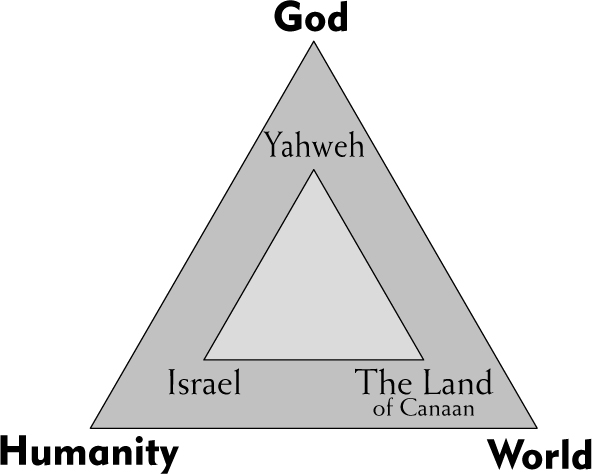
But Israel’s relationship to the land of Palestine serves as a microcosm of the relationship between the human population of the earth and the globe. Yahweh delights in the productivity of the soil and in those made in his image enjoying its bounty. The covenantal triangle involving Yahweh, Israel, and the Promised Land applies to the cosmos as a whole.
At creation, God established a trialogical arrangement linking the well-being of humankind directly to their devotion to him. In response to faithful service to Yahweh, the earth yields its produce for the benefit of all living creatures and for the glory of the Creator.
Blessing and curse. Human awareness of the alternatives of blessing and curse, dependent on the people’s response to God, is as old as the human race. Although Genesis 2–3 avoids the terms “covenant,” “blessing,” and “curse,” this is what the trees in the garden of Eden represented. The Tree of Life symbolized the reward for obedience to the divine Suzerain, while the Tree of the Knowledge of Good and Evil, whose fruit would yield death, symbolized the consequences of disobedience (Gen. 2:9, 16–17). The promises to the patriarchs held out the blessing and the curse for all the families of the earth, depending on their disposition to the ancestors as agents of blessing (Gen. 12:3).40 Admittedly the blessing and curse are never formally presented to the patriarchs as consequences of their response to Yahweh,41 but they are implicit in the narratives. The test of Abraham in Genesis 22 assumes that blessing is contingent on obedience, though elsewhere material blessing seems disconnected from moral response (Ishmael, 17:20; Abraham, 24:1, 35; Isaac, 25:11; 26:12–14).
Indeed, the accounts seem to emphasize the transfer of blessing from one generation to the next through performative speech acts by the ancestors.42 However, in Genesis 26:3–5 Yahweh expressly transfers the promise to Isaac because of Abraham’s complete obedience to his revealed will.43 In any case, the characters in the narratives are keenly aware of the alternatives of blessing and curse (cf. 27:12). Although the terms “blessing” and “curse” do not occur in Leviticus 26, the recitation of benefactions in 26:3–13 and disasters in 26:14–39 demonstrates that these two options represented integral elements of Yahweh’s covenant with Israel. Later, in Deuteronomy 28 Moses expands on these blessings and curses in great detail.
For the narrators of Israel’s history, especially the deuteronomistic historian (Joshua–2 Kings), the blessings and curses provide the determinative grid for assessing interim events,44 but especially for the final fate of the nation, which went into exile for their covenantal infidelity precisely as predicted.45 And later prophets, raised in the tradition of Moses (cf. Deut. 18:15), repeatedly challenged the people to choose life and blessing instead of death and the curse.46 In effect, Joshua’s final challenge to his people to “choose for yourselves this day whom you will serve” was a challenge to choose life by fearing Yahweh and serving him in sincerity and truth rather than going after other gods (Josh. 24:14–26).
Contemporary Significance
THE PRESENT STATE OF Israel. This passage is critical for contemporary discussions of the relationship of the state of Israel to God’s ancient covenantal promises. Prophetic visions of the restoration of Israel following the judgment were grounded in Yahweh’s eternal and irrevocable promises (Ezek. 34:1–31; 36:16–38; 37:1–28). However, the vision of Israel’s restoration that Moses paints in Deuteronomy 30:1–10 and that is presented by the prophets who follow assume a regenerate people, with circumcised hearts, wholly devoted to Yahweh, walking in his ways and keeping the commands (30:6–9). In Judaism it has long been assumed that what God requires of his people is primarily to keep Torah—particularly but not limited to the dietary laws of kashrut and the proper celebration of the ancient festivals. This view is reflected in Jesus’ pronouncement of woe on the scribes and Pharisees, who were scrupulous in tithing mint, dill, and cumin, but neglected the weightier matters of Torah: justice, mercy, and faithfulness (Matt. 23:23). It is also reflected in some of the early rabbinic conversations, like the following:
A. R. Hunah, R. Jeremiah, in the name of R. Hiyya bar Abba: “It is written, ‘Me they have abandoned’ (Jer. 6:11).
B. “Is it possible that they have kept my Torah? Would that they would abandon Me but keep my Torah.
C. “For if they had abandoned Me but kept My Torah, then in the course of their study of the Torah, the yeast that is in it would have brought them back to Me.”47
However, this is precisely the opposite of the perspective advocated by Moses in Deuteronomy. Israel’s first allegiance was to be to Yahweh, not to the law. Obedience to the will of God should be an expression of one’s prior love for God. Otherwise it degenerates to moralism and legalism. Those who have been redeemed will consider their relationship with God the supreme privilege and respond with fear and love, demonstrated in acts that please him and serve the well-being of others. Rooted in love for God, from Zion and the Promised Land as a whole, the causes of justice and peace are to flow out to the nations.
While the existence of the state of Israel today testifies to Yahweh’s permanent commitment to the physical descendants of Abraham, given their abusive policies and actions against the Palestinians, both Muslim and Christian, the present state cannot be the fulfillment of the ancient promises. Furthermore, since the New Testament equates Jesus Christ with Yahweh, the Redeemer of Israel, allegiance to the God of Israel must be expressed by devotion to Christ, for salvation from sin and from the wrath of God is to be found in Christ, and in Christ alone (Acts 4:9–12; Rom. 10:1–15; Phil. 2:4–11).48
In reinforcing the messages of Deuteronomy 6–8, this passage reminds Israel that occupation of the land provides the context and motivation for decision, as well as the reward for obedience.49 But it also reminds Gentile Christians, who have been grafted into the promises to Israel (Rom. 11:11–24), who have been blessed with every blessing in Christ, and who have obtained a spiritual inheritance as God’s own possession, to the praise of his glory (Eph. 1:3–14), that the proof of covenant commitment is undivided devotion to Christ, our Redeemer, demonstrated in a life of obedience to him. On the one hand, this means repudiating all other gods and serving Christ alone, and on the other hand, this serves as a solemn warning that there is no eternal security for those who live in sin. Paul may well have had texts like this one in mind when he presents the options in Romans 2:4–13.
Each day a day of decision. Finally, as was the case for the Israelites, for those who claim to be God’s people, every day is a day of decision. Our commitment to Yahweh must not only be renewed at significant junctures in our lives, but daily. The blessings associated with the covenant are not to be taken for granted or viewed as automatic rights. The covenant established by Christ involves a special relationship, which demands constant investment of energy and devotion. The options open to the Israelites—blessing and curse—are open to us, but how we experience them depends on our covenant commitment to Christ, demonstrated by active obedience.
Our Savior illustrated the two ways graphically with his metaphor of the vine in John 15. Branches that do not abide in Christ experience the curse. Because they do not bear fruit (i.e., keep his commands, v. 10), they are cut off, discarded, and thrown into the fire (v. 6). Contrariwise, those who abide in him experience his blessing. Because they abide in him, they bear abundant fruit; that is, they demonstrate their covenant commitment with righteous acts of obedience and are rewarded by having the Father do for them whatever they wish (v. 7). Just as Israel’s obedience and blessing brought great glory to Yahweh (Deut. 26:19), so our obedience and blessing bring great glory to God (John 15:8).
Original Meaning
A Lesson from Economic Geography: Recognizing the Gracious Provision of God (11:8–28)
THIS LARGE SECTION BREAKS down into four segments. The first three begin with a challenge to covenantal obedience and are arranged thematically in an ABA order (vv. 8–12, 13–21, 22–25); the last segment (vv. 26–28) is Moses’ concluding appeal. The clear echoes of 4:40 in verse 8 suggest that 11:8–25 presents another case of “resumptive exposition,” as Moses picks up the notions of the earlier text and develops them more fully in this new context. In so doing Moses now offers the most comprehensive statement on his theology of land. But he does not treat the land in isolation; it represents the third member of the triad involved in Yahweh’s covenant relationship with Israel: deity—people—land.
Part I: The land as gift (vv. 8–12). The land represents the climactic element in a series of gifts Yahweh promised to the ancestors.10 Moses opens his discussion of the place of the land in Israel’s relationship with Yahweh with a charge to keep the Supreme Command in all its dimensions.11 By following this command with two purpose clauses, he presents it as a virtual condition for the fulfillment of the promise that follows (vv. 8b–9).12 The first clause lists three objectives: “that you may be strong, that you may enter, and that you may possess the land” (pers. trans.). While the second and third are formulaic, the first is new.13 The second clause introduces a fourth objective, which we have also seen repeatedly, “that you may live long in the land.” Each purpose statement ends with a comment on the land. The first (v. 8b) looks forward to Israel’s crossing of the Jordan, while the second (v. 9a) looks back to Yahweh’s ancient covenantal promise to the ancestors (Gen. 17:8; Ex. 3:6–8; 6:8). In this moment past and future meet.
Moses’ excitement at Israel’s prospect of entering the land (vv. 9b–12) is evident in his excursus extolling its virtues even more effusively than in 6:10–11 and 8:7–9. Unlike Egypt, this land yields its bounty spontaneously. Moses develops this point with three basic statements. (1) This land flows naturally with milk and honey (v. 9b).14 (2) This land contrasts sharply with Egypt, from where the Israelites have come (v. 10) and where food production depended entirely on human effort.15 (3) This is a land of hills and valleys that drink water from the rains of heaven (v. 11). Clarifying his comment in 8:7, Moses invites his hearers to imagine ever-flowing streams of fresh water coursing down the hills and watering the landscape, in contrast to the stagnant and brackish waters of the Nile Delta.
As in 6:10–11 and 8:7–9, Moses’ comments are utopian. Although Egypt receives virtually no rainfall, because of the annual inundation of the Nile Delta with silt and the constant flow of the river, any farmer would have preferred the gardens of Egypt to the rocky and hilly terrain of Palestine. This is obviously not the objective report of a government surveyor, but the dream of a man who can only see the land from a distance but cannot enter it. With this speech Moses tries to excite his people about the prospects awaiting them on the other side of the Jordan. Moses envisions the Promised Land through the eyes of faith. The land is good, not only because it represents the fulfillment of the promises to the ancestors, but also because it drives its inhabitants to depend on God. To the eyes of faith this is paradise indeed.
In verse 12 Moses adds a fourth reason why the land is special: it is the object of Yahweh’s special attention and care (v. 12). He “cares for” (dāraš) it continuously, and his eyes are fixed on it from one year to the next. This statement expresses Yahweh’s disposition toward the land more dramatically and tenderly than any other in Scripture. Here the verb dāraš does not bear its common meaning, “to seek” something that is lost (22:2), but a nuance of election (cf. Lev. 25:23). Just as Yahweh has chosen Israel out of all the peoples of the earth, so he has chosen the land of Canaan (Palestine) from all the territories of the earth.
But there is more. Since the participle of dāraš (lit., “seeking”) and the adverb “continually” imply continuity, “to seek the land” is an elliptical expression for “to seek the peace and well-being of the land” (cf. 23:6[7]).16 The added reference to “the eyes of the LORD” on the land year round speaks of focused attention and constant providential care (cf. vv. 13–15).
In the added phrase “from the beginning of the year to its end,” we recognize a subtle polemic against the fertility cults of the ancient Near East. The mythologies of Mesopotamia and Ugarit perceived the seasonal rhythm of rain and drought as reflections of the fertility deity’s (Tammuz in Mesopotamia, Baal in Canaan) descent to the netherworld at the beginning of the dry season and his return at the beginning of the rainy season. Fertility gods were unable to attend to their land or their devotees while they were away, leaving the peoples’ fate in the hands of gods of drought and death (Nergal in Mesopotamia, Mot in Canaan). Unlike Baal (cf. 1 Kings 18:27), Yahweh is never distracted; he never leaves, and he never sleeps (cf. Ps. 121). Through summer and winter, seedtime and harvest, his eyes are on the land (Lev. 26:3–6, 9).
Part II: The land as test (vv. 13–21). Following an approach that is common in wisdom literature17 and anticipating what he will declare explicitly in verses 26–28 (cf. 30:1, 19), Moses presents life in the land as a test, with significant consequences (cf. 6:10–15; 8:6–20). The land symbolizes a choice between two ways: the way of blessing, prosperity, and life, or the way of the curse, adversity, and death. Moses presents the options before the people in two frames almost identical in length18 and remarkably parallel in content and form, as the following synopsis of relatively literal translations shows:
| The Test of Faith |
|---|
| The Passing Grade
Deuteronomy 11:13–15 | The Failing Grade
Deuteronomy 11:16–17 |
The human response to the test | So if you faithfully obey the commands I am giving you today—to love the LORD your God and to serve him with all your heart and with all your soul, | Be careful, or you will be enticed to turn away and worship other gods and bow down to them. |
The divine evaluation of the test | then I will send rain on your land in its season, both autumn and spring rains, | Then the LORD’s anger will burn against you, and he will shut the heavens so that it will not rain |
The interim result | so that you may gather in your grain, new wine and oil. | and the ground will yield no produce, |
The end result | I will provide grass in your fields for your cattle, and you will eat and be satisfied. | and you will soon perish from the good land the LORD is giving you. |
Moses begins by defining the passing grade, the correct response to the test (vv. 13–15). His exhortation involves themes we have heard before. The Israelites are to listen carefully to the commands and demonstrate their covenant commitment (“love”) as well as their unreserved vassaldom to Yahweh (“serve”). As elsewhere, by adding “today” Moses creates a sense of urgency. His injunctions are not for the distant future but are to be applied immediately. The Israelites must commit themselves today, even before they cross the Jordan, and in the perpetual present once they have crossed.
By speaking with Yahweh’s voice in verses 14–15, Moses draws attention to the following statements as both divine promise and divine evaluation of their response to the test.19 Extending the picture of the utopian land (vv. 8–12), Yahweh makes two promises, each introduced by (lit.) “I will give.” Each promise subdivides further into two parts, the first emphasizing the divine response to the human performance, and the second the human benefit. In both we recognize a polemical critique of the fertility religion of Canaan, as Yahweh claims for himself the functions Canaanites attributed to Baal, their storm god.
In verse 14 Yahweh promises to provide rain in abundance. He begins with a general statement, promising “rain on your land in its season.” This expression is defined with “early rain”20 and “latter rain”21 (NIV, “autumn and spring rains”).22 Here Yahweh declares that because of his gift of rain, the land will yield its produce and the people will bring home grain, wine, and olive oil. As in 7:13, these expressions both speak of the literal bounty of the land and subtly challenge the prevailing fertility deities of the region. If Yahweh’s first gift (rain) is of immediate benefit to the land, the second gift (grass) benefits animals, which naturally results in the people eating well and being satisfied (v. 15).
Earlier Moses had recognized that affluence and satisfaction may lead either to forgetting Yahweh (6:10–12) or to taking prideful credit for what one has achieved (8:17). While he does not hesitate to declare that the people’s well-being and satisfaction with life are divinely intended goals, he does not promise them unconditionally. Instead he draws a direct line from the people’s response to the demands of relationship to their enjoyment of the full blessings of the Promised Land.
In verses 16–17 Moses describes the failing grade and in so doing addresses head-on a problem from the past and what he fears is a danger in the future—defection from Yahweh and his covenant. Returning to a motif he had dealt with at length in chapters 6 and 8—the test represented by prosperity—Moses begins with a call for self-watch, which he follows up with a series of potential dangers introduced with the particle “lest.” The four verbs in verse 16 identify four kinds of actions against which the Israelites must guard themselves: being open-minded about other gods, turning to them, accepting vassaldom to them, and prostrating themselves in submission and homage before them. Only the first requires comment. “To have an open mind/heart” (NIV “be enticed”) is an elliptical version of an idiom that speaks of being easily seduced by the attractions of pagan religion.23
In verse 17 Moses declares that open-mindedness toward the worship of gods other than Yahweh is fatal. If the people fix their devotion elsewhere, instead of being the objects of Yahweh’s favor, he will unleash his fury against them,24 “turning off the taps” in the sky,25 thereby stopping the rain and preventing the ground from yielding its produce. Consequently the Israelites will perish quickly from the good land that they had received as a gift. Yahweh’s design was for himself, the Israelites, and the land to exist in harmonious symbiotic relationship to one another, each contributing to the other’s delight and each finding delight in the other. The curse represents the complete opposite of the blessing: instead of divine favor, Israel incurs his wrath; instead of abundant rain in its season, drought; instead of fruit, infertility; instead of life abundant, death—and ultimately divorce from the land.
In verses 18–21 Moses takes a surprising turn. After his warning of the consequences of covenant betrayal, he repeats the sequel to the Shema (6:6–9) almost verbatim. Most of the changes from the earlier text reflect Moses’ renewed passion, especially in the wake of his rehearsal of Israel’s history of apostasy in chapter 9 and his brief consideration of the unthinkable in verses 16–17.26 Whereas in the original context “these words” to be put on the people’s hearts would probably have been Deuteronomy 6:4–5, here the antecedent of “these” is Moses’ utopian description of the land and his presentation of two ways of responding to the gift of land in verses 8–16. While everything Moses has said since 6:4–5 is in effect commentary on these verses, he repeats what he had said earlier to imprint the message indelibly on their minds and on their hearts.
Verses 18–21 hold the key to the future relationship of deity, people, and land. In order to ensure that God’s design for Israel will be realized, the people must commit themselves wholeheartedly to him and his covenant. Yahweh’s desire is to see their population explode as the lifespan of each generation increases on the land that he had promised the ancestors. The final temporal reference, “as many as the days that the heavens are above the earth” (v. 21), alludes to the eternality of Yahweh’s covenant commitment to his people.27 Although Yahweh has previously characterized his covenant with Israel as eternal,28 this is first time the cosmic symbols are applied to it (cf. Gen. 8:22).
But how can Moses say in one breath that Israel will be destroyed, and in the next appeal to the cosmos as a symbol of the eternality of God’s covenant with the nation? The answer is found in the fact that every generation and all individual Israelites must accept the covenant by faith and demonstrate fidelity to Yahweh through obedience. Moses seems to think that Israel’s exile is inevitable, but he knows it will not be the last word (4:31; 30:1–10). Yahweh’s promise to Israel is firm, like the cosmos itself.
Part III: The land as promise (vv. 22–25). Moses concludes this part of the address by presenting the second issue raised by the land: Yahweh’s promise to dispossess the Canaanites (v. 8). Having offered the land as a test in verses 18–21 and concluded with a glorious word of promise, in verse 22 Moses yanks his audience back to reality with a third expression of conditionality. Yahweh is under no obligation to the Israelites unless they keep the Supreme Command in its entirety,29 by “putting it into practice,” by “loving Yahweh your God,” by “walking in all his ways,” and by “holding fast to him” (pers. trans.). As in 10:12 the alternation of expressions for actions and dispositions reinforces the comprehensive nature of covenant commitment. There is really only one command, to love Yahweh with one’s whole heart, but love without obedience is not love at all.30
Using strong military language, verses 23–25 spell out the rewards for having met these conditions:31 Yahweh will dispossess all the Canaanite nations in advance of the Israelites (v. 23a),32 and Israel will “possess” nations stronger and mightier than they are. By juxtaposing these statements, Moses declares that human history involves both divine and human activity, with the divine actions being determinative. In verse 24 he concretizes the promise in geographic terms: in fulfillment of Genesis 13:17, the Israelites will stake their claim to every inch of ground on which the soles of their feet tread.33
Moses’ specification of the boundaries authorizes them to claim the territory from “the desert” (Negev) in the south to “Lebanon” in the north; from the “Euphrates River” in the far northeast to the “western sea” (the Mediterranean). As in 1:7, he defines the Promised Land in terms of Yahweh’s promise to Abraham in Genesis 15:18 and later reaffirmed to Moses in Exodus 23:31. Apparently in deference to the tribes of Reuben, Gad, and one-half of Manasseh, he avoided any reference to the Jordan River as the eastern boundary (Num. 34).34
Echoing 7:24, Moses concludes this paragraph with a promise that after the Israelites have crossed the Jordan, no enemy will be able to withstand them. Verse 25 explains why this will be so: Yahweh will impose the “terror and fear” of the Israelites on all the land they claim as they tread up and down the land.35 Moses concludes with a reminder that this will occur in fulfillment of Yahweh’s earlier word (Ex. 23:27–31; Deut. 7:19–24). While Rahab will soon testify to the fulfillment of this promise (Josh. 2:8–11), the present audience must remember that these promises are all contingent on Israel’s fidelity to the covenant Lord.
Part IV: The land as opportunity (vv. 26–28). As pastor, Moses concludes this part of the sermon with a climactic appeal for decision. He calls his people to attention with “See,” and follows this with a statement of principle: “I am setting before you today a blessing and a curse.” Elsewhere Moses describes his verbal actions as “setting before” the people specific instructions (4:8; 11:32); here he is handing them the options of “blessing” and “curse.”36 Moses summarizes the conditions determining which of these the Israelites will experience in verses 27 and 28. For the content of the blessing and the curse we may look back to verses 14–17, with the first half (vv. 14–15) describing the blessing, and the second half (vv. 16–17) describing the curse. Moses will spell them out in greater detail in chapter 28.
The symmetry of the introductory clauses setting the conditions for the blessing and the curse reflects the formality of the present circumstance. In verse 27 “the commands of the LORD your God” are equated with “that I am giving you today.” In verse 28 “disobeying the commands of the LORD your God” is explained as to “turn from the way that I command you today by following other gods, which you have not known.”37 This is shorthand for what Moses had said in verse 16. The formality of the situation is reinforced by the repetition of “today” in the presentation of the blessing and the curse. While the nature of the occasion is unclear, it seems that the covenant renewal ceremony reflected in 26:16–19 underlies this text. By choosing the blessing the people formally accept their status as Yahweh’s covenant people and him as their covenant Lord.
If this view of the context is correct, then the structure of the second address recapitulates the structure of the original covenant event on Mount Horeb (Ex. 19–24). Like Exodus 19, the burden of Deuteronomy 5:1–11:32 has been to challenge, inspire, and convince the Israelites to commit themselves to Yahweh. This section expounds in detail what Yahweh had declared to the people in Exodus 19:3b–6. The principles underlying Exodus 19:3b–6 are precisely those Moses has been presenting in Deuteronomy 5–11. (1) Israel’s relationship with Yahweh is rooted in his gracious act of deliverance from the bondage of Egypt. (2) The covenant primarily involves a relationship with the covenant Lord rather than a commitment to a code of conduct. (3) Yahweh’s call to covenant relationship is purposeful: that Israel might be his special treasure, that the people might be holy, and that they might serve as an agent of grace to the nations from which they were called. (4) Israel’s enjoyment of the blessings of the covenant and the nation’s fulfillment of the divine mission are contingent on a positive response to Yahweh’s voice.
In the original context, once Moses presented these fundamental issues to the people and they responded (Ex. 19:8), Yahweh commenced the revelation of his will, which included first the Decalogue (Ex. 20:1–17), and then the “Book of the Covenant” (20:22–23:19). In this context Moses began the second address by reciting the Decalogue and then expounding on the implications of claiming Yahweh as covenant Lord. Deuteronomy 5–11 functions as the equivalent to his report of Yahweh’s speech to the people in Exodus 19:7.38 The present appeal for decision on the plains of Moab corresponds to Moses’ call for decision in Exodus 19:8. This reinforces the image of the ceremonies on the Plains of Moab as a second Horeb experience. Like Sinai/Horeb, the Plains of Moab was a place of both revelation and decision. With his call to decision in 11:26–32, Moses challenges the new generation to respond with greater fidelity than their parents had done. Their future in the land depends on it.39
Bridging Contexts
VISION OF THE LAND. As noted above, this chapter offers the fullest picture of Deuteronomy’s vision of the land. As we move into the more detailed presentation of life in the Promised Land in chapters 12–26, we must keep in mind the essential elements of that vision.
1. Israel’s land is a gift from Yahweh in fulfillment of his covenant promises to the ancestors (v. 9).
2. Israel’s land offers the covenant people a paradise-like context in which to fulfill their destiny (vv. 9–11).
3. Israel’s land is the special object of Yahweh’s election and his perpetual care (v. 12).
4. Israel’s land offers the people a geographic context for an ethical response to the covenant (vv. 8, 13, 22).
5. Israel’s land fulfills its intended role within the triangular covenant relationship only as Yahweh providentially enables it to do so (vv. 14–17).
6. Israel’s possession of the land is contingent on Yahweh’s giving it to the people, and their retention of it is contingent on their fidelity to the covenant (vv. 22–25).
The challenge and promise of this passage will become urgent for the Israelites within a matter of days or weeks, the moment they cross the Jordan and take their first steps in the Promised Land (Josh. 1:3–9). The nation’s history will prove how deaf to Moses’ voice the people’s ears will be. Within a generation spiritual recidivism will set in, and the allure of the gods of Canaan will prove too strong (Judg. 2:11–23). But Yahweh will build his church; despite their propensity to apostatize and commit “the evil,” the nation will survive and the historian will report that several centuries later, during the reigns of David and Solomon the ideals of this passage are fulfilled (1 Kings 4:20–28).
But this ideal does not last. With his own sponsorship of idolatry, Solomon adds the weight of the crown to the apostasy that eventually brings the nation to ruin at the hands successively of Assyrians (eighth century BC) and Babylonians (sixth century BC). But even as Nebuchadnezzar’s armies are in sight of Jerusalem, the people cling to the promises of this passage, demanding that Yahweh rescue them. They assume that since his covenant commitment to them is eternal, their enjoyment of his favor is unconditional. They fail to read the fine print of the covenant, which declares that God’s promises are contingent. Each generation and each individual must claim the promises by faith and demonstrate its allegiance to the divine Suzerain by conformity to his will—particularly the Supreme Command. Yahweh is not obligated to bless those who forget him and his gracious acts and go after other gods. The land is a gracious gift, and to forget the Giver and give credit to other gods is the height of ingratitude and rebellion.
But Israel’s relationship to the land of Palestine serves as a microcosm of the relationship between the human population of the earth and the globe. Yahweh delights in the productivity of the soil and in those made in his image enjoying its bounty. The covenantal triangle involving Yahweh, Israel, and the Promised Land applies to the cosmos as a whole.
At creation, God established a trialogical arrangement linking the well-being of humankind directly to their devotion to him. In response to faithful service to Yahweh, the earth yields its produce for the benefit of all living creatures and for the glory of the Creator.
Blessing and curse. Human awareness of the alternatives of blessing and curse, dependent on the people’s response to God, is as old as the human race. Although Genesis 2–3 avoids the terms “covenant,” “blessing,” and “curse,” this is what the trees in the garden of Eden represented. The Tree of Life symbolized the reward for obedience to the divine Suzerain, while the Tree of the Knowledge of Good and Evil, whose fruit would yield death, symbolized the consequences of disobedience (Gen. 2:9, 16–17). The promises to the patriarchs held out the blessing and the curse for all the families of the earth, depending on their disposition to the ancestors as agents of blessing (Gen. 12:3).40 Admittedly the blessing and curse are never formally presented to the patriarchs as consequences of their response to Yahweh,41 but they are implicit in the narratives. The test of Abraham in Genesis 22 assumes that blessing is contingent on obedience, though elsewhere material blessing seems disconnected from moral response (Ishmael, 17:20; Abraham, 24:1, 35; Isaac, 25:11; 26:12–14).
Indeed, the accounts seem to emphasize the transfer of blessing from one generation to the next through performative speech acts by the ancestors.42 However, in Genesis 26:3–5 Yahweh expressly transfers the promise to Isaac because of Abraham’s complete obedience to his revealed will.43 In any case, the characters in the narratives are keenly aware of the alternatives of blessing and curse (cf. 27:12). Although the terms “blessing” and “curse” do not occur in Leviticus 26, the recitation of benefactions in 26:3–13 and disasters in 26:14–39 demonstrates that these two options represented integral elements of Yahweh’s covenant with Israel. Later, in Deuteronomy 28 Moses expands on these blessings and curses in great detail.
For the narrators of Israel’s history, especially the deuteronomistic historian (Joshua–2 Kings), the blessings and curses provide the determinative grid for assessing interim events,44 but especially for the final fate of the nation, which went into exile for their covenantal infidelity precisely as predicted.45 And later prophets, raised in the tradition of Moses (cf. Deut. 18:15), repeatedly challenged the people to choose life and blessing instead of death and the curse.46 In effect, Joshua’s final challenge to his people to “choose for yourselves this day whom you will serve” was a challenge to choose life by fearing Yahweh and serving him in sincerity and truth rather than going after other gods (Josh. 24:14–26).
Contemporary Significance
THE PRESENT STATE OF Israel. This passage is critical for contemporary discussions of the relationship of the state of Israel to God’s ancient covenantal promises. Prophetic visions of the restoration of Israel following the judgment were grounded in Yahweh’s eternal and irrevocable promises (Ezek. 34:1–31; 36:16–38; 37:1–28). However, the vision of Israel’s restoration that Moses paints in Deuteronomy 30:1–10 and that is presented by the prophets who follow assume a regenerate people, with circumcised hearts, wholly devoted to Yahweh, walking in his ways and keeping the commands (30:6–9). In Judaism it has long been assumed that what God requires of his people is primarily to keep Torah—particularly but not limited to the dietary laws of kashrut and the proper celebration of the ancient festivals. This view is reflected in Jesus’ pronouncement of woe on the scribes and Pharisees, who were scrupulous in tithing mint, dill, and cumin, but neglected the weightier matters of Torah: justice, mercy, and faithfulness (Matt. 23:23). It is also reflected in some of the early rabbinic conversations, like the following:
A. R. Hunah, R. Jeremiah, in the name of R. Hiyya bar Abba: “It is written, ‘Me they have abandoned’ (Jer. 6:11).
B. “Is it possible that they have kept my Torah? Would that they would abandon Me but keep my Torah.
C. “For if they had abandoned Me but kept My Torah, then in the course of their study of the Torah, the yeast that is in it would have brought them back to Me.”47
However, this is precisely the opposite of the perspective advocated by Moses in Deuteronomy. Israel’s first allegiance was to be to Yahweh, not to the law. Obedience to the will of God should be an expression of one’s prior love for God. Otherwise it degenerates to moralism and legalism. Those who have been redeemed will consider their relationship with God the supreme privilege and respond with fear and love, demonstrated in acts that please him and serve the well-being of others. Rooted in love for God, from Zion and the Promised Land as a whole, the causes of justice and peace are to flow out to the nations.
While the existence of the state of Israel today testifies to Yahweh’s permanent commitment to the physical descendants of Abraham, given their abusive policies and actions against the Palestinians, both Muslim and Christian, the present state cannot be the fulfillment of the ancient promises. Furthermore, since the New Testament equates Jesus Christ with Yahweh, the Redeemer of Israel, allegiance to the God of Israel must be expressed by devotion to Christ, for salvation from sin and from the wrath of God is to be found in Christ, and in Christ alone (Acts 4:9–12; Rom. 10:1–15; Phil. 2:4–11).48
In reinforcing the messages of Deuteronomy 6–8, this passage reminds Israel that occupation of the land provides the context and motivation for decision, as well as the reward for obedience.49 But it also reminds Gentile Christians, who have been grafted into the promises to Israel (Rom. 11:11–24), who have been blessed with every blessing in Christ, and who have obtained a spiritual inheritance as God’s own possession, to the praise of his glory (Eph. 1:3–14), that the proof of covenant commitment is undivided devotion to Christ, our Redeemer, demonstrated in a life of obedience to him. On the one hand, this means repudiating all other gods and serving Christ alone, and on the other hand, this serves as a solemn warning that there is no eternal security for those who live in sin. Paul may well have had texts like this one in mind when he presents the options in Romans 2:4–13.
Each day a day of decision. Finally, as was the case for the Israelites, for those who claim to be God’s people, every day is a day of decision. Our commitment to Yahweh must not only be renewed at significant junctures in our lives, but daily. The blessings associated with the covenant are not to be taken for granted or viewed as automatic rights. The covenant established by Christ involves a special relationship, which demands constant investment of energy and devotion. The options open to the Israelites—blessing and curse—are open to us, but how we experience them depends on our covenant commitment to Christ, demonstrated by active obedience.
Our Savior illustrated the two ways graphically with his metaphor of the vine in John 15. Branches that do not abide in Christ experience the curse. Because they do not bear fruit (i.e., keep his commands, v. 10), they are cut off, discarded, and thrown into the fire (v. 6). Contrariwise, those who abide in him experience his blessing. Because they abide in him, they bear abundant fruit; that is, they demonstrate their covenant commitment with righteous acts of obedience and are rewarded by having the Father do for them whatever they wish (v. 7). Just as Israel’s obedience and blessing brought great glory to Yahweh (Deut. 26:19), so our obedience and blessing bring great glory to God (John 15:8).