Original Meaning
The Guests at Yahweh’s Table (14:1–3)
WHEREAS LEVITICUS SPEAKS OF Israel’s holiness as a quality to be practiced through imitation of Yahweh her holy God (11:44–45; 19:2; 20:7, 26), here Moses speaks of holiness as a quality that Israel possesses. Whereas in chapters 12 and 13 Moses had challenged Israel to demonstrate her status as the covenant people of Yahweh by rejecting Canaanite gods and Canaanite ways of worshiping, now he calls her to prove her holy status in her diet. Commenting primarily on the dietary laws in Leviticus 11, E. Firmage observes:
The dietary law originates . . . in a self-conscious attempt . . . to put a singular tenet of Israelite theology into practice—that Israel be holy, not simply pure (in the technical meaning of “free from impurity”). Thus, unlike the laws of personal impurity which applied even to non-Israelites, the dietary law was to be kept by Israelites alone.10
If this was true of the priestly legislation in Leviticus, it is even more so in the present text.
Without verses 1–3 the dietary regulations in verses 4–20 are external laws imposed by a suzerain upon a vassal (cf. 5:6). The introduction changes everything, for here Moses declares that Israelite life was not to be governed so much by external laws as by the relationship they enjoyed with Yahweh, a privilege they celebrate by eating at Yahweh’s table. He highlights their unique status with four expressions. They are: (1) the children of Yahweh; (2) a holy people, belonging to Yahweh their God; (3) the elect people of Yahweh, chosen from all the peoples on the face of the earth, to be (4) Yahweh’s own treasured possession. Since verse 2 reiterates 7:6, here we need to comment only on the first: Israel’s status as “the sons [bānîm] of the LORD.”
This is not the first time Moses has compared Yahweh’s relationship to Israel to that of a father and son (cf. 1:31; 8:5). However, now he strengthens the image by using a metaphor rather than a simile: Yahweh not only treats Israel like a father treats a son, he is Israel’s father. The metaphor derives from ancient Near Eastern political relationships (cf. 2 Kings 16:7). Within this relationship the suzerain’s status was referred to as “fathership” and the status of the vassal was referred to as “sonship.”11
While Deuteronomy never speaks explicitly of Yahweh’s entrance into covenant relationship with Israel with adoptive language, this is how Jeremiah 3:19–20 interprets it. By opening this unit with “Sons you are to Yahweh your God” (pers. trans.), Moses announces that whatever follows reflects Israel’s acceptance of this privileged status. In chapter 13 Moses dealt with the prospect of defection from covenantal allegiance to Yahweh by going after other gods and serving them. Now we learn that for Israelites to go after these gods would mean to deny their status as the children of Yahweh. This status as the elect vassal of Yahweh provides the basis for their participation in table fellowship with him.12
Earlier Moses had grounded the prohibition on intermarriage with the Canaanites and the total destruction of every vestige of Canaanite religion on Israel’s standing as Yahweh’s elect and holy covenant people (7:6). According to 14:1–3, Yahweh’s election provides the grounds for two additional regulations. (1) The Israelites were not to gash their bodies or cut their hair in certain ways. On the surface, both seem to be associated with the cult of the dead, since such actions were connected with mourning rites for the dead. Non-Israelites believed the deceased continued to exercise both beneficent and malevolent power over the living, and that the favorable influence of departed ancestors could be secured through mortuary rites. However, the present prohibition seems not to allude to the ancestor cult but simply to rites of mourning. Moses hereby insists that the taboos extended beyond contact with corpses to contact with the “vital forces” of the deceased.13
The exact style of haircut cannot be determined,14 but the Hebrew allows for a variety of ways of producing baldness: cutting, shaving, plucking, pulling. Although the expressions used are different, similar practice is reflected in Leviticus 19:27–28. Whereas that text grounds Israel’s ethic in the principle of imitatio dei—they are to be holy as Yahweh their God is holy (v. 2)—here Israel’s ethic is grounded on their status before Yahweh. The meaning of these prohibitions against pagan practices in the present context seems to be bound up with the dietary laws themselves. Viewing this text as an invitation to eat at Yahweh’s table, it is important that the participants be ritually clean (cf. 26:14).15 If physical contact with a corpse was deemed defiling (cf. Lev. 11:24–40), how much more objectionable for the holy people of Yahweh to attempt spiritual contact with the dead.16
(2) The second demand arising from Israel’s status as children of Yahweh involves food, specifically prohibiting any food that Yahweh deems “detestable.” Earlier Moses had applied this expression to the religious practices of the pagans (12:31; 13:13[14]). In chapter 7, with which 14:1–2 displays direct lexical and conceptual links, the expression applied both to the abhorrent practices of the nations and the silver and gold of which their idols were made (7:25–26).17 Moses does not explain why certain foods are classified as “detestable” (tôʿēbâ), nor the consequences of so doing. Perhaps if the contagion could be contracted by touching abominable artifacts, how much more by ingesting food that Yahweh had declared “detestable.”
Against this backdrop, the regulations regarding edible and inedible food that follows should be regarded as a gracious gift, seeking to protect Israel’s status as Yahweh’s holy people. Eating foods forbidden by Yahweh involves more than the ingesting of “unclean food” (vv. 7, 8, 10, 11); its association with false religion also represents a breach of covenant relationship.
Bridging Contexts
FOOD LAWS IN THE rest of the Bible. Allusions to these food laws in the Old Testament are rare. Isaiah 65:4 and 66:17 include eating swine’s flesh with other provocative actions that incite Yahweh’s fury. Hosea 9:3 mentions eating unclean food in exile as a consequence of Israel’s rebellion. In Ezekiel 4:14 the exilic prophet protests that (as one in line for priestly service) he has never defiled himself by eating the flesh of an animal that has died by itself or been torn by wild animals; no contaminated meat has ever entered his mouth. However, here the defilement would derive from cooking pastry over human dung.35 In Ezekiel 44:31 the prophet reiterates the prohibition of Deuteronomy 14:21 for priests in the new spiritual order envisaged after the exile. According to Daniel 1:8, after Daniel was brought into Nebuchadnezzar’s court, he requested permission to abstain from the rich fare offered by the king that he might not defile himself. Although in exile in Babylon, he obviously viewed the dietary regulations of Deuteronomy 14 still to be in force.
Several New Testament texts suggest Jesus’ coming signaled the end of Israel’s food laws. According to Mark 7:19, all foods are clean—though in context the point is that defilement is caused primarily by actions arising out of the heart rather than ingesting food. In Acts 10:10–16 God reveals to Peter that in the post-resurrection community of faith, the dietary boundaries of the Old Testament community of faith are erased (as are the walls between Israelites and Gentiles). Paul declares in Romans 14:14, the old objective criteria for clean and unclean have been replaced by subjective perceptions. In Acts the apostles (including Paul, 21:26) continued to observe Israel’s ceremonial regulations when they were in Jerusalem, but they invited non-Jews to the messianic community without forcing them to become cultural Jews.36
Israel’s dietary regulations served as boundary markers and symbolized God’s election of this ethnic group as his holy people. The successive expansion of the boundaries of the covenant community in the postresurrection period from converted Christian Jews (Acts 2:5–21), to converted Samaritans (half-Jews physically and spiritually, 8:14–17), to Gentile “God-fearers” in the land of Israel (10:44–48), to people in foreign lands (19:1–7) rendered the old dietary boundaries between Israel and the nations obsolete. With the resurrection of the Messiah, on the one hand, and the opening of the door of salvation and the privilege of being God’s holy people to all humankind, on the other, those laws lost their symbolic significance.
Contemporary Significance
A THEOLOGY OF PRIVILEGE and holiness. Christians today do not generally follow these regulations concerning haircuts and tattoos and diet and dietary boundaries. But this does not mean that Moses’ pastoral counsel to Israel has no bearing for us. Underlying Deuteronomy 14 is a profound theology of privilege and holiness whose relevance transcends the old covenantal order. Like the Israelites, we, the people of God, should treasure his grace in election and his claims upon us as his holy people. Expression of our holy status should not be reserved for worship services but should be demonstrated in all areas of life. Those who bear the brand of Christ’s name represent him wherever they go.
But Christians today are conflicted over the degree to which the regulations of Deuteronomy 14:1–21 apply.37 While the significance of tattoos and certain hairstyles changes from culture to culture and generation to generation, it could be argued that whenever specific forms of these practices are linked with pagan or ungodly notions, they are to be avoided. After all, as sons and daughters of the living God, chosen in Christ before the foundation of the world “to be holy and blameless in his sight,” and predestined “to be adopted as his sons through Jesus Christ . . . to the praise of his glorious grace” (Eph. 1:4–6), and chosen to be his special treasure, that we should “declare the praises of him who called you out of darkness into his wonderful light” (1 Pet. 2:11–20), we are to avoid every appearance of evil.
But what about the dietary regulations, which on the surface appear morally neutral? On a recent visit to Hong Kong, I preached on Deuteronomy 14:1–21 to a Chinese congregation, well aware that much of what these people eat, especially the food brought in from offshore—violates Israel’s food laws: octopus, squid, shrimp, and the like have neither scales nor fins. When the people saw the sermon title, “Banqueting at the Table of the Lord: The Grace of Israel’s Food Laws,” some were visibly nervous. But they were relieved when I focused on the privileges that are ours in Christ—we are adopted as children of God, we are the elect, his special treasure, his holy people—and when I explained that in Christ these dietary regulations are removed.
While these dietary restrictions no longer apply to Christians, according to Acts 15:20 at the council of Jerusalem, the first generation of disciples reaffirmed the prohibition on consuming blood and the meat of animals that had not been properly slaughtered,38 along with prohibitions on idolatry and sexual immorality. The taboo on eating blood is not rooted in Israelite covenantal stipulations but goes back to the fountainhead of humanity; in Genesis 9:4 God forbids the consumption of blood by any of Noah’s descendants. In binding Gentile Christians to this ordinance, the council of Jerusalem recognized that all life is sacred.
According to the Babylonian Talmud, “A man’s table is like an altar.”39 In a sense every meal, especially those involving the meat of animals, is a sacrifice—an animal gives its life for our sakes. Rather than calling for a vegetarian diet, both Old and New Testaments authorize the consumption of animals, provided the consumer continues to respect the sanctity of the life of the animal. Moskala rightly declares that “both sacrifice and food should be taken with or as an expression of gratitude and thankfulness.”40 But this thankfulness is not only expressed in verbal declarations to God for his gracious provision, but is also felt toward the animal world that has provided both pleasure and nourishment to God’s vice-regent.
Apart from this concern for the life of the creature, in the end, the significance of the dietary regulations for Christians is probably best understood as a corollary of Israel’s sacrificial system. If indeed Deuteronomy 14 involves Yahweh’s invitation to eat of the food in which he himself takes delight in the form of sacrifices (12:5–14), then with the termination of all sacrifices in Christ, these food regulations also become passé. Since we no longer present these offerings to God but celebrate the sacrificial work of Jesus Christ, whenever we partake of the bread and the wine of communion, we participate in the feast to which the Lord has graciously invited us.
Indeed, when Jesus transforms the annual Israelite Passover into the regular communion meal and institutes the Lord’s Supper, he acts not only as the divine host who invites us to eat in his presence, but as God in the flesh, inviting redeemed sinners, children of God, his holy people, his chosen ones, his special treasure, to eat of him. For he who said to his disciples, “Take and eat; this is my body,” also took the cup, gave thanks, and offered it to them, saying, “Drink from it, all of you. This is my blood of the covenant, which is poured out for many for the forgiveness of sins. I tell you, I will not drink of this fruit of the vine from now on until that day when I drink it anew with you in my Father’s kingdom” (Matt 26:26–29). What an amazing declaration! The Lord invites us to his table and then offers himself as the sacrifice. Through him our admission to the family of God is secured. Hallelujah, what a Savior!
Original Meaning
The Fare at Yahweh’s Table (14:4–20)
MOSES’ ADDITION OF “FOR you” (lâkem) in verses 7, 8, and 10 ties the dietary rules to the covenant people. Because Israelites are the holy people of Yahweh, the meat in their diet must be like the food that God “eats” in the sacrifices offered to him. Through everyday observance of the dietary boundaries, Israelites declared to one another and to outsiders their unique proximity to Yahweh. By eating at his table they declared their sanctified status as his covenant people “in every encounter with the animal kingdom and at every meal.”18
After appealing to Israel to avoid abominable food, Moses reminds them of the established boundaries between kosher19 and prohibited food. Many cultures have their own rules defining boundaries between the clean and unclean. The rationale for the boundaries described here is not clearly understood,20 Scholars have proposed a variety of theories for taboos on unclean food: cultic (they were associated with Canaanite religious practices), aesthetic (they are loathsome or repulsive), hygienic (they cause illness), sociological (they have ambiguous form and lack physical integrity), and didactic (they illustrate/teach wrongful behavior).21
Our text links the lists of clean and unclean animals with Israel’s holiness, but it does not spell out why clean animals cohere with the biblical notion of holiness or why unclean animals violate those notions. It seems most likely that the forbidden animals are rejected because of their association with death. (1) Leviticus 11:24–40 emphasizes the defiling effect of contact with animal carcasses. (2) The dietary instructions in Deuteronomy 14 are introduced with reference to rituals related to the cult of the dead (v. 1). (3) The account concludes with regulations concerning animals that have died a natural death (v. 21).22 In addition, we note that most of the animals designated unclean are carnivores, or scavengers that feed on carrion, or ground creatures in constant contact with unclean matter.
In the end we admit that the Old Testament never spells out the reasons for the boundaries. They may seem arbitrary to modern readers, but Yahweh’s covenant with Israel is a suzerainty covenant—the terms are not negotiated and need not even make sense to the vassal. They are simply to be accepted because they represent the will of the divine Lord. This does not mean that they are burdensome impositions. On the contrary, the mere fact of knowing the boundaries is an enviable grace (cf. 4:8). Furthermore, both Leviticus 11 and Deuteronomy 14 provide ample incentive to accept willingly these dietary boundaries; because the Israelites are the objects of Yahweh’s gracious redemption, election, and exceptional favor, obedience to all he required should be a delight.
The list of edible and inedible animals follows the traditional taxonomy recognizing four broad categories of animals: high carriage land animals (vv. 4–8), sea creatures (vv. 9–10), birds (vv. 11–18), and insects (vv. 19–20). (See Figure 1 on p. 347). Moses’ attention to these categories is uneven. He provides long lists of creatures in the land animal and bird categories, but he disposes of sea creatures and insects with one or two general sentences. The lists of land animals and birds present a study in contrasts: the former consists primarily of edible creatures; the latter, exclusively of forbidden birds. Moses’ fourfold taxonomy involving land animals, aquatic animals, two-legged aerial animals, and six-legged aerial animals represents one version of several attested in the Old Testament.23 These categories agree precisely with the colophonic ending to Leviticus 11:46–47.
Clean and Unclean Animals According to Leviticus 11 and Deuteronomy 14
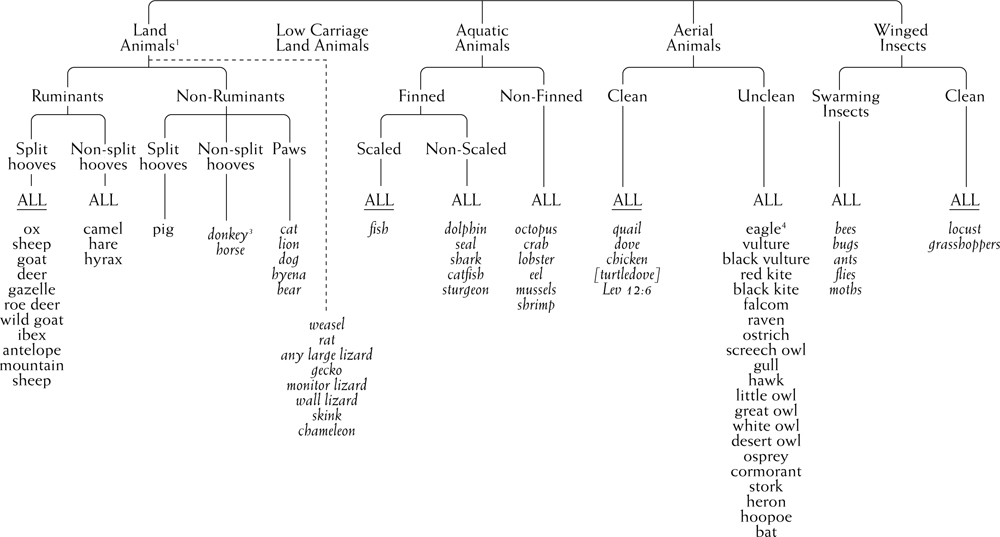
1. Deuteronomy 14 mentions only high carriage land animals. Lev 11:29–31 adds the class of low carriage land animals that “swarm on the ground.” Lev. 11:10–11 refers to corresponding aquatic “swarmers.”
2. Underlined: permitted as food.
3. Italic font: examples, not named in Leviticus 11 or Deuteronomy 14.
4. The identity of some of these birds is uncertain.
We might have expected the opening statement in verse 4 to be followed by principles by which kosher animals could be identified. Instead Moses lists ten animals permitted as food (vv. 4b–5). Three are domesticated species (ox, sheep, and goats), whose blood Yahweh will accept as sacrifices (cf. 12:23–27). Seven are wild (deer, gazelle, roebuck, wild goat, addax,24 antelope, mountain sheep) and may be considered undomesticated equivalents of the domesticated species. All are not only ruminants and split-hoofed, but also horned, at least the males of the species, though Moses makes nothing of this.25 The list expands the four basic categories of cattle, flock, gazelle, and deer referred to in 12:21–22.
Having listed clean animals, Moses explains that permissible meat may come only from animals with split hooves that chew the cud (v. 6). To illustrate this point he identifies four creatures that possess one feature but lack the other (vv. 7–8).26 The first three (v. 7) apparently chew the cud but they do not have split hooves.27 The pig is also mentioned, because it reverses the features of the previous three. Nothing is said of its disgusting habits,28 its association with trichinosis, or its role in pagan sacrificial rites or rites performed in graveyards (Isa. 65:4; 66:3, 17). The pig is rejected simply because it does not chew the cud.29 Moses’ demand that people not even touch the carcasses (cf. v. 21) reflects the strength of Israelite revulsion toward hogs.30
In verses 9–10 Moses distinguishes between clean and unclean aquatic animals. He continues the positive tone of verses 4–6 by first describing those that may be eaten—they have fins and scales—and then prohibiting those that lack these features. Not only has Moses drastically abbreviated the treatment of edible and inedible marine animals in Leviticus 11:9–12, but he has also softened the taboo, characterizing them as “unclean” for Israel rather than “detestable” and dropping any reference to their carcasses.
The most detailed listing of animals involves aerial creatures. As in the previous categories, Moses begins with a permissive declaration. However, unlike the previous two cases, he offers no criteria for classifying birds as clean or unclean. Also in contrast to the first list, after the opening line he pays no attention to edible birds but follows up the previous statement with the negative counterpart, listing birds that the Israelites may not eat.
The list of birds prohibited consists of twenty-one entries. With minor exceptions, the species named are identical to those found in Leviticus 11:12–19, suggesting that Moses is recalling that list from memory. The identities of most of the birds named are uncertain.31 They tend to be either carnivorous or scavengers. The fourfold addition of “any kind of” intentionally broadens the scope of prohibitions to species closely related to those listed. Bats are obviously mammals, but they are included with birds because Israel’s definition of “bird” was an animal with wings or that flies.
Moses concludes with a brief reference to “insects” (lit., “swarmers [šereṣ] of the wing [hāʿôp],” vv. 19–20). By itself šereṣ refers to creatures that swarm or crawl and could include rodents and snakes, except that hāʿôp (“of the wing”) limits it here to insects. Abbreviating Leviticus 11:20–23, Moses declares simply that all swarming insects are unclean and may not be eaten. But then, in keeping with the generally positive tone of this text, he adds, “All clean winged [insects] you may eat.” These include leaping insects like locusts and crickets, which are not associated with carrion or filth.
Bridging Contexts
FOOD LAWS IN THE rest of the Bible. Allusions to these food laws in the Old Testament are rare. Isaiah 65:4 and 66:17 include eating swine’s flesh with other provocative actions that incite Yahweh’s fury. Hosea 9:3 mentions eating unclean food in exile as a consequence of Israel’s rebellion. In Ezekiel 4:14 the exilic prophet protests that (as one in line for priestly service) he has never defiled himself by eating the flesh of an animal that has died by itself or been torn by wild animals; no contaminated meat has ever entered his mouth. However, here the defilement would derive from cooking pastry over human dung.35 In Ezekiel 44:31 the prophet reiterates the prohibition of Deuteronomy 14:21 for priests in the new spiritual order envisaged after the exile. According to Daniel 1:8, after Daniel was brought into Nebuchadnezzar’s court, he requested permission to abstain from the rich fare offered by the king that he might not defile himself. Although in exile in Babylon, he obviously viewed the dietary regulations of Deuteronomy 14 still to be in force.
Several New Testament texts suggest Jesus’ coming signaled the end of Israel’s food laws. According to Mark 7:19, all foods are clean—though in context the point is that defilement is caused primarily by actions arising out of the heart rather than ingesting food. In Acts 10:10–16 God reveals to Peter that in the post-resurrection community of faith, the dietary boundaries of the Old Testament community of faith are erased (as are the walls between Israelites and Gentiles). Paul declares in Romans 14:14, the old objective criteria for clean and unclean have been replaced by subjective perceptions. In Acts the apostles (including Paul, 21:26) continued to observe Israel’s ceremonial regulations when they were in Jerusalem, but they invited non-Jews to the messianic community without forcing them to become cultural Jews.36
Israel’s dietary regulations served as boundary markers and symbolized God’s election of this ethnic group as his holy people. The successive expansion of the boundaries of the covenant community in the postresurrection period from converted Christian Jews (Acts 2:5–21), to converted Samaritans (half-Jews physically and spiritually, 8:14–17), to Gentile “God-fearers” in the land of Israel (10:44–48), to people in foreign lands (19:1–7) rendered the old dietary boundaries between Israel and the nations obsolete. With the resurrection of the Messiah, on the one hand, and the opening of the door of salvation and the privilege of being God’s holy people to all humankind, on the other, those laws lost their symbolic significance.
Contemporary Significance
A THEOLOGY OF PRIVILEGE and holiness. Christians today do not generally follow these regulations concerning haircuts and tattoos and diet and dietary boundaries. But this does not mean that Moses’ pastoral counsel to Israel has no bearing for us. Underlying Deuteronomy 14 is a profound theology of privilege and holiness whose relevance transcends the old covenantal order. Like the Israelites, we, the people of God, should treasure his grace in election and his claims upon us as his holy people. Expression of our holy status should not be reserved for worship services but should be demonstrated in all areas of life. Those who bear the brand of Christ’s name represent him wherever they go.
But Christians today are conflicted over the degree to which the regulations of Deuteronomy 14:1–21 apply.37 While the significance of tattoos and certain hairstyles changes from culture to culture and generation to generation, it could be argued that whenever specific forms of these practices are linked with pagan or ungodly notions, they are to be avoided. After all, as sons and daughters of the living God, chosen in Christ before the foundation of the world “to be holy and blameless in his sight,” and predestined “to be adopted as his sons through Jesus Christ . . . to the praise of his glorious grace” (Eph. 1:4–6), and chosen to be his special treasure, that we should “declare the praises of him who called you out of darkness into his wonderful light” (1 Pet. 2:11–20), we are to avoid every appearance of evil.
But what about the dietary regulations, which on the surface appear morally neutral? On a recent visit to Hong Kong, I preached on Deuteronomy 14:1–21 to a Chinese congregation, well aware that much of what these people eat, especially the food brought in from offshore—violates Israel’s food laws: octopus, squid, shrimp, and the like have neither scales nor fins. When the people saw the sermon title, “Banqueting at the Table of the Lord: The Grace of Israel’s Food Laws,” some were visibly nervous. But they were relieved when I focused on the privileges that are ours in Christ—we are adopted as children of God, we are the elect, his special treasure, his holy people—and when I explained that in Christ these dietary regulations are removed.
While these dietary restrictions no longer apply to Christians, according to Acts 15:20 at the council of Jerusalem, the first generation of disciples reaffirmed the prohibition on consuming blood and the meat of animals that had not been properly slaughtered,38 along with prohibitions on idolatry and sexual immorality. The taboo on eating blood is not rooted in Israelite covenantal stipulations but goes back to the fountainhead of humanity; in Genesis 9:4 God forbids the consumption of blood by any of Noah’s descendants. In binding Gentile Christians to this ordinance, the council of Jerusalem recognized that all life is sacred.
According to the Babylonian Talmud, “A man’s table is like an altar.”39 In a sense every meal, especially those involving the meat of animals, is a sacrifice—an animal gives its life for our sakes. Rather than calling for a vegetarian diet, both Old and New Testaments authorize the consumption of animals, provided the consumer continues to respect the sanctity of the life of the animal. Moskala rightly declares that “both sacrifice and food should be taken with or as an expression of gratitude and thankfulness.”40 But this thankfulness is not only expressed in verbal declarations to God for his gracious provision, but is also felt toward the animal world that has provided both pleasure and nourishment to God’s vice-regent.
Apart from this concern for the life of the creature, in the end, the significance of the dietary regulations for Christians is probably best understood as a corollary of Israel’s sacrificial system. If indeed Deuteronomy 14 involves Yahweh’s invitation to eat of the food in which he himself takes delight in the form of sacrifices (12:5–14), then with the termination of all sacrifices in Christ, these food regulations also become passé. Since we no longer present these offerings to God but celebrate the sacrificial work of Jesus Christ, whenever we partake of the bread and the wine of communion, we participate in the feast to which the Lord has graciously invited us.
Indeed, when Jesus transforms the annual Israelite Passover into the regular communion meal and institutes the Lord’s Supper, he acts not only as the divine host who invites us to eat in his presence, but as God in the flesh, inviting redeemed sinners, children of God, his holy people, his chosen ones, his special treasure, to eat of him. For he who said to his disciples, “Take and eat; this is my body,” also took the cup, gave thanks, and offered it to them, saying, “Drink from it, all of you. This is my blood of the covenant, which is poured out for many for the forgiveness of sins. I tell you, I will not drink of this fruit of the vine from now on until that day when I drink it anew with you in my Father’s kingdom” (Matt 26:26–29). What an amazing declaration! The Lord invites us to his table and then offers himself as the sacrifice. Through him our admission to the family of God is secured. Hallelujah, what a Savior!
Original Meaning
A Final Reminder for Those Who Eat at Yahweh’s Table (14:21)
IN THE EPILOGUE (V. 21) Moses returns to the fundamental issue that has occupied his mind since the beginning of this chapter: Israel’s status as Yahweh’s holy people. Having explained in detail what he had meant by his prohibition of “detestable things” (v. 3), he recognizes two further culinary implications of Israel’s privileged place in the divine agenda. (1) Yahweh’s covenant people must avoid meat from animals that have died a natural death.32 The prohibition is probably connected with the need to drain the blood of animals before eating it (cf. 12:16, 23, 27; 15:23). Arising from his conviction that the entire nation of Israel is holy, Moses hereby extends to all the people a principle that Leviticus 22:8 applied only to priests. Since resident aliens and foreigners are not part of the “holy people,” these taboos do not apply. So the food may be given to the former as an act of charity or sold to the latter as a business transaction.
(2) Those who eat at Yahweh’s table must avoid certain ways of preparing the food. The proscription on boiling a kid in its mother’s milk remains a riddle.33 Scholars have proposed a variety of explanations for this regulation, but three commend themselves above all others. (a) The ordinance may arise out of a humanitarian concern, similar to that underlying the prohibition on killing a mother bird and taking its young or its eggs at the same time (Deut. 22:6–7; cf. Ex. 22:30[29]; Lev 22:27–28). (b) Boiling a kid in its mother’s milk may represent a fundamental and perverse violation of natural law—that which is intended for nourishment is used as an instrument of death. (c) Given the prohibition of eating animals from which the blood has not been drained, this proscription may be concerned with avoiding all appearance of the consumption of blood. Linking this taboo with others that forbid the slaughter of an animal less than eight days old, we note that in the first few days after giving birth, a mother animal’s milk is rich in colostrum, often giving it a reddish color. Eating the meat of a kid cooked in its mother’s milk may be considered eating meat with blood.34
It is difficult to decide which of these three possibilities is best. While this strange prohibition occurs in identical form in Exodus 23:19 and 34:26, its association with the annual pilgrimage festivals suggests it may allude to fertility rites performed in honor of a Canaanite deity.
Bridging Contexts
FOOD LAWS IN THE rest of the Bible. Allusions to these food laws in the Old Testament are rare. Isaiah 65:4 and 66:17 include eating swine’s flesh with other provocative actions that incite Yahweh’s fury. Hosea 9:3 mentions eating unclean food in exile as a consequence of Israel’s rebellion. In Ezekiel 4:14 the exilic prophet protests that (as one in line for priestly service) he has never defiled himself by eating the flesh of an animal that has died by itself or been torn by wild animals; no contaminated meat has ever entered his mouth. However, here the defilement would derive from cooking pastry over human dung.35 In Ezekiel 44:31 the prophet reiterates the prohibition of Deuteronomy 14:21 for priests in the new spiritual order envisaged after the exile. According to Daniel 1:8, after Daniel was brought into Nebuchadnezzar’s court, he requested permission to abstain from the rich fare offered by the king that he might not defile himself. Although in exile in Babylon, he obviously viewed the dietary regulations of Deuteronomy 14 still to be in force.
Several New Testament texts suggest Jesus’ coming signaled the end of Israel’s food laws. According to Mark 7:19, all foods are clean—though in context the point is that defilement is caused primarily by actions arising out of the heart rather than ingesting food. In Acts 10:10–16 God reveals to Peter that in the post-resurrection community of faith, the dietary boundaries of the Old Testament community of faith are erased (as are the walls between Israelites and Gentiles). Paul declares in Romans 14:14, the old objective criteria for clean and unclean have been replaced by subjective perceptions. In Acts the apostles (including Paul, 21:26) continued to observe Israel’s ceremonial regulations when they were in Jerusalem, but they invited non-Jews to the messianic community without forcing them to become cultural Jews.36
Israel’s dietary regulations served as boundary markers and symbolized God’s election of this ethnic group as his holy people. The successive expansion of the boundaries of the covenant community in the postresurrection period from converted Christian Jews (Acts 2:5–21), to converted Samaritans (half-Jews physically and spiritually, 8:14–17), to Gentile “God-fearers” in the land of Israel (10:44–48), to people in foreign lands (19:1–7) rendered the old dietary boundaries between Israel and the nations obsolete. With the resurrection of the Messiah, on the one hand, and the opening of the door of salvation and the privilege of being God’s holy people to all humankind, on the other, those laws lost their symbolic significance.
Contemporary Significance
A THEOLOGY OF PRIVILEGE and holiness. Christians today do not generally follow these regulations concerning haircuts and tattoos and diet and dietary boundaries. But this does not mean that Moses’ pastoral counsel to Israel has no bearing for us. Underlying Deuteronomy 14 is a profound theology of privilege and holiness whose relevance transcends the old covenantal order. Like the Israelites, we, the people of God, should treasure his grace in election and his claims upon us as his holy people. Expression of our holy status should not be reserved for worship services but should be demonstrated in all areas of life. Those who bear the brand of Christ’s name represent him wherever they go.
But Christians today are conflicted over the degree to which the regulations of Deuteronomy 14:1–21 apply.37 While the significance of tattoos and certain hairstyles changes from culture to culture and generation to generation, it could be argued that whenever specific forms of these practices are linked with pagan or ungodly notions, they are to be avoided. After all, as sons and daughters of the living God, chosen in Christ before the foundation of the world “to be holy and blameless in his sight,” and predestined “to be adopted as his sons through Jesus Christ . . . to the praise of his glorious grace” (Eph. 1:4–6), and chosen to be his special treasure, that we should “declare the praises of him who called you out of darkness into his wonderful light” (1 Pet. 2:11–20), we are to avoid every appearance of evil.
But what about the dietary regulations, which on the surface appear morally neutral? On a recent visit to Hong Kong, I preached on Deuteronomy 14:1–21 to a Chinese congregation, well aware that much of what these people eat, especially the food brought in from offshore—violates Israel’s food laws: octopus, squid, shrimp, and the like have neither scales nor fins. When the people saw the sermon title, “Banqueting at the Table of the Lord: The Grace of Israel’s Food Laws,” some were visibly nervous. But they were relieved when I focused on the privileges that are ours in Christ—we are adopted as children of God, we are the elect, his special treasure, his holy people—and when I explained that in Christ these dietary regulations are removed.
While these dietary restrictions no longer apply to Christians, according to Acts 15:20 at the council of Jerusalem, the first generation of disciples reaffirmed the prohibition on consuming blood and the meat of animals that had not been properly slaughtered,38 along with prohibitions on idolatry and sexual immorality. The taboo on eating blood is not rooted in Israelite covenantal stipulations but goes back to the fountainhead of humanity; in Genesis 9:4 God forbids the consumption of blood by any of Noah’s descendants. In binding Gentile Christians to this ordinance, the council of Jerusalem recognized that all life is sacred.
According to the Babylonian Talmud, “A man’s table is like an altar.”39 In a sense every meal, especially those involving the meat of animals, is a sacrifice—an animal gives its life for our sakes. Rather than calling for a vegetarian diet, both Old and New Testaments authorize the consumption of animals, provided the consumer continues to respect the sanctity of the life of the animal. Moskala rightly declares that “both sacrifice and food should be taken with or as an expression of gratitude and thankfulness.”40 But this thankfulness is not only expressed in verbal declarations to God for his gracious provision, but is also felt toward the animal world that has provided both pleasure and nourishment to God’s vice-regent.
Apart from this concern for the life of the creature, in the end, the significance of the dietary regulations for Christians is probably best understood as a corollary of Israel’s sacrificial system. If indeed Deuteronomy 14 involves Yahweh’s invitation to eat of the food in which he himself takes delight in the form of sacrifices (12:5–14), then with the termination of all sacrifices in Christ, these food regulations also become passé. Since we no longer present these offerings to God but celebrate the sacrificial work of Jesus Christ, whenever we partake of the bread and the wine of communion, we participate in the feast to which the Lord has graciously invited us.
Indeed, when Jesus transforms the annual Israelite Passover into the regular communion meal and institutes the Lord’s Supper, he acts not only as the divine host who invites us to eat in his presence, but as God in the flesh, inviting redeemed sinners, children of God, his holy people, his chosen ones, his special treasure, to eat of him. For he who said to his disciples, “Take and eat; this is my body,” also took the cup, gave thanks, and offered it to them, saying, “Drink from it, all of you. This is my blood of the covenant, which is poured out for many for the forgiveness of sins. I tell you, I will not drink of this fruit of the vine from now on until that day when I drink it anew with you in my Father’s kingdom” (Matt 26:26–29). What an amazing declaration! The Lord invites us to his table and then offers himself as the sacrifice. Through him our admission to the family of God is secured. Hallelujah, what a Savior!