Original Meaning
IN 15:19–16:17 Moses returns to his instructions on the vertical dimensions of covenant relationship that were interrupted by instructions regarding the poor (14:22–15:18). The first section (15:19–23) is transitional, dealing with eating in the presence of Yahweh at the central sanctuary and at home; the second (16:1–17) invites the people regularly to celebrate before him.
Whereas chapter 16 will deal with scheduled celebrations in the presence of Yahweh, 15:19–23 invites Israelites to be ready to celebrate any time. Regulations concerning the offering of the firstborn are found elsewhere in the Pentateuch (Ex. 13:2, 11–16; 22:29b–30[28b–29]; Num. 18:15–18). While critical scholars tend to highlight the inconsistencies in these texts,1 conservative scholars often try to harmonize them.2 Both approaches tend to overlook the distinctive emphases of each text, especially the role they play in the broader contexts in which they are embedded.3 Given the appeal for open hearts and open hands in 15:1–18, this treatment of offerings at the place Yahweh will choose (v. 20) creates an effective inclusio with 14:22–29 and brings this larger unit on open hands and a soft heart to an effective conclusion.
Earlier Moses had instructed the people to present the firstborn of herd and flock to Yahweh along with a series of other gifts (12:5–6, 17–18; 14:23). Now he focuses on this offering in greater detail. According to Exodus 13:1–2, because every firstborn of every creature belongs to God, it must be consecrated to him and thereby removed from profane, everyday use. Although usually translated “firstborn,”4 bekôr connotes sociological rank rather than chronological priority,5 which probably explains why Exodus 13:12 adds “the first offspring of every womb.” This phrase confirms that those claimed by Yahweh are the firstborn of a mother rather than of a father.6
Deuteronomy 15:19 restricts the law, first by specifying firstborn males, and second by requiring perfect specimens. Taking into account Exodus 13:13, which eliminates donkeys, and Numbers 18:15–16, which eliminates unclean animals, the successive narrowing of the field of candidates may be illustrated diagrammatically as follows7:
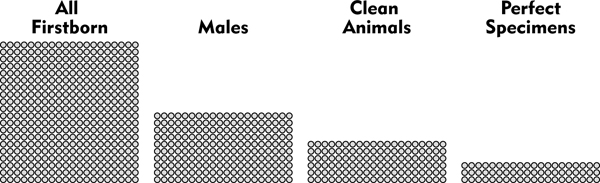
Since no more than about 15 percent of firstborn animals will have been sacrificed, the economic consequences of the law of the firstborn was minimal. Furthermore, the animals were not to be simply disposed of or sacrificed as whole burnt offerings; rather, their meat was eaten in celebration at the central sanctuary (v. 20).
The paragraph opens with a forthright command, calling Israelites to consecrate the firstborn in their herds and flocks to Yahweh their God. Whereas Numbers 3:13 establishes the basis for this demand, the supplementary commands in our text prohibit the use of these animals for normal domestic purposes. Firstborn male cattle were not to be used as draft animals, pulling wagons or plowing the fields, and the sheep and goats were not to be shorn. Since yearling cattle are strong enough for some tasks and since the finest wool comes from lambs six to twelve months old, Israelites might be tempted to compromise the integrity of these animals by using them for domestic purposes prior to consecrating them.8 Although the text does not specify the time of year to consecrate the firstborn, the expression “each year” (lit., “year by year”) suggests they were to be presented at the central sanctuary at one of the annual festivals.9 This means that some firstborn may have been as young as a few days, others could have been almost a year old.
But how shall we reconcile these instructions with Yahweh’s direct command in Exodus 22:30[29] to consecrate the firstborn on the eighth day? Apparently it depends on the location and timing of the consecration ritual. Since Numbers 18:16 sets the redemption price according to the “sanctuary shekel,” this might have transpired at the tabernacle. However, once the tribes had scattered to their allotted territories, it would have been logistically impossible for the men to trek to the central sanctuary on the eighth day after the birth of every firstborn. Perhaps the functions of Levites living in Levitical cities (Num. 35:1–8) included receiving these offerings and the money that was paid to redeem other animals. In any case, once Moses called for the presentation of the firstborn at the central sanctuary, earlier regulations were suspended in favor of new guidelines in keeping with the new situation.
Verse 20 invites the head and the entire household to a banquet in the presence of Yahweh when the firstborn are consecrated.10 Although Yahweh himself does not eat the meat, as divine host he invites his family to partake of food that has been dedicated to him. Lest they become careless about their offerings, Moses reminds the Israelites that the only meat worthy of Yahweh’s table is that which comes from flawless animals (v. 21). Although he specifies defective as lame and blind, the addition of “any serious flaw” suggests these expressions function as shorthand for any conceivable defect.11 They may be physically flawed, but they represented ceremonially clean species of animals. Therefore, like wild game, they could be eaten by anyone, whether in a state of cleanness or uncleanness in the towns where the people lived, provided the blood was properly drained during slaughtering.12
Bridging Contexts
IN CONTRAST TO EXODUS 12–13 and Numbers 18, this paragraph offers a minimalist description of the consecration and sacrifice of the firstborn animals.13 Building on Deuteronomy 12:6, it focuses on the firstborn as God’s provision of table fare for his people who are invited to come regularly and eat in his presence. Yahweh delights in their presence before him. Every birth of a firstborn male among cattle, sheep, or goats signaled a call from Yahweh to the household to come to his sanctuary to declare their gratitude and to fellowship with him. The fertility of the herds and flocks was not to be taken for granted. The ability of a ewe or cow to conceive and give birth was a gift and a mark of divine blessing.
Thus the consecration of the firstborn should not have been viewed merely as an external ritual requirement; these young animals symbolized Yahweh’s delight in his people. At the same time, this passage reflects Yahweh’s concern for economy. Defective animals were not to be wasted or treated as trash; they too reflected his delight in the people, for he authorizes them to eat their meat in their homes—provided they respect the sanctity of the life of the animals. In a sense, even these meals are sacrifices, for an animal gives its life for the people in the family of God.
The book of Malachi describes a society in which divine grace and blessing were taken for granted. The loss of reverence for Yahweh, the loss of sight of his covenant love, and the loss of the privilege of sonship (Mal. 1:1–6; cf. Deut. 14:1) were reflected in the people’s trivialization of worship. Instead of rejoicing at the prospect of worship in the presence of Yahweh, the people of Malachi’s day responded to his invitation to fellowship with cynicism and ingratitude (Mal. 1:7–14). They were bored with the ritual, and they profaned Yahweh’s table by presenting to him lame and sickly animals.
Contemporary Significance
THIS IS A PROBLEM in our own day. We often view the Lord’s blessing as a right rather than a privilege. But God’s people cannot afford to lose sight of the grace of covenant relationship with him, concretized in his blessing on our work and his invitation to worship in his presence. Success in every venture, whether agricultural, industrial, academic, or domestic, depends on God’s favor (Ps. 90:16–17). And every meal is still a sacrifice, but it is also a gracious provision of God.
If this is true of the meals we eat in our homes, how much more of the meals he invites us to eat in his presence. Every time we gather to partake of the bread and the wine of communion, Jesus, who is Yahweh incarnate, serves us at his table. However, he does not merely take the offerings we bring and then invite us to eat of it; the firstborn Son of God offers himself, saying, “Take and eat, this is my body, given for you” (Matt. 26:26–27; Mark 14:22–23; with Luke 22:19–20; 1 Cor. 11:24–25). God’s people should never treat eating at the Lord’s table as a wearisome ritual, a waste of time and resources. On the contrary, this is a precious ritual, for the invitation to eat at this meal sets us apart from all others and provides us with a constant reminder of his immeasurable grace. In the words of the angel of Revelation 19:9, “Blessed are those who are invited to the wedding supper of the Lamb!”