Original Meaning
Righteousness in the Face of Marital Infidelity (22:13–21)
WHILE CRITICAL SCHOLARS TEND to delete the paraenetic features of verses 13–21 as secondary insertions, these are integral to the pastoral tone of the text. In general, this section divides into two uneven parts, presenting a primary case (vv. 13–19), followed by a countercase (vv. 20–21).1
The primary case (vv. 13–19). Moses begins by presenting a hypothetical situation in which a man marries a woman (vv. 13–14), but in order to be released from the marriage he trumps up charges against her. Moses casts the case logically as a five-phased process: (1) a man marries a woman (v. 13a); (2) the man consummates the marriage (v. 13b); (3) the man rejects his wife (v. 13c);2 (4) the man accuses his wife of misconduct (v. 14a); (5) the man publicly shames his wife (v. 14b). The absence of a reason for the rejection in phase 3 suggests an illicit demand for divorce and sets the stage for the presentation of the case to the elders.
The charge in phase 4 may be understood either as “wanton words,” that is, unrestrained speech, or “wanton actions,” that is, profligate behavior.3 Since the elders find the woman innocent, the punishment appropriate to the crime for which the woman is charged (in this case, death by stoning) should be execution of the man (cf. 19:15–21). However, since he is “merely” chastised and forced to pay compensation to the woman’s father suggests that the primary issue here is not the veracity of the husband’s charges, but the innocence of his wife. In that case the charge in phase 4 refers to misconduct, which the husband imputes to his wife (cf. v. 17).
The statement in phase 5 reinforces this interpretation. Moses concretizes the slanderous speech in verse 14b by putting self-serving words in his mouth. Echoing the narrative introduction, the man claims that he took the woman as his wife, but when he approached her to consummate the marriage, he discovered she was not a virgin.4 While the man does not give the evidence for his charge, he had two options, both involving blood. If she was not menstruating or did not bleed after the first intercourse, he could conclude either that she was pregnant, or he was not the first man to have intercourse with her. The parents’ words in verse 17 suggests the latter is the charge. The text does not say why the husband has trumped up this charge, other than that he wants to get out of a marriage. He thinks he can achieve his objectives by pressing charges against his wife in court, which would lead to her execution for adultery (cf. Lev. 20:10).
In verses 15–17 Moses envisions the court proceedings take a surprising turn. The defendant turns out to be not the woman but the man, who has leveled the charges against her. Therefore, the elders must deal with him before they deal with the woman. Three features of the judicial procedures are significant. (1) They transpire before elders in the gate of the town where these people reside, suggesting that adultery is not simply a sinful act between two consenting adults. In a kinship-based society, healthy marriages are fundamental to the health of the community, linking families that have negotiated the marital agreement in the first place. Because the divorce sought by this man and the rumors he has spread have the potential to divide the community, elders representing the extended family units must intervene.
(2) The young woman’s parents initiate the proceedings to have their daughter’s sullied reputation cleared. Concern for their own honor may be a factor,5 but this case also involves male defense of female honor. The husband’s shaming of his wife’s honor calls for judicial intervention. Instead of fulfilling his primary duty of securing the welfare of his wife, he has taken hostile actions against her.
(3) Whereas earlier texts had called for multiple witnesses to establish the truth in a legal case (17:6–7; 19:15), in this case material evidence is presented.6 The vague reference to “proof of her virginity” in verse 14 is clarified somewhat in verse 17 with “cloth.” Although this word normally refers to an outer garment,7 here it refers either to the garment worn on the night of the wedding or the bed sheet, giving evidence of the breaking of the girl’s hymen.8 The accused woman may have stored the sheet in her “hope chest,” as a commemoration of the night of her first intercourse and as concrete evidence of her virginity at the time of her marriage—in case anyone should ever challenge this. This she now produces to her father and mother as proof of her premarital purity.
The speech of the woman’s father in verses 16b–17 echoes the man’s charges against his wife (vv. 13–14a). However, the father turns the case around and accuses the man of unfaithfulness. He has wrongly rejected his wife and spread false and malicious rumors of her misconduct in the community. After quoting his son-in-law’s charge verbatim, he spreads out the bed sheet before the elders, and declares, “Here is the proof of my daughter’s virginity.”
According to verses 18–19 the evidence of a stained bed sheet trumps the verbal accusations of a treacherous husband. The testimony of the bride’s father and the material evidence call for a decisive response against the husband. The elders must take the man and flog him (NIV “punish”), fine him one hundred shekels of silver—to be paid to the father of the young woman as compensation for her sullied reputation9—and prohibit him from ever divorcing his wife (v. 19b). While modern readers may find the last prescription troublesome, this requirement aims for a rehabilitative outcome. Because the matter is resolved in a public court of law, the people in the community become guarantors of the man’s good behavior.
The fine goes beyond compensating for the injury done to the woman’s reputation; it also restores righteousness in Israel. The striking ending of the motive clause in verse 19 assumes that sexual sins are not only personal crimes against another individual; they are also crimes against the entire community. This solution takes seriously the implications for the health of society of the original charges and the extension of the woman’s guilt to the covenant community. The court must preserve the good name of all Israelite women, but they must also act to preserve righteousness within the nation as a whole.
The countercase (vv. 20–21). Moses completes the discussion by instructing the court how to proceed if the husband’s accusations are confirmed. The description is more concise than the preceding, consisting of summary statements of the opposite result (v. 20), followed by the sentence (v. 21). The former announces simply that the husband is justified in accusing his wife of premarital adultery—proof of virginity is lacking. Failing to produce the stained bed sheet as evidence of innocence, plaintiff and defendant switch roles. The person whose guilt or innocence is at issue is no longer the man who has spread the rumors, but his wife. The punishment for premarital adultery is severe: shameful death by stoning10 at the entrance to the woman’s father’s house, because she committed fornication while still at home.11 This punishment implies the public defaming of the father and his household for having “sold damaged goods” to the husband.12
Since marriages in Israel were generally patrilocal, Moses’ demand that “the men of her town” rather than the men of the town where she and her husband lived is remarkable. This forces the community that hosted the sinful acts to come to terms with the crime. This conclusion is reinforced by the motive clause and the concluding purgation formula (v. 21). Together, these expressions highlight the heinousness and the communal implications of sexual crimes and declare Moses’ main concern—to maintain a holy community of faith before Yahweh. Radical surgery is required to remove those who flaunt contempt for the covenant by promiscuous behavior. Young men and women are to keep themselves pure for their spouse.
Bridging Contexts
SEXUAL PATTERNS IN BIBLICAL narratives. While acknowledging the male’s initiative in the sexual crimes dealt with here, these instructions reflect a remarkable equality. For women, the outcome of consensual premarital sex was death (vv. 22–24) and of nonconsensual sex, marriage (vv. 28–29). For men it was the same: death or pay the bride price and marry her. While no guilt was incurred by women if they were forced to engage in sexual activity against their will (vv. 22–27), Israel could not tolerate sexually experienced unmarried women.22 The restrictions on female prostitution23 and the tenor of narratives involving men with prostitutes suggest the same applied to men.
The narratives of the Old Testament are punctuated with accounts of sexual crimes of all sorts. Perhaps we should not be surprised when Canaanites like Shechem (Gen. 34:2) or Tamar (Gen. 38:14–19) behave immorally, but when the covenant people do so against the revealed will of God, their guilt exceeds that of those who do not have the Torah.24 Although biblical narratives recognize men with remarkable moral fortitude in the face of sexual temptation (Gen. 39:9),25 they are remarkably frank in their portrayal of the moral failures of Israel’s heroes and individuals in their families: the incest of Reuben, the eldest son and natural heir of Jacob (Gen. 35:22); the wanton sexual immorality of Phinehas and Hopni (Eli’s sons) with female worshipers (1 Sam. 2:22); David’s adulterous affair with his officer’s wife (2 Sam. 11:1–27); Amnon’s rape of his sister (2 Sam. 13:1–19). As Israel’s/Judah’s demise approached, adultery was high on the lists of crimes proving the nation’s covenantal infidelity.26
But the problem did not end with the Old Testament. Jesus recognized that sexual immorality is not merely an external act; it has its roots in the heart/mind (Matt. 5:27; 15:19; Mark 7:21), and he issued stern warnings against divorce and remarriage because of the adulterous consequences (Matt. 5:32; 19:9; Mark 10:11–12; Luke 16:18). Indeed with prophetic fervor he characterized his own generations as evil and adulterous (Matt. 12:39; 16:4; Mark 8:38). The seriousness of sexual immorality not only in society at large but within the early church in particular is reflected in the frequency with which notions of adultery and immorality appear in the New Testament letters27 and in the book of Revelation.28
Contemporary Significance
GENDER ISSUES. THE SEXUAL crimes dealt with in our text are problematic at two levels. Most obviously, they represent violations of the most fundamental of human institutions, the marriage of a man and a woman. To engage in sexual activity outside of marriage is an act of treachery against one’s own spouse (Mal. 2:13–16) and treachery against the spouse (or prospective spouse, in the case of relations with someone not married) of the person with whom one is engaged in this illicit behavior. But God is the witness to all covenants and the guarantor of fidelity,29 and he holds people accountable for their immorality.
However, the sexual crimes presented here also address issues of gender relations. Many interpret these instructions as irredeemably patriarchal, the primary intention being to defend the rights and honor of men at the expense of women.30 However, the cultural presuppositions reflected here are millennia removed from modern pervasively egalitarian Western societies. However, our caricatured view of patriarchy, which etymologically means “the rule of the father,” is problematic. It evokes images of high-handed and self-serving men whose primary concern was maintaining male honor and male control over the household.
Admittedly, the Hebrew designation of the family unit as a bêt ʾâb (“father’s house”) reflects both the androcentricity of Israelite society in general and the patricentricity of families in particular. Like most ancient Near Eastern cultures Israelite families were patrilineal (official lines of descent were traced through the father’s line),31 patrilocal (married women joined the households of their husbands), and patriarchal (the father governed the household).32
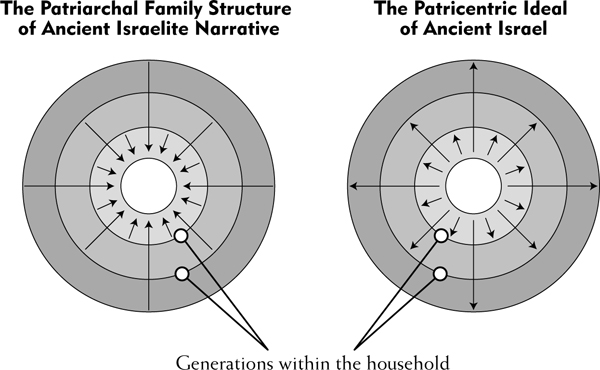
But the narratives of the Old Testament expose the problems with patriarchy, inasmuch as responsible rule in the interests of those placed in one’s charge may quickly degenerate into self-interested and abusive male behavior.33 The solution offered by the Old Testament (and the New Testament, for that matter) is not to replace these structures with some sort of egalitarianism that neutralizes gender distinctions and homogenizes roles, but to plead for transformed leadership. In patriarchy the emphasis is on the rule of the head, which often leads to dominance over and exploitation of those within the household for male interests and honor. Sadly, the prediction of Genesis 3:16 has proved to be painfully true: “He will rule over you.”
This problem exists at every level of leadership;34 instead of promoting the health of the community, leaders often undermine it. The patricentrism envisioned in Deuteronomy operates in the reverse direction. There is no denial of traditional family structures—after all, a family is the bêt ʾāb—but according to this ideal the emphasis is on the father’s responsibility (not power) to care for the household and seek the interests of others above his own.
Although these texts do not gloss over sin committed by females (vv. 20–21, 22, 23–24), their primary concern is to rein in abusive and abominable male behavior: slandering and then seeking to get rid of a wife (vv. 13–19); adultery with a woman betrothed to another man (vv. 23–24); degrading a woman betrothed to another man (vv. 25–27); degrading a virgin (vv. 28–29); and finally abusing one’s father and step-mother (v. 30[23:1]. The moral trajectory reflected here characterizes the entire book of Deuteronomy.35
A high view of community, family, and human sexuality. The scenarios envisioned in our text may be common, but they are neither normal nor excusable. The covenantal standards signaled by the Decalogue and developed in greater deal in the Deuteronomic Torah call on the “father” (ʾāb) in the “the father’s house” (bêt ʾāb) to care for and protect all those under his charge. Because of sheer superior physical power, men exhibit a propensity to exploit and abuse women as if they were nothing more than household property, as disposable as sheep or oxen. Contemporary efforts to determine and reestablish biblical ethical norms must pay attention not only to accounts of the way it was, but also to texts that seek to outline the way it should have been. In this and many other respects, the book of Deuteronomy offers a glorious gospel, setting a trajectory of male-female relations that leads ultimately to Paul’s statements in Ephesians 5:25–33.
Husbands, love your wives, just as Christ loved the church and gave himself up for her to make her holy, cleansing her by the washing with water through the word, and to present her to himself as a radiant church, without stain or wrinkle or any other blemish, but holy and blameless. In this same way, husbands ought to love their wives as their own bodies. He who loves his wife loves himself. After all, no one ever hated his own body, but he feeds and cares for it, just as Christ does the church—for we are members of his body. “For this reason a man will leave his father and mother and be united to his wife, and the two will become one flesh.” This is a profound mystery—but I am talking about Christ and the church. However, each one of you also must love his wife as he loves himself, and the wife must respect her husband.
Given this perspective on normative patricentrism, a more balanced reading of Deuteronomy 22:13–30 [23:1] becomes possible. This chapter reflects a high view of community, family, and human sexuality. It runs against the grain of modern Western approaches, which tend to view human beings atomistically, as independent and self-sufficient, and which view sexual activity as personal matters and sexual sins as purely private.36 Here Moses teaches modern readers that human sexuality is sacred, that the purity of marriage is to be defended at all cost, and that degeneration in these areas inevitably leads to disintegration of the family as a whole. In a society where the rate of failed marriages is as high among church members as outsiders, Christians in particular need to hear Moses’ call for defense of the institution of marriage.
Whatever the long-range validity of Moses’ (and Yahweh’s) demand for executing adulterers—few would approve the punishments for our day—these texts remind us of the heinousness of sexual sins in God’s eyes. As long as the standards by which the church responds to these issues are governed by worldly perspectives, so long will her voice on other aspects of justice and morality be rejected as hypocritical and empty. Jesus’ disposition on these matters is precisely in line with those of Moses, when he said, “What God has joined together, let man not separate” (Matt. 19:6; Mark 10:9)—which is tantamount to a curse on any who would interfere with another’s marriage. And Moses’ instructions are no more severe than the warnings of Paul, who declares:
Do you not know that the wicked will not inherit the kingdom of God? Do not be deceived: Neither the sexually immoral nor idolaters nor adulterers nor male prostitutes nor homosexual offenders nor thieves nor the greedy nor drunkards nor slanderers nor swindlers will inherit the kingdom of God. And that is what some of you were. But you were washed, you were sanctified, you were justified in the name of the Lord Jesus Christ and by the Spirit of our God. (1 Cor. 6:9–11)
Contemporary readers are faced with two principal alternatives when faced with texts like Deuteronomy 22:13–30: interpret these documents as cultural fossils of a bygone era with no relevance whatsoever for the issues that face readers today, or attempt to understand the permanent values reflected here and find contemporary ways of applying those values. We cast our vote for the latter.
Original Meaning
Righteousness in the Face of Sexual Promiscuity (22:22–30 [23:1])
THIS NEXT SET OF instructions seeks to establish righteousness in sexual behavior by presenting three hypothetical adulterous scenarios (vv. 22–29), and an outright apodictic prohibition of sexual relations with one’s step-mother (v. 30 [23:1]). The three scenarios exhibit a clear progression, depending on the marital status of the woman: illicit sex with a married woman (v. 22), illicit sex with a virgin who is betrothed to a man (vv. 23–27), and illicit sex with a virgin not yet betrothed to a man.
Adultery involving a married woman (v. 22). The opening formula, “If a man is found,” indicates this case is not about rumors but about adulterers discovered in the very act: A man lies with another man’s wife. The opening sentence focuses on the man, but the specified punishment suggests the act was consensual. Moses provides no details on the procedures leading up to the adulterers’ execution, nor of the execution itself. However, sandwiched between verses 15–22 and 23–24, the text seems to assume that the person(s) who discovered them in the act would notify the elders of the town and testify against them in a public hearing, whereupon they would be publicly executed by stoning. Since sexual crimes are considered crimes against the fabric of the community and crimes against God, covenantal righteousness demands the purgation of the evil from the midst of Israel, which is achieved by removing the corrupting elements.
Adultery involving a virgin engaged to be married (vv. 23–27). These instructions are more complex, like verses 13–21 (cf. 19:1–13), subdividing into two panels representing a primary case (vv. 23–24) and a countercase (vv. 25–27). The differences in outcome are determined by the location of the offense. Both cases involve a man finding a young woman and engaging in sexual intercourse with her. The woman is referred to by three expressions: “girl [young woman]”;13 “virgin,”14 and “betrothed girl.” The latter two distinguish these cases from the preceding where the adulterous wife was identified as a “wife” (v. 22). Whereas modern Western engagements involve public declarations of intention to marry, betrothal refers to a publicly binding legal act, which explains why in this context the woman was considered “another man’s wife” (v. 24).
The primary case (vv. 23–24) concerns an adulterous act committed within the walls of the town, where residents live in close proximity to one another. Since no one heard the woman’s cry for help, it is assumed she did not cry out, which suggests the sexual act was consensual. Therefore, both the man and the woman are to be brought to the gate of the town and executed by stoning. While adulterer and adulteress receive the same punishment, the reasons differ. They stone the woman because she did not cry out for help, and the man because he has debased his neighbor’s wife15 and in so doing also violated the honor of his neighbor. However, as in the preceding cases, adultery is deemed more than a private act between two consenting adults; it violates the integrity of the nation as a whole. Therefore righteousness demands the death penalty to purge the evil from the midst of the nation.
The countercase (vv. 25–27) highlights the role of the woman as victim. This hypothetical encounter transpires in the open field, where, even if she had cried for help, no one within earshot would have heard her cry. Consequently, she is given the benefit of the doubt, while the man is considered guilty. Having encountered her (v. 27) away from the village in the open country, he seized her and “lay” with her. Comparing the woman’s fate to that of the victim of murder (cf. 19:11–13), Moses pronounces the death penalty on the man. However, since the woman is presumed an innocent victim, she shall not die.
Adultery involving a virgin not engaged to be married (vv. 28–29). Of Moses’ instructions concerning adultery, this paragraph exhibits the closest links to earlier laws, particularly Exodus 22:16–17[15–16]. Both cases involve a man and a virgin who has not been engaged,16 though our text casts the actions of the adulterer in a more violent light. Whereas Exodus 22:16[15] considered the man’s actions seductive, this text envisions the man seizing the woman and “lying” with her, and the two being caught in the very act. Here the prescribed response focuses entirely on the man. Because he has deflowered and degraded the woman, he must pay the father of the woman fifty shekels. Unlike verse 19, this payment is not considered a fine but the bride price, since upon its payment she becomes his wife in a marriage from which there is to be no divorce as long as they live (cf. v. 19).
Superficially this text seems to go against the general Deuteronomic trajectory of a more humanitarian approach vis-à-vis earlier laws, tightening the ordinance as preserved in Exodus 22:16–17[15–16]. Because the man has degraded the virgin, he must pay the bride price of fifty shekels to her father and take her as his wife, which seems to add insult to injury for the woman. Not only has she been violated, but now she is forced to become his wife. However, if we translate the verb wenātan modally, “and he may pay,” rather than as an imperative, “he shall pay” (NIV), the tone changes significantly. If her father accepts the bride price and agrees to accept the man as a son-in-law, then the man must fulfill all the marital duties that go with sexual intercourse.17
Respecting one’s father’s sexuality (22:30 [23:1]). This ethical fragment is linked to the preceding by its concern for sexual integrity. However, the apodictic form and the departure from the adulterous cases of the previous paragraphs set it apart.18 This taboo on sexual intercourse between a man with his father’s wife reiterates what Yahweh had prohibited in Leviticus 18:8. The opening clause is cast as a forthright apodictic prohibition on marrying one’s father’s wife. The case probably does not involve sexual intercourse with one’s own mother (cf. Lev. 18:7); rather, it seems to presuppose polygamous family structures (Gen. 35:22; 2 Sam. 16:21–23).19 Since girls married at a very young age in ancient times,20 Moses may also be contemplating a scenario in which a man is attracted to his father’s former wife, who is free either because of divorce or the husband’s death.
The second clause, which the NIV paraphrases as “he must not dishonor his father’s bed,” gives the rationale for the prohibition. The idiom (lit., “to cover a father’s corner”) may refer to the garment covering his loins (cf. v. 12), but here it bears sexual overtones. If spreading one’s garment over a woman signified covering her nakedness, that is, marrying her (Ruth 3:9; Ezek. 16:8), then to uncover a man’s garment signified exposing the person over whom the man had spread his garment. Leviticus 18:8 suggests that to engage in intercourse with one’s step-mother desecrates the father’s marriage.21
Bridging Contexts
SEXUAL PATTERNS IN BIBLICAL narratives. While acknowledging the male’s initiative in the sexual crimes dealt with here, these instructions reflect a remarkable equality. For women, the outcome of consensual premarital sex was death (vv. 22–24) and of nonconsensual sex, marriage (vv. 28–29). For men it was the same: death or pay the bride price and marry her. While no guilt was incurred by women if they were forced to engage in sexual activity against their will (vv. 22–27), Israel could not tolerate sexually experienced unmarried women.22 The restrictions on female prostitution23 and the tenor of narratives involving men with prostitutes suggest the same applied to men.
The narratives of the Old Testament are punctuated with accounts of sexual crimes of all sorts. Perhaps we should not be surprised when Canaanites like Shechem (Gen. 34:2) or Tamar (Gen. 38:14–19) behave immorally, but when the covenant people do so against the revealed will of God, their guilt exceeds that of those who do not have the Torah.24 Although biblical narratives recognize men with remarkable moral fortitude in the face of sexual temptation (Gen. 39:9),25 they are remarkably frank in their portrayal of the moral failures of Israel’s heroes and individuals in their families: the incest of Reuben, the eldest son and natural heir of Jacob (Gen. 35:22); the wanton sexual immorality of Phinehas and Hopni (Eli’s sons) with female worshipers (1 Sam. 2:22); David’s adulterous affair with his officer’s wife (2 Sam. 11:1–27); Amnon’s rape of his sister (2 Sam. 13:1–19). As Israel’s/Judah’s demise approached, adultery was high on the lists of crimes proving the nation’s covenantal infidelity.26
But the problem did not end with the Old Testament. Jesus recognized that sexual immorality is not merely an external act; it has its roots in the heart/mind (Matt. 5:27; 15:19; Mark 7:21), and he issued stern warnings against divorce and remarriage because of the adulterous consequences (Matt. 5:32; 19:9; Mark 10:11–12; Luke 16:18). Indeed with prophetic fervor he characterized his own generations as evil and adulterous (Matt. 12:39; 16:4; Mark 8:38). The seriousness of sexual immorality not only in society at large but within the early church in particular is reflected in the frequency with which notions of adultery and immorality appear in the New Testament letters27 and in the book of Revelation.28
Contemporary Significance
GENDER ISSUES. THE SEXUAL crimes dealt with in our text are problematic at two levels. Most obviously, they represent violations of the most fundamental of human institutions, the marriage of a man and a woman. To engage in sexual activity outside of marriage is an act of treachery against one’s own spouse (Mal. 2:13–16) and treachery against the spouse (or prospective spouse, in the case of relations with someone not married) of the person with whom one is engaged in this illicit behavior. But God is the witness to all covenants and the guarantor of fidelity,29 and he holds people accountable for their immorality.
However, the sexual crimes presented here also address issues of gender relations. Many interpret these instructions as irredeemably patriarchal, the primary intention being to defend the rights and honor of men at the expense of women.30 However, the cultural presuppositions reflected here are millennia removed from modern pervasively egalitarian Western societies. However, our caricatured view of patriarchy, which etymologically means “the rule of the father,” is problematic. It evokes images of high-handed and self-serving men whose primary concern was maintaining male honor and male control over the household.
Admittedly, the Hebrew designation of the family unit as a bêt ʾâb (“father’s house”) reflects both the androcentricity of Israelite society in general and the patricentricity of families in particular. Like most ancient Near Eastern cultures Israelite families were patrilineal (official lines of descent were traced through the father’s line),31 patrilocal (married women joined the households of their husbands), and patriarchal (the father governed the household).32
But the narratives of the Old Testament expose the problems with patriarchy, inasmuch as responsible rule in the interests of those placed in one’s charge may quickly degenerate into self-interested and abusive male behavior.33 The solution offered by the Old Testament (and the New Testament, for that matter) is not to replace these structures with some sort of egalitarianism that neutralizes gender distinctions and homogenizes roles, but to plead for transformed leadership. In patriarchy the emphasis is on the rule of the head, which often leads to dominance over and exploitation of those within the household for male interests and honor. Sadly, the prediction of Genesis 3:16 has proved to be painfully true: “He will rule over you.”
This problem exists at every level of leadership;34 instead of promoting the health of the community, leaders often undermine it. The patricentrism envisioned in Deuteronomy operates in the reverse direction. There is no denial of traditional family structures—after all, a family is the bêt ʾāb—but according to this ideal the emphasis is on the father’s responsibility (not power) to care for the household and seek the interests of others above his own.
Although these texts do not gloss over sin committed by females (vv. 20–21, 22, 23–24), their primary concern is to rein in abusive and abominable male behavior: slandering and then seeking to get rid of a wife (vv. 13–19); adultery with a woman betrothed to another man (vv. 23–24); degrading a woman betrothed to another man (vv. 25–27); degrading a virgin (vv. 28–29); and finally abusing one’s father and step-mother (v. 30[23:1]. The moral trajectory reflected here characterizes the entire book of Deuteronomy.35
A high view of community, family, and human sexuality. The scenarios envisioned in our text may be common, but they are neither normal nor excusable. The covenantal standards signaled by the Decalogue and developed in greater deal in the Deuteronomic Torah call on the “father” (ʾāb) in the “the father’s house” (bêt ʾāb) to care for and protect all those under his charge. Because of sheer superior physical power, men exhibit a propensity to exploit and abuse women as if they were nothing more than household property, as disposable as sheep or oxen. Contemporary efforts to determine and reestablish biblical ethical norms must pay attention not only to accounts of the way it was, but also to texts that seek to outline the way it should have been. In this and many other respects, the book of Deuteronomy offers a glorious gospel, setting a trajectory of male-female relations that leads ultimately to Paul’s statements in Ephesians 5:25–33.
Husbands, love your wives, just as Christ loved the church and gave himself up for her to make her holy, cleansing her by the washing with water through the word, and to present her to himself as a radiant church, without stain or wrinkle or any other blemish, but holy and blameless. In this same way, husbands ought to love their wives as their own bodies. He who loves his wife loves himself. After all, no one ever hated his own body, but he feeds and cares for it, just as Christ does the church—for we are members of his body. “For this reason a man will leave his father and mother and be united to his wife, and the two will become one flesh.” This is a profound mystery—but I am talking about Christ and the church. However, each one of you also must love his wife as he loves himself, and the wife must respect her husband.
Given this perspective on normative patricentrism, a more balanced reading of Deuteronomy 22:13–30 [23:1] becomes possible. This chapter reflects a high view of community, family, and human sexuality. It runs against the grain of modern Western approaches, which tend to view human beings atomistically, as independent and self-sufficient, and which view sexual activity as personal matters and sexual sins as purely private.36 Here Moses teaches modern readers that human sexuality is sacred, that the purity of marriage is to be defended at all cost, and that degeneration in these areas inevitably leads to disintegration of the family as a whole. In a society where the rate of failed marriages is as high among church members as outsiders, Christians in particular need to hear Moses’ call for defense of the institution of marriage.
Whatever the long-range validity of Moses’ (and Yahweh’s) demand for executing adulterers—few would approve the punishments for our day—these texts remind us of the heinousness of sexual sins in God’s eyes. As long as the standards by which the church responds to these issues are governed by worldly perspectives, so long will her voice on other aspects of justice and morality be rejected as hypocritical and empty. Jesus’ disposition on these matters is precisely in line with those of Moses, when he said, “What God has joined together, let man not separate” (Matt. 19:6; Mark 10:9)—which is tantamount to a curse on any who would interfere with another’s marriage. And Moses’ instructions are no more severe than the warnings of Paul, who declares:
Do you not know that the wicked will not inherit the kingdom of God? Do not be deceived: Neither the sexually immoral nor idolaters nor adulterers nor male prostitutes nor homosexual offenders nor thieves nor the greedy nor drunkards nor slanderers nor swindlers will inherit the kingdom of God. And that is what some of you were. But you were washed, you were sanctified, you were justified in the name of the Lord Jesus Christ and by the Spirit of our God. (1 Cor. 6:9–11)
Contemporary readers are faced with two principal alternatives when faced with texts like Deuteronomy 22:13–30: interpret these documents as cultural fossils of a bygone era with no relevance whatsoever for the issues that face readers today, or attempt to understand the permanent values reflected here and find contemporary ways of applying those values. We cast our vote for the latter.