Original Meaning
Celebrating the Faithfulness of God (26:1–11)
THESE VERSES OPEN BY setting the context for the instructions that follow: after the Israelites have entered the land, taken possession of it, and occupied it.3 The ritual celebrates the triangular Yahweh–Israel–land covenant relationship. If Israel will respond to Yahweh’s gifts of redemption, covenant, and land with grateful obedience to him, the land will yield its produce in abundance.
Verse 1 sets the stage for a series of ritual actions that extends through verse 11. Excluding the embedded speeches that Moses prescribes for the worshipers, the sequence and structure of this ceremony may be highlighted by listing the actions and the actors in a chiastic manner (the following uses pers. trans.):
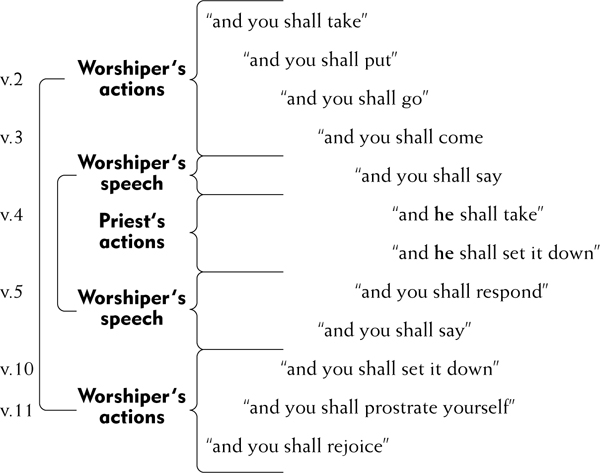
The number of actions (twelve) and the chiastic structure of the text reflect the symmetry of the ritual.4 Moses’ primary intent here is to provide a means by which Israelites may regularly celebrate the goodness Yahweh has lavished first by giving them this good land and then by causing it to yield its produce for their benefit. Responding to the harvest, God’s people were to present to Yahweh offerings selected from the first yields of the produce (vv. 2, 10; cf. 18:4).5
Neither 18:4 nor the present text specifies when these rituals are to be performed. Since Numbers 28:26a refers to the Festival of Weeks as “the day of firstfruits,” the offerings envisioned here may have been associated with Pentecost.6 As in chapter 12, these instructions are addressed to male heads of households (v. 11). While the worshiper’s speeches will recognize the corporate benefits of divine grace (vv. 6–10), his personal affirmations employ first person singular verbs (vv. 3, 5, 10). The rituals prescribed in verses 2–11 involve twelve specific verbs, but the actions may be grouped into five phases.
Phase 1: The worshiper’s first set of actions (vv. 2–3a). The first phase involves four actions by the worshiper. (1) He is to take some of the first harvestings brought in from his land. Ever mindful of the Israelites’ faulty memory (cf. 8:11–18), Moses adds a reminder that the land itself is a gift of Yahweh. (2) The worshiper is to put the offering in a container (NIV “basket”). (3) The worshiper is to go to the place that Yahweh has chosen to establish his name.7 (4) The worshiper is to “come” to the priest who is in office at the time (cf. 17:9). Since the offering is to be presented before the altar of Yahweh (v. 4), Moses must have in mind the high priest, who receives the gifts on behalf of his colleagues (cf. 18:1–5) and on God’s behalf. This may account for the shift from “go” in verse 2 to “come” in verse 3. The worshiper is portrayed as a person who has accepted the invitation to Yahweh’s presence offered in chapter 12.
Phase 2: The worshiper’s first declaration (v. 3b). The remainder of verse 3 shifts attention from prescribed ritual actions to ritual declaration. With this declaration, the worshiper recognizes the priest “in office at that time” (v. 3a) as both a symbol of divine presence8 and the official witness to his declaration. His reference to Yahweh as “your [i.e., the priest’s] God” does not mean that he is not the farmer’s God as well. Rather, it suggests respect before a superior.9 With this declaration he acknowledges that his firstfruits represent concrete evidence of Yahweh’s fidelity to the oath he swore to the ancestors. Whereas outside Israel harvest festivals celebrated the fertility of the land, here the occasion is transformed into a commemoration of Yahweh’s fidelity to a greater agenda—the gift of the land itself.
Phase 3: The high priest’s actions (v. 4). The priest’s response to the worshiper’s offering occupies the central position in this sequence of ritual acts. Having heard the farmer’s declaration, he receives the gift on Yahweh’s behalf.10 His response turns the tables, acknowledging “the altar of the LORD your God” (i.e., the God of the worshiper). The priest’s actions declare symbolically that Yahweh has accepted the worshiper’s expression of devotion.11
Phase 4: The worshiper’s second declaration (vv. 5–10a). Having observed the priest’s actions, the worshiper is to recite a summary history of his people’s experience with Yahweh. While Moses introduces the verbal declaration with a formal command, the particle “and now” in verse 10a signals a shift in addressee from the priest to Yahweh, suggesting that the credo (at least vv. 5b–9) is to be recited “before the LORD,” not to the priests.12 Many have recognized that what follows is an early creedal statement (cf. 6:20–25; 11:2–7), cast in celebrative prose, summarizing the Israelites’ basic beliefs concerning their origins.13 Structurally this speech is divided into three parts: (1) an opening statement concerning the social and/or economic status of Israel’s ancestor (v. 5b); (2) a survey of Israel’s history (vv. 5c–9); and (3) a declaration by the worshiper concerning his present offering (v. 10).
(1) The status of the ancestor (v. 5b). The opening statement, “My father was a wandering Aramean,” is alliterative and simple, but extremely difficult, with every element up for discussion. First, who is “my father,” and in what sense could he be considered an Aramaean? Because elsewhere in Deuteronomy Moses always names the three patriarchs together,14 earlier statements offer little help in identifying the “father.” However, since the narratives of Genesis associate all three patriarchs with Aram (Gen. 11:31; 12:4; 28:1–7; 31:16),15 “my father” may function as a collective, referring to all three ancestors.16 In any case, the multiplication of the nation represents Yahweh’s fulfillment of his promise repeated to Abraham, Isaac, and Jacob.17
But the modifier “wandering” remains a riddle. Based on the range of meanings of the root of this word, the clause could be translated, “an Aramaean on the point of death.”18 However, since the rest of this credo emphasizes the patriarchs’ homelessness rather than their threatened existence, the word may refer to their status as aliens, as reflected explicitly in the verb gûr (“to sojourn, live as an alien”), which is used of all three patriarchs.19 Nonetheless, since both insecurity and wandering are associated with the patriarchs (cf. Gen. 20:11–13; Ps. 105:12–13), it is difficult to decide whether the term translated “wandering” means “perishing” or “wandering.”20 The ambiguity is probably intentional; when ancient Israelites recited this credo in Hebrew, they perceived the full range of meanings of the word.
(2) A survey of the history of the ancestor and his descendants (vv. 5c–9). The bulk of this credo consists of a summary of the life of the ancestor and the fate and fortunes of his descendants (cf. 4:32–40; 6:20–25; 11:2–7; Num. 20:14–16). Moses recalls four stages in Israel’s early history.
(a) Stage 1: Israel’s sojourn and growth in Egypt (v. 5c-e). With three words Moses summarizes the remarkable shift of Israelite fortunes in Egypt (cf. Ex. 1:1–7). The ancestor began his sojourn in Egypt as the head of a small clan,21 but there his household was transformed into a great, strong, and numerous nation.22 The first clause of verse 5 recalls 10:22, where Moses clarified “a few people” as “seventy persons,” and “a great nation, powerful and and numerous”23 as a population as numerous as the stars of the sky.
(b) Stage 2: The Egyptian oppression and enslavement (v. 6). Israel’s numerical growth created a crisis for their Egyptian hosts (Ex. 1:8–14), who responded by treating the descendants of the ancestor badly and afflicting them with harsh service (cf. Ex. 1:14; 6:9). By switching to the first person plural Moses draws the worshiper and all who hear this confession into the history and fate of the ancestors, particularly the oppression described in Exodus 1.
(c) Stage 3: Israel’s cry to Yahweh and Yahweh’s attention (v. 7). Moses’ summary of the Israelites’ response to the Egyptian bondage seems more positive than Exodus 2:23–25, where the narrator portrayed the cry simply as a cry of distress, which Yahweh happened to hear. This statement suggests the Israelites actually cried out to Yahweh. Yahweh’s response to the plight of the wandering Aramaean’s descendants is captured with two verbs: Yahweh “heard” their voice, and he “saw” their misery, trouble, and oppression (cf. 4:7–8; Ex. 3:7).
(d) Stage 4: Yahweh’s actions on Israel’s behalf (vv. 8–9). Echoing Exodus 3:7–10 and repeating five of the seven expressions he had used in Deuteronomy 4:34, Moses invites Israelites to celebrate annually Yahweh’s past intervention on their behalf.24 Anticipating the imminent fulfillment of the promise of land to the ancestors and the creedal nature of this passage, Moses describes Yahweh’s actions in the past tense (v. 9). If verse 8 had celebrated the magnitude of Yahweh’s deliverance by echoing 4:34, this statement celebrates Yahweh’s magnanimity in giving the land by echoing earlier descriptions of the land.25
This credo exhibits a remarkable historical perspective. In the divine scheme, Egypt played a positive role, functioning as an incubator in which this handful of people could become a nation whose population is now as a numerous as the stars of heaven (Deut. 10:22) and could emerge in the fullness of time (cf. Gen. 15:13–16). Viewed positively, the oppression represented the nation’s birth pangs, precipitating their separation from their Egyptian hosts (cf. Ps. 105:23–38).
(3) A declaration of the worshiper concerning his offering (v. 10a). The particle “and now,” followed by “look/behold” (not represented in NIV), signals a shift from the past to the worshiper’s present ritual performance (v. 10a). Moses hereby calls on the worshiper to speak directly to Yahweh, to declare his gratitude, and to acknowledge Yahweh’s gracious provision, symbolized by the container of firstfruits he has brought. Whereas the summary of Yahweh’s past actions had employed the first person plural, now he speaks as an individual and as the head of a household. With the shift he declares his personal participation in the nation’s history, and by giving thanks for the land from which the firstfruits have come, he transforms an annual fertility celebration into a celebration of a historical event: Yahweh’s gift of the land to Israel.
Phase 5: The worshiper’s actions (vv. 10b–11). The final phase of this ritual (v. 10b) involves actions by the worshiper: He is to set the basket with the firstfruits before Yahweh, and then in a gesture of homage and submission prostrate himself before him. Having done so, he is to invite his entire household, as well as Levites and aliens from his town, to join him in celebrating all the benefactions Yahweh has lavished on them. Like the pilgrimages described in 12:5–12, this is to be a joyful event, presumably involving a meal eaten at the sanctuary in the presence of Yahweh with the entire household, as well as with Levites and aliens whom the worshiper has invited to accompany him to the sanctuary (cf. 12:7, 12, 18; 14:26–27; 16:11, 14).
Bridging Contexts
ISRAEL’S HISTORY OF FORGETTING. Despite the creedal nature of this text, specific allusions in later texts are difficult to identify. Indeed, the ritual prescribed here seems to have been “a custom more honour’d in the breach than the observance.”41 This is evident in how quickly the Israelites forgot the favors Yahweh had lavished on them—not only his deliverance of the ancestors from their slavery in Egypt and his gift of the land,42 but also his blessing the work of their hands in providing crops and flocks and herds. As if ingratitude were not enough, they quickly defected to Baal and the other fertility gods of the Canaanites.
Israelite history is a history of forgetting to give thanks. The people came to take their salvation for granted, their occupation of the land as an unconditional entitlement, and their prosperity as a divine obligation. But Amos reminded his generation that prosperity was not a divine right. On the contrary, because of their rebellion, Yahweh himself caused famines in the land, withholding rain, sending in scorching winds, and calling for insect plagues to devour the crops. Still the people did not return to him (Amos 4:6–9). And 150 years later, even as Nebuchadnezzar’s armies attacked the walls of Jerusalem, the people of Judah clung to the promises of their divine patron, having forgotten that with the privilege of covenant relationship come the responsibilities of giving thanks to God for his abundant favors and of showing mercy to others.
When David organized the national religious observances, he appointed Asaph and his brothers (1 Chron. 16:7) and Heman and Jeduthun (16:41) and all kinds of musicians (25:3; cf. 2 Chron. 5:13; 7:6) to lead the congregation in thanksgiving and praise, a pattern followed by other kings as well.43 This top-down organization of temple worship is inspiring, but our text envisions a spirit of gratitude rising from the ground and from the people. There is no substitute for personal praise of God for mercies that he has lavished on individual households and on the nation as a whole.
This principle carries over into the New Testament. In Romans 1:21 Paul declares that the first step in the slide into apostasy is refusal to honor God with thanksgiving. But in 2 Corinthians 9:5–15 he lays down the principles of Christian charity:
1. The blessings one receives from God are proportional to one’s generosity.
2. True generosity is an individual matter, requiring no legislation.
3. God loves those who give spontaneously and freely.
4. God’s blessing is guaranteed for those who are generous.
5. Generosity is not simply a matter of supplying the needs of the poor; God accepts it as an expression of thanksgiving to him.
6. Confession of the gospel of Christ accompanied by acts of obedience to God will cause observers to praise him for the giver’s generosity.
In later centuries, if the Israelites remembered the rituals of fellowship and thanksgiving, they tended to view them sacramentally, as though God was obligated to accept their worship irrespective of the condition of their hearts, the nature of their lives, and their disposition toward others. Amos portrays the sanctimonious worship of the people of the northern kingdom with bitter sarcasm:
“Go to Bethel and sin;
go to Gilgal and sin yet more.
Bring your sacrifices every morning,
your tithes every three years.
Burn leavened bread as a thank offering
and brag about your freewill offerings—
boast about them, you Israelites,
for this is what you love to do,”
declares the Sovereign LORD. (Amos 4:4–5)
Isaiah describes Yahweh’s attitude toward such empty observances with particular poignancy:
Hear the word of the LORD,
you rulers of Sodom;
listen to the law [read “Torah”] of our God,
you people of Gomorrah!
“The multitude of your sacrifices—
what are they to me?” says the LORD.
“I have more than enough of burnt offerings,
of rams and the fat of fattened animals;
I have no pleasure
in the blood of bulls and lambs and goats.
When you come to appear before me,
who has asked this of you,
this trampling of my courts?
Stop bringing meaningless offerings!
Your incense is detestable to me.
New Moons, Sabbaths and convocations—
I cannot bear your evil assemblies.
Your New Moon festivals and your appointed feasts
my soul hates.
They have become a burden to me;
I am weary of bearing them.
When you spread out your hands in prayer,
I will hide my eyes from you;
even if you offer many prayers,
I will not listen.
Your hands are full of blood;
wash and make yourselves clean.
Take your evil deeds
out of my sight!
Stop doing wrong,
learn to do right!
Seek justice,
encourage the oppressed.
Defend the cause of the fatherless,
plead the case of the widow. (Isa. 1:10–17)
This problem also carries over into the New Testament. Jesus chided the scribes and Pharisees for tithing mint and dill and cumin, but forgetting the weightier matters of Torah, that is, pursuing justice and mercy and faithfulness (Matt. 23:23). Indeed Luke’s version contrasts tithing mint and rue and every herb with neglecting justice and the love of God—that is, embodying the love of God in acts of genuine charity toward the poor (Luke 11:42).
Contemporary Significance
ACCEPTABLE WORSHIP. THIS PASSAGE offers Christians today helpful and necessary information on the nature and forms of acceptable worship. (1) True worship is focused on Yahweh. Not surprisingly this text leaves no space for the worship of any other deity. All that the Israelites are and have they owe to him. This is true not only of the daily sustenance they receive from the fruit of the ground, but especially of their status with Yahweh. The Israelites represented the community of the redeemed, who had received the land as a gracious gift from their divine Redeemer.
(2) God’s people are a thankful people. This text reminds readers of every age of the importance of specific celebrations devoted to thanksgiving. But true thanksgiving recognizes that God is much more than a fertility deity who provides for his people in the annual cycle of seedtime and harvest. Yahweh’s rescue of Israel from the bondage of Egypt was paradigmatic of our redemption from the slavery of sin and our rescue from the kingdom of darkness through the death and resurrection of Jesus Christ. Through the year our Savior has blessed the work of our hands, our minds, and even our technological instruments. It is
the indispensable duty of all Nations, not only to offer up their supplications to ALMIGHTY GOD, the Giver of all good, for his gracious assistance in a time of distress, but also in a solemn and public manner to give him praise for his goodness in general, and especially for great and signal interpositions of his providence in their behalf.44
How much more so should this be true of Christians. While we caution against identifying this or any other country as the twenty-first-century heir to Yahweh’s favors toward Israel, and we abhor the wars fought against the aboriginal peoples of North America by the first European settlers, we cannot fault the impulse reflected in the “Thanksgiving Proclamation” of 1782, setting aside “a day of solemn THANKSGIVING to GOD for all his mercies,” and recommending “all ranks, to testify to their gratitude to GOD for his goodness, by a cheerful obedience of his laws, and by promoting, each in his station, and by his influence, the practice of true and undefiled religion, which is the great foundation of public prosperity and national happiness.” The time has come for God’s people to give credit where credit is due, and restore the spiritual dimensions of what has become a secular holiday. Failure to give thanks represents an early stage in the skid to apostasy (cf. Rom. 1:21), and placing one’s trust in any other god is the height of ingratitude.45
(3) Through the liturgy prescribed here Moses offers a profoundly holistic approach to issues of faith and life. The contrast between this verbal confession and prevailing patterns in the evangelical church are stark. This text recognizes that devotion to God is demonstrated, not by lip service, but by concrete acts of obedience to the revealed will of God. Had this liturgy been designed today, the prescribed declaration would probably have been “I love you, Lord,” or “I worship you, Lord.” However, such verbal utterances ring hollow if they do not arise from lips of those who have accepted the path of radical discipleship.
(4) Although fidelity to Yahweh may be demonstrated generally by obedience to all his commands, this triennial tithe provides a true and concrete test of covenantal loyalty. God’s people are distinguished by the care they take of those who are marginalized. But their motivation for doing so is not a legalistic sense of duty or obligation, but a recognition that how one operates horizontally, especially how one treats the deprived, is a barometer of the health of the vertical relationships (cf. Prov. 14:31; 17:5).
(5) The concluding confession reminds us of the importance of scrupulous respect for the boundary between the sacred and the profane. Offerings set aside for divine use may not be confiscated for personal consumption, even if the context of the action is ethically and customarily legitimate. Yahweh takes no delight in contaminated or partial gifts.
(6) In concluding these ritual instructions with a petition for divine blessing, Moses recognizes the symbiotic relationship between faith and obedience. True faith is demonstrated by active obedience on the one hand, and by committing ourselves to the favor of God on the other. This liturgy reverses the order expressed by John H. Sammis in the lyrics of the well-known gospel song, “Trust and Obey.” God is not to be confused with the genii in Aladdin’s lamp, at the service and disposal of any who address him, irrespective of the condition of one’s heart or the shape of one’s life. Apart from obedience, God’s people have no right to expect his blessing.
(7) Finally, this liturgy recognizes a proper balance between the individual and the community. While fidelity to the covenant is demonstrated by the obedience of the individual, fidelity to the covenant also involves a primary concern for the well-being of the community. The liturgist who follows the paradigm established here will quickly move from private and personal confessions of sin and fidelity to prayers for the body.
Original Meaning
Affirming Fidelity to the Covenant (26:12–15)
WHILE VERSES 12–15 exhibit many links with the preceding, the focus shifts from Yahweh’s faithfulness to Israel to the worshiper’s fidelity to Yahweh. Together these two rituals represent the two sides of the coin of covenant relationship: thanksgiving for the privilege (vv. 1–11) and scrupulous fulfillment of the responsibilities (vv. 12–15). This text divides into two parts, describing prerequisites to (v. 12) and the nature of (vv. 13–15) acceptable verbal worship.
(1) The prerequisite to acceptable confessional worship (v. 12). Even though verse 12 opens with a reference to the tithe, the primary concern here is the ritual to be performed in the presence of Yahweh when the tithe ordinance has been duly obeyed.26 Moses’ identification of the third year as “the year of the tithe” assumes familiarity with his earlier instructions (14:22–29).27 However, it is not clear whether this “year of the tithe” was the same year for every household, or was established by communal decision, or whether each household kept its own calendar. The logistical problem of accommodating thousands of worshipers at one time at the central sanctuary at the end of the agricultural year argues for the latter.
Like the actions and the recitation of the “little historical credo” in verses 1–11, the declaration prescribed in verses 13–15 is to be recited “in the presence of the LORD your God.” Though some have argued that this ritual was to be performed at local sanctuaries (cf. 14:28–29), the absence of a reference to a competing place and the literary links between verses 1–11 and 12–1528 argue for the central sanctuary as the place where this ritual transpires.29
This is not to say the town where the farmer lived was out of the picture. Having contributed his tithe to the marginalized at the gate (v. 12b; cf. 14:28–29), every third year the farmer was to go to the central sanctuary for a special ritual performed before Yahweh. Based on his confession in verse 14, it seems that he would have eaten some of it in the meantime, though most would have been given to the poor. The ambiguity seems intentional, to prevent the hearer from simplistically equating this ritual with the actions called for in chapter 14.
Syntactically the temporal clauses carry on to the end of the verse,30 which suggests that Moses’ purpose here is to specify the context of the triennial ritual in verses 13–15. The ritual takes place after the act of kindness and is not strictly a part of it. After Israelite farmers have demonstrated covenantal loyalty to Yahweh by taking care of the poor, they are to make a pilgrimage to the central sanctuary and perform the verbal ritual that follows. By linking the triennial tithe to the ritual at the central shrine, Moses reminds his people that care for the marginalized is not merely a noble humanitarian issue; it is expressive of one’s covenant relationship with Yahweh.
(2) The nature of acceptable confessional worship (vv. 13–15). The beginning of the verbal liturgy may be interpreted as a “covenantal code of honor” consisting of nine affirmations, arranged in an A B A pattern; the first and last pairs are cast as affirmations of actions the worshiper has performed, while the middle five consist of negative statements identifying prohibited behaviors from which he has desisted. The alternation of pairs of specific and general statements reflects the thrust of the Torah of Moses as a whole; far from advocating merely external conformity to set stipulations, he calls for wholehearted grasping of the spirit of covenant relationship, in both its horizontal and vertical dimensions. Although the context of this ritual is the triennial tithe, the declaration never mentions the tithe by name. Instead the opening line refers to this offering as “the sacred [gift],” and the subsequent specific declarations retain this focus with the retrospective pronoun “it.”31 Gifts donated directly to Yahweh are holy, but what farmers donate to take care of the needy in their towns and villages is also holy. After all, they too are images of God (Prov. 14:31; 17:5).
The first declaration involves a strong verb “to remove,” used elsewhere in Deuteronomy only of purging evil or bloodguilt from the land.32 The word reinforces the notion expressed by “to finish” in verse 12a, that the farmer has scrupulously set aside one tenth of all his produce. Echoing verse 12, the second declaration lists the beneficiaries of the worshiper’s generosity. The third and fourth declarations perceive the commands as moral territory whose boundaries are defined by God. Here charity toward the poor is seen as representative of compliance with the covenantal stipulations as a whole (cf. 14:28–29). With the fourth declaration the worshiper affirms he has taken into account all the commands, though like “you shall give it” in verse 12, the absence of an object on “I have not forgotten [them]” may suggest it is the marginalized rather than the commands that are not forgotten.
With the fifth to the seventh declarations the worshiper’s focus shifts from the function and the beneficiaries of the tithe to their proper handling. These statements imply that once a gift had been designated as an offering for the deity, its sanctity must be scrupulously guarded.33 Moses anticipates three potential sources of defilement, all associated with death. Although many interpret these declarations against the widespread ancient Near Eastern belief that the deceased continued to exert influence on the living after they had died,34 as in 14:1, reading (lit.) “on account of the dead” is preferred, suggesting the mourning rites defile and disqualify a worshiper from entrance into the presence of Yahweh.35 These three declarations are less concerned with ensuring the well-being of the poor than with protecting the integrity of the triennial tithe to be presented to Yahweh.
The last two declarations are general in nature. The eighth echoes Exodus 19:5–6, suggesting the ritual was to be used as an occasion for personal covenant renewal.36 With the ninth statement the worshiper acknowledges he is a vassal of Yahweh and declares that he has obeyed Yahweh fully. Locating these instructions at the end of the second address invites readers to interpret this ritual as a token confession of fidelity to the covenant as a whole.
The ritual concludes with a prayer (v. 15), consisting of a five-word request for Yahweh’s attention, and a longer and more complex request for his blessing. The verb “to look down” perceives Yahweh as looking out from “your holy dwelling place,” that is, from “heaven.” By adding “from heaven,” the ritual highlights a fundamental mystery of Deuteronomic theology: How can an earthly worshiper be “in the presence of the LORD” (v. 13) and expect Yahweh to hear from heaven? Whereas Israel’s neighbors answered the question by erecting statues of the deities in their temples,37 the present request that Yahweh look down from heaven recalls the use of this verb with God as subject elsewhere (Pss. 14:2; 53:2[3]; 102:19[20]; Lam. 3:50), and accords with the actions he performs “from heaven” (Deut. 4:36) and throughout the Old Testament.38
The worshiper’s plea for Yahweh to observe him from heaven is motivated by a desire for his blessing “on your people Israel.” After all, the worshiper is part of the greater entity, Yahweh’s covenant nation. He completes the relational triangle by extending the scope of the blessing to the land (cf. v. 9).39 Although the land is indeed a “good land,”40 the people are still dependent on Yahweh to bless them and the land (cf. 28:1–14; 33:13–16).
Bridging Contexts
ISRAEL’S HISTORY OF FORGETTING. Despite the creedal nature of this text, specific allusions in later texts are difficult to identify. Indeed, the ritual prescribed here seems to have been “a custom more honour’d in the breach than the observance.”41 This is evident in how quickly the Israelites forgot the favors Yahweh had lavished on them—not only his deliverance of the ancestors from their slavery in Egypt and his gift of the land,42 but also his blessing the work of their hands in providing crops and flocks and herds. As if ingratitude were not enough, they quickly defected to Baal and the other fertility gods of the Canaanites.
Israelite history is a history of forgetting to give thanks. The people came to take their salvation for granted, their occupation of the land as an unconditional entitlement, and their prosperity as a divine obligation. But Amos reminded his generation that prosperity was not a divine right. On the contrary, because of their rebellion, Yahweh himself caused famines in the land, withholding rain, sending in scorching winds, and calling for insect plagues to devour the crops. Still the people did not return to him (Amos 4:6–9). And 150 years later, even as Nebuchadnezzar’s armies attacked the walls of Jerusalem, the people of Judah clung to the promises of their divine patron, having forgotten that with the privilege of covenant relationship come the responsibilities of giving thanks to God for his abundant favors and of showing mercy to others.
When David organized the national religious observances, he appointed Asaph and his brothers (1 Chron. 16:7) and Heman and Jeduthun (16:41) and all kinds of musicians (25:3; cf. 2 Chron. 5:13; 7:6) to lead the congregation in thanksgiving and praise, a pattern followed by other kings as well.43 This top-down organization of temple worship is inspiring, but our text envisions a spirit of gratitude rising from the ground and from the people. There is no substitute for personal praise of God for mercies that he has lavished on individual households and on the nation as a whole.
This principle carries over into the New Testament. In Romans 1:21 Paul declares that the first step in the slide into apostasy is refusal to honor God with thanksgiving. But in 2 Corinthians 9:5–15 he lays down the principles of Christian charity:
1. The blessings one receives from God are proportional to one’s generosity.
2. True generosity is an individual matter, requiring no legislation.
3. God loves those who give spontaneously and freely.
4. God’s blessing is guaranteed for those who are generous.
5. Generosity is not simply a matter of supplying the needs of the poor; God accepts it as an expression of thanksgiving to him.
6. Confession of the gospel of Christ accompanied by acts of obedience to God will cause observers to praise him for the giver’s generosity.
In later centuries, if the Israelites remembered the rituals of fellowship and thanksgiving, they tended to view them sacramentally, as though God was obligated to accept their worship irrespective of the condition of their hearts, the nature of their lives, and their disposition toward others. Amos portrays the sanctimonious worship of the people of the northern kingdom with bitter sarcasm:
“Go to Bethel and sin;
go to Gilgal and sin yet more.
Bring your sacrifices every morning,
your tithes every three years.
Burn leavened bread as a thank offering
and brag about your freewill offerings—
boast about them, you Israelites,
for this is what you love to do,”
declares the Sovereign LORD. (Amos 4:4–5)
Isaiah describes Yahweh’s attitude toward such empty observances with particular poignancy:
Hear the word of the LORD,
you rulers of Sodom;
listen to the law [read “Torah”] of our God,
you people of Gomorrah!
“The multitude of your sacrifices—
what are they to me?” says the LORD.
“I have more than enough of burnt offerings,
of rams and the fat of fattened animals;
I have no pleasure
in the blood of bulls and lambs and goats.
When you come to appear before me,
who has asked this of you,
this trampling of my courts?
Stop bringing meaningless offerings!
Your incense is detestable to me.
New Moons, Sabbaths and convocations—
I cannot bear your evil assemblies.
Your New Moon festivals and your appointed feasts
my soul hates.
They have become a burden to me;
I am weary of bearing them.
When you spread out your hands in prayer,
I will hide my eyes from you;
even if you offer many prayers,
I will not listen.
Your hands are full of blood;
wash and make yourselves clean.
Take your evil deeds
out of my sight!
Stop doing wrong,
learn to do right!
Seek justice,
encourage the oppressed.
Defend the cause of the fatherless,
plead the case of the widow. (Isa. 1:10–17)
This problem also carries over into the New Testament. Jesus chided the scribes and Pharisees for tithing mint and dill and cumin, but forgetting the weightier matters of Torah, that is, pursuing justice and mercy and faithfulness (Matt. 23:23). Indeed Luke’s version contrasts tithing mint and rue and every herb with neglecting justice and the love of God—that is, embodying the love of God in acts of genuine charity toward the poor (Luke 11:42).
Contemporary Significance
ACCEPTABLE WORSHIP. THIS PASSAGE offers Christians today helpful and necessary information on the nature and forms of acceptable worship. (1) True worship is focused on Yahweh. Not surprisingly this text leaves no space for the worship of any other deity. All that the Israelites are and have they owe to him. This is true not only of the daily sustenance they receive from the fruit of the ground, but especially of their status with Yahweh. The Israelites represented the community of the redeemed, who had received the land as a gracious gift from their divine Redeemer.
(2) God’s people are a thankful people. This text reminds readers of every age of the importance of specific celebrations devoted to thanksgiving. But true thanksgiving recognizes that God is much more than a fertility deity who provides for his people in the annual cycle of seedtime and harvest. Yahweh’s rescue of Israel from the bondage of Egypt was paradigmatic of our redemption from the slavery of sin and our rescue from the kingdom of darkness through the death and resurrection of Jesus Christ. Through the year our Savior has blessed the work of our hands, our minds, and even our technological instruments. It is
the indispensable duty of all Nations, not only to offer up their supplications to ALMIGHTY GOD, the Giver of all good, for his gracious assistance in a time of distress, but also in a solemn and public manner to give him praise for his goodness in general, and especially for great and signal interpositions of his providence in their behalf.44
How much more so should this be true of Christians. While we caution against identifying this or any other country as the twenty-first-century heir to Yahweh’s favors toward Israel, and we abhor the wars fought against the aboriginal peoples of North America by the first European settlers, we cannot fault the impulse reflected in the “Thanksgiving Proclamation” of 1782, setting aside “a day of solemn THANKSGIVING to GOD for all his mercies,” and recommending “all ranks, to testify to their gratitude to GOD for his goodness, by a cheerful obedience of his laws, and by promoting, each in his station, and by his influence, the practice of true and undefiled religion, which is the great foundation of public prosperity and national happiness.” The time has come for God’s people to give credit where credit is due, and restore the spiritual dimensions of what has become a secular holiday. Failure to give thanks represents an early stage in the skid to apostasy (cf. Rom. 1:21), and placing one’s trust in any other god is the height of ingratitude.45
(3) Through the liturgy prescribed here Moses offers a profoundly holistic approach to issues of faith and life. The contrast between this verbal confession and prevailing patterns in the evangelical church are stark. This text recognizes that devotion to God is demonstrated, not by lip service, but by concrete acts of obedience to the revealed will of God. Had this liturgy been designed today, the prescribed declaration would probably have been “I love you, Lord,” or “I worship you, Lord.” However, such verbal utterances ring hollow if they do not arise from lips of those who have accepted the path of radical discipleship.
(4) Although fidelity to Yahweh may be demonstrated generally by obedience to all his commands, this triennial tithe provides a true and concrete test of covenantal loyalty. God’s people are distinguished by the care they take of those who are marginalized. But their motivation for doing so is not a legalistic sense of duty or obligation, but a recognition that how one operates horizontally, especially how one treats the deprived, is a barometer of the health of the vertical relationships (cf. Prov. 14:31; 17:5).
(5) The concluding confession reminds us of the importance of scrupulous respect for the boundary between the sacred and the profane. Offerings set aside for divine use may not be confiscated for personal consumption, even if the context of the action is ethically and customarily legitimate. Yahweh takes no delight in contaminated or partial gifts.
(6) In concluding these ritual instructions with a petition for divine blessing, Moses recognizes the symbiotic relationship between faith and obedience. True faith is demonstrated by active obedience on the one hand, and by committing ourselves to the favor of God on the other. This liturgy reverses the order expressed by John H. Sammis in the lyrics of the well-known gospel song, “Trust and Obey.” God is not to be confused with the genii in Aladdin’s lamp, at the service and disposal of any who address him, irrespective of the condition of one’s heart or the shape of one’s life. Apart from obedience, God’s people have no right to expect his blessing.
(7) Finally, this liturgy recognizes a proper balance between the individual and the community. While fidelity to the covenant is demonstrated by the obedience of the individual, fidelity to the covenant also involves a primary concern for the well-being of the community. The liturgist who follows the paradigm established here will quickly move from private and personal confessions of sin and fidelity to prayers for the body.