Original Meaning
Completing the Covenantal Triangle: Yahweh—Israel—Land (27:1–8)
FOR THE FIRST TIME the narrator has Moses formally charge the people with an obligation and refers to accomplices in the speech act, that is, “the elders.” Structurally the speech divides into three parts: (1) a brief opening appeal to scrupulous adherence to the present prescriptions (v. 1b); (2) a summary of the instructions regarding the prescribed ritual (vv. 2–3); (3) a more detailed description of the prescribed ritual (vv. 4–8).
The opening appeal (v. 1) establishes the context in which the following prescriptions are to be applied, linking the moment formally with the series of events reflected in the book of Deuteronomy as a whole. The vocabulary is familiar, resembling many appeals found elsewhere in the book.7 “All these commands” to which Moses refers are not the prescribed rituals that follow, but the “the entire covenantal charge” embodied in “this Torah, this body of instruction” (vv. 3, 8, 26),8 that is, the speeches of Deuteronomy. The final word of verse 1 (“today”) reminds the reader of the distance between the time of this address, that is, the day of decision and commitment, and the time to implement the following rituals.
The remainder of the address concerns a special one-time ritual that the Israelites are to perform when they reach their destination. The instructions divide into two parts, verses 2–3 and 4–8 respectively. Although these segments exhibit distinctive emphases, the repetition of key phrases and expressions reflects a deliberately constructed and coherent whole. The beginning of each segment is signaled by “and it shall be” (wehāyâ), followed by a declaration that the ceremony is to be performed after the Israelites have crossed the Jordan. Thereafter the skeletons of both panels are represented by the following triad of commands (pers. trans.):
You shall set up [large] stones,
And you shall plaster them with plaster,
And you shall write on them all the words of this Torah.
The first panel emphasizes the context of the ritual; the second highlights the ritual itself, twice adding a fourth element to the commands: “And you shall build an altar to Yahweh your God” (pers. trans.).
Panel A (vv. 2–3). Setting the chronological context, Moses announces that the rituals to follow are to be performed “on the day” (NIV “when”) the Israelites cross the Jordan into the land that Yahweh has promised them. He highlights the significance of the moment by twice declaring that Israel is crossing over “into the land the LORD your God is giving you,” by describing the land as a desirable land “flowing with milk and honey,”9 and by ending the panel with “just as the LORD, the God of your fathers, promised you” (cf. Gen. 17:8). These rituals celebrate Yahweh’s grace, and the inscribed stones serve as permanent reminders of his faithfulness. The instructions for the ritual in verses 2b–3a are clear and reduced to the barest details. The challenge for the reader is establishing the significance of these actions.
Erecting stone monuments. The use of the verb “to set up, erect” suggests that the stones in question are vertical pillars.10 Finding an analogue in later Greek traditions of colonization, some scholars propose the pillars served as monuments to the conclusion of a journey.11 Others argue that Ebal is the “place” that Yahweh would choose for his name to dwell, and that the stone monument here is a victory stela on which is inscribed Yahweh’s name.12 However, the plural in verses 2–3 seems to call for the erection of more than one pillar. While the text does not specify their exact number, the number of tribes involved in the liturgical imprecations may suggest twelve (vv. 12–13), in which case this part of the ritual would echo the original covenant ratification ceremony celebrated at Sinai (Ex. 24:4).13
Plastering the stones. The command to plaster the stones involves the verb śîd, derived from a noun that denotes “lime.” The plaster probably involved a white alkaline compound consisting of water and calcium oxide—derived from limestone readily available in the vicinity of Ebal and Gerizim—and readily applied to surfaces. As the moisture evaporates, the plaster hardens, leaving a smooth coating over the object.14 While the scribes would probably etch the text of the Torah on the stone pillars with a sharp object, they could also write it with ink or paint. In either case, exposed to the elements the text would quickly wear away, and all that would be left as a memorial to this event were the pillars themselves. Though these could have been reused as a rallying point, these instructions call for a one-time ritual use involving the text of the Torah Moses has been promulgating.
Writing the Torah on the stones. The expression “all the words of this Torah” suggests the scribes were to include all of Moses’ present addresses on the pillars (cf. 4:2; 17:18). The logistical problems involved in transcribing “all the words of this Torah” are less than they seem at first sight. The three speeches of Moses in Deuteronomy are considerably longer than Hammurabi’s law code, which takes up less than three-fourths of the surface area of the seven-foot stela of Hammurabi.15 While the entire text of Moses’ speeches could easily have been transcribed on two six-foot stelae, if we assume twelve pillars, each pillar would have contained about 1,000 words.
Panel B (vv. 4–8). The framework of the second panel (vv. 4, 8) repeats the essential information presented in the first, though in abbreviated form. However, now Moses specifies the site as “on Mount Ebal.”16 This location is logical on several counts. (1) If one plots a straight line between the northernmost and southernmost borders of the land, Mounts Ebal and Gerizim appear precisely at the midpoint.17 (2) Mount Ebal is one of the highest mountains in the region; from its peak one could see most of the Promised Land. (3) Located near Shechem, the region of Ebal and Gerizim was extremely important in Israel’s history and tradition (Gen. 12:6–7; 33:18–20). This ceremony invites the nation to acknowledge God’s faithfulness in finally fulfilling his promise to the ancestors.
Verses 5–7 instruct the people on the rituals to be performed on Mount Ebal. They begin with a charge to build an altar, specifying natural stones (cf. vv. 2–4) rather than stones chiseled to shape with an iron tool. While this altar is distinguished from the altar used in worship at the tabernacle or temple, the proscription recalls Exodus 20:25. Apparently, just as animals to be sacrificed were to be “without defect” (Lev. 1:3) and without “any serious flaw” (Deut. 15:21), so the stones of this altar were to be whole and complete. To improve on them with human effort and man-made tools was to defile them.18
In verses 6b–7 Moses calls for whole burnt offerings (ʿôlôt) and peace/fellowship offerings (šelāmîm) to be sacrificed to Yahweh on the altar, and for celebration by feasting in his presence. The former are mentioned in chapter 12 (vv. 6, 11, 27), but verse 7 contains the only reference to the latter in the book. Deriving from the root šlm (“to be whole”), these sacrifices celebrated the health of the relationship between deity and subject,19 which explains why the šelâmîm may be eaten with joy in Yahweh’s presence. Although the phrase “in the presence of the LORD your God” is usually associated with the central sanctuary, these instructions assume the real presence of Yahweh at this altar as well. The altar is Yahweh’s table; from it he receives the “whole burnt offering” and around it the people consume the “peace/fellowship offerings.”
The combination of whole burnt offerings and peace offerings links this event not only with the altar law in Exodus 20:24–26, but even more significantly with Exodus 24:1–11. As in our text, there the sacrifices offered at Sinai are associated with twelve pillars representing the tribes of Israel (v. 4) and eating in the presence of Yahweh (v. 11), which provides one more clue to the significance of this ritual. Like the procedure at Sinai, this ceremony is covenantal. Whereas the Sinai event had sealed the bipartite relationship between people and deity, the third party (the land) was missing. The purpose of this ritual was to integrate the land in this complex of relationships and to secure Israel’s title to that which Yahweh promised long ago. By eating the covenant meal in the presence of Yahweh in the land he has given them, the Israelites celebrate the completion of the triangle.
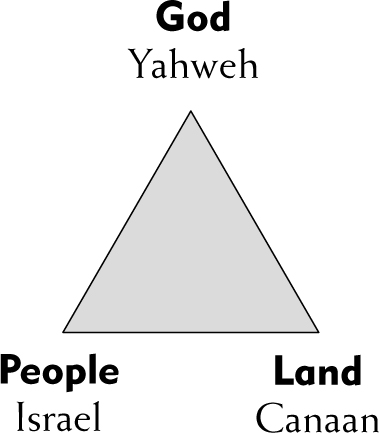
The panel closes with a charge to copy the Torah carefully on the stone pillars (v. 8). At least this is how NIV and most translations understand the Hebrew expression used here. However, recent discussions suggest this phrase speaks more to the purpose of the inscription than the nature of the script. From the perspective of speech-act theory, whereas Moses’ oral proclamation of the Torah had the effect of legally binding this generation of Israelites to the covenant their parents had signed on to at Sinai and Abraham had signed on to by accepting circumcision as the mark of the covenant (Gen. 17), so inscribing the Torah on these pillars bound the land legally to this covenant.20 Performed as soon as the Israelites entered the land, the ceremonies signaled the beginning of the full functioning of the tripartite covenant relationship.
Bridging Contexts
OLD TESTAMENT ALLUSIONS. OLD Testament allusions to the ceremonies prescribed here are rare. The names of the mountains Ebal and Gerizim occur outside Deuteronomy (cf. 11:29) only in Joshua 8:30–35, though Gerizim appears alone in Judges 9:7.40 The former reports that after the conquest of Jericho and Ai, Joshua led the Israelites in a ritual “just as Moses the servant of Yahweh had commanded the people, and just as it is written in the book of the Torah of Moses” (pers. trans.). As described, this event involved (1) constructing an altar of uncut stones; (2) presenting whole burnt and peace/fellowship offerings on it; (3) transcribing the Torah of Moses that he had written on stones in the presence of the people;41 (4) dividing the population into two halves to stand in front of Mounts Gerizim and Ebal, respectively, for the blessing of the people; and (5) reading the blessings and the curses just as they are recorded in the Torah of Moses. The text concludes by noting that Joshua read the Mosaic Torah in its entirety before all the people, including women, small children, and aliens living among them.
Although Deuteronomy 27:1–8 is silent about the ark or the Levitical priests who carried it, Joshua 8:33 makes these the focal point. Presumably the ark was stationed between the two groups of tribes, in the valley between Ebal and Gerizim—in full view of the participants in the ceremony. Since the ark represented the ruling presence of Yahweh, with this addition the narrator presents Yahweh as a witness to and a participant in the rites performed here. Remarkably, whereas Deuteronomy 27:14–26 calls for a recitation of imprecations at the end of the ceremony, Joshua 8:33 ends by noting Joshua’s scrupulous adherence to Moses’ prescriptions (vv. 31, 33, 35; cf. 1:8). This was indeed a historic milestone: for the first time, deity, nation, and land were all together. Echoes of Deuteronomy 27 in the covenant renewal ceremony at Shechem recounted in Joshua 24, particularly Joshua’s commentary on the stone that he erects (v. 27), reinforce this interpretation.
The only other reference to either of these mountains occurs in Judges 9:7, which describes Jotham standing on Mount Gerizim overlooking Shechem and proclaiming his antimonarchic fable concerning Abimelech. In postbiblical times Gerizim took on special significance especially in the Samaritan tradition. This was the site of their temple—as opposed to Jerusalem, which explains why the Samaritan Pentateuch, the only Scriptures the Samaritan sect recognized, consistently identified Gerizim as the only legitimate center of Yahweh worship.42
This tradition is recognized in 2 Maccabees 6:2, and Josephus (Ant 11.8.2, 7), but it surfaces in the New Testament in John 4:20–22. Although not identified by name, Jesus’ conversation with the Samaritan woman reflects the distinctive Samaritan tradition. In response to her comment that “our fathers worshiped on this mountain, but you Jews claim that the place where we must worship is in Jerusalem,” Jesus replied not only that the time is coming when neither “this mountain” nor Jerusalem will matter, but also that the Samaritans worship the Father in ignorance. Although the Samaritans were misled, this account testifies to the long-range significance of Moses’ instructions in Deuteronomy 27.43
Allusions to the imprecations recited at the end of the liturgy of Deuteronomy 27 are scarce. “They have treated father and mother with contempt” in Ezekiel 22:7 may echo Deuteronomy 27:16, and “In you men accept bribes to shed blood” in Ezekiel 22:12 may echo Deuteronomy 27:25. These texts and the rest of the Old Testament suggest these curses were honored more in the breach than in the observance. Illustrations of violations abound in the narratives.
• Micah erected an idolatrous image in his house (Judg. 17:3–4), which was later confiscated and used by the Danites (18:14–31); Solomon and many kings after him sponsored idolatrous state cults (1 Kings 11:1–10; cf. Manasseh in 2 Kings 21:1–9).
• David’s son Absalom dishonored him by grasping for his throne (2 Sam. 15).
• Ahab seized the vineyard of Naboth located next to the palace (1 Kings 21).
• The widow and sons of a son of the prophets were exploited by a creditor (2 Kings 4:1–7).
• Reuben had intercourse with his stepmother Bilhah (Gen. 35:22; cf. 49:4); symbolic of his claim to the throne of David, Absalom publicly had intercourse with his father’s concubines (2 Sam. 16:21–23), and Solomon seems to have interpreted Adonijah’s request to marry Abishag, David’s companion, as some such crime (1 Kings 2:13–25).
• Though he is not explicitly criticized for it, Abraham married his half-sister (Gen. 20:12). Amnon raped his sister Tamar (2 Sam. 13).
• David had his trusted warrior Uriah killed (2 Sam. 11).
• The historian summarizes the history of Israel as a history of violating the Torah and all the laws of God (2 Kings 17:34–35). A notable exception was Josiah, whose declared goal was “to establish the words of the Torah written in the scroll found in the temple” (2 Kings 23:24, pers. trans.).44
Contemporary Significance
THE AMAZING GRACE OF God. Although the chapter ends on a serious note, contemporary readers do well to recognize in the rituals performed on Mounts Gerizim and Ebal the amazing grace of God. (1) God always keeps his Word. The prescribed ceremonies proclaim Yahweh’s faithfulness to his covenant promises to the ancestors (vv. 2–3) and to the nation that came out of Egypt forty years earlier. When the Israelites perform these rituals, they will finally be at home in the land that Yahweh has given them, celebrating the covenantal union that exists among deity (Yahweh), people (Israel), and land (Canaan).
(2) With the Israelites, we need to rejoice that God has revealed his will. The Torah the Israelites are to inscribe on the stone pillars in the heart of their new homeland symbolized for them their covenant relationship with God. We do a disservice to Moses and to the Torah that he proclaims in this book if we equate this word with “law,” for the Torah is much more than law—just as the Decalogue is much more than commands. In expounding the law Moses continually reminds the people that they are the products of this grace, and their obedience is to arise both from a recognition of past grace and in anticipation of grace still to come.
(3) If the inscription of the Torah on the stone pillars symbolizes Yahweh’s gracious revelation of his will, then the altar symbolizes his gracious presence among them and his desire to have the Israelites before him. Whereas in 12:1–15 Yahweh had invited his people to his presence without reference to the altar, here the altar functions as the table on which the peace offerings are presented and at which the people eat and rejoice in the presence of Yahweh (vv. 6–7).45 By eating the peace/fellowship sacrifices in the presence of the divine host, the Israelites celebrated the covenant bond that Yahweh had graciously established with them.46
These rituals signify Israel’s security and hope in Yahweh. Of course, the peace they celebrate is made possible only through the work of Jesus Christ, whose sacrificial work underlies all these rituals. And the peace they will celebrate at Gerizim and Ebal expresses in microcosm the peace we enjoy and the heavenly inheritance we will one day claim in the very presence of God. We who were once far away have been brought near through the blood of Christ, for he himself is our peace, having destroyed the barrier between Israel and us, and created in himself one new person out of two (Eph. 4:12–15).
(4) Interrupting the ritual prescriptions, we hear Moses and the Levites reminding the Israelites that they become the people of Yahweh by grace alone (vv. 9–10). While the significance of this for Israel has been spelled out in 7:6; 14:1–2; and 26:16–19, we rejoice because as the new Israel of God, we too have become his sons, the objects of his gracious election, his special treasure, a holy people belonging to him (1 Peter 2:9–10). The awareness of our status as the Lord’s covenant people should inspire us to scrupulous but joyful obedience to his revealed will.
(5) Moses’ charge to the tribes—all twelve of them—to participate in the ceremony of blessing and cursing reminds them and modern readers of a notion that will be developed more fully in 30:15–20. Even as they enter the land, the people are to know that two ways are open to them: the way of blessing and the way of the curse. By referring to both, he anticipates chapter 28. Furthermore, by involving all the tribes, Moses reminds them that they all have equal access to the benefits of the land they have entered as well as to the delights it offers. This understanding of the people of God is remarkably egalitarian.
(6) The concluding imprecatory ceremony functions as a gracious reminder of the consequences of disobedience. The fact that Moses concludes his instructions concerning the rituals to be performed on Mounts Ebal and Gerizim with a series of curses—as stern as these are—culminating in a comprehensive warning against any violation of the covenant as represented in the Torah, accords with earlier expressions of pessimism concerning the nation’s present and future spiritual condition (cf. 5:29; 9:7–24; 12:8).
Nevertheless, to interpret this ritual as a declaration that Israel is already under the curse of the law is to misunderstand the function of curses in covenantal contexts. They never serve as sentences for guilt already incurred but as gracious warnings against future infidelity. Their purpose is positive—to motivate obedience. If God’s goodness does not stimulate his people to faith and righteous conduct, perhaps warnings like this will. Accordingly, these curses are not so much a prediction of Israel’s certain doom as a reminder that through disobedience his people store up for themselves the wrath of God (cf. Rom. 2:4–5; Gal. 6:8). Even these warnings are grace, like Jesus’ words in John 15:1–15, and as Paul will declare in Romans 11:17–24 and Colossians 1:21–23, for they serve the pastoral purpose of keeping the people of God spiritually on track.47
With this chapter we learn the full story of Israel’s paradigmatic experience of grace. When Yahweh rescued this people from Egypt and established his covenant with them at Sinai, he inaugurated the eschatology announced to Abraham centuries ago in Genesis 15:13–16 and 17:3–8. Through these events those who had been slaves in Egypt were redeemed and at Sinai adopted as children of God (cf. Deut. 14:1–2). But the full realization of the promise still awaited them. Through the ceremonies in this chapter, the Israelites were invited to celebrate the eschatology realized when they crossed the Jordan. Now deity, people, and land were finally together. Inaugurated eschatology had given way to realized eschatology.
The Israelite experience is paradigmatic of our own. Through the sacrifice of Jesus Christ on the cross, we have been rescued from the bondage of sin and declared to be children of God. But the benefits of this redemption and adoption are not yet fully realized. We live in eager anticipation of the receipt of the grant/inheritance reserved for us (Rom. 8:9–17; Eph. 1:3–14). That will be an even greater and more glorious day of celebration.
Original Meaning
The Charge of Moses and the Levites (27:9–10)
SANDWICHED BETWEEN TWO LARGER sections involving future rituals to be performed at Ebal we find a hortatory fragment that brings the audience back to the present. This citation, which involves the Levitical priests, seems to be excerpted from a longer speech, perhaps given in the context of 31:24–29. Moses recognizes that if it has been difficult to keep his people on track in their covenant relationship with Yahweh while he was with them, there will be little to restrain them after his death (v. 27). The present speech would have fit well in this context.
While 27:6–7 anticipates celebration before Yahweh, the opening appeal, “Be silent, O Israel, and listen!” and the declaration of the significance of the ceremonies in which they have just participated signal the solemnity of the present moment: They have become a people belonging to Yahweh (26:16–19).21 The “today” of verse 9 (NIV “now”) points to the specific moment of covenant renewal on the Plains of Moab. In fulfillment of Yahweh’s promise in Genesis 17:7, at Sinai the Israelites had been integrated into his covenant with Abraham and become the people of Yahweh. But that generation was gone, necessitating the confirmation of the covenant under the supervision of Moses on the Plains of Moab. Through Moses’ promulgation of the Torah (1:5) and formal covenant renewal ceremonies (26:16–19; cf. 29:10–13[9–12]), this generation had confirmed themselves as the privileged people of Yahweh.22
As in 26:16–19, this declaration is followed by an appeal to fidelity to the covenant Lord. Moses cautions the people not to assume that formal rituals of devotion are all that Yahweh demands. Covenantal fidelity is demonstrated through listening to Yahweh’s voice (v. 10a) and scrupulously observing the commands expounded upon orally by Moses, transcribed on the pillars of stone, and eventually preserved in written Torah (31:9–13). His instructions are not to be treated merely as museum pieces or literary artifacts, but as guides to life.
Bridging Contexts
OLD TESTAMENT ALLUSIONS. OLD Testament allusions to the ceremonies prescribed here are rare. The names of the mountains Ebal and Gerizim occur outside Deuteronomy (cf. 11:29) only in Joshua 8:30–35, though Gerizim appears alone in Judges 9:7.40 The former reports that after the conquest of Jericho and Ai, Joshua led the Israelites in a ritual “just as Moses the servant of Yahweh had commanded the people, and just as it is written in the book of the Torah of Moses” (pers. trans.). As described, this event involved (1) constructing an altar of uncut stones; (2) presenting whole burnt and peace/fellowship offerings on it; (3) transcribing the Torah of Moses that he had written on stones in the presence of the people;41 (4) dividing the population into two halves to stand in front of Mounts Gerizim and Ebal, respectively, for the blessing of the people; and (5) reading the blessings and the curses just as they are recorded in the Torah of Moses. The text concludes by noting that Joshua read the Mosaic Torah in its entirety before all the people, including women, small children, and aliens living among them.
Although Deuteronomy 27:1–8 is silent about the ark or the Levitical priests who carried it, Joshua 8:33 makes these the focal point. Presumably the ark was stationed between the two groups of tribes, in the valley between Ebal and Gerizim—in full view of the participants in the ceremony. Since the ark represented the ruling presence of Yahweh, with this addition the narrator presents Yahweh as a witness to and a participant in the rites performed here. Remarkably, whereas Deuteronomy 27:14–26 calls for a recitation of imprecations at the end of the ceremony, Joshua 8:33 ends by noting Joshua’s scrupulous adherence to Moses’ prescriptions (vv. 31, 33, 35; cf. 1:8). This was indeed a historic milestone: for the first time, deity, nation, and land were all together. Echoes of Deuteronomy 27 in the covenant renewal ceremony at Shechem recounted in Joshua 24, particularly Joshua’s commentary on the stone that he erects (v. 27), reinforce this interpretation.
The only other reference to either of these mountains occurs in Judges 9:7, which describes Jotham standing on Mount Gerizim overlooking Shechem and proclaiming his antimonarchic fable concerning Abimelech. In postbiblical times Gerizim took on special significance especially in the Samaritan tradition. This was the site of their temple—as opposed to Jerusalem, which explains why the Samaritan Pentateuch, the only Scriptures the Samaritan sect recognized, consistently identified Gerizim as the only legitimate center of Yahweh worship.42
This tradition is recognized in 2 Maccabees 6:2, and Josephus (Ant 11.8.2, 7), but it surfaces in the New Testament in John 4:20–22. Although not identified by name, Jesus’ conversation with the Samaritan woman reflects the distinctive Samaritan tradition. In response to her comment that “our fathers worshiped on this mountain, but you Jews claim that the place where we must worship is in Jerusalem,” Jesus replied not only that the time is coming when neither “this mountain” nor Jerusalem will matter, but also that the Samaritans worship the Father in ignorance. Although the Samaritans were misled, this account testifies to the long-range significance of Moses’ instructions in Deuteronomy 27.43
Allusions to the imprecations recited at the end of the liturgy of Deuteronomy 27 are scarce. “They have treated father and mother with contempt” in Ezekiel 22:7 may echo Deuteronomy 27:16, and “In you men accept bribes to shed blood” in Ezekiel 22:12 may echo Deuteronomy 27:25. These texts and the rest of the Old Testament suggest these curses were honored more in the breach than in the observance. Illustrations of violations abound in the narratives.
• Micah erected an idolatrous image in his house (Judg. 17:3–4), which was later confiscated and used by the Danites (18:14–31); Solomon and many kings after him sponsored idolatrous state cults (1 Kings 11:1–10; cf. Manasseh in 2 Kings 21:1–9).
• David’s son Absalom dishonored him by grasping for his throne (2 Sam. 15).
• Ahab seized the vineyard of Naboth located next to the palace (1 Kings 21).
• The widow and sons of a son of the prophets were exploited by a creditor (2 Kings 4:1–7).
• Reuben had intercourse with his stepmother Bilhah (Gen. 35:22; cf. 49:4); symbolic of his claim to the throne of David, Absalom publicly had intercourse with his father’s concubines (2 Sam. 16:21–23), and Solomon seems to have interpreted Adonijah’s request to marry Abishag, David’s companion, as some such crime (1 Kings 2:13–25).
• Though he is not explicitly criticized for it, Abraham married his half-sister (Gen. 20:12). Amnon raped his sister Tamar (2 Sam. 13).
• David had his trusted warrior Uriah killed (2 Sam. 11).
• The historian summarizes the history of Israel as a history of violating the Torah and all the laws of God (2 Kings 17:34–35). A notable exception was Josiah, whose declared goal was “to establish the words of the Torah written in the scroll found in the temple” (2 Kings 23:24, pers. trans.).44
Contemporary Significance
THE AMAZING GRACE OF God. Although the chapter ends on a serious note, contemporary readers do well to recognize in the rituals performed on Mounts Gerizim and Ebal the amazing grace of God. (1) God always keeps his Word. The prescribed ceremonies proclaim Yahweh’s faithfulness to his covenant promises to the ancestors (vv. 2–3) and to the nation that came out of Egypt forty years earlier. When the Israelites perform these rituals, they will finally be at home in the land that Yahweh has given them, celebrating the covenantal union that exists among deity (Yahweh), people (Israel), and land (Canaan).
(2) With the Israelites, we need to rejoice that God has revealed his will. The Torah the Israelites are to inscribe on the stone pillars in the heart of their new homeland symbolized for them their covenant relationship with God. We do a disservice to Moses and to the Torah that he proclaims in this book if we equate this word with “law,” for the Torah is much more than law—just as the Decalogue is much more than commands. In expounding the law Moses continually reminds the people that they are the products of this grace, and their obedience is to arise both from a recognition of past grace and in anticipation of grace still to come.
(3) If the inscription of the Torah on the stone pillars symbolizes Yahweh’s gracious revelation of his will, then the altar symbolizes his gracious presence among them and his desire to have the Israelites before him. Whereas in 12:1–15 Yahweh had invited his people to his presence without reference to the altar, here the altar functions as the table on which the peace offerings are presented and at which the people eat and rejoice in the presence of Yahweh (vv. 6–7).45 By eating the peace/fellowship sacrifices in the presence of the divine host, the Israelites celebrated the covenant bond that Yahweh had graciously established with them.46
These rituals signify Israel’s security and hope in Yahweh. Of course, the peace they celebrate is made possible only through the work of Jesus Christ, whose sacrificial work underlies all these rituals. And the peace they will celebrate at Gerizim and Ebal expresses in microcosm the peace we enjoy and the heavenly inheritance we will one day claim in the very presence of God. We who were once far away have been brought near through the blood of Christ, for he himself is our peace, having destroyed the barrier between Israel and us, and created in himself one new person out of two (Eph. 4:12–15).
(4) Interrupting the ritual prescriptions, we hear Moses and the Levites reminding the Israelites that they become the people of Yahweh by grace alone (vv. 9–10). While the significance of this for Israel has been spelled out in 7:6; 14:1–2; and 26:16–19, we rejoice because as the new Israel of God, we too have become his sons, the objects of his gracious election, his special treasure, a holy people belonging to him (1 Peter 2:9–10). The awareness of our status as the Lord’s covenant people should inspire us to scrupulous but joyful obedience to his revealed will.
(5) Moses’ charge to the tribes—all twelve of them—to participate in the ceremony of blessing and cursing reminds them and modern readers of a notion that will be developed more fully in 30:15–20. Even as they enter the land, the people are to know that two ways are open to them: the way of blessing and the way of the curse. By referring to both, he anticipates chapter 28. Furthermore, by involving all the tribes, Moses reminds them that they all have equal access to the benefits of the land they have entered as well as to the delights it offers. This understanding of the people of God is remarkably egalitarian.
(6) The concluding imprecatory ceremony functions as a gracious reminder of the consequences of disobedience. The fact that Moses concludes his instructions concerning the rituals to be performed on Mounts Ebal and Gerizim with a series of curses—as stern as these are—culminating in a comprehensive warning against any violation of the covenant as represented in the Torah, accords with earlier expressions of pessimism concerning the nation’s present and future spiritual condition (cf. 5:29; 9:7–24; 12:8).
Nevertheless, to interpret this ritual as a declaration that Israel is already under the curse of the law is to misunderstand the function of curses in covenantal contexts. They never serve as sentences for guilt already incurred but as gracious warnings against future infidelity. Their purpose is positive—to motivate obedience. If God’s goodness does not stimulate his people to faith and righteous conduct, perhaps warnings like this will. Accordingly, these curses are not so much a prediction of Israel’s certain doom as a reminder that through disobedience his people store up for themselves the wrath of God (cf. Rom. 2:4–5; Gal. 6:8). Even these warnings are grace, like Jesus’ words in John 15:1–15, and as Paul will declare in Romans 11:17–24 and Colossians 1:21–23, for they serve the pastoral purpose of keeping the people of God spiritually on track.47
With this chapter we learn the full story of Israel’s paradigmatic experience of grace. When Yahweh rescued this people from Egypt and established his covenant with them at Sinai, he inaugurated the eschatology announced to Abraham centuries ago in Genesis 15:13–16 and 17:3–8. Through these events those who had been slaves in Egypt were redeemed and at Sinai adopted as children of God (cf. Deut. 14:1–2). But the full realization of the promise still awaited them. Through the ceremonies in this chapter, the Israelites were invited to celebrate the eschatology realized when they crossed the Jordan. Now deity, people, and land were finally together. Inaugurated eschatology had given way to realized eschatology.
The Israelite experience is paradigmatic of our own. Through the sacrifice of Jesus Christ on the cross, we have been rescued from the bondage of sin and declared to be children of God. But the benefits of this redemption and adoption are not yet fully realized. We live in eager anticipation of the receipt of the grant/inheritance reserved for us (Rom. 8:9–17; Eph. 1:3–14). That will be an even greater and more glorious day of celebration.
Original Meaning
Appealing for Covenantal Fidelity in the Promised Land (27:11–26)
IN VERSES 11–26 Moses’ attention returns to the future ceremony to be performed at Mounts Gerizim and Ebal (v. 12a). Whereas verses 1–8 involved only nonverbal actions,23 the liturgy prescribed here is entirely verbal. The text divides stylistically and substantively into two parts. In verses 11–13 the Levites participate as a group alongside the rest of the tribes; in verses 14–26 they are at the center of the action pronouncing the curses. The first part anticipates the proclamation of blessings and curses, while the second reports only the latter. It seems these two segments represent two phases of a complex ritual involving the recitation of both blessings and curses as part of a covenant renewal ceremony (some version of chap. 28?). Apparently the utterance of the curses in verses 14–26 has a different function altogether. There is no need to assume an antiphonal recitation of the blessings and curses or to envision the tribes reciting anything at all—other than “Amen” after each imprecation. Verses 12–23 suggest the respective groups are to stand while the blessings and curses are recited, probably by someone else.
The prescribed arrangements for the blessings and the curses (vv. 11–13). Unlike the preceding speeches, verse 11 suggests Moses gave the following instructions by himself. Verses 12–13 are cast in symmetrical form, describing the purpose, location, and arrangement of the tribes for the liturgy on the respective mountains. On the surface, the first purpose clause (“to bless,” lamed + infinitive construct) suggests the tribes serve as speakers, but the grammar of the second is less clear. The circumlocution involving the preposition ʿal (“concerning”), followed by the definite noun “the curse,” may intentionally avoid having the tribes actually cursing the people.24 If the meaning of the lamed in the first is adjusted to the preposition ʿal in the second, functioning as a lamed of reference, neither expression involves verbal participation by the tribes. Apparently when the blessings and curses were proclaimed, the tribes on the respective mountains would rise.25 Moses provides no rationale for this arrangement.26
The list of tribal names in verses 12–13 is archaic, based on realities prior to the isolation of Levi as the priestly tribe and the division of Joseph into Ephraim and Manasseh.27 The tribal sequence reflects both geography and genealogy. Except for Issachar, the tribes stationed on the northern slope of Gerizim were allocated land to the south of the site of this ritual. Except for Dan, the tribes stationed on the southern slope of Ebal were allocated land either to the north or across the Jordan. The tribes stationed on Gerizim included those descended from Rachel (Joseph and Benjamin), plus the two Leah tribes destined to dominate Israel’s religious and political life (Levi and Judah).28 To these were added two more Leah tribes, Simeon (closely associated with Judah in the distribution of land) and Issachar, whose territory abutted that of Manasseh (Joseph). The remaining Leah tribes (Reuben and Zebulun) were left to be grouped with the descendants of Jacob’s concubines, Bilhah (Dan, Napthali) and Zilpah (Gad, Asher).
Deuteronomy 27:11–13 does not specify which blessings and curses were to be recited. The absence of blessings in verses 15–26 renders unlikely the view that it involved these curses. This interpretation is reinforced by the shift in vocabulary, from haqqelālâ (“the curse,” v. 13) to ʾârûr (“cursed be,” vv. 15–26). If the latter curses are identified with the curse of verse 13, Moses should either have used the root ʾrr in verse 13 or the root qll in verses 15–26. Instead, verse 12 speaks of “blessing” (bērēk) and verse 13 of cursing (qelālâ), the same roots found in 11:29. Therefore, it seems best to associate the blessings and curses in verses 11–13 with chapter 28.
The present ritual was to be a defining moment in Israel’s history29 as the people celebrated the completion of the covenantal triangle. The ritual prescribed in verses 11–13 functions as a verbal equivalent to the sprinkling of the blood on the people in Exodus 24:8, binding the Israelites once more to the covenant made at Sinai and renewed on the Plains of Moab under the supervision of Moses. However, this time Mounts Ebal and Gerizim are present not only as witnesses to the blessings and curses, but as the repository to the Torah itself (the inscribed pillars of uncut stones taken from the region), and the land of Canaan (now Israel) is also engaged as a vital partner in the covenantal relationship.
The imprecatory ritual (vv. 14–26). This is a self-contained subunit, with its own formal introduction (v. 14), followed by twelve imprecations (vv. 15–26). The significance if this imprecatory liturgy may be suggested by rituals reflected in ancient Mesopotamian narû inscriptions. These inscriptions divide into two principal parts. The operative parts specify the terms of the entitlement and present legal and historical circumstances that legitimize the acquisition. The imprecative segments seek “to ensure the inviolability of the entitlement and the ability of the recipient to hold the entitlement permanently, that is, to pass it down at his death to his heirs for all time.”30
While the parallels to the present ritual are obvious, narû inscriptions exhibit significant differences with our text. (1) The transcription of the Torah on plastered stones rather than chiseling the text in durable rock suggests the permanence of the entitlement does not depend on the existence of this document but is guaranteed by the copy in the custody of the Levitical priests. (2) Whereas the imprecations on narû stones sought to ensure the inviolability of the entitlement by invoking divine curses on those who violated the entitlement, the Torah written by Moses and copied on these pillars sought to secure the fidelity of the beneficiaries to the divine Superior, who had graciously granted them title to the land. (3) Whereas the second division of narû inscriptions sought to motivate fidelity only through imprecations, the corresponding part of the Torah begins with a lavish description of blessings that attend the entitlement (28:1–14).
The movement from verses 12–13 to 14 suggests the ritual of verses 15–26 is intended as a response to the blessings and curses recited—presumably by leading Levites as liturgical leaders. The size of the assembly and the role of the mountains as witnesses require the Levites to declare the curses “in a loud voice.” By receiving the declarations, these mountains are incorporated in the deity–nation–and covenantal triangle and become witnesses to the oath under which the Israelites place themselves. In so doing, they recognize that should the people prove unfaithful, Moses is not the one who curses them; they have invoked the curse on themselves.
Verses 15–26 consist of twelve imprecations, which has led scholars to refer to this text as the Dodecalogue (“the twelve words”). The quota of twelve imprecations probably derives from the preceding listing of twelve tribes, binding all twelve tribes to them and facilitating memorization and recitation. The imprecations are stereotypical in form, beginning with a verbal anathema, followed by a reference to the person cursed.31 The first and last anathemas (vv. 15, 26) are syntactically more complex than the rest, identifying the criminal action by means of relative clauses rather than a participle to identify the crime. This syntactical frame warns against breaking the Supreme Command through idolatry (v. 15) and violating the covenant as laid out in the Torah (v. 26).
The imprecations exhibit a modified chiastic structure:
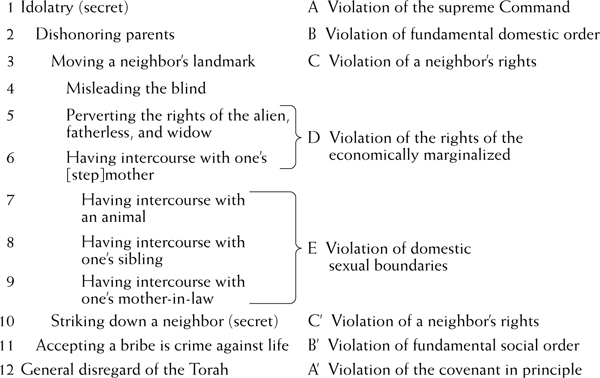
Imprecations for violating sexual taboos represent the center of gravity (##6–9). While the catalog omits several capital crimes, the crimes listed represent the kinds of offenses that need to be purged from Israel. The defiling effects of human sin intensify the seriousness of the crimes listed here, for they jeopardize the land’s performance in the triadic covenantal relationship.
This imprecatory ritual implies that covenantal righteousness could not be enforced merely through the courts. Casting the taboos as imprecations places violators under divine sanction. The verb ʾārûr (“Cursed is”) commits perpetrators into the hands of God, who supervises the moral order and will ultimately establish righteousness through the punishment of evildoers.32 In this ritual the people bind themselves to these consequences by answering each of the Levites’ proclamations in unison, “Amen.” Since this word functions as a solemn formula by which the hearers accept the declared curse, the present ritual functions as a verbal equivalent to the ritual in Exodus 24:8. Each imprecation deserves brief comment.
#1 Private household idolatry (v. 15). The curses open with an imprecation on anyone who constructs idolatrous images and secretly sets them up in his house (cf. 4:28; Judg. 17:3, 4).33 Unlike the golden calf, which served as a public national symbol (9:12, 16), this curse has in mind small household idols that could be clandestinely manufactured and set up within a house. As in 7:25 and 12:31, Moses characterizes such a practice as “detestable” (tôʿēbâ) to Yahweh, an expression used elsewhere of various socio-religious crimes (cf. 17:1; 18:12; 22:5; 23:18[19]; 25:16).
#2 Disrespectful treatment of parents (v. 16). The mistreatment of father and mother is expressed by an unusual word that conveys the opposite of “to honor” (5:16). This category of behavior obviously includes the blatant rebellion dealt with in 21:18–21, but the scope is much broader, referring to any verbal or physical action by which children demean parents.
#3 Moving a landmark (v. 17). The wording of this imprecation derives from 19:14. In Israel moving a boundary stone was viewed not only as a violation of others’ right to their own property, but also as a crime against Yahweh, the ultimate owner of the land (Lev. 25:23), who had through casting the lot personally allotted the land to the respective clans and families.
#4 Misleading the blind (v. 18). This is the first of two curses addressed to those who take advantage of others’ misfortune. While the curse addresses a particular kind of handicap (blindness), the underlying principle extends to persons with other physical deficiencies, as reflected in Leviticus 19:14 and extrabiblical texts.34
#5 Subverting the rights of the marginalized (v. 19). Like the curse on those who move boundaries (v. 17), the wording derives from earlier instruction in 24:17.35 Common to aliens, the fatherless, and widows in a patricentric world like Israel’s is the absence of an adult male to defend their rights and secure their well-being. Through their compassionate administration of justice and care for the poor, the Israelites are to emulate their God (10:18).
The next four anathemas concern sexual crimes. Those listed here may have been selected because they involve crimes committed within the household and could be easily covered up. Though adultery is not mentioned, it involves a rendezvous with a woman from outside the family, which would naturally arouse suspicion.
#6 Incest with one’s father’s wife (v. 20). Whereas 22:30[23:1] forbids marrying one’s father’s former wife, this curse condemns males who engage in sexual intercourse with their stepmother (cf. Lev. 18:7–8).36 Like the fourth command of the Decalogue, which also seeks to preserve parental honor, in this context this is the only curse grounded with a motive clause. “For he would uncover the skirt of his father” (pers. trans.) is a euphemism for violating the sanctity of the marriage, though this act would also violate the taboo expressed in the second curse (v. 16).
#7. Intercourse with an animal (v. 21). Engaging in sexual relations with animals seems to have been a relatively common practice in the ancient world.37 This curse extends the taboo in Israel to all animals. Whereas Leviticus 18:23 condemns such acts, whether committed by a man or woman, as defiling and perverse, other texts expressly declare them capital crimes (Ex. 22:19[18]; Lev. 20:15–16). Apparently bestiality was deemed such a heinous offense because it blurs the boundaries between the creaturely world and humankind created as image-bearers of God (Gen. 1:26–28). The roots of this disposition go back to Eden, where God created woman because none of the animals was an appropriate counterpart for the man (Gen. 2:18–25).
#8 Incest with one’s sister (v. 22). This taboo concerns sexual intercourse between siblings, specifically condemning such relations with one’s half-sister (lit., “daughter of his father”) or one’s full sister (“daughter of his mother”). This practice was common in royal circles of ancient Egypt,38 and apparently in Phoenicia.39
#9 Sexual intercourse with one’s mother-in-law (v. 23). The curse on a man who has sexual intercourse with his mother-in-law accords with Leviticus 20:14, which condemns this act as “wicked” and calls for capital punishment in the form of burning.
#10 Striking one’s neighbor in secret (v. 24). It is unclear whether this curse involves simply striking one’s neighbor in secret or intentionally killing a person by striking him. The formulation may be intentionally vague to cover any physical violence that threatens the well-being of the community.
#11 Accepting a bribe to condemn an innocent person (v. 25). This curse addresses a legal situation, like that envisaged in 16:19. However, here the case involves either paying a bribe to a witness in court to ensure testimony supporting fallacious charges against an innocent person that lead ultimately to his death, or paying a bribe to a judge so he condemns an innocent person to death—in which case this curse strengthens the ordinance in Exodus 23:6–7.
#12 Failure to uphold the terms of this Torah (v. 26). The imprecations conclude with a general curse on all who will not uphold “the words of this law.” As in verses 3 and 8, “the words of this law” refer minimally to the instructions in Moses’ second address, but they may include the first and third addresses as well. The appeal to establish the words of the Torah “by carrying them out” reminds the Israelites that the Torah was given not as an external badge of identity or an artifact to be analyzed and dissected, but as a document to govern conduct. Whereas in 8:18 “to confirm a covenant” had declared Yahweh’s fidelity to his covenant commitments, this imprecation calls for Israelite fidelity to him and invests Moses’ words with permanent canonical authority.
Bridging Contexts
OLD TESTAMENT ALLUSIONS. OLD Testament allusions to the ceremonies prescribed here are rare. The names of the mountains Ebal and Gerizim occur outside Deuteronomy (cf. 11:29) only in Joshua 8:30–35, though Gerizim appears alone in Judges 9:7.40 The former reports that after the conquest of Jericho and Ai, Joshua led the Israelites in a ritual “just as Moses the servant of Yahweh had commanded the people, and just as it is written in the book of the Torah of Moses” (pers. trans.). As described, this event involved (1) constructing an altar of uncut stones; (2) presenting whole burnt and peace/fellowship offerings on it; (3) transcribing the Torah of Moses that he had written on stones in the presence of the people;41 (4) dividing the population into two halves to stand in front of Mounts Gerizim and Ebal, respectively, for the blessing of the people; and (5) reading the blessings and the curses just as they are recorded in the Torah of Moses. The text concludes by noting that Joshua read the Mosaic Torah in its entirety before all the people, including women, small children, and aliens living among them.
Although Deuteronomy 27:1–8 is silent about the ark or the Levitical priests who carried it, Joshua 8:33 makes these the focal point. Presumably the ark was stationed between the two groups of tribes, in the valley between Ebal and Gerizim—in full view of the participants in the ceremony. Since the ark represented the ruling presence of Yahweh, with this addition the narrator presents Yahweh as a witness to and a participant in the rites performed here. Remarkably, whereas Deuteronomy 27:14–26 calls for a recitation of imprecations at the end of the ceremony, Joshua 8:33 ends by noting Joshua’s scrupulous adherence to Moses’ prescriptions (vv. 31, 33, 35; cf. 1:8). This was indeed a historic milestone: for the first time, deity, nation, and land were all together. Echoes of Deuteronomy 27 in the covenant renewal ceremony at Shechem recounted in Joshua 24, particularly Joshua’s commentary on the stone that he erects (v. 27), reinforce this interpretation.
The only other reference to either of these mountains occurs in Judges 9:7, which describes Jotham standing on Mount Gerizim overlooking Shechem and proclaiming his antimonarchic fable concerning Abimelech. In postbiblical times Gerizim took on special significance especially in the Samaritan tradition. This was the site of their temple—as opposed to Jerusalem, which explains why the Samaritan Pentateuch, the only Scriptures the Samaritan sect recognized, consistently identified Gerizim as the only legitimate center of Yahweh worship.42
This tradition is recognized in 2 Maccabees 6:2, and Josephus (Ant 11.8.2, 7), but it surfaces in the New Testament in John 4:20–22. Although not identified by name, Jesus’ conversation with the Samaritan woman reflects the distinctive Samaritan tradition. In response to her comment that “our fathers worshiped on this mountain, but you Jews claim that the place where we must worship is in Jerusalem,” Jesus replied not only that the time is coming when neither “this mountain” nor Jerusalem will matter, but also that the Samaritans worship the Father in ignorance. Although the Samaritans were misled, this account testifies to the long-range significance of Moses’ instructions in Deuteronomy 27.43
Allusions to the imprecations recited at the end of the liturgy of Deuteronomy 27 are scarce. “They have treated father and mother with contempt” in Ezekiel 22:7 may echo Deuteronomy 27:16, and “In you men accept bribes to shed blood” in Ezekiel 22:12 may echo Deuteronomy 27:25. These texts and the rest of the Old Testament suggest these curses were honored more in the breach than in the observance. Illustrations of violations abound in the narratives.
• Micah erected an idolatrous image in his house (Judg. 17:3–4), which was later confiscated and used by the Danites (18:14–31); Solomon and many kings after him sponsored idolatrous state cults (1 Kings 11:1–10; cf. Manasseh in 2 Kings 21:1–9).
• David’s son Absalom dishonored him by grasping for his throne (2 Sam. 15).
• Ahab seized the vineyard of Naboth located next to the palace (1 Kings 21).
• The widow and sons of a son of the prophets were exploited by a creditor (2 Kings 4:1–7).
• Reuben had intercourse with his stepmother Bilhah (Gen. 35:22; cf. 49:4); symbolic of his claim to the throne of David, Absalom publicly had intercourse with his father’s concubines (2 Sam. 16:21–23), and Solomon seems to have interpreted Adonijah’s request to marry Abishag, David’s companion, as some such crime (1 Kings 2:13–25).
• Though he is not explicitly criticized for it, Abraham married his half-sister (Gen. 20:12). Amnon raped his sister Tamar (2 Sam. 13).
• David had his trusted warrior Uriah killed (2 Sam. 11).
• The historian summarizes the history of Israel as a history of violating the Torah and all the laws of God (2 Kings 17:34–35). A notable exception was Josiah, whose declared goal was “to establish the words of the Torah written in the scroll found in the temple” (2 Kings 23:24, pers. trans.).44
Contemporary Significance
THE AMAZING GRACE OF God. Although the chapter ends on a serious note, contemporary readers do well to recognize in the rituals performed on Mounts Gerizim and Ebal the amazing grace of God. (1) God always keeps his Word. The prescribed ceremonies proclaim Yahweh’s faithfulness to his covenant promises to the ancestors (vv. 2–3) and to the nation that came out of Egypt forty years earlier. When the Israelites perform these rituals, they will finally be at home in the land that Yahweh has given them, celebrating the covenantal union that exists among deity (Yahweh), people (Israel), and land (Canaan).
(2) With the Israelites, we need to rejoice that God has revealed his will. The Torah the Israelites are to inscribe on the stone pillars in the heart of their new homeland symbolized for them their covenant relationship with God. We do a disservice to Moses and to the Torah that he proclaims in this book if we equate this word with “law,” for the Torah is much more than law—just as the Decalogue is much more than commands. In expounding the law Moses continually reminds the people that they are the products of this grace, and their obedience is to arise both from a recognition of past grace and in anticipation of grace still to come.
(3) If the inscription of the Torah on the stone pillars symbolizes Yahweh’s gracious revelation of his will, then the altar symbolizes his gracious presence among them and his desire to have the Israelites before him. Whereas in 12:1–15 Yahweh had invited his people to his presence without reference to the altar, here the altar functions as the table on which the peace offerings are presented and at which the people eat and rejoice in the presence of Yahweh (vv. 6–7).45 By eating the peace/fellowship sacrifices in the presence of the divine host, the Israelites celebrated the covenant bond that Yahweh had graciously established with them.46
These rituals signify Israel’s security and hope in Yahweh. Of course, the peace they celebrate is made possible only through the work of Jesus Christ, whose sacrificial work underlies all these rituals. And the peace they will celebrate at Gerizim and Ebal expresses in microcosm the peace we enjoy and the heavenly inheritance we will one day claim in the very presence of God. We who were once far away have been brought near through the blood of Christ, for he himself is our peace, having destroyed the barrier between Israel and us, and created in himself one new person out of two (Eph. 4:12–15).
(4) Interrupting the ritual prescriptions, we hear Moses and the Levites reminding the Israelites that they become the people of Yahweh by grace alone (vv. 9–10). While the significance of this for Israel has been spelled out in 7:6; 14:1–2; and 26:16–19, we rejoice because as the new Israel of God, we too have become his sons, the objects of his gracious election, his special treasure, a holy people belonging to him (1 Peter 2:9–10). The awareness of our status as the Lord’s covenant people should inspire us to scrupulous but joyful obedience to his revealed will.
(5) Moses’ charge to the tribes—all twelve of them—to participate in the ceremony of blessing and cursing reminds them and modern readers of a notion that will be developed more fully in 30:15–20. Even as they enter the land, the people are to know that two ways are open to them: the way of blessing and the way of the curse. By referring to both, he anticipates chapter 28. Furthermore, by involving all the tribes, Moses reminds them that they all have equal access to the benefits of the land they have entered as well as to the delights it offers. This understanding of the people of God is remarkably egalitarian.
(6) The concluding imprecatory ceremony functions as a gracious reminder of the consequences of disobedience. The fact that Moses concludes his instructions concerning the rituals to be performed on Mounts Ebal and Gerizim with a series of curses—as stern as these are—culminating in a comprehensive warning against any violation of the covenant as represented in the Torah, accords with earlier expressions of pessimism concerning the nation’s present and future spiritual condition (cf. 5:29; 9:7–24; 12:8).
Nevertheless, to interpret this ritual as a declaration that Israel is already under the curse of the law is to misunderstand the function of curses in covenantal contexts. They never serve as sentences for guilt already incurred but as gracious warnings against future infidelity. Their purpose is positive—to motivate obedience. If God’s goodness does not stimulate his people to faith and righteous conduct, perhaps warnings like this will. Accordingly, these curses are not so much a prediction of Israel’s certain doom as a reminder that through disobedience his people store up for themselves the wrath of God (cf. Rom. 2:4–5; Gal. 6:8). Even these warnings are grace, like Jesus’ words in John 15:1–15, and as Paul will declare in Romans 11:17–24 and Colossians 1:21–23, for they serve the pastoral purpose of keeping the people of God spiritually on track.47
With this chapter we learn the full story of Israel’s paradigmatic experience of grace. When Yahweh rescued this people from Egypt and established his covenant with them at Sinai, he inaugurated the eschatology announced to Abraham centuries ago in Genesis 15:13–16 and 17:3–8. Through these events those who had been slaves in Egypt were redeemed and at Sinai adopted as children of God (cf. Deut. 14:1–2). But the full realization of the promise still awaited them. Through the ceremonies in this chapter, the Israelites were invited to celebrate the eschatology realized when they crossed the Jordan. Now deity, people, and land were finally together. Inaugurated eschatology had given way to realized eschatology.
The Israelite experience is paradigmatic of our own. Through the sacrifice of Jesus Christ on the cross, we have been rescued from the bondage of sin and declared to be children of God. But the benefits of this redemption and adoption are not yet fully realized. We live in eager anticipation of the receipt of the grant/inheritance reserved for us (Rom. 8:9–17; Eph. 1:3–14). That will be an even greater and more glorious day of celebration.