Original Meaning
The Historical Prologue (5:6)
AS IN ANCIENT TREATIES, the prologue is a fundamental part of the document, introducing the Suzerain and summarizing the history of the relationship between the two parties to the covenant. However, unlike many vassal treaties, this covenant did not reflect a superior’s conquest of a people. Rather, behind this document lie the gracious actions of the divine Superior, who rescued this people from those who held them in bondage. The law is preceded by gospel; obedience to God’s will as outlined in the commands that follow represents a supreme act of worship, involving reverential human acts of submission and homage before the divine Sovereign in response to his gracious revelation of himself.
Bridging Contexts
IN CHRISTIAN TRADITION THE Decalogue has been elevated above all the rest of the Torah as the essence of God’s moral law, permanently and universally valid as the basis of ethics, in stark contrast to the rest of the laws, which have little or no relevance for us. The Decalogue is indeed a special document. Produced by the finger of God, it was the official covenant document. It reduced the divine will to ten statements that could be easily memorized and recited in a liturgical setting. Nevertheless, there is no evidence within the Old Testament or the New Testament that the Decalogue was ever treated as more authoritative or weighty than any other parts of the Sinai revelation.41 Rather, we should perceive its relationship to the other constitutional documents as organic, like that of a seed that sprouts and grows and eventually yields its full beautiful flowers.42 The relationships among these documents may be illustrated as follows:
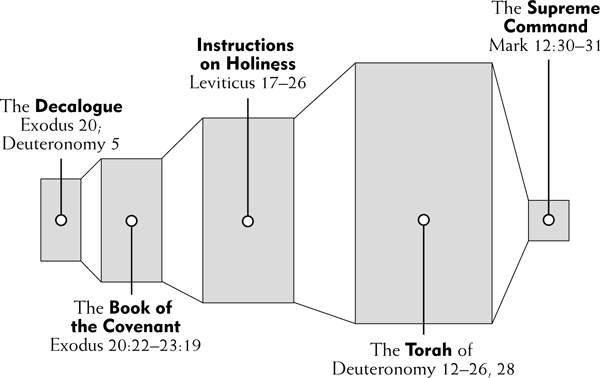
It is difficult to determine what role the Decalogue played in Israel’s worship. In the present context on the Plains of Moab, Moses recites it as the Scripture on which he will base his second address (Deut. 4:44–26:19 and 28:1–29:1[28:68]). In 6:1–11:32 he provides a detailed exposition of the first [“Supreme”] Command, while in 12:1–26:19 (misleadingly identified by many as the Deuteronomic Code) he expounds on the worldview presented by the rest of the Decalogue.43 Few texts in the Old Testament have been inspired directly by the Decalogue. Leviticus 19 may be one such text, but changes in language and forms of expression cast doubts on viewing the Decalogue as the primary inspiration.
The spiritual commitment and social ethic called for by the Decalogue are reflected in the preaching of the prophets (Jer. 7:9; Hos. 4:2), but no unequivocal echoes of the document itself are found either in the Prophets or the Psalms. Ezekiel’s lists of righteous actions in Ezekiel 18 display few formal or stylistic links with the Decalogue. If Psalms 15 and 24 did indeed originate in “entrance liturgies,”44 it is remarkable that these texts reveal no influence of the Decalogue. Psalm 50:16–21 quotes God as questioning the right of the wicked to “recite my laws” and to “take my covenant on your lips,” since they refuse to live by it. This may refer to the glib memorization and recitation of the Decalogue as a religious exercise, without any sense of personal spiritual obligation to the God who speaks in the document. However, the language suggests it may also be inspired by other constitutional texts. Psalm 81:9–10[10–11] obviously remembers the revelation at Sinai and seems to allude specifically to the preamble and the first principle of the Decalogue, but any theory of how the Decalogue might have been used in Israel’s cult is speculative.45
The citation of the Decalogue in the Nash papyrus (second century BC) and the Tefillin (phylacteries) found at Qumran46 shows that the Decalogue played an important liturgical role in early Judaism. The Mishnah (m. Tamid 5:1) suggests it was originally recited as part of the daily temple service. Whereas Christian tradition has tended to exploit the Decalogue independently of its biblical context, Judaism refused to isolate it from the larger corpus of biblical law.47
While the New Testament never formally cites the Decalogue as a cultic or liturgical document, it obviously provides the basis for both Jesus’ and Paul’s ethical teaching. The antitheses in Jesus’ Sermon on the Mount feature the Decalogue (Matt. 5:21–37), but elsewhere he reduces the principles of covenant relationship to two commands: “You shall love the Lord your God with all your heart . . . and . . . your neighbor as yourself” (Matt. 19:16–30; Mark 10:17–31; Luke 18:18–30), which capture precisely the two dimensions of covenant relationship spelled out in the Decalogue. Both James (Jas. 2:8–13) and Paul (Rom. 8:7–13; 13:8–10; Eph. 6:1–4) explicitly cite the Decalogue.48 In 2 Corinthians 3 Paul contrasts the law engraved on stone letter by letter, which dispenses only death, with the law written on the heart by the Spirit, which dispenses life. This externalism often associated with the first covenant finally gives way in the new covenant.49 Paul’s ready use of the document reflects longstanding Jewish catechetical tradition and the importance of the Decalogue in early Christian preaching. Even so, there is no evidence in the New Testament that it had unique authority for Christians.
Contemporary Significance
WHAT IS THE CHRISTIAN today to make of the Decalogue? Should Christians support the posting of the “Ten Commandments” in our courthouses and schools? Or does our freedom in Christ absolve us of obligation to all Old Testament laws, including the Decalogue? In seeking to answer these questions, we need to keep in mind several considerations.
Addressed to the redeemed. First, the Decalogue is addressed to those who have been redeemed. The ten principles of covenant relationship were not revealed to the Egyptians or Canaanites, but to the people of God, chosen to represent him and proclaim his grace and glory among the nations. The past tense of the verb (“who brought you out,” v. 6) is neither coincidental nor irrelevant; it reminds all who hear this document of the proper relationship between obedience to the divine will and Yahweh’s saving actions. The law (including the Decalogue) was neither a way of salvation nor a burdensome obligation; it was a gracious gift, a guide for God’s people so they might knowingly respond to his grace according to his will.50
This means that impulses to post the Decalogue in public schools and courthouses are fundamentally misplaced. The problem with American society is not that people do not keep the ”Ten Commandments”; it is that most have never left Egypt. It is unrealistic and unbiblical to expect those who have not been redeemed to live according to the principles and commitments of the redeemed. They have neither the motivation nor the indwelling Spirit to empower them do so.
Covenant relationship. Second, the terms of the Decalogue are revealed within the context of the establishment of a covenant relationship. Yahweh brought Israel to himself before he brought the laws to them (Ex. 19:4–6). Accordingly, the Israelites were not called primarily to follow a code of conduct but to enter a relationship with God (“I am the LORD your God”). Commitment to the revealed will of God is secondary to acceptance of the privilege of covenant relationship with him. Apart from the experience of salvation and covenant relationship, insistence on obedience to the “Ten Commands” is sheer moralism.
Complete acceptance. Third, if one accepts some terms of the Decalogue as normative for Christians, one must accept all. This document must be received as a package, beginning with the preamble and ending with the command against coveting. The principles are cast as absolute and unconditional commands, without qualification, and for the most part without declared motivation.
This includes the seventh-day Sabbath. Some argue for the normativeness of the “Ten Commands” as a guide for Christian behavior, but then remove the Sabbath ordinance as an exception, claiming this to be part of the ceremonial law that ended in Christ. However, this approach is indefensible. (1) The seventh-day Sabbath ordinance is embedded in the Decalogue as a fundamental principle of covenant relationship, along with the prohibition of any other gods, of murder, and so on. One may not treat it differently from the rest.
(2) According to the Exodus version of the Decalogue, the six-plus-one weekly rhythm is fundamental to the cosmic order. Exodus 20:11 grounds the human practice in the pattern of divine creative work.
(3) In its origin the Sabbath is separated from Israel’s ceremonial laws. In fact, Israelites were observing it as a matter of course before they got to Sinai (Ex. 16).
(4) The Sabbath command is not primarily a cultic ordinance. In intent and character it was both humanitarian (a gift offering people rest and refreshment from life-sustaining labor) and theological—offering Israelites an opportunity to declare their fundamentally theological perspective on life (God is Creator of all), their confidence in him to provide for the seventh day, their acceptance of covenant relationship, their gratitude for salvation from slavery, and their compassion for the poor.
(5) Nowhere does the New Testament declare the seventh-day Sabbath passé in Christ. On the contrary, Jesus (e.g., Luke 3:16) and the early disciples observed it (Acts 13:14, 27, 42, 44; 15:21; 16:13; 17:2; 18:4). Where Paul appears to minimize the Sabbaths (plural), he speaks of those annual or monthly festivals actually associated with the Israelite ceremonial calendar (Rom. 14:5–6; Gal. 4:10; Col. 2:16).51
It seems that by the first half of the second century AD Christians increasingly gathered for worship on Sunday, though many continued to observe the Sabbath on Saturday.52 Along with circumcision, the rite of initiation into the covenant (which was replaced by baptism), and the Passover (which was transformed into the Lord’s Supper), early Christians transformed the seventh day of rest into the first day of celebration of resurrection and new life.53 They did not abolish the Sabbath; as the seventh-day Sabbath was the sign of the covenant for Israel (cf. Ex. 31:17), so the first-day Sabbath became the sign of the new covenant for Christians.54 If Sunday is to Christians what the Sabbath was to Israel, then by observing this day we too declare our fundamentally theological perspective on life (God is creator of all), our confidence in him to provide for the sanctified day, our acceptance of covenant relationship, our gratitude for salvation from slavery to sin, and our compassion for the poor.
Jesus and the Decalogue. Finally, Jesus shows us how we are to understand the Decalogue. In reducing the revealed will of God to the simple command, “You shall love the Lord your God with all your heart . . . and . . . your neighbor as yourself” (Matt. 22:34–40; Mark 12:28–34), Jesus captured both the essence and the heart of all the law. Patrick Miller observes, “The Commandments are . . . the starting point of a rich trajectory of meaning and effects, principles and actions, that tell the community of faith how to live its life in relation to God and neighbor.”55
True godliness is demonstrated by acts of covenant commitment that seek the pleasure of God and the well-being of others. Assuming the Decalogue to be normative for his followers, Jesus quoted it explicitly (Matt. 19:18–19) and rebuked the Pharisees for hypocritically substituting their own laws for weightier matters of Torah (Matt. 15:4–20; 23:1–12). Even so, as Yahweh incarnate, the One who had spoken to Israel at Horeb, Jesus personally retained complete freedom toward this ordinance and declared himself to be the Lord of the Sabbath (Mark 2:27–28). When he commended the young inquirer for keeping the commands and called on him to follow him (Matt. 19:16–22; Mark 10:17–22; Luke 18:18–30), Jesus spoke as Yahweh in the Decalogue. Eternal life is gained through relationship with him, the covenant Lord.
Original Meaning
The Covenant Stipulations (5:7–21)
THE TERMS OF THE covenant are cast as second person commands, for the most part without preconditions or declaration of consequences. Except for the Sabbath ordinance and the command to honor parents, the stipulations are negative in form, and motive clauses are the exception rather than the rule. The commands are cast in terms that are absolute, universal, and permanent. Since they are so general as to be virtually unenforceable, we should not interpret this document as a law code. Rather, this document seeks to create a worldview intended to govern the relationship between the redeemed and their Redeemer on the one hand, and among members of the community on the other.4
As noted above on 4:13, the Old Testament consistently identifies this unit as “the Ten Words” (Ex. 34:28; Deut. 10:4). Apparently the principles of the covenant have been reduced to ten to facilitate memorization—one command for each of our ten fingers. However, there is some question how the words should be numbered. The Reformed tradition counts verses 8–10 as the second command, distinct from verse 7, and treats verse 21 as a single command. However, based on discourse linguistic grounds, it is preferable to follow the Lutheran and Roman Catholic numbering, with verses 7–10 representing the first command and splitting verse 22 into two commands.5
By this system the first two commands (vv. 7–11) govern the Israelites’ vertical relationship with Yahweh, and the last seven governing horizontal relationships between members of the covenant community (vv. 16–21). The Sabbath principle (#3; vv. 12–15) is transitional. By basing it on the divine pattern of creation, the Exodus version (Ex. 20:8–11) highlights the theological dimension of the Sabbath; by emphatically extending the Sabbath rest to the entire household and basing it on Israel’s experience of deliverance from slave labor, the Deuteronomic version transforms it into a humanitarian/horizontal command.
Although the principles of the Decalogue apply ultimately to every member of the covenant community, strictly speaking, the commands are addressed to every man, specifically adult males who are heads of households with wives and children and who possess property. If we assume patricentric social structures, the document views strong domestic leadership as the key to a healthy community. Whereas some argue that the Decalogue seeks to protect the power and privileges of wealthy male Israelites,6 it actually does the opposite, intentionally reining in potential abuse of power by male heads of households.7 In so doing this document functions as an Israelite version of a bill of rights.8 However, unlike modern bills of rights, the document does not protect one’s own rights but the rights of the next person. Each of the terms may be recast as a statement of another person’s rights and the adult males’ responsibility to guard the rights first of the covenant Lord, and second of fellow Israelites:
The Divine Rights
1. The Supreme Command: Yahweh has the right to exclusive allegiance (vv. 7–10).
2. Yahweh has the right to proper representation (v. 11).
The Human Rights
3. All in the household have the right to humane treatment by the head (vv. 12–15).9
4. One’s parents have the right to respect (v. 16).
5. One’s neighbor has the right to life (v. 17).
6. One’s neighbor has the right to purity and fidelity in marriage (v. 18).
7. One’s neighbor has the right to his property (v. 19).
8. One’s neighbor has the right to honest and truthful testimony in court (v. 20).
9. One’s neighbor has the right to security in marriage (v. 21a).
10. One’s neighbor has the right to his own household property (v. 21b).
The first principle of covenant relationship: Yahweh’s right to exclusive allegiance (5:7–10). Israel is to have no other gods10 besides Yahweh. This command prohibits the worship of any other deity alongside Yahweh, as if he were one member or even the head of a larger pantheon. While the command does not explicitly deny the existence of other gods, it denies any a share of his authority, power, or jurisdiction.11
Verses 8–10, which serve as commentary on verse 7, break down into three verbal statements: “you shall not make”; “you shall not bow down [before what you make]”; and “[you shall not] worship [what you make]” (cf. 4:15–19). The prohibition is exhaustive in scope, banning the manufacture of any image of deity after the models of God’s own creation in Genesis 1. The prohibitions are followed by a motive clause (v. 9): because Yahweh is El Qannaʾ, “Impassioned God” (NIV “a jealous God”).12 Whereas other gods tolerated their devotees’ simultaneous worship of other deities, as El Qannaʾ Yahweh will brook no rivals. The key expressions are obviously “those who reject me” (NIV, “who hate me”) and “those who love me” or are covenantally committed to me. The final clause (v. 10) declares that like divine love, human love is not merely an emotion; it is commitment demonstrated in action, in this instance by keeping Yahweh’s commands.
Yahweh warns those who reject him that he will “visit their iniquity” (NASB) on the children to the third and fourth generation.13 While the idiom “to the third and fourth generation” is commonly interpreted vertically, the phrase should be understood horizontally.14 In the ancient world a domestic unit could consist of up to four generations, all under the leadership of the “father.” This warning is based on a notion of corporate solidarity according to which the actions of one member of the household, particularly the father, implicate all the members. If the opposite of “reject” is “love,” then the opposite of “visit the guilt upon” is to demonstrate ḥesed (NIV, “show love”) toward them (v. 10). Like the Hebrew word for “love” (ʾâhab), ḥesed belongs to the covenantal semantic field, encompassing those qualities that move a person to act for the benefit of another irrespective of self-interest: love, mercy, grace, kindness, goodness, benevolence, loyalty, fidelity, and covenant faithfulness.15 Yahweh does so “to a thousand generations,” which highlights his long-term commitment to his people and his delight in covenant grace in contrast to his short-lived expression of wrath (v. 9).16
This first principle of covenant relationship (vv. 7–10) represents “the Supreme Command,” which Moses has in mind whenever he uses the singular expression “the command” in connection with the plural forms “the decrees and laws” (5:31; 6:1; 7:11). This principle will find its obverse in the Shema (6:4–5). The following nine commands represent specific ways of demonstrating one’s exclusive devotion to Yahweh.
The second principle of covenant relationship: Yahweh’s right to proper representation (5:11). Whereas Jewish tradition tends to see here a ban on the flippant use of the divine name in oaths,17 Christians often view it simply as a taboo on verbal profanities. Some treat it as a prohibition on the magical use of Yahweh’s name to exercise power over another person.18 Literally the Hebrew translates, “You shall not bear/carry the name of Yahweh your God emptily.” The idiom derives from the ancient practice of branding slaves with the name of their owner.19 To bear the name of Yahweh means to claim him as one’s owner and to accept the role of representing him (cf. Isa 44:5). At issue is Israel’s status and function as the people of Yahweh. They may not claim Yahweh as their covenant Lord and then live as if they belonged to Baal.20 The consequences of misrepresenting Yahweh are declared only in the vaguest of terms: these Yahweh will not acquit (NIV “hold guiltless”).
The third principle of covenant commitment: the right of all members of the household to humane treatment (5:12–15). Whereas the Exodus version of the Decalogue grounds the Sabbath in creation (Ex. 20:8–11; cf. Gen. 1:1–2:4a), Moses transforms this institution into a symbol of the right of all to humane treatment from the head of the household. He does not hereby negate the original meaning of the Sabbath, but ensures that the gift of Sabbath rest extends to the entire household, while the amount of space devoted to the Sabbath reflects the importance of this ordinance.21 Structurally, this command consists of three parts: (1) a summary command (v. 12); (2) an exposition of the command (vv. 13–14); and (3) a declaration of the grounds for the command (v. 15).
Like the command to respect parents, this one is cast as an affirmative statement.22 The Sabbath is kept “by keeping it holy,” that is, by sanctifying it, separating it from the other six days as a day of rest and recognizing that it belongs to Yahweh (v. 13; cf. Gen 2:3). As suggested by verses 13–14, the word šabbat derives from a root meaning “to cease, stop,” indicating that the Sabbath was not primarily a day of assembly but of quiet, when all work associated with everyday life was to cease.23
In ancient Israel it would have been tempting for the head of the household and his immediate family to observe the Sabbath while the rest of the household carried on as usual. To prevent this, the command specifically lists others in the economic unit to be included in the privilege: children (male and female), servants (male and female), draft animals (ox and donkey),24 and all outsiders temporarily residing in the town. The added motive clause insists that in their right to Sabbath rest these were all on a par with the householder; the Sabbath was a gift for all. In grounding the “holiday” on Israel’s memory of their own experience in Egypt (v. 15), Moses calls for a sympathetic disposition toward those under one’s authority. In their treatment of children, servants, animals, and outsiders, the heads of households were to embody the superior righteousness of the revealed laws of Yahweh (Deut. 4:8).
Although the weekly Sabbath rest was designed to serve several functions,25 the Old Testament offers remarkably little information on how the Israelites were to keep and sanctify it (cf. Lev. 24:8; Num. 28:9–10). The first reference to Israelites keeping the seventh-day Sabbath is found in Exodus 16:22–30. This demonstrates that the pattern was in place before the Israelites got to Sinai,26 and this was not part of the ritual system associated with tabernacle or temple worship, but a fundamentally ethical ordinance. The seventh-day Sabbath was to be celebrated as a blessed day (Gen. 2:3), set apart for all to “rest” and “to catch their breath.”27
The fourth principle of covenant relationship: parental right to respect (5:16). Although using a different verb, like Leviticus 19:3, the fourth command calls on Israelites to honor (kabbēd) both mother and father.28 The terms “father” and “mother” should not be restricted to biological parents, let alone living parents; nor is the principle valid only when one is young. Since the Decalogue is directed primarily to adult males, the scope of this ordinance extends even to deceased parents. The added motive clause links people’s well-being with their disposition toward their parents. This is not ancestor worship; one’s fate or fortune does not depend on the deceased’s continued power; well-being is a blessing granted by Yahweh in response to proper respect for one’s parents.
The fifth principle of covenant relationship: the right to life (5:17). The verb rāṣaḥ is used elsewhere of accidental manslaughter (4:42; 19:2, 4, 6), but here it refers to intentional, premeditated homicide.29 But this is not merely a prohibition against murder. It also calls for proactive prevention of accidental deaths. The command is rooted in the unique sanctity of human life that derives from our status as the image of God (Gen. 9:6). To take the life of another person is to rob God of a representative and deputy, which is the highest form of treason. Unlike Babylonian laws, this command draws no distinctions in value of life based on status, race, or gender. The life of all human beings is equally sacred.
The sixth principle of covenant relationship: the right to fidelity in marriage (5:18). Strictly speaking, “adultery” involves voluntary sexual relations between a married person and someone other than his or her spouse.30 Adultery was considered a capital crime because it undermined the integrity and covenant of marriage, violated the sanctity of sexual union, defiled a human being as the image of God, and threatened the stability of the community.31 Like murder, adultery pollutes the land and ultimately causes it to spew out its inhabitants (Lev. 18:20, 24–25). And like murder, adultery is not only a crime against one’s spouse or children or parents; it is a crime against God (cf. Gen. 39:9). Whereas elsewhere instructions on adultery focus on the female adulteress, this regulation focuses on male adultery.
The seventh principle of covenant relationship: the right to own property (5:19). Since the verb gānab is sometimes used of stealing persons (Ex. 21:15; Deut. 24:7), in Jewish tradition some have interpreted this command as a prohibition on kidnapping. However, it should not be restricted to stealing people.32 This is a categorical prohibition of all theft, particularly of items one is tempted to covet, as listed in the last principle (v. 21b).
The eighth principle of covenant relationship: the right to an honest and fair hearing in court (5:20). This ordinance may apply to all conversations, but it envisages particularly a legal setting where a person is called to testify in a case involving his neighbor. While Exodus 20:16 and Deuteronomy 19:18 characterize the forbidden form of testimony as a “falsehood, lie,” the NIV’s reading misses the present point, which prohibits “empty” testimony. The concern is testimony that does not move the case forward, that hedges the truth, or that detracts from the pursuit of justice with misleading and trivial responses.33 The seriousness of false testimony is reflected by the call for the death penalty in 19:15–21.
The ninth principle of covenant relationship: the right to marital security (5:21a). That verse 21 concerns a disposition of the heart or a mental state reinforces the conviction that the Decalogue is not a legal code to which judges could appeal to enforce proper conduct, but a body of principles by which to live. The syntactical division of this verse into two distinct clauses follows the version in Exodus 20:17, but now Moses modifies the command in three significant respects. (1) He changes the word for covet in the second from ḥāmad to hitʾawwâ.34 (2) He reverses the order of “house” and “your neighbor’s wife” and isolates this prohibition as a separate command. (3) He creates a natural pair in the second by adding “his field” to “his house.”
The significance of these shifts is monumental.35 The ambiguity of the word “house,” as well as the location of “your neighbor’s wife” in the Exodus version, opens the door to irresponsible males justifying treating their wives merely as household property. Here Moses removes the ambiguity and elevates the marital relationship above all other domestic relationships. Whereas the sixth command sought to ensure the purity of marriage, this ordinance seeks to ensure the security of the relationship. Men do not covet their neighbor’s wives only with lustful and adulterous sexual intentions. In an exploitative environment, women are also coveted for the contribution they make to the domestic economy, to enhance the status of a man, and to provide more children for the household. Moses’ modifications to the ninth principle of covenant relationship establish a trajectory in domestic relations that will be pursued throughout Deuteronomy, intentionally reining in potential abuse of power by the heads of household.
The tenth principle of covenant relationship: the right to secure ownership of household property (5:21b). Having separated the wife from the rest of the household, Moses forbids Israelites from lusting after their neighbor’s economic assets. These assets include the entire domestic compound: house and field, male and female servants, ox and donkey, as well as “anything [else] that belongs to your neighbor.”
The aim of these last two commands is to create a climate of trust and security within the covenant community. By concluding the Decalogue on this note Yahweh recognizes that actions arise from within,36 and that neither proper behavior by the individual nor the security of the community can be legislated. These are achieved only as all the members purpose within their hearts to place the interests of others ahead of themselves.
Bridging Contexts
IN CHRISTIAN TRADITION THE Decalogue has been elevated above all the rest of the Torah as the essence of God’s moral law, permanently and universally valid as the basis of ethics, in stark contrast to the rest of the laws, which have little or no relevance for us. The Decalogue is indeed a special document. Produced by the finger of God, it was the official covenant document. It reduced the divine will to ten statements that could be easily memorized and recited in a liturgical setting. Nevertheless, there is no evidence within the Old Testament or the New Testament that the Decalogue was ever treated as more authoritative or weighty than any other parts of the Sinai revelation.41 Rather, we should perceive its relationship to the other constitutional documents as organic, like that of a seed that sprouts and grows and eventually yields its full beautiful flowers.42 The relationships among these documents may be illustrated as follows:
It is difficult to determine what role the Decalogue played in Israel’s worship. In the present context on the Plains of Moab, Moses recites it as the Scripture on which he will base his second address (Deut. 4:44–26:19 and 28:1–29:1[28:68]). In 6:1–11:32 he provides a detailed exposition of the first [“Supreme”] Command, while in 12:1–26:19 (misleadingly identified by many as the Deuteronomic Code) he expounds on the worldview presented by the rest of the Decalogue.43 Few texts in the Old Testament have been inspired directly by the Decalogue. Leviticus 19 may be one such text, but changes in language and forms of expression cast doubts on viewing the Decalogue as the primary inspiration.
The spiritual commitment and social ethic called for by the Decalogue are reflected in the preaching of the prophets (Jer. 7:9; Hos. 4:2), but no unequivocal echoes of the document itself are found either in the Prophets or the Psalms. Ezekiel’s lists of righteous actions in Ezekiel 18 display few formal or stylistic links with the Decalogue. If Psalms 15 and 24 did indeed originate in “entrance liturgies,”44 it is remarkable that these texts reveal no influence of the Decalogue. Psalm 50:16–21 quotes God as questioning the right of the wicked to “recite my laws” and to “take my covenant on your lips,” since they refuse to live by it. This may refer to the glib memorization and recitation of the Decalogue as a religious exercise, without any sense of personal spiritual obligation to the God who speaks in the document. However, the language suggests it may also be inspired by other constitutional texts. Psalm 81:9–10[10–11] obviously remembers the revelation at Sinai and seems to allude specifically to the preamble and the first principle of the Decalogue, but any theory of how the Decalogue might have been used in Israel’s cult is speculative.45
The citation of the Decalogue in the Nash papyrus (second century BC) and the Tefillin (phylacteries) found at Qumran46 shows that the Decalogue played an important liturgical role in early Judaism. The Mishnah (m. Tamid 5:1) suggests it was originally recited as part of the daily temple service. Whereas Christian tradition has tended to exploit the Decalogue independently of its biblical context, Judaism refused to isolate it from the larger corpus of biblical law.47
While the New Testament never formally cites the Decalogue as a cultic or liturgical document, it obviously provides the basis for both Jesus’ and Paul’s ethical teaching. The antitheses in Jesus’ Sermon on the Mount feature the Decalogue (Matt. 5:21–37), but elsewhere he reduces the principles of covenant relationship to two commands: “You shall love the Lord your God with all your heart . . . and . . . your neighbor as yourself” (Matt. 19:16–30; Mark 10:17–31; Luke 18:18–30), which capture precisely the two dimensions of covenant relationship spelled out in the Decalogue. Both James (Jas. 2:8–13) and Paul (Rom. 8:7–13; 13:8–10; Eph. 6:1–4) explicitly cite the Decalogue.48 In 2 Corinthians 3 Paul contrasts the law engraved on stone letter by letter, which dispenses only death, with the law written on the heart by the Spirit, which dispenses life. This externalism often associated with the first covenant finally gives way in the new covenant.49 Paul’s ready use of the document reflects longstanding Jewish catechetical tradition and the importance of the Decalogue in early Christian preaching. Even so, there is no evidence in the New Testament that it had unique authority for Christians.
Contemporary Significance
WHAT IS THE CHRISTIAN today to make of the Decalogue? Should Christians support the posting of the “Ten Commandments” in our courthouses and schools? Or does our freedom in Christ absolve us of obligation to all Old Testament laws, including the Decalogue? In seeking to answer these questions, we need to keep in mind several considerations.
Addressed to the redeemed. First, the Decalogue is addressed to those who have been redeemed. The ten principles of covenant relationship were not revealed to the Egyptians or Canaanites, but to the people of God, chosen to represent him and proclaim his grace and glory among the nations. The past tense of the verb (“who brought you out,” v. 6) is neither coincidental nor irrelevant; it reminds all who hear this document of the proper relationship between obedience to the divine will and Yahweh’s saving actions. The law (including the Decalogue) was neither a way of salvation nor a burdensome obligation; it was a gracious gift, a guide for God’s people so they might knowingly respond to his grace according to his will.50
This means that impulses to post the Decalogue in public schools and courthouses are fundamentally misplaced. The problem with American society is not that people do not keep the ”Ten Commandments”; it is that most have never left Egypt. It is unrealistic and unbiblical to expect those who have not been redeemed to live according to the principles and commitments of the redeemed. They have neither the motivation nor the indwelling Spirit to empower them do so.
Covenant relationship. Second, the terms of the Decalogue are revealed within the context of the establishment of a covenant relationship. Yahweh brought Israel to himself before he brought the laws to them (Ex. 19:4–6). Accordingly, the Israelites were not called primarily to follow a code of conduct but to enter a relationship with God (“I am the LORD your God”). Commitment to the revealed will of God is secondary to acceptance of the privilege of covenant relationship with him. Apart from the experience of salvation and covenant relationship, insistence on obedience to the “Ten Commands” is sheer moralism.
Complete acceptance. Third, if one accepts some terms of the Decalogue as normative for Christians, one must accept all. This document must be received as a package, beginning with the preamble and ending with the command against coveting. The principles are cast as absolute and unconditional commands, without qualification, and for the most part without declared motivation.
This includes the seventh-day Sabbath. Some argue for the normativeness of the “Ten Commands” as a guide for Christian behavior, but then remove the Sabbath ordinance as an exception, claiming this to be part of the ceremonial law that ended in Christ. However, this approach is indefensible. (1) The seventh-day Sabbath ordinance is embedded in the Decalogue as a fundamental principle of covenant relationship, along with the prohibition of any other gods, of murder, and so on. One may not treat it differently from the rest.
(2) According to the Exodus version of the Decalogue, the six-plus-one weekly rhythm is fundamental to the cosmic order. Exodus 20:11 grounds the human practice in the pattern of divine creative work.
(3) In its origin the Sabbath is separated from Israel’s ceremonial laws. In fact, Israelites were observing it as a matter of course before they got to Sinai (Ex. 16).
(4) The Sabbath command is not primarily a cultic ordinance. In intent and character it was both humanitarian (a gift offering people rest and refreshment from life-sustaining labor) and theological—offering Israelites an opportunity to declare their fundamentally theological perspective on life (God is Creator of all), their confidence in him to provide for the seventh day, their acceptance of covenant relationship, their gratitude for salvation from slavery, and their compassion for the poor.
(5) Nowhere does the New Testament declare the seventh-day Sabbath passé in Christ. On the contrary, Jesus (e.g., Luke 3:16) and the early disciples observed it (Acts 13:14, 27, 42, 44; 15:21; 16:13; 17:2; 18:4). Where Paul appears to minimize the Sabbaths (plural), he speaks of those annual or monthly festivals actually associated with the Israelite ceremonial calendar (Rom. 14:5–6; Gal. 4:10; Col. 2:16).51
It seems that by the first half of the second century AD Christians increasingly gathered for worship on Sunday, though many continued to observe the Sabbath on Saturday.52 Along with circumcision, the rite of initiation into the covenant (which was replaced by baptism), and the Passover (which was transformed into the Lord’s Supper), early Christians transformed the seventh day of rest into the first day of celebration of resurrection and new life.53 They did not abolish the Sabbath; as the seventh-day Sabbath was the sign of the covenant for Israel (cf. Ex. 31:17), so the first-day Sabbath became the sign of the new covenant for Christians.54 If Sunday is to Christians what the Sabbath was to Israel, then by observing this day we too declare our fundamentally theological perspective on life (God is creator of all), our confidence in him to provide for the sanctified day, our acceptance of covenant relationship, our gratitude for salvation from slavery to sin, and our compassion for the poor.
Jesus and the Decalogue. Finally, Jesus shows us how we are to understand the Decalogue. In reducing the revealed will of God to the simple command, “You shall love the Lord your God with all your heart . . . and . . . your neighbor as yourself” (Matt. 22:34–40; Mark 12:28–34), Jesus captured both the essence and the heart of all the law. Patrick Miller observes, “The Commandments are . . . the starting point of a rich trajectory of meaning and effects, principles and actions, that tell the community of faith how to live its life in relation to God and neighbor.”55
True godliness is demonstrated by acts of covenant commitment that seek the pleasure of God and the well-being of others. Assuming the Decalogue to be normative for his followers, Jesus quoted it explicitly (Matt. 19:18–19) and rebuked the Pharisees for hypocritically substituting their own laws for weightier matters of Torah (Matt. 15:4–20; 23:1–12). Even so, as Yahweh incarnate, the One who had spoken to Israel at Horeb, Jesus personally retained complete freedom toward this ordinance and declared himself to be the Lord of the Sabbath (Mark 2:27–28). When he commended the young inquirer for keeping the commands and called on him to follow him (Matt. 19:16–22; Mark 10:17–22; Luke 18:18–30), Jesus spoke as Yahweh in the Decalogue. Eternal life is gained through relationship with him, the covenant Lord.
Original Meaning
The Transcriptional Epilogue (5:22)
WHILE MANY CONSIDER THIS verse to be the introduction to the next literary section that extends from 5:22 to 6:3, on form-critical grounds and based on comparison with ancient treaties, this verse is best understood as the conclusion to Moses’ recitation of the Decalogue (cf. Ex. 24:12–18; 31:18). Moses recalls that Yahweh’s revelation at Sinai was visual, oral, and textual.37 Indeed he highlights the identification of the oral with the textual revelation: what Yahweh said, that he wrote, and no more. Having produced the written document himself, Yahweh handed it to his authorized representative and interpreter. By reciting the Decalogue, Moses has laid the foundations for the rest of the second address.
The transcription of the Decalogue on a pair of durable tablets of stone rather than perishable materials like parchment or papyrus reflects both its official nature and its permanent validity. Longstanding tradition has it that one tablet38 contained the commands that dealt with Israel’s relationship to God, and the second those that governed horizontal relationships.39 This interpretation is groundless exegetically and contextually. Ancient Near Eastern custom required duplicate copies of treaties be produced, one for each party to the agreement.40 Exodus 33:15 observed that the words of the Decalogue covered the stone slabs front and back, reinforcing the conclusion that Yahweh gave Moses two identical copies: one for the people and one for himself.
Bridging Contexts
IN CHRISTIAN TRADITION THE Decalogue has been elevated above all the rest of the Torah as the essence of God’s moral law, permanently and universally valid as the basis of ethics, in stark contrast to the rest of the laws, which have little or no relevance for us. The Decalogue is indeed a special document. Produced by the finger of God, it was the official covenant document. It reduced the divine will to ten statements that could be easily memorized and recited in a liturgical setting. Nevertheless, there is no evidence within the Old Testament or the New Testament that the Decalogue was ever treated as more authoritative or weighty than any other parts of the Sinai revelation.41 Rather, we should perceive its relationship to the other constitutional documents as organic, like that of a seed that sprouts and grows and eventually yields its full beautiful flowers.42 The relationships among these documents may be illustrated as follows:
It is difficult to determine what role the Decalogue played in Israel’s worship. In the present context on the Plains of Moab, Moses recites it as the Scripture on which he will base his second address (Deut. 4:44–26:19 and 28:1–29:1[28:68]). In 6:1–11:32 he provides a detailed exposition of the first [“Supreme”] Command, while in 12:1–26:19 (misleadingly identified by many as the Deuteronomic Code) he expounds on the worldview presented by the rest of the Decalogue.43 Few texts in the Old Testament have been inspired directly by the Decalogue. Leviticus 19 may be one such text, but changes in language and forms of expression cast doubts on viewing the Decalogue as the primary inspiration.
The spiritual commitment and social ethic called for by the Decalogue are reflected in the preaching of the prophets (Jer. 7:9; Hos. 4:2), but no unequivocal echoes of the document itself are found either in the Prophets or the Psalms. Ezekiel’s lists of righteous actions in Ezekiel 18 display few formal or stylistic links with the Decalogue. If Psalms 15 and 24 did indeed originate in “entrance liturgies,”44 it is remarkable that these texts reveal no influence of the Decalogue. Psalm 50:16–21 quotes God as questioning the right of the wicked to “recite my laws” and to “take my covenant on your lips,” since they refuse to live by it. This may refer to the glib memorization and recitation of the Decalogue as a religious exercise, without any sense of personal spiritual obligation to the God who speaks in the document. However, the language suggests it may also be inspired by other constitutional texts. Psalm 81:9–10[10–11] obviously remembers the revelation at Sinai and seems to allude specifically to the preamble and the first principle of the Decalogue, but any theory of how the Decalogue might have been used in Israel’s cult is speculative.45
The citation of the Decalogue in the Nash papyrus (second century BC) and the Tefillin (phylacteries) found at Qumran46 shows that the Decalogue played an important liturgical role in early Judaism. The Mishnah (m. Tamid 5:1) suggests it was originally recited as part of the daily temple service. Whereas Christian tradition has tended to exploit the Decalogue independently of its biblical context, Judaism refused to isolate it from the larger corpus of biblical law.47
While the New Testament never formally cites the Decalogue as a cultic or liturgical document, it obviously provides the basis for both Jesus’ and Paul’s ethical teaching. The antitheses in Jesus’ Sermon on the Mount feature the Decalogue (Matt. 5:21–37), but elsewhere he reduces the principles of covenant relationship to two commands: “You shall love the Lord your God with all your heart . . . and . . . your neighbor as yourself” (Matt. 19:16–30; Mark 10:17–31; Luke 18:18–30), which capture precisely the two dimensions of covenant relationship spelled out in the Decalogue. Both James (Jas. 2:8–13) and Paul (Rom. 8:7–13; 13:8–10; Eph. 6:1–4) explicitly cite the Decalogue.48 In 2 Corinthians 3 Paul contrasts the law engraved on stone letter by letter, which dispenses only death, with the law written on the heart by the Spirit, which dispenses life. This externalism often associated with the first covenant finally gives way in the new covenant.49 Paul’s ready use of the document reflects longstanding Jewish catechetical tradition and the importance of the Decalogue in early Christian preaching. Even so, there is no evidence in the New Testament that it had unique authority for Christians.
Contemporary Significance
WHAT IS THE CHRISTIAN today to make of the Decalogue? Should Christians support the posting of the “Ten Commandments” in our courthouses and schools? Or does our freedom in Christ absolve us of obligation to all Old Testament laws, including the Decalogue? In seeking to answer these questions, we need to keep in mind several considerations.
Addressed to the redeemed. First, the Decalogue is addressed to those who have been redeemed. The ten principles of covenant relationship were not revealed to the Egyptians or Canaanites, but to the people of God, chosen to represent him and proclaim his grace and glory among the nations. The past tense of the verb (“who brought you out,” v. 6) is neither coincidental nor irrelevant; it reminds all who hear this document of the proper relationship between obedience to the divine will and Yahweh’s saving actions. The law (including the Decalogue) was neither a way of salvation nor a burdensome obligation; it was a gracious gift, a guide for God’s people so they might knowingly respond to his grace according to his will.50
This means that impulses to post the Decalogue in public schools and courthouses are fundamentally misplaced. The problem with American society is not that people do not keep the ”Ten Commandments”; it is that most have never left Egypt. It is unrealistic and unbiblical to expect those who have not been redeemed to live according to the principles and commitments of the redeemed. They have neither the motivation nor the indwelling Spirit to empower them do so.
Covenant relationship. Second, the terms of the Decalogue are revealed within the context of the establishment of a covenant relationship. Yahweh brought Israel to himself before he brought the laws to them (Ex. 19:4–6). Accordingly, the Israelites were not called primarily to follow a code of conduct but to enter a relationship with God (“I am the LORD your God”). Commitment to the revealed will of God is secondary to acceptance of the privilege of covenant relationship with him. Apart from the experience of salvation and covenant relationship, insistence on obedience to the “Ten Commands” is sheer moralism.
Complete acceptance. Third, if one accepts some terms of the Decalogue as normative for Christians, one must accept all. This document must be received as a package, beginning with the preamble and ending with the command against coveting. The principles are cast as absolute and unconditional commands, without qualification, and for the most part without declared motivation.
This includes the seventh-day Sabbath. Some argue for the normativeness of the “Ten Commands” as a guide for Christian behavior, but then remove the Sabbath ordinance as an exception, claiming this to be part of the ceremonial law that ended in Christ. However, this approach is indefensible. (1) The seventh-day Sabbath ordinance is embedded in the Decalogue as a fundamental principle of covenant relationship, along with the prohibition of any other gods, of murder, and so on. One may not treat it differently from the rest.
(2) According to the Exodus version of the Decalogue, the six-plus-one weekly rhythm is fundamental to the cosmic order. Exodus 20:11 grounds the human practice in the pattern of divine creative work.
(3) In its origin the Sabbath is separated from Israel’s ceremonial laws. In fact, Israelites were observing it as a matter of course before they got to Sinai (Ex. 16).
(4) The Sabbath command is not primarily a cultic ordinance. In intent and character it was both humanitarian (a gift offering people rest and refreshment from life-sustaining labor) and theological—offering Israelites an opportunity to declare their fundamentally theological perspective on life (God is Creator of all), their confidence in him to provide for the seventh day, their acceptance of covenant relationship, their gratitude for salvation from slavery, and their compassion for the poor.
(5) Nowhere does the New Testament declare the seventh-day Sabbath passé in Christ. On the contrary, Jesus (e.g., Luke 3:16) and the early disciples observed it (Acts 13:14, 27, 42, 44; 15:21; 16:13; 17:2; 18:4). Where Paul appears to minimize the Sabbaths (plural), he speaks of those annual or monthly festivals actually associated with the Israelite ceremonial calendar (Rom. 14:5–6; Gal. 4:10; Col. 2:16).51
It seems that by the first half of the second century AD Christians increasingly gathered for worship on Sunday, though many continued to observe the Sabbath on Saturday.52 Along with circumcision, the rite of initiation into the covenant (which was replaced by baptism), and the Passover (which was transformed into the Lord’s Supper), early Christians transformed the seventh day of rest into the first day of celebration of resurrection and new life.53 They did not abolish the Sabbath; as the seventh-day Sabbath was the sign of the covenant for Israel (cf. Ex. 31:17), so the first-day Sabbath became the sign of the new covenant for Christians.54 If Sunday is to Christians what the Sabbath was to Israel, then by observing this day we too declare our fundamentally theological perspective on life (God is creator of all), our confidence in him to provide for the sanctified day, our acceptance of covenant relationship, our gratitude for salvation from slavery to sin, and our compassion for the poor.
Jesus and the Decalogue. Finally, Jesus shows us how we are to understand the Decalogue. In reducing the revealed will of God to the simple command, “You shall love the Lord your God with all your heart . . . and . . . your neighbor as yourself” (Matt. 22:34–40; Mark 12:28–34), Jesus captured both the essence and the heart of all the law. Patrick Miller observes, “The Commandments are . . . the starting point of a rich trajectory of meaning and effects, principles and actions, that tell the community of faith how to live its life in relation to God and neighbor.”55
True godliness is demonstrated by acts of covenant commitment that seek the pleasure of God and the well-being of others. Assuming the Decalogue to be normative for his followers, Jesus quoted it explicitly (Matt. 19:18–19) and rebuked the Pharisees for hypocritically substituting their own laws for weightier matters of Torah (Matt. 15:4–20; 23:1–12). Even so, as Yahweh incarnate, the One who had spoken to Israel at Horeb, Jesus personally retained complete freedom toward this ordinance and declared himself to be the Lord of the Sabbath (Mark 2:27–28). When he commended the young inquirer for keeping the commands and called on him to follow him (Matt. 19:16–22; Mark 10:17–22; Luke 18:18–30), Jesus spoke as Yahweh in the Decalogue. Eternal life is gained through relationship with him, the covenant Lord.