Original Meaning
The Focus of Covenant Commitment (6:4)
THE SHEMA IS ONE of the most important symbols of Judaism.2 To this day, orthodox Jews recite verses 4–5 twice daily as part of their prayers (cf. v. 7).3 Despite its importance in Jewish and Christian tradition, the Shema is enigmatic. The sense of the first two words is clear. But the construction of the remainder is unparalleled in the entire Old Testament, so any interpretation, including our own, should be deemed provisional. On the surface the four words appear to be arranged in an ABAB parallelistic order, translated literally:
Hebrew transliteration | Literal translation | NIV |
yhwh ʾ elōhênû | “Yahweh our God” | “The LORD our God” |
yhwh ʾeḥād | “Yahweh one” | “The LORD is one” |
The first line could be interpreted either as a sentence, “Yahweh is our God,” or appositionally, “Yahweh our God,” though the latter creates problems for interpreting the second line. The critical word in the second part is obviously ʾeḥād, which in the overwhelming number of occurrences represents the cardinal number “one.”4 However, in a half dozen instances, the word functions as an equivalent to lebaddô, “unique, only, alone.”5 Within the immediate and the broader contexts the purpose of this statement is not to answer the question, “How many is God?” but “Who is the God of Israel?” To this question the Israelites were to respond in unison and without compromise or equivocation, “Our God is Yahweh, Yahweh alone!”6
Moses’ concern here is whether God’s people would remain devoted exclusively to Yahweh or be seduced by the gods of Canaan. His exposition of the Shema in the remainder of 6:5–19 confirms this interpretation. Answering to the Supreme Command, by uttering the Shema the Israelites were declaring their complete, undivided, and unqualified devotion to Yahweh. This is not strictly a monotheistic confession (cf. 4:35, 39) but a cry of allegiance, an affirmation of covenant commitment that defines the boundaries of the covenant community. It consists of those who claim this utterance as a verbal badge of identity and who demonstrate this identity with uncompromising covenant commitment, a subject to which Moses now turns.
Bridging Contexts
FEW TEXTS IN THE Old Testament are as pregnant with significance as this passage. (1) The Shema functioned as Israel’s pledge of allegiance. Whenever Israelites recited this pledge, they acknowledged that the God who redeemed them was not some amorphous and unknowable deity. He is Yahweh, who intervenes in history on behalf of his chosen people and calls them to covenant relationship with himself. No other god, ancient or modern, has done this.
Given the theological and confessional weight of the Shema, it is remarkable how faint are its echoes in the Old Testament. Indeed we hear the only certain echo at the very end, in Zechariah 14:9, where the enigmatic verbless clause is transformed into a clear verbal declaration: “The LORD [Yahweh] will be king over the whole earth. On that day there will be one LORD [Yahweh], and his name the only name.”22 As in the original Shema, the issue here is not the unification of God in one deity, but expanding the boundaries of those who claim only Yahweh as their God to the ends of the earth.
References and allusions to the Shema in the New Testament are both fascinating and exciting. While Jesus cites it as a sort of creedal statement in connection with the Supreme Command (Mark 12:30), it falls to Paul to draw out its christological significance. He does so most pointedly in 1 Corinthians 8:1–6, where he roots his polemic against idolatry in Deuteronomy 6:4–5 and beyond.23 Like Moses, Paul declares the uniqueness and exclusive existence of Yahweh in contrast to the nothingness of idols. Reflecting a thorough understanding of the Shema in its original context, in 1 Corinthians 8:5–6, Paul declares hypothetically that even if one concedes the existence of other gods (which, in the light of v. 4, he will not do), “for us there is but one God, the Father, from whom all things came and for whom we live; and there is but one Lord [i.e., Yahweh], Jesus Christ, through whom all things came and through whom we live.” The christological effect of inserting the name “Jesus Christ” after “Lord” is extraordinary,24 in that Paul identifies Jesus unequivocally with Yahweh, the one and only God to whom true Israelites declared allegiance (cf. Rom. 3:29–30; 10:13). What the Old Testament has said about Yahweh may now be said about the Christ.25
(2) Whereas elsewhere the Old Testament in general and Deuteronomy in particular spoke of commitment to Yahweh in terms of “fear” and “clinging to Yahweh,” here for the first time in the Pentateuch, Moses picks up on a notion expressed in the Decalogue and speaks of the proper response to God as “love” (ʾāhab). In the Decalogue Yahweh promised covenant faithfulness (ḥesed) to those who demonstrate love for him by keeping his commands (5:10; Ex. 20:6; cf. Deut. 7:9), but from this point in Deuteronomy, this word will become increasingly important as an expression of the human disposition toward God. However, this kind of love is not merely an emotion, nor may it be taken for granted—Moses commanded it.26 In the face of temptation to withhold love or to give it to other gods, the Shema provided Israelites with a necessary and constant reminder to commit themselves to Yahweh alone.27
Given the emphasis on loving God here and throughout Deuteronomy, and given the general assumption that the pious do “love” Yahweh/God (Ps. 97:10), it is remarkable that only once in the Old Testament is anyone said to have “loved” (ʾāhab) God.28 When it speaks of individuals who appear to have measured up to the standard of Deuteronomy 6:5 the verb is changed.29 Even more striking, especially in light of current habits in worship, the verb ʾāhab never occurs with a first person subject when it has Yahweh/God as the object. No one (not even the psalmists) ever declares that he or she loves Yahweh.30 This probably explains why Peter will say he loves Jesus in the sense of phileô, but he will not claim agapaô (John 21:15–19).31 And how could he? He just demonstrated a total lack of “covenant commitment” by denying Jesus three times—the opposite of the love called for by Deuteronomy 6:6–9.
Contemporary Significance
TRUE SPIRITUALITY. MOSES TAUGHT his people and he teaches us and Christians everywhere that true spirituality arises from the heart and extends to all of life. Those who claim to be religious tend to be subject to two temptations: either to treat spirituality as primarily interior and private, or to treat it as a matter of external performance. True love for God is rooted in the heart, but it is demonstrated in life, specifically a passion to speak of one’s faith in the context of the family and to declare one’s allegiance publicly to the world. This passage suggests that the very decoration of our homes should bear testimony to our faith, declaring to all guests and passers-by the fundamentally theological outlook of those who live within, and serving as reminders to residents to live in dependence on God and to realize that blessing is contingent on obedience.
My wife and I witnessed a striking illustration of this in 1968 when, for two months we lived in Soest, Germany. In the older part of town many of the half-timbered houses were decorated on the exterior by inscriptions, often religious. Into the black doorframe of one memorable house was carved and painted in gold the declaration, “An Gottes Segen ist alles gelegen,” which translates loosely as, “Everything depends on the blessing of God.” While we cannot make any judgments about the present residents, for the person originally responsible for the inscription, the text served two noble purposes, declaring to passers-by the theological outlook of those who lived within and reminding residents to live in dependence on God.
The meaning of love. Our text also reminds us today of the biblical understanding of love and its expression. Speaking biblically “love” is not merely an emotion, a pleasant disposition toward another person, but covenant commitment demonstrated in actions that seek the interest of the next person. Christians must indeed praise God for the love he has demonstrated in Christ Jesus and in his many providences. However, from biblical patterns we might learn to be more modest about professions of love for God in both prayer and song; the self-laudatory confessions so ubiquitous in contemporary worship find no precedent or warrant in Scripture. Words come easily. Just as in marriage true love is demonstrated not merely or even primarily by roses and verbal utterances of “I love you,” but in actions that seek the well-being and delight of one’s spouse, so true love for God is demonstrated primarily in active obedience to God. After all, did not Jesus himself say, “If you love me, you will obey what I command” (John 14:15)? Such obedience is the fruit of union with Christ (John 15:1–11).
True religion in the Old Testament. Finally, this passage should correct a common misunderstanding of true religion in the Old Testament. We often hear it said that whereas in ancient Israel, God demanded the sacrifices of animals and produce of the fields, in the New Testament he calls for sacrifice of our very bodies. However, not only does this view drive an unfortunate wedge between the Testaments; it is also patently false. Deuteronomy 6:4–5 is the Old Testament equivalent of Romans 12:1–2. As is true for us, in ancient Israel the truly godly were covenantly committed to him in their inner beings, with their entire bodies, and with all their resources. Paul and Moses are on the same page.
Original Meaning
The Locus of Covenant Commitment (6:5)
VERSE 5 EXPLAINS WHAT Moses means by exclusive allegiance to Yahweh. As noted earlier (4:37), Hebrew ʾāhab (“love”) refers to covenant commitment demonstrated in actions that seek the well-being and pleasure of one’s covenant partner. Here Moses calls on the people to back up the verbal commitment expressed in verse 4 with wholehearted and full-bodied love.
Moses highlights the intensity of this commitment with a triad of qualifiers, which the NIV renders as “with all your heart and with all your soul and with all your strength.” The rendering is traditional, but it is somewhat misleading and obscures the profundity of this statement. Although some have interpreted verse 5 as a Greek psychological statement reflecting a tripartite anthropology, this is intended as an emphatic reinforcement of the absolute and singular devotion to Yahweh called for by verse 4.7 Proceeding from the inside out, the three Hebrew expressions, lēb, nepeš, meʾôd, represent three concentric circles, each of which represents a sphere of human existence (see figure).
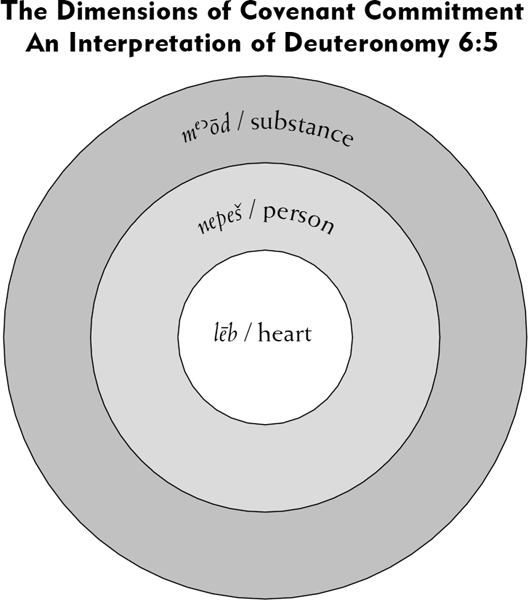
The Hebrew word lēb (“heart”) often functions metaphorically for the seat of the emotions and will, but equally often it refers to the “mind” or the seat of thought. Here the word serves comprehensively for one’s inner being, including the “heart” and “mind.”8 Concretely nepeš means “throat, gullet,” but the word is used in a variety of derived metaphorical senses: “appetite/desire” (Prov. 23:2; Eccl. 6:7); “life” (Gen. 9:5; 2 Sam. 23:17; Jonah 2:5[6]); a person as a “living being” (Ezek. 4:14; etc.); the whole self (Lev. 26:11); even a corpse, that is, a body without life/breath (Lev. 21:11). Here the word refers to one’s entire person. The NIV’s rendering of meʾôd as “strength” follows the LXX, which reads dynamis, “power” (cf. ischys in Mark 12:30), but this flattens the sense required by the Hebrew. Except for this text and 2 Kings 23:25, which echoes this statement, elsewhere meʾôd always functions adverbially, meaning “greatly, exceedingly.”9 Here its meaning is best captured by a word like “resources,” which includes physical strength, but also economic or social strength, and it may extend to the physical things an Israelite owned: tools, livestock, a house, and the like.
The progression and concentricity in Moses’ vocabulary now become apparent. Calling all Israelites to love God without reservation or qualification, Moses begins with the inner being, then moves to the whole person, and ends with all that one claims as one’s own.10 This is the “yoke of the kingdom”—covenant commitment rooted in the heart, but extending to every level of one’s being.
Bridging Contexts
FEW TEXTS IN THE Old Testament are as pregnant with significance as this passage. (1) The Shema functioned as Israel’s pledge of allegiance. Whenever Israelites recited this pledge, they acknowledged that the God who redeemed them was not some amorphous and unknowable deity. He is Yahweh, who intervenes in history on behalf of his chosen people and calls them to covenant relationship with himself. No other god, ancient or modern, has done this.
Given the theological and confessional weight of the Shema, it is remarkable how faint are its echoes in the Old Testament. Indeed we hear the only certain echo at the very end, in Zechariah 14:9, where the enigmatic verbless clause is transformed into a clear verbal declaration: “The LORD [Yahweh] will be king over the whole earth. On that day there will be one LORD [Yahweh], and his name the only name.”22 As in the original Shema, the issue here is not the unification of God in one deity, but expanding the boundaries of those who claim only Yahweh as their God to the ends of the earth.
References and allusions to the Shema in the New Testament are both fascinating and exciting. While Jesus cites it as a sort of creedal statement in connection with the Supreme Command (Mark 12:30), it falls to Paul to draw out its christological significance. He does so most pointedly in 1 Corinthians 8:1–6, where he roots his polemic against idolatry in Deuteronomy 6:4–5 and beyond.23 Like Moses, Paul declares the uniqueness and exclusive existence of Yahweh in contrast to the nothingness of idols. Reflecting a thorough understanding of the Shema in its original context, in 1 Corinthians 8:5–6, Paul declares hypothetically that even if one concedes the existence of other gods (which, in the light of v. 4, he will not do), “for us there is but one God, the Father, from whom all things came and for whom we live; and there is but one Lord [i.e., Yahweh], Jesus Christ, through whom all things came and through whom we live.” The christological effect of inserting the name “Jesus Christ” after “Lord” is extraordinary,24 in that Paul identifies Jesus unequivocally with Yahweh, the one and only God to whom true Israelites declared allegiance (cf. Rom. 3:29–30; 10:13). What the Old Testament has said about Yahweh may now be said about the Christ.25
(2) Whereas elsewhere the Old Testament in general and Deuteronomy in particular spoke of commitment to Yahweh in terms of “fear” and “clinging to Yahweh,” here for the first time in the Pentateuch, Moses picks up on a notion expressed in the Decalogue and speaks of the proper response to God as “love” (ʾāhab). In the Decalogue Yahweh promised covenant faithfulness (ḥesed) to those who demonstrate love for him by keeping his commands (5:10; Ex. 20:6; cf. Deut. 7:9), but from this point in Deuteronomy, this word will become increasingly important as an expression of the human disposition toward God. However, this kind of love is not merely an emotion, nor may it be taken for granted—Moses commanded it.26 In the face of temptation to withhold love or to give it to other gods, the Shema provided Israelites with a necessary and constant reminder to commit themselves to Yahweh alone.27
Given the emphasis on loving God here and throughout Deuteronomy, and given the general assumption that the pious do “love” Yahweh/God (Ps. 97:10), it is remarkable that only once in the Old Testament is anyone said to have “loved” (ʾāhab) God.28 When it speaks of individuals who appear to have measured up to the standard of Deuteronomy 6:5 the verb is changed.29 Even more striking, especially in light of current habits in worship, the verb ʾāhab never occurs with a first person subject when it has Yahweh/God as the object. No one (not even the psalmists) ever declares that he or she loves Yahweh.30 This probably explains why Peter will say he loves Jesus in the sense of phileô, but he will not claim agapaô (John 21:15–19).31 And how could he? He just demonstrated a total lack of “covenant commitment” by denying Jesus three times—the opposite of the love called for by Deuteronomy 6:6–9.
Contemporary Significance
TRUE SPIRITUALITY. MOSES TAUGHT his people and he teaches us and Christians everywhere that true spirituality arises from the heart and extends to all of life. Those who claim to be religious tend to be subject to two temptations: either to treat spirituality as primarily interior and private, or to treat it as a matter of external performance. True love for God is rooted in the heart, but it is demonstrated in life, specifically a passion to speak of one’s faith in the context of the family and to declare one’s allegiance publicly to the world. This passage suggests that the very decoration of our homes should bear testimony to our faith, declaring to all guests and passers-by the fundamentally theological outlook of those who live within, and serving as reminders to residents to live in dependence on God and to realize that blessing is contingent on obedience.
My wife and I witnessed a striking illustration of this in 1968 when, for two months we lived in Soest, Germany. In the older part of town many of the half-timbered houses were decorated on the exterior by inscriptions, often religious. Into the black doorframe of one memorable house was carved and painted in gold the declaration, “An Gottes Segen ist alles gelegen,” which translates loosely as, “Everything depends on the blessing of God.” While we cannot make any judgments about the present residents, for the person originally responsible for the inscription, the text served two noble purposes, declaring to passers-by the theological outlook of those who lived within and reminding residents to live in dependence on God.
The meaning of love. Our text also reminds us today of the biblical understanding of love and its expression. Speaking biblically “love” is not merely an emotion, a pleasant disposition toward another person, but covenant commitment demonstrated in actions that seek the interest of the next person. Christians must indeed praise God for the love he has demonstrated in Christ Jesus and in his many providences. However, from biblical patterns we might learn to be more modest about professions of love for God in both prayer and song; the self-laudatory confessions so ubiquitous in contemporary worship find no precedent or warrant in Scripture. Words come easily. Just as in marriage true love is demonstrated not merely or even primarily by roses and verbal utterances of “I love you,” but in actions that seek the well-being and delight of one’s spouse, so true love for God is demonstrated primarily in active obedience to God. After all, did not Jesus himself say, “If you love me, you will obey what I command” (John 14:15)? Such obedience is the fruit of union with Christ (John 15:1–11).
True religion in the Old Testament. Finally, this passage should correct a common misunderstanding of true religion in the Old Testament. We often hear it said that whereas in ancient Israel, God demanded the sacrifices of animals and produce of the fields, in the New Testament he calls for sacrifice of our very bodies. However, not only does this view drive an unfortunate wedge between the Testaments; it is also patently false. Deuteronomy 6:4–5 is the Old Testament equivalent of Romans 12:1–2. As is true for us, in ancient Israel the truly godly were covenantly committed to him in their inner beings, with their entire bodies, and with all their resources. Paul and Moses are on the same page.
Original Meaning
The Dimensions of Covenant Commitment (6:6–9)
CONTINUING THIS CENTRIFUGAL PATTERN, in the remainder of this paragraph Moses emphasizes that this unreserved commitment is to permeate all of life. (1) The commitment expressed in the Shema and the call for unreserved love for Yahweh must be indelibly written on one’s own inner being (v. 6). Israelite faith is not to be defined by ritual acts but by deep internal commitment to Yahweh.11
(2) This covenant commitment is to be a family matter, demonstrated by the indoctrination of children and the spontaneous discussion of the issue with the members of one’s household (v. 7). This is to be accomplished by “impressing” these words on children (vv. 4–5). This means repeating them constantly,12 when God’s people sit in their homes and walk on the road; when they lie down and when they rise up.13 In this case, every adult Israelite is to be a teacher, seizing every opportunity for instruction.
(3) This commitment is to be a public matter. Moses continues his pattern of triadic expression by charging his people to bind these words on their hands, apply them as phylacteries on their foreheads (lit., “between their eyes”), and inscribe them on the doorposts of their buildings (cf. Ex. 13:9, 16). That which is bound is apparently the Shema and the call for wholehearted covenant love (vv. 4–5).14 What kind of object Moses intends to be bound on the hands we cannot know—nor even if he intends this injunction to be taken literally.15 If we associate this act with the inscription of the divine name on one’s hand (cf. Deut 5:11; Isa. 44:5), this action signifies more than a tattoo or brand on the hand.16 The binding concretizes the declaration of allegiance and ownership by Yahweh as declared orally in the Shema.
The second act is even more enigmatic: These words are to serve as ṭôṭāpôt between the eyes, that is, the forehead (cf. 14:1; Dan. 8:5, 21). The etymology of ṭôṭāpôt is uncertain, making any interpretation tentative. Some interpret the command metaphorically, but several factors speak for a literal application. (a) This seems to be the case with the actions called for in verse 9. (b) The medallion worn by the high priest (Ex. 28:36–39) and extrabiblical evidence for ornaments worn on the forehead in Egypt and Mesopotamia support a literal intention here.17 (c) Two silver plaques inscribed with biblical texts from the seventh century BC attest to an analogous custom in the First Temple Period.18 (d) Finally, this text provided the basis for the practice of wearing phylacteries (Aramaic tefillîn) in the late Second Temple Period.19 In any case, the purpose of all three elements was to mark Israelites as those who claimed Yahweh as their covenant Lord and committed themselves to loving him wholeheartedly.20
(4) Moses concludes this call for public declarations of covenant commitment with a command to write these words on the doorposts of their houses and on their gates (v. 9).21 In so doing Israelites will remind themselves that their primary allegiance is to Yahweh whenever they leave from or return to their homes, and that love for Yahweh must govern all activities inside and outside the house. Furthermore, it will declare to guests and all who pass by that in this household Yahweh is not only the unseen guest but also the supreme head. The inscription on the gates extends this commitment to the entire community, reminding citizens and visitors alike of Yahweh’s rule over the town and the nation as a whole. Since city gates also functioned as courthouses, these inscriptions will also remind those participating in legal or administrative proceedings that all must be done in honor and on behalf of the divine ruler.
Bridging Contexts
FEW TEXTS IN THE Old Testament are as pregnant with significance as this passage. (1) The Shema functioned as Israel’s pledge of allegiance. Whenever Israelites recited this pledge, they acknowledged that the God who redeemed them was not some amorphous and unknowable deity. He is Yahweh, who intervenes in history on behalf of his chosen people and calls them to covenant relationship with himself. No other god, ancient or modern, has done this.
Given the theological and confessional weight of the Shema, it is remarkable how faint are its echoes in the Old Testament. Indeed we hear the only certain echo at the very end, in Zechariah 14:9, where the enigmatic verbless clause is transformed into a clear verbal declaration: “The LORD [Yahweh] will be king over the whole earth. On that day there will be one LORD [Yahweh], and his name the only name.”22 As in the original Shema, the issue here is not the unification of God in one deity, but expanding the boundaries of those who claim only Yahweh as their God to the ends of the earth.
References and allusions to the Shema in the New Testament are both fascinating and exciting. While Jesus cites it as a sort of creedal statement in connection with the Supreme Command (Mark 12:30), it falls to Paul to draw out its christological significance. He does so most pointedly in 1 Corinthians 8:1–6, where he roots his polemic against idolatry in Deuteronomy 6:4–5 and beyond.23 Like Moses, Paul declares the uniqueness and exclusive existence of Yahweh in contrast to the nothingness of idols. Reflecting a thorough understanding of the Shema in its original context, in 1 Corinthians 8:5–6, Paul declares hypothetically that even if one concedes the existence of other gods (which, in the light of v. 4, he will not do), “for us there is but one God, the Father, from whom all things came and for whom we live; and there is but one Lord [i.e., Yahweh], Jesus Christ, through whom all things came and through whom we live.” The christological effect of inserting the name “Jesus Christ” after “Lord” is extraordinary,24 in that Paul identifies Jesus unequivocally with Yahweh, the one and only God to whom true Israelites declared allegiance (cf. Rom. 3:29–30; 10:13). What the Old Testament has said about Yahweh may now be said about the Christ.25
(2) Whereas elsewhere the Old Testament in general and Deuteronomy in particular spoke of commitment to Yahweh in terms of “fear” and “clinging to Yahweh,” here for the first time in the Pentateuch, Moses picks up on a notion expressed in the Decalogue and speaks of the proper response to God as “love” (ʾāhab). In the Decalogue Yahweh promised covenant faithfulness (ḥesed) to those who demonstrate love for him by keeping his commands (5:10; Ex. 20:6; cf. Deut. 7:9), but from this point in Deuteronomy, this word will become increasingly important as an expression of the human disposition toward God. However, this kind of love is not merely an emotion, nor may it be taken for granted—Moses commanded it.26 In the face of temptation to withhold love or to give it to other gods, the Shema provided Israelites with a necessary and constant reminder to commit themselves to Yahweh alone.27
Given the emphasis on loving God here and throughout Deuteronomy, and given the general assumption that the pious do “love” Yahweh/God (Ps. 97:10), it is remarkable that only once in the Old Testament is anyone said to have “loved” (ʾāhab) God.28 When it speaks of individuals who appear to have measured up to the standard of Deuteronomy 6:5 the verb is changed.29 Even more striking, especially in light of current habits in worship, the verb ʾāhab never occurs with a first person subject when it has Yahweh/God as the object. No one (not even the psalmists) ever declares that he or she loves Yahweh.30 This probably explains why Peter will say he loves Jesus in the sense of phileô, but he will not claim agapaô (John 21:15–19).31 And how could he? He just demonstrated a total lack of “covenant commitment” by denying Jesus three times—the opposite of the love called for by Deuteronomy 6:6–9.
Contemporary Significance
TRUE SPIRITUALITY. MOSES TAUGHT his people and he teaches us and Christians everywhere that true spirituality arises from the heart and extends to all of life. Those who claim to be religious tend to be subject to two temptations: either to treat spirituality as primarily interior and private, or to treat it as a matter of external performance. True love for God is rooted in the heart, but it is demonstrated in life, specifically a passion to speak of one’s faith in the context of the family and to declare one’s allegiance publicly to the world. This passage suggests that the very decoration of our homes should bear testimony to our faith, declaring to all guests and passers-by the fundamentally theological outlook of those who live within, and serving as reminders to residents to live in dependence on God and to realize that blessing is contingent on obedience.
My wife and I witnessed a striking illustration of this in 1968 when, for two months we lived in Soest, Germany. In the older part of town many of the half-timbered houses were decorated on the exterior by inscriptions, often religious. Into the black doorframe of one memorable house was carved and painted in gold the declaration, “An Gottes Segen ist alles gelegen,” which translates loosely as, “Everything depends on the blessing of God.” While we cannot make any judgments about the present residents, for the person originally responsible for the inscription, the text served two noble purposes, declaring to passers-by the theological outlook of those who lived within and reminding residents to live in dependence on God.
The meaning of love. Our text also reminds us today of the biblical understanding of love and its expression. Speaking biblically “love” is not merely an emotion, a pleasant disposition toward another person, but covenant commitment demonstrated in actions that seek the interest of the next person. Christians must indeed praise God for the love he has demonstrated in Christ Jesus and in his many providences. However, from biblical patterns we might learn to be more modest about professions of love for God in both prayer and song; the self-laudatory confessions so ubiquitous in contemporary worship find no precedent or warrant in Scripture. Words come easily. Just as in marriage true love is demonstrated not merely or even primarily by roses and verbal utterances of “I love you,” but in actions that seek the well-being and delight of one’s spouse, so true love for God is demonstrated primarily in active obedience to God. After all, did not Jesus himself say, “If you love me, you will obey what I command” (John 14:15)? Such obedience is the fruit of union with Christ (John 15:1–11).
True religion in the Old Testament. Finally, this passage should correct a common misunderstanding of true religion in the Old Testament. We often hear it said that whereas in ancient Israel, God demanded the sacrifices of animals and produce of the fields, in the New Testament he calls for sacrifice of our very bodies. However, not only does this view drive an unfortunate wedge between the Testaments; it is also patently false. Deuteronomy 6:4–5 is the Old Testament equivalent of Romans 12:1–2. As is true for us, in ancient Israel the truly godly were covenantly committed to him in their inner beings, with their entire bodies, and with all their resources. Paul and Moses are on the same page.