Original Meaning
THIS IS ARGUABLY the most ironically comic scene in the entire Bible. While Haman plots Mordecai’s outrageous death, the king plans to honor Mordecai’s faithful service. An unsuspecting Haman enters the king’s court, where he magnificently trips over his own pride. “Who is there that the king would rather honor than me?” he muses. If ever there was a picture of pride going before the fall, Haman is it.
Haman’s splendid humiliation results from a series of coincidences, each believable in itself, and yet a series that is completely out of Haman’s control. The mighty Haman is rendered powerless by a “chance event” when the king just happens to have a sleepless night. He just happens to have the chronicles of his reign read to him. The story of Mordecai’s loyalty just happens to come to his attention at the same moment when Haman just happens to be plotting Mordecai’s death.
After the king’s intriguing banquet with Esther, he is unable to sleep. Xerxes decides to review court business. “The book of the chronicles” was the official record of the Persian kings, in which every official transaction of the court was recorded. From this official transcript the king would draw up a list of those who were to be rewarded for faithful service to the throne.
It was important that Persian kings publicly reward those who were loyal as a means of promoting their own safety in such treacherous times. Herodotus records examples of two such honors. In one instance Xerxes granted land to two ships’ captains who had assisted in a battle against the Greeks and recorded one of them in the list of the “King’s Benefactors.”1 In another incident, a man was made governor of Cilicia for saving the life of Xerxes’ brother.2
The king was mortified to find that nothing had been done to honor Mordecai publicly, who some five years before had foiled an assassination plot against him (cf. 2:16; 3:7). Why the king was reviewing his official transcripts from years earlier is not explained—another chance event. Mordecai had no doubt been keenly disappointed by this oversight. His willingness to overlook the slight and continue faithfully to serve the king gives insight into his character.
Haman’s proposal for what “should be done to the man the king delights to honor” may seem unusual by modern standards. Believing the honors would go to himself, Haman could not ask for a promotion because he was already second only to the king in his authority over the empire. He apparently had all the wealth and luxury such a high-ranking position could afford in opulent Persia. His request to wear the king’s robe and ride the king’s horse was intended both to honor the king and to reinforce Haman’s relationship with him.
There is some evidence from ancient historians that the Persian royal robes, as well as the king’s bed and throne, were believed to have the power to impart the benefits of royalty in an almost magical way. However, even without the invocation of magic, a man permitted to wear the king’s robe would be vested with a certain dignity and prestige in the eyes of his peers because of the close association with the king. To put it in modern terms, there would be nothing magical about the President of the United States allowing his personal jet, Air Force One, to transport one of his associates, in effect elevating that person’s power and prestige in the public eye.
A similar episode involving royal robes symbolically predicted King David’s rise to power. Prior to the Persian period in Israel’s history, Jonathan, the royal prince and heir of Israel’s throne, symbolized his covenant with David by giving him the robes he was wearing (1 Sam. 18:1–5). The very next sentence tells us that David was thereafter so successful that he was given a high rank in Saul’s army. Eventually David himself wore the royal robes of Israel’s king, sitting on the throne that would have been Jonathan’s had Saul’s dynasty continued.
For Haman no other honor was left to him but to partake of the king’s own power, prestige, and stature. To have such an intimate gesture bestowed instead on Mordecai, the Jew, is a crushing humiliation. More importantly, it foreshadows the reversal of fortune that is about to inexorably unfold before Haman’s horrified eyes. When he plotted the destruction of “a certain people” (3:8), he failed to mention their identity to the king or to his wife and friends. When Haman’s wife, Zeresh, and his friends later learn that Mordecai is Jewish, they reverse their earlier advice. Not only will Haman’s plan against Mordecai be frustrated, but Haman himself will come to ruin for the attempt. The full extent of Haman’s tragic miscalculation begins to emerge.
Bridging Contexts
FEASTS. THE KING’S sleepless night is the pivot point of the literary structure of the story around which the great reversal of destiny occurs. The literary structure of this book is defined by the recurrence of the primary literary motif, the mišteh—the Hebrew word most often translated in the NIV as “feast” or “banquet.”3 This Hebrew word, which occurs twenty times in the book of Esther and only twenty-four times in all the rest of the Old Testament, usually refers to eating and drinking on special occasions. This dominant motif of feasting is appropriate, since the Esther story explains the origin of Purim, a Jewish feast day. It further explains why Purim was celebrated on two different, consecutive days.
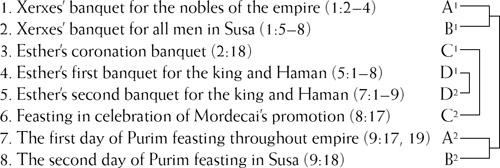
As several commentators have noted, the story of Esther both begins and concludes with pairs of feasts, with other pairs of feasts intervening.4 In chapter 1 Xerxes gives two consecutive feasts; in chapter 9 the Jews observe two consecutive feast days to celebrate their deliverance. These two pairs of feasts mirror each other. For instance, Xerxes’ first feast is for the nobility throughout the empire; the first of the Purim feast days is celebrated by the Jews throughout the empire. Xerxes’ second feast is for the residents of Susa; the second day of the Purim feast is celebrated by the Jews residing in Susa.
When the several banquets in the Esther story are listed, they appear to form pairs, as indicated in the following diagram by the letters (i.e., A1 and A2 are a pair):
Banquets and Feasting in Esther
| 1. Xerxes’ banquet for the nobles of the empire (1:2–4) | |
| 2. Xerxes’ banquet for all men in Susa (1:5–8) | |
| 3. Esther’s coronation banquet (2:18) | |
| 4. Esther’s first banquet for the king and Haman (5:1–8) | |
| 5. Esther’s second banquet for the king and Haman (7:1–9) | |
| 6. Feasting in celebration of Mordecai’s promotion (8:17) | |
| 7. The first day of Purim feasting throughout empire (9:17, 19) | |
| 8. The second day of Purim feasting in Susa (9:18) | |
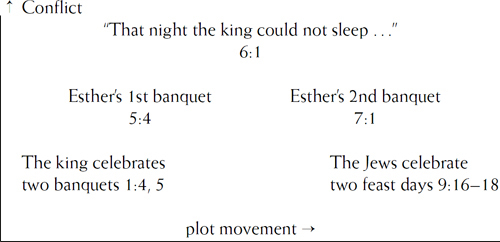
Since the book both begins and ends with pairs of feasts, it is striking that Esther also gives not one, but two banquets for the king and Haman. Haman’s downfall begins between the first and second of Esther’s banquets, when the king has a sleepless night. Thus there are three pairs of feasts that mark the beginning, the climax, and the conclusion of the story.
Peripety. These three pairs of feasts define the rise and fall of a plot that is characterized by peripety—a literary term that refers to a sudden turn of events in a story that reverses the intended and expected action (see comments on “Literary Structure” in the Introduction). The deliverance of the Jewish people against all odds is a reversal of destiny. Peripety in Esther is achieved by a literary device called chiasm, where each element of the chiasm not only corresponds to its parallel, but in reverse order. The use of this literary structure to achieve peripety in Esther is a good example of the interplay between content and literary form (see chart on next page).
The narrative tension of the conflict between the Jews of Persia and their enemy, Haman, is not simply resolved, it is resolved through reversals. Haman’s plan could have simply been stopped and the status quo preserved. Instead, there is a great reversal of fortune. An event intended to harm the Jews actually results in the opposite, against every expectation. Instead of being destroyed, the Jewish people are not only delivered, but empowered through the high rank of Esther and Mordecai. The empowered destroyer, Haman, not only loses his power, but is himself destroyed. In 9:1, the author explicitly states the theme of deliverance as a reversal:
On the thirteenth day of the twelfth month, the month of Adar, the edict commanded by the king was to be carried out. On this day the enemies of the Jews had hoped to overpower them, but now the tables were turned and the Jews got the upper hand over those who hated them. (emphasis added)
| Chiastic Structure of Reversals in Esther |
|---|
3:10—the king gives Haman his ring | 8:2—the king gives Mordecai the same ring |
3:12—Haman summons the king’s scribes | 8:9—Mordecai summons the king’s scribes |
3:12—letters written, sealed with ring | 8:10—letters written, sealed with same ring |
3:13—the Jews, even women and children, to be killed on one day | 8:11—the enemies, even women and children, to be killed on one day |
3:14—Haman’s decree publicly displayed as law | 8:13—Mordecai’s decree publicly displayed as law |
3:15—couriers go out in haste | 8:14—couriers go out in haste |
3:15—the city of Susa is bewildered | 8:15—the city of Susa rejoices |
4:1—Mordecai wears sackcloth and ashes | 8:15—Mordecai wears royal robes |
4:1—Mordecai goes through city crying | 6:11—Mordecai led through the city in honor |
5:14—Zeresh advises Mordecai’s death | 6:13—Zeresh predicts Haman’s ruin |
Chapter 6 contains the first of the many reversals to follow. On the very day Haman goes to the king seeking permission to kill Mordecai (6:4), Haman ends up not only not killing Mordecai, but publicly honoring him in the king’s name (6:11).
The three pairs of feasts focus the structure of the story on the pivot point of the peripety around which these reversals occur. The author’s attention to rhetorical symmetry is also expressed by referring to the annals of the king three times—at the beginning of the story (2:23), in the middle (6:1), and at the end (10:2).
The Literary Structure of Esther
“. . . their sorrow was turned into joy and their mourning into a day of celebration” (9:22)
Peripety: a sudden turn of events that reverses the expected or intended outcome.
| ↑ Conflict | | | |
| “That night the king could not sleep . . .” | | | |
| 6:1 | | | |
| Esther’s 1st banquet | | | Esther’s 2nd banquet | |
| 5:4 | | | 7:1 | |
| The king celebrates two banquets 1:4, 5 | | | The Jews celebrate two feast days 9:16–18 | |
| plot movement → | | | |
One might expect the pivot point of peripety in narrative to fall on the scene of highest narrative tension. The point of highest dramatic tension is usually a scene involving two or more of the characters, typically the protagonist (hero) facing off with the antagonist (villain). In the story of Esther, her uninvited audience with the king is certainly a scene of high dramatic tension, but it does not bring the plot to its climax. Rather, it reaches its climax during the second banquet, when Esther confronts Haman (the antagonist) to his face. Therefore, standard literary form indicates that this scene of narrative climax shows Esther to be the protagonist, or heroine, of the story, rather than Mordecai, for it is she who faces off with the antagonist.
Notice, however, that the pivot point of the peripety in Esther is not located at the climax of the narrative. Instead, the pivot point of this peripety is the seemingly insignificant event recorded in 6:1, when the king had a sleepless night. As insignificant as this ordinary event may appear, it is with this event that the tables begin to turn and the reversals begin to occur. The Feast of Purim celebrates this grand reversal in the month of Adar because it was a month “when their sorrow was turned into joy and their mourning into a day of celebrating” (9:22).
By making the pivot point of the peripety an insignificant event rather than the point of highest dramatic tension, the author is taking the focus away from human action. Had the pivot point of the peripety been at the scene where Esther approaches the king uninvited or where Esther confronts Haman, the king and/or Esther would have been spotlighted as the actual cause of the reversal. By separating the pivot point of the peripety in Esther from the point of highest dramatic tension, the characters of the story are not spotlighted as the cause of the reversal. This reinforces the message that no one in the story, not even the most powerful person in the empire, is in control of what is about to happen. An unseen power is controlling the reversal of destiny. The Greek translation makes this implicit truth explicit with the statement, “The Lord took sleep from the king that night” (LXX of 6:1, pers. trans.).
Contemporary Significance
THE MONOTHEISTIC WORLDVIEW of the author of Esther. This structure of peripety in Esther is not simply a literary device that produces an aesthetically pleasing story. The literary form of the story and its content mutually interact to create its meta-message. The structure of peripety deeply reflects the worldview of the author and provides the framework within which we can understand the theological implications of the Esther story.
In spite of having all the power of the Persian empire at his disposal, Haman’s carefully laid plans were turned against him simply because the king had a sleepless night! The author is suggesting that beneath the surface of human decisions and actions is an unseen and uncontrollable power at work, which can be neither explained nor thwarted. In ancient polytheistic culture, the gods controlled fate. With a pantheon of competing gods and goddesses, human affairs could be turned upside down if one god overpowered another. Fate was therefore capricious, because one could never be sure which god or goddess was in control of one’s situation. The author of Esther wrote from the perspective of the Jews, who were monotheistic. By constructing this story using peripety, what is the divinely inspired author of Esther trying to say about how God rules?
If there is but one God, does he change his mind from day to day or week to week, making human events lead first in one direction and then in another? Read in a polytheistic context, the story suggests that Yahweh, the God of the Jews, had overpowered Haman’s gods in this instance. Read from a monotheistic perspective, the story explains the reversal of fortune not as an ongoing tug-of-war between the gods, but as consistent with the powerful word of the one, true God. The author of Esther implies a consistency in God’s rule of human history that is based on his word, not on circumstances. Regardless of how circumstances appear, God is ruling history according to the ancient covenant he made with Israel at Sinai.
The reversal of destiny that began when the king had a sleepless night implies that, despite their sin and despite their location away from Jerusalem, God’s promise to Israel made at the beginning of their nation still stood. God was not capricious like the gods of the pagans. He was not locked in some struggle with other deities that gave him control only on certain days or in certain situations. All that had happened was consistent with the stated provisions of God’s covenant. The Agagites would be destroyed, even though they seemed inviolable in their wealth and power.
Previously in Israel’s history, God had used mighty miracles to deliver his people and to fulfill his promises. In the story of Esther God was using the ordinary events of life to realize his covenant promises to his people. He used even seemingly insignificant events, such as the king’s sleepless night, and the decisions of less-than-perfect people to fulfill nevertheless the promises of his ancient covenant.
It is particularly appropriate for the pivot point of the peripety that reverses the expected outcome to occur at an ordinary and insignificant event in a book whose meta-message is about divine providence. God providentially directs the flow of human history through the ordinary lives of individuals to fulfill the promises of his covenant. What a great God we serve! Any deity worth his salt can do a miracle now and then. Our God is so great, so powerful, that he can work without miracles through the ordinary events of billions of human lives through millennia of time to accomplish his eternal purposes and ancient promises. God delivered an entire race of people in Persia because the king had a sleepless night, because a man would not bow to his superior, because a woman found herself taken to the bedroom of a ruthless man for a night of pleasure. How inscrutable are the ways of the Lord!
God’s providence in our own lives. Is it not true that God has worked in your own life often through events that were unexpected and seemed insignificant at the time? Consider the chain of circumstances that led up to your own conversion to Christ. Perhaps you were randomly changing channels on the TV or radio when you happened to come upon a preacher whose message began a transformation in your life. Maybe you happened to pick up an evangelistic tract that opened your heart to the Lord. For others, it may have been a friend or casual acquaintance who happened to invite them to church or a home Bible study. That most significant work of God in your life came about through a chain of events, each of which probably seemed unimportant at the time.
Consider how God has guided and directed your life. How did you come to meet and marry your spouse? Why are you living in the place you are? What circumstances led to your current job? God’s care and protection for his children seldom come by mighty miracles, but constantly and inexorably with the unfolding circumstances of each day, as one thing leads to another. Tiny miracles of God’s providence direct your steps.
Of course, not all of life’s circumstances are pleasant. Tragedies occur when, in God’s providence, someone is in the wrong place at the wrong time. Life’s circumstances can be tragic, ugly, and destructive, like the plot to annihilate the Jews of Persia initiated on the eve of Passover. The death of a loved one, serious illness, wayward children, broken relationships, shattered hopes and dreams—all are links in the uninterrupted chain of life. While none of these things is good in itself, even in the worst of life’s circumstances God is working to fulfill his perfect promises. One thing leads to the next. The path to the joy God promises may wind through the swamps of suffering and despair.
Christians can face threatening circumstances with hope only because of the new covenant in Christ. The Jews of Persia were delivered because of the ancient covenant God had made with Israel on Mount Sinai. The peripety expressed in Esther was a deliverance against all odds from the destiny of death to a destiny of life. This life-and-death antithesis was inseparably bound up with Yahweh’s ancient covenant. Before entering the Promised Land Moses set the covenant before the new generation of Israel, and in so doing set before them “life and prosperity, death and destruction” (Deut. 30:15–20). The reversal of destiny from death to life expressed by peripety in Esther actualized the covenant for the Jews of Persia.
The structure of redemptive history. The literary structure of peripety found in the book of Esther and its pivot point in an ordinary and insignificant event mirrors on a small scale the structure of all of redemptive history. Because of our sin, we are not living in the Garden of Eden, where the Lord walks and talks with us in the coolness of the day. Rather, we live in the exile of history, in a world where God is unseen. God has pronounced a sentence of death on us (Gen. 3), and every evidence of human circumstances demonstrates its efficacy. We should expect nothing but death, but we have seen the ultimate peripety, the ultimate reversal of expected ends, in another seemingly ordinary human event: the birth of a baby in Bethlehem and the execution of that man on a cross. The ordinary and the miraculous intersect in Jesus Christ. Because of the death and resurrection of Jesus Christ, our destiny has been reversed from death to life against all expectation. The cross of Jesus Christ is the pivot point of the great reversal of history, where our sorrow has been turned to joy.
Because the ancient covenant of Sinai is consummated in Jesus Christ,5 God has made a covenant with those in Christ that cannot be thwarted by even the worst life brings against us. As the apostle Paul writes in Romans 8:35–39:
Who shall separate us from the love of Christ? Shall trouble or hardship or persecution or famine or nakedness or danger or sword? As it is written:
“For your sake we face death all day long;
we are considered as sheep to be slaughtered.”
No, in all these things we are more than conquerors through him who loved us. For I am convinced that neither death nor life, neither angels nor demons, neither the present nor the future, nor any powers, neither height nor depth, nor anything else in all creation, will be able to separate us from the love of God that is in Christ Jesus our Lord.
In our darkest hours we can be assured of our final destiny of glory with Christ. We can be assured that the reversal of circumstance we so crave will one day be ours. By contrast, no matter how prosperous or powerful, those who are not in Christ will ultimately also suffer a reversal of fortune. Like Haman, they will find themselves caught in a web of destruction that hindsight will show to be of their own making. It can happen at any time.