The Tabernacle (26:1–37 ; 36:8–38)
26:1“Make the tabernacle with ten curtains of finely twisted linen and blue, purple and scarlet yarn, with cherubim worked into them by a skilled craftsman. 2All the curtains are to be the same size—twenty-eight cubits long and four cubits wide. 3Join five of the curtains together, and do the same with the other five. 4Make loops of blue material along the edge of the end curtain in one set, and do the same with the end curtain in the other set. 5Make fifty loops on one curtain and fifty loops on the end curtain of the other set, with the loops opposite each other. 6Then make fifty gold clasps and use them to fasten the curtains together so that the tabernacle is a unit.
7“Make curtains of goat hair for the tent over the tabernacle—eleven altogether. 8All eleven curtains are to be the same size—thirty cubits long and four cubits wide. 9Join five of the curtains together into one set and the other six into another set. Fold the sixth curtain double at the front of the tent. 10Make fifty loops along the edge of the end curtain in one set and also along the edge of the end curtain in the other set. 11Then make fifty bronze clasps and put them in the loops to fasten the tent together as a unit. 12As for the additional length of the tent curtains, the half curtain that is left over is to hang down at the rear of the tabernacle. 13The tent curtains will be a cubit longer on both sides; what is left will hang over the sides of the tabernacle so as to cover it. 14Make for the tent a covering of ram skins dyed red, and over that a covering of hides of sea cows.
15“Make upright frames of acacia wood for the tabernacle. 16Each frame is to be ten cubits long and a cubit and a half wide, 17with two projections set parallel to each other. Make all the frames of the tabernacle in this way. 18Make twenty frames for the south side of the tabernacle 19and make forty silver bases to go under them—two bases for each frame, one under each projection. 20For the other side, the north side of the tabernacle, make twenty frames 21and forty silver bases—two under each frame. 22Make six frames for the far end, that is, the west end of the tabernacle, 23and make two frames for the corners at the far end. 24At these two corners they must be double from the bottom all the way to the top, and fitted into a single ring; both shall be like that. 25So there will be eight frames and sixteen silver bases—two under each frame.
26“Also make crossbars of acacia wood: five for the frames on one side of the tabernacle, 27five for those on the other side, and five for the frames on the west, at the far end of the tabernacle. 28The center crossbar is to extend from end to end at the middle of the frames. 29Overlay the frames with gold and make gold rings to hold the crossbars. Also overlay the crossbars with gold.
30“Set up the tabernacle according to the plan shown you on the mountain.
31“Make a curtain of blue, purple and scarlet yarn and finely twisted linen, with cherubim worked into it by a skilled craftsman. 32Hang it with gold hooks on four posts of acacia wood overlaid with gold and standing on four silver bases. 33Hang the curtain from the clasps and place the ark of the Testimony behind the curtain. The curtain will separate the Holy Place from the Most Holy Place. 34Put the atonement cover on the ark of the Testimony in the Most Holy Place. 35Place the table outside the curtain on the north side of the tabernacle and put the lampstand opposite it on the south side.
36“For the entrance to the tent make a curtain of blue, purple and scarlet yarn and finely twisted linen—the work of an embroiderer. 37Make gold hooks for this curtain and five posts of acacia wood overlaid with gold. And cast five bronze bases for them.
36:8All the skilled men among the workmen made the tabernacle with ten curtains of finely twisted linen and blue, purple and scarlet yarn, with cherubim worked into them by a skilled craftsman. 9All the curtains were the same size—twenty-eight cubits long and four cubits wide. 10They joined five of the curtains together and did the same with the other five. 11Then they made loops of blue material along the edge of the end curtain in one set, and the same was done with the end curtain in the other set. 12They also made fifty loops on one curtain and fifty loops on the end curtain of the other set, with the loops opposite each other. 13Then they made fifty gold clasps and used them to fasten the two sets of curtains together so that the tabernacle was a unit.
14They made curtains of goat hair for the tent over the tabernacle—eleven altogether. 15All eleven curtains were the same size—thirty cubits long and four cubits wide. 16They joined five of the curtains into one set and the other six into another set. 17Then they made fifty loops along the edge of the end curtain in one set and also along the edge of the end curtain in the other set. 18They made fifty bronze clasps to fasten the tent together as a unit. 19Then they made for the tent a covering of ram skins dyed red, and over that a covering of hides of sea cows.
20They made upright frames of acacia wood for the tabernacle. 21Each frame was ten cubits long and a cubit and a half wide, 22with two projections set parallel to each other. They made all the frames of the tabernacle in this way. 23They made twenty frames for the south side of the tabernacle 24and made forty silver bases to go under them—two bases for each frame, one under each projection. 25For the other side, the north side of the tabernacle, they made twenty frames 26and forty silver bases—two under each frame. 27They made six frames for the far end, that is, the west end of the tabernacle, 28and two frames were made for the corners of the tabernacle at the far end. 29At these two corners the frames were double from the bottom all the way to the top and fitted into a single ring; both were made alike. 30So there were eight frames and sixteen silver bases—two under each frame.
31They also made crossbars of acacia wood: five for the frames on one side of the tabernacle, 32five for those on the other side, and five for the frames on the west, at the far end of the tabernacle. 33They made the center crossbar so that it extended from end to end at the middle of the frames. 34They overlaid the frames with gold and made gold rings to hold the crossbars. They also overlaid the crossbars with gold.
35They made the curtain of blue, purple and scarlet yarn and finely twisted linen, with cherubim worked into it by a skilled craftsman. 36They made four posts of acacia wood for it and overlaid them with gold. They made gold hooks for them and cast their four silver bases. 37For the entrance to the tent they made a curtain of blue, purple and scarlet yarn and finely twisted linen—the work of an embroiderer; 38and they made five posts with hooks for them. They overlaid the tops of the posts and their bands with gold and made their five bases of bronze.
It is only after the instructions for the ark, table, and lampstand are given that we finally come to the tabernacle itself. The amount of space devoted to its description only begins to tell the story of its vital significance for Israel’s religious practices.
The tabernacle is basically a series of curtains and frames. The curtains covering the entire structure are to be made of fine linen and colored yarn. Cherubim are to be worked into them, an ever-present reminder that the tabernacle is an earthly representation of the heavenly tabernacle. This first layer of curtains must be covered on the outside by a second layer made of goat hair, most likely to protect the inner curtains from the elements. There are apparently two further layers of ram skins and hides of sea cows covering the layer of goat hair (26:14). These curtains are to be kept together by a system of bronze clasps and loops.
The frames and crossbars that support the curtains are to be made of acacia wood, doubled in the corners for strength. The crossbars are overlaid with gold and kept together with gold rings. Despite the information given, just how the structure holds together is not clear.
After giving the instructions for the frame and the large curtains that form the roof and walls, the Lord reminds Moses once again to adhere strictly to this plan (26:30). This is a fitting reminder here, since 26:31 commences with instructions concerning the curtain to separate the Holy Place from the Most Holy Place. This curtain seems to be made in the same manner as the first layer of curtains described in 26:1. Another similarly constructed curtain is to be placed at the entrance of the tent (i.e., between the Holy Place and the outer court). Note that this curtain has no cherubim worked into it since this is one step removed from the Most Holy Place.
In current Old Testament scholarship, only the most extreme pessimists cast serious doubt on the historicity of the tabernacle. This happy state of affairs has not always been the case. Julius Wellhausen, for example, considered the tabernacle as a figment of the Priestly writer’s (P source) cultic imagination, an attempt to read the splendor of the temple back into the Mosaic era, perhaps to lend ancient support to the practices for which the Priestly class was known. But this view has given way to greater care in assessing the evidence. Recent research has demonstrated that worship in tent shrines in the ancient Semitic world was normal.22
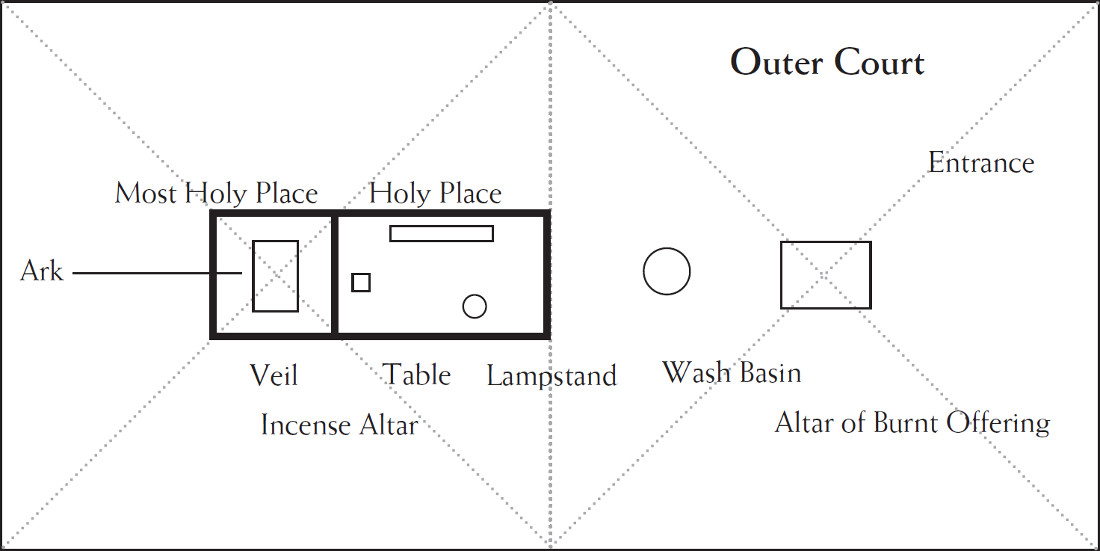
Much has been made of the dimensions of the tabernacle, and rightly so (see the diagram below).23 The entire structure measured 150′ on the north and south sides and 75′ on the east and west, thus forming a rectangle made up of two squares 75′ by 75′. The one square constituted the outer court, in which was placed the altar of burnt offering, roughly a 7′6″ square structure, and the wash basin at the entrance of the Holy Place. Inside the other square was the Holy Place, a rectangle measuring 30′ by 15′, the same proportions as the tabernacle as a whole. The adjoining Most Holy Place measured a perfect 15′ square.
Tabernacle Diagram
As we have noted elsewhere (see Original Meaning section of 24:1–18), the three-part structure of the tabernacle, moving from lesser to greater degrees of holiness, reflects the gradations of holiness on Mount Sinai. The tabernacle is modeled after a higher, cosmic reality: the dwelling place of God.
This brings us to a matter of great importance for understanding the meaning of the tabernacle in its original setting. The precise measurements of the structure combined with the symbolism of the curtains and the furnishings are not without deep significance. The tabernacle seems to represent a microcosm of creation itself. The splendor and beauty of the materials used—fine fabrics, precious metals, and stones—affirm the goodness of the created world. The precise and perfect dimensions of the tabernacle indicate a sense of order amid chaos.
In pointing this out I am not offering suggestions as to how we might approach the theological significance of the tabernacle today. Rather, I am suggesting, as others have done, that to think of the tabernacle as an act of cosmic re-creation is precisely what the building of the tabernacle originally intended to convey. We have already seen a couple of examples of the creation theme in the tabernacle (“created” in seven segments; the cherubim). The ornate and orderly structure of the tabernacle itself is another. More examples will follow.
The connection between tabernacle and creation is aptly assessed by Levenson.24 According to him, the tabernacle (actually, his focus is on the temple, but the point holds nonetheless) and creation are two “building projects.” They are not simply parallel, however, as if the former is a scaled down model of the latter.
Rather, they implicate each other, and neither is complete alone. The microcosm is the idealized cosmos . . . the world as it was meant to be, a powerful piece of testimony to God the creator, a palace for the victorious king. To view creation within the precincts of the Temple is to summon up an ideal world that is far from the mundane reality of profane life and its persistent evil. It is that ideal world which is the result of God’s creative labors.25
In the midst of a fallen world, in exile from the Garden of Eden—the original “heaven on earth”—God undertakes another act of creation, a building project that is nothing less than a return to pre-Fall splendor. The tabernacle, therefore, is laden with redemptive significance, not just because of the sacrifices and offerings within its walls, but simply because of what it is: a piece of holy ground amid a world that has lost its way. If this is a correct understanding of the tabernacle, we begin to see why the writer of Exodus devotes so much space to its description.
Bridging Contexts
THE THEOLOGY OF the tabernacle and temple. The tabernacle (and later, the temple) and the priestly service are at the heart of ancient Israelite religious practice. The notion, so common among Christians, that these institutions were mainly about endless sacrifices and tedious rituals and can therefore be safely dismissed misunderstands not only their significance in the Old Testament but the purpose of Christ’s coming. These institutions were, rather, symbols of a higher—and ultimately mysterious—reality. They were truly the means by which God and his people “connected.”
To draw the tabernacle into the orbit of the Christian life, however, does not mean simply transferring its surface meaning to today’s world. We must understand what the tabernacle represents. What does it teach us about God, and how do those lessons develop as biblical revelation progresses? In other words, we need to answer the question, “What did the tabernacle ‘do’ for Israel?” It is, therefore, the theology of the tabernacle that holds our interest.
Of course, from Exodus 25 on, the tabernacle and priestly regulations remain recurring topics of discussion. The duties of the priests are more fully described in Leviticus and the early chapters of Numbers. The institution founded at the foot of Mount Sinai, one year after the Exodus, marches full steam for several generations, from the Exodus to the desert period, then on to the Conquest, the judges, and the early years of the monarchy.
Eventually, the portable tabernacle is replaced by the temple, a structure intended to be permanent.57 The construction of the temple is given a much briefer account than that of the tabernacle (see 1 Kings 5–8). Also, specific instructions as to how it should be built are missing, the emphasis being mainly on the fact that Solomon built it rather than David (see 2 Sam. 7:12–13). Most likely it was constructed according to the pattern of the tabernacle, the obvious differences being the materials used (e.g., stone and cedar for the temple) and its size (the temple being roughly twice as large).
Despite these understandable changes, however, what the tabernacle represented remains essentially unchanged with the construction of the temple. Hence, it is perfectly legitimate, indeed necessary, to speak of the theology of the tabernacle and of the temple in the same breath, for the latter is a conscious continuation of the former.
We have seen that the tabernacle was an earthly representation of heavenly reality. It was a microcosm of the created order—hence, a microcosm of the only spotless point in creation, Eden. This is not to say, however, that the intended ideal was always met. It is fair to say that God’s great revelation in Exodus 25–40, the establishment of the tabernacle and the priesthood, became institutionalized over time. This state of affairs prompted prophetic critique. Relatively little is mentioned by the prophets about the tabernacle, the temple, and the priestly system. But what little there is, is critical of what these institutions had become (see Isa. 1:10–17; Hos. 6:6; Amos 5:21–24; Mic. 6:6–8; see also Ps. 40:6; 50:7–15; 51:16–17).
In making this observation we should be careful to avoid the common Christian criticism that these institutions in and of themselves are tedious and ineffective. The prophetic critique is against abuse of the system, the notion that God can be controlled or manipulated apart from a true heart devotion to him. In fact, such prophetic critique presumes the legitimacy of the system itself. The tabernacle, despite being built as a perfect rectangle, was never intended to be a “box” in which God, like the pagan gods around them, could be safely stored away and called upon to serve the people’s purpose. If anything, the many allusions to creation in the tabernacle’s construction reminded Israel of the exact opposite: The God worshiped within is Creator of heaven and earth.
The temple was the center of Israel’s religious activity. Without it, they would cease to be an active, worshiping people of God. Without it, the purpose for which they were brought out of Egypt no longer existed. This is why the Exile and destruction of the temple was such a devastating event. For hundreds of years God had been seated above the ark, between the cherubim. Where would he be now? Where would the priests go to offer the daily sacrifices and the all-important rituals of the Day of Atonement? We will have little sympathy with this state of affairs if we assume that these things were merely dead ritual, but we must never forget that these rituals were instituted at God’s command and that the tabernacle was an earthly representation of God’s heavenly dwelling built by his design. Now it is gone. Devastating!
During the Exile Israel’s self-identity took a heavy beating. Afterward one of Israel’s first orders of business was to rebuild the temple, a task recorded in Ezra and Haggai. Clearly, the reestablishment of the temple ritual was important. The problem, however, was that the second temple was a mere shadow of the first one, as is implied in Haggai 2:3: “Who of you is left who saw this house in its former glory? How does it look to you now? Does it not seem to you like nothing?” Temple worship continued to be vital to Israelite life throughout the late biblical and intertestamental period, but it never again achieved the grandeur and attention it once had.
On at least two occasions, Jesus is referred to as either the new temple or the tabernacle. Well known are Jesus’ words in John 2:19: “Destroy this temple, and I will raise it again in three days.” This was misunderstood by the Jews as a claim to be able to rebuild the literal temple, but John quickly adds that the temple of which Jesus spoke was his body (v. 21). John 1:14 is also important here, although its impact is lost in English: “The Word became flesh and made his dwelling among us” (italics added). The Greek verb translated “made his dwelling” is skenoo, which is related to the noun skene, the word used throughout the Septuagint (Greek translation of the Hebrew Old Testament) for the tabernacle. In other words, Jesus came and “tabernacled” among his people.58
To talk like this does more than simply add a bit of drama to shock the readers. The intention is that Jesus be seen as the new—and improved—tabernacle/temple. This is not to reject the Old Testament versions of the temple as merely ritualistic and now, thankfully, done away with. It is, rather, to understand the reality to which the Old Testament structures pointed, a reality that reaches its climax in Christ. Hence, John continues in John 1:14: “We have seen his glory.” The glory that resided above the ark in the Most Holy Place, to which the high priest alone had access once a year, is now walking the streets of Jerusalem for all to see, a truly “portable” tabernacle!
The coming of Christ is not a dulling of the majesty of the Old Testament tabernacle but a heightening of what it stood for. True, the ornate decorations and furnishings are not here, but something far better is. Inasmuch as the tabernacle was an earthly representation of a heavenly reality, how much more so is Christ, who—to continue John’s words in 1:14—“came from the Father, full of grace and truth.” Christ fulfills the purpose for which the tabernacle was built.
We should also keep in mind here the role of the priests in the tabernacle. We saw earlier that their garments, particularly those of the high priest, were made of the same material as the tabernacle. In a manner of speaking, the priests embodied the tabernacle. What the tabernacle was made for—to connect the people with God—is also what the priests did by properly performing their duties in that tent. Like a priest,59 Christ also embodies the tabernacle, not by how he is dressed but by who he is. His clothes are not reminders of the heavenly reality; rather, he himself as God and man is the manifestation of that reality. That which the tabernacle and the priesthood together symbolized only partially is embodied fully by Christ alone.
At Christ’s return, another chapter will be written on this theme. At the descent of the new Jerusalem, there will be no temple in this new city, for “the Lord God Almighty and the Lamb are its temple” (Rev. 21:22). At the end of our age and the dawn of the new, what the tabernacle and temple represented in the Old Testament, the very presence of God, will be present with God’s people without mediation. God himself will live with his people. These words are no doubt intended to provoke the imagination rather than satisfy our intellectual curiosity. Just how this will look is hard to say. What John does make clear, however, is that at the consummation, the very thing that shaped Israelite self-identity will no longer be needed, because something better will be here, which was first seen when Christ came to earth.
Between the first and second comings of Christ there is another state of affairs. Christ, the new temple, has ascended to the Father. His presence, however, has not left his people, for he has sent his Spirit to abide with us. In fact, he abides in us. This is what Paul means in his description of the church in 1 Corinthians 3:16–17: “Don’t you know that you60 yourselves are God’s temple and that God’s Spirit lives in you? If anyone destroys God’s temple, God will destroy him; for God’s temple is sacred, and you are that temple.” This is not just a way of saying that the church is “special” to God. Paul is saying that the church now becomes God’s holy dwelling, God’s temple.
Paul continues the thought in 1 Corinthians 6:19: “Do you not know that your body is a temple of the Holy Spirit, who is in you, whom you have received from God? You are not your own.” The apostle here applies the temple theme to the individual Christian, for the topic here is sexual conduct for individual believers. His point is that between the first and second comings of Christ, the church both collectively and individually realizes the intimacy between God and his people that was first experienced at the building of the tabernacle.
In knowing that Christ fulfills the tabernacle/temple, we can point out a few ways in which some of the specifics of the tabernacle and its symbolism come into sharper focus in Christ. As I mentioned earlier, I do not advocate finding specific Christological significance in, for example, the lampstand or the anointing oil. Even though such an approach has been taken, I see little value in it. We are after the big picture—how the symbolism of the tabernacle as a whole comes to fulfillment in Christ.
As I have argued, the idea of creation is important for understanding the tabernacle. The tabernacle represents God’s presence on earth, just as the coming of Christ does. Also, the tabernacle represents a new creation, which comes into clearer focus in Christ. He who was “in the beginning” (John 1:1) comes now to “tabernacle” with his people (1:14). He is a piece of heaven on earth and, like one drop of dye in a glass of water, he has come so that his creative force may spread through all of creation, making all things new (2 Cor. 5:17; Rev. 21:5).
To use another element discussed above, Christ is himself holy and sacred ground, in whom the glory of God resides. With the spread of the gospel, God’s glory can now be seen in new temples everywhere, that is, wherever men and women repent and come to know God, wherever people gather together to worship. God’s sacred space is no longer restricted to a building in one part of the world. Nor is it embodied only in his Son, as it was for a brief time two thousand years ago. By the work of the Holy Spirit, God’s sacred space has spread over all the earth. Indeed, the redemption of the earth was his plan all along. As it was once before, the earth is now again God’s holy dwelling.
Contemporary Significance
WE ARE THE TABERNACLE OF GOD. How does one “apply” the tabernacle? As we have just seen, the New Testament points us in the direction we should go. Christ fulfills the symbolism of the tabernacle/temple, and Christians, because they are in Christ, have also become the dwelling place of God, the “temple” (to use Paul’s word). What does it mean for God to take up residence in us? How does this work out concretely in our lives?
A proper understanding of the theology of the tabernacle does not provide us with specific guidelines for what we ought to do. A contemporary application of the tabernacle would be strained indeed if we looked to the curtains or furniture for clues as to how we should live. For example, the weekly replenishing of the bread of the Presence is not a sign that we should tithe, nor is the lampstand a sign that “the light of God” should always shine in us. And as beautiful and ornate as the tabernacle/temple was, it is not a justification for the opulence of some modern churches. Any such “application” misses not only the original significance of the tabernacle but how the Bible as a whole, especially the New Testament, has understood that significance.
Applying the tabernacle must be approached from a different angle. Rather than tell us what we ought to do, it tells us why we ought to do it. It is the tabernacle as a whole that we should seek to apply. It is the big picture that gives us a proper theological framework within which to view our daily activities. A proper understanding of tabernacle theology motivates us to live so as to please God. It does this simply by reminding us of who God is and who we are in relation to him. An understanding of the tabernacle helps shape our minds to reflect more the way God wants us to think.
No one should think that such an approach to application is merely “cerebral.” I often hear people say, “That’s just head knowledge. I want something I can sink my teeth into, something I can do! I need something I can tell the people Sunday morning!” That point is well taken, but sometimes the best way to make it happen is to take a step back from the hustle and bustle and remember—meditate on who God is and what he has done for us. The Bible itself gives numerous examples, particularly in the Psalms, of the importance of catching the vision and remembering who God is (Ps. 8; 19; 24; 105; 106; 144–150). We should think of “application” as including such reflection. Sometimes what the Bible does is change how we think about God, ourselves, and the world we live in. Only after our thinking is properly adjusted can we behave in ways that reflect that thinking.
Thus, the tabernacle—what it looked like, how it functioned, what it represented—is one reminder of who God is. There is perhaps no thought more important than to be clear on the question of what God is like. What is the picture of God that we see in the tabernacle?
For one thing, we have noted repeatedly that the tabernacle is a microcosm of creation. In it we see the God of all creation dwelling on earth in a structure intended to reflect the perfect created order—a piece of heaven on earth. Then, at the climactic stage in redemptive history, God took up residence in Christ, the temple who “tabernacled” among his people. He is not a building constructed to reflect heavenly glory. He himself is from heaven and is therefore the concrete manifestation of what the tabernacle symbolized. And finally, inexplicably, the God of creation has built us up to be his house so he can take up residence in us. He has fashioned us with material far more precious than gold or silver, dyed yarn or fine linen, in the image of the risen Christ so that even we reflect a piece of heaven. We are worthy of the Spirit’s indwelling because we have been re-created by the power of God into heavenly beings.
What does this mean? The paths to understanding and applying this profound mystery are endless. But I want to point out two implications for how we, as tabernacles, should reflect the order of God amid the chaos around us: how we worship and how we live.
(1) The tabernacle was a place of worship, a place of giving God praise and acknowledging that he alone is worthy. It was a place of “connecting” with God. Worship may be described as the place where heaven and earth meet. This is why we “go to church” on Sunday. When the saints of God meet on Sunday mornings, they, like the Israelites before them, are worshiping in holy time and space. It is holy time because, like the Sabbath, it is the one day in seven set apart for worship. It is holy space in the sense that church buildings set apart from common use are dedicated to the worship of God. I do not mean that the modern church building is analogous to the tabernacle; Christ is the analogy, as are those who are in Christ. I only mean that there is something different, something “set apart,” something holy about Christians meeting together at an appointed time and place each week.
I don’t always feel like going to church. Sometimes I think it is boring. Sometimes I just want a break. (I thank God my salvation does not depend on whether or not I have these feelings!) At times like these I preach to myself, encouraging myself about what going to church means. I remind myself of the profound mystery of God’s dwelling among his people. Church is not a place where programs happen. It is not a place to go and be noticed by others. It is not a place to meet people. It is not even a place where we “listen to sermons.” It is where heaven and earth meet. To be sure, one implication of our being tabernacles of the Spirit is that each of us is a concrete reminder that God has come to earth. But God has chosen to do this not only individually but corporately. Christians come together to experience communally the reality that God dwells with us.
This is why we go to church—not because we “have to” or because we will feel guilty if we don’t. We do it because it is the ordained manner by which we enter into God’s time and God’s space. Sunday is a foretaste of eternity, where all of time and space will be completely, tangibly under God’s rule. We go to church regularly not to put notches on our belts, but because the weekly rhythm becomes a part of us; it seeps into our routines, not so that it can simply become “routine,” but so it can shape us into the people of God.
Going to church is also a testimony to the chaotic world around us. As redeemed people we participate in heavenly reality. Worshiping God collectively one day in seven is a sign to the world that there is something other, something higher, than the private universes people create for themselves. Whether in the end the world is attracted to this alternative is the Lord’s doing, not ours. But we bear visible, tangible witness that God’s order is not the order of the world. We demonstrate that we follow different rules, God’s rules, and in doing so God is glorified.
(2) We also reflect divine order by how we live day to day in a fallen world. When we think of our bodies as the temple of God, it puts sinning in a different perspective. This is really Paul’s point in 1 Corinthians 6:18–20, where he equates individual Christians at Corinth with the temple. Some in Corinth were engaging in sexual immorality. Paul’s rebuke essentially amounts to this: “What, are you crazy?! How can you possibly think of doing anything like this?! Don’t you know God himself resides in you?!”
Paul’s attitude here should not be restricted to sexual sin. It should define our attitude concerning any kind of sin. God is not out there, up in the sky somewhere looking down occasionally at what we are doing, so “make sure you’re good.” God has chosen to take up residence in us. This is a way of getting at the intimacy that God shares with his people.
Some things are unthinkable in God’s house. No one, for example, would put a condom machine alongside the pulpit of a church (although in our day and age, I am not so sure). Well, we are God’s house, and some things should be unthinkable for us. In fact, if we wish to expand the analogy with the Old Testament tabernacle, any sin is repulsive. Just like the construction of the tabernacle and its furnishings, not even the slightest deviation from the divine norm can be tolerated. To introduce sin to the holy dwellings God has made us is unthinkable.
Most Christians, at least on paper, readily acknowledge that all sins are equal. As a matter of practice, however, we devise our own hierarchy. We would rather have our children cheat on their taxes than on their spouses. Lying is OK if it is against an impersonal company, but not if against your parents. To be honest, such hierarchies exist because we all sense that some sins get more at the heart of things than others. I also think it is “less wrong” to steal a pencil from work than to break into someone’s house and steal their personal belongings. The point to keep in mind, however, is that we are God’s temple and that everything in it has its place and order. Throughout the tabernacle narrative we read recurring reminders that Moses is to follow the divine pattern exactly, without the slightest deviation. As God’s temple, we should also strive to follow God’s pattern even to the smallest detail.
Such knowledge should not make us paranoid about whether we are living perfect lives. That will not happen. We sin unconsciously all the time, and the blood of Christ atones continually for us. But what of those situations that come up constantly, where a conscious decision has to be made, a fork in the road between the right thing and the wrong thing? These are the times when we hear that all too familiar argument going on inside our heads: “Should I or shouldn’t I?” “I know I should trust God, but I just don’t have the motivation.” These are the times in our lives to put on the brakes and say: “No. I won’t do it. I am going to do the right thing, no matter what. The Spirit of God resides in me.”
The fact that the Spirit of God resides in our bodies also reminds us that our physical bodies are worthy of such honor. Again, no one is clear as to what it means for God to dwell in us. I do not mean to present a childish picture of God pulling up a chair somewhere behind our solar plexus. But neither do I not want to play down what Paul assumes in 1 Corinthians 6:19 about the importance of our bodies: “Do you not know that your body is a temple of the Holy Spirit, who is in you, whom you have received from God? You are not your own.”
Our society exhibits two extremes with respect to the physical body. On the one hand, our bodies and its desires are the center of the universe, our only goal being to satisfy its urgings. Much advertising is based on this assumption. On the other hand, the opposite notion also prevails, that what is important is getting in touch with our inner selves, to find spiritual solace that our bodies cannot give us. The latter has affinities with certain quarters of ancient Greek philosophy that tended to downplay the importance of the flesh and amplify the mind or soul. There was a dichotomy between body and soul; the soul was the “real you,” whereas the body was just a temporary prison from which you yearned to be released. I would suggest that the latter approach, with its ancient roots, is to some extent borne out of the failures of the former.
In any event, Christians, whose bodies are God’s temple, should be able to resist either of these extremes. Though our bodies are worthy of divine indwelling, this does not make flesh and blood the center of the universe. If anything, it reminds us that we should hold our personal urgings in check. But it also reminds us that our bodies are good. Our reflection of God’s image is both spiritual and physical. We are entirely created in God’s image. While this does not imply that God has a body, it does mean that the totality of our humanity is by God’s design. It was the whole person that God declared “very good” on the sixth day of creation (Gen. 1:31). We do not shun the body, nor do we worship it. The fact that God somehow, mysteriously dwells in the human body shows that our physical selves are to be elevated to the appropriate level.
The story of the Bible is nothing less than God’s initial intimacy with his creation, the severing of that intimacy, and the steps he takes to restore that intimacy. By living in us, by making us temples of his Spirit, he demonstrates that we are participating in the last chapter of that story.
The Tabernacle (26:1–37 ; 36:8–38)
26:1“Make the tabernacle with ten curtains of finely twisted linen and blue, purple and scarlet yarn, with cherubim worked into them by a skilled craftsman. 2All the curtains are to be the same size—twenty-eight cubits long and four cubits wide. 3Join five of the curtains together, and do the same with the other five. 4Make loops of blue material along the edge of the end curtain in one set, and do the same with the end curtain in the other set. 5Make fifty loops on one curtain and fifty loops on the end curtain of the other set, with the loops opposite each other. 6Then make fifty gold clasps and use them to fasten the curtains together so that the tabernacle is a unit.
7“Make curtains of goat hair for the tent over the tabernacle—eleven altogether. 8All eleven curtains are to be the same size—thirty cubits long and four cubits wide. 9Join five of the curtains together into one set and the other six into another set. Fold the sixth curtain double at the front of the tent. 10Make fifty loops along the edge of the end curtain in one set and also along the edge of the end curtain in the other set. 11Then make fifty bronze clasps and put them in the loops to fasten the tent together as a unit. 12As for the additional length of the tent curtains, the half curtain that is left over is to hang down at the rear of the tabernacle. 13The tent curtains will be a cubit longer on both sides; what is left will hang over the sides of the tabernacle so as to cover it. 14Make for the tent a covering of ram skins dyed red, and over that a covering of hides of sea cows.
15“Make upright frames of acacia wood for the tabernacle. 16Each frame is to be ten cubits long and a cubit and a half wide, 17with two projections set parallel to each other. Make all the frames of the tabernacle in this way. 18Make twenty frames for the south side of the tabernacle 19and make forty silver bases to go under them—two bases for each frame, one under each projection. 20For the other side, the north side of the tabernacle, make twenty frames 21and forty silver bases—two under each frame. 22Make six frames for the far end, that is, the west end of the tabernacle, 23and make two frames for the corners at the far end. 24At these two corners they must be double from the bottom all the way to the top, and fitted into a single ring; both shall be like that. 25So there will be eight frames and sixteen silver bases—two under each frame.
26“Also make crossbars of acacia wood: five for the frames on one side of the tabernacle, 27five for those on the other side, and five for the frames on the west, at the far end of the tabernacle. 28The center crossbar is to extend from end to end at the middle of the frames. 29Overlay the frames with gold and make gold rings to hold the crossbars. Also overlay the crossbars with gold.
30“Set up the tabernacle according to the plan shown you on the mountain.
31“Make a curtain of blue, purple and scarlet yarn and finely twisted linen, with cherubim worked into it by a skilled craftsman. 32Hang it with gold hooks on four posts of acacia wood overlaid with gold and standing on four silver bases. 33Hang the curtain from the clasps and place the ark of the Testimony behind the curtain. The curtain will separate the Holy Place from the Most Holy Place. 34Put the atonement cover on the ark of the Testimony in the Most Holy Place. 35Place the table outside the curtain on the north side of the tabernacle and put the lampstand opposite it on the south side.
36“For the entrance to the tent make a curtain of blue, purple and scarlet yarn and finely twisted linen—the work of an embroiderer. 37Make gold hooks for this curtain and five posts of acacia wood overlaid with gold. And cast five bronze bases for them.
36:8All the skilled men among the workmen made the tabernacle with ten curtains of finely twisted linen and blue, purple and scarlet yarn, with cherubim worked into them by a skilled craftsman. 9All the curtains were the same size—twenty-eight cubits long and four cubits wide. 10They joined five of the curtains together and did the same with the other five. 11Then they made loops of blue material along the edge of the end curtain in one set, and the same was done with the end curtain in the other set. 12They also made fifty loops on one curtain and fifty loops on the end curtain of the other set, with the loops opposite each other. 13Then they made fifty gold clasps and used them to fasten the two sets of curtains together so that the tabernacle was a unit.
14They made curtains of goat hair for the tent over the tabernacle—eleven altogether. 15All eleven curtains were the same size—thirty cubits long and four cubits wide. 16They joined five of the curtains into one set and the other six into another set. 17Then they made fifty loops along the edge of the end curtain in one set and also along the edge of the end curtain in the other set. 18They made fifty bronze clasps to fasten the tent together as a unit. 19Then they made for the tent a covering of ram skins dyed red, and over that a covering of hides of sea cows.
20They made upright frames of acacia wood for the tabernacle. 21Each frame was ten cubits long and a cubit and a half wide, 22with two projections set parallel to each other. They made all the frames of the tabernacle in this way. 23They made twenty frames for the south side of the tabernacle 24and made forty silver bases to go under them—two bases for each frame, one under each projection. 25For the other side, the north side of the tabernacle, they made twenty frames 26and forty silver bases—two under each frame. 27They made six frames for the far end, that is, the west end of the tabernacle, 28and two frames were made for the corners of the tabernacle at the far end. 29At these two corners the frames were double from the bottom all the way to the top and fitted into a single ring; both were made alike. 30So there were eight frames and sixteen silver bases—two under each frame.
31They also made crossbars of acacia wood: five for the frames on one side of the tabernacle, 32five for those on the other side, and five for the frames on the west, at the far end of the tabernacle. 33They made the center crossbar so that it extended from end to end at the middle of the frames. 34They overlaid the frames with gold and made gold rings to hold the crossbars. They also overlaid the crossbars with gold.
35They made the curtain of blue, purple and scarlet yarn and finely twisted linen, with cherubim worked into it by a skilled craftsman. 36They made four posts of acacia wood for it and overlaid them with gold. They made gold hooks for them and cast their four silver bases. 37For the entrance to the tent they made a curtain of blue, purple and scarlet yarn and finely twisted linen—the work of an embroiderer; 38and they made five posts with hooks for them. They overlaid the tops of the posts and their bands with gold and made their five bases of bronze.
It is only after the instructions for the ark, table, and lampstand are given that we finally come to the tabernacle itself. The amount of space devoted to its description only begins to tell the story of its vital significance for Israel’s religious practices.
The tabernacle is basically a series of curtains and frames. The curtains covering the entire structure are to be made of fine linen and colored yarn. Cherubim are to be worked into them, an ever-present reminder that the tabernacle is an earthly representation of the heavenly tabernacle. This first layer of curtains must be covered on the outside by a second layer made of goat hair, most likely to protect the inner curtains from the elements. There are apparently two further layers of ram skins and hides of sea cows covering the layer of goat hair (26:14). These curtains are to be kept together by a system of bronze clasps and loops.
The frames and crossbars that support the curtains are to be made of acacia wood, doubled in the corners for strength. The crossbars are overlaid with gold and kept together with gold rings. Despite the information given, just how the structure holds together is not clear.
After giving the instructions for the frame and the large curtains that form the roof and walls, the Lord reminds Moses once again to adhere strictly to this plan (26:30). This is a fitting reminder here, since 26:31 commences with instructions concerning the curtain to separate the Holy Place from the Most Holy Place. This curtain seems to be made in the same manner as the first layer of curtains described in 26:1. Another similarly constructed curtain is to be placed at the entrance of the tent (i.e., between the Holy Place and the outer court). Note that this curtain has no cherubim worked into it since this is one step removed from the Most Holy Place.
In current Old Testament scholarship, only the most extreme pessimists cast serious doubt on the historicity of the tabernacle. This happy state of affairs has not always been the case. Julius Wellhausen, for example, considered the tabernacle as a figment of the Priestly writer’s (P source) cultic imagination, an attempt to read the splendor of the temple back into the Mosaic era, perhaps to lend ancient support to the practices for which the Priestly class was known. But this view has given way to greater care in assessing the evidence. Recent research has demonstrated that worship in tent shrines in the ancient Semitic world was normal.22
Much has been made of the dimensions of the tabernacle, and rightly so (see the diagram below).23 The entire structure measured 150′ on the north and south sides and 75′ on the east and west, thus forming a rectangle made up of two squares 75′ by 75′. The one square constituted the outer court, in which was placed the altar of burnt offering, roughly a 7′6″ square structure, and the wash basin at the entrance of the Holy Place. Inside the other square was the Holy Place, a rectangle measuring 30′ by 15′, the same proportions as the tabernacle as a whole. The adjoining Most Holy Place measured a perfect 15′ square.
Tabernacle Diagram
As we have noted elsewhere (see Original Meaning section of 24:1–18), the three-part structure of the tabernacle, moving from lesser to greater degrees of holiness, reflects the gradations of holiness on Mount Sinai. The tabernacle is modeled after a higher, cosmic reality: the dwelling place of God.
This brings us to a matter of great importance for understanding the meaning of the tabernacle in its original setting. The precise measurements of the structure combined with the symbolism of the curtains and the furnishings are not without deep significance. The tabernacle seems to represent a microcosm of creation itself. The splendor and beauty of the materials used—fine fabrics, precious metals, and stones—affirm the goodness of the created world. The precise and perfect dimensions of the tabernacle indicate a sense of order amid chaos.
In pointing this out I am not offering suggestions as to how we might approach the theological significance of the tabernacle today. Rather, I am suggesting, as others have done, that to think of the tabernacle as an act of cosmic re-creation is precisely what the building of the tabernacle originally intended to convey. We have already seen a couple of examples of the creation theme in the tabernacle (“created” in seven segments; the cherubim). The ornate and orderly structure of the tabernacle itself is another. More examples will follow.
The connection between tabernacle and creation is aptly assessed by Levenson.24 According to him, the tabernacle (actually, his focus is on the temple, but the point holds nonetheless) and creation are two “building projects.” They are not simply parallel, however, as if the former is a scaled down model of the latter.
Rather, they implicate each other, and neither is complete alone. The microcosm is the idealized cosmos . . . the world as it was meant to be, a powerful piece of testimony to God the creator, a palace for the victorious king. To view creation within the precincts of the Temple is to summon up an ideal world that is far from the mundane reality of profane life and its persistent evil. It is that ideal world which is the result of God’s creative labors.25
In the midst of a fallen world, in exile from the Garden of Eden—the original “heaven on earth”—God undertakes another act of creation, a building project that is nothing less than a return to pre-Fall splendor. The tabernacle, therefore, is laden with redemptive significance, not just because of the sacrifices and offerings within its walls, but simply because of what it is: a piece of holy ground amid a world that has lost its way. If this is a correct understanding of the tabernacle, we begin to see why the writer of Exodus devotes so much space to its description.
Bridging Contexts
THE THEOLOGY OF the tabernacle and temple. The tabernacle (and later, the temple) and the priestly service are at the heart of ancient Israelite religious practice. The notion, so common among Christians, that these institutions were mainly about endless sacrifices and tedious rituals and can therefore be safely dismissed misunderstands not only their significance in the Old Testament but the purpose of Christ’s coming. These institutions were, rather, symbols of a higher—and ultimately mysterious—reality. They were truly the means by which God and his people “connected.”
To draw the tabernacle into the orbit of the Christian life, however, does not mean simply transferring its surface meaning to today’s world. We must understand what the tabernacle represents. What does it teach us about God, and how do those lessons develop as biblical revelation progresses? In other words, we need to answer the question, “What did the tabernacle ‘do’ for Israel?” It is, therefore, the theology of the tabernacle that holds our interest.
Of course, from Exodus 25 on, the tabernacle and priestly regulations remain recurring topics of discussion. The duties of the priests are more fully described in Leviticus and the early chapters of Numbers. The institution founded at the foot of Mount Sinai, one year after the Exodus, marches full steam for several generations, from the Exodus to the desert period, then on to the Conquest, the judges, and the early years of the monarchy.
Eventually, the portable tabernacle is replaced by the temple, a structure intended to be permanent.57 The construction of the temple is given a much briefer account than that of the tabernacle (see 1 Kings 5–8). Also, specific instructions as to how it should be built are missing, the emphasis being mainly on the fact that Solomon built it rather than David (see 2 Sam. 7:12–13). Most likely it was constructed according to the pattern of the tabernacle, the obvious differences being the materials used (e.g., stone and cedar for the temple) and its size (the temple being roughly twice as large).
Despite these understandable changes, however, what the tabernacle represented remains essentially unchanged with the construction of the temple. Hence, it is perfectly legitimate, indeed necessary, to speak of the theology of the tabernacle and of the temple in the same breath, for the latter is a conscious continuation of the former.
We have seen that the tabernacle was an earthly representation of heavenly reality. It was a microcosm of the created order—hence, a microcosm of the only spotless point in creation, Eden. This is not to say, however, that the intended ideal was always met. It is fair to say that God’s great revelation in Exodus 25–40, the establishment of the tabernacle and the priesthood, became institutionalized over time. This state of affairs prompted prophetic critique. Relatively little is mentioned by the prophets about the tabernacle, the temple, and the priestly system. But what little there is, is critical of what these institutions had become (see Isa. 1:10–17; Hos. 6:6; Amos 5:21–24; Mic. 6:6–8; see also Ps. 40:6; 50:7–15; 51:16–17).
In making this observation we should be careful to avoid the common Christian criticism that these institutions in and of themselves are tedious and ineffective. The prophetic critique is against abuse of the system, the notion that God can be controlled or manipulated apart from a true heart devotion to him. In fact, such prophetic critique presumes the legitimacy of the system itself. The tabernacle, despite being built as a perfect rectangle, was never intended to be a “box” in which God, like the pagan gods around them, could be safely stored away and called upon to serve the people’s purpose. If anything, the many allusions to creation in the tabernacle’s construction reminded Israel of the exact opposite: The God worshiped within is Creator of heaven and earth.
The temple was the center of Israel’s religious activity. Without it, they would cease to be an active, worshiping people of God. Without it, the purpose for which they were brought out of Egypt no longer existed. This is why the Exile and destruction of the temple was such a devastating event. For hundreds of years God had been seated above the ark, between the cherubim. Where would he be now? Where would the priests go to offer the daily sacrifices and the all-important rituals of the Day of Atonement? We will have little sympathy with this state of affairs if we assume that these things were merely dead ritual, but we must never forget that these rituals were instituted at God’s command and that the tabernacle was an earthly representation of God’s heavenly dwelling built by his design. Now it is gone. Devastating!
During the Exile Israel’s self-identity took a heavy beating. Afterward one of Israel’s first orders of business was to rebuild the temple, a task recorded in Ezra and Haggai. Clearly, the reestablishment of the temple ritual was important. The problem, however, was that the second temple was a mere shadow of the first one, as is implied in Haggai 2:3: “Who of you is left who saw this house in its former glory? How does it look to you now? Does it not seem to you like nothing?” Temple worship continued to be vital to Israelite life throughout the late biblical and intertestamental period, but it never again achieved the grandeur and attention it once had.
On at least two occasions, Jesus is referred to as either the new temple or the tabernacle. Well known are Jesus’ words in John 2:19: “Destroy this temple, and I will raise it again in three days.” This was misunderstood by the Jews as a claim to be able to rebuild the literal temple, but John quickly adds that the temple of which Jesus spoke was his body (v. 21). John 1:14 is also important here, although its impact is lost in English: “The Word became flesh and made his dwelling among us” (italics added). The Greek verb translated “made his dwelling” is skenoo, which is related to the noun skene, the word used throughout the Septuagint (Greek translation of the Hebrew Old Testament) for the tabernacle. In other words, Jesus came and “tabernacled” among his people.58
To talk like this does more than simply add a bit of drama to shock the readers. The intention is that Jesus be seen as the new—and improved—tabernacle/temple. This is not to reject the Old Testament versions of the temple as merely ritualistic and now, thankfully, done away with. It is, rather, to understand the reality to which the Old Testament structures pointed, a reality that reaches its climax in Christ. Hence, John continues in John 1:14: “We have seen his glory.” The glory that resided above the ark in the Most Holy Place, to which the high priest alone had access once a year, is now walking the streets of Jerusalem for all to see, a truly “portable” tabernacle!
The coming of Christ is not a dulling of the majesty of the Old Testament tabernacle but a heightening of what it stood for. True, the ornate decorations and furnishings are not here, but something far better is. Inasmuch as the tabernacle was an earthly representation of a heavenly reality, how much more so is Christ, who—to continue John’s words in 1:14—“came from the Father, full of grace and truth.” Christ fulfills the purpose for which the tabernacle was built.
We should also keep in mind here the role of the priests in the tabernacle. We saw earlier that their garments, particularly those of the high priest, were made of the same material as the tabernacle. In a manner of speaking, the priests embodied the tabernacle. What the tabernacle was made for—to connect the people with God—is also what the priests did by properly performing their duties in that tent. Like a priest,59 Christ also embodies the tabernacle, not by how he is dressed but by who he is. His clothes are not reminders of the heavenly reality; rather, he himself as God and man is the manifestation of that reality. That which the tabernacle and the priesthood together symbolized only partially is embodied fully by Christ alone.
At Christ’s return, another chapter will be written on this theme. At the descent of the new Jerusalem, there will be no temple in this new city, for “the Lord God Almighty and the Lamb are its temple” (Rev. 21:22). At the end of our age and the dawn of the new, what the tabernacle and temple represented in the Old Testament, the very presence of God, will be present with God’s people without mediation. God himself will live with his people. These words are no doubt intended to provoke the imagination rather than satisfy our intellectual curiosity. Just how this will look is hard to say. What John does make clear, however, is that at the consummation, the very thing that shaped Israelite self-identity will no longer be needed, because something better will be here, which was first seen when Christ came to earth.
Between the first and second comings of Christ there is another state of affairs. Christ, the new temple, has ascended to the Father. His presence, however, has not left his people, for he has sent his Spirit to abide with us. In fact, he abides in us. This is what Paul means in his description of the church in 1 Corinthians 3:16–17: “Don’t you know that you60 yourselves are God’s temple and that God’s Spirit lives in you? If anyone destroys God’s temple, God will destroy him; for God’s temple is sacred, and you are that temple.” This is not just a way of saying that the church is “special” to God. Paul is saying that the church now becomes God’s holy dwelling, God’s temple.
Paul continues the thought in 1 Corinthians 6:19: “Do you not know that your body is a temple of the Holy Spirit, who is in you, whom you have received from God? You are not your own.” The apostle here applies the temple theme to the individual Christian, for the topic here is sexual conduct for individual believers. His point is that between the first and second comings of Christ, the church both collectively and individually realizes the intimacy between God and his people that was first experienced at the building of the tabernacle.
In knowing that Christ fulfills the tabernacle/temple, we can point out a few ways in which some of the specifics of the tabernacle and its symbolism come into sharper focus in Christ. As I mentioned earlier, I do not advocate finding specific Christological significance in, for example, the lampstand or the anointing oil. Even though such an approach has been taken, I see little value in it. We are after the big picture—how the symbolism of the tabernacle as a whole comes to fulfillment in Christ.
As I have argued, the idea of creation is important for understanding the tabernacle. The tabernacle represents God’s presence on earth, just as the coming of Christ does. Also, the tabernacle represents a new creation, which comes into clearer focus in Christ. He who was “in the beginning” (John 1:1) comes now to “tabernacle” with his people (1:14). He is a piece of heaven on earth and, like one drop of dye in a glass of water, he has come so that his creative force may spread through all of creation, making all things new (2 Cor. 5:17; Rev. 21:5).
To use another element discussed above, Christ is himself holy and sacred ground, in whom the glory of God resides. With the spread of the gospel, God’s glory can now be seen in new temples everywhere, that is, wherever men and women repent and come to know God, wherever people gather together to worship. God’s sacred space is no longer restricted to a building in one part of the world. Nor is it embodied only in his Son, as it was for a brief time two thousand years ago. By the work of the Holy Spirit, God’s sacred space has spread over all the earth. Indeed, the redemption of the earth was his plan all along. As it was once before, the earth is now again God’s holy dwelling.
Contemporary Significance
WE ARE THE TABERNACLE OF GOD. How does one “apply” the tabernacle? As we have just seen, the New Testament points us in the direction we should go. Christ fulfills the symbolism of the tabernacle/temple, and Christians, because they are in Christ, have also become the dwelling place of God, the “temple” (to use Paul’s word). What does it mean for God to take up residence in us? How does this work out concretely in our lives?
A proper understanding of the theology of the tabernacle does not provide us with specific guidelines for what we ought to do. A contemporary application of the tabernacle would be strained indeed if we looked to the curtains or furniture for clues as to how we should live. For example, the weekly replenishing of the bread of the Presence is not a sign that we should tithe, nor is the lampstand a sign that “the light of God” should always shine in us. And as beautiful and ornate as the tabernacle/temple was, it is not a justification for the opulence of some modern churches. Any such “application” misses not only the original significance of the tabernacle but how the Bible as a whole, especially the New Testament, has understood that significance.
Applying the tabernacle must be approached from a different angle. Rather than tell us what we ought to do, it tells us why we ought to do it. It is the tabernacle as a whole that we should seek to apply. It is the big picture that gives us a proper theological framework within which to view our daily activities. A proper understanding of tabernacle theology motivates us to live so as to please God. It does this simply by reminding us of who God is and who we are in relation to him. An understanding of the tabernacle helps shape our minds to reflect more the way God wants us to think.
No one should think that such an approach to application is merely “cerebral.” I often hear people say, “That’s just head knowledge. I want something I can sink my teeth into, something I can do! I need something I can tell the people Sunday morning!” That point is well taken, but sometimes the best way to make it happen is to take a step back from the hustle and bustle and remember—meditate on who God is and what he has done for us. The Bible itself gives numerous examples, particularly in the Psalms, of the importance of catching the vision and remembering who God is (Ps. 8; 19; 24; 105; 106; 144–150). We should think of “application” as including such reflection. Sometimes what the Bible does is change how we think about God, ourselves, and the world we live in. Only after our thinking is properly adjusted can we behave in ways that reflect that thinking.
Thus, the tabernacle—what it looked like, how it functioned, what it represented—is one reminder of who God is. There is perhaps no thought more important than to be clear on the question of what God is like. What is the picture of God that we see in the tabernacle?
For one thing, we have noted repeatedly that the tabernacle is a microcosm of creation. In it we see the God of all creation dwelling on earth in a structure intended to reflect the perfect created order—a piece of heaven on earth. Then, at the climactic stage in redemptive history, God took up residence in Christ, the temple who “tabernacled” among his people. He is not a building constructed to reflect heavenly glory. He himself is from heaven and is therefore the concrete manifestation of what the tabernacle symbolized. And finally, inexplicably, the God of creation has built us up to be his house so he can take up residence in us. He has fashioned us with material far more precious than gold or silver, dyed yarn or fine linen, in the image of the risen Christ so that even we reflect a piece of heaven. We are worthy of the Spirit’s indwelling because we have been re-created by the power of God into heavenly beings.
What does this mean? The paths to understanding and applying this profound mystery are endless. But I want to point out two implications for how we, as tabernacles, should reflect the order of God amid the chaos around us: how we worship and how we live.
(1) The tabernacle was a place of worship, a place of giving God praise and acknowledging that he alone is worthy. It was a place of “connecting” with God. Worship may be described as the place where heaven and earth meet. This is why we “go to church” on Sunday. When the saints of God meet on Sunday mornings, they, like the Israelites before them, are worshiping in holy time and space. It is holy time because, like the Sabbath, it is the one day in seven set apart for worship. It is holy space in the sense that church buildings set apart from common use are dedicated to the worship of God. I do not mean that the modern church building is analogous to the tabernacle; Christ is the analogy, as are those who are in Christ. I only mean that there is something different, something “set apart,” something holy about Christians meeting together at an appointed time and place each week.
I don’t always feel like going to church. Sometimes I think it is boring. Sometimes I just want a break. (I thank God my salvation does not depend on whether or not I have these feelings!) At times like these I preach to myself, encouraging myself about what going to church means. I remind myself of the profound mystery of God’s dwelling among his people. Church is not a place where programs happen. It is not a place to go and be noticed by others. It is not a place to meet people. It is not even a place where we “listen to sermons.” It is where heaven and earth meet. To be sure, one implication of our being tabernacles of the Spirit is that each of us is a concrete reminder that God has come to earth. But God has chosen to do this not only individually but corporately. Christians come together to experience communally the reality that God dwells with us.
This is why we go to church—not because we “have to” or because we will feel guilty if we don’t. We do it because it is the ordained manner by which we enter into God’s time and God’s space. Sunday is a foretaste of eternity, where all of time and space will be completely, tangibly under God’s rule. We go to church regularly not to put notches on our belts, but because the weekly rhythm becomes a part of us; it seeps into our routines, not so that it can simply become “routine,” but so it can shape us into the people of God.
Going to church is also a testimony to the chaotic world around us. As redeemed people we participate in heavenly reality. Worshiping God collectively one day in seven is a sign to the world that there is something other, something higher, than the private universes people create for themselves. Whether in the end the world is attracted to this alternative is the Lord’s doing, not ours. But we bear visible, tangible witness that God’s order is not the order of the world. We demonstrate that we follow different rules, God’s rules, and in doing so God is glorified.
(2) We also reflect divine order by how we live day to day in a fallen world. When we think of our bodies as the temple of God, it puts sinning in a different perspective. This is really Paul’s point in 1 Corinthians 6:18–20, where he equates individual Christians at Corinth with the temple. Some in Corinth were engaging in sexual immorality. Paul’s rebuke essentially amounts to this: “What, are you crazy?! How can you possibly think of doing anything like this?! Don’t you know God himself resides in you?!”
Paul’s attitude here should not be restricted to sexual sin. It should define our attitude concerning any kind of sin. God is not out there, up in the sky somewhere looking down occasionally at what we are doing, so “make sure you’re good.” God has chosen to take up residence in us. This is a way of getting at the intimacy that God shares with his people.
Some things are unthinkable in God’s house. No one, for example, would put a condom machine alongside the pulpit of a church (although in our day and age, I am not so sure). Well, we are God’s house, and some things should be unthinkable for us. In fact, if we wish to expand the analogy with the Old Testament tabernacle, any sin is repulsive. Just like the construction of the tabernacle and its furnishings, not even the slightest deviation from the divine norm can be tolerated. To introduce sin to the holy dwellings God has made us is unthinkable.
Most Christians, at least on paper, readily acknowledge that all sins are equal. As a matter of practice, however, we devise our own hierarchy. We would rather have our children cheat on their taxes than on their spouses. Lying is OK if it is against an impersonal company, but not if against your parents. To be honest, such hierarchies exist because we all sense that some sins get more at the heart of things than others. I also think it is “less wrong” to steal a pencil from work than to break into someone’s house and steal their personal belongings. The point to keep in mind, however, is that we are God’s temple and that everything in it has its place and order. Throughout the tabernacle narrative we read recurring reminders that Moses is to follow the divine pattern exactly, without the slightest deviation. As God’s temple, we should also strive to follow God’s pattern even to the smallest detail.
Such knowledge should not make us paranoid about whether we are living perfect lives. That will not happen. We sin unconsciously all the time, and the blood of Christ atones continually for us. But what of those situations that come up constantly, where a conscious decision has to be made, a fork in the road between the right thing and the wrong thing? These are the times when we hear that all too familiar argument going on inside our heads: “Should I or shouldn’t I?” “I know I should trust God, but I just don’t have the motivation.” These are the times in our lives to put on the brakes and say: “No. I won’t do it. I am going to do the right thing, no matter what. The Spirit of God resides in me.”
The fact that the Spirit of God resides in our bodies also reminds us that our physical bodies are worthy of such honor. Again, no one is clear as to what it means for God to dwell in us. I do not mean to present a childish picture of God pulling up a chair somewhere behind our solar plexus. But neither do I not want to play down what Paul assumes in 1 Corinthians 6:19 about the importance of our bodies: “Do you not know that your body is a temple of the Holy Spirit, who is in you, whom you have received from God? You are not your own.”
Our society exhibits two extremes with respect to the physical body. On the one hand, our bodies and its desires are the center of the universe, our only goal being to satisfy its urgings. Much advertising is based on this assumption. On the other hand, the opposite notion also prevails, that what is important is getting in touch with our inner selves, to find spiritual solace that our bodies cannot give us. The latter has affinities with certain quarters of ancient Greek philosophy that tended to downplay the importance of the flesh and amplify the mind or soul. There was a dichotomy between body and soul; the soul was the “real you,” whereas the body was just a temporary prison from which you yearned to be released. I would suggest that the latter approach, with its ancient roots, is to some extent borne out of the failures of the former.
In any event, Christians, whose bodies are God’s temple, should be able to resist either of these extremes. Though our bodies are worthy of divine indwelling, this does not make flesh and blood the center of the universe. If anything, it reminds us that we should hold our personal urgings in check. But it also reminds us that our bodies are good. Our reflection of God’s image is both spiritual and physical. We are entirely created in God’s image. While this does not imply that God has a body, it does mean that the totality of our humanity is by God’s design. It was the whole person that God declared “very good” on the sixth day of creation (Gen. 1:31). We do not shun the body, nor do we worship it. The fact that God somehow, mysteriously dwells in the human body shows that our physical selves are to be elevated to the appropriate level.
The story of the Bible is nothing less than God’s initial intimacy with his creation, the severing of that intimacy, and the steps he takes to restore that intimacy. By living in us, by making us temples of his Spirit, he demonstrates that we are participating in the last chapter of that story.
The Ark (25:10–22 ; 37:1–9)
25:10“Have them make a chest of acacia wood—two and a half cubits long, a cubit and a half wide, and a cubit and a half high. 11Overlay it with pure gold, both inside and out, and make a gold molding around it. 12Cast four gold rings for it and fasten them to its four feet, with two rings on one side and two rings on the other. 13Then make poles of acacia wood and overlay them with gold. 14Insert the poles into the rings on the sides of the chest to carry it. 15The poles are to remain in the rings of this ark; they are not to be removed. 16Then put in the ark the Testimony, which I will give you.
17“Make an atonement cover of pure gold—two and a half cubits long and a cubit and a half wide. 18And make two cherubim out of hammered gold at the ends of the cover. 19Make one cherub on one end and the second cherub on the other; make the cherubim of one piece with the cover, at the two ends. 20The cherubim are to have their wings spread upward, overshadowing the cover with them. The cherubim are to face each other, looking toward the cover. 21Place the cover on top of the ark and put in the ark the Testimony, which I will give you. 22There, above the cover between the two cherubim that are over the ark of the Testimony, I will meet with you and give you all my commands for the Israelites.
37:1Bezalel9 made the ark of acacia wood—two and a half cubits long, a cubit and a half wide, and a cubit and a half high. 2He overlaid it with pure gold, both inside and out, and made a gold molding around it. 3He cast four gold rings for it and fastened them to its four feet, with two rings on one side and two rings on the other. 4Then he made poles of acacia wood and overlaid them with gold. 5And he inserted the poles into the rings on the sides of the ark to carry it.
6He made the atonement cover of pure gold—two and a half cubits long and a cubit and a half wide. 7Then he made two cherubim out of hammered gold at the ends of the cover. 8He made one cherub on one end and the second cherub on the other; at the two ends he made them of one piece with the cover. 9The cherubim had their wings spread upward, overshadowing the cover with them. The cherubim faced each other, looking toward the cover.
We now begin with specifics. The first thing to be mentioned is the ark. This may strike us as a bit unexpected. We would expect first to have the instructions for the tabernacle, since this structure will house the articles like the ark. The “displacement” of the ark here is further suggested by the fact that the actual building of the ark in 37:1–9 follows the building of the tabernacle in 36:8–38. So the sequence here is reversed. Why?
Apparently the writer wants to stress the importance of the ark. As Durham puts it, the ark is the “supreme post-Sinai symbol of the Presence of Yahweh.”10 It is, after all, the only furnishing located in the Most Holy Place. By placing the ark first, the reader’s attention is drawn to the central concern of the tabernacle narrative. The ark is the focus of God’s presence with his people, the central point of contact between heaven and the tabernacle, the earthly symbol of heaven.
The holiness of the ark is no doubt why it is not to be touched. You cannot simply walk up to it, pick it up, and move it as you might a basket of laundry. Rather, a system of rings and poles is necessary to transport it. As we read in the well-known story of Uzzah, to touch the ark means death (2 Sam. 6:3–7; 1 Chron. 13:9–10).
As with the tabernacle in general, the ark also has ancient Near Eastern parallels. In King Tut’s tomb, for example, was found a cedar chest complete with rings and poles.11 Depositing the law inside a sacred place (cf. 25:16, 21) is also known from other ancient sources.12 The same is true of the cherubim that sit atop the cover of the ark. These were common symbols in the ancient world, and the Israelites were no doubt familiar with them. Moreover, the sudden reference to these creatures (in the Pentateuch cherubim also occur in Gen. 3:24 and Num. 7:8913) implies that they need no explanation for the Israelite readers. Cherubim appear not only over the cover but throughout the design of the tabernacle, a sign that the tabernacle is a symbolic representation of God’s heavenly dwelling.
The presence of the cherubim also emphasizes the holiness of the ark. Over the ark, which measures approximately 3′9″ long by 2′4″ wide and high, is the “atonement cover,” so called because the Hebrew word kapporet derives from the root kpr, which often refers to atonement in the Old Testament. From above this cover, between the cherubim, God will meet with his people and speak with them (25:22). It is God’s location above the cover and between the cherubim that has led some scholars to regard the cover as God’s throne and the ark itself his footstool.14 This is not just a scholarly conjecture. A number of passages speak of God being enthroned between the cherubim (1 Sam. 4:4; 2 Sam. 6:2; Ps. 80:1; 99:1).
We know little else about these cherubim and why God chooses this image in particular for such an important and holy purpose. Perhaps the most we can say is that they are angelic, heavenly beings who live in God’s presence (much like the seraphs of Isa. 6:1–7). Since any image of God was strictly forbidden, the best Israel can do is make an image of those beings closest to him. Thus, his holiness is emphasized. Moreover, the fact that the law, God’s supreme self-revelation to his people, is kept inside the ark also indicates that the ark is the “center of gravity” of God’s presence with his people.
Bridging Contexts
THE THEOLOGY OF the tabernacle and temple. The tabernacle (and later, the temple) and the priestly service are at the heart of ancient Israelite religious practice. The notion, so common among Christians, that these institutions were mainly about endless sacrifices and tedious rituals and can therefore be safely dismissed misunderstands not only their significance in the Old Testament but the purpose of Christ’s coming. These institutions were, rather, symbols of a higher—and ultimately mysterious—reality. They were truly the means by which God and his people “connected.”
To draw the tabernacle into the orbit of the Christian life, however, does not mean simply transferring its surface meaning to today’s world. We must understand what the tabernacle represents. What does it teach us about God, and how do those lessons develop as biblical revelation progresses? In other words, we need to answer the question, “What did the tabernacle ‘do’ for Israel?” It is, therefore, the theology of the tabernacle that holds our interest.
Of course, from Exodus 25 on, the tabernacle and priestly regulations remain recurring topics of discussion. The duties of the priests are more fully described in Leviticus and the early chapters of Numbers. The institution founded at the foot of Mount Sinai, one year after the Exodus, marches full steam for several generations, from the Exodus to the desert period, then on to the Conquest, the judges, and the early years of the monarchy.
Eventually, the portable tabernacle is replaced by the temple, a structure intended to be permanent.57 The construction of the temple is given a much briefer account than that of the tabernacle (see 1 Kings 5–8). Also, specific instructions as to how it should be built are missing, the emphasis being mainly on the fact that Solomon built it rather than David (see 2 Sam. 7:12–13). Most likely it was constructed according to the pattern of the tabernacle, the obvious differences being the materials used (e.g., stone and cedar for the temple) and its size (the temple being roughly twice as large).
Despite these understandable changes, however, what the tabernacle represented remains essentially unchanged with the construction of the temple. Hence, it is perfectly legitimate, indeed necessary, to speak of the theology of the tabernacle and of the temple in the same breath, for the latter is a conscious continuation of the former.
We have seen that the tabernacle was an earthly representation of heavenly reality. It was a microcosm of the created order—hence, a microcosm of the only spotless point in creation, Eden. This is not to say, however, that the intended ideal was always met. It is fair to say that God’s great revelation in Exodus 25–40, the establishment of the tabernacle and the priesthood, became institutionalized over time. This state of affairs prompted prophetic critique. Relatively little is mentioned by the prophets about the tabernacle, the temple, and the priestly system. But what little there is, is critical of what these institutions had become (see Isa. 1:10–17; Hos. 6:6; Amos 5:21–24; Mic. 6:6–8; see also Ps. 40:6; 50:7–15; 51:16–17).
In making this observation we should be careful to avoid the common Christian criticism that these institutions in and of themselves are tedious and ineffective. The prophetic critique is against abuse of the system, the notion that God can be controlled or manipulated apart from a true heart devotion to him. In fact, such prophetic critique presumes the legitimacy of the system itself. The tabernacle, despite being built as a perfect rectangle, was never intended to be a “box” in which God, like the pagan gods around them, could be safely stored away and called upon to serve the people’s purpose. If anything, the many allusions to creation in the tabernacle’s construction reminded Israel of the exact opposite: The God worshiped within is Creator of heaven and earth.
The temple was the center of Israel’s religious activity. Without it, they would cease to be an active, worshiping people of God. Without it, the purpose for which they were brought out of Egypt no longer existed. This is why the Exile and destruction of the temple was such a devastating event. For hundreds of years God had been seated above the ark, between the cherubim. Where would he be now? Where would the priests go to offer the daily sacrifices and the all-important rituals of the Day of Atonement? We will have little sympathy with this state of affairs if we assume that these things were merely dead ritual, but we must never forget that these rituals were instituted at God’s command and that the tabernacle was an earthly representation of God’s heavenly dwelling built by his design. Now it is gone. Devastating!
During the Exile Israel’s self-identity took a heavy beating. Afterward one of Israel’s first orders of business was to rebuild the temple, a task recorded in Ezra and Haggai. Clearly, the reestablishment of the temple ritual was important. The problem, however, was that the second temple was a mere shadow of the first one, as is implied in Haggai 2:3: “Who of you is left who saw this house in its former glory? How does it look to you now? Does it not seem to you like nothing?” Temple worship continued to be vital to Israelite life throughout the late biblical and intertestamental period, but it never again achieved the grandeur and attention it once had.
On at least two occasions, Jesus is referred to as either the new temple or the tabernacle. Well known are Jesus’ words in John 2:19: “Destroy this temple, and I will raise it again in three days.” This was misunderstood by the Jews as a claim to be able to rebuild the literal temple, but John quickly adds that the temple of which Jesus spoke was his body (v. 21). John 1:14 is also important here, although its impact is lost in English: “The Word became flesh and made his dwelling among us” (italics added). The Greek verb translated “made his dwelling” is skenoo, which is related to the noun skene, the word used throughout the Septuagint (Greek translation of the Hebrew Old Testament) for the tabernacle. In other words, Jesus came and “tabernacled” among his people.58
To talk like this does more than simply add a bit of drama to shock the readers. The intention is that Jesus be seen as the new—and improved—tabernacle/temple. This is not to reject the Old Testament versions of the temple as merely ritualistic and now, thankfully, done away with. It is, rather, to understand the reality to which the Old Testament structures pointed, a reality that reaches its climax in Christ. Hence, John continues in John 1:14: “We have seen his glory.” The glory that resided above the ark in the Most Holy Place, to which the high priest alone had access once a year, is now walking the streets of Jerusalem for all to see, a truly “portable” tabernacle!
The coming of Christ is not a dulling of the majesty of the Old Testament tabernacle but a heightening of what it stood for. True, the ornate decorations and furnishings are not here, but something far better is. Inasmuch as the tabernacle was an earthly representation of a heavenly reality, how much more so is Christ, who—to continue John’s words in 1:14—“came from the Father, full of grace and truth.” Christ fulfills the purpose for which the tabernacle was built.
We should also keep in mind here the role of the priests in the tabernacle. We saw earlier that their garments, particularly those of the high priest, were made of the same material as the tabernacle. In a manner of speaking, the priests embodied the tabernacle. What the tabernacle was made for—to connect the people with God—is also what the priests did by properly performing their duties in that tent. Like a priest,59 Christ also embodies the tabernacle, not by how he is dressed but by who he is. His clothes are not reminders of the heavenly reality; rather, he himself as God and man is the manifestation of that reality. That which the tabernacle and the priesthood together symbolized only partially is embodied fully by Christ alone.
At Christ’s return, another chapter will be written on this theme. At the descent of the new Jerusalem, there will be no temple in this new city, for “the Lord God Almighty and the Lamb are its temple” (Rev. 21:22). At the end of our age and the dawn of the new, what the tabernacle and temple represented in the Old Testament, the very presence of God, will be present with God’s people without mediation. God himself will live with his people. These words are no doubt intended to provoke the imagination rather than satisfy our intellectual curiosity. Just how this will look is hard to say. What John does make clear, however, is that at the consummation, the very thing that shaped Israelite self-identity will no longer be needed, because something better will be here, which was first seen when Christ came to earth.
Between the first and second comings of Christ there is another state of affairs. Christ, the new temple, has ascended to the Father. His presence, however, has not left his people, for he has sent his Spirit to abide with us. In fact, he abides in us. This is what Paul means in his description of the church in 1 Corinthians 3:16–17: “Don’t you know that you60 yourselves are God’s temple and that God’s Spirit lives in you? If anyone destroys God’s temple, God will destroy him; for God’s temple is sacred, and you are that temple.” This is not just a way of saying that the church is “special” to God. Paul is saying that the church now becomes God’s holy dwelling, God’s temple.
Paul continues the thought in 1 Corinthians 6:19: “Do you not know that your body is a temple of the Holy Spirit, who is in you, whom you have received from God? You are not your own.” The apostle here applies the temple theme to the individual Christian, for the topic here is sexual conduct for individual believers. His point is that between the first and second comings of Christ, the church both collectively and individually realizes the intimacy between God and his people that was first experienced at the building of the tabernacle.
In knowing that Christ fulfills the tabernacle/temple, we can point out a few ways in which some of the specifics of the tabernacle and its symbolism come into sharper focus in Christ. As I mentioned earlier, I do not advocate finding specific Christological significance in, for example, the lampstand or the anointing oil. Even though such an approach has been taken, I see little value in it. We are after the big picture—how the symbolism of the tabernacle as a whole comes to fulfillment in Christ.
As I have argued, the idea of creation is important for understanding the tabernacle. The tabernacle represents God’s presence on earth, just as the coming of Christ does. Also, the tabernacle represents a new creation, which comes into clearer focus in Christ. He who was “in the beginning” (John 1:1) comes now to “tabernacle” with his people (1:14). He is a piece of heaven on earth and, like one drop of dye in a glass of water, he has come so that his creative force may spread through all of creation, making all things new (2 Cor. 5:17; Rev. 21:5).
To use another element discussed above, Christ is himself holy and sacred ground, in whom the glory of God resides. With the spread of the gospel, God’s glory can now be seen in new temples everywhere, that is, wherever men and women repent and come to know God, wherever people gather together to worship. God’s sacred space is no longer restricted to a building in one part of the world. Nor is it embodied only in his Son, as it was for a brief time two thousand years ago. By the work of the Holy Spirit, God’s sacred space has spread over all the earth. Indeed, the redemption of the earth was his plan all along. As it was once before, the earth is now again God’s holy dwelling.
Contemporary Significance
WE ARE THE TABERNACLE OF GOD. How does one “apply” the tabernacle? As we have just seen, the New Testament points us in the direction we should go. Christ fulfills the symbolism of the tabernacle/temple, and Christians, because they are in Christ, have also become the dwelling place of God, the “temple” (to use Paul’s word). What does it mean for God to take up residence in us? How does this work out concretely in our lives?
A proper understanding of the theology of the tabernacle does not provide us with specific guidelines for what we ought to do. A contemporary application of the tabernacle would be strained indeed if we looked to the curtains or furniture for clues as to how we should live. For example, the weekly replenishing of the bread of the Presence is not a sign that we should tithe, nor is the lampstand a sign that “the light of God” should always shine in us. And as beautiful and ornate as the tabernacle/temple was, it is not a justification for the opulence of some modern churches. Any such “application” misses not only the original significance of the tabernacle but how the Bible as a whole, especially the New Testament, has understood that significance.
Applying the tabernacle must be approached from a different angle. Rather than tell us what we ought to do, it tells us why we ought to do it. It is the tabernacle as a whole that we should seek to apply. It is the big picture that gives us a proper theological framework within which to view our daily activities. A proper understanding of tabernacle theology motivates us to live so as to please God. It does this simply by reminding us of who God is and who we are in relation to him. An understanding of the tabernacle helps shape our minds to reflect more the way God wants us to think.
No one should think that such an approach to application is merely “cerebral.” I often hear people say, “That’s just head knowledge. I want something I can sink my teeth into, something I can do! I need something I can tell the people Sunday morning!” That point is well taken, but sometimes the best way to make it happen is to take a step back from the hustle and bustle and remember—meditate on who God is and what he has done for us. The Bible itself gives numerous examples, particularly in the Psalms, of the importance of catching the vision and remembering who God is (Ps. 8; 19; 24; 105; 106; 144–150). We should think of “application” as including such reflection. Sometimes what the Bible does is change how we think about God, ourselves, and the world we live in. Only after our thinking is properly adjusted can we behave in ways that reflect that thinking.
Thus, the tabernacle—what it looked like, how it functioned, what it represented—is one reminder of who God is. There is perhaps no thought more important than to be clear on the question of what God is like. What is the picture of God that we see in the tabernacle?
For one thing, we have noted repeatedly that the tabernacle is a microcosm of creation. In it we see the God of all creation dwelling on earth in a structure intended to reflect the perfect created order—a piece of heaven on earth. Then, at the climactic stage in redemptive history, God took up residence in Christ, the temple who “tabernacled” among his people. He is not a building constructed to reflect heavenly glory. He himself is from heaven and is therefore the concrete manifestation of what the tabernacle symbolized. And finally, inexplicably, the God of creation has built us up to be his house so he can take up residence in us. He has fashioned us with material far more precious than gold or silver, dyed yarn or fine linen, in the image of the risen Christ so that even we reflect a piece of heaven. We are worthy of the Spirit’s indwelling because we have been re-created by the power of God into heavenly beings.
What does this mean? The paths to understanding and applying this profound mystery are endless. But I want to point out two implications for how we, as tabernacles, should reflect the order of God amid the chaos around us: how we worship and how we live.
(1) The tabernacle was a place of worship, a place of giving God praise and acknowledging that he alone is worthy. It was a place of “connecting” with God. Worship may be described as the place where heaven and earth meet. This is why we “go to church” on Sunday. When the saints of God meet on Sunday mornings, they, like the Israelites before them, are worshiping in holy time and space. It is holy time because, like the Sabbath, it is the one day in seven set apart for worship. It is holy space in the sense that church buildings set apart from common use are dedicated to the worship of God. I do not mean that the modern church building is analogous to the tabernacle; Christ is the analogy, as are those who are in Christ. I only mean that there is something different, something “set apart,” something holy about Christians meeting together at an appointed time and place each week.
I don’t always feel like going to church. Sometimes I think it is boring. Sometimes I just want a break. (I thank God my salvation does not depend on whether or not I have these feelings!) At times like these I preach to myself, encouraging myself about what going to church means. I remind myself of the profound mystery of God’s dwelling among his people. Church is not a place where programs happen. It is not a place to go and be noticed by others. It is not a place to meet people. It is not even a place where we “listen to sermons.” It is where heaven and earth meet. To be sure, one implication of our being tabernacles of the Spirit is that each of us is a concrete reminder that God has come to earth. But God has chosen to do this not only individually but corporately. Christians come together to experience communally the reality that God dwells with us.
This is why we go to church—not because we “have to” or because we will feel guilty if we don’t. We do it because it is the ordained manner by which we enter into God’s time and God’s space. Sunday is a foretaste of eternity, where all of time and space will be completely, tangibly under God’s rule. We go to church regularly not to put notches on our belts, but because the weekly rhythm becomes a part of us; it seeps into our routines, not so that it can simply become “routine,” but so it can shape us into the people of God.
Going to church is also a testimony to the chaotic world around us. As redeemed people we participate in heavenly reality. Worshiping God collectively one day in seven is a sign to the world that there is something other, something higher, than the private universes people create for themselves. Whether in the end the world is attracted to this alternative is the Lord’s doing, not ours. But we bear visible, tangible witness that God’s order is not the order of the world. We demonstrate that we follow different rules, God’s rules, and in doing so God is glorified.
(2) We also reflect divine order by how we live day to day in a fallen world. When we think of our bodies as the temple of God, it puts sinning in a different perspective. This is really Paul’s point in 1 Corinthians 6:18–20, where he equates individual Christians at Corinth with the temple. Some in Corinth were engaging in sexual immorality. Paul’s rebuke essentially amounts to this: “What, are you crazy?! How can you possibly think of doing anything like this?! Don’t you know God himself resides in you?!”
Paul’s attitude here should not be restricted to sexual sin. It should define our attitude concerning any kind of sin. God is not out there, up in the sky somewhere looking down occasionally at what we are doing, so “make sure you’re good.” God has chosen to take up residence in us. This is a way of getting at the intimacy that God shares with his people.
Some things are unthinkable in God’s house. No one, for example, would put a condom machine alongside the pulpit of a church (although in our day and age, I am not so sure). Well, we are God’s house, and some things should be unthinkable for us. In fact, if we wish to expand the analogy with the Old Testament tabernacle, any sin is repulsive. Just like the construction of the tabernacle and its furnishings, not even the slightest deviation from the divine norm can be tolerated. To introduce sin to the holy dwellings God has made us is unthinkable.
Most Christians, at least on paper, readily acknowledge that all sins are equal. As a matter of practice, however, we devise our own hierarchy. We would rather have our children cheat on their taxes than on their spouses. Lying is OK if it is against an impersonal company, but not if against your parents. To be honest, such hierarchies exist because we all sense that some sins get more at the heart of things than others. I also think it is “less wrong” to steal a pencil from work than to break into someone’s house and steal their personal belongings. The point to keep in mind, however, is that we are God’s temple and that everything in it has its place and order. Throughout the tabernacle narrative we read recurring reminders that Moses is to follow the divine pattern exactly, without the slightest deviation. As God’s temple, we should also strive to follow God’s pattern even to the smallest detail.
Such knowledge should not make us paranoid about whether we are living perfect lives. That will not happen. We sin unconsciously all the time, and the blood of Christ atones continually for us. But what of those situations that come up constantly, where a conscious decision has to be made, a fork in the road between the right thing and the wrong thing? These are the times when we hear that all too familiar argument going on inside our heads: “Should I or shouldn’t I?” “I know I should trust God, but I just don’t have the motivation.” These are the times in our lives to put on the brakes and say: “No. I won’t do it. I am going to do the right thing, no matter what. The Spirit of God resides in me.”
The fact that the Spirit of God resides in our bodies also reminds us that our physical bodies are worthy of such honor. Again, no one is clear as to what it means for God to dwell in us. I do not mean to present a childish picture of God pulling up a chair somewhere behind our solar plexus. But neither do I not want to play down what Paul assumes in 1 Corinthians 6:19 about the importance of our bodies: “Do you not know that your body is a temple of the Holy Spirit, who is in you, whom you have received from God? You are not your own.”
Our society exhibits two extremes with respect to the physical body. On the one hand, our bodies and its desires are the center of the universe, our only goal being to satisfy its urgings. Much advertising is based on this assumption. On the other hand, the opposite notion also prevails, that what is important is getting in touch with our inner selves, to find spiritual solace that our bodies cannot give us. The latter has affinities with certain quarters of ancient Greek philosophy that tended to downplay the importance of the flesh and amplify the mind or soul. There was a dichotomy between body and soul; the soul was the “real you,” whereas the body was just a temporary prison from which you yearned to be released. I would suggest that the latter approach, with its ancient roots, is to some extent borne out of the failures of the former.
In any event, Christians, whose bodies are God’s temple, should be able to resist either of these extremes. Though our bodies are worthy of divine indwelling, this does not make flesh and blood the center of the universe. If anything, it reminds us that we should hold our personal urgings in check. But it also reminds us that our bodies are good. Our reflection of God’s image is both spiritual and physical. We are entirely created in God’s image. While this does not imply that God has a body, it does mean that the totality of our humanity is by God’s design. It was the whole person that God declared “very good” on the sixth day of creation (Gen. 1:31). We do not shun the body, nor do we worship it. The fact that God somehow, mysteriously dwells in the human body shows that our physical selves are to be elevated to the appropriate level.
The story of the Bible is nothing less than God’s initial intimacy with his creation, the severing of that intimacy, and the steps he takes to restore that intimacy. By living in us, by making us temples of his Spirit, he demonstrates that we are participating in the last chapter of that story.
The Ark (25:10–22 ; 37:1–9)
25:10“Have them make a chest of acacia wood—two and a half cubits long, a cubit and a half wide, and a cubit and a half high. 11Overlay it with pure gold, both inside and out, and make a gold molding around it. 12Cast four gold rings for it and fasten them to its four feet, with two rings on one side and two rings on the other. 13Then make poles of acacia wood and overlay them with gold. 14Insert the poles into the rings on the sides of the chest to carry it. 15The poles are to remain in the rings of this ark; they are not to be removed. 16Then put in the ark the Testimony, which I will give you.
17“Make an atonement cover of pure gold—two and a half cubits long and a cubit and a half wide. 18And make two cherubim out of hammered gold at the ends of the cover. 19Make one cherub on one end and the second cherub on the other; make the cherubim of one piece with the cover, at the two ends. 20The cherubim are to have their wings spread upward, overshadowing the cover with them. The cherubim are to face each other, looking toward the cover. 21Place the cover on top of the ark and put in the ark the Testimony, which I will give you. 22There, above the cover between the two cherubim that are over the ark of the Testimony, I will meet with you and give you all my commands for the Israelites.
37:1Bezalel9 made the ark of acacia wood—two and a half cubits long, a cubit and a half wide, and a cubit and a half high. 2He overlaid it with pure gold, both inside and out, and made a gold molding around it. 3He cast four gold rings for it and fastened them to its four feet, with two rings on one side and two rings on the other. 4Then he made poles of acacia wood and overlaid them with gold. 5And he inserted the poles into the rings on the sides of the ark to carry it.
6He made the atonement cover of pure gold—two and a half cubits long and a cubit and a half wide. 7Then he made two cherubim out of hammered gold at the ends of the cover. 8He made one cherub on one end and the second cherub on the other; at the two ends he made them of one piece with the cover. 9The cherubim had their wings spread upward, overshadowing the cover with them. The cherubim faced each other, looking toward the cover.
We now begin with specifics. The first thing to be mentioned is the ark. This may strike us as a bit unexpected. We would expect first to have the instructions for the tabernacle, since this structure will house the articles like the ark. The “displacement” of the ark here is further suggested by the fact that the actual building of the ark in 37:1–9 follows the building of the tabernacle in 36:8–38. So the sequence here is reversed. Why?
Apparently the writer wants to stress the importance of the ark. As Durham puts it, the ark is the “supreme post-Sinai symbol of the Presence of Yahweh.”10 It is, after all, the only furnishing located in the Most Holy Place. By placing the ark first, the reader’s attention is drawn to the central concern of the tabernacle narrative. The ark is the focus of God’s presence with his people, the central point of contact between heaven and the tabernacle, the earthly symbol of heaven.
The holiness of the ark is no doubt why it is not to be touched. You cannot simply walk up to it, pick it up, and move it as you might a basket of laundry. Rather, a system of rings and poles is necessary to transport it. As we read in the well-known story of Uzzah, to touch the ark means death (2 Sam. 6:3–7; 1 Chron. 13:9–10).
As with the tabernacle in general, the ark also has ancient Near Eastern parallels. In King Tut’s tomb, for example, was found a cedar chest complete with rings and poles.11 Depositing the law inside a sacred place (cf. 25:16, 21) is also known from other ancient sources.12 The same is true of the cherubim that sit atop the cover of the ark. These were common symbols in the ancient world, and the Israelites were no doubt familiar with them. Moreover, the sudden reference to these creatures (in the Pentateuch cherubim also occur in Gen. 3:24 and Num. 7:8913) implies that they need no explanation for the Israelite readers. Cherubim appear not only over the cover but throughout the design of the tabernacle, a sign that the tabernacle is a symbolic representation of God’s heavenly dwelling.
The presence of the cherubim also emphasizes the holiness of the ark. Over the ark, which measures approximately 3′9″ long by 2′4″ wide and high, is the “atonement cover,” so called because the Hebrew word kapporet derives from the root kpr, which often refers to atonement in the Old Testament. From above this cover, between the cherubim, God will meet with his people and speak with them (25:22). It is God’s location above the cover and between the cherubim that has led some scholars to regard the cover as God’s throne and the ark itself his footstool.14 This is not just a scholarly conjecture. A number of passages speak of God being enthroned between the cherubim (1 Sam. 4:4; 2 Sam. 6:2; Ps. 80:1; 99:1).
We know little else about these cherubim and why God chooses this image in particular for such an important and holy purpose. Perhaps the most we can say is that they are angelic, heavenly beings who live in God’s presence (much like the seraphs of Isa. 6:1–7). Since any image of God was strictly forbidden, the best Israel can do is make an image of those beings closest to him. Thus, his holiness is emphasized. Moreover, the fact that the law, God’s supreme self-revelation to his people, is kept inside the ark also indicates that the ark is the “center of gravity” of God’s presence with his people.
Bridging Contexts
THE THEOLOGY OF the tabernacle and temple. The tabernacle (and later, the temple) and the priestly service are at the heart of ancient Israelite religious practice. The notion, so common among Christians, that these institutions were mainly about endless sacrifices and tedious rituals and can therefore be safely dismissed misunderstands not only their significance in the Old Testament but the purpose of Christ’s coming. These institutions were, rather, symbols of a higher—and ultimately mysterious—reality. They were truly the means by which God and his people “connected.”
To draw the tabernacle into the orbit of the Christian life, however, does not mean simply transferring its surface meaning to today’s world. We must understand what the tabernacle represents. What does it teach us about God, and how do those lessons develop as biblical revelation progresses? In other words, we need to answer the question, “What did the tabernacle ‘do’ for Israel?” It is, therefore, the theology of the tabernacle that holds our interest.
Of course, from Exodus 25 on, the tabernacle and priestly regulations remain recurring topics of discussion. The duties of the priests are more fully described in Leviticus and the early chapters of Numbers. The institution founded at the foot of Mount Sinai, one year after the Exodus, marches full steam for several generations, from the Exodus to the desert period, then on to the Conquest, the judges, and the early years of the monarchy.
Eventually, the portable tabernacle is replaced by the temple, a structure intended to be permanent.57 The construction of the temple is given a much briefer account than that of the tabernacle (see 1 Kings 5–8). Also, specific instructions as to how it should be built are missing, the emphasis being mainly on the fact that Solomon built it rather than David (see 2 Sam. 7:12–13). Most likely it was constructed according to the pattern of the tabernacle, the obvious differences being the materials used (e.g., stone and cedar for the temple) and its size (the temple being roughly twice as large).
Despite these understandable changes, however, what the tabernacle represented remains essentially unchanged with the construction of the temple. Hence, it is perfectly legitimate, indeed necessary, to speak of the theology of the tabernacle and of the temple in the same breath, for the latter is a conscious continuation of the former.
We have seen that the tabernacle was an earthly representation of heavenly reality. It was a microcosm of the created order—hence, a microcosm of the only spotless point in creation, Eden. This is not to say, however, that the intended ideal was always met. It is fair to say that God’s great revelation in Exodus 25–40, the establishment of the tabernacle and the priesthood, became institutionalized over time. This state of affairs prompted prophetic critique. Relatively little is mentioned by the prophets about the tabernacle, the temple, and the priestly system. But what little there is, is critical of what these institutions had become (see Isa. 1:10–17; Hos. 6:6; Amos 5:21–24; Mic. 6:6–8; see also Ps. 40:6; 50:7–15; 51:16–17).
In making this observation we should be careful to avoid the common Christian criticism that these institutions in and of themselves are tedious and ineffective. The prophetic critique is against abuse of the system, the notion that God can be controlled or manipulated apart from a true heart devotion to him. In fact, such prophetic critique presumes the legitimacy of the system itself. The tabernacle, despite being built as a perfect rectangle, was never intended to be a “box” in which God, like the pagan gods around them, could be safely stored away and called upon to serve the people’s purpose. If anything, the many allusions to creation in the tabernacle’s construction reminded Israel of the exact opposite: The God worshiped within is Creator of heaven and earth.
The temple was the center of Israel’s religious activity. Without it, they would cease to be an active, worshiping people of God. Without it, the purpose for which they were brought out of Egypt no longer existed. This is why the Exile and destruction of the temple was such a devastating event. For hundreds of years God had been seated above the ark, between the cherubim. Where would he be now? Where would the priests go to offer the daily sacrifices and the all-important rituals of the Day of Atonement? We will have little sympathy with this state of affairs if we assume that these things were merely dead ritual, but we must never forget that these rituals were instituted at God’s command and that the tabernacle was an earthly representation of God’s heavenly dwelling built by his design. Now it is gone. Devastating!
During the Exile Israel’s self-identity took a heavy beating. Afterward one of Israel’s first orders of business was to rebuild the temple, a task recorded in Ezra and Haggai. Clearly, the reestablishment of the temple ritual was important. The problem, however, was that the second temple was a mere shadow of the first one, as is implied in Haggai 2:3: “Who of you is left who saw this house in its former glory? How does it look to you now? Does it not seem to you like nothing?” Temple worship continued to be vital to Israelite life throughout the late biblical and intertestamental period, but it never again achieved the grandeur and attention it once had.
On at least two occasions, Jesus is referred to as either the new temple or the tabernacle. Well known are Jesus’ words in John 2:19: “Destroy this temple, and I will raise it again in three days.” This was misunderstood by the Jews as a claim to be able to rebuild the literal temple, but John quickly adds that the temple of which Jesus spoke was his body (v. 21). John 1:14 is also important here, although its impact is lost in English: “The Word became flesh and made his dwelling among us” (italics added). The Greek verb translated “made his dwelling” is skenoo, which is related to the noun skene, the word used throughout the Septuagint (Greek translation of the Hebrew Old Testament) for the tabernacle. In other words, Jesus came and “tabernacled” among his people.58
To talk like this does more than simply add a bit of drama to shock the readers. The intention is that Jesus be seen as the new—and improved—tabernacle/temple. This is not to reject the Old Testament versions of the temple as merely ritualistic and now, thankfully, done away with. It is, rather, to understand the reality to which the Old Testament structures pointed, a reality that reaches its climax in Christ. Hence, John continues in John 1:14: “We have seen his glory.” The glory that resided above the ark in the Most Holy Place, to which the high priest alone had access once a year, is now walking the streets of Jerusalem for all to see, a truly “portable” tabernacle!
The coming of Christ is not a dulling of the majesty of the Old Testament tabernacle but a heightening of what it stood for. True, the ornate decorations and furnishings are not here, but something far better is. Inasmuch as the tabernacle was an earthly representation of a heavenly reality, how much more so is Christ, who—to continue John’s words in 1:14—“came from the Father, full of grace and truth.” Christ fulfills the purpose for which the tabernacle was built.
We should also keep in mind here the role of the priests in the tabernacle. We saw earlier that their garments, particularly those of the high priest, were made of the same material as the tabernacle. In a manner of speaking, the priests embodied the tabernacle. What the tabernacle was made for—to connect the people with God—is also what the priests did by properly performing their duties in that tent. Like a priest,59 Christ also embodies the tabernacle, not by how he is dressed but by who he is. His clothes are not reminders of the heavenly reality; rather, he himself as God and man is the manifestation of that reality. That which the tabernacle and the priesthood together symbolized only partially is embodied fully by Christ alone.
At Christ’s return, another chapter will be written on this theme. At the descent of the new Jerusalem, there will be no temple in this new city, for “the Lord God Almighty and the Lamb are its temple” (Rev. 21:22). At the end of our age and the dawn of the new, what the tabernacle and temple represented in the Old Testament, the very presence of God, will be present with God’s people without mediation. God himself will live with his people. These words are no doubt intended to provoke the imagination rather than satisfy our intellectual curiosity. Just how this will look is hard to say. What John does make clear, however, is that at the consummation, the very thing that shaped Israelite self-identity will no longer be needed, because something better will be here, which was first seen when Christ came to earth.
Between the first and second comings of Christ there is another state of affairs. Christ, the new temple, has ascended to the Father. His presence, however, has not left his people, for he has sent his Spirit to abide with us. In fact, he abides in us. This is what Paul means in his description of the church in 1 Corinthians 3:16–17: “Don’t you know that you60 yourselves are God’s temple and that God’s Spirit lives in you? If anyone destroys God’s temple, God will destroy him; for God’s temple is sacred, and you are that temple.” This is not just a way of saying that the church is “special” to God. Paul is saying that the church now becomes God’s holy dwelling, God’s temple.
Paul continues the thought in 1 Corinthians 6:19: “Do you not know that your body is a temple of the Holy Spirit, who is in you, whom you have received from God? You are not your own.” The apostle here applies the temple theme to the individual Christian, for the topic here is sexual conduct for individual believers. His point is that between the first and second comings of Christ, the church both collectively and individually realizes the intimacy between God and his people that was first experienced at the building of the tabernacle.
In knowing that Christ fulfills the tabernacle/temple, we can point out a few ways in which some of the specifics of the tabernacle and its symbolism come into sharper focus in Christ. As I mentioned earlier, I do not advocate finding specific Christological significance in, for example, the lampstand or the anointing oil. Even though such an approach has been taken, I see little value in it. We are after the big picture—how the symbolism of the tabernacle as a whole comes to fulfillment in Christ.
As I have argued, the idea of creation is important for understanding the tabernacle. The tabernacle represents God’s presence on earth, just as the coming of Christ does. Also, the tabernacle represents a new creation, which comes into clearer focus in Christ. He who was “in the beginning” (John 1:1) comes now to “tabernacle” with his people (1:14). He is a piece of heaven on earth and, like one drop of dye in a glass of water, he has come so that his creative force may spread through all of creation, making all things new (2 Cor. 5:17; Rev. 21:5).
To use another element discussed above, Christ is himself holy and sacred ground, in whom the glory of God resides. With the spread of the gospel, God’s glory can now be seen in new temples everywhere, that is, wherever men and women repent and come to know God, wherever people gather together to worship. God’s sacred space is no longer restricted to a building in one part of the world. Nor is it embodied only in his Son, as it was for a brief time two thousand years ago. By the work of the Holy Spirit, God’s sacred space has spread over all the earth. Indeed, the redemption of the earth was his plan all along. As it was once before, the earth is now again God’s holy dwelling.
Contemporary Significance
WE ARE THE TABERNACLE OF GOD. How does one “apply” the tabernacle? As we have just seen, the New Testament points us in the direction we should go. Christ fulfills the symbolism of the tabernacle/temple, and Christians, because they are in Christ, have also become the dwelling place of God, the “temple” (to use Paul’s word). What does it mean for God to take up residence in us? How does this work out concretely in our lives?
A proper understanding of the theology of the tabernacle does not provide us with specific guidelines for what we ought to do. A contemporary application of the tabernacle would be strained indeed if we looked to the curtains or furniture for clues as to how we should live. For example, the weekly replenishing of the bread of the Presence is not a sign that we should tithe, nor is the lampstand a sign that “the light of God” should always shine in us. And as beautiful and ornate as the tabernacle/temple was, it is not a justification for the opulence of some modern churches. Any such “application” misses not only the original significance of the tabernacle but how the Bible as a whole, especially the New Testament, has understood that significance.
Applying the tabernacle must be approached from a different angle. Rather than tell us what we ought to do, it tells us why we ought to do it. It is the tabernacle as a whole that we should seek to apply. It is the big picture that gives us a proper theological framework within which to view our daily activities. A proper understanding of tabernacle theology motivates us to live so as to please God. It does this simply by reminding us of who God is and who we are in relation to him. An understanding of the tabernacle helps shape our minds to reflect more the way God wants us to think.
No one should think that such an approach to application is merely “cerebral.” I often hear people say, “That’s just head knowledge. I want something I can sink my teeth into, something I can do! I need something I can tell the people Sunday morning!” That point is well taken, but sometimes the best way to make it happen is to take a step back from the hustle and bustle and remember—meditate on who God is and what he has done for us. The Bible itself gives numerous examples, particularly in the Psalms, of the importance of catching the vision and remembering who God is (Ps. 8; 19; 24; 105; 106; 144–150). We should think of “application” as including such reflection. Sometimes what the Bible does is change how we think about God, ourselves, and the world we live in. Only after our thinking is properly adjusted can we behave in ways that reflect that thinking.
Thus, the tabernacle—what it looked like, how it functioned, what it represented—is one reminder of who God is. There is perhaps no thought more important than to be clear on the question of what God is like. What is the picture of God that we see in the tabernacle?
For one thing, we have noted repeatedly that the tabernacle is a microcosm of creation. In it we see the God of all creation dwelling on earth in a structure intended to reflect the perfect created order—a piece of heaven on earth. Then, at the climactic stage in redemptive history, God took up residence in Christ, the temple who “tabernacled” among his people. He is not a building constructed to reflect heavenly glory. He himself is from heaven and is therefore the concrete manifestation of what the tabernacle symbolized. And finally, inexplicably, the God of creation has built us up to be his house so he can take up residence in us. He has fashioned us with material far more precious than gold or silver, dyed yarn or fine linen, in the image of the risen Christ so that even we reflect a piece of heaven. We are worthy of the Spirit’s indwelling because we have been re-created by the power of God into heavenly beings.
What does this mean? The paths to understanding and applying this profound mystery are endless. But I want to point out two implications for how we, as tabernacles, should reflect the order of God amid the chaos around us: how we worship and how we live.
(1) The tabernacle was a place of worship, a place of giving God praise and acknowledging that he alone is worthy. It was a place of “connecting” with God. Worship may be described as the place where heaven and earth meet. This is why we “go to church” on Sunday. When the saints of God meet on Sunday mornings, they, like the Israelites before them, are worshiping in holy time and space. It is holy time because, like the Sabbath, it is the one day in seven set apart for worship. It is holy space in the sense that church buildings set apart from common use are dedicated to the worship of God. I do not mean that the modern church building is analogous to the tabernacle; Christ is the analogy, as are those who are in Christ. I only mean that there is something different, something “set apart,” something holy about Christians meeting together at an appointed time and place each week.
I don’t always feel like going to church. Sometimes I think it is boring. Sometimes I just want a break. (I thank God my salvation does not depend on whether or not I have these feelings!) At times like these I preach to myself, encouraging myself about what going to church means. I remind myself of the profound mystery of God’s dwelling among his people. Church is not a place where programs happen. It is not a place to go and be noticed by others. It is not a place to meet people. It is not even a place where we “listen to sermons.” It is where heaven and earth meet. To be sure, one implication of our being tabernacles of the Spirit is that each of us is a concrete reminder that God has come to earth. But God has chosen to do this not only individually but corporately. Christians come together to experience communally the reality that God dwells with us.
This is why we go to church—not because we “have to” or because we will feel guilty if we don’t. We do it because it is the ordained manner by which we enter into God’s time and God’s space. Sunday is a foretaste of eternity, where all of time and space will be completely, tangibly under God’s rule. We go to church regularly not to put notches on our belts, but because the weekly rhythm becomes a part of us; it seeps into our routines, not so that it can simply become “routine,” but so it can shape us into the people of God.
Going to church is also a testimony to the chaotic world around us. As redeemed people we participate in heavenly reality. Worshiping God collectively one day in seven is a sign to the world that there is something other, something higher, than the private universes people create for themselves. Whether in the end the world is attracted to this alternative is the Lord’s doing, not ours. But we bear visible, tangible witness that God’s order is not the order of the world. We demonstrate that we follow different rules, God’s rules, and in doing so God is glorified.
(2) We also reflect divine order by how we live day to day in a fallen world. When we think of our bodies as the temple of God, it puts sinning in a different perspective. This is really Paul’s point in 1 Corinthians 6:18–20, where he equates individual Christians at Corinth with the temple. Some in Corinth were engaging in sexual immorality. Paul’s rebuke essentially amounts to this: “What, are you crazy?! How can you possibly think of doing anything like this?! Don’t you know God himself resides in you?!”
Paul’s attitude here should not be restricted to sexual sin. It should define our attitude concerning any kind of sin. God is not out there, up in the sky somewhere looking down occasionally at what we are doing, so “make sure you’re good.” God has chosen to take up residence in us. This is a way of getting at the intimacy that God shares with his people.
Some things are unthinkable in God’s house. No one, for example, would put a condom machine alongside the pulpit of a church (although in our day and age, I am not so sure). Well, we are God’s house, and some things should be unthinkable for us. In fact, if we wish to expand the analogy with the Old Testament tabernacle, any sin is repulsive. Just like the construction of the tabernacle and its furnishings, not even the slightest deviation from the divine norm can be tolerated. To introduce sin to the holy dwellings God has made us is unthinkable.
Most Christians, at least on paper, readily acknowledge that all sins are equal. As a matter of practice, however, we devise our own hierarchy. We would rather have our children cheat on their taxes than on their spouses. Lying is OK if it is against an impersonal company, but not if against your parents. To be honest, such hierarchies exist because we all sense that some sins get more at the heart of things than others. I also think it is “less wrong” to steal a pencil from work than to break into someone’s house and steal their personal belongings. The point to keep in mind, however, is that we are God’s temple and that everything in it has its place and order. Throughout the tabernacle narrative we read recurring reminders that Moses is to follow the divine pattern exactly, without the slightest deviation. As God’s temple, we should also strive to follow God’s pattern even to the smallest detail.
Such knowledge should not make us paranoid about whether we are living perfect lives. That will not happen. We sin unconsciously all the time, and the blood of Christ atones continually for us. But what of those situations that come up constantly, where a conscious decision has to be made, a fork in the road between the right thing and the wrong thing? These are the times when we hear that all too familiar argument going on inside our heads: “Should I or shouldn’t I?” “I know I should trust God, but I just don’t have the motivation.” These are the times in our lives to put on the brakes and say: “No. I won’t do it. I am going to do the right thing, no matter what. The Spirit of God resides in me.”
The fact that the Spirit of God resides in our bodies also reminds us that our physical bodies are worthy of such honor. Again, no one is clear as to what it means for God to dwell in us. I do not mean to present a childish picture of God pulling up a chair somewhere behind our solar plexus. But neither do I not want to play down what Paul assumes in 1 Corinthians 6:19 about the importance of our bodies: “Do you not know that your body is a temple of the Holy Spirit, who is in you, whom you have received from God? You are not your own.”
Our society exhibits two extremes with respect to the physical body. On the one hand, our bodies and its desires are the center of the universe, our only goal being to satisfy its urgings. Much advertising is based on this assumption. On the other hand, the opposite notion also prevails, that what is important is getting in touch with our inner selves, to find spiritual solace that our bodies cannot give us. The latter has affinities with certain quarters of ancient Greek philosophy that tended to downplay the importance of the flesh and amplify the mind or soul. There was a dichotomy between body and soul; the soul was the “real you,” whereas the body was just a temporary prison from which you yearned to be released. I would suggest that the latter approach, with its ancient roots, is to some extent borne out of the failures of the former.
In any event, Christians, whose bodies are God’s temple, should be able to resist either of these extremes. Though our bodies are worthy of divine indwelling, this does not make flesh and blood the center of the universe. If anything, it reminds us that we should hold our personal urgings in check. But it also reminds us that our bodies are good. Our reflection of God’s image is both spiritual and physical. We are entirely created in God’s image. While this does not imply that God has a body, it does mean that the totality of our humanity is by God’s design. It was the whole person that God declared “very good” on the sixth day of creation (Gen. 1:31). We do not shun the body, nor do we worship it. The fact that God somehow, mysteriously dwells in the human body shows that our physical selves are to be elevated to the appropriate level.
The story of the Bible is nothing less than God’s initial intimacy with his creation, the severing of that intimacy, and the steps he takes to restore that intimacy. By living in us, by making us temples of his Spirit, he demonstrates that we are participating in the last chapter of that story.
The Ark (25:10–22 ; 37:1–9)
25:10“Have them make a chest of acacia wood—two and a half cubits long, a cubit and a half wide, and a cubit and a half high. 11Overlay it with pure gold, both inside and out, and make a gold molding around it. 12Cast four gold rings for it and fasten them to its four feet, with two rings on one side and two rings on the other. 13Then make poles of acacia wood and overlay them with gold. 14Insert the poles into the rings on the sides of the chest to carry it. 15The poles are to remain in the rings of this ark; they are not to be removed. 16Then put in the ark the Testimony, which I will give you.
17“Make an atonement cover of pure gold—two and a half cubits long and a cubit and a half wide. 18And make two cherubim out of hammered gold at the ends of the cover. 19Make one cherub on one end and the second cherub on the other; make the cherubim of one piece with the cover, at the two ends. 20The cherubim are to have their wings spread upward, overshadowing the cover with them. The cherubim are to face each other, looking toward the cover. 21Place the cover on top of the ark and put in the ark the Testimony, which I will give you. 22There, above the cover between the two cherubim that are over the ark of the Testimony, I will meet with you and give you all my commands for the Israelites.
37:1Bezalel9 made the ark of acacia wood—two and a half cubits long, a cubit and a half wide, and a cubit and a half high. 2He overlaid it with pure gold, both inside and out, and made a gold molding around it. 3He cast four gold rings for it and fastened them to its four feet, with two rings on one side and two rings on the other. 4Then he made poles of acacia wood and overlaid them with gold. 5And he inserted the poles into the rings on the sides of the ark to carry it.
6He made the atonement cover of pure gold—two and a half cubits long and a cubit and a half wide. 7Then he made two cherubim out of hammered gold at the ends of the cover. 8He made one cherub on one end and the second cherub on the other; at the two ends he made them of one piece with the cover. 9The cherubim had their wings spread upward, overshadowing the cover with them. The cherubim faced each other, looking toward the cover.
We now begin with specifics. The first thing to be mentioned is the ark. This may strike us as a bit unexpected. We would expect first to have the instructions for the tabernacle, since this structure will house the articles like the ark. The “displacement” of the ark here is further suggested by the fact that the actual building of the ark in 37:1–9 follows the building of the tabernacle in 36:8–38. So the sequence here is reversed. Why?
Apparently the writer wants to stress the importance of the ark. As Durham puts it, the ark is the “supreme post-Sinai symbol of the Presence of Yahweh.”10 It is, after all, the only furnishing located in the Most Holy Place. By placing the ark first, the reader’s attention is drawn to the central concern of the tabernacle narrative. The ark is the focus of God’s presence with his people, the central point of contact between heaven and the tabernacle, the earthly symbol of heaven.
The holiness of the ark is no doubt why it is not to be touched. You cannot simply walk up to it, pick it up, and move it as you might a basket of laundry. Rather, a system of rings and poles is necessary to transport it. As we read in the well-known story of Uzzah, to touch the ark means death (2 Sam. 6:3–7; 1 Chron. 13:9–10).
As with the tabernacle in general, the ark also has ancient Near Eastern parallels. In King Tut’s tomb, for example, was found a cedar chest complete with rings and poles.11 Depositing the law inside a sacred place (cf. 25:16, 21) is also known from other ancient sources.12 The same is true of the cherubim that sit atop the cover of the ark. These were common symbols in the ancient world, and the Israelites were no doubt familiar with them. Moreover, the sudden reference to these creatures (in the Pentateuch cherubim also occur in Gen. 3:24 and Num. 7:8913) implies that they need no explanation for the Israelite readers. Cherubim appear not only over the cover but throughout the design of the tabernacle, a sign that the tabernacle is a symbolic representation of God’s heavenly dwelling.
The presence of the cherubim also emphasizes the holiness of the ark. Over the ark, which measures approximately 3′9″ long by 2′4″ wide and high, is the “atonement cover,” so called because the Hebrew word kapporet derives from the root kpr, which often refers to atonement in the Old Testament. From above this cover, between the cherubim, God will meet with his people and speak with them (25:22). It is God’s location above the cover and between the cherubim that has led some scholars to regard the cover as God’s throne and the ark itself his footstool.14 This is not just a scholarly conjecture. A number of passages speak of God being enthroned between the cherubim (1 Sam. 4:4; 2 Sam. 6:2; Ps. 80:1; 99:1).
We know little else about these cherubim and why God chooses this image in particular for such an important and holy purpose. Perhaps the most we can say is that they are angelic, heavenly beings who live in God’s presence (much like the seraphs of Isa. 6:1–7). Since any image of God was strictly forbidden, the best Israel can do is make an image of those beings closest to him. Thus, his holiness is emphasized. Moreover, the fact that the law, God’s supreme self-revelation to his people, is kept inside the ark also indicates that the ark is the “center of gravity” of God’s presence with his people.
Bridging Contexts
THE THEOLOGY OF the tabernacle and temple. The tabernacle (and later, the temple) and the priestly service are at the heart of ancient Israelite religious practice. The notion, so common among Christians, that these institutions were mainly about endless sacrifices and tedious rituals and can therefore be safely dismissed misunderstands not only their significance in the Old Testament but the purpose of Christ’s coming. These institutions were, rather, symbols of a higher—and ultimately mysterious—reality. They were truly the means by which God and his people “connected.”
To draw the tabernacle into the orbit of the Christian life, however, does not mean simply transferring its surface meaning to today’s world. We must understand what the tabernacle represents. What does it teach us about God, and how do those lessons develop as biblical revelation progresses? In other words, we need to answer the question, “What did the tabernacle ‘do’ for Israel?” It is, therefore, the theology of the tabernacle that holds our interest.
Of course, from Exodus 25 on, the tabernacle and priestly regulations remain recurring topics of discussion. The duties of the priests are more fully described in Leviticus and the early chapters of Numbers. The institution founded at the foot of Mount Sinai, one year after the Exodus, marches full steam for several generations, from the Exodus to the desert period, then on to the Conquest, the judges, and the early years of the monarchy.
Eventually, the portable tabernacle is replaced by the temple, a structure intended to be permanent.57 The construction of the temple is given a much briefer account than that of the tabernacle (see 1 Kings 5–8). Also, specific instructions as to how it should be built are missing, the emphasis being mainly on the fact that Solomon built it rather than David (see 2 Sam. 7:12–13). Most likely it was constructed according to the pattern of the tabernacle, the obvious differences being the materials used (e.g., stone and cedar for the temple) and its size (the temple being roughly twice as large).
Despite these understandable changes, however, what the tabernacle represented remains essentially unchanged with the construction of the temple. Hence, it is perfectly legitimate, indeed necessary, to speak of the theology of the tabernacle and of the temple in the same breath, for the latter is a conscious continuation of the former.
We have seen that the tabernacle was an earthly representation of heavenly reality. It was a microcosm of the created order—hence, a microcosm of the only spotless point in creation, Eden. This is not to say, however, that the intended ideal was always met. It is fair to say that God’s great revelation in Exodus 25–40, the establishment of the tabernacle and the priesthood, became institutionalized over time. This state of affairs prompted prophetic critique. Relatively little is mentioned by the prophets about the tabernacle, the temple, and the priestly system. But what little there is, is critical of what these institutions had become (see Isa. 1:10–17; Hos. 6:6; Amos 5:21–24; Mic. 6:6–8; see also Ps. 40:6; 50:7–15; 51:16–17).
In making this observation we should be careful to avoid the common Christian criticism that these institutions in and of themselves are tedious and ineffective. The prophetic critique is against abuse of the system, the notion that God can be controlled or manipulated apart from a true heart devotion to him. In fact, such prophetic critique presumes the legitimacy of the system itself. The tabernacle, despite being built as a perfect rectangle, was never intended to be a “box” in which God, like the pagan gods around them, could be safely stored away and called upon to serve the people’s purpose. If anything, the many allusions to creation in the tabernacle’s construction reminded Israel of the exact opposite: The God worshiped within is Creator of heaven and earth.
The temple was the center of Israel’s religious activity. Without it, they would cease to be an active, worshiping people of God. Without it, the purpose for which they were brought out of Egypt no longer existed. This is why the Exile and destruction of the temple was such a devastating event. For hundreds of years God had been seated above the ark, between the cherubim. Where would he be now? Where would the priests go to offer the daily sacrifices and the all-important rituals of the Day of Atonement? We will have little sympathy with this state of affairs if we assume that these things were merely dead ritual, but we must never forget that these rituals were instituted at God’s command and that the tabernacle was an earthly representation of God’s heavenly dwelling built by his design. Now it is gone. Devastating!
During the Exile Israel’s self-identity took a heavy beating. Afterward one of Israel’s first orders of business was to rebuild the temple, a task recorded in Ezra and Haggai. Clearly, the reestablishment of the temple ritual was important. The problem, however, was that the second temple was a mere shadow of the first one, as is implied in Haggai 2:3: “Who of you is left who saw this house in its former glory? How does it look to you now? Does it not seem to you like nothing?” Temple worship continued to be vital to Israelite life throughout the late biblical and intertestamental period, but it never again achieved the grandeur and attention it once had.
On at least two occasions, Jesus is referred to as either the new temple or the tabernacle. Well known are Jesus’ words in John 2:19: “Destroy this temple, and I will raise it again in three days.” This was misunderstood by the Jews as a claim to be able to rebuild the literal temple, but John quickly adds that the temple of which Jesus spoke was his body (v. 21). John 1:14 is also important here, although its impact is lost in English: “The Word became flesh and made his dwelling among us” (italics added). The Greek verb translated “made his dwelling” is skenoo, which is related to the noun skene, the word used throughout the Septuagint (Greek translation of the Hebrew Old Testament) for the tabernacle. In other words, Jesus came and “tabernacled” among his people.58
To talk like this does more than simply add a bit of drama to shock the readers. The intention is that Jesus be seen as the new—and improved—tabernacle/temple. This is not to reject the Old Testament versions of the temple as merely ritualistic and now, thankfully, done away with. It is, rather, to understand the reality to which the Old Testament structures pointed, a reality that reaches its climax in Christ. Hence, John continues in John 1:14: “We have seen his glory.” The glory that resided above the ark in the Most Holy Place, to which the high priest alone had access once a year, is now walking the streets of Jerusalem for all to see, a truly “portable” tabernacle!
The coming of Christ is not a dulling of the majesty of the Old Testament tabernacle but a heightening of what it stood for. True, the ornate decorations and furnishings are not here, but something far better is. Inasmuch as the tabernacle was an earthly representation of a heavenly reality, how much more so is Christ, who—to continue John’s words in 1:14—“came from the Father, full of grace and truth.” Christ fulfills the purpose for which the tabernacle was built.
We should also keep in mind here the role of the priests in the tabernacle. We saw earlier that their garments, particularly those of the high priest, were made of the same material as the tabernacle. In a manner of speaking, the priests embodied the tabernacle. What the tabernacle was made for—to connect the people with God—is also what the priests did by properly performing their duties in that tent. Like a priest,59 Christ also embodies the tabernacle, not by how he is dressed but by who he is. His clothes are not reminders of the heavenly reality; rather, he himself as God and man is the manifestation of that reality. That which the tabernacle and the priesthood together symbolized only partially is embodied fully by Christ alone.
At Christ’s return, another chapter will be written on this theme. At the descent of the new Jerusalem, there will be no temple in this new city, for “the Lord God Almighty and the Lamb are its temple” (Rev. 21:22). At the end of our age and the dawn of the new, what the tabernacle and temple represented in the Old Testament, the very presence of God, will be present with God’s people without mediation. God himself will live with his people. These words are no doubt intended to provoke the imagination rather than satisfy our intellectual curiosity. Just how this will look is hard to say. What John does make clear, however, is that at the consummation, the very thing that shaped Israelite self-identity will no longer be needed, because something better will be here, which was first seen when Christ came to earth.
Between the first and second comings of Christ there is another state of affairs. Christ, the new temple, has ascended to the Father. His presence, however, has not left his people, for he has sent his Spirit to abide with us. In fact, he abides in us. This is what Paul means in his description of the church in 1 Corinthians 3:16–17: “Don’t you know that you60 yourselves are God’s temple and that God’s Spirit lives in you? If anyone destroys God’s temple, God will destroy him; for God’s temple is sacred, and you are that temple.” This is not just a way of saying that the church is “special” to God. Paul is saying that the church now becomes God’s holy dwelling, God’s temple.
Paul continues the thought in 1 Corinthians 6:19: “Do you not know that your body is a temple of the Holy Spirit, who is in you, whom you have received from God? You are not your own.” The apostle here applies the temple theme to the individual Christian, for the topic here is sexual conduct for individual believers. His point is that between the first and second comings of Christ, the church both collectively and individually realizes the intimacy between God and his people that was first experienced at the building of the tabernacle.
In knowing that Christ fulfills the tabernacle/temple, we can point out a few ways in which some of the specifics of the tabernacle and its symbolism come into sharper focus in Christ. As I mentioned earlier, I do not advocate finding specific Christological significance in, for example, the lampstand or the anointing oil. Even though such an approach has been taken, I see little value in it. We are after the big picture—how the symbolism of the tabernacle as a whole comes to fulfillment in Christ.
As I have argued, the idea of creation is important for understanding the tabernacle. The tabernacle represents God’s presence on earth, just as the coming of Christ does. Also, the tabernacle represents a new creation, which comes into clearer focus in Christ. He who was “in the beginning” (John 1:1) comes now to “tabernacle” with his people (1:14). He is a piece of heaven on earth and, like one drop of dye in a glass of water, he has come so that his creative force may spread through all of creation, making all things new (2 Cor. 5:17; Rev. 21:5).
To use another element discussed above, Christ is himself holy and sacred ground, in whom the glory of God resides. With the spread of the gospel, God’s glory can now be seen in new temples everywhere, that is, wherever men and women repent and come to know God, wherever people gather together to worship. God’s sacred space is no longer restricted to a building in one part of the world. Nor is it embodied only in his Son, as it was for a brief time two thousand years ago. By the work of the Holy Spirit, God’s sacred space has spread over all the earth. Indeed, the redemption of the earth was his plan all along. As it was once before, the earth is now again God’s holy dwelling.
Contemporary Significance
WE ARE THE TABERNACLE OF GOD. How does one “apply” the tabernacle? As we have just seen, the New Testament points us in the direction we should go. Christ fulfills the symbolism of the tabernacle/temple, and Christians, because they are in Christ, have also become the dwelling place of God, the “temple” (to use Paul’s word). What does it mean for God to take up residence in us? How does this work out concretely in our lives?
A proper understanding of the theology of the tabernacle does not provide us with specific guidelines for what we ought to do. A contemporary application of the tabernacle would be strained indeed if we looked to the curtains or furniture for clues as to how we should live. For example, the weekly replenishing of the bread of the Presence is not a sign that we should tithe, nor is the lampstand a sign that “the light of God” should always shine in us. And as beautiful and ornate as the tabernacle/temple was, it is not a justification for the opulence of some modern churches. Any such “application” misses not only the original significance of the tabernacle but how the Bible as a whole, especially the New Testament, has understood that significance.
Applying the tabernacle must be approached from a different angle. Rather than tell us what we ought to do, it tells us why we ought to do it. It is the tabernacle as a whole that we should seek to apply. It is the big picture that gives us a proper theological framework within which to view our daily activities. A proper understanding of tabernacle theology motivates us to live so as to please God. It does this simply by reminding us of who God is and who we are in relation to him. An understanding of the tabernacle helps shape our minds to reflect more the way God wants us to think.
No one should think that such an approach to application is merely “cerebral.” I often hear people say, “That’s just head knowledge. I want something I can sink my teeth into, something I can do! I need something I can tell the people Sunday morning!” That point is well taken, but sometimes the best way to make it happen is to take a step back from the hustle and bustle and remember—meditate on who God is and what he has done for us. The Bible itself gives numerous examples, particularly in the Psalms, of the importance of catching the vision and remembering who God is (Ps. 8; 19; 24; 105; 106; 144–150). We should think of “application” as including such reflection. Sometimes what the Bible does is change how we think about God, ourselves, and the world we live in. Only after our thinking is properly adjusted can we behave in ways that reflect that thinking.
Thus, the tabernacle—what it looked like, how it functioned, what it represented—is one reminder of who God is. There is perhaps no thought more important than to be clear on the question of what God is like. What is the picture of God that we see in the tabernacle?
For one thing, we have noted repeatedly that the tabernacle is a microcosm of creation. In it we see the God of all creation dwelling on earth in a structure intended to reflect the perfect created order—a piece of heaven on earth. Then, at the climactic stage in redemptive history, God took up residence in Christ, the temple who “tabernacled” among his people. He is not a building constructed to reflect heavenly glory. He himself is from heaven and is therefore the concrete manifestation of what the tabernacle symbolized. And finally, inexplicably, the God of creation has built us up to be his house so he can take up residence in us. He has fashioned us with material far more precious than gold or silver, dyed yarn or fine linen, in the image of the risen Christ so that even we reflect a piece of heaven. We are worthy of the Spirit’s indwelling because we have been re-created by the power of God into heavenly beings.
What does this mean? The paths to understanding and applying this profound mystery are endless. But I want to point out two implications for how we, as tabernacles, should reflect the order of God amid the chaos around us: how we worship and how we live.
(1) The tabernacle was a place of worship, a place of giving God praise and acknowledging that he alone is worthy. It was a place of “connecting” with God. Worship may be described as the place where heaven and earth meet. This is why we “go to church” on Sunday. When the saints of God meet on Sunday mornings, they, like the Israelites before them, are worshiping in holy time and space. It is holy time because, like the Sabbath, it is the one day in seven set apart for worship. It is holy space in the sense that church buildings set apart from common use are dedicated to the worship of God. I do not mean that the modern church building is analogous to the tabernacle; Christ is the analogy, as are those who are in Christ. I only mean that there is something different, something “set apart,” something holy about Christians meeting together at an appointed time and place each week.
I don’t always feel like going to church. Sometimes I think it is boring. Sometimes I just want a break. (I thank God my salvation does not depend on whether or not I have these feelings!) At times like these I preach to myself, encouraging myself about what going to church means. I remind myself of the profound mystery of God’s dwelling among his people. Church is not a place where programs happen. It is not a place to go and be noticed by others. It is not a place to meet people. It is not even a place where we “listen to sermons.” It is where heaven and earth meet. To be sure, one implication of our being tabernacles of the Spirit is that each of us is a concrete reminder that God has come to earth. But God has chosen to do this not only individually but corporately. Christians come together to experience communally the reality that God dwells with us.
This is why we go to church—not because we “have to” or because we will feel guilty if we don’t. We do it because it is the ordained manner by which we enter into God’s time and God’s space. Sunday is a foretaste of eternity, where all of time and space will be completely, tangibly under God’s rule. We go to church regularly not to put notches on our belts, but because the weekly rhythm becomes a part of us; it seeps into our routines, not so that it can simply become “routine,” but so it can shape us into the people of God.
Going to church is also a testimony to the chaotic world around us. As redeemed people we participate in heavenly reality. Worshiping God collectively one day in seven is a sign to the world that there is something other, something higher, than the private universes people create for themselves. Whether in the end the world is attracted to this alternative is the Lord’s doing, not ours. But we bear visible, tangible witness that God’s order is not the order of the world. We demonstrate that we follow different rules, God’s rules, and in doing so God is glorified.
(2) We also reflect divine order by how we live day to day in a fallen world. When we think of our bodies as the temple of God, it puts sinning in a different perspective. This is really Paul’s point in 1 Corinthians 6:18–20, where he equates individual Christians at Corinth with the temple. Some in Corinth were engaging in sexual immorality. Paul’s rebuke essentially amounts to this: “What, are you crazy?! How can you possibly think of doing anything like this?! Don’t you know God himself resides in you?!”
Paul’s attitude here should not be restricted to sexual sin. It should define our attitude concerning any kind of sin. God is not out there, up in the sky somewhere looking down occasionally at what we are doing, so “make sure you’re good.” God has chosen to take up residence in us. This is a way of getting at the intimacy that God shares with his people.
Some things are unthinkable in God’s house. No one, for example, would put a condom machine alongside the pulpit of a church (although in our day and age, I am not so sure). Well, we are God’s house, and some things should be unthinkable for us. In fact, if we wish to expand the analogy with the Old Testament tabernacle, any sin is repulsive. Just like the construction of the tabernacle and its furnishings, not even the slightest deviation from the divine norm can be tolerated. To introduce sin to the holy dwellings God has made us is unthinkable.
Most Christians, at least on paper, readily acknowledge that all sins are equal. As a matter of practice, however, we devise our own hierarchy. We would rather have our children cheat on their taxes than on their spouses. Lying is OK if it is against an impersonal company, but not if against your parents. To be honest, such hierarchies exist because we all sense that some sins get more at the heart of things than others. I also think it is “less wrong” to steal a pencil from work than to break into someone’s house and steal their personal belongings. The point to keep in mind, however, is that we are God’s temple and that everything in it has its place and order. Throughout the tabernacle narrative we read recurring reminders that Moses is to follow the divine pattern exactly, without the slightest deviation. As God’s temple, we should also strive to follow God’s pattern even to the smallest detail.
Such knowledge should not make us paranoid about whether we are living perfect lives. That will not happen. We sin unconsciously all the time, and the blood of Christ atones continually for us. But what of those situations that come up constantly, where a conscious decision has to be made, a fork in the road between the right thing and the wrong thing? These are the times when we hear that all too familiar argument going on inside our heads: “Should I or shouldn’t I?” “I know I should trust God, but I just don’t have the motivation.” These are the times in our lives to put on the brakes and say: “No. I won’t do it. I am going to do the right thing, no matter what. The Spirit of God resides in me.”
The fact that the Spirit of God resides in our bodies also reminds us that our physical bodies are worthy of such honor. Again, no one is clear as to what it means for God to dwell in us. I do not mean to present a childish picture of God pulling up a chair somewhere behind our solar plexus. But neither do I not want to play down what Paul assumes in 1 Corinthians 6:19 about the importance of our bodies: “Do you not know that your body is a temple of the Holy Spirit, who is in you, whom you have received from God? You are not your own.”
Our society exhibits two extremes with respect to the physical body. On the one hand, our bodies and its desires are the center of the universe, our only goal being to satisfy its urgings. Much advertising is based on this assumption. On the other hand, the opposite notion also prevails, that what is important is getting in touch with our inner selves, to find spiritual solace that our bodies cannot give us. The latter has affinities with certain quarters of ancient Greek philosophy that tended to downplay the importance of the flesh and amplify the mind or soul. There was a dichotomy between body and soul; the soul was the “real you,” whereas the body was just a temporary prison from which you yearned to be released. I would suggest that the latter approach, with its ancient roots, is to some extent borne out of the failures of the former.
In any event, Christians, whose bodies are God’s temple, should be able to resist either of these extremes. Though our bodies are worthy of divine indwelling, this does not make flesh and blood the center of the universe. If anything, it reminds us that we should hold our personal urgings in check. But it also reminds us that our bodies are good. Our reflection of God’s image is both spiritual and physical. We are entirely created in God’s image. While this does not imply that God has a body, it does mean that the totality of our humanity is by God’s design. It was the whole person that God declared “very good” on the sixth day of creation (Gen. 1:31). We do not shun the body, nor do we worship it. The fact that God somehow, mysteriously dwells in the human body shows that our physical selves are to be elevated to the appropriate level.
The story of the Bible is nothing less than God’s initial intimacy with his creation, the severing of that intimacy, and the steps he takes to restore that intimacy. By living in us, by making us temples of his Spirit, he demonstrates that we are participating in the last chapter of that story.
The Ark (25:10–22 ; 37:1–9)
25:10“Have them make a chest of acacia wood—two and a half cubits long, a cubit and a half wide, and a cubit and a half high. 11Overlay it with pure gold, both inside and out, and make a gold molding around it. 12Cast four gold rings for it and fasten them to its four feet, with two rings on one side and two rings on the other. 13Then make poles of acacia wood and overlay them with gold. 14Insert the poles into the rings on the sides of the chest to carry it. 15The poles are to remain in the rings of this ark; they are not to be removed. 16Then put in the ark the Testimony, which I will give you.
17“Make an atonement cover of pure gold—two and a half cubits long and a cubit and a half wide. 18And make two cherubim out of hammered gold at the ends of the cover. 19Make one cherub on one end and the second cherub on the other; make the cherubim of one piece with the cover, at the two ends. 20The cherubim are to have their wings spread upward, overshadowing the cover with them. The cherubim are to face each other, looking toward the cover. 21Place the cover on top of the ark and put in the ark the Testimony, which I will give you. 22There, above the cover between the two cherubim that are over the ark of the Testimony, I will meet with you and give you all my commands for the Israelites.
37:1Bezalel9 made the ark of acacia wood—two and a half cubits long, a cubit and a half wide, and a cubit and a half high. 2He overlaid it with pure gold, both inside and out, and made a gold molding around it. 3He cast four gold rings for it and fastened them to its four feet, with two rings on one side and two rings on the other. 4Then he made poles of acacia wood and overlaid them with gold. 5And he inserted the poles into the rings on the sides of the ark to carry it.
6He made the atonement cover of pure gold—two and a half cubits long and a cubit and a half wide. 7Then he made two cherubim out of hammered gold at the ends of the cover. 8He made one cherub on one end and the second cherub on the other; at the two ends he made them of one piece with the cover. 9The cherubim had their wings spread upward, overshadowing the cover with them. The cherubim faced each other, looking toward the cover.
We now begin with specifics. The first thing to be mentioned is the ark. This may strike us as a bit unexpected. We would expect first to have the instructions for the tabernacle, since this structure will house the articles like the ark. The “displacement” of the ark here is further suggested by the fact that the actual building of the ark in 37:1–9 follows the building of the tabernacle in 36:8–38. So the sequence here is reversed. Why?
Apparently the writer wants to stress the importance of the ark. As Durham puts it, the ark is the “supreme post-Sinai symbol of the Presence of Yahweh.”10 It is, after all, the only furnishing located in the Most Holy Place. By placing the ark first, the reader’s attention is drawn to the central concern of the tabernacle narrative. The ark is the focus of God’s presence with his people, the central point of contact between heaven and the tabernacle, the earthly symbol of heaven.
The holiness of the ark is no doubt why it is not to be touched. You cannot simply walk up to it, pick it up, and move it as you might a basket of laundry. Rather, a system of rings and poles is necessary to transport it. As we read in the well-known story of Uzzah, to touch the ark means death (2 Sam. 6:3–7; 1 Chron. 13:9–10).
As with the tabernacle in general, the ark also has ancient Near Eastern parallels. In King Tut’s tomb, for example, was found a cedar chest complete with rings and poles.11 Depositing the law inside a sacred place (cf. 25:16, 21) is also known from other ancient sources.12 The same is true of the cherubim that sit atop the cover of the ark. These were common symbols in the ancient world, and the Israelites were no doubt familiar with them. Moreover, the sudden reference to these creatures (in the Pentateuch cherubim also occur in Gen. 3:24 and Num. 7:8913) implies that they need no explanation for the Israelite readers. Cherubim appear not only over the cover but throughout the design of the tabernacle, a sign that the tabernacle is a symbolic representation of God’s heavenly dwelling.
The presence of the cherubim also emphasizes the holiness of the ark. Over the ark, which measures approximately 3′9″ long by 2′4″ wide and high, is the “atonement cover,” so called because the Hebrew word kapporet derives from the root kpr, which often refers to atonement in the Old Testament. From above this cover, between the cherubim, God will meet with his people and speak with them (25:22). It is God’s location above the cover and between the cherubim that has led some scholars to regard the cover as God’s throne and the ark itself his footstool.14 This is not just a scholarly conjecture. A number of passages speak of God being enthroned between the cherubim (1 Sam. 4:4; 2 Sam. 6:2; Ps. 80:1; 99:1).
We know little else about these cherubim and why God chooses this image in particular for such an important and holy purpose. Perhaps the most we can say is that they are angelic, heavenly beings who live in God’s presence (much like the seraphs of Isa. 6:1–7). Since any image of God was strictly forbidden, the best Israel can do is make an image of those beings closest to him. Thus, his holiness is emphasized. Moreover, the fact that the law, God’s supreme self-revelation to his people, is kept inside the ark also indicates that the ark is the “center of gravity” of God’s presence with his people.
Bridging Contexts
THE THEOLOGY OF the tabernacle and temple. The tabernacle (and later, the temple) and the priestly service are at the heart of ancient Israelite religious practice. The notion, so common among Christians, that these institutions were mainly about endless sacrifices and tedious rituals and can therefore be safely dismissed misunderstands not only their significance in the Old Testament but the purpose of Christ’s coming. These institutions were, rather, symbols of a higher—and ultimately mysterious—reality. They were truly the means by which God and his people “connected.”
To draw the tabernacle into the orbit of the Christian life, however, does not mean simply transferring its surface meaning to today’s world. We must understand what the tabernacle represents. What does it teach us about God, and how do those lessons develop as biblical revelation progresses? In other words, we need to answer the question, “What did the tabernacle ‘do’ for Israel?” It is, therefore, the theology of the tabernacle that holds our interest.
Of course, from Exodus 25 on, the tabernacle and priestly regulations remain recurring topics of discussion. The duties of the priests are more fully described in Leviticus and the early chapters of Numbers. The institution founded at the foot of Mount Sinai, one year after the Exodus, marches full steam for several generations, from the Exodus to the desert period, then on to the Conquest, the judges, and the early years of the monarchy.
Eventually, the portable tabernacle is replaced by the temple, a structure intended to be permanent.57 The construction of the temple is given a much briefer account than that of the tabernacle (see 1 Kings 5–8). Also, specific instructions as to how it should be built are missing, the emphasis being mainly on the fact that Solomon built it rather than David (see 2 Sam. 7:12–13). Most likely it was constructed according to the pattern of the tabernacle, the obvious differences being the materials used (e.g., stone and cedar for the temple) and its size (the temple being roughly twice as large).
Despite these understandable changes, however, what the tabernacle represented remains essentially unchanged with the construction of the temple. Hence, it is perfectly legitimate, indeed necessary, to speak of the theology of the tabernacle and of the temple in the same breath, for the latter is a conscious continuation of the former.
We have seen that the tabernacle was an earthly representation of heavenly reality. It was a microcosm of the created order—hence, a microcosm of the only spotless point in creation, Eden. This is not to say, however, that the intended ideal was always met. It is fair to say that God’s great revelation in Exodus 25–40, the establishment of the tabernacle and the priesthood, became institutionalized over time. This state of affairs prompted prophetic critique. Relatively little is mentioned by the prophets about the tabernacle, the temple, and the priestly system. But what little there is, is critical of what these institutions had become (see Isa. 1:10–17; Hos. 6:6; Amos 5:21–24; Mic. 6:6–8; see also Ps. 40:6; 50:7–15; 51:16–17).
In making this observation we should be careful to avoid the common Christian criticism that these institutions in and of themselves are tedious and ineffective. The prophetic critique is against abuse of the system, the notion that God can be controlled or manipulated apart from a true heart devotion to him. In fact, such prophetic critique presumes the legitimacy of the system itself. The tabernacle, despite being built as a perfect rectangle, was never intended to be a “box” in which God, like the pagan gods around them, could be safely stored away and called upon to serve the people’s purpose. If anything, the many allusions to creation in the tabernacle’s construction reminded Israel of the exact opposite: The God worshiped within is Creator of heaven and earth.
The temple was the center of Israel’s religious activity. Without it, they would cease to be an active, worshiping people of God. Without it, the purpose for which they were brought out of Egypt no longer existed. This is why the Exile and destruction of the temple was such a devastating event. For hundreds of years God had been seated above the ark, between the cherubim. Where would he be now? Where would the priests go to offer the daily sacrifices and the all-important rituals of the Day of Atonement? We will have little sympathy with this state of affairs if we assume that these things were merely dead ritual, but we must never forget that these rituals were instituted at God’s command and that the tabernacle was an earthly representation of God’s heavenly dwelling built by his design. Now it is gone. Devastating!
During the Exile Israel’s self-identity took a heavy beating. Afterward one of Israel’s first orders of business was to rebuild the temple, a task recorded in Ezra and Haggai. Clearly, the reestablishment of the temple ritual was important. The problem, however, was that the second temple was a mere shadow of the first one, as is implied in Haggai 2:3: “Who of you is left who saw this house in its former glory? How does it look to you now? Does it not seem to you like nothing?” Temple worship continued to be vital to Israelite life throughout the late biblical and intertestamental period, but it never again achieved the grandeur and attention it once had.
On at least two occasions, Jesus is referred to as either the new temple or the tabernacle. Well known are Jesus’ words in John 2:19: “Destroy this temple, and I will raise it again in three days.” This was misunderstood by the Jews as a claim to be able to rebuild the literal temple, but John quickly adds that the temple of which Jesus spoke was his body (v. 21). John 1:14 is also important here, although its impact is lost in English: “The Word became flesh and made his dwelling among us” (italics added). The Greek verb translated “made his dwelling” is skenoo, which is related to the noun skene, the word used throughout the Septuagint (Greek translation of the Hebrew Old Testament) for the tabernacle. In other words, Jesus came and “tabernacled” among his people.58
To talk like this does more than simply add a bit of drama to shock the readers. The intention is that Jesus be seen as the new—and improved—tabernacle/temple. This is not to reject the Old Testament versions of the temple as merely ritualistic and now, thankfully, done away with. It is, rather, to understand the reality to which the Old Testament structures pointed, a reality that reaches its climax in Christ. Hence, John continues in John 1:14: “We have seen his glory.” The glory that resided above the ark in the Most Holy Place, to which the high priest alone had access once a year, is now walking the streets of Jerusalem for all to see, a truly “portable” tabernacle!
The coming of Christ is not a dulling of the majesty of the Old Testament tabernacle but a heightening of what it stood for. True, the ornate decorations and furnishings are not here, but something far better is. Inasmuch as the tabernacle was an earthly representation of a heavenly reality, how much more so is Christ, who—to continue John’s words in 1:14—“came from the Father, full of grace and truth.” Christ fulfills the purpose for which the tabernacle was built.
We should also keep in mind here the role of the priests in the tabernacle. We saw earlier that their garments, particularly those of the high priest, were made of the same material as the tabernacle. In a manner of speaking, the priests embodied the tabernacle. What the tabernacle was made for—to connect the people with God—is also what the priests did by properly performing their duties in that tent. Like a priest,59 Christ also embodies the tabernacle, not by how he is dressed but by who he is. His clothes are not reminders of the heavenly reality; rather, he himself as God and man is the manifestation of that reality. That which the tabernacle and the priesthood together symbolized only partially is embodied fully by Christ alone.
At Christ’s return, another chapter will be written on this theme. At the descent of the new Jerusalem, there will be no temple in this new city, for “the Lord God Almighty and the Lamb are its temple” (Rev. 21:22). At the end of our age and the dawn of the new, what the tabernacle and temple represented in the Old Testament, the very presence of God, will be present with God’s people without mediation. God himself will live with his people. These words are no doubt intended to provoke the imagination rather than satisfy our intellectual curiosity. Just how this will look is hard to say. What John does make clear, however, is that at the consummation, the very thing that shaped Israelite self-identity will no longer be needed, because something better will be here, which was first seen when Christ came to earth.
Between the first and second comings of Christ there is another state of affairs. Christ, the new temple, has ascended to the Father. His presence, however, has not left his people, for he has sent his Spirit to abide with us. In fact, he abides in us. This is what Paul means in his description of the church in 1 Corinthians 3:16–17: “Don’t you know that you60 yourselves are God’s temple and that God’s Spirit lives in you? If anyone destroys God’s temple, God will destroy him; for God’s temple is sacred, and you are that temple.” This is not just a way of saying that the church is “special” to God. Paul is saying that the church now becomes God’s holy dwelling, God’s temple.
Paul continues the thought in 1 Corinthians 6:19: “Do you not know that your body is a temple of the Holy Spirit, who is in you, whom you have received from God? You are not your own.” The apostle here applies the temple theme to the individual Christian, for the topic here is sexual conduct for individual believers. His point is that between the first and second comings of Christ, the church both collectively and individually realizes the intimacy between God and his people that was first experienced at the building of the tabernacle.
In knowing that Christ fulfills the tabernacle/temple, we can point out a few ways in which some of the specifics of the tabernacle and its symbolism come into sharper focus in Christ. As I mentioned earlier, I do not advocate finding specific Christological significance in, for example, the lampstand or the anointing oil. Even though such an approach has been taken, I see little value in it. We are after the big picture—how the symbolism of the tabernacle as a whole comes to fulfillment in Christ.
As I have argued, the idea of creation is important for understanding the tabernacle. The tabernacle represents God’s presence on earth, just as the coming of Christ does. Also, the tabernacle represents a new creation, which comes into clearer focus in Christ. He who was “in the beginning” (John 1:1) comes now to “tabernacle” with his people (1:14). He is a piece of heaven on earth and, like one drop of dye in a glass of water, he has come so that his creative force may spread through all of creation, making all things new (2 Cor. 5:17; Rev. 21:5).
To use another element discussed above, Christ is himself holy and sacred ground, in whom the glory of God resides. With the spread of the gospel, God’s glory can now be seen in new temples everywhere, that is, wherever men and women repent and come to know God, wherever people gather together to worship. God’s sacred space is no longer restricted to a building in one part of the world. Nor is it embodied only in his Son, as it was for a brief time two thousand years ago. By the work of the Holy Spirit, God’s sacred space has spread over all the earth. Indeed, the redemption of the earth was his plan all along. As it was once before, the earth is now again God’s holy dwelling.
Contemporary Significance
WE ARE THE TABERNACLE OF GOD. How does one “apply” the tabernacle? As we have just seen, the New Testament points us in the direction we should go. Christ fulfills the symbolism of the tabernacle/temple, and Christians, because they are in Christ, have also become the dwelling place of God, the “temple” (to use Paul’s word). What does it mean for God to take up residence in us? How does this work out concretely in our lives?
A proper understanding of the theology of the tabernacle does not provide us with specific guidelines for what we ought to do. A contemporary application of the tabernacle would be strained indeed if we looked to the curtains or furniture for clues as to how we should live. For example, the weekly replenishing of the bread of the Presence is not a sign that we should tithe, nor is the lampstand a sign that “the light of God” should always shine in us. And as beautiful and ornate as the tabernacle/temple was, it is not a justification for the opulence of some modern churches. Any such “application” misses not only the original significance of the tabernacle but how the Bible as a whole, especially the New Testament, has understood that significance.
Applying the tabernacle must be approached from a different angle. Rather than tell us what we ought to do, it tells us why we ought to do it. It is the tabernacle as a whole that we should seek to apply. It is the big picture that gives us a proper theological framework within which to view our daily activities. A proper understanding of tabernacle theology motivates us to live so as to please God. It does this simply by reminding us of who God is and who we are in relation to him. An understanding of the tabernacle helps shape our minds to reflect more the way God wants us to think.
No one should think that such an approach to application is merely “cerebral.” I often hear people say, “That’s just head knowledge. I want something I can sink my teeth into, something I can do! I need something I can tell the people Sunday morning!” That point is well taken, but sometimes the best way to make it happen is to take a step back from the hustle and bustle and remember—meditate on who God is and what he has done for us. The Bible itself gives numerous examples, particularly in the Psalms, of the importance of catching the vision and remembering who God is (Ps. 8; 19; 24; 105; 106; 144–150). We should think of “application” as including such reflection. Sometimes what the Bible does is change how we think about God, ourselves, and the world we live in. Only after our thinking is properly adjusted can we behave in ways that reflect that thinking.
Thus, the tabernacle—what it looked like, how it functioned, what it represented—is one reminder of who God is. There is perhaps no thought more important than to be clear on the question of what God is like. What is the picture of God that we see in the tabernacle?
For one thing, we have noted repeatedly that the tabernacle is a microcosm of creation. In it we see the God of all creation dwelling on earth in a structure intended to reflect the perfect created order—a piece of heaven on earth. Then, at the climactic stage in redemptive history, God took up residence in Christ, the temple who “tabernacled” among his people. He is not a building constructed to reflect heavenly glory. He himself is from heaven and is therefore the concrete manifestation of what the tabernacle symbolized. And finally, inexplicably, the God of creation has built us up to be his house so he can take up residence in us. He has fashioned us with material far more precious than gold or silver, dyed yarn or fine linen, in the image of the risen Christ so that even we reflect a piece of heaven. We are worthy of the Spirit’s indwelling because we have been re-created by the power of God into heavenly beings.
What does this mean? The paths to understanding and applying this profound mystery are endless. But I want to point out two implications for how we, as tabernacles, should reflect the order of God amid the chaos around us: how we worship and how we live.
(1) The tabernacle was a place of worship, a place of giving God praise and acknowledging that he alone is worthy. It was a place of “connecting” with God. Worship may be described as the place where heaven and earth meet. This is why we “go to church” on Sunday. When the saints of God meet on Sunday mornings, they, like the Israelites before them, are worshiping in holy time and space. It is holy time because, like the Sabbath, it is the one day in seven set apart for worship. It is holy space in the sense that church buildings set apart from common use are dedicated to the worship of God. I do not mean that the modern church building is analogous to the tabernacle; Christ is the analogy, as are those who are in Christ. I only mean that there is something different, something “set apart,” something holy about Christians meeting together at an appointed time and place each week.
I don’t always feel like going to church. Sometimes I think it is boring. Sometimes I just want a break. (I thank God my salvation does not depend on whether or not I have these feelings!) At times like these I preach to myself, encouraging myself about what going to church means. I remind myself of the profound mystery of God’s dwelling among his people. Church is not a place where programs happen. It is not a place to go and be noticed by others. It is not a place to meet people. It is not even a place where we “listen to sermons.” It is where heaven and earth meet. To be sure, one implication of our being tabernacles of the Spirit is that each of us is a concrete reminder that God has come to earth. But God has chosen to do this not only individually but corporately. Christians come together to experience communally the reality that God dwells with us.
This is why we go to church—not because we “have to” or because we will feel guilty if we don’t. We do it because it is the ordained manner by which we enter into God’s time and God’s space. Sunday is a foretaste of eternity, where all of time and space will be completely, tangibly under God’s rule. We go to church regularly not to put notches on our belts, but because the weekly rhythm becomes a part of us; it seeps into our routines, not so that it can simply become “routine,” but so it can shape us into the people of God.
Going to church is also a testimony to the chaotic world around us. As redeemed people we participate in heavenly reality. Worshiping God collectively one day in seven is a sign to the world that there is something other, something higher, than the private universes people create for themselves. Whether in the end the world is attracted to this alternative is the Lord’s doing, not ours. But we bear visible, tangible witness that God’s order is not the order of the world. We demonstrate that we follow different rules, God’s rules, and in doing so God is glorified.
(2) We also reflect divine order by how we live day to day in a fallen world. When we think of our bodies as the temple of God, it puts sinning in a different perspective. This is really Paul’s point in 1 Corinthians 6:18–20, where he equates individual Christians at Corinth with the temple. Some in Corinth were engaging in sexual immorality. Paul’s rebuke essentially amounts to this: “What, are you crazy?! How can you possibly think of doing anything like this?! Don’t you know God himself resides in you?!”
Paul’s attitude here should not be restricted to sexual sin. It should define our attitude concerning any kind of sin. God is not out there, up in the sky somewhere looking down occasionally at what we are doing, so “make sure you’re good.” God has chosen to take up residence in us. This is a way of getting at the intimacy that God shares with his people.
Some things are unthinkable in God’s house. No one, for example, would put a condom machine alongside the pulpit of a church (although in our day and age, I am not so sure). Well, we are God’s house, and some things should be unthinkable for us. In fact, if we wish to expand the analogy with the Old Testament tabernacle, any sin is repulsive. Just like the construction of the tabernacle and its furnishings, not even the slightest deviation from the divine norm can be tolerated. To introduce sin to the holy dwellings God has made us is unthinkable.
Most Christians, at least on paper, readily acknowledge that all sins are equal. As a matter of practice, however, we devise our own hierarchy. We would rather have our children cheat on their taxes than on their spouses. Lying is OK if it is against an impersonal company, but not if against your parents. To be honest, such hierarchies exist because we all sense that some sins get more at the heart of things than others. I also think it is “less wrong” to steal a pencil from work than to break into someone’s house and steal their personal belongings. The point to keep in mind, however, is that we are God’s temple and that everything in it has its place and order. Throughout the tabernacle narrative we read recurring reminders that Moses is to follow the divine pattern exactly, without the slightest deviation. As God’s temple, we should also strive to follow God’s pattern even to the smallest detail.
Such knowledge should not make us paranoid about whether we are living perfect lives. That will not happen. We sin unconsciously all the time, and the blood of Christ atones continually for us. But what of those situations that come up constantly, where a conscious decision has to be made, a fork in the road between the right thing and the wrong thing? These are the times when we hear that all too familiar argument going on inside our heads: “Should I or shouldn’t I?” “I know I should trust God, but I just don’t have the motivation.” These are the times in our lives to put on the brakes and say: “No. I won’t do it. I am going to do the right thing, no matter what. The Spirit of God resides in me.”
The fact that the Spirit of God resides in our bodies also reminds us that our physical bodies are worthy of such honor. Again, no one is clear as to what it means for God to dwell in us. I do not mean to present a childish picture of God pulling up a chair somewhere behind our solar plexus. But neither do I not want to play down what Paul assumes in 1 Corinthians 6:19 about the importance of our bodies: “Do you not know that your body is a temple of the Holy Spirit, who is in you, whom you have received from God? You are not your own.”
Our society exhibits two extremes with respect to the physical body. On the one hand, our bodies and its desires are the center of the universe, our only goal being to satisfy its urgings. Much advertising is based on this assumption. On the other hand, the opposite notion also prevails, that what is important is getting in touch with our inner selves, to find spiritual solace that our bodies cannot give us. The latter has affinities with certain quarters of ancient Greek philosophy that tended to downplay the importance of the flesh and amplify the mind or soul. There was a dichotomy between body and soul; the soul was the “real you,” whereas the body was just a temporary prison from which you yearned to be released. I would suggest that the latter approach, with its ancient roots, is to some extent borne out of the failures of the former.
In any event, Christians, whose bodies are God’s temple, should be able to resist either of these extremes. Though our bodies are worthy of divine indwelling, this does not make flesh and blood the center of the universe. If anything, it reminds us that we should hold our personal urgings in check. But it also reminds us that our bodies are good. Our reflection of God’s image is both spiritual and physical. We are entirely created in God’s image. While this does not imply that God has a body, it does mean that the totality of our humanity is by God’s design. It was the whole person that God declared “very good” on the sixth day of creation (Gen. 1:31). We do not shun the body, nor do we worship it. The fact that God somehow, mysteriously dwells in the human body shows that our physical selves are to be elevated to the appropriate level.
The story of the Bible is nothing less than God’s initial intimacy with his creation, the severing of that intimacy, and the steps he takes to restore that intimacy. By living in us, by making us temples of his Spirit, he demonstrates that we are participating in the last chapter of that story.
The Ark (25:10–22 ; 37:1–9)
25:10“Have them make a chest of acacia wood—two and a half cubits long, a cubit and a half wide, and a cubit and a half high. 11Overlay it with pure gold, both inside and out, and make a gold molding around it. 12Cast four gold rings for it and fasten them to its four feet, with two rings on one side and two rings on the other. 13Then make poles of acacia wood and overlay them with gold. 14Insert the poles into the rings on the sides of the chest to carry it. 15The poles are to remain in the rings of this ark; they are not to be removed. 16Then put in the ark the Testimony, which I will give you.
17“Make an atonement cover of pure gold—two and a half cubits long and a cubit and a half wide. 18And make two cherubim out of hammered gold at the ends of the cover. 19Make one cherub on one end and the second cherub on the other; make the cherubim of one piece with the cover, at the two ends. 20The cherubim are to have their wings spread upward, overshadowing the cover with them. The cherubim are to face each other, looking toward the cover. 21Place the cover on top of the ark and put in the ark the Testimony, which I will give you. 22There, above the cover between the two cherubim that are over the ark of the Testimony, I will meet with you and give you all my commands for the Israelites.
37:1Bezalel9 made the ark of acacia wood—two and a half cubits long, a cubit and a half wide, and a cubit and a half high. 2He overlaid it with pure gold, both inside and out, and made a gold molding around it. 3He cast four gold rings for it and fastened them to its four feet, with two rings on one side and two rings on the other. 4Then he made poles of acacia wood and overlaid them with gold. 5And he inserted the poles into the rings on the sides of the ark to carry it.
6He made the atonement cover of pure gold—two and a half cubits long and a cubit and a half wide. 7Then he made two cherubim out of hammered gold at the ends of the cover. 8He made one cherub on one end and the second cherub on the other; at the two ends he made them of one piece with the cover. 9The cherubim had their wings spread upward, overshadowing the cover with them. The cherubim faced each other, looking toward the cover.
We now begin with specifics. The first thing to be mentioned is the ark. This may strike us as a bit unexpected. We would expect first to have the instructions for the tabernacle, since this structure will house the articles like the ark. The “displacement” of the ark here is further suggested by the fact that the actual building of the ark in 37:1–9 follows the building of the tabernacle in 36:8–38. So the sequence here is reversed. Why?
Apparently the writer wants to stress the importance of the ark. As Durham puts it, the ark is the “supreme post-Sinai symbol of the Presence of Yahweh.”10 It is, after all, the only furnishing located in the Most Holy Place. By placing the ark first, the reader’s attention is drawn to the central concern of the tabernacle narrative. The ark is the focus of God’s presence with his people, the central point of contact between heaven and the tabernacle, the earthly symbol of heaven.
The holiness of the ark is no doubt why it is not to be touched. You cannot simply walk up to it, pick it up, and move it as you might a basket of laundry. Rather, a system of rings and poles is necessary to transport it. As we read in the well-known story of Uzzah, to touch the ark means death (2 Sam. 6:3–7; 1 Chron. 13:9–10).
As with the tabernacle in general, the ark also has ancient Near Eastern parallels. In King Tut’s tomb, for example, was found a cedar chest complete with rings and poles.11 Depositing the law inside a sacred place (cf. 25:16, 21) is also known from other ancient sources.12 The same is true of the cherubim that sit atop the cover of the ark. These were common symbols in the ancient world, and the Israelites were no doubt familiar with them. Moreover, the sudden reference to these creatures (in the Pentateuch cherubim also occur in Gen. 3:24 and Num. 7:8913) implies that they need no explanation for the Israelite readers. Cherubim appear not only over the cover but throughout the design of the tabernacle, a sign that the tabernacle is a symbolic representation of God’s heavenly dwelling.
The presence of the cherubim also emphasizes the holiness of the ark. Over the ark, which measures approximately 3′9″ long by 2′4″ wide and high, is the “atonement cover,” so called because the Hebrew word kapporet derives from the root kpr, which often refers to atonement in the Old Testament. From above this cover, between the cherubim, God will meet with his people and speak with them (25:22). It is God’s location above the cover and between the cherubim that has led some scholars to regard the cover as God’s throne and the ark itself his footstool.14 This is not just a scholarly conjecture. A number of passages speak of God being enthroned between the cherubim (1 Sam. 4:4; 2 Sam. 6:2; Ps. 80:1; 99:1).
We know little else about these cherubim and why God chooses this image in particular for such an important and holy purpose. Perhaps the most we can say is that they are angelic, heavenly beings who live in God’s presence (much like the seraphs of Isa. 6:1–7). Since any image of God was strictly forbidden, the best Israel can do is make an image of those beings closest to him. Thus, his holiness is emphasized. Moreover, the fact that the law, God’s supreme self-revelation to his people, is kept inside the ark also indicates that the ark is the “center of gravity” of God’s presence with his people.
Bridging Contexts
THE THEOLOGY OF the tabernacle and temple. The tabernacle (and later, the temple) and the priestly service are at the heart of ancient Israelite religious practice. The notion, so common among Christians, that these institutions were mainly about endless sacrifices and tedious rituals and can therefore be safely dismissed misunderstands not only their significance in the Old Testament but the purpose of Christ’s coming. These institutions were, rather, symbols of a higher—and ultimately mysterious—reality. They were truly the means by which God and his people “connected.”
To draw the tabernacle into the orbit of the Christian life, however, does not mean simply transferring its surface meaning to today’s world. We must understand what the tabernacle represents. What does it teach us about God, and how do those lessons develop as biblical revelation progresses? In other words, we need to answer the question, “What did the tabernacle ‘do’ for Israel?” It is, therefore, the theology of the tabernacle that holds our interest.
Of course, from Exodus 25 on, the tabernacle and priestly regulations remain recurring topics of discussion. The duties of the priests are more fully described in Leviticus and the early chapters of Numbers. The institution founded at the foot of Mount Sinai, one year after the Exodus, marches full steam for several generations, from the Exodus to the desert period, then on to the Conquest, the judges, and the early years of the monarchy.
Eventually, the portable tabernacle is replaced by the temple, a structure intended to be permanent.57 The construction of the temple is given a much briefer account than that of the tabernacle (see 1 Kings 5–8). Also, specific instructions as to how it should be built are missing, the emphasis being mainly on the fact that Solomon built it rather than David (see 2 Sam. 7:12–13). Most likely it was constructed according to the pattern of the tabernacle, the obvious differences being the materials used (e.g., stone and cedar for the temple) and its size (the temple being roughly twice as large).
Despite these understandable changes, however, what the tabernacle represented remains essentially unchanged with the construction of the temple. Hence, it is perfectly legitimate, indeed necessary, to speak of the theology of the tabernacle and of the temple in the same breath, for the latter is a conscious continuation of the former.
We have seen that the tabernacle was an earthly representation of heavenly reality. It was a microcosm of the created order—hence, a microcosm of the only spotless point in creation, Eden. This is not to say, however, that the intended ideal was always met. It is fair to say that God’s great revelation in Exodus 25–40, the establishment of the tabernacle and the priesthood, became institutionalized over time. This state of affairs prompted prophetic critique. Relatively little is mentioned by the prophets about the tabernacle, the temple, and the priestly system. But what little there is, is critical of what these institutions had become (see Isa. 1:10–17; Hos. 6:6; Amos 5:21–24; Mic. 6:6–8; see also Ps. 40:6; 50:7–15; 51:16–17).
In making this observation we should be careful to avoid the common Christian criticism that these institutions in and of themselves are tedious and ineffective. The prophetic critique is against abuse of the system, the notion that God can be controlled or manipulated apart from a true heart devotion to him. In fact, such prophetic critique presumes the legitimacy of the system itself. The tabernacle, despite being built as a perfect rectangle, was never intended to be a “box” in which God, like the pagan gods around them, could be safely stored away and called upon to serve the people’s purpose. If anything, the many allusions to creation in the tabernacle’s construction reminded Israel of the exact opposite: The God worshiped within is Creator of heaven and earth.
The temple was the center of Israel’s religious activity. Without it, they would cease to be an active, worshiping people of God. Without it, the purpose for which they were brought out of Egypt no longer existed. This is why the Exile and destruction of the temple was such a devastating event. For hundreds of years God had been seated above the ark, between the cherubim. Where would he be now? Where would the priests go to offer the daily sacrifices and the all-important rituals of the Day of Atonement? We will have little sympathy with this state of affairs if we assume that these things were merely dead ritual, but we must never forget that these rituals were instituted at God’s command and that the tabernacle was an earthly representation of God’s heavenly dwelling built by his design. Now it is gone. Devastating!
During the Exile Israel’s self-identity took a heavy beating. Afterward one of Israel’s first orders of business was to rebuild the temple, a task recorded in Ezra and Haggai. Clearly, the reestablishment of the temple ritual was important. The problem, however, was that the second temple was a mere shadow of the first one, as is implied in Haggai 2:3: “Who of you is left who saw this house in its former glory? How does it look to you now? Does it not seem to you like nothing?” Temple worship continued to be vital to Israelite life throughout the late biblical and intertestamental period, but it never again achieved the grandeur and attention it once had.
On at least two occasions, Jesus is referred to as either the new temple or the tabernacle. Well known are Jesus’ words in John 2:19: “Destroy this temple, and I will raise it again in three days.” This was misunderstood by the Jews as a claim to be able to rebuild the literal temple, but John quickly adds that the temple of which Jesus spoke was his body (v. 21). John 1:14 is also important here, although its impact is lost in English: “The Word became flesh and made his dwelling among us” (italics added). The Greek verb translated “made his dwelling” is skenoo, which is related to the noun skene, the word used throughout the Septuagint (Greek translation of the Hebrew Old Testament) for the tabernacle. In other words, Jesus came and “tabernacled” among his people.58
To talk like this does more than simply add a bit of drama to shock the readers. The intention is that Jesus be seen as the new—and improved—tabernacle/temple. This is not to reject the Old Testament versions of the temple as merely ritualistic and now, thankfully, done away with. It is, rather, to understand the reality to which the Old Testament structures pointed, a reality that reaches its climax in Christ. Hence, John continues in John 1:14: “We have seen his glory.” The glory that resided above the ark in the Most Holy Place, to which the high priest alone had access once a year, is now walking the streets of Jerusalem for all to see, a truly “portable” tabernacle!
The coming of Christ is not a dulling of the majesty of the Old Testament tabernacle but a heightening of what it stood for. True, the ornate decorations and furnishings are not here, but something far better is. Inasmuch as the tabernacle was an earthly representation of a heavenly reality, how much more so is Christ, who—to continue John’s words in 1:14—“came from the Father, full of grace and truth.” Christ fulfills the purpose for which the tabernacle was built.
We should also keep in mind here the role of the priests in the tabernacle. We saw earlier that their garments, particularly those of the high priest, were made of the same material as the tabernacle. In a manner of speaking, the priests embodied the tabernacle. What the tabernacle was made for—to connect the people with God—is also what the priests did by properly performing their duties in that tent. Like a priest,59 Christ also embodies the tabernacle, not by how he is dressed but by who he is. His clothes are not reminders of the heavenly reality; rather, he himself as God and man is the manifestation of that reality. That which the tabernacle and the priesthood together symbolized only partially is embodied fully by Christ alone.
At Christ’s return, another chapter will be written on this theme. At the descent of the new Jerusalem, there will be no temple in this new city, for “the Lord God Almighty and the Lamb are its temple” (Rev. 21:22). At the end of our age and the dawn of the new, what the tabernacle and temple represented in the Old Testament, the very presence of God, will be present with God’s people without mediation. God himself will live with his people. These words are no doubt intended to provoke the imagination rather than satisfy our intellectual curiosity. Just how this will look is hard to say. What John does make clear, however, is that at the consummation, the very thing that shaped Israelite self-identity will no longer be needed, because something better will be here, which was first seen when Christ came to earth.
Between the first and second comings of Christ there is another state of affairs. Christ, the new temple, has ascended to the Father. His presence, however, has not left his people, for he has sent his Spirit to abide with us. In fact, he abides in us. This is what Paul means in his description of the church in 1 Corinthians 3:16–17: “Don’t you know that you60 yourselves are God’s temple and that God’s Spirit lives in you? If anyone destroys God’s temple, God will destroy him; for God’s temple is sacred, and you are that temple.” This is not just a way of saying that the church is “special” to God. Paul is saying that the church now becomes God’s holy dwelling, God’s temple.
Paul continues the thought in 1 Corinthians 6:19: “Do you not know that your body is a temple of the Holy Spirit, who is in you, whom you have received from God? You are not your own.” The apostle here applies the temple theme to the individual Christian, for the topic here is sexual conduct for individual believers. His point is that between the first and second comings of Christ, the church both collectively and individually realizes the intimacy between God and his people that was first experienced at the building of the tabernacle.
In knowing that Christ fulfills the tabernacle/temple, we can point out a few ways in which some of the specifics of the tabernacle and its symbolism come into sharper focus in Christ. As I mentioned earlier, I do not advocate finding specific Christological significance in, for example, the lampstand or the anointing oil. Even though such an approach has been taken, I see little value in it. We are after the big picture—how the symbolism of the tabernacle as a whole comes to fulfillment in Christ.
As I have argued, the idea of creation is important for understanding the tabernacle. The tabernacle represents God’s presence on earth, just as the coming of Christ does. Also, the tabernacle represents a new creation, which comes into clearer focus in Christ. He who was “in the beginning” (John 1:1) comes now to “tabernacle” with his people (1:14). He is a piece of heaven on earth and, like one drop of dye in a glass of water, he has come so that his creative force may spread through all of creation, making all things new (2 Cor. 5:17; Rev. 21:5).
To use another element discussed above, Christ is himself holy and sacred ground, in whom the glory of God resides. With the spread of the gospel, God’s glory can now be seen in new temples everywhere, that is, wherever men and women repent and come to know God, wherever people gather together to worship. God’s sacred space is no longer restricted to a building in one part of the world. Nor is it embodied only in his Son, as it was for a brief time two thousand years ago. By the work of the Holy Spirit, God’s sacred space has spread over all the earth. Indeed, the redemption of the earth was his plan all along. As it was once before, the earth is now again God’s holy dwelling.
Contemporary Significance
WE ARE THE TABERNACLE OF GOD. How does one “apply” the tabernacle? As we have just seen, the New Testament points us in the direction we should go. Christ fulfills the symbolism of the tabernacle/temple, and Christians, because they are in Christ, have also become the dwelling place of God, the “temple” (to use Paul’s word). What does it mean for God to take up residence in us? How does this work out concretely in our lives?
A proper understanding of the theology of the tabernacle does not provide us with specific guidelines for what we ought to do. A contemporary application of the tabernacle would be strained indeed if we looked to the curtains or furniture for clues as to how we should live. For example, the weekly replenishing of the bread of the Presence is not a sign that we should tithe, nor is the lampstand a sign that “the light of God” should always shine in us. And as beautiful and ornate as the tabernacle/temple was, it is not a justification for the opulence of some modern churches. Any such “application” misses not only the original significance of the tabernacle but how the Bible as a whole, especially the New Testament, has understood that significance.
Applying the tabernacle must be approached from a different angle. Rather than tell us what we ought to do, it tells us why we ought to do it. It is the tabernacle as a whole that we should seek to apply. It is the big picture that gives us a proper theological framework within which to view our daily activities. A proper understanding of tabernacle theology motivates us to live so as to please God. It does this simply by reminding us of who God is and who we are in relation to him. An understanding of the tabernacle helps shape our minds to reflect more the way God wants us to think.
No one should think that such an approach to application is merely “cerebral.” I often hear people say, “That’s just head knowledge. I want something I can sink my teeth into, something I can do! I need something I can tell the people Sunday morning!” That point is well taken, but sometimes the best way to make it happen is to take a step back from the hustle and bustle and remember—meditate on who God is and what he has done for us. The Bible itself gives numerous examples, particularly in the Psalms, of the importance of catching the vision and remembering who God is (Ps. 8; 19; 24; 105; 106; 144–150). We should think of “application” as including such reflection. Sometimes what the Bible does is change how we think about God, ourselves, and the world we live in. Only after our thinking is properly adjusted can we behave in ways that reflect that thinking.
Thus, the tabernacle—what it looked like, how it functioned, what it represented—is one reminder of who God is. There is perhaps no thought more important than to be clear on the question of what God is like. What is the picture of God that we see in the tabernacle?
For one thing, we have noted repeatedly that the tabernacle is a microcosm of creation. In it we see the God of all creation dwelling on earth in a structure intended to reflect the perfect created order—a piece of heaven on earth. Then, at the climactic stage in redemptive history, God took up residence in Christ, the temple who “tabernacled” among his people. He is not a building constructed to reflect heavenly glory. He himself is from heaven and is therefore the concrete manifestation of what the tabernacle symbolized. And finally, inexplicably, the God of creation has built us up to be his house so he can take up residence in us. He has fashioned us with material far more precious than gold or silver, dyed yarn or fine linen, in the image of the risen Christ so that even we reflect a piece of heaven. We are worthy of the Spirit’s indwelling because we have been re-created by the power of God into heavenly beings.
What does this mean? The paths to understanding and applying this profound mystery are endless. But I want to point out two implications for how we, as tabernacles, should reflect the order of God amid the chaos around us: how we worship and how we live.
(1) The tabernacle was a place of worship, a place of giving God praise and acknowledging that he alone is worthy. It was a place of “connecting” with God. Worship may be described as the place where heaven and earth meet. This is why we “go to church” on Sunday. When the saints of God meet on Sunday mornings, they, like the Israelites before them, are worshiping in holy time and space. It is holy time because, like the Sabbath, it is the one day in seven set apart for worship. It is holy space in the sense that church buildings set apart from common use are dedicated to the worship of God. I do not mean that the modern church building is analogous to the tabernacle; Christ is the analogy, as are those who are in Christ. I only mean that there is something different, something “set apart,” something holy about Christians meeting together at an appointed time and place each week.
I don’t always feel like going to church. Sometimes I think it is boring. Sometimes I just want a break. (I thank God my salvation does not depend on whether or not I have these feelings!) At times like these I preach to myself, encouraging myself about what going to church means. I remind myself of the profound mystery of God’s dwelling among his people. Church is not a place where programs happen. It is not a place to go and be noticed by others. It is not a place to meet people. It is not even a place where we “listen to sermons.” It is where heaven and earth meet. To be sure, one implication of our being tabernacles of the Spirit is that each of us is a concrete reminder that God has come to earth. But God has chosen to do this not only individually but corporately. Christians come together to experience communally the reality that God dwells with us.
This is why we go to church—not because we “have to” or because we will feel guilty if we don’t. We do it because it is the ordained manner by which we enter into God’s time and God’s space. Sunday is a foretaste of eternity, where all of time and space will be completely, tangibly under God’s rule. We go to church regularly not to put notches on our belts, but because the weekly rhythm becomes a part of us; it seeps into our routines, not so that it can simply become “routine,” but so it can shape us into the people of God.
Going to church is also a testimony to the chaotic world around us. As redeemed people we participate in heavenly reality. Worshiping God collectively one day in seven is a sign to the world that there is something other, something higher, than the private universes people create for themselves. Whether in the end the world is attracted to this alternative is the Lord’s doing, not ours. But we bear visible, tangible witness that God’s order is not the order of the world. We demonstrate that we follow different rules, God’s rules, and in doing so God is glorified.
(2) We also reflect divine order by how we live day to day in a fallen world. When we think of our bodies as the temple of God, it puts sinning in a different perspective. This is really Paul’s point in 1 Corinthians 6:18–20, where he equates individual Christians at Corinth with the temple. Some in Corinth were engaging in sexual immorality. Paul’s rebuke essentially amounts to this: “What, are you crazy?! How can you possibly think of doing anything like this?! Don’t you know God himself resides in you?!”
Paul’s attitude here should not be restricted to sexual sin. It should define our attitude concerning any kind of sin. God is not out there, up in the sky somewhere looking down occasionally at what we are doing, so “make sure you’re good.” God has chosen to take up residence in us. This is a way of getting at the intimacy that God shares with his people.
Some things are unthinkable in God’s house. No one, for example, would put a condom machine alongside the pulpit of a church (although in our day and age, I am not so sure). Well, we are God’s house, and some things should be unthinkable for us. In fact, if we wish to expand the analogy with the Old Testament tabernacle, any sin is repulsive. Just like the construction of the tabernacle and its furnishings, not even the slightest deviation from the divine norm can be tolerated. To introduce sin to the holy dwellings God has made us is unthinkable.
Most Christians, at least on paper, readily acknowledge that all sins are equal. As a matter of practice, however, we devise our own hierarchy. We would rather have our children cheat on their taxes than on their spouses. Lying is OK if it is against an impersonal company, but not if against your parents. To be honest, such hierarchies exist because we all sense that some sins get more at the heart of things than others. I also think it is “less wrong” to steal a pencil from work than to break into someone’s house and steal their personal belongings. The point to keep in mind, however, is that we are God’s temple and that everything in it has its place and order. Throughout the tabernacle narrative we read recurring reminders that Moses is to follow the divine pattern exactly, without the slightest deviation. As God’s temple, we should also strive to follow God’s pattern even to the smallest detail.
Such knowledge should not make us paranoid about whether we are living perfect lives. That will not happen. We sin unconsciously all the time, and the blood of Christ atones continually for us. But what of those situations that come up constantly, where a conscious decision has to be made, a fork in the road between the right thing and the wrong thing? These are the times when we hear that all too familiar argument going on inside our heads: “Should I or shouldn’t I?” “I know I should trust God, but I just don’t have the motivation.” These are the times in our lives to put on the brakes and say: “No. I won’t do it. I am going to do the right thing, no matter what. The Spirit of God resides in me.”
The fact that the Spirit of God resides in our bodies also reminds us that our physical bodies are worthy of such honor. Again, no one is clear as to what it means for God to dwell in us. I do not mean to present a childish picture of God pulling up a chair somewhere behind our solar plexus. But neither do I not want to play down what Paul assumes in 1 Corinthians 6:19 about the importance of our bodies: “Do you not know that your body is a temple of the Holy Spirit, who is in you, whom you have received from God? You are not your own.”
Our society exhibits two extremes with respect to the physical body. On the one hand, our bodies and its desires are the center of the universe, our only goal being to satisfy its urgings. Much advertising is based on this assumption. On the other hand, the opposite notion also prevails, that what is important is getting in touch with our inner selves, to find spiritual solace that our bodies cannot give us. The latter has affinities with certain quarters of ancient Greek philosophy that tended to downplay the importance of the flesh and amplify the mind or soul. There was a dichotomy between body and soul; the soul was the “real you,” whereas the body was just a temporary prison from which you yearned to be released. I would suggest that the latter approach, with its ancient roots, is to some extent borne out of the failures of the former.
In any event, Christians, whose bodies are God’s temple, should be able to resist either of these extremes. Though our bodies are worthy of divine indwelling, this does not make flesh and blood the center of the universe. If anything, it reminds us that we should hold our personal urgings in check. But it also reminds us that our bodies are good. Our reflection of God’s image is both spiritual and physical. We are entirely created in God’s image. While this does not imply that God has a body, it does mean that the totality of our humanity is by God’s design. It was the whole person that God declared “very good” on the sixth day of creation (Gen. 1:31). We do not shun the body, nor do we worship it. The fact that God somehow, mysteriously dwells in the human body shows that our physical selves are to be elevated to the appropriate level.
The story of the Bible is nothing less than God’s initial intimacy with his creation, the severing of that intimacy, and the steps he takes to restore that intimacy. By living in us, by making us temples of his Spirit, he demonstrates that we are participating in the last chapter of that story.
The Ark (25:10–22 ; 37:1–9)
25:10“Have them make a chest of acacia wood—two and a half cubits long, a cubit and a half wide, and a cubit and a half high. 11Overlay it with pure gold, both inside and out, and make a gold molding around it. 12Cast four gold rings for it and fasten them to its four feet, with two rings on one side and two rings on the other. 13Then make poles of acacia wood and overlay them with gold. 14Insert the poles into the rings on the sides of the chest to carry it. 15The poles are to remain in the rings of this ark; they are not to be removed. 16Then put in the ark the Testimony, which I will give you.
17“Make an atonement cover of pure gold—two and a half cubits long and a cubit and a half wide. 18And make two cherubim out of hammered gold at the ends of the cover. 19Make one cherub on one end and the second cherub on the other; make the cherubim of one piece with the cover, at the two ends. 20The cherubim are to have their wings spread upward, overshadowing the cover with them. The cherubim are to face each other, looking toward the cover. 21Place the cover on top of the ark and put in the ark the Testimony, which I will give you. 22There, above the cover between the two cherubim that are over the ark of the Testimony, I will meet with you and give you all my commands for the Israelites.
37:1Bezalel9 made the ark of acacia wood—two and a half cubits long, a cubit and a half wide, and a cubit and a half high. 2He overlaid it with pure gold, both inside and out, and made a gold molding around it. 3He cast four gold rings for it and fastened them to its four feet, with two rings on one side and two rings on the other. 4Then he made poles of acacia wood and overlaid them with gold. 5And he inserted the poles into the rings on the sides of the ark to carry it.
6He made the atonement cover of pure gold—two and a half cubits long and a cubit and a half wide. 7Then he made two cherubim out of hammered gold at the ends of the cover. 8He made one cherub on one end and the second cherub on the other; at the two ends he made them of one piece with the cover. 9The cherubim had their wings spread upward, overshadowing the cover with them. The cherubim faced each other, looking toward the cover.
We now begin with specifics. The first thing to be mentioned is the ark. This may strike us as a bit unexpected. We would expect first to have the instructions for the tabernacle, since this structure will house the articles like the ark. The “displacement” of the ark here is further suggested by the fact that the actual building of the ark in 37:1–9 follows the building of the tabernacle in 36:8–38. So the sequence here is reversed. Why?
Apparently the writer wants to stress the importance of the ark. As Durham puts it, the ark is the “supreme post-Sinai symbol of the Presence of Yahweh.”10 It is, after all, the only furnishing located in the Most Holy Place. By placing the ark first, the reader’s attention is drawn to the central concern of the tabernacle narrative. The ark is the focus of God’s presence with his people, the central point of contact between heaven and the tabernacle, the earthly symbol of heaven.
The holiness of the ark is no doubt why it is not to be touched. You cannot simply walk up to it, pick it up, and move it as you might a basket of laundry. Rather, a system of rings and poles is necessary to transport it. As we read in the well-known story of Uzzah, to touch the ark means death (2 Sam. 6:3–7; 1 Chron. 13:9–10).
As with the tabernacle in general, the ark also has ancient Near Eastern parallels. In King Tut’s tomb, for example, was found a cedar chest complete with rings and poles.11 Depositing the law inside a sacred place (cf. 25:16, 21) is also known from other ancient sources.12 The same is true of the cherubim that sit atop the cover of the ark. These were common symbols in the ancient world, and the Israelites were no doubt familiar with them. Moreover, the sudden reference to these creatures (in the Pentateuch cherubim also occur in Gen. 3:24 and Num. 7:8913) implies that they need no explanation for the Israelite readers. Cherubim appear not only over the cover but throughout the design of the tabernacle, a sign that the tabernacle is a symbolic representation of God’s heavenly dwelling.
The presence of the cherubim also emphasizes the holiness of the ark. Over the ark, which measures approximately 3′9″ long by 2′4″ wide and high, is the “atonement cover,” so called because the Hebrew word kapporet derives from the root kpr, which often refers to atonement in the Old Testament. From above this cover, between the cherubim, God will meet with his people and speak with them (25:22). It is God’s location above the cover and between the cherubim that has led some scholars to regard the cover as God’s throne and the ark itself his footstool.14 This is not just a scholarly conjecture. A number of passages speak of God being enthroned between the cherubim (1 Sam. 4:4; 2 Sam. 6:2; Ps. 80:1; 99:1).
We know little else about these cherubim and why God chooses this image in particular for such an important and holy purpose. Perhaps the most we can say is that they are angelic, heavenly beings who live in God’s presence (much like the seraphs of Isa. 6:1–7). Since any image of God was strictly forbidden, the best Israel can do is make an image of those beings closest to him. Thus, his holiness is emphasized. Moreover, the fact that the law, God’s supreme self-revelation to his people, is kept inside the ark also indicates that the ark is the “center of gravity” of God’s presence with his people.
Bridging Contexts
THE THEOLOGY OF the tabernacle and temple. The tabernacle (and later, the temple) and the priestly service are at the heart of ancient Israelite religious practice. The notion, so common among Christians, that these institutions were mainly about endless sacrifices and tedious rituals and can therefore be safely dismissed misunderstands not only their significance in the Old Testament but the purpose of Christ’s coming. These institutions were, rather, symbols of a higher—and ultimately mysterious—reality. They were truly the means by which God and his people “connected.”
To draw the tabernacle into the orbit of the Christian life, however, does not mean simply transferring its surface meaning to today’s world. We must understand what the tabernacle represents. What does it teach us about God, and how do those lessons develop as biblical revelation progresses? In other words, we need to answer the question, “What did the tabernacle ‘do’ for Israel?” It is, therefore, the theology of the tabernacle that holds our interest.
Of course, from Exodus 25 on, the tabernacle and priestly regulations remain recurring topics of discussion. The duties of the priests are more fully described in Leviticus and the early chapters of Numbers. The institution founded at the foot of Mount Sinai, one year after the Exodus, marches full steam for several generations, from the Exodus to the desert period, then on to the Conquest, the judges, and the early years of the monarchy.
Eventually, the portable tabernacle is replaced by the temple, a structure intended to be permanent.57 The construction of the temple is given a much briefer account than that of the tabernacle (see 1 Kings 5–8). Also, specific instructions as to how it should be built are missing, the emphasis being mainly on the fact that Solomon built it rather than David (see 2 Sam. 7:12–13). Most likely it was constructed according to the pattern of the tabernacle, the obvious differences being the materials used (e.g., stone and cedar for the temple) and its size (the temple being roughly twice as large).
Despite these understandable changes, however, what the tabernacle represented remains essentially unchanged with the construction of the temple. Hence, it is perfectly legitimate, indeed necessary, to speak of the theology of the tabernacle and of the temple in the same breath, for the latter is a conscious continuation of the former.
We have seen that the tabernacle was an earthly representation of heavenly reality. It was a microcosm of the created order—hence, a microcosm of the only spotless point in creation, Eden. This is not to say, however, that the intended ideal was always met. It is fair to say that God’s great revelation in Exodus 25–40, the establishment of the tabernacle and the priesthood, became institutionalized over time. This state of affairs prompted prophetic critique. Relatively little is mentioned by the prophets about the tabernacle, the temple, and the priestly system. But what little there is, is critical of what these institutions had become (see Isa. 1:10–17; Hos. 6:6; Amos 5:21–24; Mic. 6:6–8; see also Ps. 40:6; 50:7–15; 51:16–17).
In making this observation we should be careful to avoid the common Christian criticism that these institutions in and of themselves are tedious and ineffective. The prophetic critique is against abuse of the system, the notion that God can be controlled or manipulated apart from a true heart devotion to him. In fact, such prophetic critique presumes the legitimacy of the system itself. The tabernacle, despite being built as a perfect rectangle, was never intended to be a “box” in which God, like the pagan gods around them, could be safely stored away and called upon to serve the people’s purpose. If anything, the many allusions to creation in the tabernacle’s construction reminded Israel of the exact opposite: The God worshiped within is Creator of heaven and earth.
The temple was the center of Israel’s religious activity. Without it, they would cease to be an active, worshiping people of God. Without it, the purpose for which they were brought out of Egypt no longer existed. This is why the Exile and destruction of the temple was such a devastating event. For hundreds of years God had been seated above the ark, between the cherubim. Where would he be now? Where would the priests go to offer the daily sacrifices and the all-important rituals of the Day of Atonement? We will have little sympathy with this state of affairs if we assume that these things were merely dead ritual, but we must never forget that these rituals were instituted at God’s command and that the tabernacle was an earthly representation of God’s heavenly dwelling built by his design. Now it is gone. Devastating!
During the Exile Israel’s self-identity took a heavy beating. Afterward one of Israel’s first orders of business was to rebuild the temple, a task recorded in Ezra and Haggai. Clearly, the reestablishment of the temple ritual was important. The problem, however, was that the second temple was a mere shadow of the first one, as is implied in Haggai 2:3: “Who of you is left who saw this house in its former glory? How does it look to you now? Does it not seem to you like nothing?” Temple worship continued to be vital to Israelite life throughout the late biblical and intertestamental period, but it never again achieved the grandeur and attention it once had.
On at least two occasions, Jesus is referred to as either the new temple or the tabernacle. Well known are Jesus’ words in John 2:19: “Destroy this temple, and I will raise it again in three days.” This was misunderstood by the Jews as a claim to be able to rebuild the literal temple, but John quickly adds that the temple of which Jesus spoke was his body (v. 21). John 1:14 is also important here, although its impact is lost in English: “The Word became flesh and made his dwelling among us” (italics added). The Greek verb translated “made his dwelling” is skenoo, which is related to the noun skene, the word used throughout the Septuagint (Greek translation of the Hebrew Old Testament) for the tabernacle. In other words, Jesus came and “tabernacled” among his people.58
To talk like this does more than simply add a bit of drama to shock the readers. The intention is that Jesus be seen as the new—and improved—tabernacle/temple. This is not to reject the Old Testament versions of the temple as merely ritualistic and now, thankfully, done away with. It is, rather, to understand the reality to which the Old Testament structures pointed, a reality that reaches its climax in Christ. Hence, John continues in John 1:14: “We have seen his glory.” The glory that resided above the ark in the Most Holy Place, to which the high priest alone had access once a year, is now walking the streets of Jerusalem for all to see, a truly “portable” tabernacle!
The coming of Christ is not a dulling of the majesty of the Old Testament tabernacle but a heightening of what it stood for. True, the ornate decorations and furnishings are not here, but something far better is. Inasmuch as the tabernacle was an earthly representation of a heavenly reality, how much more so is Christ, who—to continue John’s words in 1:14—“came from the Father, full of grace and truth.” Christ fulfills the purpose for which the tabernacle was built.
We should also keep in mind here the role of the priests in the tabernacle. We saw earlier that their garments, particularly those of the high priest, were made of the same material as the tabernacle. In a manner of speaking, the priests embodied the tabernacle. What the tabernacle was made for—to connect the people with God—is also what the priests did by properly performing their duties in that tent. Like a priest,59 Christ also embodies the tabernacle, not by how he is dressed but by who he is. His clothes are not reminders of the heavenly reality; rather, he himself as God and man is the manifestation of that reality. That which the tabernacle and the priesthood together symbolized only partially is embodied fully by Christ alone.
At Christ’s return, another chapter will be written on this theme. At the descent of the new Jerusalem, there will be no temple in this new city, for “the Lord God Almighty and the Lamb are its temple” (Rev. 21:22). At the end of our age and the dawn of the new, what the tabernacle and temple represented in the Old Testament, the very presence of God, will be present with God’s people without mediation. God himself will live with his people. These words are no doubt intended to provoke the imagination rather than satisfy our intellectual curiosity. Just how this will look is hard to say. What John does make clear, however, is that at the consummation, the very thing that shaped Israelite self-identity will no longer be needed, because something better will be here, which was first seen when Christ came to earth.
Between the first and second comings of Christ there is another state of affairs. Christ, the new temple, has ascended to the Father. His presence, however, has not left his people, for he has sent his Spirit to abide with us. In fact, he abides in us. This is what Paul means in his description of the church in 1 Corinthians 3:16–17: “Don’t you know that you60 yourselves are God’s temple and that God’s Spirit lives in you? If anyone destroys God’s temple, God will destroy him; for God’s temple is sacred, and you are that temple.” This is not just a way of saying that the church is “special” to God. Paul is saying that the church now becomes God’s holy dwelling, God’s temple.
Paul continues the thought in 1 Corinthians 6:19: “Do you not know that your body is a temple of the Holy Spirit, who is in you, whom you have received from God? You are not your own.” The apostle here applies the temple theme to the individual Christian, for the topic here is sexual conduct for individual believers. His point is that between the first and second comings of Christ, the church both collectively and individually realizes the intimacy between God and his people that was first experienced at the building of the tabernacle.
In knowing that Christ fulfills the tabernacle/temple, we can point out a few ways in which some of the specifics of the tabernacle and its symbolism come into sharper focus in Christ. As I mentioned earlier, I do not advocate finding specific Christological significance in, for example, the lampstand or the anointing oil. Even though such an approach has been taken, I see little value in it. We are after the big picture—how the symbolism of the tabernacle as a whole comes to fulfillment in Christ.
As I have argued, the idea of creation is important for understanding the tabernacle. The tabernacle represents God’s presence on earth, just as the coming of Christ does. Also, the tabernacle represents a new creation, which comes into clearer focus in Christ. He who was “in the beginning” (John 1:1) comes now to “tabernacle” with his people (1:14). He is a piece of heaven on earth and, like one drop of dye in a glass of water, he has come so that his creative force may spread through all of creation, making all things new (2 Cor. 5:17; Rev. 21:5).
To use another element discussed above, Christ is himself holy and sacred ground, in whom the glory of God resides. With the spread of the gospel, God’s glory can now be seen in new temples everywhere, that is, wherever men and women repent and come to know God, wherever people gather together to worship. God’s sacred space is no longer restricted to a building in one part of the world. Nor is it embodied only in his Son, as it was for a brief time two thousand years ago. By the work of the Holy Spirit, God’s sacred space has spread over all the earth. Indeed, the redemption of the earth was his plan all along. As it was once before, the earth is now again God’s holy dwelling.
Contemporary Significance
WE ARE THE TABERNACLE OF GOD. How does one “apply” the tabernacle? As we have just seen, the New Testament points us in the direction we should go. Christ fulfills the symbolism of the tabernacle/temple, and Christians, because they are in Christ, have also become the dwelling place of God, the “temple” (to use Paul’s word). What does it mean for God to take up residence in us? How does this work out concretely in our lives?
A proper understanding of the theology of the tabernacle does not provide us with specific guidelines for what we ought to do. A contemporary application of the tabernacle would be strained indeed if we looked to the curtains or furniture for clues as to how we should live. For example, the weekly replenishing of the bread of the Presence is not a sign that we should tithe, nor is the lampstand a sign that “the light of God” should always shine in us. And as beautiful and ornate as the tabernacle/temple was, it is not a justification for the opulence of some modern churches. Any such “application” misses not only the original significance of the tabernacle but how the Bible as a whole, especially the New Testament, has understood that significance.
Applying the tabernacle must be approached from a different angle. Rather than tell us what we ought to do, it tells us why we ought to do it. It is the tabernacle as a whole that we should seek to apply. It is the big picture that gives us a proper theological framework within which to view our daily activities. A proper understanding of tabernacle theology motivates us to live so as to please God. It does this simply by reminding us of who God is and who we are in relation to him. An understanding of the tabernacle helps shape our minds to reflect more the way God wants us to think.
No one should think that such an approach to application is merely “cerebral.” I often hear people say, “That’s just head knowledge. I want something I can sink my teeth into, something I can do! I need something I can tell the people Sunday morning!” That point is well taken, but sometimes the best way to make it happen is to take a step back from the hustle and bustle and remember—meditate on who God is and what he has done for us. The Bible itself gives numerous examples, particularly in the Psalms, of the importance of catching the vision and remembering who God is (Ps. 8; 19; 24; 105; 106; 144–150). We should think of “application” as including such reflection. Sometimes what the Bible does is change how we think about God, ourselves, and the world we live in. Only after our thinking is properly adjusted can we behave in ways that reflect that thinking.
Thus, the tabernacle—what it looked like, how it functioned, what it represented—is one reminder of who God is. There is perhaps no thought more important than to be clear on the question of what God is like. What is the picture of God that we see in the tabernacle?
For one thing, we have noted repeatedly that the tabernacle is a microcosm of creation. In it we see the God of all creation dwelling on earth in a structure intended to reflect the perfect created order—a piece of heaven on earth. Then, at the climactic stage in redemptive history, God took up residence in Christ, the temple who “tabernacled” among his people. He is not a building constructed to reflect heavenly glory. He himself is from heaven and is therefore the concrete manifestation of what the tabernacle symbolized. And finally, inexplicably, the God of creation has built us up to be his house so he can take up residence in us. He has fashioned us with material far more precious than gold or silver, dyed yarn or fine linen, in the image of the risen Christ so that even we reflect a piece of heaven. We are worthy of the Spirit’s indwelling because we have been re-created by the power of God into heavenly beings.
What does this mean? The paths to understanding and applying this profound mystery are endless. But I want to point out two implications for how we, as tabernacles, should reflect the order of God amid the chaos around us: how we worship and how we live.
(1) The tabernacle was a place of worship, a place of giving God praise and acknowledging that he alone is worthy. It was a place of “connecting” with God. Worship may be described as the place where heaven and earth meet. This is why we “go to church” on Sunday. When the saints of God meet on Sunday mornings, they, like the Israelites before them, are worshiping in holy time and space. It is holy time because, like the Sabbath, it is the one day in seven set apart for worship. It is holy space in the sense that church buildings set apart from common use are dedicated to the worship of God. I do not mean that the modern church building is analogous to the tabernacle; Christ is the analogy, as are those who are in Christ. I only mean that there is something different, something “set apart,” something holy about Christians meeting together at an appointed time and place each week.
I don’t always feel like going to church. Sometimes I think it is boring. Sometimes I just want a break. (I thank God my salvation does not depend on whether or not I have these feelings!) At times like these I preach to myself, encouraging myself about what going to church means. I remind myself of the profound mystery of God’s dwelling among his people. Church is not a place where programs happen. It is not a place to go and be noticed by others. It is not a place to meet people. It is not even a place where we “listen to sermons.” It is where heaven and earth meet. To be sure, one implication of our being tabernacles of the Spirit is that each of us is a concrete reminder that God has come to earth. But God has chosen to do this not only individually but corporately. Christians come together to experience communally the reality that God dwells with us.
This is why we go to church—not because we “have to” or because we will feel guilty if we don’t. We do it because it is the ordained manner by which we enter into God’s time and God’s space. Sunday is a foretaste of eternity, where all of time and space will be completely, tangibly under God’s rule. We go to church regularly not to put notches on our belts, but because the weekly rhythm becomes a part of us; it seeps into our routines, not so that it can simply become “routine,” but so it can shape us into the people of God.
Going to church is also a testimony to the chaotic world around us. As redeemed people we participate in heavenly reality. Worshiping God collectively one day in seven is a sign to the world that there is something other, something higher, than the private universes people create for themselves. Whether in the end the world is attracted to this alternative is the Lord’s doing, not ours. But we bear visible, tangible witness that God’s order is not the order of the world. We demonstrate that we follow different rules, God’s rules, and in doing so God is glorified.
(2) We also reflect divine order by how we live day to day in a fallen world. When we think of our bodies as the temple of God, it puts sinning in a different perspective. This is really Paul’s point in 1 Corinthians 6:18–20, where he equates individual Christians at Corinth with the temple. Some in Corinth were engaging in sexual immorality. Paul’s rebuke essentially amounts to this: “What, are you crazy?! How can you possibly think of doing anything like this?! Don’t you know God himself resides in you?!”
Paul’s attitude here should not be restricted to sexual sin. It should define our attitude concerning any kind of sin. God is not out there, up in the sky somewhere looking down occasionally at what we are doing, so “make sure you’re good.” God has chosen to take up residence in us. This is a way of getting at the intimacy that God shares with his people.
Some things are unthinkable in God’s house. No one, for example, would put a condom machine alongside the pulpit of a church (although in our day and age, I am not so sure). Well, we are God’s house, and some things should be unthinkable for us. In fact, if we wish to expand the analogy with the Old Testament tabernacle, any sin is repulsive. Just like the construction of the tabernacle and its furnishings, not even the slightest deviation from the divine norm can be tolerated. To introduce sin to the holy dwellings God has made us is unthinkable.
Most Christians, at least on paper, readily acknowledge that all sins are equal. As a matter of practice, however, we devise our own hierarchy. We would rather have our children cheat on their taxes than on their spouses. Lying is OK if it is against an impersonal company, but not if against your parents. To be honest, such hierarchies exist because we all sense that some sins get more at the heart of things than others. I also think it is “less wrong” to steal a pencil from work than to break into someone’s house and steal their personal belongings. The point to keep in mind, however, is that we are God’s temple and that everything in it has its place and order. Throughout the tabernacle narrative we read recurring reminders that Moses is to follow the divine pattern exactly, without the slightest deviation. As God’s temple, we should also strive to follow God’s pattern even to the smallest detail.
Such knowledge should not make us paranoid about whether we are living perfect lives. That will not happen. We sin unconsciously all the time, and the blood of Christ atones continually for us. But what of those situations that come up constantly, where a conscious decision has to be made, a fork in the road between the right thing and the wrong thing? These are the times when we hear that all too familiar argument going on inside our heads: “Should I or shouldn’t I?” “I know I should trust God, but I just don’t have the motivation.” These are the times in our lives to put on the brakes and say: “No. I won’t do it. I am going to do the right thing, no matter what. The Spirit of God resides in me.”
The fact that the Spirit of God resides in our bodies also reminds us that our physical bodies are worthy of such honor. Again, no one is clear as to what it means for God to dwell in us. I do not mean to present a childish picture of God pulling up a chair somewhere behind our solar plexus. But neither do I not want to play down what Paul assumes in 1 Corinthians 6:19 about the importance of our bodies: “Do you not know that your body is a temple of the Holy Spirit, who is in you, whom you have received from God? You are not your own.”
Our society exhibits two extremes with respect to the physical body. On the one hand, our bodies and its desires are the center of the universe, our only goal being to satisfy its urgings. Much advertising is based on this assumption. On the other hand, the opposite notion also prevails, that what is important is getting in touch with our inner selves, to find spiritual solace that our bodies cannot give us. The latter has affinities with certain quarters of ancient Greek philosophy that tended to downplay the importance of the flesh and amplify the mind or soul. There was a dichotomy between body and soul; the soul was the “real you,” whereas the body was just a temporary prison from which you yearned to be released. I would suggest that the latter approach, with its ancient roots, is to some extent borne out of the failures of the former.
In any event, Christians, whose bodies are God’s temple, should be able to resist either of these extremes. Though our bodies are worthy of divine indwelling, this does not make flesh and blood the center of the universe. If anything, it reminds us that we should hold our personal urgings in check. But it also reminds us that our bodies are good. Our reflection of God’s image is both spiritual and physical. We are entirely created in God’s image. While this does not imply that God has a body, it does mean that the totality of our humanity is by God’s design. It was the whole person that God declared “very good” on the sixth day of creation (Gen. 1:31). We do not shun the body, nor do we worship it. The fact that God somehow, mysteriously dwells in the human body shows that our physical selves are to be elevated to the appropriate level.
The story of the Bible is nothing less than God’s initial intimacy with his creation, the severing of that intimacy, and the steps he takes to restore that intimacy. By living in us, by making us temples of his Spirit, he demonstrates that we are participating in the last chapter of that story.
The Ark (25:10–22 ; 37:1–9)
25:10“Have them make a chest of acacia wood—two and a half cubits long, a cubit and a half wide, and a cubit and a half high. 11Overlay it with pure gold, both inside and out, and make a gold molding around it. 12Cast four gold rings for it and fasten them to its four feet, with two rings on one side and two rings on the other. 13Then make poles of acacia wood and overlay them with gold. 14Insert the poles into the rings on the sides of the chest to carry it. 15The poles are to remain in the rings of this ark; they are not to be removed. 16Then put in the ark the Testimony, which I will give you.
17“Make an atonement cover of pure gold—two and a half cubits long and a cubit and a half wide. 18And make two cherubim out of hammered gold at the ends of the cover. 19Make one cherub on one end and the second cherub on the other; make the cherubim of one piece with the cover, at the two ends. 20The cherubim are to have their wings spread upward, overshadowing the cover with them. The cherubim are to face each other, looking toward the cover. 21Place the cover on top of the ark and put in the ark the Testimony, which I will give you. 22There, above the cover between the two cherubim that are over the ark of the Testimony, I will meet with you and give you all my commands for the Israelites.
37:1Bezalel9 made the ark of acacia wood—two and a half cubits long, a cubit and a half wide, and a cubit and a half high. 2He overlaid it with pure gold, both inside and out, and made a gold molding around it. 3He cast four gold rings for it and fastened them to its four feet, with two rings on one side and two rings on the other. 4Then he made poles of acacia wood and overlaid them with gold. 5And he inserted the poles into the rings on the sides of the ark to carry it.
6He made the atonement cover of pure gold—two and a half cubits long and a cubit and a half wide. 7Then he made two cherubim out of hammered gold at the ends of the cover. 8He made one cherub on one end and the second cherub on the other; at the two ends he made them of one piece with the cover. 9The cherubim had their wings spread upward, overshadowing the cover with them. The cherubim faced each other, looking toward the cover.
We now begin with specifics. The first thing to be mentioned is the ark. This may strike us as a bit unexpected. We would expect first to have the instructions for the tabernacle, since this structure will house the articles like the ark. The “displacement” of the ark here is further suggested by the fact that the actual building of the ark in 37:1–9 follows the building of the tabernacle in 36:8–38. So the sequence here is reversed. Why?
Apparently the writer wants to stress the importance of the ark. As Durham puts it, the ark is the “supreme post-Sinai symbol of the Presence of Yahweh.”10 It is, after all, the only furnishing located in the Most Holy Place. By placing the ark first, the reader’s attention is drawn to the central concern of the tabernacle narrative. The ark is the focus of God’s presence with his people, the central point of contact between heaven and the tabernacle, the earthly symbol of heaven.
The holiness of the ark is no doubt why it is not to be touched. You cannot simply walk up to it, pick it up, and move it as you might a basket of laundry. Rather, a system of rings and poles is necessary to transport it. As we read in the well-known story of Uzzah, to touch the ark means death (2 Sam. 6:3–7; 1 Chron. 13:9–10).
As with the tabernacle in general, the ark also has ancient Near Eastern parallels. In King Tut’s tomb, for example, was found a cedar chest complete with rings and poles.11 Depositing the law inside a sacred place (cf. 25:16, 21) is also known from other ancient sources.12 The same is true of the cherubim that sit atop the cover of the ark. These were common symbols in the ancient world, and the Israelites were no doubt familiar with them. Moreover, the sudden reference to these creatures (in the Pentateuch cherubim also occur in Gen. 3:24 and Num. 7:8913) implies that they need no explanation for the Israelite readers. Cherubim appear not only over the cover but throughout the design of the tabernacle, a sign that the tabernacle is a symbolic representation of God’s heavenly dwelling.
The presence of the cherubim also emphasizes the holiness of the ark. Over the ark, which measures approximately 3′9″ long by 2′4″ wide and high, is the “atonement cover,” so called because the Hebrew word kapporet derives from the root kpr, which often refers to atonement in the Old Testament. From above this cover, between the cherubim, God will meet with his people and speak with them (25:22). It is God’s location above the cover and between the cherubim that has led some scholars to regard the cover as God’s throne and the ark itself his footstool.14 This is not just a scholarly conjecture. A number of passages speak of God being enthroned between the cherubim (1 Sam. 4:4; 2 Sam. 6:2; Ps. 80:1; 99:1).
We know little else about these cherubim and why God chooses this image in particular for such an important and holy purpose. Perhaps the most we can say is that they are angelic, heavenly beings who live in God’s presence (much like the seraphs of Isa. 6:1–7). Since any image of God was strictly forbidden, the best Israel can do is make an image of those beings closest to him. Thus, his holiness is emphasized. Moreover, the fact that the law, God’s supreme self-revelation to his people, is kept inside the ark also indicates that the ark is the “center of gravity” of God’s presence with his people.
Bridging Contexts
THE THEOLOGY OF the tabernacle and temple. The tabernacle (and later, the temple) and the priestly service are at the heart of ancient Israelite religious practice. The notion, so common among Christians, that these institutions were mainly about endless sacrifices and tedious rituals and can therefore be safely dismissed misunderstands not only their significance in the Old Testament but the purpose of Christ’s coming. These institutions were, rather, symbols of a higher—and ultimately mysterious—reality. They were truly the means by which God and his people “connected.”
To draw the tabernacle into the orbit of the Christian life, however, does not mean simply transferring its surface meaning to today’s world. We must understand what the tabernacle represents. What does it teach us about God, and how do those lessons develop as biblical revelation progresses? In other words, we need to answer the question, “What did the tabernacle ‘do’ for Israel?” It is, therefore, the theology of the tabernacle that holds our interest.
Of course, from Exodus 25 on, the tabernacle and priestly regulations remain recurring topics of discussion. The duties of the priests are more fully described in Leviticus and the early chapters of Numbers. The institution founded at the foot of Mount Sinai, one year after the Exodus, marches full steam for several generations, from the Exodus to the desert period, then on to the Conquest, the judges, and the early years of the monarchy.
Eventually, the portable tabernacle is replaced by the temple, a structure intended to be permanent.57 The construction of the temple is given a much briefer account than that of the tabernacle (see 1 Kings 5–8). Also, specific instructions as to how it should be built are missing, the emphasis being mainly on the fact that Solomon built it rather than David (see 2 Sam. 7:12–13). Most likely it was constructed according to the pattern of the tabernacle, the obvious differences being the materials used (e.g., stone and cedar for the temple) and its size (the temple being roughly twice as large).
Despite these understandable changes, however, what the tabernacle represented remains essentially unchanged with the construction of the temple. Hence, it is perfectly legitimate, indeed necessary, to speak of the theology of the tabernacle and of the temple in the same breath, for the latter is a conscious continuation of the former.
We have seen that the tabernacle was an earthly representation of heavenly reality. It was a microcosm of the created order—hence, a microcosm of the only spotless point in creation, Eden. This is not to say, however, that the intended ideal was always met. It is fair to say that God’s great revelation in Exodus 25–40, the establishment of the tabernacle and the priesthood, became institutionalized over time. This state of affairs prompted prophetic critique. Relatively little is mentioned by the prophets about the tabernacle, the temple, and the priestly system. But what little there is, is critical of what these institutions had become (see Isa. 1:10–17; Hos. 6:6; Amos 5:21–24; Mic. 6:6–8; see also Ps. 40:6; 50:7–15; 51:16–17).
In making this observation we should be careful to avoid the common Christian criticism that these institutions in and of themselves are tedious and ineffective. The prophetic critique is against abuse of the system, the notion that God can be controlled or manipulated apart from a true heart devotion to him. In fact, such prophetic critique presumes the legitimacy of the system itself. The tabernacle, despite being built as a perfect rectangle, was never intended to be a “box” in which God, like the pagan gods around them, could be safely stored away and called upon to serve the people’s purpose. If anything, the many allusions to creation in the tabernacle’s construction reminded Israel of the exact opposite: The God worshiped within is Creator of heaven and earth.
The temple was the center of Israel’s religious activity. Without it, they would cease to be an active, worshiping people of God. Without it, the purpose for which they were brought out of Egypt no longer existed. This is why the Exile and destruction of the temple was such a devastating event. For hundreds of years God had been seated above the ark, between the cherubim. Where would he be now? Where would the priests go to offer the daily sacrifices and the all-important rituals of the Day of Atonement? We will have little sympathy with this state of affairs if we assume that these things were merely dead ritual, but we must never forget that these rituals were instituted at God’s command and that the tabernacle was an earthly representation of God’s heavenly dwelling built by his design. Now it is gone. Devastating!
During the Exile Israel’s self-identity took a heavy beating. Afterward one of Israel’s first orders of business was to rebuild the temple, a task recorded in Ezra and Haggai. Clearly, the reestablishment of the temple ritual was important. The problem, however, was that the second temple was a mere shadow of the first one, as is implied in Haggai 2:3: “Who of you is left who saw this house in its former glory? How does it look to you now? Does it not seem to you like nothing?” Temple worship continued to be vital to Israelite life throughout the late biblical and intertestamental period, but it never again achieved the grandeur and attention it once had.
On at least two occasions, Jesus is referred to as either the new temple or the tabernacle. Well known are Jesus’ words in John 2:19: “Destroy this temple, and I will raise it again in three days.” This was misunderstood by the Jews as a claim to be able to rebuild the literal temple, but John quickly adds that the temple of which Jesus spoke was his body (v. 21). John 1:14 is also important here, although its impact is lost in English: “The Word became flesh and made his dwelling among us” (italics added). The Greek verb translated “made his dwelling” is skenoo, which is related to the noun skene, the word used throughout the Septuagint (Greek translation of the Hebrew Old Testament) for the tabernacle. In other words, Jesus came and “tabernacled” among his people.58
To talk like this does more than simply add a bit of drama to shock the readers. The intention is that Jesus be seen as the new—and improved—tabernacle/temple. This is not to reject the Old Testament versions of the temple as merely ritualistic and now, thankfully, done away with. It is, rather, to understand the reality to which the Old Testament structures pointed, a reality that reaches its climax in Christ. Hence, John continues in John 1:14: “We have seen his glory.” The glory that resided above the ark in the Most Holy Place, to which the high priest alone had access once a year, is now walking the streets of Jerusalem for all to see, a truly “portable” tabernacle!
The coming of Christ is not a dulling of the majesty of the Old Testament tabernacle but a heightening of what it stood for. True, the ornate decorations and furnishings are not here, but something far better is. Inasmuch as the tabernacle was an earthly representation of a heavenly reality, how much more so is Christ, who—to continue John’s words in 1:14—“came from the Father, full of grace and truth.” Christ fulfills the purpose for which the tabernacle was built.
We should also keep in mind here the role of the priests in the tabernacle. We saw earlier that their garments, particularly those of the high priest, were made of the same material as the tabernacle. In a manner of speaking, the priests embodied the tabernacle. What the tabernacle was made for—to connect the people with God—is also what the priests did by properly performing their duties in that tent. Like a priest,59 Christ also embodies the tabernacle, not by how he is dressed but by who he is. His clothes are not reminders of the heavenly reality; rather, he himself as God and man is the manifestation of that reality. That which the tabernacle and the priesthood together symbolized only partially is embodied fully by Christ alone.
At Christ’s return, another chapter will be written on this theme. At the descent of the new Jerusalem, there will be no temple in this new city, for “the Lord God Almighty and the Lamb are its temple” (Rev. 21:22). At the end of our age and the dawn of the new, what the tabernacle and temple represented in the Old Testament, the very presence of God, will be present with God’s people without mediation. God himself will live with his people. These words are no doubt intended to provoke the imagination rather than satisfy our intellectual curiosity. Just how this will look is hard to say. What John does make clear, however, is that at the consummation, the very thing that shaped Israelite self-identity will no longer be needed, because something better will be here, which was first seen when Christ came to earth.
Between the first and second comings of Christ there is another state of affairs. Christ, the new temple, has ascended to the Father. His presence, however, has not left his people, for he has sent his Spirit to abide with us. In fact, he abides in us. This is what Paul means in his description of the church in 1 Corinthians 3:16–17: “Don’t you know that you60 yourselves are God’s temple and that God’s Spirit lives in you? If anyone destroys God’s temple, God will destroy him; for God’s temple is sacred, and you are that temple.” This is not just a way of saying that the church is “special” to God. Paul is saying that the church now becomes God’s holy dwelling, God’s temple.
Paul continues the thought in 1 Corinthians 6:19: “Do you not know that your body is a temple of the Holy Spirit, who is in you, whom you have received from God? You are not your own.” The apostle here applies the temple theme to the individual Christian, for the topic here is sexual conduct for individual believers. His point is that between the first and second comings of Christ, the church both collectively and individually realizes the intimacy between God and his people that was first experienced at the building of the tabernacle.
In knowing that Christ fulfills the tabernacle/temple, we can point out a few ways in which some of the specifics of the tabernacle and its symbolism come into sharper focus in Christ. As I mentioned earlier, I do not advocate finding specific Christological significance in, for example, the lampstand or the anointing oil. Even though such an approach has been taken, I see little value in it. We are after the big picture—how the symbolism of the tabernacle as a whole comes to fulfillment in Christ.
As I have argued, the idea of creation is important for understanding the tabernacle. The tabernacle represents God’s presence on earth, just as the coming of Christ does. Also, the tabernacle represents a new creation, which comes into clearer focus in Christ. He who was “in the beginning” (John 1:1) comes now to “tabernacle” with his people (1:14). He is a piece of heaven on earth and, like one drop of dye in a glass of water, he has come so that his creative force may spread through all of creation, making all things new (2 Cor. 5:17; Rev. 21:5).
To use another element discussed above, Christ is himself holy and sacred ground, in whom the glory of God resides. With the spread of the gospel, God’s glory can now be seen in new temples everywhere, that is, wherever men and women repent and come to know God, wherever people gather together to worship. God’s sacred space is no longer restricted to a building in one part of the world. Nor is it embodied only in his Son, as it was for a brief time two thousand years ago. By the work of the Holy Spirit, God’s sacred space has spread over all the earth. Indeed, the redemption of the earth was his plan all along. As it was once before, the earth is now again God’s holy dwelling.
Contemporary Significance
WE ARE THE TABERNACLE OF GOD. How does one “apply” the tabernacle? As we have just seen, the New Testament points us in the direction we should go. Christ fulfills the symbolism of the tabernacle/temple, and Christians, because they are in Christ, have also become the dwelling place of God, the “temple” (to use Paul’s word). What does it mean for God to take up residence in us? How does this work out concretely in our lives?
A proper understanding of the theology of the tabernacle does not provide us with specific guidelines for what we ought to do. A contemporary application of the tabernacle would be strained indeed if we looked to the curtains or furniture for clues as to how we should live. For example, the weekly replenishing of the bread of the Presence is not a sign that we should tithe, nor is the lampstand a sign that “the light of God” should always shine in us. And as beautiful and ornate as the tabernacle/temple was, it is not a justification for the opulence of some modern churches. Any such “application” misses not only the original significance of the tabernacle but how the Bible as a whole, especially the New Testament, has understood that significance.
Applying the tabernacle must be approached from a different angle. Rather than tell us what we ought to do, it tells us why we ought to do it. It is the tabernacle as a whole that we should seek to apply. It is the big picture that gives us a proper theological framework within which to view our daily activities. A proper understanding of tabernacle theology motivates us to live so as to please God. It does this simply by reminding us of who God is and who we are in relation to him. An understanding of the tabernacle helps shape our minds to reflect more the way God wants us to think.
No one should think that such an approach to application is merely “cerebral.” I often hear people say, “That’s just head knowledge. I want something I can sink my teeth into, something I can do! I need something I can tell the people Sunday morning!” That point is well taken, but sometimes the best way to make it happen is to take a step back from the hustle and bustle and remember—meditate on who God is and what he has done for us. The Bible itself gives numerous examples, particularly in the Psalms, of the importance of catching the vision and remembering who God is (Ps. 8; 19; 24; 105; 106; 144–150). We should think of “application” as including such reflection. Sometimes what the Bible does is change how we think about God, ourselves, and the world we live in. Only after our thinking is properly adjusted can we behave in ways that reflect that thinking.
Thus, the tabernacle—what it looked like, how it functioned, what it represented—is one reminder of who God is. There is perhaps no thought more important than to be clear on the question of what God is like. What is the picture of God that we see in the tabernacle?
For one thing, we have noted repeatedly that the tabernacle is a microcosm of creation. In it we see the God of all creation dwelling on earth in a structure intended to reflect the perfect created order—a piece of heaven on earth. Then, at the climactic stage in redemptive history, God took up residence in Christ, the temple who “tabernacled” among his people. He is not a building constructed to reflect heavenly glory. He himself is from heaven and is therefore the concrete manifestation of what the tabernacle symbolized. And finally, inexplicably, the God of creation has built us up to be his house so he can take up residence in us. He has fashioned us with material far more precious than gold or silver, dyed yarn or fine linen, in the image of the risen Christ so that even we reflect a piece of heaven. We are worthy of the Spirit’s indwelling because we have been re-created by the power of God into heavenly beings.
What does this mean? The paths to understanding and applying this profound mystery are endless. But I want to point out two implications for how we, as tabernacles, should reflect the order of God amid the chaos around us: how we worship and how we live.
(1) The tabernacle was a place of worship, a place of giving God praise and acknowledging that he alone is worthy. It was a place of “connecting” with God. Worship may be described as the place where heaven and earth meet. This is why we “go to church” on Sunday. When the saints of God meet on Sunday mornings, they, like the Israelites before them, are worshiping in holy time and space. It is holy time because, like the Sabbath, it is the one day in seven set apart for worship. It is holy space in the sense that church buildings set apart from common use are dedicated to the worship of God. I do not mean that the modern church building is analogous to the tabernacle; Christ is the analogy, as are those who are in Christ. I only mean that there is something different, something “set apart,” something holy about Christians meeting together at an appointed time and place each week.
I don’t always feel like going to church. Sometimes I think it is boring. Sometimes I just want a break. (I thank God my salvation does not depend on whether or not I have these feelings!) At times like these I preach to myself, encouraging myself about what going to church means. I remind myself of the profound mystery of God’s dwelling among his people. Church is not a place where programs happen. It is not a place to go and be noticed by others. It is not a place to meet people. It is not even a place where we “listen to sermons.” It is where heaven and earth meet. To be sure, one implication of our being tabernacles of the Spirit is that each of us is a concrete reminder that God has come to earth. But God has chosen to do this not only individually but corporately. Christians come together to experience communally the reality that God dwells with us.
This is why we go to church—not because we “have to” or because we will feel guilty if we don’t. We do it because it is the ordained manner by which we enter into God’s time and God’s space. Sunday is a foretaste of eternity, where all of time and space will be completely, tangibly under God’s rule. We go to church regularly not to put notches on our belts, but because the weekly rhythm becomes a part of us; it seeps into our routines, not so that it can simply become “routine,” but so it can shape us into the people of God.
Going to church is also a testimony to the chaotic world around us. As redeemed people we participate in heavenly reality. Worshiping God collectively one day in seven is a sign to the world that there is something other, something higher, than the private universes people create for themselves. Whether in the end the world is attracted to this alternative is the Lord’s doing, not ours. But we bear visible, tangible witness that God’s order is not the order of the world. We demonstrate that we follow different rules, God’s rules, and in doing so God is glorified.
(2) We also reflect divine order by how we live day to day in a fallen world. When we think of our bodies as the temple of God, it puts sinning in a different perspective. This is really Paul’s point in 1 Corinthians 6:18–20, where he equates individual Christians at Corinth with the temple. Some in Corinth were engaging in sexual immorality. Paul’s rebuke essentially amounts to this: “What, are you crazy?! How can you possibly think of doing anything like this?! Don’t you know God himself resides in you?!”
Paul’s attitude here should not be restricted to sexual sin. It should define our attitude concerning any kind of sin. God is not out there, up in the sky somewhere looking down occasionally at what we are doing, so “make sure you’re good.” God has chosen to take up residence in us. This is a way of getting at the intimacy that God shares with his people.
Some things are unthinkable in God’s house. No one, for example, would put a condom machine alongside the pulpit of a church (although in our day and age, I am not so sure). Well, we are God’s house, and some things should be unthinkable for us. In fact, if we wish to expand the analogy with the Old Testament tabernacle, any sin is repulsive. Just like the construction of the tabernacle and its furnishings, not even the slightest deviation from the divine norm can be tolerated. To introduce sin to the holy dwellings God has made us is unthinkable.
Most Christians, at least on paper, readily acknowledge that all sins are equal. As a matter of practice, however, we devise our own hierarchy. We would rather have our children cheat on their taxes than on their spouses. Lying is OK if it is against an impersonal company, but not if against your parents. To be honest, such hierarchies exist because we all sense that some sins get more at the heart of things than others. I also think it is “less wrong” to steal a pencil from work than to break into someone’s house and steal their personal belongings. The point to keep in mind, however, is that we are God’s temple and that everything in it has its place and order. Throughout the tabernacle narrative we read recurring reminders that Moses is to follow the divine pattern exactly, without the slightest deviation. As God’s temple, we should also strive to follow God’s pattern even to the smallest detail.
Such knowledge should not make us paranoid about whether we are living perfect lives. That will not happen. We sin unconsciously all the time, and the blood of Christ atones continually for us. But what of those situations that come up constantly, where a conscious decision has to be made, a fork in the road between the right thing and the wrong thing? These are the times when we hear that all too familiar argument going on inside our heads: “Should I or shouldn’t I?” “I know I should trust God, but I just don’t have the motivation.” These are the times in our lives to put on the brakes and say: “No. I won’t do it. I am going to do the right thing, no matter what. The Spirit of God resides in me.”
The fact that the Spirit of God resides in our bodies also reminds us that our physical bodies are worthy of such honor. Again, no one is clear as to what it means for God to dwell in us. I do not mean to present a childish picture of God pulling up a chair somewhere behind our solar plexus. But neither do I not want to play down what Paul assumes in 1 Corinthians 6:19 about the importance of our bodies: “Do you not know that your body is a temple of the Holy Spirit, who is in you, whom you have received from God? You are not your own.”
Our society exhibits two extremes with respect to the physical body. On the one hand, our bodies and its desires are the center of the universe, our only goal being to satisfy its urgings. Much advertising is based on this assumption. On the other hand, the opposite notion also prevails, that what is important is getting in touch with our inner selves, to find spiritual solace that our bodies cannot give us. The latter has affinities with certain quarters of ancient Greek philosophy that tended to downplay the importance of the flesh and amplify the mind or soul. There was a dichotomy between body and soul; the soul was the “real you,” whereas the body was just a temporary prison from which you yearned to be released. I would suggest that the latter approach, with its ancient roots, is to some extent borne out of the failures of the former.
In any event, Christians, whose bodies are God’s temple, should be able to resist either of these extremes. Though our bodies are worthy of divine indwelling, this does not make flesh and blood the center of the universe. If anything, it reminds us that we should hold our personal urgings in check. But it also reminds us that our bodies are good. Our reflection of God’s image is both spiritual and physical. We are entirely created in God’s image. While this does not imply that God has a body, it does mean that the totality of our humanity is by God’s design. It was the whole person that God declared “very good” on the sixth day of creation (Gen. 1:31). We do not shun the body, nor do we worship it. The fact that God somehow, mysteriously dwells in the human body shows that our physical selves are to be elevated to the appropriate level.
The story of the Bible is nothing less than God’s initial intimacy with his creation, the severing of that intimacy, and the steps he takes to restore that intimacy. By living in us, by making us temples of his Spirit, he demonstrates that we are participating in the last chapter of that story.
The Table (25:23–30 ; 37:10–16)
25:23“Make a table of acacia wood—two cubits long, a cubit wide and a cubit and a half high. 24Overlay it with pure gold and make a gold molding around it. 25Also make around it a rim a handbreadth wide and put a gold molding on the rim. 26Make four gold rings for the table and fasten them to the four corners, where the four legs are. 27The rings are to be close to the rim to hold the poles used in carrying the table. 28Make the poles of acacia wood, overlay them with gold and carry the table with them. 29And make its plates and dishes of pure gold, as well as its pitchers and bowls for the pouring out of offerings. 30Put the bread of the Presence on this table to be before me at all times.
37:10They made the table of acacia wood—two cubits long, a cubit wide, and a cubit and a half high. 11Then they overlaid it with pure gold and made a gold molding around it. 12They also made around it a rim a handbreadth wide and put a gold molding on the rim. 13They cast four gold rings for the table and fastened them to the four corners, where the four legs were. 14The rings were put close to the rim to hold the poles used in carrying the table. 15The poles for carrying the table were made of acacia wood and were overlaid with gold. 16And they made from pure gold the articles for the table—its plates and dishes and bowls and its pitchers for the pouring out of drink offerings.
The table is constructed apparently for the singular purpose of holding the bread of the Presence (25:30). Its dimensions are 3’ long by 1′6″ wide and 2′3″ high; it is made of acacia wood overlaid with pure gold. Like the ark, it has a system of rings and poles for carrying. It will be placed in the Holy Place along with the lampstand and the incense altar.
This passage is cryptic in a number of places. For example, what are the plates and dishes mentioned in 25:29 used for? According to Leviticus 24:9, priests are to eat of the bread, but this information is not given here.15 Also, the pitchers and bowls mentioned in the same verse are for “the pouring out of offerings,” but just what type of offerings is not mentioned (37:16 gives a little more information by speaking of “drink offerings”16).
Likewise no explanation is given here for “the bread of the Presence.” According to Leviticus 24:6, twelve loaves of bread (two rows of six) are to be placed on the table, the number no doubt representing the tribes of Israel. According to 24:8–9, this bread is to be set out afresh weekly, on the Sabbath, and the priests are to dispose of it properly, that is, by eating it within the confines of the tabernacle. The term bread of the Presence is an ambiguous term, which may simply mean “bread that is in the presence [of God].” We should not look at this in mystical terms, as if God is present “in” the bread. It is the bread that is placed before God, who is in the Most Holy Place, over the ark.
As to any further significance of the bread we are given little information. Clearly, the placement of the bread on the table at the entrance of the Most Holy Place indicates its status relative to the other furnishings of the tabernacle. Janzen may be correct by suggesting that the table and bread indicate hospitality toward God, though this is conjectural.17 Another approach may be more helpful. This is the second time within the span of two chapters (cf. 24:11) that we have seen Israel’s leaders partaking in a meal in God’s presence. Perhaps the bread of the Presence along with the drink offering implied in 25:29 are elements in another covenant meal between God and Israel’s leaders. The bread and the wine, situated as they are just outside the Most Holy Place, are a continual reminder of the covenant that the holy God, who is located behind a curtain just several feet away, has made with his people.
Bridging Contexts
THE THEOLOGY OF the tabernacle and temple. The tabernacle (and later, the temple) and the priestly service are at the heart of ancient Israelite religious practice. The notion, so common among Christians, that these institutions were mainly about endless sacrifices and tedious rituals and can therefore be safely dismissed misunderstands not only their significance in the Old Testament but the purpose of Christ’s coming. These institutions were, rather, symbols of a higher—and ultimately mysterious—reality. They were truly the means by which God and his people “connected.”
To draw the tabernacle into the orbit of the Christian life, however, does not mean simply transferring its surface meaning to today’s world. We must understand what the tabernacle represents. What does it teach us about God, and how do those lessons develop as biblical revelation progresses? In other words, we need to answer the question, “What did the tabernacle ‘do’ for Israel?” It is, therefore, the theology of the tabernacle that holds our interest.
Of course, from Exodus 25 on, the tabernacle and priestly regulations remain recurring topics of discussion. The duties of the priests are more fully described in Leviticus and the early chapters of Numbers. The institution founded at the foot of Mount Sinai, one year after the Exodus, marches full steam for several generations, from the Exodus to the desert period, then on to the Conquest, the judges, and the early years of the monarchy.
Eventually, the portable tabernacle is replaced by the temple, a structure intended to be permanent.57 The construction of the temple is given a much briefer account than that of the tabernacle (see 1 Kings 5–8). Also, specific instructions as to how it should be built are missing, the emphasis being mainly on the fact that Solomon built it rather than David (see 2 Sam. 7:12–13). Most likely it was constructed according to the pattern of the tabernacle, the obvious differences being the materials used (e.g., stone and cedar for the temple) and its size (the temple being roughly twice as large).
Despite these understandable changes, however, what the tabernacle represented remains essentially unchanged with the construction of the temple. Hence, it is perfectly legitimate, indeed necessary, to speak of the theology of the tabernacle and of the temple in the same breath, for the latter is a conscious continuation of the former.
We have seen that the tabernacle was an earthly representation of heavenly reality. It was a microcosm of the created order—hence, a microcosm of the only spotless point in creation, Eden. This is not to say, however, that the intended ideal was always met. It is fair to say that God’s great revelation in Exodus 25–40, the establishment of the tabernacle and the priesthood, became institutionalized over time. This state of affairs prompted prophetic critique. Relatively little is mentioned by the prophets about the tabernacle, the temple, and the priestly system. But what little there is, is critical of what these institutions had become (see Isa. 1:10–17; Hos. 6:6; Amos 5:21–24; Mic. 6:6–8; see also Ps. 40:6; 50:7–15; 51:16–17).
In making this observation we should be careful to avoid the common Christian criticism that these institutions in and of themselves are tedious and ineffective. The prophetic critique is against abuse of the system, the notion that God can be controlled or manipulated apart from a true heart devotion to him. In fact, such prophetic critique presumes the legitimacy of the system itself. The tabernacle, despite being built as a perfect rectangle, was never intended to be a “box” in which God, like the pagan gods around them, could be safely stored away and called upon to serve the people’s purpose. If anything, the many allusions to creation in the tabernacle’s construction reminded Israel of the exact opposite: The God worshiped within is Creator of heaven and earth.
The temple was the center of Israel’s religious activity. Without it, they would cease to be an active, worshiping people of God. Without it, the purpose for which they were brought out of Egypt no longer existed. This is why the Exile and destruction of the temple was such a devastating event. For hundreds of years God had been seated above the ark, between the cherubim. Where would he be now? Where would the priests go to offer the daily sacrifices and the all-important rituals of the Day of Atonement? We will have little sympathy with this state of affairs if we assume that these things were merely dead ritual, but we must never forget that these rituals were instituted at God’s command and that the tabernacle was an earthly representation of God’s heavenly dwelling built by his design. Now it is gone. Devastating!
During the Exile Israel’s self-identity took a heavy beating. Afterward one of Israel’s first orders of business was to rebuild the temple, a task recorded in Ezra and Haggai. Clearly, the reestablishment of the temple ritual was important. The problem, however, was that the second temple was a mere shadow of the first one, as is implied in Haggai 2:3: “Who of you is left who saw this house in its former glory? How does it look to you now? Does it not seem to you like nothing?” Temple worship continued to be vital to Israelite life throughout the late biblical and intertestamental period, but it never again achieved the grandeur and attention it once had.
On at least two occasions, Jesus is referred to as either the new temple or the tabernacle. Well known are Jesus’ words in John 2:19: “Destroy this temple, and I will raise it again in three days.” This was misunderstood by the Jews as a claim to be able to rebuild the literal temple, but John quickly adds that the temple of which Jesus spoke was his body (v. 21). John 1:14 is also important here, although its impact is lost in English: “The Word became flesh and made his dwelling among us” (italics added). The Greek verb translated “made his dwelling” is skenoo, which is related to the noun skene, the word used throughout the Septuagint (Greek translation of the Hebrew Old Testament) for the tabernacle. In other words, Jesus came and “tabernacled” among his people.58
To talk like this does more than simply add a bit of drama to shock the readers. The intention is that Jesus be seen as the new—and improved—tabernacle/temple. This is not to reject the Old Testament versions of the temple as merely ritualistic and now, thankfully, done away with. It is, rather, to understand the reality to which the Old Testament structures pointed, a reality that reaches its climax in Christ. Hence, John continues in John 1:14: “We have seen his glory.” The glory that resided above the ark in the Most Holy Place, to which the high priest alone had access once a year, is now walking the streets of Jerusalem for all to see, a truly “portable” tabernacle!
The coming of Christ is not a dulling of the majesty of the Old Testament tabernacle but a heightening of what it stood for. True, the ornate decorations and furnishings are not here, but something far better is. Inasmuch as the tabernacle was an earthly representation of a heavenly reality, how much more so is Christ, who—to continue John’s words in 1:14—“came from the Father, full of grace and truth.” Christ fulfills the purpose for which the tabernacle was built.
We should also keep in mind here the role of the priests in the tabernacle. We saw earlier that their garments, particularly those of the high priest, were made of the same material as the tabernacle. In a manner of speaking, the priests embodied the tabernacle. What the tabernacle was made for—to connect the people with God—is also what the priests did by properly performing their duties in that tent. Like a priest,59 Christ also embodies the tabernacle, not by how he is dressed but by who he is. His clothes are not reminders of the heavenly reality; rather, he himself as God and man is the manifestation of that reality. That which the tabernacle and the priesthood together symbolized only partially is embodied fully by Christ alone.
At Christ’s return, another chapter will be written on this theme. At the descent of the new Jerusalem, there will be no temple in this new city, for “the Lord God Almighty and the Lamb are its temple” (Rev. 21:22). At the end of our age and the dawn of the new, what the tabernacle and temple represented in the Old Testament, the very presence of God, will be present with God’s people without mediation. God himself will live with his people. These words are no doubt intended to provoke the imagination rather than satisfy our intellectual curiosity. Just how this will look is hard to say. What John does make clear, however, is that at the consummation, the very thing that shaped Israelite self-identity will no longer be needed, because something better will be here, which was first seen when Christ came to earth.
Between the first and second comings of Christ there is another state of affairs. Christ, the new temple, has ascended to the Father. His presence, however, has not left his people, for he has sent his Spirit to abide with us. In fact, he abides in us. This is what Paul means in his description of the church in 1 Corinthians 3:16–17: “Don’t you know that you60 yourselves are God’s temple and that God’s Spirit lives in you? If anyone destroys God’s temple, God will destroy him; for God’s temple is sacred, and you are that temple.” This is not just a way of saying that the church is “special” to God. Paul is saying that the church now becomes God’s holy dwelling, God’s temple.
Paul continues the thought in 1 Corinthians 6:19: “Do you not know that your body is a temple of the Holy Spirit, who is in you, whom you have received from God? You are not your own.” The apostle here applies the temple theme to the individual Christian, for the topic here is sexual conduct for individual believers. His point is that between the first and second comings of Christ, the church both collectively and individually realizes the intimacy between God and his people that was first experienced at the building of the tabernacle.
In knowing that Christ fulfills the tabernacle/temple, we can point out a few ways in which some of the specifics of the tabernacle and its symbolism come into sharper focus in Christ. As I mentioned earlier, I do not advocate finding specific Christological significance in, for example, the lampstand or the anointing oil. Even though such an approach has been taken, I see little value in it. We are after the big picture—how the symbolism of the tabernacle as a whole comes to fulfillment in Christ.
As I have argued, the idea of creation is important for understanding the tabernacle. The tabernacle represents God’s presence on earth, just as the coming of Christ does. Also, the tabernacle represents a new creation, which comes into clearer focus in Christ. He who was “in the beginning” (John 1:1) comes now to “tabernacle” with his people (1:14). He is a piece of heaven on earth and, like one drop of dye in a glass of water, he has come so that his creative force may spread through all of creation, making all things new (2 Cor. 5:17; Rev. 21:5).
To use another element discussed above, Christ is himself holy and sacred ground, in whom the glory of God resides. With the spread of the gospel, God’s glory can now be seen in new temples everywhere, that is, wherever men and women repent and come to know God, wherever people gather together to worship. God’s sacred space is no longer restricted to a building in one part of the world. Nor is it embodied only in his Son, as it was for a brief time two thousand years ago. By the work of the Holy Spirit, God’s sacred space has spread over all the earth. Indeed, the redemption of the earth was his plan all along. As it was once before, the earth is now again God’s holy dwelling.
Contemporary Significance
WE ARE THE TABERNACLE OF GOD. How does one “apply” the tabernacle? As we have just seen, the New Testament points us in the direction we should go. Christ fulfills the symbolism of the tabernacle/temple, and Christians, because they are in Christ, have also become the dwelling place of God, the “temple” (to use Paul’s word). What does it mean for God to take up residence in us? How does this work out concretely in our lives?
A proper understanding of the theology of the tabernacle does not provide us with specific guidelines for what we ought to do. A contemporary application of the tabernacle would be strained indeed if we looked to the curtains or furniture for clues as to how we should live. For example, the weekly replenishing of the bread of the Presence is not a sign that we should tithe, nor is the lampstand a sign that “the light of God” should always shine in us. And as beautiful and ornate as the tabernacle/temple was, it is not a justification for the opulence of some modern churches. Any such “application” misses not only the original significance of the tabernacle but how the Bible as a whole, especially the New Testament, has understood that significance.
Applying the tabernacle must be approached from a different angle. Rather than tell us what we ought to do, it tells us why we ought to do it. It is the tabernacle as a whole that we should seek to apply. It is the big picture that gives us a proper theological framework within which to view our daily activities. A proper understanding of tabernacle theology motivates us to live so as to please God. It does this simply by reminding us of who God is and who we are in relation to him. An understanding of the tabernacle helps shape our minds to reflect more the way God wants us to think.
No one should think that such an approach to application is merely “cerebral.” I often hear people say, “That’s just head knowledge. I want something I can sink my teeth into, something I can do! I need something I can tell the people Sunday morning!” That point is well taken, but sometimes the best way to make it happen is to take a step back from the hustle and bustle and remember—meditate on who God is and what he has done for us. The Bible itself gives numerous examples, particularly in the Psalms, of the importance of catching the vision and remembering who God is (Ps. 8; 19; 24; 105; 106; 144–150). We should think of “application” as including such reflection. Sometimes what the Bible does is change how we think about God, ourselves, and the world we live in. Only after our thinking is properly adjusted can we behave in ways that reflect that thinking.
Thus, the tabernacle—what it looked like, how it functioned, what it represented—is one reminder of who God is. There is perhaps no thought more important than to be clear on the question of what God is like. What is the picture of God that we see in the tabernacle?
For one thing, we have noted repeatedly that the tabernacle is a microcosm of creation. In it we see the God of all creation dwelling on earth in a structure intended to reflect the perfect created order—a piece of heaven on earth. Then, at the climactic stage in redemptive history, God took up residence in Christ, the temple who “tabernacled” among his people. He is not a building constructed to reflect heavenly glory. He himself is from heaven and is therefore the concrete manifestation of what the tabernacle symbolized. And finally, inexplicably, the God of creation has built us up to be his house so he can take up residence in us. He has fashioned us with material far more precious than gold or silver, dyed yarn or fine linen, in the image of the risen Christ so that even we reflect a piece of heaven. We are worthy of the Spirit’s indwelling because we have been re-created by the power of God into heavenly beings.
What does this mean? The paths to understanding and applying this profound mystery are endless. But I want to point out two implications for how we, as tabernacles, should reflect the order of God amid the chaos around us: how we worship and how we live.
(1) The tabernacle was a place of worship, a place of giving God praise and acknowledging that he alone is worthy. It was a place of “connecting” with God. Worship may be described as the place where heaven and earth meet. This is why we “go to church” on Sunday. When the saints of God meet on Sunday mornings, they, like the Israelites before them, are worshiping in holy time and space. It is holy time because, like the Sabbath, it is the one day in seven set apart for worship. It is holy space in the sense that church buildings set apart from common use are dedicated to the worship of God. I do not mean that the modern church building is analogous to the tabernacle; Christ is the analogy, as are those who are in Christ. I only mean that there is something different, something “set apart,” something holy about Christians meeting together at an appointed time and place each week.
I don’t always feel like going to church. Sometimes I think it is boring. Sometimes I just want a break. (I thank God my salvation does not depend on whether or not I have these feelings!) At times like these I preach to myself, encouraging myself about what going to church means. I remind myself of the profound mystery of God’s dwelling among his people. Church is not a place where programs happen. It is not a place to go and be noticed by others. It is not a place to meet people. It is not even a place where we “listen to sermons.” It is where heaven and earth meet. To be sure, one implication of our being tabernacles of the Spirit is that each of us is a concrete reminder that God has come to earth. But God has chosen to do this not only individually but corporately. Christians come together to experience communally the reality that God dwells with us.
This is why we go to church—not because we “have to” or because we will feel guilty if we don’t. We do it because it is the ordained manner by which we enter into God’s time and God’s space. Sunday is a foretaste of eternity, where all of time and space will be completely, tangibly under God’s rule. We go to church regularly not to put notches on our belts, but because the weekly rhythm becomes a part of us; it seeps into our routines, not so that it can simply become “routine,” but so it can shape us into the people of God.
Going to church is also a testimony to the chaotic world around us. As redeemed people we participate in heavenly reality. Worshiping God collectively one day in seven is a sign to the world that there is something other, something higher, than the private universes people create for themselves. Whether in the end the world is attracted to this alternative is the Lord’s doing, not ours. But we bear visible, tangible witness that God’s order is not the order of the world. We demonstrate that we follow different rules, God’s rules, and in doing so God is glorified.
(2) We also reflect divine order by how we live day to day in a fallen world. When we think of our bodies as the temple of God, it puts sinning in a different perspective. This is really Paul’s point in 1 Corinthians 6:18–20, where he equates individual Christians at Corinth with the temple. Some in Corinth were engaging in sexual immorality. Paul’s rebuke essentially amounts to this: “What, are you crazy?! How can you possibly think of doing anything like this?! Don’t you know God himself resides in you?!”
Paul’s attitude here should not be restricted to sexual sin. It should define our attitude concerning any kind of sin. God is not out there, up in the sky somewhere looking down occasionally at what we are doing, so “make sure you’re good.” God has chosen to take up residence in us. This is a way of getting at the intimacy that God shares with his people.
Some things are unthinkable in God’s house. No one, for example, would put a condom machine alongside the pulpit of a church (although in our day and age, I am not so sure). Well, we are God’s house, and some things should be unthinkable for us. In fact, if we wish to expand the analogy with the Old Testament tabernacle, any sin is repulsive. Just like the construction of the tabernacle and its furnishings, not even the slightest deviation from the divine norm can be tolerated. To introduce sin to the holy dwellings God has made us is unthinkable.
Most Christians, at least on paper, readily acknowledge that all sins are equal. As a matter of practice, however, we devise our own hierarchy. We would rather have our children cheat on their taxes than on their spouses. Lying is OK if it is against an impersonal company, but not if against your parents. To be honest, such hierarchies exist because we all sense that some sins get more at the heart of things than others. I also think it is “less wrong” to steal a pencil from work than to break into someone’s house and steal their personal belongings. The point to keep in mind, however, is that we are God’s temple and that everything in it has its place and order. Throughout the tabernacle narrative we read recurring reminders that Moses is to follow the divine pattern exactly, without the slightest deviation. As God’s temple, we should also strive to follow God’s pattern even to the smallest detail.
Such knowledge should not make us paranoid about whether we are living perfect lives. That will not happen. We sin unconsciously all the time, and the blood of Christ atones continually for us. But what of those situations that come up constantly, where a conscious decision has to be made, a fork in the road between the right thing and the wrong thing? These are the times when we hear that all too familiar argument going on inside our heads: “Should I or shouldn’t I?” “I know I should trust God, but I just don’t have the motivation.” These are the times in our lives to put on the brakes and say: “No. I won’t do it. I am going to do the right thing, no matter what. The Spirit of God resides in me.”
The fact that the Spirit of God resides in our bodies also reminds us that our physical bodies are worthy of such honor. Again, no one is clear as to what it means for God to dwell in us. I do not mean to present a childish picture of God pulling up a chair somewhere behind our solar plexus. But neither do I not want to play down what Paul assumes in 1 Corinthians 6:19 about the importance of our bodies: “Do you not know that your body is a temple of the Holy Spirit, who is in you, whom you have received from God? You are not your own.”
Our society exhibits two extremes with respect to the physical body. On the one hand, our bodies and its desires are the center of the universe, our only goal being to satisfy its urgings. Much advertising is based on this assumption. On the other hand, the opposite notion also prevails, that what is important is getting in touch with our inner selves, to find spiritual solace that our bodies cannot give us. The latter has affinities with certain quarters of ancient Greek philosophy that tended to downplay the importance of the flesh and amplify the mind or soul. There was a dichotomy between body and soul; the soul was the “real you,” whereas the body was just a temporary prison from which you yearned to be released. I would suggest that the latter approach, with its ancient roots, is to some extent borne out of the failures of the former.
In any event, Christians, whose bodies are God’s temple, should be able to resist either of these extremes. Though our bodies are worthy of divine indwelling, this does not make flesh and blood the center of the universe. If anything, it reminds us that we should hold our personal urgings in check. But it also reminds us that our bodies are good. Our reflection of God’s image is both spiritual and physical. We are entirely created in God’s image. While this does not imply that God has a body, it does mean that the totality of our humanity is by God’s design. It was the whole person that God declared “very good” on the sixth day of creation (Gen. 1:31). We do not shun the body, nor do we worship it. The fact that God somehow, mysteriously dwells in the human body shows that our physical selves are to be elevated to the appropriate level.
The story of the Bible is nothing less than God’s initial intimacy with his creation, the severing of that intimacy, and the steps he takes to restore that intimacy. By living in us, by making us temples of his Spirit, he demonstrates that we are participating in the last chapter of that story.
The Lampstand (25:31–40 ; 37:17–24)
25:31“Make a lampstand of pure gold and hammer it out, base and shaft; its flowerlike cups, buds and blossoms shall be of one piece with it. 32Six branches are to extend from the sides of the lampstand—three on one side and three on the other. 33Three cups shaped like almond flowers with buds and blossoms are to be on one branch, three on the next branch, and the same for all six branches extending from the lampstand. 34And on the lampstand there are to be four cups shaped like almond flowers with buds and blossoms. 35One bud shall be under the first pair of branches extending from the lampstand, a second bud under the second pair, and a third bud under the third pair—six branches in all. 36The buds and branches shall all be of one piece with the lampstand, hammered out of pure gold.
37“Then make its seven lamps and set them up on it so that they light the space in front of it. 38Its wick trimmers and trays are to be of pure gold. 39A talent of pure gold is to be used for the lampstand and all these accessories. 40See that you make them according to the pattern shown you on the mountain.
37:17They made the lampstand of pure gold and hammered it out, base and shaft; its flowerlike cups, buds and blossoms were of one piece with it. 18Six branches extended from the sides of the lampstand—three on one side and three on the other. 19Three cups shaped like almond flowers with buds and blossoms were on one branch, three on the next branch and the same for all six branches extending from the lampstand. 20And on the lampstand were four cups shaped like almond flowers with buds and blossoms. 21One bud was under the first pair of branches extending from the lampstand, a second bud under the second pair, and a third bud under the third pair—six branches in all. 22The buds and the branches were all of one piece with the lampstand, hammered out of pure gold.
23They made its seven lamps, as well as its wick trimmers and trays, of pure gold. 24They made the lampstand and all its accessories from one talent of pure gold.
The lampstand and its lamps are made of pure gold with no wood. This is because these items are small enough, although a talent of gold (about 75 pounds) is needed. There is no clear indication of their symbolic meaning. All that 25:37 says is that the lamps are to “light the space in front if it [the lampstand itself].” Is this all there is to it? Why is lighting this space so important? Is it merely to give a friendly glow to the Holy Place?18
The matter of tending the lamps is serious business. As we read in Leviticus 24:1–4, it is the high priest’s responsibility to do so “from evening till morning, continually” (v. 3). It is unfortunate that the Bible does not satisfy our curiosity by telling us what all this means. Perhaps it is no more significant than to light the Holy Place so the priests can see what they are doing after the sun has set! But if so, why the solemnity? Their function is likely ritualistic and symbolic, though precisely what we do not know.
If we can say nothing further about the function of the lampstand, something more may be said about its design. Carol Meyers has argued on the basis of the botanical imagery of the lampstand that it represents a “stylized tree of life design and symbolizes such themes as the fertility of nature and the sustenance of life.”19 Meyer’s thesis is convincing to many, but it, too, is not explicit in the text. In the final analysis, Levenson’s acute observation on the “muteness” of the biblical text, both here and elsewhere, is worthy of serious consideration:
This muteness, this refusal to relate meanings, may be another example of the demythologizing current in biblical thought. By keeping a tight control upon the cosmogonic significance of the Temple20 appurtenances, the text stresses in austere fashion their subordination to the free and sovereign will of YHWH, the creator who majestically refuses to accord intrinsic meaning to his creation.21
In other words, the fact that there is mystery may be precisely the point. What the lampstand represents is something God may or may not be pleased to reveal. And even if such significance is hidden from Israel, it has no bearing on how they are to behave. The lampstand is to be made as he said and the light is to be kept burning. Perhaps the mystery will be further revealed as Israel continues to obey God’s command. But for now, “See that you make them according to the pattern shown you on the mountain” (Ex. 25:40).
Bridging Contexts
THE THEOLOGY OF the tabernacle and temple. The tabernacle (and later, the temple) and the priestly service are at the heart of ancient Israelite religious practice. The notion, so common among Christians, that these institutions were mainly about endless sacrifices and tedious rituals and can therefore be safely dismissed misunderstands not only their significance in the Old Testament but the purpose of Christ’s coming. These institutions were, rather, symbols of a higher—and ultimately mysterious—reality. They were truly the means by which God and his people “connected.”
To draw the tabernacle into the orbit of the Christian life, however, does not mean simply transferring its surface meaning to today’s world. We must understand what the tabernacle represents. What does it teach us about God, and how do those lessons develop as biblical revelation progresses? In other words, we need to answer the question, “What did the tabernacle ‘do’ for Israel?” It is, therefore, the theology of the tabernacle that holds our interest.
Of course, from Exodus 25 on, the tabernacle and priestly regulations remain recurring topics of discussion. The duties of the priests are more fully described in Leviticus and the early chapters of Numbers. The institution founded at the foot of Mount Sinai, one year after the Exodus, marches full steam for several generations, from the Exodus to the desert period, then on to the Conquest, the judges, and the early years of the monarchy.
Eventually, the portable tabernacle is replaced by the temple, a structure intended to be permanent.57 The construction of the temple is given a much briefer account than that of the tabernacle (see 1 Kings 5–8). Also, specific instructions as to how it should be built are missing, the emphasis being mainly on the fact that Solomon built it rather than David (see 2 Sam. 7:12–13). Most likely it was constructed according to the pattern of the tabernacle, the obvious differences being the materials used (e.g., stone and cedar for the temple) and its size (the temple being roughly twice as large).
Despite these understandable changes, however, what the tabernacle represented remains essentially unchanged with the construction of the temple. Hence, it is perfectly legitimate, indeed necessary, to speak of the theology of the tabernacle and of the temple in the same breath, for the latter is a conscious continuation of the former.
We have seen that the tabernacle was an earthly representation of heavenly reality. It was a microcosm of the created order—hence, a microcosm of the only spotless point in creation, Eden. This is not to say, however, that the intended ideal was always met. It is fair to say that God’s great revelation in Exodus 25–40, the establishment of the tabernacle and the priesthood, became institutionalized over time. This state of affairs prompted prophetic critique. Relatively little is mentioned by the prophets about the tabernacle, the temple, and the priestly system. But what little there is, is critical of what these institutions had become (see Isa. 1:10–17; Hos. 6:6; Amos 5:21–24; Mic. 6:6–8; see also Ps. 40:6; 50:7–15; 51:16–17).
In making this observation we should be careful to avoid the common Christian criticism that these institutions in and of themselves are tedious and ineffective. The prophetic critique is against abuse of the system, the notion that God can be controlled or manipulated apart from a true heart devotion to him. In fact, such prophetic critique presumes the legitimacy of the system itself. The tabernacle, despite being built as a perfect rectangle, was never intended to be a “box” in which God, like the pagan gods around them, could be safely stored away and called upon to serve the people’s purpose. If anything, the many allusions to creation in the tabernacle’s construction reminded Israel of the exact opposite: The God worshiped within is Creator of heaven and earth.
The temple was the center of Israel’s religious activity. Without it, they would cease to be an active, worshiping people of God. Without it, the purpose for which they were brought out of Egypt no longer existed. This is why the Exile and destruction of the temple was such a devastating event. For hundreds of years God had been seated above the ark, between the cherubim. Where would he be now? Where would the priests go to offer the daily sacrifices and the all-important rituals of the Day of Atonement? We will have little sympathy with this state of affairs if we assume that these things were merely dead ritual, but we must never forget that these rituals were instituted at God’s command and that the tabernacle was an earthly representation of God’s heavenly dwelling built by his design. Now it is gone. Devastating!
During the Exile Israel’s self-identity took a heavy beating. Afterward one of Israel’s first orders of business was to rebuild the temple, a task recorded in Ezra and Haggai. Clearly, the reestablishment of the temple ritual was important. The problem, however, was that the second temple was a mere shadow of the first one, as is implied in Haggai 2:3: “Who of you is left who saw this house in its former glory? How does it look to you now? Does it not seem to you like nothing?” Temple worship continued to be vital to Israelite life throughout the late biblical and intertestamental period, but it never again achieved the grandeur and attention it once had.
On at least two occasions, Jesus is referred to as either the new temple or the tabernacle. Well known are Jesus’ words in John 2:19: “Destroy this temple, and I will raise it again in three days.” This was misunderstood by the Jews as a claim to be able to rebuild the literal temple, but John quickly adds that the temple of which Jesus spoke was his body (v. 21). John 1:14 is also important here, although its impact is lost in English: “The Word became flesh and made his dwelling among us” (italics added). The Greek verb translated “made his dwelling” is skenoo, which is related to the noun skene, the word used throughout the Septuagint (Greek translation of the Hebrew Old Testament) for the tabernacle. In other words, Jesus came and “tabernacled” among his people.58
To talk like this does more than simply add a bit of drama to shock the readers. The intention is that Jesus be seen as the new—and improved—tabernacle/temple. This is not to reject the Old Testament versions of the temple as merely ritualistic and now, thankfully, done away with. It is, rather, to understand the reality to which the Old Testament structures pointed, a reality that reaches its climax in Christ. Hence, John continues in John 1:14: “We have seen his glory.” The glory that resided above the ark in the Most Holy Place, to which the high priest alone had access once a year, is now walking the streets of Jerusalem for all to see, a truly “portable” tabernacle!
The coming of Christ is not a dulling of the majesty of the Old Testament tabernacle but a heightening of what it stood for. True, the ornate decorations and furnishings are not here, but something far better is. Inasmuch as the tabernacle was an earthly representation of a heavenly reality, how much more so is Christ, who—to continue John’s words in 1:14—“came from the Father, full of grace and truth.” Christ fulfills the purpose for which the tabernacle was built.
We should also keep in mind here the role of the priests in the tabernacle. We saw earlier that their garments, particularly those of the high priest, were made of the same material as the tabernacle. In a manner of speaking, the priests embodied the tabernacle. What the tabernacle was made for—to connect the people with God—is also what the priests did by properly performing their duties in that tent. Like a priest,59 Christ also embodies the tabernacle, not by how he is dressed but by who he is. His clothes are not reminders of the heavenly reality; rather, he himself as God and man is the manifestation of that reality. That which the tabernacle and the priesthood together symbolized only partially is embodied fully by Christ alone.
At Christ’s return, another chapter will be written on this theme. At the descent of the new Jerusalem, there will be no temple in this new city, for “the Lord God Almighty and the Lamb are its temple” (Rev. 21:22). At the end of our age and the dawn of the new, what the tabernacle and temple represented in the Old Testament, the very presence of God, will be present with God’s people without mediation. God himself will live with his people. These words are no doubt intended to provoke the imagination rather than satisfy our intellectual curiosity. Just how this will look is hard to say. What John does make clear, however, is that at the consummation, the very thing that shaped Israelite self-identity will no longer be needed, because something better will be here, which was first seen when Christ came to earth.
Between the first and second comings of Christ there is another state of affairs. Christ, the new temple, has ascended to the Father. His presence, however, has not left his people, for he has sent his Spirit to abide with us. In fact, he abides in us. This is what Paul means in his description of the church in 1 Corinthians 3:16–17: “Don’t you know that you60 yourselves are God’s temple and that God’s Spirit lives in you? If anyone destroys God’s temple, God will destroy him; for God’s temple is sacred, and you are that temple.” This is not just a way of saying that the church is “special” to God. Paul is saying that the church now becomes God’s holy dwelling, God’s temple.
Paul continues the thought in 1 Corinthians 6:19: “Do you not know that your body is a temple of the Holy Spirit, who is in you, whom you have received from God? You are not your own.” The apostle here applies the temple theme to the individual Christian, for the topic here is sexual conduct for individual believers. His point is that between the first and second comings of Christ, the church both collectively and individually realizes the intimacy between God and his people that was first experienced at the building of the tabernacle.
In knowing that Christ fulfills the tabernacle/temple, we can point out a few ways in which some of the specifics of the tabernacle and its symbolism come into sharper focus in Christ. As I mentioned earlier, I do not advocate finding specific Christological significance in, for example, the lampstand or the anointing oil. Even though such an approach has been taken, I see little value in it. We are after the big picture—how the symbolism of the tabernacle as a whole comes to fulfillment in Christ.
As I have argued, the idea of creation is important for understanding the tabernacle. The tabernacle represents God’s presence on earth, just as the coming of Christ does. Also, the tabernacle represents a new creation, which comes into clearer focus in Christ. He who was “in the beginning” (John 1:1) comes now to “tabernacle” with his people (1:14). He is a piece of heaven on earth and, like one drop of dye in a glass of water, he has come so that his creative force may spread through all of creation, making all things new (2 Cor. 5:17; Rev. 21:5).
To use another element discussed above, Christ is himself holy and sacred ground, in whom the glory of God resides. With the spread of the gospel, God’s glory can now be seen in new temples everywhere, that is, wherever men and women repent and come to know God, wherever people gather together to worship. God’s sacred space is no longer restricted to a building in one part of the world. Nor is it embodied only in his Son, as it was for a brief time two thousand years ago. By the work of the Holy Spirit, God’s sacred space has spread over all the earth. Indeed, the redemption of the earth was his plan all along. As it was once before, the earth is now again God’s holy dwelling.
Contemporary Significance
WE ARE THE TABERNACLE OF GOD. How does one “apply” the tabernacle? As we have just seen, the New Testament points us in the direction we should go. Christ fulfills the symbolism of the tabernacle/temple, and Christians, because they are in Christ, have also become the dwelling place of God, the “temple” (to use Paul’s word). What does it mean for God to take up residence in us? How does this work out concretely in our lives?
A proper understanding of the theology of the tabernacle does not provide us with specific guidelines for what we ought to do. A contemporary application of the tabernacle would be strained indeed if we looked to the curtains or furniture for clues as to how we should live. For example, the weekly replenishing of the bread of the Presence is not a sign that we should tithe, nor is the lampstand a sign that “the light of God” should always shine in us. And as beautiful and ornate as the tabernacle/temple was, it is not a justification for the opulence of some modern churches. Any such “application” misses not only the original significance of the tabernacle but how the Bible as a whole, especially the New Testament, has understood that significance.
Applying the tabernacle must be approached from a different angle. Rather than tell us what we ought to do, it tells us why we ought to do it. It is the tabernacle as a whole that we should seek to apply. It is the big picture that gives us a proper theological framework within which to view our daily activities. A proper understanding of tabernacle theology motivates us to live so as to please God. It does this simply by reminding us of who God is and who we are in relation to him. An understanding of the tabernacle helps shape our minds to reflect more the way God wants us to think.
No one should think that such an approach to application is merely “cerebral.” I often hear people say, “That’s just head knowledge. I want something I can sink my teeth into, something I can do! I need something I can tell the people Sunday morning!” That point is well taken, but sometimes the best way to make it happen is to take a step back from the hustle and bustle and remember—meditate on who God is and what he has done for us. The Bible itself gives numerous examples, particularly in the Psalms, of the importance of catching the vision and remembering who God is (Ps. 8; 19; 24; 105; 106; 144–150). We should think of “application” as including such reflection. Sometimes what the Bible does is change how we think about God, ourselves, and the world we live in. Only after our thinking is properly adjusted can we behave in ways that reflect that thinking.
Thus, the tabernacle—what it looked like, how it functioned, what it represented—is one reminder of who God is. There is perhaps no thought more important than to be clear on the question of what God is like. What is the picture of God that we see in the tabernacle?
For one thing, we have noted repeatedly that the tabernacle is a microcosm of creation. In it we see the God of all creation dwelling on earth in a structure intended to reflect the perfect created order—a piece of heaven on earth. Then, at the climactic stage in redemptive history, God took up residence in Christ, the temple who “tabernacled” among his people. He is not a building constructed to reflect heavenly glory. He himself is from heaven and is therefore the concrete manifestation of what the tabernacle symbolized. And finally, inexplicably, the God of creation has built us up to be his house so he can take up residence in us. He has fashioned us with material far more precious than gold or silver, dyed yarn or fine linen, in the image of the risen Christ so that even we reflect a piece of heaven. We are worthy of the Spirit’s indwelling because we have been re-created by the power of God into heavenly beings.
What does this mean? The paths to understanding and applying this profound mystery are endless. But I want to point out two implications for how we, as tabernacles, should reflect the order of God amid the chaos around us: how we worship and how we live.
(1) The tabernacle was a place of worship, a place of giving God praise and acknowledging that he alone is worthy. It was a place of “connecting” with God. Worship may be described as the place where heaven and earth meet. This is why we “go to church” on Sunday. When the saints of God meet on Sunday mornings, they, like the Israelites before them, are worshiping in holy time and space. It is holy time because, like the Sabbath, it is the one day in seven set apart for worship. It is holy space in the sense that church buildings set apart from common use are dedicated to the worship of God. I do not mean that the modern church building is analogous to the tabernacle; Christ is the analogy, as are those who are in Christ. I only mean that there is something different, something “set apart,” something holy about Christians meeting together at an appointed time and place each week.
I don’t always feel like going to church. Sometimes I think it is boring. Sometimes I just want a break. (I thank God my salvation does not depend on whether or not I have these feelings!) At times like these I preach to myself, encouraging myself about what going to church means. I remind myself of the profound mystery of God’s dwelling among his people. Church is not a place where programs happen. It is not a place to go and be noticed by others. It is not a place to meet people. It is not even a place where we “listen to sermons.” It is where heaven and earth meet. To be sure, one implication of our being tabernacles of the Spirit is that each of us is a concrete reminder that God has come to earth. But God has chosen to do this not only individually but corporately. Christians come together to experience communally the reality that God dwells with us.
This is why we go to church—not because we “have to” or because we will feel guilty if we don’t. We do it because it is the ordained manner by which we enter into God’s time and God’s space. Sunday is a foretaste of eternity, where all of time and space will be completely, tangibly under God’s rule. We go to church regularly not to put notches on our belts, but because the weekly rhythm becomes a part of us; it seeps into our routines, not so that it can simply become “routine,” but so it can shape us into the people of God.
Going to church is also a testimony to the chaotic world around us. As redeemed people we participate in heavenly reality. Worshiping God collectively one day in seven is a sign to the world that there is something other, something higher, than the private universes people create for themselves. Whether in the end the world is attracted to this alternative is the Lord’s doing, not ours. But we bear visible, tangible witness that God’s order is not the order of the world. We demonstrate that we follow different rules, God’s rules, and in doing so God is glorified.
(2) We also reflect divine order by how we live day to day in a fallen world. When we think of our bodies as the temple of God, it puts sinning in a different perspective. This is really Paul’s point in 1 Corinthians 6:18–20, where he equates individual Christians at Corinth with the temple. Some in Corinth were engaging in sexual immorality. Paul’s rebuke essentially amounts to this: “What, are you crazy?! How can you possibly think of doing anything like this?! Don’t you know God himself resides in you?!”
Paul’s attitude here should not be restricted to sexual sin. It should define our attitude concerning any kind of sin. God is not out there, up in the sky somewhere looking down occasionally at what we are doing, so “make sure you’re good.” God has chosen to take up residence in us. This is a way of getting at the intimacy that God shares with his people.
Some things are unthinkable in God’s house. No one, for example, would put a condom machine alongside the pulpit of a church (although in our day and age, I am not so sure). Well, we are God’s house, and some things should be unthinkable for us. In fact, if we wish to expand the analogy with the Old Testament tabernacle, any sin is repulsive. Just like the construction of the tabernacle and its furnishings, not even the slightest deviation from the divine norm can be tolerated. To introduce sin to the holy dwellings God has made us is unthinkable.
Most Christians, at least on paper, readily acknowledge that all sins are equal. As a matter of practice, however, we devise our own hierarchy. We would rather have our children cheat on their taxes than on their spouses. Lying is OK if it is against an impersonal company, but not if against your parents. To be honest, such hierarchies exist because we all sense that some sins get more at the heart of things than others. I also think it is “less wrong” to steal a pencil from work than to break into someone’s house and steal their personal belongings. The point to keep in mind, however, is that we are God’s temple and that everything in it has its place and order. Throughout the tabernacle narrative we read recurring reminders that Moses is to follow the divine pattern exactly, without the slightest deviation. As God’s temple, we should also strive to follow God’s pattern even to the smallest detail.
Such knowledge should not make us paranoid about whether we are living perfect lives. That will not happen. We sin unconsciously all the time, and the blood of Christ atones continually for us. But what of those situations that come up constantly, where a conscious decision has to be made, a fork in the road between the right thing and the wrong thing? These are the times when we hear that all too familiar argument going on inside our heads: “Should I or shouldn’t I?” “I know I should trust God, but I just don’t have the motivation.” These are the times in our lives to put on the brakes and say: “No. I won’t do it. I am going to do the right thing, no matter what. The Spirit of God resides in me.”
The fact that the Spirit of God resides in our bodies also reminds us that our physical bodies are worthy of such honor. Again, no one is clear as to what it means for God to dwell in us. I do not mean to present a childish picture of God pulling up a chair somewhere behind our solar plexus. But neither do I not want to play down what Paul assumes in 1 Corinthians 6:19 about the importance of our bodies: “Do you not know that your body is a temple of the Holy Spirit, who is in you, whom you have received from God? You are not your own.”
Our society exhibits two extremes with respect to the physical body. On the one hand, our bodies and its desires are the center of the universe, our only goal being to satisfy its urgings. Much advertising is based on this assumption. On the other hand, the opposite notion also prevails, that what is important is getting in touch with our inner selves, to find spiritual solace that our bodies cannot give us. The latter has affinities with certain quarters of ancient Greek philosophy that tended to downplay the importance of the flesh and amplify the mind or soul. There was a dichotomy between body and soul; the soul was the “real you,” whereas the body was just a temporary prison from which you yearned to be released. I would suggest that the latter approach, with its ancient roots, is to some extent borne out of the failures of the former.
In any event, Christians, whose bodies are God’s temple, should be able to resist either of these extremes. Though our bodies are worthy of divine indwelling, this does not make flesh and blood the center of the universe. If anything, it reminds us that we should hold our personal urgings in check. But it also reminds us that our bodies are good. Our reflection of God’s image is both spiritual and physical. We are entirely created in God’s image. While this does not imply that God has a body, it does mean that the totality of our humanity is by God’s design. It was the whole person that God declared “very good” on the sixth day of creation (Gen. 1:31). We do not shun the body, nor do we worship it. The fact that God somehow, mysteriously dwells in the human body shows that our physical selves are to be elevated to the appropriate level.
The story of the Bible is nothing less than God’s initial intimacy with his creation, the severing of that intimacy, and the steps he takes to restore that intimacy. By living in us, by making us temples of his Spirit, he demonstrates that we are participating in the last chapter of that story.
The Lampstand (25:31–40 ; 37:17–24)
25:31“Make a lampstand of pure gold and hammer it out, base and shaft; its flowerlike cups, buds and blossoms shall be of one piece with it. 32Six branches are to extend from the sides of the lampstand—three on one side and three on the other. 33Three cups shaped like almond flowers with buds and blossoms are to be on one branch, three on the next branch, and the same for all six branches extending from the lampstand. 34And on the lampstand there are to be four cups shaped like almond flowers with buds and blossoms. 35One bud shall be under the first pair of branches extending from the lampstand, a second bud under the second pair, and a third bud under the third pair—six branches in all. 36The buds and branches shall all be of one piece with the lampstand, hammered out of pure gold.
37“Then make its seven lamps and set them up on it so that they light the space in front of it. 38Its wick trimmers and trays are to be of pure gold. 39A talent of pure gold is to be used for the lampstand and all these accessories. 40See that you make them according to the pattern shown you on the mountain.
37:17They made the lampstand of pure gold and hammered it out, base and shaft; its flowerlike cups, buds and blossoms were of one piece with it. 18Six branches extended from the sides of the lampstand—three on one side and three on the other. 19Three cups shaped like almond flowers with buds and blossoms were on one branch, three on the next branch and the same for all six branches extending from the lampstand. 20And on the lampstand were four cups shaped like almond flowers with buds and blossoms. 21One bud was under the first pair of branches extending from the lampstand, a second bud under the second pair, and a third bud under the third pair—six branches in all. 22The buds and the branches were all of one piece with the lampstand, hammered out of pure gold.
23They made its seven lamps, as well as its wick trimmers and trays, of pure gold. 24They made the lampstand and all its accessories from one talent of pure gold.
The lampstand and its lamps are made of pure gold with no wood. This is because these items are small enough, although a talent of gold (about 75 pounds) is needed. There is no clear indication of their symbolic meaning. All that 25:37 says is that the lamps are to “light the space in front if it [the lampstand itself].” Is this all there is to it? Why is lighting this space so important? Is it merely to give a friendly glow to the Holy Place?18
The matter of tending the lamps is serious business. As we read in Leviticus 24:1–4, it is the high priest’s responsibility to do so “from evening till morning, continually” (v. 3). It is unfortunate that the Bible does not satisfy our curiosity by telling us what all this means. Perhaps it is no more significant than to light the Holy Place so the priests can see what they are doing after the sun has set! But if so, why the solemnity? Their function is likely ritualistic and symbolic, though precisely what we do not know.
If we can say nothing further about the function of the lampstand, something more may be said about its design. Carol Meyers has argued on the basis of the botanical imagery of the lampstand that it represents a “stylized tree of life design and symbolizes such themes as the fertility of nature and the sustenance of life.”19 Meyer’s thesis is convincing to many, but it, too, is not explicit in the text. In the final analysis, Levenson’s acute observation on the “muteness” of the biblical text, both here and elsewhere, is worthy of serious consideration:
This muteness, this refusal to relate meanings, may be another example of the demythologizing current in biblical thought. By keeping a tight control upon the cosmogonic significance of the Temple20 appurtenances, the text stresses in austere fashion their subordination to the free and sovereign will of YHWH, the creator who majestically refuses to accord intrinsic meaning to his creation.21
In other words, the fact that there is mystery may be precisely the point. What the lampstand represents is something God may or may not be pleased to reveal. And even if such significance is hidden from Israel, it has no bearing on how they are to behave. The lampstand is to be made as he said and the light is to be kept burning. Perhaps the mystery will be further revealed as Israel continues to obey God’s command. But for now, “See that you make them according to the pattern shown you on the mountain” (Ex. 25:40).
Bridging Contexts
THE THEOLOGY OF the tabernacle and temple. The tabernacle (and later, the temple) and the priestly service are at the heart of ancient Israelite religious practice. The notion, so common among Christians, that these institutions were mainly about endless sacrifices and tedious rituals and can therefore be safely dismissed misunderstands not only their significance in the Old Testament but the purpose of Christ’s coming. These institutions were, rather, symbols of a higher—and ultimately mysterious—reality. They were truly the means by which God and his people “connected.”
To draw the tabernacle into the orbit of the Christian life, however, does not mean simply transferring its surface meaning to today’s world. We must understand what the tabernacle represents. What does it teach us about God, and how do those lessons develop as biblical revelation progresses? In other words, we need to answer the question, “What did the tabernacle ‘do’ for Israel?” It is, therefore, the theology of the tabernacle that holds our interest.
Of course, from Exodus 25 on, the tabernacle and priestly regulations remain recurring topics of discussion. The duties of the priests are more fully described in Leviticus and the early chapters of Numbers. The institution founded at the foot of Mount Sinai, one year after the Exodus, marches full steam for several generations, from the Exodus to the desert period, then on to the Conquest, the judges, and the early years of the monarchy.
Eventually, the portable tabernacle is replaced by the temple, a structure intended to be permanent.57 The construction of the temple is given a much briefer account than that of the tabernacle (see 1 Kings 5–8). Also, specific instructions as to how it should be built are missing, the emphasis being mainly on the fact that Solomon built it rather than David (see 2 Sam. 7:12–13). Most likely it was constructed according to the pattern of the tabernacle, the obvious differences being the materials used (e.g., stone and cedar for the temple) and its size (the temple being roughly twice as large).
Despite these understandable changes, however, what the tabernacle represented remains essentially unchanged with the construction of the temple. Hence, it is perfectly legitimate, indeed necessary, to speak of the theology of the tabernacle and of the temple in the same breath, for the latter is a conscious continuation of the former.
We have seen that the tabernacle was an earthly representation of heavenly reality. It was a microcosm of the created order—hence, a microcosm of the only spotless point in creation, Eden. This is not to say, however, that the intended ideal was always met. It is fair to say that God’s great revelation in Exodus 25–40, the establishment of the tabernacle and the priesthood, became institutionalized over time. This state of affairs prompted prophetic critique. Relatively little is mentioned by the prophets about the tabernacle, the temple, and the priestly system. But what little there is, is critical of what these institutions had become (see Isa. 1:10–17; Hos. 6:6; Amos 5:21–24; Mic. 6:6–8; see also Ps. 40:6; 50:7–15; 51:16–17).
In making this observation we should be careful to avoid the common Christian criticism that these institutions in and of themselves are tedious and ineffective. The prophetic critique is against abuse of the system, the notion that God can be controlled or manipulated apart from a true heart devotion to him. In fact, such prophetic critique presumes the legitimacy of the system itself. The tabernacle, despite being built as a perfect rectangle, was never intended to be a “box” in which God, like the pagan gods around them, could be safely stored away and called upon to serve the people’s purpose. If anything, the many allusions to creation in the tabernacle’s construction reminded Israel of the exact opposite: The God worshiped within is Creator of heaven and earth.
The temple was the center of Israel’s religious activity. Without it, they would cease to be an active, worshiping people of God. Without it, the purpose for which they were brought out of Egypt no longer existed. This is why the Exile and destruction of the temple was such a devastating event. For hundreds of years God had been seated above the ark, between the cherubim. Where would he be now? Where would the priests go to offer the daily sacrifices and the all-important rituals of the Day of Atonement? We will have little sympathy with this state of affairs if we assume that these things were merely dead ritual, but we must never forget that these rituals were instituted at God’s command and that the tabernacle was an earthly representation of God’s heavenly dwelling built by his design. Now it is gone. Devastating!
During the Exile Israel’s self-identity took a heavy beating. Afterward one of Israel’s first orders of business was to rebuild the temple, a task recorded in Ezra and Haggai. Clearly, the reestablishment of the temple ritual was important. The problem, however, was that the second temple was a mere shadow of the first one, as is implied in Haggai 2:3: “Who of you is left who saw this house in its former glory? How does it look to you now? Does it not seem to you like nothing?” Temple worship continued to be vital to Israelite life throughout the late biblical and intertestamental period, but it never again achieved the grandeur and attention it once had.
On at least two occasions, Jesus is referred to as either the new temple or the tabernacle. Well known are Jesus’ words in John 2:19: “Destroy this temple, and I will raise it again in three days.” This was misunderstood by the Jews as a claim to be able to rebuild the literal temple, but John quickly adds that the temple of which Jesus spoke was his body (v. 21). John 1:14 is also important here, although its impact is lost in English: “The Word became flesh and made his dwelling among us” (italics added). The Greek verb translated “made his dwelling” is skenoo, which is related to the noun skene, the word used throughout the Septuagint (Greek translation of the Hebrew Old Testament) for the tabernacle. In other words, Jesus came and “tabernacled” among his people.58
To talk like this does more than simply add a bit of drama to shock the readers. The intention is that Jesus be seen as the new—and improved—tabernacle/temple. This is not to reject the Old Testament versions of the temple as merely ritualistic and now, thankfully, done away with. It is, rather, to understand the reality to which the Old Testament structures pointed, a reality that reaches its climax in Christ. Hence, John continues in John 1:14: “We have seen his glory.” The glory that resided above the ark in the Most Holy Place, to which the high priest alone had access once a year, is now walking the streets of Jerusalem for all to see, a truly “portable” tabernacle!
The coming of Christ is not a dulling of the majesty of the Old Testament tabernacle but a heightening of what it stood for. True, the ornate decorations and furnishings are not here, but something far better is. Inasmuch as the tabernacle was an earthly representation of a heavenly reality, how much more so is Christ, who—to continue John’s words in 1:14—“came from the Father, full of grace and truth.” Christ fulfills the purpose for which the tabernacle was built.
We should also keep in mind here the role of the priests in the tabernacle. We saw earlier that their garments, particularly those of the high priest, were made of the same material as the tabernacle. In a manner of speaking, the priests embodied the tabernacle. What the tabernacle was made for—to connect the people with God—is also what the priests did by properly performing their duties in that tent. Like a priest,59 Christ also embodies the tabernacle, not by how he is dressed but by who he is. His clothes are not reminders of the heavenly reality; rather, he himself as God and man is the manifestation of that reality. That which the tabernacle and the priesthood together symbolized only partially is embodied fully by Christ alone.
At Christ’s return, another chapter will be written on this theme. At the descent of the new Jerusalem, there will be no temple in this new city, for “the Lord God Almighty and the Lamb are its temple” (Rev. 21:22). At the end of our age and the dawn of the new, what the tabernacle and temple represented in the Old Testament, the very presence of God, will be present with God’s people without mediation. God himself will live with his people. These words are no doubt intended to provoke the imagination rather than satisfy our intellectual curiosity. Just how this will look is hard to say. What John does make clear, however, is that at the consummation, the very thing that shaped Israelite self-identity will no longer be needed, because something better will be here, which was first seen when Christ came to earth.
Between the first and second comings of Christ there is another state of affairs. Christ, the new temple, has ascended to the Father. His presence, however, has not left his people, for he has sent his Spirit to abide with us. In fact, he abides in us. This is what Paul means in his description of the church in 1 Corinthians 3:16–17: “Don’t you know that you60 yourselves are God’s temple and that God’s Spirit lives in you? If anyone destroys God’s temple, God will destroy him; for God’s temple is sacred, and you are that temple.” This is not just a way of saying that the church is “special” to God. Paul is saying that the church now becomes God’s holy dwelling, God’s temple.
Paul continues the thought in 1 Corinthians 6:19: “Do you not know that your body is a temple of the Holy Spirit, who is in you, whom you have received from God? You are not your own.” The apostle here applies the temple theme to the individual Christian, for the topic here is sexual conduct for individual believers. His point is that between the first and second comings of Christ, the church both collectively and individually realizes the intimacy between God and his people that was first experienced at the building of the tabernacle.
In knowing that Christ fulfills the tabernacle/temple, we can point out a few ways in which some of the specifics of the tabernacle and its symbolism come into sharper focus in Christ. As I mentioned earlier, I do not advocate finding specific Christological significance in, for example, the lampstand or the anointing oil. Even though such an approach has been taken, I see little value in it. We are after the big picture—how the symbolism of the tabernacle as a whole comes to fulfillment in Christ.
As I have argued, the idea of creation is important for understanding the tabernacle. The tabernacle represents God’s presence on earth, just as the coming of Christ does. Also, the tabernacle represents a new creation, which comes into clearer focus in Christ. He who was “in the beginning” (John 1:1) comes now to “tabernacle” with his people (1:14). He is a piece of heaven on earth and, like one drop of dye in a glass of water, he has come so that his creative force may spread through all of creation, making all things new (2 Cor. 5:17; Rev. 21:5).
To use another element discussed above, Christ is himself holy and sacred ground, in whom the glory of God resides. With the spread of the gospel, God’s glory can now be seen in new temples everywhere, that is, wherever men and women repent and come to know God, wherever people gather together to worship. God’s sacred space is no longer restricted to a building in one part of the world. Nor is it embodied only in his Son, as it was for a brief time two thousand years ago. By the work of the Holy Spirit, God’s sacred space has spread over all the earth. Indeed, the redemption of the earth was his plan all along. As it was once before, the earth is now again God’s holy dwelling.
Contemporary Significance
WE ARE THE TABERNACLE OF GOD. How does one “apply” the tabernacle? As we have just seen, the New Testament points us in the direction we should go. Christ fulfills the symbolism of the tabernacle/temple, and Christians, because they are in Christ, have also become the dwelling place of God, the “temple” (to use Paul’s word). What does it mean for God to take up residence in us? How does this work out concretely in our lives?
A proper understanding of the theology of the tabernacle does not provide us with specific guidelines for what we ought to do. A contemporary application of the tabernacle would be strained indeed if we looked to the curtains or furniture for clues as to how we should live. For example, the weekly replenishing of the bread of the Presence is not a sign that we should tithe, nor is the lampstand a sign that “the light of God” should always shine in us. And as beautiful and ornate as the tabernacle/temple was, it is not a justification for the opulence of some modern churches. Any such “application” misses not only the original significance of the tabernacle but how the Bible as a whole, especially the New Testament, has understood that significance.
Applying the tabernacle must be approached from a different angle. Rather than tell us what we ought to do, it tells us why we ought to do it. It is the tabernacle as a whole that we should seek to apply. It is the big picture that gives us a proper theological framework within which to view our daily activities. A proper understanding of tabernacle theology motivates us to live so as to please God. It does this simply by reminding us of who God is and who we are in relation to him. An understanding of the tabernacle helps shape our minds to reflect more the way God wants us to think.
No one should think that such an approach to application is merely “cerebral.” I often hear people say, “That’s just head knowledge. I want something I can sink my teeth into, something I can do! I need something I can tell the people Sunday morning!” That point is well taken, but sometimes the best way to make it happen is to take a step back from the hustle and bustle and remember—meditate on who God is and what he has done for us. The Bible itself gives numerous examples, particularly in the Psalms, of the importance of catching the vision and remembering who God is (Ps. 8; 19; 24; 105; 106; 144–150). We should think of “application” as including such reflection. Sometimes what the Bible does is change how we think about God, ourselves, and the world we live in. Only after our thinking is properly adjusted can we behave in ways that reflect that thinking.
Thus, the tabernacle—what it looked like, how it functioned, what it represented—is one reminder of who God is. There is perhaps no thought more important than to be clear on the question of what God is like. What is the picture of God that we see in the tabernacle?
For one thing, we have noted repeatedly that the tabernacle is a microcosm of creation. In it we see the God of all creation dwelling on earth in a structure intended to reflect the perfect created order—a piece of heaven on earth. Then, at the climactic stage in redemptive history, God took up residence in Christ, the temple who “tabernacled” among his people. He is not a building constructed to reflect heavenly glory. He himself is from heaven and is therefore the concrete manifestation of what the tabernacle symbolized. And finally, inexplicably, the God of creation has built us up to be his house so he can take up residence in us. He has fashioned us with material far more precious than gold or silver, dyed yarn or fine linen, in the image of the risen Christ so that even we reflect a piece of heaven. We are worthy of the Spirit’s indwelling because we have been re-created by the power of God into heavenly beings.
What does this mean? The paths to understanding and applying this profound mystery are endless. But I want to point out two implications for how we, as tabernacles, should reflect the order of God amid the chaos around us: how we worship and how we live.
(1) The tabernacle was a place of worship, a place of giving God praise and acknowledging that he alone is worthy. It was a place of “connecting” with God. Worship may be described as the place where heaven and earth meet. This is why we “go to church” on Sunday. When the saints of God meet on Sunday mornings, they, like the Israelites before them, are worshiping in holy time and space. It is holy time because, like the Sabbath, it is the one day in seven set apart for worship. It is holy space in the sense that church buildings set apart from common use are dedicated to the worship of God. I do not mean that the modern church building is analogous to the tabernacle; Christ is the analogy, as are those who are in Christ. I only mean that there is something different, something “set apart,” something holy about Christians meeting together at an appointed time and place each week.
I don’t always feel like going to church. Sometimes I think it is boring. Sometimes I just want a break. (I thank God my salvation does not depend on whether or not I have these feelings!) At times like these I preach to myself, encouraging myself about what going to church means. I remind myself of the profound mystery of God’s dwelling among his people. Church is not a place where programs happen. It is not a place to go and be noticed by others. It is not a place to meet people. It is not even a place where we “listen to sermons.” It is where heaven and earth meet. To be sure, one implication of our being tabernacles of the Spirit is that each of us is a concrete reminder that God has come to earth. But God has chosen to do this not only individually but corporately. Christians come together to experience communally the reality that God dwells with us.
This is why we go to church—not because we “have to” or because we will feel guilty if we don’t. We do it because it is the ordained manner by which we enter into God’s time and God’s space. Sunday is a foretaste of eternity, where all of time and space will be completely, tangibly under God’s rule. We go to church regularly not to put notches on our belts, but because the weekly rhythm becomes a part of us; it seeps into our routines, not so that it can simply become “routine,” but so it can shape us into the people of God.
Going to church is also a testimony to the chaotic world around us. As redeemed people we participate in heavenly reality. Worshiping God collectively one day in seven is a sign to the world that there is something other, something higher, than the private universes people create for themselves. Whether in the end the world is attracted to this alternative is the Lord’s doing, not ours. But we bear visible, tangible witness that God’s order is not the order of the world. We demonstrate that we follow different rules, God’s rules, and in doing so God is glorified.
(2) We also reflect divine order by how we live day to day in a fallen world. When we think of our bodies as the temple of God, it puts sinning in a different perspective. This is really Paul’s point in 1 Corinthians 6:18–20, where he equates individual Christians at Corinth with the temple. Some in Corinth were engaging in sexual immorality. Paul’s rebuke essentially amounts to this: “What, are you crazy?! How can you possibly think of doing anything like this?! Don’t you know God himself resides in you?!”
Paul’s attitude here should not be restricted to sexual sin. It should define our attitude concerning any kind of sin. God is not out there, up in the sky somewhere looking down occasionally at what we are doing, so “make sure you’re good.” God has chosen to take up residence in us. This is a way of getting at the intimacy that God shares with his people.
Some things are unthinkable in God’s house. No one, for example, would put a condom machine alongside the pulpit of a church (although in our day and age, I am not so sure). Well, we are God’s house, and some things should be unthinkable for us. In fact, if we wish to expand the analogy with the Old Testament tabernacle, any sin is repulsive. Just like the construction of the tabernacle and its furnishings, not even the slightest deviation from the divine norm can be tolerated. To introduce sin to the holy dwellings God has made us is unthinkable.
Most Christians, at least on paper, readily acknowledge that all sins are equal. As a matter of practice, however, we devise our own hierarchy. We would rather have our children cheat on their taxes than on their spouses. Lying is OK if it is against an impersonal company, but not if against your parents. To be honest, such hierarchies exist because we all sense that some sins get more at the heart of things than others. I also think it is “less wrong” to steal a pencil from work than to break into someone’s house and steal their personal belongings. The point to keep in mind, however, is that we are God’s temple and that everything in it has its place and order. Throughout the tabernacle narrative we read recurring reminders that Moses is to follow the divine pattern exactly, without the slightest deviation. As God’s temple, we should also strive to follow God’s pattern even to the smallest detail.
Such knowledge should not make us paranoid about whether we are living perfect lives. That will not happen. We sin unconsciously all the time, and the blood of Christ atones continually for us. But what of those situations that come up constantly, where a conscious decision has to be made, a fork in the road between the right thing and the wrong thing? These are the times when we hear that all too familiar argument going on inside our heads: “Should I or shouldn’t I?” “I know I should trust God, but I just don’t have the motivation.” These are the times in our lives to put on the brakes and say: “No. I won’t do it. I am going to do the right thing, no matter what. The Spirit of God resides in me.”
The fact that the Spirit of God resides in our bodies also reminds us that our physical bodies are worthy of such honor. Again, no one is clear as to what it means for God to dwell in us. I do not mean to present a childish picture of God pulling up a chair somewhere behind our solar plexus. But neither do I not want to play down what Paul assumes in 1 Corinthians 6:19 about the importance of our bodies: “Do you not know that your body is a temple of the Holy Spirit, who is in you, whom you have received from God? You are not your own.”
Our society exhibits two extremes with respect to the physical body. On the one hand, our bodies and its desires are the center of the universe, our only goal being to satisfy its urgings. Much advertising is based on this assumption. On the other hand, the opposite notion also prevails, that what is important is getting in touch with our inner selves, to find spiritual solace that our bodies cannot give us. The latter has affinities with certain quarters of ancient Greek philosophy that tended to downplay the importance of the flesh and amplify the mind or soul. There was a dichotomy between body and soul; the soul was the “real you,” whereas the body was just a temporary prison from which you yearned to be released. I would suggest that the latter approach, with its ancient roots, is to some extent borne out of the failures of the former.
In any event, Christians, whose bodies are God’s temple, should be able to resist either of these extremes. Though our bodies are worthy of divine indwelling, this does not make flesh and blood the center of the universe. If anything, it reminds us that we should hold our personal urgings in check. But it also reminds us that our bodies are good. Our reflection of God’s image is both spiritual and physical. We are entirely created in God’s image. While this does not imply that God has a body, it does mean that the totality of our humanity is by God’s design. It was the whole person that God declared “very good” on the sixth day of creation (Gen. 1:31). We do not shun the body, nor do we worship it. The fact that God somehow, mysteriously dwells in the human body shows that our physical selves are to be elevated to the appropriate level.
The story of the Bible is nothing less than God’s initial intimacy with his creation, the severing of that intimacy, and the steps he takes to restore that intimacy. By living in us, by making us temples of his Spirit, he demonstrates that we are participating in the last chapter of that story.