Original Meaning
The Genealogy (6:13–27)
AT THIS POINT in the narrative we read a genealogy of Moses and Aaron (6:13–27). This striking element raises a number of questions. What is it doing here, especially since it seems to disrupt the flow of the narrative. Does it really need to be there? Verses 28–30 may help bring us closer to answering such questions. Verses 10–12 and 28–30 surround the genealogy. Moreover, verses 28–30 essentially repeat verses 10–12. In both passages God gives Moses the order to go to Pharaoh and both times Moses reminds God, somewhat feebly, that he has a problem speaking.
These two passages are not separate events, but one and the same. That is, verses 28–30 repeat verses 10–12 in an effort to “frame” the genealogy. Hence, this repetition shows that the “insertion” of the genealogy here is purposeful. What is that purpose? Verses 26–27 provide the answer: It establishes the pedigree of Moses and Aaron—or perhaps more accurately, of Aaron. Both are of the tribe of Levi.
But this purpose raises two further questions: (1) Why is their Levite heritage so important, and (2) why is it so important to place it at this juncture in the narrative? A close, though brief, look at this genealogy may help us arrive at some answers.
In verse 13, one gets the impression that the genealogy to follow will be a more or less complete genealogy of the Israelites as a whole: “Now the LORD spoke to Moses and Aaron about the Israelites and Pharaoh king of Egypt, and he commanded them to bring the Israelites out of Egypt.” And the list begins by mentioning Reuben and Simeon (vv. 14–15), the two oldest of the twelve sons of Jacob (see also Gen. 46:8ff.). Thus, the genealogy begins in an ordinary way.
The next name to appear is Levi, the third son of Jacob and Leah, but the emphasis placed on this son becomes quickly apparent. The remainder of the genealogy traces Levi’s descendants exclusively, to the fifth generation, with the primary focus being not Moses but Aaron, as can be seen in the following diagram (this diagram streamlines the genealogy in order to allow its focus to stand out more clearly):
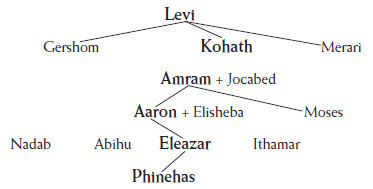
Levi to Phinehas
Although other names are mentioned, the clear focus of the genealogy is the levitical lineage from Levi to Phinehas, with Aaron standing in the midway position. This is not to say, however, that the genealogy is to be understood woodenly.11 Rather, there is strong indication that this, like other biblical genealogies, is telescoped. For example, according to Genesis 46:11, Kohath is one of the sons of Levi who made the initial journey into Egypt. Hence, there must have been about a 350-year span between Kohath and Moses (since the entire stay in Egypt was 430 years and Moses was 80 at the time of the Exodus; Ex. 7:7; 12:40–41), which makes it unlikely that Kohath is Moses’ great-uncle. One should not conclude, however, that this genealogy is thus faulty or inaccurate. Rather, it is precisely the nonliteralness of the genealogy that suggests a purposefulness and a theological significance for the manner in which it is presented here.
What is the significance of this genealogy in this context? For one thing, it extends back to the patriarchal period. Thus, we see once again the connection with the past that the writer of Exodus is so concerned to underscore throughout his book. To put it another way, the reference to the patriarchal period highlights the ancient purposefulness of God and his plan to redeem Israel.12 Moreover, the genealogy ends with the grandson of Aaron, Phinehas, a fact that suggests that the author’s view is not only past but future as well. By providing this wide-ranging genealogy, at least one purpose of the author is to place the Exodus event in its broad historical perspective: God’s purpose reaches backward and forward.
The termination of the genealogy with Phinehas is also significant, but it does not afford an easy explanation. Phinehas is a highly regarded figure in the Old Testament. In Numbers 25:1–17, he is the one who turns God’s anger away from the Israelites by killing an Israelite and his Midianite wife (Zimri and Cozbi).13 The result of his actions is that God makes a “covenant of peace” with him (25:12), meaning, “He and his descendants will have a covenant of a lasting priesthood, because he was zealous for the honor of his God and made atonement for the Israelites” (v. 13). In Joshua 22:1–34, Phinehas is among those who successfully intervene to avoid war when the eastern tribes build an altar at Geliloth. Perhaps the significance of Phinehas as the termination point for this genealogy is to draw attention to the covenant faithfulness of the line of Levi to Phinehas, which includes Aaron.
The question remains, however, why the focus of this genealogy should be Aaron rather than Moses. The context of this passage may help point us in the right direction. Aaron and Moses have been working in tandem (see 4:14). In the present passage, too, the verses that frame the genealogy (6:13 and 26) mention both Moses and Aaron. In fact, in verse 26, Aaron is mentioned first. The point of this genealogy in this context seems to be to establish Aaron as a worthy partner in the deliverance of Israel from Egypt, particularly in his role as Moses’ mouthpiece—a role reiterated in 6:28–7:7.14
Verse 12 brings this into sharper focus. The point at which the genealogy “interrupts” the conversation between Moses and God is where Moses, once again, complains about his difficulty in speaking. In 4:14–16, when Moses makes this complaint, Aaron is designated to help. In an effort to provide the reader with some rationale for such a choice, the genealogy, quite logically, is placed here. By the time we get to the end of the genealogy, Aaron’s pedigree is firmly established and the stage is set for the series of encounters with Pharaoh that will eventually lead to the release of the Israelites. Yet, to anticipate a point we will treat later on, it is most curious why, after such an apology for Aaron, he seems to take on a relatively inactive role throughout the plague narrative, which is precisely where we would expect him to become more prominent.
Bridging Contexts
REVIEW OF THEMES and the writer’s manner of expression. Before we look at the unique themes of this passage, it is worthwhile to pause and mention a number of elements in 5:22–7:7 that have already surfaced in previous passages.
(1) Consider the manner in which the author of Exodus tells the story. One pattern in his approach that has been easy to discern is the streamlined manner in which he presents the material. As we have noted again and again, the author is not concerned to give all the details of the events—he is not writing an exhaustive history or a journalistic account of Israel’s release from Egypt (in fact, no history writing, ancient or modern, is ever exhaustive or neutral). Rather, he is writing a theological account of that event. As a result, our exploration of this (and any other) book of the Old Testament should similarly be concerned, sooner or later, to uncover its theological significance rather than the details or background matters, whether geographical or historical, that the account itself does not provide.
This is not to say, of course, that the historical setting of the book is irrelevant, only that uncovering some of these specifics should not be the focus of reading Exodus. In 5:22–7:7, for example, the focus of the genealogy is the line of Levi extending to Phinehas with Aaron at the center. This is its main concern. It is the biblical narratives themselves that drive us to look for the overarching meaning of the passage. This is one reason why we focus on theological themes in the Bridging Contexts sections.
(2) Though this point is more subtle, we should note that throughout the previous chapters the author has presented a complex moral portrait of his characters, Moses in particular. He is the chosen instrument of Israel’s redemption, but at the same time a refugee from justice and a stubborn recipient of God’s plan. The Exodus narrative presents Moses neither as an ideal moral figure to be emulated nor as a rogue to be shunned.
This narrative does not intend to present Moses as a moral paradigm for present-day (or ancient) readers. There is no exhortation to “be like Moses” when he humbly removes his sandals in God’s presence (3:5), nor to “not be like Moses” when he questions God’s integrity (5:22–23). Rather, Moses, like so many of the major figures in the Old Testament, is a complex character. As we continue reading—not only in Exodus but throughout the remaining books of the Pentateuch—we see a progression in Moses’ self-understanding and in his relationship to God. It is precisely the varied moral portrait of Moses in these early chapters that is one of the factors that pushes us to read the story in its broader context. This, too, is another reason why I prefer to place the passages under discussion in ever-widening circles of canonical reflection.
(3) There are also a number of themes from previous passages that are revisited in 5:22–7:7. Exodus, like so much of Old Testament narrative, is a repetitive book, where themes are reiterated, developed, and expanded. Hence, each passage does not necessarily have its own theological theme or themes distinct from the rest of the book. Rather, the same themes come into play at various points, often with increased emphasis or added dimensions.
We have already seen that the reference to the patriarchs (6:3) and the inclusion of the genealogy (6:13–27) reiterate the writer’s desire to maintain a connection to the past, that present events can only be understood in the fullest historical context. The theme of grumbling is already hinted at in 2:11–14, but becomes an undercurrent of sorts in both conversations between Moses and God: The people grumble against Moses and Moses grumbles against God. This theme intensifies throughout the book and the Pentateuch, culminating in the forty-year desert purge and Moses’ preclusion from entering the Promised Land. God’s sovereign control of circumstances despite appearances (e.g., ch. 1) also receives considerable treatment in 5:22–7:7.
In fact, with the reiteration of the divine name in 3:14–15 and 6:3 and the recurring refrain “I am the LORD,” we may say that we have a reached a high-water point in this theme. The focus turns more and more to God and what he will do, and the reader is left with the expectation of imminent action. Ultimately, this complex of themes in Exodus converge on one central notion, that the mighty God loves his people and will display that love by saving them.
Moses as God. One striking element in this section is 7:1, which, like 4:16, refers to Moses as God. Of course, this is in no way intended to suggest that Moses actually becomes the God of Israel, the Creator of heaven and earth. Still, it will not do to lessen the impact of this statement. Exodus 7:1 does not say that Yahweh will make Moses “like” God to Pharaoh (as the NIV has it), but, rather straightforward, that he will make Moses God to Pharaoh.15 This is, however, not a statement of some divine metamorphosis. Rather, the point is that Moses will be God functionally both to Pharaoh and to the Israelites.
It may be helpful here to understand this through Pharaoh’s eyes. In Egyptian royal ideology, the pharaoh was considered to be a divine being. So by calling Moses God, Yahweh is beating Pharaoh at his own game.16 It is not the king of Egypt who is god; rather, it is this shepherd and leader of slaves who is God. And this Moses-God defeats Pharaoh in a manner that leaves no doubt as to the true nature and source of his power: He controls the elements, bugs, livestock, fire from heaven, and the water of the sea; he even has authority over life and death. Moses is not simply like God to Pharaoh. He truly is God to Pharaoh in that God is acting through Moses.17
Not only is Moses God to Pharaoh; he is also God to the Israelites. Although this point is not explicitly mentioned in the text, it is certainly implied in the role that Moses is to play in delivering the Israelites. In 5:22–7:7, Moses is, for the second time, privy to God’s self-disclosure. He announces to Moses what he intends to do: Israel will be delivered and Moses will be his instrument to bring that about. Moses is the one through whom God brings salvation to Israel. God does not simply act; he acts through Moses. Later, on Mount Sinai (chs. 20–23), he does not simply speak; he speaks through Moses.
Moses’ role as “God” is unique to this point in the Old Testament. But from a theological and canonical point of view, Moses’ close association with God should be seen not as an arbitrary spasm of divine empowerment, but as a striking episode in the type of intimacy that God intended to have with all humanity but that was lost in the garden. Adam and Eve enjoyed as close a union with God as any people ever did. Specifically relevant to this context is Adam and Eve as image-bearers of God (Gen. 1:27). Further, they were given dominion over all of creation (1:26; cf. Adam’s naming the animals in 2:19–20). As “rulers” of creation, Adam and Eve exhibited their image-bearing role most clearly.
From this perspective we may think of Moses as God as a striking example of “Adam-like” activity. Moses’ acting like God is not so much a comment on his elevation to some superhuman status. It is, rather, a sad comment on the “subhuman” status to which the rest of humanity—in this case, the Israelites—have sunk because of Adam’s sin. From this canonical perspective, Moses is not superhuman, but truly human—he is a new Adam. His true humanity is displayed precisely in his intimacy with God.
In this sense, Moses is called by God to mediate God’s image to the enslaved Israelites. The Israelites are themselves dominated by the Egyptians, led by Pharaoh, the false image-bearer. But God plans for them to be delivered from their condition and brought back to intimacy with him. This intimacy is already displayed in the person of Moses, through whom God will not only save the Israelites but will later, on Mount Sinai, reveal his will to them for how this intimacy can be sustained—that is, the law and the tabernacle, expressions of God’s holiness.
Any Old Testament figure who mediates God to the people is in some sense performing a similar image-bearing role. We have already seen elsewhere that prophets, priests, and kings represent God to the people. The clearest parallel with Moses is to be found with the prophets, since they, too, bring a message of salvation to the Israelites and a message of judgment to Israel’s enemies, and, when needed, to rebellious Israel herself.18 Priests mediate God to the people by maintaining the intimacy between God and his people through the ritual of sacrifice, by which Israel’s sins are atoned for. In other words, like Moses, the priests mediate salvation or deliverance to the people.
Moses as God, then, is a powerful reminder of what was lost in the garden, but likewise of what is to come in Israel’s history as embodied by prophets, priests, and kings. Moses is the most striking Old Testament example of regaining the glory that humanity once had in the garden as the bearers of God’s image. He is also the paradigm for subsequent image-bearers.
Moses as God is not just a trick used to stump Pharaoh, nor is it merely hyperbole. It is a profound theological statement that takes us from the garden to the cross. Few Christians can read 4:16 and 7:1 without having their thoughts turn quickly to Jesus, the God-Man. Moses’ role as God is a typological foreshadowing of Jesus, who is God. In this sense, Moses’ divine function is similar to what we have seen in conjunction with 3:2 and the angel of the Lord. Both figures serve to draw us to a fuller understanding of the significance of Jesus. The angel is not the preincarnate Christ in the Old Testament, nor is Moses in 4:16 and 7:1. What these figures represent, rather, are partial hints of what we, living in postresurrection reality, are privy to. Christ truly is God, not just in a functional sense as we have seen with Moses, but in his essence. As such, he can fully mediate both God’s word and salvation to us.
Christ is the one who is able fully to restore our image-bearing right as human beings. He is the true “image of the invisible God” (Col. 1:15). He embodies the glory of humanity that was lost in the garden, since he is without sin or blemish. In a manner of speaking, Christ embodies what it means to be truly human—not so much by his frailty and other “human” characteristics (which we think of when we consider Christ’s humanity), but by his exemplifying what God intended for humanity: perfect image-bearers. Christ fulfills the ideal hinted at in the life of Moses and the other Old Testament mediators. Jesus saves us not simply so that we can have a “relationship” with God, but so that the intimacy between God and humanity, lost in the Fall, can be restored. As Christians, we participate in nothing less than the first installment of the reversal of the Fall, which was inaugurated at the resurrection of Christ and will be complete at his return.
A witness to the nations. Yahweh is the God of the Israelites. But he is not simply a local god, as were so many of the gods of the ancient Near Eastern world. Rather, he is with his people wherever they go. He was with Abraham as he left his homeland of Ur in Mesopotamia. He was with the patriarchs during their travels throughout Canaan. He also accompanied the Israelites during their lengthy stay in Egypt, first accompanying Joseph during his enforced exile, and then the Israelites as they went from citizens to slaves. It matters not where his people are; he is with them.
From an Egyptian perspective, the God of Israel had no business intruding on Egyptian soil. They had their own gods; why would they need a foreign god, particularly one who allowed his patrons to become slaves? Yet Yahweh is no “foreign” God. He is the Creator and Sustainer of all the earth, including the mighty land of Egypt. At least part of the purpose behind God’s mighty acts in Egypt is to display just that: The God of Israel is the true God and his act of salvation will bring this to light for all to see. We see this throughout the Exodus story; for example: “And the Egyptians will know that I am the LORD when I stretch out my hand against Egypt and bring the Israelites out of it” (7:5; see also 7:17; 8:22; 9:29). To say that Yahweh is the God of the Israelites should not be mistaken as an indication of his limited power. It indicates instead the special relationship he has with Israel, his chosen people.
Even though God in the Old Testament has a special relationship with the Israelites, his salvation of his people has far-reaching implications. God is zealous to display his glory and might to the nations and to creation as a whole. His purpose for choosing a particular race of people is, somewhat ironically, to show his ownership over everything. We see this in prophetic literature, where the nations that surround the Israelites, however powerful and fearsome they may be, are nothing more than pawns in Yahweh’s hand. They are used ultimately for Israel’s benefit, and in the end, these nations will come to know the true God for who he really is.
In some cases, this newfound knowledge will result in a saving knowledge of God (see Isa. 19:16–25). This prophecy speaks of a time when Egypt and Assyria will, along with Israel, be a blessing on the earth and “will worship together” (v. 23; see also Zeph. 2:11). Is this prophecy to be taken literally, or do these nations represent the non-Israelite, Gentile, world? I am strongly inclined toward the latter (particularly since biblical “Assyria” no longer exists as a national entity), with its fulfillment coming with the death and resurrection of Christ.
Elsewhere in prophetic literature we see various oracles delivered against the nations.19 In Yahweh’s dealings with Israel, God has something to say to all peoples, and that message can be one of judgment (as we see in Exodus). God judges these nations to a large extent because of their hostile stance toward Israel, his people. The end result is an implicit recognition, if not confession, by the nations that Yahweh is God. Thus, when God delivers Israel from oppressive circumstances, his glory is revealed not only to Israel but to the nations as well. This point is made with great force in Isaiah 40:3–5, where Israel’s deliverance from Babylon is drawing near. God is coming to bring them across the desert back to their homeland (vv. 3–4). In doing so, “the glory of the LORD will be revealed, and all mankind together will see it” (v. 5; see also 52:10).
Yet prophecies such as this do not serve primarily as warnings to the nations of God’s impending activity. They are words of encouragement to Israel, for whom the machinations of the world powers often seem overwhelming. The words of the prophets, after all, were likely not handed over for consideration to the respective rulers of the nations. They were intended for the Israelites themselves, so that, when the smoke and dust of political intrigue had settled, God’s people could look back and declare his faithfulness to them. “Do you not know? Have you not heard? Has it not been told you from the beginning?” (Isa. 40:21).
Christ’s coming does not signify the beginning of God’s “universal” appeal to humanity as distinct from the Old Testament’s more restricted scope. It is a common misconception of the Old Testament that God’s glance is directed solely toward Israel. To be sure, the inclusion of the Gentiles is a more dominant theme in the New Testament, but this emphasis is not to be contrasted absolutely to the Old Testament. It is, rather, the fuller realization of the universalism that is implied, even promised (see Isa. 19:16–25), in the Old Testament.
In fact, Luke 3:4–6 quotes Isaiah 40:3–5 (cf. above). With Christ’s birth, God’s salvation has fully come and will truly be seen by “all mankind.” The deliverance of Israel from Babylon in Isaiah 40 is a prelude, a foreshadowing, of God’s final salvation sealed by the resurrection of Christ. The nations will witness God’s ultimate act of salvation.20
The point of this universal appeal is not that the inclusion of the Gentiles means the abandonment of God’s promises to Israel, but that the Gentiles, by virtue of their union with the risen Christ, now partake in those blessings. The inclusion of the Gentiles into God’s family is the ultimate witness of the nations to God’s salvific power. All Gentiles united to Christ have also been grafted into the “branch” (Israel; see Rom. 11:11–24) and, hence, are the fulfillment of the universalistic promise of God through the Old Testament prophets.
The resurrection of Christ has far-reaching implications. It is not simply a one-time display of God’s power over death. Nor is it simply a powerful vindication of Christ’s status as God’s Son. It is the great act of salvation, whereby God displays once and for all his purpose for humanity. This was not done in secret but in public. Armed with the power of the resurrected Christ, the apostles went out and proclaimed the gospel to the nations in fulfillment of a command from the resurrected Christ: “You will be my witnesses in Jerusalem, and in all Judea and Samaria, and to the ends of the earth” (Acts 1:8). God’s mighty acts in the Exodus generation were primarily to bring judgment on the Egyptians. They would know God as a result—not as a savior but as a destroyer. The oracles against the nations likewise bear a tone of judgment, although throughout we catch glimpses of God’s overarching plan for them.
The focus of the New Testament is the inclusion of the nations into the family of God through faith in the risen Christ. The final result will be that all people in all ages, whether in Christ or not, will acknowledge the Lord as the one who raised Christ from the dead. “At the name of Jesus every knee [will] bow, in heaven and on earth and under the earth, and every tongue confess that Jesus Christ is Lord, to the glory of God the Father” (Phil. 2:10–11; cf. Isa. 45:23). The nations have witnessed the gospel of Christ. All the world acknowledges him as Lord. The author of the play, as C. S. Lewis puts it, has come out on stage and received the acclaim that is his due. The play is over. God’s purpose is accomplished.
Contemporary Significance
BEARING THE IMAGE of God. It is perhaps easy to empathize with Moses in 5:22–7:7. God has called him to a special task, yet in following God he faces severe discouragement. One can hardly blame Moses’ exasperation in 5:22–23. It seems natural for us to allow setbacks to affect how we live out the Christian life—even how we view our relationship to God himself. Yet, the Lord often pushes us, as he did Moses, to reach limits we thought impossible.
As Christians, we have been re-created in God’s image. In our union with the Son, we, like him, are true image-bearers. Although not yet fully, we truly reflect the image-bearing status that was lost in the garden but that will once again be fully realized in eternity. Such knowledge ought to have an effect on how we live from day to day. It seems an almost natural tendency among the Christians I know (including myself!) to follow the pattern of Moses rather than that of Christ. We have doubts regarding our status as being re-created by the Father, in Christ, for a glorious purpose. We are known by God. He gives us a new start, a fresh beginning, but that high reality does not always translate well in our contact with the world in which we live.
To be human is not to be frail, weak, or rebellious. These are marks of sin. To be human means to be the pinnacle of God’s creation. It is only after he created humanity that God said “very good” (Gen. 1:31). It was humans alone whom God created in his image (1:27). People were intended all along to be God-like in the world, to have intimate communion with him, and, therefore, to have authority over the rest of creation, to “fill the earth and subdue it” (1:28).
We should thus resist with great boldness trends that devalue the marvel and wonder of what it means to be human. How often have we heard someone excuse his or her actions with the disclaimer, “I’m only human”? There is nothing “only” about being human. Being human means having a great capacity for love, joy, energy, justice, work, accomplishments, charity—a capacity for anything God-like. Our shortcomings are not the result of being human, but of our sinful nature that has tarnished true humanity.
One contemporary issue that reflects such a distorted view of humanity is animal rights advocacy. In my estimation, this currently popular issue is the logical flip side of such a low view of humanity. Although any reasonable person would freely acknowledge that the abuse and cruel treatment of animals is wrong, the argument for “animal rights” is often made on the basis of the supposed link between humans and animals. Even leaving aside the complicated issue of the theory of evolution, which some argue supports an elevated view of the value of animal life (or, conversely, the devaluation of human life), there is a prevalent notion today that animals are our brothers and sisters, that we must learn to live in harmony with them, that they have the right to occupy our planet as much as we do, and that any activity on our part that infringes on their right to exist is wrong.
There are a number of obvious difficulties with animal rights advocacy. Again, in the language of Genesis 1:28, as humans in God’s image, God has given us authority over the animal kingdom. Authority does not mean abuse, of course; these two are often equated in our world. Authority in the biblical sense is a God-like authority, an image-bearing authority. It exercises authority with wisdom, compassion, and justice. The creatures God created are entrusted to our care, but they are not on the same level as God’s crowning creative act, humanity, which bears his image. Of course, this perspective does not settle the many ethical questions that arise. For example, is it right to experiment on animals to develop new drugs? What about new cosmetics? Is it okay to wear mink? If not, why do we wear leather shoes and jackets? The point here is not to solve these questions but to suggest a proper foundation for discussing them.
Being human is precious, but it is something that our world takes for granted. It is ironic that in the midst of our “culture of narcissism,” to use Christopher Lasch’s famous phrase, we are so unreflective of the utter awe and wonder that being human should inspire.21 We are self-centered, but the self we are centered on is a sorry substitute. It is our humanness that, of all the wonders of God’s creation, shouts loudest to us that we are not an accident of the random convergence of cosmic forces. We are here by design. We are here for a purpose. And that purpose is not to make the world a better place to live, however admirable such efforts may be. It is ultimately not to help our fellow human beings or contribute to society. These things are not so much wrong as superficial.
Our ultimate purpose is here to reflect the glory and image of God, and any philosophy, worldview, international summit, or government program that falls short of that purpose is “subhuman.” Whatever benefits such activities may bring, they will ultimately not set captives free or bring true joy. God’s purpose for his creation is far beyond the expectations of the world. As Christians, therefore, we have the obligation and privilege of telling a fallen world, “Be all you can be.” We are the instruments used by God to bring the gospel to them, a gospel that does not just save sinners—barely—but that is intended to blow apart the present system and replace it with one that is holy and lasting. Indeed, that process has already begun—the tomb is empty.
“Being God” to others. Such an understanding of humanity should instill confidence in us, both in how we view our relationship to God and in how we relate to the world in which we live. Moses’ doubts as reflected in 5:22–7:7, however much empathy we may feel, are wrong. We have often heard the argument for boldness in evangelism: “You may be the only Bible they ever see.” Taking our cue from our passage, we should take this a step further: You may be the only “God” they see. Or, perhaps more accurately, you may be the first God they see. As people re-created in God’s image, as true image-bearers, we are the means by which the news of God’s salvation spreads.
Rarely (if ever) does one repent of one’s sins by watching a sunset or by some other attempt at communing with nature. The primary way God has ordained to bring others onto the path of being a restored image-bearer is through words, through communication, and this normally involves some form of human contact. This is the purpose behind the mystery of the Incarnation: For God to reach us, he became like us. Christians, in whom the image of God has been restored in Christ, are the ideal means to spread God’s Word. It is not verbal manipulation or finely crafted arguments. It is the whole person’s life, so thoroughly re-created in God’s image, that bears witness to the world, that draws people to the kingdom.
There is more to being a witness to Christ than quoting Bible verses and refraining from certain filthy habits. As Christ’s brothers and sisters, we are God to the world. Our goal is to be a part of that process that brings the world (those with whom the Lord places us) back to its Edenic glory. The extent to which that goal is realized is, of course, the Lord’s doing, not ours. Still, we labor toward that end. Put otherwise, we reflect God’s image to a world in which that image has been corrupted by the effects of sin. The ways in which we perform this role, the ways in which we, like Moses, act as “witnesses to the nations,” are varied and diverse.
If I may speak from recent personal experience, the ways in which we are called upon to be God to the world are often subtle and challenging. I have been coaching my son’s Little League team for several years. As I write this, one particularly “memorable” season ended—mercifully—just a few days ago (let’s just say we didn’t come in first place!). Every Little League coach knows the nearly impossible challenge he or she faces: field a team that won’t get blown off the field but give every child a chance to play and develop as people and players. Unfortunately, when you do the one, you rarely succeed in the other. But as you step back from the competitive fray, you begin to see the children under your charge more than simply as players with varying degrees of ability who may or may not help you win. You see children from broken homes, children with difficulty following directions, children with abilities that help them excel in areas other than the baseball diamond.
You see, in a word, people created in God’s image but who, because of the Fall, reflect that image in a distorted way. Long after these children have outgrown their cleats and lost their gloves, long after the standings and statistics have been forgotten, these children, these people, will still exist—either as distorted image-bearers or as completed image-bearers. For all I know, as I sit in the dugout and make up the lineups and contemplate who will and will not play, I may be the only completed image-bearer they or their parents have ever known. My knowledge of my role as image-bearer, as “God” to my Little League team, should form the motivating factor in how I treat them. As always, such knowledge does not determine the precise decisions I make (e.g., would it be best for all involved if I insert a weak player into a demanding, stressful situation?). The point is not so much the decisions themselves as it is the approach I take to making those decisions.
Another recent incident involves an episode of nearly universal suburban appeal: neighbor problems. Neighbors do not always get along. Often such problems are a matter of differing perspectives and can be exacerbated by poor communication. The details are not important here, but, in my mind, a simple and workable problem has escalated beyond what the issue warrants. Accusations have begun to fly our way, even a little gossip. No amount of reasoned discussion is helping. In fact, discussion at this point seems out of the picture.
How should I and my wife handle this situation? It is very tempting to fire back by starting some gossip ourselves. How tempting it has been to forget that they are not Christians and that we are! More than once I have come close to alerting our other neighbors as to what is happening in order to get them on our side. Also, more than once I have been tempted to answer their accusations one-by-one and tell them “what I really think” of them.
But I am God to them. This does not mean that I am a doormat and I take their tactics without any response. But as God, what do I do? My wife and I decided to resist what comes naturally to us: to counter their gossip with our own, to be rude or give them the “silent treatment,” to find things that they do that we don’t like and make problems for them (revenge). Rather, we have decided on two strategies. The first is to speak to them face-to-face about the fact that we do not think the way they are handling the situation is proper. We are not angry, vengeful, or combative. We simply tell them that if they have a legitimate complaint, they should come to us directly and not talk about us to the neighbors. Second, we are killing them with kindness. In the midst of an awkward situation, we are going out of our way to greet them when we see them, to pick up their trash cans when they blow over, to cut their small patch of grass that borders our property directly but that is out of the way for them.
Our approach is to think of the long term. We may be the only God they know. They know we are believers, and they (perhaps the other neighbors as well) are watching. The Lord has delivered us from our sins and put us in this situation so that we might “witness to the nations” how thorough and far-reaching his might is. We are to act in such a way that even through our frailties, God’s power and love may be seen, that they may know that there is another way to behave, that God’s purpose is to bring them to a higher level of existence, that is, to make them fully human, completed image-bearers.
All of life is ready to be used by the Lord to bear witness and bring glory to himself. He makes us God to the people around us so that they may know the great and awesome mystery—their Creator is their Savior. This situation has reminded me to be alert in whatever situation I find myself. How am I, here and now, even where I least expect it, to be God in this situation?
Our passage has much to teach us, and these thoughts only scratch the surface. Personally, I have been moved by Calvin’s diagnosis of the significance of this portion of Exodus. I would like to end this discussion with his insights.
It was, indeed, possible for God to overwhelm him [Pharaoh] at once, by a single nod, so that he should even fall down dead at the very sight of Moses; but . . . as he will himself presently declare, He, in the first place, chose more clearly to lay open His power; for if Pharaoh had either voluntarily yielded, or had been overcome without effort, the glory of the victory would not have been so illustrious. In the second place, He wished this monument to exist of His singular love towards His elect people; for by contending so perseveringly and so forcibly against the obstinacy of this most powerful king, He gave no doubtful proof of his love towards his Church. In the third place, He wished to accustom His servants in all ages to patience, lest they should faint in their minds, if He does not immediately answer their prayers, and, at every moment, relieve them from their distresses. In the fourth place, He wished to shew that, against all the strivings and devices of Satan, against the madness of the ungodly, and all worldly hindrances, His hand must always prevail; and to leave us no room to doubt, but that whatever we see opposing us will at length be overcome by him. In the fifth place, by detecting the illusions of Satan and the magicians, He would render His Church more wary, that she might carefully watch against such devices, and that her faith might continue invincible against all the machinations of error. Finally, He would convince Pharaoh and the Egyptians that their folly was not to be excused by any pretense of ignorance; and, at the same time, by this example, He would shew us how horrible a darkness possesses the minds of the reprobate, when He has deprived them of the light of His Spirit. These things must be attentively observed in the course of the narrative, if we desire to profit by it.22
Original Meaning
God (Again) Promises Deliverance (5:22–6:12)
THE SECTION BEGINS with Moses seemingly at the end of his rope. He is exasperated. After the dual defeat of the previous verses (both Pharaoh and the Israelites want nothing to do with him), he “returns” to the Lord. It is not clear precisely what this means. Did he physically return to Mount Horeb? This is unlikely, especially since no return journey is mentioned. Did he “return” to God in prayer?1 This is possible, since a conversation between him and God follows. Still, prayer is not what the text actually says. Moreover, the previous conversation between Moses and God was not a prayer, so why should we think this return to Yahweh should be described so? We are struck, once again, by the fact that the biblical writer is not concerned to tell us the details of the circumstances surrounding this conversation. What is vital is simply the fact that the conversation takes place—and what is said.
As Moses returns to God, he asks why he has brought this evil on the people, as if to say: “You are to blame, God. Why are you making my job so much harder?” His complaint here is reminiscent of the foremen’s complaint to Pharaoh in verse 15: “Why did you do this?” It also follows closely upon the complaint the Israelites give to Moses in verse 21: “You are to blame, Moses.” Everyone seems to be looking for someone to blame. Moses’ complaint in verse 22 is just one more in a series of complaints and shows that his grasp of the situation has not yet transcended that of the other parties involved, despite the fact that he has earlier had the privilege of receiving instructions directly from Yahweh. At this juncture, Moses is not yet the stalwart leader he later becomes. He still has much to learn about the God who is unwavering in keeping his promise to Abraham, Isaac, and Jacob.
Here, in effect, Moses is calling into question God’s character. God said he was planning to bring the Israelites out of Egypt with Moses as his chosen vessel to bring it about. For now, however, things seem to be skidding out of control, and Moses concludes that God is actually bringing trouble on them. His complete exasperation comes across in the second part of verse 22: “Why in the world have you sent me?”2
Moses is undone; his focus is on the disastrous outcome of his first encounter with Pharaoh, not on the character of the God who has called him. The most vital lesson of the Mount Horeb experience, “I will be with you” despite Pharaoh’s hard heart, has not yet sunk in. Moses has not yet learned that there is more at stake here than how he is doing. God’s character is at stake; he has a promise to keep to Abraham, Isaac, and Jacob.
In chapter 6, the Lord responds to Moses’ complaint: “Now you will see what I will do to Pharaoh” (6:1). Although “now” may simply preface the following remark, as is common in both Hebrew and English,3 it seems to take on a temporal nuance in this context. Now is the right time for God to show his great saving power. Moses is confused and despondent, the people have all but turned their backs on him, and Pharaoh’s pride is increasing by the minute. It is at this point in the unfolding drama that God responds: “Now look at what I will do.” We have already seen what Moses has done. We have also seen what Pharaoh, the anti-God figure, has done. Now it is God’s turn to act.
God’s response to Moses recalls three prominent elements of their previous conversation:
• v. 2: I am Yahweh (see 3:14)
• vv. 3–4: I am the God of the patriarchs (see 3:6, 15–17)
• v. 5: I have heard your complaint (see 3:7 [and 2:24–25])
By repeating these vital elements, God is saying to Moses, “Let’s try it again, but this time listen closely. This is who I am; I am Yahweh [v. 2]. I made a promise to the patriarchs that I have every intention of keeping [vv. 3–4]. I know what is happening, and I am now poised to do something about it [v. 5]. So, stand back and watch.”
No discussion of this passage can pass by verse 3, which, along with 3:14–15, is one of the more difficult, controversial, and widely discussed verses in the entire book. According to the mainstream of critical scholarship, 6:3 is all but impossible to reconcile with 3:14, since both seem to reveal God’s name, Yahweh, for the first time: “I appeared to Abraham, to Isaac and to Jacob as God Almighty, but by my name the LORD I did not make myself known to them.”
How can God reveal his name to Moses twice? Critical scholarship has essentially concluded, with some variation, that these two passages come from different, independent sources.4 It is argued that in 3:14–15, God’s name “Yahweh” is being revealed according to the “E” source, while in 6:3 it is being revealed according to the “Priestly” (or “P”) source, typically dated to the postexilic period. According to the theory, the author of “P” held that El-Shaddai5 was the name by which the patriarchs knew their God, but “Yahweh” is a new name, just now given to Moses. In other words, 3:14–15 and 6:3 are two parallel but different and mutually exclusive versions of the revelation of God’s name “Yahweh” to Moses. These two versions were simply placed near each other in the Exodus story by an editor of some sort, who apparently was not bothered to have two contradictory episodes in his book.
The issues involved are numerous, and a full discussion of this approach to understanding 3:14–15 and 6:3 would take us far beyond our purpose here. Still, it is worth distilling the responses that have been given to this approach.6 It seems to me that, inasmuch as 3:14–15 is not the revelation of God’s name (see comments), neither is 6:3. One point that argues against the documentary approach, both here and in 3:14–15, is that if “Yahweh” is a new name, the force of the argument seems to be lost.7 In other words, if the purpose of the constant references to the patriarchs in the opening chapters in Exodus is to establish a connection to the past, what purpose would there be for such an absolute contrast between the names by which that God was known?
The traditional answer to the documentary approach is in my view correct: Exodus 6:3 does not say that God is now giving a new name, but that God’s name is now going to be fully known; that is, the significance of the name is going to be understood at this most pivotal time in Israel’s history.8 Verse 3, then, may be paraphrased as follows:
I appeared to Abraham, Isaac, and Jacob, but only partially—in the capacity of El Shaddai. But who I am fully, which is what my name Yahweh captures, I did not make myself known to them. This is made known first only now, to you, the Exodus generation, who will witness my mighty saving power.
There is, to be sure, a distinction between the age in which Moses lived and that of the patriarchs, but it is one of emphasis and degree rather than kind. Exodus 6:3 does create some distance between the God of the Exodus and the God of the patriarchs: Now God’s character as a saving God is to be fully revealed. Nevertheless, what 3:14–15 and 6:3 demonstrate is not the newness of the divine name, but the centrality of the Exodus as the event by which God’s salvation, and hence his salvation name, “Yahweh,” is fully known. To make it merely an issue of knowing someone’s name is trivial and anticlimactic.
We see here the degree to which the two conversations between Moses and God follow a similar progression. Both the first meeting on Mount Horeb and this conversation involve a complaint on Moses’ part, which is answered by God. And that answer reaffirms his character, a character that is best exhibited by his name: Yahweh, the saving God, the God of the patriarchs.9
Armed, then, with this reaffirmation of God’s character and his presence with Moses and the Israelites, Moses is again sent back. His first step is to revisit the Israelites, just as he did in 4:29–31, in an effort to reestablish the trust broken in the previous passage. Moses is to speak God’s promise to them, that he will “bring out” the Israelites, “free” them from slavery, and “redeem” them (v. 6). The end result is that (1) they will become the people of God, (2) Yahweh will be their God, and (3) they will know that Yahweh has delivered them (v. 7).
This third point is particularly important for at least two reasons. For one thing, it helps put 6:3 in its proper perspective. By being delivered from Egypt, the Israelites will come to know God in a way that the patriarchs did not. Also, the Israelites will know that “I am the LORD your God.” The refrain “I am Yahweh [the LORD]” is familiar to us from the previous encounter between Moses and the Lord on Mount Horeb (see also 6:2, 8, 29; 7:5). Clearly, the focus of God’s message to the Israelites is on who he is, and their assessment of the situation must be based squarely on that immovable fact.
The reaction of the Israelites, however, is not unlike that of Moses at the beginning of the passage: They will not be fooled again. Once again the Israelites are grumbling in the face of God’s mercy.10 Their present reality dictates what they think God can and cannot do; they do “not listen to him because of their discouragement and cruel bondage” (v. 9).
But inasmuch as the Israelites have not yet learned their lesson, apparently neither has Moses. The Lord tells him to go once more to Pharaoh (v. 10), but Moses responds (can we really blame him?), as it were: “It’s no use, LORD. If my own people won’t listen, what makes you think Pharaoh will? Besides, I speak with faltering lips.” In a certain sense, we reach here the nadir of Moses’ despondence, for he falls back on the same excuse that God answered in the previous meeting (4:11–17). Does Moses really think it will work this time? Here is no evidence of Moses’ humility but of his continued inability to see past the end of his nose.
Bridging Contexts
REVIEW OF THEMES and the writer’s manner of expression. Before we look at the unique themes of this passage, it is worthwhile to pause and mention a number of elements in 5:22–7:7 that have already surfaced in previous passages.
(1) Consider the manner in which the author of Exodus tells the story. One pattern in his approach that has been easy to discern is the streamlined manner in which he presents the material. As we have noted again and again, the author is not concerned to give all the details of the events—he is not writing an exhaustive history or a journalistic account of Israel’s release from Egypt (in fact, no history writing, ancient or modern, is ever exhaustive or neutral). Rather, he is writing a theological account of that event. As a result, our exploration of this (and any other) book of the Old Testament should similarly be concerned, sooner or later, to uncover its theological significance rather than the details or background matters, whether geographical or historical, that the account itself does not provide.
This is not to say, of course, that the historical setting of the book is irrelevant, only that uncovering some of these specifics should not be the focus of reading Exodus. In 5:22–7:7, for example, the focus of the genealogy is the line of Levi extending to Phinehas with Aaron at the center. This is its main concern. It is the biblical narratives themselves that drive us to look for the overarching meaning of the passage. This is one reason why we focus on theological themes in the Bridging Contexts sections.
(2) Though this point is more subtle, we should note that throughout the previous chapters the author has presented a complex moral portrait of his characters, Moses in particular. He is the chosen instrument of Israel’s redemption, but at the same time a refugee from justice and a stubborn recipient of God’s plan. The Exodus narrative presents Moses neither as an ideal moral figure to be emulated nor as a rogue to be shunned.
This narrative does not intend to present Moses as a moral paradigm for present-day (or ancient) readers. There is no exhortation to “be like Moses” when he humbly removes his sandals in God’s presence (3:5), nor to “not be like Moses” when he questions God’s integrity (5:22–23). Rather, Moses, like so many of the major figures in the Old Testament, is a complex character. As we continue reading—not only in Exodus but throughout the remaining books of the Pentateuch—we see a progression in Moses’ self-understanding and in his relationship to God. It is precisely the varied moral portrait of Moses in these early chapters that is one of the factors that pushes us to read the story in its broader context. This, too, is another reason why I prefer to place the passages under discussion in ever-widening circles of canonical reflection.
(3) There are also a number of themes from previous passages that are revisited in 5:22–7:7. Exodus, like so much of Old Testament narrative, is a repetitive book, where themes are reiterated, developed, and expanded. Hence, each passage does not necessarily have its own theological theme or themes distinct from the rest of the book. Rather, the same themes come into play at various points, often with increased emphasis or added dimensions.
We have already seen that the reference to the patriarchs (6:3) and the inclusion of the genealogy (6:13–27) reiterate the writer’s desire to maintain a connection to the past, that present events can only be understood in the fullest historical context. The theme of grumbling is already hinted at in 2:11–14, but becomes an undercurrent of sorts in both conversations between Moses and God: The people grumble against Moses and Moses grumbles against God. This theme intensifies throughout the book and the Pentateuch, culminating in the forty-year desert purge and Moses’ preclusion from entering the Promised Land. God’s sovereign control of circumstances despite appearances (e.g., ch. 1) also receives considerable treatment in 5:22–7:7.
In fact, with the reiteration of the divine name in 3:14–15 and 6:3 and the recurring refrain “I am the LORD,” we may say that we have a reached a high-water point in this theme. The focus turns more and more to God and what he will do, and the reader is left with the expectation of imminent action. Ultimately, this complex of themes in Exodus converge on one central notion, that the mighty God loves his people and will display that love by saving them.
Moses as God. One striking element in this section is 7:1, which, like 4:16, refers to Moses as God. Of course, this is in no way intended to suggest that Moses actually becomes the God of Israel, the Creator of heaven and earth. Still, it will not do to lessen the impact of this statement. Exodus 7:1 does not say that Yahweh will make Moses “like” God to Pharaoh (as the NIV has it), but, rather straightforward, that he will make Moses God to Pharaoh.15 This is, however, not a statement of some divine metamorphosis. Rather, the point is that Moses will be God functionally both to Pharaoh and to the Israelites.
It may be helpful here to understand this through Pharaoh’s eyes. In Egyptian royal ideology, the pharaoh was considered to be a divine being. So by calling Moses God, Yahweh is beating Pharaoh at his own game.16 It is not the king of Egypt who is god; rather, it is this shepherd and leader of slaves who is God. And this Moses-God defeats Pharaoh in a manner that leaves no doubt as to the true nature and source of his power: He controls the elements, bugs, livestock, fire from heaven, and the water of the sea; he even has authority over life and death. Moses is not simply like God to Pharaoh. He truly is God to Pharaoh in that God is acting through Moses.17
Not only is Moses God to Pharaoh; he is also God to the Israelites. Although this point is not explicitly mentioned in the text, it is certainly implied in the role that Moses is to play in delivering the Israelites. In 5:22–7:7, Moses is, for the second time, privy to God’s self-disclosure. He announces to Moses what he intends to do: Israel will be delivered and Moses will be his instrument to bring that about. Moses is the one through whom God brings salvation to Israel. God does not simply act; he acts through Moses. Later, on Mount Sinai (chs. 20–23), he does not simply speak; he speaks through Moses.
Moses’ role as “God” is unique to this point in the Old Testament. But from a theological and canonical point of view, Moses’ close association with God should be seen not as an arbitrary spasm of divine empowerment, but as a striking episode in the type of intimacy that God intended to have with all humanity but that was lost in the garden. Adam and Eve enjoyed as close a union with God as any people ever did. Specifically relevant to this context is Adam and Eve as image-bearers of God (Gen. 1:27). Further, they were given dominion over all of creation (1:26; cf. Adam’s naming the animals in 2:19–20). As “rulers” of creation, Adam and Eve exhibited their image-bearing role most clearly.
From this perspective we may think of Moses as God as a striking example of “Adam-like” activity. Moses’ acting like God is not so much a comment on his elevation to some superhuman status. It is, rather, a sad comment on the “subhuman” status to which the rest of humanity—in this case, the Israelites—have sunk because of Adam’s sin. From this canonical perspective, Moses is not superhuman, but truly human—he is a new Adam. His true humanity is displayed precisely in his intimacy with God.
In this sense, Moses is called by God to mediate God’s image to the enslaved Israelites. The Israelites are themselves dominated by the Egyptians, led by Pharaoh, the false image-bearer. But God plans for them to be delivered from their condition and brought back to intimacy with him. This intimacy is already displayed in the person of Moses, through whom God will not only save the Israelites but will later, on Mount Sinai, reveal his will to them for how this intimacy can be sustained—that is, the law and the tabernacle, expressions of God’s holiness.
Any Old Testament figure who mediates God to the people is in some sense performing a similar image-bearing role. We have already seen elsewhere that prophets, priests, and kings represent God to the people. The clearest parallel with Moses is to be found with the prophets, since they, too, bring a message of salvation to the Israelites and a message of judgment to Israel’s enemies, and, when needed, to rebellious Israel herself.18 Priests mediate God to the people by maintaining the intimacy between God and his people through the ritual of sacrifice, by which Israel’s sins are atoned for. In other words, like Moses, the priests mediate salvation or deliverance to the people.
Moses as God, then, is a powerful reminder of what was lost in the garden, but likewise of what is to come in Israel’s history as embodied by prophets, priests, and kings. Moses is the most striking Old Testament example of regaining the glory that humanity once had in the garden as the bearers of God’s image. He is also the paradigm for subsequent image-bearers.
Moses as God is not just a trick used to stump Pharaoh, nor is it merely hyperbole. It is a profound theological statement that takes us from the garden to the cross. Few Christians can read 4:16 and 7:1 without having their thoughts turn quickly to Jesus, the God-Man. Moses’ role as God is a typological foreshadowing of Jesus, who is God. In this sense, Moses’ divine function is similar to what we have seen in conjunction with 3:2 and the angel of the Lord. Both figures serve to draw us to a fuller understanding of the significance of Jesus. The angel is not the preincarnate Christ in the Old Testament, nor is Moses in 4:16 and 7:1. What these figures represent, rather, are partial hints of what we, living in postresurrection reality, are privy to. Christ truly is God, not just in a functional sense as we have seen with Moses, but in his essence. As such, he can fully mediate both God’s word and salvation to us.
Christ is the one who is able fully to restore our image-bearing right as human beings. He is the true “image of the invisible God” (Col. 1:15). He embodies the glory of humanity that was lost in the garden, since he is without sin or blemish. In a manner of speaking, Christ embodies what it means to be truly human—not so much by his frailty and other “human” characteristics (which we think of when we consider Christ’s humanity), but by his exemplifying what God intended for humanity: perfect image-bearers. Christ fulfills the ideal hinted at in the life of Moses and the other Old Testament mediators. Jesus saves us not simply so that we can have a “relationship” with God, but so that the intimacy between God and humanity, lost in the Fall, can be restored. As Christians, we participate in nothing less than the first installment of the reversal of the Fall, which was inaugurated at the resurrection of Christ and will be complete at his return.
A witness to the nations. Yahweh is the God of the Israelites. But he is not simply a local god, as were so many of the gods of the ancient Near Eastern world. Rather, he is with his people wherever they go. He was with Abraham as he left his homeland of Ur in Mesopotamia. He was with the patriarchs during their travels throughout Canaan. He also accompanied the Israelites during their lengthy stay in Egypt, first accompanying Joseph during his enforced exile, and then the Israelites as they went from citizens to slaves. It matters not where his people are; he is with them.
From an Egyptian perspective, the God of Israel had no business intruding on Egyptian soil. They had their own gods; why would they need a foreign god, particularly one who allowed his patrons to become slaves? Yet Yahweh is no “foreign” God. He is the Creator and Sustainer of all the earth, including the mighty land of Egypt. At least part of the purpose behind God’s mighty acts in Egypt is to display just that: The God of Israel is the true God and his act of salvation will bring this to light for all to see. We see this throughout the Exodus story; for example: “And the Egyptians will know that I am the LORD when I stretch out my hand against Egypt and bring the Israelites out of it” (7:5; see also 7:17; 8:22; 9:29). To say that Yahweh is the God of the Israelites should not be mistaken as an indication of his limited power. It indicates instead the special relationship he has with Israel, his chosen people.
Even though God in the Old Testament has a special relationship with the Israelites, his salvation of his people has far-reaching implications. God is zealous to display his glory and might to the nations and to creation as a whole. His purpose for choosing a particular race of people is, somewhat ironically, to show his ownership over everything. We see this in prophetic literature, where the nations that surround the Israelites, however powerful and fearsome they may be, are nothing more than pawns in Yahweh’s hand. They are used ultimately for Israel’s benefit, and in the end, these nations will come to know the true God for who he really is.
In some cases, this newfound knowledge will result in a saving knowledge of God (see Isa. 19:16–25). This prophecy speaks of a time when Egypt and Assyria will, along with Israel, be a blessing on the earth and “will worship together” (v. 23; see also Zeph. 2:11). Is this prophecy to be taken literally, or do these nations represent the non-Israelite, Gentile, world? I am strongly inclined toward the latter (particularly since biblical “Assyria” no longer exists as a national entity), with its fulfillment coming with the death and resurrection of Christ.
Elsewhere in prophetic literature we see various oracles delivered against the nations.19 In Yahweh’s dealings with Israel, God has something to say to all peoples, and that message can be one of judgment (as we see in Exodus). God judges these nations to a large extent because of their hostile stance toward Israel, his people. The end result is an implicit recognition, if not confession, by the nations that Yahweh is God. Thus, when God delivers Israel from oppressive circumstances, his glory is revealed not only to Israel but to the nations as well. This point is made with great force in Isaiah 40:3–5, where Israel’s deliverance from Babylon is drawing near. God is coming to bring them across the desert back to their homeland (vv. 3–4). In doing so, “the glory of the LORD will be revealed, and all mankind together will see it” (v. 5; see also 52:10).
Yet prophecies such as this do not serve primarily as warnings to the nations of God’s impending activity. They are words of encouragement to Israel, for whom the machinations of the world powers often seem overwhelming. The words of the prophets, after all, were likely not handed over for consideration to the respective rulers of the nations. They were intended for the Israelites themselves, so that, when the smoke and dust of political intrigue had settled, God’s people could look back and declare his faithfulness to them. “Do you not know? Have you not heard? Has it not been told you from the beginning?” (Isa. 40:21).
Christ’s coming does not signify the beginning of God’s “universal” appeal to humanity as distinct from the Old Testament’s more restricted scope. It is a common misconception of the Old Testament that God’s glance is directed solely toward Israel. To be sure, the inclusion of the Gentiles is a more dominant theme in the New Testament, but this emphasis is not to be contrasted absolutely to the Old Testament. It is, rather, the fuller realization of the universalism that is implied, even promised (see Isa. 19:16–25), in the Old Testament.
In fact, Luke 3:4–6 quotes Isaiah 40:3–5 (cf. above). With Christ’s birth, God’s salvation has fully come and will truly be seen by “all mankind.” The deliverance of Israel from Babylon in Isaiah 40 is a prelude, a foreshadowing, of God’s final salvation sealed by the resurrection of Christ. The nations will witness God’s ultimate act of salvation.20
The point of this universal appeal is not that the inclusion of the Gentiles means the abandonment of God’s promises to Israel, but that the Gentiles, by virtue of their union with the risen Christ, now partake in those blessings. The inclusion of the Gentiles into God’s family is the ultimate witness of the nations to God’s salvific power. All Gentiles united to Christ have also been grafted into the “branch” (Israel; see Rom. 11:11–24) and, hence, are the fulfillment of the universalistic promise of God through the Old Testament prophets.
The resurrection of Christ has far-reaching implications. It is not simply a one-time display of God’s power over death. Nor is it simply a powerful vindication of Christ’s status as God’s Son. It is the great act of salvation, whereby God displays once and for all his purpose for humanity. This was not done in secret but in public. Armed with the power of the resurrected Christ, the apostles went out and proclaimed the gospel to the nations in fulfillment of a command from the resurrected Christ: “You will be my witnesses in Jerusalem, and in all Judea and Samaria, and to the ends of the earth” (Acts 1:8). God’s mighty acts in the Exodus generation were primarily to bring judgment on the Egyptians. They would know God as a result—not as a savior but as a destroyer. The oracles against the nations likewise bear a tone of judgment, although throughout we catch glimpses of God’s overarching plan for them.
The focus of the New Testament is the inclusion of the nations into the family of God through faith in the risen Christ. The final result will be that all people in all ages, whether in Christ or not, will acknowledge the Lord as the one who raised Christ from the dead. “At the name of Jesus every knee [will] bow, in heaven and on earth and under the earth, and every tongue confess that Jesus Christ is Lord, to the glory of God the Father” (Phil. 2:10–11; cf. Isa. 45:23). The nations have witnessed the gospel of Christ. All the world acknowledges him as Lord. The author of the play, as C. S. Lewis puts it, has come out on stage and received the acclaim that is his due. The play is over. God’s purpose is accomplished.
Contemporary Significance
BEARING THE IMAGE of God. It is perhaps easy to empathize with Moses in 5:22–7:7. God has called him to a special task, yet in following God he faces severe discouragement. One can hardly blame Moses’ exasperation in 5:22–23. It seems natural for us to allow setbacks to affect how we live out the Christian life—even how we view our relationship to God himself. Yet, the Lord often pushes us, as he did Moses, to reach limits we thought impossible.
As Christians, we have been re-created in God’s image. In our union with the Son, we, like him, are true image-bearers. Although not yet fully, we truly reflect the image-bearing status that was lost in the garden but that will once again be fully realized in eternity. Such knowledge ought to have an effect on how we live from day to day. It seems an almost natural tendency among the Christians I know (including myself!) to follow the pattern of Moses rather than that of Christ. We have doubts regarding our status as being re-created by the Father, in Christ, for a glorious purpose. We are known by God. He gives us a new start, a fresh beginning, but that high reality does not always translate well in our contact with the world in which we live.
To be human is not to be frail, weak, or rebellious. These are marks of sin. To be human means to be the pinnacle of God’s creation. It is only after he created humanity that God said “very good” (Gen. 1:31). It was humans alone whom God created in his image (1:27). People were intended all along to be God-like in the world, to have intimate communion with him, and, therefore, to have authority over the rest of creation, to “fill the earth and subdue it” (1:28).
We should thus resist with great boldness trends that devalue the marvel and wonder of what it means to be human. How often have we heard someone excuse his or her actions with the disclaimer, “I’m only human”? There is nothing “only” about being human. Being human means having a great capacity for love, joy, energy, justice, work, accomplishments, charity—a capacity for anything God-like. Our shortcomings are not the result of being human, but of our sinful nature that has tarnished true humanity.
One contemporary issue that reflects such a distorted view of humanity is animal rights advocacy. In my estimation, this currently popular issue is the logical flip side of such a low view of humanity. Although any reasonable person would freely acknowledge that the abuse and cruel treatment of animals is wrong, the argument for “animal rights” is often made on the basis of the supposed link between humans and animals. Even leaving aside the complicated issue of the theory of evolution, which some argue supports an elevated view of the value of animal life (or, conversely, the devaluation of human life), there is a prevalent notion today that animals are our brothers and sisters, that we must learn to live in harmony with them, that they have the right to occupy our planet as much as we do, and that any activity on our part that infringes on their right to exist is wrong.
There are a number of obvious difficulties with animal rights advocacy. Again, in the language of Genesis 1:28, as humans in God’s image, God has given us authority over the animal kingdom. Authority does not mean abuse, of course; these two are often equated in our world. Authority in the biblical sense is a God-like authority, an image-bearing authority. It exercises authority with wisdom, compassion, and justice. The creatures God created are entrusted to our care, but they are not on the same level as God’s crowning creative act, humanity, which bears his image. Of course, this perspective does not settle the many ethical questions that arise. For example, is it right to experiment on animals to develop new drugs? What about new cosmetics? Is it okay to wear mink? If not, why do we wear leather shoes and jackets? The point here is not to solve these questions but to suggest a proper foundation for discussing them.
Being human is precious, but it is something that our world takes for granted. It is ironic that in the midst of our “culture of narcissism,” to use Christopher Lasch’s famous phrase, we are so unreflective of the utter awe and wonder that being human should inspire.21 We are self-centered, but the self we are centered on is a sorry substitute. It is our humanness that, of all the wonders of God’s creation, shouts loudest to us that we are not an accident of the random convergence of cosmic forces. We are here by design. We are here for a purpose. And that purpose is not to make the world a better place to live, however admirable such efforts may be. It is ultimately not to help our fellow human beings or contribute to society. These things are not so much wrong as superficial.
Our ultimate purpose is here to reflect the glory and image of God, and any philosophy, worldview, international summit, or government program that falls short of that purpose is “subhuman.” Whatever benefits such activities may bring, they will ultimately not set captives free or bring true joy. God’s purpose for his creation is far beyond the expectations of the world. As Christians, therefore, we have the obligation and privilege of telling a fallen world, “Be all you can be.” We are the instruments used by God to bring the gospel to them, a gospel that does not just save sinners—barely—but that is intended to blow apart the present system and replace it with one that is holy and lasting. Indeed, that process has already begun—the tomb is empty.
“Being God” to others. Such an understanding of humanity should instill confidence in us, both in how we view our relationship to God and in how we relate to the world in which we live. Moses’ doubts as reflected in 5:22–7:7, however much empathy we may feel, are wrong. We have often heard the argument for boldness in evangelism: “You may be the only Bible they ever see.” Taking our cue from our passage, we should take this a step further: You may be the only “God” they see. Or, perhaps more accurately, you may be the first God they see. As people re-created in God’s image, as true image-bearers, we are the means by which the news of God’s salvation spreads.
Rarely (if ever) does one repent of one’s sins by watching a sunset or by some other attempt at communing with nature. The primary way God has ordained to bring others onto the path of being a restored image-bearer is through words, through communication, and this normally involves some form of human contact. This is the purpose behind the mystery of the Incarnation: For God to reach us, he became like us. Christians, in whom the image of God has been restored in Christ, are the ideal means to spread God’s Word. It is not verbal manipulation or finely crafted arguments. It is the whole person’s life, so thoroughly re-created in God’s image, that bears witness to the world, that draws people to the kingdom.
There is more to being a witness to Christ than quoting Bible verses and refraining from certain filthy habits. As Christ’s brothers and sisters, we are God to the world. Our goal is to be a part of that process that brings the world (those with whom the Lord places us) back to its Edenic glory. The extent to which that goal is realized is, of course, the Lord’s doing, not ours. Still, we labor toward that end. Put otherwise, we reflect God’s image to a world in which that image has been corrupted by the effects of sin. The ways in which we perform this role, the ways in which we, like Moses, act as “witnesses to the nations,” are varied and diverse.
If I may speak from recent personal experience, the ways in which we are called upon to be God to the world are often subtle and challenging. I have been coaching my son’s Little League team for several years. As I write this, one particularly “memorable” season ended—mercifully—just a few days ago (let’s just say we didn’t come in first place!). Every Little League coach knows the nearly impossible challenge he or she faces: field a team that won’t get blown off the field but give every child a chance to play and develop as people and players. Unfortunately, when you do the one, you rarely succeed in the other. But as you step back from the competitive fray, you begin to see the children under your charge more than simply as players with varying degrees of ability who may or may not help you win. You see children from broken homes, children with difficulty following directions, children with abilities that help them excel in areas other than the baseball diamond.
You see, in a word, people created in God’s image but who, because of the Fall, reflect that image in a distorted way. Long after these children have outgrown their cleats and lost their gloves, long after the standings and statistics have been forgotten, these children, these people, will still exist—either as distorted image-bearers or as completed image-bearers. For all I know, as I sit in the dugout and make up the lineups and contemplate who will and will not play, I may be the only completed image-bearer they or their parents have ever known. My knowledge of my role as image-bearer, as “God” to my Little League team, should form the motivating factor in how I treat them. As always, such knowledge does not determine the precise decisions I make (e.g., would it be best for all involved if I insert a weak player into a demanding, stressful situation?). The point is not so much the decisions themselves as it is the approach I take to making those decisions.
Another recent incident involves an episode of nearly universal suburban appeal: neighbor problems. Neighbors do not always get along. Often such problems are a matter of differing perspectives and can be exacerbated by poor communication. The details are not important here, but, in my mind, a simple and workable problem has escalated beyond what the issue warrants. Accusations have begun to fly our way, even a little gossip. No amount of reasoned discussion is helping. In fact, discussion at this point seems out of the picture.
How should I and my wife handle this situation? It is very tempting to fire back by starting some gossip ourselves. How tempting it has been to forget that they are not Christians and that we are! More than once I have come close to alerting our other neighbors as to what is happening in order to get them on our side. Also, more than once I have been tempted to answer their accusations one-by-one and tell them “what I really think” of them.
But I am God to them. This does not mean that I am a doormat and I take their tactics without any response. But as God, what do I do? My wife and I decided to resist what comes naturally to us: to counter their gossip with our own, to be rude or give them the “silent treatment,” to find things that they do that we don’t like and make problems for them (revenge). Rather, we have decided on two strategies. The first is to speak to them face-to-face about the fact that we do not think the way they are handling the situation is proper. We are not angry, vengeful, or combative. We simply tell them that if they have a legitimate complaint, they should come to us directly and not talk about us to the neighbors. Second, we are killing them with kindness. In the midst of an awkward situation, we are going out of our way to greet them when we see them, to pick up their trash cans when they blow over, to cut their small patch of grass that borders our property directly but that is out of the way for them.
Our approach is to think of the long term. We may be the only God they know. They know we are believers, and they (perhaps the other neighbors as well) are watching. The Lord has delivered us from our sins and put us in this situation so that we might “witness to the nations” how thorough and far-reaching his might is. We are to act in such a way that even through our frailties, God’s power and love may be seen, that they may know that there is another way to behave, that God’s purpose is to bring them to a higher level of existence, that is, to make them fully human, completed image-bearers.
All of life is ready to be used by the Lord to bear witness and bring glory to himself. He makes us God to the people around us so that they may know the great and awesome mystery—their Creator is their Savior. This situation has reminded me to be alert in whatever situation I find myself. How am I, here and now, even where I least expect it, to be God in this situation?
Our passage has much to teach us, and these thoughts only scratch the surface. Personally, I have been moved by Calvin’s diagnosis of the significance of this portion of Exodus. I would like to end this discussion with his insights.
It was, indeed, possible for God to overwhelm him [Pharaoh] at once, by a single nod, so that he should even fall down dead at the very sight of Moses; but . . . as he will himself presently declare, He, in the first place, chose more clearly to lay open His power; for if Pharaoh had either voluntarily yielded, or had been overcome without effort, the glory of the victory would not have been so illustrious. In the second place, He wished this monument to exist of His singular love towards His elect people; for by contending so perseveringly and so forcibly against the obstinacy of this most powerful king, He gave no doubtful proof of his love towards his Church. In the third place, He wished to accustom His servants in all ages to patience, lest they should faint in their minds, if He does not immediately answer their prayers, and, at every moment, relieve them from their distresses. In the fourth place, He wished to shew that, against all the strivings and devices of Satan, against the madness of the ungodly, and all worldly hindrances, His hand must always prevail; and to leave us no room to doubt, but that whatever we see opposing us will at length be overcome by him. In the fifth place, by detecting the illusions of Satan and the magicians, He would render His Church more wary, that she might carefully watch against such devices, and that her faith might continue invincible against all the machinations of error. Finally, He would convince Pharaoh and the Egyptians that their folly was not to be excused by any pretense of ignorance; and, at the same time, by this example, He would shew us how horrible a darkness possesses the minds of the reprobate, when He has deprived them of the light of His Spirit. These things must be attentively observed in the course of the narrative, if we desire to profit by it.22
Original Meaning
Aaron Speaks for Moses (6:28–7:7)
IN 6:28–30, THE author picks up where he left off before the genealogy, repeating verses 10–12. The emphasis is again placed on God’s decisive role in bringing the Israelites out of Egypt. The Lord addresses Moses by announcing yet again, “I am the LORD.” Moses is only to tell Pharaoh what God tells him to say. Moses’ reiteration of the complaint he gave in 4:10, which is also mentioned in 6:12 and of which the reader is no doubt tiring by this point, is answered by God a final time.
But there is one significant difference between God’s response to Moses here and that given in 4:15–16. In their first conversation on Mount Horeb, God tells Moses that he will be God to Aaron. Here the roles played by Moses and Aaron are presented differently: Moses is to be God directly to Pharaoh (7:1). That is, Moses will be an authority figure to Pharaoh rather than just to Aaron. We may think of this as an extra dose of power that God bestows on Moses for the purpose of confronting the king of Egypt. The halting dismissal that Pharaoh gave the first time will not be repeated. From now on, albeit not all at once, Pharaoh, too, will know that Moses is God’s representative and is therefore someone to be reckoned with.
The point of 7:1–5 is similar to 3:18–22: God gives Moses a preview of coming attractions. Moses and Aaron are to go to Pharaoh to demand the Israelites’ release, but God will make Pharaoh resistant to complying with this request. Instead, he will use this as an opportunity to show Egypt his might. Hence, this second conversation with Moses ends by repeating the theme that has formed the backbone of the first six chapters of Exodus: the focus of Exodus is Yahweh. He is now poised to do a great thing for Israel. He promised the patriarchs he would, and he will not allow his honor to be trampled by Pharaoh. Rather, he will toy with this “mighty” nation and its godlike king, and by doing so will leave no doubt that it is he who fights the battle (7:5).
God is more interested in Israel’s vindication and Egypt’s punishment than Moses has been giving him credit for, for it is God’s honor that is ultimately being vindicated. Perhaps the great irony of all this, as we will see later, is that whereas Egypt learns this lesson in most decisive terms, it is Israel, the people whom God came to deliver, who are so slow to understand what God has done.
Exodus 3:1–7:7 as a whole forms a large unit that is unified by a central theme: The God of Israel is in control. The main way in which this theme is presented is by the reiteration of the divine name in 3:14–15 and 6:3 and the recurring reference to God being the “I AM.” Despite apparent setbacks, the game plan has not changed. Moses and the Israelites may be panicking, but God is steady and sure, for the outcome is never in doubt. Moses and Aaron should understand the recurring setbacks they experience by Pharaoh’s repeated refusals as being well within the parameters of God’s plan of deliverance.
Bridging Contexts
REVIEW OF THEMES and the writer’s manner of expression. Before we look at the unique themes of this passage, it is worthwhile to pause and mention a number of elements in 5:22–7:7 that have already surfaced in previous passages.
(1) Consider the manner in which the author of Exodus tells the story. One pattern in his approach that has been easy to discern is the streamlined manner in which he presents the material. As we have noted again and again, the author is not concerned to give all the details of the events—he is not writing an exhaustive history or a journalistic account of Israel’s release from Egypt (in fact, no history writing, ancient or modern, is ever exhaustive or neutral). Rather, he is writing a theological account of that event. As a result, our exploration of this (and any other) book of the Old Testament should similarly be concerned, sooner or later, to uncover its theological significance rather than the details or background matters, whether geographical or historical, that the account itself does not provide.
This is not to say, of course, that the historical setting of the book is irrelevant, only that uncovering some of these specifics should not be the focus of reading Exodus. In 5:22–7:7, for example, the focus of the genealogy is the line of Levi extending to Phinehas with Aaron at the center. This is its main concern. It is the biblical narratives themselves that drive us to look for the overarching meaning of the passage. This is one reason why we focus on theological themes in the Bridging Contexts sections.
(2) Though this point is more subtle, we should note that throughout the previous chapters the author has presented a complex moral portrait of his characters, Moses in particular. He is the chosen instrument of Israel’s redemption, but at the same time a refugee from justice and a stubborn recipient of God’s plan. The Exodus narrative presents Moses neither as an ideal moral figure to be emulated nor as a rogue to be shunned.
This narrative does not intend to present Moses as a moral paradigm for present-day (or ancient) readers. There is no exhortation to “be like Moses” when he humbly removes his sandals in God’s presence (3:5), nor to “not be like Moses” when he questions God’s integrity (5:22–23). Rather, Moses, like so many of the major figures in the Old Testament, is a complex character. As we continue reading—not only in Exodus but throughout the remaining books of the Pentateuch—we see a progression in Moses’ self-understanding and in his relationship to God. It is precisely the varied moral portrait of Moses in these early chapters that is one of the factors that pushes us to read the story in its broader context. This, too, is another reason why I prefer to place the passages under discussion in ever-widening circles of canonical reflection.
(3) There are also a number of themes from previous passages that are revisited in 5:22–7:7. Exodus, like so much of Old Testament narrative, is a repetitive book, where themes are reiterated, developed, and expanded. Hence, each passage does not necessarily have its own theological theme or themes distinct from the rest of the book. Rather, the same themes come into play at various points, often with increased emphasis or added dimensions.
We have already seen that the reference to the patriarchs (6:3) and the inclusion of the genealogy (6:13–27) reiterate the writer’s desire to maintain a connection to the past, that present events can only be understood in the fullest historical context. The theme of grumbling is already hinted at in 2:11–14, but becomes an undercurrent of sorts in both conversations between Moses and God: The people grumble against Moses and Moses grumbles against God. This theme intensifies throughout the book and the Pentateuch, culminating in the forty-year desert purge and Moses’ preclusion from entering the Promised Land. God’s sovereign control of circumstances despite appearances (e.g., ch. 1) also receives considerable treatment in 5:22–7:7.
In fact, with the reiteration of the divine name in 3:14–15 and 6:3 and the recurring refrain “I am the LORD,” we may say that we have a reached a high-water point in this theme. The focus turns more and more to God and what he will do, and the reader is left with the expectation of imminent action. Ultimately, this complex of themes in Exodus converge on one central notion, that the mighty God loves his people and will display that love by saving them.
Moses as God. One striking element in this section is 7:1, which, like 4:16, refers to Moses as God. Of course, this is in no way intended to suggest that Moses actually becomes the God of Israel, the Creator of heaven and earth. Still, it will not do to lessen the impact of this statement. Exodus 7:1 does not say that Yahweh will make Moses “like” God to Pharaoh (as the NIV has it), but, rather straightforward, that he will make Moses God to Pharaoh.15 This is, however, not a statement of some divine metamorphosis. Rather, the point is that Moses will be God functionally both to Pharaoh and to the Israelites.
It may be helpful here to understand this through Pharaoh’s eyes. In Egyptian royal ideology, the pharaoh was considered to be a divine being. So by calling Moses God, Yahweh is beating Pharaoh at his own game.16 It is not the king of Egypt who is god; rather, it is this shepherd and leader of slaves who is God. And this Moses-God defeats Pharaoh in a manner that leaves no doubt as to the true nature and source of his power: He controls the elements, bugs, livestock, fire from heaven, and the water of the sea; he even has authority over life and death. Moses is not simply like God to Pharaoh. He truly is God to Pharaoh in that God is acting through Moses.17
Not only is Moses God to Pharaoh; he is also God to the Israelites. Although this point is not explicitly mentioned in the text, it is certainly implied in the role that Moses is to play in delivering the Israelites. In 5:22–7:7, Moses is, for the second time, privy to God’s self-disclosure. He announces to Moses what he intends to do: Israel will be delivered and Moses will be his instrument to bring that about. Moses is the one through whom God brings salvation to Israel. God does not simply act; he acts through Moses. Later, on Mount Sinai (chs. 20–23), he does not simply speak; he speaks through Moses.
Moses’ role as “God” is unique to this point in the Old Testament. But from a theological and canonical point of view, Moses’ close association with God should be seen not as an arbitrary spasm of divine empowerment, but as a striking episode in the type of intimacy that God intended to have with all humanity but that was lost in the garden. Adam and Eve enjoyed as close a union with God as any people ever did. Specifically relevant to this context is Adam and Eve as image-bearers of God (Gen. 1:27). Further, they were given dominion over all of creation (1:26; cf. Adam’s naming the animals in 2:19–20). As “rulers” of creation, Adam and Eve exhibited their image-bearing role most clearly.
From this perspective we may think of Moses as God as a striking example of “Adam-like” activity. Moses’ acting like God is not so much a comment on his elevation to some superhuman status. It is, rather, a sad comment on the “subhuman” status to which the rest of humanity—in this case, the Israelites—have sunk because of Adam’s sin. From this canonical perspective, Moses is not superhuman, but truly human—he is a new Adam. His true humanity is displayed precisely in his intimacy with God.
In this sense, Moses is called by God to mediate God’s image to the enslaved Israelites. The Israelites are themselves dominated by the Egyptians, led by Pharaoh, the false image-bearer. But God plans for them to be delivered from their condition and brought back to intimacy with him. This intimacy is already displayed in the person of Moses, through whom God will not only save the Israelites but will later, on Mount Sinai, reveal his will to them for how this intimacy can be sustained—that is, the law and the tabernacle, expressions of God’s holiness.
Any Old Testament figure who mediates God to the people is in some sense performing a similar image-bearing role. We have already seen elsewhere that prophets, priests, and kings represent God to the people. The clearest parallel with Moses is to be found with the prophets, since they, too, bring a message of salvation to the Israelites and a message of judgment to Israel’s enemies, and, when needed, to rebellious Israel herself.18 Priests mediate God to the people by maintaining the intimacy between God and his people through the ritual of sacrifice, by which Israel’s sins are atoned for. In other words, like Moses, the priests mediate salvation or deliverance to the people.
Moses as God, then, is a powerful reminder of what was lost in the garden, but likewise of what is to come in Israel’s history as embodied by prophets, priests, and kings. Moses is the most striking Old Testament example of regaining the glory that humanity once had in the garden as the bearers of God’s image. He is also the paradigm for subsequent image-bearers.
Moses as God is not just a trick used to stump Pharaoh, nor is it merely hyperbole. It is a profound theological statement that takes us from the garden to the cross. Few Christians can read 4:16 and 7:1 without having their thoughts turn quickly to Jesus, the God-Man. Moses’ role as God is a typological foreshadowing of Jesus, who is God. In this sense, Moses’ divine function is similar to what we have seen in conjunction with 3:2 and the angel of the Lord. Both figures serve to draw us to a fuller understanding of the significance of Jesus. The angel is not the preincarnate Christ in the Old Testament, nor is Moses in 4:16 and 7:1. What these figures represent, rather, are partial hints of what we, living in postresurrection reality, are privy to. Christ truly is God, not just in a functional sense as we have seen with Moses, but in his essence. As such, he can fully mediate both God’s word and salvation to us.
Christ is the one who is able fully to restore our image-bearing right as human beings. He is the true “image of the invisible God” (Col. 1:15). He embodies the glory of humanity that was lost in the garden, since he is without sin or blemish. In a manner of speaking, Christ embodies what it means to be truly human—not so much by his frailty and other “human” characteristics (which we think of when we consider Christ’s humanity), but by his exemplifying what God intended for humanity: perfect image-bearers. Christ fulfills the ideal hinted at in the life of Moses and the other Old Testament mediators. Jesus saves us not simply so that we can have a “relationship” with God, but so that the intimacy between God and humanity, lost in the Fall, can be restored. As Christians, we participate in nothing less than the first installment of the reversal of the Fall, which was inaugurated at the resurrection of Christ and will be complete at his return.
A witness to the nations. Yahweh is the God of the Israelites. But he is not simply a local god, as were so many of the gods of the ancient Near Eastern world. Rather, he is with his people wherever they go. He was with Abraham as he left his homeland of Ur in Mesopotamia. He was with the patriarchs during their travels throughout Canaan. He also accompanied the Israelites during their lengthy stay in Egypt, first accompanying Joseph during his enforced exile, and then the Israelites as they went from citizens to slaves. It matters not where his people are; he is with them.
From an Egyptian perspective, the God of Israel had no business intruding on Egyptian soil. They had their own gods; why would they need a foreign god, particularly one who allowed his patrons to become slaves? Yet Yahweh is no “foreign” God. He is the Creator and Sustainer of all the earth, including the mighty land of Egypt. At least part of the purpose behind God’s mighty acts in Egypt is to display just that: The God of Israel is the true God and his act of salvation will bring this to light for all to see. We see this throughout the Exodus story; for example: “And the Egyptians will know that I am the LORD when I stretch out my hand against Egypt and bring the Israelites out of it” (7:5; see also 7:17; 8:22; 9:29). To say that Yahweh is the God of the Israelites should not be mistaken as an indication of his limited power. It indicates instead the special relationship he has with Israel, his chosen people.
Even though God in the Old Testament has a special relationship with the Israelites, his salvation of his people has far-reaching implications. God is zealous to display his glory and might to the nations and to creation as a whole. His purpose for choosing a particular race of people is, somewhat ironically, to show his ownership over everything. We see this in prophetic literature, where the nations that surround the Israelites, however powerful and fearsome they may be, are nothing more than pawns in Yahweh’s hand. They are used ultimately for Israel’s benefit, and in the end, these nations will come to know the true God for who he really is.
In some cases, this newfound knowledge will result in a saving knowledge of God (see Isa. 19:16–25). This prophecy speaks of a time when Egypt and Assyria will, along with Israel, be a blessing on the earth and “will worship together” (v. 23; see also Zeph. 2:11). Is this prophecy to be taken literally, or do these nations represent the non-Israelite, Gentile, world? I am strongly inclined toward the latter (particularly since biblical “Assyria” no longer exists as a national entity), with its fulfillment coming with the death and resurrection of Christ.
Elsewhere in prophetic literature we see various oracles delivered against the nations.19 In Yahweh’s dealings with Israel, God has something to say to all peoples, and that message can be one of judgment (as we see in Exodus). God judges these nations to a large extent because of their hostile stance toward Israel, his people. The end result is an implicit recognition, if not confession, by the nations that Yahweh is God. Thus, when God delivers Israel from oppressive circumstances, his glory is revealed not only to Israel but to the nations as well. This point is made with great force in Isaiah 40:3–5, where Israel’s deliverance from Babylon is drawing near. God is coming to bring them across the desert back to their homeland (vv. 3–4). In doing so, “the glory of the LORD will be revealed, and all mankind together will see it” (v. 5; see also 52:10).
Yet prophecies such as this do not serve primarily as warnings to the nations of God’s impending activity. They are words of encouragement to Israel, for whom the machinations of the world powers often seem overwhelming. The words of the prophets, after all, were likely not handed over for consideration to the respective rulers of the nations. They were intended for the Israelites themselves, so that, when the smoke and dust of political intrigue had settled, God’s people could look back and declare his faithfulness to them. “Do you not know? Have you not heard? Has it not been told you from the beginning?” (Isa. 40:21).
Christ’s coming does not signify the beginning of God’s “universal” appeal to humanity as distinct from the Old Testament’s more restricted scope. It is a common misconception of the Old Testament that God’s glance is directed solely toward Israel. To be sure, the inclusion of the Gentiles is a more dominant theme in the New Testament, but this emphasis is not to be contrasted absolutely to the Old Testament. It is, rather, the fuller realization of the universalism that is implied, even promised (see Isa. 19:16–25), in the Old Testament.
In fact, Luke 3:4–6 quotes Isaiah 40:3–5 (cf. above). With Christ’s birth, God’s salvation has fully come and will truly be seen by “all mankind.” The deliverance of Israel from Babylon in Isaiah 40 is a prelude, a foreshadowing, of God’s final salvation sealed by the resurrection of Christ. The nations will witness God’s ultimate act of salvation.20
The point of this universal appeal is not that the inclusion of the Gentiles means the abandonment of God’s promises to Israel, but that the Gentiles, by virtue of their union with the risen Christ, now partake in those blessings. The inclusion of the Gentiles into God’s family is the ultimate witness of the nations to God’s salvific power. All Gentiles united to Christ have also been grafted into the “branch” (Israel; see Rom. 11:11–24) and, hence, are the fulfillment of the universalistic promise of God through the Old Testament prophets.
The resurrection of Christ has far-reaching implications. It is not simply a one-time display of God’s power over death. Nor is it simply a powerful vindication of Christ’s status as God’s Son. It is the great act of salvation, whereby God displays once and for all his purpose for humanity. This was not done in secret but in public. Armed with the power of the resurrected Christ, the apostles went out and proclaimed the gospel to the nations in fulfillment of a command from the resurrected Christ: “You will be my witnesses in Jerusalem, and in all Judea and Samaria, and to the ends of the earth” (Acts 1:8). God’s mighty acts in the Exodus generation were primarily to bring judgment on the Egyptians. They would know God as a result—not as a savior but as a destroyer. The oracles against the nations likewise bear a tone of judgment, although throughout we catch glimpses of God’s overarching plan for them.
The focus of the New Testament is the inclusion of the nations into the family of God through faith in the risen Christ. The final result will be that all people in all ages, whether in Christ or not, will acknowledge the Lord as the one who raised Christ from the dead. “At the name of Jesus every knee [will] bow, in heaven and on earth and under the earth, and every tongue confess that Jesus Christ is Lord, to the glory of God the Father” (Phil. 2:10–11; cf. Isa. 45:23). The nations have witnessed the gospel of Christ. All the world acknowledges him as Lord. The author of the play, as C. S. Lewis puts it, has come out on stage and received the acclaim that is his due. The play is over. God’s purpose is accomplished.
Contemporary Significance
BEARING THE IMAGE of God. It is perhaps easy to empathize with Moses in 5:22–7:7. God has called him to a special task, yet in following God he faces severe discouragement. One can hardly blame Moses’ exasperation in 5:22–23. It seems natural for us to allow setbacks to affect how we live out the Christian life—even how we view our relationship to God himself. Yet, the Lord often pushes us, as he did Moses, to reach limits we thought impossible.
As Christians, we have been re-created in God’s image. In our union with the Son, we, like him, are true image-bearers. Although not yet fully, we truly reflect the image-bearing status that was lost in the garden but that will once again be fully realized in eternity. Such knowledge ought to have an effect on how we live from day to day. It seems an almost natural tendency among the Christians I know (including myself!) to follow the pattern of Moses rather than that of Christ. We have doubts regarding our status as being re-created by the Father, in Christ, for a glorious purpose. We are known by God. He gives us a new start, a fresh beginning, but that high reality does not always translate well in our contact with the world in which we live.
To be human is not to be frail, weak, or rebellious. These are marks of sin. To be human means to be the pinnacle of God’s creation. It is only after he created humanity that God said “very good” (Gen. 1:31). It was humans alone whom God created in his image (1:27). People were intended all along to be God-like in the world, to have intimate communion with him, and, therefore, to have authority over the rest of creation, to “fill the earth and subdue it” (1:28).
We should thus resist with great boldness trends that devalue the marvel and wonder of what it means to be human. How often have we heard someone excuse his or her actions with the disclaimer, “I’m only human”? There is nothing “only” about being human. Being human means having a great capacity for love, joy, energy, justice, work, accomplishments, charity—a capacity for anything God-like. Our shortcomings are not the result of being human, but of our sinful nature that has tarnished true humanity.
One contemporary issue that reflects such a distorted view of humanity is animal rights advocacy. In my estimation, this currently popular issue is the logical flip side of such a low view of humanity. Although any reasonable person would freely acknowledge that the abuse and cruel treatment of animals is wrong, the argument for “animal rights” is often made on the basis of the supposed link between humans and animals. Even leaving aside the complicated issue of the theory of evolution, which some argue supports an elevated view of the value of animal life (or, conversely, the devaluation of human life), there is a prevalent notion today that animals are our brothers and sisters, that we must learn to live in harmony with them, that they have the right to occupy our planet as much as we do, and that any activity on our part that infringes on their right to exist is wrong.
There are a number of obvious difficulties with animal rights advocacy. Again, in the language of Genesis 1:28, as humans in God’s image, God has given us authority over the animal kingdom. Authority does not mean abuse, of course; these two are often equated in our world. Authority in the biblical sense is a God-like authority, an image-bearing authority. It exercises authority with wisdom, compassion, and justice. The creatures God created are entrusted to our care, but they are not on the same level as God’s crowning creative act, humanity, which bears his image. Of course, this perspective does not settle the many ethical questions that arise. For example, is it right to experiment on animals to develop new drugs? What about new cosmetics? Is it okay to wear mink? If not, why do we wear leather shoes and jackets? The point here is not to solve these questions but to suggest a proper foundation for discussing them.
Being human is precious, but it is something that our world takes for granted. It is ironic that in the midst of our “culture of narcissism,” to use Christopher Lasch’s famous phrase, we are so unreflective of the utter awe and wonder that being human should inspire.21 We are self-centered, but the self we are centered on is a sorry substitute. It is our humanness that, of all the wonders of God’s creation, shouts loudest to us that we are not an accident of the random convergence of cosmic forces. We are here by design. We are here for a purpose. And that purpose is not to make the world a better place to live, however admirable such efforts may be. It is ultimately not to help our fellow human beings or contribute to society. These things are not so much wrong as superficial.
Our ultimate purpose is here to reflect the glory and image of God, and any philosophy, worldview, international summit, or government program that falls short of that purpose is “subhuman.” Whatever benefits such activities may bring, they will ultimately not set captives free or bring true joy. God’s purpose for his creation is far beyond the expectations of the world. As Christians, therefore, we have the obligation and privilege of telling a fallen world, “Be all you can be.” We are the instruments used by God to bring the gospel to them, a gospel that does not just save sinners—barely—but that is intended to blow apart the present system and replace it with one that is holy and lasting. Indeed, that process has already begun—the tomb is empty.
“Being God” to others. Such an understanding of humanity should instill confidence in us, both in how we view our relationship to God and in how we relate to the world in which we live. Moses’ doubts as reflected in 5:22–7:7, however much empathy we may feel, are wrong. We have often heard the argument for boldness in evangelism: “You may be the only Bible they ever see.” Taking our cue from our passage, we should take this a step further: You may be the only “God” they see. Or, perhaps more accurately, you may be the first God they see. As people re-created in God’s image, as true image-bearers, we are the means by which the news of God’s salvation spreads.
Rarely (if ever) does one repent of one’s sins by watching a sunset or by some other attempt at communing with nature. The primary way God has ordained to bring others onto the path of being a restored image-bearer is through words, through communication, and this normally involves some form of human contact. This is the purpose behind the mystery of the Incarnation: For God to reach us, he became like us. Christians, in whom the image of God has been restored in Christ, are the ideal means to spread God’s Word. It is not verbal manipulation or finely crafted arguments. It is the whole person’s life, so thoroughly re-created in God’s image, that bears witness to the world, that draws people to the kingdom.
There is more to being a witness to Christ than quoting Bible verses and refraining from certain filthy habits. As Christ’s brothers and sisters, we are God to the world. Our goal is to be a part of that process that brings the world (those with whom the Lord places us) back to its Edenic glory. The extent to which that goal is realized is, of course, the Lord’s doing, not ours. Still, we labor toward that end. Put otherwise, we reflect God’s image to a world in which that image has been corrupted by the effects of sin. The ways in which we perform this role, the ways in which we, like Moses, act as “witnesses to the nations,” are varied and diverse.
If I may speak from recent personal experience, the ways in which we are called upon to be God to the world are often subtle and challenging. I have been coaching my son’s Little League team for several years. As I write this, one particularly “memorable” season ended—mercifully—just a few days ago (let’s just say we didn’t come in first place!). Every Little League coach knows the nearly impossible challenge he or she faces: field a team that won’t get blown off the field but give every child a chance to play and develop as people and players. Unfortunately, when you do the one, you rarely succeed in the other. But as you step back from the competitive fray, you begin to see the children under your charge more than simply as players with varying degrees of ability who may or may not help you win. You see children from broken homes, children with difficulty following directions, children with abilities that help them excel in areas other than the baseball diamond.
You see, in a word, people created in God’s image but who, because of the Fall, reflect that image in a distorted way. Long after these children have outgrown their cleats and lost their gloves, long after the standings and statistics have been forgotten, these children, these people, will still exist—either as distorted image-bearers or as completed image-bearers. For all I know, as I sit in the dugout and make up the lineups and contemplate who will and will not play, I may be the only completed image-bearer they or their parents have ever known. My knowledge of my role as image-bearer, as “God” to my Little League team, should form the motivating factor in how I treat them. As always, such knowledge does not determine the precise decisions I make (e.g., would it be best for all involved if I insert a weak player into a demanding, stressful situation?). The point is not so much the decisions themselves as it is the approach I take to making those decisions.
Another recent incident involves an episode of nearly universal suburban appeal: neighbor problems. Neighbors do not always get along. Often such problems are a matter of differing perspectives and can be exacerbated by poor communication. The details are not important here, but, in my mind, a simple and workable problem has escalated beyond what the issue warrants. Accusations have begun to fly our way, even a little gossip. No amount of reasoned discussion is helping. In fact, discussion at this point seems out of the picture.
How should I and my wife handle this situation? It is very tempting to fire back by starting some gossip ourselves. How tempting it has been to forget that they are not Christians and that we are! More than once I have come close to alerting our other neighbors as to what is happening in order to get them on our side. Also, more than once I have been tempted to answer their accusations one-by-one and tell them “what I really think” of them.
But I am God to them. This does not mean that I am a doormat and I take their tactics without any response. But as God, what do I do? My wife and I decided to resist what comes naturally to us: to counter their gossip with our own, to be rude or give them the “silent treatment,” to find things that they do that we don’t like and make problems for them (revenge). Rather, we have decided on two strategies. The first is to speak to them face-to-face about the fact that we do not think the way they are handling the situation is proper. We are not angry, vengeful, or combative. We simply tell them that if they have a legitimate complaint, they should come to us directly and not talk about us to the neighbors. Second, we are killing them with kindness. In the midst of an awkward situation, we are going out of our way to greet them when we see them, to pick up their trash cans when they blow over, to cut their small patch of grass that borders our property directly but that is out of the way for them.
Our approach is to think of the long term. We may be the only God they know. They know we are believers, and they (perhaps the other neighbors as well) are watching. The Lord has delivered us from our sins and put us in this situation so that we might “witness to the nations” how thorough and far-reaching his might is. We are to act in such a way that even through our frailties, God’s power and love may be seen, that they may know that there is another way to behave, that God’s purpose is to bring them to a higher level of existence, that is, to make them fully human, completed image-bearers.
All of life is ready to be used by the Lord to bear witness and bring glory to himself. He makes us God to the people around us so that they may know the great and awesome mystery—their Creator is their Savior. This situation has reminded me to be alert in whatever situation I find myself. How am I, here and now, even where I least expect it, to be God in this situation?
Our passage has much to teach us, and these thoughts only scratch the surface. Personally, I have been moved by Calvin’s diagnosis of the significance of this portion of Exodus. I would like to end this discussion with his insights.
It was, indeed, possible for God to overwhelm him [Pharaoh] at once, by a single nod, so that he should even fall down dead at the very sight of Moses; but . . . as he will himself presently declare, He, in the first place, chose more clearly to lay open His power; for if Pharaoh had either voluntarily yielded, or had been overcome without effort, the glory of the victory would not have been so illustrious. In the second place, He wished this monument to exist of His singular love towards His elect people; for by contending so perseveringly and so forcibly against the obstinacy of this most powerful king, He gave no doubtful proof of his love towards his Church. In the third place, He wished to accustom His servants in all ages to patience, lest they should faint in their minds, if He does not immediately answer their prayers, and, at every moment, relieve them from their distresses. In the fourth place, He wished to shew that, against all the strivings and devices of Satan, against the madness of the ungodly, and all worldly hindrances, His hand must always prevail; and to leave us no room to doubt, but that whatever we see opposing us will at length be overcome by him. In the fifth place, by detecting the illusions of Satan and the magicians, He would render His Church more wary, that she might carefully watch against such devices, and that her faith might continue invincible against all the machinations of error. Finally, He would convince Pharaoh and the Egyptians that their folly was not to be excused by any pretense of ignorance; and, at the same time, by this example, He would shew us how horrible a darkness possesses the minds of the reprobate, when He has deprived them of the light of His Spirit. These things must be attentively observed in the course of the narrative, if we desire to profit by it.22