Original Meaning
I BELIEVE THIS section is the most important passage in the book of Galatians for understanding the nature of Paul’s theological argument against the Judaizers. This passage tells us more what lies behind Paul’s arguments than any other passage. In fact, it is one of the most important passages in all of Paul’s letters when it comes to understanding the relationship of Christianity to the law of Moses, no small issue for first-century Jewish Christians.
But being important does not necessarily mean it is easy to understand. The debates that scholars have generated on this passage alone amount to shelves and shelves of evidence, arguments, and debates. Due to the complexity of Paul’s argument I can do no more than state my views here. Rarely will I be able to argue even partially for the positions I take, and even more rarely will I interact with opposing viewpoints at more than a superficial level. Those who wish to follow up the debates and ponder the issues more completely will have to read in the works mentioned in the footnotes. I will begin with an outline and then expound each section of that outline.
I. The Question About the Historical Purpose of the Law (vv. 19–20)
A. The question (v. 19a)
B. The answer (vv. 19b–20)
1. The purpose of the law (v. 19b)
2. The temporal limitations of the law (v. 19c)
3. The circumstances of the giving of the law (vv. 19d–20)
II. The Question About the Historical Function of the Law (vv. 21–25)
A. The question (v. 21a)
B. The answer (v. 21b)
C. The reason for the answer (vv. 21c–25)
1. The inability of the law (v. 21c)
2. The function of the law in history (v. 22a)
3. The function of the promises in history (v. 22b)
4. The explanation of the function of the law (vv. 23–25)
a. Time elements of the law (v. 23)
b. Effect of the law (v. 24a)
c. Result of the law’s effect (v. 24b)
d. Suspension of the law (v. 25)
The Question About the Historical Purpose of the Law (vv. 19–20)
PAUL’S FIRST QUESTION arises naturally for every law-revering Jew: If it is the case that Abraham’s covenant is paramount for God’s relationship with his people, what then was the purpose of the law? Why did God even give the law if Abraham’s covenant was adequate? Paul knew that many (perhaps most) Jews had lived as if the law were the foundation of one’s relationship to God and the Abrahamic covenant were only the beginning of that relationship. He also knew that most thoughtful Jews would have argued for some sort of “progressive revelation”: what God began in Abraham he perfected through the revelation to Moses. So it is no surprise that Paul would be interrogated thoroughly about how he saw the law in God’s plan of redemption. Furthermore, the argument from analogy (vv. 15–18) was only an illustration of what Paul had already argued: that the Galatians themselves experienced everything good by faith rather than works (vv. 1–5), that Abraham himself was justified by faith (vv. 6–9), and that those under the law were under a curse (vv. 10–14). It is no wonder Paul had to pause and clarify the basis for everything: the law was never intended by God to do what the Judaizers were asking it to do, nor was it ever intended to be the socially restricting instrument it had become.
It would also have been natural for thoughtful Jews to wonder if Paul believed at all in the authority of the law of Moses; if they concluded that he did not, it would also have been natural for them to think of Paul as a deviant. This means that Paul’s answer in this section is fundamentally important for the success of his mission and even more important for his own apostolic authority. If he cannot come up with an adequate response, Paul is done, the Judaizers will win, and the Galatians will convert to Judaism.
The question Paul raises (“What, then, was the purpose of the law?”) is easy to understand. His answer, however, takes some unraveling. There are three cords wound together. He begins by talking about the purpose of the law (v. 19b), moves on to the temporal limitations of the law (v. 19c), and then concludes with some inferences from the circumstances surrounding the actual giving of the law to Moses (v. 19d–20). Before proceeding to expound these, I think it might be helpful if we sketched over the way Christians have seen the role of the law and how it relates to Christians today.
Essentially, there are three answers to the purpose of the law in the history of the church. (1) The first sees the law abrogated by Christ and the new era inaugurated by the Spirit. For these people, the law no longer has any binding relationship to Christians; it belongs completely to a bygone era. While this view has sometimes been associated most significantly with an early heretic, Marcion, one need not deny any central Christian doctrines to espouse this view. (2) The second view contends that the law was God’s first but incomplete revelation of his will and that his will has now been completely revealed through Christ and through the teachings of the New Testament as inspired by the Holy Spirit. For these people, the law is God’s will, but it is not completely his will for his church. Furthermore, Christians, while they are not subject to the law or “under the law,” find in the law preliminary principles for living but find also that, in living in faith and in the Spirit, they do all that the law asked for and more. (3) The third view is that the law of Moses remains prescriptive for the church as well. The law, for these people, was the revealed will of God for his people and remains that will; however, these people also contend that God’s will cannot be performed properly unless one has the Spirit of God. Then the Christian does what God wants, and that is revealed in the law.
How important is our view on the law? Very important! Theologians have distinguished three “uses” of the Law: (1) in society as God’s moral check and guideline for civil law; (2) in history and personal life as God’s means of revealing sin in order to drive people to trust in his grace; (3) in the church as a guideline for Christian ethics. Our concern here is primarily with the so-called “third use of the law” (tertius usus legis).1 Do we check our lives against the Ten Commandments or not? Do we seek out Exodus, Leviticus, and Deuteronomy when we seek to live honorably before God, or do we seek out what Jesus wants of us and what God’s Spirit is saying to us (as confirmed through the New Testament)? Do we have any arguments for social issues in our day (e.g., capital punishment, marriage and divorce laws) that can be derived from the New Testament, or do we have to go to the Old Testament for such answers? This brings us right back to Paul’s question: Why did God give the law? Did he give it for us (as Christians) or only for Jews of a bygone era? Our answer to the question about the importance of this discussion is clear; we must find how the law relates to us today.
First, Paul answers the question by stating the purpose of the law (v. 19b): “it was added because of transgressions.” Scholars here are divided: Should we translate “It was added because of transgressions,” or “It was added for the purpose of revealing transgressions”? Put differently, which came first: sin or the law? Did God add the law because the people were sinning, or did the people suddenly learn that they were sinning because God gave the law? Later Paul states that the law does not give life (vv. 21–22) but is a teacher (v. 24); elsewhere he says that “through the law we become conscious of sin” (Rom. 3:20; cf. 7:7) and that when there is no law there is no sin (4:15; cf. 5:13). Romans 5:20 states that “the law was added so that the trespass might increase” (cf. 7:13). Thus, I conclude with many who see the purpose of the law as being that it was given in order to reveal certain kinds of behavior as sinful.2 The law, then, was a judging instrument for the people of God; through its written code they learned that certain behavior was contrary to God’s will. We might diagram it thus:
Abraham—Israel’s bad behavior—Law of Moses—SIN.
The second part of Paul’s answer on the historical purpose of the law pertains to the temporal limitations of the law (v. 19c): “until the Seed to whom the promise referred had come.” Here is Paul’s most radical statement: the law was to govern God’s people for only a certain number of years. In other words, God gave the law (1) to reveal bad behavior as transgression of his moral law but (2) only until Messiah had come. Thus, our diagram:
Abraham—Israel’s bad behavior—Law of Moses—SIN—Christ.
Finally, Paul speaks about the circumstances of the giving of the law (vv. 19d–20) and infers that the law is inferior to the promise because of these circumstances. The underlying assumption here is that an arrangement between a person and God that has mediators is inferior to an arrangement that has no mediators, because the latter arrangement is directly from God. Paul is also assuming that the arrangement with Abraham, the covenant established through Genesis 12 and 15, is one that had no mediation; for that reason alone it is superior.
The first comments in verse 19d-e assume that God gave the law through angels3 and that the mediator himself was Moses.4 Thus:
GOD
X X X X X X X X X X X X (Angels)
Moses
Israel at Sinai
is inferior to:
GOD
Abraham
The law, then, has a dual mediation: angels stood between the people and God, and so does Moses. This means that the law is inferior to the promise of Abraham and that the Judaizers must be wrong in arguing for the priority of Mosaic law. But note that this is a point tacked on by Paul. His first point is that the law was given (1) to reveal sin (not to bring life to God’s people), and (2) to reveal sin only until Christ came (and the Spirit, who convicts; cf. John 16:7–11).
The Question About the Historical Function of the Law (vv. 21–25)
PAUL MUST NOW address the issue from a slightly different angle: having established that the law was given to reveal sin and for only a limited time, he must now ask another question: Is the law actually working against the purposes of God in the Abrahamic promise (v. 20a)?
The answer (v. 21b) Again, the question makes the issue explicit, but the explanation involves considerable complexity. Paul’s answer is simple: “Absolutely not!” But the Judaizers are not satisfied and Paul knows that. He has just spent the better part of twenty verses putting the law in its place and, in their view, he has depreciated it. Furthermore, merely saying that the law is not contrary to the promises does not mean that Paul is cleared of their charges. So Paul must explain.
The reason for the answer (vv. 21c–25) Paul first states four basic things here: he speaks to the inability of the law first (v. 21c), then to the function of the law in history (v. 22a), next to the function of the promises in history (v. 22b), and finally to an explanation for the function of the law (vv. 23–25). I will look briefly at each.
First, Paul talks about the essential inability of the law to bring saving life (v. 21c). Here once again the Judaizer will be upset: Jewish history and tradition had elevated the law to that which God uses to redeem his people. Mishnah Aboth 2:8 says, in an interesting list of wisdom, “lots of Torah, lots of life,” and then says, “If he has gotten teachings of Torah, he has gotten himself life eternal.”5 The law and knowledge of it is what separated Israel from the rest of the sinful world and what marked them out as God’s holy people. But Paul counters their elevation of the law. He performs this countering move by assuming that the Judaizers were Christians, and so he assumes that justification is by faith (and not by works of the law). Assuming this, he says, “If a law had been given that could impart life, then righteousness would certainly have come by the law.” But righteousness did not come via the law, because the promise was given to those who, like Abraham, believed. In effect, Paul’s argument is that the law is not intended to bring life;6 therefore, the Judaizers cannot be demanding the Galatians to follow the law of Moses in order to be accepted by God.
Paul now moves on to discuss the function of both the law and the promises in history. In these statements he simply repeats (in different words) what he has already stated or assumed in verses 19–20. The function of the law (v. 22a) was to declare “that the whole world is a prisoner of sin.” That is, the purpose of the law7 was to reveal sin (cf. v. 19). The law did this in order to clarify the function of the promises in history (v. 22b): “so that what was promised … might be given to those who believe.” Paul here relates the condemning function of the law with the life-giving function of the promise.
To further our diagram above, we offer the following (updated) chart:
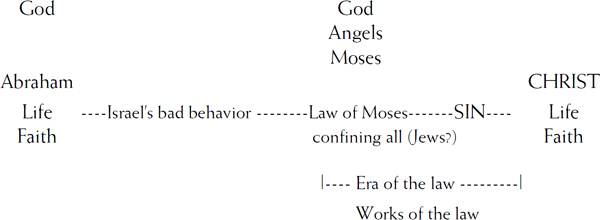
The next three verses (vv. 23–25) outline Paul’s explanation of the function of the law. He largely restates what has been said before about both the purpose of the law and its time limitations, but this time he uses other terms. He deals with the time elements (v. 23), the effect of the law (v. 24a), and its result (v. 24b). The conclusion of the entire section concerns the suspension of the law (v. 25).
First, Paul speaks of the time elements of the law (v. 23). At verse 19 Paul had said that the law was to “reveal sin” until the Seed had come; now he says the same thing but uses different expressions for both elements. Instead of “Seed,” Paul uses “faith”; instead of “revealing sin,” Paul uses “held prisoners.” But there is no essential difference in what he is saying. The law reveals Israel’s sinfulness and, in effect, holds Israel as prisoner. The “Seed” is Christ, and when Christ comes it is the era of faith. While some readers might think that “faith” here is the personal response of an individual, that is not what Paul means. He is now talking about the era of faith as eclipsing the era of “works of the law,” just as the era of the law is superseded by the era of Christ and the Spirit. To do the “works of the law” is to live in the wrong era.
Second, he addresses the effect of the law (v. 24a). The law held those under it (probably Jews) as prisoners and locked them up. What this means8 is that “the law was put in charge to lead us.” This latter expression is a free translation of what literally translates, “the law has become our pedagogue [Gk. paidagogos].” A “pedagogue,” while sometimes used to describe a positive image, here describes the law’s confining and imprisoning work—as is seen in verse 25, where we are no longer under the pedagogue (that verse parallels the law’s imprisoning work of vv. 22–23), and in 4:2–3, where the time under a pedagogue is compared to a time of children being enslaved. Thus, the effect of the law was that it was an imprisoning pedagogue eis Christon (“unto Christ”).
This last expression has two possible meanings, the differences of which are great. The first takes it in an educative function: “the law was our pedagogue to lead us to Christ.” This view is a common, traditional view, which sees the law as pointing out our sins so we will cry out for God’s grace in Christ.9 But besides the fact that Paul is not talking here about “individual experience” but rather about “salvation history,” he does not teach in Galatians that this is the purpose of the law. True enough, Paul does teach that the law “reveals sin” and “imprisons,” but he does not say that it does these things to “lead us to Christ” but to condemn us. The second view is therefore to be preferred: “the law was our pedagogue until Christ.” This view is not only the majority view today but is also contextually more compatible.10 The line of thinking about the law in verses 19–25 is temporal: the law had a limited function (revealing, imprisoning) for a limited time (until the Seed, until Christ). Notice the time dimensions: “until the Seed” (v. 19), “before this faith came” (v. 23), “until faith” (v. 23), “now that faith has come” (v. 25). Our text only makes sense if “to Christ” means that the law had a confining ministry until the era of Christ came.
Third, Paul turns to the result of the law’s effect (v. 24b). The word order of the Greek sentence is important in order to gain Paul’s point: “that on the basis of faith we might be justified.” All of Paul’s argument assumes that the Judaizers agree that justification begins with faith in Christ; they also mistakenly assume that the “works of the law” perfect that faith. But now that Paul has shown that the law pertains to a limited time, he can say that justification is solely by faith because “works of the law” now pertain to a bygone era.
Finally, Paul draws it all together by speaking of the suspension of the law (v. 25). His words in this verse are strong. He claims that the era of Christ eclipses the era of Moses because the era of Christ is the climax of the promise of Abraham. The law had a limited purpose, and this purpose was only for a limited time—until the Seed had come. The expression “under the supervision of the law” once again translates the term paidagogos (“pedagogue”). As in verse 24, this term here does not define a positive role for the law. Rather, it refers once again to the “condemning” and “imprisoning” function of the law (cf. vv. 22–23). So, in effect, Paul says that once faith came, the law could no longer condemn us. Why? We can only reason that it is because Christ (who starts the age of faith) absorbed the curse of the law (cf. vv. 10–14).
To use Paul’s words, I now use “an example from everyday life” (v. 15). I often compare the role of the law in history to the role typewriters have played in the development of word processing. The technology and idea of a typewriter was eventually developed into an electronic, faster, and far more complex computer that does word processing. But when typing on a computer, one realizes that one is still using the old manual typewriter’s technology. Further, one realizes that the computer far transcends what the typewriter was. Everything that a typewriter wanted to be when it was a little boy (and more!) is now found in the computer. This compares to the law. Everything the law wanted to be when it was young (as revealed to Moses) is found now in Christ and in life in the Spirit. Thus, when a Christian lives in the Spirit and under Christ, that Christian is not living contrary to the law but is living in transcendence of the law. And it is for this very reason that life lived primarily under the law is wrong.
When the computer age arrived, we put away our manual typewriters because they belonged to the former era. Paul’s critique of the Judaizers is that they are typing on manual typewriters after computers are on the desk! He calls them to put the manual typewriters away. But in putting them away, we do not destroy them. We fulfill them by typing on computers. Every maneuver on a computer is the final hope of the manual typewriter. “Now that faith/Christ has come, we are no longer under the supervision of the law”—but not because the law is contrary to the promises; rather, it is because the law is fulfilled in Christ and the Spirit in a manner similar to the way a typewriter is fulfilled in the technology of a computer. And I am profoundly thankful for both!
Put together, Paul argues that the Judaizers are wrong (and those Galatian Christians who follow them) because they do not understand why God gave the law. They do not know that it was designed to turn Israel’s bad behaviors into transgressions of God’s law. Nor do they know that it was given for only a short period; we might talk here about the “parenthesis of the law.” Consequently, they do not know that everything for salvation and acceptance with God is established in Abraham. Consequently, they do not know that imposing the law after Christ has come is a gross stepping back in God’s plan of redemption to a previous era. It is B.C. lifestyle in an A.D. period. Essentially, Paul’s argument against the Judaizers is historical and biblical: they do not understand what God’s plan of salvation was all about as he progressively revealed himself, beginning with Abraham and continuing with Moses until Christ (see also Rom. 6:11–14; 7:7–13; 11:25–32; 2 Cor. 3:7–18; Phil. 3:2–11).
Bridging Contexts
THE BEST PLACE to begin is with Paul’s conclusion: “We are no longer under the supervision of the law” (v. 25). As I stated above, “supervision” here refers to the imprisoning ministry of the law. I think this statement is similar to Paul’s statement, written a few years later, to the Romans: “Therefore, since we have been justified through faith, we have peace with God” (Rom. 5:1). It is also similar to Romans 8:1–2: “Therefore, there is now no condemnation for those who are in Christ Jesus, because through Christ Jesus the law of the Spirit of life set me free from the law of sin and death.” Those who trust in Christ are immune from the curse and condemnation of the law. Its “pedagogical” (imprisoning) role has come to an end with the arrival of Christ.
The obvious implication of the suspension of the law for Galatians is that the Judaizers are doubly wrong: not only have they misunderstood the purpose of the law (it was to reveal sin, not give life), but they have also not understood that it now pertains to a bygone era. Thus, the concern of Paul is once again established: we gain our identity before God on the basis of our faith in, and faithfulness to, Jesus Christ, not on the basis of our conformity to Mosaic law. This can be moved into our world quite simply, as we have done so frequently in this commentary. Yet another argument against legalizing movements and concerns in the church today is that the era of the law is over. Since we have worked the theme of legalism in the world and churches today so often in the previous pages, it would be good for us to move our applications here in a slightly different direction. What I will do in our “Bridging Contexts” and “Contemporary Significance” sections is to explore the significance of the suspension of the law for moral life today.
The tendency here is extremes. It is frequently stated that Christians are not under the law, but there are Christians who think they must reconstruct the world on the basis of Old Testament law.11 But in what sense are Christians not under the law? Are Christians exempted from the law being a preliminary sketch of God’s moral will? Or are they exempted from it being their sure guide to a noble life before God? We should note that Paul never excuses Christians from disobeying the law because they are not “under the law.” Instead, Paul expects Christians to live the law by living “under the Spirit” (v. 18). Jesus taught something similar for his followers (Matt. 5:20; 7:12; 22:34–40). So being freed from the law does not mean being freed from every purpose, use, or implication of the law of God. Furthermore, it is clear from the numerous quotations from the Old Testament found throughout Paul’s letters (as in Gal. 3:6–14) that Paul does not think the law is suspended in every sense. The law remains authoritative for him, and he quotes it as the foundation of his arguments.
So as we move to our world with Paul’s statement that now that faith has come we are no longer under the law, we know that the law has not been destroyed and annulled. Rather, it is no longer the primary arrangement for acceptance with God, and it is no longer a means of separating Israel (the people of God) from other nations in some exclusive sense. The law is not the “contractual obligation” under which the Christian lives. It was not designed to give us life before God (v. 21). But it remains valuable—highly valuable—for our clarification of ethics, as long as it is understood in light of what Paul teaches about its fulfillment (Rom. 10:4), the “law of Christ” (Gal. 6:2), and the impact that the Holy Spirit has on our relationship to the law (cf. chaps. 5–6).12
Furthermore, any reasonable reader would agree that Paul’s statement that the law “was added because of transgressions,” meaning “it was added to reveal transgressions” (see above), remains a continuing function of the law. If the law is holy and good (Rom. 7:12), then it follows that it still reveals God’s will, albeit not the fullness of that will. And if it reveals his will, then it will reveal sin. And if, in addition, the law has been given by God to increase sinfulness to God’s people (cf. Rom. 5:20), it most likely will continue to do so. I think, then, that while the law has been suspended as a “contractual obligation” or as the “covenant between people and God,” it has not been suspended as a preliminary statement of God’s will, nor has it been suspended as a moral check on all human behavior. To revert to my typewriter-computer analogy, when we use a computer we are conscious that what is before us is a typewriter nonetheless (even if it is much more). It is a development of that typewriter, but it is the typewriter that has been developed. So I believe the law retains its functions of (1) giving us a sketch of God’s moral will for us and (2) convicting people of their sin. But how these two uses of the law work themselves out for people who are filled with God’s Spirit is even more important; I will touch on this issue below and later at 5:16–26. General conclusions in Paul’s letters must be understood in such a way that they do not conflict with the message of Paul and the Bible.
Once again we are confronted by a text whose primary purpose was to speak to a Jewish problem, the problem of being under the law. This was not a problem for Gentiles since they neither knew the law nor lived under it the way Jews did. It was Jews who raised the questions about the purpose of the law in history and how the law relates to the Abrahamic promises. Jewish privilege seemed to be undermined (cf. Rom. 3:9–20; 9:1–5). But we have two points to make in defense of the view that the law of God, and specifically its purpose of condemning people as sinful, is just as applicable to Gentiles as it is to Jews.
First, I made a point earlier that Gentiles have the law written in their hearts (see Rom. 2:14–16). Thus, at some level, they are also responsible to God’s moral will. Now it may not be clear precisely what they know about God’s law, but it is clear enough from Paul that they know enough to get in trouble. “Hence, even though the Gentiles do not have the law publicly given to Israel, they have it in all essentials privately.”13 Our point remains valid here. If the law was designed to reveal sin, then it follows that, to the degree that Gentiles know God’s law in their hearts and consciences, their sins also have been revealed. Second, Paul says in verse 22 that “the whole world is a prisoner of sin.” This expression “whole world” is a translation of ta panta (“the everyone/everything,” “the whole world”), and the majority of commentators think this describes not just Jews but “everyone in the world without distinction.” So while it is reasonable to think that really only Jews are under the law, it still follows (for reasons Paul does not say here) that “everyone” has received the law’s sentence of condemnation for not following it.
These two reasons allow us to say that it is fairly natural for us to think that all humans have sinned, whether they have transgressed God’s written law (which they have heard in the Bible somehow) or God’s law written in the human heart. If we add, on top of this, the inflaming conviction of God’s Spirit (John 16:7–11), then it is also clear that we have every right to think that most humans know they are sinful (whether they suppress this or not). This is a great platform on which to build evangelism.
Contemporary Significance
ONE OF THE most significant implications of these verses is the conclusion that God’s law (meaning the law of Moses—primarily Exodus, Leviticus, and Deuteronomy) has been in some sense suspended for the Christian. The Mosaic law is a preliminary glimpse of God’s will for his people. How then do we work out moral problems today in light of this view of the law? Perhaps we could try to work out a moral problem in the light of what we know about verses 19–25.
First, Christians must begin with two assumptions: (1) that faith is the response God wants of us if we are to be accepted by him and that this faith works itself out in obedience;14 and (2) that life in the Spirit (under the Spirit) is our primary mode of operation as we seek to live obediently before God. This has an important corollary: Christians who are seeking God’s will do not turn first of all to the law of Moses for direction. Instead, they listen to God’s Spirit and to the teachings of Jesus (“the law of Christ”; see 6:2); both of these teach them that they are to “love God” and “love others.” In following the Spirit and Christ, the Christian will always do what the law tried to tell them what to do. Thus, they will actually do God’s will.
What if there are no directions in the New Testament, and what if the Spirit does not seem to speaking with clarity? This question about the Spirit deserves some discussion. I want to begin by saying that few Christians today believe that the Spirit of God is the central focus for Christian ethics. I believe, in fact, that Christians treat the New Testament more like a second Mosaic law than as a witness to God’s Spirit leading his new people. Paul saw the Judaizers as “law-centered,” and he wanted a church of people who were “Spirit-centered.” But we cannot be detained by this perspective, since we are assuming that Christians do believe in the Spirit’s guidance, can follow it, and will do what God’s Spirit says.
I continue the question asked above. What if the New Testament teaching and the Spirit’s prompting seem to conflict with the law of Moses and the witness of the books of Moses? How then do we operate? I could go on and on about principles of moral conduct, but it is probably best for us to proceed by working through the biblical evidence for a specific example, for in that way the newness of Paul’s ethic is seen more clearly. So we shall look at one test case—how Christians today should participate in international warfare.15
The main question is: Should Christians go to war? It is not my purpose here to resolve what has become, at times, a bone of contention among Christians (though if I could resolve the issue once and for all, I would). My purpose here is more limited. I want to examine how we make such a moral decision as Christians in light of Paul’s view that the law has been suspended. In other words, we are concerned here with method and not with answers, though some answers will be suggested. Because of the need to illustrate the complexity of moving from the Old Testament into our world, I will need to spend more time on this issue than would otherwise be done.
I begin with a partial sketch of how this moral issue is treated today in evangelical churches. Fortunately, there is no impending war that could cloud our thinking on the issue. Unfortunately, however, too many conservative Christians have infrequently taken this issue as a serious one. Certainly life is precious, and the taking of another person’s life is a serious act with lifelong consequences for the one who takes that other person’s life. Murder itself is prohibited by God (Exod. 20:13) and no Christian would want to be involved in murdering another person. While I am not necessarily arguing that bloodshed in war is murder, I do believe we can agree that murder is wrong and so the taking of another person’s life must be treated as a moral issue.
Once again, unfortunately, in the last fifteen years in the United States particularly, patriotism has become connected to the center of Christianity for many people. Though I believe that it is good to be patriotic, to submit to our governing authorities, and to pray for them (so Rom. 13:1–7; Titus 3:1; 1 Peter 2:13–17), I also believe that patriotism at times has to bow to submission to God’s will (Acts 4:1–22). So we need to think about how Christians are to respond to international conflict, not just “fall in line” with the government. There may be times when we will agree (and go to war) and times when we will not (and become conscientious objectors). Regardless, we must think through the issue before God and ask what he would have us do.
One final point: economical advantage in the Western world is not the sole foundation for making a decision about international conflict. Ours is a materialistic world, and I hope everyone agrees with me here. Indeed, I am not sure that we are all as aware as we ought to be of how economically driven and motivated our political and international decisions actually are. There have been those who have argued (forcefully at times) that some, even most, of U.S. involvement in international conflict has been exclusively motivated by self-interest in economical matters. I am one who thinks that such concerns often motivate our government; I am also of the view that economical concerns are not necessarily bad. What we need here is Christian thinking on the matter. When our government decides that international conflict is appropriate and necessary over a certain issue, then it is fundamentally important for Christians to determine whether or not they will be involved for such a motivation. Perhaps at times Christians will decide to go to war (just war theory) and at other times not. What we must do is make that decision before God on solid biblical grounds, not just for personal economical advantages.
I see four basic approaches that Christians have taken. What I mean here is not four positions, but four ways of making decisions about Christian involvement. The first approach seeks for the texts about patriotism, usually limited to zeal, and the pursuit of justice in the whole Bible (e.g., Num. 25; Joshua–Judges; 1 Kings 18–19; Rom. 13:1–7; 1 Peter 2:13–17), and contends that, since the Bible enjoins the people of God to be patriotic and to pursue justice, then Christians should be and do the same; this means participating in war. It is obvious that some major leaps are involved in this move from Bible times to the twentieth century. To name but three considerations: (1) Patriotism to a nation that is theocratic (as Israel was) is much different than to a nation that is secular and democratic. (2) The texts that speak of “submission” to government are spoken in contexts of peace and by people who, at times, were willing to disobey government (e.g., Peter at Acts 4:1–22); thus they should not be taken as blanket endorsements of governing authorities. (3) Why patriotism means willingness to go to war and do combat is not clear. Is there perhaps some other way of being patriotic? How, after all, is a Christian patriotic? Some Christians, as most readers would know, refuse to swear an oath of allegiance to any “flag” since their only allegiance is to Christ. In spite of some important points raised by this approach to the whole issue, patriotism is too narrow of an angle on the biblical evidence, and there are too many ill-defined maneuvers here.
A second approach has been to examine Old Testament texts on war as the critical biblical evidence. As might be expected, three conclusions have followed. (1) For some, the Old Testament evidence on war (e.g., Deut. 7; 20; Joshua–Judges; 1–2 Samuel)16 leads them to think that God initiates wars, guides them, and stands behind the victors; thus, war must not be seen as immoral. Since the God of the Old Testament is involved in wars and since the Christian God is the same God, then it follows that Christians can also be involved in wars. Usually this means there is a demand to be discerning of which side God is on and which side is right, and then participating on that side (just war theory). (2) Others contend that Christians must encourage a more enterprising approach: they may have to be on the side of an aggressive government that is making the world more just and equitable (crusade/preventive war theory). (3) Still others have contended that Old Testament wars, while they certainly existed, are unlike any kinds of wars fought today because the wars of Israel were actually spiritual wars fought by the Lord himself.17
This approach to the issue of war deserves some response, though I can give such only briefly here. First, I commend this approach for tackling what I believe to be some of the most important evidence that has to be considered: the Old Testament texts describing not only warfare but God’s initiation and support of such. But, second, I must admit that this is where a Christian approach to the matter is fundamentally important. While it may be true that God participated in war in the Old Testament period, what is the responsibility of Christians in the New Testament period (our era)? It is interesting (and perhaps illuminating) that no one in the New Testament is a known warrior for Israel, and no one is known for military violence as a Christian. In fact, church historians are generally agreed that early Christians only at the end of the second century A.D. became involved in the militia of Rome, and then with censure from some.18 To step back in our argument, we still need to address the issue of how we relate Old Testament concepts of war to New Testament concepts of “following Jesus” (who did not fight in a war) and “life in the Spirit.”
A third approach has been to examine biblical texts on peace and peace-making, make them operative and dominant, and then argue that Christians must live in a peaceful way. Of course, texts that have been given priority are Matthew 5:9, 38–42 and the records of martyrdom (e.g., Acts 12:2). Once again, there have been only a few basic options: (1) pursuing peace means denouncing every involvement by the Christian in war (pacifist view); (2) pursuing peace means nonviolent forms of involvement (modified pacifism, or nonviolent resistance, or nonresistance view), or (3) pursuing peace means military build-up (peace-through-strength view). But once again, approaching the matter this way is stunted. Who is to decide that the approach is exclusively through the idea of peace? Does seeking peace (Matt. 5:9) imply no participation in military? Was that in Jesus’ mind at all? And, how can people who believe in the Bible decide simply to omit the Old Testament evidence for war? Once again, we are confronted with a significant problem in the way we approach the whole question.
A final approach I will call the individualism approach; this one is so much a part of Western culture that Christians have unknowingly accepted it without thinking about its long-term impacts. This view simply says that participating in war is up to the individual who must make a decision before God and is accountable before God for his or her decision. This approach is both very modern, where blanket toleration and pluralism are rampant and where moral absolutes are usually denied, and quite unbiblical, because it seeks to let the person become the sole authority and refuses to let the Bible speak where it can. How do we get out of all of this?
I make several suggestions in the paragraphs that follow that are (1) based on the view Paul has of the priority of the Abrahamic covenant over the Mosaic law and the new covenant as the climax of the Abrahamic covenant, (2) rooted in evidence of all sorts, and (3) ultimately reliant on the view of Paul that Christians live “under the law of Christ” and “in the life of the Spirit.”
First, it is fundamentally important that the Christian base his or her lifestyle entirely on faith in Christ, obedience to Christ, and life in the Spirit. This means that Christians do not go first of all to the Old Testament texts to find God’s will. They are not bound to Mosaic law, even if they are bound to God’s will. Jesus promised a Counselor who would guide (John 14–16), Pentecost fulfilled that promise (Acts 2), and Paul showed just how the Spirit was to operate (Gal. 5). Jesus also taught his disciples to “fulfill” the law by loving God and loving others as the sure tests of that obedience (Matt. 22:34–40; cf. 7:12). This is where the Christian begins: with obeying Jesus in loving God and others, and with submitting to the Spirit.
May those, then, who submit to the Spirit and follow Jesus involve themselves in international conflict? This is a good question, one that Christians must spend time discussing. How does the cross of Christ fit into God’s overall design for the Christian’s essential lifestyle? Is it not the case, perhaps, that “self-denial” (exemplified in the cross of Christ) is the fundamental norm of Christian living? We need to consider this more than we have.19
Second, I would also suggest that the newness of the age of Christ and his gift of the Spirit renovates the Old Testament theocratic kingdom and functionally eliminates the Old Testament passages on war as paradigms for Christian activity.20 I believe this is an implication of Paul’s teaching on the law (which prescribed how Israel was to engage in warfare and how the Lord would be behind Israel) and of how it has been suspended by, and fulfilled in, Christ. The message of Galatians is that God works with all kinds now, that God is no longer operating in a nationalistic sense, and that God’s people are comprised of all those who believe, whether Jew or Gentile. I believe that this universalism means that God is no longer exclusively behind one nation.
This means that Old Testament principles of how God stands behind Israel (his times against Israel were designed to provoke Israel to repentance, not to vindicate other nations) are suspended as well, since God is no longer behind one nation. In other words, the message of universalism in Galatians effectively suspends the biblical concepts operating behind the concept of war (Israel is God’s nation and God therefore fights for Israel). What we are getting at here is one possible implication (I do not pretend to think I am absolutely correct here) of the “suspension of the law” according to Galatians 3:25 and how it might apply to the Christian who is struggling over how to participate in international conflict.
Third, the Christian’s first priority in life is to follow Christ, evangelize the world with the good news of God’s love in Christ (as Paul did), and live a life of submission to the Spirit. What I find in the pages of the New Testament is no trace of military activity as evidence of the Spirit and no trace of military activity as evidence of following Christ. Does this mean that all participation in international conflict is unchristian? It is my view, which I humbly submit to you, that Christians can be involved in international conflict only as an extension of God’s calling in their life to follow Christ, to live in the Spirit, and to evangelize the world, and, furthermore, only in ways that are consistent with the cross of Christ and the revealed will of God.21
Does this exclude violence and warfare itself? I believe so. How can Christians put to death others for whom Christ has died (who are not believers), and how can any Christian put to death a fellow believer? In the latter case it would be to render to Caesar what is clearly God’s; in the former, it would be to render to Caesar what may become God’s. We have no way out. Behind this position is the universalism taught in the book of Galatians which, I submit to you, erodes the social barriers that are erected in times of international conflict.
We have moved a considerable distance from Paul’s message of justification by faith, which he proved by appealing to the priority of the Abrahamic covenant. While the most important implication of our passage is that justification is by faith and not by observing the law, we also saw that Paul was operating with an entirely new reading of the Bible that “put the law in its place.” Our movement from that world into our world concerned itself in this passage with this notion of Paul’s about the law. We have argued that Paul was quite radical in this regard and that we as Christians need to explore its implications. I have attempted one such exploration into the field of the Christian participation in international conflict. May God guide us, through his Spirit, as we seek to live today as followers of Jesus!