Original Meaning
Abram’s and Sarai’s Decision and Its Outcome (16:1–16)
HAGAR’S ROLE. The problem is portrayed clearly in the opening verses: Sarai has not borne any children for Abram. Consequently, this situation brings the covenant into jeopardy. How is it to be resolved? It is Sarai who makes the suggestion of a way that Abram can have a son as the Lord has promised. It seems an unusual course of action to us since it follows an option that our society does not consider appropriate. But in the context of the ancient world, this was not only appropriate but at times contractually dictated. Marriage contracts from the town of Nuzi in the middle of the second millennium B.C. stipulate that if the wife turns out to be barren, she should provide the husband with a surrogate child-bearer. The pertinent section reads:
If Gilimninu bears children, Shennima shall not take another wife. But if Gilimninu fails to bear children, Gilimninu shall get for Shennima a woman from the Lullu country (a slave girl) as concubine. In that case, Gilimninu herself shall have authority over the offspring.1
This same contingency is mirrored in an Old Assyrian marriage contract:
Laqipum took (in marriage) Hatala, the daughter of Enishru. In the country Laqipum shall not take (in marriage) another (woman), (but) in the city (of Ashshur) he may take (in marriage) a priestess. If within two years she has not procured offspring for him, only she may buy a maid-servant and even later on, after she procures somehow an infant for him, she may sell her wherever she pleases.2
This practice extended throughout the preexilic period, so it would have been familiar to the Israelite audience. The resulting friction between the two women is not difficult to predict. Bearing children is a sign of God’s blessing, both culturally and in the context of the blessing of Genesis 1, first demonstrated here by an Akkadian prayer to the moon god and then one of the biblical psalms:
Without you scattered people are not brought together.
Where you command so the scorned one gives birth to children.
You grip by the hand the fallen one who is debilitated.
You cause the weary to receive an honest and just judgment. Whoever has no son you give him an heir.
Without you the childless one can receive neither seed nor impregnation.3
He raises the poor from the dust
and lifts the needy from the ash heap;
he seats them with princes,
with the princes of their people.
He settles the barren woman in her home
as a happy mother of children. (Ps. 113:7–9)
The inference that follows inversely from Psalm 113 is that the inability to bear children was seen as a punishment from God. That the privilege of bearing was in the hands of God is clear in Sarai’s statement that the Lord had kept her from having children (Gen. 16:2). Infertility also had the potential of causing a woman social difficulties. It was bad enough that people would generally consider her accursed, but in many cases her condition would serve as cause for her to be divorced, and it was small comfort that her dowry would be returned to her.4 Van der Toorn aptly summarizes the resulting stress.
The woman who remained childless not only ran the risk of being disdained, or worse, repudiated by her husband and in-laws, she also incurred the suspicion of indecent behavior. The gods surely had to have their reasons for withholding children. Consequently, we may safely assume that newly-wed who, as time elapsed perceived no signs pointing to pregnancy, was overcome by panic. Her fear undoubtedly doubled her piety.5
Sarai’s fear additionally doubled her sensitivity. Hagar’s spite and feeling of superiority came from her confidence that a deity had blessed her and that Abram was now dependent on her since she carried the heir to the family in her womb. No wonder she considered herself to have attained privileged status. Sarai’s accusation against Abram is that, apparently in his delight at becoming a father, he has neglected the necessary steps that would keep Hagar remembering her appropriate place within the household.
When Abram puts the matter in Sarai’s hands to show Hagar her place, the results are again predictably disastrous. In a reaction that was counterproductive to the desire to vouchsafe an heir, Sarai’s mistreatment of the girl drives her to desertion. The customs regarding this situation are reflected in Hammurabi’s law collection, where the servant who has fulfilled the role of surrogate mother enjoyed only a modicum of protection from the ire of her mistress.
If a man marries a priestess, and she gives a slave woman to her husband, and she (the slave) then bears children, after which that slave woman aspires to equal status with her mistress—because she bore children, her mistress will not sell her; she shall place upon her the slave-hairlock, and she shall reckon her with the slave women.6
This situation now represents triple jeopardy. (1) The covenant promises are in jeopardy because of the absence of the true heir. (2) An attempt at resolution of the initial jeopardy creates the second jeopardy of a son who will be a competing heir. (3) The makeshift heir is now in jeopardy of being lost to Abram and Sarai before he is even born. Only this last is known to Abram; the other two stand as jeopardy only from the perspective of the informed reader.
Hagar’s flight. Obviously, Hagar is fleeing back to her homeland. The text does not indicate how long she traveled before being confronted by the angel (she is by the road to Shur, not in Shur). Shur is located in the northern region of the Sinai peninsula. An east-west route runs through the region that connects Egypt to the King’s Highway in Transjordan at Bozrah, or leads up into Palestine through Beersheba. Shur means “wall” in Hebrew, so it is possible that this term refers to the well-known Egyptian line of fortresses in this region.
This conclusion is supported by Numbers 33:8, where it is associated with the desert of Etham (Etham = fort). The site of Beer Lahai Roi is in the vicinity of Kadesh (Gen. 16:14), most likely northwest of Kadesh on the Wadi el-Arish. If Abram’s camp is still in Hebron, she has traveled about seventy miles through inhospitable territory, pregnant and apparently alone. This means she has been on the road at least a week.
The “angel of the LORD” makes his first appearance in Genesis in 16:7. The word translated “angel” simply means “messenger” in Hebrew and can be used for either human or supernatural messengers, though the latter is far more frequent and is undoubtedly the case here. A more detailed study of the angel of the Lord will be presented in the Bridging Contexts section. The message of the angel shows distinct covenantal overtones in making reference to a numerous seed. But we must keep in mind that that clause in the covenant itself reflects a previous theme of God’s blessing on all humanity. She is going to be fruitful and multiply.
The pronouncement in 16:11–12 also includes motifs of patriarchal pronouncements by addressing relationships (cf. 9:25–27). It starts with a birth pronouncement, similar to that found in Isaiah 7:14. The name is given as a reminder of God’s response to her suffering at the hands of Sarai. A more common circumstance for giving such a name would have been as the response of a barren woman. Verse 12 does not sound at all positive. Moses undoubtedly found in it an accurate description of the Bedouin lifestyle of Ishmael’s descendants (see 25:18).
Hagar affirms a supernatural identity for the messenger and may well believe that the messenger was indeed a deity, but we would expect little in terms of spiritual insight or discerning subtleties from an Egyptian slave girl. The fact that she expresses incredulity about the likelihood of having seen deity does not mean that she has seen one (additionally, the text is difficult to translate and may not even suggest this much).7 Most likely Hagar is expressing surprise that she has encountered in such an unlikely place a deity inclined to show favor to her.
The narrator identifies the deity as “the LORD” (i.e., Yahweh) but gives no indication that Hagar knows the deity is Yahweh. This is the only example in the Old Testament of someone assigning a name to deity. Usually naming someone or something is a way of affirming authority over the one named. Here it is more likely that since she does not know the name of the deity who has shown her favor, she assigns a name to him as an identification of his nature, so that she may invoke that name in the future.8
Bridging Contexts
PURPOSE OF GENESIS 16:1–18:15. Again we find God in the business of removing obstacles; Genesis 16 sets up certain obstacles, while chapters 17–18 remove them. It is important to observe that in chapter 16 Abram and Sarai believe they are hurdling an obstacle, when in reality they are creating an additional one. Once Ishmael is born, they believe that their childlessness is no longer an obstacle. The heir has been born. Just as Abram did not see Lot as an obstacle to the land, he no longer sees Sarai’s barrenness as an obstacle to a family, and he does not see Ishmael as an obstacle to the covenant. In fact, he sees Ishmael as a solution.
The author then shows how God goes about removing the obstacles of Sarai’s barrenness in his way and of Ishmael’s claims to the land as Abram’s heir (competition to Isaac). As he removes the obstacles, there is also advancement in the covenant as the promises are restated, a sign is established, and a true son is promised.
The Hagar option. The ancient world did not understand that conception was the result of male sperm fertilizing the female egg. They simply thought that the male deposited the seed in the woman, who then acted as an incubator for the child. They certainly had no understanding of genetics, though they undoubtedly realized that often children had characteristics of the mother. Nevertheless, one incubator would do as well as another. We have already established that this was a legitimate option in society of the time, but does it suggest a lack of faith on Abram’s part?
It is difficult to sustain a case against Abram on that count. He has been told in 15:4 that the heir will be his biological son, and the Hagar option does indeed give Abram a biological son. Abram suffers as much from lack of specific information from God as we sometimes experience in our decisions. Is he trying to “help God out?”—perhaps in a way, but mostly he is just trying to consider all the options. God has not indicated precisely how he will secure an heir for Abram.
This is one of those cases where we can go far astray by trying to infer a course of action from Abram. If we conclude that it was wrong of Abram to “get out ahead of the Lord” instead of “waiting on the Lord,” we may find ourselves sitting on the sidelines for a lifetime waiting for God to act when in reality he is waiting for us to move forward in faith. If we conclude that Abram’s experience teaches us to be proactive in designing creative courses of action, we may find ourselves straying far from God’s will. The text does not offer sufficient evaluation of Abram’s actions in chapter 16 for us to adapt them and incorporate them into our lives as biblical teaching for our own behavior.
Who is the God of Abraham? When reading through the book of Genesis, one may wonder why I ask this question. The personal name Yahweh (“LORD”) is used frequently. The patriarchs address God by that name, and God identifies himself by that name. The problem does not surface until Exodus. At the burning bush Moses asks what name he should give for the God who is sending him—even though God has already identified himself as the God of Abraham, Isaac, and Jacob (Ex. 3:6–13). In verse 15, the name Yahweh is introduced and seems to some interpreters that God is giving a new name not previously revealed.
The situation is made worse in Exodus 6:2–3, where God says to Moses, “I am Yahweh; and I appeared to Abraham, Isaac, and Jacob as El Shaddai, but by my name, Yahweh, I did not make myself known to them” (pers. trans.). Verses such as these have led some to postulate that the occurrence of Yahweh in the patriarchal narratives is simply the work of the editor of Genesis (be it Moses or someone else) showing the continuity between the patriarchs and later Israel.
Critical study has focused on how each of the supposed sources of the Pentateuch has idealized or reconstructed the religion of the patriarchs, believing for the most part that it is impossible to do anything else. Therefore, scholarly discussion of patriarchal religion has often been premised on source criticism. It is admitted by the critics that each of the sources of the Pentateuch affirms that Abraham at least worshiped the same God as Moses. These critics are satisfied to think, however, that this homogeneity was the result of theological retroversion by the editors and that contradictory evidence buried in the strands and layers of the text betray anachronism in attributing worship of Yahweh back as far as Abraham.15
The key to arriving at sound conclusions is a careful study of the names for deity used in the book. In the patriarchal narratives these fall into three classifications:
1. The El titles (El Bethel, El Olam, El Elyon, El Shaddai, and El Roi)
2. The God of the fathers
3. Yahweh
Our next step is to examine each of these to see what contribution it makes to our understanding of the religion of the patriarchs.
(1) The El titles. The seminal work on the religion of the patriarchs is an article by Albrecht Alt entitled “The God of the Fathers” written in 1929. Alt was of the opinion that El Olam, for instance, ought to be translated “the god Olam” and that he, along with the others, was originally one of the local Canaanite deities typically attached to a sanctuary at a specific location. Also in 1929 came the astounding discovery of ancient Ugarit made at Ras Shamra, shedding much more light on the religion of the Canaanites.
In the intervening decades, much has become known about the Canaanite deity El, who was head of the pantheon. He is also prominent in Old Akkadian texts and Amorite personal names. Since it is also found in Old South Arabic, this divine proper name can boast representation in each of the major branches of the Semitic languages, suggesting that it may have belonged to the common stock of proto-Semitic.16 Some scholars, such as M. Haran, infer from this that the El titles preserve the legacy of an original Hebrew pantheon.17 More common is the view promulgated by F. Cross, that these names are all epithets used for the god El, whom he considers to have been the god worshiped by the patriarchs.18 Cross sees this as confirmed by the fact that some of the El names occurring in the narratives of Genesis can also be found in Ugaritic material. He therefore translates these titles as, for example, El the eternal.
It should also be noted that the use of the El epithets is limited in the patriarchal narratives. El Olam is used just once (21:33); El Elyon is used only in the conversations with Melchizedek and the king of Sodom (14:18–22); El Roi is not used by the patriarchs but by Hagar (16:13); El Bethel is used in connection with Jacob’s commitments at Bethel (31:13; 35:7); El Shaddai is used more frequently (five times)—we will return to this name later.
(2) God of the fathers. Alt considers the “God of the fathers” concept as a much more significant element than the El titles. His study is based on parallels he saw in titles for deity in Nabatean materials from the first couple of centuries A.D. He portrays the patriarchal narratives as cult sagas that describe the gradual combining of originally independent clan deities into a single “God of the fathers.” He considers this resulting clan deity as anonymous and not associated with any geographic cult center.
Further data has again shown that Alt’s conclusions were incorrect. Similar epithets occur in Cappadocian tablets from the Assyrian colonies in Anatolia in the nineteenth century B.C. The “god of my father” was sometimes unnamed, but it was connected also to deities such as Ilabrat or Ishtar. It is also found once in the Mari texts, and Amarna texts several times refer to Shamash as El.19 While it should not be doubted that the epithet makes reference to a clan’s deity, there is no reason to dissociate the God of the fathers from the El titles or from Yahweh. There is nothing inherent in the epithet that requires editorial reconciliation.
(3) Yahweh tradition. While some have viewed Yahweh as a deity native to Israelite tradition (at times viewing Moses as the initiator), it is more common in modern critical scholarship to suppose that the Israelites borrowed the deity Yahweh from another group, from whence he was transformed into the deity known in Scripture. Usually the nomads of the Sinai region or the region of Kadesh Barnea are considered to be the ones who passed Yahweh on to the Israelites. Often Jethro, Moses’ father-in-law, is considered instrumental in that transmission, based on some of the information in Exodus 18.
Alternatively, Cross has suggested that Yahweh was originally a cult name for El. Much of this discussion concerns the grammatical form and the meaning of the name Yahweh.
There seems to be no valid reason to doubt that Yahweh is a primitive divine name, the verbal (hypocoristic) element in a liturgical epithet or sentence name.20
The accumulated evidence thus strongly supports the view that the name Yahweh is a causative imperfect of the Canaanite-Proto-Hebrew verb hwy, “to be.”21
Cross therefore suggests that Yahweh was originally Yahweh-Il, meaning, “Il creates.”22 Names such as this are in evidence in the onomastica from Mari.23
Cross’s explanation does not require that Yahweh be viewed as a deity borrowed from a West Semitic pantheon. El/Il is the generic term for deity in Semitic languages.24 Rather, the name designates the deity by his most outstanding attribute. If Cross is right in seeing a causative verbal element in the name Yahweh, there may be a parallel here to the use of the Akkadian verb banu, which is used in names to describe the personal god’s engendering relationship to his protégé. It describes not so much a concept of actual birth as it does the initiating of a relationship. The sentence name Yahweh-Il then designates “a God who creates” in the sense of “a God who enters a personal relationship.”25 This may be a rather generic epithet for a personal god, but it may also lay the foundation for the key concept of a covenant God, for this engendering becomes synonymous with choice (= election).
The name Yahweh for the Israelite God is fairly well attested outside the Old Testament. The name occurs on the Moabite stone, in the Arad Ostraca, in the Lachish letters, on an eighth-century seal, in an inscription from Khirbet el-Qom, in an inscription from Kuntillet Ajrud near the Sinai Peninsula, in wall inscriptions from Khirbet Beit Lei, and in material from Elephantine. There have also been assertions that Yahweh has been identified as a divine name outside of Israel with material drawn from Babylonian, Ugaritic, Amorite, and Eblaite personal names.
All of these have been disputed, and none is certain.26 The earliest extrabiblical references are in the ninth century and do not help us in analyzing the patriarchal religion. There is also considerable extrabiblical onomastic evidence in Western Semitic as well as in Akkadian sources. But this does not provide any information about Yahweh except concerning the pronunciation of the name. This evidence likewise does not predate the ninth century B.C.
Typically one of the best ways to determine what gods a people of the ancient Near East worshiped is to examine the personal names. Names were often theophoric; that is, they had the name of a deity in them. Frequently names were sentences making a statement about a deity. Therefore, an analysis of names can give an indication of the deities considered important.
The Israelites shared in this practice of using theophorous names, as any reading in the Old Testament attests. A study of the names prior to the time of Moses, however, does not turn up a single instance of Yahweh being used as the theophoric element in a name.27 While it would be an argument from silence to suggest that this proves Yahweh was not worshiped, it must be acknowledged that the absence of Yahweh in the names argues against the belief that the patriarchs considered Yahweh to be the primary name of the God they served.
Suggested resolution. The fact that Genesis takes its final form no earlier than the time of Moses has allowed some conservative scholars to be content with viewing the references to Yahweh in the patriarchal narratives as a purposeful intrusion. To them, the name of Yahweh was added in appropriate places to affirm that the patriarchs really did worship the same God as the Israelites, though they called him by a different name. This may be acceptable in some situations—such as Genesis 16:11, where the name Ishmael uses the theophoric element El, though the narrator makes the connection that his name will be Ishmael because Yahweh heard. But it does not explain all the cases, especially the passages where God is presented as identifying himself as Yahweh.
Without addressing the role of the name Yahweh in detail, T. McComiskey concludes that El was the name of the God worshiped by the patriarchs.
There is good evidence for regarding the God of the patriarchs as El, who manifested various aspects of His nature in the epithets by which He is known in the Pentateuchal sources. It is He with whom the name Yahweh is identified, and the epithets inherent in the tradition of the God of the Fathers, i.e., the “God of Abraham,” the “Fear of Isaac,” and the “Mighty One of Jacob,” may well be descriptive epithets of El, the God of the patriarchs.28
This is compatible with the view of Cross that Yahweh was one of the epithets of El and is supported by Gelb’s suggestion that “the god Il was the chief divinity of the Mesopotamian Semites in the pre-Sargonic period.”29
Applying this view to the initial problem as presented by Exodus 3 and 6, we find that reconciliation is not that difficult. In Exodus 3:13 Moses’ question is which epithet is most appropriate to use. In verse 15, God explains that the epithet “Yahweh” is the appropriate one. In Exodus 6:3 he explains that El Shaddai (“God Almighty”) was the epithet most appropriately connected with how God interacted with the patriarchs and with what he accomplished for them. They did not experience firsthand the significance of the epithet Yahweh. It is Moses’ generation who will come to know God as Yahweh. This usage of the verb “to know” is confirmed in the Exodus context in 7:5, where the Lord says to Moses, “The Egyptians will know that I am the LORD [Yahweh] when I stretch out my hand against Egypt and bring the Israelites out of it.” That is, they will experience the attributes of Yahweh.
How should we differentiate between the Shaddai and Yahweh epithets, and is it clear that there was a distinction? The evidence comes from the theophanies in the book of Genesis. Both Abraham and Jacob experience one “Shaddai theophany” and one “Yahweh theophany.” The Yahweh theophany comes first in each instance and comes at the initiation of the agreement between God and the patriarch.
The emphasis of the Yahweh theophany is on the land that is eventually going to be given to the patriarch. In contrast, the El Shaddai theophanies come when Abraham and Jacob accept participation in the covenant. Especially in the case of Abraham, it comes when the actual fulfillment is about to take place. The emphasis is on the element that begins to find fulfillment in the patriarchs’ lifetimes: descendants. Even in the usages outside of the theophanies, the name El Shaddai is most closely connected with descendants (Gen. 28:3; 43:14; 48:3). Moreover, the theophanies to Abraham and Jacob feature the acceptance of a name change by the patriarch, showing that each considered himself to be in allegiance with El Shaddai.
In sum, therefore, the epithet Yahweh was connected to the longer-term promises of God to the patriarchs, specifically the land, which even Abraham was told would be a long time coming. The patriarchs could truly be considered then not to have “known” God by his name Yahweh, for the promises with which Yahweh had been most closely associated had not yet come to pass. In Exodus, however, it was now Yahweh who was sending Moses to take the Israelites to the land that had been promised to them in the covenant. In other words, it is not that the patriarchs were ignorant of the name Yahweh, but the epithet Shaddai was appropriate for the aspects of the covenant that they experienced.
This approach is not entirely new, for as far back as the medieval Jewish interpreter Rashi up to the contemporary interpreter Cassuto, both maintain that God as Yahweh should be considered the fulfiller of promises. Thus, Yahweh is the fulfiller of the long-term promise connected with the land, which Exodus addresses.
Was the God the patriarchs worshiped known to them at all as Yahweh? I would say that the name Yahweh was one of many epithets they used to refer to their God, but it was not the one that was primary in their usage or understanding. This not only explains its absence in personal names but also accepts the text as it stands without requiring the editor to introduce the name intrusively in the text. It provides an acceptable interpretation of the Exodus passages as well as giving explanation of the theophanies found in Genesis.
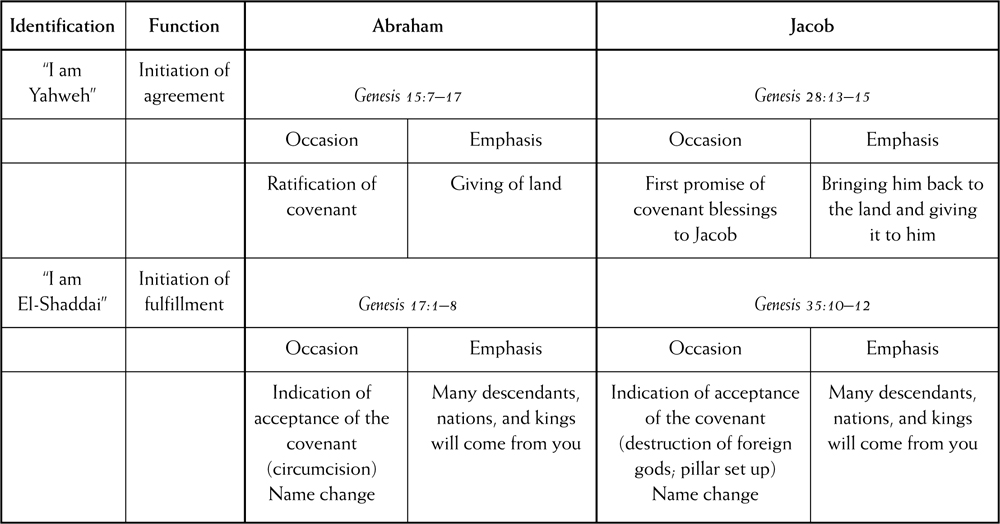
Identification | Function | Abraham | Jacob |
“I am Yahweh” | Initiation of agreement | Genesis 15:7–17 | Genesis 28:13–15 |
| | Occasion | Emphasis | Occasion | Emphasis |
| | Ratification of covenant | Giving of land | First promise of covenant blessings to Jacob | Bringing him back to the land and giving it to him |
“I am El-Shaddai” | Initiation of fulfillment | Genesis 17:1–8 | Genesis 35:10–12 |
| | Occasion | Emphasis | Occasion | Emphasis |
| | Indication of acceptance of the covenant (circumcision) Name change | Many descendants, nations, and kings will come from you | Indication of acceptance of the covenant (destruction of foreign gods; pillar set up) Name change | Many descendants, nations, and kings will come from you |
Identification: “I am Yahweh”
Function: Initiation of agreement
Abraham: Genesis 15:7–17
Occasion: Ratification of covenant
Emphasis: Giving of land
Jacob: Genesis 28:13–15
Occasion: First promise of covenant blessings to Jacob
Emphasis: Bringing him back to the land and giving it to him
Identification: “I am El-Shaddai”
Function: Initiation of fulfillment
Abraham: Genesis 17:1–8
Occasion: Indication of acceptance of the covenant (circumcision) Name change
Emphasis: Many descendants, nations, and kings will come from you
Jacob: Genesis 35:10–12
Occasion: Indication of acceptance of the covenant (destruction of foreign gods; pillar set up) Name change
Emphasis: Many descendants, nations, and kings will come from you
Angel of the Lord.
History. The most significant reflection of the angelology of the Old Testament is that embodied in the identification of the angel of the Lord.30 W. G. MacDonald has presented a helpful summary of the history of the development of Christian belief concerning the angel of the Lord.31 He finds that as early as Justin Martyr Christian interpreters championed the opinion that the angel of the Lord was to be equated with the preincarnate Christ. Clement of Alexandria and Tertullian followed suit. In contrast, Athanasius and Augustine were reluctant to identify the angel of the Lord as a preincarnation or as exclusively representative of the second person of the Trinity. Nonetheless, they did accord him divine status.
When Justin identified the angel of the Lord as the preincarnate Christ, it was not because of exegetical problems with the Old Testament passages. Rather, it reflected his determined intention to find the triune Godhead in the Old Testament in order to defend the cause of Christianity. In the interpretive methods employed throughout that era there was little concern for what the intentions of the human authors of Scripture may have been. Any objections raised to his view were of a theological nature, not hermeneutical or exegetical.
The theological perspective developed by Justin enjoyed many centuries of virtually unquestioned popularity before it encountered objections being raised on exegetical grounds. By then it was so firmly entrenched that exegetes were inclined to actively seek evidence that would sustain the theology. In fact, as early as the mid-fourth century, one’s orthodoxy could become suspect if one failed to relate the angel of the Lord with the second person of the Trinity.32 MacDonald’s historical survey continues as it shows support for the “angel = Christ” view throughout the Reformation and into the nineteenth and twentieth centuries (Hengstenberg and Walvoord, respectively).33
What does our exegesis tell us? What did the Israelites think of the angel of the Lord? Does the New Testament insist on a view that is different from or developed beyond the Israelite view? What are the exegetical evidences used to maintain the theological status quo, and do they have validity?
Data. The primary exegetical support for identifying the angel of the Lord as deity in general and as Christ in particular derives from the passages where the angel speaks in the first person for God (even to the extent that his speeches are introduced as the Lord’s speeches) and is in turn addressed as deity and treated as deity. The key passages are as follows:
Reference | Subject Matter | First-Person Speech Deity | Speaker Identified as (Worship) | Treated as Deity |
Gen. 16:7–14 | Hagar | × | × | |
Gen. 21:17–18 | Hagar and Ishmael | × | | |
Gen. 22:11–18 | Sacrifice of Isaac | × | | |
Gen. 31:10–13 | Jacob instructed to return | × | × | |
Ex. 3:2–6 | Moses at the burning bush | × | × | |
Num. 22:35; 23:5 | Balaam | × | | |
Judg. 2:1–4 | Indictment against Israel | × | | |
Judg. 6:11–24 | Gideon | × | × | × |
Judg. 13 | Samson’s parents | | × | × |
Zech. 3 | Investiture of Joshua | × | × | |
A few comments concerning the above data are in order. (1) Once the angel begins speaking in the first person, the actions and characteristics of the deity are also freely applied to him (e.g., offering forgiveness, Zech. 3:4; delivering from Egypt and keeping the covenant, Judg. 2:1). One cannot contend that these actions and attributes are applied to the angel if it can be maintained that the first-person address is only on behalf of the Lord rather than the angel speaking for himself.
(2) In five of the passages where the angel is using the first person, he uses it consistently throughout. In Genesis 21 and Judges 6 there is an initial introduction where the angel uses third person, but then lapses into first person for the remainder of the passage. In Genesis 16 there is only one line in first person, while the longer oracle that takes up most of the passage speaks of deity in the third person. Zechariah 3 features the most switching back and forth between first and third person (and even combinations, see v. 2), interchanging freely.
(3) In the six cases where the angel is identified as deity, three times it is by the narrator (Ex. 3; Judg. 6; Zech. 3), twice it is by the characters (Gen. 16; Judg. 13), and once it is by the angel himself (Gen. 31:13, “I am the God of Bethel”).34
(4) It is only the Judges passages that feature anything resembling worship in the contexts. In Judges 2 there is no difficulty, for the text states outright that they sacrifice to the Lord. In Judges 13 the angel instructs them to sacrifice to the Lord if they are so inclined (v. 16), while verse 19 states that they do so.
Judges 6 is the most ambiguous. Gideon expresses his desire to bring a minḥa (a “gift,” which can be a sacrifice, but need not be) and “set” it before the angel (v. 18). This verb is not used elsewhere of presenting a sacrifice, so its employment here does not suggest a sacrificial setting. Once the food is prepared, Gideon “draws near” with it (v. 19). This verb can be used for coming with a sacrifice (1 Sam. 13:9), but it is also used of food in formal settings (Gen. 27:25). There is nothing in the language that indicates clearly that Gideon has a sacrifice rather than a meal of hospitality in mind. In other words, none of the words used are strictly from the realm of ritual performance. In fact, the angel’s instructions to put the food on the rock (where they are to function as a sacrifice) imply that it is the angel who turns the gift into a sacrifice. If these instances are ruled out due to ambiguity, there is no passage that shows the angel being offered and receiving worship.
Alternative options. When we begin to explore this confusion of identity between the angel and deity in more depth, some significant insights become available that offer alternative solutions to the perceived problem.35 Of most importance is the recognition of the role of the official messenger in the ancient world.
In our day of fast and easy travel and sophisticated technology, direct communication between heads of state can be attained at a moment’s notice. In the ancient world, however, such direct communication was a rarity. Diplomatic and political exchange normally required the use of an intermediary, a function that our ambassadors continue to exercise today. The messenger who served as the intermediary was a fully vested representative of the party he represented. He spoke for that party and with the authority of that party. He was accorded the same treatment as that party would enjoy were he there in person. While this was standard protocol, there was no confusion about the person’s identity.
All of this treatment simply served as appropriate recognition of the individual that the intermediary represented. Gifts given were understood to belong to the represented party, not the representative. Words spoken to the representative were expected to be reported back in accurate detail and were understood as having been spoken directly to the represented individual. When official words were spoken by the representative, everyone understood that he was not speaking for himself but was merely conveying the words, opinions, policies, and decisions of his liege.36 Thus in Ugaritic literature, when Baal sends messengers to Mot, the messengers utilize first-person forms of speech. E. T. Mullen concludes that the usage of the first person “signifies that the messengers not only are envoys of the god, but actually embody the power of their sender.”37
In the same way the angel of the Lord serves as the messenger, the royal envoy endowed with the authority of the sender of the message.38 Since such messengers represent God, they do not speak for themselves but only for God. It is therefore not unusual for them to use the first person, “I.” This view easily accounts for the textual elements observed above, such as the alternation between first and third person and the close association of the messenger with the Lord. When the angel is identified with the Lord by the narrator or himself, it is nothing more than an indication of the source and authority behind the message. When the characters identify the angel as the Lord, it is nothing more than either confusion on their part or recognition of the authority the messenger represents.
This alternative for understanding the nature of the angel of the Lord can be supported by biblical examples of similar circumstances. For instance, the alternation between first and third person by a messenger can be witnessed in the words of Joseph’s messengers to his brothers (Gen. 44:5, 1039). God’s human spokesman, Moses, likewise moves back and forth as he presents his message as the word of the Lord, but halfway through lapses into first person.
Moses summoned all the Israelites and said to them:
Your eyes have seen all that the LORD did in Egypt to Pharaoh, to all his officials and to all his land. With your own eyes you saw those great trials, those miraculous signs and great wonders. But to this day the LORD has not given you a mind that understands or eyes that see or ears that hear. During the forty years that I led you through the desert, your clothes did not wear out, nor did the sandals on your feet. You ate no bread and drank no wine or other fermented drink. I did this so that you might know that I am the LORD your God (Deut. 29:2–6).
Furthermore, the signification, “angel of the Lord” is not restricted to use with one particular heavenly functionary. Haggai the prophet is called the angel of the Lord, using the exact same form (Hag. 1:13; NIV translates it “the LORD’s messenger”). All of this suggests that an Israelite would easily arrive at the conclusion that the angel of the Lord was not a deity himself, though he certainly was to be feared, respected, and treated with the highest honor.
Over and above the excellent case made by MacDonald concerning the New Testament appearances of the angel and the significant issues within Christology, a final observation regarding the Israelite view should be made with regard to a few of the key passages where the angel is carefully distinguished from the deity whom he represents.
In Genesis 22:15–16 the text reads, “The angel of the LORD called to Abraham from heaven a second time and said, ‘I swear by myself, declares the LORD, that because you have done this and have not withheld your son, your only son, I will surely bless you. . . .’ ” Here, though the angel is using first person, he identifies the source of the message as the Lord, which is clearly not him. Israel had no warrant for identifying anyone as deity who was not Yahweh.
Similarly Judges 13:16 reports, “The angel of the LORD replied, ‘Even though you detain me, I will not eat any of your food. But if you prepare a burnt offering, offer it to the LORD.’ ” Here the angel makes a clear distinction between himself and the Lord, the confusion of Manoah notwithstanding.
Conclusions. Given a contextual explanation for the “irregularities” of the text based on the role of the messenger in the ancient world, claims that those textual irregularities can only be explained by an angel being the preincarnate Christ can no longer be justified. There is no warrant to move beyond the intention of the author and posit a more theologically sophisticated explanation. The interpretation of the angel as Christ did not arise from exegetical problems but from an aggressive attempt to read distinctives of Christian theology back into the Old Testament with an apologist’s agenda. As important as apologetics is, it must be subordinated to the sound hermeneutics of exegesis. Our bottom line of defense is the text itself. If we exploit or subvert the text in order to achieve a particular defense, we have sold out our cause. God cannot be defended at the expense of the text.
Sign of the covenant.40 What is the importance of having a sign of the covenant? In each phase of the covenant there is an element that is identified as a hinge point for that phase, a response that serves as a sign of conformity to the relationship of the elect party to God, the covenant maker. The hinge can either be an individual act by which one joins the community of the elect or a specific conduct by which one indicates a continuing commitment to the covenant relationship. If we work backward through the covenant phases, we can see the nature of these signs. The signs of the new covenant are generally those elements that are seen as sacraments. Both communion (Luke 22:20) and baptism (Acts 2:38) are signs of the new covenant reflecting the commitment of the elect to the covenant relationship. The former is a periodic observance, while the latter is an initiation sign.
In the Davidic phase of the covenant, the sign is the anointing of the Davidic king. This initiated the relationship between God and the kings and signified that the king was chosen of God. When the king submitted to the ceremony, he showed recognition of his subordination to a divine kingship.
The sign of participation in the Sinai phase of the covenant is the Sabbath. Exodus 31:13–17 makes it clear that corporate Israel showed their allegiance by their continual observance of the Sabbath. The violation of the Sabbath was therefore appropriately cited as one of the primary reasons for God’s judgment against them (Ezek. 20:10–26).
We can now see that for Abraham’s family, circumcision is established as a sign of their participation in the covenant. It is not a condition for the covenant as a whole or for the elect status of Abraham and his family, but it is a condition for an individual’s entry into the community of the elect. It is a sign of participation, a symbol of subordination, and an initiation into relationship as defined by the covenant. It signifies membership in the revelatory community of Israel comparable to (adult) baptism’s signification of membership in the soteriological community. For those who adhere to infant baptism, the sacrament is generally understood as symbolizing entry into the nurturing circle of the family of faith.
Contemporary Significance
NAMING. Think of how important it makes a person feel when someone famous knows his or her name. Imagine being part of a crowd at a parade in London, standing there among tens of thousands of people. As the queen’s car goes by, the motorcade suddenly comes to a halt and the queen gets out and walks up to you and greets you by name and tells you how much your work has meant to her. This scenario gets us closer, but not all the way to what Abraham experiences here. God does not just address him by name; he gives him a new, meaningful name of blessing. A name is more than a moniker; it is an identity.
In the state of Andhra Pradesh in southern India, there is an indigenous mission organization called India Rural Evangelical Fellowship. It was begun in 1947 when Prasado Rao began training evangelists to go out into the rural villages and taking orphans into his home to show them the love of Christ.41 By the late 1990s there were over 120 itinerant evangelists reaching 360 villages bringing many to Christ and planting churches at an incredible rate.
Annually teams go to India to help out in evangelistic crusades. By their reports, hundreds come forward in these crusades to make commitments to Christ and be baptized. One of the elements of these baptismal services that may seem strange to us is that those getting baptized are also often given new names—Christian names. I am sure that this is not unique to southern India. Adopting a new name is a way of severing ties to the old life. I am told that many of the family names and given names in India have a history that link an individual to the gods (or demons) of their culture.
God does not give each of us new names when we enter into relationship with him, nor do we adopt new names when baptized.42 Nevertheless, the concept that we are joyfully submitting to a new master is no less significant and deserves visible recognition. In medieval times soldiers were sworn to allegiance by being dubbed as knights. Their fealty thereafter belonged to that lord. It is perhaps our loss that we no longer display our allegiance so visibly. Even the corporate name “Christian” has suffered at the hands of those who misapply it or adopt it unworthily, and the label “church” is claimed even by cults that are polar opposites of what it means to be the body of Christ. Though we no longer adopt Christian names, it is essential that we find our identity in Christ, pledge our allegiance to Christ, and count Christ as the benefactor of all blessings. This is what it means to be named in Christ; it is the same concept as is represented in Abraham’s receiving a new name.
Response to God. In chapter 17’s initiation of circumcision, we see the importance of making committed responses to God—not because Abraham made such a commitment, but because God asked for one. God wants to mark us as his own, and he wants that mark to be an indication that we have identified with him. We already mentioned communion and baptism as signs of our covenant relationship with Christ, but in what other ways should we be marked? In 1 John 3:18–24 the apostle makes it clear that one way we signify our relationship to God is by loving one another. Another way to signify our relationship to God is by obedience (John 15:5–15). Just as circumcision was not a condition of the covenant but a sign of participation in it, we understand that our responses to God are not the conditions of our salvation but are the appropriate and expected signs of our participation in the new covenant.
There was a chorus that I remember singing in Sunday school in my childhood:
After all he’s done for me,
After all he’s done for me,
How can I do less than give him my best,
And live for him completely,
After all he’s done for me.
This captures the essence of response. What does our salvation cost us? Nothing. What does our faith cost us? Everything. We are saved by grace alone, but as Christians we live by faith.
I suggest that we must be defined not by our salvation but by our faith. The “Lordship Salvation” debate is frustrating because sometimes proponents on both sides make it sound as if “salvation” is the reason for our faith.43 That cannot be right. Salvation is a benefit of our faith gained by the grace of God; God is the reason for our faith. It is foolish to dwell on whether we have to live a responsive life of faith in order to go to heaven. When will we realize how less important heaven is than God? How can we possibly feel good about gaining heaven if in the process we do not give ourselves to God? For some, eternity is nothing more than a selfish pursuit born of a fear of death or hell, and living for God is too much trouble. Let us hope that God does not grant their wish by leaving them alone. If he did, they would find to their dismay that if heaven were filled only with themselves, it would be little better than hell. They would languish in the vacuum.44
Perspectives on God’s plans. In chapter 16 Abraham makes decisions, but we are not told whether they are good ones or bad ones. More important, Abraham does not even know whether they are good or bad. In the thirteen-year gap between 16:16 and 17:1 we should be startled to discover that Abram has not been informed that Ishmael is not going to be the ultimate heir that the covenant had promised. For all these years he thinks that he is on the right track. His heart is devoted to Ishmael.
Are Abraham’s sentiments misplaced? Were those thirteen years wasted? Was Ishmael a “mistake”? The answer is a resounding “No” on all three counts. Even though sometimes what we see as solutions turn out to be only more obstacles for God to deal with, that does not mean that God disapproves of the paths we seek out or that we should start feeling regrets for wasted time. With God there are no dead ends, only training grounds.
There was a picture book that our family enjoyed when the kids were young entitled Going the Moose Way Home.45 The book contains several stories about a moose who gets involved in various adventures that draw him out of his routine or away from his intentions. Despite the unexpected or digressive nature of whatever turn of events he encounters, he always finds he has significant experiences or has made valued friendships “going his moose way home.” We have picked up the phrase as a family explanation for when things are not turning out the way we expect—we are simply “taking the moose way.”
The point is that we need not think of digressions as failures or as unproductive. God in his sovereignty and providence does not waste our experiences. As long as we are not ignoring his signals or indulging our self-will, we can be sure he is shaping us for his service. Perhaps we too often think of God’s plan for our lives as a perfectly straight track leading to his perfect will, with sidetracks deviating left and right as pitfalls and senseless distractions that seek to waylay us. It is more helpful to think of our lives in terms of a complicated model train set in the basement, with inside tracks, outside tracks, and many crisscrossing tracks. It doesn’t matter whether we are on the inside or the outside track or cutting across. Sometimes we may feel as if we are going in circles, which is OK as long as we don’t derail. Our goal is not to “get somewhere” but to serve. We must remember that we are on the rails and God is at the switch. What is most important about our faith is not where we are going but what we are becoming.46
Is anything too hard for God? The rhetorical question of 18:14 does not present us with a promise to claim but an attribute to embrace, a faith to aspire to, and a hope to sustain us. When we face difficult circumstances, we cannot claim this verse as confidence that God will change our circumstances. He is capable of changing any circumstances, but perhaps the hard thing that he will do is to help us to accept our circumstances and grow through them.
In 1967, teenager Joni Eareckson took a dive that changed her life forever. Her story has been told so often that it may seem redundant here, but there is an important point that is not often made—one that gives us a vital insight into how God works in our circumstances. Her broken body at first brought denial and bitterness. When Joni began to confront her paralysis, she was encouraged by some friends to have the faith that God could miraculously heal her. After all, “nothing is too hard for God.” As she explored this faith, she struggled with the difference between faith that God could heal her and faith that God would heal her. Would it take just as much faith to believe that God would heal her spirit without healing her body and use her in his service regardless of her limitations? Doesn’t God do a hard thing when he uses any of us despite our limitations?
If you had told Joni then that thirty years in the future she would be an internationally known mouth artist, author of more than twenty-five books (translated into thirty-three languages), and an inspirational speaker whose radio broadcasts are presently aired by some eight hundred stations daily, she may have considered that doing that would be a much more difficult accomplishment for God than healing her paralysis. If you had told her that in addition she would have produced a number of albums and videotapes and founded a ministry to and for the disabled that put her in the national and international spotlight as their spokesperson, she may have thought that healing was the easy way out for God. As it turns out, Joni’s faith that she could be transformed was of far more use to God than her faith that she could be healed.
We must be cautious that as we accept by faith that nothing is too hard for God, we do not begin to dictate to him which hard thing he must do. He tends to have things in mind that go far beyond what we are able to ask or even think.