Original Meaning
Blessing (9:1–7)
IS “THE FEAR and dread” experienced by animals over against human beings a new element that God adds to the psyche of the animal kingdom? The text stops short of implicating direct divine action by using passive formulations. The only action of which God is the subject is granting animals for food (v. 3). Consequently, the fear and dread can be viewed as the natural response to being hunted prey.1
Literarily the statement about “fear and dread” replaces the “subdue and rule” clause in 1:28. What brings about this alteration? In our study of Genesis 1, I suggested that the end result of ruling was domestication and control (see p. 132). The statement in this chapter goes beyond rule (actions to be carried out) in that all creatures are given into human hands (passive recipients). Rule is not taken away, but neither is it reiterated.
Moreover, the blessing of God still includes reproduction (9:1) and procurement of food. Just as God’s pronouncement in chapter 3 made it clear that despite the Fall the blessing was still intact, here the text makes clear that despite the Flood, the blessing is still largely intact. After the Fall the ground would not be cooperative, so that food was not as easily obtainable. Likewise here we find that animals will not be cooperative, with the result that obtaining food will continue to be a challenge.
It is likely that permission to use animals for food should be seen as a concession of grace. If so, it is parallel to the making of skin garments for Adam and Eve and putting the mark on Cain. It also suggests the possibility that a contributing factor to the pre-Flood violence was the shortage of food, but these are inferences that go well beyond the statements of the text.
Note also that the category given for food is remeś (NIV, “everything that moves”). The noun (remeś) and the associated verb (rmś) each occur seventeen times in the Old Testament, ten times each in Genesis 1–9. This word group is distinct from both the wild (predatory) beasts and domesticated flocks and herds. Neither verb nor noun is ever used to refer to larger wild animals or to domesticated animals. In no place is remeś a catch-all category for all creatures.2 It is one category of creature only. The division of the Hebrew terms used up to this point in Genesis reflects the nature of the animal (not the locomotion, genre, species, or the morphology).3
If this is true, we are mistaken to translate remeś as if it describes a type of locomotion (e.g., “creeping things”). An alternative is suggested by the Akkadian cognate nammašu/nammaštu, which typically refers to wild animals that travel in herds4; they are distinct from wild animals that hunt or scavenge,5 from the domesticated cattle, and from the docile beasts that do not tend to be found in herds.6 It is most familiar as the group that Enkidu watched over in his precivilized days in the Gilgamesh Epic.7 These animals were typically characterized as being the prey of hunters and predatory beasts. The most common members of this group were wild cattle, antelope, fallow deer, gazelle, and ibex. Some of these could be managed, though not domesticated. Whether animals such as rabbits are included in this group depends on whether the primary characteristic is “herd living” or “serving as prey.”
There is a difference between being a meat-eater (people who use flocks or cattle for food at least on some occasions) and being a predator (hunting for food). Since this verse only grants the remeś group for food, it is logical to assume that it gives people permission to be predatory hunters of food. It is unclear whether butchering cattle for food is already assumed or has not yet been permitted.8 Note the interesting fact that when Genesis 1:29–30 granted permission for food, its terminology describes that which grew wild rather than referring to crops that were planted—though the terminology is general enough not to exclude what is sown.9 I tentatively propose, then, that domesticated plants and animals were always considered legitimate sources of food, while permission was granted for gathering of food growing wild (1:30) and hunting animals for food (9:3). Meat was not a common portion of ancient meals. Animals were kept primarily for their milk, hair, and wool, not for their meat.
In giving permission to eat this meat, the text introduces two caveats. (1) In verse 3, the qualification is that the animal is living. This presumably rules out feeding from dead carcasses found in the wild. (2) In verse 4 is the qualification that the meat cannot be eaten with the lifeblood in it. This presumably assures that the animal has been killed.10 In ancient times the blood was considered a life force (Deut. 12:23). The prohibition does not require that no blood at all be consumed, but only that the blood must be drained. Ritually speaking, the draining of the blood before eating the meat was a way of returning the life force of the animal to God who gave it life. This offers recognition that they have taken the life with permission and are partaking of God’s bounty as his guests. Its function is not unlike that of the blessing said before a meal in modern practice. No comparable prohibition is known elsewhere in the ancient world.
Human life, because of the image of God, remains under the protection of God. Accountability to God for preserving human life is put into humanity’s hands, thus instituting blood vengeance in the ancient world and capital punishment in modern societies. In Israelite society blood vengeance was in the hands of the family of the victim. Capital punishment was the recognized right of the family and was considered an act of justice.
Bridging Contexts
IF THE AUTHOR has deliberately used recursion, as suggested above, then the parallels between this section and Genesis 3 are of most significance. We should not be looking for the teaching of the text in lessons learned from Noah’s indiscretion22 or Ham’s perversity. As we have seen, the text does not comment on the former and does not detail the latter. Any lessons we may draw on those counts come only from what we read into the text. In contrast, if we follow the author’s theme as developed in his use of recursion, we can pick up his deliberate points and try to understand their implications. The authority of the text underlies this explicit teaching of the author that we capture by reading synoptically.
Persistence of blessing and sin. We have seen throughout these early chapters of Genesis the intertwining themes of blessing and sin. God gave the blessing at the end of chapter 1 and made it functional in chapter 2. A blessing boundary was trespassed in chapter 3 when Adam and Eve ate disallowed food. In the subsequent pronouncement the blessing was retained, but only with struggles and anxiety would they be fruitful and multiply and gain food. The blessing continues to be engaged in chapter 4 as Eve bears children and Cain and Abel bring offerings of the food that they have produced. The genealogies of chapters 4–5 elaborate the reproduction scheme as generation follows generation.
At the same time as the blessing persists, so does sin. It grows progressively worse as it moves from individuals to family to society’s institutions to a violence and corruption that pervade all humanity. According to chapter 9, these two forces are going to continue undeterred in the postdiluvian world, the world as we know it. The blessing is restated in 9:1–3, 7, and the persistence of sin is confirmed in 8:21. The evidence of the continued vitality of the blessing is highlighted in 9:18–19, where the repopulation of the earth is referred to (yet to be detailed in ch. 10), and in 9:20 as the ground again begins to produce food and drink. The evidence that sin has not abated with the floodwaters is found in the perverse behavior of Ham (and soon in the Tower of Babel). God has not wiped out sin, but he has not rescinded the blessing either.
Functional permanence. While the Flood is a major interruption to both blessing and sin, the statements in its aftermath indicate that there will not be such major interruptions in the future. Sin and its punishment will not again interrupt the functionality of the cosmos (8:21–22) or the functionality of the blessing (9:11, 15). To the Israelites this means that there is a certain stability in the world, and sin will be dealt with in a more “case by case” fashion. This can be illustrated if we use the example of an old-fashioned balance scale with trays connected to either end of a rocker beam balanced on its center point.
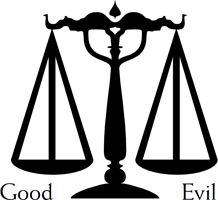
If we envision such a scale for God’s handling of sin in the temporal material frame,23 we will have a cogent picture of Israel’s general theology. One tray represents evil, the other side, good. As a group or individual does what is right, weights are placed onto the “good” tray. As a group or individual does what is sinful or wrong, weights are placed in the “evil” tray. One additional feature of this system is that under the evil tray is a button that sounds an alarm. When evil sufficiently outweighs good, the alarm sounds and God prepares to carry out judgment.
In the period before the Flood, we can imagine a single scale for all of humanity in addition to smaller scales for smaller groups and even individuals. When the weight of sin in the world sufficiently overwhelmed good, the tray sounded the alarm, and God took action to judge the whole world, sparing Noah as the only one putting weights in the good tray. After the Flood, the situation is changed. God will no longer be dealing with humanity on a single scale by which the whole of humanity can reach the point of sounding the alarm. Instead, the scales for each nation, family, and perhaps individual will be used to govern and regulate the system.
This theology must be understood in relation to a strikingly similar element that emerges from the flood account in the Gilgamesh Epic. After the Flood ended, the gods gathered around Utnapishtim’s sacrifice. Famished from the lack of food (which humankind’s sacrifices were intended to provide), they absorbed the nourishment and realized how foolish it was to try to wipe out people entirely. In an attempt to relieve the guilt of their own complicity in this shortsighted decision, they turn their scorn on Enlil, the head of the pantheon. Since Ea was the only one who had the audacity to warn and thereby deliver some of humanity, he is the one who makes a speech recognized as one of the most important parts of the composition:
Ea made ready to speak, and said to the warrior Enlil:
“You, O warrior, are the sage of the gods,
How could you, unreasoning, have brought on the Deluge?
Impose punishment on the sinner for his sin, on the transgressor for his transgression.”24
This speech serves as an exhortation that divine punishment not focus on humanity as a whole, but target more carefully those who have committed the offense. This is comparable to the idea in Genesis that God will no longer wipe out all of humanity. Presumably this does not mean that he will no longer punish sin, but that he will punish sin on a case-by-case basis.
The differences, however, are also of great significance. Enlil’s act of destruction was, in hindsight, viewed as a foolishly shortsighted act that was unjust because it lacked any attempt to discern whether each individual deserved the punishment. Enlil’s flood is therefore portrayed as an act of injustice that should not be repeated because there is no justification for such action. Yahweh’s Flood is portrayed as an act of justice (bringing fully deserved punishment) that will not be repeated because grace prevails even though there will undoubtedly be future situations that call for such extensive judgment. To use the scale illustration, Enlil throws away the grand scale (the one for all humanity) because it does not promote justice; Yahweh throws it away because humanity cannot survive justice. What for Enlil is a deterrent for foolish shortsightedness, for Yahweh is the triumph of grace.
Human role in capital punishment. When verse 6 says that “whoever sheds the blood of man, by man shall his blood be shed,” we may well ask what the alternative is: What is this establishing? There are two ways to read this, which I will illustrate by two different extended paraphrases:
1. From now on when someone commits murder, it will be society’s responsibility to call the murderer to account and require his blood rather than leaving that task to God. Society is competent to carry out this responsibility because people have been made in the image of God and therefore can serve as his representative in a judicial capacity.
2. From now on when someone commits murder, it will be society’s responsibility to call the murderer to account and require his blood rather than leaving that task to God. Such a drastic response is required because he has taken the life of someone who was created in the image of God.
In # 1 society is put in charge of enforcing law because the image of God enables people to carry out that function on God’s behalf. The image of God applies to the jurisdiction of the judge and explains why God can delegate the responsibility. In # 2 there is a mandate to enforce capital punishment because the taking of human life is a violation against the image of God. The image of God applies to a characteristic of the victim and explains why society has to discharge its responsibility. Capital punishment is assumed in either case. Since in the next section of the text (vv. 14–15) God indicates that his role in carrying out punishment will change, it is clear that here he is delegating responsibility for society to be involved in the accountability system to preserve the balance of justice. That responsibility is here no matter which option we choose.
The most promising means of deciding between the two options for the significance of the reference to the image of God comes from an investigation of legislative syntax. In verse 6 we have a conditional legislative formulation composed of (1) a criminal action identified by means of a participial clause, (2) an indication of the mandated sentence for the crime, and (3) a motive clause. None of these are unusual syntactical features in biblical legislation, but they do not often occur together. Motive clauses typically either offer justification for the law or an incentive for keeping it.25 This verse falls into the former category, but we need to know whether the justification comes in terms of giving a rationale for the process (option # 1) or a rationale for the sentence (option # 2).
Based on an investigation of the three closest syntactical constructions (Ex. 31:14; Lev. 17:14; 19:8), I conclude that the motive clause is intended to get to the heart of why the crime is so bad, therefore favoring option # 2 above. Nevertheless, this does not negate the idea that there is also a transfer of responsibility for enforcement that takes place here. We should therefore recognize that the purpose of verse 7 is not to establish the idea that murder should be punishable by death. That precedent had already been set since God had just carried out the death penalty on all of humanity for their violence. The intention is rather to delegate the responsibility for enforcing this penalty to society on his behalf.
In other words, the emphasis is on “by man” rather than on “shall his blood be shed.” Execution is seen as appropriate since it represents matching the punishment to the crime.
Contemporary Significance
BEFORE WE BEGIN to discuss the contemporary significance of this chapter, we must make a statement of something it is not. For centuries the curse of Canaan (often referred to as “the curse of Ham”) was one of the principal passages used to justify slavery. It was claimed that Ham was the forefather of the African race and that their slavery was thereby biblically mandated because of the curse. Both elements in this contention are fatally flawed. (1) There are few families from the line of Ham that eventuate in dark-skinned peoples, and none from the line of Canaan. There is therefore no line of descent connecting Ham or the curse on Canaan to dark-skinned Africans. (2) A curse does not create a mandate. It is something for God to carry out, not humans (though he may use humans as his instruments). I do not know anyone who cultivates weeds just so the curse on the ground will remain reality. A final point would be found in the reminder that this is Noah’s curse, not God’s. Fortunately the line of thinking addressed here has for the most part passed out of fashion, so we need not dwell on it.
Implications of God’s empowering a human justice system. “Vengeance is mine, I will repay,” says the Lord. Wouldn’t justice be easier that way? No long trials; no hung juries; no innocent people on death row; no endless search for criminals, some of whom are never caught; no heartbreak when the guilty go unpunished. Why doesn’t God punish murderers himself? Why delegate such an important job to an imperfect system run by imperfect people? Recent decades have seen a number of high-profile celebrity cases, from Sam Shepherd to James Earl Ray; from boxing great Rubin “Hurricane” Carter to football Hall-of-Famer O. J. Simpson; many question how well society is discharging its duty.
We can be sure that when God delegated responsibility to people, it was not an abdication of his role or a step toward less involvement in the human realm. It was a step designed for our benefit. There are advantages to be realized when society has to take responsibility for itself. A parallel can be seen in examining the difference of attitude that might exist between someone who works for a large firm as an insurance broker and someone who starts his or her own business as an independent insurance broker. The person who is self-employed is going to be considerably more concerned about how time is spent and office supplies are used and all the myriad details of running a business because he or she is responsible for the success of the business. There is no one to fall back on.
In the same way God knows that we will take a far greater interest in maintaining justice and enforcing the laws if we have total responsibility for the system. Every employer, teacher, and parent knows the value of delegating responsibility. Even if the teacher can do something better than the student, it is important for students to do things so they can learn. In other words, God wants us to learn the value and skills of justice. He is a hands-on mentor, but responsibility has been given to us, and we are free to succeed or fail.
Capital punishment.26 Capital punishment continues to be a volatile issue in society today. Several different positions can be identified. At one end of the spectrum are those who agree that the Bible mandates capital punishment but view it with cultural suspicion and feel no obligation to its mandates. Such people may contend that the practice is barbaric or produce statistics that say it does not deter would-be murderers from their crime. At the other end are those who insist that biblical law is clear and that society’s law should conform to biblical law regardless of the problems.
In between these extremes are those who take biblical mandates seriously, but for various reasons believe that the mandate no longer applies, perhaps because the New Testament overrides it with the law of love and forgiveness. Another group in the middle agrees that the biblical mandate remains theoretically in force, but our inability to make the justice system work fairly and infallibly argues against actually enforcing it. In fact, even as I write, the governor of Illinois has declared a moratorium on executions in the state because since the death penalty was reinstituted in Illinois, more inmates have been released from death row having been wrongly convicted (13) than have actually been executed (12).
There are two factors to explore: the Bible’s mandate for our contemporary society, and the state of society and the justice system. (1) We must unflinchingly declare that nothing God commands may be justifiably labeled barbaric. Furthermore, if God commands capital punishment, it is not for us to wonder whether or not it is an effective deterrent—it is a command regardless. But does the Bible’s command remain in force? (a) Since the mandate is given here in Genesis 9, it is not a part of the law of Moses. (b) It is not repudiated by the commandment against murder in Exodus 20:13 because the Mosaic law includes capital punishment in certain instructions and does not appear to find that internally inconsistent. (c) Moreover, since it is outside the law of Moses, this law cannot be considered as abolished with the law of Moses (regardless how one understands that abolishment). In Romans 13:4 Paul appears to still consider bearing the sword in justice as viable. (d) Furthermore, love and forgiveness do not necessarily negate the consequences to one’s actions. In conclusion, then, from the Bible side of the debate, it is difficult to make a case against capital punishment.
(2) But what of society’s fallibility? Does not the irreversible nature of the punishment extenuate the circumstances? Certainly the jeopardy to justice that is represented in false convictions should encourage us to be as careful as we can be. In a fallen world there are bound to be both mistakes and travesties of justice. But that was as true when the command was given as it is today. Murder by the judiciary system is as serious as any other murder,27 but the fact that some choose to abuse the system does not demand that the system be dismantled, only that more safeguards be applied.
In the category of mistaken convictions, the number of releases in recent days testify to our increasing ability to discern guilt or innocence. Many of those released have been the beneficiaries of DNA testing, which greatly improves our ability to provide absolute proof of guilt or innocence. Even so, we cannot allow these exceptions to obscure the fact that many of those on death row are unequivocally guilty of heinous crimes and that society needs to discharge its duty to punish them without delay.
Both the biblical mandate and the good of society commend the continued use of the death penalty, as drastic and irreversible as it continues to be. Our responsibility before God and to society is to be so unflinching in our pursuit of justice that we ferret out the weaknesses that cause abuse in the system and continue to develop new ways to make sure we have properly identified criminals. For those who argue that these criminals should not be executed in case they might yet repent and their souls be saved, it can only be said that capital punishment sent people to their eternal destiny in the Old Testament too, yet God mandated it in his law.
Vegetarianism. Since Genesis 1 speaks only of vegetation while meat is not granted for food until here after the Flood, some have argued that vegetarianism is the ideal and permission to eat meat is only a concession to our fallenness. The first objection against this is that if and when God makes concessions to our fallenness, it is not done by allowing something immoral or sinful in any way, for such concessions would compromise his integrity. The most we may conclude here is that eating meat is not ideal.
Note too that in the instructions for the sacrificial system, God commanded certain sacrifices to be brought that required the eating of meat. God has not simply tolerated meat-eating; he did, on certain occasions, prescribe it.
Finally, if it is true, as suggested above, that the food permitted in this passage is hunted food and that domesticated animals were always considered approved for human consumption, the distinction between concessionary and ideal is invalid. Regardless how that last issue settles out, it is difficult to build a case for vegetarianism from the pages of Scripture.
Stability. The stability that is vouchsafed in Genesis 8–9 is not a social stability but an ecological stability. In our world we worry about those things that might upset the relative stability that we enjoy. We hear about the depletion of the ozone layer and the possible effects of global warming. Threats of disappearing rain forests, dwindling fossil-fuel reserves, and melting ice caps become the fodder for ecology’s doomsday prophets. Do 8:21–22 and 9:11, 15 suggest that if we believe God, we need not be concerned about such apparent destabilizers?
Not at all. (1) Each of these destabilizers would bring radical and devastating changes long before they reached the stage where they would qualify as making the earth nonfunctional. Such changes would certainly be detrimental to the quality of life and therefore should be avoided if for nothing more than selfish reasons (not that selfish reasons are legitimate).
(2) It is important to differentiate root causes. God has pledged that he will not bring the return of chaos through his actions. But that does not mean he will prevent us from bringing ecological doom on ourselves. It would be odd for the text to address humanity’s potential for self-destruction since the ancient audience would not have been able to imagine any way that their own actions could so directly disrupt the functionality of the cosmos. As a result, I suggest that the security we may derive from God’s commitment should not make us so comfortable that we consider ourselves invulnerable to ecological catastrophe, with license to be as reckless as our indulgences demand. Like the Israelites who considered God’s presence in the temple a protection from all danger, we may easily find ourselves abandoned and destitute picking through the ruins of what used to be our home.
Given this warning, however, we can find security in the idea that as often as catastrophic acts of God may occur, they end. We need not fear God’s retributive justice on a universal scale until time and history have run their course.
Yet does not this pledge of enduring stability interfere with God’s ability to maintain justice? An answer to this question can be found in Christ’s parable of the weeds (Matt. 13:24–30), in which the kingdom of heaven is compared to a field sown with both good seed and weeds. The servants of the farmer suggest pulling up the weeds immediately, but the owner fears that in doing so, the wheat will suffer damage. Thus, the two will be allowed to grow together until harvest (though the wheat may not do as well, having to share the soil’s nourishment with weeds), when they will be separated and the weeds burned. Likewise God has allowed wickedness to take root in society until the time of judgment. In the meantime, the stability is a benefit we enjoy and something we can praise God for (as the psalmist does in Ps. 104).
Recursion and cycles of sin. According to the adage, those who do not learn from the mistakes of history are doomed to repeat them. Judging by the impact of those who decry history as “bunk” and of those who have simply had no opportunity to study its lessons, we must admit the truism’s accuracy. Power continues to corrupt leaders. Self-indulgence continues to bring decay in society. Greed continues to undermine economic growth. The sins of the fathers are visited on the children primarily because they repeat them. Recursion does not create such parallels; it highlights them in juxtaposition to one another.
A poignant example of recursion on a society level is found both in George Orwell’s Animal Farm and in the communist system it satirizes. In the novel, when the animals take over the farm, their intention is to create an egalitarian society that is free of the repressive slavery that brought hunger and drudgery to their empty lives. Their determination never to become like people is reflected in their commitment: “No animal must ever live in a house or sleep in a bed, or wear clothes, or drink alcohol, or smoke tobacco, or touch money, or engage in trade.” As the novel progresses, however, the dream of a classless society becomes more and more distant as the charter documents are reshaped to the advantage of those in power, Napoleon and his fellow pigs. “All are equal, but some are more equal than others,” the charter eventually comes to read. The deterioration escalates as the pigs begin to enjoy the same prerogatives of power that the animals had despised and resented in those whom they had overthrown. They wear human clothes, they walk on two feet, they drink whiskey.
In the end, Napoleon and the pigs, who have instituted a repression far worse than the animals’ original situation under Farmer Jones, negotiate with the humans and, indeed, are indistinguishable from them. “Twelve voices were shouting in anger, and they were all alike. No question, now, what had happened to the faces of the pigs. The creatures outside looked from pig to man, and from man to pig, and from pig to man again; but already it was impossible to say which was which.”28
Orwell’s satire of communism highlighted the fact that all of the social ills that communism proposed to cure were eventually duplicated as the corruption of greed and power wrapped its tentacles around the leaders of the revolution and those entrusted with its ongoing success. The end result was a repressive tyranny that again robbed the people of their freedom and dignity as the sins came full cycle.
Cycles of sin are not only repeated across the span of centuries; they are also repeated in each person’s habits and thoughts. Lodged in the network of our brains are developed patterns of behavior that repeatedly corrupt us. Whether these are habits of conceit and pride, of deception and façade, of unfaithful thoughts, of manipulation or patronization, of prejudice or revenge, of anger and hate, of perverse thoughts, or of selfish indulgence, we secretly cultivate them. We cling to them; we deny them to ourselves and hide them from others. Our own personal depravities thrive because we continue to feed the addictions of our minds and perpetuate the thoughts that our habits stimulate.
We are all trapped in cycles of sin, and the recursions that can be traced through our lives would horrify us if we allowed ourselves to be conscious of them. But we rarely achieve that level of consciousness, perhaps because, as C. S. Lewis astutely observes, though people picture Satan putting things into their minds, in reality his best work is done by keeping things out.29
The Count of Monte Cristo by Alexander Dumas has become a classic tale of what happens in someone’s life when he or she habitually courts the pursuit of revenge over decades. Not only are there results that were never planned or desired, but over time the passions that drive us shape us into different people. The novel recounts the life of Edmund Dantes, who is framed by jealous associates and arrested on his wedding day. Accused of conspiracy and treason, he is thrown into an infested rat hole of a prison, forgotten and abandoned with only death to hope for. Through a series of circumstances, he befriends another prisoner, who tells him of a buried treasure. When that prisoner dies, Dantes succeeds in taking the place of the man’s corpse in the body bag and thereby escapes the dungeon and finds the treasure.
With his newfound wealth he establishes a new identity for himself, the Count of Monte Cristo, and begins elaborate plans of revenge on those who had acted so treacherously against him. Though readers sympathize with Dantes’s plight and admit how deserving his enemies are of punishment, it is nevertheless lamentable to see the transformation that engulfs Dantes as he allows his appetite for revenge to take full control of his life. In the end, he loses more than he gains, and many innocent bystanders’ lives are changed or lost in the fallout. In one of his more lucid moments, Dantes sees the change that his passion for revenge has made in him: “From good-natured, confiding, and forgiving, I became revengeful, cursing, and wicked, or rather, immovable as fate.”30 As we are shaped by our habits, it is no wonder that we become trapped in cycles of sin.
As revenge shaped the life of Edmund Dantes, miserliness shaped the life of Ebenezer Scrooge in The Christmas Carol. In this archetypal tale of reclamation Dickens masterfully develops (through the scenes of Christmas past) how the likeable but lonely Ebenezer succumbed to his greed and drive for success. Those pursuits took root in his soul as miserliness flowered into habits of life and attitudes of mind that imposed his own debilitating standards, values, and criteria on all of those around him, thus passing his misery along to others through oppression and intolerance. The cycle was only broken when he was forcefully confronted with the reality of the person he had become.
In contemporary society, pornography may be cited as an insidious sin that corrupts the mind by implanting lascivious ways of thinking about others into the patterns and habits of thought. As images become entrenched in the mind, our memories often access them without being prodded to do so. Just as when the mind and body once learn to ride a bike, they never forget, so the images we allow into our minds take a permanent place there. This applies not only to the images from pornographic literature but also to the intimate scenes that pervade television and movies.
It does not stop at visual material. When we allow ourselves to be constantly bombarded by the coarse, sexual humor and perspective that has practically come to define the modern-day sitcom and late-night talk shows, we cannot help but begin to develop the same habits of thought and perspective in our own minds because we find the wittiness entertaining and become desensitized to its perversities. These elements too easily take their place in the paths of thought that define our mental habits and set the criteria by which we judge something to be normal or acceptable. In extreme form they become obsessions or fixations. But they are just as dangerous in the form of mental habits because it is easier to persuade ourselves that they are innocuous. In fact, however, they are more appropriately compared to addictions.
Literature is replete with graphic images of addiction from its early stages to its later ravages. An example of the former is portrayed in the Narnian adventure, The Lion, the Witch and the Wardrobe. When Edmund is befriended by the White Witch, he has no knowledge of who she is or what she represents. She wins his allegiance and, in fact, enslaves him by treating him to some magical Turkish Delight, a confection so delectable and satisfying that Edmund will do anything to get more of it. His appetite for Turkish Delight transforms his personality, making him nasty, treacherous, and deceptive. It eventually incites him to betray his brother and sisters.
While the example of Edmund shows us the profound effects that one person’s hunger for satisfaction can have on others, it is Tolkien’s Gollum in The Hobbit and The Lord of the Rings who portrays how an individual can be ravaged by his or her appetites until all that is left is an empty shell of craving. The ring he finds, while offering invisibility and all the power and wealth that such a capability can provide, also creates a hunger for itself that far transcends the hunger for its benefits. It possesses and empties the one who bears it. In the end Gollum is willing to accept every form of slavery and even death itself to keep another from possessing the ring.
Tolkien may well have borrowed the image of the ring from the Norse myth of Regin and Fafnir, Sigurd and Gunnar, where the desire to possess Andvaranaut, the ring of power, leads to violence in a succession of generations. This mythology also became the center of Wagner’s magisterial opera entitled The Ring. In all of these examples the ring represents power and greed that corrupt so that those who were once likeable and brave become cringing, sniveling, conniving slaves to Desire. It is the price paid for the indulgence of sinful appetites.
What if our computers were designed so that every image document we accessed from the Internet would be loaded automatically onto our hard drives and would be put in a pop-up file that could not be changed or deleted? Like the ads on the Internet, these images would pop up repeatedly as we used our computers. Wouldn’t we be careful what sites we accessed? This is precisely how our brains operate. We do not have to download or “copy and paste”; the minute we read or view material its images lodge in our brains.
This law of human nature is powerfully portrayed in a short story by Giovanni Verga entitled “La Lupa.”31 It is the story of a hauntingly beautiful but promiscuous woman who sets her attention on a young soldier. The soldier, rather than falling prey to her amorous advances, expresses his preference to marry her daughter. The woman agrees on the condition that she be allowed to retain a small corner in their house for her straw bed. The young man concedes, and the story traces the eventual wreckage of marriage and lives as the presence of the mother exerts its inevitable influence to the ruin of all. In like manner, our moral indolence leads us to make bargains of convenience, concessions with ourselves to allow sin to retain a “small corner” in our minds. No sin is ever content staying in a small corner.
This should lead us to be concerned about what sort of material we see and read. We must break the habits that feed our sin cycles. If we can break old habits, the habits we put in their place can begin to shape us anew. This is precisely what Christ offers. In him we can be born again; we can become new creations. Through his power the old can pass away and the new can take its place (2 Cor. 5:17). Humanity’s sin cycle was reestablished in Noah and continues today in society, in families, and in our minds. But, as detailed in Romans 6–8, Christ has given individuals the power to become the sons of God, to break our own sin cycles; and though our sins are as scarlet, they will be white as snow (Isa. 1:18).
Original Meaning
Covenant (9:8–17)
THIS REFERENCE TO COVENANT (berit) follows up the statement made in 6:18, where the concept is first introduced. Yet we cannot treat the Bible as if it is a textbook for a course that introduces concepts in an educational manner. The author and audience of Genesis were familiar with covenants and the role they played. Perhaps the closest concept to a covenant in our society is a legal contract. Both covenant and contract formalize an agreement. The agreement may involve stipulations for both parties or for only one. Here the covenant is used as a means for God to formalize a pledge that he will not undo the blessing again.
Genesis 9 follows the path set by the Flood narrative in being patterned after the Creation and Fall narratives in earlier chapters. In the previous chapter I suggested that the Flood represents a return to chaos and then a re-creation following the pattern of Genesis 1 (e.g., dry land emerges, people and animals brought forth/brought out). After the chaos waters are returned to their boundaries and God establishes equilibrium (8:22), he gives a blessing (9:1–7). He again gives human beings reproduction and food procurement, and he will not negate them again by returning the earth to watery chaos. In this way, the covenant is tightly connected to the blessing theme.
Shortly we will present the idea that Noah’s drunkenness has important parallels with the Fall narrative and reflects, in a sense, a second fall.11 But before we do so, we must address the covenant of 9:8–17. Where does it fit into this literary structure? If we were to follow the tracking of Genesis 1–3, the covenant here should be parallel to the Garden of Eden narrative of Genesis 2, and indeed that idea can find easy support. Genesis 1 records a nonfunctional situation that is addressed by establishing functions. In Genesis 6–8 is a recurrence of the nonfunctional condition and a reestablishment of a functional world. In addition, a greater permanence to the functionality of the cosmos is given (8:21–22).
Moving on, we have suggested that Genesis 2 began with transition from the blessing, which was portrayed in 2:5–6 as being nonfunctional (no means for food, no means for reproduction). The purpose of this chapter, I proposed, was to make the blessing functional. In the same manner, the Flood had, in a real way, undone the blessing (the result of being fruitful and multiplying was undone when the population was wiped out and food was destroyed). The covenant in 9:8–17 reestablishes the functionality of the blessing in the same way that the functionality of the cosmos has been reestablished in chapter 8. Again, just as 8:21–22 indicates that God will not interfere with the functional cosmos in such a way again, so 9:15 indicates that neither will he interfere with the functional blessing in such a way.
Items | Genesis 1–3 | Genesis 6–9 |
Nonfunctional cosmos | 1:2 | 7:17–24 |
Cosmos made functional | 1:3–2:4 | 8:1–22 (without further interference) |
Blessing nonfunctional | 2:5–6 | (7:17–24) |
Blessing made functional | 2:7–24 | 9:9–17 (without further interference) |
Plant connected with Fall | 2:9 | 9:20 |
Naked and unaware | 2:25 | 9:21 |
Offense related to blessing boundaries | 3:1–6 | 9:22–23 |
Eyes were opened and knew | 3:7 | 9:24 |
Pronouncement | 3:14–19 | 9:25–27 |
The designation of the rainbow as a sign of the covenant does not suggest this was the first rainbow ever seen. The function of a sign is connected to the significance attached to it. In like manner, circumcision is designated as a sign of the covenant with Abraham, yet that was an ancient practice, not new with Abraham and his family. In the Gilgamesh Epic the goddess Beletili identified the lapis lazuli (deep blue semiprecious stones with traces of gold-colored pyrite) of her necklace as the basis of an oath by which she would never forget the days of the Flood.
An eleventh-century Assyrian B.C. relief shows two hands reaching out of the clouds, one hand offering blessing, the other holding a bow. Since the word for rainbow is the same Hebrew word as that used for the bow weapon, this offers an interesting image. The bow was often in the armory of the divine warrior in the ancient Near East.12 Earlier I discussed that the Flood was often viewed in extrabiblical sources as destruction carried out by the gods in anger. This is not the biblical picture, but it is a pregnant image to have God hanging up his bow. This should not change our interpretation of the rainbow, but it does hint at other subtle images and nuances floating in the background.
Bridging Contexts
IF THE AUTHOR has deliberately used recursion, as suggested above, then the parallels between this section and Genesis 3 are of most significance. We should not be looking for the teaching of the text in lessons learned from Noah’s indiscretion22 or Ham’s perversity. As we have seen, the text does not comment on the former and does not detail the latter. Any lessons we may draw on those counts come only from what we read into the text. In contrast, if we follow the author’s theme as developed in his use of recursion, we can pick up his deliberate points and try to understand their implications. The authority of the text underlies this explicit teaching of the author that we capture by reading synoptically.
Persistence of blessing and sin. We have seen throughout these early chapters of Genesis the intertwining themes of blessing and sin. God gave the blessing at the end of chapter 1 and made it functional in chapter 2. A blessing boundary was trespassed in chapter 3 when Adam and Eve ate disallowed food. In the subsequent pronouncement the blessing was retained, but only with struggles and anxiety would they be fruitful and multiply and gain food. The blessing continues to be engaged in chapter 4 as Eve bears children and Cain and Abel bring offerings of the food that they have produced. The genealogies of chapters 4–5 elaborate the reproduction scheme as generation follows generation.
At the same time as the blessing persists, so does sin. It grows progressively worse as it moves from individuals to family to society’s institutions to a violence and corruption that pervade all humanity. According to chapter 9, these two forces are going to continue undeterred in the postdiluvian world, the world as we know it. The blessing is restated in 9:1–3, 7, and the persistence of sin is confirmed in 8:21. The evidence of the continued vitality of the blessing is highlighted in 9:18–19, where the repopulation of the earth is referred to (yet to be detailed in ch. 10), and in 9:20 as the ground again begins to produce food and drink. The evidence that sin has not abated with the floodwaters is found in the perverse behavior of Ham (and soon in the Tower of Babel). God has not wiped out sin, but he has not rescinded the blessing either.
Functional permanence. While the Flood is a major interruption to both blessing and sin, the statements in its aftermath indicate that there will not be such major interruptions in the future. Sin and its punishment will not again interrupt the functionality of the cosmos (8:21–22) or the functionality of the blessing (9:11, 15). To the Israelites this means that there is a certain stability in the world, and sin will be dealt with in a more “case by case” fashion. This can be illustrated if we use the example of an old-fashioned balance scale with trays connected to either end of a rocker beam balanced on its center point.
If we envision such a scale for God’s handling of sin in the temporal material frame,23 we will have a cogent picture of Israel’s general theology. One tray represents evil, the other side, good. As a group or individual does what is right, weights are placed onto the “good” tray. As a group or individual does what is sinful or wrong, weights are placed in the “evil” tray. One additional feature of this system is that under the evil tray is a button that sounds an alarm. When evil sufficiently outweighs good, the alarm sounds and God prepares to carry out judgment.
In the period before the Flood, we can imagine a single scale for all of humanity in addition to smaller scales for smaller groups and even individuals. When the weight of sin in the world sufficiently overwhelmed good, the tray sounded the alarm, and God took action to judge the whole world, sparing Noah as the only one putting weights in the good tray. After the Flood, the situation is changed. God will no longer be dealing with humanity on a single scale by which the whole of humanity can reach the point of sounding the alarm. Instead, the scales for each nation, family, and perhaps individual will be used to govern and regulate the system.
This theology must be understood in relation to a strikingly similar element that emerges from the flood account in the Gilgamesh Epic. After the Flood ended, the gods gathered around Utnapishtim’s sacrifice. Famished from the lack of food (which humankind’s sacrifices were intended to provide), they absorbed the nourishment and realized how foolish it was to try to wipe out people entirely. In an attempt to relieve the guilt of their own complicity in this shortsighted decision, they turn their scorn on Enlil, the head of the pantheon. Since Ea was the only one who had the audacity to warn and thereby deliver some of humanity, he is the one who makes a speech recognized as one of the most important parts of the composition:
Ea made ready to speak, and said to the warrior Enlil:
“You, O warrior, are the sage of the gods,
How could you, unreasoning, have brought on the Deluge?
Impose punishment on the sinner for his sin, on the transgressor for his transgression.”24
This speech serves as an exhortation that divine punishment not focus on humanity as a whole, but target more carefully those who have committed the offense. This is comparable to the idea in Genesis that God will no longer wipe out all of humanity. Presumably this does not mean that he will no longer punish sin, but that he will punish sin on a case-by-case basis.
The differences, however, are also of great significance. Enlil’s act of destruction was, in hindsight, viewed as a foolishly shortsighted act that was unjust because it lacked any attempt to discern whether each individual deserved the punishment. Enlil’s flood is therefore portrayed as an act of injustice that should not be repeated because there is no justification for such action. Yahweh’s Flood is portrayed as an act of justice (bringing fully deserved punishment) that will not be repeated because grace prevails even though there will undoubtedly be future situations that call for such extensive judgment. To use the scale illustration, Enlil throws away the grand scale (the one for all humanity) because it does not promote justice; Yahweh throws it away because humanity cannot survive justice. What for Enlil is a deterrent for foolish shortsightedness, for Yahweh is the triumph of grace.
Human role in capital punishment. When verse 6 says that “whoever sheds the blood of man, by man shall his blood be shed,” we may well ask what the alternative is: What is this establishing? There are two ways to read this, which I will illustrate by two different extended paraphrases:
1. From now on when someone commits murder, it will be society’s responsibility to call the murderer to account and require his blood rather than leaving that task to God. Society is competent to carry out this responsibility because people have been made in the image of God and therefore can serve as his representative in a judicial capacity.
2. From now on when someone commits murder, it will be society’s responsibility to call the murderer to account and require his blood rather than leaving that task to God. Such a drastic response is required because he has taken the life of someone who was created in the image of God.
In # 1 society is put in charge of enforcing law because the image of God enables people to carry out that function on God’s behalf. The image of God applies to the jurisdiction of the judge and explains why God can delegate the responsibility. In # 2 there is a mandate to enforce capital punishment because the taking of human life is a violation against the image of God. The image of God applies to a characteristic of the victim and explains why society has to discharge its responsibility. Capital punishment is assumed in either case. Since in the next section of the text (vv. 14–15) God indicates that his role in carrying out punishment will change, it is clear that here he is delegating responsibility for society to be involved in the accountability system to preserve the balance of justice. That responsibility is here no matter which option we choose.
The most promising means of deciding between the two options for the significance of the reference to the image of God comes from an investigation of legislative syntax. In verse 6 we have a conditional legislative formulation composed of (1) a criminal action identified by means of a participial clause, (2) an indication of the mandated sentence for the crime, and (3) a motive clause. None of these are unusual syntactical features in biblical legislation, but they do not often occur together. Motive clauses typically either offer justification for the law or an incentive for keeping it.25 This verse falls into the former category, but we need to know whether the justification comes in terms of giving a rationale for the process (option # 1) or a rationale for the sentence (option # 2).
Based on an investigation of the three closest syntactical constructions (Ex. 31:14; Lev. 17:14; 19:8), I conclude that the motive clause is intended to get to the heart of why the crime is so bad, therefore favoring option # 2 above. Nevertheless, this does not negate the idea that there is also a transfer of responsibility for enforcement that takes place here. We should therefore recognize that the purpose of verse 7 is not to establish the idea that murder should be punishable by death. That precedent had already been set since God had just carried out the death penalty on all of humanity for their violence. The intention is rather to delegate the responsibility for enforcing this penalty to society on his behalf.
In other words, the emphasis is on “by man” rather than on “shall his blood be shed.” Execution is seen as appropriate since it represents matching the punishment to the crime.
Contemporary Significance
BEFORE WE BEGIN to discuss the contemporary significance of this chapter, we must make a statement of something it is not. For centuries the curse of Canaan (often referred to as “the curse of Ham”) was one of the principal passages used to justify slavery. It was claimed that Ham was the forefather of the African race and that their slavery was thereby biblically mandated because of the curse. Both elements in this contention are fatally flawed. (1) There are few families from the line of Ham that eventuate in dark-skinned peoples, and none from the line of Canaan. There is therefore no line of descent connecting Ham or the curse on Canaan to dark-skinned Africans. (2) A curse does not create a mandate. It is something for God to carry out, not humans (though he may use humans as his instruments). I do not know anyone who cultivates weeds just so the curse on the ground will remain reality. A final point would be found in the reminder that this is Noah’s curse, not God’s. Fortunately the line of thinking addressed here has for the most part passed out of fashion, so we need not dwell on it.
Implications of God’s empowering a human justice system. “Vengeance is mine, I will repay,” says the Lord. Wouldn’t justice be easier that way? No long trials; no hung juries; no innocent people on death row; no endless search for criminals, some of whom are never caught; no heartbreak when the guilty go unpunished. Why doesn’t God punish murderers himself? Why delegate such an important job to an imperfect system run by imperfect people? Recent decades have seen a number of high-profile celebrity cases, from Sam Shepherd to James Earl Ray; from boxing great Rubin “Hurricane” Carter to football Hall-of-Famer O. J. Simpson; many question how well society is discharging its duty.
We can be sure that when God delegated responsibility to people, it was not an abdication of his role or a step toward less involvement in the human realm. It was a step designed for our benefit. There are advantages to be realized when society has to take responsibility for itself. A parallel can be seen in examining the difference of attitude that might exist between someone who works for a large firm as an insurance broker and someone who starts his or her own business as an independent insurance broker. The person who is self-employed is going to be considerably more concerned about how time is spent and office supplies are used and all the myriad details of running a business because he or she is responsible for the success of the business. There is no one to fall back on.
In the same way God knows that we will take a far greater interest in maintaining justice and enforcing the laws if we have total responsibility for the system. Every employer, teacher, and parent knows the value of delegating responsibility. Even if the teacher can do something better than the student, it is important for students to do things so they can learn. In other words, God wants us to learn the value and skills of justice. He is a hands-on mentor, but responsibility has been given to us, and we are free to succeed or fail.
Capital punishment.26 Capital punishment continues to be a volatile issue in society today. Several different positions can be identified. At one end of the spectrum are those who agree that the Bible mandates capital punishment but view it with cultural suspicion and feel no obligation to its mandates. Such people may contend that the practice is barbaric or produce statistics that say it does not deter would-be murderers from their crime. At the other end are those who insist that biblical law is clear and that society’s law should conform to biblical law regardless of the problems.
In between these extremes are those who take biblical mandates seriously, but for various reasons believe that the mandate no longer applies, perhaps because the New Testament overrides it with the law of love and forgiveness. Another group in the middle agrees that the biblical mandate remains theoretically in force, but our inability to make the justice system work fairly and infallibly argues against actually enforcing it. In fact, even as I write, the governor of Illinois has declared a moratorium on executions in the state because since the death penalty was reinstituted in Illinois, more inmates have been released from death row having been wrongly convicted (13) than have actually been executed (12).
There are two factors to explore: the Bible’s mandate for our contemporary society, and the state of society and the justice system. (1) We must unflinchingly declare that nothing God commands may be justifiably labeled barbaric. Furthermore, if God commands capital punishment, it is not for us to wonder whether or not it is an effective deterrent—it is a command regardless. But does the Bible’s command remain in force? (a) Since the mandate is given here in Genesis 9, it is not a part of the law of Moses. (b) It is not repudiated by the commandment against murder in Exodus 20:13 because the Mosaic law includes capital punishment in certain instructions and does not appear to find that internally inconsistent. (c) Moreover, since it is outside the law of Moses, this law cannot be considered as abolished with the law of Moses (regardless how one understands that abolishment). In Romans 13:4 Paul appears to still consider bearing the sword in justice as viable. (d) Furthermore, love and forgiveness do not necessarily negate the consequences to one’s actions. In conclusion, then, from the Bible side of the debate, it is difficult to make a case against capital punishment.
(2) But what of society’s fallibility? Does not the irreversible nature of the punishment extenuate the circumstances? Certainly the jeopardy to justice that is represented in false convictions should encourage us to be as careful as we can be. In a fallen world there are bound to be both mistakes and travesties of justice. But that was as true when the command was given as it is today. Murder by the judiciary system is as serious as any other murder,27 but the fact that some choose to abuse the system does not demand that the system be dismantled, only that more safeguards be applied.
In the category of mistaken convictions, the number of releases in recent days testify to our increasing ability to discern guilt or innocence. Many of those released have been the beneficiaries of DNA testing, which greatly improves our ability to provide absolute proof of guilt or innocence. Even so, we cannot allow these exceptions to obscure the fact that many of those on death row are unequivocally guilty of heinous crimes and that society needs to discharge its duty to punish them without delay.
Both the biblical mandate and the good of society commend the continued use of the death penalty, as drastic and irreversible as it continues to be. Our responsibility before God and to society is to be so unflinching in our pursuit of justice that we ferret out the weaknesses that cause abuse in the system and continue to develop new ways to make sure we have properly identified criminals. For those who argue that these criminals should not be executed in case they might yet repent and their souls be saved, it can only be said that capital punishment sent people to their eternal destiny in the Old Testament too, yet God mandated it in his law.
Vegetarianism. Since Genesis 1 speaks only of vegetation while meat is not granted for food until here after the Flood, some have argued that vegetarianism is the ideal and permission to eat meat is only a concession to our fallenness. The first objection against this is that if and when God makes concessions to our fallenness, it is not done by allowing something immoral or sinful in any way, for such concessions would compromise his integrity. The most we may conclude here is that eating meat is not ideal.
Note too that in the instructions for the sacrificial system, God commanded certain sacrifices to be brought that required the eating of meat. God has not simply tolerated meat-eating; he did, on certain occasions, prescribe it.
Finally, if it is true, as suggested above, that the food permitted in this passage is hunted food and that domesticated animals were always considered approved for human consumption, the distinction between concessionary and ideal is invalid. Regardless how that last issue settles out, it is difficult to build a case for vegetarianism from the pages of Scripture.
Stability. The stability that is vouchsafed in Genesis 8–9 is not a social stability but an ecological stability. In our world we worry about those things that might upset the relative stability that we enjoy. We hear about the depletion of the ozone layer and the possible effects of global warming. Threats of disappearing rain forests, dwindling fossil-fuel reserves, and melting ice caps become the fodder for ecology’s doomsday prophets. Do 8:21–22 and 9:11, 15 suggest that if we believe God, we need not be concerned about such apparent destabilizers?
Not at all. (1) Each of these destabilizers would bring radical and devastating changes long before they reached the stage where they would qualify as making the earth nonfunctional. Such changes would certainly be detrimental to the quality of life and therefore should be avoided if for nothing more than selfish reasons (not that selfish reasons are legitimate).
(2) It is important to differentiate root causes. God has pledged that he will not bring the return of chaos through his actions. But that does not mean he will prevent us from bringing ecological doom on ourselves. It would be odd for the text to address humanity’s potential for self-destruction since the ancient audience would not have been able to imagine any way that their own actions could so directly disrupt the functionality of the cosmos. As a result, I suggest that the security we may derive from God’s commitment should not make us so comfortable that we consider ourselves invulnerable to ecological catastrophe, with license to be as reckless as our indulgences demand. Like the Israelites who considered God’s presence in the temple a protection from all danger, we may easily find ourselves abandoned and destitute picking through the ruins of what used to be our home.
Given this warning, however, we can find security in the idea that as often as catastrophic acts of God may occur, they end. We need not fear God’s retributive justice on a universal scale until time and history have run their course.
Yet does not this pledge of enduring stability interfere with God’s ability to maintain justice? An answer to this question can be found in Christ’s parable of the weeds (Matt. 13:24–30), in which the kingdom of heaven is compared to a field sown with both good seed and weeds. The servants of the farmer suggest pulling up the weeds immediately, but the owner fears that in doing so, the wheat will suffer damage. Thus, the two will be allowed to grow together until harvest (though the wheat may not do as well, having to share the soil’s nourishment with weeds), when they will be separated and the weeds burned. Likewise God has allowed wickedness to take root in society until the time of judgment. In the meantime, the stability is a benefit we enjoy and something we can praise God for (as the psalmist does in Ps. 104).
Recursion and cycles of sin. According to the adage, those who do not learn from the mistakes of history are doomed to repeat them. Judging by the impact of those who decry history as “bunk” and of those who have simply had no opportunity to study its lessons, we must admit the truism’s accuracy. Power continues to corrupt leaders. Self-indulgence continues to bring decay in society. Greed continues to undermine economic growth. The sins of the fathers are visited on the children primarily because they repeat them. Recursion does not create such parallels; it highlights them in juxtaposition to one another.
A poignant example of recursion on a society level is found both in George Orwell’s Animal Farm and in the communist system it satirizes. In the novel, when the animals take over the farm, their intention is to create an egalitarian society that is free of the repressive slavery that brought hunger and drudgery to their empty lives. Their determination never to become like people is reflected in their commitment: “No animal must ever live in a house or sleep in a bed, or wear clothes, or drink alcohol, or smoke tobacco, or touch money, or engage in trade.” As the novel progresses, however, the dream of a classless society becomes more and more distant as the charter documents are reshaped to the advantage of those in power, Napoleon and his fellow pigs. “All are equal, but some are more equal than others,” the charter eventually comes to read. The deterioration escalates as the pigs begin to enjoy the same prerogatives of power that the animals had despised and resented in those whom they had overthrown. They wear human clothes, they walk on two feet, they drink whiskey.
In the end, Napoleon and the pigs, who have instituted a repression far worse than the animals’ original situation under Farmer Jones, negotiate with the humans and, indeed, are indistinguishable from them. “Twelve voices were shouting in anger, and they were all alike. No question, now, what had happened to the faces of the pigs. The creatures outside looked from pig to man, and from man to pig, and from pig to man again; but already it was impossible to say which was which.”28
Orwell’s satire of communism highlighted the fact that all of the social ills that communism proposed to cure were eventually duplicated as the corruption of greed and power wrapped its tentacles around the leaders of the revolution and those entrusted with its ongoing success. The end result was a repressive tyranny that again robbed the people of their freedom and dignity as the sins came full cycle.
Cycles of sin are not only repeated across the span of centuries; they are also repeated in each person’s habits and thoughts. Lodged in the network of our brains are developed patterns of behavior that repeatedly corrupt us. Whether these are habits of conceit and pride, of deception and façade, of unfaithful thoughts, of manipulation or patronization, of prejudice or revenge, of anger and hate, of perverse thoughts, or of selfish indulgence, we secretly cultivate them. We cling to them; we deny them to ourselves and hide them from others. Our own personal depravities thrive because we continue to feed the addictions of our minds and perpetuate the thoughts that our habits stimulate.
We are all trapped in cycles of sin, and the recursions that can be traced through our lives would horrify us if we allowed ourselves to be conscious of them. But we rarely achieve that level of consciousness, perhaps because, as C. S. Lewis astutely observes, though people picture Satan putting things into their minds, in reality his best work is done by keeping things out.29
The Count of Monte Cristo by Alexander Dumas has become a classic tale of what happens in someone’s life when he or she habitually courts the pursuit of revenge over decades. Not only are there results that were never planned or desired, but over time the passions that drive us shape us into different people. The novel recounts the life of Edmund Dantes, who is framed by jealous associates and arrested on his wedding day. Accused of conspiracy and treason, he is thrown into an infested rat hole of a prison, forgotten and abandoned with only death to hope for. Through a series of circumstances, he befriends another prisoner, who tells him of a buried treasure. When that prisoner dies, Dantes succeeds in taking the place of the man’s corpse in the body bag and thereby escapes the dungeon and finds the treasure.
With his newfound wealth he establishes a new identity for himself, the Count of Monte Cristo, and begins elaborate plans of revenge on those who had acted so treacherously against him. Though readers sympathize with Dantes’s plight and admit how deserving his enemies are of punishment, it is nevertheless lamentable to see the transformation that engulfs Dantes as he allows his appetite for revenge to take full control of his life. In the end, he loses more than he gains, and many innocent bystanders’ lives are changed or lost in the fallout. In one of his more lucid moments, Dantes sees the change that his passion for revenge has made in him: “From good-natured, confiding, and forgiving, I became revengeful, cursing, and wicked, or rather, immovable as fate.”30 As we are shaped by our habits, it is no wonder that we become trapped in cycles of sin.
As revenge shaped the life of Edmund Dantes, miserliness shaped the life of Ebenezer Scrooge in The Christmas Carol. In this archetypal tale of reclamation Dickens masterfully develops (through the scenes of Christmas past) how the likeable but lonely Ebenezer succumbed to his greed and drive for success. Those pursuits took root in his soul as miserliness flowered into habits of life and attitudes of mind that imposed his own debilitating standards, values, and criteria on all of those around him, thus passing his misery along to others through oppression and intolerance. The cycle was only broken when he was forcefully confronted with the reality of the person he had become.
In contemporary society, pornography may be cited as an insidious sin that corrupts the mind by implanting lascivious ways of thinking about others into the patterns and habits of thought. As images become entrenched in the mind, our memories often access them without being prodded to do so. Just as when the mind and body once learn to ride a bike, they never forget, so the images we allow into our minds take a permanent place there. This applies not only to the images from pornographic literature but also to the intimate scenes that pervade television and movies.
It does not stop at visual material. When we allow ourselves to be constantly bombarded by the coarse, sexual humor and perspective that has practically come to define the modern-day sitcom and late-night talk shows, we cannot help but begin to develop the same habits of thought and perspective in our own minds because we find the wittiness entertaining and become desensitized to its perversities. These elements too easily take their place in the paths of thought that define our mental habits and set the criteria by which we judge something to be normal or acceptable. In extreme form they become obsessions or fixations. But they are just as dangerous in the form of mental habits because it is easier to persuade ourselves that they are innocuous. In fact, however, they are more appropriately compared to addictions.
Literature is replete with graphic images of addiction from its early stages to its later ravages. An example of the former is portrayed in the Narnian adventure, The Lion, the Witch and the Wardrobe. When Edmund is befriended by the White Witch, he has no knowledge of who she is or what she represents. She wins his allegiance and, in fact, enslaves him by treating him to some magical Turkish Delight, a confection so delectable and satisfying that Edmund will do anything to get more of it. His appetite for Turkish Delight transforms his personality, making him nasty, treacherous, and deceptive. It eventually incites him to betray his brother and sisters.
While the example of Edmund shows us the profound effects that one person’s hunger for satisfaction can have on others, it is Tolkien’s Gollum in The Hobbit and The Lord of the Rings who portrays how an individual can be ravaged by his or her appetites until all that is left is an empty shell of craving. The ring he finds, while offering invisibility and all the power and wealth that such a capability can provide, also creates a hunger for itself that far transcends the hunger for its benefits. It possesses and empties the one who bears it. In the end Gollum is willing to accept every form of slavery and even death itself to keep another from possessing the ring.
Tolkien may well have borrowed the image of the ring from the Norse myth of Regin and Fafnir, Sigurd and Gunnar, where the desire to possess Andvaranaut, the ring of power, leads to violence in a succession of generations. This mythology also became the center of Wagner’s magisterial opera entitled The Ring. In all of these examples the ring represents power and greed that corrupt so that those who were once likeable and brave become cringing, sniveling, conniving slaves to Desire. It is the price paid for the indulgence of sinful appetites.
What if our computers were designed so that every image document we accessed from the Internet would be loaded automatically onto our hard drives and would be put in a pop-up file that could not be changed or deleted? Like the ads on the Internet, these images would pop up repeatedly as we used our computers. Wouldn’t we be careful what sites we accessed? This is precisely how our brains operate. We do not have to download or “copy and paste”; the minute we read or view material its images lodge in our brains.
This law of human nature is powerfully portrayed in a short story by Giovanni Verga entitled “La Lupa.”31 It is the story of a hauntingly beautiful but promiscuous woman who sets her attention on a young soldier. The soldier, rather than falling prey to her amorous advances, expresses his preference to marry her daughter. The woman agrees on the condition that she be allowed to retain a small corner in their house for her straw bed. The young man concedes, and the story traces the eventual wreckage of marriage and lives as the presence of the mother exerts its inevitable influence to the ruin of all. In like manner, our moral indolence leads us to make bargains of convenience, concessions with ourselves to allow sin to retain a “small corner” in our minds. No sin is ever content staying in a small corner.
This should lead us to be concerned about what sort of material we see and read. We must break the habits that feed our sin cycles. If we can break old habits, the habits we put in their place can begin to shape us anew. This is precisely what Christ offers. In him we can be born again; we can become new creations. Through his power the old can pass away and the new can take its place (2 Cor. 5:17). Humanity’s sin cycle was reestablished in Noah and continues today in society, in families, and in our minds. But, as detailed in Romans 6–8, Christ has given individuals the power to become the sons of God, to break our own sin cycles; and though our sins are as scarlet, they will be white as snow (Isa. 1:18).
Original Meaning
Noah’s Vineyard (9:18–23)
THE TEXT DOES not suggest that Noah discovered viticulture. The verb that leads off the Hebrew sentence (NIV “proceeded”) indicates that he is embarking on a course of action. The course of action undertaken is usually introduced by an infinitive construct, but that is not the case here. The only other occurrence of the syntax used here13 is found in Ezra 3:8: “Zerubbabel . . . began the work, appointing Levites twenty years of age and older to supervise the building of the house of the LORD.” Thus here the text should read: “Noah . . . began by planting a vineyard.” It most likely refers to his beginning this renewed stage of human existence.
The phrase “man of the soil” probably connotes more than simply “farmer” (which up until this point has been expressed by the Hebrew “worker of the soil,” cf. 2:5; 3:23; 4:2). The NIV’s “soil” translates the Hebrew ʾ adama, which has been a significant term in these early chapters. It is the ʾ adama that the man is made from (dust of the ʾ adama), it is ʾ adama that is cursed (3:17), and it is ʾ adama to which people return when they die (3:19). The ʾ adama is doomed and flooded, then God promises never to destroy it again. As a man of the ʾ adama, Noah is mortal and must continue to struggle with the curse. At the same time, the ʾ adama has survived, and Noah finds himself again on terra firma, with a second chance for humanity.
After Noah plants the vineyard, he becomes inebriated from its produce. The text does not explain, excuse, or condemn Noah’s drunkenness. This does not mean that there is no explanation, no excuse, or no condemnation; it simply indicates that the text is not willing to be deterred from its purpose. The parallel to the Fall is in Ham’s action, not in Noah’s condition. Note how in the prelude to the Fall Adam and Eve are unaware of their nakedness, as Noah is here. Moreover, Ham is the one implicated in the curse, not Noah. Nevertheless, identification of Ham’s offense has been elusive. In addition to understanding what he did, it is important for us to discern what role the offense plays in the narrative.
Numerous interpreters have sought to read extra meaning into the verbs that describe Ham’s activities in 9:22, “saw” and “told.” The results have been incredible, insofar as Ham has been accused of incest with his mother, homosexual activity with his father, or even the castration of his father. Besides the obvious problems associated with getting these meanings out of these verbs, these sexual offenses are refuted by the fact that Shem and Japheth resist the offense of Ham by walking backward as they cover their father, which the text says was done specifically so they would not “see” (with its conventional meaning). The typical objection to Ham’s offense being identified with simple seeing and telling is that the consequences seem far too extreme for such a sin. This objection can be met by reevaluating the consequences (to which we will turn shortly). But before proceeding to that, we must pause to consider methodology.
How do we proceed when something that we suppose was transparent to the original audience is opaque to us? In such a case the text is not necessarily trying to be obscure, it may just be that we do not have all the information we need to interpret it confidently. If the words of the text, therefore, do not offer the information we need, do we have any other recourse? Methodologically one option open to us is to approach the interpretation using the tools of literary patterning.
For example, when the Chronicler is relating the events surrounding Josiah’s death, he includes the detail that Josiah disguised himself in battle so that he would not be targeted as the king. Nevertheless, he is wounded by a arrow and asks to be taken out of battle, and he dies of his wounds (2 Chron. 35:22–24). The account of Josiah in Kings does not include any of these details. Scholars studying Chronicles have made a persuasive case that the Chronicler has included them for the distinct purpose of establishing a parallel between Josiah and Ahab. Ahab went into battle against the Lord’s advice, disguised himself, was wounded by a random arrow, asks to be taken out of the battle, and dies of his wounds (2 Chron. 18:29–34). In Ahab’s case, the text is clear that the king knew he was acting against God’s wishes. The text is not forthright about that in Josiah’s case, but the literary patterning leads to that conclusion. The narrative technique involved is called recursion.14
How persuasive a case can be built for interpreting this section as using recursion? If Ham’s offense is parallel to the Fall (as other literary indicators throughout this section suggest), then we should look for the common denominator of the parallels for clues. This does not mean that Ham’s offense is the same as Eve’s, but we can look for some point of comparison. We begin with observations. Both Eve and Ham are betrayed by their eyes. Eve saw that the fruit was desirable, and Ham saw his father’s nakedness (was there something desirable about it?).
Moreover, both Eve and Ham seek to entice others to join them in the offensive act. Adam succumbed, but Ham’s brothers resist. In the Garden of Eden, there was an established food boundary, through which we can see that the sin of Eve was related to the blessing (which entailed provision of food). Eve was confronted with that food boundary and chose to cross it. She then persuaded Adam to cross it as well. A possible parallel in the account of Noah is that another blessing boundary is being crossed, this time regarding being fruitful and multiplying. Ham is being confronted by that boundary and tells his brothers of his intention to cross that boundary in some way. If so, Ham’s sin is related to the “fruitfulness” part of the blessing just as Eve’s sin was related to the food part of the blessing.
One of the immediate obstacles is that if the fertility aspect of the blessing is involved, there must be a female in the picture. Exploring that possibility, there is some support found in Leviticus 18:7–8, which makes it clear that at least one of the ways to understand the nakedness of the father is in terms of the nakedness of the mother. Furthermore, Leviticus 20:11 makes it clear that sexual relationship with one’s mother or stepmother can be described as uncovering the nakedness of the father. The nuance suggested by this usage of nakedness may be captured if we use the word “intimacy”—i.e., Ham saw his father’s intimacy and told his brothers of it.
In Genesis 9 the text does not allow that Ham be considered responsible for uncovering Noah’s nakedness (Noah “lay uncovered,” a durative Hithpael), but a key question concerns what Ham expects to be the result of telling his brothers. One possibility is presented in the scenario of Genesis 19:30–38. Just as the family of Noah is left alone in the world, Lot and his daughters believe they have been left alone in the world. Fearful that they will not have the opportunity to be fruitful and multiply, Lot’s daughters encourage one another to take advantage of their father’s drunkenness for the purposes of reproduction. There are certainly important differences between the situations in Genesis 9 and Genesis 19, but the similarities alert us to some of the ways of thinking in the ancient world.
Since the “nakedness of the father” can include the nakedness of the mother and since the nakedness of the father is a euphemism for coitus (throughout Lev. 18 and 20),15 is it possible that both Noah and his wife have become drunk16 and, falling into unconsciousness after intercourse, lie exposed in the tent?17 If one can infer from the act of telling his brothers that Ham may be hinting at (rather than making explicit suggestion, as in Gen. 19) impregnating his mother, the text would fit nicely within the literary patterning, for this is the sort of act that would constitute a transgression of reproduction boundaries. If something like this is in fact the case, Ham’s offense is not one he has actually committed or even one that he has outright suggested, but only one he has intimated.
If Ham’s comments were a vague intimation, it would explain why the text falls considerably short of being explicit. The brothers’ actions would fit such a scenario in that, instead of taking advantage, they cover their parents and preserve not only their dignity but also the integrity of the boundaries for reproduction. They walk backward so they will not see their father’s nakedness (i.e., will not be tempted by their mother’s nakedness).
While it is easy to see that the words of the text do not go this far, the advantage of an explanation such as this is that it is plausible within the language of the text and that it falls into the range of the recursion pattern that the text has demonstrated throughout Genesis thus far. There is no question, however, that the text could have been much clearer if it wanted to convey the events as discussed above. In balance we can say that the same objection can be raised against every other interpretation that has been suggested.
The critical question to ask is whether this understanding of the text would have suggested itself to the original audience. The methodology that we have been exploring here is intended to retrieve a meaning that may have been clear to the original audience but has become obscure through distance in time and culture. In this case the presence of Noah’s wife can easily have been implied to the ancient audience by the text, but it is more difficult to determine whether they would have inferred that Ham was intimating sexual activity. In the end, the use of recursion by the author can be confidently acknowledged. What remains uncertain is how much we can infer about the nature of Ham’s offense on the basis of recursion. While the interpretation discussed above commends itself by being sensitive to the recursive element, it remains too speculative and reconstructive to accept with confidence.
Bridging Contexts
IF THE AUTHOR has deliberately used recursion, as suggested above, then the parallels between this section and Genesis 3 are of most significance. We should not be looking for the teaching of the text in lessons learned from Noah’s indiscretion22 or Ham’s perversity. As we have seen, the text does not comment on the former and does not detail the latter. Any lessons we may draw on those counts come only from what we read into the text. In contrast, if we follow the author’s theme as developed in his use of recursion, we can pick up his deliberate points and try to understand their implications. The authority of the text underlies this explicit teaching of the author that we capture by reading synoptically.
Persistence of blessing and sin. We have seen throughout these early chapters of Genesis the intertwining themes of blessing and sin. God gave the blessing at the end of chapter 1 and made it functional in chapter 2. A blessing boundary was trespassed in chapter 3 when Adam and Eve ate disallowed food. In the subsequent pronouncement the blessing was retained, but only with struggles and anxiety would they be fruitful and multiply and gain food. The blessing continues to be engaged in chapter 4 as Eve bears children and Cain and Abel bring offerings of the food that they have produced. The genealogies of chapters 4–5 elaborate the reproduction scheme as generation follows generation.
At the same time as the blessing persists, so does sin. It grows progressively worse as it moves from individuals to family to society’s institutions to a violence and corruption that pervade all humanity. According to chapter 9, these two forces are going to continue undeterred in the postdiluvian world, the world as we know it. The blessing is restated in 9:1–3, 7, and the persistence of sin is confirmed in 8:21. The evidence of the continued vitality of the blessing is highlighted in 9:18–19, where the repopulation of the earth is referred to (yet to be detailed in ch. 10), and in 9:20 as the ground again begins to produce food and drink. The evidence that sin has not abated with the floodwaters is found in the perverse behavior of Ham (and soon in the Tower of Babel). God has not wiped out sin, but he has not rescinded the blessing either.
Functional permanence. While the Flood is a major interruption to both blessing and sin, the statements in its aftermath indicate that there will not be such major interruptions in the future. Sin and its punishment will not again interrupt the functionality of the cosmos (8:21–22) or the functionality of the blessing (9:11, 15). To the Israelites this means that there is a certain stability in the world, and sin will be dealt with in a more “case by case” fashion. This can be illustrated if we use the example of an old-fashioned balance scale with trays connected to either end of a rocker beam balanced on its center point.
If we envision such a scale for God’s handling of sin in the temporal material frame,23 we will have a cogent picture of Israel’s general theology. One tray represents evil, the other side, good. As a group or individual does what is right, weights are placed onto the “good” tray. As a group or individual does what is sinful or wrong, weights are placed in the “evil” tray. One additional feature of this system is that under the evil tray is a button that sounds an alarm. When evil sufficiently outweighs good, the alarm sounds and God prepares to carry out judgment.
In the period before the Flood, we can imagine a single scale for all of humanity in addition to smaller scales for smaller groups and even individuals. When the weight of sin in the world sufficiently overwhelmed good, the tray sounded the alarm, and God took action to judge the whole world, sparing Noah as the only one putting weights in the good tray. After the Flood, the situation is changed. God will no longer be dealing with humanity on a single scale by which the whole of humanity can reach the point of sounding the alarm. Instead, the scales for each nation, family, and perhaps individual will be used to govern and regulate the system.
This theology must be understood in relation to a strikingly similar element that emerges from the flood account in the Gilgamesh Epic. After the Flood ended, the gods gathered around Utnapishtim’s sacrifice. Famished from the lack of food (which humankind’s sacrifices were intended to provide), they absorbed the nourishment and realized how foolish it was to try to wipe out people entirely. In an attempt to relieve the guilt of their own complicity in this shortsighted decision, they turn their scorn on Enlil, the head of the pantheon. Since Ea was the only one who had the audacity to warn and thereby deliver some of humanity, he is the one who makes a speech recognized as one of the most important parts of the composition:
Ea made ready to speak, and said to the warrior Enlil:
“You, O warrior, are the sage of the gods,
How could you, unreasoning, have brought on the Deluge?
Impose punishment on the sinner for his sin, on the transgressor for his transgression.”24
This speech serves as an exhortation that divine punishment not focus on humanity as a whole, but target more carefully those who have committed the offense. This is comparable to the idea in Genesis that God will no longer wipe out all of humanity. Presumably this does not mean that he will no longer punish sin, but that he will punish sin on a case-by-case basis.
The differences, however, are also of great significance. Enlil’s act of destruction was, in hindsight, viewed as a foolishly shortsighted act that was unjust because it lacked any attempt to discern whether each individual deserved the punishment. Enlil’s flood is therefore portrayed as an act of injustice that should not be repeated because there is no justification for such action. Yahweh’s Flood is portrayed as an act of justice (bringing fully deserved punishment) that will not be repeated because grace prevails even though there will undoubtedly be future situations that call for such extensive judgment. To use the scale illustration, Enlil throws away the grand scale (the one for all humanity) because it does not promote justice; Yahweh throws it away because humanity cannot survive justice. What for Enlil is a deterrent for foolish shortsightedness, for Yahweh is the triumph of grace.
Human role in capital punishment. When verse 6 says that “whoever sheds the blood of man, by man shall his blood be shed,” we may well ask what the alternative is: What is this establishing? There are two ways to read this, which I will illustrate by two different extended paraphrases:
1. From now on when someone commits murder, it will be society’s responsibility to call the murderer to account and require his blood rather than leaving that task to God. Society is competent to carry out this responsibility because people have been made in the image of God and therefore can serve as his representative in a judicial capacity.
2. From now on when someone commits murder, it will be society’s responsibility to call the murderer to account and require his blood rather than leaving that task to God. Such a drastic response is required because he has taken the life of someone who was created in the image of God.
In # 1 society is put in charge of enforcing law because the image of God enables people to carry out that function on God’s behalf. The image of God applies to the jurisdiction of the judge and explains why God can delegate the responsibility. In # 2 there is a mandate to enforce capital punishment because the taking of human life is a violation against the image of God. The image of God applies to a characteristic of the victim and explains why society has to discharge its responsibility. Capital punishment is assumed in either case. Since in the next section of the text (vv. 14–15) God indicates that his role in carrying out punishment will change, it is clear that here he is delegating responsibility for society to be involved in the accountability system to preserve the balance of justice. That responsibility is here no matter which option we choose.
The most promising means of deciding between the two options for the significance of the reference to the image of God comes from an investigation of legislative syntax. In verse 6 we have a conditional legislative formulation composed of (1) a criminal action identified by means of a participial clause, (2) an indication of the mandated sentence for the crime, and (3) a motive clause. None of these are unusual syntactical features in biblical legislation, but they do not often occur together. Motive clauses typically either offer justification for the law or an incentive for keeping it.25 This verse falls into the former category, but we need to know whether the justification comes in terms of giving a rationale for the process (option # 1) or a rationale for the sentence (option # 2).
Based on an investigation of the three closest syntactical constructions (Ex. 31:14; Lev. 17:14; 19:8), I conclude that the motive clause is intended to get to the heart of why the crime is so bad, therefore favoring option # 2 above. Nevertheless, this does not negate the idea that there is also a transfer of responsibility for enforcement that takes place here. We should therefore recognize that the purpose of verse 7 is not to establish the idea that murder should be punishable by death. That precedent had already been set since God had just carried out the death penalty on all of humanity for their violence. The intention is rather to delegate the responsibility for enforcing this penalty to society on his behalf.
In other words, the emphasis is on “by man” rather than on “shall his blood be shed.” Execution is seen as appropriate since it represents matching the punishment to the crime.
Contemporary Significance
BEFORE WE BEGIN to discuss the contemporary significance of this chapter, we must make a statement of something it is not. For centuries the curse of Canaan (often referred to as “the curse of Ham”) was one of the principal passages used to justify slavery. It was claimed that Ham was the forefather of the African race and that their slavery was thereby biblically mandated because of the curse. Both elements in this contention are fatally flawed. (1) There are few families from the line of Ham that eventuate in dark-skinned peoples, and none from the line of Canaan. There is therefore no line of descent connecting Ham or the curse on Canaan to dark-skinned Africans. (2) A curse does not create a mandate. It is something for God to carry out, not humans (though he may use humans as his instruments). I do not know anyone who cultivates weeds just so the curse on the ground will remain reality. A final point would be found in the reminder that this is Noah’s curse, not God’s. Fortunately the line of thinking addressed here has for the most part passed out of fashion, so we need not dwell on it.
Implications of God’s empowering a human justice system. “Vengeance is mine, I will repay,” says the Lord. Wouldn’t justice be easier that way? No long trials; no hung juries; no innocent people on death row; no endless search for criminals, some of whom are never caught; no heartbreak when the guilty go unpunished. Why doesn’t God punish murderers himself? Why delegate such an important job to an imperfect system run by imperfect people? Recent decades have seen a number of high-profile celebrity cases, from Sam Shepherd to James Earl Ray; from boxing great Rubin “Hurricane” Carter to football Hall-of-Famer O. J. Simpson; many question how well society is discharging its duty.
We can be sure that when God delegated responsibility to people, it was not an abdication of his role or a step toward less involvement in the human realm. It was a step designed for our benefit. There are advantages to be realized when society has to take responsibility for itself. A parallel can be seen in examining the difference of attitude that might exist between someone who works for a large firm as an insurance broker and someone who starts his or her own business as an independent insurance broker. The person who is self-employed is going to be considerably more concerned about how time is spent and office supplies are used and all the myriad details of running a business because he or she is responsible for the success of the business. There is no one to fall back on.
In the same way God knows that we will take a far greater interest in maintaining justice and enforcing the laws if we have total responsibility for the system. Every employer, teacher, and parent knows the value of delegating responsibility. Even if the teacher can do something better than the student, it is important for students to do things so they can learn. In other words, God wants us to learn the value and skills of justice. He is a hands-on mentor, but responsibility has been given to us, and we are free to succeed or fail.
Capital punishment.26 Capital punishment continues to be a volatile issue in society today. Several different positions can be identified. At one end of the spectrum are those who agree that the Bible mandates capital punishment but view it with cultural suspicion and feel no obligation to its mandates. Such people may contend that the practice is barbaric or produce statistics that say it does not deter would-be murderers from their crime. At the other end are those who insist that biblical law is clear and that society’s law should conform to biblical law regardless of the problems.
In between these extremes are those who take biblical mandates seriously, but for various reasons believe that the mandate no longer applies, perhaps because the New Testament overrides it with the law of love and forgiveness. Another group in the middle agrees that the biblical mandate remains theoretically in force, but our inability to make the justice system work fairly and infallibly argues against actually enforcing it. In fact, even as I write, the governor of Illinois has declared a moratorium on executions in the state because since the death penalty was reinstituted in Illinois, more inmates have been released from death row having been wrongly convicted (13) than have actually been executed (12).
There are two factors to explore: the Bible’s mandate for our contemporary society, and the state of society and the justice system. (1) We must unflinchingly declare that nothing God commands may be justifiably labeled barbaric. Furthermore, if God commands capital punishment, it is not for us to wonder whether or not it is an effective deterrent—it is a command regardless. But does the Bible’s command remain in force? (a) Since the mandate is given here in Genesis 9, it is not a part of the law of Moses. (b) It is not repudiated by the commandment against murder in Exodus 20:13 because the Mosaic law includes capital punishment in certain instructions and does not appear to find that internally inconsistent. (c) Moreover, since it is outside the law of Moses, this law cannot be considered as abolished with the law of Moses (regardless how one understands that abolishment). In Romans 13:4 Paul appears to still consider bearing the sword in justice as viable. (d) Furthermore, love and forgiveness do not necessarily negate the consequences to one’s actions. In conclusion, then, from the Bible side of the debate, it is difficult to make a case against capital punishment.
(2) But what of society’s fallibility? Does not the irreversible nature of the punishment extenuate the circumstances? Certainly the jeopardy to justice that is represented in false convictions should encourage us to be as careful as we can be. In a fallen world there are bound to be both mistakes and travesties of justice. But that was as true when the command was given as it is today. Murder by the judiciary system is as serious as any other murder,27 but the fact that some choose to abuse the system does not demand that the system be dismantled, only that more safeguards be applied.
In the category of mistaken convictions, the number of releases in recent days testify to our increasing ability to discern guilt or innocence. Many of those released have been the beneficiaries of DNA testing, which greatly improves our ability to provide absolute proof of guilt or innocence. Even so, we cannot allow these exceptions to obscure the fact that many of those on death row are unequivocally guilty of heinous crimes and that society needs to discharge its duty to punish them without delay.
Both the biblical mandate and the good of society commend the continued use of the death penalty, as drastic and irreversible as it continues to be. Our responsibility before God and to society is to be so unflinching in our pursuit of justice that we ferret out the weaknesses that cause abuse in the system and continue to develop new ways to make sure we have properly identified criminals. For those who argue that these criminals should not be executed in case they might yet repent and their souls be saved, it can only be said that capital punishment sent people to their eternal destiny in the Old Testament too, yet God mandated it in his law.
Vegetarianism. Since Genesis 1 speaks only of vegetation while meat is not granted for food until here after the Flood, some have argued that vegetarianism is the ideal and permission to eat meat is only a concession to our fallenness. The first objection against this is that if and when God makes concessions to our fallenness, it is not done by allowing something immoral or sinful in any way, for such concessions would compromise his integrity. The most we may conclude here is that eating meat is not ideal.
Note too that in the instructions for the sacrificial system, God commanded certain sacrifices to be brought that required the eating of meat. God has not simply tolerated meat-eating; he did, on certain occasions, prescribe it.
Finally, if it is true, as suggested above, that the food permitted in this passage is hunted food and that domesticated animals were always considered approved for human consumption, the distinction between concessionary and ideal is invalid. Regardless how that last issue settles out, it is difficult to build a case for vegetarianism from the pages of Scripture.
Stability. The stability that is vouchsafed in Genesis 8–9 is not a social stability but an ecological stability. In our world we worry about those things that might upset the relative stability that we enjoy. We hear about the depletion of the ozone layer and the possible effects of global warming. Threats of disappearing rain forests, dwindling fossil-fuel reserves, and melting ice caps become the fodder for ecology’s doomsday prophets. Do 8:21–22 and 9:11, 15 suggest that if we believe God, we need not be concerned about such apparent destabilizers?
Not at all. (1) Each of these destabilizers would bring radical and devastating changes long before they reached the stage where they would qualify as making the earth nonfunctional. Such changes would certainly be detrimental to the quality of life and therefore should be avoided if for nothing more than selfish reasons (not that selfish reasons are legitimate).
(2) It is important to differentiate root causes. God has pledged that he will not bring the return of chaos through his actions. But that does not mean he will prevent us from bringing ecological doom on ourselves. It would be odd for the text to address humanity’s potential for self-destruction since the ancient audience would not have been able to imagine any way that their own actions could so directly disrupt the functionality of the cosmos. As a result, I suggest that the security we may derive from God’s commitment should not make us so comfortable that we consider ourselves invulnerable to ecological catastrophe, with license to be as reckless as our indulgences demand. Like the Israelites who considered God’s presence in the temple a protection from all danger, we may easily find ourselves abandoned and destitute picking through the ruins of what used to be our home.
Given this warning, however, we can find security in the idea that as often as catastrophic acts of God may occur, they end. We need not fear God’s retributive justice on a universal scale until time and history have run their course.
Yet does not this pledge of enduring stability interfere with God’s ability to maintain justice? An answer to this question can be found in Christ’s parable of the weeds (Matt. 13:24–30), in which the kingdom of heaven is compared to a field sown with both good seed and weeds. The servants of the farmer suggest pulling up the weeds immediately, but the owner fears that in doing so, the wheat will suffer damage. Thus, the two will be allowed to grow together until harvest (though the wheat may not do as well, having to share the soil’s nourishment with weeds), when they will be separated and the weeds burned. Likewise God has allowed wickedness to take root in society until the time of judgment. In the meantime, the stability is a benefit we enjoy and something we can praise God for (as the psalmist does in Ps. 104).
Recursion and cycles of sin. According to the adage, those who do not learn from the mistakes of history are doomed to repeat them. Judging by the impact of those who decry history as “bunk” and of those who have simply had no opportunity to study its lessons, we must admit the truism’s accuracy. Power continues to corrupt leaders. Self-indulgence continues to bring decay in society. Greed continues to undermine economic growth. The sins of the fathers are visited on the children primarily because they repeat them. Recursion does not create such parallels; it highlights them in juxtaposition to one another.
A poignant example of recursion on a society level is found both in George Orwell’s Animal Farm and in the communist system it satirizes. In the novel, when the animals take over the farm, their intention is to create an egalitarian society that is free of the repressive slavery that brought hunger and drudgery to their empty lives. Their determination never to become like people is reflected in their commitment: “No animal must ever live in a house or sleep in a bed, or wear clothes, or drink alcohol, or smoke tobacco, or touch money, or engage in trade.” As the novel progresses, however, the dream of a classless society becomes more and more distant as the charter documents are reshaped to the advantage of those in power, Napoleon and his fellow pigs. “All are equal, but some are more equal than others,” the charter eventually comes to read. The deterioration escalates as the pigs begin to enjoy the same prerogatives of power that the animals had despised and resented in those whom they had overthrown. They wear human clothes, they walk on two feet, they drink whiskey.
In the end, Napoleon and the pigs, who have instituted a repression far worse than the animals’ original situation under Farmer Jones, negotiate with the humans and, indeed, are indistinguishable from them. “Twelve voices were shouting in anger, and they were all alike. No question, now, what had happened to the faces of the pigs. The creatures outside looked from pig to man, and from man to pig, and from pig to man again; but already it was impossible to say which was which.”28
Orwell’s satire of communism highlighted the fact that all of the social ills that communism proposed to cure were eventually duplicated as the corruption of greed and power wrapped its tentacles around the leaders of the revolution and those entrusted with its ongoing success. The end result was a repressive tyranny that again robbed the people of their freedom and dignity as the sins came full cycle.
Cycles of sin are not only repeated across the span of centuries; they are also repeated in each person’s habits and thoughts. Lodged in the network of our brains are developed patterns of behavior that repeatedly corrupt us. Whether these are habits of conceit and pride, of deception and façade, of unfaithful thoughts, of manipulation or patronization, of prejudice or revenge, of anger and hate, of perverse thoughts, or of selfish indulgence, we secretly cultivate them. We cling to them; we deny them to ourselves and hide them from others. Our own personal depravities thrive because we continue to feed the addictions of our minds and perpetuate the thoughts that our habits stimulate.
We are all trapped in cycles of sin, and the recursions that can be traced through our lives would horrify us if we allowed ourselves to be conscious of them. But we rarely achieve that level of consciousness, perhaps because, as C. S. Lewis astutely observes, though people picture Satan putting things into their minds, in reality his best work is done by keeping things out.29
The Count of Monte Cristo by Alexander Dumas has become a classic tale of what happens in someone’s life when he or she habitually courts the pursuit of revenge over decades. Not only are there results that were never planned or desired, but over time the passions that drive us shape us into different people. The novel recounts the life of Edmund Dantes, who is framed by jealous associates and arrested on his wedding day. Accused of conspiracy and treason, he is thrown into an infested rat hole of a prison, forgotten and abandoned with only death to hope for. Through a series of circumstances, he befriends another prisoner, who tells him of a buried treasure. When that prisoner dies, Dantes succeeds in taking the place of the man’s corpse in the body bag and thereby escapes the dungeon and finds the treasure.
With his newfound wealth he establishes a new identity for himself, the Count of Monte Cristo, and begins elaborate plans of revenge on those who had acted so treacherously against him. Though readers sympathize with Dantes’s plight and admit how deserving his enemies are of punishment, it is nevertheless lamentable to see the transformation that engulfs Dantes as he allows his appetite for revenge to take full control of his life. In the end, he loses more than he gains, and many innocent bystanders’ lives are changed or lost in the fallout. In one of his more lucid moments, Dantes sees the change that his passion for revenge has made in him: “From good-natured, confiding, and forgiving, I became revengeful, cursing, and wicked, or rather, immovable as fate.”30 As we are shaped by our habits, it is no wonder that we become trapped in cycles of sin.
As revenge shaped the life of Edmund Dantes, miserliness shaped the life of Ebenezer Scrooge in The Christmas Carol. In this archetypal tale of reclamation Dickens masterfully develops (through the scenes of Christmas past) how the likeable but lonely Ebenezer succumbed to his greed and drive for success. Those pursuits took root in his soul as miserliness flowered into habits of life and attitudes of mind that imposed his own debilitating standards, values, and criteria on all of those around him, thus passing his misery along to others through oppression and intolerance. The cycle was only broken when he was forcefully confronted with the reality of the person he had become.
In contemporary society, pornography may be cited as an insidious sin that corrupts the mind by implanting lascivious ways of thinking about others into the patterns and habits of thought. As images become entrenched in the mind, our memories often access them without being prodded to do so. Just as when the mind and body once learn to ride a bike, they never forget, so the images we allow into our minds take a permanent place there. This applies not only to the images from pornographic literature but also to the intimate scenes that pervade television and movies.
It does not stop at visual material. When we allow ourselves to be constantly bombarded by the coarse, sexual humor and perspective that has practically come to define the modern-day sitcom and late-night talk shows, we cannot help but begin to develop the same habits of thought and perspective in our own minds because we find the wittiness entertaining and become desensitized to its perversities. These elements too easily take their place in the paths of thought that define our mental habits and set the criteria by which we judge something to be normal or acceptable. In extreme form they become obsessions or fixations. But they are just as dangerous in the form of mental habits because it is easier to persuade ourselves that they are innocuous. In fact, however, they are more appropriately compared to addictions.
Literature is replete with graphic images of addiction from its early stages to its later ravages. An example of the former is portrayed in the Narnian adventure, The Lion, the Witch and the Wardrobe. When Edmund is befriended by the White Witch, he has no knowledge of who she is or what she represents. She wins his allegiance and, in fact, enslaves him by treating him to some magical Turkish Delight, a confection so delectable and satisfying that Edmund will do anything to get more of it. His appetite for Turkish Delight transforms his personality, making him nasty, treacherous, and deceptive. It eventually incites him to betray his brother and sisters.
While the example of Edmund shows us the profound effects that one person’s hunger for satisfaction can have on others, it is Tolkien’s Gollum in The Hobbit and The Lord of the Rings who portrays how an individual can be ravaged by his or her appetites until all that is left is an empty shell of craving. The ring he finds, while offering invisibility and all the power and wealth that such a capability can provide, also creates a hunger for itself that far transcends the hunger for its benefits. It possesses and empties the one who bears it. In the end Gollum is willing to accept every form of slavery and even death itself to keep another from possessing the ring.
Tolkien may well have borrowed the image of the ring from the Norse myth of Regin and Fafnir, Sigurd and Gunnar, where the desire to possess Andvaranaut, the ring of power, leads to violence in a succession of generations. This mythology also became the center of Wagner’s magisterial opera entitled The Ring. In all of these examples the ring represents power and greed that corrupt so that those who were once likeable and brave become cringing, sniveling, conniving slaves to Desire. It is the price paid for the indulgence of sinful appetites.
What if our computers were designed so that every image document we accessed from the Internet would be loaded automatically onto our hard drives and would be put in a pop-up file that could not be changed or deleted? Like the ads on the Internet, these images would pop up repeatedly as we used our computers. Wouldn’t we be careful what sites we accessed? This is precisely how our brains operate. We do not have to download or “copy and paste”; the minute we read or view material its images lodge in our brains.
This law of human nature is powerfully portrayed in a short story by Giovanni Verga entitled “La Lupa.”31 It is the story of a hauntingly beautiful but promiscuous woman who sets her attention on a young soldier. The soldier, rather than falling prey to her amorous advances, expresses his preference to marry her daughter. The woman agrees on the condition that she be allowed to retain a small corner in their house for her straw bed. The young man concedes, and the story traces the eventual wreckage of marriage and lives as the presence of the mother exerts its inevitable influence to the ruin of all. In like manner, our moral indolence leads us to make bargains of convenience, concessions with ourselves to allow sin to retain a “small corner” in our minds. No sin is ever content staying in a small corner.
This should lead us to be concerned about what sort of material we see and read. We must break the habits that feed our sin cycles. If we can break old habits, the habits we put in their place can begin to shape us anew. This is precisely what Christ offers. In him we can be born again; we can become new creations. Through his power the old can pass away and the new can take its place (2 Cor. 5:17). Humanity’s sin cycle was reestablished in Noah and continues today in society, in families, and in our minds. But, as detailed in Romans 6–8, Christ has given individuals the power to become the sons of God, to break our own sin cycles; and though our sins are as scarlet, they will be white as snow (Isa. 1:18).
Original Meaning
Pronouncement (9:24–29)
NATURE OF THE PRONOUNCEMENT. Many have wondered why Canaan is cursed when apparently Ham committed the offense. This question can be resolved when we recognize the nature of Noah’s statements. Verses 25–27 fit into the category of “patriarchal pronouncement,” which we first introduced in our treatment of 3:15–22 (pp. 236–39). There we observed that these pronouncements concern fertility of the family and ground and the question of who will dominate whom. Such pronouncements often include both negative and positive statements and are often given by a father on his deathbed, but they need not be limited to that situation. They can be influenced by various factors, including mood.
Consequently, when Isaac is ready to make his pronouncement, he asks Esau to go hunting and cook his favorite dinner (Gen. 27:4). In the same context Jacob is reluctant to get involved in the masquerade suggested by his mother because he is fearful that if his father discovers his ruse, he will become the object of a curse (27:12). It is therefore understandable that Noah’s discovery of Ham’s behavior leads to the uttering of his patriarchal pronouncement. But it is not necessary to conclude that the entire pronouncement is preserved by the author of Genesis. There may well have been a pronouncement made concerning Ham himself and others that addressed his sons other than Canaan. The author of Genesis is not obliged to record the whole but inevitably focuses on the part most pertinent to his purpose.
A final observation that needs to be made about the nature of the pronouncement is that it is not in the same category as prophecy. These pronouncements are never given as a message from God, nor are they presented as received revelation by the patriarch.18 In other words, God is under no obligation to fulfill these, and they do not necessarily reflect his will and plan. Nevertheless, such pronouncements were accepted with utmost gravity and confidence by the people of Israel, and there are numerous occasions where the statements do end up being fulfilled as the plan of God unfolds. In such cases their significance has been seen in retrospect. In other cases, it is difficult to tell whether or not they have been fulfilled.19
Those who are inclined to think that the curse is too harsh and extensive for the offense that Ham committed (whatever that was) should consider two points. (1) We need not think that the curse is solely driven by this single event. Alternatively, this event may have been only the proverbial “straw that broke the camel’s back.” (2) We must consider the possibility that Noah’s utterance may be somewhat irrational if it is made in the heat of the moment. Since it is not equated with prophecy, God is under no obligation to fulfill it and need not approve of the conditions under which it was pronounced.20 If it does come true, however, it could simply be a case of misguided human actions dovetailing with God’s plan (e.g., like Joseph’s brothers selling him into slavery).
Details of the pronouncement. The main difficulty that faces translators of the pronouncement is found in identifying the subject of the verb in verse 27. The Hebrew reads literally: “May God extend Japheth and may be dwell in the tents of Shem.” Wenham cogently summarizes the issue:
Who is to dwell in Shem’s tents? Is it God or Japhet? That God should dwell there is a very old Jewish interpretation attested in the book of Jubilees and the Targums, for example. While there was an obvious fulfillment of this prayer in that God did dwell in Israel (Shem; škn “dwell” is used of God camping in Israel [Exod 25:8; 29:45; Lev 16:16; Num 35:34, etc.]) it seems more likely that Japhet must be the subject of “dwell” for several reasons: (1) it is hard to construe God’s dwelling with Shem as a blessing on Japhet; (2) the use of the plural “tents of Shem” suggests that a group of people is dwelling among Shem, not a singular God; (3) if God were the subject of “dwell,” one might have expected his personal name “the LORD” to be used as in v 26.21
We need not be overly concerned with identifying a fulfillment of this situation in history. (1) As already mentioned, this is not a prophecy, so fulfillment is less urgent. (2) Since there is no question concerning the slave status assigned to Canaan, any situation in which Canaan is under someone else’s power qualifies. Japheth’s dwelling in the tents of Shem most likely indicates an alliance between the two (the same verb is used for Yahweh’s dwelling in the midst of Israel). Again, many moments in history can serve as evidence of such alliances.
Function of the pronouncement. The pronouncement places a curse on Canaan relative to his status within the family. He will be fruitful and multiply, but his descendants will be slaves. In similar ways the pronouncement on Adam and Eve placed a curse that impacted their status with regard to food. They would have food but would have to work hard to get it. The reason why the curse on Canaan is preserved is almost too obvious to mention. Both times Ham is mentioned by name, the text informs us that he is the father of Canaan. Within Genesis, we can conclude that the author is more interested in Canaan than he is in Ham. He implies that the Canaanites got off on the wrong foot from the beginning; thus, it is no surprise that by the time of Moses and his audience, they have earned the wrath and punishment of God. This concept in turn gives the Israelites at the time of Joshua a broader perspective about the Canaanites.
Bridging Contexts
IF THE AUTHOR has deliberately used recursion, as suggested above, then the parallels between this section and Genesis 3 are of most significance. We should not be looking for the teaching of the text in lessons learned from Noah’s indiscretion22 or Ham’s perversity. As we have seen, the text does not comment on the former and does not detail the latter. Any lessons we may draw on those counts come only from what we read into the text. In contrast, if we follow the author’s theme as developed in his use of recursion, we can pick up his deliberate points and try to understand their implications. The authority of the text underlies this explicit teaching of the author that we capture by reading synoptically.
Persistence of blessing and sin. We have seen throughout these early chapters of Genesis the intertwining themes of blessing and sin. God gave the blessing at the end of chapter 1 and made it functional in chapter 2. A blessing boundary was trespassed in chapter 3 when Adam and Eve ate disallowed food. In the subsequent pronouncement the blessing was retained, but only with struggles and anxiety would they be fruitful and multiply and gain food. The blessing continues to be engaged in chapter 4 as Eve bears children and Cain and Abel bring offerings of the food that they have produced. The genealogies of chapters 4–5 elaborate the reproduction scheme as generation follows generation.
At the same time as the blessing persists, so does sin. It grows progressively worse as it moves from individuals to family to society’s institutions to a violence and corruption that pervade all humanity. According to chapter 9, these two forces are going to continue undeterred in the postdiluvian world, the world as we know it. The blessing is restated in 9:1–3, 7, and the persistence of sin is confirmed in 8:21. The evidence of the continued vitality of the blessing is highlighted in 9:18–19, where the repopulation of the earth is referred to (yet to be detailed in ch. 10), and in 9:20 as the ground again begins to produce food and drink. The evidence that sin has not abated with the floodwaters is found in the perverse behavior of Ham (and soon in the Tower of Babel). God has not wiped out sin, but he has not rescinded the blessing either.
Functional permanence. While the Flood is a major interruption to both blessing and sin, the statements in its aftermath indicate that there will not be such major interruptions in the future. Sin and its punishment will not again interrupt the functionality of the cosmos (8:21–22) or the functionality of the blessing (9:11, 15). To the Israelites this means that there is a certain stability in the world, and sin will be dealt with in a more “case by case” fashion. This can be illustrated if we use the example of an old-fashioned balance scale with trays connected to either end of a rocker beam balanced on its center point.
If we envision such a scale for God’s handling of sin in the temporal material frame,23 we will have a cogent picture of Israel’s general theology. One tray represents evil, the other side, good. As a group or individual does what is right, weights are placed onto the “good” tray. As a group or individual does what is sinful or wrong, weights are placed in the “evil” tray. One additional feature of this system is that under the evil tray is a button that sounds an alarm. When evil sufficiently outweighs good, the alarm sounds and God prepares to carry out judgment.
In the period before the Flood, we can imagine a single scale for all of humanity in addition to smaller scales for smaller groups and even individuals. When the weight of sin in the world sufficiently overwhelmed good, the tray sounded the alarm, and God took action to judge the whole world, sparing Noah as the only one putting weights in the good tray. After the Flood, the situation is changed. God will no longer be dealing with humanity on a single scale by which the whole of humanity can reach the point of sounding the alarm. Instead, the scales for each nation, family, and perhaps individual will be used to govern and regulate the system.
This theology must be understood in relation to a strikingly similar element that emerges from the flood account in the Gilgamesh Epic. After the Flood ended, the gods gathered around Utnapishtim’s sacrifice. Famished from the lack of food (which humankind’s sacrifices were intended to provide), they absorbed the nourishment and realized how foolish it was to try to wipe out people entirely. In an attempt to relieve the guilt of their own complicity in this shortsighted decision, they turn their scorn on Enlil, the head of the pantheon. Since Ea was the only one who had the audacity to warn and thereby deliver some of humanity, he is the one who makes a speech recognized as one of the most important parts of the composition:
Ea made ready to speak, and said to the warrior Enlil:
“You, O warrior, are the sage of the gods,
How could you, unreasoning, have brought on the Deluge?
Impose punishment on the sinner for his sin, on the transgressor for his transgression.”24
This speech serves as an exhortation that divine punishment not focus on humanity as a whole, but target more carefully those who have committed the offense. This is comparable to the idea in Genesis that God will no longer wipe out all of humanity. Presumably this does not mean that he will no longer punish sin, but that he will punish sin on a case-by-case basis.
The differences, however, are also of great significance. Enlil’s act of destruction was, in hindsight, viewed as a foolishly shortsighted act that was unjust because it lacked any attempt to discern whether each individual deserved the punishment. Enlil’s flood is therefore portrayed as an act of injustice that should not be repeated because there is no justification for such action. Yahweh’s Flood is portrayed as an act of justice (bringing fully deserved punishment) that will not be repeated because grace prevails even though there will undoubtedly be future situations that call for such extensive judgment. To use the scale illustration, Enlil throws away the grand scale (the one for all humanity) because it does not promote justice; Yahweh throws it away because humanity cannot survive justice. What for Enlil is a deterrent for foolish shortsightedness, for Yahweh is the triumph of grace.
Human role in capital punishment. When verse 6 says that “whoever sheds the blood of man, by man shall his blood be shed,” we may well ask what the alternative is: What is this establishing? There are two ways to read this, which I will illustrate by two different extended paraphrases:
1. From now on when someone commits murder, it will be society’s responsibility to call the murderer to account and require his blood rather than leaving that task to God. Society is competent to carry out this responsibility because people have been made in the image of God and therefore can serve as his representative in a judicial capacity.
2. From now on when someone commits murder, it will be society’s responsibility to call the murderer to account and require his blood rather than leaving that task to God. Such a drastic response is required because he has taken the life of someone who was created in the image of God.
In # 1 society is put in charge of enforcing law because the image of God enables people to carry out that function on God’s behalf. The image of God applies to the jurisdiction of the judge and explains why God can delegate the responsibility. In # 2 there is a mandate to enforce capital punishment because the taking of human life is a violation against the image of God. The image of God applies to a characteristic of the victim and explains why society has to discharge its responsibility. Capital punishment is assumed in either case. Since in the next section of the text (vv. 14–15) God indicates that his role in carrying out punishment will change, it is clear that here he is delegating responsibility for society to be involved in the accountability system to preserve the balance of justice. That responsibility is here no matter which option we choose.
The most promising means of deciding between the two options for the significance of the reference to the image of God comes from an investigation of legislative syntax. In verse 6 we have a conditional legislative formulation composed of (1) a criminal action identified by means of a participial clause, (2) an indication of the mandated sentence for the crime, and (3) a motive clause. None of these are unusual syntactical features in biblical legislation, but they do not often occur together. Motive clauses typically either offer justification for the law or an incentive for keeping it.25 This verse falls into the former category, but we need to know whether the justification comes in terms of giving a rationale for the process (option # 1) or a rationale for the sentence (option # 2).
Based on an investigation of the three closest syntactical constructions (Ex. 31:14; Lev. 17:14; 19:8), I conclude that the motive clause is intended to get to the heart of why the crime is so bad, therefore favoring option # 2 above. Nevertheless, this does not negate the idea that there is also a transfer of responsibility for enforcement that takes place here. We should therefore recognize that the purpose of verse 7 is not to establish the idea that murder should be punishable by death. That precedent had already been set since God had just carried out the death penalty on all of humanity for their violence. The intention is rather to delegate the responsibility for enforcing this penalty to society on his behalf.
In other words, the emphasis is on “by man” rather than on “shall his blood be shed.” Execution is seen as appropriate since it represents matching the punishment to the crime.
Contemporary Significance
BEFORE WE BEGIN to discuss the contemporary significance of this chapter, we must make a statement of something it is not. For centuries the curse of Canaan (often referred to as “the curse of Ham”) was one of the principal passages used to justify slavery. It was claimed that Ham was the forefather of the African race and that their slavery was thereby biblically mandated because of the curse. Both elements in this contention are fatally flawed. (1) There are few families from the line of Ham that eventuate in dark-skinned peoples, and none from the line of Canaan. There is therefore no line of descent connecting Ham or the curse on Canaan to dark-skinned Africans. (2) A curse does not create a mandate. It is something for God to carry out, not humans (though he may use humans as his instruments). I do not know anyone who cultivates weeds just so the curse on the ground will remain reality. A final point would be found in the reminder that this is Noah’s curse, not God’s. Fortunately the line of thinking addressed here has for the most part passed out of fashion, so we need not dwell on it.
Implications of God’s empowering a human justice system. “Vengeance is mine, I will repay,” says the Lord. Wouldn’t justice be easier that way? No long trials; no hung juries; no innocent people on death row; no endless search for criminals, some of whom are never caught; no heartbreak when the guilty go unpunished. Why doesn’t God punish murderers himself? Why delegate such an important job to an imperfect system run by imperfect people? Recent decades have seen a number of high-profile celebrity cases, from Sam Shepherd to James Earl Ray; from boxing great Rubin “Hurricane” Carter to football Hall-of-Famer O. J. Simpson; many question how well society is discharging its duty.
We can be sure that when God delegated responsibility to people, it was not an abdication of his role or a step toward less involvement in the human realm. It was a step designed for our benefit. There are advantages to be realized when society has to take responsibility for itself. A parallel can be seen in examining the difference of attitude that might exist between someone who works for a large firm as an insurance broker and someone who starts his or her own business as an independent insurance broker. The person who is self-employed is going to be considerably more concerned about how time is spent and office supplies are used and all the myriad details of running a business because he or she is responsible for the success of the business. There is no one to fall back on.
In the same way God knows that we will take a far greater interest in maintaining justice and enforcing the laws if we have total responsibility for the system. Every employer, teacher, and parent knows the value of delegating responsibility. Even if the teacher can do something better than the student, it is important for students to do things so they can learn. In other words, God wants us to learn the value and skills of justice. He is a hands-on mentor, but responsibility has been given to us, and we are free to succeed or fail.
Capital punishment.26 Capital punishment continues to be a volatile issue in society today. Several different positions can be identified. At one end of the spectrum are those who agree that the Bible mandates capital punishment but view it with cultural suspicion and feel no obligation to its mandates. Such people may contend that the practice is barbaric or produce statistics that say it does not deter would-be murderers from their crime. At the other end are those who insist that biblical law is clear and that society’s law should conform to biblical law regardless of the problems.
In between these extremes are those who take biblical mandates seriously, but for various reasons believe that the mandate no longer applies, perhaps because the New Testament overrides it with the law of love and forgiveness. Another group in the middle agrees that the biblical mandate remains theoretically in force, but our inability to make the justice system work fairly and infallibly argues against actually enforcing it. In fact, even as I write, the governor of Illinois has declared a moratorium on executions in the state because since the death penalty was reinstituted in Illinois, more inmates have been released from death row having been wrongly convicted (13) than have actually been executed (12).
There are two factors to explore: the Bible’s mandate for our contemporary society, and the state of society and the justice system. (1) We must unflinchingly declare that nothing God commands may be justifiably labeled barbaric. Furthermore, if God commands capital punishment, it is not for us to wonder whether or not it is an effective deterrent—it is a command regardless. But does the Bible’s command remain in force? (a) Since the mandate is given here in Genesis 9, it is not a part of the law of Moses. (b) It is not repudiated by the commandment against murder in Exodus 20:13 because the Mosaic law includes capital punishment in certain instructions and does not appear to find that internally inconsistent. (c) Moreover, since it is outside the law of Moses, this law cannot be considered as abolished with the law of Moses (regardless how one understands that abolishment). In Romans 13:4 Paul appears to still consider bearing the sword in justice as viable. (d) Furthermore, love and forgiveness do not necessarily negate the consequences to one’s actions. In conclusion, then, from the Bible side of the debate, it is difficult to make a case against capital punishment.
(2) But what of society’s fallibility? Does not the irreversible nature of the punishment extenuate the circumstances? Certainly the jeopardy to justice that is represented in false convictions should encourage us to be as careful as we can be. In a fallen world there are bound to be both mistakes and travesties of justice. But that was as true when the command was given as it is today. Murder by the judiciary system is as serious as any other murder,27 but the fact that some choose to abuse the system does not demand that the system be dismantled, only that more safeguards be applied.
In the category of mistaken convictions, the number of releases in recent days testify to our increasing ability to discern guilt or innocence. Many of those released have been the beneficiaries of DNA testing, which greatly improves our ability to provide absolute proof of guilt or innocence. Even so, we cannot allow these exceptions to obscure the fact that many of those on death row are unequivocally guilty of heinous crimes and that society needs to discharge its duty to punish them without delay.
Both the biblical mandate and the good of society commend the continued use of the death penalty, as drastic and irreversible as it continues to be. Our responsibility before God and to society is to be so unflinching in our pursuit of justice that we ferret out the weaknesses that cause abuse in the system and continue to develop new ways to make sure we have properly identified criminals. For those who argue that these criminals should not be executed in case they might yet repent and their souls be saved, it can only be said that capital punishment sent people to their eternal destiny in the Old Testament too, yet God mandated it in his law.
Vegetarianism. Since Genesis 1 speaks only of vegetation while meat is not granted for food until here after the Flood, some have argued that vegetarianism is the ideal and permission to eat meat is only a concession to our fallenness. The first objection against this is that if and when God makes concessions to our fallenness, it is not done by allowing something immoral or sinful in any way, for such concessions would compromise his integrity. The most we may conclude here is that eating meat is not ideal.
Note too that in the instructions for the sacrificial system, God commanded certain sacrifices to be brought that required the eating of meat. God has not simply tolerated meat-eating; he did, on certain occasions, prescribe it.
Finally, if it is true, as suggested above, that the food permitted in this passage is hunted food and that domesticated animals were always considered approved for human consumption, the distinction between concessionary and ideal is invalid. Regardless how that last issue settles out, it is difficult to build a case for vegetarianism from the pages of Scripture.
Stability. The stability that is vouchsafed in Genesis 8–9 is not a social stability but an ecological stability. In our world we worry about those things that might upset the relative stability that we enjoy. We hear about the depletion of the ozone layer and the possible effects of global warming. Threats of disappearing rain forests, dwindling fossil-fuel reserves, and melting ice caps become the fodder for ecology’s doomsday prophets. Do 8:21–22 and 9:11, 15 suggest that if we believe God, we need not be concerned about such apparent destabilizers?
Not at all. (1) Each of these destabilizers would bring radical and devastating changes long before they reached the stage where they would qualify as making the earth nonfunctional. Such changes would certainly be detrimental to the quality of life and therefore should be avoided if for nothing more than selfish reasons (not that selfish reasons are legitimate).
(2) It is important to differentiate root causes. God has pledged that he will not bring the return of chaos through his actions. But that does not mean he will prevent us from bringing ecological doom on ourselves. It would be odd for the text to address humanity’s potential for self-destruction since the ancient audience would not have been able to imagine any way that their own actions could so directly disrupt the functionality of the cosmos. As a result, I suggest that the security we may derive from God’s commitment should not make us so comfortable that we consider ourselves invulnerable to ecological catastrophe, with license to be as reckless as our indulgences demand. Like the Israelites who considered God’s presence in the temple a protection from all danger, we may easily find ourselves abandoned and destitute picking through the ruins of what used to be our home.
Given this warning, however, we can find security in the idea that as often as catastrophic acts of God may occur, they end. We need not fear God’s retributive justice on a universal scale until time and history have run their course.
Yet does not this pledge of enduring stability interfere with God’s ability to maintain justice? An answer to this question can be found in Christ’s parable of the weeds (Matt. 13:24–30), in which the kingdom of heaven is compared to a field sown with both good seed and weeds. The servants of the farmer suggest pulling up the weeds immediately, but the owner fears that in doing so, the wheat will suffer damage. Thus, the two will be allowed to grow together until harvest (though the wheat may not do as well, having to share the soil’s nourishment with weeds), when they will be separated and the weeds burned. Likewise God has allowed wickedness to take root in society until the time of judgment. In the meantime, the stability is a benefit we enjoy and something we can praise God for (as the psalmist does in Ps. 104).
Recursion and cycles of sin. According to the adage, those who do not learn from the mistakes of history are doomed to repeat them. Judging by the impact of those who decry history as “bunk” and of those who have simply had no opportunity to study its lessons, we must admit the truism’s accuracy. Power continues to corrupt leaders. Self-indulgence continues to bring decay in society. Greed continues to undermine economic growth. The sins of the fathers are visited on the children primarily because they repeat them. Recursion does not create such parallels; it highlights them in juxtaposition to one another.
A poignant example of recursion on a society level is found both in George Orwell’s Animal Farm and in the communist system it satirizes. In the novel, when the animals take over the farm, their intention is to create an egalitarian society that is free of the repressive slavery that brought hunger and drudgery to their empty lives. Their determination never to become like people is reflected in their commitment: “No animal must ever live in a house or sleep in a bed, or wear clothes, or drink alcohol, or smoke tobacco, or touch money, or engage in trade.” As the novel progresses, however, the dream of a classless society becomes more and more distant as the charter documents are reshaped to the advantage of those in power, Napoleon and his fellow pigs. “All are equal, but some are more equal than others,” the charter eventually comes to read. The deterioration escalates as the pigs begin to enjoy the same prerogatives of power that the animals had despised and resented in those whom they had overthrown. They wear human clothes, they walk on two feet, they drink whiskey.
In the end, Napoleon and the pigs, who have instituted a repression far worse than the animals’ original situation under Farmer Jones, negotiate with the humans and, indeed, are indistinguishable from them. “Twelve voices were shouting in anger, and they were all alike. No question, now, what had happened to the faces of the pigs. The creatures outside looked from pig to man, and from man to pig, and from pig to man again; but already it was impossible to say which was which.”28
Orwell’s satire of communism highlighted the fact that all of the social ills that communism proposed to cure were eventually duplicated as the corruption of greed and power wrapped its tentacles around the leaders of the revolution and those entrusted with its ongoing success. The end result was a repressive tyranny that again robbed the people of their freedom and dignity as the sins came full cycle.
Cycles of sin are not only repeated across the span of centuries; they are also repeated in each person’s habits and thoughts. Lodged in the network of our brains are developed patterns of behavior that repeatedly corrupt us. Whether these are habits of conceit and pride, of deception and façade, of unfaithful thoughts, of manipulation or patronization, of prejudice or revenge, of anger and hate, of perverse thoughts, or of selfish indulgence, we secretly cultivate them. We cling to them; we deny them to ourselves and hide them from others. Our own personal depravities thrive because we continue to feed the addictions of our minds and perpetuate the thoughts that our habits stimulate.
We are all trapped in cycles of sin, and the recursions that can be traced through our lives would horrify us if we allowed ourselves to be conscious of them. But we rarely achieve that level of consciousness, perhaps because, as C. S. Lewis astutely observes, though people picture Satan putting things into their minds, in reality his best work is done by keeping things out.29
The Count of Monte Cristo by Alexander Dumas has become a classic tale of what happens in someone’s life when he or she habitually courts the pursuit of revenge over decades. Not only are there results that were never planned or desired, but over time the passions that drive us shape us into different people. The novel recounts the life of Edmund Dantes, who is framed by jealous associates and arrested on his wedding day. Accused of conspiracy and treason, he is thrown into an infested rat hole of a prison, forgotten and abandoned with only death to hope for. Through a series of circumstances, he befriends another prisoner, who tells him of a buried treasure. When that prisoner dies, Dantes succeeds in taking the place of the man’s corpse in the body bag and thereby escapes the dungeon and finds the treasure.
With his newfound wealth he establishes a new identity for himself, the Count of Monte Cristo, and begins elaborate plans of revenge on those who had acted so treacherously against him. Though readers sympathize with Dantes’s plight and admit how deserving his enemies are of punishment, it is nevertheless lamentable to see the transformation that engulfs Dantes as he allows his appetite for revenge to take full control of his life. In the end, he loses more than he gains, and many innocent bystanders’ lives are changed or lost in the fallout. In one of his more lucid moments, Dantes sees the change that his passion for revenge has made in him: “From good-natured, confiding, and forgiving, I became revengeful, cursing, and wicked, or rather, immovable as fate.”30 As we are shaped by our habits, it is no wonder that we become trapped in cycles of sin.
As revenge shaped the life of Edmund Dantes, miserliness shaped the life of Ebenezer Scrooge in The Christmas Carol. In this archetypal tale of reclamation Dickens masterfully develops (through the scenes of Christmas past) how the likeable but lonely Ebenezer succumbed to his greed and drive for success. Those pursuits took root in his soul as miserliness flowered into habits of life and attitudes of mind that imposed his own debilitating standards, values, and criteria on all of those around him, thus passing his misery along to others through oppression and intolerance. The cycle was only broken when he was forcefully confronted with the reality of the person he had become.
In contemporary society, pornography may be cited as an insidious sin that corrupts the mind by implanting lascivious ways of thinking about others into the patterns and habits of thought. As images become entrenched in the mind, our memories often access them without being prodded to do so. Just as when the mind and body once learn to ride a bike, they never forget, so the images we allow into our minds take a permanent place there. This applies not only to the images from pornographic literature but also to the intimate scenes that pervade television and movies.
It does not stop at visual material. When we allow ourselves to be constantly bombarded by the coarse, sexual humor and perspective that has practically come to define the modern-day sitcom and late-night talk shows, we cannot help but begin to develop the same habits of thought and perspective in our own minds because we find the wittiness entertaining and become desensitized to its perversities. These elements too easily take their place in the paths of thought that define our mental habits and set the criteria by which we judge something to be normal or acceptable. In extreme form they become obsessions or fixations. But they are just as dangerous in the form of mental habits because it is easier to persuade ourselves that they are innocuous. In fact, however, they are more appropriately compared to addictions.
Literature is replete with graphic images of addiction from its early stages to its later ravages. An example of the former is portrayed in the Narnian adventure, The Lion, the Witch and the Wardrobe. When Edmund is befriended by the White Witch, he has no knowledge of who she is or what she represents. She wins his allegiance and, in fact, enslaves him by treating him to some magical Turkish Delight, a confection so delectable and satisfying that Edmund will do anything to get more of it. His appetite for Turkish Delight transforms his personality, making him nasty, treacherous, and deceptive. It eventually incites him to betray his brother and sisters.
While the example of Edmund shows us the profound effects that one person’s hunger for satisfaction can have on others, it is Tolkien’s Gollum in The Hobbit and The Lord of the Rings who portrays how an individual can be ravaged by his or her appetites until all that is left is an empty shell of craving. The ring he finds, while offering invisibility and all the power and wealth that such a capability can provide, also creates a hunger for itself that far transcends the hunger for its benefits. It possesses and empties the one who bears it. In the end Gollum is willing to accept every form of slavery and even death itself to keep another from possessing the ring.
Tolkien may well have borrowed the image of the ring from the Norse myth of Regin and Fafnir, Sigurd and Gunnar, where the desire to possess Andvaranaut, the ring of power, leads to violence in a succession of generations. This mythology also became the center of Wagner’s magisterial opera entitled The Ring. In all of these examples the ring represents power and greed that corrupt so that those who were once likeable and brave become cringing, sniveling, conniving slaves to Desire. It is the price paid for the indulgence of sinful appetites.
What if our computers were designed so that every image document we accessed from the Internet would be loaded automatically onto our hard drives and would be put in a pop-up file that could not be changed or deleted? Like the ads on the Internet, these images would pop up repeatedly as we used our computers. Wouldn’t we be careful what sites we accessed? This is precisely how our brains operate. We do not have to download or “copy and paste”; the minute we read or view material its images lodge in our brains.
This law of human nature is powerfully portrayed in a short story by Giovanni Verga entitled “La Lupa.”31 It is the story of a hauntingly beautiful but promiscuous woman who sets her attention on a young soldier. The soldier, rather than falling prey to her amorous advances, expresses his preference to marry her daughter. The woman agrees on the condition that she be allowed to retain a small corner in their house for her straw bed. The young man concedes, and the story traces the eventual wreckage of marriage and lives as the presence of the mother exerts its inevitable influence to the ruin of all. In like manner, our moral indolence leads us to make bargains of convenience, concessions with ourselves to allow sin to retain a “small corner” in our minds. No sin is ever content staying in a small corner.
This should lead us to be concerned about what sort of material we see and read. We must break the habits that feed our sin cycles. If we can break old habits, the habits we put in their place can begin to shape us anew. This is precisely what Christ offers. In him we can be born again; we can become new creations. Through his power the old can pass away and the new can take its place (2 Cor. 5:17). Humanity’s sin cycle was reestablished in Noah and continues today in society, in families, and in our minds. But, as detailed in Romans 6–8, Christ has given individuals the power to become the sons of God, to break our own sin cycles; and though our sins are as scarlet, they will be white as snow (Isa. 1:18).