Original Meaning
A Harsh Word of Warning (10:26–31)
AS F. F. Bruce notes, commenting especially on the phrase “deliberately keep on sinning,” “this passage was destined to have repercussions in Christian history beyond what our author could have foreseen,”1 insofar as interpreters have struggled with the issue of “post-baptismal sin.” Whatever one’s interpretation of this deliberate sin (10:24), the additional proclamations concerning “raging fire,” consumption of the enemies of God, and a punishment more severe than death have put fear into many hearts—and rightly so! A living God is not one with whom we can trifle. Yet, what problem is being addressed?
The word placed first in the Greek text, a position marking it as important to the author, is the word translated as “deliberately” (hekousios). This adverb communicates the idea of willing participation in an action, something done with a clear mind and firm step, and is important to our interpretation of the passage. What the author has in mind is a deliberate, sinful lifestyle of high-handed rebellion against the gospel. If a person keeps on sinning in this way after receiving a knowledge of the gospel’s truth, no sacrifice for this kind of sin remains.
The distinction between those who sin in ignorance, wandering off the path (5:2), and those who radically rebel against the Word of God may be seen in Numbers 15:27–31, where the latter course is said to be blasphemy.2 So in Hebrews 10:26 those whom the author has in mind demonstrate a continuity between the time before hearing the gospel and after, continuing a lifestyle of rejecting God’s Word. For those persons there exists no sacrifice for their sins. In 10:1–18 the author has already made clear that the sacrifice offered by Christ has rendered all others obsolete. Where, then, can one go other than to Christ for an efficacious sacrifice? Once he and his provision have been rejected, there is nowhere else to turn.
What does remain is anything but pleasant. The writer mentions “a fearful expectation of judgment” and “of raging fire,” images that continue to play off old covenant imagery and also communicate eschatological realities. The concept of fear in the biblical literature often describes a human response to the awesomeness and power of God. Here in Hebrews 10 the expectation of certain judgment is said to be “fearful.” Much more than a mere feeling, this expectation has to do with an awareness of an impending event—God’s reckoning with the sinners’ defiant rebellion against his grace.3
The author describes the nature of that judgment by alluding to Isaiah 26:11. The context of that Old Testament passage is suggestive since it depicts a contrast between the righteous, who walk in the ways of God and long for his presence, and the wicked, who go on doing evil in spite of God’s grace toward them. The former look forward to the judgments of God on the earth; the latter belong to the ranks of God’s enemies, for whom the fire is reserved.
In 10:28–29 the writer of Hebrews crafts an “argument from lesser to greater,” much like that found in 2:1–4.4 In such an argument the ancient preacher first presents an assertion the hearers will recognize as undeniably valid: “Anyone who rejected the law of Moses died without mercy on the testimony of two or three witnesses” (10:28), alluding most directly to Deuteronomy 17:2–7. This passage from the Pentateuch proclaims that those who violate the covenant by turning away from the Lord’s commands and worshiping other gods must be put to death. That the punishment is to be carried out “without mercy” introduces an additional element from Deuteronomy 13:8.5 The author of Hebrews wishes to remind the hearers of the extreme penalty for rejection of God’s revealed will under the old covenant. This, however, he presents as the lesser of two important situations, the greater situation being delineated in Hebrews 10:29.
That greater situation, of course, is the rejection of the new covenant high priest and his offering—see the words “how much more” at the beginning of verse 29. Those who have turned away from the work of grace accomplished in God’s Son are faced with a more serious situation than the apostates of the old covenant era. The new covenant is better than that covenant (8:3–13), the new covenant priest greater than the priests of old (7:1–28), and the new covenant sacrifice superior in every way to old covenant sacrifices (9:11–10:18). Therefore, it is logical that those who reject the superior workings of God through his Son deserve even greater punishment than those who rebelled under an older revelation. Inherent to the argument is the assumption that those who have heard the message of the gospel have had a greater opportunity and greater resources for a response of obedience (2:3–4).
The rebellion of those who have turned away from the gospel is depicted in terms of three actions graphically expressed. (1) They have “trampled the Son of God under foot.” The metaphor of “trampling on” someone was used in both classical literature and the Greek Old Testament as an image of utter disdain.6 Thus, those who have rejected the gospel have shown the lowest form of contempt not only for a set of teachings but for the very person of God’s Son.
(2) The rebels have “treated as an unholy thing the blood of the covenant.” The word translated “unholy” by the NIV
(koinos) can mean “common, defiled, unclean.” In the context of the Levitical purity laws it especially referred to that which was unfit or ceremonially impure (e.g., Mark 7:2, 5; Acts 10:28). Under the old covenant great emphasis was placed on the fitness of the sacrifices used to atone for sins, and the author of Hebrews has gone to great lengths to demonstrate that Christ’s own blood was superior to that used under the older system (Heb. 9:13–14, 23–25). Therefore, for the apostates to reject his sacrifice constitutes their declaration that it is unfit as a sacrifice for their sins. Based on broader contextual concerns we translate the phrase “that sanctified him” as “by which one is sanctified,”7 suggesting that those in this condition in reality have not been sanctified by Christ. Those who truly have been sanctified by the offering of the Son of God have been perfected for all time (10:14).
(3) Finally, those rejecting Christ and his sacrifice have “insulted the Spirit of grace” or caused him outrage. During Jesus’ earthly ministry those who rejected his work and words suggested that his power originated with Satan rather than the Holy Spirit of God (Mark 3:22–30). Correspondingly, those who turn away from the gospel and the Spirit’s gentle promptings toward its reception have blasphemed, denying the gospel’s true origin and importance. They have committed a sin with eternal implications.8
In 10:30 the author reinforces his assertion concerning the seriousness of the situation by quoting two brief portions of the Song of Moses in Deuteronomy 32. This song, sung by Moses at the end of his life, eloquently delivered a warning to the people of Israel by depicting God’s judgment toward a faithless people who had turned their backs on his covenant. In spite of all he had done for them, they had abandoned him. God’s response to them was scathing judgment. The relevance for the audience of Hebrews could not be more striking.
The author’s quotations comprise two parts of Deuteronomy 32:35–36, which reads:
It is mine to avenge; I will repay.
In due time their foot will slip;
their day of disaster is near
and their doom rushes upon them.
The LORD will judge his people
and have compassion on his servants
when he sees their strength is gone
and no one is left, slave or free.
Both portions quoted by Hebrews—“It is mine to avenge, I will repay,” and “The LORD will judge his people”—emphasize that God himself takes responsibility for judging those who have spurned the gospel and deserted the community of faith.9
The author tersely concludes with, “It is a dreadful thing to fall into the hands of the living God” (v. 31). The word translated “dreadful” (phoberon) communicates the idea of terror and, for emphasis, is placed first in the Greek sentence. To “fall into the hands” of God speaks both of God’s awesome power and of the helplessness of the recipients of judgment. There exists no means of escape for those who have rejected the grace of the Living One (4:12–13).
Bridging Contexts
IN
SOME
WAYS it is easy to identify both the “timely” and the “timeless” in Hebrews 10:26–39. The passage speaks volumes about the hearers’ immediate, critical situation. The threat of some members apostatizing from the community comes through clearly in the author’s rigorous warning of 10:26–31. We have at least a hint of why they might have been turning their backs on Christianity, for in 10:32–34 the author speaks of severe, public persecution that had been faced in the past. His use of that time of persecution for instruction probably indicates something about their present difficulty.
Although some have been leaving, these believers on the whole have been faithful witnesses to Christ and maintained solidarity with one another. Hebrews 10:32–34 provides one of the writer’s most clear descriptions of those to whom he preaches—a portrait seized from a time of great faithfulness in the face of suffering. That he can use them as an example for themselves indicates that many in this church have come far in the faith and need to hold onto their progress. Thus, the author indirectly depicts a Christian fellowship made up of many who have been Christians for a long time and have paid a great price for that commitment, but a fellowship in which some are growing weary and are abandoning the faith altogether. Both his warning and encouragement must have been timely at the book’s first reading.
However, the timeless nature of the text also jumps out and presents itself. When in all of Christian history have believers not needed both warnings and encouragement? When have we not needed the challenge to live in light of eternity, as seen in 10:35–39? The principle has been with us from the beginning: “Therefore keep watch, because you do not know on what day your Lord will come” (Matt. 24:42). He is coming and will find both the righteous living by faith and those who shrink back and, therefore, are ashamed at his coming (cf. 1 John 2:28).
We have, of course, dealt with warnings and encouragements earlier in Hebrews,16 but these dynamics and their respective roles in Christian preaching are richly multifaceted. Therefore, we are challenged to tease out principles that to this point in the commentary have been treated but lightly. I will treat three of them in this section.
Christians must think clearly about authority structures upon which they base their beliefs and actions. When we speak of “authority structures,” we mean those dynamic contexts or forces in our lives that in reality determine the decisions we make. As depicted in the illustration below, these authority structures may be either divine or human in orientation and either internal or external. For example, most Christians would probably place the Holy Spirit in quadrant A since the Spirit is a divine authority who dwells within a believer (Rom. 8:9).
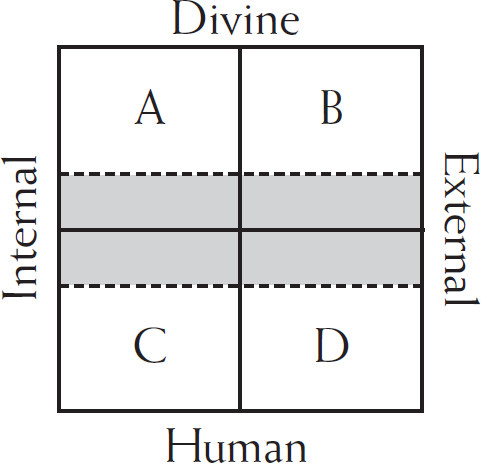
Authority Structures
In quadrant B we would place the Scriptures since the Bible is external to us but authoritative to us nonetheless. As John Stott states, “Scripture then is ‘God’s word written,’ his self-disclosure in speech and writing, the product of his revelation, inspiration and providence.”17 True, we acknowledge the Bible must be rightly interpreted and applied, and many who have held up the authority of the Bible have done so, in reality, in service to their own prejudices and traditions. But the mishandling of the Bible diminishes none of its authority.
This brings us to a third quadrant, quadrant D, for there exist many external human authorities that clamor for our conformity. For example, we might list government, parents, a document (e.g., the “Constitution of the United States”), a pastor or elder board, cultural norms, cultural perspectives, or traditions (either religious or secular). Some would argue that several of these (namely, government, parents, and church leaders) reside somewhere in the gray area between divine and human authority since these are sanctioned by God for leadership in the world. The authorities of this quadrant need not carry the label “authority” in order to be so functionally. For example, a cultural perspective holds no official position but may, in reality, be determinative for decisions an individual makes; it functions as an authority for that person.
Finally, quadrant C draws our attention to internal human authorities. For example, many people live out of their emotions as the primary driving force for their lives. For most the conscience constitutes another important internal authority. It may be argued that the conscience might be pushed up toward the area of divine authority, since it is an aspect of human nature by God’s design (Rom. 2:14–15).
It is this writer’s perspective that we must seek to live our lives from the top of this grid down. In other words, all human authorities must be considered in light of divine authority. We must hear and obey the Word of God as illumined by the Spirit of God. This word must determine the way we relate to both the external and internal human authorities calling for our attention. The rub, of course, comes with our determination of whether or not we truly are hearing God’s Word and discerning the true prompting of the Spirit. We all face the danger of reading our own cultures, experiences, and traditions into our interpretations of Scripture to such an extent that the voice of God is effectively drowned out of consideration. When the authority grid is inverted so that either consciously or unconsciously the Word and Spirit are relegated to a back-seat position, our lives are driven primarily by what is human. Thus we are no longer living from a standpoint of authentic Christianity.
For example, some so exalt the status of their denominational traditions that they will entertain no further discussion in light of further biblical study. Others in our culture are so saturated with pop notions about God that they have dismissed biblical teachings that contradict such notions. The “judgment of God,” for instance, in some corners has been completely eradicated in the presence of a one-sided proclamation of the “love of God.” Moreover, the very existence of God has been dismissed by those who suggest that a naturalistic worldview gives adequate explanation for human and material existence. These are examples of external human authorities being given precedent over divine authority.
I remember painfully an occasion at which I was attempting to arbitrate a divisive situation in a church. The pastor was being attacked unfairly by a subgroup within the church, which, by the way, had a history of dismissing pastors after a brief term of service. At one point in the conversation with a certain individual I reminded him that the Scriptures teach believers to be reconciled to one another. I pointed out that the pastor, who had done no moral wrong, had gone to great lengths to be reconciled with the factional group. I asked the man what it would take for him to be reconciled to the pastor. He responded bitterly, “I will not be reconciled to him!” I inquired, “Even though you understand that Scripture teaches that you must?” “That’s right,” he replied. This man provides us with an excellent example of one who has placed his emotions—an internal, human “authority”—in a place of preeminence over the Scriptures.
My point is this: Unless one comes to grips with the primacy of divine authority for life thoughts and life choices, scriptural warnings, such as the one found in Hebrews 10:26–31, are meaningless. Such warnings only make sense within a certain matrix of authority. Therefore, it may be that we will need a “pre-step” to preaching the warning texts of Hebrews, which will include a discussion of authority structures in life.
Christians must think clearly about the nature of spiritual development or nondevelopment.Hebrews 10:26–39 in part presents us with a picture of community development on the one hand and nondevelopment on the other. We receive a snapshot of those who have progressed in the faith to the point of taking a public stand with the persecuted church. At the end of the day the author is confident that many in this beleaguered church will not “shrink back” but will persevere to the end. Evidently, however, some associated with the community have failed to develop at all, calling into question the reality of their commitment, or have stagnated spiritually. The forces of this fallen world ever pull the Christian downward, grabbing at spiritual shirttails in order to hold him or her back from true Christian growth.
Our author knows that progress in the Christian life does not just happen; it is the product of an ongoing life of choices made in light of God’s will—in light of warnings, promises, and examples that help us perceive God’s will more fully. Yet, as shown in this text, either we move ahead in a way that is perceived or, perhaps, unperceived, or we stagnate spiritually. Therefore, the Christian life calls for deep reflection and volition. Evelyn Underhill writes:
However busy we may be, however mature and efficient we may seem, that growth, if we are real Christians, must go on. Even the greatest spiritual teachers, such as St. Paul and St. Augustine, could never afford to relax the tension of their own spiritual lives; they never seem to stand still, are never afraid of conflict and change. Their souls too were growing entities, with a potential capacity for love, adoration and creative service: in other words, for holiness, the achievement of the stature of Christ. A saint is simply a human being whose soul has thus grown up to its full stature, by full and generous response to its environment, God.18
Nevertheless, we need to understand that growth is seasonal. As I write these words, I am experiencing one of my favorite times of the year. The sugar maple outside my bedroom window in recent days has transformed to an almost iridescent yellow. My perennials are bowing down to the ground for sleep, and the grass, thankfully, has stopped its persistent plea for attention. These all will awake with new leaves, new development, new “life” in a few months; but for now they are content to be what they are in this special season.
In a similar manner we experience the ebb and flow, the rotation of seasons, in the Christian life. Some periods seem as vibrant as spring; the presence of God is as real to us as the presence of a spouse or friend in the next room. Other periods seem more dormant, the signs of life having been removed from our perception for the time being, leaving us to make right choices, to think right thoughts, in the midst of a spiritual dryness. Both kinds of times play an important part in the big picture of Christian development. One writer has put it this way:
I am always reminded that the experience which may be mine at a particular moment may be an experience in which things are stopping. Or it may be an experience in which things are just beginning. It is important that I know which process is taking place. An intimate part of growing into life is the development of a sensitiveness, an apprehension of process in its totality, that I may be enabled to know the character of the event with which I am dealing. Then I will not act in the house of death unnaturally by not accepting it. All of this is to say that there is inherent in life and brooding over life of man the creative mind and the spirit of the living God.19
The danger comes when a dry or seemingly dormant season dominates our lives for months or years on end. When this happens we should ask if the perceived dry spell is a normal part of development, because of a crisis in life or the product of our own wrong choices. A time of crisis, such as that being faced by the original addressees of Hebrews, may catch us at a point in life in which our spiritual resources are running low. Such a time may serve as a wake-up call that shakes us to our senses.
Thus, in applying Hebrews 10:26–39 we should ask ourselves where we, or those to whom we speak, are at this moment. What is called for concerning progress in the faith? Warning? A reminder of the past? A promise of future reward? All three? Yes, perhaps all three on a somewhat consistent basis; for we are people in tension, needing to move on in a world that wants to hold us back. At any given point, however, the various applications of this passage will be needed by some in any given Christian community. We must keep before us the grace of God in the face of God’s wrath, godly examples, and God’s promises. These will take us through various stages in the Christian life, hopefully building more and more consistency as time goes on. There is grace for struggle; his warnings, promises, reminders, examples, and the community of faith itself are expressions of that grace.
Christians must be willing to identify publicly with Christ and his body. Notice how much this passage has to do with public identification with or disassociation from Christ and his covenant people. The broader context suggests that those who “trampled the Son of God under foot” did so by publicly renouncing Christ or at least by quitting the community (6:6; 10:25). The positive example offered by those in the church involved their open association with Christ as they themselves were persecuted, and with others in the covenant as those brothers and sisters faced persecution. The author does not want them, therefore, to throw away their public boldness (i.e., “confidence,” v. 35) or to “shrink back.” Rather, they must by faith stand forward in face of the current crisis.
Christ’s call to discipleship has always been one that involves a great cost, for association with Jesus inevitably leads down the path of persecution (John 15:20; 2 Tim. 3:12). People outside the faith do not appreciate our devotion to Christ, and conflict arises as they realize we are not committed ultimately to them or to their views of life. This relational conflict, moreover, may be played out in the living room or the town square, but it does not occur in a closet. There comes a time when we must be willing to be counted with Christ or against him. There is no middle ground; we all must choose one side or the other.
Therefore, our application of Hebrews 10:26–39 may include probing into how we identify or fail to identify with Christ and his church today. What price are we willing to pay for our association? In what ways might we stand forth with Christ in the public contexts of our work, business, government, friendships, or family relationships? What is the difference between associating with an organized local church and the body of Christ invisible? Might there be times when we will be called to stand against an institution with “church” in its title in order to more fully identify with Christ? These are just a few of the questions we should ask as we seek to apply the text.
Contemporary Significance
NOT
A
TAME
God. One of C. S. Lewis’s favorite comments on Aslan, that great beast, the figure of Christ in the Narnia Chronicles, is, “He is not a tame lion.” The deep growl, the severe mercy; the uncompromising, firm-but-smiling gaze. When Aslan speaks no one in the story can question who is in charge. When the lion speaks, one not only gets the sense, but one knows that nothing more need be said. This is really the way things are and not only will they not be changed, indeed they cannot—we have bumped up against a greater reality than ourselves and our particular perspective. He is Lord and he does what he wills. He calls children from another world when and to where he desires. He vanquishes foes in his own good time. No one can ever think of sitting in judgment on him. To think of controlling him would be preposterous. The lightning is too powerful to be bottled, the mountain too furious to be captured in a video tape. There is a wildness in his nature and he will not be muzzled.
The “god” to which our culture invites us, with whom our culture is comfortable, is more like the simple and simplistic donkey in the stable of The Last Battle. Hidden away in a dark barn, he appears only for a few seconds in the night by the light of a dim fire. Many are fooled, but the donkey is a poor substitute for a real lion. He waddles when he walks; he does not roar; he has an old, dead covering that gives him a hint of lion-likeness. But when the real thing shows, all that is ripped away. When Aslan comes, no one can stand against him.
Nongods and dead gods and donkey gods are no threat, but a Living God is another matter altogether. The Living God has cosmic-sized, power-laden hands and is dreadful indeed. He will not be tamed by our postmodern repulsion for Truth, nor by our aversion to the concept of judgment. We must adjust ourselves to him or face the consequences. The great foolishness of walking away from his gospel, judging Christ as insufficient, lies in this: He has no greater means for dealing with sin. This sacrifice, this work on the cross, is the best work for dealing with our sins, and all other means are by nature inferior. We should fear our lack of grasping that reality; only real lions are dangerous, and donkeys can do us no harm. He is the Living God and it is a dreadful thing to fall into his hands as an enemy.
Calling to ourselves from the past. I am not sure why, but I have always liked time-travel stories (if you are not into science fiction, please bear with me for a moment). A popular movie, Back to the Future, tells of a boy named Marty, who, by a friend’s time-travel invention (a car), is zapped back in time. The boy’s visit to the past has a profound impact on the future as he interacts with his parents (then teenagers) and their peers. He even saves the life of his friend, the inventor, by giving him a message in the past, a note warning him that terrorists will eventually kill him.
Our past can also affect our present and future as we speak to ourselves from the past, as we “remember those earlier days” of our commitment to Christ. Perhaps there was a time when we as individuals stood in the face of severe trial. We should own and build memorials for the remembrance of those past times, using them for our own encouragement to endurance. If we as individuals have had no such experience, we can benefit from the example of our broader community of faith, looking to a time in the past at which they sacrificed greatly. Is there in the location where your church meets, a place for people to remember the past boldness of your faith community, perhaps through photographs or written documents? Are there times during which your church celebrates those past stances publicly? How are you creating an organizational memory that can help people stand firm in their commitment to Christ in the present?
If our local church has had no such experience (which is unlikely), we can benefit from the example of those in the broader body of Christ, perhaps by weaving through our preaching or teaching accounts of the public stands made by those in various arenas of church history. We as the church should call to ourselves from the past, challenging ourselves to endure in our public identification with Christ.
Identifying with Christ and his church. William Faulkner, in his book Intruders in the Dust,20 graphically depicts the racial prejudice of a small Mississippi town in the pre-civil rights South. The story has two main characters, whose lives become intertwined as the plot develops. Both chance and crisis throw Charles Mallison, a twelve-year-old white boy at the beginning of the story and a sixteen-year-old at its end, into an unwelcome relationship with Lucas Beauchamp, a black man who refuses to bow to the accepted social “position” to which he is assigned by virtue of his ancestry.
While hunting rabbits twelve-year-old Charles falls off a footlog into an icy creek. After crawling out of the water he looks up to find Lucas Beauchamp, with an ax on his shoulder, wearing a sheep-lined coat and a broad felt hat like Charles’ grandfather used to wear. The boy now experiences a series of cultural role reversals in the story. He is told what to do by this man and obeys, following him to the Beauchamp house. Charles strips naked by the fire, wraps himself in the “negro” blanket and eats the “negro” food. Being indebted to Lucas, the boy tries to pay him for helping him (indeed, after throwing the seventy cents to the floor, Charles commands Lucas with a heated “Pick it up!”). But Lucas “beats” him, refusing to take the money and instructing the two black boys present to return the money.
Later Charles tries again to repay and cleanse his conscience from debasing “not merely his manhood but his whole race.” He sends a dress to Molly, Lucas’s wife; but Lucas “beats” him again, sending in return a gallon of fresh homemade sorghum molasses by the hand of a white boy riding a mule. So Charles remains indebted to Lucas Beauchamp.
Four years later Lucas is accused of murdering a white man, Vinson Gowrie, from a family of “brawlers, and farmers and fox-hunters and stock-and timber-traders who would not even be the last anywhere to let one of its number be killed by anyone …” and faces the threat of being lynched by a mob. Charles, under direction from his uncle, goes to the jail to take Lucas some tobacco, and their encounter at this point is the part of the story I am most interested in at this moment. There in the jail Lucas asks the now-sixteen-year-old Charles to go out and dig up the body of the dead man. He asks him, in effect, to risk his life to help one of a different, perceived-as-inferior race. He asks him to join with the minority and risk severe persecution.
Charles realizes that he is no longer held by the plate of collard greens and the warm fire. He is held by the thought that Lucas is reaching out to him in hope that he “would hear the mute unhoping urgency of the eyes.” When Lucas approaches the bars of the cell and takes hold of those bars, Charles looks down and sees his “own hands holding to two of the bars, the two pairs of hands, the black ones and the white ones, grasping the bars while they faced one another above them.” And the boy agrees to join in Lucas’s cause.
We as followers of Christ are called to identify with a spiritual, minority “race”—believers of every race, nationality, and church affiliation—even at great cost to ourselves. We are called to take a stand for Christ publicly and to stand with those who are being persecuted for the Christian message. We face moments of “grasping the bars” with those hurt by enemies of the truth found in Jesus, moments at which we must decide to be counted with “confidence,” a public boldness that chooses the difficult path of identification. The only other option is to “shrink back” from that identification.
Back in what has been called his “born-again Christian phase” Bob Dylan, a pop music icon, made a public profession of faith in Christ with songs like “You’ve Gotta Serve Somebody.” Yet, now Dylan begins to get uneasy when asked about that era of his life:
It’s not tangible to me.… I don’t think I’m tangible to myself. I mean, I think one thing today and I think another thing tomorrow. I change during the course of a day. I wake and I’m one person, and when I go to sleep I know for certain I’m somebody else. I don’t know who I am most of the time. It doesn’t even matter to me.…
… Here’s the thing with me and the religious thing. This is the flat-out truth: I find the religiosity and philosophy in the music. I don’t find it anywhere else … I don’t adhere to rabbis, preachers, evangelists, all of that. I’ve learned more from the songs than I’ve learned from any of this kind of entity. The songs are my lexicon. I believe the songs.21
He seems to have shrunk back from identification with Christ, preferring instead to identify with the songs. Ironically, the cover of Newsweek in which the article appears carries a large picture of Dylan’s face and the proclamation, “Dylan Lives.”
Original Meaning
Remember the Past (10:32–34)
IT
IS
INTERESTING that at one point in the Song of Moses, two portions of which the author has just quoted, the great leader exhorts the Israelites to “remember the days of old” (Deut. 32:7). For the author of Hebrews now encourages his listeners to “remember.” Whereas Moses’ song focused on remembering God’s past deeds, Hebrews 10:32–34 uses the hearers’ own past commitment as a basis for hearty encouragement. The author challenges them to “remember those earlier days after you had received the light,” pinpointing the time frame at their experience of receiving the gospel.10 The assertion that they “stood [their] ground in a great contest in the face of suffering” speaks of a time of great, perhaps unusual, trial. The word athlesis (“contest”) connotes not just a challenge but a difficult struggle. Both Lane and Bruce have suggested the expulsion from Rome under Claudius in A.D. 49 as a possible identification of this experience, and the evidence provided in these verses matches the circumstances we know from that time.
Specifically, the believers had endured at least four forms of ill treatment. (1) They had faced public ridicule and persecution. The verb rendered “publicly exposed” (theatrizo) originally meant “to bring up on the stage,” but as the language developed it took on the figurative meaning of “to make a public spectacle of.”11 They had been made an item of derision in public both by “insult and persecution,” that is, both by verbal and physical abuse.
(2) Moreover, even when they had not been the objects of such abuse, they had felt the pain of identification with those who were so treated.
(3) This solidarity extended from the public square to the prison cell, as the listeners “sympathized” (sympatheo) with those incarcerated (v. 34). This verb communicates the idea of being “affected by the same suffering, the same impressions, the same emotions as another” person. It is compassion put in action by one rendering aid to someone in dire straights (cf. 13:3).12
(4) Finally, the believers “joyfully accepted the confiscation” of their property. If the eviction from Rome in A.D. 49 is the social setting behind the author’s reminder, the confiscation of property attending such an eviction would be in mind here. At various times in the first century the Jews were publicly abused as a group, and after being evicted from their homes they witnessed widespread looting of their properties and possessions.
A key to the author’s use of his hearers’ past stance as a present example is the attitude of “joy” attendant on these circumstances. This manner in which they accepted the theft of their properties describes a spiritual condition by which one sees and celebrates greater realities than those immediately observable. The hearers had joy in the midst of their persecution because they knew that “better and lasting possessions” were promised them by virtue of their identification with the Lord and his church.
Bridging Contexts
IN
SOME
WAYS it is easy to identify both the “timely” and the “timeless” in Hebrews 10:26–39. The passage speaks volumes about the hearers’ immediate, critical situation. The threat of some members apostatizing from the community comes through clearly in the author’s rigorous warning of 10:26–31. We have at least a hint of why they might have been turning their backs on Christianity, for in 10:32–34 the author speaks of severe, public persecution that had been faced in the past. His use of that time of persecution for instruction probably indicates something about their present difficulty.
Although some have been leaving, these believers on the whole have been faithful witnesses to Christ and maintained solidarity with one another. Hebrews 10:32–34 provides one of the writer’s most clear descriptions of those to whom he preaches—a portrait seized from a time of great faithfulness in the face of suffering. That he can use them as an example for themselves indicates that many in this church have come far in the faith and need to hold onto their progress. Thus, the author indirectly depicts a Christian fellowship made up of many who have been Christians for a long time and have paid a great price for that commitment, but a fellowship in which some are growing weary and are abandoning the faith altogether. Both his warning and encouragement must have been timely at the book’s first reading.
However, the timeless nature of the text also jumps out and presents itself. When in all of Christian history have believers not needed both warnings and encouragement? When have we not needed the challenge to live in light of eternity, as seen in 10:35–39? The principle has been with us from the beginning: “Therefore keep watch, because you do not know on what day your Lord will come” (Matt. 24:42). He is coming and will find both the righteous living by faith and those who shrink back and, therefore, are ashamed at his coming (cf. 1 John 2:28).
We have, of course, dealt with warnings and encouragements earlier in Hebrews,16 but these dynamics and their respective roles in Christian preaching are richly multifaceted. Therefore, we are challenged to tease out principles that to this point in the commentary have been treated but lightly. I will treat three of them in this section.
Christians must think clearly about authority structures upon which they base their beliefs and actions. When we speak of “authority structures,” we mean those dynamic contexts or forces in our lives that in reality determine the decisions we make. As depicted in the illustration below, these authority structures may be either divine or human in orientation and either internal or external. For example, most Christians would probably place the Holy Spirit in quadrant A since the Spirit is a divine authority who dwells within a believer (Rom. 8:9).
Authority Structures
In quadrant B we would place the Scriptures since the Bible is external to us but authoritative to us nonetheless. As John Stott states, “Scripture then is ‘God’s word written,’ his self-disclosure in speech and writing, the product of his revelation, inspiration and providence.”17 True, we acknowledge the Bible must be rightly interpreted and applied, and many who have held up the authority of the Bible have done so, in reality, in service to their own prejudices and traditions. But the mishandling of the Bible diminishes none of its authority.
This brings us to a third quadrant, quadrant D, for there exist many external human authorities that clamor for our conformity. For example, we might list government, parents, a document (e.g., the “Constitution of the United States”), a pastor or elder board, cultural norms, cultural perspectives, or traditions (either religious or secular). Some would argue that several of these (namely, government, parents, and church leaders) reside somewhere in the gray area between divine and human authority since these are sanctioned by God for leadership in the world. The authorities of this quadrant need not carry the label “authority” in order to be so functionally. For example, a cultural perspective holds no official position but may, in reality, be determinative for decisions an individual makes; it functions as an authority for that person.
Finally, quadrant C draws our attention to internal human authorities. For example, many people live out of their emotions as the primary driving force for their lives. For most the conscience constitutes another important internal authority. It may be argued that the conscience might be pushed up toward the area of divine authority, since it is an aspect of human nature by God’s design (Rom. 2:14–15).
It is this writer’s perspective that we must seek to live our lives from the top of this grid down. In other words, all human authorities must be considered in light of divine authority. We must hear and obey the Word of God as illumined by the Spirit of God. This word must determine the way we relate to both the external and internal human authorities calling for our attention. The rub, of course, comes with our determination of whether or not we truly are hearing God’s Word and discerning the true prompting of the Spirit. We all face the danger of reading our own cultures, experiences, and traditions into our interpretations of Scripture to such an extent that the voice of God is effectively drowned out of consideration. When the authority grid is inverted so that either consciously or unconsciously the Word and Spirit are relegated to a back-seat position, our lives are driven primarily by what is human. Thus we are no longer living from a standpoint of authentic Christianity.
For example, some so exalt the status of their denominational traditions that they will entertain no further discussion in light of further biblical study. Others in our culture are so saturated with pop notions about God that they have dismissed biblical teachings that contradict such notions. The “judgment of God,” for instance, in some corners has been completely eradicated in the presence of a one-sided proclamation of the “love of God.” Moreover, the very existence of God has been dismissed by those who suggest that a naturalistic worldview gives adequate explanation for human and material existence. These are examples of external human authorities being given precedent over divine authority.
I remember painfully an occasion at which I was attempting to arbitrate a divisive situation in a church. The pastor was being attacked unfairly by a subgroup within the church, which, by the way, had a history of dismissing pastors after a brief term of service. At one point in the conversation with a certain individual I reminded him that the Scriptures teach believers to be reconciled to one another. I pointed out that the pastor, who had done no moral wrong, had gone to great lengths to be reconciled with the factional group. I asked the man what it would take for him to be reconciled to the pastor. He responded bitterly, “I will not be reconciled to him!” I inquired, “Even though you understand that Scripture teaches that you must?” “That’s right,” he replied. This man provides us with an excellent example of one who has placed his emotions—an internal, human “authority”—in a place of preeminence over the Scriptures.
My point is this: Unless one comes to grips with the primacy of divine authority for life thoughts and life choices, scriptural warnings, such as the one found in Hebrews 10:26–31, are meaningless. Such warnings only make sense within a certain matrix of authority. Therefore, it may be that we will need a “pre-step” to preaching the warning texts of Hebrews, which will include a discussion of authority structures in life.
Christians must think clearly about the nature of spiritual development or nondevelopment.Hebrews 10:26–39 in part presents us with a picture of community development on the one hand and nondevelopment on the other. We receive a snapshot of those who have progressed in the faith to the point of taking a public stand with the persecuted church. At the end of the day the author is confident that many in this beleaguered church will not “shrink back” but will persevere to the end. Evidently, however, some associated with the community have failed to develop at all, calling into question the reality of their commitment, or have stagnated spiritually. The forces of this fallen world ever pull the Christian downward, grabbing at spiritual shirttails in order to hold him or her back from true Christian growth.
Our author knows that progress in the Christian life does not just happen; it is the product of an ongoing life of choices made in light of God’s will—in light of warnings, promises, and examples that help us perceive God’s will more fully. Yet, as shown in this text, either we move ahead in a way that is perceived or, perhaps, unperceived, or we stagnate spiritually. Therefore, the Christian life calls for deep reflection and volition. Evelyn Underhill writes:
However busy we may be, however mature and efficient we may seem, that growth, if we are real Christians, must go on. Even the greatest spiritual teachers, such as St. Paul and St. Augustine, could never afford to relax the tension of their own spiritual lives; they never seem to stand still, are never afraid of conflict and change. Their souls too were growing entities, with a potential capacity for love, adoration and creative service: in other words, for holiness, the achievement of the stature of Christ. A saint is simply a human being whose soul has thus grown up to its full stature, by full and generous response to its environment, God.18
Nevertheless, we need to understand that growth is seasonal. As I write these words, I am experiencing one of my favorite times of the year. The sugar maple outside my bedroom window in recent days has transformed to an almost iridescent yellow. My perennials are bowing down to the ground for sleep, and the grass, thankfully, has stopped its persistent plea for attention. These all will awake with new leaves, new development, new “life” in a few months; but for now they are content to be what they are in this special season.
In a similar manner we experience the ebb and flow, the rotation of seasons, in the Christian life. Some periods seem as vibrant as spring; the presence of God is as real to us as the presence of a spouse or friend in the next room. Other periods seem more dormant, the signs of life having been removed from our perception for the time being, leaving us to make right choices, to think right thoughts, in the midst of a spiritual dryness. Both kinds of times play an important part in the big picture of Christian development. One writer has put it this way:
I am always reminded that the experience which may be mine at a particular moment may be an experience in which things are stopping. Or it may be an experience in which things are just beginning. It is important that I know which process is taking place. An intimate part of growing into life is the development of a sensitiveness, an apprehension of process in its totality, that I may be enabled to know the character of the event with which I am dealing. Then I will not act in the house of death unnaturally by not accepting it. All of this is to say that there is inherent in life and brooding over life of man the creative mind and the spirit of the living God.19
The danger comes when a dry or seemingly dormant season dominates our lives for months or years on end. When this happens we should ask if the perceived dry spell is a normal part of development, because of a crisis in life or the product of our own wrong choices. A time of crisis, such as that being faced by the original addressees of Hebrews, may catch us at a point in life in which our spiritual resources are running low. Such a time may serve as a wake-up call that shakes us to our senses.
Thus, in applying Hebrews 10:26–39 we should ask ourselves where we, or those to whom we speak, are at this moment. What is called for concerning progress in the faith? Warning? A reminder of the past? A promise of future reward? All three? Yes, perhaps all three on a somewhat consistent basis; for we are people in tension, needing to move on in a world that wants to hold us back. At any given point, however, the various applications of this passage will be needed by some in any given Christian community. We must keep before us the grace of God in the face of God’s wrath, godly examples, and God’s promises. These will take us through various stages in the Christian life, hopefully building more and more consistency as time goes on. There is grace for struggle; his warnings, promises, reminders, examples, and the community of faith itself are expressions of that grace.
Christians must be willing to identify publicly with Christ and his body. Notice how much this passage has to do with public identification with or disassociation from Christ and his covenant people. The broader context suggests that those who “trampled the Son of God under foot” did so by publicly renouncing Christ or at least by quitting the community (6:6; 10:25). The positive example offered by those in the church involved their open association with Christ as they themselves were persecuted, and with others in the covenant as those brothers and sisters faced persecution. The author does not want them, therefore, to throw away their public boldness (i.e., “confidence,” v. 35) or to “shrink back.” Rather, they must by faith stand forward in face of the current crisis.
Christ’s call to discipleship has always been one that involves a great cost, for association with Jesus inevitably leads down the path of persecution (John 15:20; 2 Tim. 3:12). People outside the faith do not appreciate our devotion to Christ, and conflict arises as they realize we are not committed ultimately to them or to their views of life. This relational conflict, moreover, may be played out in the living room or the town square, but it does not occur in a closet. There comes a time when we must be willing to be counted with Christ or against him. There is no middle ground; we all must choose one side or the other.
Therefore, our application of Hebrews 10:26–39 may include probing into how we identify or fail to identify with Christ and his church today. What price are we willing to pay for our association? In what ways might we stand forth with Christ in the public contexts of our work, business, government, friendships, or family relationships? What is the difference between associating with an organized local church and the body of Christ invisible? Might there be times when we will be called to stand against an institution with “church” in its title in order to more fully identify with Christ? These are just a few of the questions we should ask as we seek to apply the text.
Contemporary Significance
NOT
A
TAME
God. One of C. S. Lewis’s favorite comments on Aslan, that great beast, the figure of Christ in the Narnia Chronicles, is, “He is not a tame lion.” The deep growl, the severe mercy; the uncompromising, firm-but-smiling gaze. When Aslan speaks no one in the story can question who is in charge. When the lion speaks, one not only gets the sense, but one knows that nothing more need be said. This is really the way things are and not only will they not be changed, indeed they cannot—we have bumped up against a greater reality than ourselves and our particular perspective. He is Lord and he does what he wills. He calls children from another world when and to where he desires. He vanquishes foes in his own good time. No one can ever think of sitting in judgment on him. To think of controlling him would be preposterous. The lightning is too powerful to be bottled, the mountain too furious to be captured in a video tape. There is a wildness in his nature and he will not be muzzled.
The “god” to which our culture invites us, with whom our culture is comfortable, is more like the simple and simplistic donkey in the stable of The Last Battle. Hidden away in a dark barn, he appears only for a few seconds in the night by the light of a dim fire. Many are fooled, but the donkey is a poor substitute for a real lion. He waddles when he walks; he does not roar; he has an old, dead covering that gives him a hint of lion-likeness. But when the real thing shows, all that is ripped away. When Aslan comes, no one can stand against him.
Nongods and dead gods and donkey gods are no threat, but a Living God is another matter altogether. The Living God has cosmic-sized, power-laden hands and is dreadful indeed. He will not be tamed by our postmodern repulsion for Truth, nor by our aversion to the concept of judgment. We must adjust ourselves to him or face the consequences. The great foolishness of walking away from his gospel, judging Christ as insufficient, lies in this: He has no greater means for dealing with sin. This sacrifice, this work on the cross, is the best work for dealing with our sins, and all other means are by nature inferior. We should fear our lack of grasping that reality; only real lions are dangerous, and donkeys can do us no harm. He is the Living God and it is a dreadful thing to fall into his hands as an enemy.
Calling to ourselves from the past. I am not sure why, but I have always liked time-travel stories (if you are not into science fiction, please bear with me for a moment). A popular movie, Back to the Future, tells of a boy named Marty, who, by a friend’s time-travel invention (a car), is zapped back in time. The boy’s visit to the past has a profound impact on the future as he interacts with his parents (then teenagers) and their peers. He even saves the life of his friend, the inventor, by giving him a message in the past, a note warning him that terrorists will eventually kill him.
Our past can also affect our present and future as we speak to ourselves from the past, as we “remember those earlier days” of our commitment to Christ. Perhaps there was a time when we as individuals stood in the face of severe trial. We should own and build memorials for the remembrance of those past times, using them for our own encouragement to endurance. If we as individuals have had no such experience, we can benefit from the example of our broader community of faith, looking to a time in the past at which they sacrificed greatly. Is there in the location where your church meets, a place for people to remember the past boldness of your faith community, perhaps through photographs or written documents? Are there times during which your church celebrates those past stances publicly? How are you creating an organizational memory that can help people stand firm in their commitment to Christ in the present?
If our local church has had no such experience (which is unlikely), we can benefit from the example of those in the broader body of Christ, perhaps by weaving through our preaching or teaching accounts of the public stands made by those in various arenas of church history. We as the church should call to ourselves from the past, challenging ourselves to endure in our public identification with Christ.
Identifying with Christ and his church. William Faulkner, in his book Intruders in the Dust,20 graphically depicts the racial prejudice of a small Mississippi town in the pre-civil rights South. The story has two main characters, whose lives become intertwined as the plot develops. Both chance and crisis throw Charles Mallison, a twelve-year-old white boy at the beginning of the story and a sixteen-year-old at its end, into an unwelcome relationship with Lucas Beauchamp, a black man who refuses to bow to the accepted social “position” to which he is assigned by virtue of his ancestry.
While hunting rabbits twelve-year-old Charles falls off a footlog into an icy creek. After crawling out of the water he looks up to find Lucas Beauchamp, with an ax on his shoulder, wearing a sheep-lined coat and a broad felt hat like Charles’ grandfather used to wear. The boy now experiences a series of cultural role reversals in the story. He is told what to do by this man and obeys, following him to the Beauchamp house. Charles strips naked by the fire, wraps himself in the “negro” blanket and eats the “negro” food. Being indebted to Lucas, the boy tries to pay him for helping him (indeed, after throwing the seventy cents to the floor, Charles commands Lucas with a heated “Pick it up!”). But Lucas “beats” him, refusing to take the money and instructing the two black boys present to return the money.
Later Charles tries again to repay and cleanse his conscience from debasing “not merely his manhood but his whole race.” He sends a dress to Molly, Lucas’s wife; but Lucas “beats” him again, sending in return a gallon of fresh homemade sorghum molasses by the hand of a white boy riding a mule. So Charles remains indebted to Lucas Beauchamp.
Four years later Lucas is accused of murdering a white man, Vinson Gowrie, from a family of “brawlers, and farmers and fox-hunters and stock-and timber-traders who would not even be the last anywhere to let one of its number be killed by anyone …” and faces the threat of being lynched by a mob. Charles, under direction from his uncle, goes to the jail to take Lucas some tobacco, and their encounter at this point is the part of the story I am most interested in at this moment. There in the jail Lucas asks the now-sixteen-year-old Charles to go out and dig up the body of the dead man. He asks him, in effect, to risk his life to help one of a different, perceived-as-inferior race. He asks him to join with the minority and risk severe persecution.
Charles realizes that he is no longer held by the plate of collard greens and the warm fire. He is held by the thought that Lucas is reaching out to him in hope that he “would hear the mute unhoping urgency of the eyes.” When Lucas approaches the bars of the cell and takes hold of those bars, Charles looks down and sees his “own hands holding to two of the bars, the two pairs of hands, the black ones and the white ones, grasping the bars while they faced one another above them.” And the boy agrees to join in Lucas’s cause.
We as followers of Christ are called to identify with a spiritual, minority “race”—believers of every race, nationality, and church affiliation—even at great cost to ourselves. We are called to take a stand for Christ publicly and to stand with those who are being persecuted for the Christian message. We face moments of “grasping the bars” with those hurt by enemies of the truth found in Jesus, moments at which we must decide to be counted with “confidence,” a public boldness that chooses the difficult path of identification. The only other option is to “shrink back” from that identification.
Back in what has been called his “born-again Christian phase” Bob Dylan, a pop music icon, made a public profession of faith in Christ with songs like “You’ve Gotta Serve Somebody.” Yet, now Dylan begins to get uneasy when asked about that era of his life:
It’s not tangible to me.… I don’t think I’m tangible to myself. I mean, I think one thing today and I think another thing tomorrow. I change during the course of a day. I wake and I’m one person, and when I go to sleep I know for certain I’m somebody else. I don’t know who I am most of the time. It doesn’t even matter to me.…
… Here’s the thing with me and the religious thing. This is the flat-out truth: I find the religiosity and philosophy in the music. I don’t find it anywhere else … I don’t adhere to rabbis, preachers, evangelists, all of that. I’ve learned more from the songs than I’ve learned from any of this kind of entity. The songs are my lexicon. I believe the songs.21
He seems to have shrunk back from identification with Christ, preferring instead to identify with the songs. Ironically, the cover of Newsweek in which the article appears carries a large picture of Dylan’s face and the proclamation, “Dylan Lives.”
Original Meaning
Encouragement to Persevere (10:35–39)
FOLLOWING
FROM
THIS reminder of their former boldness in the face of severe persecution, the author exhorts his hearers to stay that course: “So do not throw away your confidence.” The word “confidence” (parresia) can mean “openness, boldness, confidence”; often, as here, it has overtones of something done in public.13 The author, therefore, is encouraging the believers not to retreat from a pattern of public identification with the body of Christ (10:25), reminding them that such identification will be rewarded richly. This reward, however, comes to those who accomplish God’s will by persevering in their public confession (10:36).
The quotation found in 10:37–38 brings together parts of two Old Testament texts (Isa. 26:20–21 and Hab. 2:3–4) and focuses on a contrast between the righteous who live by faith and the wicked. The two passages probably were brought together by virtue of their common reference to “the coming.”14 In the Isaiah passage it is the Lord who is coming to punish the wicked; in Habakkuk it is the revelation of judgment that will come both to reward the person who lives by faith and to deal with the unrighteous.
The Isaiah text carries with it strong overtones of the end of time, since it speaks both of resurrection and comprehensive judgment,15 and thus has been adopted by our author to speak of Christ’s second coming. The Habakkuk passage also lends itself for application to that eschatological event, since it speaks of “the end.” Originally, that prophecy concerned the destruction of Israel at the hands of the Chaldeans. The Lord instructs the prophet to write the revelation on tablets and assures him that though the fulfillment lingers, it will surely come at the appointed time. Habakkuk then follows with a contrast between the wicked person, who has a crooked soul, and the righteous, who lives by faith (Hab. 2:4).
The author of Hebrews applies these conflated Old Testament texts to his hearers’ situation. The concept of “waiting” for an impending time of reward and punishment fits the tension of their circumstances precisely. They struggle (as do we) to remain faithful in a time prior to the Lord’s coming. The decision before them is clear. They can choose the route of faith and be rewarded by the Lord at his coming, or they can “shrink back” and face the Lord’s displeasure and destruction (v. 39a). The author ends this section with a confident assertion that he and his community belong to those who have chosen the former path (v. 39b), for they walk the way of faith as “those who believe and are saved,” more literally, those “of faith resulting in the preservation [or salvation] of the soul” (cf. 4:1–3).
Bridging Contexts
IN
SOME
WAYS it is easy to identify both the “timely” and the “timeless” in Hebrews 10:26–39. The passage speaks volumes about the hearers’ immediate, critical situation. The threat of some members apostatizing from the community comes through clearly in the author’s rigorous warning of 10:26–31. We have at least a hint of why they might have been turning their backs on Christianity, for in 10:32–34 the author speaks of severe, public persecution that had been faced in the past. His use of that time of persecution for instruction probably indicates something about their present difficulty.
Although some have been leaving, these believers on the whole have been faithful witnesses to Christ and maintained solidarity with one another. Hebrews 10:32–34 provides one of the writer’s most clear descriptions of those to whom he preaches—a portrait seized from a time of great faithfulness in the face of suffering. That he can use them as an example for themselves indicates that many in this church have come far in the faith and need to hold onto their progress. Thus, the author indirectly depicts a Christian fellowship made up of many who have been Christians for a long time and have paid a great price for that commitment, but a fellowship in which some are growing weary and are abandoning the faith altogether. Both his warning and encouragement must have been timely at the book’s first reading.
However, the timeless nature of the text also jumps out and presents itself. When in all of Christian history have believers not needed both warnings and encouragement? When have we not needed the challenge to live in light of eternity, as seen in 10:35–39? The principle has been with us from the beginning: “Therefore keep watch, because you do not know on what day your Lord will come” (Matt. 24:42). He is coming and will find both the righteous living by faith and those who shrink back and, therefore, are ashamed at his coming (cf. 1 John 2:28).
We have, of course, dealt with warnings and encouragements earlier in Hebrews,16 but these dynamics and their respective roles in Christian preaching are richly multifaceted. Therefore, we are challenged to tease out principles that to this point in the commentary have been treated but lightly. I will treat three of them in this section.
Christians must think clearly about authority structures upon which they base their beliefs and actions. When we speak of “authority structures,” we mean those dynamic contexts or forces in our lives that in reality determine the decisions we make. As depicted in the illustration below, these authority structures may be either divine or human in orientation and either internal or external. For example, most Christians would probably place the Holy Spirit in quadrant A since the Spirit is a divine authority who dwells within a believer (Rom. 8:9).
Authority Structures
In quadrant B we would place the Scriptures since the Bible is external to us but authoritative to us nonetheless. As John Stott states, “Scripture then is ‘God’s word written,’ his self-disclosure in speech and writing, the product of his revelation, inspiration and providence.”17 True, we acknowledge the Bible must be rightly interpreted and applied, and many who have held up the authority of the Bible have done so, in reality, in service to their own prejudices and traditions. But the mishandling of the Bible diminishes none of its authority.
This brings us to a third quadrant, quadrant D, for there exist many external human authorities that clamor for our conformity. For example, we might list government, parents, a document (e.g., the “Constitution of the United States”), a pastor or elder board, cultural norms, cultural perspectives, or traditions (either religious or secular). Some would argue that several of these (namely, government, parents, and church leaders) reside somewhere in the gray area between divine and human authority since these are sanctioned by God for leadership in the world. The authorities of this quadrant need not carry the label “authority” in order to be so functionally. For example, a cultural perspective holds no official position but may, in reality, be determinative for decisions an individual makes; it functions as an authority for that person.
Finally, quadrant C draws our attention to internal human authorities. For example, many people live out of their emotions as the primary driving force for their lives. For most the conscience constitutes another important internal authority. It may be argued that the conscience might be pushed up toward the area of divine authority, since it is an aspect of human nature by God’s design (Rom. 2:14–15).
It is this writer’s perspective that we must seek to live our lives from the top of this grid down. In other words, all human authorities must be considered in light of divine authority. We must hear and obey the Word of God as illumined by the Spirit of God. This word must determine the way we relate to both the external and internal human authorities calling for our attention. The rub, of course, comes with our determination of whether or not we truly are hearing God’s Word and discerning the true prompting of the Spirit. We all face the danger of reading our own cultures, experiences, and traditions into our interpretations of Scripture to such an extent that the voice of God is effectively drowned out of consideration. When the authority grid is inverted so that either consciously or unconsciously the Word and Spirit are relegated to a back-seat position, our lives are driven primarily by what is human. Thus we are no longer living from a standpoint of authentic Christianity.
For example, some so exalt the status of their denominational traditions that they will entertain no further discussion in light of further biblical study. Others in our culture are so saturated with pop notions about God that they have dismissed biblical teachings that contradict such notions. The “judgment of God,” for instance, in some corners has been completely eradicated in the presence of a one-sided proclamation of the “love of God.” Moreover, the very existence of God has been dismissed by those who suggest that a naturalistic worldview gives adequate explanation for human and material existence. These are examples of external human authorities being given precedent over divine authority.
I remember painfully an occasion at which I was attempting to arbitrate a divisive situation in a church. The pastor was being attacked unfairly by a subgroup within the church, which, by the way, had a history of dismissing pastors after a brief term of service. At one point in the conversation with a certain individual I reminded him that the Scriptures teach believers to be reconciled to one another. I pointed out that the pastor, who had done no moral wrong, had gone to great lengths to be reconciled with the factional group. I asked the man what it would take for him to be reconciled to the pastor. He responded bitterly, “I will not be reconciled to him!” I inquired, “Even though you understand that Scripture teaches that you must?” “That’s right,” he replied. This man provides us with an excellent example of one who has placed his emotions—an internal, human “authority”—in a place of preeminence over the Scriptures.
My point is this: Unless one comes to grips with the primacy of divine authority for life thoughts and life choices, scriptural warnings, such as the one found in Hebrews 10:26–31, are meaningless. Such warnings only make sense within a certain matrix of authority. Therefore, it may be that we will need a “pre-step” to preaching the warning texts of Hebrews, which will include a discussion of authority structures in life.
Christians must think clearly about the nature of spiritual development or nondevelopment.Hebrews 10:26–39 in part presents us with a picture of community development on the one hand and nondevelopment on the other. We receive a snapshot of those who have progressed in the faith to the point of taking a public stand with the persecuted church. At the end of the day the author is confident that many in this beleaguered church will not “shrink back” but will persevere to the end. Evidently, however, some associated with the community have failed to develop at all, calling into question the reality of their commitment, or have stagnated spiritually. The forces of this fallen world ever pull the Christian downward, grabbing at spiritual shirttails in order to hold him or her back from true Christian growth.
Our author knows that progress in the Christian life does not just happen; it is the product of an ongoing life of choices made in light of God’s will—in light of warnings, promises, and examples that help us perceive God’s will more fully. Yet, as shown in this text, either we move ahead in a way that is perceived or, perhaps, unperceived, or we stagnate spiritually. Therefore, the Christian life calls for deep reflection and volition. Evelyn Underhill writes:
However busy we may be, however mature and efficient we may seem, that growth, if we are real Christians, must go on. Even the greatest spiritual teachers, such as St. Paul and St. Augustine, could never afford to relax the tension of their own spiritual lives; they never seem to stand still, are never afraid of conflict and change. Their souls too were growing entities, with a potential capacity for love, adoration and creative service: in other words, for holiness, the achievement of the stature of Christ. A saint is simply a human being whose soul has thus grown up to its full stature, by full and generous response to its environment, God.18
Nevertheless, we need to understand that growth is seasonal. As I write these words, I am experiencing one of my favorite times of the year. The sugar maple outside my bedroom window in recent days has transformed to an almost iridescent yellow. My perennials are bowing down to the ground for sleep, and the grass, thankfully, has stopped its persistent plea for attention. These all will awake with new leaves, new development, new “life” in a few months; but for now they are content to be what they are in this special season.
In a similar manner we experience the ebb and flow, the rotation of seasons, in the Christian life. Some periods seem as vibrant as spring; the presence of God is as real to us as the presence of a spouse or friend in the next room. Other periods seem more dormant, the signs of life having been removed from our perception for the time being, leaving us to make right choices, to think right thoughts, in the midst of a spiritual dryness. Both kinds of times play an important part in the big picture of Christian development. One writer has put it this way:
I am always reminded that the experience which may be mine at a particular moment may be an experience in which things are stopping. Or it may be an experience in which things are just beginning. It is important that I know which process is taking place. An intimate part of growing into life is the development of a sensitiveness, an apprehension of process in its totality, that I may be enabled to know the character of the event with which I am dealing. Then I will not act in the house of death unnaturally by not accepting it. All of this is to say that there is inherent in life and brooding over life of man the creative mind and the spirit of the living God.19
The danger comes when a dry or seemingly dormant season dominates our lives for months or years on end. When this happens we should ask if the perceived dry spell is a normal part of development, because of a crisis in life or the product of our own wrong choices. A time of crisis, such as that being faced by the original addressees of Hebrews, may catch us at a point in life in which our spiritual resources are running low. Such a time may serve as a wake-up call that shakes us to our senses.
Thus, in applying Hebrews 10:26–39 we should ask ourselves where we, or those to whom we speak, are at this moment. What is called for concerning progress in the faith? Warning? A reminder of the past? A promise of future reward? All three? Yes, perhaps all three on a somewhat consistent basis; for we are people in tension, needing to move on in a world that wants to hold us back. At any given point, however, the various applications of this passage will be needed by some in any given Christian community. We must keep before us the grace of God in the face of God’s wrath, godly examples, and God’s promises. These will take us through various stages in the Christian life, hopefully building more and more consistency as time goes on. There is grace for struggle; his warnings, promises, reminders, examples, and the community of faith itself are expressions of that grace.
Christians must be willing to identify publicly with Christ and his body. Notice how much this passage has to do with public identification with or disassociation from Christ and his covenant people. The broader context suggests that those who “trampled the Son of God under foot” did so by publicly renouncing Christ or at least by quitting the community (6:6; 10:25). The positive example offered by those in the church involved their open association with Christ as they themselves were persecuted, and with others in the covenant as those brothers and sisters faced persecution. The author does not want them, therefore, to throw away their public boldness (i.e., “confidence,” v. 35) or to “shrink back.” Rather, they must by faith stand forward in face of the current crisis.
Christ’s call to discipleship has always been one that involves a great cost, for association with Jesus inevitably leads down the path of persecution (John 15:20; 2 Tim. 3:12). People outside the faith do not appreciate our devotion to Christ, and conflict arises as they realize we are not committed ultimately to them or to their views of life. This relational conflict, moreover, may be played out in the living room or the town square, but it does not occur in a closet. There comes a time when we must be willing to be counted with Christ or against him. There is no middle ground; we all must choose one side or the other.
Therefore, our application of Hebrews 10:26–39 may include probing into how we identify or fail to identify with Christ and his church today. What price are we willing to pay for our association? In what ways might we stand forth with Christ in the public contexts of our work, business, government, friendships, or family relationships? What is the difference between associating with an organized local church and the body of Christ invisible? Might there be times when we will be called to stand against an institution with “church” in its title in order to more fully identify with Christ? These are just a few of the questions we should ask as we seek to apply the text.
Contemporary Significance
NOT
A
TAME
God. One of C. S. Lewis’s favorite comments on Aslan, that great beast, the figure of Christ in the Narnia Chronicles, is, “He is not a tame lion.” The deep growl, the severe mercy; the uncompromising, firm-but-smiling gaze. When Aslan speaks no one in the story can question who is in charge. When the lion speaks, one not only gets the sense, but one knows that nothing more need be said. This is really the way things are and not only will they not be changed, indeed they cannot—we have bumped up against a greater reality than ourselves and our particular perspective. He is Lord and he does what he wills. He calls children from another world when and to where he desires. He vanquishes foes in his own good time. No one can ever think of sitting in judgment on him. To think of controlling him would be preposterous. The lightning is too powerful to be bottled, the mountain too furious to be captured in a video tape. There is a wildness in his nature and he will not be muzzled.
The “god” to which our culture invites us, with whom our culture is comfortable, is more like the simple and simplistic donkey in the stable of The Last Battle. Hidden away in a dark barn, he appears only for a few seconds in the night by the light of a dim fire. Many are fooled, but the donkey is a poor substitute for a real lion. He waddles when he walks; he does not roar; he has an old, dead covering that gives him a hint of lion-likeness. But when the real thing shows, all that is ripped away. When Aslan comes, no one can stand against him.
Nongods and dead gods and donkey gods are no threat, but a Living God is another matter altogether. The Living God has cosmic-sized, power-laden hands and is dreadful indeed. He will not be tamed by our postmodern repulsion for Truth, nor by our aversion to the concept of judgment. We must adjust ourselves to him or face the consequences. The great foolishness of walking away from his gospel, judging Christ as insufficient, lies in this: He has no greater means for dealing with sin. This sacrifice, this work on the cross, is the best work for dealing with our sins, and all other means are by nature inferior. We should fear our lack of grasping that reality; only real lions are dangerous, and donkeys can do us no harm. He is the Living God and it is a dreadful thing to fall into his hands as an enemy.
Calling to ourselves from the past. I am not sure why, but I have always liked time-travel stories (if you are not into science fiction, please bear with me for a moment). A popular movie, Back to the Future, tells of a boy named Marty, who, by a friend’s time-travel invention (a car), is zapped back in time. The boy’s visit to the past has a profound impact on the future as he interacts with his parents (then teenagers) and their peers. He even saves the life of his friend, the inventor, by giving him a message in the past, a note warning him that terrorists will eventually kill him.
Our past can also affect our present and future as we speak to ourselves from the past, as we “remember those earlier days” of our commitment to Christ. Perhaps there was a time when we as individuals stood in the face of severe trial. We should own and build memorials for the remembrance of those past times, using them for our own encouragement to endurance. If we as individuals have had no such experience, we can benefit from the example of our broader community of faith, looking to a time in the past at which they sacrificed greatly. Is there in the location where your church meets, a place for people to remember the past boldness of your faith community, perhaps through photographs or written documents? Are there times during which your church celebrates those past stances publicly? How are you creating an organizational memory that can help people stand firm in their commitment to Christ in the present?
If our local church has had no such experience (which is unlikely), we can benefit from the example of those in the broader body of Christ, perhaps by weaving through our preaching or teaching accounts of the public stands made by those in various arenas of church history. We as the church should call to ourselves from the past, challenging ourselves to endure in our public identification with Christ.
Identifying with Christ and his church. William Faulkner, in his book Intruders in the Dust,20 graphically depicts the racial prejudice of a small Mississippi town in the pre-civil rights South. The story has two main characters, whose lives become intertwined as the plot develops. Both chance and crisis throw Charles Mallison, a twelve-year-old white boy at the beginning of the story and a sixteen-year-old at its end, into an unwelcome relationship with Lucas Beauchamp, a black man who refuses to bow to the accepted social “position” to which he is assigned by virtue of his ancestry.
While hunting rabbits twelve-year-old Charles falls off a footlog into an icy creek. After crawling out of the water he looks up to find Lucas Beauchamp, with an ax on his shoulder, wearing a sheep-lined coat and a broad felt hat like Charles’ grandfather used to wear. The boy now experiences a series of cultural role reversals in the story. He is told what to do by this man and obeys, following him to the Beauchamp house. Charles strips naked by the fire, wraps himself in the “negro” blanket and eats the “negro” food. Being indebted to Lucas, the boy tries to pay him for helping him (indeed, after throwing the seventy cents to the floor, Charles commands Lucas with a heated “Pick it up!”). But Lucas “beats” him, refusing to take the money and instructing the two black boys present to return the money.
Later Charles tries again to repay and cleanse his conscience from debasing “not merely his manhood but his whole race.” He sends a dress to Molly, Lucas’s wife; but Lucas “beats” him again, sending in return a gallon of fresh homemade sorghum molasses by the hand of a white boy riding a mule. So Charles remains indebted to Lucas Beauchamp.
Four years later Lucas is accused of murdering a white man, Vinson Gowrie, from a family of “brawlers, and farmers and fox-hunters and stock-and timber-traders who would not even be the last anywhere to let one of its number be killed by anyone …” and faces the threat of being lynched by a mob. Charles, under direction from his uncle, goes to the jail to take Lucas some tobacco, and their encounter at this point is the part of the story I am most interested in at this moment. There in the jail Lucas asks the now-sixteen-year-old Charles to go out and dig up the body of the dead man. He asks him, in effect, to risk his life to help one of a different, perceived-as-inferior race. He asks him to join with the minority and risk severe persecution.
Charles realizes that he is no longer held by the plate of collard greens and the warm fire. He is held by the thought that Lucas is reaching out to him in hope that he “would hear the mute unhoping urgency of the eyes.” When Lucas approaches the bars of the cell and takes hold of those bars, Charles looks down and sees his “own hands holding to two of the bars, the two pairs of hands, the black ones and the white ones, grasping the bars while they faced one another above them.” And the boy agrees to join in Lucas’s cause.
We as followers of Christ are called to identify with a spiritual, minority “race”—believers of every race, nationality, and church affiliation—even at great cost to ourselves. We are called to take a stand for Christ publicly and to stand with those who are being persecuted for the Christian message. We face moments of “grasping the bars” with those hurt by enemies of the truth found in Jesus, moments at which we must decide to be counted with “confidence,” a public boldness that chooses the difficult path of identification. The only other option is to “shrink back” from that identification.
Back in what has been called his “born-again Christian phase” Bob Dylan, a pop music icon, made a public profession of faith in Christ with songs like “You’ve Gotta Serve Somebody.” Yet, now Dylan begins to get uneasy when asked about that era of his life:
It’s not tangible to me.… I don’t think I’m tangible to myself. I mean, I think one thing today and I think another thing tomorrow. I change during the course of a day. I wake and I’m one person, and when I go to sleep I know for certain I’m somebody else. I don’t know who I am most of the time. It doesn’t even matter to me.…
… Here’s the thing with me and the religious thing. This is the flat-out truth: I find the religiosity and philosophy in the music. I don’t find it anywhere else … I don’t adhere to rabbis, preachers, evangelists, all of that. I’ve learned more from the songs than I’ve learned from any of this kind of entity. The songs are my lexicon. I believe the songs.21
He seems to have shrunk back from identification with Christ, preferring instead to identify with the songs. Ironically, the cover of Newsweek in which the article appears carries a large picture of Dylan’s face and the proclamation, “Dylan Lives.”