Original Meaning
Running the Race (12:1–2)
THE
WRITER
OF Hebrews begins chapter 12 with the familiar race metaphor, presenting a forceful challenge for Christians to endure in a “marathon” commitment to Christ. The author crafts a logical transition between chapters 11 and 12 with the particle “therefore” (toigaroun
1) and a reference to the “great cloud of witnesses,” the exemplars of faith just recounted. With 12:1 he turns the spotlight on his own community of faith, using the first person plural “we” to challenge this community to recognize themselves as part of the great host called to live by faith. The basis for this exhortation has been laid well with the example list of chapter 11.
Authors of classical literature used the image of a “cloud” to describe a large group of people, and our writer employs this metaphor with an added emphasis, pointing back to the multitude of persons listed or alluded to in chapter 11 as “such a great cloud.” In what sense, however, are the heroes of the faith surrounding the Christian community a “great cloud of witnesses”? Some, in light of the race imagery, have understood this confession to mean that the countless thousands of God’s faithful throughout the ages now sit in the “stands” of eternity, observing Christians as they seek to live for Christ in the world. The word “witness” (martys) certainly can carry the meaning “spectator,” as in 1 Timothy 6:12, and “surrounded” (perikeimenon) brings to mind the ancient amphitheater with its tiered rows of seats.
However, the author intends more from this image than to conjure the faithful of the ages as passive spectators. Rather, they are witnesses in the sense that they bear witness to the Christian community of God’s faithfulness and of the effectiveness of faith.2 God has given witness to them (“commended” in 11:2, 39 is from a related word, the verb martyreo), and they, as examples, bear witness to him before succeeding generations. In this way, the great cloud of faithful Christ-followers through history offer the community motivation in its current struggle to stay the course of commitment. As F. F. Bruce notes, “It is not so much they who look at us as we who look to them—for encouragement.”3
The writer calls his hearers to “throw off everything that hinders and the sin that so easily entangles.” An ancient writer could use the word onkos to mean “mass, weight, heaviness, bodily fat,” or more positively, “fullness.” In line with the sports imagery of verse 1, the word could refer to a runner stripping of burdensome clothing or losing excess bodily fat. For success one had to get rid of anything that would “hinder breathing or the free movement of the limbs.”4 So the Christ-follower must lay aside “everything that hinders” if the faith race is to be run triumphantly. More specifically, we are to get rid of the “entangling sin” (cf. NIV
). The word euperistatos possibly refers to something that clings so closely that it impedes movement, but its meaning is uncertain.5 Those who prefer a translation in line with the NIV
understand the term to derive from periïstemi (“to surround”). The author does not seem to have a specific sin in mind,6 but rather understands any sin as hindering progress in the faith.
The main clause of 12:1–2a is translated with “let us run.” This image of “running” emphasizes that Christ-followers have a course to complete or a goal to reach, and must exert effort if the Christian life is to be lived faithfully.7 The author has in view, however, a marathon rather than a sprint, as seen in the phrase “with endurance.” The effort called for, consequently, is a sustained effort that goes the distance, following through on one’s commitment with dogged determination. This is how we must run “the race marked out for us.”
Prokeimai, translated here as “marked out,” can also be translated “lie before, lie in view, be at hand”;8 the author has already used the word at 6:18 to speak of the hope that has been “offered to” or “placed before” the believer. The picture evoked in 12:1 is that of runners looking down the track at the course they must run. They know where they must go and now must bring their training and commitment to bear on the task of running the race successfully. As runners see the path lying before them, so Christians see the path of the faith life stretch into the future.
Yet, thankfully, the path is not all the believer sees. We are called to “fix our eyes on Jesus, the author and perfecter of our faith” (12:2). Looking to a king or leader as a model, or to God for inspiration, was a common motif in various rhetorical literatures of the ancient world.9 In the context of the “race,” Jesus is the one who has run the path before us, and he offers the preeminent example of how the race is to be run. But he is more; that he is the “author and perfecter of our faith” sets him apart from all the examples enumerated in Hebrews 11.
The word translated “author” is rich with meaning and can communicate variously the idea of a champion, leader, forerunner, or initiator. The word has already been used in Hebrews in the context of Christ’s bringing of salvation (2:10). These various nuances may overlap in the present context. Both the concepts of forerunner and champion fit the athletic imagery of the passage. Juxtaposed with the word translated “perfecter,”10 however, it also may connote the idea of an initiator. That he perfected our faith means that the Lord accomplished fully what it would take for new covenant faith to be a reality. Donald Hagner comments:
As perfecter of faith, he brings it to its intended goal. Thus, whether one talks about faith as a possibility or as the experience of fulfillment, all depends upon Jesus. For this reason, Christians must keep looking away from this world to him. He is not only the basis, means, and fulfillment of faith, but in his life he also exemplifies the same principle of faith that we saw in the paragons of chapter 11.11
Ultimately, Jesus accomplished the perfection of our faith by his sacrificial death on the cross. In keeping with the race imagery, he has cleared the path of faith so that we may run it. The way is open, and although hurdles exist, the roadblocks have been removed.
As Hagner notes, Jesus not only perfected faith but also provided the preeminent example of endurance because he looked beyond immediate, painful circumstances to the reward that was ahead. The verb kataphroneo, translated here as “scorning,” means to treat someone or something as if he or it had little value. Paul uses the same word in Romans 2:4, where he speaks of “scorning” God’s kindness. It also occurs in Jesus’ proclamation that no one can serve two masters; rather, one will be loved and the other scorned (Matt. 6:24; Luke 16:13). That Jesus “scorned” the shame of the cross means that he treated it as insignificant or of little consequence.
The author’s choice of words here is powerful. The cross was the lowest form of capital punishment in the Roman world, reserved for slaves and criminals and involving both torture and public humiliation. On the cross Jesus was treated as valueless, being mocked and ridiculed—in short, being “scorned” or “shamed.” He, however, turned the experience inside out, “scorning the scorn,” or in the author’s words here, “scorning the shame”; the cross was insignificant compared to the joy set before our Lord. The end result of its shame was his exaltation to the right hand of God (Ps. 110:1). Thus, Christians are encouraged to look beyond their present difficulties to God’s promised rewards.
Bridging Contexts
HEBREWS 12:1–17
OFFERS us a tapestry of rich images by which the author wishes to motivate his readers to endurance in the Christian life. Figurative language is meant to stimulate the imagination, inviting a reader to enter into the image and connect with the relevant material the image has to offer. The key in dealing with such images is to discern the connecting point between the image and the topic at hand.
Focusing on the “race.” There are many ways, for example, in which the author of Hebrews does not intend the race imagery to be read. He certainly does not play up the idea of competition, as in “God wants you to beat the other fellow.” Nor does he mean to emphasize here that God gives Christians the ability to overcome all obstacles.22 One finds no hint of “the race belongs to the strong,” or “pace yourself—you will get farther,” or “break out of the pack!” We must not read anachronistically our modern clichés of a race back into this text. Therefore, the preacher or teacher of this text needs to exercise restraint in the use of this image.
What the author means to emphasize by his use of the race motif can be seen clearly by a grammatical analysis of the structure of 12:1–2a. This structure is obscured by the NIV
translation, which renders this text as a series of exhortations (i.e., with its repetition of “Let us …”). In the Greek, there is but one exhortation in the passage: “Let us run.” As depicted in the following diagram, this focal verb is supported by a series of participles and prepositional phrases. The diagram maintains the order of the clauses as they occur in the Greek text and depicts the subordination of clauses and phrases by indenting them. Objects are marked by their location following an arrow. The diagram also translates the participles to show their subordination to the main verb.
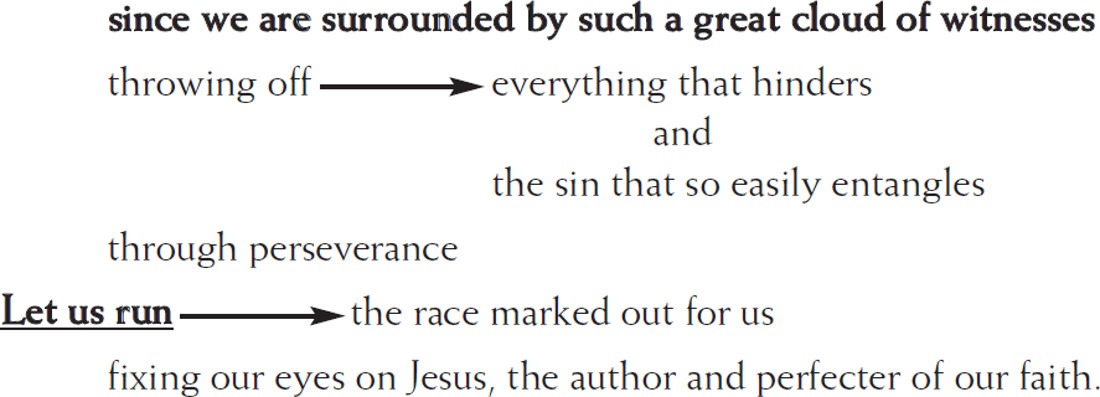
The examples of faith in Hebrews 11 provide a solid basis for the exhortation, and the author gives three elements that may be understood as the means (or, perhaps, manner) of running the race well. We are to run (1) throwing off all that hinders and sin, (2) by means of perseverance, and, especially, (3) fixing our eyes on Jesus. The author understandably gives the last of these, the focus on Jesus, the greatest attention, since he has dedicated much of his book to building the hearers’ understanding of God’s Son. It is Jesus who provides the ultimate basis for a Christian’s perseverance.
Thus, the race image provides at least three primary concepts that overlap with the Christian life. (1) Some things in life must be rejected if we are to run effectively. (2) The Christian life, like a long-distance run, is difficult and, therefore, takes sustained effort. (3) If we are to live for God in a faithful manner, a healthy view of Christ and relationship with him are paramount. Consequently, our application of 12:1–2 should focus on these aspects of living the Christian life as a well-run “race.” From the context, it seems that making right choices in the face of opposition to the Christian worldview and message is especially in view.
God’s love and “parental discipline.” The analogy of God’s discipline through our trials with the discipline offered by an earthly parent provides us with an interesting hermeneutical exercise on several counts. (1) We live in a time when certain kinds of parental discipline, especially those involving pain, are viewed as unacceptable by many. It is not uncommon to hear a social commentator proclaim the emotional and psychological damage done to a child by any form of “negative” treatment, be it a “spanking” or a verbal rebuke. Now, we need not digress to a discussion of contemporary parenting theories. My point is that if we hold to a theory that disallows any form of pain or unpleasantness in the training of a child, we will have difficulty either in grasping or applying Hebrews 12:3–13, which assumes that parental discipline involves pain in some form (12:11).
These points on the human side of the analogy are inescapable: Parental discipline is mandatory for the well-being of the child, and it is painful for the child. On the other hand, if one has experienced abuse at the hands of a parent or injustice in the welding of discipline, it may be equally difficult to see discipline as a positive, loving aspect of the parent-child relationship.
(2) The focus on the “father-child” relationship in this passage returns us to the use of gender in dealing with such passages.23 Many children in modern culture do not know their fathers, or if they do, the father is disengaged from any aspect of child training. For many the mother functions as the dominant figure in the home. For these, a surface reading of this text might be difficult to identify with.
What is needed as a first step, therefore, is to have a clear picture of the background behind the author’s view of a father’s discipline. In the cultural context behind Hebrews (both in Judaism and the broader Greco-Roman culture) the father was seen as having the ultimate responsibility for the training of a son (the language used here). Although a tutor might be responsible for the care and training of a boy after age six or seven, the ongoing role of the father was much more significant (cf. 1 Cor. 4:15). In a positive sense, the father’s responsibility was to train his son in such a way that he was well prepared for adulthood. This training often involved correction and punishment, but the goal was to help the child develop character and wisdom.
This relationship, therefore, parallels any parent—mother or father—in modern culture who seeks to train a child—son or daughter—in areas of character development, since the responsibility for parental discipline in many modern contexts rests with either father or mother, or both. Furthermore, most modern cultures no longer demarcate between the training of a son and a daughter. Moreover, most parents acknowledge the need for some form of discipline in the training of a child. Even if that discipline consists of disappointment over not getting one’s way or painful consequences experienced because the child did not obey the parent’s instructions, such experiences are inevitable in a child’s development.
Therefore, we might do well to focus on this aspect of the author’s message. God uses the difficulties we encounter as an aspect of training and moral development. They really are a gift that we might be all that he wants us to be. It does not take much reflection for us to recognize that much of our progress as persons comes through challenging or even painful experiences, whether they be in the realm of athletics, relationships, or other areas of skill development. So our author’s point is that God can redeem the pain we experience in life, using it for our good.
This raises the question of theodicy, the query concerning how a good God can allow, and even use, evil, since it is likely that the difficulties the author of Hebrews has in mind in 12:3–13 stem from persecution at the hands of evil people (e.g., 12:3–4). We can respond that God’s ability to redeem bad circumstances and turn them to good use is expressed throughout Scripture (e.g., 1 Sam. 16:14–16; Isa. 45:7; Jer. 4:6; Amos 3:6; Rom. 8:28). Christians are constantly encouraged to perceive their difficulties as a cause for celebration instead of sorrow (1 Thess. 5:16–18; James 1:2–4). This shows that God, never the source of evil, can turn evil “inside out,” utilizing it for his greater purposes. No event bears witness to this truth more than the cross (Heb. 12:1–3).
What role for Hebrews 12:14–17? Several commentators have chosen to place verses 14–17 with what follows rather than the first thirteen verses of the chapter.24 Indeed, the Greek text I am using at the moment (UBS4) and my copy of the NIV
both place a break between 12:13 and 12:14. However, there are good reasons for understanding 12:14–17 as having a direct connection with 12:1–13. The emphasis on holiness and, especially, the continued focus on the role of a “son” testify that 12:14–17 is an important concluding statement on 12:1–13. In verses 1, 4, 10–11 the author speaks to turning from sin and growing in holiness, themes echoed in the references to holiness over against immorality in verses 14–17. Also, the author’s focus on the role of a “son,” a motif not addressed since 2:10–18, begins with 12:5 and continues through the exposition on Esau in 12:16–17.
So, what is the point of the author’s treatment of the “bitter root” and Esau in 12:14–17? Let’s begin with the latter. Esau is a paradigm for a person who treats the honors of an heir lightly. He is the consummate fool because he threw away a precious privilege on a whim born of a physical appetite. The cravings of the moment outweighed the premier gifts of a lifetime.
It may seem to us that our author is unfair in his assessment of Esau, especially in relation to “the blessing.” After all, Jacob tricked the poor fellow out of that blessing! The writer, however, wishes to leave a stark picture in our minds through his use of Esau, who represents someone who has missed out on the blessings attached to the position of an honored child. Because of his rejection of his right of inheritance in the first instance and his brother’s trickery in the second, Esau could no longer be considered a legitimate bearer of those blessings. The author wants his hearers to avoid that foul position in relation to God the Father. They must not reject the honored status offered them as “legitimate children” because of momentary cravings (e.g., getting out from under the pressure of persecution).25
The image of the “bitter root” that defiles the community carries an underlying theme shared with the Esau exposition. The Old Testament context behind the image is critical if we are to grasp its significance. The image, derived from Deuteronomy 29:18, deals with those who have rejected the covenant and, therefore, have damaged the community of faith. Like Esau they have rejected something precious, and the outcome is most unpleasant. Whereas the focus of the Esau passage has to do with the personal implications of such a foolish decision, Hebrews 12:14–15 points to the devastating implications of rejection of the covenant for the community of faith. Thus, in seeking to apply 12:14–17, we must reflect on both personal and corporate losses when those within the church turn away from Christ.
Threads of unity in this section. Before moving on to our application of this passage, we should reflect for a moment on the “big picture” unifying this section of Hebrews 12. The author’s treatment of each of the images used here witnesses to the difficulty of the Christian life. The race is portrayed as challenging, the discipline of God as unpleasant, and the dangers of the bitter root or the foolishness of Esau as to be avoided. This all adds up to a realistic picture of Christ-following as costly. Struggle goes with the call to be Christ’s person in this world.
Consequently, the believer faces the constant need for endurance, wise choices, and perspective. “Hindrances” must be put off and discouraged hearts strengthened. Outward difficulties must be perceived as lovingly used by the Father for our good. The community of faith must be protected by the members’ good choices to live peaceably and in holiness as they value the blessings as God’s children. Hebrews 12:1–17 calls us to endure in the Christian life, following our preeminent example, the Lord Jesus himself (12:1–2).
Contemporary Significance
RUNNING
THE
RACE. The Eighth Olympiad of modern times began on July 5, 1924, and was held in the city of Paris, France. Over forty-five countries were represented, and the stadium swelled to a crowd of 60,000 spectators. Among the competitors from Great Britain, Eric Liddell, a Scot with wings on his feet, had come under the shadow of controversy. As a Christian, Liddell held the conviction that he should not run on Sunday, which he considered the Sabbath. Months before the Olympic games Liddell informed Great Britain’s Olympic committee that he would not be able to participate in the preliminary heat for the hundred-meter run. As the Olympics drew near, the criticism of Liddell’s “fanaticism” increased, but he doggedly refused. As Harold Abrahams ran the hundred-meter preliminary, Eric Liddell preached to a congregation in the Scots Kirk in another part of Paris. Abrahams went on to win the final in that race and set a world record that would stand for fifty-six years.
On the following Tuesday, Liddell and Abrahams both qualified for a place in the two hundred-meter final, to be held on the following day. Eric became the first Scot ever to bring home a medal in that race, winning the bronze. No one from Great Britain had ever placed higher. Eric went on to compete in the four hundred-meter race, joining runners from Canada, United States, and a fellow Briton named Guy Butler in the final. Just prior to the race Liddell went down the line, shaking his competitors’ hands in a ritual that he had made familiar over time. At the gun Eric bolted into a three-meter lead. As the race progressed, Fitch, the American, began to close in on the Scot, but Liddell increased his speed. As he crossed the finish line with a five-meter lead, his head cocked back and arms flailing the air, Eric brought home the gold medal. After an explosive roar from the British spectators, a hush finally fell over the crowd as they waited for the official time. The cheers erupted again as it was announced that Eric Liddell had set a new world record of 47.6 seconds.26
Eric Liddell was a sprinter as an Olympian, but the young believer from Scotland, just twenty-two years of age during the Eighth Olympiad, provides a powerful example of one who ran the Christian race with a marathoner’s endurance. Based on his commitment to Christ,27 he “threw off” the opinions of both the general public and the powerful, giving up the opportunity for glory in the hundred meters, a race for which he had trained for years. Liddell endured not only in the months prior to the Olympic games, but afterward embarked on a career as a missionary to China, where he died eventually in a Chinese prison. His life evidenced a long-term focus on Christ as his reference point. In all things he took his cues from the Lord Jesus, who was his example, sustainer, and guide. Because he had thrown off hindrances to his spiritual race and had chosen a path of perseverance, Liddell had a clear view of Christ and his call, and he abides as a strong example of the Christian life lived nobly.
As we look to those like Eric Liddell, who looked to Christ for how they should run the race of life, we should reflect on what we need to “throw off.” There may be encumbrances that are not bad or sinful in and of themselves but should be evaluated in light of their effect on our running the race. Certain possessions, hobbies, patterns of life, or even people can occupy us in a way so as to cool our hearts to Christ.
Reading the newspaper or watching a television program, for example, may be minor considerations unless they distract us constantly from reflection on God’s Word or reading edifying literature. An unmarried person may take great pleasure in the company of a new romance, but such a relationship must be weighed in light of its effect on one’s Christian commitment. A sport such as golf might be a source of physical exercise and fellowship but can also cause a person to neglect his or her family. We should assess how we are responding to the pull of popularity, position, or place in our given life occupations—none necessarily bad inherently, but potentially stunting to spiritual development if they are out of line in what should be Christian priorities.
It goes without saying that all sins, including especially such sins as lust, greed, hatred, or pride, hamstring us in the contest and must be rejected over and again if we are to run well and run long. For to run with perseverance means that we will grow in a pattern of obedience to God’s Word, day after day, year after year. It means that we will train to make the right choices, choosing the level path of righteousness. The premier sin to be jettisoned is the sin of abandoning Christian commitment altogether. We must strengthen our “feeble arms and week knees” if we are lagging in a rut of despair. This exercise is helped most by riveting “our eyes on Jesus,” who has shown us what to scorn and what to hold as a cause of joy, and joy is set before us if we will persevere in the race.
Facing hardship from a biblical perspective. Most of us perhaps can remember an incident from our childhood in which we were disciplined and failed to grasp fully why it had to be so. On occasion our lack of understanding may have resulted from unfairness or poor communication on a parent’s part. Yet I can remember clearly unpleasant, though loving, confrontations by my father, the significance of which later—sometimes much later—dawned on me. He had very good reasons for driving some lessons home with a painful tenacity. He loved me enough to move me toward greater maturity and responsibility, which normally were found outside of my childish, self-centered comfort zone.
Now I deal with my own children, a five-and a two-year-old, both of whom I love dearly. They struggle with understanding, at times, why certain negative consequences follow from unacceptable actions. As my youngest reaches to investigate a lamp plug poked into an electrical outlet, I pull her hand away with a firm “No, no, Anna!” Tears well up and her bottom lip pokes out in a heart-wrenching visage of dejection. She doesn’t understand. When Joshua recently was too rough with Anna as they played, he lost the privilege of playing with her for the rest of the afternoon. He cried in disappointment—he loves his sister. He struggles to understand such situations. I discipline my children, often bringing tears of pain or disappointment. But I do this so that they might grow in wisdom and maturity.
Christians have never been entirely comfortable with hardship, which looks, feels, and smells like a “snake” but which Hebrews suggests is “fish,” brought by the Lord for our spiritual nourishment. We simply do not like hardship’s pain. Hebrews says this is normal. Yet pain and difficulty are part and parcel of living in a fallen world. As Oswald Chambers notes in his classic devotional guide, My Utmost For His Highest:
We say that there ought to be no sorrow, but there is sorrow, and we have to receive ourselves in its fires. If we try and evade sorrow, refuse to lay our account with it, we are foolish. Sorrow is one of the biggest facts in life; it is no use saying sorrow ought not to be. Sin and sorrow and suffering are, and it is not for us to say that God has made a mistake in allowing them.28
In a now famous passage, C. S. Lewis notes the meaningfulness of pain: “God whispers to us in our pleasure, speaks in our conscience, but shouts in our pains: it is His megaphone to rouse a deaf world.”29
We too in the Christian community can turn a deaf ear to this language of God, this pain language, or at best strain to hear God’s message through our difficulties, especially when they come at the hands of unfair and hurtful people. We weep at our emotional loss, our bitter sense of rejection and being misunderstood. Our pain deafens us to God’s music playing in the background, music that seeks to teach us to sing joyfully of what God can do in us, even while others seek to do harm to us. But we must ask him to discipline our ears to hear, to help us rouse ourselves to readiness for receiving what he wishes to teach us through our painful experiences. Speaking of enduring hardship, Thomas à Kempis, as if quoting Christ, writes:
The better you prepare yourself to meet suffering, the more wisely will you act, and the greater will be your merit. You will bear all the more easily if your heart and mind is diligently prepared. Do not say, “I cannot endure such things from this person,” or, “I will not tolerate these things: he has done me great injury, and accused me of things I never considered; from another person I might bear it, and regard it as something that must be endured.” Such thoughts are foolish, for you ignore the merit of patience and Him who rewards it, and think only of the person who has injured you and the wrong you endure.
You are not truly patient if you will only endure what you think fit, and only from those whom you like. A truly patient man does not consider by whom he is tried, whether by his superior, his equal, or his inferior; whether by a good and holy man, or by a perverse and wicked person. But however great or frequent the trial that besets him, and by whatever agency it comes, he accepts it gladly as from the hand of God, and counts it all gain.30
He “counts it all gain.” Yes, this is easier said than done, but we are called to this perspective, called to make a choice to view our struggles from an angle that reveals God’s loving hand. Thankfully, that love of God expresses itself in his working his perspective in us as we yield to him. It is in yielding our rights to ease and happiness that we find true joy; it is in yielding our poverty of spirit because of what we are tempted to give up that we find the riches and supply of his Spirit. It is by yielding our weakness that we find his strength. We can trust him, for he is the most loving Father. He will bring us home to himself through the fire and flood of our difficulties.
The root of bitterness. One of the tempter’s most insidious weapons, self-centeredness, causes one to focus on one’s own perspective, one’s own circumstances, and the implications of certain decisions for one’s own life. In church life this issue demands more attention. When “bitter roots”—dynamics within the church introduced by those who have become disaffected with the fellowship—spring up, many are defiled, according to Hebrews. The fellowship suffers contamination. In the introduction to this commentary I started by sharing a fictitious story about Antonius Bardavid, a young Jewish participant in a house church of first-century Rome.31 As Antonius struggles with estrangement from his family and verbal abuse at the hands of his employer, it is easy to perceive his cooling commitment to Christ as detrimental to him alone. At the end of the introduction I shared about two couples, Betty and Fred Johnson and Amanda and Tom Smith, members of Community Church, cared for by Pastor David.
In our individualistic Western culture we can forget the vast implications, the detrimental effects of Antonius, Betty, Fred, and Tom’s apostasy on those around them. How would Antonius’s leaving the house church change that church and those in it? What effect would Tom’s apostasy have on those in Community Church who had witnessed his testimony, to whom he had ministered, and perhaps those whom he had led to Christ? How would Betty and Fred’s children respond, their views of Christ altered forever by the immediate choices of their parents? How would Elder Joseph in Rome or Pastor David be affected? Certainly not toward encouragement, and maybe they would struggle with deep discouragement at a moment when another in the church desperately needed help. Apostasy defiles the community it touches. It must not be perceived solely as an individual choice with implications only for an individual. This is why it remains a community problem and responsibility (3:12–13; 10:24–25).
In a letter from the persecuted believers of Vienna and Lyons to the churches of Asia and Phrygia, dated A.D. 177, a description is given of the disheartening effect apostates had on those who were seeking to stand strong in the faith. The Christians of that area had been mocked, beaten, robbed, stoned, and imprisoned by unbelievers. Having confessed their faith publicly before the city rulers, many were held in prison to await the arrival of the governor, who upon examining them treated them cruelly. Having described the distinction of a Christian named Vettius, who, although young, was called “the Advocate of the Christians” because of his rigorous and bold defense of the church, the letter goes on to describe the distress caused by those who waffled in their commitment:
But some appeared who were unprepared and untrained. They were still weak and unable to bear the tension of a great contest. Of these about ten in number proved abortions; causing great grief and immeasurable sorrow amongst us and damping the ardor of the others who had not yet been arrested. For these, although they suffered every kind of cruelty, remained nevertheless in the company of the Witnesses and did not forsake them. Then all of us were greatly alarmed because of our uncertainty of their confession. We did not fear because of the tortures inflicted, but because we looked to the end and dreaded lest any one should fall away.32
The emotional grief and dread caused by the specter of apostasy in this ancient church should cause us to pause for reflection. How do we respond to the apostasy of those from within our churches? Is there an intensity of grief and dread over this problem? If not, why not? What is there in our theological or cultural makeup that tempts us to accept apostasy as of minimal importance? If you as an individual are struggling with following the example of Esau, treating God’s promised inheritance as if it was of little consequence, have you stopped to consider the impact of that decision on those around you? Your close associates in the church? Those in your Bible study? Your spouse or closest friends? Your children? Your pastor? Please stop and consider the curse of being one who introduces a bitter root to the church of the living God! In doing so you not only affect yourself, but you also contaminate others in such a way that will mark your life and theirs forever.
Original Meaning
The Discipline of Children (12:3–13)
HEBREWS 12:3
IS transitional, leading into the author’s exposition of Proverbs 3:11–12, a text that challenges the Christ-follower not to “lose heart” in the face of God’s discipline. When the author says, “Consider him who endured such opposition from sinful men,” he restates the need to focus on Jesus as he endured the cross (Heb. 12:2), but here he gives the reason: “so that you will not grow weary and lose heart.” In this statement, the hearers’ critical circumstance stands out clearly. They were facing persecution at the hands of unbelievers in a way that was causing emotional weariness. The word translated “lose heart” is a participle (eklyomenoi) and means “fainting” or “giving up.” Thus they were experiencing a weariness of soul that was rendering them emotionally fatigued and was tempting them to quit the faith.
Consequently, a parallel exists between their situation and that of Jesus’ cross—both were trials of suffering at the hands of sinful people. Because of this parallel, the persecuted community could draw strength from the positive outcome of Jesus’ suffering. However, as 12:4 points out, those in this church, unlike Jesus, had yet to shed their blood in the struggle against sin. This verse implies that if Jesus endured through the pouring out of his life’s blood, they could endure in the lesser persecution they were facing.12
In verses 5–6 the author quotes from the book of Proverbs. The emotional discouragement of his hearers prompts him to offer a gentle rebuke, “And you have forgotten that word of encouragement …,” which can as easily be read as a question, “Have you forgotten that word of encouragement …?” Two points stand out in the way he introduces the quote. (1) The author places the subject of discipline in a positive framework as a topic for “encouragement” or “comfort” (paraklesis) because of the references to the Lord’s love and acceptance in Proverbs 3:12 (Heb. 12:6). (2) The writer takes the references to the “son” in the proverb to be directly applicable to the Christian community. This use of the “sonship” motif mirrors the earlier treatment of believers as the “children of God” in 2:10–18.13
The Proverbs quotation itself falls into two movements, the first a twofold exhortation concerning the Lord’s discipline/rebuke, and the second the rationale for adhering to the word of encouragement. The word oligoreo, translated “make light of,” is a synonym of the word translated “scorning” in 12:2 and means to treat something as insignificant or of little value. Thus, the Lord’s discipline or training is not to be looked down on as worthless. The proverb also encourages the reader not to “lose heart” (the same word as used at the end of v. 3) when the Lord “rebukes” (elencho).
The rationale for taking the Lord’s discipline seriously and taking courage when facing his rebuke has to do with his motive of love. The Lord does not discipline arbitrarily, but rather as an expression of genuine relationship. The word rendered by the NIV
as “punishes” (mastigoo) is used in the context of parental discipline (cf. Prov. 19:25; Jer. 5:3; 6:7). This image is one of loving training given to amend actions and attitudes. Such training is only given to legitimate children, that is, to those whom the Lord “accepts” or “acknowledges” (paradechomai) as his own.
The author begins his exposition of the proverb with the exhortation, “Endure hardship as discipline.”14 Apart from its four occurrences here in Hebrews 12 (vv. 5, 7, 8, 11), the word translated “disicipline” (paideia) is found in the New Testament only at Ephesians 6:4 and 2 Timothy 3:16. The former verse speaks of a father training his children and the latter of Scripture as useful for “training in righteousness.” The writer, therefore, makes his focal connection between this proverb and the situation of the hearers. They are to recognize in their current difficulties the Lord’s hand lovingly training them in right character.
The exposition that follows occurs in three movements. Hebrews 12:7b–8 presents discipline as a validating mark of their relationship to God as Father. Next, in verse 9, the writer addresses the proper filial response to God’s discipline. Finally, verses 10–11 deal with the productivity, or benefit, of the Father’s loving discipline.15
(1) The original hearers of Hebrews could have interpreted the persecution they were facing as an indication of God’s inattention. In verses 7b–8 the author of Hebrews asserts that nothing is further from the truth. Rather, the difficulties they face are actually a sign that they are true children of the Father. He asks, “What son is not disciplined by his father?” implying that discipline is a normal part of the parent-child relationship. On the contrary, he argues in verse 8, if a person does not experience discipline as a child, that lack of discipline is a mark of illegitimacy.
(2) How then should one respond to the Lord’s discipline? In verse 9 the author uses an a fortioriargument or an “argument from lesser to greater”16 to answer this question. Such an argument reasons that if something applies in a less important situation, it certainly applies in a more important situation. The less important situation in verse 9 has to do with discipline given by a human father. The author comments that human fathers are given respect in response to their discipline. Since this is the case, therefore, God deserves even more reverence. Indeed we should “submit” to him as “the Father of our spirits and live.” The verb translated “submit” (hypotasso) is the same as used in 2:5–9 and means “to yield to, subordinate oneself to.” In the present context, the author suggests that in the face of difficult circumstances, we should bow our wills to the will of the Father, since his will is the path that leads to life.
(3) In 12:10–11 the writer rounds out his exposition of the proverb by pointing out the benefits of divine discipline. “Our fathers” (i.e., our human fathers) did the best they could with discipline during the years of our childhood, but, the author implies, their perspective was limited. God, on the other hand, “disciplines us for our good” (sympheron, which means something done for the advantage of another). Specifically, his discipline is given “that we may share in his holiness.” The whole context suggests that right parental discipline involves training or instructing in right living. So the discipline of God, when received in the right manner, trains the Christian in right character, purifying the heart.
The author admits (v. 11) that the experience of discipline is not pleasant but painful. However, the fruit of the discipline is worth the price of pain. Discipline from the Lord “produces a harvest of righteousness and peace for those who have been trained by it.” Paul wrote the believers at Thessalonica that their sufferings, even while condemning their persecutors, showed the sufferers as worthy of the kingdom of God (2 Thess. 1:4–8).17 Thus, suffering is a blessing that the Christian should consider a cause of joy because it has a positive outcome in one’s character and relationship with God (James 1:2–4; 1 Peter 3:14; 4:14).
With verse 12 the author returns briefly to his earlier use of athletic imagery (vv. 1–2) and draws his material both from a passage in Isaiah and from yet another passage in Proverbs. The picture of “feeble arms and weak knees” portrays exhaustion, an echo of the spiritual and emotional fatigue with which the writer has already shown concern in 12:3, 5. Here, however, he uses a portion of a prophetic passage of encouragement that challenges the readers to hope in God’s salvation and to look to his way of holiness (Isa. 35:3–8):
Strengthen the feeble hands,
steady the knees that give way;
say to those with fearful hearts,
“Be strong, do not fear;
your God will come,
he will come with vengeance;
with divine retribution
he will come to save you.”
Then will the eyes of the blind be opened
and the ears of the deaf unstopped.
Then will the lame leap like a deer,
and the mute tongue shout for joy.
Water will gush forth in the wilderness
and streams in the desert.
The burning sand will become a pool,
the thirsty ground bubbling springs.
In the haunts where the jackals once lay,
grass and reeds and papyrus will grow.
And a highway will be there;
it will be called the Way of Holiness.
The unclean will not journey on it;
it will be for those who walk in that Way;
wicked fools will not go about on it.
In other words, those who are discouraged because of their dire situation are called to hope in the coming, the justice, and the blessings of God (cf. Heb. 10:37). The strengthening of the arms and knees, therefore, is figurative of taking heart or hoping in the Lord; this message could not be more applicable to the original hearers of Hebrews, who were trudging along a path of persecution.
Hebrews 12:13 continues with a quote from Proverbs 4:26, which also concerns choosing of a right path: “Make level paths for your feet.” The straight or level path is a common image in wisdom literature for God’s way of right living, as is clear from Proverbs 4:25–27. In Hebrews 12:13 the author vies for his hearers to take courage in and choose the Lord’s way of holiness so that their spiritual and emotional conditions might be strengthened.
The reference to “the lame” in 12:13 is another image of exhaustion or the crippling effect of spiritual discouragement. Running a race on an uneven path full of bumps and potholes is not only inconvenient but also dangerous, especially for a person who is not in good physical condition to begin with. In other words, if the hearers choose the wrong path, their spiritual condition will get worse. The verb ektrepo can be translated “turn aside, go astray,” but the context supports the NIV
’s rendering “disabled.”18 In the ancient world the word was used in technical medical contexts to refer to dislocation.19 Thus, the readers are called to follow the Lord’s “level path” of holiness so that their current spiritual condition will result in healing rather than in a more serious spiritual condition.
Bridging Contexts
HEBREWS 12:1–17
OFFERS us a tapestry of rich images by which the author wishes to motivate his readers to endurance in the Christian life. Figurative language is meant to stimulate the imagination, inviting a reader to enter into the image and connect with the relevant material the image has to offer. The key in dealing with such images is to discern the connecting point between the image and the topic at hand.
Focusing on the “race.” There are many ways, for example, in which the author of Hebrews does not intend the race imagery to be read. He certainly does not play up the idea of competition, as in “God wants you to beat the other fellow.” Nor does he mean to emphasize here that God gives Christians the ability to overcome all obstacles.22 One finds no hint of “the race belongs to the strong,” or “pace yourself—you will get farther,” or “break out of the pack!” We must not read anachronistically our modern clichés of a race back into this text. Therefore, the preacher or teacher of this text needs to exercise restraint in the use of this image.
What the author means to emphasize by his use of the race motif can be seen clearly by a grammatical analysis of the structure of 12:1–2a. This structure is obscured by the NIV
translation, which renders this text as a series of exhortations (i.e., with its repetition of “Let us …”). In the Greek, there is but one exhortation in the passage: “Let us run.” As depicted in the following diagram, this focal verb is supported by a series of participles and prepositional phrases. The diagram maintains the order of the clauses as they occur in the Greek text and depicts the subordination of clauses and phrases by indenting them. Objects are marked by their location following an arrow. The diagram also translates the participles to show their subordination to the main verb.
The examples of faith in Hebrews 11 provide a solid basis for the exhortation, and the author gives three elements that may be understood as the means (or, perhaps, manner) of running the race well. We are to run (1) throwing off all that hinders and sin, (2) by means of perseverance, and, especially, (3) fixing our eyes on Jesus. The author understandably gives the last of these, the focus on Jesus, the greatest attention, since he has dedicated much of his book to building the hearers’ understanding of God’s Son. It is Jesus who provides the ultimate basis for a Christian’s perseverance.
Thus, the race image provides at least three primary concepts that overlap with the Christian life. (1) Some things in life must be rejected if we are to run effectively. (2) The Christian life, like a long-distance run, is difficult and, therefore, takes sustained effort. (3) If we are to live for God in a faithful manner, a healthy view of Christ and relationship with him are paramount. Consequently, our application of 12:1–2 should focus on these aspects of living the Christian life as a well-run “race.” From the context, it seems that making right choices in the face of opposition to the Christian worldview and message is especially in view.
God’s love and “parental discipline.” The analogy of God’s discipline through our trials with the discipline offered by an earthly parent provides us with an interesting hermeneutical exercise on several counts. (1) We live in a time when certain kinds of parental discipline, especially those involving pain, are viewed as unacceptable by many. It is not uncommon to hear a social commentator proclaim the emotional and psychological damage done to a child by any form of “negative” treatment, be it a “spanking” or a verbal rebuke. Now, we need not digress to a discussion of contemporary parenting theories. My point is that if we hold to a theory that disallows any form of pain or unpleasantness in the training of a child, we will have difficulty either in grasping or applying Hebrews 12:3–13, which assumes that parental discipline involves pain in some form (12:11).
These points on the human side of the analogy are inescapable: Parental discipline is mandatory for the well-being of the child, and it is painful for the child. On the other hand, if one has experienced abuse at the hands of a parent or injustice in the welding of discipline, it may be equally difficult to see discipline as a positive, loving aspect of the parent-child relationship.
(2) The focus on the “father-child” relationship in this passage returns us to the use of gender in dealing with such passages.23 Many children in modern culture do not know their fathers, or if they do, the father is disengaged from any aspect of child training. For many the mother functions as the dominant figure in the home. For these, a surface reading of this text might be difficult to identify with.
What is needed as a first step, therefore, is to have a clear picture of the background behind the author’s view of a father’s discipline. In the cultural context behind Hebrews (both in Judaism and the broader Greco-Roman culture) the father was seen as having the ultimate responsibility for the training of a son (the language used here). Although a tutor might be responsible for the care and training of a boy after age six or seven, the ongoing role of the father was much more significant (cf. 1 Cor. 4:15). In a positive sense, the father’s responsibility was to train his son in such a way that he was well prepared for adulthood. This training often involved correction and punishment, but the goal was to help the child develop character and wisdom.
This relationship, therefore, parallels any parent—mother or father—in modern culture who seeks to train a child—son or daughter—in areas of character development, since the responsibility for parental discipline in many modern contexts rests with either father or mother, or both. Furthermore, most modern cultures no longer demarcate between the training of a son and a daughter. Moreover, most parents acknowledge the need for some form of discipline in the training of a child. Even if that discipline consists of disappointment over not getting one’s way or painful consequences experienced because the child did not obey the parent’s instructions, such experiences are inevitable in a child’s development.
Therefore, we might do well to focus on this aspect of the author’s message. God uses the difficulties we encounter as an aspect of training and moral development. They really are a gift that we might be all that he wants us to be. It does not take much reflection for us to recognize that much of our progress as persons comes through challenging or even painful experiences, whether they be in the realm of athletics, relationships, or other areas of skill development. So our author’s point is that God can redeem the pain we experience in life, using it for our good.
This raises the question of theodicy, the query concerning how a good God can allow, and even use, evil, since it is likely that the difficulties the author of Hebrews has in mind in 12:3–13 stem from persecution at the hands of evil people (e.g., 12:3–4). We can respond that God’s ability to redeem bad circumstances and turn them to good use is expressed throughout Scripture (e.g., 1 Sam. 16:14–16; Isa. 45:7; Jer. 4:6; Amos 3:6; Rom. 8:28). Christians are constantly encouraged to perceive their difficulties as a cause for celebration instead of sorrow (1 Thess. 5:16–18; James 1:2–4). This shows that God, never the source of evil, can turn evil “inside out,” utilizing it for his greater purposes. No event bears witness to this truth more than the cross (Heb. 12:1–3).
What role for Hebrews 12:14–17? Several commentators have chosen to place verses 14–17 with what follows rather than the first thirteen verses of the chapter.24 Indeed, the Greek text I am using at the moment (UBS4) and my copy of the NIV
both place a break between 12:13 and 12:14. However, there are good reasons for understanding 12:14–17 as having a direct connection with 12:1–13. The emphasis on holiness and, especially, the continued focus on the role of a “son” testify that 12:14–17 is an important concluding statement on 12:1–13. In verses 1, 4, 10–11 the author speaks to turning from sin and growing in holiness, themes echoed in the references to holiness over against immorality in verses 14–17. Also, the author’s focus on the role of a “son,” a motif not addressed since 2:10–18, begins with 12:5 and continues through the exposition on Esau in 12:16–17.
So, what is the point of the author’s treatment of the “bitter root” and Esau in 12:14–17? Let’s begin with the latter. Esau is a paradigm for a person who treats the honors of an heir lightly. He is the consummate fool because he threw away a precious privilege on a whim born of a physical appetite. The cravings of the moment outweighed the premier gifts of a lifetime.
It may seem to us that our author is unfair in his assessment of Esau, especially in relation to “the blessing.” After all, Jacob tricked the poor fellow out of that blessing! The writer, however, wishes to leave a stark picture in our minds through his use of Esau, who represents someone who has missed out on the blessings attached to the position of an honored child. Because of his rejection of his right of inheritance in the first instance and his brother’s trickery in the second, Esau could no longer be considered a legitimate bearer of those blessings. The author wants his hearers to avoid that foul position in relation to God the Father. They must not reject the honored status offered them as “legitimate children” because of momentary cravings (e.g., getting out from under the pressure of persecution).25
The image of the “bitter root” that defiles the community carries an underlying theme shared with the Esau exposition. The Old Testament context behind the image is critical if we are to grasp its significance. The image, derived from Deuteronomy 29:18, deals with those who have rejected the covenant and, therefore, have damaged the community of faith. Like Esau they have rejected something precious, and the outcome is most unpleasant. Whereas the focus of the Esau passage has to do with the personal implications of such a foolish decision, Hebrews 12:14–15 points to the devastating implications of rejection of the covenant for the community of faith. Thus, in seeking to apply 12:14–17, we must reflect on both personal and corporate losses when those within the church turn away from Christ.
Threads of unity in this section. Before moving on to our application of this passage, we should reflect for a moment on the “big picture” unifying this section of Hebrews 12. The author’s treatment of each of the images used here witnesses to the difficulty of the Christian life. The race is portrayed as challenging, the discipline of God as unpleasant, and the dangers of the bitter root or the foolishness of Esau as to be avoided. This all adds up to a realistic picture of Christ-following as costly. Struggle goes with the call to be Christ’s person in this world.
Consequently, the believer faces the constant need for endurance, wise choices, and perspective. “Hindrances” must be put off and discouraged hearts strengthened. Outward difficulties must be perceived as lovingly used by the Father for our good. The community of faith must be protected by the members’ good choices to live peaceably and in holiness as they value the blessings as God’s children. Hebrews 12:1–17 calls us to endure in the Christian life, following our preeminent example, the Lord Jesus himself (12:1–2).
Contemporary Significance
RUNNING
THE
RACE. The Eighth Olympiad of modern times began on July 5, 1924, and was held in the city of Paris, France. Over forty-five countries were represented, and the stadium swelled to a crowd of 60,000 spectators. Among the competitors from Great Britain, Eric Liddell, a Scot with wings on his feet, had come under the shadow of controversy. As a Christian, Liddell held the conviction that he should not run on Sunday, which he considered the Sabbath. Months before the Olympic games Liddell informed Great Britain’s Olympic committee that he would not be able to participate in the preliminary heat for the hundred-meter run. As the Olympics drew near, the criticism of Liddell’s “fanaticism” increased, but he doggedly refused. As Harold Abrahams ran the hundred-meter preliminary, Eric Liddell preached to a congregation in the Scots Kirk in another part of Paris. Abrahams went on to win the final in that race and set a world record that would stand for fifty-six years.
On the following Tuesday, Liddell and Abrahams both qualified for a place in the two hundred-meter final, to be held on the following day. Eric became the first Scot ever to bring home a medal in that race, winning the bronze. No one from Great Britain had ever placed higher. Eric went on to compete in the four hundred-meter race, joining runners from Canada, United States, and a fellow Briton named Guy Butler in the final. Just prior to the race Liddell went down the line, shaking his competitors’ hands in a ritual that he had made familiar over time. At the gun Eric bolted into a three-meter lead. As the race progressed, Fitch, the American, began to close in on the Scot, but Liddell increased his speed. As he crossed the finish line with a five-meter lead, his head cocked back and arms flailing the air, Eric brought home the gold medal. After an explosive roar from the British spectators, a hush finally fell over the crowd as they waited for the official time. The cheers erupted again as it was announced that Eric Liddell had set a new world record of 47.6 seconds.26
Eric Liddell was a sprinter as an Olympian, but the young believer from Scotland, just twenty-two years of age during the Eighth Olympiad, provides a powerful example of one who ran the Christian race with a marathoner’s endurance. Based on his commitment to Christ,27 he “threw off” the opinions of both the general public and the powerful, giving up the opportunity for glory in the hundred meters, a race for which he had trained for years. Liddell endured not only in the months prior to the Olympic games, but afterward embarked on a career as a missionary to China, where he died eventually in a Chinese prison. His life evidenced a long-term focus on Christ as his reference point. In all things he took his cues from the Lord Jesus, who was his example, sustainer, and guide. Because he had thrown off hindrances to his spiritual race and had chosen a path of perseverance, Liddell had a clear view of Christ and his call, and he abides as a strong example of the Christian life lived nobly.
As we look to those like Eric Liddell, who looked to Christ for how they should run the race of life, we should reflect on what we need to “throw off.” There may be encumbrances that are not bad or sinful in and of themselves but should be evaluated in light of their effect on our running the race. Certain possessions, hobbies, patterns of life, or even people can occupy us in a way so as to cool our hearts to Christ.
Reading the newspaper or watching a television program, for example, may be minor considerations unless they distract us constantly from reflection on God’s Word or reading edifying literature. An unmarried person may take great pleasure in the company of a new romance, but such a relationship must be weighed in light of its effect on one’s Christian commitment. A sport such as golf might be a source of physical exercise and fellowship but can also cause a person to neglect his or her family. We should assess how we are responding to the pull of popularity, position, or place in our given life occupations—none necessarily bad inherently, but potentially stunting to spiritual development if they are out of line in what should be Christian priorities.
It goes without saying that all sins, including especially such sins as lust, greed, hatred, or pride, hamstring us in the contest and must be rejected over and again if we are to run well and run long. For to run with perseverance means that we will grow in a pattern of obedience to God’s Word, day after day, year after year. It means that we will train to make the right choices, choosing the level path of righteousness. The premier sin to be jettisoned is the sin of abandoning Christian commitment altogether. We must strengthen our “feeble arms and week knees” if we are lagging in a rut of despair. This exercise is helped most by riveting “our eyes on Jesus,” who has shown us what to scorn and what to hold as a cause of joy, and joy is set before us if we will persevere in the race.
Facing hardship from a biblical perspective. Most of us perhaps can remember an incident from our childhood in which we were disciplined and failed to grasp fully why it had to be so. On occasion our lack of understanding may have resulted from unfairness or poor communication on a parent’s part. Yet I can remember clearly unpleasant, though loving, confrontations by my father, the significance of which later—sometimes much later—dawned on me. He had very good reasons for driving some lessons home with a painful tenacity. He loved me enough to move me toward greater maturity and responsibility, which normally were found outside of my childish, self-centered comfort zone.
Now I deal with my own children, a five-and a two-year-old, both of whom I love dearly. They struggle with understanding, at times, why certain negative consequences follow from unacceptable actions. As my youngest reaches to investigate a lamp plug poked into an electrical outlet, I pull her hand away with a firm “No, no, Anna!” Tears well up and her bottom lip pokes out in a heart-wrenching visage of dejection. She doesn’t understand. When Joshua recently was too rough with Anna as they played, he lost the privilege of playing with her for the rest of the afternoon. He cried in disappointment—he loves his sister. He struggles to understand such situations. I discipline my children, often bringing tears of pain or disappointment. But I do this so that they might grow in wisdom and maturity.
Christians have never been entirely comfortable with hardship, which looks, feels, and smells like a “snake” but which Hebrews suggests is “fish,” brought by the Lord for our spiritual nourishment. We simply do not like hardship’s pain. Hebrews says this is normal. Yet pain and difficulty are part and parcel of living in a fallen world. As Oswald Chambers notes in his classic devotional guide, My Utmost For His Highest:
We say that there ought to be no sorrow, but there is sorrow, and we have to receive ourselves in its fires. If we try and evade sorrow, refuse to lay our account with it, we are foolish. Sorrow is one of the biggest facts in life; it is no use saying sorrow ought not to be. Sin and sorrow and suffering are, and it is not for us to say that God has made a mistake in allowing them.28
In a now famous passage, C. S. Lewis notes the meaningfulness of pain: “God whispers to us in our pleasure, speaks in our conscience, but shouts in our pains: it is His megaphone to rouse a deaf world.”29
We too in the Christian community can turn a deaf ear to this language of God, this pain language, or at best strain to hear God’s message through our difficulties, especially when they come at the hands of unfair and hurtful people. We weep at our emotional loss, our bitter sense of rejection and being misunderstood. Our pain deafens us to God’s music playing in the background, music that seeks to teach us to sing joyfully of what God can do in us, even while others seek to do harm to us. But we must ask him to discipline our ears to hear, to help us rouse ourselves to readiness for receiving what he wishes to teach us through our painful experiences. Speaking of enduring hardship, Thomas à Kempis, as if quoting Christ, writes:
The better you prepare yourself to meet suffering, the more wisely will you act, and the greater will be your merit. You will bear all the more easily if your heart and mind is diligently prepared. Do not say, “I cannot endure such things from this person,” or, “I will not tolerate these things: he has done me great injury, and accused me of things I never considered; from another person I might bear it, and regard it as something that must be endured.” Such thoughts are foolish, for you ignore the merit of patience and Him who rewards it, and think only of the person who has injured you and the wrong you endure.
You are not truly patient if you will only endure what you think fit, and only from those whom you like. A truly patient man does not consider by whom he is tried, whether by his superior, his equal, or his inferior; whether by a good and holy man, or by a perverse and wicked person. But however great or frequent the trial that besets him, and by whatever agency it comes, he accepts it gladly as from the hand of God, and counts it all gain.30
He “counts it all gain.” Yes, this is easier said than done, but we are called to this perspective, called to make a choice to view our struggles from an angle that reveals God’s loving hand. Thankfully, that love of God expresses itself in his working his perspective in us as we yield to him. It is in yielding our rights to ease and happiness that we find true joy; it is in yielding our poverty of spirit because of what we are tempted to give up that we find the riches and supply of his Spirit. It is by yielding our weakness that we find his strength. We can trust him, for he is the most loving Father. He will bring us home to himself through the fire and flood of our difficulties.
The root of bitterness. One of the tempter’s most insidious weapons, self-centeredness, causes one to focus on one’s own perspective, one’s own circumstances, and the implications of certain decisions for one’s own life. In church life this issue demands more attention. When “bitter roots”—dynamics within the church introduced by those who have become disaffected with the fellowship—spring up, many are defiled, according to Hebrews. The fellowship suffers contamination. In the introduction to this commentary I started by sharing a fictitious story about Antonius Bardavid, a young Jewish participant in a house church of first-century Rome.31 As Antonius struggles with estrangement from his family and verbal abuse at the hands of his employer, it is easy to perceive his cooling commitment to Christ as detrimental to him alone. At the end of the introduction I shared about two couples, Betty and Fred Johnson and Amanda and Tom Smith, members of Community Church, cared for by Pastor David.
In our individualistic Western culture we can forget the vast implications, the detrimental effects of Antonius, Betty, Fred, and Tom’s apostasy on those around them. How would Antonius’s leaving the house church change that church and those in it? What effect would Tom’s apostasy have on those in Community Church who had witnessed his testimony, to whom he had ministered, and perhaps those whom he had led to Christ? How would Betty and Fred’s children respond, their views of Christ altered forever by the immediate choices of their parents? How would Elder Joseph in Rome or Pastor David be affected? Certainly not toward encouragement, and maybe they would struggle with deep discouragement at a moment when another in the church desperately needed help. Apostasy defiles the community it touches. It must not be perceived solely as an individual choice with implications only for an individual. This is why it remains a community problem and responsibility (3:12–13; 10:24–25).
In a letter from the persecuted believers of Vienna and Lyons to the churches of Asia and Phrygia, dated A.D. 177, a description is given of the disheartening effect apostates had on those who were seeking to stand strong in the faith. The Christians of that area had been mocked, beaten, robbed, stoned, and imprisoned by unbelievers. Having confessed their faith publicly before the city rulers, many were held in prison to await the arrival of the governor, who upon examining them treated them cruelly. Having described the distinction of a Christian named Vettius, who, although young, was called “the Advocate of the Christians” because of his rigorous and bold defense of the church, the letter goes on to describe the distress caused by those who waffled in their commitment:
But some appeared who were unprepared and untrained. They were still weak and unable to bear the tension of a great contest. Of these about ten in number proved abortions; causing great grief and immeasurable sorrow amongst us and damping the ardor of the others who had not yet been arrested. For these, although they suffered every kind of cruelty, remained nevertheless in the company of the Witnesses and did not forsake them. Then all of us were greatly alarmed because of our uncertainty of their confession. We did not fear because of the tortures inflicted, but because we looked to the end and dreaded lest any one should fall away.32
The emotional grief and dread caused by the specter of apostasy in this ancient church should cause us to pause for reflection. How do we respond to the apostasy of those from within our churches? Is there an intensity of grief and dread over this problem? If not, why not? What is there in our theological or cultural makeup that tempts us to accept apostasy as of minimal importance? If you as an individual are struggling with following the example of Esau, treating God’s promised inheritance as if it was of little consequence, have you stopped to consider the impact of that decision on those around you? Your close associates in the church? Those in your Bible study? Your spouse or closest friends? Your children? Your pastor? Please stop and consider the curse of being one who introduces a bitter root to the church of the living God! In doing so you not only affect yourself, but you also contaminate others in such a way that will mark your life and theirs forever.
Original Meaning
The Importance of Choosing Holiness (12:14–17)
THE
EXHORTATIONS
OF12:14–17 may seem somewhat disjointed from 12:1–13, but these verses continue with two themes that are central to the first thirteen verses: spiritual struggle and the need for holiness. Verse 14 reads, “Make every effort to live in peace with all men and to be holy; without holiness no one will see the Lord.” Believers are to “make every effort” or “strive for” two things: peace with others and holiness, the two being intertwined dynamics in the present context.
Holiness is expressed as vital for two relationships in life. (1) Holiness has a profound impact on our relationships with other people (Rom. 12:18), a thought the author will develop in the next verse; it is impossible to “live in peace” with others when we choose the unholy path. (2) The author makes it clear that holiness is indispensable for an authentic Christian life. The person who chooses to live an unholy life can be offered no assurance of “seeing the Lord.” This probably refers to meeting the Lord joyfully upon his return (Heb. 9:28; 1 John 3:2).
Verse 15 begins with a participle the NIV
translates with “see to it.” Grammatically the word relates back to the main verb in verse 14, translated “make every effort,” and can be rendered “seeing to it.” Thus, Christians are to strive for peace and holiness in part by being mindful of certain spiritual dynamics in their community, such as three delineated in the author’s continuing discussion (cf. 2:1; 3:12; 4:1). (1) They are to see to it that no one “misses the grace of God.” The verb hystereo can mean “to lack, fall short of.” The state of missing the grace of God is the same as that warned against in 4:1; 6:4–6; 10:26–31, namely, the state of rejecting the gospel and missing the forgiveness offered by virtue of Christ’s sacrifice.20
(2) The believers are to see to it that “no bitter root grows up to cause trouble and defile many.” Here the author alludes to Deuteronomy 29:18, which reads: “Make sure there is no man or woman, clan or tribe among you today whose heart turns away from the LORD our God to go and worship the gods of those nations; make sure there is no root among you that produces such bitter poison.” The context of this Old Testament text is significant, since it deals with idolatry and apostasy from the covenant community. Those among Hebrews’ original recipients who were jettisoning their confession of Christ were causing severe friction within the community, and relationships were breaking down.
The verb miaino, translated by the NIV
as “defile,” communicates the idea of contamination. It is used variously in the New Testament to speak of ceremonial impurity (John 18:28), a person who lives in impurity or has a corrupt mind (Titus 1:15), and a person who is sexually immoral (Jude 8). In Hebrews 12:15 the author speaks of apostasy as introducing an insidious, spiritually corroding element into the church.
(3) The hearers are to see to it that no member of the church falls into the pattern of immoral Esau (12:16–17). That Esau was “sexually immoral” is somewhat problematic since the biblical text does not mention sexual promiscuity on his part. However, some strands of Jewish interpretation describe him as sexually suspect because of his marriage to the Hittites Judith and Basemath (Gen. 26:34), and our author may be picking up on this tradition.21 The word bebelos, which the NIV
renders “godless,” speaks of something that is unholy, ungodly, or base. Hebrews describes Esau in this way because of his misplaced values that led to his unwise decision to give up his inheritance. For something as valueless as a meal—simply a means of gaining immediate gratification for physical hunger pangs—he foolishly gave up his rights as the firstborn, that is, the double portion of his father’s inheritance.
The author of Hebrews goes on to allude to what happened later in the Genesis account, when Jacob stole Esau’s blessing (Gen. 27:30–40). Having given up his inheritance and being rejected from receiving the blessing, Esau, weeping, pleaded with his father to reverse the situation, but the patriarch could not. The author of Hebrews wishes to drive home the point that only tears and rejection await those who sell out the inheritance that God promises to his children.
Bridging Contexts
HEBREWS 12:1–17
OFFERS us a tapestry of rich images by which the author wishes to motivate his readers to endurance in the Christian life. Figurative language is meant to stimulate the imagination, inviting a reader to enter into the image and connect with the relevant material the image has to offer. The key in dealing with such images is to discern the connecting point between the image and the topic at hand.
Focusing on the “race.” There are many ways, for example, in which the author of Hebrews does not intend the race imagery to be read. He certainly does not play up the idea of competition, as in “God wants you to beat the other fellow.” Nor does he mean to emphasize here that God gives Christians the ability to overcome all obstacles.22 One finds no hint of “the race belongs to the strong,” or “pace yourself—you will get farther,” or “break out of the pack!” We must not read anachronistically our modern clichés of a race back into this text. Therefore, the preacher or teacher of this text needs to exercise restraint in the use of this image.
What the author means to emphasize by his use of the race motif can be seen clearly by a grammatical analysis of the structure of 12:1–2a. This structure is obscured by the NIV
translation, which renders this text as a series of exhortations (i.e., with its repetition of “Let us …”). In the Greek, there is but one exhortation in the passage: “Let us run.” As depicted in the following diagram, this focal verb is supported by a series of participles and prepositional phrases. The diagram maintains the order of the clauses as they occur in the Greek text and depicts the subordination of clauses and phrases by indenting them. Objects are marked by their location following an arrow. The diagram also translates the participles to show their subordination to the main verb.
The examples of faith in Hebrews 11 provide a solid basis for the exhortation, and the author gives three elements that may be understood as the means (or, perhaps, manner) of running the race well. We are to run (1) throwing off all that hinders and sin, (2) by means of perseverance, and, especially, (3) fixing our eyes on Jesus. The author understandably gives the last of these, the focus on Jesus, the greatest attention, since he has dedicated much of his book to building the hearers’ understanding of God’s Son. It is Jesus who provides the ultimate basis for a Christian’s perseverance.
Thus, the race image provides at least three primary concepts that overlap with the Christian life. (1) Some things in life must be rejected if we are to run effectively. (2) The Christian life, like a long-distance run, is difficult and, therefore, takes sustained effort. (3) If we are to live for God in a faithful manner, a healthy view of Christ and relationship with him are paramount. Consequently, our application of 12:1–2 should focus on these aspects of living the Christian life as a well-run “race.” From the context, it seems that making right choices in the face of opposition to the Christian worldview and message is especially in view.
God’s love and “parental discipline.” The analogy of God’s discipline through our trials with the discipline offered by an earthly parent provides us with an interesting hermeneutical exercise on several counts. (1) We live in a time when certain kinds of parental discipline, especially those involving pain, are viewed as unacceptable by many. It is not uncommon to hear a social commentator proclaim the emotional and psychological damage done to a child by any form of “negative” treatment, be it a “spanking” or a verbal rebuke. Now, we need not digress to a discussion of contemporary parenting theories. My point is that if we hold to a theory that disallows any form of pain or unpleasantness in the training of a child, we will have difficulty either in grasping or applying Hebrews 12:3–13, which assumes that parental discipline involves pain in some form (12:11).
These points on the human side of the analogy are inescapable: Parental discipline is mandatory for the well-being of the child, and it is painful for the child. On the other hand, if one has experienced abuse at the hands of a parent or injustice in the welding of discipline, it may be equally difficult to see discipline as a positive, loving aspect of the parent-child relationship.
(2) The focus on the “father-child” relationship in this passage returns us to the use of gender in dealing with such passages.23 Many children in modern culture do not know their fathers, or if they do, the father is disengaged from any aspect of child training. For many the mother functions as the dominant figure in the home. For these, a surface reading of this text might be difficult to identify with.
What is needed as a first step, therefore, is to have a clear picture of the background behind the author’s view of a father’s discipline. In the cultural context behind Hebrews (both in Judaism and the broader Greco-Roman culture) the father was seen as having the ultimate responsibility for the training of a son (the language used here). Although a tutor might be responsible for the care and training of a boy after age six or seven, the ongoing role of the father was much more significant (cf. 1 Cor. 4:15). In a positive sense, the father’s responsibility was to train his son in such a way that he was well prepared for adulthood. This training often involved correction and punishment, but the goal was to help the child develop character and wisdom.
This relationship, therefore, parallels any parent—mother or father—in modern culture who seeks to train a child—son or daughter—in areas of character development, since the responsibility for parental discipline in many modern contexts rests with either father or mother, or both. Furthermore, most modern cultures no longer demarcate between the training of a son and a daughter. Moreover, most parents acknowledge the need for some form of discipline in the training of a child. Even if that discipline consists of disappointment over not getting one’s way or painful consequences experienced because the child did not obey the parent’s instructions, such experiences are inevitable in a child’s development.
Therefore, we might do well to focus on this aspect of the author’s message. God uses the difficulties we encounter as an aspect of training and moral development. They really are a gift that we might be all that he wants us to be. It does not take much reflection for us to recognize that much of our progress as persons comes through challenging or even painful experiences, whether they be in the realm of athletics, relationships, or other areas of skill development. So our author’s point is that God can redeem the pain we experience in life, using it for our good.
This raises the question of theodicy, the query concerning how a good God can allow, and even use, evil, since it is likely that the difficulties the author of Hebrews has in mind in 12:3–13 stem from persecution at the hands of evil people (e.g., 12:3–4). We can respond that God’s ability to redeem bad circumstances and turn them to good use is expressed throughout Scripture (e.g., 1 Sam. 16:14–16; Isa. 45:7; Jer. 4:6; Amos 3:6; Rom. 8:28). Christians are constantly encouraged to perceive their difficulties as a cause for celebration instead of sorrow (1 Thess. 5:16–18; James 1:2–4). This shows that God, never the source of evil, can turn evil “inside out,” utilizing it for his greater purposes. No event bears witness to this truth more than the cross (Heb. 12:1–3).
What role for Hebrews 12:14–17? Several commentators have chosen to place verses 14–17 with what follows rather than the first thirteen verses of the chapter.24 Indeed, the Greek text I am using at the moment (UBS4) and my copy of the NIV
both place a break between 12:13 and 12:14. However, there are good reasons for understanding 12:14–17 as having a direct connection with 12:1–13. The emphasis on holiness and, especially, the continued focus on the role of a “son” testify that 12:14–17 is an important concluding statement on 12:1–13. In verses 1, 4, 10–11 the author speaks to turning from sin and growing in holiness, themes echoed in the references to holiness over against immorality in verses 14–17. Also, the author’s focus on the role of a “son,” a motif not addressed since 2:10–18, begins with 12:5 and continues through the exposition on Esau in 12:16–17.
So, what is the point of the author’s treatment of the “bitter root” and Esau in 12:14–17? Let’s begin with the latter. Esau is a paradigm for a person who treats the honors of an heir lightly. He is the consummate fool because he threw away a precious privilege on a whim born of a physical appetite. The cravings of the moment outweighed the premier gifts of a lifetime.
It may seem to us that our author is unfair in his assessment of Esau, especially in relation to “the blessing.” After all, Jacob tricked the poor fellow out of that blessing! The writer, however, wishes to leave a stark picture in our minds through his use of Esau, who represents someone who has missed out on the blessings attached to the position of an honored child. Because of his rejection of his right of inheritance in the first instance and his brother’s trickery in the second, Esau could no longer be considered a legitimate bearer of those blessings. The author wants his hearers to avoid that foul position in relation to God the Father. They must not reject the honored status offered them as “legitimate children” because of momentary cravings (e.g., getting out from under the pressure of persecution).25
The image of the “bitter root” that defiles the community carries an underlying theme shared with the Esau exposition. The Old Testament context behind the image is critical if we are to grasp its significance. The image, derived from Deuteronomy 29:18, deals with those who have rejected the covenant and, therefore, have damaged the community of faith. Like Esau they have rejected something precious, and the outcome is most unpleasant. Whereas the focus of the Esau passage has to do with the personal implications of such a foolish decision, Hebrews 12:14–15 points to the devastating implications of rejection of the covenant for the community of faith. Thus, in seeking to apply 12:14–17, we must reflect on both personal and corporate losses when those within the church turn away from Christ.
Threads of unity in this section. Before moving on to our application of this passage, we should reflect for a moment on the “big picture” unifying this section of Hebrews 12. The author’s treatment of each of the images used here witnesses to the difficulty of the Christian life. The race is portrayed as challenging, the discipline of God as unpleasant, and the dangers of the bitter root or the foolishness of Esau as to be avoided. This all adds up to a realistic picture of Christ-following as costly. Struggle goes with the call to be Christ’s person in this world.
Consequently, the believer faces the constant need for endurance, wise choices, and perspective. “Hindrances” must be put off and discouraged hearts strengthened. Outward difficulties must be perceived as lovingly used by the Father for our good. The community of faith must be protected by the members’ good choices to live peaceably and in holiness as they value the blessings as God’s children. Hebrews 12:1–17 calls us to endure in the Christian life, following our preeminent example, the Lord Jesus himself (12:1–2).
Contemporary Significance
RUNNING
THE
RACE. The Eighth Olympiad of modern times began on July 5, 1924, and was held in the city of Paris, France. Over forty-five countries were represented, and the stadium swelled to a crowd of 60,000 spectators. Among the competitors from Great Britain, Eric Liddell, a Scot with wings on his feet, had come under the shadow of controversy. As a Christian, Liddell held the conviction that he should not run on Sunday, which he considered the Sabbath. Months before the Olympic games Liddell informed Great Britain’s Olympic committee that he would not be able to participate in the preliminary heat for the hundred-meter run. As the Olympics drew near, the criticism of Liddell’s “fanaticism” increased, but he doggedly refused. As Harold Abrahams ran the hundred-meter preliminary, Eric Liddell preached to a congregation in the Scots Kirk in another part of Paris. Abrahams went on to win the final in that race and set a world record that would stand for fifty-six years.
On the following Tuesday, Liddell and Abrahams both qualified for a place in the two hundred-meter final, to be held on the following day. Eric became the first Scot ever to bring home a medal in that race, winning the bronze. No one from Great Britain had ever placed higher. Eric went on to compete in the four hundred-meter race, joining runners from Canada, United States, and a fellow Briton named Guy Butler in the final. Just prior to the race Liddell went down the line, shaking his competitors’ hands in a ritual that he had made familiar over time. At the gun Eric bolted into a three-meter lead. As the race progressed, Fitch, the American, began to close in on the Scot, but Liddell increased his speed. As he crossed the finish line with a five-meter lead, his head cocked back and arms flailing the air, Eric brought home the gold medal. After an explosive roar from the British spectators, a hush finally fell over the crowd as they waited for the official time. The cheers erupted again as it was announced that Eric Liddell had set a new world record of 47.6 seconds.26
Eric Liddell was a sprinter as an Olympian, but the young believer from Scotland, just twenty-two years of age during the Eighth Olympiad, provides a powerful example of one who ran the Christian race with a marathoner’s endurance. Based on his commitment to Christ,27 he “threw off” the opinions of both the general public and the powerful, giving up the opportunity for glory in the hundred meters, a race for which he had trained for years. Liddell endured not only in the months prior to the Olympic games, but afterward embarked on a career as a missionary to China, where he died eventually in a Chinese prison. His life evidenced a long-term focus on Christ as his reference point. In all things he took his cues from the Lord Jesus, who was his example, sustainer, and guide. Because he had thrown off hindrances to his spiritual race and had chosen a path of perseverance, Liddell had a clear view of Christ and his call, and he abides as a strong example of the Christian life lived nobly.
As we look to those like Eric Liddell, who looked to Christ for how they should run the race of life, we should reflect on what we need to “throw off.” There may be encumbrances that are not bad or sinful in and of themselves but should be evaluated in light of their effect on our running the race. Certain possessions, hobbies, patterns of life, or even people can occupy us in a way so as to cool our hearts to Christ.
Reading the newspaper or watching a television program, for example, may be minor considerations unless they distract us constantly from reflection on God’s Word or reading edifying literature. An unmarried person may take great pleasure in the company of a new romance, but such a relationship must be weighed in light of its effect on one’s Christian commitment. A sport such as golf might be a source of physical exercise and fellowship but can also cause a person to neglect his or her family. We should assess how we are responding to the pull of popularity, position, or place in our given life occupations—none necessarily bad inherently, but potentially stunting to spiritual development if they are out of line in what should be Christian priorities.
It goes without saying that all sins, including especially such sins as lust, greed, hatred, or pride, hamstring us in the contest and must be rejected over and again if we are to run well and run long. For to run with perseverance means that we will grow in a pattern of obedience to God’s Word, day after day, year after year. It means that we will train to make the right choices, choosing the level path of righteousness. The premier sin to be jettisoned is the sin of abandoning Christian commitment altogether. We must strengthen our “feeble arms and week knees” if we are lagging in a rut of despair. This exercise is helped most by riveting “our eyes on Jesus,” who has shown us what to scorn and what to hold as a cause of joy, and joy is set before us if we will persevere in the race.
Facing hardship from a biblical perspective. Most of us perhaps can remember an incident from our childhood in which we were disciplined and failed to grasp fully why it had to be so. On occasion our lack of understanding may have resulted from unfairness or poor communication on a parent’s part. Yet I can remember clearly unpleasant, though loving, confrontations by my father, the significance of which later—sometimes much later—dawned on me. He had very good reasons for driving some lessons home with a painful tenacity. He loved me enough to move me toward greater maturity and responsibility, which normally were found outside of my childish, self-centered comfort zone.
Now I deal with my own children, a five-and a two-year-old, both of whom I love dearly. They struggle with understanding, at times, why certain negative consequences follow from unacceptable actions. As my youngest reaches to investigate a lamp plug poked into an electrical outlet, I pull her hand away with a firm “No, no, Anna!” Tears well up and her bottom lip pokes out in a heart-wrenching visage of dejection. She doesn’t understand. When Joshua recently was too rough with Anna as they played, he lost the privilege of playing with her for the rest of the afternoon. He cried in disappointment—he loves his sister. He struggles to understand such situations. I discipline my children, often bringing tears of pain or disappointment. But I do this so that they might grow in wisdom and maturity.
Christians have never been entirely comfortable with hardship, which looks, feels, and smells like a “snake” but which Hebrews suggests is “fish,” brought by the Lord for our spiritual nourishment. We simply do not like hardship’s pain. Hebrews says this is normal. Yet pain and difficulty are part and parcel of living in a fallen world. As Oswald Chambers notes in his classic devotional guide, My Utmost For His Highest:
We say that there ought to be no sorrow, but there is sorrow, and we have to receive ourselves in its fires. If we try and evade sorrow, refuse to lay our account with it, we are foolish. Sorrow is one of the biggest facts in life; it is no use saying sorrow ought not to be. Sin and sorrow and suffering are, and it is not for us to say that God has made a mistake in allowing them.28
In a now famous passage, C. S. Lewis notes the meaningfulness of pain: “God whispers to us in our pleasure, speaks in our conscience, but shouts in our pains: it is His megaphone to rouse a deaf world.”29
We too in the Christian community can turn a deaf ear to this language of God, this pain language, or at best strain to hear God’s message through our difficulties, especially when they come at the hands of unfair and hurtful people. We weep at our emotional loss, our bitter sense of rejection and being misunderstood. Our pain deafens us to God’s music playing in the background, music that seeks to teach us to sing joyfully of what God can do in us, even while others seek to do harm to us. But we must ask him to discipline our ears to hear, to help us rouse ourselves to readiness for receiving what he wishes to teach us through our painful experiences. Speaking of enduring hardship, Thomas à Kempis, as if quoting Christ, writes:
The better you prepare yourself to meet suffering, the more wisely will you act, and the greater will be your merit. You will bear all the more easily if your heart and mind is diligently prepared. Do not say, “I cannot endure such things from this person,” or, “I will not tolerate these things: he has done me great injury, and accused me of things I never considered; from another person I might bear it, and regard it as something that must be endured.” Such thoughts are foolish, for you ignore the merit of patience and Him who rewards it, and think only of the person who has injured you and the wrong you endure.
You are not truly patient if you will only endure what you think fit, and only from those whom you like. A truly patient man does not consider by whom he is tried, whether by his superior, his equal, or his inferior; whether by a good and holy man, or by a perverse and wicked person. But however great or frequent the trial that besets him, and by whatever agency it comes, he accepts it gladly as from the hand of God, and counts it all gain.30
He “counts it all gain.” Yes, this is easier said than done, but we are called to this perspective, called to make a choice to view our struggles from an angle that reveals God’s loving hand. Thankfully, that love of God expresses itself in his working his perspective in us as we yield to him. It is in yielding our rights to ease and happiness that we find true joy; it is in yielding our poverty of spirit because of what we are tempted to give up that we find the riches and supply of his Spirit. It is by yielding our weakness that we find his strength. We can trust him, for he is the most loving Father. He will bring us home to himself through the fire and flood of our difficulties.
The root of bitterness. One of the tempter’s most insidious weapons, self-centeredness, causes one to focus on one’s own perspective, one’s own circumstances, and the implications of certain decisions for one’s own life. In church life this issue demands more attention. When “bitter roots”—dynamics within the church introduced by those who have become disaffected with the fellowship—spring up, many are defiled, according to Hebrews. The fellowship suffers contamination. In the introduction to this commentary I started by sharing a fictitious story about Antonius Bardavid, a young Jewish participant in a house church of first-century Rome.31 As Antonius struggles with estrangement from his family and verbal abuse at the hands of his employer, it is easy to perceive his cooling commitment to Christ as detrimental to him alone. At the end of the introduction I shared about two couples, Betty and Fred Johnson and Amanda and Tom Smith, members of Community Church, cared for by Pastor David.
In our individualistic Western culture we can forget the vast implications, the detrimental effects of Antonius, Betty, Fred, and Tom’s apostasy on those around them. How would Antonius’s leaving the house church change that church and those in it? What effect would Tom’s apostasy have on those in Community Church who had witnessed his testimony, to whom he had ministered, and perhaps those whom he had led to Christ? How would Betty and Fred’s children respond, their views of Christ altered forever by the immediate choices of their parents? How would Elder Joseph in Rome or Pastor David be affected? Certainly not toward encouragement, and maybe they would struggle with deep discouragement at a moment when another in the church desperately needed help. Apostasy defiles the community it touches. It must not be perceived solely as an individual choice with implications only for an individual. This is why it remains a community problem and responsibility (3:12–13; 10:24–25).
In a letter from the persecuted believers of Vienna and Lyons to the churches of Asia and Phrygia, dated A.D. 177, a description is given of the disheartening effect apostates had on those who were seeking to stand strong in the faith. The Christians of that area had been mocked, beaten, robbed, stoned, and imprisoned by unbelievers. Having confessed their faith publicly before the city rulers, many were held in prison to await the arrival of the governor, who upon examining them treated them cruelly. Having described the distinction of a Christian named Vettius, who, although young, was called “the Advocate of the Christians” because of his rigorous and bold defense of the church, the letter goes on to describe the distress caused by those who waffled in their commitment:
But some appeared who were unprepared and untrained. They were still weak and unable to bear the tension of a great contest. Of these about ten in number proved abortions; causing great grief and immeasurable sorrow amongst us and damping the ardor of the others who had not yet been arrested. For these, although they suffered every kind of cruelty, remained nevertheless in the company of the Witnesses and did not forsake them. Then all of us were greatly alarmed because of our uncertainty of their confession. We did not fear because of the tortures inflicted, but because we looked to the end and dreaded lest any one should fall away.32
The emotional grief and dread caused by the specter of apostasy in this ancient church should cause us to pause for reflection. How do we respond to the apostasy of those from within our churches? Is there an intensity of grief and dread over this problem? If not, why not? What is there in our theological or cultural makeup that tempts us to accept apostasy as of minimal importance? If you as an individual are struggling with following the example of Esau, treating God’s promised inheritance as if it was of little consequence, have you stopped to consider the impact of that decision on those around you? Your close associates in the church? Those in your Bible study? Your spouse or closest friends? Your children? Your pastor? Please stop and consider the curse of being one who introduces a bitter root to the church of the living God! In doing so you not only affect yourself, but you also contaminate others in such a way that will mark your life and theirs forever.