Original Meaning
Submission of All Things to Christ (2:5–8a)
ANCIENT JUDAISM
HELD to the belief that angels had been placed by God over the nations of the world. The basis for this belief went back to an interpretation of Deuteronomy 32:8 (cf. NIV
note), which referred to the boundaries of the nations as set according to the number of God’s angels. Later, in Daniel 10:20–21; 12:1, angels are designated as the “prince of Persia” and “prince of Greece,” and Michael is referred to as “the great prince” who watches over God’s people, Israel. As in the New Testament (e.g., Eph. 6:12), some of the principalities in Daniel are depicted as evil, opposing the will and work of God (Dan. 10:20–21).3 Yet angels, whether good or bad, will hold no position of government in the coming age (see Heb. 2:5–9).
The quote of Psalm 110:1 in Hebrews 1:13, rather than the exhortation of 2:1–4, gives rise to the statement, “It is not to angels that he has subjected the world to come, about which we are speaking.”4 The author has in mind the part of Psalm 110 that reads, “until I make your enemies a footstool for your feet.” This is the subjugation of “the world to come” to which the author refers in 2:5.
In the New Testament the word translated “subjected” in the NIV
(hypotasso) is widely used. Christians are to submit to God (1 Cor. 15:28; Heb. 12:9) and to God’s law (Rom. 8:7). On the human level they are to subject themselves to one another (1 Cor. 16:16; Eph. 5:21); wives submit to husbands (Eph. 5:24; Col. 3:18; Titus 2:5; 1 Peter 3:1, 5), the young to the old (1 Peter 5:5), slaves to masters (Eph. 6:5; Titus 2:9; 1 Peter 2:18), and believers in general to governing authorities (Rom. 13:1). Thus submission, that act of yielding to the perspective or position of another, constitutes a fundamental element of Christian practice.5 More broadly, however, all the powers of the universe—even those that do not do so willingly—must submit to Christ (1 Cor. 15:27–28; Eph. 1:22; Phil. 2:10–11; 3:21; 1 Peter 3:22).
The author understands both Psalm 8:4–6 and 110:1 to contain a reference to those placed under Christ’s feet.6 As seen in the diagram below, the preacher employs Psalm 8 because, in addition to its references to the Son’s supremacy by virtue of exaltation, it mentions a time during which the Son came down to earth, taking on a “status” or position (as a human being) that was lower than that of the angels; the author then turns to the Incarnation in 2:10–18.7
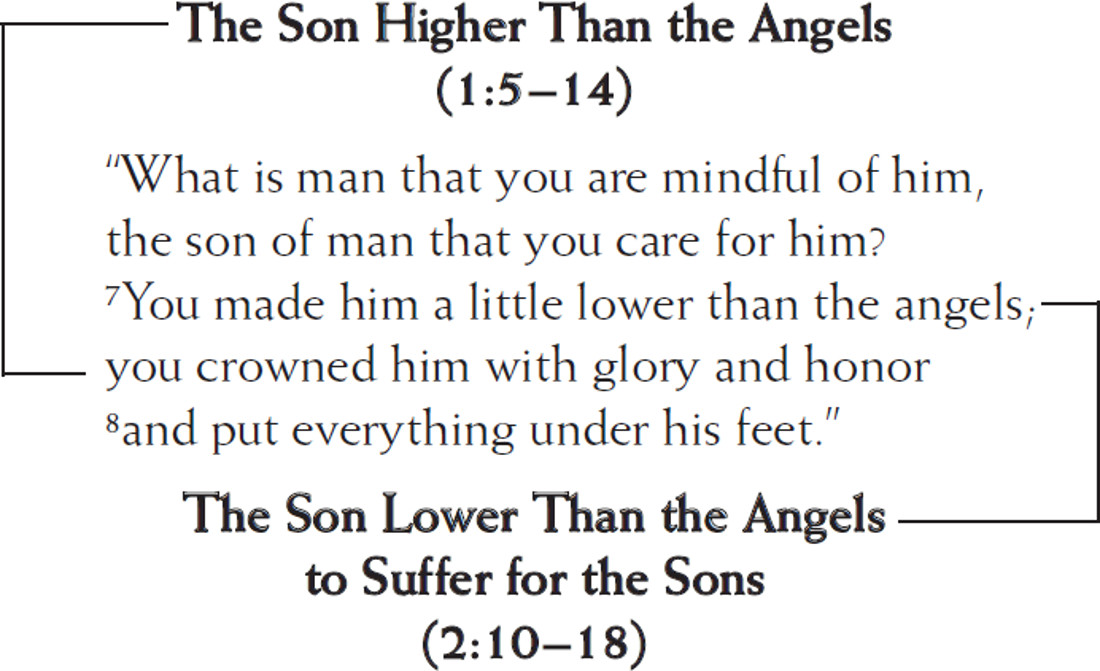
The statement about the Incarnation in Psalm 8, as interpreted by our author, reads, “You made him a little lower than the angels.” The word brachy (lit., “little”) in this phrase can be understood in two ways: a small measure of distance or substance (“just a little lower”), or a small amount of time (“for a little while”). This latter meaning seems to fit the context better since the author is not interested in the degree to which the Son was of a lower status than the angels. Moreover, the author is expressing the thought that Christ walked the earth as a human being for a brief time before being exalted back to heaven.8 The psalm moves from this statement of humiliation to a statement of glorification, in which the Son of Man is said to have been “crowned with glory and honor” and to have had “everything” placed “under his feet.”
Bridging Contexts
AS
WE
BEGIN to move toward application of Hebrews 2:5–9, two points are crucial if we are to avoid serious missteps in bringing the text into our modern contexts. (1) The author’s use of Psalm 8 must be understood as Christological rather than anthropological. In addition to this psalm being used Christologically elsewhere in the New Testament, the author himself clearly interprets it in light of Christ. He understands that Jesus is the one made lower than the angels for a time and the one whom, speaking of the exaltation, God “has crowned … with glory and honor and put everything under his feet” (v. 5, 9). Barclay, for example, completely misses the point of the passage by focusing on humanity’s plight rather than on the Son’s exaltation and incarnation.11 The Christological interpretation of Psalm 8 affirms Christ’s identification with humanity, or perhaps his role as representative of humanity, but the focus is on his experience and position, not ours.
(2) The author’s use of Psalm 8 must be seen as transitional. The opening statement, which speaks of the subjugation of the world to come, clearly points back to the quotation of Psalm 110:1 in Hebrews 1:13. As already stated, the author uses Psalm 110 in conjunction with Psalm 8 because of their common reference to all things being put under the feet of the Son. The clarifying comments of 2:8–9 make sense in light of the two psalms being considered together. Furthermore, Psalm 8, with its emphasis both on humiliation as well as exaltation, effects a smooth transition to the next unit which highlights Christ’s suffering.
As a transition between two major blocks of the sermon, therefore, our application should not be weighted toward either exaltation or incarnation but rather the connection between the two. This connection is both spatial and temporal. It is spatial in that the experience of the Son has spanned the distance from heaven to earth. The all-powerful Son exalted above the principalities of the universe—the Lord of heaven—is the same one who has lived among us, identified with us, and died for us. Jesus is both the one who has authority over all the forces of the universe (including the evil angels in charge of the evil, church-opposing nations) and the one who, having been for a time lower than the angels, can identify with us and has suffered for us. This is intended as a basis of hope and will constitute a key theme in the rest of Hebrews.
This connection between heaven and earth, however, seems ironic for those experiencing persecution. If Christ, even though he can identify with us in our suffering, now has power over those making us suffer, why does he remain silent? This poses a specifically Christian form of the theological query known as the “problem of evil,”12 which brings us to a second crucial connection between the exaltation and incarnation: the temporal connection between the present time and the time to come. Herein lies the answer to the seeming contradiction presented by an exalted Christ and a persecuted church—God’s timing. In his incarnation the Son of God offered himself as a sacrifice for the forgiveness of sins. Thus he opened the way for God’s new covenant to be established with those who respond to the preaching of the Gospel.
The intervening time between the exaltation and consummation of Christ’s rule allows for God’s mission of reconciliation as the church proclaims forgiveness in Christ. However, this in-between time also involves suffering for the church since Christ’s domination of the powers, while being real (i.e., an accomplished fact), has yet to be fully realized. There exists, therefore,
a tension between the “already” and the “not yet” of the Christian hope, but each is essential to the other. In the language of the seer of Patmos, the Lamb that was slain has by his death won the decisive victory (Rev. 5:5), but its final outworking, in reward and judgment, lies in the future (Rev. 22:12). The fact that we now “see Jesus crowned with glory and honor” is guarantee enough that God “has put all things under his feet” (Heb. 2:8–9). His people already share his risen life, and those who reject him are “condemned already” (John 3:18). For the Fourth Evangelist, the judgment of the world coincided with the passion of the incarnate Word (John 12:31); yet a future resurrection to judgment is contemplated as well as a resurrection to life (John 5:29).13
The New Testament fosters the position that the kingdom has been established and its effects set in motion, but its full realization is postponed until the second coming of Christ (Heb. 9:28).
Contemporary Significance
BASED
ON
OUR study and discussion of 2:5–9, three themes should occupy our attention as we apply this text to the church today. (1) All things have already been submitted to Christ at his exaltation at the right hand of God. (2) The subjection of all things to Christ, although a present reality, will not be fully perceptible until the end of the age. (3) Christians should focus on both Jesus’ example of endurance and his present position as regent of the universe, which serve as twin bases for endurance in the midst of our difficulties.
Grappling with the silence of God. Several years ago my family and I lived just down Sanders Bluff Road from Barry and Brenda with their three young boys, John, Drew, and Wade—a wonderful family. Barry was fun, a man of deep faith who talked openly of his love for Christ; Pat and Brenda enjoyed having tea together (a picture of one of their outings is still magnetized to our refrigerator), and the boys were great with our Joshua, who trailed them in age. We were excited about our new-found friends.
In 1993 Brenda contracted liver cancer. In the months that followed, family, friends, and churches in our area prayed, fasted, and believed in God for a miracle. I have never seen such consistency or fervency of prayer. Barry, a great man of faith, was a spiritual rock, ministering to his family and waiting on the Lord. Nevertheless, the answer for which we prayed—Brenda’s healing from cancer—did not come this side of the grave. At the end of this unrelenting illness her emaciated body, only a shadow of the lovely young mother we loved, finally succumbed to the disease. The funeral heralded the victory we as Christians have in death; yet I believe an emotional undercurrent ran through the auditorium that day as sincere, saddened believers asked the question, “God, why did you not answer our prayers?”
To this example could be added countless thousands: the child born with a deformity in spite of prayers for a healthy baby; the missionary who loses a spouse in an auto accident on the field of calling; a homosexual entangled in lust, desperately asking for deliverance from his obsessions; the unanswered prayer for a job; or the request for financial help that seems to get no higher than the ceiling. In times of God’s silence Jesus’ promise of “whatever you ask in prayer” (Mark 11:24) seems mocking, and we cry out with the psalmist in Psalm 44:23–26:
Awake, O Lord! Why do you sleep?
Rouse yourself! Do not reject us forever.
Why do you hide your face
and forget our misery and oppression?
We are brought down to the dust;
our bodies cling to the ground.
Rise up and help us;
redeem us because of your unfailing love.
“Unfailing love?” we ask. What exactly does that mean? If God loves us, why does he not intervene on our behalf?14
The persecuted church. To persecuted Christians around the world this question must seem especially relevant. As reported in a 1996 Christianity Today article, Christians are a minority in 87 of the world’s countries and territories. In many of these, believers are interrogated, imprisoned, harassed, fined, and killed because of the faith. For example, Islamic countries such as Sudan, Kuwait, Pakistan, Iran, and Saudi Arabia restrict or prohibit the practice of Christianity. Five Christian women in Sudan were given the death penalty in August 1995 for their confession of Christ, and other believers in that country have been raped and tortured by government forces. Three months earlier in Cuba, Pastor Orson Vila was arrested and imprisoned for holding church meetings at his home.
In Vietnam, both Protestant and Catholic leaders also have been imprisoned for leading religious activities. Just over the border in northern provinces of Laos, Christians have been forced to sign affidavits renouncing their faith, and officials have initiated a campaign to close all churches. Xiao Biguang, a Chinese intellectual who came to Christ after the Tiananmen Square massacre, has spent the past two years in prison for “creating a negative atmosphere among students” in China. His wife, Gou Qinghui, has lost her teaching job and been detained by authorities on four occasions. She has not seen her husband since his arrest.15 This couple is part of a persecuted, underground church in China that may number as many as fifty million members. To these dramatic examples could be added less dramatic, but painful, situations around the world in which believers are tormented by bosses or family members unsympathetic to Christian belief and practice.
God’s answers. So why, at times, does God not answer the cries of these persecuted believers as they are beaten, raped, imprisoned, or killed? Why does he not always answer the prayer for healing, staying the hand of death? Why does he sometimes refuse to respond to our desperate call for help?
The question here is not whether God answers prayer. He most certainly does! The people of God through faith have “conquered kingdoms, administered justice … gained what was promised; … shut the mouths of lions, quenched the fury of the flames, and escaped the edge of the sword …” (Heb. 11:33–34). The question is how should we respond when “we do not see everything submitted to him.” This too has been the experience of God’s faithful through the ages: “Some faced jeers and flogging, while still others were chained and put in prison. They were stoned; they were sawed in two; they were put to death by the sword. They went about in sheepskins and goat-skins, destitute, persecuted and mistreated” (11:36–37). Although these people, like those earlier mentioned, were commended for their faith, these did not receive what was promised (11:39). So, what is going on when, in our immediate situations, Christ does not seem to be in control?
The answer to our dilemma lies in our perception of reality and, specifically, the nature of the Christian faith. In Western Christianity especially, “we have become committed to relieving the pain behind our problems rather than using our pain to wrestle more passionately with the character and purposes of God. Feeling better has become more important than finding God. And worse, we assume that people who find God always feel better.”16 To focus on our situations, our problems, our pains as primary (rather than the purposes of God) is to move away from important aspects of following Christ. We must follow Christ in the way of suffering. God’s people have always been persecuted as counter to the power systems of this world; the enemy death still walks the highways of the globe, having yet to be put completely out of commission (1 Cor. 15:25–27); this “in-between time” is a time of tears and pain (Rev. 21:4).
Yet, in these experiences we walk in the way of Christ, who was persecuted, wept, and died. “To this you were called, because Christ suffered for you, leaving you an example, that you should follow in his steps” (1 Peter 2:21). Persecution has always been the normal Christian experience (e.g., Matt. 24:8–10; Mark 13:9–13; Acts 5:29–42; Rom. 8:35–37; 2 Cor. 4:8–12; Phil. 1:29; Col. 1:24). As we look to the example of Jesus in his earthly experiences of persecution, we gain strength for endurance. We see that sometimes what looks to be the darkest hour in this world’s perspective is actually the brightest; the feeling of being forsaken by God may even occur at the pinnacle of our mission for him (Matt. 27:45–46). When we see Jesus in his incarnation, we are reminded of the price attached to living as God’s person for God’s purposes in a fallen world. He often brings glory to himself and “works for the good” (Rom. 8:28) through our pain. Jesus shows us a trust-God-and-hold-to-it-at-all-costs kind of faith.17
Moreover, as we consider Jesus, the now exalted Lord of the universe, we perceive that the last chapters of our stories have yet to be written. The exaltation heralds the ultimate demise of all powers of persecution, the burial of death, and the wiping away of all tears from our eyes, reunion with loved ones, and the supply of every need. We will not always live in the “in-between time.” The age of hope looms on the horizon, dwarfing the pains of the present.
The problem of evil for the Christian lies not in God’s abilities, nor even in our perception of his will and timing (cf. Job 42:3–4), but in our perception of Jesus. As a pilot in a dense fog keeps on course by looking to the instruments, Jesus provides a reference point from which to assess the greater realities of any given situation. What we need is to “see Jesus” (2:8–9), to take a “double look” at him in his incarnation and exaltation.
Original Meaning
Submission of All Things to Christ (2:5–8a)
ANCIENT JUDAISM
HELD to the belief that angels had been placed by God over the nations of the world. The basis for this belief went back to an interpretation of Deuteronomy 32:8 (cf. NIV
note), which referred to the boundaries of the nations as set according to the number of God’s angels. Later, in Daniel 10:20–21; 12:1, angels are designated as the “prince of Persia” and “prince of Greece,” and Michael is referred to as “the great prince” who watches over God’s people, Israel. As in the New Testament (e.g., Eph. 6:12), some of the principalities in Daniel are depicted as evil, opposing the will and work of God (Dan. 10:20–21).3 Yet angels, whether good or bad, will hold no position of government in the coming age (see Heb. 2:5–9).
The quote of Psalm 110:1 in Hebrews 1:13, rather than the exhortation of 2:1–4, gives rise to the statement, “It is not to angels that he has subjected the world to come, about which we are speaking.”4 The author has in mind the part of Psalm 110 that reads, “until I make your enemies a footstool for your feet.” This is the subjugation of “the world to come” to which the author refers in 2:5.
In the New Testament the word translated “subjected” in the NIV
(hypotasso) is widely used. Christians are to submit to God (1 Cor. 15:28; Heb. 12:9) and to God’s law (Rom. 8:7). On the human level they are to subject themselves to one another (1 Cor. 16:16; Eph. 5:21); wives submit to husbands (Eph. 5:24; Col. 3:18; Titus 2:5; 1 Peter 3:1, 5), the young to the old (1 Peter 5:5), slaves to masters (Eph. 6:5; Titus 2:9; 1 Peter 2:18), and believers in general to governing authorities (Rom. 13:1). Thus submission, that act of yielding to the perspective or position of another, constitutes a fundamental element of Christian practice.5 More broadly, however, all the powers of the universe—even those that do not do so willingly—must submit to Christ (1 Cor. 15:27–28; Eph. 1:22; Phil. 2:10–11; 3:21; 1 Peter 3:22).
The author understands both Psalm 8:4–6 and 110:1 to contain a reference to those placed under Christ’s feet.6 As seen in the diagram below, the preacher employs Psalm 8 because, in addition to its references to the Son’s supremacy by virtue of exaltation, it mentions a time during which the Son came down to earth, taking on a “status” or position (as a human being) that was lower than that of the angels; the author then turns to the Incarnation in 2:10–18.7
The statement about the Incarnation in Psalm 8, as interpreted by our author, reads, “You made him a little lower than the angels.” The word brachy (lit., “little”) in this phrase can be understood in two ways: a small measure of distance or substance (“just a little lower”), or a small amount of time (“for a little while”). This latter meaning seems to fit the context better since the author is not interested in the degree to which the Son was of a lower status than the angels. Moreover, the author is expressing the thought that Christ walked the earth as a human being for a brief time before being exalted back to heaven.8 The psalm moves from this statement of humiliation to a statement of glorification, in which the Son of Man is said to have been “crowned with glory and honor” and to have had “everything” placed “under his feet.”
Bridging Contexts
AS
WE
BEGIN to move toward application of Hebrews 2:5–9, two points are crucial if we are to avoid serious missteps in bringing the text into our modern contexts. (1) The author’s use of Psalm 8 must be understood as Christological rather than anthropological. In addition to this psalm being used Christologically elsewhere in the New Testament, the author himself clearly interprets it in light of Christ. He understands that Jesus is the one made lower than the angels for a time and the one whom, speaking of the exaltation, God “has crowned … with glory and honor and put everything under his feet” (v. 5, 9). Barclay, for example, completely misses the point of the passage by focusing on humanity’s plight rather than on the Son’s exaltation and incarnation.11 The Christological interpretation of Psalm 8 affirms Christ’s identification with humanity, or perhaps his role as representative of humanity, but the focus is on his experience and position, not ours.
(2) The author’s use of Psalm 8 must be seen as transitional. The opening statement, which speaks of the subjugation of the world to come, clearly points back to the quotation of Psalm 110:1 in Hebrews 1:13. As already stated, the author uses Psalm 110 in conjunction with Psalm 8 because of their common reference to all things being put under the feet of the Son. The clarifying comments of 2:8–9 make sense in light of the two psalms being considered together. Furthermore, Psalm 8, with its emphasis both on humiliation as well as exaltation, effects a smooth transition to the next unit which highlights Christ’s suffering.
As a transition between two major blocks of the sermon, therefore, our application should not be weighted toward either exaltation or incarnation but rather the connection between the two. This connection is both spatial and temporal. It is spatial in that the experience of the Son has spanned the distance from heaven to earth. The all-powerful Son exalted above the principalities of the universe—the Lord of heaven—is the same one who has lived among us, identified with us, and died for us. Jesus is both the one who has authority over all the forces of the universe (including the evil angels in charge of the evil, church-opposing nations) and the one who, having been for a time lower than the angels, can identify with us and has suffered for us. This is intended as a basis of hope and will constitute a key theme in the rest of Hebrews.
This connection between heaven and earth, however, seems ironic for those experiencing persecution. If Christ, even though he can identify with us in our suffering, now has power over those making us suffer, why does he remain silent? This poses a specifically Christian form of the theological query known as the “problem of evil,”12 which brings us to a second crucial connection between the exaltation and incarnation: the temporal connection between the present time and the time to come. Herein lies the answer to the seeming contradiction presented by an exalted Christ and a persecuted church—God’s timing. In his incarnation the Son of God offered himself as a sacrifice for the forgiveness of sins. Thus he opened the way for God’s new covenant to be established with those who respond to the preaching of the Gospel.
The intervening time between the exaltation and consummation of Christ’s rule allows for God’s mission of reconciliation as the church proclaims forgiveness in Christ. However, this in-between time also involves suffering for the church since Christ’s domination of the powers, while being real (i.e., an accomplished fact), has yet to be fully realized. There exists, therefore,
a tension between the “already” and the “not yet” of the Christian hope, but each is essential to the other. In the language of the seer of Patmos, the Lamb that was slain has by his death won the decisive victory (Rev. 5:5), but its final outworking, in reward and judgment, lies in the future (Rev. 22:12). The fact that we now “see Jesus crowned with glory and honor” is guarantee enough that God “has put all things under his feet” (Heb. 2:8–9). His people already share his risen life, and those who reject him are “condemned already” (John 3:18). For the Fourth Evangelist, the judgment of the world coincided with the passion of the incarnate Word (John 12:31); yet a future resurrection to judgment is contemplated as well as a resurrection to life (John 5:29).13
The New Testament fosters the position that the kingdom has been established and its effects set in motion, but its full realization is postponed until the second coming of Christ (Heb. 9:28).
Contemporary Significance
BASED
ON
OUR study and discussion of 2:5–9, three themes should occupy our attention as we apply this text to the church today. (1) All things have already been submitted to Christ at his exaltation at the right hand of God. (2) The subjection of all things to Christ, although a present reality, will not be fully perceptible until the end of the age. (3) Christians should focus on both Jesus’ example of endurance and his present position as regent of the universe, which serve as twin bases for endurance in the midst of our difficulties.
Grappling with the silence of God. Several years ago my family and I lived just down Sanders Bluff Road from Barry and Brenda with their three young boys, John, Drew, and Wade—a wonderful family. Barry was fun, a man of deep faith who talked openly of his love for Christ; Pat and Brenda enjoyed having tea together (a picture of one of their outings is still magnetized to our refrigerator), and the boys were great with our Joshua, who trailed them in age. We were excited about our new-found friends.
In 1993 Brenda contracted liver cancer. In the months that followed, family, friends, and churches in our area prayed, fasted, and believed in God for a miracle. I have never seen such consistency or fervency of prayer. Barry, a great man of faith, was a spiritual rock, ministering to his family and waiting on the Lord. Nevertheless, the answer for which we prayed—Brenda’s healing from cancer—did not come this side of the grave. At the end of this unrelenting illness her emaciated body, only a shadow of the lovely young mother we loved, finally succumbed to the disease. The funeral heralded the victory we as Christians have in death; yet I believe an emotional undercurrent ran through the auditorium that day as sincere, saddened believers asked the question, “God, why did you not answer our prayers?”
To this example could be added countless thousands: the child born with a deformity in spite of prayers for a healthy baby; the missionary who loses a spouse in an auto accident on the field of calling; a homosexual entangled in lust, desperately asking for deliverance from his obsessions; the unanswered prayer for a job; or the request for financial help that seems to get no higher than the ceiling. In times of God’s silence Jesus’ promise of “whatever you ask in prayer” (Mark 11:24) seems mocking, and we cry out with the psalmist in Psalm 44:23–26:
Awake, O Lord! Why do you sleep?
Rouse yourself! Do not reject us forever.
Why do you hide your face
and forget our misery and oppression?
We are brought down to the dust;
our bodies cling to the ground.
Rise up and help us;
redeem us because of your unfailing love.
“Unfailing love?” we ask. What exactly does that mean? If God loves us, why does he not intervene on our behalf?14
The persecuted church. To persecuted Christians around the world this question must seem especially relevant. As reported in a 1996 Christianity Today article, Christians are a minority in 87 of the world’s countries and territories. In many of these, believers are interrogated, imprisoned, harassed, fined, and killed because of the faith. For example, Islamic countries such as Sudan, Kuwait, Pakistan, Iran, and Saudi Arabia restrict or prohibit the practice of Christianity. Five Christian women in Sudan were given the death penalty in August 1995 for their confession of Christ, and other believers in that country have been raped and tortured by government forces. Three months earlier in Cuba, Pastor Orson Vila was arrested and imprisoned for holding church meetings at his home.
In Vietnam, both Protestant and Catholic leaders also have been imprisoned for leading religious activities. Just over the border in northern provinces of Laos, Christians have been forced to sign affidavits renouncing their faith, and officials have initiated a campaign to close all churches. Xiao Biguang, a Chinese intellectual who came to Christ after the Tiananmen Square massacre, has spent the past two years in prison for “creating a negative atmosphere among students” in China. His wife, Gou Qinghui, has lost her teaching job and been detained by authorities on four occasions. She has not seen her husband since his arrest.15 This couple is part of a persecuted, underground church in China that may number as many as fifty million members. To these dramatic examples could be added less dramatic, but painful, situations around the world in which believers are tormented by bosses or family members unsympathetic to Christian belief and practice.
God’s answers. So why, at times, does God not answer the cries of these persecuted believers as they are beaten, raped, imprisoned, or killed? Why does he not always answer the prayer for healing, staying the hand of death? Why does he sometimes refuse to respond to our desperate call for help?
The question here is not whether God answers prayer. He most certainly does! The people of God through faith have “conquered kingdoms, administered justice … gained what was promised; … shut the mouths of lions, quenched the fury of the flames, and escaped the edge of the sword …” (Heb. 11:33–34). The question is how should we respond when “we do not see everything submitted to him.” This too has been the experience of God’s faithful through the ages: “Some faced jeers and flogging, while still others were chained and put in prison. They were stoned; they were sawed in two; they were put to death by the sword. They went about in sheepskins and goat-skins, destitute, persecuted and mistreated” (11:36–37). Although these people, like those earlier mentioned, were commended for their faith, these did not receive what was promised (11:39). So, what is going on when, in our immediate situations, Christ does not seem to be in control?
The answer to our dilemma lies in our perception of reality and, specifically, the nature of the Christian faith. In Western Christianity especially, “we have become committed to relieving the pain behind our problems rather than using our pain to wrestle more passionately with the character and purposes of God. Feeling better has become more important than finding God. And worse, we assume that people who find God always feel better.”16 To focus on our situations, our problems, our pains as primary (rather than the purposes of God) is to move away from important aspects of following Christ. We must follow Christ in the way of suffering. God’s people have always been persecuted as counter to the power systems of this world; the enemy death still walks the highways of the globe, having yet to be put completely out of commission (1 Cor. 15:25–27); this “in-between time” is a time of tears and pain (Rev. 21:4).
Yet, in these experiences we walk in the way of Christ, who was persecuted, wept, and died. “To this you were called, because Christ suffered for you, leaving you an example, that you should follow in his steps” (1 Peter 2:21). Persecution has always been the normal Christian experience (e.g., Matt. 24:8–10; Mark 13:9–13; Acts 5:29–42; Rom. 8:35–37; 2 Cor. 4:8–12; Phil. 1:29; Col. 1:24). As we look to the example of Jesus in his earthly experiences of persecution, we gain strength for endurance. We see that sometimes what looks to be the darkest hour in this world’s perspective is actually the brightest; the feeling of being forsaken by God may even occur at the pinnacle of our mission for him (Matt. 27:45–46). When we see Jesus in his incarnation, we are reminded of the price attached to living as God’s person for God’s purposes in a fallen world. He often brings glory to himself and “works for the good” (Rom. 8:28) through our pain. Jesus shows us a trust-God-and-hold-to-it-at-all-costs kind of faith.17
Moreover, as we consider Jesus, the now exalted Lord of the universe, we perceive that the last chapters of our stories have yet to be written. The exaltation heralds the ultimate demise of all powers of persecution, the burial of death, and the wiping away of all tears from our eyes, reunion with loved ones, and the supply of every need. We will not always live in the “in-between time.” The age of hope looms on the horizon, dwarfing the pains of the present.
The problem of evil for the Christian lies not in God’s abilities, nor even in our perception of his will and timing (cf. Job 42:3–4), but in our perception of Jesus. As a pilot in a dense fog keeps on course by looking to the instruments, Jesus provides a reference point from which to assess the greater realities of any given situation. What we need is to “see Jesus” (2:8–9), to take a “double look” at him in his incarnation and exaltation.