Original Meaning
A Harsh Word of Warning (6:4–8)
AT
A
NUMBER of points in Hebrews the author presents a compact, highly stylized treatment of an issue by stringing together participle clauses,1 an approach he uses in 6:4–8. The first three verses of this unit cohere around the central assertion, “It is impossible for those … to be brought back to repentance.” The two main parts of this declaration (lit., “impossible the ones …” [v. 4] and “again to renew to repentance” [v. 6]) are separated from each other by five intervening clauses. Such a separation of closely related elements was done at times for rhetorical effect (i.e., by their isolation from one another they stand out more clearly).2 The structure of the passage may be depicted as follows:
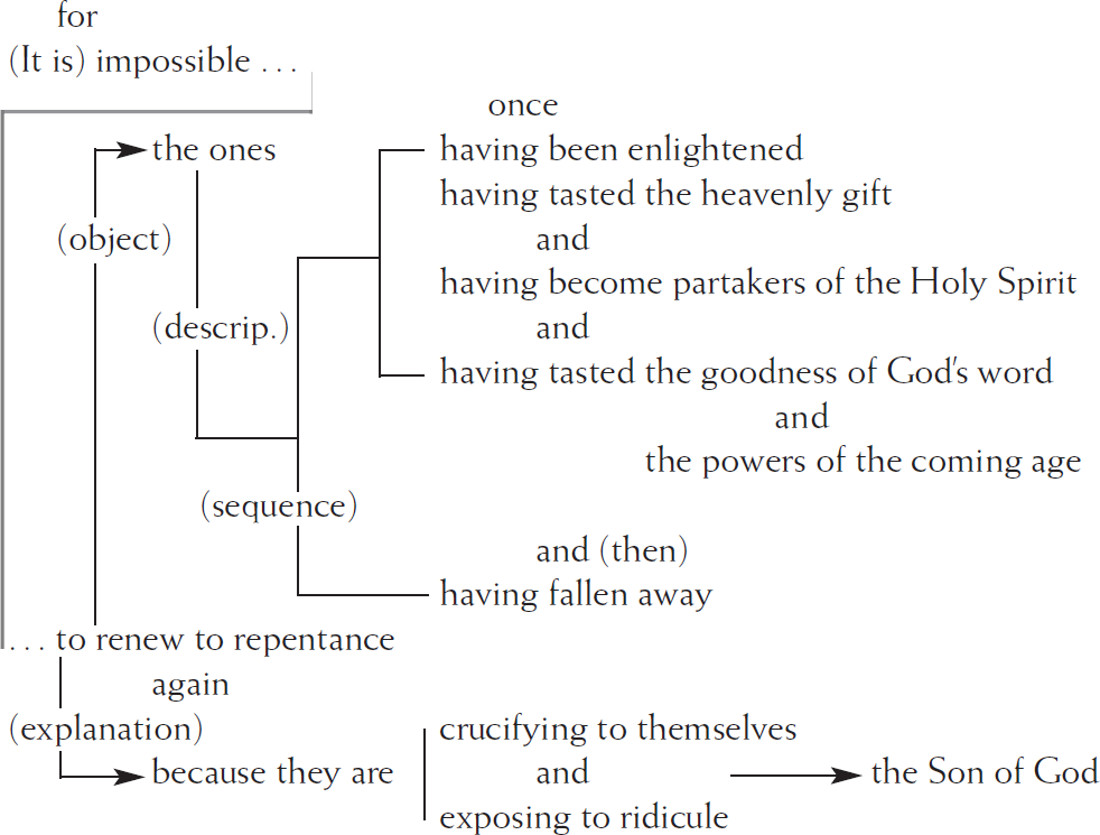
The author places the term translated “impossible” (adynaton) first in the passage for emphasis.3 He uses this word at three other points in Hebrews, proclaiming it is “impossible for God to lie” (6:18), “impossible for the blood of bulls and goats to take away sins” (10:4), and “impossible to please God” apart from faith (11:6). The term clearly means that something cannot happen. That those under discussion “have once been enlightened” (photizo) probably refers to their initial exposure to the gospel or early instruction in Christian doctrine.4 The only other use of photizo in Hebrews occurs at 10:32, where the author encourages his hearers with, “Remember those earlier days after you had received the light.…”
Although some have taken the word translated “tasted” (geusamenous, from geuomai) to mean “to have tried but not fully partaken of,”5 this interpretation must be ruled out on consideration of its usage elsewhere.6 Others have understood the act of tasting to refer literally to partaking of the Eucharist. However, little in the context commends such an interpretation. The word is used metaphorically, as at 2:9, where Christ is said to have “tasted” death for every person. Thus the verb geuomai means “to experience something.”
What these people have experienced is “the heavenly gift.” In Acts the “gift” refers to the Holy Spirit (Acts 2:38; 8:20; 10:45; 11:17), but here the author seems to make a distinction between this gift and the Holy Spirit. In Pauline usage the word refers more generally to the blessings of God surrounding salvation (e.g., Rom. 5:15, 17; 2 Cor. 9:15; Eph. 3:7; 4:7), and several commentators have found that interpretation most attractive in the present context.7
Ancient authors could use the word “partakers” (metochos; NIV
, “who shared in”) with reference either to a normal companion or to an associate in a legal or moral context. It can function as a synonym for koinonos (“partner,” “sharer”), referring, for example, to a partner in business. We move closer to the meaning here when we understand the metachoi as those who share in spiritual realities. The word has been used several times in the previous chapters. It occurs in the quote of Psalm 45:6–7 at Hebrews 1:9, meaning “companions”; it probably has the same sense as 3:1, 14, where the hearers are called respectively (lit.) “companions of a heavenly calling” and “companions of Christ.” A use later in the book (12:8) says that all true children of God are “sharers” of discipline. A cognate verb (metecho) appears in participial form at 5:13, referring to partaking of milk (i.e., basic teachings), and points to metaphorical uses of the word for eating and instruction.8 Thus the word has a broad semantic range and generally seems to mean “to have a close association with” or “participate in.” Thus, here those who have fallen away are said to have been “companions of” or “sharers of” the Holy Spirit.
Furthermore, these people “have tasted the goodness of the word of God and the powers of the coming age.” The Word of God and his power are closely linked (e.g., 1:2–3; 2:3–4; 3:7–19; 4:12–13), and the language here is reminiscent of those who fell in the desert through lack of faith9 even though they had heard God’s voice and seen his mighty acts (3:7–11). The verb “tasted,” as in verse 4, refers to something experienced. Consequently, those being used as a bad example in 6:4–6 in some way have experienced God’s good Word and power.
At the climax of this string of participles comes the clause “if they fall away” (v. 6). Rather than reading the clause as conditional with the NIV
, however, it might be better to understand it as the culminating experience in a sequence of experiences: “(who) have been enlightened, tasted the heavenly gift, become partakers of the Holy Spirit, have tasted the goodness of God’s word and the powers of the coming age and then have fallen away.…” The verb “to fall away” (parapipto) can mean simply to “go astray,” but the harshness of the descriptions that follow (“crucifying the Son of God” and “subjecting him to public disgrace”) demand that it be understood in terms of a serious sin—that of rejecting Christ.10
The author finally rounds off the main verbal idea in this long sentence, informing the readers of what is “impossible”: It is impossible for those who have fallen away “to be brought back to repentance.” He uses the Greek words palin (“again”) coupled with the infinitive anakainizo (“to renew”; NIV
, “be brought back”), suggesting that those who had fallen away had repented previously. In other words, those who have fallen away cannot be brought back again to a true repentance. This thought has caused a great deal of anxiety among those who read the book of Hebrews. What does it mean?
The assertion here must be considered in light of the broader context of Hebrews. In 6:1 the author has identified “repentance” as foundational in Christian teaching. In the view of the author of Hebrews true repentance can be experienced only in the shadow of Christ’s sacrifice, since there exists no other valid sacrifice for sin (10:18, 26). In the Jewish literature of the day, repentance was God’s gift, and Hebrews has taken that thought as specifically incarnated in the person and work of the Son of God. Repentance in 6:4–6 is “impossible” because there is nowhere else to go for repentance once one has rejected Christ. The apostate in effect has turned his or her back on the only means available for forgiveness before God.11
The writer now provides an explanation in the form of two parallel present-tense form participles: “to their loss they are crucifying the Son of God all over again and subjecting him to public disgrace.” The switch to the present tense is significant since the author has used the aorist tense to this point in the passage. These present participles may indicate that the actions under consideration are actions in progress. Furthermore, the acts of “crucifying” and “subjecting … to disgrace” should be understood as modifying the infinitive “to be brought back.” The participles may be interpreted either as causal (“because they …”) or temporal (“while they …”). In either case the effect is the same: Repentance has been (and is) ruled out because the fallen ones are rejecting Christ. If the incompleteness of these actions is stressed, however, Hebrews 6:4–6 does not negate the possibility of the fallen reversing course in the future (i.e., “as long as they are crucifying the Son of God and subjecting him to public disgrace”).12
The language of crucifixion and public shaming is both potent and ironic. Instead of being blessed by accepting the forgiveness found in the crucified Christ, the ones who have fallen away identify with those who used the cross as an ultimate expression of rejection. Instead of being shamed in the eyes of the world by identification with the Son, “bearing the disgrace he bore” (13:13), the apostates stand with those before the cross who cast insults, disparaging Christ’s claims as the true Messiah:
Those who passed by hurled insults at him, shaking their heads and saying, “You who are going to destroy the temple and build it in three days, save yourself! Come down from the cross, if you are the Son of God!”
In the same way the chief priests, the teachers of the law and the elders mocked him. “He saved others,” they said, “but he can’t save himself! He’s the King of Israel! Let him come down now from the cross, and we will believe in him. He trusts in God. Let God rescue him now if he wants him, for he said, ‘I am the Son of God.’” In the same way the robbers who were crucified with him also heaped insults on him. (Matt. 27:39–44)
The author continues with common agricultural imagery,13 illustrating the contrast between those who come to a good end in relation to God over against those who do not end well. Verse 7 portrays fruitfulness, which well describes the hearers in whom the author expresses confidence in verses 9–10. On the other hand, verse 8 illustrates the unfruitful persons just used as an object of warning in verses 4–6.
The vast majority of people reading this commentary probably are urbanites who spend little, if any, effort in raising crops for food or livelihood. The feel of dirt between your fingers, the anticipation of planting seeds or a young vine, and the joy of harvest might be aspects of a hobby but for most do not fall into the category of life necessities. Yet for most people of the ancient world, agriculture comprised a much more important aspect of life. There existed no frozen food or canned vegetable sections at a grocery store.14 A bad crop had implications both for the farmer and his family and for those who depended on his supply of food in the markets.
In 6:7–8 the author describes twin experiences familiar to those from an agricultural context. On the one hand, seeds have been planted in the earth, rain falls on the land, crops are produced, and the farmers who planted the seeds envision an eventual harvest. This is a picture of God’s blessing. On the other hand, we have a picture of disappointment and frustration. The seeds have been planted, rain falls in abundance on the land, but instead of the hoped-for crop, worthless “thorns and thistles” are produced. Rather than evidencing the blessing of God, such land is “near to a curse” (pers. trans.; cf. Gen. 3:17–18), suggesting inevitable devastation.15 The farmer’s only recourse is to burn off the area.
Bridging Contexts
SPECIAL
DIFFICULTIES
IN
interpreting this passage. Both the diversity of interpretations and intensity surrounding discussions on Hebrews 6:4–12 have at their root at least two important factors that we do well to keep in mind as we move toward application of this controversial text.
(1) The language of the passage is notoriously ambiguous. At several points the terminology used describes certain phenomena without defining exactly what the author has in mind. Although I have attempted to do a credible job of shedding light on ambiguous phrases (such as “once been enlightened,” “tasted the heavenly gift,” and “shared in the Holy Spirit”), the problem remains that the author lists these without defining them. What does seem certain, given the evidence, is that the description in 6:4–6 fits those who have taken initial steps in associating with the Christian community. Whether this means they have been changed by the power of God into “new creatures,” as some commentators suggest, or in some way have manifested certain phenomena normally associated with the new life but never giving evidence that a true life-change has taken place, forms the central question in debates on the passage.
(2) Since a “presuppositionless hermeneutic” is impossible, every interpreter comes to the text with preconceived ideas on the theological issues addressed. In other words, we all carry certain theological baggage into the task of interpretation. This baggage has been picked up over a long period of time and consists of our life experiences and the influence of interpretive communities to which we belong. This does not make objectivity impossible—just difficult to achieve, especially when the stakes are so high. After all, the nature of salvation and perseverance are focal concepts to our understanding of the Christian life. Some who come to the text may belong to an interpretive community in which a “wrong interpretation” (from that community’s perspective) carries with it vast professional and personal consequences. Therefore, to “bracket” our theological presuppositions when seeking to encounter such a text in a fresh way demands a resolute commitment to truth-seeking.
Several reminders. In light of these difficulties, therefore, we need to remember several important hermeneutical guidelines that might help to steer us through our discussion. (1) We must keep in mind that the genre of this passage is exhortation. Of course, theology underlies the author’s hortatory material in Hebrews, but the primary purpose of 6:4–12 is to motivate to action rather than to offer theological instruction. This may be why the author does not stop to define his terms. Thus, when we approach a text like 6:4–8 for theological instruction, we come at the text with a purpose that was at least secondary in the author’s mind.
I do not mean to suggest, of course, that the author has ceased thinking theologically in his exhortation sections, just that his theology is presupposed and is now in the service of exhortation. This does not make the theological questions we raise any less important, but it does force us to ask: “In what way did the author intend this particular passage to challenge his hearers to change their attitudes and actions?” and “What are the dynamics here that could be misinterpreted if we do not keep the ‘hortatory factor’ in view?”
(2) Also related to the issue of genre, we must recognize 6:7–8 as a widely used wisdom form found in both biblical and extrabiblical literature,19 which depicts the blessing associated with fruitfulness over against the curse associated with barrenness.20 As such, we should be careful of associating specific theological constructs with the images of “rain,” “crops,” “thorns,” and even being “burned.” The material here is meant to be metaphorical or analogous to spiritual realities without directly making reference to those realities. For example, even though it is true that the author uses “fire” as an image of judgment elsewhere in Hebrews (10:27; 12:29) and it certainly alludes to judgment here, to draw too narrow a theological conclusion from the image of burning in 6:8 (such as its being a reference to hell) is to neglect the wisdom form of the author’s illustration.21 The image of burning, rather, presents a general picture of destruction without defining the specific nature of that destruction.
(3) We must be careful about jumping from a possible word meaning to a theological conclusion when the author himself has not defined specifically the word in question. For example, I have suggested that the word “tasted” in 6:4–5 means “to experience something.” Specifically in this passage, those under consideration have “tasted the heavenly gift” and “the goodness of the word of God and the powers of the coming age.” The word does not mean “to sample” or “eat without fully digesting,” as some have suggested. However, even when we say that the expression means to experience something, we have not defined the nature of that experience and must be careful about drawing theological conclusions from that word. For example, the desert wanderers—the author’s paradigm for those who fall away from God—could be said to have fully experienced God’s Word and power (Heb. 3:7–9, 16–19), yet faith was not in the mix of that experience. When we consider the pronouncement that the apostates had experienced the blessings surrounding salvation (if that is the meaning of “heavenly gift”), what does that mean? How did they experience those blessings? The writer of Hebrews does not say.
Furthermore, what does it mean to be a metochos, a “companion of” or “sharer in” the Holy Spirit? It may refer to someone who has been converted and thus been indwelt by the Spirit. Yet it could also mean one who has interacted with the Holy Spirit, in the sense of experiencing the Spirit’s convicting presence, without being converted. F. F. Bruce, for instance, draws attention to the experience of Simon Magus in Acts 8. This miracle-worker had associated himself initially with the Christian movement, having hands laid on him in an act associated with the Spirit, yet was pronounced by Peter to be still in the bondage of sin.22
I do not mean to suggest that we must remain agnostic about the author’s meaning in this passage. I will present and defend my own position on the message of 6:4–8 below. However, its ambiguity calls for caution. Whether we come from a tradition that affirms “perseverance of the saints” or one that holds apostasy as possible for true believers, we tend to seize on those word meanings that seem to support our position. Integrity demands that we consider carefully as much data as possible when attempting to arrive at an interpretation and open ourselves to the arguments of others who have grappled with this text.
Interpretations. Several years ago while attending a professional meeting in San Francisco, two friends and I went for an outing to a popular shopping district in the city. These friends are known authors and teach New Testament at prominent evangelical institutions. As we traveled across the city, we met yet another New Testament professor, a popular writer and speaker, who joined us on a crowded trolley. Somehow we began discussing the warning passages in Hebrews. There, packed like sardines in a mixed crowd of shoppers, tourists, and business people, we carried on an energetic debate about the situation described by Hebrews 6:4–8. Two in our party defended an Arminian position (i.e., that a true Christian can lose salvation). One proclaimed those described in 6:4–8 as real Christians who had not lost salvation but were under judgment as the people of God. The fourth member of the debate suggested that the “fallen” were never true believers in the first place.
The scene was somewhat comical. Here were four New Testament professors arguing over the intricacies of Greek grammar and word meanings, surrounded by a crowd silently staring straight ahead with blank faces but forced to listen to our theological wrangling. The picture illustrates that scholars are anything but of uniform opinion when it comes to the warnings of Hebrews, and many laypeople do not share our enthusiasm for the debate!
Therefore, let us consider the various positions scholars have set forth on Hebrews 6:4–8.23 (1) The hypothetical view suggests that the author crafts this harsh warning for rhetorical impact, to blast the hearers out of their spiritual slumber, but that the state described cannot really happen. The passage, therefore, is read: “If there were those who fell away, which cannot really happen, then it would be impossible to renew them to repentance.” In favor of this view, the author exhibits fine rhetorical skills and knows how to motivate his listeners through eloquent oratory. However, the problem with this position stems from the harshness and repetition of severe warnings in the book (e.g., 2:1–4; 3:6, 14; 4:12–13; 10:26–31, 39; 12:25–29). The author appears to be concerned deeply that there are those associated with the community who indeed could fall away from God. His warnings to them speak of harsh, impending judgment for those who do not heed these exhortations, and the judgments are presented as real, not hypothetical.
(2) The pre-conversion Jew view states that those addressed are Jews who have associated somewhat with the Christian community but have yet to make a commitment to Christ. There can be no doubt that the audience had a rich background in Jewish thought and worship.24 Yet, given the many and overt references to those being challenged as, for example, “holy brothers” (3:1), a part of Christ’s house (3:6), Christ’s companions (3:14), and those who have made a profession (4:14), this position does not seem tenable. Furthermore, in the immediate passage the language seems to point to those who in some way have been associated with Christian practice and belief.
(3) The covenant community view, set forth by Verlyn Verbrugge, suggests that the “Vineyard Song” of Isaiah 5:1–7 forms the backdrop of Hebrews 6:4–6 and that the author has in mind God’s rejection of a whole community rather than individuals.25 In this passage the Lord sings of a fertile vineyard on a hillside, well prepared and planted with high quality vines. Yet, this vineyard yields only bad fruit. The Lord’s judgment consists of destroying the vineyard, breaking down its wall, making it a waste area, allowing the weeds to grow up, and refusing it rain. This illustration composes a judgment against the people of Israel and Judah (Isa. 5:7). In line with this Old Testament passage, which proclaims a devastating warning against the covenant people of God, Verbrugge proposes that the threatened rejection of the community in Hebrews does not equal the rejection of every individual. Yet, the author of Hebrews seems to make distinctions between different groups and individuals within this Christian community. In 4:1 he states, “let us be careful that none of you be found to have fallen short” (emphasis added). In 6:4–12 he makes a distinction between those who have fallen away (6:4–6) and the hearers of whom he expresses confidence.
(4) A fourth view might be called the true believer under judgment view. This position holds that those threatened by the judgment of God indeed are true believers and do face severe judgment by God but cannot lose their salvation. This position focuses on the desert wanderers as the author’s primary paradigm for those who fall. The logic goes this way: “The Old Testament fallen were the people of God and were judged by him on the basis of his covenant with them. However, they did not lose their relationship with God but rather the earthly reward of entering the promised land.” The position, moreover, takes seriously the language of 6:4–8 and other passages in the book that seem to suggest the fallen have been associated with the Christian movement. Hebrews 10:30 states, “The Lord will judge his people.”
The problem here, however, comes when we consider verses such as 3:6, 14, in which the author expresses concern over his friends if they do not hold on to their courage and hope. They seem to have “fallen short” of a commitment that combines faith with hearing the gospel (4:1–2). Furthermore, 10:26–31 describes the fallen as “enemies of God” (v. 27); they are those for whom there no longer exists a sacrifice and whose end is destruction (10:26–29, 39). In 6:9, moreover, the author contrasts the hearers, those from whom he expects better things associated with salvation, with the fallen of 6:4–6. The inference may be drawn that those of 6:4–6 have no part in the things related to salvation. It seems to me that the warnings simply are too harsh and specific to tone them down to a loss of reward rather than a loss of salvation.
(5) Another view has been called the phenomenological true believer view. This interpretation holds that those under consideration must be judged as having been true, regenerate believers, who have now lost their relationship with Christ and can no longer anticipate salvation upon Christ’s return. This interpretation rests on the “phenomena” surrounding “Christian experience” detailed by the author of Hebrews in 6:4–8 and other passages in the book. One of the more exegetically oriented defenses of this position comes from Scot McKnight.26
McKnight’s approach has several strengths. (a) He seeks to offer a systematic analysis of all the hortatory material in the book, thus drawing conclusions from a number of passages in concert rather than depending on isolated data from one particular passage. (b) His detailed exegetical work, at points, unveils the sloppy thinking of others in regard to word meanings and grammar. (c) McKnight places emphasis on the concept of inaugurated eschatology, an important theological construct in Hebrews.27 Inaugurated eschatology understands salvation as a process involving conversion, development, and consummation at the coming of Christ. McKnight is correct in his suggestion that Hebrews places a great deal of emphasis on the “future orientation” of salvation.28
However, I disagree with McKnight’s analysis of the warnings in Hebrews on two major issues (as well as several minor points), which in the end have vast implications for our understanding of apostasy in Hebrews. (1) McKnight holds that one can have present dimensions of salvation and “lose … faith.”29 In other words, one can have a true relationship with Christ and then, through a lack of perseverance, can lose that relationship. Yet, Hebrews is concerned about those whose association with the Christian community appears to be inauthentic because of a lack of perseverance: “We are his house, if we hold on …” (3:6); “we have come to share in Christ if we hold firmly till the end …” (3:14). At 4:1–2 the author expresses concern about those who seem to have “fallen short” of the promised rest, who have yet to combine true faith with their hearing of the gospel.30 It must be remembered that faith for Hebrews equals obedience to the will of God.
Thus for Hebrews, and for New Testament theology generally, true relationship with God results in a lifestyle of obedience to God. If that obedience is absent, that person’s relationship with God is questionable. So in Hebrews 6:7–8 the part of the illustration analogous to the apostate depicts barren land that, in spite of the blessings of God, has failed to produce fruit. By contrast, those who are truly being made holy have evidence of salvation (6:9), have been perfected for all time (10:14), have come to Mount Zion, where the spirits of righteous men have been made perfect (12:22–24), and will experience the consummation of salvation at the end (9:28). Salvation has a continuity from present to future and manifests a life of perseverance and obedience to God. If the present involves true salvation, that salvation will be consummated at the end. If at the end one has failed to persevere, then the former public association with the Christian community is manifested to have been illegitimate. This does not mean that the apostates were knowingly fraudulent, just that they had not truly been changed by God’s power.
(2) McKnight’s analysis does not consider adequately the author’s confessed lack of omniscience. He states, “This view also contends vigorously that there is no evidence in Hebrews that the readers are perceived by the author to be either fakes or unregenerate. Rather, the author treats them as believers and identifies himself so closely with them that division into true and false believers is impossible.” True. Yet, this statement misses a vitally important dynamic evident in Hebrews: Although the author addresses the community as a whole as believers, he hints at his own lack of omniscience—some may not be true believers even though by association they appear to be (3:6,14; 4:1–2; 6:11).31
McKnight’s argument rests in part on the assumption that the author presents everyone under his teaching as a true Christian. The evidence seems to suggest, rather, that he knew some may not have been covenant people of Christ.
(6) This then brings us to a sixth position, the one proposed in this commentary, which might be labeled the phenomenological unbeliever view. The stance has been a favorite of those with a Calvinistic orientation and proposes that the “fallen” in Hebrews may have seemed to be genuine Christians as they participated in the community of believers, but in fact, by their rejection of Christ, have shown themselves to lack genuine faith. The danger heralded in the warnings, therefore, is real, constituting eternal judgment, and those being addressed could commit the sin.
There are at least two stringent challenges to this position that should be mentioned. (a) In the passage under consideration, especially 6:4–6, the author does use language that can be interpreted as referring to Christians. The phenomenological unbeliever view holds that the ambiguous language here suggests a participation in the things of God associated with entrance to the Christian community—they look from outward appearances like Christians—but that those under consideration have not experienced true faith. They may have been instructed in the basics of the faith (6:4), heard the Word of God and seen his power (6:5), experienced the convicting influence of the Holy Spirit (6:4), experienced the blessings associated with God’s salvific activity (6:4), and even repented publicly (6:6); but they have not borne fruit (6:7–8) and, therefore, do not manifest the “better things” associated with salvation (6:9–10).32
(b) Hebrews 10:29 reads, “How much more severely do you think a man deserves to be punished who has trampled the Son of God under foot, who has treated as an unholy thing the blood of the covenant that sanctified him, and who has insulted the Spirit of grace?” Under this position the Greek phrase en hō hagiasthe, translated normally with “by which he is sanctified,” must be understood as impersonal: “by which one is sanctified” (since an apostate, in this view, could not be said to have been sanctified). Grammatically, this impersonal translation is perfectly feasible. Moreover, it avoids an apparent conflict with 10:14, which suggests that sanctification is an ongoing process and true believers have been perfected forever by the sacrifice of Christ.
It seems to me that the two factors discussed above under an analysis of McKnight’s work have been neglected for the most part among proponents of the phenomenological unbeliever view. (1) The temporal framework of our author’s eschatology consists of both the “now” and the “not yet.” Christ is Lord now, for instance, but the full realization of his Lordship will come at the end of time (2:5–9). This orientation must be kept in mind for his soteriology as well. The continuum between present salvation and future salvation is a “package deal” in a sense. Both are important; yet you cannot have one without the other. As stated above, what this means is that if one comes to the end and does not have a relationship with Christ because of a lack of perseverance, that relationship never was really there in the first place. This is analogous to the statement in 1 John 2:19 that “they went out from us, but they did not really belong to us.”
(2) Most discussions of the warnings in Hebrews have greatly neglected the “omniscience” factor. The author admits his lack of knowledge concerning the spiritual state of all those in this community of hearers. That spiritual state, moreover, can only be discerned in light of ongoing fruitfulness and perseverance.
Summary and conclusions. In this Bridging Contexts section we have noted certain difficulties in interpreting Hebrews 6:4–8, including the ambiguity of the author’s language in the passage and our own presuppositions as we come to the task of interpretation. Further, we have delineated important hermeneutical considerations, such as the dynamics of genre in this portion of Scripture and the danger of jumping from possible lexical meanings to theological constructs. It goes without saying that the discussion of various interpretations of 6:4–8 falls short of offering a thorough explanation of each since our treatment is meant to provide a mere starting point for those considering the issue. However, in trying to be fair to the various positions, I have pointed to both strengths and weaknesses of each.
Having finished our discussion (for now), a passage like 6:4–12 tends to leave us somewhat fragmented in the Christian community. As we move toward discussion of this text’s application today, therefore, we should note the principles from this text upon which we might be able to agree. (1) We must emphasize that those who fall away from God, cutting off their association with the Christian community and rejecting Christ, are in deep trouble and under the judgment of God. The nature of this judgment will differ according to one’s interpretation; however, the warning here looms dark against the bright backdrop of Christian teaching on perseverance and fruitfulness. Those who fall away from God have reason for fear. Therefore, it is incumbent on all those who minister in the context of the church to be responsible in issuing warnings in this regard. Those who fall away from the faith must not be allowed to slip calmly into the night. They should be confronted with the spiritual peril associated with their actions. It is mandatory, therefore, that every professed believer take these words of harsh caution to heart, examining their lives “to make [their] hope sure” (6:11).
(2) Although the terms here will be applied according to one’s interpretation of the passage, participation in the Christian community does not necessarily equal salvation. Just because a person starts well in his or her association with the church, we cannot afford to assume that finishing well will follow automatically; this places a great deal of responsibility both on us as individual Christians and on us as church leaders. As individuals we must rest in the grace and justice of God (6:10) even while we “show diligence to the very end” (6:11). As church leaders we are called to care for those who come into the church for spiritual nourishment and protection.
(3) True spirituality cannot be evaluated apart from fruitful faithfulness in the Christian life. Everywhere in the New Testament this principle stands out. Jesus admonished the disciples, “By their fruit you will recognize them” (Matt. 7:16). Paul proclaimed, “For we are God’s workmanship, created in Christ Jesus to do good works, which God prepared in advance for us to do” (Eph. 2:10). James reminds us that a workless faith is suspect (James 2:14), and John warns that true relationship with God manifests itself in love of God and humankind (1 John 4:7–8, 20). In Hebrews 6:7–8 the wisdom saying depicts the dichotomy of a blessed fruitfulness over against a cursed barrenness. This does not mean that our works maintain our relationship with God, but rather that true relationship with God will manifest itself in our works. This “works as a result of salvation” orientation also points to the nature of Christian ministry as an occupation of all believers rather than a chosen few. As the author infers in 6:10, a hallmark of true Christianity is ministry to others. Therefore all true Christians engage in helping others.
Contemporary Significance
A THIRTY-SOMETHING
BUSINESSWOMAN prays a prayer after her friend shares the gospel over tea and cake. Yet, she begins to drift from the church and Christianity after two months of sporadic involvement, disillusioned with the church’s teaching about topics such as giving, Satan, judgment, and the church’s stance on certain social issues. A prominent black pastor leaves his church to become a Muslim, stating that Islam has become the real impetus for social change in the American black community. A young woman of the Third World faces terrible persecution from family and the government as a result of her conversion to Christianity. Under pressure she finally recants, returning to her former religion. A child goes through confirmation class at twelve years of age and seemingly is committed to Christ in the teen years but falls away as an adult, adopting an eclectic mix of New Age spirituality, philosophy, and naturalism.
Such scenarios are all too common in the church today. Anyone engaged in Christian ministry has certainly struggled with the pain and confusion of seeing those who have come into the church suddenly turn and walk away as if their professions of Christ were meaningless. Some of us have family members who, to our horror, have renounced the gospel, shaming the crucified Lord. Others, perhaps, are walking now alongside a person who has drifted dangerously close to the chasm of apostasy. How are we to respond? To those who have fallen or are close to falling away we should offer strong warnings in line with Hebrews 6:4–8. For those who have come into the church, joining our communities of faith, we should offer strong nurture in doctrine and relationships. For any of us who have struggled to throw off spiritual mediocrity and maintain passion about Christian commitment, we should offer encouragement, pointing to God’s applause of our works in ministering to the saints.
The rhetorical power of a negative example. I have a confession to make. I used to drive through train crossings—when the barriers were down and the red signal lights were flashing. I developed the habit when I first lived in Fort Worth, Texas, a city crisscrossed with railroad tracks. My trek across town would be irritatingly interrupted when the black and white striped bars lowered in my path and the red lights gave a flashing, dinging caution that a train was on its way. I noticed, however, that often the train was distant, slowly making its way toward me; its ominous whistle cried a warning that seemed somehow irrelevant for me at the moment. Thus I would maneuver around the bar blocking my side of the road and be on my merry way.
This irresponsible practice came to an end with two confrontations. My wife-to-be, Pat, made known to me in no uncertain terms that this behavior was unacceptable. Pat has always had a healthy fear of trains. Further, in a period of about six months I read in the newspaper of numerous fatal auto accidents at train crossings. Photos of the mangled cars or trucks whose drivers had no time to spare for such a signal accompanied the articles. They now, simply, had no time. The red flashing lights and bars of the crossing became more meaningful to me when coupled with a personal admonition and dark images of those who had transgressed the barriers.
The use of strong “warning signals” in conjunction with negative examples has a long tradition in the new covenant community, dating back to Jesus’ prophecy concerning those who say “Lord, Lord” (Matt. 7:22) and, later, Paul’s words concerning the desert wanderers, whose bodies were scattered over the desert, in 1 Corinthians 10:6–12:
Now these things occurred as examples to keep us from setting our hearts on evil things as they did. Do not be idolaters, as some of them were.… We should not commit sexual immorality, as some of them did—and in one day twenty-three thousand of them died. We should not test the Lord, as some of them did—and were killed by snakes. And do not grumble, as some of them did—and were killed by the destroying angel.
These things happened to them as examples and were written down as warnings for us, on whom the fulfillment of the ages has come. So if you think you are standing firm, be careful that you don’t fall!
Jesus, Paul, and other new covenant preachers through the ages have flashed the lights and brought down the bars against a destructive transgressing of the barriers, often pointing to those whose outcome has been devastation.
The use of negative examples points to an element with which our modern church cultures seem uneasy—fear.33 As Charles Colson points out, “Fear of the Lord would not rank particularly high on the list of modern church growth strategies.” Yet, as Colson notes, a healthy fear proved integral to the expansion of the church:
We can feel that awe pulsating through the pages of Acts. The sense of worship and reverence, the conviction that Christ had risen and would return, the vibrant, absolute joy of their faith. It was a faith based on a series of heart-stopping paradoxes: God become man. Life out of death. And intimate glorious worship of the Lord they loved with holy fear.
So filled were they with this awe that they could face a hostile world with holy abandon. Nothing else mattered, not even their lives.
For the church in the West to come alive, it needs to resolve its identity crisis, to stand on truth, to renew its vision … and, more than anything else, it needs to recover the fear of the Lord. Only that will give us the holy abandon that will cause us to be the church no matter what the culture around us says or does. The fear of the Lord is the beginning.… 34
Thus, a healthy perspective on life involves a certain amount of healthy fear; examples about those who have failed, used as warnings, can play an important role in developing healthy, spiritual fear. We do well, therefore, in our preaching and in our living to hold up before ourselves and others examples of those who have fallen away from God, such as those described in Hebrews 6:4–8. We should not shy away from such a passage but rather utilize it to the encouragement of modern-day church people. It can help us to flash the lights, bring down the barriers, and display pictures of wreckage against a coming tragedy.
Regeneration in contrast to participation. Regeneration is a mystery. “Conversion,” suggests theologian Millard Erickson, “refers to the response of the human being to God’s offer of salvation and approach to man. Regeneration is the other side of conversion. It is God’s doing. It is God’s transformation of individual believers, his giving new spiritual vitality and direction to their lives when they accept Christ.”35 Thus, it has to do with the action of the invisible God on a person’s invisible spirit.
Furthermore, regeneration relates to the first stage of our salvation. As pointed out by J. I. Packer, salvation in the New Testament has a past, present, and future tense. In the past we have been saved from the penalty of sin; presently we are being saved from the power of sin—its rule over us has been broken; in the future we will be saved from the presence of sin.36 Regeneration has to do with that first stage, in which we were transformed by the power of God, being made new creatures (2 Cor. 5:17) who now have peace with God because of our introduction by faith into God’s grace (Rom. 5:1–2).
As an invisible action by the invisible God on a person’s invisible spirit, the act of regeneration—that change of one’s spirit into something new—has never been witnessed by a third party. We see the results. We witness what seems to be a powerful, spiritual surrender or a quiet dawning of gospel-understanding that leads to a refreshing newness. The change in perspective, the altering of character, and the gradual transformation of lifestyle point to a deeper reality, a regenerate condition of the heart. Yet, our scope of understanding, our perception of reality is limited greatly, often skewed. Only God knows the human heart perfectly. We must base our judgments on the outward manifestations of heart conditions rather than the conditions themselves.
What does all this have to do with Hebrews 6:4–12? As we deal with others in the church, our application of this passage relates to how we respond to the outward manifestations of imperceptible conditions of the human heart. Neither can we bring about regeneration (our part is to bear witness to the God of the gospel) nor perceive whether regeneration has taken place. It is entirely possible that some who come into the church and begin participating in what seems to be the life of faith have yet to experience regeneration. They manifest what seem to be spiritual realities and perhaps have even repented publicly. We must be careful, however, not to equate participation with spiritual transformation. If one has truly been transformed, it will be manifest over a long span of time. We must take the “long look” at a person’s life, final judgments being reserved for the end of the race.
Our part is to encourage others in the life of faith, doing everything possible to affirm their involvement in the Christian community and their growth in the things of God. This is what the author of Hebrews attempts in 6:4–12. He is doing what he knows to do, as skillfully as he knows how to do it, to prevent more of those in the community from falling away.
From our human standpoint, it may be helpful to ask why people do not stay engaged in our churches once they have joined and what we can do about it. We might write off their drifting away to a lack of commitment or a cliché: “It just wasn’t meant to be.” As the Christian community, however, we have responsibilities to those in our midst. So, beyond giving warnings concerning those who fall away, what can we do to help young converts stay with their commitments?
In their article “Closing the Evangelistic Back Door,” Win and Charles Arn suggest the process by which people come to a Christian decision is a crucial determining factor. Among their findings I emphasize two. (1) New church members are more likely to drop out if they were introduced to Christianity through a manipulative process. Among those surveyed, “87 percent of those now inactive came to their point of decision through a church member who used manipulative monologue.”37 This is contrasted with the 70 percent of those still active in the church who came to Christ as a result of nonmanipulative dialogue. In her book Out of the Salt Shaker, Rebecca Manley Pippert tells of an encounter that illustrates the latter process:
At the University of California, Berkeley campus, I met a co-ed one afternoon in Sproul Plaza. Our conversation moved to whether we believed in God. It was an easy, almost casual talk. I began telling her about Jesus and she seemed interested. But as I became more enthusiastic about what it meant to be a Christian, she seemed to withdraw emotionally. Still I kept on talking about Jesus—for want of knowing what else to do. But even though my mouth kept moving, I was very aware that I was turning her off. So there I was, having a private conversation with myself, trying to figure out how to stop, while I could hear myself talking to her about Christ.
Suddenly I realized how ridiculous all this was, so I said, “Look, I feel really bad. I am very excited about who God is and what he’s done in my life. But I hate it when people push ‘religion’ on me. So if I’m coming on too strong will you just tell me?”
She looked at me in disbelief. “I can’t believe you just said that. I mean, I cannot believe you honestly said that,” she answered.
“Why?” I asked.
“Well, I never knew Christians were aware that we hate being recipients of a running monologue,” she answered.38
Writing of the need for sensitive hearing in the process of evangelism, Earl Palmer notes:
Evangelists who ignore the person’s journey are missing something important. Or, we make the mistake of listening once—then freezing people in that state of rebellion. They may have spoken more outrageously than they believe; they may have only been trying to shock us; or they may have moved on from their first rejection of Christ. We must keep hearing the clues and moving along as they move.39
In other words, we must enter into sincere dialogue with those to whom we witness, listening to their objections, feelings, and questions. It makes sense that those who have had ample opportunity to consider the claims of Christ, asking questions and weighing the implications of Christ-following, would be better prepared to make solid, long-term commitments. This means that we must examine our methods of evangelism and evangelism training in our churches. Programs like Evangelism Explosion can be used effectively to train lay people to share the gospel clearly. Yet when mishandled, such a program can become a manipulative tool that places the focus on instant results rather than long-term relationships.
This is not to suggest that “invitations” at the end of a church service or challenging a hearer to accept the gospel after an initial hearing is wrong—God uses a variety of means to draw people to himself. The emphasis here rests on a mindset oriented to building healthy, long-term relationships with unbelievers. Thus, we must evaluate how we use such tools in our churches, reminding ourselves and others to proclaim the gospel both boldly and sensitively, allowing a person to experience the “music of the Gospel,” as Joe Aldrich puts it.40 As they witness the beauty of Christ’s message in our lives and words, they are called to respond to that message.
(2) Dropouts are more likely to result from a process that neglects long-term development in the faith after a person has converted. Thus, those churches that see a person’s engagement with the Christian community in the evangelism process and their initial entry into that community as the first steps in faith development are more likely to integrate meaningfully those who make commitments.41 This calls us to a well-crafted program of educating and assimilating those who come into the church.
The applause of heaven. We all need encouragement. One of the great Christian hopes is that of the encouraging prospect of being told “Well done, good and faithful servant” at the end of our earthly travels. Speaking of our “homecoming” Max Lucado writes:
You may not have noticed it, but you are closer to home than ever before. Each moment is a step taken. Each breath is a page turned. Each day is a mile marked, a mountain climbed. You are closer to home than you’ve ever been.
Before you know it, your appointed arrival time will come; you’ll descend the ramp and enter the City. You’ll see faces that are waiting for you. You’ll hear your name spoken by those who love you. And, maybe, just maybe—in the back, behind the crowds—the One who would rather die than live without you will remove his pierced hands from his heavenly robe and … applaud.42
This great hope the author of Hebrews expounds especially in chapters 11–13. Yet, 6:10 reminds us that God notices and applauds our work of ministry now—there exists a “now-and-not-yet” tension in God’s affirmation of his covenant people. God, as just, remembers our works of the past and present, which means he values the ministry in which we are involved. He applauds our efforts as viable expressions of true relationship with him. Thus we should draw strong encouragement as we reflect on our past and present ministries to God’s people. We can say to ourselves, “My hope in the Lord is well placed. God has and continues to work in and through my life.” We can also encourage others as we witness God’s ongoing work in and through their lives.
Ministry to the saints, therefore, represents a hallmark of real Christianity. This being the case, all Christians are expected to minister. In large, shadowed corners of the church, we still suffer from the false dichotomy between the “ministers” and the laity. Yet,
all Christians without exception are called to ministry, indeed to spend their lives in ministry. Ministry is not the privilege of a small elite, but of all the disciples of Jesus. You will have noticed that I did not say that all Christians are called to the ministry, but to ministry, diakonia, service. We do a great disservice to the Christian cause whenever we refer to the pastorate as “the ministry.” For by our use of the definite article we give the impression that the pastorate is the only ministry there is, much as medieval churchmen regarded the priesthood as the only (or at least the most “spiritual”) vocation there is.43
The broad ministry by the whole body of Christ works not only to build the body through the orchestrated utilization of our various gifts. It also effects in each member of the body our own personal edification and encouragement in the faith, as we each see God’s hand at work through our hands in the work. In short, ministry serves as a source of hope.
In 1834 Isaac D’Israeli stated, “It is a wretched taste to be gratified with mediocrity when the excellent lies before us.”44 As Christ-followers we are challenged to reject lives of lazy mediocrity, in which neither we nor others can witness the powerful ministry of God’s Spirit in and through us. Lazy Christians who display paralyzing passivity in regard to ministry have treated the wine of the gospel, given to bring joy and fullness of life to ourselves and others, as if it were water. Insipid, ineffectual Christians bear witness to little and are those about whom little can be borne witness. Let us, therefore, show diligence “to the very end,” giving ourselves and others a source for encouragement and living in a joyful awareness of heaven’s applause.
Original Meaning
An Encouraging Word (6:9–12)
WITH VERSE 9 the author changes tones abruptly. The harsh warning of 6:4–8 is now softened considerably by an expression of confidence in the listeners: “Even though we speak like this, dear friends, we are confident of better things in your case.…” This is the only place in the book he addresses his hearers as “dear friends” (agapetoi), a name of endearment perhaps meant to reaffirm his relationship with them as members of Christ’s community.
The verb translated “we are confident” (peitho), used in the passive as here, means “to be confident, trust, be certain, be sure.” 16 Although this word can express a mere opinion, it most often communicates a strong or absolute conviction (e.g., Phil. 1:6). Therefore, having become persuaded of their genuine commitment to Christ, the author communicates a personal conviction, based on his observations, that his readers share in “better things … that accompany salvation.” The “better” (kreisson) motif figures prominently in Hebrews’ wider discourse—see, for example, 1:4; 7:19, 22; 8:6; 9:23; 12:24, which speak of Christ’s superior person and ministry. Yet here, as at 10:34, the word describes the hearers’ experience. Their experience is “better” than that of the apostates described in 6:4–8, primarily because it relates in some manner to salvation.17 The word translated “salvation” (soteria) has a strong orientation to the future for Hebrews (e.g., 1:14; 5:9; 9:28). The author suggests that, rather than a cursed outcome, genuine followers of Christ are on a path that will end in the consummation of their salvation.
What is the basis of the writer’s confidence in these people? Their faith has been lived out in “work”; they have and are manifesting a “love” for God expressed through ministry to his people. The New Testament often speaks of God’s judgment in relation to one’s works (e.g., Rom. 2:6–7; 1 Cor. 3:13–15), and a right relationship with God expresses itself in substantive ministry to the saints (e.g., James 2:15–16; 1 John 3:16–20). Thus the author’s description of his hearers points to a genuineness of personal relationship to God. God, as just, remembers their work and love and affirms their relationship to him.
Verse 11, however, again bears witness to a basic, though often neglected, dynamic in this author’s sermon—the uncertainty that surrounds any evaluation of another person’s status before God apart from continued manifestations of God’s grace.18 In other words, if the outward manifestations of genuineness dealt with in 6:9–10 cease, confidence in that genuineness evaporates.
Therefore, this first-century preacher encourages his congregation to continue to exhibit “the same diligence” shown in their work and love to this point. The word rendered “diligence” (spoude) means “eagerness, effort, haste” and suggests the state of being meaningfully engaged in something. Such diligence leads to a hope characterized by conviction or assurance. What is called for, moreover, is a perseverance by which the hearers will remain engaged in the work and love of God, thus possessing a confident hope until the end of their earthly journeys.
By contrast, the author does not want his readers to lapse into laziness, but rather “to imitate those who through faith and patience inherit what has been promised.” His desire that they emulate great people of faith manifests itself not only through this exhortation, but also through his use of positive examples, such as Abraham in the verses that follow (6:13–15), the Lord Jesus (3:1–2; 12:1–2), and the great host of the faithful in Hebrews 11.
Bridging Contexts
SPECIAL
DIFFICULTIES
IN
interpreting this passage. Both the diversity of interpretations and intensity surrounding discussions on Hebrews 6:4–12 have at their root at least two important factors that we do well to keep in mind as we move toward application of this controversial text.
(1) The language of the passage is notoriously ambiguous. At several points the terminology used describes certain phenomena without defining exactly what the author has in mind. Although I have attempted to do a credible job of shedding light on ambiguous phrases (such as “once been enlightened,” “tasted the heavenly gift,” and “shared in the Holy Spirit”), the problem remains that the author lists these without defining them. What does seem certain, given the evidence, is that the description in 6:4–6 fits those who have taken initial steps in associating with the Christian community. Whether this means they have been changed by the power of God into “new creatures,” as some commentators suggest, or in some way have manifested certain phenomena normally associated with the new life but never giving evidence that a true life-change has taken place, forms the central question in debates on the passage.
(2) Since a “presuppositionless hermeneutic” is impossible, every interpreter comes to the text with preconceived ideas on the theological issues addressed. In other words, we all carry certain theological baggage into the task of interpretation. This baggage has been picked up over a long period of time and consists of our life experiences and the influence of interpretive communities to which we belong. This does not make objectivity impossible—just difficult to achieve, especially when the stakes are so high. After all, the nature of salvation and perseverance are focal concepts to our understanding of the Christian life. Some who come to the text may belong to an interpretive community in which a “wrong interpretation” (from that community’s perspective) carries with it vast professional and personal consequences. Therefore, to “bracket” our theological presuppositions when seeking to encounter such a text in a fresh way demands a resolute commitment to truth-seeking.
Several reminders. In light of these difficulties, therefore, we need to remember several important hermeneutical guidelines that might help to steer us through our discussion. (1) We must keep in mind that the genre of this passage is exhortation. Of course, theology underlies the author’s hortatory material in Hebrews, but the primary purpose of 6:4–12 is to motivate to action rather than to offer theological instruction. This may be why the author does not stop to define his terms. Thus, when we approach a text like 6:4–8 for theological instruction, we come at the text with a purpose that was at least secondary in the author’s mind.
I do not mean to suggest, of course, that the author has ceased thinking theologically in his exhortation sections, just that his theology is presupposed and is now in the service of exhortation. This does not make the theological questions we raise any less important, but it does force us to ask: “In what way did the author intend this particular passage to challenge his hearers to change their attitudes and actions?” and “What are the dynamics here that could be misinterpreted if we do not keep the ‘hortatory factor’ in view?”
(2) Also related to the issue of genre, we must recognize 6:7–8 as a widely used wisdom form found in both biblical and extrabiblical literature,19 which depicts the blessing associated with fruitfulness over against the curse associated with barrenness.20 As such, we should be careful of associating specific theological constructs with the images of “rain,” “crops,” “thorns,” and even being “burned.” The material here is meant to be metaphorical or analogous to spiritual realities without directly making reference to those realities. For example, even though it is true that the author uses “fire” as an image of judgment elsewhere in Hebrews (10:27; 12:29) and it certainly alludes to judgment here, to draw too narrow a theological conclusion from the image of burning in 6:8 (such as its being a reference to hell) is to neglect the wisdom form of the author’s illustration.21 The image of burning, rather, presents a general picture of destruction without defining the specific nature of that destruction.
(3) We must be careful about jumping from a possible word meaning to a theological conclusion when the author himself has not defined specifically the word in question. For example, I have suggested that the word “tasted” in 6:4–5 means “to experience something.” Specifically in this passage, those under consideration have “tasted the heavenly gift” and “the goodness of the word of God and the powers of the coming age.” The word does not mean “to sample” or “eat without fully digesting,” as some have suggested. However, even when we say that the expression means to experience something, we have not defined the nature of that experience and must be careful about drawing theological conclusions from that word. For example, the desert wanderers—the author’s paradigm for those who fall away from God—could be said to have fully experienced God’s Word and power (Heb. 3:7–9, 16–19), yet faith was not in the mix of that experience. When we consider the pronouncement that the apostates had experienced the blessings surrounding salvation (if that is the meaning of “heavenly gift”), what does that mean? How did they experience those blessings? The writer of Hebrews does not say.
Furthermore, what does it mean to be a metochos, a “companion of” or “sharer in” the Holy Spirit? It may refer to someone who has been converted and thus been indwelt by the Spirit. Yet it could also mean one who has interacted with the Holy Spirit, in the sense of experiencing the Spirit’s convicting presence, without being converted. F. F. Bruce, for instance, draws attention to the experience of Simon Magus in Acts 8. This miracle-worker had associated himself initially with the Christian movement, having hands laid on him in an act associated with the Spirit, yet was pronounced by Peter to be still in the bondage of sin.22
I do not mean to suggest that we must remain agnostic about the author’s meaning in this passage. I will present and defend my own position on the message of 6:4–8 below. However, its ambiguity calls for caution. Whether we come from a tradition that affirms “perseverance of the saints” or one that holds apostasy as possible for true believers, we tend to seize on those word meanings that seem to support our position. Integrity demands that we consider carefully as much data as possible when attempting to arrive at an interpretation and open ourselves to the arguments of others who have grappled with this text.
Interpretations. Several years ago while attending a professional meeting in San Francisco, two friends and I went for an outing to a popular shopping district in the city. These friends are known authors and teach New Testament at prominent evangelical institutions. As we traveled across the city, we met yet another New Testament professor, a popular writer and speaker, who joined us on a crowded trolley. Somehow we began discussing the warning passages in Hebrews. There, packed like sardines in a mixed crowd of shoppers, tourists, and business people, we carried on an energetic debate about the situation described by Hebrews 6:4–8. Two in our party defended an Arminian position (i.e., that a true Christian can lose salvation). One proclaimed those described in 6:4–8 as real Christians who had not lost salvation but were under judgment as the people of God. The fourth member of the debate suggested that the “fallen” were never true believers in the first place.
The scene was somewhat comical. Here were four New Testament professors arguing over the intricacies of Greek grammar and word meanings, surrounded by a crowd silently staring straight ahead with blank faces but forced to listen to our theological wrangling. The picture illustrates that scholars are anything but of uniform opinion when it comes to the warnings of Hebrews, and many laypeople do not share our enthusiasm for the debate!
Therefore, let us consider the various positions scholars have set forth on Hebrews 6:4–8.23 (1) The hypothetical view suggests that the author crafts this harsh warning for rhetorical impact, to blast the hearers out of their spiritual slumber, but that the state described cannot really happen. The passage, therefore, is read: “If there were those who fell away, which cannot really happen, then it would be impossible to renew them to repentance.” In favor of this view, the author exhibits fine rhetorical skills and knows how to motivate his listeners through eloquent oratory. However, the problem with this position stems from the harshness and repetition of severe warnings in the book (e.g., 2:1–4; 3:6, 14; 4:12–13; 10:26–31, 39; 12:25–29). The author appears to be concerned deeply that there are those associated with the community who indeed could fall away from God. His warnings to them speak of harsh, impending judgment for those who do not heed these exhortations, and the judgments are presented as real, not hypothetical.
(2) The pre-conversion Jew view states that those addressed are Jews who have associated somewhat with the Christian community but have yet to make a commitment to Christ. There can be no doubt that the audience had a rich background in Jewish thought and worship.24 Yet, given the many and overt references to those being challenged as, for example, “holy brothers” (3:1), a part of Christ’s house (3:6), Christ’s companions (3:14), and those who have made a profession (4:14), this position does not seem tenable. Furthermore, in the immediate passage the language seems to point to those who in some way have been associated with Christian practice and belief.
(3) The covenant community view, set forth by Verlyn Verbrugge, suggests that the “Vineyard Song” of Isaiah 5:1–7 forms the backdrop of Hebrews 6:4–6 and that the author has in mind God’s rejection of a whole community rather than individuals.25 In this passage the Lord sings of a fertile vineyard on a hillside, well prepared and planted with high quality vines. Yet, this vineyard yields only bad fruit. The Lord’s judgment consists of destroying the vineyard, breaking down its wall, making it a waste area, allowing the weeds to grow up, and refusing it rain. This illustration composes a judgment against the people of Israel and Judah (Isa. 5:7). In line with this Old Testament passage, which proclaims a devastating warning against the covenant people of God, Verbrugge proposes that the threatened rejection of the community in Hebrews does not equal the rejection of every individual. Yet, the author of Hebrews seems to make distinctions between different groups and individuals within this Christian community. In 4:1 he states, “let us be careful that none of you be found to have fallen short” (emphasis added). In 6:4–12 he makes a distinction between those who have fallen away (6:4–6) and the hearers of whom he expresses confidence.
(4) A fourth view might be called the true believer under judgment view. This position holds that those threatened by the judgment of God indeed are true believers and do face severe judgment by God but cannot lose their salvation. This position focuses on the desert wanderers as the author’s primary paradigm for those who fall. The logic goes this way: “The Old Testament fallen were the people of God and were judged by him on the basis of his covenant with them. However, they did not lose their relationship with God but rather the earthly reward of entering the promised land.” The position, moreover, takes seriously the language of 6:4–8 and other passages in the book that seem to suggest the fallen have been associated with the Christian movement. Hebrews 10:30 states, “The Lord will judge his people.”
The problem here, however, comes when we consider verses such as 3:6, 14, in which the author expresses concern over his friends if they do not hold on to their courage and hope. They seem to have “fallen short” of a commitment that combines faith with hearing the gospel (4:1–2). Furthermore, 10:26–31 describes the fallen as “enemies of God” (v. 27); they are those for whom there no longer exists a sacrifice and whose end is destruction (10:26–29, 39). In 6:9, moreover, the author contrasts the hearers, those from whom he expects better things associated with salvation, with the fallen of 6:4–6. The inference may be drawn that those of 6:4–6 have no part in the things related to salvation. It seems to me that the warnings simply are too harsh and specific to tone them down to a loss of reward rather than a loss of salvation.
(5) Another view has been called the phenomenological true believer view. This interpretation holds that those under consideration must be judged as having been true, regenerate believers, who have now lost their relationship with Christ and can no longer anticipate salvation upon Christ’s return. This interpretation rests on the “phenomena” surrounding “Christian experience” detailed by the author of Hebrews in 6:4–8 and other passages in the book. One of the more exegetically oriented defenses of this position comes from Scot McKnight.26
McKnight’s approach has several strengths. (a) He seeks to offer a systematic analysis of all the hortatory material in the book, thus drawing conclusions from a number of passages in concert rather than depending on isolated data from one particular passage. (b) His detailed exegetical work, at points, unveils the sloppy thinking of others in regard to word meanings and grammar. (c) McKnight places emphasis on the concept of inaugurated eschatology, an important theological construct in Hebrews.27 Inaugurated eschatology understands salvation as a process involving conversion, development, and consummation at the coming of Christ. McKnight is correct in his suggestion that Hebrews places a great deal of emphasis on the “future orientation” of salvation.28
However, I disagree with McKnight’s analysis of the warnings in Hebrews on two major issues (as well as several minor points), which in the end have vast implications for our understanding of apostasy in Hebrews. (1) McKnight holds that one can have present dimensions of salvation and “lose … faith.”29 In other words, one can have a true relationship with Christ and then, through a lack of perseverance, can lose that relationship. Yet, Hebrews is concerned about those whose association with the Christian community appears to be inauthentic because of a lack of perseverance: “We are his house, if we hold on …” (3:6); “we have come to share in Christ if we hold firmly till the end …” (3:14). At 4:1–2 the author expresses concern about those who seem to have “fallen short” of the promised rest, who have yet to combine true faith with their hearing of the gospel.30 It must be remembered that faith for Hebrews equals obedience to the will of God.
Thus for Hebrews, and for New Testament theology generally, true relationship with God results in a lifestyle of obedience to God. If that obedience is absent, that person’s relationship with God is questionable. So in Hebrews 6:7–8 the part of the illustration analogous to the apostate depicts barren land that, in spite of the blessings of God, has failed to produce fruit. By contrast, those who are truly being made holy have evidence of salvation (6:9), have been perfected for all time (10:14), have come to Mount Zion, where the spirits of righteous men have been made perfect (12:22–24), and will experience the consummation of salvation at the end (9:28). Salvation has a continuity from present to future and manifests a life of perseverance and obedience to God. If the present involves true salvation, that salvation will be consummated at the end. If at the end one has failed to persevere, then the former public association with the Christian community is manifested to have been illegitimate. This does not mean that the apostates were knowingly fraudulent, just that they had not truly been changed by God’s power.
(2) McKnight’s analysis does not consider adequately the author’s confessed lack of omniscience. He states, “This view also contends vigorously that there is no evidence in Hebrews that the readers are perceived by the author to be either fakes or unregenerate. Rather, the author treats them as believers and identifies himself so closely with them that division into true and false believers is impossible.” True. Yet, this statement misses a vitally important dynamic evident in Hebrews: Although the author addresses the community as a whole as believers, he hints at his own lack of omniscience—some may not be true believers even though by association they appear to be (3:6,14; 4:1–2; 6:11).31
McKnight’s argument rests in part on the assumption that the author presents everyone under his teaching as a true Christian. The evidence seems to suggest, rather, that he knew some may not have been covenant people of Christ.
(6) This then brings us to a sixth position, the one proposed in this commentary, which might be labeled the phenomenological unbeliever view. The stance has been a favorite of those with a Calvinistic orientation and proposes that the “fallen” in Hebrews may have seemed to be genuine Christians as they participated in the community of believers, but in fact, by their rejection of Christ, have shown themselves to lack genuine faith. The danger heralded in the warnings, therefore, is real, constituting eternal judgment, and those being addressed could commit the sin.
There are at least two stringent challenges to this position that should be mentioned. (a) In the passage under consideration, especially 6:4–6, the author does use language that can be interpreted as referring to Christians. The phenomenological unbeliever view holds that the ambiguous language here suggests a participation in the things of God associated with entrance to the Christian community—they look from outward appearances like Christians—but that those under consideration have not experienced true faith. They may have been instructed in the basics of the faith (6:4), heard the Word of God and seen his power (6:5), experienced the convicting influence of the Holy Spirit (6:4), experienced the blessings associated with God’s salvific activity (6:4), and even repented publicly (6:6); but they have not borne fruit (6:7–8) and, therefore, do not manifest the “better things” associated with salvation (6:9–10).32
(b) Hebrews 10:29 reads, “How much more severely do you think a man deserves to be punished who has trampled the Son of God under foot, who has treated as an unholy thing the blood of the covenant that sanctified him, and who has insulted the Spirit of grace?” Under this position the Greek phrase en hō hagiasthe, translated normally with “by which he is sanctified,” must be understood as impersonal: “by which one is sanctified” (since an apostate, in this view, could not be said to have been sanctified). Grammatically, this impersonal translation is perfectly feasible. Moreover, it avoids an apparent conflict with 10:14, which suggests that sanctification is an ongoing process and true believers have been perfected forever by the sacrifice of Christ.
It seems to me that the two factors discussed above under an analysis of McKnight’s work have been neglected for the most part among proponents of the phenomenological unbeliever view. (1) The temporal framework of our author’s eschatology consists of both the “now” and the “not yet.” Christ is Lord now, for instance, but the full realization of his Lordship will come at the end of time (2:5–9). This orientation must be kept in mind for his soteriology as well. The continuum between present salvation and future salvation is a “package deal” in a sense. Both are important; yet you cannot have one without the other. As stated above, what this means is that if one comes to the end and does not have a relationship with Christ because of a lack of perseverance, that relationship never was really there in the first place. This is analogous to the statement in 1 John 2:19 that “they went out from us, but they did not really belong to us.”
(2) Most discussions of the warnings in Hebrews have greatly neglected the “omniscience” factor. The author admits his lack of knowledge concerning the spiritual state of all those in this community of hearers. That spiritual state, moreover, can only be discerned in light of ongoing fruitfulness and perseverance.
Summary and conclusions. In this Bridging Contexts section we have noted certain difficulties in interpreting Hebrews 6:4–8, including the ambiguity of the author’s language in the passage and our own presuppositions as we come to the task of interpretation. Further, we have delineated important hermeneutical considerations, such as the dynamics of genre in this portion of Scripture and the danger of jumping from possible lexical meanings to theological constructs. It goes without saying that the discussion of various interpretations of 6:4–8 falls short of offering a thorough explanation of each since our treatment is meant to provide a mere starting point for those considering the issue. However, in trying to be fair to the various positions, I have pointed to both strengths and weaknesses of each.
Having finished our discussion (for now), a passage like 6:4–12 tends to leave us somewhat fragmented in the Christian community. As we move toward discussion of this text’s application today, therefore, we should note the principles from this text upon which we might be able to agree. (1) We must emphasize that those who fall away from God, cutting off their association with the Christian community and rejecting Christ, are in deep trouble and under the judgment of God. The nature of this judgment will differ according to one’s interpretation; however, the warning here looms dark against the bright backdrop of Christian teaching on perseverance and fruitfulness. Those who fall away from God have reason for fear. Therefore, it is incumbent on all those who minister in the context of the church to be responsible in issuing warnings in this regard. Those who fall away from the faith must not be allowed to slip calmly into the night. They should be confronted with the spiritual peril associated with their actions. It is mandatory, therefore, that every professed believer take these words of harsh caution to heart, examining their lives “to make [their] hope sure” (6:11).
(2) Although the terms here will be applied according to one’s interpretation of the passage, participation in the Christian community does not necessarily equal salvation. Just because a person starts well in his or her association with the church, we cannot afford to assume that finishing well will follow automatically; this places a great deal of responsibility both on us as individual Christians and on us as church leaders. As individuals we must rest in the grace and justice of God (6:10) even while we “show diligence to the very end” (6:11). As church leaders we are called to care for those who come into the church for spiritual nourishment and protection.
(3) True spirituality cannot be evaluated apart from fruitful faithfulness in the Christian life. Everywhere in the New Testament this principle stands out. Jesus admonished the disciples, “By their fruit you will recognize them” (Matt. 7:16). Paul proclaimed, “For we are God’s workmanship, created in Christ Jesus to do good works, which God prepared in advance for us to do” (Eph. 2:10). James reminds us that a workless faith is suspect (James 2:14), and John warns that true relationship with God manifests itself in love of God and humankind (1 John 4:7–8, 20). In Hebrews 6:7–8 the wisdom saying depicts the dichotomy of a blessed fruitfulness over against a cursed barrenness. This does not mean that our works maintain our relationship with God, but rather that true relationship with God will manifest itself in our works. This “works as a result of salvation” orientation also points to the nature of Christian ministry as an occupation of all believers rather than a chosen few. As the author infers in 6:10, a hallmark of true Christianity is ministry to others. Therefore all true Christians engage in helping others.
Contemporary Significance
A THIRTY-SOMETHING
BUSINESSWOMAN prays a prayer after her friend shares the gospel over tea and cake. Yet, she begins to drift from the church and Christianity after two months of sporadic involvement, disillusioned with the church’s teaching about topics such as giving, Satan, judgment, and the church’s stance on certain social issues. A prominent black pastor leaves his church to become a Muslim, stating that Islam has become the real impetus for social change in the American black community. A young woman of the Third World faces terrible persecution from family and the government as a result of her conversion to Christianity. Under pressure she finally recants, returning to her former religion. A child goes through confirmation class at twelve years of age and seemingly is committed to Christ in the teen years but falls away as an adult, adopting an eclectic mix of New Age spirituality, philosophy, and naturalism.
Such scenarios are all too common in the church today. Anyone engaged in Christian ministry has certainly struggled with the pain and confusion of seeing those who have come into the church suddenly turn and walk away as if their professions of Christ were meaningless. Some of us have family members who, to our horror, have renounced the gospel, shaming the crucified Lord. Others, perhaps, are walking now alongside a person who has drifted dangerously close to the chasm of apostasy. How are we to respond? To those who have fallen or are close to falling away we should offer strong warnings in line with Hebrews 6:4–8. For those who have come into the church, joining our communities of faith, we should offer strong nurture in doctrine and relationships. For any of us who have struggled to throw off spiritual mediocrity and maintain passion about Christian commitment, we should offer encouragement, pointing to God’s applause of our works in ministering to the saints.
The rhetorical power of a negative example. I have a confession to make. I used to drive through train crossings—when the barriers were down and the red signal lights were flashing. I developed the habit when I first lived in Fort Worth, Texas, a city crisscrossed with railroad tracks. My trek across town would be irritatingly interrupted when the black and white striped bars lowered in my path and the red lights gave a flashing, dinging caution that a train was on its way. I noticed, however, that often the train was distant, slowly making its way toward me; its ominous whistle cried a warning that seemed somehow irrelevant for me at the moment. Thus I would maneuver around the bar blocking my side of the road and be on my merry way.
This irresponsible practice came to an end with two confrontations. My wife-to-be, Pat, made known to me in no uncertain terms that this behavior was unacceptable. Pat has always had a healthy fear of trains. Further, in a period of about six months I read in the newspaper of numerous fatal auto accidents at train crossings. Photos of the mangled cars or trucks whose drivers had no time to spare for such a signal accompanied the articles. They now, simply, had no time. The red flashing lights and bars of the crossing became more meaningful to me when coupled with a personal admonition and dark images of those who had transgressed the barriers.
The use of strong “warning signals” in conjunction with negative examples has a long tradition in the new covenant community, dating back to Jesus’ prophecy concerning those who say “Lord, Lord” (Matt. 7:22) and, later, Paul’s words concerning the desert wanderers, whose bodies were scattered over the desert, in 1 Corinthians 10:6–12:
Now these things occurred as examples to keep us from setting our hearts on evil things as they did. Do not be idolaters, as some of them were.… We should not commit sexual immorality, as some of them did—and in one day twenty-three thousand of them died. We should not test the Lord, as some of them did—and were killed by snakes. And do not grumble, as some of them did—and were killed by the destroying angel.
These things happened to them as examples and were written down as warnings for us, on whom the fulfillment of the ages has come. So if you think you are standing firm, be careful that you don’t fall!
Jesus, Paul, and other new covenant preachers through the ages have flashed the lights and brought down the bars against a destructive transgressing of the barriers, often pointing to those whose outcome has been devastation.
The use of negative examples points to an element with which our modern church cultures seem uneasy—fear.33 As Charles Colson points out, “Fear of the Lord would not rank particularly high on the list of modern church growth strategies.” Yet, as Colson notes, a healthy fear proved integral to the expansion of the church:
We can feel that awe pulsating through the pages of Acts. The sense of worship and reverence, the conviction that Christ had risen and would return, the vibrant, absolute joy of their faith. It was a faith based on a series of heart-stopping paradoxes: God become man. Life out of death. And intimate glorious worship of the Lord they loved with holy fear.
So filled were they with this awe that they could face a hostile world with holy abandon. Nothing else mattered, not even their lives.
For the church in the West to come alive, it needs to resolve its identity crisis, to stand on truth, to renew its vision … and, more than anything else, it needs to recover the fear of the Lord. Only that will give us the holy abandon that will cause us to be the church no matter what the culture around us says or does. The fear of the Lord is the beginning.… 34
Thus, a healthy perspective on life involves a certain amount of healthy fear; examples about those who have failed, used as warnings, can play an important role in developing healthy, spiritual fear. We do well, therefore, in our preaching and in our living to hold up before ourselves and others examples of those who have fallen away from God, such as those described in Hebrews 6:4–8. We should not shy away from such a passage but rather utilize it to the encouragement of modern-day church people. It can help us to flash the lights, bring down the barriers, and display pictures of wreckage against a coming tragedy.
Regeneration in contrast to participation. Regeneration is a mystery. “Conversion,” suggests theologian Millard Erickson, “refers to the response of the human being to God’s offer of salvation and approach to man. Regeneration is the other side of conversion. It is God’s doing. It is God’s transformation of individual believers, his giving new spiritual vitality and direction to their lives when they accept Christ.”35 Thus, it has to do with the action of the invisible God on a person’s invisible spirit.
Furthermore, regeneration relates to the first stage of our salvation. As pointed out by J. I. Packer, salvation in the New Testament has a past, present, and future tense. In the past we have been saved from the penalty of sin; presently we are being saved from the power of sin—its rule over us has been broken; in the future we will be saved from the presence of sin.36 Regeneration has to do with that first stage, in which we were transformed by the power of God, being made new creatures (2 Cor. 5:17) who now have peace with God because of our introduction by faith into God’s grace (Rom. 5:1–2).
As an invisible action by the invisible God on a person’s invisible spirit, the act of regeneration—that change of one’s spirit into something new—has never been witnessed by a third party. We see the results. We witness what seems to be a powerful, spiritual surrender or a quiet dawning of gospel-understanding that leads to a refreshing newness. The change in perspective, the altering of character, and the gradual transformation of lifestyle point to a deeper reality, a regenerate condition of the heart. Yet, our scope of understanding, our perception of reality is limited greatly, often skewed. Only God knows the human heart perfectly. We must base our judgments on the outward manifestations of heart conditions rather than the conditions themselves.
What does all this have to do with Hebrews 6:4–12? As we deal with others in the church, our application of this passage relates to how we respond to the outward manifestations of imperceptible conditions of the human heart. Neither can we bring about regeneration (our part is to bear witness to the God of the gospel) nor perceive whether regeneration has taken place. It is entirely possible that some who come into the church and begin participating in what seems to be the life of faith have yet to experience regeneration. They manifest what seem to be spiritual realities and perhaps have even repented publicly. We must be careful, however, not to equate participation with spiritual transformation. If one has truly been transformed, it will be manifest over a long span of time. We must take the “long look” at a person’s life, final judgments being reserved for the end of the race.
Our part is to encourage others in the life of faith, doing everything possible to affirm their involvement in the Christian community and their growth in the things of God. This is what the author of Hebrews attempts in 6:4–12. He is doing what he knows to do, as skillfully as he knows how to do it, to prevent more of those in the community from falling away.
From our human standpoint, it may be helpful to ask why people do not stay engaged in our churches once they have joined and what we can do about it. We might write off their drifting away to a lack of commitment or a cliché: “It just wasn’t meant to be.” As the Christian community, however, we have responsibilities to those in our midst. So, beyond giving warnings concerning those who fall away, what can we do to help young converts stay with their commitments?
In their article “Closing the Evangelistic Back Door,” Win and Charles Arn suggest the process by which people come to a Christian decision is a crucial determining factor. Among their findings I emphasize two. (1) New church members are more likely to drop out if they were introduced to Christianity through a manipulative process. Among those surveyed, “87 percent of those now inactive came to their point of decision through a church member who used manipulative monologue.”37 This is contrasted with the 70 percent of those still active in the church who came to Christ as a result of nonmanipulative dialogue. In her book Out of the Salt Shaker, Rebecca Manley Pippert tells of an encounter that illustrates the latter process:
At the University of California, Berkeley campus, I met a co-ed one afternoon in Sproul Plaza. Our conversation moved to whether we believed in God. It was an easy, almost casual talk. I began telling her about Jesus and she seemed interested. But as I became more enthusiastic about what it meant to be a Christian, she seemed to withdraw emotionally. Still I kept on talking about Jesus—for want of knowing what else to do. But even though my mouth kept moving, I was very aware that I was turning her off. So there I was, having a private conversation with myself, trying to figure out how to stop, while I could hear myself talking to her about Christ.
Suddenly I realized how ridiculous all this was, so I said, “Look, I feel really bad. I am very excited about who God is and what he’s done in my life. But I hate it when people push ‘religion’ on me. So if I’m coming on too strong will you just tell me?”
She looked at me in disbelief. “I can’t believe you just said that. I mean, I cannot believe you honestly said that,” she answered.
“Why?” I asked.
“Well, I never knew Christians were aware that we hate being recipients of a running monologue,” she answered.38
Writing of the need for sensitive hearing in the process of evangelism, Earl Palmer notes:
Evangelists who ignore the person’s journey are missing something important. Or, we make the mistake of listening once—then freezing people in that state of rebellion. They may have spoken more outrageously than they believe; they may have only been trying to shock us; or they may have moved on from their first rejection of Christ. We must keep hearing the clues and moving along as they move.39
In other words, we must enter into sincere dialogue with those to whom we witness, listening to their objections, feelings, and questions. It makes sense that those who have had ample opportunity to consider the claims of Christ, asking questions and weighing the implications of Christ-following, would be better prepared to make solid, long-term commitments. This means that we must examine our methods of evangelism and evangelism training in our churches. Programs like Evangelism Explosion can be used effectively to train lay people to share the gospel clearly. Yet when mishandled, such a program can become a manipulative tool that places the focus on instant results rather than long-term relationships.
This is not to suggest that “invitations” at the end of a church service or challenging a hearer to accept the gospel after an initial hearing is wrong—God uses a variety of means to draw people to himself. The emphasis here rests on a mindset oriented to building healthy, long-term relationships with unbelievers. Thus, we must evaluate how we use such tools in our churches, reminding ourselves and others to proclaim the gospel both boldly and sensitively, allowing a person to experience the “music of the Gospel,” as Joe Aldrich puts it.40 As they witness the beauty of Christ’s message in our lives and words, they are called to respond to that message.
(2) Dropouts are more likely to result from a process that neglects long-term development in the faith after a person has converted. Thus, those churches that see a person’s engagement with the Christian community in the evangelism process and their initial entry into that community as the first steps in faith development are more likely to integrate meaningfully those who make commitments.41 This calls us to a well-crafted program of educating and assimilating those who come into the church.
The applause of heaven. We all need encouragement. One of the great Christian hopes is that of the encouraging prospect of being told “Well done, good and faithful servant” at the end of our earthly travels. Speaking of our “homecoming” Max Lucado writes:
You may not have noticed it, but you are closer to home than ever before. Each moment is a step taken. Each breath is a page turned. Each day is a mile marked, a mountain climbed. You are closer to home than you’ve ever been.
Before you know it, your appointed arrival time will come; you’ll descend the ramp and enter the City. You’ll see faces that are waiting for you. You’ll hear your name spoken by those who love you. And, maybe, just maybe—in the back, behind the crowds—the One who would rather die than live without you will remove his pierced hands from his heavenly robe and … applaud.42
This great hope the author of Hebrews expounds especially in chapters 11–13. Yet, 6:10 reminds us that God notices and applauds our work of ministry now—there exists a “now-and-not-yet” tension in God’s affirmation of his covenant people. God, as just, remembers our works of the past and present, which means he values the ministry in which we are involved. He applauds our efforts as viable expressions of true relationship with him. Thus we should draw strong encouragement as we reflect on our past and present ministries to God’s people. We can say to ourselves, “My hope in the Lord is well placed. God has and continues to work in and through my life.” We can also encourage others as we witness God’s ongoing work in and through their lives.
Ministry to the saints, therefore, represents a hallmark of real Christianity. This being the case, all Christians are expected to minister. In large, shadowed corners of the church, we still suffer from the false dichotomy between the “ministers” and the laity. Yet,
all Christians without exception are called to ministry, indeed to spend their lives in ministry. Ministry is not the privilege of a small elite, but of all the disciples of Jesus. You will have noticed that I did not say that all Christians are called to the ministry, but to ministry, diakonia, service. We do a great disservice to the Christian cause whenever we refer to the pastorate as “the ministry.” For by our use of the definite article we give the impression that the pastorate is the only ministry there is, much as medieval churchmen regarded the priesthood as the only (or at least the most “spiritual”) vocation there is.43
The broad ministry by the whole body of Christ works not only to build the body through the orchestrated utilization of our various gifts. It also effects in each member of the body our own personal edification and encouragement in the faith, as we each see God’s hand at work through our hands in the work. In short, ministry serves as a source of hope.
In 1834 Isaac D’Israeli stated, “It is a wretched taste to be gratified with mediocrity when the excellent lies before us.”44 As Christ-followers we are challenged to reject lives of lazy mediocrity, in which neither we nor others can witness the powerful ministry of God’s Spirit in and through us. Lazy Christians who display paralyzing passivity in regard to ministry have treated the wine of the gospel, given to bring joy and fullness of life to ourselves and others, as if it were water. Insipid, ineffectual Christians bear witness to little and are those about whom little can be borne witness. Let us, therefore, show diligence “to the very end,” giving ourselves and others a source for encouragement and living in a joyful awareness of heaven’s applause.