Introduction
Antonius sat alone in a deteriorating second-story apartment located in a slum on the slope of Esquiline hill in Rome. As rain pelted the age-worn wall outside, a plate of bread and vegetables and a cup of sour wine rested on the make-shift table. The room had turned dark with the coming of this storm, and Antonius lit a small oil lamp against the gloom. With the light, hungry roaches materialized, scampering to the dark safety of cracks in the wall. In the apartment next door a baby cried, and the infant’s father screamed obscenities at the infant’s mother. An urgent conversation rose and then faded as an unseen pair of business partners walked down the stairs. Somewhere in the muddy street below a unit of Roman soldiers marched past, driven under sharp orders from its commander. Antonius sat alone, thinking.
That morning his employer, a rough, burly fellow named Brutus, once again turned from the task of pricing fruits and vegetables to ridicule this young Christian. The verbal jabs had become as annoying as gnats darting to and fro in the shop’s pungent air. Brutus was big, obnoxious, and cruel. Antonius cringed against the man’s emotional blows, wishing he could strike back out of his hurt and embarrassment. Each time he “turned the other cheek” it received a slap in kind. Yet, he bit his lip, nursed his wounded pride, and again asked the Lord’s forgiveness for his thoughts.
Persecution of the church in Rome had yet to result in martyrdom, but since the expulsion of Jews under the Emperor Claudius, Christians had continued to be harassed to various degrees by both Jews and pagans. Upon the expulsion some had suffered imprisonment, beatings, and the seizure of their properties. That was almost fifteen years ago now. Antonius had not been part of the Christian church at that time but had heard about the conflict. In fact his own grandfather, ruler of the Synagogue of the Augustenses, had been one of the most outspoken opponents of the Christians. When at seventeen Antonius converted to Christianity, the old man almost died, declaring Antonius dead in a shouting match that ended in tears and a tattered relationship.
In recent months abuse of the church had escalated with the amused approval of the emperor himself, and now emotional fatigue was taking its toll. Footsteps in the hall; a scream in the night; meaningless events that, nevertheless, set Antonius’s heart racing. He had been told the cost of following the Messiah, but somehow his experience was different than he expected. In the beginning he thought his joy would never be broken, that he would always feel the presence of God. He had been taught that the Lord, the righteous Judge, would vindicate his new covenant people. Did not the Scriptures, speaking of the Messiah, say that God had put “all things in subjection under his feet”? But the church had taken a great beating lately, and members of its various house-groups had become discouraged and were questioning whether Christ was really in control. In their hearts they wondered if God had closed his ears against their cries for relief. Some, in their disillusionment, doubted and left the church altogether.
Antonius Bardavid remembered the traditions of the synagogue and the support of the Jewish community, the joy of the festivals, and the solemn celebrations of the Jewish calendar. He appreciated the fellowship of Christ’s community, but genuinely missed the traditions of his ancestors—and he missed members of his family. He watched them from a distance as they walked together to market by the Tiber River. Some of them still would not speak to him and passed him on the street as they would a Gentile. That was difficult, and today his loneliness closed in around him like a dark, damp blanket.
To make matters worse he was one of the poorer members of the church. When Antonius became a Christian, he lost his job as a tailor’s apprentice in the Jewish quarter. He now spent his days sorting rotting produce, sweeping the floor, swatting flies, and receiving orders from obnoxious Roman slaves shopping for rich mistresses. He stooped so low as to take pieces of rotten fruit home to supplement his meager food supply. Even rich men’s slaves fared better. Earlier in the week, Gaius, the kitchen slave of an equestrian who lived in the area, tossed him a handful of over-ripe figs saying, “Here, Christian! Change your cannibalistic diet by taking a bit of good fruit.” Laughter hung with the gnats in the air. To be poor and a Christian invited double portions of ridicule.
Antonius had missed the weekly meal and worship for the past two weeks, and his heart had cooled somewhat toward the little house-group. A spiritual itch in the back of his spirit warned him, cautioning him concerning his loss of perspective; yet, in recent days he had begun to snuff such thoughts from his mind as quickly as they came. Antonius’s bitterness over his current circumstances was growing and slowly obscuring the Truth.
That night the believers were to meet for worship and encouragement. Rumor had it the leaders had received a document from back east somewhere. Although discouraged and tempted to skip the meeting again, Antonius’s curiosity was aroused, and he decided to travel the short distance to the neighborhood house at which the fellowship was to meet. Entering the gathering room, he spoke greetings to several friends, who also looked tired from the day’s work. The hostess offered something to drink and friendly banter, but dejection hung like a cloud over the room. When the meal was finished, the group’s leader, a good and godly man of almost seventy years, finally arrived. Joseph was a bit out of breath, having come from a meeting with the other leaders half way across the city. He was visibly moved as he stood smiling before the group of about twenty, his hands shaking slightly from advancing age. After a few words of introduction Joseph took a deep breath and explained he had talked the other leaders into allowing his group the first reading of the scroll. With a twinkle in his eye the elder said, “I believe you will find this quite relevant.” He unrolled the first part of the parchment and began reading with vigor: “In the past God spoke to our forefathers through the prophets at many times and in various ways, but in these last days he has spoken to us by his Son.…”
Discouragement. What believer through the ages, at one time or another, has not felt its numbing grip pulling him or her toward the mire of self-pity and despair? Life, and thus the Christian life, is fraught with trials that suck the emotional winds from our sails. When discouragement comes—the kind of discouragement that screams questions at the faith—we need encouragement and perspective; we need the community of faith; we need help to stay the course of commitment. Hebrews was written to offer such help.
Commentators have had to write tentatively concerning issues of background when it comes to this wonderfully complex document. As William L. Lane notes, “Hebrews is a delight for the person who enjoys puzzles.”1 The author simply left us little in the way of overt remarks on his own context and the context of the recipients. Yet, like a Sherlock Holmes mystery, clues in the text lead the interested investigator to feasible conclusions. Although fictitious, the account of our young man Antonius may not be far from the actual setting behind the book of Hebrews.
The Setting, Purpose, and Date of Hebrews
THE ORIGINAL HEARERS. The original recipients of this New Testament book had a rich background in Jewish worship and thought. Several dynamics in the text point to the conclusion that the first audience came out of a setting oriented to Jewish thought and worship. (1) The author assumes his audience has an extensive knowledge of the Old Testament. Of all the writings of the New Testament, none is more saturated with overt references to the Old Testament.2 The author so filled his discourse with Old Testament thoughts and passages that they permeate every chapter. Thirty-five quotations from a Greek3 translation of the Old Testament and thirty-four allusions work to support the development of Hebrews’ argument. In addition, the writer offers nineteen summaries of Old Testament material, and thirteen times he mentions an Old Testament name or topic, often without reference to a specific context.
(2) The author uses theological concepts that were popular in the Greek-speaking synagogues of the first century. These include a veneration of Moses as one having special access to God (3:1–6), angels as the mediators of the older covenant revelation (2:1–4), and references to the divine Wisdom’s role in creation (1:1–4).4
(3) A potential danger to this community seems to lie in the temptation to reject Christianity and return to Judaism proper. Although some scholars have taken these insights to indicate a thoroughly Jewish audience for Hebrews, one must remember that many Gentiles affiliated themselves with first-century synagogues, either as proselytes or God-fearers. Consequently, some Gentiles came to Christ with a rich background in Jewish worship and extensive knowledge of the Jewish Scriptures. Therefore, the exact mix of Jews and Gentiles in this church group must remain a mystery. However, prior to accepting Christ the worship orientation of these believers had been to the synagogue.
The believers addressed by Hebrews probably constituted a house church, or group of house churches, in or near the city of Rome. Tradition has it that in 753 B.C., about the same time the Hebrew visionary Amos hurled his sermons against the northern kingdom of Israel, a man named Romulus established a small settlement on the banks of the Tiber River. This event could not have had more far-reaching historical significance. By the mid-first century A.D. the city of Rome would boast a population of over one million and lead an empire spanning continents. Living among its citizens were between forty and sixty thousand Jews, whose community had formed a significant segment of Roman society for over one hundred years.5 Many were Roman citizens, spoke Greek, and had Greek names, although, as with our fictitious friend Antonius, they often gave Latin names to their offspring.6Acts 2:10 reports that among those at the first preaching of the gospel were Jews from Rome; it is likely that some of these converted to Christianity and returned to the empire’s capital, establishing the church there.
Although a number of destinations for the book of Hebrews have been suggested,7 Rome seems the most likely, based on available evidence. (1) In Hebrews 13:24 the author addresses the audience with these words: “Those from Italy send you their greetings.” This phrase is ambiguous in Greek. However, in the New Testament the phrase “from Italy” occurs in Acts 18:2, referring to Aquila and Priscilla. This husband and wife team was residing in Corinth, Luke tells us, and, with other Jews, had been expelled “from Italy” (i.e., Rome) at the decree of Claudius.8 Therefore, a likely interpretation of Hebrews 13:24 is that people from Rome, now residing elsewhere, were sending greetings back to the believers in Rome via the document we know as Hebrews.
(2) Whereas pastors in the Christian communities were normally referred to as “elders” or “overseers,” in Hebrews alone among the New Testament documents they are called “leaders” (hegoumenoi) (13:7, 17, 24). Outside the New Testament this designation for church leadership occurs in two early Christian documents, 1 Clement and The Shepherd of Hermas, both of which we know to have been associated with the church at Rome.
(3) First Clement, a pastoral letter written from Clement of Rome to the church at Corinth sometime around the end of the first century, demonstrates extensive use of Hebrews. One section in particular (36:1–6) shows direct literary dependence on the book, and the rest of the document bears the marks of Hebrews’ influence. Therefore, the earliest evidence of Hebrews’ use in the ancient church locates the document in Rome.
Members of this church were becoming discouraged about Christian commitment. Especially from the exhortation sections,9 we see reflected in Hebrews a community of believers who were struggling against spiritual lethargy, which, if not addressed, could lead them to abandoning their Christian confession. In 2:1–4 the preacher warns them against drifting from the Christian message, reminding them of the consequences of disobedience. He challenges them to faithfulness with the positive example of Jesus in 3:1–6 and with the negative example of those who fell in the desert in 3:7–4:2. In 4:3–11 the hearers are encouraged to consider the promise of eschatological rest, and, in 4:12–13, they are warned of the penetrating, powerful, judging word of God.
The writer to the Hebrews then challenges his readers to hold fast their Christian confession (4:14; 10:23) and describes his audience as spiritually immature, even though their Christian experience should have borne more fruit, given the length of their experience (5:11–6:3). In 6:4–8 he again offers warning through a negative example—in this case those who have already fallen away from the community of Christian faith. He then offers encouragement via his confidence in them and the confidence they should have in the promises of God (6:9–20).
These believers should not abandon their constant fellowship with one another but should be mutual sources of encouragement and stimulation to Christian commitment (10:24–25). The writer gives harsh warning of the judgment awaiting those who turn away from God (10:26–31), then holds before them the positive example of their own past commitment (10:32–39). The theme of endurance holds together the exhortation from 10:32 through 12:17. He offers an “example list” in Hebrews 11, demonstrating the effectiveness of a life of faith through Old Testament persons who found pleasure with God. Jesus again plays the role of positive example in 12:1–2, and the hearers are encouraged to bear up under God’s discipline as that offered by a father to his children (12:3–13). A negative example is Esau, who sold his birthright to satisfy an earthly appetite (12:14–17).
These exhortations to persevere in Christian faith climax with the highly stylized contrast between two mountains—Sinai, a place of terror, and Zion, a place of promise (12:18–24). The preacher presents, in 12:26–29, a final harsh warning against neglecting divine revelation. Finally, with the last chapter of Hebrews, he offers numerous practical considerations for the community, including the exhortations not to “be carried away by all kinds of strange teachings” (13:9), to bear “the disgrace he bore” (13:13), and to “not forget to do good and to share with others” (13:16).
The exhortation sections of Hebrews, therefore, reveal a community of Christian believers, some of whom were wavering in their devotion to Christ. Their experience of persecution and an increasingly blurred picture of Jesus and the Christian faith had led to a further drifting from right thinking and right living. They were in need of perseverance in the things of God so that they might experience the full measure of his promises. This is our author’s challenge: to encourage a group of discouraged believers drifting from real Christianity by bolstering their commitment to draw near to God and to endure in commitment to Christ.
Date of writing. If a Roman destination accurately interprets the evidence concerning the provenance of Hebrews, several points concerning the present circumstance of the audience help to narrow the date of writing. (1) They had been Christians for a while. In Hebrews 5:11–6:3 the preacher rebukes the hearers’ immaturity, an immaturity unreasonably prolonged considering the amount of time since their entrance to the Christian community. (2) According to 10:32–34 these believers had faced and persevered in a time of serious persecution in the past. (3) They had yet to suffer martyrdom for the faith (12:4) but were now facing a more severe time of trial (11:35–12:3; 12:7; 13:3, 12–13), in which some of their number were defecting.
Although dating most of the New Testament literature is a difficult endeavor, with any propositions considered tentative, the situation indicated by the data above suggests Hebrews was written in the mid-60s A.D., just prior to the extreme persecution of the Roman church under Nero. At this point the Roman church had been in existence for about three decades. The conflict with Jews and the government in A.D. 49, which led to the expulsion by Claudius, would account for the earlier time of testing experienced by this community (10:32–39). Also, Nero’s rising threat to the church accounts for the fear of death and the waning of commitment indicated in Hebrews.10
Authorship
WHO, THEN, WAS the Christian minister called on by God to meet this exacting challenge? Few questions concerning the New Testament have fostered more curiosity and fewer firm answers than the query, “Who wrote the book of Hebrews?” This popular question has raised speculation since the second century, because Hebrews provides no personal introduction of the author to his audience. Earliest suggestions included such noteworthy people as Paul, Luke, Clement of Rome, and Barnabas. More recent proposals set forth Priscilla,11 Jude, Apollos, Philip, and Silvanus.12 As with other matters of background we are almost entirely dependent on evidence internal to the book. So, what does the work reveal of its maker?
The author of Hebrews was a dynamic preacher. By the first century the synagogue had become the center of Jewish social and religious culture throughout the Mediterranean world; the climax of synagogue worship was exposition of the Scriptures.13 Homilies focused on the interpretation of Old Testament texts, the preacher quoting or alluding to a passage and then commenting on its various words or phrases. Often other passages were brought to the discussion, based on a common word or phrase.14 The preacher also interspersed his message with exhortations to the congregation.
It is widely recognized that Hebrews begins like a sermon rather than a letter. In addition to its introduction, this New Testament book has numerous affinities with ancient sermons associated with the Greek-speaking synagogues of the day.15 At 13:22 the author himself calls the document a “word [or message] of exhortation” (tou logou tes parakleseos), a designation used elsewhere to refer to a sermon. For example, Paul and Barnabas were offered an opportunity to preach at a synagogue in Pisidian Antioch: “On the Sabbath they entered the synagogue and sat down. After the reading from the Law and the Prophets, the synagogue rulers sent word to them, saying ‘Brothers, if you have a message of encouragement (logos parakleseos) for the people, please speak’” (Acts 13:14–15). The phrase is the same as in Hebrews 13:22, with the exception that the Acts passage omits the articles.16 Therefore, the author of Hebrews crafted his work in the form of a first-century sermon. In fact, it may be our earliest and most complete sermon addressed to an established Christian community. By any informed estimation, Hebrews, with its striking rhetorical power and elegance, ranks among the greatest homiletical achievements of all time.
The author of Hebrews was knowledgeable of the Old Testament and its interpretation. We have already noted the author’s extensive use of the Old Testament in our treatment of his audience.17 As mentioned there, he fills his sermon with a mixture of allusions to and quotations of Old Testament texts. We must remember that the “Bible” our author had in hand was a collection of scrolls. He did not have the benefit of chapter and verse demarcation or of a cross-referencing system. What he did have was a cultural heritage that emphasized the memorization of the Scriptures. His copious use of the Old Testament reveals a mind saturated with the Word of God and a heart committed to that Word as bearing the utmost authority. With other teachers of first-century, Greek-speaking synagogues, the author of Hebrews most often presents the Scriptures as falling from the lips of God.
Just as modern preachers are taught methods of interpretation, rabbis of the first century used commonly held perspectives on how a text should be interpreted. As the author of Hebrews expounds the Scriptures, he does so utilizing a number of these hermeneutical techniques. Especially two principles, verbal analogy and an argument from lesser to greater, play significant roles in the development of Hebrews. The former refers to an interpreter’s utilization of one passage to explain another in light of a term or phrase the two have in common. The latter principle is based on the assumption that what applies in a lesser situation certainly applies in a more important situation.18 Our author uses these and other techniques with deftness and acumen.
Therefore, the author of Hebrews may be said to have been a gifted expositor, thoroughly versed in the Old Testament and trained in the homiletical skills of the synagogue of his day. Communicating the Word of God to his audience, he was passionate about the authority and relevance of the Old Testament and convinced of its central role in exhorting his fellow believers to remain faithful to Christ.
The author of Hebrews was highly educated. In the ancient world when students went for advanced education, they studied rhetoric, and it seems clear this author had extensive academic training in the subject.
What he learned—the sign, in his culture, of an educated man—was a formal and highly stylized means of self-expression and argumentation. What his peers would look for as the mark of his attainment was his ability to handle extremely traditional forms of speech and thought in a manner that formally adhered to the rules [of rhetoric] but, within these boundaries, found something interesting to say. These are indeed the traits of an “Alexandrian” art; our own age, in the grip of a very different set of artistic canons, finds them almost impossible to appreciate.19
For example, in the book’s first four verses, which one commentator has called the most perfect Greek sentence in the New Testament,20 the author of Hebrews uses periodic style (a crafted configuration of clauses and phrases that concludes with a majestic ending), effectiveness, compactness, contrast, poetic structure, omissions, figures, repetition (alliteration), and rhythm—all features extolled in the rhetorical handbooks of the day.21 His use of the Greek language ranks at the top of New Testament authors; his rich vocabulary reveals the background of one widely read.
Some have associated the author with the intellectual culture of Alexandria, a focal point for rhetorical education in the Roman world, because of his use of terminology also found in the works of Philo of Alexandria and Wisdom of Solomon. However, these works probably enjoyed great exposure throughout Greek-speaking Judaism and may not indicate a specific geographical location.22 What is certain is that our writer brought numerous skills gained through advanced education to his task.
The author of Hebrews was a committed minister of Jesus Christ and deeply concerned about the spiritual state of the group of believers he addressed. Drawing on his tremendous training in Old Testament thought, homiletics, and rhetoric, the author joins these to his understanding of the Christian tradition23 to carry out the pastoral ministry of encouraging a group of believers to stay the course of Christian commitment. He seems to have a detailed knowledge of the congregation’s past and present situations (e.g., 10:32–34; 13:7–24) and, through the urgency of his message, communicates a deep concern for them.24
The discussion above offers a basic portrait of the preacher-minister-rhetor who wrote the book of Hebrews. The question of his exact identity is unanswerable; any suggestion remains a “best guess.” However, a reasonable suggestion is found in the New Testament figure Apollos, so believed by Martin Luther to be the author of Hebrews. In Acts 18:24–28 Luke describes Apollos as a Jew from Alexandria, who was “eloquent” (a term used of those with rhetorical training) and thoroughly versed in the Scriptures. Furthermore, he was a pastor who had received the gospel from eyewitnesses of Jesus’ ministry (Heb. 2:3), was at home in the Greek-speaking synagogues of the Mediterranean, and had close acquaintances from Italy (see Heb. 13:24). With Origen we confess our ignorance: “Who wrote the epistle, God knows the truth.”25 Whoever he was, we owe him respect for his rhetorical craftsmanship, admiration for the depth of his theological reflection, and gratitude for this enduring word of exhortation.
The Structure and Argument of Hebrews
ALTHOUGH THE AUTHOR chooses to address the pressing problem facing this community in the form of a sermon, the development and structure of this sermon’s argument have baffled commentators through the centuries.26 A quick look at the introductions to several commentaries demonstrates the lack of consensus on this matter among those who have attempted to outline the book. The most popular approach is to understand the sermon as built around the important “superiority” motif: “Christ Superior to the Prophets” (1:1–3), “Christ Superior to the Angels” (1:4–2:18), “Christ Superior to Moses” (3:1–4:13), etc.27 However, this approach fails to take seriously the two distinct types of literature found in Hebrews, namely, exposition, in which the author expounds the person and work of Christ, and exhortation, in which he seeks to motivate the congregation to a positive response.28 Hebrews does not develop in a neat outline from point A to point Z. Rather, the author switches back and forth between exposition and exhortation. Although the two work together powerfully, weaving a tapestry of concepts toward the accomplishment of his purpose, they contribute to that purpose in different manners.
Imagine that I came to your church this past Sunday and preached on the subject of faith, using, as my text, the story of Abraham in Genesis 12. The three points of my exegetical sermon were the “Call to Faith” (Gen. 12:1–3), the “Commitment of Faith” (12:4–5), and the “Confirmation of Faith” (12:6–7). With each of these points I explained several verses of the text, commenting on background, terms, and stylistic features. The development of the message moved from point to point in a logical manner, each point building on the one before it.
However, following each point I interjected a strong exhortation to the congregation, turning momentarily from expounding the text to challenging them to take action. With each of these challenges I addressed them directly and reiterated the same basic theme: “My fellow believers, you are called by God today to live as people of faith!” I used different examples each time I returned to the exhortation and connected the exhortation to the exegetical point I had just finished, but hammered home again and again the same challenge to live by faith. Thus the sermon developed both by a point-by-point exposition of the text and the reiteration of the action needed to live out the text today. Hebrews develops in much the same manner.
Exposition. The expositional material in Hebrews addresses the person and work of the Son of God, and does so with a logically developing argument.29
Introduction: God Has Spoken to Us in a Son (1:1–4)
I. The Position of the Son in Relation to the Angels (1:5–2:18)
A. The Son Superior to the Angels (1:5–14)
ab. The Superior Son for a Time Became Positionally Lower than the Angels (2:5–9)
B. The Son Lower than the Angels (i.e., among humans) to Suffer for the “Sons” (i.e., heirs) (2:10–18)
II. The Position of the Son, Our High Priest, in Relation to the Earthly Sacrificial System (4:14–10:25)
Opening: We Have a Sinless High Priest Who Has Gone Into Heaven (4:14–16)
A. The Appointment of the Son as a Superior High Priest (5:1–10; 7:1–28)
1. Introduction: The Son Taken from Among Humans and Appointed According to the Order of Melchizedek (5:1–10)
2. The Superiority of Melchizedek (7:1–10)
3. The Superiority of Our Eternal, Melchizedekan High Priest (7:11–28)
ab. We Have Such a High Priest Who is a Minister in Heaven (8:1–2)
B. The Superior Offering of the Appointed High Priest (8:3–10:18)
1. Introduction: The More Excellent Ministry of the Heavenly High Priest (8:3–6)
2. The Superiority of the New Covenant (8:7–13)
3. The Superior New Covenant Offering (9:1–10:18)
Closing: We Have a Great Priest Who Takes Us Into Heaven (10:19–25)
Following the introduction of 1:1–4, the preacher presents his material on Christ in two main movements, each with several subsections: “The Position of the Son in Relation to the Angels” (1:5–2:18), and “The Position of the Son, Our High Priest, in Relation to the Earthly Sacrificial System.” The first subsection of the material on Christ’s relation to the angels communicates “The Son Superior to the Angels” (1:5–14). This is followed by the second subsection, “The Son Lower Than the Angels (i.e., among humans) to Suffer for the ‘Sons’ (i.e., heirs)” (2:10–18). These first two units are bridged by a brief transition in 2:5–9. The first section of the second movement, the high-priestly ministry of Christ, occurs at 5:1–10; 7:1–28, where the author presents “The Appointment of the Son as a Superior High Priest.” Following a short transition at 8:1–2, the preacher moves from the appointment to the offering of the heavenly high priest (8:3–10:18).
Notice the logical and spatial development of the steps in the writer’s sermon. The Son begins at the highest point in the universe, exalted above the angels (1:5–14). He comes down among humanity (“lower than the angels”) in order to deliver us from sin (2:10–18). On the basis of his solidarity with humankind the Son is taken from among us and appointed high priest (5:1–10; 7:1–28). Finally, by virtue of this appointment he is able to move into the heavenly sphere once again and offer a superior, heavenly offering for sin. See diagram 1.
Exhortation. Regarding the hortatory material of Hebrews, we find a much different approach. Whereas the exposition on the Son focuses on different main themes section by section, the units of exhortation return again and again to the same key motifs: falling away, sin, punishment, promise, the need to receive the message of God, the voice of God, Jesus/the Son, faith, obedience, endurance, entering in, and the use of examples. In the various themes of his exhortations, the preacher turns from a focus on the Son to focus the white-hot truth of God’s Word on his congregation. These subjects are woven together in a complex of warnings, encouragement, and the portrayal of both positive and negative examples, all of which offer the hearers a dichotomy of decision.
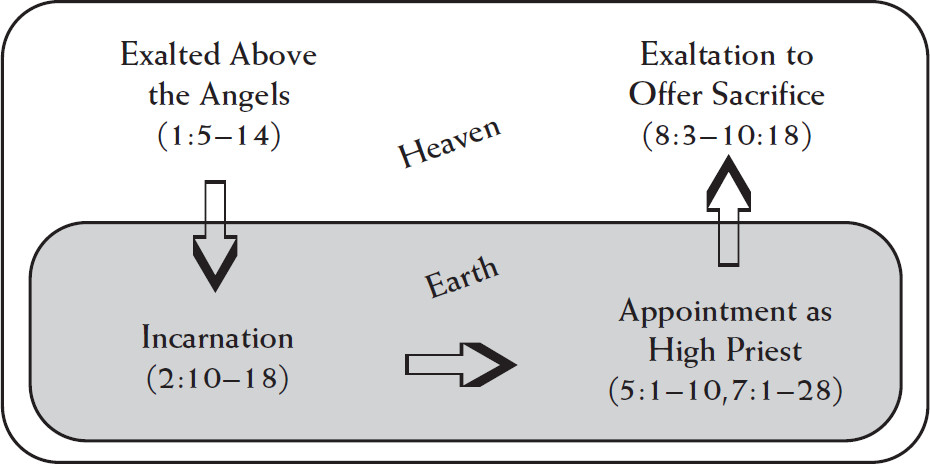
Diagram 1
The preacher asserts that God’s Word to this community is either a word of promise or a word of punishment. If they endure through faith, they can lay hold of the promised inheritance. However, if they fall away, rejecting the Word of God, they fall into severe judgment. Therefore, with his appeals, the author repeatedly returns to the same themes, reemphasizing both the positive possibilities and the potential dangers of the hearers’ next step. Here he does much more than instruct—he seeks to motivate, to challenge the audience to action. See diagram 2.
The main message of Hebrews. How, then, does this preacher’s use of exposition and exhortation work together to challenge these lethargic believers to endure in their commitment to Christ? In the hortatory sections he offers powerful warnings, challenges, examples, and reminders of God’s faithfulness to his promises, all based on God’s Word. He lays a solid foundation for his exhortation with a thorough exposition on the Son of God. The expository and hortatory sections in Hebrews overlap in the relationship of the hearers, to whom God has spoken his powerful word, with the Son, of whom and to whom God has also made proclamations. The ultimate bases for endurance, therefore, are their new-covenant relationship with God’s superior Son and an ongoing openness to God’s Word. In other words, one’s endurance ultimately will depend on the health of one’s relationship to Christ and faithful obedience to the Word.30
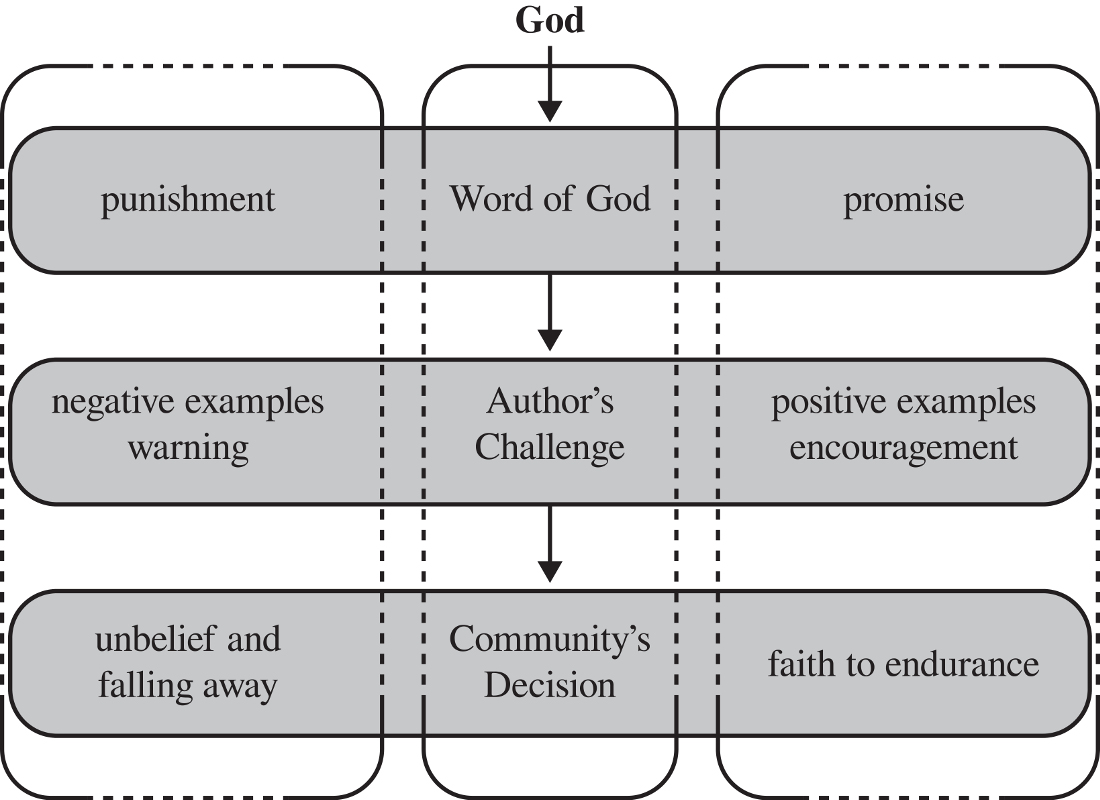
Diagram 2: Exhortation in Hebrews
From His World to Ours: Thoughts on Interpreting Hebrews
WITH A FAIRLY CLEAR PICTURE of Hebrews’ original setting, we have highlighted clues in the text that indicate a faltering community in need of strengthening their commitment by drawing near to God. Hebrews also offers us a partial portrait of the author, an educated preacher who loved the Old Testament and the people to whom he preached. Thus we have moved back in time to see some aspects of the “why,” “who,” and “how” surrounding this dynamic discourse. Yet, we must not stay there. You and I live in a modern world and need a fresh word of encouragement. Can Hebrews speak to us? Can it reach across the centuries and breathe strength into our “feeble arms and weak knees” (12:12)? The conviction reflected in this commentary is that it not only can but must. We too are under obligation to hear the voice of God today (3:7–19). Yet, to hear that voice clearly and apply the Word responsibly presents us with an exciting and demanding challenge.
Back in the summer of 1981 a friend from college and I traveled to seminary in Texas. Danny and I grew up in the same part of the country, and with only a few words between us, we normally understood each other perfectly. To us “barbecue” meant shredded pork, Paris was a town in West Tennessee, and to “carry” someone to church meant giving them a lift in your car. Of course, such expressions were executed with more syllables than needed since we each spoke with a southern accent! At seminary, however, I found communication could be more challenging. To my friends from Texas, “barbecue” was beef brisket and Paris was a town in northeast Texas. To my surprise, a “tank” was a small body of water used for fishing or watering the cows.
During this time I was also privileged to know several close friends from around the world. One of the first was a man from Korea, who went on to be a leader in church development in Seoul. To understand my Korean friend took a great deal more effort than discourse with any of my U.S. friends, regardless of what part of the country they called home. As we ate pulgoki (Korean “barbecue”) and fermented cabbage, we struggled for the right words to communicate our thoughts. We often found that cultural differences and the definitions of specific terms had to be understood before meaningful discourse could occur. The effort was always worth it; with time we forged a deep friendship.
In each of these situations, cultural and linguistic “distance” affected the communication process. Such distance exists even in the closest of family relationships (as any parent of teenagers knows quite well!), but as I ventured into communication encounters with those far removed from my immediate culture of West Tennessee, I found more effort was needed for understanding to take place. The fewer commonalties between my culture and that of the person with whom I was trying to communicate, the more resources I needed to bridge the cultural and linguistic distance.
Consider this analogy. The Forked Deer, a small river approximately thirty feet wide, flows near my home. As I travel to work each day, I pass over this river, and, thankfully, the highway department in my area built a sturdy bridge there long ago. The financial and human resources needed to build the bridge were extensive, but that bridge certainly makes travel to work much easier. Some fifty miles away, near Dyersburg, Tennessee, a huge bridge reaches one mile across the Mississippi River. Because of the great distance, the financial resources, people resources, and time needed to build that structure were many, many times those needed for the little bridge near my home. The effort and expense has paid off in ease of travel for those who formerly had to travel across the mighty Mississippi by ferry—a dangerous and time-consuming mode of transportation. Far, far to the south, near the mouth of the Mississippi, in southern Louisiana, lies the Atchafalaya Swamp. As my family and I traveled recently from Houston, Texas, to New Orleans, we passed right through this swamp on a bridge seventeen miles long! Those who built the bridge had a much greater distance to span than those who built the bridge over the Mississippi River, and they had to do it in an area filled with alligators and snakes! The greater the distance, the greater the resources needed to span that distance.
Understanding the communication of another person, whether in written, spoken, or visual form, presents a singularly exciting challenge, and the challenge grows as language and cultural factors are added to the equation. The greater the cultural and linguistic distance, the more resources are needed. Yet with the help of the proper resources we can understand the communication of others as bridges are built across these divides.
The message of Hebrews was written almost two millennia ago, in the Greek language, by an educated person of Jewish descent, in the form of a synagogue sermon, and for a church located in Greco-Roman culture. To say the least, this message is packaged in strange wrappings and lies on the far side of a wide cultural and linguistic divide. It might be called the Atchafalaya Swamp of the New Testament (complete with “hermeneutical alligators” swimming around a few key passages!). Hebrews can seem terribly enigmatic and foreign with its uses of rabbinic interpretive methodologies, strange characters like Melchizedek, rhetorical arguments, and obscure theological concepts. Yet, there are resources available to help us bridge the distance and understand what Hebrews would say to us today.
(1) The intent of this commentary is really two-directional. We not only want to move across the bridge of time to Hebrews’ ancient context, seeking to understand what the book meant to the original audience, but we also want to ask, “What does it mean to us today?” and “How do we come back across the bridge, moving responsibly from the ancient context to our own?” Therefore we must consider the principles that will guide our trek across the hermeneutical bridge to Hebrews and back again to the contemporary church.
Our discussion of the historical background of Hebrews, although leading to some conclusions that must be considered tentative, is an important one.31 God originally chose to reveal truth through Hebrews at a specific time in history and in specific cultural contexts. To understand what this book speaks to us today, we must first understand what it communicated to the original audience, keeping in mind both the correspondences and the differences between our situation and theirs. For example, the trials this ancient congregation faced seem to have stemmed from their association with the Christian movement. Hebrews 10:36 reads, “You need to persevere so that when you have done the will of God, you will receive what he has promised.” The author encourages this house church to continue to confess the name of Christ, even though that confession may cost them socially and physically. He assures them that God has a reward for them at the end of their current path of tears.
The modern Christian who applies this passage to a broken-down car—reasoning, for example, “If I just persevere God will meet my need for a new auto”—is in danger hermeneutically of “coloring outside the lines.” Based on the background of this passage, its message is much more directly applicable to the woman facing harassment at her job because of her Christian confession, or to Christians in the underground church of China, many of whom have been imprisoned or left destitute because of their association with the body of Christ. Nevertheless, the book of Hebrews as a whole does speak to anyone struggling with the sin of unbelief or spiritual laziness (3:13; 6:12) and addresses a wide variety of difficult situations that demand faith and perseverance (11:1–40). The book is especially relevant for those tempted to turn from Christianity, or Christian fellowship, in order to return to preconversion patterns of life.
(2) We must be ever mindful of the genre in which this document was crafted—a sermon. This means the author probably intended the writing to be heard by the audience in one sitting.32 Once this is understood, much of the repetition in the book makes sense. When I teach a class on Hebrews, I often begin the first day of lecture by dressing up in the garb of the ancient Mediterranean world and reading a large portion of the book. When finished I ask the class to tell me what they noticed from the reading that they had not noticed in Hebrews before. Of course many of the stylistic details are lost in the English translation. Nevertheless, they begin to get the feel of Hebrews as a piece of homiletical craftsmanship and sense the flow of the book’s messages.
In the Bridging Contexts sections of the commentary, therefore, we will constantly refer to the big picture in this sermon. I want to address how each section plays its specific role in the message and answer the question concerning the preacher’s intended impact on his listeners. This, of course, bleeds into the important area of literary context as a key for the interpretive process. A discourse is not merely the sum of its parts. Each part has a specific role with others in accomplishing the author’s intended goal. In understanding the intended impact at various points in the book, we can ask the impact Hebrews might have on us, that is, what the bases are for our motivation to persevere in following Christ.
(3) Finally, we must attempt to do justice to the author’s use of language and style. We especially want to be careful of certain exegetical fallacies related to word meanings.33 Many a faulty application of the Scriptures rests on poor exegesis of terms and phrases in the text.
The Contemporary Significance of Hebrews: The Problem and Promise of Perseverance—A Tale of Two Couples
ONCE WE HAVE HEARD the ancient word, remaining sensitive to historical and literary context, genre, and language, we will begin our adventure back across the bridge of interpretation to the needs of our own time. Once understood, no New Testament document speaks more relevantly or powerfully to a crying need in the modern church, as illustrated in the following story.34
Betty Johnson had grown up a Presbyterian but quit attending when she went to college. Her husband, Fred, had never been involved in church, and the couple stayed busy in the first years of marriage building their respective careers as an accountant and doctor. After the birth of their first child, Betty felt a need to expose her daughter to the things of God. So she visited Community Church one Sunday morning and was pleasantly surprised by the warmth of the people. The next Sunday evening, she convinced Fred to go with her to a potluck supper. Fred genuinely enjoyed the people he met, and, being a guitar player, was impressed by the young man playing the guitar for the fellowship. This couple gradually became more and more involved until Betty joined the church and Fred made a commitment to Christ. Betty did volunteer service on the church newsletter, Fred joined in the worship team as a guitar player, and their kids were involved in the children’s program. Both Fred and Betty were seen as key leaders in Community Church.
One of Betty’s best friends in the coming years was Amanda. A leader in the church’s women’s ministry, Amanda had become a Christian at the age of six. She grew up in a loving home in the Midwest with two parents deeply committed to Christ and the church. Amanda was president of the youth group in high school, sang in the choir, and was involved in the Young People for Christ organization. When she went to college, she attended a small Christian university near her hometown and became deeply involved with Campus Crusade.
At her university was a young man named Tom Smith, who was working on a master’s degree in business. He was not a Christian but was charming, handsome, and intelligent, and he did agree to go to church with her from time to time. Against the counsel of her parents, pastor, and some close friends, Amanda started dating Tom seriously and eventually said “yes” to his proposal of marriage. After marriage, the rigors of his graduate program gave Tom less and less time to attend church. When he finished grad school, the Smiths moved to Texas and bought a home right down the street from Fred and Betty Johnson. Amanda became involved in Community Church almost immediately; Tom did not.
About two years later Betty went through a crisis of faith. When her children reached school age, she had decided to go back to work part-time at a large accounting firm in the area. She became close to several of the young professional women at the office. Betty was refreshed by their winsome attitudes and zest for life. With her heavy responsibilities at church and home Betty had begun to feel a bit burned out. Knowing she should be witnessing to her new friends at work, she felt she had neither the gifts nor emotional energy. Her friends’ occasional jabs at Christianity stung and motivated her to keep her faith to herself. These women seemed fulfilled and, for the most part, had decent relationships at home. They read the latest books on parenting and marriage and seemed to be doing well with life. They enjoyed themselves, attending parties and going on weekend trips with their husbands. Her church life began to seem dull. Who was she to tell them they needed to accept Christ to have a “full and meaningful life.” She shared her concerns with her husband and Amanda, but it didn’t seem to help.
Just before Betty Johnson’s reentry to the workplace, Tom Smith, the husband for whom Amanda had prayed faithfully for six years, became a believer. Pastor David had been playing golf with Tom for two years, when one day on the golf course Tom saw his need for Jesus. Amanda was ecstatic and wept openly the night Tom was baptized. In the months to come Tom devoured the Scriptures and became involved with numerous ministry opportunities at church. He was “on fire” for the Lord, attending men’s meetings and inviting non-Christian friends to worship services. Tom, although busy in his blossoming business, became even more committed to his family, and life was good at the Smith end of the street.
At the other end of the street Fred and Betty Johnson maintained a degree of equilibrium in their marriage, but Betty eventually dropped out of church completely. Nevertheless, Fred stayed the course of church involvement, taking their daughter with him occasionally and continuing his ministry in Community Church’s worship team. Yet, after two years Fred began missing worship periodically. A weekend trip to Betty’s parents. Summer vacation. Two weeks of illness, during which he stayed at home and watched a megachurch service on television. These “excused absences” were joined by Sunday mornings that found Fred tired and just wanting to spend more time with his family. Unfortunately, these became more and more frequent until Fred had dropped out of church almost completely.
Pastor David, whose heart broke over this family, received an even greater shock about a year later. Tom Smith, the most energetic young convert with whom the pastor had ever worked, the faithful follower of Christ who had “burned all his candles at both ends” in the Lord’s service, renounced the Christian faith. No explanation. No conversation. Nothing. He did not even tell Amanda what had happened to bring about his apostasy. He simply quit coming, quit confessing, and quit caring. The pastor could not believe it. These defections affected him deeply. He cried, and prayed, and wondered what he could have done for these friends who, seemingly, had walked closely to Christ. Moreover, he wondered what he could say or do in the future to keep other members of his church from falling away.
A theological and pastoral issue. Christians through the centuries have discussed, debated, and despaired over the references to “falling away” in Hebrews. With his harsh warnings against falling, is the author simply speaking of a “back-slidden” condition experienced by believers who have drifted away from God; or can genuine followers of Christ lose their salvation? On the other hand, perhaps those “who have once been enlightened, who have tasted the heavenly gift” (6:4), never were Christians at all. Perhaps they had been exposed to the gospel, almost crossing the threshold of commitment, only to turn away from God prior to being transformed by the power of God. Such questions are the stuff of theological debates—and these are vitally important questions.
At appropriate points in this commentary we will deal seriously with the theological issue of apostasy. However, I would like for us to begin by focusing on Hebrews as a pastoral appeal; this may offer a common starting point for us no matter where we fall on the Calvinist-Arminian theological spectrum. If you have been involved in church for some time, you have witnessed the same types of situations occurring in Community Church. If you have been or are a pastor, Sunday school teacher, Bible study leader, or concerned church member, you can probably empathize with the broken heart of pastor David as you have watched good friends or family members drift away from God.
The writer of Hebrews is a biblical theologian of the first order. Yet, he brings his theology to bear in service of a critical pastoral need, struggling to help friends in danger of defecting from Christian commitment. In writing Hebrews his first concern is to present a dynamic, motivational, relational appeal, not a cold theological treatise. Again, I intend no dichotomy here. His pastoral ministry is anchored deeply in the waters of his Christian doctrine. However, he confronts an issue encountered by church leaders—whatever their interpretation of Hebrews 6:4–8—throughout the centuries: How do I help my people maintain their commitment to Christ in the face of rigorous opposition to their perseverance? This was the question facing our fictitious church leader in Rome and the question facing pastor David, both struggling to deal with the people for whom they cared deeply; this is the question facing many of us today.
The author of Hebrews takes the question seriously indeed, for he was certain that to fall away from God is a terribly serious and dangerous business, for “‘the Lord will judge his people.’ It is a dreadful thing to fall into the hands of the living God” (10:30–31). This is the point upon which we can agree. For even one member of the Christian community (however we interpret his or her status) to drift away from God is a horrifying tragedy. It should disturb us greatly that thousands each year jettison their church involvement, too many denying the faith altogether. To be sure, the question of whether many of these were really true Christians to begin with is valid. They certainly have quit attending for a wide variety of reasons and represent a broad spectrum of continuing relationships or nonrelationships with the church. Yet, it should alarm us that the attrition rate is so high and challenge us to consider what can be done about it.
Elsewhere around the world our brothers and sisters face intense persecution, some experiencing beatings, rape, theft, and even death. How should the body of Christ respond to these believers? How can their pastors preach effectively words of hope and encouragement in light of such devastating opposition? In this commentary we will deal with how the author of Hebrews seeks to answer these dilemmas, and we will seek to bring his answers responsibly across the hermeneutical bridge to points of application in our contemporary contexts.