Original Meaning
Yahweh’s First Response (2:18–20)
THIS NEW SECTION is separated from the preceding context by a new speaker, Yahweh himself, and by different grammatical constructions, indicative rather than imperative verbal forms. It is not a completely separate unit from what precedes, as some have claimed,2 since the Hebrew verbal construction with which it begins ties it to the preceding context. Yahweh appropriately responds (cf. “reply,” v. 19) to the mourning of “his land” (v. 18; cf. 1:6, 10) and to anguished cries of “his people” (2:18), who have suffered under “his army” (2:11).3 The strong association with Yahweh indicated by the pronominal suffixes (“his”) explains his jealousy for them (Zech. 1:14; 8:2), his desire for an exclusive relationship with them.4 Yahweh’s jealousy is spelled out in the Ten Commandments and as such is a foundational principle for Israel’s life (Ex. 20:5; Deut. 5:9), one they too often neglect (see Bridging Contexts section).
The next verb (“takes pity”) looks inward toward the people rather than outward toward other interests. Yahweh directs his compassion and pity on his suffering people, just as Pharaoh’s daughter did on the crying baby Moses (Ex. 2:6; cf. 2 Sam. 21:7). Joel 2:13 anticipates this pity from the compassionate God. He responds through promised restoration of what was previously destroyed: “grain, new wine and oil” (2:19; cf. 1:10). God is not a debtor but rather makes good even beyond that which is lost, going beyond “enough” to “satisfaction, satiety” (2:19; cf. Deut. 6:11; Isa. 1:11; cf. Job 42:10–17). All this replaces the “scorn” Yahweh allowed neighboring nations to lay on them (Joel 2:19; cf. 2:17).
Verse 18 is a literary pivot in the book.5 Up to now, the problem has been presented and the response of the people has been called for. Now God’s response unfolds. It is not introduced here de novo, however, since the possibility (“who knows?”) of restoration was laid out in 2:14. Now that possibility is reality (“the LORD will”). The same structure is found in the Flood story, which built up to the climax of God’s remembering Noah (Gen. 8:1).6 This verse is also the physical center of Joel according to a word-unit count.7
God’s promises expand in Joel 2:19, eradicating the problem and not simply making up for the loss of agricultural produce (1:10). The uncertainty of God’s “perhaps” of 2:14 now becomes the certainty of his “yes, I will.” In Hosea, God promises to respond to Israelite faithfulness by having the earth provide grain, wine, and oil (Hos. 2:21–22). This happens “in that day,” the Day of the Lord. God here responds (using the same verb, ʿnh) through the same three agricultural products. For Joel, these events following the Judean response to God fulfill Hosea’s prophecy.
God’s reply is one of two mentions of God “saying” (ʾmr) anything in the book (cf. also Joel 2:32), a marked contrast to the frequent prophetic usage elsewhere of the verb ʾmr for speeches of Yahweh (e.g., Isa. 3:16; 7:3, and passim). The book does contain his direct speech, but this specific verb, common elsewhere, is intriguingly missing in Joel. The scorn that the priests pray to avoid (Joel 2:17) will be removed, showing God’s attentiveness to his people’s requests. He “sent” them blessing, in contrast to the plagues brought on Pharaoh, who neglected to “send” Israel out in order to be able to worship (Ex. 10:4).
The locust army (Joel 1:4; 2:2–11), now identified by its place of geographical origin (“the northern army,” 2:20), will be driven away (Deut. 30:1; 2 Chron. 13:9) from the land, reversing the proximity of the coming at the Day of the Lord (Joel 1:15; cf. 3:14). As Yahweh previously drove the plague of locusts away (Ex. 10:17, 19), so he now does with the encroaching army. Since their arrival results in a dry and destroyed land (Joel 1:7, 10, 12; 2:3; cf. 3:19[2x]), it is only appropriate that this be the locust’s final destination, a “tit-for-tat” type of conclusion.8
The huge expanse of the swarming army is indicated by its finally reaching between two seas (lit., those “in front” and “behind”). From the perspective of those already settled within the land, these are “eastern” (Dead Sea) and “western” (Mediterranean Sea) respectively (Job 18:20; Ezek. 10:19; Zech. 14:8). Their removal results in the death of the ousted locusts, killed by water (cf. Ex. 10:19) and lack of food in the desert. A rising “stench” often results from decaying organic material (cf. Isa. 34:3; Amos 4:10—both passages in the context of death in battle, continuing the military metaphor for the locusts; cf. Ex. 7:18, 21).
The last clause of verse 20 is one of the most grammatically and literarily obscure in the book. Literally it reads “for/indeed he magnified to do” (cf. v. 21d; Ps. 126:2–3). Most see the combination of finite verb + infinitive, or even the finite form on its own, as meaning “to do great things” (BDB; KJV; NASB; NIV; NJPS; NRSV; LXX: “he made his work great”), even though there is no explicit direct object for the verb. Even if accepted, the subject is not at all clear. Many take it as Yahweh, an anticipation of the same clause with him as subject at the end of verse 21 (NCV; NJPS; NIV, as indicated by punctuation and spacing; NLT). Others see it as concluding the previous section, contributing to the locusts’ destruction, with the locust swarm (“it”) as the subject (MT; ASV; ESV; KJV; RSV; NASB; NJB; NKJV, “Because he has done monstrous things”; NRSV).9
If the latter is the correct interpretation, there is a contrast between the powerful deeds and the poor end; magnification precedes destruction. As pride in power affects human nations and their armies (e.g., Assyria, Isa. 10:5–19; Moab, 16:6; Judah, Jer. 13:9; Israel, Hos. 5:5), so it metaphorically does to locust hordes. This interpretation is preferred, for the clause then provides a segue, a catch phrase that leads to the following section.
Bridging Contexts
JEALOUS GOD. Yahweh demands an exclusive relationship with his people. To my knowledge, this is unique to Israel from among her immediate neighbors. In a polytheistic society such as theirs, a deity would be hard pressed to expect undivided allegiance, since there were many other gods in the society also laying claim on its members. A monotheism such as Israel had leads more logically toward a deity who could be jealous for the sole position in the hearts and minds of his people. The problem arose when Israel, called to be monotheistic (e.g., Deut. 6:4–5), became polytheistic, inviting other, pagan deities into her religious system.
From the time of creation, Israel’s God has wanted humanity to rely on him and his directions rather than on either their own incomplete understanding of reality (cf. Gen. 3, where the result of abandoning this by listening to the blandishments of another is powerfully presented) or the deities of her neighbors—gods who are in fact not gods. The very first words of the preface to Israel’s national constitution echoes this exclusivity, “I [and no other] am the LORD your God” (Ex. 20:2). The concept is reiterated and made formal in the first of the Ten Commandments: “You shall have no other gods before/beside me” (v. 3). God is a jealous God (cf. v. 5; 34:14; Deut. 4:24; 5:9; 32:16; 1 Kings 14:23; Ps. 78:58), who views his “marriage” with Israel as inviolable. Association with any other deity comprises spiritual adultery.
This marriage/adultery metaphor is brought out most emphatically by Hosea. He was called to literally marry an unfaithful wife (Hos. 1:2), symbolizing the unfaithfulness the Israelites display by their liaison with Baal. This act undoubtedly brought Hosea’s neighbors to him sharing their repugnance, to which he could then reply, “Aren’t you doing exactly the same thing with Baal, and doesn’t Yahweh feel the same repugnance?” Part of Israel’s adultery involved crediting Baal, the Canaanite storm god, with their agricultural bounty of grain, wine, and olive oil (2:8), things in fact provided by Yahweh himself. To bring the actual source of all provisions to Israel’s attention, he was going to withhold them (v. 9; cf. also the contest between Baal and Yahweh in 1 Kings 17).
In Joel, Yahweh’s jealousy is reversed, using vocabulary reminiscent of the Baal conflicts. His jealousy is not just to punish, but it is ultimately for their restoration (cf. Isa. 9:6; 37:32; Zech. 1:14; 8:2), since Israel is his dearly beloved wife. His desire for their good will restore the same elements—grain, wine, and oil (Joel 2:19)—that he removed in Hosea.
Army from the north. Though describing the locust swarm in Joel, the northern army may well have a wider referent. Locusts most regularly swarmed into Israel from the east and south (cf. Ex. 10:13, 19), so swarms from the north were unusual. Human armies regularly came from either the north (e.g., the Syrians [Aram, Judg. 3:8; 1 Kings 20; 22:31], Assyrians [2 Kings 15:19–20, 29; 17:3–6], and Babylonians [2 Kings 24:1–2, 10–12; 25; Ezek. 26:7]) or the south (the Egyptians [1 Kings 9:16; 14:25–26; 19:9; 22:29]), since the east and west are effectively blocked by the Arabian Desert and the Mediterranean Sea, respectively.
Two biblical prophets also envision an eschatological army from the north that threatens Israel (Jer. 1:13–15; 4:6; 6:1, 22; 10:22; 25:9; Ezek. 1:4; 38:6, 15; 39:2).35 Pagan deities, and most particularly the Canaanite Baal, are also associated with the north, most specifically a mountain there (Zaphon; cf. Isa. 14:13).36 This is a motif countered by the Yahweh-worshiping writer of the Psalms, who has Zion replacing it in importance (Ps. 48:2), and also in Job, where Yahweh himself is portrayed as coming from the north (Job 37:22).
God’s Spirit in the Old Testament. The “Spirit [of God/the LORD]” (rûaḥ [ʾ elōhîm / yhwh]) plays an important, though often behind-the-scenes, role in the Old Testament. Mention of the Spirit spans the opening verses of the Jewish canon (Gen. 1:2), where she37 broods over the primordial deep, to its last book (2 Chron. 24:20), where she provides prophetic revelation.38 There is no systematic presentation in the Old Testament of a theology of the Spirit (or of anything else, for that matter), but the Spirit is encountered periodically in its story.
The Spirit’s presence is usually seen to be beneficial and empowering (e.g., Ex. 31:3; 35:31; Judg. 14:6, 19; 15:14; 1 Sam. 10:10; 11:6; 19:20, 23; 1 Kings 18:12; 2 Chron. 15:1; 24:20; Isa. 63:14; Ezek. 11:24; Mic. 2:7), even by pagans (e.g., Gen. 41:38), to whom she also provides revelation (Num. 24:2–3).39 The Spirit comes on several people to empower them in a special way for a leadership role, such as judge (Judg. 3:10; 6:34; 11:29), prophet (1 Sam 10:6; 19:20–24; 2 Chron. 20:14; Ezek. 11:5; Mic. 3:8; cf. Num. 11:16–20), king (1 Sam. 16:13–14; cf. 2 Sam. 23:2, where David’s words of song are ascribed to the Spirit), or Messiah (e.g., Isa. 11:2; 59:21; 61:1 [Luke 4:18]).
There is also evidence of a wider function of the Spirit beyond to individual people. In Isaiah, Yahweh’s Spirit and his words remain not only with the prophet himself, but also with his children and their descendants forever (Isa. 59:21). The office of prophet is not hereditary, but their role seems here to be viewed as spreading beyond the formal office to many others.
God also promises to place his Spirit in the midst of his people, who will be restored after their punishing exile, enabling them to adhere to his covenant commands (Ezek. 36:27; cf. 39:29). The context indicates that the Spirit is not some force working on the people from the outside but rather an element of their inner being, since 36:26 states: “I will give you a new heart and put a new spirit in you.” The Spirit provides the nation life (37:14), renewing their freshness and vitality like water in the desert (Isa. 44:3; contrast 40:7).
The same verb as used in this Joel passage is associated with the Spirit in Zech. 12:10 (“And I will pour out on the house of David and the inhabitants of Jerusalem a spirit of grace and supplication”). It is not specifically identified as the Spirit of God (cf. NIV text note), though that could be what is in mind.
The widespread dispersion of the Spirit is thus not a novelty for Joel’s prophecy. What it does, however, is to draw out the fuller meaning of this dispersion. It is to be poured out on Israel, David’s house, but not just a bestowal on its religious or political leadership. People from all walks of life, all social strata, and even from all nations (“all flesh,” Joel 2:28), will be blessed, empowered, and vivified through the gift of the Spirit of God.
Peter picks up this theme in his Pentecostal sermon in Jerusalem (Acts 2:17–21). He recognizes the event of the filling of the Spirit for those gathered on that occasion as an element of fulfillment of Joel’s promise. It is not completed on that occasion, however, for Peter also explains that the promised Spirit comes “for you and your children and for all who are far off” (2:32; cf. Isa. 59:21). To the surprise of the Jewish members of the early church, this goes even beyond their number to include the despised Samaritans (Acts 8:14–17; cf. John 4:10–14, 23–24) and Gentiles (Acts 10:44–48).
Peter made the indwelling conditional in a way also related to what is previously mentioned in the Old Testament. It follows repentance and baptism (Acts 2:38) and involves commitments to following God and being members of his covenant community. It is the ability to do so that Ezekiel previously envisioned (Ezek. 36:27). God’s people in the Old Testament are to be known by their renunciation of self-determination by submitting to God’s directives in the covenant and by the outward sign of circumcision, while his New Testament people are to be known also by repentance from sinful self-determination and by the outward sign of baptism. The Spirit is available to all who “call on the name of the Lord” (Acts 2:32).
This theme is picked up by Paul (Rom. 10:13). He does not limit the application to the Israelites, as the Joel passage could be read, but uses it as a universalizing statement, since he says in verse 12, “there is no difference between Jew and Gentile—the same Lord is Lord of all and richly blesses all who call on him.” This argues for the universal availability of the Spirit.
Divine revelation in the Old Testament. God is not silent, in spite of the claims of some who consider him dead.40 This concept would have been especially foreign to people from the biblical period, within Israel itself and also among her neighbors. For them, divine revelation is, if not a daily experience, at least something that is not completely foreign (as a counterexample, see the mention of the rarity of God’s revelation in 1 Sam. 3:1). According to the biblical text, the medium of revelation for Israel varied. On the canonically earliest occasions, the text mentions direct communication between God and humanity, whether laity or leaders, with God speaking directly (e.g., Gen. 1:29; 3:9–19; 4:6–7, 9, 15; 6:13; 7:1; 8:15; 9:8; 12:4; 17:9, 15, 19, etc.). Upon seeing the powerful theophany at Mount Sinai, the people request an intermediary between themselves and God (Ex. 20:18–21), and record of direct human-divine contact diminishes.
At other times, a specific revelatory medium is mentioned. These are often dreams41 or visions.42 These two seem to have become standard means of revelation to prophets.43 They could be misused, however, as could other, less acceptable means of hearing from God or the gods (e.g., 1 Sam 28; Jer. 23:16; 27:9; 29:8–9; Ezek. 13:6–7, 16). These two means were also used among Israel’s neighbors, Egypt and Mesopotamia.44 They were not reserved solely for prophets, however, in either Israel or the ancient Near East, as previous references indicate.45
The innovation in this Joel passage is, therefore, not in the means of revelation but in its recipients. The beneficiaries of the Spirit-gift and its accompanying revelation will not only be a special class, the prophets, or even a few folk, whose prophetic gift is rare enough to be a matter of note. Rather, this bestowal will be universal, blessing young and old, male and female, free or slave; it will affect all of humanity. God desires his Word to be widely known (cf. Prov. 1:23).
This kind of universalistic promise is not unknown in Israel (cf. Gen. 9:8–11; 12:3; Isa. 2:2–4; 56:3–8). Israel kept forgetting this truth, however, seeking to limit God’s power and provision of the Spirit (cf. Isa. 44:3; 54:13; Ezek. 39:29) to themselves alone, so God had to remind them of the wideness of his mercy (e.g., Isa. 40:3–5; 49:6; Amos 9:7; cf. Luke 3:6). He revealed himself in these ways again and in a special way in the events surrounding the birth of Jesus (e.g., Matt. 1:20; 2:12, 13, 19, 22; Luke 1:22; cf. v. 67; 2:36–38).
Rain in an agricultural society. Water is one of life’s necessities, and its long-term lack makes an area uninhabitable.46 Some regions in the ancient Near East relied on river water supplemented by irrigation. In Mesopotamia the rivers flowed regularly (cf. Isa. 8:7) while in Egypt there was an annual flooding (Ex. 7:19; Isa. 19:5–8). Other areas depended on rainfall for agriculture and daily use. This distinction is noted in Scripture (Deut. 11:10–11).47 Israel did have several rivers, and there is evidence of limited irrigation,48 but she depended much more on rainfall (1 Kings 8:35–36; Isa. 30:23) and water storage, such as cisterns and wells (Gen. 21:25; Deut. 6:11; Isa. 22:9, 11; Jer. 2:13).
The entire agricultural calendar was dependent on “rain in its season” for the crop cycle to produce the most bounty (Lev. 26:4–5; Deut. 11:13–17; this word for “rain,” gešem, is a common, general term for natural watering that can be beneficial or devastating, causing floods [Gen. 7:12; 8:2; Ps. 68:9]; cf. also with the same meaning for meṭar, Deut. 11:11, 14). The dry season ran generally from April to September, the rainy season from October to April. The ground could only be plowed and planted after the softening of the early rains, which came in September to October. These are called the yôreh, having the same root as the term occurring twice in Joel 2:23, môreh (cf. Ps. 84:7). Special rains close out the season—the latter or spring rains, called the malqôš (Prov. 16:15; Jer. 3:3), with which yôreh always appears, serving as a merism (see comment on Joel 2:23). A delay of the first rains leaves a season too short to allow the crops to fully ripen, while if they come too soon, there may not be enough moisture during the rest of the season to be able to adequately provide for the crop’s maturation.49
Numerous other words also describe aspects of rain, such as its abundance (’arubbâ, a gushing flood as if through open floodgates, Gen. 7:11; 8:2; Isa. 24:18; zerem, heavy downpour, Isa. 30:30; 32:2; nepeṣ, cloudburst, Isa. 30:30; sagrîr, persistent downpour, Prov. 27:15; sepîḥâ, downpour, Job 14:19).50 Rain in all of its forms shows God’s continued covenant loyalty to his people (Deut. 28:12).
Covenant language. Pronouns are easy to ignore while reading, since they appear less concrete and have less impact than the attendant nouns. They do carry considerable baggage, however, especially if one is careful to determine which nouns they are referring to and the relationships to which they point. Jesus’ cry of dereliction on the cross, “My God, my God, why have you forsaken me” (Matt. 27:46; Mark 15:34; citing Ps. 22:1) derives its poignancy and power from the fact that it indicates a prior relationship, one established before this abandonment. God is not just “a” God, or even “the” God, but he is “my” God, a relationship that engenders expectations. Others who identified God in this way experienced his salvation (e.g., Ex. 15:2; 2 Sam. 22:3) or desired to do so (e.g., Mic. 7:7; Zech. 14:4); based on this, they promised obedience, even if it was at a cost (Deut. 26:14; Josh. 14:8; 2 Sam. 24:24). Jesus is not, at least in the near term, able to experience this salvation from suffering, in spite of the relationship with “my God,” but was rather obedient to death.
These verses in Joel pick up a covenantal relationship between God and his people, one often expressed through pronouns: “your God” and “my people” (Joel 2:26–27). These pronouns of relationship, which we can so easily glide over, are of special impact for Israel because they have been instrumental in their very birth as a nation. At that time God promised this mutual relationship (Ex. 6:7). The relationship’s import is evident since its two-sided nature is reiterated by both Jeremiah (Jer. 7:23; 11:4; 30:22) and Ezekiel (Ezek. 36:28), prophets who had to provide God’s people with messages of hope since they faced destruction and exile. The relationships are also stated by using just one half of the pair, “my people,” occurring over two hundred times in the Old Testament, most often in the mouth of God,51 and “your God,” occurring over five hundred times, mostly referring to Yahweh.52
Contemporary Significance
THE SOURCE OF good things. When prosperity or success comes to a nation or a church today, we do not credit it to God’s gift of rain, because most Westerners have lost a tie to the earth. In reality we rarely acknowledge God at all, usually crediting it to our own strength or ingenuity. If we can but show more of this strength and ingenuity, more success will naturally and inevitably result. Another way this is manifest is through following the latest model and application of someone’s ingenuity or insight that is sure to lead to results: seven habits for effectiveness,53 ten steps to growth,54 twelve steps to sobriety,55 seventeen or twenty-one laws or qualities for leaders and teams.56
There is, of course, nothing wrong with disciplined action, and planning is noble and productive, so many of these models benefit numerous people. It is not the model that is effective, however, but rather a knowledge that things are not completely as they should be, a desire for improvement, and a heightened awareness of the goal. For the believer, these are all accompanied by the empowerment of the Holy Spirit, accompanied by the awareness that all good gifts, all progress in sanctification, and every blessing come from God himself and not from our planning and perseverance, as good as that is (cf. 1 Cor. 3:6–7). This is because it is not ultimately for our benefit but for his glory that these things come (cf. Ps. 115:1).
This attitude not only provides a needed corrective against arrogance, but it also brings an antidote for discouragement. In situations such as Joel’s, where locusts and drought could not be directly averted by the people of Israel, no matter their great physical efforts, they could but turn to the one with ultimate control over these “natural” elements. This is like Job, who is vexed after butting heads with his dialog partners to no avail. He finally hears God himself (Job 38–41), and though he does not get any more answers to his questions from God than he did from his human interlocutors, he is satisfied because he knows that he has been heard. He ends up in the same posture as he begins, acknowledging God’s blessedness and wonderfulness, even though he does not comprehend him (1:21; 42:1–6). For our own lives, a lack of ability or no results from our efforts lead to discouragement, but the results are not ultimately in our hands. Ours is to strive, God’s to bring to fruition.
Here our understanding of God’s jealousy also comes into play. We understand this emotion on a human level as wanting to keep something completely and solely for ourselves and not sharing it with anyone else. Our resources, whether financial or relational, are finite, and we feel as if they are only sufficient for our own needs. God’s jealousy must not be understood in this same way. This is not the picture of jealousy painted by Joel. God’s jealousy is to shower his people with all good blessings, wanting to raise them to the heights rather than keeping them low and impoverished. He desires all of their allegiance and love to be directed toward him, since it is finite and should not be squandered on another deity (see 2 Cor. 11:1–4, esp. v. 2). His infinite blessing, however, is completely available to those who so worship him.
Gifts of nature. In common vernacular we talk about “gifts of nature,” the enjoyable things that come from the natural realm: budding flowers and shrubs in the spring, ripening fruit from the garden, colorful leaves in the fall, and a clear, crisp day in which one can speed down the ski slope. We also speak of nature being harsh or cruel, with hurricanes and tornados destroying swathes of houses, and earthquakes, tsunamis, or forest fires leaving destruction and loss. Joel indicates that this type of description of these events is theologically problematic.
A literal understanding of this concept could honor nature with not only personality but also with power. Paganism or pantheism, in which elements of the divine inhabit all things, animate and inanimate alike, is closer to this understanding than is classical Judeo-Christian theology. God reminds the people of Joel’s time that nature is neither inherently malevolent, working for their ill through the calamity of locust and drought, nor is it autonomous and self-determining. Rather, it is under Yahweh’s ultimate control, since he is its Creator and Organizer (Gen. 1–2).
This has pastoral implication for people today. From a biblical perspective, events are neither simply random nor inevitable. While we may not be directly masters of our own fate, we have been created by one who is master and who desires to be known by his creatures not as fate but as Father. His control extends not only over human armies but also armies of locusts, and he provides not only human support and encouragement but also provisions through nature, which is a secondary provider under his primary impulse and direction.
I will repay. Our family first encountered the phenomenon while teaching in South Africa, but found that it spread there from the United States. People came to our small church having been severely wounded by a large church in the area. Their self-esteem was in tatters and their security in God’s love nonexistent, for they were taught that a correct relationship with God results in only blessing; any suffering or loss can result only from sin or falling short of God’s desires for us. Christians will not face battles and opposition, only victory. When sincere Christians attending that church met disaster through illness, unemployment, or death of a loved one, there was no succor for them; they were considered less than worthy and ostracized. Many who did not abandon the church altogether found their way to us for ministry and healing.
While we might wish that the Christian life is indeed as it was preached by that pastor, and many others, the uniform experience of saints throughout the ages gives the lie to this understanding. While some pain is God-given discipline to punish those who have turned away from him, the final goal of it is restoration, not ostracism (cf. Gal. 6:1). All suffering is not like this, however, lest Paul or even Jesus be branded as sinners, since they both suffered greatly (e.g., Paul, 2 Cor. 12:7–10; Jesus in his Passion). Paul states a reason for such suffering, namely, to be able to experience God’s grace and strength through a period of his own weakness.
God does not promise those in covenant relation with him a detour around life’s battles, whether the Christian of today facing life’s challenges or Joel and his contemporaries battling their locust armies. What he does promise is a companion as one goes through the battles (Deut. 31:6; Josh. 1:5; 1 Kings 8:56; Matt. 28:20). God also promises restoration after them, not only to Joel but also to many others in numerous promises of renewed blessing (e.g., Isa. 2:1–5; 44:24–28; Ezek. 36–37; Hos. 14; Amos 9:11–15; Obad. 17–21).
Prophetic responsibility. Christians are rightly pleased that Peter and Paul both apply Joel’s promise of the Spirit to others besides the Israelites. After all, if the promise is to Jews alone, the Gentile church is not its beneficiary. With the benefit of the Spirit comes obligation, however. While revelation from God through dreams, visions, and prophecies is a gift to be desired, it is not directed ultimately toward its recipient but toward others.
Prophets in the Old Testament were God’s intermediaries to the people and their rulers. Paul states the same thing in his teaching to the Corinthians (1 Cor. 14:1–25). The contrast he made between self-edification through tongues and the lack of it through prophecy may indicate that the latter may not be of great personal advantage. Jeremiah, and numerous other prophets, have found that the “gift” is in fact exercised at great personal cost.57
One could then ask, “Why should I want this, or any of the gifts of the Spirit?” This reflects an attitude that is unfortunately all too prevalent among many in the church. The secular attitude of “What’s in it for me?” is unfortunately not restricted to the secular. In some ways, this is what Jesus taught his disciples in the Upper Room. While they hoped for personal position and prestige (Matt. 20:21; Mark 10:37), Jesus showed them the way of service (John 13:1–17). Jesus exhibited the same attitude with his entire life, and especially with his death, which brought him no personal gain (in fact, it brought the opposite), but did bring inexpressible gain to others.
The correct Christian question should not be, “What is in it for me?” This is one of the dangers of an evangelical understanding of salvation as being strictly personal. While that is necessary, it is not a sufficient view of what salvation is (see the Contemporary Significance section of Joel 2:10–17). A truly Christlike question is, rather, “What can I do for you? How can I aid in bringing you into a correct relationship with our covenant God?” A useful definition of spiritual formation describes “a process of being conformed to the image of Christ for the sake of others.”58 Too often contemporary Western Christianity engages in theological narcissism by omitting the last phrase.
Original Meaning
People, Rejoice! (2:21–24)
THE VERBAL FORMS in verses 21–22 revert to imperative-like forms in a call to praise, not directed only to people who suffered but also to inanimate creation and dumb beasts, who are also directly affected (“land,” v. 21, cf. 1:10; “wild animals,” v. 22; cf. 1:18, 20). Rather than terror (2:11), God’s people reexperience the gladness and joy they lost (1:16; cf. 2:23). Why? Because of the mighty acts of Yahweh (see comment on 2:20), exemplified in verse 22 by the restoration of pasture (the “greening” of what has been consumed in 1:19–20), fruit trees (the resumed bearing by what has been dried out and scorched in 1:12, 19), and most specifically the fig tree and grape vine (1:7, 12). The latter two “yield their riches” (ḥêl; Gen. 34:29; Num. 31:9), a play on this same word elsewhere used of the “forces” or “army” of the locusts (Joel 2:11, 25); the one is overturned and replaced by the other, both physically and semantically.
Subsequently the people, those previously summoned to fear, weep, and pray in Zion (2:1, 15), now join the rest of creation in celebration (2:21). The basis of their rejoicing is God himself, and secondarily his actions on their behalf. These include his acts in nature, now not in removing the locusts but in relieving from drought (2:23; cf. 1:10).
Instead of making (ntn) them an object of scorn (v. 19), Yahweh provides (ntn; NIV “has given” in v. 23) rain by causing it to come down (“sends”). For many of us, rain is only a bother, but for agriculturalists in a semiarid climate, it is the difference between plentiful crops and starvation. Since rain is vital for their society, Israel has several terms for different types and periods of rain (see Bridging Contexts section). The more general term is more specifically identified as “autumn rains” and “spring rains.” These two types of rain form a merism (a literary form using two polar extremes to include everything in between them; cf. Deut. 11:14; Jer. 5:24), which indicates the resumption of all rains. That resumption is indeed cause for celebration.
Two different adverbs describe God’s sending rain in verse 23. The first is literally “for righteousness.”10 In the three other occurrences of this exact form (Ps. 106:31; Isa. 5:7; Hos. 10:12), righteousness is the goal sought, so that is probably what is meant here, though whose righteousness is unclear. The second adverb (“as before”; lit., “in the first”) is only used outside Joel in the context of dating events, referring to the “first (month)” (e.g., Gen. 8:13; 9:5). While no month is specified here, context suggests that it refers to the situation at the beginning of the time of destruction just past, before all the locusts, drought, and flame had come.
There may be a similar thematic link between these two concepts as well as the gracious gift of rain in Deuteronomy 11:8–12, which can help us understand this passage. There the Israelites were promised that, if they live in covenant faithfulness with Yahweh, he will provide abundant moisture for the land over which he keeps his eye all the year, from beginning to end. In Joel, the previous time of plenty, as promised in Deuteronomy, will be the result of Yahweh’s righteousness in remembering his promises, but it will also serve as a reminder to Israel that they must show righteous obedience as well. Thus there could be in the Joel passage an implicit reference to covenant.11
Ahlström notes a purposeful progression in these verses, calling for rejoicing starting with the land, progressing to the animals, and ending with the people of Zion—that is, moving from the periphery to those who actively worship God.12 The Hebrew emphasizes “O people of Zion,” placing them at the start of the sentence with an emphatic or affirmative conjunction.13
The final stage of restoration follows (Joel 2:24). After the locusts are expelled (v. 20) and the trees start to bear (v. 22) because the rains have returned (v. 23), other crops are prepared for consumption and storing away. Two places of production are mentioned for the first time in the prophecy, since previously they lay unused as a result of the lack of raw material. The “threshing floor” (Ruth 3:2; Job 39:12) is where the wheat and barley (cf. Joel 1:10–11) are processed, removing the edible kernel (the “grain,” cf. Amos 5:11; 8:5) from the waste chaff through the process of winnowing. The previously unused site will now be filled, probably by the farmers who previously were without any work (Joel 1:11), though the subject is unspecified.
The presses (NIV, “vats”; cf. 3:13; Job 24:11; Isa. 5:2) for processing raw material for their liquid content, such as grapes, resulting in wine (Joel 1:10; 2:19), and olives, resulting in oil (1:10; 2:19), will now overflow like a river that overflows after God’s rain (Ps. 65:9; Joel 3:13). The locusts previously destroyed all of these, but God makes them good in abundance.
Bridging Contexts
JEALOUS GOD. Yahweh demands an exclusive relationship with his people. To my knowledge, this is unique to Israel from among her immediate neighbors. In a polytheistic society such as theirs, a deity would be hard pressed to expect undivided allegiance, since there were many other gods in the society also laying claim on its members. A monotheism such as Israel had leads more logically toward a deity who could be jealous for the sole position in the hearts and minds of his people. The problem arose when Israel, called to be monotheistic (e.g., Deut. 6:4–5), became polytheistic, inviting other, pagan deities into her religious system.
From the time of creation, Israel’s God has wanted humanity to rely on him and his directions rather than on either their own incomplete understanding of reality (cf. Gen. 3, where the result of abandoning this by listening to the blandishments of another is powerfully presented) or the deities of her neighbors—gods who are in fact not gods. The very first words of the preface to Israel’s national constitution echoes this exclusivity, “I [and no other] am the LORD your God” (Ex. 20:2). The concept is reiterated and made formal in the first of the Ten Commandments: “You shall have no other gods before/beside me” (v. 3). God is a jealous God (cf. v. 5; 34:14; Deut. 4:24; 5:9; 32:16; 1 Kings 14:23; Ps. 78:58), who views his “marriage” with Israel as inviolable. Association with any other deity comprises spiritual adultery.
This marriage/adultery metaphor is brought out most emphatically by Hosea. He was called to literally marry an unfaithful wife (Hos. 1:2), symbolizing the unfaithfulness the Israelites display by their liaison with Baal. This act undoubtedly brought Hosea’s neighbors to him sharing their repugnance, to which he could then reply, “Aren’t you doing exactly the same thing with Baal, and doesn’t Yahweh feel the same repugnance?” Part of Israel’s adultery involved crediting Baal, the Canaanite storm god, with their agricultural bounty of grain, wine, and olive oil (2:8), things in fact provided by Yahweh himself. To bring the actual source of all provisions to Israel’s attention, he was going to withhold them (v. 9; cf. also the contest between Baal and Yahweh in 1 Kings 17).
In Joel, Yahweh’s jealousy is reversed, using vocabulary reminiscent of the Baal conflicts. His jealousy is not just to punish, but it is ultimately for their restoration (cf. Isa. 9:6; 37:32; Zech. 1:14; 8:2), since Israel is his dearly beloved wife. His desire for their good will restore the same elements—grain, wine, and oil (Joel 2:19)—that he removed in Hosea.
Army from the north. Though describing the locust swarm in Joel, the northern army may well have a wider referent. Locusts most regularly swarmed into Israel from the east and south (cf. Ex. 10:13, 19), so swarms from the north were unusual. Human armies regularly came from either the north (e.g., the Syrians [Aram, Judg. 3:8; 1 Kings 20; 22:31], Assyrians [2 Kings 15:19–20, 29; 17:3–6], and Babylonians [2 Kings 24:1–2, 10–12; 25; Ezek. 26:7]) or the south (the Egyptians [1 Kings 9:16; 14:25–26; 19:9; 22:29]), since the east and west are effectively blocked by the Arabian Desert and the Mediterranean Sea, respectively.
Two biblical prophets also envision an eschatological army from the north that threatens Israel (Jer. 1:13–15; 4:6; 6:1, 22; 10:22; 25:9; Ezek. 1:4; 38:6, 15; 39:2).35 Pagan deities, and most particularly the Canaanite Baal, are also associated with the north, most specifically a mountain there (Zaphon; cf. Isa. 14:13).36 This is a motif countered by the Yahweh-worshiping writer of the Psalms, who has Zion replacing it in importance (Ps. 48:2), and also in Job, where Yahweh himself is portrayed as coming from the north (Job 37:22).
God’s Spirit in the Old Testament. The “Spirit [of God/the LORD]” (rûaḥ [ʾ elōhîm / yhwh]) plays an important, though often behind-the-scenes, role in the Old Testament. Mention of the Spirit spans the opening verses of the Jewish canon (Gen. 1:2), where she37 broods over the primordial deep, to its last book (2 Chron. 24:20), where she provides prophetic revelation.38 There is no systematic presentation in the Old Testament of a theology of the Spirit (or of anything else, for that matter), but the Spirit is encountered periodically in its story.
The Spirit’s presence is usually seen to be beneficial and empowering (e.g., Ex. 31:3; 35:31; Judg. 14:6, 19; 15:14; 1 Sam. 10:10; 11:6; 19:20, 23; 1 Kings 18:12; 2 Chron. 15:1; 24:20; Isa. 63:14; Ezek. 11:24; Mic. 2:7), even by pagans (e.g., Gen. 41:38), to whom she also provides revelation (Num. 24:2–3).39 The Spirit comes on several people to empower them in a special way for a leadership role, such as judge (Judg. 3:10; 6:34; 11:29), prophet (1 Sam 10:6; 19:20–24; 2 Chron. 20:14; Ezek. 11:5; Mic. 3:8; cf. Num. 11:16–20), king (1 Sam. 16:13–14; cf. 2 Sam. 23:2, where David’s words of song are ascribed to the Spirit), or Messiah (e.g., Isa. 11:2; 59:21; 61:1 [Luke 4:18]).
There is also evidence of a wider function of the Spirit beyond to individual people. In Isaiah, Yahweh’s Spirit and his words remain not only with the prophet himself, but also with his children and their descendants forever (Isa. 59:21). The office of prophet is not hereditary, but their role seems here to be viewed as spreading beyond the formal office to many others.
God also promises to place his Spirit in the midst of his people, who will be restored after their punishing exile, enabling them to adhere to his covenant commands (Ezek. 36:27; cf. 39:29). The context indicates that the Spirit is not some force working on the people from the outside but rather an element of their inner being, since 36:26 states: “I will give you a new heart and put a new spirit in you.” The Spirit provides the nation life (37:14), renewing their freshness and vitality like water in the desert (Isa. 44:3; contrast 40:7).
The same verb as used in this Joel passage is associated with the Spirit in Zech. 12:10 (“And I will pour out on the house of David and the inhabitants of Jerusalem a spirit of grace and supplication”). It is not specifically identified as the Spirit of God (cf. NIV text note), though that could be what is in mind.
The widespread dispersion of the Spirit is thus not a novelty for Joel’s prophecy. What it does, however, is to draw out the fuller meaning of this dispersion. It is to be poured out on Israel, David’s house, but not just a bestowal on its religious or political leadership. People from all walks of life, all social strata, and even from all nations (“all flesh,” Joel 2:28), will be blessed, empowered, and vivified through the gift of the Spirit of God.
Peter picks up this theme in his Pentecostal sermon in Jerusalem (Acts 2:17–21). He recognizes the event of the filling of the Spirit for those gathered on that occasion as an element of fulfillment of Joel’s promise. It is not completed on that occasion, however, for Peter also explains that the promised Spirit comes “for you and your children and for all who are far off” (2:32; cf. Isa. 59:21). To the surprise of the Jewish members of the early church, this goes even beyond their number to include the despised Samaritans (Acts 8:14–17; cf. John 4:10–14, 23–24) and Gentiles (Acts 10:44–48).
Peter made the indwelling conditional in a way also related to what is previously mentioned in the Old Testament. It follows repentance and baptism (Acts 2:38) and involves commitments to following God and being members of his covenant community. It is the ability to do so that Ezekiel previously envisioned (Ezek. 36:27). God’s people in the Old Testament are to be known by their renunciation of self-determination by submitting to God’s directives in the covenant and by the outward sign of circumcision, while his New Testament people are to be known also by repentance from sinful self-determination and by the outward sign of baptism. The Spirit is available to all who “call on the name of the Lord” (Acts 2:32).
This theme is picked up by Paul (Rom. 10:13). He does not limit the application to the Israelites, as the Joel passage could be read, but uses it as a universalizing statement, since he says in verse 12, “there is no difference between Jew and Gentile—the same Lord is Lord of all and richly blesses all who call on him.” This argues for the universal availability of the Spirit.
Divine revelation in the Old Testament. God is not silent, in spite of the claims of some who consider him dead.40 This concept would have been especially foreign to people from the biblical period, within Israel itself and also among her neighbors. For them, divine revelation is, if not a daily experience, at least something that is not completely foreign (as a counterexample, see the mention of the rarity of God’s revelation in 1 Sam. 3:1). According to the biblical text, the medium of revelation for Israel varied. On the canonically earliest occasions, the text mentions direct communication between God and humanity, whether laity or leaders, with God speaking directly (e.g., Gen. 1:29; 3:9–19; 4:6–7, 9, 15; 6:13; 7:1; 8:15; 9:8; 12:4; 17:9, 15, 19, etc.). Upon seeing the powerful theophany at Mount Sinai, the people request an intermediary between themselves and God (Ex. 20:18–21), and record of direct human-divine contact diminishes.
At other times, a specific revelatory medium is mentioned. These are often dreams41 or visions.42 These two seem to have become standard means of revelation to prophets.43 They could be misused, however, as could other, less acceptable means of hearing from God or the gods (e.g., 1 Sam 28; Jer. 23:16; 27:9; 29:8–9; Ezek. 13:6–7, 16). These two means were also used among Israel’s neighbors, Egypt and Mesopotamia.44 They were not reserved solely for prophets, however, in either Israel or the ancient Near East, as previous references indicate.45
The innovation in this Joel passage is, therefore, not in the means of revelation but in its recipients. The beneficiaries of the Spirit-gift and its accompanying revelation will not only be a special class, the prophets, or even a few folk, whose prophetic gift is rare enough to be a matter of note. Rather, this bestowal will be universal, blessing young and old, male and female, free or slave; it will affect all of humanity. God desires his Word to be widely known (cf. Prov. 1:23).
This kind of universalistic promise is not unknown in Israel (cf. Gen. 9:8–11; 12:3; Isa. 2:2–4; 56:3–8). Israel kept forgetting this truth, however, seeking to limit God’s power and provision of the Spirit (cf. Isa. 44:3; 54:13; Ezek. 39:29) to themselves alone, so God had to remind them of the wideness of his mercy (e.g., Isa. 40:3–5; 49:6; Amos 9:7; cf. Luke 3:6). He revealed himself in these ways again and in a special way in the events surrounding the birth of Jesus (e.g., Matt. 1:20; 2:12, 13, 19, 22; Luke 1:22; cf. v. 67; 2:36–38).
Rain in an agricultural society. Water is one of life’s necessities, and its long-term lack makes an area uninhabitable.46 Some regions in the ancient Near East relied on river water supplemented by irrigation. In Mesopotamia the rivers flowed regularly (cf. Isa. 8:7) while in Egypt there was an annual flooding (Ex. 7:19; Isa. 19:5–8). Other areas depended on rainfall for agriculture and daily use. This distinction is noted in Scripture (Deut. 11:10–11).47 Israel did have several rivers, and there is evidence of limited irrigation,48 but she depended much more on rainfall (1 Kings 8:35–36; Isa. 30:23) and water storage, such as cisterns and wells (Gen. 21:25; Deut. 6:11; Isa. 22:9, 11; Jer. 2:13).
The entire agricultural calendar was dependent on “rain in its season” for the crop cycle to produce the most bounty (Lev. 26:4–5; Deut. 11:13–17; this word for “rain,” gešem, is a common, general term for natural watering that can be beneficial or devastating, causing floods [Gen. 7:12; 8:2; Ps. 68:9]; cf. also with the same meaning for meṭar, Deut. 11:11, 14). The dry season ran generally from April to September, the rainy season from October to April. The ground could only be plowed and planted after the softening of the early rains, which came in September to October. These are called the yôreh, having the same root as the term occurring twice in Joel 2:23, môreh (cf. Ps. 84:7). Special rains close out the season—the latter or spring rains, called the malqôš (Prov. 16:15; Jer. 3:3), with which yôreh always appears, serving as a merism (see comment on Joel 2:23). A delay of the first rains leaves a season too short to allow the crops to fully ripen, while if they come too soon, there may not be enough moisture during the rest of the season to be able to adequately provide for the crop’s maturation.49
Numerous other words also describe aspects of rain, such as its abundance (’arubbâ, a gushing flood as if through open floodgates, Gen. 7:11; 8:2; Isa. 24:18; zerem, heavy downpour, Isa. 30:30; 32:2; nepeṣ, cloudburst, Isa. 30:30; sagrîr, persistent downpour, Prov. 27:15; sepîḥâ, downpour, Job 14:19).50 Rain in all of its forms shows God’s continued covenant loyalty to his people (Deut. 28:12).
Covenant language. Pronouns are easy to ignore while reading, since they appear less concrete and have less impact than the attendant nouns. They do carry considerable baggage, however, especially if one is careful to determine which nouns they are referring to and the relationships to which they point. Jesus’ cry of dereliction on the cross, “My God, my God, why have you forsaken me” (Matt. 27:46; Mark 15:34; citing Ps. 22:1) derives its poignancy and power from the fact that it indicates a prior relationship, one established before this abandonment. God is not just “a” God, or even “the” God, but he is “my” God, a relationship that engenders expectations. Others who identified God in this way experienced his salvation (e.g., Ex. 15:2; 2 Sam. 22:3) or desired to do so (e.g., Mic. 7:7; Zech. 14:4); based on this, they promised obedience, even if it was at a cost (Deut. 26:14; Josh. 14:8; 2 Sam. 24:24). Jesus is not, at least in the near term, able to experience this salvation from suffering, in spite of the relationship with “my God,” but was rather obedient to death.
These verses in Joel pick up a covenantal relationship between God and his people, one often expressed through pronouns: “your God” and “my people” (Joel 2:26–27). These pronouns of relationship, which we can so easily glide over, are of special impact for Israel because they have been instrumental in their very birth as a nation. At that time God promised this mutual relationship (Ex. 6:7). The relationship’s import is evident since its two-sided nature is reiterated by both Jeremiah (Jer. 7:23; 11:4; 30:22) and Ezekiel (Ezek. 36:28), prophets who had to provide God’s people with messages of hope since they faced destruction and exile. The relationships are also stated by using just one half of the pair, “my people,” occurring over two hundred times in the Old Testament, most often in the mouth of God,51 and “your God,” occurring over five hundred times, mostly referring to Yahweh.52
Contemporary Significance
THE SOURCE OF good things. When prosperity or success comes to a nation or a church today, we do not credit it to God’s gift of rain, because most Westerners have lost a tie to the earth. In reality we rarely acknowledge God at all, usually crediting it to our own strength or ingenuity. If we can but show more of this strength and ingenuity, more success will naturally and inevitably result. Another way this is manifest is through following the latest model and application of someone’s ingenuity or insight that is sure to lead to results: seven habits for effectiveness,53 ten steps to growth,54 twelve steps to sobriety,55 seventeen or twenty-one laws or qualities for leaders and teams.56
There is, of course, nothing wrong with disciplined action, and planning is noble and productive, so many of these models benefit numerous people. It is not the model that is effective, however, but rather a knowledge that things are not completely as they should be, a desire for improvement, and a heightened awareness of the goal. For the believer, these are all accompanied by the empowerment of the Holy Spirit, accompanied by the awareness that all good gifts, all progress in sanctification, and every blessing come from God himself and not from our planning and perseverance, as good as that is (cf. 1 Cor. 3:6–7). This is because it is not ultimately for our benefit but for his glory that these things come (cf. Ps. 115:1).
This attitude not only provides a needed corrective against arrogance, but it also brings an antidote for discouragement. In situations such as Joel’s, where locusts and drought could not be directly averted by the people of Israel, no matter their great physical efforts, they could but turn to the one with ultimate control over these “natural” elements. This is like Job, who is vexed after butting heads with his dialog partners to no avail. He finally hears God himself (Job 38–41), and though he does not get any more answers to his questions from God than he did from his human interlocutors, he is satisfied because he knows that he has been heard. He ends up in the same posture as he begins, acknowledging God’s blessedness and wonderfulness, even though he does not comprehend him (1:21; 42:1–6). For our own lives, a lack of ability or no results from our efforts lead to discouragement, but the results are not ultimately in our hands. Ours is to strive, God’s to bring to fruition.
Here our understanding of God’s jealousy also comes into play. We understand this emotion on a human level as wanting to keep something completely and solely for ourselves and not sharing it with anyone else. Our resources, whether financial or relational, are finite, and we feel as if they are only sufficient for our own needs. God’s jealousy must not be understood in this same way. This is not the picture of jealousy painted by Joel. God’s jealousy is to shower his people with all good blessings, wanting to raise them to the heights rather than keeping them low and impoverished. He desires all of their allegiance and love to be directed toward him, since it is finite and should not be squandered on another deity (see 2 Cor. 11:1–4, esp. v. 2). His infinite blessing, however, is completely available to those who so worship him.
Gifts of nature. In common vernacular we talk about “gifts of nature,” the enjoyable things that come from the natural realm: budding flowers and shrubs in the spring, ripening fruit from the garden, colorful leaves in the fall, and a clear, crisp day in which one can speed down the ski slope. We also speak of nature being harsh or cruel, with hurricanes and tornados destroying swathes of houses, and earthquakes, tsunamis, or forest fires leaving destruction and loss. Joel indicates that this type of description of these events is theologically problematic.
A literal understanding of this concept could honor nature with not only personality but also with power. Paganism or pantheism, in which elements of the divine inhabit all things, animate and inanimate alike, is closer to this understanding than is classical Judeo-Christian theology. God reminds the people of Joel’s time that nature is neither inherently malevolent, working for their ill through the calamity of locust and drought, nor is it autonomous and self-determining. Rather, it is under Yahweh’s ultimate control, since he is its Creator and Organizer (Gen. 1–2).
This has pastoral implication for people today. From a biblical perspective, events are neither simply random nor inevitable. While we may not be directly masters of our own fate, we have been created by one who is master and who desires to be known by his creatures not as fate but as Father. His control extends not only over human armies but also armies of locusts, and he provides not only human support and encouragement but also provisions through nature, which is a secondary provider under his primary impulse and direction.
I will repay. Our family first encountered the phenomenon while teaching in South Africa, but found that it spread there from the United States. People came to our small church having been severely wounded by a large church in the area. Their self-esteem was in tatters and their security in God’s love nonexistent, for they were taught that a correct relationship with God results in only blessing; any suffering or loss can result only from sin or falling short of God’s desires for us. Christians will not face battles and opposition, only victory. When sincere Christians attending that church met disaster through illness, unemployment, or death of a loved one, there was no succor for them; they were considered less than worthy and ostracized. Many who did not abandon the church altogether found their way to us for ministry and healing.
While we might wish that the Christian life is indeed as it was preached by that pastor, and many others, the uniform experience of saints throughout the ages gives the lie to this understanding. While some pain is God-given discipline to punish those who have turned away from him, the final goal of it is restoration, not ostracism (cf. Gal. 6:1). All suffering is not like this, however, lest Paul or even Jesus be branded as sinners, since they both suffered greatly (e.g., Paul, 2 Cor. 12:7–10; Jesus in his Passion). Paul states a reason for such suffering, namely, to be able to experience God’s grace and strength through a period of his own weakness.
God does not promise those in covenant relation with him a detour around life’s battles, whether the Christian of today facing life’s challenges or Joel and his contemporaries battling their locust armies. What he does promise is a companion as one goes through the battles (Deut. 31:6; Josh. 1:5; 1 Kings 8:56; Matt. 28:20). God also promises restoration after them, not only to Joel but also to many others in numerous promises of renewed blessing (e.g., Isa. 2:1–5; 44:24–28; Ezek. 36–37; Hos. 14; Amos 9:11–15; Obad. 17–21).
Prophetic responsibility. Christians are rightly pleased that Peter and Paul both apply Joel’s promise of the Spirit to others besides the Israelites. After all, if the promise is to Jews alone, the Gentile church is not its beneficiary. With the benefit of the Spirit comes obligation, however. While revelation from God through dreams, visions, and prophecies is a gift to be desired, it is not directed ultimately toward its recipient but toward others.
Prophets in the Old Testament were God’s intermediaries to the people and their rulers. Paul states the same thing in his teaching to the Corinthians (1 Cor. 14:1–25). The contrast he made between self-edification through tongues and the lack of it through prophecy may indicate that the latter may not be of great personal advantage. Jeremiah, and numerous other prophets, have found that the “gift” is in fact exercised at great personal cost.57
One could then ask, “Why should I want this, or any of the gifts of the Spirit?” This reflects an attitude that is unfortunately all too prevalent among many in the church. The secular attitude of “What’s in it for me?” is unfortunately not restricted to the secular. In some ways, this is what Jesus taught his disciples in the Upper Room. While they hoped for personal position and prestige (Matt. 20:21; Mark 10:37), Jesus showed them the way of service (John 13:1–17). Jesus exhibited the same attitude with his entire life, and especially with his death, which brought him no personal gain (in fact, it brought the opposite), but did bring inexpressible gain to others.
The correct Christian question should not be, “What is in it for me?” This is one of the dangers of an evangelical understanding of salvation as being strictly personal. While that is necessary, it is not a sufficient view of what salvation is (see the Contemporary Significance section of Joel 2:10–17). A truly Christlike question is, rather, “What can I do for you? How can I aid in bringing you into a correct relationship with our covenant God?” A useful definition of spiritual formation describes “a process of being conformed to the image of Christ for the sake of others.”58 Too often contemporary Western Christianity engages in theological narcissism by omitting the last phrase.
Original Meaning
Yahweh’s Second Response (2:25–27)
YAHWEH AGAIN SPEAKS directly to his people, promising his covenant faithfulness. He continues to be “your God” (v. 26), just as they are still “my people” (v. 26; cf. Ex. 6:7; Lev. 26:12; Jer. 7:23; 30:22). Referring back to the devastating locust horde, Yahweh repeats each destructive locust type found in Joel 1:4. He also acknowledges that they are his own great “army” (“forces” in 2:11), sent by him just as are the grain, new wine, and oil (2:19). This acknowledgment has not yet been specifically mentioned. Now he “will repay,” restoring the situation to its state prior to the devastation (cf. 3:4; see the interpretation of 2:24; also Job 8:6). He brings both woe and weal.
New information is given regarding the length of time the people have suffered. Taking this verse at face value, the devastation does not last just for a season, but rather for “years” (v. 25). This is expected even in the event of a regular crop failure, since it takes at least two years under those circumstances before the people can use the next crop. The vivid descriptions of the horror in this case indicate that this episode is distinctly worse, so recovery will, in the normal course of events, take even longer. However, Yahweh promises that this long delay will not happen; the time of lack is now over.
Instead of locusts eating, the people will now eat—and not just for subsistence, but to satiety (2:26–27; cf. 2:19). As a result of his deliverance, people “will praise” Yahweh’s name and reputation (cf. Gen. 12:2; Neh. 9:10; Ezek. 16:14), lifting it high, in contrast to those demeaning it, bringing it to scorn (Joel 2:17, 19). This contrast is also brought out in the verb translated “work wonders” (plʾ ), which is in the causative stem in Hebrew, indicating an outward focus. It is not just that Yahweh does mighty acts, but that those wonders inspire others with awe and reverence (cf. Ex. 15:11; Isa. 25:1), not the scorn and derision they intended. Shame and humiliation are reversed forever (cf. Joel 3:20), reminding the hearers that the power of Yahweh is in reality stronger and more enduring than any seemingly unparalleled and permanent threat. The assurance of no further shame is sufficiently important that it is repeated in both verses 26 and 27.
This repeated clause forms an inclusio around what is arguably the theological center of the prophecy. Israel has been psychologically defeated by the natural attacks it suffered, with even its neighbors convinced that God abandoned them, because he is apparently nowhere to be found. Now Yahweh proclaims that Israel (“you”), and secondarily her neighbors, knows three things for a surety. This is a bold affirmation, unlike the uncertainty of knowing whether God would forgive noted previously (2:14). Yahweh has forgiven, God will restore, and they can know the following (2:27):
1. He has not abandoned Israel, his people whom he for the first time calls by their name, “Israel.” He is still in her midst in power, as he was when the nation was first being born (cf. Num. 14:14).
2. His relationship with them has not changed from the time he entered into a covenant relationship with them (see Bridging Contexts section).
3. In stark contrast to the apparently absent God for whom Israel’s neighbors sought to ridicule her, Yahweh is the only God there is; none other exists.
These three are sufficient reasons for Israel to forget any of her shame, not only now but forever. The ultimate ground for her confidence and hope does not ultimately lie within her and her identity, but in Yahweh, her eternally present God.
Statements 2 and 3 call to mind the strong proclamation of monotheism in Isaiah 45–46, where variations of it occur no less than seven times.14 Each of these, plus Joel 3:17, where a variation recurs, is here laid out for comparison with our passage:
a href="v29002027"Joel 2:27/a | | waʾ anî | yhwh | ʾ elōhêkem | weʾên | ʿôd |
| | For I (am) | Yahweh | your God, | and there is none other |
a href="v29003017"Joel 3:17/a | kî | ʾ anî | yhwh | ʾ elōhêkem | | |
| That | I (am) | Yahweh | your God | | |
a href="v23045005"Isa. 45:5/a | | ʾ anî | yhwh | | weʾên | ʿôd zûlātîʾ ên ʾ elōhîm |
| | I (am) | Yahweh, | | and there is none other. Except for me there is no god. |
a href="v23045006"Isa. 45:6/a | | ʾ anî | yhwh | | weʾên | ʿôd |
| | I (am) | Yahweh, | | and there is none other. |
a href="v23045014"Isa. 45:14/a | ʾak bāk | | | ʾēl | weʾên | ʿôd |
| Only in you (is there) a | God, | and there is none other. |
a href="v23045018"Isa. 45:18/a | | ʾ anî | yhwh | | weʾên | ʿôd |
| | I (am) | Yahweh, | | and there is none other. |
a href="v23045021"Isa. 45:21/a | balôʾ | ʾ anî | yhwh | | weʾên- | ʿôd ʾ elohim mibbalʿāday |
| | Am not I | Yahweh, | | and there is no other god apart from me. |
a href="v23045022"Isa. 45:22/a | kî | ʾ anî- | | ʾēl | weʾên | ʿôd |
| For | I (am) | | God, | and there is none other. |
a href="v23046009"Isa. 46:9/a | kî | ʾ anōkî | | ʾēl | weʾên | ʿôd |
| For | I (am) | | God, | and there is none other. |
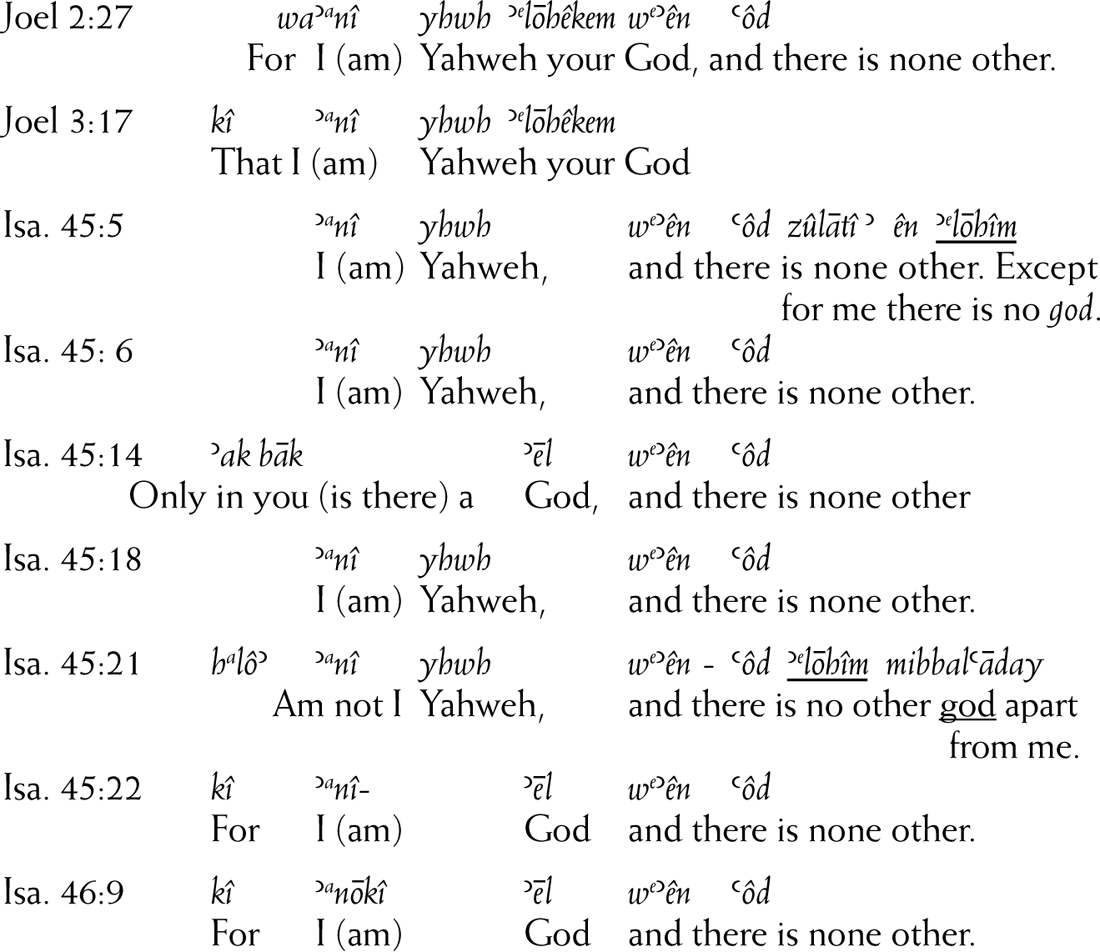
While Joel could know Isaiah, or vice versa, there is authorial intent in the modifications made between the two books. In the case of Joel, it is clear from the context that the emphasis is on the jealousy of God (Joel 2:18). He and he alone is Israel’s God, and a relationship has already been pronounced four previous times in the prophecy (1:13, 14, 23, 26). This, then, is a theological pivot point of the book, the truth that provides the nation with the psychological boost they need to overcome their extreme distress: Yahweh exists, Yahweh is present with them, and Yahweh, and no natural phenomenon of force, has divine power over them.
Bridging Contexts
JEALOUS GOD. Yahweh demands an exclusive relationship with his people. To my knowledge, this is unique to Israel from among her immediate neighbors. In a polytheistic society such as theirs, a deity would be hard pressed to expect undivided allegiance, since there were many other gods in the society also laying claim on its members. A monotheism such as Israel had leads more logically toward a deity who could be jealous for the sole position in the hearts and minds of his people. The problem arose when Israel, called to be monotheistic (e.g., Deut. 6:4–5), became polytheistic, inviting other, pagan deities into her religious system.
From the time of creation, Israel’s God has wanted humanity to rely on him and his directions rather than on either their own incomplete understanding of reality (cf. Gen. 3, where the result of abandoning this by listening to the blandishments of another is powerfully presented) or the deities of her neighbors—gods who are in fact not gods. The very first words of the preface to Israel’s national constitution echoes this exclusivity, “I [and no other] am the LORD your God” (Ex. 20:2). The concept is reiterated and made formal in the first of the Ten Commandments: “You shall have no other gods before/beside me” (v. 3). God is a jealous God (cf. v. 5; 34:14; Deut. 4:24; 5:9; 32:16; 1 Kings 14:23; Ps. 78:58), who views his “marriage” with Israel as inviolable. Association with any other deity comprises spiritual adultery.
This marriage/adultery metaphor is brought out most emphatically by Hosea. He was called to literally marry an unfaithful wife (Hos. 1:2), symbolizing the unfaithfulness the Israelites display by their liaison with Baal. This act undoubtedly brought Hosea’s neighbors to him sharing their repugnance, to which he could then reply, “Aren’t you doing exactly the same thing with Baal, and doesn’t Yahweh feel the same repugnance?” Part of Israel’s adultery involved crediting Baal, the Canaanite storm god, with their agricultural bounty of grain, wine, and olive oil (2:8), things in fact provided by Yahweh himself. To bring the actual source of all provisions to Israel’s attention, he was going to withhold them (v. 9; cf. also the contest between Baal and Yahweh in 1 Kings 17).
In Joel, Yahweh’s jealousy is reversed, using vocabulary reminiscent of the Baal conflicts. His jealousy is not just to punish, but it is ultimately for their restoration (cf. Isa. 9:6; 37:32; Zech. 1:14; 8:2), since Israel is his dearly beloved wife. His desire for their good will restore the same elements—grain, wine, and oil (Joel 2:19)—that he removed in Hosea.
Army from the north. Though describing the locust swarm in Joel, the northern army may well have a wider referent. Locusts most regularly swarmed into Israel from the east and south (cf. Ex. 10:13, 19), so swarms from the north were unusual. Human armies regularly came from either the north (e.g., the Syrians [Aram, Judg. 3:8; 1 Kings 20; 22:31], Assyrians [2 Kings 15:19–20, 29; 17:3–6], and Babylonians [2 Kings 24:1–2, 10–12; 25; Ezek. 26:7]) or the south (the Egyptians [1 Kings 9:16; 14:25–26; 19:9; 22:29]), since the east and west are effectively blocked by the Arabian Desert and the Mediterranean Sea, respectively.
Two biblical prophets also envision an eschatological army from the north that threatens Israel (Jer. 1:13–15; 4:6; 6:1, 22; 10:22; 25:9; Ezek. 1:4; 38:6, 15; 39:2).35 Pagan deities, and most particularly the Canaanite Baal, are also associated with the north, most specifically a mountain there (Zaphon; cf. Isa. 14:13).36 This is a motif countered by the Yahweh-worshiping writer of the Psalms, who has Zion replacing it in importance (Ps. 48:2), and also in Job, where Yahweh himself is portrayed as coming from the north (Job 37:22).
God’s Spirit in the Old Testament. The “Spirit [of God/the LORD]” (rûaḥ [ʾ elōhîm / yhwh]) plays an important, though often behind-the-scenes, role in the Old Testament. Mention of the Spirit spans the opening verses of the Jewish canon (Gen. 1:2), where she37 broods over the primordial deep, to its last book (2 Chron. 24:20), where she provides prophetic revelation.38 There is no systematic presentation in the Old Testament of a theology of the Spirit (or of anything else, for that matter), but the Spirit is encountered periodically in its story.
The Spirit’s presence is usually seen to be beneficial and empowering (e.g., Ex. 31:3; 35:31; Judg. 14:6, 19; 15:14; 1 Sam. 10:10; 11:6; 19:20, 23; 1 Kings 18:12; 2 Chron. 15:1; 24:20; Isa. 63:14; Ezek. 11:24; Mic. 2:7), even by pagans (e.g., Gen. 41:38), to whom she also provides revelation (Num. 24:2–3).39 The Spirit comes on several people to empower them in a special way for a leadership role, such as judge (Judg. 3:10; 6:34; 11:29), prophet (1 Sam 10:6; 19:20–24; 2 Chron. 20:14; Ezek. 11:5; Mic. 3:8; cf. Num. 11:16–20), king (1 Sam. 16:13–14; cf. 2 Sam. 23:2, where David’s words of song are ascribed to the Spirit), or Messiah (e.g., Isa. 11:2; 59:21; 61:1 [Luke 4:18]).
There is also evidence of a wider function of the Spirit beyond to individual people. In Isaiah, Yahweh’s Spirit and his words remain not only with the prophet himself, but also with his children and their descendants forever (Isa. 59:21). The office of prophet is not hereditary, but their role seems here to be viewed as spreading beyond the formal office to many others.
God also promises to place his Spirit in the midst of his people, who will be restored after their punishing exile, enabling them to adhere to his covenant commands (Ezek. 36:27; cf. 39:29). The context indicates that the Spirit is not some force working on the people from the outside but rather an element of their inner being, since 36:26 states: “I will give you a new heart and put a new spirit in you.” The Spirit provides the nation life (37:14), renewing their freshness and vitality like water in the desert (Isa. 44:3; contrast 40:7).
The same verb as used in this Joel passage is associated with the Spirit in Zech. 12:10 (“And I will pour out on the house of David and the inhabitants of Jerusalem a spirit of grace and supplication”). It is not specifically identified as the Spirit of God (cf. NIV text note), though that could be what is in mind.
The widespread dispersion of the Spirit is thus not a novelty for Joel’s prophecy. What it does, however, is to draw out the fuller meaning of this dispersion. It is to be poured out on Israel, David’s house, but not just a bestowal on its religious or political leadership. People from all walks of life, all social strata, and even from all nations (“all flesh,” Joel 2:28), will be blessed, empowered, and vivified through the gift of the Spirit of God.
Peter picks up this theme in his Pentecostal sermon in Jerusalem (Acts 2:17–21). He recognizes the event of the filling of the Spirit for those gathered on that occasion as an element of fulfillment of Joel’s promise. It is not completed on that occasion, however, for Peter also explains that the promised Spirit comes “for you and your children and for all who are far off” (2:32; cf. Isa. 59:21). To the surprise of the Jewish members of the early church, this goes even beyond their number to include the despised Samaritans (Acts 8:14–17; cf. John 4:10–14, 23–24) and Gentiles (Acts 10:44–48).
Peter made the indwelling conditional in a way also related to what is previously mentioned in the Old Testament. It follows repentance and baptism (Acts 2:38) and involves commitments to following God and being members of his covenant community. It is the ability to do so that Ezekiel previously envisioned (Ezek. 36:27). God’s people in the Old Testament are to be known by their renunciation of self-determination by submitting to God’s directives in the covenant and by the outward sign of circumcision, while his New Testament people are to be known also by repentance from sinful self-determination and by the outward sign of baptism. The Spirit is available to all who “call on the name of the Lord” (Acts 2:32).
This theme is picked up by Paul (Rom. 10:13). He does not limit the application to the Israelites, as the Joel passage could be read, but uses it as a universalizing statement, since he says in verse 12, “there is no difference between Jew and Gentile—the same Lord is Lord of all and richly blesses all who call on him.” This argues for the universal availability of the Spirit.
Divine revelation in the Old Testament. God is not silent, in spite of the claims of some who consider him dead.40 This concept would have been especially foreign to people from the biblical period, within Israel itself and also among her neighbors. For them, divine revelation is, if not a daily experience, at least something that is not completely foreign (as a counterexample, see the mention of the rarity of God’s revelation in 1 Sam. 3:1). According to the biblical text, the medium of revelation for Israel varied. On the canonically earliest occasions, the text mentions direct communication between God and humanity, whether laity or leaders, with God speaking directly (e.g., Gen. 1:29; 3:9–19; 4:6–7, 9, 15; 6:13; 7:1; 8:15; 9:8; 12:4; 17:9, 15, 19, etc.). Upon seeing the powerful theophany at Mount Sinai, the people request an intermediary between themselves and God (Ex. 20:18–21), and record of direct human-divine contact diminishes.
At other times, a specific revelatory medium is mentioned. These are often dreams41 or visions.42 These two seem to have become standard means of revelation to prophets.43 They could be misused, however, as could other, less acceptable means of hearing from God or the gods (e.g., 1 Sam 28; Jer. 23:16; 27:9; 29:8–9; Ezek. 13:6–7, 16). These two means were also used among Israel’s neighbors, Egypt and Mesopotamia.44 They were not reserved solely for prophets, however, in either Israel or the ancient Near East, as previous references indicate.45
The innovation in this Joel passage is, therefore, not in the means of revelation but in its recipients. The beneficiaries of the Spirit-gift and its accompanying revelation will not only be a special class, the prophets, or even a few folk, whose prophetic gift is rare enough to be a matter of note. Rather, this bestowal will be universal, blessing young and old, male and female, free or slave; it will affect all of humanity. God desires his Word to be widely known (cf. Prov. 1:23).
This kind of universalistic promise is not unknown in Israel (cf. Gen. 9:8–11; 12:3; Isa. 2:2–4; 56:3–8). Israel kept forgetting this truth, however, seeking to limit God’s power and provision of the Spirit (cf. Isa. 44:3; 54:13; Ezek. 39:29) to themselves alone, so God had to remind them of the wideness of his mercy (e.g., Isa. 40:3–5; 49:6; Amos 9:7; cf. Luke 3:6). He revealed himself in these ways again and in a special way in the events surrounding the birth of Jesus (e.g., Matt. 1:20; 2:12, 13, 19, 22; Luke 1:22; cf. v. 67; 2:36–38).
Rain in an agricultural society. Water is one of life’s necessities, and its long-term lack makes an area uninhabitable.46 Some regions in the ancient Near East relied on river water supplemented by irrigation. In Mesopotamia the rivers flowed regularly (cf. Isa. 8:7) while in Egypt there was an annual flooding (Ex. 7:19; Isa. 19:5–8). Other areas depended on rainfall for agriculture and daily use. This distinction is noted in Scripture (Deut. 11:10–11).47 Israel did have several rivers, and there is evidence of limited irrigation,48 but she depended much more on rainfall (1 Kings 8:35–36; Isa. 30:23) and water storage, such as cisterns and wells (Gen. 21:25; Deut. 6:11; Isa. 22:9, 11; Jer. 2:13).
The entire agricultural calendar was dependent on “rain in its season” for the crop cycle to produce the most bounty (Lev. 26:4–5; Deut. 11:13–17; this word for “rain,” gešem, is a common, general term for natural watering that can be beneficial or devastating, causing floods [Gen. 7:12; 8:2; Ps. 68:9]; cf. also with the same meaning for meṭar, Deut. 11:11, 14). The dry season ran generally from April to September, the rainy season from October to April. The ground could only be plowed and planted after the softening of the early rains, which came in September to October. These are called the yôreh, having the same root as the term occurring twice in Joel 2:23, môreh (cf. Ps. 84:7). Special rains close out the season—the latter or spring rains, called the malqôš (Prov. 16:15; Jer. 3:3), with which yôreh always appears, serving as a merism (see comment on Joel 2:23). A delay of the first rains leaves a season too short to allow the crops to fully ripen, while if they come too soon, there may not be enough moisture during the rest of the season to be able to adequately provide for the crop’s maturation.49
Numerous other words also describe aspects of rain, such as its abundance (’arubbâ, a gushing flood as if through open floodgates, Gen. 7:11; 8:2; Isa. 24:18; zerem, heavy downpour, Isa. 30:30; 32:2; nepeṣ, cloudburst, Isa. 30:30; sagrîr, persistent downpour, Prov. 27:15; sepîḥâ, downpour, Job 14:19).50 Rain in all of its forms shows God’s continued covenant loyalty to his people (Deut. 28:12).
Covenant language. Pronouns are easy to ignore while reading, since they appear less concrete and have less impact than the attendant nouns. They do carry considerable baggage, however, especially if one is careful to determine which nouns they are referring to and the relationships to which they point. Jesus’ cry of dereliction on the cross, “My God, my God, why have you forsaken me” (Matt. 27:46; Mark 15:34; citing Ps. 22:1) derives its poignancy and power from the fact that it indicates a prior relationship, one established before this abandonment. God is not just “a” God, or even “the” God, but he is “my” God, a relationship that engenders expectations. Others who identified God in this way experienced his salvation (e.g., Ex. 15:2; 2 Sam. 22:3) or desired to do so (e.g., Mic. 7:7; Zech. 14:4); based on this, they promised obedience, even if it was at a cost (Deut. 26:14; Josh. 14:8; 2 Sam. 24:24). Jesus is not, at least in the near term, able to experience this salvation from suffering, in spite of the relationship with “my God,” but was rather obedient to death.
These verses in Joel pick up a covenantal relationship between God and his people, one often expressed through pronouns: “your God” and “my people” (Joel 2:26–27). These pronouns of relationship, which we can so easily glide over, are of special impact for Israel because they have been instrumental in their very birth as a nation. At that time God promised this mutual relationship (Ex. 6:7). The relationship’s import is evident since its two-sided nature is reiterated by both Jeremiah (Jer. 7:23; 11:4; 30:22) and Ezekiel (Ezek. 36:28), prophets who had to provide God’s people with messages of hope since they faced destruction and exile. The relationships are also stated by using just one half of the pair, “my people,” occurring over two hundred times in the Old Testament, most often in the mouth of God,51 and “your God,” occurring over five hundred times, mostly referring to Yahweh.52
Contemporary Significance
THE SOURCE OF good things. When prosperity or success comes to a nation or a church today, we do not credit it to God’s gift of rain, because most Westerners have lost a tie to the earth. In reality we rarely acknowledge God at all, usually crediting it to our own strength or ingenuity. If we can but show more of this strength and ingenuity, more success will naturally and inevitably result. Another way this is manifest is through following the latest model and application of someone’s ingenuity or insight that is sure to lead to results: seven habits for effectiveness,53 ten steps to growth,54 twelve steps to sobriety,55 seventeen or twenty-one laws or qualities for leaders and teams.56
There is, of course, nothing wrong with disciplined action, and planning is noble and productive, so many of these models benefit numerous people. It is not the model that is effective, however, but rather a knowledge that things are not completely as they should be, a desire for improvement, and a heightened awareness of the goal. For the believer, these are all accompanied by the empowerment of the Holy Spirit, accompanied by the awareness that all good gifts, all progress in sanctification, and every blessing come from God himself and not from our planning and perseverance, as good as that is (cf. 1 Cor. 3:6–7). This is because it is not ultimately for our benefit but for his glory that these things come (cf. Ps. 115:1).
This attitude not only provides a needed corrective against arrogance, but it also brings an antidote for discouragement. In situations such as Joel’s, where locusts and drought could not be directly averted by the people of Israel, no matter their great physical efforts, they could but turn to the one with ultimate control over these “natural” elements. This is like Job, who is vexed after butting heads with his dialog partners to no avail. He finally hears God himself (Job 38–41), and though he does not get any more answers to his questions from God than he did from his human interlocutors, he is satisfied because he knows that he has been heard. He ends up in the same posture as he begins, acknowledging God’s blessedness and wonderfulness, even though he does not comprehend him (1:21; 42:1–6). For our own lives, a lack of ability or no results from our efforts lead to discouragement, but the results are not ultimately in our hands. Ours is to strive, God’s to bring to fruition.
Here our understanding of God’s jealousy also comes into play. We understand this emotion on a human level as wanting to keep something completely and solely for ourselves and not sharing it with anyone else. Our resources, whether financial or relational, are finite, and we feel as if they are only sufficient for our own needs. God’s jealousy must not be understood in this same way. This is not the picture of jealousy painted by Joel. God’s jealousy is to shower his people with all good blessings, wanting to raise them to the heights rather than keeping them low and impoverished. He desires all of their allegiance and love to be directed toward him, since it is finite and should not be squandered on another deity (see 2 Cor. 11:1–4, esp. v. 2). His infinite blessing, however, is completely available to those who so worship him.
Gifts of nature. In common vernacular we talk about “gifts of nature,” the enjoyable things that come from the natural realm: budding flowers and shrubs in the spring, ripening fruit from the garden, colorful leaves in the fall, and a clear, crisp day in which one can speed down the ski slope. We also speak of nature being harsh or cruel, with hurricanes and tornados destroying swathes of houses, and earthquakes, tsunamis, or forest fires leaving destruction and loss. Joel indicates that this type of description of these events is theologically problematic.
A literal understanding of this concept could honor nature with not only personality but also with power. Paganism or pantheism, in which elements of the divine inhabit all things, animate and inanimate alike, is closer to this understanding than is classical Judeo-Christian theology. God reminds the people of Joel’s time that nature is neither inherently malevolent, working for their ill through the calamity of locust and drought, nor is it autonomous and self-determining. Rather, it is under Yahweh’s ultimate control, since he is its Creator and Organizer (Gen. 1–2).
This has pastoral implication for people today. From a biblical perspective, events are neither simply random nor inevitable. While we may not be directly masters of our own fate, we have been created by one who is master and who desires to be known by his creatures not as fate but as Father. His control extends not only over human armies but also armies of locusts, and he provides not only human support and encouragement but also provisions through nature, which is a secondary provider under his primary impulse and direction.
I will repay. Our family first encountered the phenomenon while teaching in South Africa, but found that it spread there from the United States. People came to our small church having been severely wounded by a large church in the area. Their self-esteem was in tatters and their security in God’s love nonexistent, for they were taught that a correct relationship with God results in only blessing; any suffering or loss can result only from sin or falling short of God’s desires for us. Christians will not face battles and opposition, only victory. When sincere Christians attending that church met disaster through illness, unemployment, or death of a loved one, there was no succor for them; they were considered less than worthy and ostracized. Many who did not abandon the church altogether found their way to us for ministry and healing.
While we might wish that the Christian life is indeed as it was preached by that pastor, and many others, the uniform experience of saints throughout the ages gives the lie to this understanding. While some pain is God-given discipline to punish those who have turned away from him, the final goal of it is restoration, not ostracism (cf. Gal. 6:1). All suffering is not like this, however, lest Paul or even Jesus be branded as sinners, since they both suffered greatly (e.g., Paul, 2 Cor. 12:7–10; Jesus in his Passion). Paul states a reason for such suffering, namely, to be able to experience God’s grace and strength through a period of his own weakness.
God does not promise those in covenant relation with him a detour around life’s battles, whether the Christian of today facing life’s challenges or Joel and his contemporaries battling their locust armies. What he does promise is a companion as one goes through the battles (Deut. 31:6; Josh. 1:5; 1 Kings 8:56; Matt. 28:20). God also promises restoration after them, not only to Joel but also to many others in numerous promises of renewed blessing (e.g., Isa. 2:1–5; 44:24–28; Ezek. 36–37; Hos. 14; Amos 9:11–15; Obad. 17–21).
Prophetic responsibility. Christians are rightly pleased that Peter and Paul both apply Joel’s promise of the Spirit to others besides the Israelites. After all, if the promise is to Jews alone, the Gentile church is not its beneficiary. With the benefit of the Spirit comes obligation, however. While revelation from God through dreams, visions, and prophecies is a gift to be desired, it is not directed ultimately toward its recipient but toward others.
Prophets in the Old Testament were God’s intermediaries to the people and their rulers. Paul states the same thing in his teaching to the Corinthians (1 Cor. 14:1–25). The contrast he made between self-edification through tongues and the lack of it through prophecy may indicate that the latter may not be of great personal advantage. Jeremiah, and numerous other prophets, have found that the “gift” is in fact exercised at great personal cost.57
One could then ask, “Why should I want this, or any of the gifts of the Spirit?” This reflects an attitude that is unfortunately all too prevalent among many in the church. The secular attitude of “What’s in it for me?” is unfortunately not restricted to the secular. In some ways, this is what Jesus taught his disciples in the Upper Room. While they hoped for personal position and prestige (Matt. 20:21; Mark 10:37), Jesus showed them the way of service (John 13:1–17). Jesus exhibited the same attitude with his entire life, and especially with his death, which brought him no personal gain (in fact, it brought the opposite), but did bring inexpressible gain to others.
The correct Christian question should not be, “What is in it for me?” This is one of the dangers of an evangelical understanding of salvation as being strictly personal. While that is necessary, it is not a sufficient view of what salvation is (see the Contemporary Significance section of Joel 2:10–17). A truly Christlike question is, rather, “What can I do for you? How can I aid in bringing you into a correct relationship with our covenant God?” A useful definition of spiritual formation describes “a process of being conformed to the image of Christ for the sake of others.”58 Too often contemporary Western Christianity engages in theological narcissism by omitting the last phrase.
Original Meaning
Yahweh’s Third Response (2:28–32 [3:1–5])
IN THE PRECEDING sections, the prophet has presented God as restoring to fullness what he punished for some unidentified wrongdoing. Now he moves beyond restoration to promising a new thing, advancing beyond anything his people, or any people, experienced before.
Yahweh continues his direct speech here. The section begins with a variant of an introductory formula to a new section (e.g., Jer. 21:7; 49:6). The formula also ties in that which precedes to that which follows. These things happen (“and it will take place,” at the beginning of Joel 2:28, omitted in NIV; also in 2:32; 3:18)15 in a period temporally subsequent to (“afterward”) God’s restoration of Israel’s livelihood. This is not a return to a previous state, but the beginning of a new one. As the locust plague is without parallel (1:2), so is this event.
Following the time-setting element, the first aspect of God’s new activity is marked by an inclusio in verses 28b and 29, with Yahweh promising, “I will pour out my Spirit” (cf. Ezek. 39:29). The literal use of the verb špk involves pouring either liquid or dry material from a container (e.g., Ex. 4:9; Lev. 14:41). The audience was all too familiar with the metaphorical use of outpouring God’s anger on people (e.g., Ezek. 7:8; Hos. 5:10), and of the ritual blood being poured out in the sacrificial system for the sin offering (Lev. 4:7, 12, 18, 25, 30; cf. Ex. 29:12) or of other things for the drink offering (Isa. 57:6)—aspects that are appropriate to the context of Joel (Joel 1:9, 13; 2:14). This time it is God’s Spirit that is poured out like a liquid (cf. Isa. 44:3).16
From the preceding context of blessing, first-time readers would suppose that this spiritual outpouring is a positive event rather than a punishment. This is confirmed in what follows. The recipients of the outpouring are clear from the text: “all people” (lit., “flesh”), but the phrase is probably misheard by readers to be nationally restricted, since in the subsequent development, all those affected are Israelites, as indicated by the pronominal suffixes “your.” “Flesh” is not limited to Israel, however, but can refer to humanity generally as contrasted to God (e.g., Gen. 6:3; Deut. 5:23), to animals as distinct from humans (e.g., Gen. 6:19; 8:17–including birds and reptiles), and to all creatures generally (e.g., Gen. 6:13; 9:11; Isa. 40:5).
While it is most suitable to see the following promises as restricted to humanity, limiting them to Israel alone is a misreading of this text. While the Spirit in the Old Testament is many-faceted (see Bridging Contexts section), here she (the noun is grammatically feminine in Hebrew) is associated with receiving revelation from God. This comes in three forms: prophecy, dreams, and visions, terms that often overlap in meaning. The new thing is not in the revelation per se, but in its recipients.
Two more merisms (see comment on Joel 2:23) exemplifying what is meant by “all flesh” follow. The first indicates that this gift is available to both genders: “sons” and “daughters.” While the terms foundationally designate male and female biological descendants of a single generation (Gen. 4:25; 30:21), they also are used without the single generation connotation for males and females (Gen. 30:13; Lev. 6:18; Judg. 12:9).17 No one is excluded by gender.
The second merism seems more related to age (Prov. 20:29; Jer. 31:13; Lam. 5:14), since “elders” in this context is best understood as those toward the end of life (see comments on Joel 1:2), while “young men” contrast with the elderly and infants and also with young women (Deut. 32:25; Lam. 2:21; 5:14), being old enough to marry and fight at war (2 Chron. 25:5; Isa. 62:5). Since both genders have already been included, and will be again, one should not take these two groups as being exclusive but representative of the entire people. Moses’ prayer that all might be prophets (Num. 11:29) is fulfilled at this time.
This spiritual endowment is most certainly not exclusive, as shown by verse 29, since it is given, using exactly the same sentence structure, to both male and female slaves or servants. This category receives heightened semantic focus because of the use of the connector (lit.) “and even.”18 The “men” servants can refer to males owned by another (e.g., Gen. 39:17), but it can also be gender neutral (e.g., Deut. 5:15). It may also indicate those who serve but are not necessarily the chattel of another (“servant” or “subject’; e.g., Gen. 18:3, where the word is a way of address showing honor when spoken to a superior, e.g., “I am your humble servant”). Here, however, it is probably denotes male slaves since the other term is restricted to female slaves (e.g., Gen. 12:16) or servants/subjects (showing the same semantic range as the previous term; 2 Kings 14:2).19
In the socioeconomic scale, these servants or slaves are close to the bottom. Israelites were not the permanent property of a master, but they could be forced into servitude because of economic difficulty.20 Foreign prisoners of war, however, could be owned outright and sold or bartered.21 Being at this rung in the socioeconomic ladder makes receiving a blessing such as this poured-out Spirit an astounding thing. It indicates to the audience that the promise is indeed to “all flesh.”
This all happens “in those days” (cf. 2:29b; 3:1). This exact form, which occurs only eight times in the Old Testament,22 refers back to past events when used in historical narrative (Neh. 13:15). In prophetic texts, since the natural referent of the demonstrative pronoun is to the most recent time indicator, which itself refers to future events, the events so described occur simultaneously to these. In this case, the latest time reference (“and afterward,” Joel 2:28) indicates the time of the outpoured Spirit, with which the events of the following passage occur. Sometimes this phrase describes events both predicted from the viewpoint of the writer but then fulfilled within the period of the Old Testament, such as the Lord’s preserving a remnant from the Babylonian army that, at the time of the message, was yet to invade Judah (Jer. 5:18), or a return from Mesopotamian exile (3:18; 50:4).
Sometimes, however, there are elements that are not ever fulfilled in this way, such as the predicted restoration of both Judah and Israel (Jer. 3:18; 50:4) and a turning by all nations to Israel and Jerusalem as the only source for help and guidance from God (Jer. 3:16–17; Zech. 8:14), neither of which have happened up to this day. There can be, therefore, an eschatological implication with this phrase, pointing beyond the original context and situation. This fits the present passage, which Christian interpreters understand as referring to a much later Pentecost (Acts 2:1–21) and beyond (Rev. 8:7).
Displays in the astral (“the heavens”) and terrestrial (“the earth”) spheres accompany the Spirit’s outpouring (vv. 30–31), just as they did with the locust army (2:10). They are “wonders” (“portents,” LXX; NRSV; “warnings,” GNB), tokens or signs of power used to convince observers of the truth of a statement or of God’s power (Ex. 7:9; Deut. 7:19; 28:46; 1 Kings 13:3, 5). The plagues in Egypt served both of these functions (e.g., Ex. 7:3; Ps. 78:43; 105:27; 135:9). Blood (Joel 3:19, 21), fire (1:19, 20; 2:3, 5), and smoke billows are also aspects of the same Exodus-Sinai episode (blood: Ex. 4:9, 25–26; 7:17–21; 12:7, 13, 22–23; fire: 3:2; 9:23–24 [translated as “lightning”]; 12:8–10; 13:21–22; 14:24; 19:18; smoke: Ex. 19:18; 20:18).23
Other theophanies have fire and smoke, though blood is much rarer (e.g., Gen. 15:8–17, where fire and smoke are mentioned and blood is implied from the context; cf. 2 Sam. 22:9//Ps. 18:8). Blood, fire, and smoke appear together frequently, however, in another context of divine-human contact, the sacrificial ritual in the tabernacle or temple (e.g., Lev. 1–7).24 These ambiguous symbols of life and death raise ambivalent feelings in those who observe them, not knowing what they portend. Will they issue in good or ill? Or it can be both, as in the Exodus-Sinai event, depending on whether one is Egyptian or Israelite!
This verse does not specify the manner in which these phenomena show themselves. This could be the function of verse 31, at least as regards “the heavens.” The sun and moon were both affected on a natural level in similar ways by the locust swarm (2:10; 3:15). Now it is precipitated by the approaching “day of the LORD.” These two astral bodies are part of the pantheon among Israel’s neighbors—the Egyptians,25 Assyro-Babylonians,26 and most immediately, the Canaanites.27 It is against this background that this verse is heard. Rather than picturing the sun and moon as autonomous powers in their own right, they are under Yahweh’s control, he who can go as far as altering and negating their very character.28
This is the sole occurrence of the sun or moon as subject of the verb hpk, but the resultant blood is governed by the same verb when Moses, through Yahweh’s power, turns the Egyptian water supply to blood during the plague episode (Ex. 7:17, 20).29 Light to darkness is found elsewhere in the Old Testament (e.g., 2 Sam. 22:12), but its occurrence as another one of the Egyptian plagues (Ex. 10:21–22; cf. 14:20; Deut. 4:11; 5:23; Ps. 105:28) provides yet another thematic and lexical link with that story.30 God as Creator of both light and darkness is in control of both (Isa. 45:7; Amos 5:8).
All of these phenomena are harbingers of the “day of the LORD,” which this time is not described by its proximity (Joel 1:15; 2:1; 3:14) but by its character; it is “great” (“important,” 2 Sam. 3:38; 2 Chron. 2:4) and “dreadful” (Joel 2:11), a description found verbatim in Malachi 4:5. Both of these terms apply to Yahweh himself (e.g., Neh. 1:5; 4:8; Ps. 99:3). This Day is associated with darkness by other prophets too (Amos 5:18, 20; Zeph. 1:15), each time with a threatening, negative overtone.
The NIV translation seems, however, to bring too negative a connotation to the term here since “dreadful” in common usage has moved from an archaic usage based on its etymology of “inspiring awe, dread” (the connotation here) to something that is disagreeable or bad, which is not the implicit connotation of the Hebrew term here. The verb can mean “to fear,” but it does not hold the feeling of shaking terror such as one feels before an immediate threat to life;31 rather, it denotes the awe and reverence felt in the presence of a greater power who, while potentially threatening, is also potentially beneficent.
In conjunction with (“and,” NIV; Heb., “and then it will be”) these physically powerful events are those equally powerful on a psychological and personal level: Salvation is offered to all. The NIV translation is not the best since in Christian jargon “salvation” usually carries the theological meaning of deliverance from the consequences and power of sin, which is not in view here. The Hebrew noun used in the second clause of the verse is well-rendered by the NIV as “deliverance” (pelêṭâ), used of escaping with one’s life from physical captivity, danger, or judgment (e.g., Gen. 32:9; Jer. 50:29). In this context, the verb used in the first clause has this same physical nuance, “fleeing or escaping with one’s life,” as Lot and his family did from Sodom (mlṭ; Gen. 19:17–22; 1 Sam. 19:10–12), rather than a theological meaning.
This deliverance was in Jerusalem, also known as Mount Zion (e.g., Isa. 2:3//Mic. 4:2; Amos 1:2), the dwelling place of God that suffered severely from the natural disasters (Zion: see Joel 2:1; cf. 15, 23; 3:16, 17, 21; Jerusalem: see 3:1). For people convinced that life is finished, since their food supply was irremediably destroyed, Yahweh is offering deliverance, a reprieve from death.
Relief is not automatic, however, but must be requested. “Calling on God’s name” means invoking him, praying for his help, and even expressing allegiance and belonging to him (Gen. 12:8; 2 Kings 5:11; Isa. 44:5). Those who do this realize that they are in themselves powerless against natural disaster; only the Lord of nature has the necessary power to deliver. The promise is confirming one Obadiah delivered previously. Deliverance in Mount Zion is repeated almost verbatim in Obadiah 17a,32 and Joel acknowledges that Yahweh spoke on that earlier occasion.
Unfortunately, there are casualties, since those making the request of God are “among the survivors,” a synonym of those delivered earlier in the verse. This implies that there are also some who have perished (Num. 21:35; Isa. 1:9).33 Calling is mutual, since these are also ones whom Yahweh calls over a period of time as he did young Samuel (1 Sam. 3:8). The intended nuance of the clause is difficult to perceive, which may explain some seeing it as a later addition.34 This is in fact begging the question, however, since the present text is a unit, so someone, whether the original author or subsequent editor(s) or redactor(s), must have made sense of the present text.
Bridging Contexts
JEALOUS GOD. Yahweh demands an exclusive relationship with his people. To my knowledge, this is unique to Israel from among her immediate neighbors. In a polytheistic society such as theirs, a deity would be hard pressed to expect undivided allegiance, since there were many other gods in the society also laying claim on its members. A monotheism such as Israel had leads more logically toward a deity who could be jealous for the sole position in the hearts and minds of his people. The problem arose when Israel, called to be monotheistic (e.g., Deut. 6:4–5), became polytheistic, inviting other, pagan deities into her religious system.
From the time of creation, Israel’s God has wanted humanity to rely on him and his directions rather than on either their own incomplete understanding of reality (cf. Gen. 3, where the result of abandoning this by listening to the blandishments of another is powerfully presented) or the deities of her neighbors—gods who are in fact not gods. The very first words of the preface to Israel’s national constitution echoes this exclusivity, “I [and no other] am the LORD your God” (Ex. 20:2). The concept is reiterated and made formal in the first of the Ten Commandments: “You shall have no other gods before/beside me” (v. 3). God is a jealous God (cf. v. 5; 34:14; Deut. 4:24; 5:9; 32:16; 1 Kings 14:23; Ps. 78:58), who views his “marriage” with Israel as inviolable. Association with any other deity comprises spiritual adultery.
This marriage/adultery metaphor is brought out most emphatically by Hosea. He was called to literally marry an unfaithful wife (Hos. 1:2), symbolizing the unfaithfulness the Israelites display by their liaison with Baal. This act undoubtedly brought Hosea’s neighbors to him sharing their repugnance, to which he could then reply, “Aren’t you doing exactly the same thing with Baal, and doesn’t Yahweh feel the same repugnance?” Part of Israel’s adultery involved crediting Baal, the Canaanite storm god, with their agricultural bounty of grain, wine, and olive oil (2:8), things in fact provided by Yahweh himself. To bring the actual source of all provisions to Israel’s attention, he was going to withhold them (v. 9; cf. also the contest between Baal and Yahweh in 1 Kings 17).
In Joel, Yahweh’s jealousy is reversed, using vocabulary reminiscent of the Baal conflicts. His jealousy is not just to punish, but it is ultimately for their restoration (cf. Isa. 9:6; 37:32; Zech. 1:14; 8:2), since Israel is his dearly beloved wife. His desire for their good will restore the same elements—grain, wine, and oil (Joel 2:19)—that he removed in Hosea.
Army from the north. Though describing the locust swarm in Joel, the northern army may well have a wider referent. Locusts most regularly swarmed into Israel from the east and south (cf. Ex. 10:13, 19), so swarms from the north were unusual. Human armies regularly came from either the north (e.g., the Syrians [Aram, Judg. 3:8; 1 Kings 20; 22:31], Assyrians [2 Kings 15:19–20, 29; 17:3–6], and Babylonians [2 Kings 24:1–2, 10–12; 25; Ezek. 26:7]) or the south (the Egyptians [1 Kings 9:16; 14:25–26; 19:9; 22:29]), since the east and west are effectively blocked by the Arabian Desert and the Mediterranean Sea, respectively.
Two biblical prophets also envision an eschatological army from the north that threatens Israel (Jer. 1:13–15; 4:6; 6:1, 22; 10:22; 25:9; Ezek. 1:4; 38:6, 15; 39:2).35 Pagan deities, and most particularly the Canaanite Baal, are also associated with the north, most specifically a mountain there (Zaphon; cf. Isa. 14:13).36 This is a motif countered by the Yahweh-worshiping writer of the Psalms, who has Zion replacing it in importance (Ps. 48:2), and also in Job, where Yahweh himself is portrayed as coming from the north (Job 37:22).
God’s Spirit in the Old Testament. The “Spirit [of God/the LORD]” (rûaḥ [ʾ elōhîm / yhwh]) plays an important, though often behind-the-scenes, role in the Old Testament. Mention of the Spirit spans the opening verses of the Jewish canon (Gen. 1:2), where she37 broods over the primordial deep, to its last book (2 Chron. 24:20), where she provides prophetic revelation.38 There is no systematic presentation in the Old Testament of a theology of the Spirit (or of anything else, for that matter), but the Spirit is encountered periodically in its story.
The Spirit’s presence is usually seen to be beneficial and empowering (e.g., Ex. 31:3; 35:31; Judg. 14:6, 19; 15:14; 1 Sam. 10:10; 11:6; 19:20, 23; 1 Kings 18:12; 2 Chron. 15:1; 24:20; Isa. 63:14; Ezek. 11:24; Mic. 2:7), even by pagans (e.g., Gen. 41:38), to whom she also provides revelation (Num. 24:2–3).39 The Spirit comes on several people to empower them in a special way for a leadership role, such as judge (Judg. 3:10; 6:34; 11:29), prophet (1 Sam 10:6; 19:20–24; 2 Chron. 20:14; Ezek. 11:5; Mic. 3:8; cf. Num. 11:16–20), king (1 Sam. 16:13–14; cf. 2 Sam. 23:2, where David’s words of song are ascribed to the Spirit), or Messiah (e.g., Isa. 11:2; 59:21; 61:1 [Luke 4:18]).
There is also evidence of a wider function of the Spirit beyond to individual people. In Isaiah, Yahweh’s Spirit and his words remain not only with the prophet himself, but also with his children and their descendants forever (Isa. 59:21). The office of prophet is not hereditary, but their role seems here to be viewed as spreading beyond the formal office to many others.
God also promises to place his Spirit in the midst of his people, who will be restored after their punishing exile, enabling them to adhere to his covenant commands (Ezek. 36:27; cf. 39:29). The context indicates that the Spirit is not some force working on the people from the outside but rather an element of their inner being, since 36:26 states: “I will give you a new heart and put a new spirit in you.” The Spirit provides the nation life (37:14), renewing their freshness and vitality like water in the desert (Isa. 44:3; contrast 40:7).
The same verb as used in this Joel passage is associated with the Spirit in Zech. 12:10 (“And I will pour out on the house of David and the inhabitants of Jerusalem a spirit of grace and supplication”). It is not specifically identified as the Spirit of God (cf. NIV text note), though that could be what is in mind.
The widespread dispersion of the Spirit is thus not a novelty for Joel’s prophecy. What it does, however, is to draw out the fuller meaning of this dispersion. It is to be poured out on Israel, David’s house, but not just a bestowal on its religious or political leadership. People from all walks of life, all social strata, and even from all nations (“all flesh,” Joel 2:28), will be blessed, empowered, and vivified through the gift of the Spirit of God.
Peter picks up this theme in his Pentecostal sermon in Jerusalem (Acts 2:17–21). He recognizes the event of the filling of the Spirit for those gathered on that occasion as an element of fulfillment of Joel’s promise. It is not completed on that occasion, however, for Peter also explains that the promised Spirit comes “for you and your children and for all who are far off” (2:32; cf. Isa. 59:21). To the surprise of the Jewish members of the early church, this goes even beyond their number to include the despised Samaritans (Acts 8:14–17; cf. John 4:10–14, 23–24) and Gentiles (Acts 10:44–48).
Peter made the indwelling conditional in a way also related to what is previously mentioned in the Old Testament. It follows repentance and baptism (Acts 2:38) and involves commitments to following God and being members of his covenant community. It is the ability to do so that Ezekiel previously envisioned (Ezek. 36:27). God’s people in the Old Testament are to be known by their renunciation of self-determination by submitting to God’s directives in the covenant and by the outward sign of circumcision, while his New Testament people are to be known also by repentance from sinful self-determination and by the outward sign of baptism. The Spirit is available to all who “call on the name of the Lord” (Acts 2:32).
This theme is picked up by Paul (Rom. 10:13). He does not limit the application to the Israelites, as the Joel passage could be read, but uses it as a universalizing statement, since he says in verse 12, “there is no difference between Jew and Gentile—the same Lord is Lord of all and richly blesses all who call on him.” This argues for the universal availability of the Spirit.
Divine revelation in the Old Testament. God is not silent, in spite of the claims of some who consider him dead.40 This concept would have been especially foreign to people from the biblical period, within Israel itself and also among her neighbors. For them, divine revelation is, if not a daily experience, at least something that is not completely foreign (as a counterexample, see the mention of the rarity of God’s revelation in 1 Sam. 3:1). According to the biblical text, the medium of revelation for Israel varied. On the canonically earliest occasions, the text mentions direct communication between God and humanity, whether laity or leaders, with God speaking directly (e.g., Gen. 1:29; 3:9–19; 4:6–7, 9, 15; 6:13; 7:1; 8:15; 9:8; 12:4; 17:9, 15, 19, etc.). Upon seeing the powerful theophany at Mount Sinai, the people request an intermediary between themselves and God (Ex. 20:18–21), and record of direct human-divine contact diminishes.
At other times, a specific revelatory medium is mentioned. These are often dreams41 or visions.42 These two seem to have become standard means of revelation to prophets.43 They could be misused, however, as could other, less acceptable means of hearing from God or the gods (e.g., 1 Sam 28; Jer. 23:16; 27:9; 29:8–9; Ezek. 13:6–7, 16). These two means were also used among Israel’s neighbors, Egypt and Mesopotamia.44 They were not reserved solely for prophets, however, in either Israel or the ancient Near East, as previous references indicate.45
The innovation in this Joel passage is, therefore, not in the means of revelation but in its recipients. The beneficiaries of the Spirit-gift and its accompanying revelation will not only be a special class, the prophets, or even a few folk, whose prophetic gift is rare enough to be a matter of note. Rather, this bestowal will be universal, blessing young and old, male and female, free or slave; it will affect all of humanity. God desires his Word to be widely known (cf. Prov. 1:23).
This kind of universalistic promise is not unknown in Israel (cf. Gen. 9:8–11; 12:3; Isa. 2:2–4; 56:3–8). Israel kept forgetting this truth, however, seeking to limit God’s power and provision of the Spirit (cf. Isa. 44:3; 54:13; Ezek. 39:29) to themselves alone, so God had to remind them of the wideness of his mercy (e.g., Isa. 40:3–5; 49:6; Amos 9:7; cf. Luke 3:6). He revealed himself in these ways again and in a special way in the events surrounding the birth of Jesus (e.g., Matt. 1:20; 2:12, 13, 19, 22; Luke 1:22; cf. v. 67; 2:36–38).
Rain in an agricultural society. Water is one of life’s necessities, and its long-term lack makes an area uninhabitable.46 Some regions in the ancient Near East relied on river water supplemented by irrigation. In Mesopotamia the rivers flowed regularly (cf. Isa. 8:7) while in Egypt there was an annual flooding (Ex. 7:19; Isa. 19:5–8). Other areas depended on rainfall for agriculture and daily use. This distinction is noted in Scripture (Deut. 11:10–11).47 Israel did have several rivers, and there is evidence of limited irrigation,48 but she depended much more on rainfall (1 Kings 8:35–36; Isa. 30:23) and water storage, such as cisterns and wells (Gen. 21:25; Deut. 6:11; Isa. 22:9, 11; Jer. 2:13).
The entire agricultural calendar was dependent on “rain in its season” for the crop cycle to produce the most bounty (Lev. 26:4–5; Deut. 11:13–17; this word for “rain,” gešem, is a common, general term for natural watering that can be beneficial or devastating, causing floods [Gen. 7:12; 8:2; Ps. 68:9]; cf. also with the same meaning for meṭar, Deut. 11:11, 14). The dry season ran generally from April to September, the rainy season from October to April. The ground could only be plowed and planted after the softening of the early rains, which came in September to October. These are called the yôreh, having the same root as the term occurring twice in Joel 2:23, môreh (cf. Ps. 84:7). Special rains close out the season—the latter or spring rains, called the malqôš (Prov. 16:15; Jer. 3:3), with which yôreh always appears, serving as a merism (see comment on Joel 2:23). A delay of the first rains leaves a season too short to allow the crops to fully ripen, while if they come too soon, there may not be enough moisture during the rest of the season to be able to adequately provide for the crop’s maturation.49
Numerous other words also describe aspects of rain, such as its abundance (’arubbâ, a gushing flood as if through open floodgates, Gen. 7:11; 8:2; Isa. 24:18; zerem, heavy downpour, Isa. 30:30; 32:2; nepeṣ, cloudburst, Isa. 30:30; sagrîr, persistent downpour, Prov. 27:15; sepîḥâ, downpour, Job 14:19).50 Rain in all of its forms shows God’s continued covenant loyalty to his people (Deut. 28:12).
Covenant language. Pronouns are easy to ignore while reading, since they appear less concrete and have less impact than the attendant nouns. They do carry considerable baggage, however, especially if one is careful to determine which nouns they are referring to and the relationships to which they point. Jesus’ cry of dereliction on the cross, “My God, my God, why have you forsaken me” (Matt. 27:46; Mark 15:34; citing Ps. 22:1) derives its poignancy and power from the fact that it indicates a prior relationship, one established before this abandonment. God is not just “a” God, or even “the” God, but he is “my” God, a relationship that engenders expectations. Others who identified God in this way experienced his salvation (e.g., Ex. 15:2; 2 Sam. 22:3) or desired to do so (e.g., Mic. 7:7; Zech. 14:4); based on this, they promised obedience, even if it was at a cost (Deut. 26:14; Josh. 14:8; 2 Sam. 24:24). Jesus is not, at least in the near term, able to experience this salvation from suffering, in spite of the relationship with “my God,” but was rather obedient to death.
These verses in Joel pick up a covenantal relationship between God and his people, one often expressed through pronouns: “your God” and “my people” (Joel 2:26–27). These pronouns of relationship, which we can so easily glide over, are of special impact for Israel because they have been instrumental in their very birth as a nation. At that time God promised this mutual relationship (Ex. 6:7). The relationship’s import is evident since its two-sided nature is reiterated by both Jeremiah (Jer. 7:23; 11:4; 30:22) and Ezekiel (Ezek. 36:28), prophets who had to provide God’s people with messages of hope since they faced destruction and exile. The relationships are also stated by using just one half of the pair, “my people,” occurring over two hundred times in the Old Testament, most often in the mouth of God,51 and “your God,” occurring over five hundred times, mostly referring to Yahweh.52
Contemporary Significance
THE SOURCE OF good things. When prosperity or success comes to a nation or a church today, we do not credit it to God’s gift of rain, because most Westerners have lost a tie to the earth. In reality we rarely acknowledge God at all, usually crediting it to our own strength or ingenuity. If we can but show more of this strength and ingenuity, more success will naturally and inevitably result. Another way this is manifest is through following the latest model and application of someone’s ingenuity or insight that is sure to lead to results: seven habits for effectiveness,53 ten steps to growth,54 twelve steps to sobriety,55 seventeen or twenty-one laws or qualities for leaders and teams.56
There is, of course, nothing wrong with disciplined action, and planning is noble and productive, so many of these models benefit numerous people. It is not the model that is effective, however, but rather a knowledge that things are not completely as they should be, a desire for improvement, and a heightened awareness of the goal. For the believer, these are all accompanied by the empowerment of the Holy Spirit, accompanied by the awareness that all good gifts, all progress in sanctification, and every blessing come from God himself and not from our planning and perseverance, as good as that is (cf. 1 Cor. 3:6–7). This is because it is not ultimately for our benefit but for his glory that these things come (cf. Ps. 115:1).
This attitude not only provides a needed corrective against arrogance, but it also brings an antidote for discouragement. In situations such as Joel’s, where locusts and drought could not be directly averted by the people of Israel, no matter their great physical efforts, they could but turn to the one with ultimate control over these “natural” elements. This is like Job, who is vexed after butting heads with his dialog partners to no avail. He finally hears God himself (Job 38–41), and though he does not get any more answers to his questions from God than he did from his human interlocutors, he is satisfied because he knows that he has been heard. He ends up in the same posture as he begins, acknowledging God’s blessedness and wonderfulness, even though he does not comprehend him (1:21; 42:1–6). For our own lives, a lack of ability or no results from our efforts lead to discouragement, but the results are not ultimately in our hands. Ours is to strive, God’s to bring to fruition.
Here our understanding of God’s jealousy also comes into play. We understand this emotion on a human level as wanting to keep something completely and solely for ourselves and not sharing it with anyone else. Our resources, whether financial or relational, are finite, and we feel as if they are only sufficient for our own needs. God’s jealousy must not be understood in this same way. This is not the picture of jealousy painted by Joel. God’s jealousy is to shower his people with all good blessings, wanting to raise them to the heights rather than keeping them low and impoverished. He desires all of their allegiance and love to be directed toward him, since it is finite and should not be squandered on another deity (see 2 Cor. 11:1–4, esp. v. 2). His infinite blessing, however, is completely available to those who so worship him.
Gifts of nature. In common vernacular we talk about “gifts of nature,” the enjoyable things that come from the natural realm: budding flowers and shrubs in the spring, ripening fruit from the garden, colorful leaves in the fall, and a clear, crisp day in which one can speed down the ski slope. We also speak of nature being harsh or cruel, with hurricanes and tornados destroying swathes of houses, and earthquakes, tsunamis, or forest fires leaving destruction and loss. Joel indicates that this type of description of these events is theologically problematic.
A literal understanding of this concept could honor nature with not only personality but also with power. Paganism or pantheism, in which elements of the divine inhabit all things, animate and inanimate alike, is closer to this understanding than is classical Judeo-Christian theology. God reminds the people of Joel’s time that nature is neither inherently malevolent, working for their ill through the calamity of locust and drought, nor is it autonomous and self-determining. Rather, it is under Yahweh’s ultimate control, since he is its Creator and Organizer (Gen. 1–2).
This has pastoral implication for people today. From a biblical perspective, events are neither simply random nor inevitable. While we may not be directly masters of our own fate, we have been created by one who is master and who desires to be known by his creatures not as fate but as Father. His control extends not only over human armies but also armies of locusts, and he provides not only human support and encouragement but also provisions through nature, which is a secondary provider under his primary impulse and direction.
I will repay. Our family first encountered the phenomenon while teaching in South Africa, but found that it spread there from the United States. People came to our small church having been severely wounded by a large church in the area. Their self-esteem was in tatters and their security in God’s love nonexistent, for they were taught that a correct relationship with God results in only blessing; any suffering or loss can result only from sin or falling short of God’s desires for us. Christians will not face battles and opposition, only victory. When sincere Christians attending that church met disaster through illness, unemployment, or death of a loved one, there was no succor for them; they were considered less than worthy and ostracized. Many who did not abandon the church altogether found their way to us for ministry and healing.
While we might wish that the Christian life is indeed as it was preached by that pastor, and many others, the uniform experience of saints throughout the ages gives the lie to this understanding. While some pain is God-given discipline to punish those who have turned away from him, the final goal of it is restoration, not ostracism (cf. Gal. 6:1). All suffering is not like this, however, lest Paul or even Jesus be branded as sinners, since they both suffered greatly (e.g., Paul, 2 Cor. 12:7–10; Jesus in his Passion). Paul states a reason for such suffering, namely, to be able to experience God’s grace and strength through a period of his own weakness.
God does not promise those in covenant relation with him a detour around life’s battles, whether the Christian of today facing life’s challenges or Joel and his contemporaries battling their locust armies. What he does promise is a companion as one goes through the battles (Deut. 31:6; Josh. 1:5; 1 Kings 8:56; Matt. 28:20). God also promises restoration after them, not only to Joel but also to many others in numerous promises of renewed blessing (e.g., Isa. 2:1–5; 44:24–28; Ezek. 36–37; Hos. 14; Amos 9:11–15; Obad. 17–21).
Prophetic responsibility. Christians are rightly pleased that Peter and Paul both apply Joel’s promise of the Spirit to others besides the Israelites. After all, if the promise is to Jews alone, the Gentile church is not its beneficiary. With the benefit of the Spirit comes obligation, however. While revelation from God through dreams, visions, and prophecies is a gift to be desired, it is not directed ultimately toward its recipient but toward others.
Prophets in the Old Testament were God’s intermediaries to the people and their rulers. Paul states the same thing in his teaching to the Corinthians (1 Cor. 14:1–25). The contrast he made between self-edification through tongues and the lack of it through prophecy may indicate that the latter may not be of great personal advantage. Jeremiah, and numerous other prophets, have found that the “gift” is in fact exercised at great personal cost.57
One could then ask, “Why should I want this, or any of the gifts of the Spirit?” This reflects an attitude that is unfortunately all too prevalent among many in the church. The secular attitude of “What’s in it for me?” is unfortunately not restricted to the secular. In some ways, this is what Jesus taught his disciples in the Upper Room. While they hoped for personal position and prestige (Matt. 20:21; Mark 10:37), Jesus showed them the way of service (John 13:1–17). Jesus exhibited the same attitude with his entire life, and especially with his death, which brought him no personal gain (in fact, it brought the opposite), but did bring inexpressible gain to others.
The correct Christian question should not be, “What is in it for me?” This is one of the dangers of an evangelical understanding of salvation as being strictly personal. While that is necessary, it is not a sufficient view of what salvation is (see the Contemporary Significance section of Joel 2:10–17). A truly Christlike question is, rather, “What can I do for you? How can I aid in bringing you into a correct relationship with our covenant God?” A useful definition of spiritual formation describes “a process of being conformed to the image of Christ for the sake of others.”58 Too often contemporary Western Christianity engages in theological narcissism by omitting the last phrase.