The Composition of the Book of Judges
Title of the Book and Role of the Judges
THE ENGLISH TITLE for the book of Judges derives from the Latin Liber Judicum. The Latin stems from the Old Greek (LXX) Kritai (“Judges”). The English term judges implies the notion of individuals who adjudicate legal disputes or determine guilt or innocence in criminal cases. But it is quite apparent that such was not their primary task. The Hebrew title of the book is šōpeṭîm. The meaning of this term can be seen in 2:16–17: “Then the LORD raised up judges [šōpeṭîm], who saved them out of the hands of these raiders. Yet they would not listen to their judges but prostituted themselves to other gods and worshiped them.”
Thus the judges (šōpeṭîm) are viewed as both “deliverers” or “saviors” of their people from their enemies and “instigators,” “catalysts,” or “stimuli” for godly living. In essence, their purpose was not judicial, but soteriological.1 In fact, two of the judges are designated deliverers (môšîaʿ ): Othniel (3:9) and Ehud (3:15). A number of the activities of others are described through the use of the verb yāšaʿ (“save, deliver”; cf. Shamgar, 3:31; Gideon, 6:15; 8:22; Tola, 10:1; Jephthah, 12:3; and Samson, 13:5).2 Hence, this was apparently their role as leaders in external affairs, “restoring shalom, harmonious relations.”3
But Judges 2:17 seems to imply clearly that these šōpeṭîm were also to be leaders in internal affairs regarding spiritual/moral matters. The verb šāpaṭ itself underscores this. Block has recently noted that šāpaṭ has the general meaning of “to rule, govern, exercise leadership” and thus can be used in more particular contexts to express “to judge” (i.e., to lead in internal affairs) and/or “to deliver” (i.e., to lead in external affairs).4 Thus the šōpeṭîm should best be understood as “tribal rulers, leaders,” rather than “judges,” so that the name of the book is better rendered “The Book of Tribal Rulers.”5
The success of the individual judges in the book is related to their success in delivering the people as well as in their spurring them by example to a proper relationship with God. The ultimate “judge” (šōpēṭ) is Yahweh (11:27). He is the One who gives the people into the hands of their oppressors; he is the One who raises up deliverers (i.e., the judges) for them; he is the One who brings his Spirit upon the deliverers and equips them for their tasks (3:10; 6:34; 11:29; 14:6, 19; 15:14).6
In another sense, each judge symbolizes an aspect of Israel, a weakness, a particular quality that leads to the narrative consequences of that episode and contributes to the resolution of the book. Thus the text supports the relevance of local events to the people as a whole. While individual judges are tribal leaders, they are identified as national leaders in order to emphasize God’s dealings with the nation as a whole. Hence, on this basis, each of the judges may be seen as a symbol of Israel; furthermore, each serves to reveal a new aspect of the people’s relationship to Yahweh.7
The book of Judges appears to deal with two types of judges, usually designated by scholars as “major” and “minor” judges (Block describes them as “primary” and “secondary”8). Both designations connote things that are not accurate to the book’s narration. A more neutral designation is “cyclical” and “noncyclical” judges. It is important to remember that the functional distinctions between two types of judges should not be too sharply drawn.9 The differences seem to be primarily twofold: (1) in the use of the narrative framework of the cycle for the development of the plot of each major (or cyclical) judge story, and (2) in the degree of narrative development attached to each of the major judge stories.
Authorship and Date of Composition
THE BOOK OF JUDGES is anonymous. It is apparent that the book is a collection of various blocks of material concerning the different judges. Some of the stories may have existed very early in oral or written form, but none of these blocks are attributed to any particular source in the text. Modern scholars have expended great amounts of time and energy in an attempt to identify these sources, but with limited success.10
The reference in 18:30 to “the time of the captivity of the land” seems to refer to the Exile (either 722 or 586 B.C.) and suggests that the final edition of the book came from the Exile or afterwards.11 Thus the precise author and date are uncertain. But this should hardly deter the reader from understanding the book’s message.
Purpose
THE BOOK OF JUDGES has a coherent message concerning the consequences of disobedience to God with the resultant moral degeneration that characterized the history of this period. Recently, Block has expressed this by describing the central theme of the book as “the Canaanization of Israel.”12 The book’s selective presentation of the period is clearly designed to instruct the reader on the consequences of disobedience to God and his law.
Marius has divided the book of Judges along the theme of degeneracy, using different categories of perspective. Judges 1:1–2:5 is developed along a historical/military perspective. Judges 2:6–3:6 utilizes a religious perspective. The cycles section (3:7–16:31) uses the religious perspective traced in individual lives. The final section of the book (17:1–21:25) represents all three perspectives in terms of “the spheres of cultus, family, and nation.”13 Israel as a nation expresses, in the final chapters, its fullest point of degeneracy in its corporate actions. It may be that Samson is “the epitome of degeneration,”14 but the extension of that degeneration takes its widest scope in chapters 17–21, reaching its conclusion in the final chapter.
Interestingly, not every oppression that Israel suffers during the judges’ era is fully narrated (or for that matter alluded to). This is manifest from 10:11–14, where the Lord refers to the oppressions of some peoples for which there is no corresponding narration in the book (e.g., Egyptians, Amorites, Sidonians, Maonites). It is also evident in the lack of plot development of the minor or noncyclical judges. The double introduction and double conclusion to the book are also written in order to add those things important to the interpretation and understanding of the purpose and to separate out those things that would detract from the primary message of the cycles section (see discussion of structure below). All and all, the author’s didactic objective is well achieved.15
Chronology
THE PERIOD OF the judges began with the death of Joshua and ended with the coronation of Saul (i.e., the beginning of the monarchy). But if one simply adds the length of each judge’s administration with its preceding oppression, the total comes to 410 years, a period far too extended to fit the time between Joshua and Saul. Therefore, scholars agree that the periods of some oppressions and judgeships overlap. This is to be expected since many (if not all) of the judges are local, tribal leaders, operating in geographically limited portions of Israel. The amount or degree of overlap is difficult to discern, and so the precise chronology of the period of the judges is unknown.16 In addition, the book’s uses of numbers in some instances are uncertain. For example, the book may use the number forty as a round number or figuratively to simply denote a generation.17 It may not be intended to be understood literally.
Judges does not include an adequate historical presentation of all of the judges. In the case of the so-called “minor” (or noncyclical) judges, the writer chooses to give limited information. For example, the author relates that “Tola saved Israel.” But from whom? Had Israel done evil in the eyes of the Lord as in other cases? How did he “save” Israel? The information is not forthcoming. Moreover, individuals such as Eli and Samuel, whom many scholars believe functioned as judges in Israel, are not included in the book. They are certainly part of the period of the judges (as 1 Sam. 12:11 clearly indicates for Samuel), yet the writer has not included them.18 Thus it is important to remember that the book is very much a selective presentation designed to reinforce the author’s didactic message.
The “Tribal League”
THE BOOK OF JUDGES presents Israel as constituting some sort of tribal confederacy or league. Such a confederation would facilitate important political, economic, social, and religious purposes. A brief overview of the tribal structure of ancient Israel will enhance an understanding of a number of passages in the book of Judges.
The family or house (hold) (bêt ʾāb, lit., “house of the father”) was the fundamental unit of social structure. This unit was not simply the nuclear family (i.e., husband, wife/wives, and children) but had wider relational connections so that it could be used to designate a more extended family (i.e., husband, wife/wives, married children and grandchildren, all living in relatively close proximity to each other).19 While an individual male warrior (gibbôr) might be the head of his own family (bêtʾab), each family usually had a number of male warriors (cf. Josh. 7:14, 17).
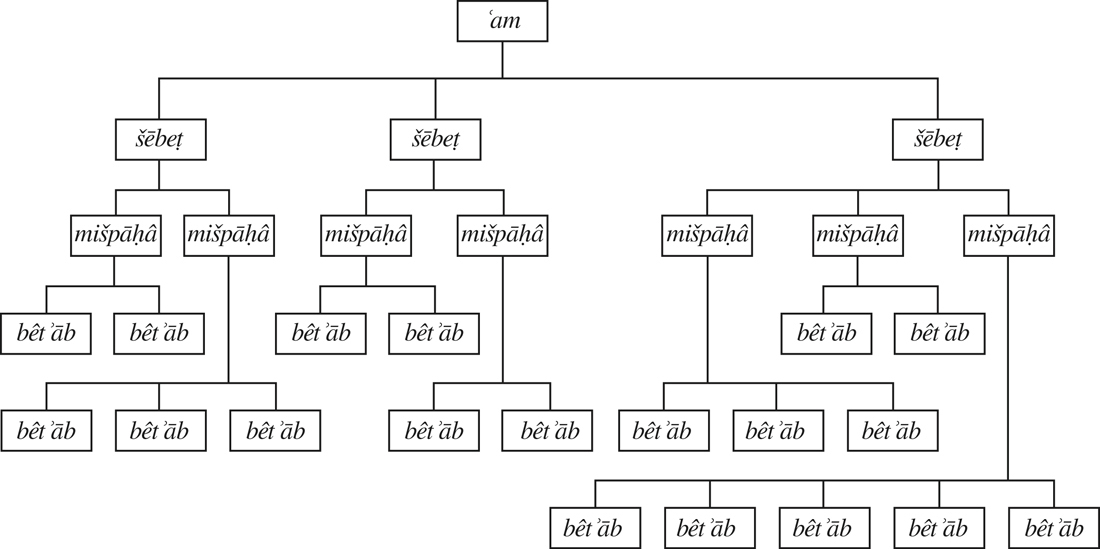
KEY
ʿam = “people”
šēbeṭ = “tribe” (= maṭṭeh)
mišpāḥâ = “clan,” “maximal lineage group” (ʾelep)
bêt ʾāb = “family” “father’s house”
The term that in most English versions is translated “clan” (mišpaḥâ) is more accurately a “maximal lineage group.” It was a descent group that established ties of kinship between families or households (bêt ʾāb) through a common ancestor (who was no longer living), adding a protective and social function. It established vertical kinship solidarity. It appears that it was on the level of the mišpāḥâ that the law of the gōʾēl (kinsman-redeemer) functioned (see the introduction to Ruth).
The tribe (šēbeṭ) is more difficult to define, since social groups can be bound together in so many different ways: by descent, by residence, by common dialect, or by a common religion. In the Old Testament, tribes were generally certainly groups connected to one another by residence and descent as well as possibly dialect (see 12:6, where the Cisjordanian Ephraimites could not pronounce the word “shibboleth”). Studies of modern tribal societies demonstrate that Old Testament tribal culture was not necessarily an evolutionary stage following that of the band and preceding the state stage, but could represent a social form in its own right.20 The term šēbeṭ may be applied to any kind of organization where there is unity at the center but freedom and variation at the periphery. In the Old Testament, therefore, a tribe seems to be the largest social unit for mutual defense against foreigners or other Israelite social units.21
Finally, several tribes combined to form the ethnic group, the ʿam, “people” (a root that implies internal blood relationship).22 The book of Judges assumes that common descent from an eponymous ancestor provides the basis for Israel’s ethnic unity. Expressions such as “Israel,” the “sons of Israel” (or “Israelites”), “all Israel,” and so on underscore the basic ethnic unity of the tribal confederation—at least as the book of Judges presents it.
Among numerous characteristics of tribal societies, one of the most important is that of vertical kinship solidarity within a segmentary system (i.e., rights, duties, privileges are inherited along the same segmentary lines that give clan and lineage solidarity). Examples of this from the Old Testament are: an emphasis on remembering genealogies, the kinsman-redeemer (gōʾēl) law, and landholding. Another important tribal characteristic is the importance of alliances. The covenant or treaty (berît) functioned not only as a moral and religious document but also as a basis for tribal alliances within the confederacy or league.23
In clan ideology, it can be said fairly that the concept of abstract justice is lacking. All actions are based on specific loyalties, the lines of which are structurally determined. One supports one’s fellow clansman in a dispute, regardless of moral questions. The only consideration is, “he is my fellow-clansman.”24 This fact concerning clan ideology is important to understand the loyalties in the case of Benjamin in Judges 19–20.
The Ḥērem
THE CONCEPT OF the ḥērem is important to understanding the book of Judges (especially the book’s double introduction and double conclusion, where the term occurs). While the word is not used in the main section of the book, its concept and legal implications are present in a number of instances. The NIV usually translates the noun form as “devoted thing” and the verbal form as “totally destroy.”
Although roughly 85 percent of its occurrences are in the context of warfare and destruction, its nonmilitary usage is informative. In Leviticus 27:21–29, a distinction is made between dedicating (haqdîš) and devoting (haḥarîm) in that the thing dedicated can be redeemed while that which is devoted cannot. The person devoted to Yahweh must be put to death (27:28–29). According to Exodus 22:20 [Heb. 19], a person who sacrifices to any god other than Yahweh alone “must be destroyed [ḥrm].”25 This text links the ḥērem with the people’s “internal identity” as Yahweh’s people. Thus, the Old Testament ḥērem- narratives are stories connected with the notion of obedience/disobedience to Yahweh (i.e., the execution/nonexecution of the ḥērem).26
The essential delineation of the law of the ḥērem in military contexts is found in Deuteronomy 7. The prescriptive phrases (7:1–5, 11, 16, 25) and promises (7:20–22) echo precisely the terms of Exodus 23:20–33.27 The implications of the ḥērem are clearly manifest: no covenant (treaty) with the inhabitants, no mercy, no intermarriage. Its purpose according to Deuteronomy 7 is to drive out (i.e., “dispossess”) the Canaanites. The reasons appear to be threefold: judgment of the Canaanites, protection of the Israelites from Canaanite religious influence, and fulfillment of the patriarchal promises concerning the land. In Deuteronomy 20:16–17, ḥērem is defined by the clause “do not leave alive anything that breathes” (referring to humans in particular).
The kind of warfare attributed to Israel in the conquest of Canaan does not originate in a theology of “holy war” peculiar to Old Testament theology. Rather, it is a political ideology that Israel shared with other nations in the ancient Near East.28 All wars waged by a country were “holy wars,” dedicated to the glorification of its deity and the extension of the deity’s land and reign.
Thus the term ḥērem seems to connote the uncompromising devotion of things without the possibility of recall or redemption.29 It was not only applied to idolatrous objects but to things that could have been taken as plunder or people who could have been enslaved. In the case of its use in connection with people, it always implies their utter destruction. It is important to note that the use of the phrase “holy war” is an inadequate description often given to the ḥērem.30
In the book of Judges, ḥērem is first encountered in Judges 1:17, where it is applied by the Simeonites and Judahites in the possession of the Simeonite allotment. Deuteronomy 7 clearly provides the background to this application. While the term only occurs here in chapter 1, it is undoubtedly implied throughout the chapter by the Israelite tribes’ attempts at possessing their allotments. The failure to implement the ḥērem is seen in the repetition of the phrases “did not drive out” (yāraš) and “live among” (yāšab) in the assessments of the individual tribes (see discussion of chapter 1 below).
Beside 1:17, the only other occurrence of ḥērem in the book of Judges is in 21:11, where it is applied selectively against Jabesh-Gilead as a means of securing wives for the surviving Benjamites. Even so, the concept is present in the total annihilation of the population of Laish by the Danites and in the civil war against Benjamin (Deut. 7 again providing the background). Ironically, Laish was not in Dan’s allotment and should not have been subject to the ḥērem by them.
Moreover, the irony of the vow in the case of the civil war could not be greater. The Israelites were expected to ḥērem the Canaanites; they were not supposed to give their sons and daughters to the Canaanites. They do not do the former, and they do the latter. In the case of Benjamin, however, they ḥērem the Benjamites (if only 600 men are left, the ḥērem has certainly been applied!); and they vow that they will never give their daughters to the Benjamites. Right from the beginning of the book, the Israelites show little restraint in giving their sons and daughters to the Canaanites. But they tenaciously uphold their vow not to give their daughters to the Benjamites (a rash vow—shades of Jephthah’s vow and daughter!). Note especially that the Benjamites are part of Israel, whereas the Canaanites are the real enemy.
The Structure of the Book of Judges
AS A PRELIMINARY to discussing the structure of the book of Judges, it is important to point out a basic literary assumption that the book makes. Judges assumes a basic familiarity with God’s law—in particular, as contained in the book of Deuteronomy. The events recorded in Judges are interpreted and evaluated through the filter of Deuteronomy (if not more generally in the wider context of the Pentateuch as a whole). For example, the book assumes a knowledge of the ḥērem, of the covenant, of God’s previous statements to the nation (particularly the blessings and curses of Deut. 28; cf. Lev. 26), and so on. Therefore, a close reading of the book of Deuteronomy before studying Judges is a positive move toward understanding the book.
The book of Judges has three main parts: a double introduction (1:1–2:5; 2:6–3:6), a double conclusion (17:1–18:31; 19:1–21:25), and a main section that is commonly called the “cycles” section (3:7–16:31).
The Double Introduction and Double Conclusion
THE BALANCE OF the double introduction by the double conclusion forms a type of inclusio.31 The first introduction (A) is concerned with foreign wars of subjugation with the ḥērem being applied. In its counterpart, the second conclusion (A′) narrates domestic wars with the ḥērem being applied. The second introduction (B) relates the difficulties Israel had with foreign religious idols of the Canaanites. Its counterpart, the first conclusion (B′), describes the difficulties that Israel had with its own domestic idols. Thus the inclusio is clearly perceived as follows:
A Foreign wars of subjugation with the ḥērem being applied (1:1–2:5)
B Difficulties with foreign religious idols (2:6–3:6)
B′ Difficulties with domestic religious idols (17:1–18:31)
A′ Domestic wars with the ḥērem being applied (19:1–21:25)
Besides its obvious relationship with the double conclusion, the double introduction initiates paradigms that create literary expectations for the main cycles section. Judges 1:1–2:5 introduces the reader to the pattern of Israel’s increasing failure to drive out the Canaanites, which will be mirrored in the moral degeneration of the major judges’ lives. It also reveals the geographic sequence pattern of Judah to Dan reflected in the major judge cycles (Othniel to Samson). Judges 2:6–3:6 introduces the reader to the all-important cyclic pattern, the framework of the cycles section. These paradigms lay the groundwork to the subsequent irony that permeates the book.
In the double conclusion (17:1–21:25), Israel’s enemy is no longer external but internal. Cyclical time, which was introduced in 2:6–3:6 and has dominated the cycles section, is exhausted. The period is preeminently characterized by absence: “In those days Israel had no king.”
The entire double conclusion is unified by the four-time repetition of a distinctive refrain: twice in full at the beginning and end of the double conclusion and twice in the center of the section32 with an ellipsis of the refrain’s second line (lit. trans. follows):
A In those days there was no king . . .
Every man did what right in his own eyes (17:6)
B In those days there was no king . . . (18:1)
B′ In those days there was no king . . . (19:1)
A′ In those days there was no king . . .
Every man did what was right in his own eyes (21:25)
The significance of the refrain is construed through the important statement in 8:23 (“I will not rule over you. . . . The LORD will rule over you”). Consequently, the first line of the refrain carries a double entendre: During the period of the judges there was no physical king, but more importantly there was no spiritual king!33 Thus the resultant “every man did what was right in his own eyes” is more profoundly linked to the previous chapters than is typically realized.
The war of occupation with which the book begins (Israel vs. the Canaanites) and the civil war with which it closes (Israel vs. Benjamin) bracket the book, reinforcing its theme.34 Polzin explains it this way:
If the book’s first chapter begins with an effective psychological portrait of the process whereby Israel, after Joshua’s death, progressively went from certainty to confusion . . . the book’s finale [chs. 19–21] now completes with a flourish the paradoxical picture of confusion within certainty, obscurity in clarity, that has occupied its pages from the start . . . here [chs. 19–21] the narrator is intent upon intensifying the doubt and confusion in Israel with which he began his story in Judges 1.35
In summary, some of the strikingly similar parallels between the double introduction and the double conclusion can be seen in the following chart:36
Introduction 1 (1:1–2:5) | Conclusion 2 (19:1–21:25) |
The Israelites asked the LORD, saying, “Who will be the first to go up and fight for us against the Canaanites?” The LORD answered, “Judah is to go. . . .” (1:1–2) | The Israelites . . . inquired of God . . . “Who of us shall go first to fight against the Benjamites?” The LORD replied, “Judah. . . .” (20:18) |
The story of how the remainder of the Benjamites got their wives (21:1–25) | |
The Benjamites fail to drive out the Jebusites from Jebus (1:21) | A Levite carefully avoiding the Jebusites in Jebus suffers terrible outrage in Gibeah of Benjamin (19:1–30) |
Bochim: God’s covenant; Israel’s unlawful covenants with the Canaanites; Israel’s weeping before the angel (messenger) of Yahweh (2:1–5) | Bethel: the ark of the covenant of God; Israel weeps and fasts before the Lord (20:26–29) |
Introduction 2 (2:6–3:6) | Conclusion 1 (17:1–18:31) |
The degeneration of the generations after the death of Joshua (2:6–19); God leaves certain nations “to test the Israelites to see whether they would obey the LORD’s commands, which he had given . . . through Moses” (2:20–3:4) | A mother dedicates silver to the Lord for her son to make an idol! That son makes one of his own sons a priest in his idolatrous shrine, then replaces him with a Levite. That Levite is Moses’ grandson. He and his sons become priests at Dan’s shrine. |
Finally, it should be noted that the double conclusion itself (17:1–18:31 and 19:1–21:25) has internal links. Thus in 17:1–18:31, the story’s coherence revolves around a Levite in Judah moving to the hill country of Ephraim and then on to Dan. In 19:1–21:25, the story’s coherence revolves around a Levite in Ephraim looking for his concubine in Bethlehem in Judah. Both passages end with a reference to Shiloh. Both conclusions begin by narrating the actions of individual Israelites (Micah and his mother in ch. 17, the Levite and his concubine in ch. 19) that consequently expand events on the tribal or national level (Dan in ch. 18, all the Israelite tribes in chs. 20–21). Moreover, both conclusions begin with a predicament (the curse of Micah’s mother; the Levite’s estrangement from his concubine) that seems to be solved almost immediately but turns out to have further complications and ramifications. These repeated patterns unify the chapters.37
THE MAIN SECTION of Judges (3:7–16:31) contains six major judge stories built around a basic literary cycle. It also contains interspersed stories of minor judges, which occur in a one-two-three sequence. However, this main section (3:7–16:31) is not simply an anthology of judge stories and summary notices, but a long and complex narrative movement. The tendency to study and preach the major/cyclical judges in isolation from the overarching message of the cycles section has created many false impressions about these characters. Often these judges are held up as models after whom Christians should pattern their lives. But this is not the primary message that the book is communicating.38
Samson and Gideon are two clear examples. Samson is by far the best known of all the judges. Sermons and Sunday school lessons often concentrate on his various heroic deeds as positive attributes. But the picture from the context—especially when the entire cycles section is considered—is very different. Many of Samson’s heroic feats are seen as blatant acts of disobedience to the Law, acts of a selfishly motivated man who cares little for his spiritual calling. Gideon too is frequently held up as a spiritual leader of the greatest sort with the famous fleece incidents interpreted as positive spiritual qualities. But again in the context of Judges, Gideon is far from this portrayal. Not only are the fleece incidents of negative spiritual quality, but before he is even dead, the Israelites are worshiping an idol that Gideon himself has made!
It is, therefore, important that the six major/cyclical judge narratives be read within the larger narrative complex of 3:7–16:31. Interpretation of the individual cycles should take into account both the distinctive features of that cycle and the function of that cycle within the larger literary context (i.e., the macrostructure) of the entire cycles section. To neglect this process of interpretation is to misunderstand the cycles section and produce the type of misreadings like those about Gideon and Samson mentioned above.
Moreover, the entire cycles section (3:7–16:31) should be read in the light of the double introduction’s paradigms (as explained above). The linear movement towards a literary climax and moral nadir is a pattern that Introduction 1 (1:1–2:5) demonstrates. Introduction 1 also introduces the pattern of geographic arrangement that reinforces the linear movement. There is a rough geographic progression from south to north (Othniel, Ehud, Barak, Gideon) and from east to west (Jephthah, Samson). This may indicate that artistic considerations were operative in the sequencing of the cycles section (as opposed to a strict chronological arrangement).39 The second paradigm—that is, the cyclical pattern itself (see discussion in the next paragraph)—is displayed in Introduction 2 (2:6–3:6). When both paradigms are recognized, the coherence of the message of the cycles section is manifest.
The major/cyclical judge cycle (introduced in 2:6–3:6) is composed of the following basic components:40
1. Israel does evil in the eyes of Yahweh.
2. Yahweh gives/sells them into the hands of oppressors.
3. Israel serves the oppressor for X years.
4. Israel cries out to Yahweh.
5. Yahweh raises up a deliverer (i.e., judge).
6. The Spirit of Yahweh is upon the deliverer.
7. The oppressor is subdued (reversal of component 2).
8. The land has “rest” for X years.
These cycle components do not occur in a fixed grid into which the rest of the narrative material is forced regardless of its content. In fact, except for the first cycle (the Othniel cycle), in all the remaining cycles the writer selects some framework statement of the paradigm to expand on, giving fuller elaboration: the nature of the oppression, the manner in which the deliverer is raised up, the way in which the deliverance is achieved, the judge’s subsequent activity, the legacy of the judge. Thus the narrator enhances the literary quality of the overall work by giving depth and texture to the plots and also heightening the reader’s interest with numerous surprising turns.41 The framework components are varied in such a way as to indicate the changing state of Israel as seen in the succession of the major/cyclical judge cycles. The change is one of progressive deterioration in Israel’s condition: in relation to Yahweh, in relation to its enemies, and in relation to its own internal stability.42 In fact, the further into the cycles section one goes, the less consistent—generally speaking—are the components occurrences.43 By the time of Samson, the cycle has almost disappeared.
This inconsistency and variations in the framework components can be illustrated through a few basic observations (which could be greatly expanded if space allowed). The “deliverer” in the Deborah and Barak story is not explicitly identified. The people do not remain faithful to Yahweh during Gideon’s lifetime; rather, Gideon’s own construction of a golden ephod becomes a snare both to him and to them. By the time of Jephthah, the list of Israel’s apostasies is considerably expanded (10:6), and when the people first cry out, Yahweh refuses to deliver them. Neither the Jephthah story nor the Samson story depicts the land as regaining “rest,” nor do the people of Samson’s time bother to cry to Yahweh. Furthermore, Samson himself dies in captivity to the oppressor.44 In other words, this unraveling of the cycle helps communicate the moral deterioration taking place during the period of the judges.
Accordingly, the “cycles” themselves in 3:6–16:31 (often considered part of the so-called Deuteronomistic framework) are arranged in such a way as to point to this decline in the character of the judges as illustrative of the chaos of the time. It is no happen-chance that the consistency of the pattern generally breaks down.45 Cheryl Exum aptly remarks:
Rather than attributing the lack of consistency in the framework pattern to careless redaction, I take it as a sign of further dissolution. The political and moral instability depicted in Judges is reflected in the textual instability. The framework deconstructs itself, so to speak, and the cycle of apostasy and deliverance becomes increasingly murky.46
Moreover, besides the cycles pattern that is observable in this main section (3:7–16:31), there are two linear movements: a literary movement towards a climax and a moral movement towards a nadir. The Samson cycle is both the literary climax and moral nadir of the cycles section.
The moral decline in the major/cyclical judges is generally reinforced through the amount of verbiage used for each judge. Othniel, the ideal judge, receives the least amount of verbiage; Ehud slightly more; Deborah/Barak more; Gideon more than Jephthah, less than Samson; Jephthah more than Deborah/Barak, less than Gideon or Samson;47 and Samson, the worst judge and moral nadir of the major/cyclical judges, the most. Thus, the amount of verbiage attached to each major/cyclical judge is generally proportional to his or her spiritual or moral quality: the more moral, the less verbiage; the less moral, the greater the verbiage.
The moral decline in the relationship between Israel and Yahweh can also be seen in the characterization of the women of the book.48 Acsah’s practical shrewdness and resourcefulness in seizing the initiative from both Othniel and Caleb—the two male heroes of the story—introduces a motif that will recur at crucial points throughout the cycles section (3:6–16:31), particularly at 4:17–22 (Deborah and Jael), 9:53–54 (the “certain woman” of Thebez), and 16:14–21 (Delilah). While Acsah’s actions will be commended because of her positive intentions, there is a deterioration until we reach Delilah, who is willing to take the initiative to bring down her man. Thus, the book evinces a clear degeneration from the outspoken (in a positive sense) Acsah (1:12–15), to Deborah and Jael (chs. 4–5), to the “[certain] woman” (9:53), to Jephthah’s daughter (11:34–40), to Delilah (16:4–22), and finally to the dependent and silent women of chapters 19–21.
The male/female polarity is eminently important for the whole of Judges. Barak is eclipsed by Deborah as well as by Jael, the great victory song in Judges 5 comes from a woman, Jephthah is determined by the whore-virgin tension (= mother and daughter respectively!), the whoremonger Samson is fascinated by one Philistine woman after another (which among other things is a sign of an authority conflict with his parents), not to speak of the horrors and chaos brought upon the women in chapters 19–21.49
In some instances, scholars have argued that Gideon is the ideal judge.50 Usually this is based on a belief that the Gideon cycle is central and therefore the ideal. It is also thought that Gideon evokes the memory of Moses and hence is another Moses type. But this evaluation of Gideon ignores the tremendous negative assessment of Gideon throughout and especially at the end of his cycle. He is the only judge who makes an idol and influences Israel to worship it before his death. In addition, the Gideon cycle is not completed until the end of the Abimelech account (Gideon = the judge, non-king; Abimelech = the king, non-judge). The macrostructure with its moral declivity argues against Gideon’s identification as the ideal judge. Othniel is clearly the ideal judge (for more, see 3:7–11).
But the Gideon cycle is pivotal in every sense. It is the beginning of the Out-group judges.51 The In-group judges (Othniel, Ehud, Deborah/Barak) come from outstanding or acceptable backgrounds. While two of these In-group judge cycles (Ehud and Barak) manifest less than perfect characters, the Out-group judges exhibit “disturbing weaknesses, if not serious faults.”52 The Out-group judges (Gideon, Jephthah, and Samson) come from less than acceptable backgrounds. Gideon’s father has made a Baal altar and an Asherah pole in Gideon’s hometown. Jephthah is the son of a prostitute. Samson is from the renegade tribe of Dan. Moreover, there is a notable religious deterioration from Gideon on: Gideon/Abimelech (idolatry and the worship of Baal Berith) to Jephthah (human sacrifice) to Samson (doing what seems right in his own eyes, violating all his Nazirite vows).53
Revenge is a major motif of the Out-group judges. Note its presence in the Gideon/Abimelech cycle (severe revenge on the two towns of Succoth and Peniel, Jotham’s prophetic allegory, retribution of Abimelech on the people of Shechem) and in the Jephthah cycle (the vengeance on the Ephraimites). It reaches a climax in the Samson cycle (revenge again and again on the Philistines, who are also dominated by revenge). An adjunct to this motif that begins in the Out-group judges is the movement toward civil war, which eventually becomes a reality at the end of the book. From Gideon on, Israelite society seems to become more and more fractured and chaotic.
The Gideon narrative is also pivotal because it is the first time that Israel’s appeal to Yahweh will be met with a stern rebuke rather than immediate assistance. The response of Yahweh in the Jephthah cycle is even more severe; Yahweh is straightforwardly sarcastic in his response to Israel’s continuing apostasy. In the Samson cycle, Israel does not appeal to Yahweh at all. From Gideon on, the major/cyclical judges evince significant character flaws. With the Gideon cycle and its sequel the pattern of declivity within the repeating pattern of the successive episodes comes sharply into focus.
In the cycles of the first three major/cyclical judges (the In-group judges), things return basically to the status quo that was in effect at the beginning of the cycle. But in the cycles of the last three major/cyclical judges (the Out-group judges), things are much worse in Israel than before the beginning of each cycle. By the end of the Gideon/Abimelech cycle, Israel has returned to worshiping the Baals and has begun to unravel internally.54 It is only after Jephthah reintroduces a situation of instability into Israel (again originating internally, as in the Abimelech story) that the narrator brings to close the account of this deliverer (12:7). Finally, Samson has not delivered Israel (though killing a number of Philistines in his quests for personal revenge); he really only agitates the Philistines into making the oppression worse on Israel.
The motif of fire/burning plays an important role in the Out-group judges. In the case of Gideon, there is the incineration of the sacrifice, the use of three hundred torches, and so on. Jephthah burns his daughter, and the Ephraimites threaten to burn Jephthah’s house over him. In the Samson cycle, the Philistines threaten to burn Samson’s wife and father-in-law if she does not get the answer to Samson’s riddle; three hundred foxes burn the shocks, standing grain, vineyards, and olive groves; the Philistines burn Samson’s wife and father-in-law; the ropes with which the Judahites had tied Samson up become as “charred flax” in the presence of the Philistines (15:14); and the fresh bowstrings used in Delilah’s first attempt to subdue Samson “snap . . . as easily as a piece of string snaps when it comes close to a flame” (16:9).
Note also that the center cycles (Deborah/Barak; Gideon/Abimelech) manifest a propensity for pairs.55 Deborah and Barak are paired against Jabin and Sisera. There is a pair of rhetorical questions used by Deborah to prompt Barak’s military involvement against Sisera (4:6, 14). In addition, the Deborah/Barak cycle is conveyed in two parallel complementary accounts: a prose narration (ch. 4) and a poem (ch. 5). In the Deborah/Barak cycle there are parallel climaxes.
The complete cycle of Gideon/Abimelech manifests a goodly number of pairs. Gideon faces the pairs of Oreb and Zeeb (killed together on the west side of the Jordan) and Zebah and Zalmunna (killed together later on the east side of the Jordan). Other pairs or doublets include: two altar and offering scenes, two names for the hero (Gideon/Jerub-Baal), two different sizes of military force, two battles with surprise attacks, two tests of God by fleece and dew, two towns on which extreme reprisals are executed, and so on.
The Gideon/Abimelech cycle is also conveyed in two climaxes (although nonparallel): the account of Gideon (6:1–8:32) and the account of Abimelech (8:33–9:57). The Abimelech account is really a prolongation of the Gideon account, bringing to resolution a number of complications introduced in the Gideon narrative. Whereas the Gideon account contains a significant usage of the divine name Yahweh, in the Abimelech account the divine name Yahweh does not occur at all (only Elohim). While both narratives address the issue of the danger of kingship, neither condemns kingship as an institution.56 But they both demonstrate the significant dangers of the wrong kind of kingship, one not patterned according to God’s Law (Torah)—that is, one that is Canaanite in its essence. They accomplish this from two different directions: the Gideon narrative is subtle and implicit; the Abimelech story blunt and explicit. Even though Gideon attacks Baal worship and declares Yahweh’s kingship, he subverts God’s kingship with his own. Abimelech blatantly sets himself up as a king of a Canaanite city with the help of Baal/El.
Both accounts address the issue of infidelity, though the Gideon narrative addresses infidelity to Yahweh (“the Israelites . . . did not remember the LORD their God, who had rescued them,” 8:33–34), while the Abimelech narrative addresses infidelity to Gideon’s family (“[the Israelites] failed to show kindness [ḥesed] to the family of Jerub-Baal [that is, Gideon],” 8:35). Finally, in many ways, Jotham’s act of challenging the people of Shechem concerning their allegiance to Abimelech is analogous to Gideon’s act of destroying the Baal altar and challenging the people of Ophrah concerning their allegiance to Baal.
There are other clear links between the two center cycles. The Deborah/Barak cycle begins with a prophetess (Deborah) ministering to Israel and ends with a woman, introduced late in the narrative, performing a mighty deed as an agent of Yahweh (Jael driving a tent peg into Sisera’s skull). The Gideon and Abimelech cycle begins with a prophet (unnamed) challenging Israel (6:7–10) and ends with a woman, introduced late in the narrative, performing a mighty deed as the agent of Yahweh (the certain woman smashing Abimelech’s skull with an upper millstone). Both evince Yahweh’s sovereign control over circumstances in order to bring about victory (over Sisera or Abimelech) and poetic justice (vis-à-vis Barak or Abimelech).
Besides this propensity for pairing in the two middle cyclical judge narratives, it is also clear that there is a set of three pairings among the cyclical/major judges themselves. Othniel and Ehud form an initial pair. They exhibit the two most successful judges in terms of basic outline. They are also, by far, the two shortest narratives of the six cyclical judges; they are the only two designated by the term “savior/deliverer” (môšîaʿ ); and they do their delivering in the southern end of the country. The Deborah/Barak cycle and the Gideon/Abimelech cycle form the second pairing (see above for discussion). They are the pivotal cycles with Deborah/Barak being the last of the In-group judges and Gideon/Abimelech being the first of the Out-group cycles. They do their delivering in the northern, Cisjordanian context. Finally, the third pairing is Jephthah and Samson. They evince the most serious character flaws of the six, and the oppressions they address are introduced together (10:6–8). They both feature agreements with leaders, vows to God undone by a female, and so on. In particular, one can see this in the matter of vows. In the case of Jephthah, his manipulative, rash vow is ignorantly fulfilled, whereas in the case of Samson, the God-ordained Nazirite vow is callously broken.
Finally, the three pairings of the cyclical judges can be seen in the type of oppressors/opponents with which they are associated, as the following chart illustrates:57
Judge Cycle | Type of Oppressors | Names |
1. Othniel | single, named | Cushan-Rishathaim (melek) |
2. Ehud | single, named | Eglon (melek) |
3. Deborah/Barak | pair, named | Jabin (melek)/Sisera (śar) |
4. Gideon/Abimelech | pairs, named | Oreb/Zeeb (śārîm); Zebah/Zalmunna (melākîm); Jotham/Gaal |
5. Jephthah | single, unnamed | —— |
6. Samson | multiple, unnamed | —— |
While there is unquestionably this pairing process with its own internal links, there are also strong links between the pairs themselves. For example, the Ehud and Deborah/Barak cycles evince a number of links, the most obvious being the way in which the death scenes of the oppressors (Eglon and Sisera) are portrayed. Ehud and Jael are painted in similar colors as they execute the enemy leader. There is likewise great similarity between the discovery of the dead Eglon by his Moabite guards and the discovery of Sisera by the pursuing Barak.
There are also strong links between the Gideon/Abimelech cycle and the Jephthah cycle. On the one hand, there are bonds between the Gideon narrative and Jephthah’s account. Both open with a confrontation between Yahweh and Israel (6:7–10; 10:6–10). Both men begin as nobodies, become heroes (both characterized as gibbôr ḥayil), and end as despots. Both are empowered by the Spirit of Yahweh, which results in the immediate mobilization of troops (6:34–35; 11:29). Both follow up the divine empowerment with expressions of doubt (6:36–40; 11:30–31). Both win great victories over the enemy (7:19–25; 11:32–33). Both must deal with confrontations with the jealous Ephraimites after the battle has been won (8:1–3; 12:1–6). Both brutalize their own countrymen (8:4–17; 12:4–6).58
There are strong bonds between the Abimelech account and the Jephthah cycle. Both are children of secondary women (concubine, prostitute; 8:31; 11:1). Both are apparently disinherited by their half-brothers. Both recruit morally empty and reckless men to make up their armed gang (9:4; 11:3). Both are opportunists who negotiate their way into powerful leadership positions (9:1–6; 11:4–11). Both seal the agreement with their subjects in a formal ceremony at a sacred site (9:6; 11:11). Both turn out to be brutal rulers, slaughtering their own relatives (9:5; 11:34–40) and engaging their own countrymen in battle (9:26–57; 12:1–6). Both end up as tragic figures without a future (9:50–57; 11:34–35).59 Thus Jephthah is in many ways a composite of the two characters of the previous cycle.
Modern scholarship in the main has tended to detach the minor/noncyclical judges from the narrative of the cycles section altogether. It has been divided over who counts as a noncyclical judge and what function or role such judges had. This lack of integration of the noncyclical (“minor”) judges in the interpretation of the cycles section has contributed to the inability to comprehend its overarching message. The short notices concerning these judges are not only integral to the message of the cycles section, but also reinforce it. The moral declivity of the major/cyclical judges is also perceptible in the minor/noncyclical judges, as will be made clear in the exposition below.
Some scholars attempt to differentiate between “saving/delivering” judges and “nonsaving” or “administering” judges.60 However, according to the description of Judges 2, part of the role of a judge included the responsibility of “delivering” Israel from the oppressors. Thus, those judges who do not deliver Israel are simply judges who do not live up to their responsibility. Two of the noncyclical judges (Shamgar and Tola) fulfill this role, although the others do not.61 Only in the case of Shamgar are the details provided (i.e., he saved Israel from the Philistines, etc.). If Eli and Samuel are included in this discussion, Eli evidently failed in his responsibility, while Samuel succeeded.
That there is no essential difference of the official role between the major/cyclical judges and the minor/noncyclical judges may be discerned both from the fact that the account of Jephthah closes with a pattern formula (12:7) used elsewhere in the minor/noncyclical judges (10:2, 3–5; 12:8–10, 13–15) and from the fact that Tola, a minor/noncyclical judge, is said to have arisen to deliver Israel (10:1)—a description elsewhere limited to the major/cyclical judge accounts.62
The initial minor/noncyclical judge formula uses the preposition “after” (ʾaḥarê) all six times to introduce each noncyclical judge, usually in the phrase: “and after him. . . .” The one-two-three character of the noncyclical judge reports is also demonstrated by this formula:63
1. Shamgar (3:31a) | “after him was . . .” | weʾaḥarāyw hāyâ64 |
2. Tola (10:1a) | “And there arose after . . .” | wayyāqom ʾaḥarê |
Jair (10:3a) | “And there arose after him” | wayyāqom ʾaḥarāyw |
3. Ibzan (12:8a) | “And there judged after him” | wayyišpōṭ ʾaḥarāyw |
Elon (12:11a) | “And there judged after him” | wayyišpōṭ ʾaḥarāyw |
Abdon (12:13a) | “And there judged after him” | wayyišpōṭ ʾaḥarāyw |
The use of different verbs with the preposition (ʾaḥarê) solidifies the one-two-three pattern. Thus this pattern is not fortuitous; rather, it is part of the literary movement that culminates in the climax of the Samson cycle.
Thus in every way, the cycles section of the book reflects a progressive degeneration. By the end of the story of Samson, the reader is left questioning the value of judgeship altogether. This is precisely what the narrator has planned so that his double conclusion to the book will be exactly the proper ending in which the issue of kingship is raised.
INTERPRETIVE ISSUES. In bridging the ancient context to the modern, we must keep in mind a basic principle that, while important in the interpretation and application of any passage from the Old Testament, it is especially important in the interpretation and application of the book of Judges. The historical, literary context of this book must be fully understood and appreciated before any application can be employed. Observations about the literary or rhetorical structure of the book are not fortuitous; they are not simply “filler” to make this particular commentary a certain length!
The old adage “it’s not just what you say; it’s how you say it” applies here. It is not just what the book says that is important, it is how the writer has chosen to say it that is also important. Through the historical, literary structure the writer effectively communicated his message to the ancient audience; thus, to ignore it is to diminish the understanding of that message and its application in a modern situation. For example, to not perceive the literary structures in the episode about Othniel (3:7–11) is to lose much of the power of the message of that passage (see below).
Furthermore, to fail to put the individual cyclical (“major”) judge narratives into their larger context within the cycles section of the book endangers the proper understanding of the particular cyclical judge narrative (e.g., see comments on the misinterpretation of the Gideon and Samson narratives above, pp. 34–37). The downward spiral of these judges must be kept in mind at each point in the cycles section.
Another danger to avoid is the common fallacy of moralizing the message of the Old Testament. Many sermons and much teaching on the book of Judges err by falling into the trap of simply turning the book’s characters into heroes and villains: “Be like Gideon!” or “Don’t be like Barak!” Such an approach removes the focus of the book from the intended main point, God, and thus misses the power of the passage.65 This kind of preaching never pays any attention to the macrostructures and literary development of the message of the book. For if attention were paid to this, one would never, knowing the full development of the Gideon/Abimelech cycle, want a person to simply “be like Gideon.”
We are not advocating that the actions of the various characters are irrelevant to the modern Christian. When Samson blatantly breaks his Nazirite vows, this action is theologically instructive to the modern reader—not in the sense that we should take Nazirite vows and be careful not to break them, but in the sense that we should avoid the self-absorbed narcissism that Samson manifested in the process of which he carelessly broke his commitments to God.
The Old Testament historical books are not just there to teach us what happened in the past or to inform us about the nature of God in the abstract, but are also intended to shape our emotions and our actions. The Old Testament is not a philosophical or theological treatise, nor is it a systematic theology for use only in the classroom. The Old Testament narratives have a didactic intention to stimulate godly living through the stories of God’s interaction with his people in the past.66 The Word of God is intended to motivate us intellectually, emotionally, and spiritually to serve God. But to explicate this means that we must strive to implement a thorough investigation of the historical, literary context of the book in its canonical place.
Cultural, religious issues. On the surface, it appears that there is little connection between the ancient Israelite religious context and the contemporary religious scene. There is little danger today that people will worship Baal or Asherah or any of the various Canaanite deities. But there are three problems here.
(1) There is a general misunderstanding of the dangers of idolatry even in a modern context. Idolatry is not simply the making and worshiping of a graven image. Idolatry is the blurring or obscuring of the distinction between the living God who creates and the creation he has created (Ex. 20:4–6). Anything that is substituted or added to the worship of the one true God is idolatry. The myth of secularism is that idolatry cannot exist in a secular society, for secular society has no god at its heart whose reality makes other objects of worship into idols. But idolatry does exist in so-called secular society. Secularization has a constant, ever-present friend labeled by sociologists as sacralization—the development by which “people, things, events and processes are bestowed with ‘sacred’ status” (e.g., money, self, human sexuality, etc.).67
(2) There is a misunderstanding of the nature and especially the goals of ancient Baal and Asherah worship. Both deities were part of a wider fertility religion. Cults connected to fertility were concerned about securing for the worshiper a large family, large flocks and herds, and abundant crops, all of which are connected to material prosperity. Certainly, the materialistic emphasis of our modern culture corresponds to this (see comments on 2:6–3:6).
(3) There is an unawareness that at the heart of idolatry is the concept of magic. While the cult image was seen to be the joint product of human and divine artisans, the human artisans were perceived to be acting on behalf of the gods in fashioning the statues, and any skill that they displayed was ultimately that of specific craft deities. Thus we end up with human artisans even disavowing that they have crafted the deity, for, in Esarhaddon’s words, “the making of [images of] the gods and goddesses is your [i.e., Ashur’s and Marduk’s] right, it is in your hands.”68
It is clear that statues could not “become divine” through mere human activity. The living presence of the god in the image was magically accomplished through the famous pīt pî or mīs pî (“opening of the mouth” or “washing of the mouth”) ceremony.69 This nocturnal ritual70 was performed in the craftsman’s workshop so that the work of human hands was thought to magically come alive. The cult image became the vessel for the deity. In fact, precise methods of production of cult images were followed in the ancient Near East. The statues had to be made of specific materials, and detailed procedures had to be followed in their manufacture. If these things were not done and done properly, the magical indwelling of the cult image by the deity could not take place. One Akkadian text reads: “This [statue?] without the mouth-opening ceremony [pīt pî] cannot smell incense, cannot eat food, and cannot drink water.”
But once this ceremony had taken place, the cult image became the primary focus of the deity’s presence on earth. Oppenheim puts it this way: “Fundamentally, the deity was considered present in its image. . . . The god moved with the image when it was carried off. . . . Only on the mythological level were the deities thought to reside in the cosmic localities.”71 This is why cult images/idols were taken away from a conquered people and deposited in the temple of the victorious god (cf. the famous and somewhat humorous story of the captured ark of the covenant in the temple of Dagon in 1 Sam. 5–6). The terms ṣalmu or ṣelem (“image”) could also be used to refer to the cult “symbol,” which, on occasion, could even be understood as the deity itself.72
The presence of the deity in the statue was then maintained magically through offerings and the proper care of the statue. If improper attention was given to the cult image, the deity could withdraw of its own free will. In addition, the deity could be forced to withdraw through desecration of the physical object (this explains the purposeful overturning and destruction of cult images by conquering armies, who were too busy or lazy to carry them off).
Thus in the production of the idol, in the idol’s embodiment by the deity, and in the maintenance of deity’s indwelling of the idol, there was a significant degree of control exercised by the human manufacturers and worshipers through magical means. The second commandment (Ex. 20:4–6) addresses especially the issue of the cult image73 since this is a human manipulative attempt that inverts the created order. Consequently, any human attempt to manipulate God, whether in thought, intent, or action, is a serious breech of the second commandment.
Contemporary Significance
THE BOOK OF JUDGES has great contemporary significance. Recently I taught a Doctor of Ministry course to about twenty pastors from Canada and the western part of the United States. At the end of the course, to a person, they all expressed their surprise at how relevant the book of Judges is to the modern context. We live today in a Western society that has been dubbed by one scholar as “neo-pagan.”74 With the decline of the influence of Christianity during the nineteenth and twentieth centuries, the unbelief that underlies Western culture has become more pre-dominant.75 While it is chiefly in the philosophic and religious spheres that this is especially true, the impact on other areas has been fully felt at the beginning of the twenty-first century. The apostasy of the Israelites in their worship of Yahweh finds particular relevance to the modern problems of materialism, hedonism, and narcissism (see comments on 2:6–3:6). Carl Henry sums this up:
These factors—the extensive loss of God through a commanding spread of atheism, the collapse of modern philosophical supports for human rights, the brutish dehumanization of life which beyond abortion and terrorism could encourage also a future acceptance even of nuclear war, and a striking shift of sexual behavior that welcomes not only divorce and infidelity but devious alternatives to monogamous marriage as well—attest that radical secularism grips the life of Western man more firmly than at any time since the pre-Christian pagan era. Still more disconcerting is the fact that modernity deliberately experiences this new immorality as an option superior to the inherited Judeo-Christian alternative. What underlies the atheistic commitment to novel sexual and marital and political patterns is a stultification of Biblical conscience, an irreligious redefinition of the good, a profane willset.76
While the overall message of Judges records increasing and devastating failures by the human participants with an almost depressing feeling coming upon the reader by the end of the narration,77 it is important to recognize that the book reveals important truths about God and his sovereignty, grace, and faithfulness. At the end it is hard not to appreciate the great longsuffering of God toward his people and humanity in general. The appalling and dreadful degeneration exhibited in the downward spiral of the cycles section and the self-destructive behavior and depravity of the double conclusion only stress in contrast how much God loves. Were it not for his great everlasting compassion and patience, who would not be consumed?