Original Meaning
IN STEREOTYPICAL STATEMENTS that repeat the previous section’s outline (2:6–3:6), the first cyclical judge narrative begins. The complete cycle of framework statements occurs only in the Othniel story. The plot of the Othniel narrative is formed chiefly through these framework statements. After this cycle, each cycle will lack more and more of the framework statements (see the introduction). Thus, although for the first time there is a particular enemy and a particular judge, there are no plot expansions or developments:1 no dialogue, no reported speech of any kind, no dramatization of events, no scenic presentation, no descriptions of any character flaws, and so on. Such narrative expansions will characterize the next five cycles. Consequently, their absence here is significant. Nothing distracts the reader from the clear message of God’s intervention through the deliverer (môšîaʿ )2 he raises up.
Thus from a literary standpoint, it appears as if the writer wishes to establish the pattern with a formally correct example—a paragon of the paradigm—before using traditions and other data, which may be more interesting as stories but are more difficult to fit into the scheme. Hence Block concludes: “This brief account functions as a paradigmatic model against which the rest must be interpreted.”3 The Othniel account serves literarily as a foil to the other judge cycles—especially to the climactic Samson cycle.
While the narration may seem on the surface dull and colorless, a closer reading reveals that this is not entirely accurate. There are a number of features within this short text that give it a deeper level of sophistication and enhance the communication of this cycle’s message. These features contribute to that message by highlighting Othniel as Yahweh’s means of saving Israel.
As is the case with all six cyclical judge narratives, the initial framework statement is: “The Israelites did evil in the eyes of the LORD” (3:7). This documents Israelite apostasy.4 The next two statements occur only in Introduction 2, the Othniel cycle, and the Jephthah cycle: They “served the Baals and the Asherahs,” and “the anger of the LORD burned against Israel.”5 The statement that “they forgot the LORD their God” is unique to the Othniel section.6
The statement that the Israelites served the Baals and Asherahs is reminiscent of Introduction 2’s assertion that the Israelites served “Baal and the Ashtoreths [i.e., the Astartes]” (2:13), although here it is not Astarte but Asherah that is in view. Asherah was a fertility goddess7 and was regularly represented by an upright wooden pole (frequently denounced in the Hebrew Bible). The only clearly identifiable representation of Asherah in Israel is found on the tenth-century cult stand from Taanach.8 Here she is represented anthropomorphically as a nude female holding the lions’ ears in tier four of the cult stand. That this is the goddess Asherah is not disputed. In other instances that are less certain the goddess may be represented iconographically with anthropomorphic and vegetative imagery and could be associated with lion imagery.
Some scholars feel that there are textual references to the goddess Asherah in inscriptions from Kuntillet ʿAjrud and Khirbet el-Qôm.9 Other scholars understand the references in these inscriptions to be to the cult image, not the goddess.10 Interestingly, at the beginning of the Out-group judge cycles (i.e., the fourth cycle), Gideon is instructed to tear down his father’s altar to Baal and cut down the Asherah pole beside it (6:25).
Deservedly, Yahweh becomes angry with Israel. Fittingly, he sells (mkr) them into the hands of an oppressor,11 Cushan-Rishathaim (see discussion below). Justly, Yahweh subjects those who have served (ʿbd) foreign Baals and Asherahs to serve (ʿbd) this foreign king for eight years.
On account of this oppression, the Israelites cry out (zʿq) to Yahweh. This outcry is not to be interpreted as a penitential plea, as though the Israelites have repented. Rather, it is a simple anguishing cry of pain (i.e., “a yelp of pain”) of people in a distressing situation in need of deliverance. Thus, it is a cry for help, for rescue from a dire predicament, and is addressed to someone who it is hoped will intervene. That the element of repentance is lacking can be graphically seen in 10:14, where when the Israelites cry out (zʿq) to Yahweh, he retorts sarcastically, “Go and cry out [zʿq] to the gods you have chosen. Let them save [hôšîaʿ ] you when you are in trouble [ṣārâ].”12 As noted above, Yahweh intervenes on Israel’s behalf solely on the basis of his compassion for the Israelites in the midst of their distress, not on the basis of their repentance.
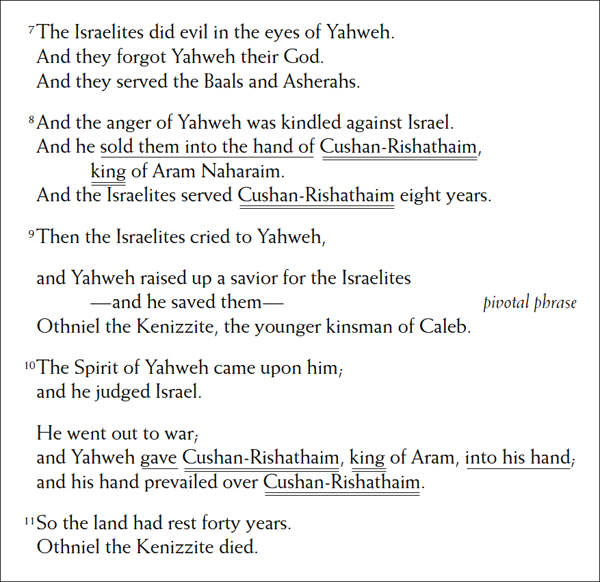
The introduction of Othniel13 is heightened by a number of items that are clear in the Hebrew text (obscured by the NIV translation; for each of these items see Fig. 1). (1) The name Cushan-Rishathaim is mentioned twice (v. 8) before the introduction of Othniel (v. 9), and then twice after Othniel’s introduction (v. 10). Thus the name serves a compositional function with wider thematic implications.14
7The Israelites did evil in the eyes of Yahweh.
And they forgot Yahweh their God.
And they served the Baals and Asherahs.
8And the anger of Yahweh was kindled against Israel.
And he sold them into the hand of Cushan-Rishathaim,
king of Aram Naharaim. |
And the Israelites served Cushan-Rishathaim eight years.
9Then the Israelites cried to Yahweh,
and Yahweh raised up a savior for the Israelites
—and he saved them— pivotal phrase
Othniel the Kenizzite, the younger kinsman of Caleb.
10The Spirit of Yahweh came upon him;
He went out to war;
and Yahweh gave Cushan-Rishathaim, king of Aram, into his hand;
and his hand prevailed over Cushan-Rishathaim.
11So the land had rest forty years.
Othniel the Kenizzite died. |
Figure 1
(2) Along these same lines, Cushan-Rishathaim is called a “king” (melek) twice: once before the introduction of Othniel and once afterward.15
(3) The NIV’s phrase “who saved them” (lit., “and he saved them”) is syntactically parenthetical and is centrally positioned. Thus, there is a purposed ambiguity: Is it Yahweh or Othniel who “saves” them? The implication is both. Obviously, Othniel is involved in saving Israel. But ultimately it is Yahweh who accomplishes this through Othniel.
(4) In the Hebrew text, there are precisely eight lines before the clause “and he saved them” and eight lines after it.16 This heightens the emphasis on the phrase and its implied double subject. Othniel works so in tandem with Yahweh that they merge together as one.
(5) The use of the verbal phrases “to sell into the hand”/“to give into the hand” are usually employed in the cyclic framework statements to describe Yahweh’s action of disciplining Israel through an oppressor (as also here in 3:8a). Only in the Othniel cycle is this phrase “to give into the hand” used to describe Yahweh’s delivering the oppressor into the hand of the judge. In this way, Othniel is uniquely described as accomplishing the complete reversal of Cushan-Rishathaim’s oppression.
The enemy that Othniel defeats is Cushan-Rishathaim, king of Aram Naharaim (for proposed identifications, see below). The name means “dark, doubly wicked!” and is clearly a pejorative (parents do not typically name their children such!).17 There seems to have been a play on words with his original name (and/or a title?), which may have sounded like “Cushan-Rishathaim.” The obvious implication is that he is evil, really bad—hence, the worst of the oppressors. The very name of this oppressor is used to invoke fear in the original readers’ minds.
In addition, according to the text, he comes from Aram Naharaim.18 Located in the area between the Euphrates and Habur rivers in northern Mesopotamia,19 this would make Cushan-Rishathaim the oppressor who comes the greatest distance to oppress Israel.20 Again this may underscore his severity. The Israelites, who choose to serve (ʿbd) foreign gods (3:7), are made to serve (ʿbd) a foreign tyrant (3:8). This type of retributive justice is noticed throughout the book (cf., e.g., 1:7).
But Othniel “overpowered him” (lit., “his hand was strong upon Cushan-Rishathaim”). This evinces the complete overwhelming of the foe. For Othniel, there is no need for deceptive stratagems, outside help, special vows, and so on. It is a simple, straightforward victory through the Spirit of Yahweh’s empowerment.
The lack of mention of any character flaw immediately alerts the reader to his model qualities. Many commentators have noted that the narrator writes nothing negative about this man. This appears to be intentional.21 O’Connell sums up this depiction as follows:
The characterization of Othniel is unique among the deliverer accounts in that his is the only portrayal that lacks negative aspects. Nothing is said in this account that could be construed as negatively characterizing Othniel’s motives or devotion to YHWH. Without exception, all the subsequent (non-Judahite) deliverers will evince some flaw of character that is paralleled, on an escalated level, by the negative portrayal of the deliverer’s tribe or nation.22
Therefore, Othniel appears as the paragon by which the other major or cyclical judges are assessed. He functions in the macrostructure of the cycles section as the “ideal” judge. It is important also to remember that this ideal judge is a non-Israelite in ethnic origin, though as a proselyte he counts within the tribe of Judah (as we are reminded in 1:13). Technically, Othniel, Acsah, and Caleb were Kenizzites who by faith commitment have been included in Israel—in particular, the tribe of Judah.23
In the larger narrative context, this short narrative about Othniel is set in direct contrast to the preceding Israelites who have taken Canaanite daughters to be their wives (3:6). Othniel has an “Israelite” wife, Acsah (previously introduced in 1:11–15), who served as his incentive for capturing Kiriath Sepher and who pressed her father for a field. As the daughter of Caleb, who acts with initiative for positive spiritual outcomes (see pp. 67–68 above), she elevates Othniel’s ideal judgeship.24 Again this is especially true when contrasted to the last major judge’s woman, Delilah.
There is a certain appropriateness that the first judge should be a Judahite. Judah was the first to go up to fight the Canaanites (1:1–2), and they had the best record against the Canaanites of any Israelite tribe (ch. 1). Thus the reader is not surprised by Yahweh’s choosing of Othniel. The confidence we feel at this point (even the workings of the divine mind are within our grasp) is going to be subtly transformed in subsequent episodes. There will be one surprise after the other. Things will turn out to be not as straightforward as the introduction and the Othniel episodes have led us to believe.
Finally, the identity of Cushan-Rishathaim is difficult and debated. Some of the proposals are:25 (1) Cushan-Rishathaim is Irsu from Egypt, a Semitic usurper described as a Syrian.26 (2) Cushan-Rishathaim is an otherwise unknown Cushan who came from Edom. Since Othniel was from the south country (Judah), some scholars have supposed that this threat came from Edom (Aram and Edom are easily confused in Hebrew, and in Hab. 3:7, Cushan appears in parallelism with Midian).27 (3) Cushan-Rishathaim is Tushratta, a king of Mitanni.28 (4) Cushan-Rishathaim is Artatama II, a Mitannian monarch.29 (5) Cushan-Rishathaim is Sharri Kushkh, a Hittite ruler of Carchemish.30 (6) Cushan-Rishathaim is the ruler of a group of displaced Hurrians seeking a new homeland rather than a foreign conqueror trying to enlarge his empire.31 The second proposal is the most popular in current scholarly literature.32
All of these proposals, however, are speculative. At the end of the day, we simply must admit that we do not know the identity of this individual. The problem is complicated because we lack enough chronological data in the book of Judges to accurately date the episode (see the introduction, pp. 24–25). It is also compounded by the fact that the name is a hebraized pejorative wordplay, which, without extrabiblical evidence, makes any attempt to analyze and identify the name enigmatic.
Bridging Contexts
PRELIMINARY COMMENTS. As one attempts to bridge the ancient context with the modern in the cycles section of the book of Judges, there are some essentials to keep in mind. (1) As a preliminary to the interpretation and application of each cycle, it is important to place the particular cycle under consideration within the larger macrostructure of the cycles section (see the introduction, pp. 34–37). This ensures that the cycle will be seen in its proper context within the downward spiral that is the moral movement of the cycles section. This will also ensure that the individual judges will be properly evaluated in relationship to one another in the larger context.
(2) Each cycle’s narrative works on two levels: a human plane and a divine plane. The story of the actions of the Israelites and the particular judge active in each cycle will contribute to the downward spiral observed in the cycles section. In these human actions there will be a level at which the text may be applied to the modern context. But there is also a level at which Yahweh is at work. Thus, there is a theme running throughout each individual cycle within the section, a theme of the glorification of Yahweh.33 In each instance, in spite of the growing human failure to obey and worship the Lord, God will act to save Israel, his people, and thus demonstrate his great compassion and grace to humankind. In other words, each cycle in some way reflects this glorification of God.
(3) Although the Othniel cycle is short and sterile, the portrait of this judge emerges in graphic clarity once its structural features are recognized. As the first major judge cycle, it gives a successful cycle, a demonstration of how it could be. While Othniel is a man of positive spiritual character, demonstrated earlier by his faith in Yahweh in the conquest of Debir (1:11–15), the narrative is more about Yahweh’s saving of Israel through Othniel than about who Othniel is. It is in this that he serves as an example of faith and godliness.
In other words, through this literary structuring more attention is drawn to Yahweh’s character than to the individual judge. This contributes greatly to the theme of Yahweh’s glorification. Yahweh is portrayed as justly subjecting the Israelites who served Baals and Asherahs (3:7b) to serving a foreign king, Cushan-Rishathaim (3:8b). When his people cry to him, Yahweh is further glorified by raising up a deliverer entirely on the basis of his compassion and not because of any repentance on the part of Israel. Moreover, Yahweh allows his Spirit to come on Othniel to judge Israel; finally, he gives Cushan-Rishathaim into Othniel’s hand. In no other cycle is Yahweh’s involvement so explicitly stated at every stage in the cycle. And in no other cycle will Yahweh’s glorification be so complete, for in every other cycle there will be something—or numerous things—that distract the reader from fully appreciating the glorification of Yahweh.
Othniel, the ideal judge. On the human level, Othniel evinces the kind of devotion and service of the Lord that results in this type of glorification of Yahweh. In a world where it is often difficult to find true godly role models, Othniel serves as a breath of fresh air. He is depicted in this capacity in a number of important facets.
(1) In the larger context Othniel is the antithesis of the Israelites who are marrying unbelieving Canaanites (3:5–6). He marries a believer, a godly woman, Acsah (1:13). This is important, for the influence of a marriage partner can be spiritually positive or detrimental. Both the Old and New Testaments contain clear injunctions for believers to marry believers, not unbelievers. This clear teaching of the law (esp. Deuteronomy) is certainly a tenet promoted in Judges.
(2) Othniel overcomes a background that might be considered limiting (he is a Kenizzite) in order to become the ideal judge of Israel. Not being biologically Israelite may be considered by some to marginalize an individual, preventing such a person from attaining certain ranks. But Yahweh promoted Othniel because of his faithfulness.
(3) Othniel overcomes the worst of the oppressors. As evil and intimidating as the enemy was (at the very least as the name reflects the apex of evil), Othniel trusts in Yahweh, who can overcome even the greatest of foes. Thus the narrative is an encouragement that God can overcome any problem that challenges his people.
(4) Othniel performs this deliverance in tandem with Yahweh; they act as one. This gives evidence that Othniel truly walks with God so that his action reflects God’s desired action. For the Christian, we are expected to walk in the light as he is in the light (1 John 1:7) so that we may have fellowship with one another and the blood of Christ, his Son, may purify us from all sin. In this way, we overcome the world (1 John 5:4–5).
Contemporary Significance
FOR THE TEN YEARS that I taught an undergraduate Old Testament literature class at LeTourneau University, I conducted an informal survey when we came to the book of Judges. I asked the students who among them had heard of “Samson”; there was an almost unanimous response of “yes.” When I followed up with the question who among them had heard of “Othniel,” only a few could answer “yes.” It is a great irony that the worst of the judges in moral character and success in delivering Israel is the best-known judge, while the ideal judge is the least known.
The Scriptures give numerous examples of men and women who walked with God, but Othniel stands out because of his simplicity. In spite of those things that might hold Christians back, Othniel serves as an example of one who was not limited by his background (Kenizzite). Background should not limit our service to Christ. No matter what human deficiencies, we can be faithful to God’s calling in our lives. In the book of Judges, besides possibly Joshua (Judg. 2:8), Othniel is the only male who is so positively pictured (i.e., walking with God so completely).34
In an age when many choose a different path, not uncommonly bringing on themselves oppression that is the result of sin (i.e., like a Cushan-Rishathaim), it is wonderful to see a model like Othniel who simply walks in tandem with God and overcomes evil. While it is inferential from the text, it is apparent that like any godly believer throughout the ages, Othniel loved his fellow Israelites. He could not stand by and watch them suffer. In other words, his motives were not self-seeking but others-seeking. He acted (and this is important to emphasize) in accordance with the Lord’s will—Yahweh raised up a “deliverer,” a “savior” (môšîaʿ ). If we walk with God and our eyes are on others’ needs rather than our own self-interests, we will want to act in accordance with God’s will. The simplicity and faithfulness of Othniel is in radical contrast to the complexity and self-gratification of the final judge of the book of Judges, Samson. The message is not that we “be an Othniel.” Rather, we should demonstrate faithfulness to God’s call for us, whatever that may be.
Ultimately, this initial judge serves to bring glory to God. While the human character is Othniel, this passage is not a biography about him.35 Instead, the human character highlights God’s involvement in the affairs of his people. In Othniel’s day God punished evil, had compassion on his people, and brought deliverance and rest; Othniel was simply God’s tool to accomplish that salvation. So too today, God still acts to punish evil, but he has compassion on his people and will bring deliverance and rest.