WHY SACRIFICE TIME on reading Leviticus? A graduate student at the Hebrew University of Jerusalem joined an elderly couple for evening worship. Continuing their faithful program of reading the Bible from cover to cover every year, the Palmers rapidly read through several chapters of Leviticus. When they had finished, eighty-year-old Mrs. Palmer reacted: “You know, sometimes when I read that book, I wonder what the Lord was up to. Did the Almighty get up on the wrong side of the bed?” The student responded: “It’s true, Leviticus does have some difficulties, but many of those hard-to-understand passages can be explained.” At this she lifted her hand and exclaimed: “No, don’t start giving us explanations; we’ll never get through!”1
So why would anyone want to read and understand Leviticus? If the present commentary were on the Psalms, the Gospel of John, or Paul’s letter to the Romans, or if it were directed primarily to a Jewish readership, we could skip that kind of question and nobody would notice. Leviticus for Christians, however, is another matter.
A commentary on Leviticus must explain convincingly why it is important that this biblical book should be read today. Unless this question is answered clearly and compellingly, people will not bother to penetrate to its full meaning for today.2
True, this book of twenty-seven chapters contains more direct speech by God himself than any other book of the Bible and it is placed at the heart of the Torah or Pentateuch (the five books of Moses), which forms the foundation for all of Scripture. So even though Leviticus is the shortest book of the Pentateuch, we get the impression that it should be important. However, aside from narratives in chapters 8–10 (consecration and inauguration of the sanctuary and its priesthood) and 24:10–23 (the blasphemer), and covenant blessings and curses in chapter 26, Leviticus consists of laws. Even the narratives contain divine laws embedded in them (10:8–11; 24:15–22), and the events described in chapters 8–10 are ritual ones closely related to the sacrificial procedures prescribed in laws of the previous chapters (chs. 1–7).
What do laws addressed to an ancient, obsolete culture have for modern Christians?3 Ritual laws, which take up much of Leviticus, are particularly challenging because they were designed to regulate a worship system that is foreign to us. Their meanings are not obvious to us, and explanations provided by the biblical text are few and cryptic. Instructions for sacrifices, which involve slaughtering animals for no apparent practical purpose, include a lot of details that can be tedious and gory to readers who are not butchers, veterinarians, or biologists. Even if we wanted to observe or participate in such rituals, we cannot because the Israelite sanctuary/temple and its Aaronic priesthood are gone.
If we take the New Testament seriously, it is worthwhile to pause and reconsider our attitude toward Leviticus. For one thing, in 2 Timothy 3:16 the apostle Paul writes: “All Scripture is God-breathed and is useful for teaching, rebuking, correcting and training in righteousness” (emphasis supplied). For Paul “all Scripture” certainly included Leviticus. More specifically, the fact that the New Testament refers to the Old Testament ritual system in order to explain what Christ has accomplished and is continuing to accomplish indicates that knowledge of the rituals should be helpful, and may even be indispensable, for comprehending the richness of salvation through Christ (e.g. Luke 24:27; 1 Cor. 5:7; 15:20; Heb. 7–10; Rev. 4–5).
Linkage between the Old and New Testaments includes the fact that Israelite ritual bathing and celebration of the Passover formed the basis for Christian baptism and the Lord’s Supper/Communion. So by grasping the meanings of the earlier practices, we enhance comprehension of our own rituals.
The fact that Christ’s death on the cross, as described in the Gospels, was so much more painful than the animal sacrifices (cf. Isa. 52:14) indicates that the latter were mitigated and relatively humane “shadows.” There had to be blood to make the point (Heb. 9:22), but it was obtained with a minimum of suffering by slitting the throat of an animal so that it would quickly go unconscious from loss of blood.4 Apparently nothing short of this kind of disturbingly graphic procedure could adequately impress on ancient people the eternal death-and-life consequences of sin and of salvation through a single sacrificial transaction that had not yet occurred (cf. Rom. 6:23).
As shadows/prototypes, the ancient sacrifices that were necessarily repeated many times and were officiated by faulty priests could not really take away sins (Heb. 10:1–4). However, because they were performed on earth, where people could experience them by participation, they served a useful purpose as dramatic illustrations. No single kind of sacrifice could adequately prefigure the richness of Christ’s sacrifice, just as no single picture in an anatomy and physiology textbook can capture the full complexity of a living organism. Although each kind of sacrifice is an inadequate illustration, this very inadequacy benefits us by breaking down the complexity so that we can grasp one aspect at a time.
So why not skip Leviticus and jump to the “real thing” in the New Testament? An analogous question provides some perspective: Why should a medical student spend time with distorted, analyzed, two-dimensional pictures, diagrams, and explanations in an anatomy and physiology textbook when real, living human bodies are available for examination? The answer is that the textbook teaches the budding physician what on earth he or she is looking at when confronted with the real thing. Similarly, we need Leviticus as a textbook so that when we encounter Christ’s sacrifice, we can gain the full impact.
We will find that the animal sacrifices were God’s “altar calls,” symbolizing the way he relentlessly extends mercy with justice to faulty people. These rituals revealed his loving character and his desire for restoration and maintenance of intimate interaction with those whom he claimed as his own. While the ritual worship and theocratic civil institutions of ancient Israel are long gone, the God revealed by them remains the same. Herein lies the precious, timeless significance of Leviticus for twenty-first-century Christians.
The laws of Leviticus were not isolated from practical human experience. Rather, their details were given in the context of a grand story that recounts Israel’s formation from an oppressed group of slaves to a powerful “kingdom of priests and a holy nation” (Ex. 19:6), among whom the deity dwelt (25:8). Divine laws addressed real life and were intended to shape its destiny with God. In this sense each law is a kind of distilled story.
Through Leviticus we can learn what God is like in relation to ourselves and how we can effectively interact with him across the boundary between the seen and unseen spheres. While our modern situation is outwardly different from that of the Israelites in significant respects, we too can participate in transactions with God (through prayer rather than sacrifice) and profit from their experience because it parallels our own on a deeper level: The Lord continues to deliver us from slavery (to sin) and transforms us into “a chosen people, a royal priesthood, a holy nation, a people belonging to God” (1 Peter 2:9) so that he can dwell with us and be our God (Rev. 21:3).
Although laws in Leviticus designed to protect and enhance divine-human and human-human relations outside worship are routinely dismissed as Mosaic civil legislation that served only the Israelite theocracy, they encapsulate timeless and valuable principles. Many of them exemplify subprinciples of the foundational principle of love, which underlies the moral/ethical Ten Commandments (Ex. 20; Deut. 5; cf. Matt. 22:36–40; Rom. 13:8–10). It is true that the “civil” laws of Leviticus (in Lev. 18–20; 24–25), like those of other Pentateuchal books (e.g., in Ex. 21–23; Num. 35; Deut. 15; 17; 19–25), are clothed in the garb of an ancient culture and its judicial system. Nevertheless, without succumbing to legalistic “oughtism,” we can gain the practical benefit of observing them to the extent that their principles can be applied in our own life situations.5
Of course, discovering new principles threatens our status quo, especially when they are introduced as “Thus saith the Lord.” We pay human physicians to interfere with our lifestyles and counselors to help us adjust our relationships, but when our Creator gives us prescriptions and counsel free of charge, we tend to resent his meddling and to regard our accountability as a kind of “guilt trip.” The truth is, our responsibility to him is simultaneously accountability to ourselves, because his instructions are based on cause and effect, like the Surgeon General’s recommendations for good diet and exercise and warnings against smoking. Ignorance is as blissful as undiagnosed cancer.
Leviticus is not welcome in an environment of feel-good, self-help, “cafeteria-style” religion. Nor are other parts of the Bible. George Barna explains why not:
In the last quarter-century it seems that we have learned how to sell Bibles but not how to sell what’s in the Bible. Increasingly, people pick and choose the Bible content they like or feel comfortable with, but ignore the rest of God’s counsel. This tendency seems especially prolific among young adults and teenagers. What can we do to elevate the prominence, credibility, and perceived value of God’s Word in the eyes of a fickle and distracted public?6
Nothing I say here about the healing relevance of Leviticus for the lives of modern Christians can compare with the searing experience of Minnie Warburton, a victim of abuse as a child, who found cleansing and vindication in the incest laws of Leviticus 18.7 Nor are my words anything like the remarkable report of Rob Bell, pastor of the Mars Hill Bible Church in Grandville, Michigan, which he planted in February of 1999 to reach unchurched and disillusioned people in Grand Rapids. To ensure that any success the church enjoyed would be due to the power of God rather than simply human resources, and to demonstrate that every part of the Bible—even Leviticus—is for today, Bell spent the first year preaching through Leviticus verse by verse. He says:
Why start a church with Leviticus? Why not a series on relationships or finding peace? That would be a safer approach. Leviticus cannot be tamed. Its imagery is too wild. We ventured into its lair and let it devour us, trusting that God would deliver us with a truer picture of his Son.
. . . We discovered that the Bible is an organic whole: these concepts do connect, these images do make sense. For the first time, many in our congregation began to realize, this story is my story. These people are my people. This God is my God.8
It turned out that Leviticus was surprisingly effective because it met the needs of contemporary people for visual imagery, grappling with tough questions and a sense of community. Even more important, it awakened in those who previously had no belief in God a need for salvation through his Son.
The response has been exuberant. After a high school football game, a man called out to Rob, “Hey, Pastor! Leviticus is turning our world upside down. We’re rocked to the core.” Then two high school kids caught up with him, saying, “We’ve been talking about what you said. That was awesome! Can’t wait for Sunday. See ya!” So what did Bell start preaching after he finished Leviticus? The book of Numbers, of course!9
Authorship
WHO IS THE author of Leviticus? It depends what you mean. If you are referring to the source of the ideas, most of the book (the legislation) is presented as a series of speeches by the Lord. So in this sense God is the primary author. Whether or not you believe it is up to you, of course, but this is what Leviticus claims.
If you are thinking of the human author, Leviticus consistently maintains that the chief recipient and transmitter of its divine speeches was Moses, so it can be regarded as coauthored. The bibliographic reference could read:
God and Moses, Leviticus. Sinai: Israel Publications, second millennium B.C.
Again, this is a matter of belief. Mosaic authorship at this level goes with divine authorship. For Christians it is significant that the New Testament, including direct speech of Jesus, refers to legislation in Leviticus as authoritative and from Moses.10
If you mean the person(s) who actually wrote down the words of Leviticus, the book is—strictly speaking—anonymous. If you believe other Pentateuchal passages that speak of Moses as writing messages from the Lord (Ex. 17:14; 24:4; 34:27; Deut. 31:9), you can allow for the possibility or even probability that Moses similarly recorded the divine speeches that form the bulk of Leviticus. In Jewish tradition, accepted by Christian interpreters until modern times, Moses is the human author (including the writer) of Leviticus.
Contributions to the Pentateuch by persons other than Moses would in no way invalidate his central, monumental contribution to the Torah or diminish its inspiration.11 As Joseph ben Eliezer Bonfils (second half of the fourteenth century A.D.) said regarding Ibn Ezra’s comment on Genesis 12:6, “what difference does it make whether Moses or some other prophet wrote it since the words of all of them are truth and were received by prophecy?”12 Similarly, the apostle Paul did not distinguish between the inspiration and authority of primary and secondary authors/editors—“All Scripture is God-breathed” (2 Tim. 3:16). It is the divine authorship that is crucial. While we can acknowledge what Leviticus says about itself in terms of basic divine-Mosaic origin, we do not know how it reached its final form, who was involved in the writing-editing process, or how long this took (during Moses’ lifetime? into the monarchy? completed by Ezra?) because no hard evidence regarding these questions has come to light.
Methodology
WHAT IS A fruitful methodology for studying Leviticus? Modern interpreters generally seek to understand the plain sense of Leviticus rather than to engage in the allegorical, spiritualizing, mystical, or midrashic modes of exposition practiced centuries ago.13 Since the same text is the starting point for every investigation, scholars agree on many aspects. Nevertheless, it is surprising that conclusions derived from the plain sense are as divergent as they are.
Perhaps the most powerful factors behind lack of agreement among Leviticus scholars are differences of opinion regarding the authorship and audience of the book.14 What was the worldview of the author (or group of authors), as shaped by his historical context? What audience and situations(s) did he intend to address? What did he intend to accomplish? The answers to such questions are significant for gaining the full message of any literary production. Without them, for example, we could read Gulliver’s Travels purely as entertainment and miss the level of political satire that was Jonathan Swift’s primary motivation. What would we make of The Screwtape Letters if we lacked the preface by C. S. Lewis?
Looking at Leviticus in terms of what it says about itself within the canonical context of the Pentateuch, God through Moses addressed a neonatal nation of freshly liberated slaves in the Sinai Desert sometime during the latter half of the second millennium B.C. In this light, the initial purpose of the book was to establish and maintain enduring patterns of divine-human and human-human interaction that are appropriate and necessary for a holy tribal community centered in the divine Presence.
Once we have a provisional grasp of the overall historical setting and purpose, we can gain a more coherent, detailed, and nuanced comprehension of the message that Leviticus was designed to convey to an ancient audience by exploring various aspects of the text: rhetorical and thematic structure; (Hebrew) grammatical, syntactic, and semantic indicators; and the historical, literary, and cultural context within the ancient Near East.
It is an exciting time to study Leviticus. Tools and data are rapidly expanding. Powerful Bible software programs, such as Accordance, facilitate a close reading of the biblical text, intratextual or intertextual comparisons, and the exhilarating joy of discovery through “surfing” the Bible. Fresh methodologies, such as that of anthropologist Mary Douglas, are helping scholars view old texts and problems from new angles. Meanwhile, archaeology and related disciplines continue to feed us ancient Near Eastern material culture and texts that shed light on ancient religion, language, law, and lifestyle that is relevant to Leviticus.
In our quest for original meaning, we can discover underlying dynamics, themes, and principles that are exemplified with reference to, but not dependent on, the original target culture. With these bridging contexts as a kind of template, we can faithfully apply the contours of the book’s message to our twenty-first-century century A.D. life situation so that we arrive at contemporary significance.
If the message of Leviticus is from God, as it claims and as Jesus believed it to be, its impact is transformational. It cannot remain in the study but must be unleashed into the rest of the life. As Jesus said, “Blessed rather are those who hear the word of God and obey it” (Luke 11:28). The Moses portrayed in Leviticus would certainly approve of approaching this book with the questions: What does the Word of God say to me? How can I obey it? After bridging the contexts and exploring contemporary significance, we should then step outside the pages of this commentary into contemporary action.
WHAT ARE THE structure and themes of Leviticus? Our first question must be: Of what does Leviticus consist? Is it a self-standing book, or is it part of a larger whole? If the latter, how do we know where it begins and ends? We will find that Leviticus is structurally and thematically linked to the preceding book of Exodus, continuing Israel’s experience with God from the point where divine communication comes from the tabernacle inside the desert camp rather than from Mount Sinai outside it (see comments on Lev. 1:1). We will discover that Leviticus ends when Numbers 1 resumes the account of Israel’s journey with a date formula that is followed by organization of the community in preparation for conquering Canaan.
Between preparations for the worship system through construction of the tabernacle in Exodus and resumption of the march toward the Promised Land in Numbers, Leviticus fills a crucial niche in an ongoing process: constitution of the core values and practices that make the Israelites one holy nation not only under God, but also with his holy Presence in their midst. Thus Leviticus is located at the structural and conceptual heart of the Pentateuch as its third book,15 a separate unit but also part of a cumulative development that depends on Exodus and paves the way for Numbers.16
“Leviticus,” the LXX name of the book, is not primarily about the Levites. Indeed the book of Numbers tells us more about the tribe of Levi as a whole. Leviticus is not even primarily about the Aaronic priests, who belonged to the tribe of Levi. Rather, it is about God’s call to a life of holiness in relation to himself and other members of the community of faith, introduced with the words: “The LORD called to Moses and spoke to him from the Tent of Meeting” (Lev. 1:1). Appropriately, this opening has provided the Hebrew name of the book: wayyiqraʾ, “Then he [Yahweh] called. . . .”
In Leviticus, as in countless other works, literary structure highlights themes,17 and structure can legitimately be found on more than one level. A strong case can be made for the structural centrality of chapter 16, both because it contains the middle divine speech18 and because its culmination of ritual matters (chs. 1–16) paves the way for laws on holy living to be observed by a morally cleansed community (chs. 17–27).19
W. Shea has proposed that the overall structure of Leviticus is a large chiasm or introversion in chapters 1–25 with chapter 16 at its center, followed by concluding chapters (chs. 26–27). This approach is instructive even though Shea recognizes that it does not neatly account for everything, most notably placement of the blasphemer narrative in 24:10–23:20
Cultic legislation (chs. 1–7)
Priestly history (chs. 8–10)
Personal laws of uncleanness (chs. 11–15)
Day of Atonement (ch. 16)
Personal moral laws (chs. 17–20)
Priestly legislation (chs. 21–22)
Cultic legislation (chs. 23–25, except history in 24:10–23)
Conclusion (chs. 26–27)
J. H. Walton acknowledges that chapter 16 plays an important role, but he views the structure of Leviticus from the angle of preserving the sanctity of sacred space, which is divided into a series of zones. These zones move outward from the place of God’s Presence at the sanctuary: holy of holies, holy place (outer sanctum), courtyard, camp, and outside the camp.
. . . Leviticus deals with issues of equilibrium zone by zone as it speaks of space, status and time, and the qualifications and procedures associated with each. Chapters 1–23 concern equilibrium relative to deity, and chaps. 24–27 concern equilibrium relative to Israel.21
| Divine Equilibrium | |
|---|---|
| Equilibrium of Sacred Space: Maintenance Procedures and Qualifications | |
Chs. 1–7 | Sacrifices to maintain the holiest center zone |
Chs. 8–10 | Priests set up to maintain enclosure zone |
Chs. 11–15 | Purity regulations to maintain the camp zone |
Yom Kippur (Day of Atonement), which resets the holiness of the entire sacred compass annually | |
Ch. 17 | Maintaining holiness from outside the camp |
| Equilibrium of Sacred Space: Disqualifications from Sacred Space | |
Chs. 18–20 | Disqualification of people from the camp |
Chs. 21–22a | Disqualification of priests from the enclosure |
Ch. 22b | Disqualification of animals for use in the center |
| Equilibrium of Sacred Times | |
Ch. 23 | Sacred festivals |
| Human Equilibrium | |
Ch. 24a | Human equilibrium in sacred space (center zone) |
Ch. 24b | Human equilibrium in status (in the camp) |
Ch. 25 | Human equilibrium in setting times (outside the camp) |
Ch. 26 | Establishing or disrupting equilibrium across the zones |
Ch. 27 | Sacred objects vowed to the Lord (movement through zones)22 |
By emphasizing sacred space in this way, Walton offers healthy balance to the Christian preoccupation with viewing Leviticus in terms of soteriology (study of salvation) that is concerned with a person’s status in regard to sin.23 We will find that Leviticus has plenty to say about remedies for sin, and soteriological issues are profoundly illuminated by restoration of sacred space that is defined with reference to God (see esp. comments on chs. 4 and 16). However, Leviticus is primarily about the Presence and character of God in relation to his people and only secondarily concerned with sin, which interferes with the divine-human relationship.
Notice that Walton sees a transition from chapters 1–17 to chapter 18 and following, but not a drastic break that divides Leviticus, according to the old scholarly consensus, into a bipartite structure consisting of Priestly Torah (“P”: chs. 1–16/17) and Holiness Code (“H”: chs. 17/18–26/27). Chapters 1–17 concentrate on ritual matters, including sacrifices and ritual purity. Even sexuality is treated from a ritual viewpoint (chs. 12; 15). Chapter 18, however, focuses on moral/ethical aspects of sexuality: sexual unions that the Lord forbids. This emphasis on the moral holiness of all Israelites living in God’s land, combined with exhortations to obey his commands (18:2–5, 24–30) and repeated identification of the divine authority behind the legislation—“I am the LORD (your God)” (vv. 2, 4, 5, 6, 21, 30)—are the hallmarks of the following chapters.
Although chapter 18 introduces a shift in emphasis, this is not the first time that moral concerns have surfaced. In chapter 4 the purification offering expiates for inadvertent violation of any of God’s prohibitive commandments (v.2), which would include ethical ones. In 6:1–7 (Heb. 5:20–26) wronging another person through a false oath requires a reparation offering. Here again, a ritual remedy can address an ethical wrong.24
Further contributing to cohesion between the earlier part of the book and chapter 18 is 11:44–45:
I am the LORD your God; consecrate yourselves and be holy, because I am holy. Do not make yourselves unclean by any creature that moves about on the ground. I am the LORD who brought you up out of Egypt to be your God; therefore be holy, because I am holy.
Here the Lord elevates what would otherwise be merely a mundane aspect of Israelite daily life (i.e., diet) into a matter of sacred significance that is relevant to maintaining harmony with their holy Deliverer. Notice the repeated self-identifications: “I am the LORD your God” (11:44) and “I am the LORD” (v.45). Aside from these two verses, all instances of this formula appear in chapters 18–26. Because of the close affinity between 11:44–45 and the later “holiness” portions of Leviticus, some scholars hold that it is an “H” (“Holiness”) interpolation.25 But whatever the prehistory of the passage may be, in the present form of the text, chapters 18–26 expand on this robust conceptual kernel.
M. Douglas has offered the fascinating proposal that Leviticus is a “ring composition” like that found in the Greek classics.26 This is a literary device
by which the conclusion of a speech or digression and the return to the main flow of the narrative was indicated with some verbal reminiscence of its beginning. Such verbal and thematic echoes . . . were developed over the centuries into a powerful means for securing both unity and intensity in narrative.27
For Douglas, the central turning point of Leviticus is chapter 19 (see bottom of diagram, below), rather than chapter 16. The tipoff that chapter 19 is in the middle of some kind of structure is the close parallel between chapters 18 and 20, which frame it on either side with laws regarding sexuality and Molech worship. Douglas outlines the scheme of the book as follows:28
Second turn, | ||
Latch (ch. 27) | ||
Exposition | Beginning of the Ending | |
(chs 8–10) | (chs. 21–22) | |
(chs. 11–17) | ||
(ch. 18) |
| (ch. 20) |
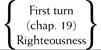
The central structural position of chapter 19 focuses attention on the astounding depth of its teaching with regard to the nature of holiness, which is the overarching theme of the entire book.29 Following the introduction to divine speech addressed to all Israelites, the “theme command” in verse 2 echoes the call of 11:44–45 to emulate divine holiness. The rest of chapter 19 consists of instructions for preserving divine-human and human-human relationships. The connection is obvious: The way God expects his people to be holy as he is holy is by leading holy lives that are in harmony with his relational character. While it is not possible to cover every facet of life in a limited series of laws, the variety of examples provided here emphasizes the comprehensive scope of practical holiness.
While love as the underlying principle of holy living is implied throughout Leviticus 19, it surfaces in verse 18b as the middle injunction of this chapter of 37 verses: “Love your neighbor as yourself.” So love is at the heart of Leviticus 19, a pivotal chapter of Leviticus, the central book of the Torah (Pentateuch),30 which is the foundation of Scripture (cf. Matt. 22:36–40)!
Obviously any outline of the literary structure of Leviticus is a scholarly abstraction that is limited at best. Rather than pitting the various proposals against each other, the most useful approach is to recognize them for what they are and learn from them regarding complementary aspects of holiness, which reach ritual and ethical high points in the twin peaks of chapters 16 and 19.
Like Shea’s proposal, my own tentative outline of the book (see in detail below) has seven sections, of which the fourth/middle one is chapter 16. My first four sections coincide with his, but the last three, which extend holiness to all aspects of Israelite life, do not:
I. Sacrificial Worship (chs. 1–7)
II. Description of Ceremonies That Founded the Ritual System (chs. 8–10)
III. Purity Versus Impurity (chs. 11–15)
IV. Purgation of Sanctuary and Camp on Day of Atonement (ch. 16)
V. Holy (Sacrificial) Slaughter (ch. 17)
VI. Community Holiness (chs. 18–20)
VII. Special Holy Entities (chs. 21–27)
Within the sixth section, chapters 18 and 20 frame chapter 19 and thereby highlight its importance (see above):
VI. Community Holiness (chs. 18–20)
Sexuality (ch. 18)
Comprehensive Life of Holiness (ch. 19)
Terminal Penalties for Inexpiable Offenses, Including Sexual Ones (ch. 20)
The seventh section deals with a series of eight holy entities, with the central positions occupied by the light and bread of the sanctuary’s outer sanctum (24:1–9) and the divine name of the deity (24:10–23), whose Presence resides in the inner sanctum. Notice that this section integrates the problematic blasphemer unit (24:10–23) and chapter 27, which has generally been regarded as an appendix tacked on after the real conclusion of the book with the covenant blessings and curses in chapter 26.
VII. Special Holy Entities (chaps. 21–27)
A. Holy Priests (21:1–24)
B. Holy Offerings (22:1–33)
C. Holy Times (23:1–44)
D. Holy Light and Bread (24:1–9)
E. Holy Divine Name (24:10–23)
F. Holy Land (25:1–55)
G. Holy Covenant (26:1–46)
H. Holy Consecrations and Redemption of Them (27:1–34)