Original Meaning
Preparatory Activities (16:1–10)
LET’S LOOK AT THE EVENTS of the Day of Purgation more closely. To prepare for special interaction with God in the inner sanctum, the high priest did not merely rinse his hands and feet with water drawn from the holy basin, as he was required to do before entering the outer sanctum or officiating at the altar in the court (cf. Ex. 30:18–21). Rather, he bathed his entire body. Then he donned sacred linen garments reserved for this occasion (Lev. 16:4). Designation of these clothes as holy agrees with the fact that elsewhere, heavenly angels are described as clad in linen (Ezek. 9:2–3, 11; 10:2; Dan. 10:5; 12:6–7). Once the high priest was ready and the required animals were assembled in the courtyard of the sanctuary, he performed a unique preparatory casting of lots to determine the respective ritual roles of two goats provided by the people.
Bridging Contexts
REVERSAL. THE ISRAELITE SYSTEM of purification offerings has presented us with three pieces of a puzzle. (1) “Outer altar” and “outer sanctum” purification offerings throughout the year had the goal of expiating/removing (kipper) sins and severe ritual impurities from (privative min) those who offered them at the sanctuary so that they could be forgiven (Niphal of slḥ) by the Lord (see comments on Lev. 4).
(2) Purification offerings throughout the year were already carrying the contamination from their offerers when the animal blood was applied to the outer altar or outer sanctum and the suet/fat was put on the outer altar (see comments on 6:27–28).
(3) Once a year the high priest expiates/purges (kipper) out the ritual impurities, transgressions, and all (kol) the sins that are in the sanctuary (16:16), and expels all (kol) of the Israelites’ moral faults into the desert (16:21–22). As a result of the sanctuary’s purgation, Israelites are purified (verb ṭhr) from their sins (16:30; cf. v. 34). Thus, uniquely for purification offerings, the goal of such sacrifices for the people on the Day of Purgation is moral purification beyond forgiveness, not moral expiation prior to forgiveness or physical ritual purification.19
Contrary to widespread misconception dating as early as the Second Temple period, none of the rituals unique to the Day of Purgation lead to forgiveness at all.20 The root slḥ (“forgive”) does not appear once in Leviticus 16 or any other passage that has to do with the Day of Purgation (cf. 23:26–32; 25:9–10; Num. 29:7–11).21 Thus, unlike the purification offerings that remedy moral faults throughout the year (Lev. 4–5, etc.), the special sacrifices on the Day of Purgation that primarily accomplish purification of the sanctuary and secondarily achieve the moral cleansing of God’s people are not prerequisite to direct divine forgiveness.
It doesn’t take a rocket scientist to fit the pieces of the puzzle together in their proper places. Each expiable evil was treated in two major stages of ritual expiation/purgation (kipper).
Stage 1: Throughout the year purification offerings removed evils from their offerers and left those evils at the sanctuary, where they accumulated. Thus, the evils were moving into the sanctuary. This stage resulted in forgiveness (slḥ) or physical cleansing (ṭhr) for the offerer.
Stage 2: On the yearly “Day of Purgation,” special purification offerings removed from the sanctuary and camp the evils that had accumulated in the sanctuary throughout the year. This stage resulted in moral cleansing (ṭhr) for the Israelites.
The overall contour is a dramatic reversal in the flow of evil. What goes in must come out! Whereas the Lord uniquely and paradoxically frees human beings from impurities and sins by allowing these evils to penetrate his holy domain through purification offerings, he then turns the evils around by “the purification offering of purgation,” sends them away, and gets rid of them forever.
The reversal of evil experienced by God is necessitated by his provision for the much smaller reversals in the lives of his individual people. Sin and death, represented by ritual impurity, have spread to each person (cf. Rom. 5:12). However, most holy purification offerings absorbed sins and impurities from them. These rituals found fulfillment in our most holy Purification Offering (John 1:29), who paradoxically allowed sin and death to penetrate him (2 Cor. 5:21) so that he can cleanse these evils out of those who accept his sacrifice: “If we confess our sins, he is faithful and just and will forgive us our sins and purify us from all unrighteousness” (1 John 1:9, emphasis added).
Reversal in two stages of expiation/purgation (kipper) into and then out of the sanctuary is confirmed by comparing the order of activities in “outer sanctum” purification offerings (Lev. 4:3–21) with that of the yearly “purification offering of purgation” (16:11–19, 25, 27–28).22 During the “outer sanctum” sacrifices of the high priest (4:3–12) and the whole community (4:13–21), the high priest was to apply blood to the sanctuary as follows: (1) Sprinkle blood seven times in front of the veil (4:6, 17), that is, within the main area of the outer sanctum and in front of the incense altar (see comments on ch. 4); (2) daub blood on the horns of the incense altar (4:7, 18). Thus, the order of blood applications required the high priest to move toward the ark, above which the divine Presence was located (see diagram and comments in ch. 4). Such purification offerings throughout the year carried sin from their offerers and into the sanctuary.
In contrast to the direction of “outer sanctum” sacrifices, the yearly “purification offering of purgation” on the Day of Purgation/Atonement was designed to purge the sanctuary from the inside out: inner sanctum → outer sanctum → outer altar. Within each of these three areas, the high priest was to apply blood in places that progressively moved away from the ark (16:14–16, 18–19):
1. Ark cover (sprinkling 1×).
2. In front of ark cover (sprinkling 7×).
3. Incense altar (daubing 1× on horns).
4. In front of incense altar (sprinkling 7×).
5. Outer altar (daubing 1× on horns).
6. Outer altar (sprinkling 7×).
The Israelite System
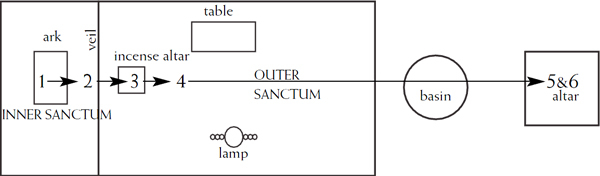
Reversal. The Israelite system of purification offerings has presented us with three pieces of a puzzle.
This outward direction makes perfect sense for the “housecleaning job” that it is.23 Anyone who has swept a room knows that you clean from the inside out.
The idea that evils were moving into the sanctuary throughout the year and then out of it on the Day of Purgation explains why assistants who incinerated carcasses of “outer sanctum” purification offerings needed no ablutions (4:11–12, 21), but one who performed the same task with “the purification offering of purgation” had to launder his clothes and bathe (16:27–28). Only in the latter case did the carcasses function as “ritual sponges” for removing evil from the sanctuary. By contrast, “outer sanctum” sacrifices moved sin from the offerer and into the sanctuary.
Tracking. The two stages of expiation/purgation (kipper) affected several evils. Because these evils possessed different properties, they followed different trajectories in relation to the two stages. By tracking their movements, as radar tracks the courses of various kinds of aircraft, we can learn more about these evils and the stages of expiation/purgation that influence their paths.24
Leviticus 16:16, 21 use four terms for evil: ṭumeʾah (“impurity”), pešaʿ (“transgression), ḥaṭṭaʾt (“sin”), and ʿawon (“iniquity/culpability”). The last three of these terms, which denote moral faults, can be used synonymously or at least with overlapping meaning elsewhere in the Hebrew Bible (e.g., Ex. 34:7; Ps. 32:1–2, 5; Dan. 9:24). Therefore, interpreters of Leviticus 16:16, 21 have generally regarded these terms as lumped together to emphasize comprehensive treatment of sin, with at least two of them overlapping in meaning.25 However, by tracking the terms through Leviticus, we find that their usage is more precise in this book. Each term refers to a distinct category of evil:
• ṭumeʾah (“impurity”) is removed from offerers by purification offerings throughout the year (14:19; 15:30; cf. 12:7–8; 15:15) and then purged from the sanctuary on the Day of Purgation (16:16).
• pešaʿ (“transgression) is purged from the sanctuary and camp on the Day of Purgation (16:16, 21).
• ḥaṭṭaʾt (“sin”) is removed from offerers by purification offerings throughout the year (e.g., 4:26; 5:6, 10) and then purged from the sanctuary and camp on the Day of Purgation (16:16, 21), as a result of which it is secondarily purged from the people (16:30, 34).
• ʿawon (“iniquity”) is removed from offerers by purification offerings throughout the year (5:1, 6), borne by priests (10:17), and then purged from the camp on the Day of Purgation (16:21).
Term for evil | Stage 1: Throughout year | Stage 2: Day of Purgation |
Expiated from offerer (Lev. 4–5, 12, 14, 15) | Borne by priests (10:17) | Purged from sanctuary (16:16) | Purged from camp (16:21) | Purged from people (16:30, 34) |
ṭumeʾah (“impurity”) | × | | × | | |
pešaʿ (“transgression”) | | × | × | × | |
ḅaṭṭaʾt (“sin”) | × | | × | × | × |
ʿawon (“iniquity”) | × | | | × | |
Here is what our “radar screen” looks like: We can see at a glance that each term for evil follows a different trajectory according to its nature. (1) While ṭumeʾah (“impurity”) is removed at the sanctuary by purification offerings and therefore must be purged from the sanctuary on the Day of Purgation, it does not need to be borne by the priests or purged from the camp and people on the Day of Purgation because it is not moral fault. In Pentateuchal law, ṭumeʾah is only physical ritual impurity.26
(2) Pešaʿ (“transgression) is moral fault that somehow gets into the sanctuary so that it must be purged from it and from the camp on the Day of Purgation, but it does not reach the sanctuary via purification offerings throughout the year. We have not seen and will not see this term in connection with any kind of expiation throughout the year. In fact, pešaʿ appears only in Leviticus 16:16, 21 in all of Pentateuchal ritual law. Because this kind of sin is not expiated from the transgressor at Stage 1, it cannot be purged from the people who committed such sins at Stage 2 on the Day of Purgation, just as you can’t get a Ph.D. without a prerequisite Master’s degree or its equivalent. The transgression remains on the sinner, who must suffer the consequences.
The trajectory of pešaʿ matches the grave offenses of Molech worship (Lev. 20:3) and wanton neglect to have oneself purified from corpse contamination (Num. 19:13, 20), which automatically defile the sanctuary when they are committed, but for which the sinners are “cut off” without eligibility for expiation through sacrifice (see comments on 20:3).27
The seriousness of these offenses in breaking the divine/human relationship agrees with the fact that the verb from the same root pšʿ means “rebel,” that is, cast off allegiance, whether against God (Isa. 1:2; 43:27; Jer. 2:8; 33:8) or an earthly overlord (1 Kings 12:19; 2 Kings 1:1; 3:5, 7; 8:20, 22). Outside the Israelite sacrificial system the Lord could save people from their pešaʿ sins if they repented (e.g., Ex. 34:7; Num. 14:18),28 but this mercy was granted directly by God and transcended the possibilities for reconciliation that he offered through rituals.29
(3) Elsewhere in the Bible ḥaṭṭaʾt (“sin”) can describe grave sins for which no sacrificial expiation would be available if the ritual system were operating (Gen. 4:7; 18:20; 50:17; Ex. 32:30, 32, 34). However, in Pentateuchal ritual law (not including Lev. 26:18, 21, 24, 28), this term is restricted to moral faults for which the sinners can receive the benefit of expiation through sacrifice. These include inadvertent sins (e.g., 4:3, 14, 23, 26, 28), forgetting to perform a duty to the Lord (5:2–4, 6), and some deliberate sins (5:1, 6; Num. 5:6–7; cf. Lev. 6:2–4), but exclude sins committed “high-handedly,” that is, defiantly (Num. 15:30–31; cf. vv. 22–29). The fact that in Leviticus 1–16 ḥaṭṭaʾt means “expiable sin” is in harmony with the fact that it is removed from the offerer in Stage 1 and from the sanctuary, camp, and people in Stage 2. However, it is not borne by the priests; it only affects the sanctuary in the form of defilement.
(4) In the Hebrew Bible, ʿawon (“iniquity”) can refer to any part of the process of wrongful act → blame → punishment, whether the act is intentional or not.30 However, in Leviticus 1–16 its usage is restricted to blame in the sense of “culpability,” that is, liability to punishment that the sinner must bear (Qal of nśʾ; 5:1, 17; 7:18) unless/until it is transferred to an officiating priest through a purification offering, who bears (nśʾ ) it (10:17),31 presumably until it is borne (nśʾ ) out of the camp by the live goat on the Day of Purgation (16:21–22).32 It is important to recognize that in Leviticus 1–16 ʿawon (“iniquity/culpability”) arises from an act of ḥaṭṭaʾt (“expiable sin”), rather than from a separate wrongful act. This is clear in 5:1, 5–6, where a witness who commits a sin (verb and noun from the root ḥṭʾ ) bears his ḥaṭṭaʾt as a consequence until he or she receives expiation (cf. 5:17; Ps. 32:5).
By following the movements of the four terms for evil, we have arrived at a more precise understanding of them: ṭumeʾah (“physical ritual impurity”), pešaʿ (“inexpiable rebellious sin”), ḥaṭṭaʾt (“expiable sin”), and ʿawon (“culpability”). In the process we have found that the two-stage system of expiation/purgation highlights several important distinctions:
• physical ritual impurities ↔ moral faults
• expiable sin ↔ inexpiable rebellious sin
• wrongful act ↔ resulting culpability
• defilement of sanctuary ↔ culpability borne by priests
Implications of these distinctions are profound. (1) God is concerned about redemption of human beings not only from morally faulty acts, but also from the human state of mortality, represented by ritual impurity, that has resulted from sin (see comments on Lev. 12–15).
(2) Expiation is a privilege, not a right, and the line between expiable and inexpiable sins is drawn between wrongs that are rebellious in the sense of casting off allegiance to the Lord and those that are not. So the bottom line for God is the relational question of loyalty to him (see further below).
(3) The fact that resulting culpability can be separated from a wrongful act means that one person can bear culpability for an offense committed by another. This happens in society and in families when somebody mistakenly and unfairly “takes the rap” for what someone else has done. My brother will never let me forget that on one occasion during our childhood he was blamed and punished for something I did. In the sanctuary, the act or culpability distinction allows the priests to intentionally and voluntarily bear culpability for the people while the sanctuary bears the defilement caused by the people’s sins.
(4) The priests bear (nśʾ ) the culpability rather than the sanctuary because priests are persons who can be liable to punishment. Together the priests and sanctuary represent the administration of God, who is “bearing (nśʾ ) culpability and inexpiable rebellious sin and expiable sin” (Ex. 34:7; author’s transl.).
Our investigation supports P. Jenson’s observation regarding Leviticus 16 (Stage 2):
The comprehensive phraseology suggests that the scope of the ceremony was intended to include every kind of sin. This could include even those which may already have been dealt with, from the human side by the civil law, or from the divine side by direct action. What happens outside the sanctuary affects in some way what goes on inside, since it is the same God who dwells in the sanctuary and who is sovereign over all that Israel does. It would be appropriate to have some sort of cultic ritual which acknowledges the implications for God of human sin.33
The cost of mercy with justice. Why would the ritual system enact the idea that forgiven sin defiled the Lord’s sanctuary? What kind of real-life rationale lies behind this? Once a person is forgiven, what need for a second stage of expiation/purgation could possibly remain?
S. Geller points out a dimension of reconciliation that goes beyond forgiveness:
. . . the logic of the covenantal relationship between God and Israel requires that sins be more than merely “forgiven.” It is a known fact that, despite the proverbial expression, it is impossible really to “forget” offenses one has supposedly “forgiven.” The memory of the crime remains as a shadow on future relations. When two people begin to quarrel, each soon resurrects the full inventory of “sins” the other has committed in the past. For the covenant to remain effective, God must wipe out completely this residual effect of sin . . . and so renew the pristine nature of the bond. For this process an expression like “purgation of impurity” would then be a priestly metaphor.34
There is biblical support for Geller’s insight. To begin with, in the “new covenant” promise to Jeremiah, the Lord promises to forgive the people’s iniquity “and remember their sin no more” (31:34 NRSV). The point of this anthropomorphic expression is not that God will come down with a case of amnesia. Rather, he will do something beyond forgiveness. Until sin/debt is forgotten, forgiveness can be revoked (Matt. 18:23–35), but the Lord “will make sin irrevocably irrelevant to the future of the relationship, just as a grievance between two human beings loses its potential for revival if it is forgotten.”35
The story in 2 Samuel 14 about King David and the woman of Tekoa can illuminate our understanding of the relational/legal dynamics that result from forgiveness by the divine king.36 This woman cried out to David for help, telling him that she was a widow and that one of her sons had murdered his brother (2 Sam. 14:4–6). Her clan was eager to fulfill its duty by inflicting capital punishment on the murderer. Justice demanded that the murderer should die. But because he was the only surviving son, the effect would be like “cutting off” her family (v. 7).
As the “chief justice of the supreme court,” King David had the power to extend mercy. But forgiving a guilty murderer who was supposed to die (cf. Num. 35:31) would compromise his reputation for social justice, which he and other ancient Near Eastern kings were responsible for maintaining.37 So David’s reputation was not simply a matter of personal ego; it was a key factor in holding the fabric of his nation together. Since the case was a difficult and risky one, he told the woman to go home and he would send the verdict later (2 Sam. 14:8).
The Tekoite woman wanted an immediate answer, not a diplomatic brushoff. So she offered: “The culpability [ʿawon] is on me, my lord the king, and on my father’s house, but the king and his throne are clean” (2 Sam. 9; author’s transl.), that is, free from blame (cf. Ex. 23:7) with regard to the case.
What kind of culpability would rest on the king and his administration, represented by his throne, unless she bore it for him? David had not been involved in the murder. But he would become involved if he pardoned the guilty man, whom God’s law condemned to capital punishment (Ex. 21:12; Lev. 24:17; cf. Gen. 9:6), and thereby failed to carry out his judicial responsibility to uphold justice (cf. 1 Kings 2:5–6, 31–33). As the judge, he was morally responsible for his judgment.38 However, the woman of Tekoa was willing to take the cost of mercy on herself and her family so that the king could be “clean,” that is, free from blame. On this basis David granted her request (2 Sam. 14:10).
At the heart of the interaction between David and the Tekoite woman was tension between mercy and justice. It is true that she was an able actress set up by General Joab to rearrange David’s thinking toward his own son Absalom, and her story was a fictitious juridical parable (2 Sam. 14:1–3).39 But David did not yet know that, and her pathetic plea was successful with him because it was true to life, reflecting realities of mercy and justice that applied to real situations, including Absalom’s murder of his brother Amnon (2 Sam. 13:28–39). In fact, it was David’s failure to uphold justice by punishing Amnon for raping Tamar, Absalom’s full sister, that had triggered Absalom’s desire to take the law into his own hands by lynching Amnon (13:1–22).
Lest we doubt the damage to society that a king/judge can cause by compromising justice in order to extend mercy, we need look no further than the rest of David’s story. Recognizing the implications of his exchange with the Tekoite for his relationship to Absalom, David granted him amnesty and allowed him to return to Jerusalem (2 Sam. 14:21–24). But the cost of mercy that David took on himself was high, and he paid it in full. Ironically, it was Absalom himself who made David pay by running for office on the platform of judicial reform, seizing the throne and even David’s concubines and forcing David into humiliating exile (chs. 15–16). The ensuing civil war tore national unity apart before David managed to restore order (chs. 18–20).
As great and wise as he was, David was faced with tensions between justice and mercy, the two sides of love, that he was unable to resolve successfully. These are precisely the kinds of dynamics that the Lord must balance when he provides for forgiveness of human beings who are truly guilty.
As David was to Absalom, God is to us: our parent, king, and judge. Like Absalom, we have sinned. Like David, God forgives us because He loves us (Ps 103:3–4). . . . As judge, God is like David in that He is morally responsible for his judgments, including His forgiveness of guilty people.
God must deal with the cost of mercy and there is nobody to bear it but Himself. He has borne it in His sanctuary and through the sacrifice of Christ, who endured far greater suffering and humiliation than David did when he fled from Absalom.
Having paid the ransom for our condemned lives (Matt 20:28) that we could never pay (compare Ps 49:7–8), God is just when He justifies those who have faith in Jesus (Rom 3:26). By paying the terrible full cost of mercy, the sacrifice of Christ provides a lasting solution to human sin by maintaining full justice at the same time as providing for full mercy. Righteousness and salvation are intertwined, reflecting harmonious balance between mercy and justice in the character of God. Through Christ, “Lovingkindness and truth have met together; Righteousness and peace have kissed each other” (Ps 85:10; NASB).40
Returning to our opening question, now we are in a better position to comprehend why the ritual system would enact the idea that forgiven sin defiled the Lord’s sanctuary. We have found that David and his throne, representing his administration, would incur culpability (ʿawon if he forgave a guilty person without someone to take this blame for him (2 Sam. 14:9). Things work similarly for the divine king of Israel and his administration, represented in Leviticus by the sanctuary headquarters where he was enthroned (e.g., Ex. 25:22; Num. 7:89; 1 Sam. 4:4; cf. Jer. 17:12). As with David, the place of God’s enthronement stood for the authority and character of his government: “Righteousness and justice are the foundation of his throne” (Ps. 97:2).
To be true to his own paradigmatic, exemplary ideals, the Lord must achieve harmonious balance between justice and mercy, the two sides of his character (Ex. 20:5–6; 34:6–7; Ps. 85:10).41 Mercy at the expense of justice would encourage unmerciful moral chaos and unbridled iniquity.42 Oppressive justice without mercy would destroy his faulty people.
Just as the full authority of an absolute human monarch entails responsibility for upholding justice in society (e.g., 2 Sam 15:2–4), in the Pentateuch “the self-characterization of YHWH takes the guise of the just king, who must not only promulgate and interpret law, but enforce it as well.”43 As the epitome of an ideal ruler who seeks social stability among his subjects, the Lord promulgates and abides by internationally recognized principles of justice.44
Ambrose, Bishop of Milan, grasped the importance of justice: “How great a thing justice is can be gathered from the fact that there is no place, nor person, nor time, with which it has nothing to do. It must even be preserved in all dealings with enemies.”45
God commanded Israelite judicial administrators to be fair, clearing the innocent and condemning the guilty (e.g., Ex. 23:6–8; Deut. 1:16–17). In King Solomon’s temple dedication prayer, he understood that the Lord would practice what he preaches: “Judge between your servants, condemning the guilty and bringing down on his own head what he has done. Declare the innocent not guilty, and so establish his innocence” (1 Kings 8:32 NJPS).
A judge who lets a guilty individual off the hook is responsible for his ruling, but this is precisely what the Lord must do in order to save guilty people: He forgives them and therefore incurs judicial responsibility, a cost of mercy that he voluntarily bears.46 However, by this he does not commit a moral fault. Unlike David, the Lord can and does fully justify what he is doing through a second stage of the redemptive process, although at the initial stage he needs to emphasize mercy at the expense of justice.
At Stage 1 throughout the year, the Lord’s responsibility was shared between the sanctuary, which was metaphorically sullied by expiable sin (ḥaṭṭaʾt, see Lev. 16:16), and the priests, who bore culpability (ʿawon) resulting from the same sin (10:17; cf. Ex. 34:7). We will find that purgation of the Lord’s sanctuary system at Stage 2 enacted restoration of the balance between justice and mercy. This equilibrium could only be achieved by vindicating the justice of the mercy that had already been given (see comments on Lev. 23:26–32).
The mysterious “Azazel.” We already know that the live goat for Azazel serves as a ritual “garbage truck” to haul nonmaterial moral faults away as if they were material refuse. We also know that this ritual is not a sacrifice, not because of the absence of slaughter, but because the animal is not offered to the Lord for his utilization. To the contrary, it goes away from him. It is true that 16:5 speaks of the slain and live goats as ḥaṭṭaʾt animals, but with reference to the latter this term simply means (nonsacrificial) “purification ritual” rather than the usual (sacrificial) “purification offering.”47 This usage reflects the fact that both goats play roles in purification from evil, one through sacrifice and the other through an elimination process.
The live goat is owned by “Azazel.” In 16:8–10 the syntax of lyhwh (“to/for the LORD”) and laʿ azaʾzel (“to/for Azazel”) is: preposition l + proper name, as on ancient Israelite seals that identify objects as belonging to individuals. In lyhwh the preposition clearly carries a possessive meaning: The sacrificial goat offered to God “belongs to the LORD.” So the parallel laʿ azaʾzel must mean “belongs to Azazel.”48 Since “Azazel” is capable of ownership and his name is placed alongside that of the Lord, he must be a supernatural being other than the Lord.49 Since the Lord allows sacrifices only to himself (e.g., 17:7), he would not permit the Israelites to send a goat to Azazel as a sacrifice.
Already we can cut through the fat of mistaken theories. Once we know that laʿ azaʾzel is the proper name “Azazel,” referring to a personal being other than the Lord, we automatically rule out the notion that it is a place. Because Azazel is the owner of the goat, we also rule out the traditional mistranslation of ʿazaʾzel as “scapegoat,” that is, the goat that goes away or escapes.50 Another argument against “scapegoat” is the fact that the live goat is sent laʿazaʾzel (16:10). While several English versions render this preposition l by “for/as” (i.e., “for/as a/the scapegoat,” KJV, NKJV, NASB, NIV), the simplest plain sense of l in this context is “to”: The goat is sent “to ʿazaʾzel.” Plug “scapegoat” in here and you get nonsense: The live goat is sent “to the scapegoat.”51 There is no such problem if you read “to/for Azazel” (NJPS, NJB, NRSV).
In early Christian tradition (Barnabas, Tertullian), the live goat symbolized Christ.52 Similarly, John Calvin viewed it as a bloodless sacrifice that was paired with the slain goat to represent another means of making atonement “when Christ, ‘being made a curse for us,’ transferred to Himself the sins which alienated men from God.”53 However, we already know that the ritual was not a sacrifice, so it could not have typified the sacrifice of Christ. Moreover, as the slain sacrifice, Christ was the Victim “of God, who takes away the sin of the world” (John 1:29; emphasis supplied). So if the live goat also pointed forward to Christ, even in a nonsacrificial function, why would it belong to someone other than the Lord? If Azazel himself were Christ, why would his identity always be separate from that of the Lord, to the extent that he was off in the desert rather than at the sanctuary (16:8–10)? Why would he be the end recipient of the accumulated sins of Israel, a permanent moral “septic tank”?
It is true that the live goat goes outside the camp, bearing reproach, as Christ does in Hebrews 13:11–13. However, in this passage Christ is identified with the carcasses of purification offerings, the blood of which was applied by the high priest inside the sacred Tent, whether throughout the year in the outer sanctum (Lev. 4:6–7, 17–18) or in the inner and outer sanctums on the Day of Purgation (16:14–16). Hebrews 13:11–13 is not talking about Azazel’s goat at all.
So who is the mysterious Azazel, who is not mentioned by this name anywhere in the Bible outside Leviticus 16? Proposed etymologies of ʿazaʾzel—including reference to a place, a personal being such as a demon or deity, or an abstraction signifying removal—are legion, but a definitive solution regarding the derivation and meaning of this name continues to elude scholars.54 So we must rely on other factors.
The dynamics of the live goat ritual imply that Azazel is the Lord’s enemy:
The Lord directed the Israelites to transport their sins on a goat to Azazel, who ended up with this noxious load. This would be like sending someone a truck full of chemical waste or dumping a load of reeking, maggot infested chicken manure all over his front lawn—not a friendly gesture. Here, Azazel, get a load of this!55
If Azazel was the Lord’s enemy and the goat belonged to him, it is clear why the high priest would use a lot ritual so that chance (i.e., the Lord; cf. 1 Sam. 10:19–24) would designate the goat for its ritual role (Lev. 16:7–8). “Otherwise, if the high priest chose the animals, it would appear that he and the people he represented were offering an animal to Azazel.”56
If Azazel was the Lord’s enemy, what was the meaning of expiation/purgation (kipper) on (preposition ʿal) the goat, which was accomplished by sending it to him in the desert (16:10)? Here nonsacrificial purgation was made on the animal itself in the sense that it functioned as a vehicle to purge moral faults from the Israelite camp. This purgation was not substitutionary. It was kipper in the basic sense of restoring the relationship between the Lord and his people by getting rid of evil that had come between them (cf. Num. 25:13).
The Lord’s goat belonged to the Lord and was offered to the Lord, but it also represented the one who died for human sin: Christ (Heb. 13:11–13), who is the Lord (John 8:58; 10:30). If there is this tight a connection between the Lord and his goat, we must consider the possibility that the goat belonging to Azazel and sent to him also represents him. If so, this enemy of God and his people would be the final bearer and recipient of the Israelites’ culpabilities, inexpiable rebellious sins, and expiable sins (Lev. 16:21–22). Yet he does not bear them as the substitute for the Israelites, who committed them.
What has Azazel done to deserve this kind of treatment? Leviticus simply does not say. But early Jewish interpretation (1 Enoch 9:6; 10:4–5, 8, Apocalypse of Abraham, rabbinic literature), with which Revelation 20 has important connections, identifies Azazel as a demonic source of evil, to whom the Lord has his people return their sins.57 This makes good sense in light of biblical data outside Leviticus 16. (1) Human sin was instigated by a nonhuman tempter (Gen. 3), that is, the devil (cf. Matt. 4; Luke 4).
(2) Both the Lord’s goat and Azazel’s goat were śeʿ irim (“[hairy] male goats,” 16:5, 8–10, 20–22). Desert areas, such as that to which the live goat was sent to Azazel (16:10), could be inhabited by wild śeʿ irim (“[hairy] male goats,” Isa. 13:21; 34:14). In Leviticus 17:7 the Lord prohibits the Israelites from offering illegitimate sacrifices away from the sanctuary to śeʿ irim, which in this context must refer to “goat demons” (NASB, NJPS, NRSV; cf. KJV [“devils”]; NKJV [“demons”]). It was appropriate to banish Azazel’s goat as far from God’s presence as possible58 to the deserted domain of its wild relatives, which represented demons (cf. Luke 11:24; Rev. 18:2).
(3) It is a biblical principle that results of evils come back on those who cause them, as expressed in the proverb: “If a man digs a pit, he will fall into it; if a man rolls a stone, it will roll back on him” (Prov. 26:27). Today we say: “Chickens come home to roost,” or, “What goes around comes around.” The Lord sees to it that justice is meted out in this way by putting wrongful actions on the head(s) of their perpetrator(s) (e.g., Ezek. 9:10; 11:21; 16:43; 22:31). This helps to explain why the Lord directed that witnesses to blasphemy should lean their hands on the head of the blasphemer before he was put to death, thereby identifying him as the one who bore his own culpability (Lev. 24:14–15). Compare the ritual of Azazel’s goat: The high priest leans his hands on the head of the animal, loading culpability onto him through confession (16:21–22).59
It is true that culpability on the live goat was that of the Israelites (16:21), but if Azazel was the source of Israel’s sin, the high priest’s confession implicitly testified against Azazel. Confession of a crime by an accomplice implicates the mastermind who instigated it. Thus the high priest, representing the community of Israelites (who were already forgiven), placed responsibility for instigation of evil where it belonged and banished it from the camp. In this way the priest severed any residual, nominal ties to the nefarious Azazel and thereby cemented the security of Israel’s relationship with the Lord.
Contemporary Significance
“IT AIN’T OVER UNTIL it’s over!” So Yogi Berra, the legendary catcher of the New York Yankees base-ball team, famously observed. This truism applies to many areas of life. For example, don’t call the results of a baseball game, a business competition, or an international altercation too soon because the “underdog” may still have a chance to come back and win. When you wash the dishes, don’t forget to clean out the sink and wipe the decks. A marriage may still be salvaged if the divorce is not yet finalized.
The same principle holds true in Leviticus. A sacrifice isn’t over when the victim has been slaughtered. The priest must also apply its blood to the outer altar or inside the tabernacle and turn its suet/fat into smoke on the altar. Only after completing this priestly mediation is the goal of the ritual achieved. If the goal is forgiveness through a prerequisite expiatory sacrifice, this is the first stage in a process of reconciliation with God. The process isn’t over until the purging of the sanctuary, demonstration of loyalty, and moral cleansing of the Day of Purgation is accomplished.
For someone with a legalistic orientation, who tries to earn the promised Paradise rather than receive it as a gift because he or she values it more than the Giver, the multistage process of reconciliation is long and burdensome. By contrast, for those who want nothing more than oneness with God, every step by which he brings his people closer to himself is an occasion for rejoicing (Phil. 1:3–6). As love grows (Phil. 1:9–11), reconciliation and reintegration progressively reverse the “Big Bang” of Adam and Eve’s sin, which blew relationships apart (Gen. 3).
Paul confronts us with an apparent contradiction. On the one hand, he wrote that through Christ’s death, God had already reconciled human beings to himself (Rom. 5:10; 2 Cor. 5:18–19; Col. 1:22; cf. Rom. 5:1). On the other hand, he appealed: “Be reconciled to God” (2 Cor. 5:20). Why would the Corinthians need reconciliation to God when they had already been reconciled to God through Christ? The answer must be that, as in Leviticus, there are stages of reconciliation. Christ’s one and only sacrificial death (Heb. 9:26, 28) has made complete provision for the salvation of anyone who accepts him (John 3:16–18). “It is finished” (19:30)! In this sense our reconciliation/at-one-ment was complete at the cross. All reconciliation/atonement flows from Christ on the cross.
Yet the story did not end on a gruesome hill two thousand years ago, or even at the empty tomb or the Mount of Olives. The story continues as Christ and the Holy Spirit bring reconciliation and moral restoration to each of us (e.g., Titus 3:4–7). As long as our relationship with God is being healed, he is reconciling us to himself.
Ongoing reconciliation is a gift from God through Christ. Having obtained eternal redemption for us by his blood (Heb. 9:12), Christ metaphorically applies his blood as our High Priest to “cleanse our consciences from acts that lead to death, so that we may serve the living God” (9:13–14). So after making provision for everyone on Planet Earth, Christ fulfills the mediatorial role of distributing the transforming benefit to all who believe (cf. Rom. 8:34). Just as priestly mediation was an essential component of an Israelite sacrifice, Christ’s “intercession is an intense reality—a work that is absolutely necessary—and without which the continued application of redemption cannot take place.”60
Provision and distribution are inseparable. A scholarship initiative for needy students needs money in the bank. Without this provision, there is nothing to give. But if the funds are to accomplish their intended purpose, they cannot simply sit in the bank drawing interest. Somebody must distribute the money by writing checks to students. There is no river without a source, but a source that does not flow out is not a source.
Continuation of relational healing is to be fostered, not taken for granted. In Colossians 1, Paul addresses those who were alienated from God (Col. 1:21), whom God has reconciled through Christ’s death “to present you holy in his sight, without blemish and free from accusation—if you continue in your faith, established and firm, not moved from the hope held out in the gospel” (1:22–23; emphasis supplied). Similarly, Romans 3:26 says that Christ’s sacrifice was to demonstrate God’s “justice at the present time, so as to be just and the one who justifies those who have faith in Jesus.” God is just when he justifies those who have (present tense, not “had”) faith, but he would not be just if he were to justify those who do not have faith. So it was with the ancient Israelites, for whom it was essential to keep on being faithful to God rather than throwing everything away by failing to show loyalty on the Day of Purgation (Lev. 23:29–30).
The bottom line is that we have the awesome privilege of participating in God’s grand process of reconciliation/atonement by receiving, cherishing, and sharing all of the healing gifts that he lavishes on us through Christ. “It ain’t over until it’s over!” As bumper stickers affirm, “Jesus isn’t finished with me yet.”
Reputation. The press refers to the White House as if it were a person: “The White House denies recent speculation that . . .”; “The White House confirms reports that . . .”; “An independent investigation has cleared the White House from charges that. . . .” These are examples of metonymy, by which “the meaning of a word is extended to include things closely related to it. When the White House makes a statement, it is understood that the building is not talking but its chief resident, the president.”61
As the headquarters of ancient Israel’s Chief Executive, the sanctuary was God’s White House, which represented his character, authority, and reputation. Emphasizing this, the Lord promised to put his “name” at the permanent location he designated for the sanctuary (Deut. 12:5, 11). His “name” involves his reputation, as we see in Ezekiel 20:9: “But for the sake of my name
I did what would keep it from being profaned in the eyes of the nations.”
The concept that a name involves the reputation of the one it identifies is alive and thriving in the modern world, especially in the areas of business and politics. A good name is worth votes and/or dollars. In California a radio advertisement for “The Good Guys,” a chain of retail electronics outlets, concluded: “We’re the Good Guys. We’ve gotta be good!” Making and keeping a good “name” requires living up to one’s reputation.
God’s reputation is worth a lot more than votes or dollars. Our level of trust in him or lack thereof has a lot to do with whether or not we desire a relationship with him. Our level of respect for his authority and justice has a lot to do with our sense of accountability for the way we treat others. We want to know if God is a hypocrite with “skeletons in his closet,” a “spin doctor” who is manipulating “smoke and mirrors” to keep his image intact in spite of the truth, or the perfectly loving, fair, merciful, and omnipotent Creator he says he is.
Christ’s sacrifice did wonders for God’s reputation, vindicating his justice, law, and government as nothing else could have:
Have you ever understood how God can be just to the full, not remitting penalty nor blunting the edge of the sword, and yet can be infinitely merciful, and can justify the ungodly who turn to Him? It was because the Son of God, supremely glorious in His matchless person, undertook to vindicate the law by bearing the sentence due to me, that therefore God is able to pass by my sin. The law of God was more vindicated by the death of Christ than it would have been had all transgressors been sent to Hell. For the Son of God to suffer for sin was a more glorious establishment of the government of God, than for the whole race to suffer.62
We have found that purging the ancient Israelite sanctuary once a year signified the clearing of God’s reputation with regard to his treatment of people who had made different kinds of choices regarding him. Since Christ’s ministry in God’s heavenly temple has superseded the Aaronic services (Heb. 7–10) at the earthly “copy and shadow” (8:5), the possibility arises that Christ as Victim-Priest may address a burden of God’s reputation that is borne at his headquarters in the temple.
This possibility is strengthened by the fact that “heavenly things” had to be purified by Christ’s sacrifice at the beginning of his priestly ministry in God’s temple (Heb. 9:23), just as part of the earthly sanctuary received purging blood when Aaron and his sons were consecrated (9:21; cf. Lev. 8:15—outer altar). Thus, “the New Testament does not limit the application of Christ’s death to cleansing the person; it also affirms that the sanctuary has been purified by the blood of Christ so that we now have access into the heavenly court.”63 If Christ’s better sacrifice has this function at the beginning of his priestly ministry, perhaps it also cleanses the heavenly sanctuary later on in some way that is analogous to the purgation accomplished by the Israelite high priest on the Day of Purgation (see comments on Lev. 23:26–32).
God’s temple in heaven would be affected by spiritual rather than ritual transactions. We pray to confess our sins rather than physically leaning our hands on Christ’s head, and he forgives and cleanses us (1 John 1:9). He purifies our consciences with his blood (Heb. 9:14), but it is not literal, physical blood that he took with him in a container when he ascended to heaven. Rather, Christ has carried the “cross event” with him to heaven in his own person (Rev. 5:6).
Archenemy. We see evil of many kinds all around us, but the Bible tells us that it was not always here and that it has a source. Leviticus apparently refers to that source as “Azazel.” This revelation did not open the nature of Azazel’s personality to the Israelites, perhaps to avoid the danger that some of them would be tempted to worship him.64 However, his adversarial relation to God is clear, and there is only one being in the Bible who fits it: Satan, whose name is Hebrew for “Adversary.”
In the Bible, God’s archenemy is “that ancient serpent called the devil, or Satan, who leads the whole world astray” (Rev. 12:9; cf. Gen. 3). As Christ’s nemesis (Matt. 4:1–11), he is “a murderer from the beginning . . . and the father of lies” (John 8:44). As the tempter, Satan is heavily involved with human sinning (1 Chron. 21:1; 1 Cor. 7:5). He tries to deceive people (2 Cor. 2:11; 11:14), and if they let him, he can enter them (John 13:27) and fill their hearts (Acts 5:3).
Flip Wilson, the comedian, got barrels of laughs with his excuse: “The devil made me do it!” But though Satan is behind our sins, our own evil desires also play a role in tempting us (James 1:14–15), and his temptation cannot force us to do wrong because God “will also provide a way out so that you can stand up under it” (1 Cor. 10:13; cf. James 4:7). If we do sin, we bear responsibility for that offense (cf. Lev. 5:1) along with Satan. When we receive forgiveness through Christ’s sacrifice, God takes away our culpability (Ex. 34:7; Rom. 8:1–3), but Satan shoulders his own blame for his part as the tempter.
The idea that two or more persons/beings can share responsibility for the same offense is easy to illustrate. When several men rob a bank, they are each responsible in various ways for the same crime. Planning the operation, holding up the tellers, opening the vault, and driving the getaway car are all part of the process. Similarly, when we sin, we cooperate with Satan as if we were members of his “gang.”
Of the five animals used in the rituals unique to the Day of Purgation (Lev. 16), “the LORD’s goat” for the lay community carried the primary meaning of what Christ does for us, and the goat for Azazel had to do with the role of Satan. So the drama of that great annual event boils down to “a tale of two goats.”65 The animals were indistinguishable—just Billy the Goat and Billy the Goat—until the Lord determined their respective functions through a lot ritual (Lev. 16:8). Just as the Israelites had to rely on the Lord’s identification of the goat for Azazel, we need to rely on his identification of Satan in the Bible, “for Satan himself masquerades as an angel of light” (2 Cor. 11:14). If we try to follow our own wisdom, we lay ourselves wide open to deception, as Eve did (Gen. 3).
Satan not only tempts us; when he lures us into sins, he then turns around and accuses us (Zech. 3:1–2). This is “entrapment.” He tells the truth when he says that we have sinned. He knows because it was he who tempted us. But he doesn’t stop accusing us when we are forgiven. He is “the accuser of our brothers, who accuses them before our God day and night” (Rev. 12:10) in his slanderous attempt to make God’s people share his fate.
By obsessively accusing us, Satan implicates himself. He is like the mugger who attacked a computer science student as he was walking home after a late-night study session at the University of California library in Berkeley. As he approached his apartment, George heard a sound in the bushes and realized that someone was there. Panicking, he warned the man to go away or he would call the police. The intruder did go away, but first he beat up George. Badly shaken, George got himself inside and called the police, who rounded up suspects. The next day, George went to the police station to identify the culprit in a lineup. Unfortunately the attack was in the middle of the night, so poor George couldn’t distinguish one suspect from another. Nevertheless, the puzzle was solved when one suspect pointed at George and angrily protested to the police: “He threatened me!”
When Satan accuses forgiven people of being unforgiven, he identifies himself not only as a liar but also as a malicious, false witness. Deuteronomy 19:18–19 states the serious consequences that an Israelite would bring on himself if he tried to destroy someone through the judicial process by means of false testimony: “The judges must make a thorough investigation, and if the witness proves to be a liar, giving false testimony against his brother, then do to him as he intended to do to his brother. You must purge the evil from among you.”
Years ago while earning money for school, I was coating a masonry block wall with another worker. We passed the time discussing the Bible. All went quite well until I mentioned the role of Satan in causing trouble, to which he indignantly replied: “To hell with the devil!”
I heartily agree that the devil belongs in hell and the sooner the better. However, if the Bible takes the trouble to warn us about him, it does not seem wise to simply ignore his influence. While we are fighting the good fight (1 Tim. 6:12; cf. 1:18), we are better able to cooperate with God when we know who the enemy is. We also have incentive to rely on the Lord’s power and wisdom rather than our own when we grasp the sobering reality that Satan is far stronger and smarter than we are. It is naive to dismiss him when he is roaring around seeking to devour us (1 Peter 5:8) and is “filled with fury, because he knows that his time is short” (Rev 12:12). To ignore Satan would be like ignoring Hitler in Europe in 1944.66 However, our focus should be on “the love of God that is in Christ Jesus our Lord,” from whom “neither death nor life, neither angels nor demons . . . will be able to separate us” (Rom. 8:38–39).
Original Meaning
Purification Offerings (16:11–19)
THE CORE of the ritual procedure begins in verse 11. After slaughtering the purification offering bull for himself and his priestly household, the high priest was to deposit a censer in the inner sanctum (“the Most Holy Place”) to provide a cloud of incense smoke (vv. 12–13). This cloud was to shield him from God’s lethally glorious Presence by covering the kapporet, the golden slab covering the top surface of the ark of the covenant (the so-called “mercy seat” or “atonement cover”), over which the Lord’s Presence hovered (cf. Ex. 25:17, 21, 22; Num. 7:89). Then he was to bring the bull’s blood into the inner sanctum, where he would sprinkle some of it once on the kapporet and seven times in front of this most sacred object (Lev. 16:14). Notice that by sprinkling he would avoid touching it.
Before applying the bull’s blood to other parts of the sanctuary, the high priest was to slaughter the Lord’s goat (16:6–9) on behalf of the lay community and similarly sprinkle once on and seven times before the kapporet (16:15). In this way he would begin the purification offering of the goat before completing that of the bull.
The first part of verse 16 states what the high priest would accomplish by sprinkling the blood of the bull and of the goat in the inner sanctum: “Thus he shall purge [kipper] the [most] holy place from [privative min] the impurities of the Israelites and from their transgressions as well as all their sins” (author’s transl.). In other words, by sprinkling on and in front of the ark, the high priest was to remove ritual impurities and two kinds of moral faults—transgressions and sins—that had belonged to the priestly and lay communities from the area of the inner sanctum, including the ark located there.
Having cleansed the inner sanctum, the high priest was to purify the outer sanctum, which is referred to here as the “Tent of Meeting” (16:16b), that is, the rest of the tabernacle. At this point the text abbreviates by referring to the procedural pattern followed in the inner sanctum: “He is to do the same for the Tent of Meeting.”2 This must mean that the priest was to purge the area and its contents by applying the blood of the bull and of the goat once to a central object—in this case, the incense altar (cf. Ex. 30:10)—and seven times in front of that object.3
Exiting to the courtyard, the high priest was to daub the mixed bloods of the bull and goat on the horns of the outer altar in order to purge it (16:18). Rather than directing a subsequent sevenfold sprinkling in front of the altar to purge the court, he was to sprinkle seven times on the altar itself to reconsecrate it (16:19b; cf. Ex. 29:36–37). The court needed no purgation because it had not been consecrated with anointing oil like the altar and Tent (Lev. 8:10–11), but the altar itself needed an extra dose of restoration because the Israelites had brought their sins and impurities to it throughout the year.4
Bridging Contexts
REVERSAL. THE ISRAELITE SYSTEM of purification offerings has presented us with three pieces of a puzzle. (1) “Outer altar” and “outer sanctum” purification offerings throughout the year had the goal of expiating/removing (kipper) sins and severe ritual impurities from (privative min) those who offered them at the sanctuary so that they could be forgiven (Niphal of slḥ) by the Lord (see comments on Lev. 4).
(2) Purification offerings throughout the year were already carrying the contamination from their offerers when the animal blood was applied to the outer altar or outer sanctum and the suet/fat was put on the outer altar (see comments on 6:27–28).
(3) Once a year the high priest expiates/purges (kipper) out the ritual impurities, transgressions, and all (kol) the sins that are in the sanctuary (16:16), and expels all (kol) of the Israelites’ moral faults into the desert (16:21–22). As a result of the sanctuary’s purgation, Israelites are purified (verb ṭhr) from their sins (16:30; cf. v. 34). Thus, uniquely for purification offerings, the goal of such sacrifices for the people on the Day of Purgation is moral purification beyond forgiveness, not moral expiation prior to forgiveness or physical ritual purification.19
Contrary to widespread misconception dating as early as the Second Temple period, none of the rituals unique to the Day of Purgation lead to forgiveness at all.20 The root slḥ (“forgive”) does not appear once in Leviticus 16 or any other passage that has to do with the Day of Purgation (cf. 23:26–32; 25:9–10; Num. 29:7–11).21 Thus, unlike the purification offerings that remedy moral faults throughout the year (Lev. 4–5, etc.), the special sacrifices on the Day of Purgation that primarily accomplish purification of the sanctuary and secondarily achieve the moral cleansing of God’s people are not prerequisite to direct divine forgiveness.
It doesn’t take a rocket scientist to fit the pieces of the puzzle together in their proper places. Each expiable evil was treated in two major stages of ritual expiation/purgation (kipper).
Stage 1: Throughout the year purification offerings removed evils from their offerers and left those evils at the sanctuary, where they accumulated. Thus, the evils were moving into the sanctuary. This stage resulted in forgiveness (slḥ) or physical cleansing (ṭhr) for the offerer.
Stage 2: On the yearly “Day of Purgation,” special purification offerings removed from the sanctuary and camp the evils that had accumulated in the sanctuary throughout the year. This stage resulted in moral cleansing (ṭhr) for the Israelites.
The overall contour is a dramatic reversal in the flow of evil. What goes in must come out! Whereas the Lord uniquely and paradoxically frees human beings from impurities and sins by allowing these evils to penetrate his holy domain through purification offerings, he then turns the evils around by “the purification offering of purgation,” sends them away, and gets rid of them forever.
The reversal of evil experienced by God is necessitated by his provision for the much smaller reversals in the lives of his individual people. Sin and death, represented by ritual impurity, have spread to each person (cf. Rom. 5:12). However, most holy purification offerings absorbed sins and impurities from them. These rituals found fulfillment in our most holy Purification Offering (John 1:29), who paradoxically allowed sin and death to penetrate him (2 Cor. 5:21) so that he can cleanse these evils out of those who accept his sacrifice: “If we confess our sins, he is faithful and just and will forgive us our sins and purify us from all unrighteousness” (1 John 1:9, emphasis added).
Reversal in two stages of expiation/purgation (kipper) into and then out of the sanctuary is confirmed by comparing the order of activities in “outer sanctum” purification offerings (Lev. 4:3–21) with that of the yearly “purification offering of purgation” (16:11–19, 25, 27–28).22 During the “outer sanctum” sacrifices of the high priest (4:3–12) and the whole community (4:13–21), the high priest was to apply blood to the sanctuary as follows: (1) Sprinkle blood seven times in front of the veil (4:6, 17), that is, within the main area of the outer sanctum and in front of the incense altar (see comments on ch. 4); (2) daub blood on the horns of the incense altar (4:7, 18). Thus, the order of blood applications required the high priest to move toward the ark, above which the divine Presence was located (see diagram and comments in ch. 4). Such purification offerings throughout the year carried sin from their offerers and into the sanctuary.
In contrast to the direction of “outer sanctum” sacrifices, the yearly “purification offering of purgation” on the Day of Purgation/Atonement was designed to purge the sanctuary from the inside out: inner sanctum → outer sanctum → outer altar. Within each of these three areas, the high priest was to apply blood in places that progressively moved away from the ark (16:14–16, 18–19):
1. Ark cover (sprinkling 1×).
2. In front of ark cover (sprinkling 7×).
3. Incense altar (daubing 1× on horns).
4. In front of incense altar (sprinkling 7×).
5. Outer altar (daubing 1× on horns).
6. Outer altar (sprinkling 7×).
The Israelite System
Reversal. The Israelite system of purification offerings has presented us with three pieces of a puzzle.
This outward direction makes perfect sense for the “housecleaning job” that it is.23 Anyone who has swept a room knows that you clean from the inside out.
The idea that evils were moving into the sanctuary throughout the year and then out of it on the Day of Purgation explains why assistants who incinerated carcasses of “outer sanctum” purification offerings needed no ablutions (4:11–12, 21), but one who performed the same task with “the purification offering of purgation” had to launder his clothes and bathe (16:27–28). Only in the latter case did the carcasses function as “ritual sponges” for removing evil from the sanctuary. By contrast, “outer sanctum” sacrifices moved sin from the offerer and into the sanctuary.
Tracking. The two stages of expiation/purgation (kipper) affected several evils. Because these evils possessed different properties, they followed different trajectories in relation to the two stages. By tracking their movements, as radar tracks the courses of various kinds of aircraft, we can learn more about these evils and the stages of expiation/purgation that influence their paths.24
Leviticus 16:16, 21 use four terms for evil: ṭumeʾah (“impurity”), pešaʿ (“transgression), ḥaṭṭaʾt (“sin”), and ʿawon (“iniquity/culpability”). The last three of these terms, which denote moral faults, can be used synonymously or at least with overlapping meaning elsewhere in the Hebrew Bible (e.g., Ex. 34:7; Ps. 32:1–2, 5; Dan. 9:24). Therefore, interpreters of Leviticus 16:16, 21 have generally regarded these terms as lumped together to emphasize comprehensive treatment of sin, with at least two of them overlapping in meaning.25 However, by tracking the terms through Leviticus, we find that their usage is more precise in this book. Each term refers to a distinct category of evil:
• ṭumeʾah (“impurity”) is removed from offerers by purification offerings throughout the year (14:19; 15:30; cf. 12:7–8; 15:15) and then purged from the sanctuary on the Day of Purgation (16:16).
• pešaʿ (“transgression) is purged from the sanctuary and camp on the Day of Purgation (16:16, 21).
• ḥaṭṭaʾt (“sin”) is removed from offerers by purification offerings throughout the year (e.g., 4:26; 5:6, 10) and then purged from the sanctuary and camp on the Day of Purgation (16:16, 21), as a result of which it is secondarily purged from the people (16:30, 34).
• ʿawon (“iniquity”) is removed from offerers by purification offerings throughout the year (5:1, 6), borne by priests (10:17), and then purged from the camp on the Day of Purgation (16:21).
Term for evil | Stage 1: Throughout year | Stage 2: Day of Purgation |
Expiated from offerer (Lev. 4–5, 12, 14, 15) | Borne by priests (10:17) | Purged from sanctuary (16:16) | Purged from camp (16:21) | Purged from people (16:30, 34) |
ṭumeʾah (“impurity”) | × | | × | | |
pešaʿ (“transgression”) | | × | × | × | |
ḅaṭṭaʾt (“sin”) | × | | × | × | × |
ʿawon (“iniquity”) | × | | | × | |
Here is what our “radar screen” looks like: We can see at a glance that each term for evil follows a different trajectory according to its nature. (1) While ṭumeʾah (“impurity”) is removed at the sanctuary by purification offerings and therefore must be purged from the sanctuary on the Day of Purgation, it does not need to be borne by the priests or purged from the camp and people on the Day of Purgation because it is not moral fault. In Pentateuchal law, ṭumeʾah is only physical ritual impurity.26
(2) Pešaʿ (“transgression) is moral fault that somehow gets into the sanctuary so that it must be purged from it and from the camp on the Day of Purgation, but it does not reach the sanctuary via purification offerings throughout the year. We have not seen and will not see this term in connection with any kind of expiation throughout the year. In fact, pešaʿ appears only in Leviticus 16:16, 21 in all of Pentateuchal ritual law. Because this kind of sin is not expiated from the transgressor at Stage 1, it cannot be purged from the people who committed such sins at Stage 2 on the Day of Purgation, just as you can’t get a Ph.D. without a prerequisite Master’s degree or its equivalent. The transgression remains on the sinner, who must suffer the consequences.
The trajectory of pešaʿ matches the grave offenses of Molech worship (Lev. 20:3) and wanton neglect to have oneself purified from corpse contamination (Num. 19:13, 20), which automatically defile the sanctuary when they are committed, but for which the sinners are “cut off” without eligibility for expiation through sacrifice (see comments on 20:3).27
The seriousness of these offenses in breaking the divine/human relationship agrees with the fact that the verb from the same root pšʿ means “rebel,” that is, cast off allegiance, whether against God (Isa. 1:2; 43:27; Jer. 2:8; 33:8) or an earthly overlord (1 Kings 12:19; 2 Kings 1:1; 3:5, 7; 8:20, 22). Outside the Israelite sacrificial system the Lord could save people from their pešaʿ sins if they repented (e.g., Ex. 34:7; Num. 14:18),28 but this mercy was granted directly by God and transcended the possibilities for reconciliation that he offered through rituals.29
(3) Elsewhere in the Bible ḥaṭṭaʾt (“sin”) can describe grave sins for which no sacrificial expiation would be available if the ritual system were operating (Gen. 4:7; 18:20; 50:17; Ex. 32:30, 32, 34). However, in Pentateuchal ritual law (not including Lev. 26:18, 21, 24, 28), this term is restricted to moral faults for which the sinners can receive the benefit of expiation through sacrifice. These include inadvertent sins (e.g., 4:3, 14, 23, 26, 28), forgetting to perform a duty to the Lord (5:2–4, 6), and some deliberate sins (5:1, 6; Num. 5:6–7; cf. Lev. 6:2–4), but exclude sins committed “high-handedly,” that is, defiantly (Num. 15:30–31; cf. vv. 22–29). The fact that in Leviticus 1–16 ḥaṭṭaʾt means “expiable sin” is in harmony with the fact that it is removed from the offerer in Stage 1 and from the sanctuary, camp, and people in Stage 2. However, it is not borne by the priests; it only affects the sanctuary in the form of defilement.
(4) In the Hebrew Bible, ʿawon (“iniquity”) can refer to any part of the process of wrongful act → blame → punishment, whether the act is intentional or not.30 However, in Leviticus 1–16 its usage is restricted to blame in the sense of “culpability,” that is, liability to punishment that the sinner must bear (Qal of nśʾ; 5:1, 17; 7:18) unless/until it is transferred to an officiating priest through a purification offering, who bears (nśʾ ) it (10:17),31 presumably until it is borne (nśʾ ) out of the camp by the live goat on the Day of Purgation (16:21–22).32 It is important to recognize that in Leviticus 1–16 ʿawon (“iniquity/culpability”) arises from an act of ḥaṭṭaʾt (“expiable sin”), rather than from a separate wrongful act. This is clear in 5:1, 5–6, where a witness who commits a sin (verb and noun from the root ḥṭʾ ) bears his ḥaṭṭaʾt as a consequence until he or she receives expiation (cf. 5:17; Ps. 32:5).
By following the movements of the four terms for evil, we have arrived at a more precise understanding of them: ṭumeʾah (“physical ritual impurity”), pešaʿ (“inexpiable rebellious sin”), ḥaṭṭaʾt (“expiable sin”), and ʿawon (“culpability”). In the process we have found that the two-stage system of expiation/purgation highlights several important distinctions:
• physical ritual impurities ↔ moral faults
• expiable sin ↔ inexpiable rebellious sin
• wrongful act ↔ resulting culpability
• defilement of sanctuary ↔ culpability borne by priests
Implications of these distinctions are profound. (1) God is concerned about redemption of human beings not only from morally faulty acts, but also from the human state of mortality, represented by ritual impurity, that has resulted from sin (see comments on Lev. 12–15).
(2) Expiation is a privilege, not a right, and the line between expiable and inexpiable sins is drawn between wrongs that are rebellious in the sense of casting off allegiance to the Lord and those that are not. So the bottom line for God is the relational question of loyalty to him (see further below).
(3) The fact that resulting culpability can be separated from a wrongful act means that one person can bear culpability for an offense committed by another. This happens in society and in families when somebody mistakenly and unfairly “takes the rap” for what someone else has done. My brother will never let me forget that on one occasion during our childhood he was blamed and punished for something I did. In the sanctuary, the act or culpability distinction allows the priests to intentionally and voluntarily bear culpability for the people while the sanctuary bears the defilement caused by the people’s sins.
(4) The priests bear (nśʾ ) the culpability rather than the sanctuary because priests are persons who can be liable to punishment. Together the priests and sanctuary represent the administration of God, who is “bearing (nśʾ ) culpability and inexpiable rebellious sin and expiable sin” (Ex. 34:7; author’s transl.).
Our investigation supports P. Jenson’s observation regarding Leviticus 16 (Stage 2):
The comprehensive phraseology suggests that the scope of the ceremony was intended to include every kind of sin. This could include even those which may already have been dealt with, from the human side by the civil law, or from the divine side by direct action. What happens outside the sanctuary affects in some way what goes on inside, since it is the same God who dwells in the sanctuary and who is sovereign over all that Israel does. It would be appropriate to have some sort of cultic ritual which acknowledges the implications for God of human sin.33
The cost of mercy with justice. Why would the ritual system enact the idea that forgiven sin defiled the Lord’s sanctuary? What kind of real-life rationale lies behind this? Once a person is forgiven, what need for a second stage of expiation/purgation could possibly remain?
S. Geller points out a dimension of reconciliation that goes beyond forgiveness:
. . . the logic of the covenantal relationship between God and Israel requires that sins be more than merely “forgiven.” It is a known fact that, despite the proverbial expression, it is impossible really to “forget” offenses one has supposedly “forgiven.” The memory of the crime remains as a shadow on future relations. When two people begin to quarrel, each soon resurrects the full inventory of “sins” the other has committed in the past. For the covenant to remain effective, God must wipe out completely this residual effect of sin . . . and so renew the pristine nature of the bond. For this process an expression like “purgation of impurity” would then be a priestly metaphor.34
There is biblical support for Geller’s insight. To begin with, in the “new covenant” promise to Jeremiah, the Lord promises to forgive the people’s iniquity “and remember their sin no more” (31:34 NRSV). The point of this anthropomorphic expression is not that God will come down with a case of amnesia. Rather, he will do something beyond forgiveness. Until sin/debt is forgotten, forgiveness can be revoked (Matt. 18:23–35), but the Lord “will make sin irrevocably irrelevant to the future of the relationship, just as a grievance between two human beings loses its potential for revival if it is forgotten.”35
The story in 2 Samuel 14 about King David and the woman of Tekoa can illuminate our understanding of the relational/legal dynamics that result from forgiveness by the divine king.36 This woman cried out to David for help, telling him that she was a widow and that one of her sons had murdered his brother (2 Sam. 14:4–6). Her clan was eager to fulfill its duty by inflicting capital punishment on the murderer. Justice demanded that the murderer should die. But because he was the only surviving son, the effect would be like “cutting off” her family (v. 7).
As the “chief justice of the supreme court,” King David had the power to extend mercy. But forgiving a guilty murderer who was supposed to die (cf. Num. 35:31) would compromise his reputation for social justice, which he and other ancient Near Eastern kings were responsible for maintaining.37 So David’s reputation was not simply a matter of personal ego; it was a key factor in holding the fabric of his nation together. Since the case was a difficult and risky one, he told the woman to go home and he would send the verdict later (2 Sam. 14:8).
The Tekoite woman wanted an immediate answer, not a diplomatic brushoff. So she offered: “The culpability [ʿawon] is on me, my lord the king, and on my father’s house, but the king and his throne are clean” (2 Sam. 9; author’s transl.), that is, free from blame (cf. Ex. 23:7) with regard to the case.
What kind of culpability would rest on the king and his administration, represented by his throne, unless she bore it for him? David had not been involved in the murder. But he would become involved if he pardoned the guilty man, whom God’s law condemned to capital punishment (Ex. 21:12; Lev. 24:17; cf. Gen. 9:6), and thereby failed to carry out his judicial responsibility to uphold justice (cf. 1 Kings 2:5–6, 31–33). As the judge, he was morally responsible for his judgment.38 However, the woman of Tekoa was willing to take the cost of mercy on herself and her family so that the king could be “clean,” that is, free from blame. On this basis David granted her request (2 Sam. 14:10).
At the heart of the interaction between David and the Tekoite woman was tension between mercy and justice. It is true that she was an able actress set up by General Joab to rearrange David’s thinking toward his own son Absalom, and her story was a fictitious juridical parable (2 Sam. 14:1–3).39 But David did not yet know that, and her pathetic plea was successful with him because it was true to life, reflecting realities of mercy and justice that applied to real situations, including Absalom’s murder of his brother Amnon (2 Sam. 13:28–39). In fact, it was David’s failure to uphold justice by punishing Amnon for raping Tamar, Absalom’s full sister, that had triggered Absalom’s desire to take the law into his own hands by lynching Amnon (13:1–22).
Lest we doubt the damage to society that a king/judge can cause by compromising justice in order to extend mercy, we need look no further than the rest of David’s story. Recognizing the implications of his exchange with the Tekoite for his relationship to Absalom, David granted him amnesty and allowed him to return to Jerusalem (2 Sam. 14:21–24). But the cost of mercy that David took on himself was high, and he paid it in full. Ironically, it was Absalom himself who made David pay by running for office on the platform of judicial reform, seizing the throne and even David’s concubines and forcing David into humiliating exile (chs. 15–16). The ensuing civil war tore national unity apart before David managed to restore order (chs. 18–20).
As great and wise as he was, David was faced with tensions between justice and mercy, the two sides of love, that he was unable to resolve successfully. These are precisely the kinds of dynamics that the Lord must balance when he provides for forgiveness of human beings who are truly guilty.
As David was to Absalom, God is to us: our parent, king, and judge. Like Absalom, we have sinned. Like David, God forgives us because He loves us (Ps 103:3–4). . . . As judge, God is like David in that He is morally responsible for his judgments, including His forgiveness of guilty people.
God must deal with the cost of mercy and there is nobody to bear it but Himself. He has borne it in His sanctuary and through the sacrifice of Christ, who endured far greater suffering and humiliation than David did when he fled from Absalom.
Having paid the ransom for our condemned lives (Matt 20:28) that we could never pay (compare Ps 49:7–8), God is just when He justifies those who have faith in Jesus (Rom 3:26). By paying the terrible full cost of mercy, the sacrifice of Christ provides a lasting solution to human sin by maintaining full justice at the same time as providing for full mercy. Righteousness and salvation are intertwined, reflecting harmonious balance between mercy and justice in the character of God. Through Christ, “Lovingkindness and truth have met together; Righteousness and peace have kissed each other” (Ps 85:10; NASB).40
Returning to our opening question, now we are in a better position to comprehend why the ritual system would enact the idea that forgiven sin defiled the Lord’s sanctuary. We have found that David and his throne, representing his administration, would incur culpability (ʿawon if he forgave a guilty person without someone to take this blame for him (2 Sam. 14:9). Things work similarly for the divine king of Israel and his administration, represented in Leviticus by the sanctuary headquarters where he was enthroned (e.g., Ex. 25:22; Num. 7:89; 1 Sam. 4:4; cf. Jer. 17:12). As with David, the place of God’s enthronement stood for the authority and character of his government: “Righteousness and justice are the foundation of his throne” (Ps. 97:2).
To be true to his own paradigmatic, exemplary ideals, the Lord must achieve harmonious balance between justice and mercy, the two sides of his character (Ex. 20:5–6; 34:6–7; Ps. 85:10).41 Mercy at the expense of justice would encourage unmerciful moral chaos and unbridled iniquity.42 Oppressive justice without mercy would destroy his faulty people.
Just as the full authority of an absolute human monarch entails responsibility for upholding justice in society (e.g., 2 Sam 15:2–4), in the Pentateuch “the self-characterization of YHWH takes the guise of the just king, who must not only promulgate and interpret law, but enforce it as well.”43 As the epitome of an ideal ruler who seeks social stability among his subjects, the Lord promulgates and abides by internationally recognized principles of justice.44
Ambrose, Bishop of Milan, grasped the importance of justice: “How great a thing justice is can be gathered from the fact that there is no place, nor person, nor time, with which it has nothing to do. It must even be preserved in all dealings with enemies.”45
God commanded Israelite judicial administrators to be fair, clearing the innocent and condemning the guilty (e.g., Ex. 23:6–8; Deut. 1:16–17). In King Solomon’s temple dedication prayer, he understood that the Lord would practice what he preaches: “Judge between your servants, condemning the guilty and bringing down on his own head what he has done. Declare the innocent not guilty, and so establish his innocence” (1 Kings 8:32 NJPS).
A judge who lets a guilty individual off the hook is responsible for his ruling, but this is precisely what the Lord must do in order to save guilty people: He forgives them and therefore incurs judicial responsibility, a cost of mercy that he voluntarily bears.46 However, by this he does not commit a moral fault. Unlike David, the Lord can and does fully justify what he is doing through a second stage of the redemptive process, although at the initial stage he needs to emphasize mercy at the expense of justice.
At Stage 1 throughout the year, the Lord’s responsibility was shared between the sanctuary, which was metaphorically sullied by expiable sin (ḥaṭṭaʾt, see Lev. 16:16), and the priests, who bore culpability (ʿawon) resulting from the same sin (10:17; cf. Ex. 34:7). We will find that purgation of the Lord’s sanctuary system at Stage 2 enacted restoration of the balance between justice and mercy. This equilibrium could only be achieved by vindicating the justice of the mercy that had already been given (see comments on Lev. 23:26–32).
The mysterious “Azazel.” We already know that the live goat for Azazel serves as a ritual “garbage truck” to haul nonmaterial moral faults away as if they were material refuse. We also know that this ritual is not a sacrifice, not because of the absence of slaughter, but because the animal is not offered to the Lord for his utilization. To the contrary, it goes away from him. It is true that 16:5 speaks of the slain and live goats as ḥaṭṭaʾt animals, but with reference to the latter this term simply means (nonsacrificial) “purification ritual” rather than the usual (sacrificial) “purification offering.”47 This usage reflects the fact that both goats play roles in purification from evil, one through sacrifice and the other through an elimination process.
The live goat is owned by “Azazel.” In 16:8–10 the syntax of lyhwh (“to/for the LORD”) and laʿ azaʾzel (“to/for Azazel”) is: preposition l + proper name, as on ancient Israelite seals that identify objects as belonging to individuals. In lyhwh the preposition clearly carries a possessive meaning: The sacrificial goat offered to God “belongs to the LORD.” So the parallel laʿ azaʾzel must mean “belongs to Azazel.”48 Since “Azazel” is capable of ownership and his name is placed alongside that of the Lord, he must be a supernatural being other than the Lord.49 Since the Lord allows sacrifices only to himself (e.g., 17:7), he would not permit the Israelites to send a goat to Azazel as a sacrifice.
Already we can cut through the fat of mistaken theories. Once we know that laʿ azaʾzel is the proper name “Azazel,” referring to a personal being other than the Lord, we automatically rule out the notion that it is a place. Because Azazel is the owner of the goat, we also rule out the traditional mistranslation of ʿazaʾzel as “scapegoat,” that is, the goat that goes away or escapes.50 Another argument against “scapegoat” is the fact that the live goat is sent laʿazaʾzel (16:10). While several English versions render this preposition l by “for/as” (i.e., “for/as a/the scapegoat,” KJV, NKJV, NASB, NIV), the simplest plain sense of l in this context is “to”: The goat is sent “to ʿazaʾzel.” Plug “scapegoat” in here and you get nonsense: The live goat is sent “to the scapegoat.”51 There is no such problem if you read “to/for Azazel” (NJPS, NJB, NRSV).
In early Christian tradition (Barnabas, Tertullian), the live goat symbolized Christ.52 Similarly, John Calvin viewed it as a bloodless sacrifice that was paired with the slain goat to represent another means of making atonement “when Christ, ‘being made a curse for us,’ transferred to Himself the sins which alienated men from God.”53 However, we already know that the ritual was not a sacrifice, so it could not have typified the sacrifice of Christ. Moreover, as the slain sacrifice, Christ was the Victim “of God, who takes away the sin of the world” (John 1:29; emphasis supplied). So if the live goat also pointed forward to Christ, even in a nonsacrificial function, why would it belong to someone other than the Lord? If Azazel himself were Christ, why would his identity always be separate from that of the Lord, to the extent that he was off in the desert rather than at the sanctuary (16:8–10)? Why would he be the end recipient of the accumulated sins of Israel, a permanent moral “septic tank”?
It is true that the live goat goes outside the camp, bearing reproach, as Christ does in Hebrews 13:11–13. However, in this passage Christ is identified with the carcasses of purification offerings, the blood of which was applied by the high priest inside the sacred Tent, whether throughout the year in the outer sanctum (Lev. 4:6–7, 17–18) or in the inner and outer sanctums on the Day of Purgation (16:14–16). Hebrews 13:11–13 is not talking about Azazel’s goat at all.
So who is the mysterious Azazel, who is not mentioned by this name anywhere in the Bible outside Leviticus 16? Proposed etymologies of ʿazaʾzel—including reference to a place, a personal being such as a demon or deity, or an abstraction signifying removal—are legion, but a definitive solution regarding the derivation and meaning of this name continues to elude scholars.54 So we must rely on other factors.
The dynamics of the live goat ritual imply that Azazel is the Lord’s enemy:
The Lord directed the Israelites to transport their sins on a goat to Azazel, who ended up with this noxious load. This would be like sending someone a truck full of chemical waste or dumping a load of reeking, maggot infested chicken manure all over his front lawn—not a friendly gesture. Here, Azazel, get a load of this!55
If Azazel was the Lord’s enemy and the goat belonged to him, it is clear why the high priest would use a lot ritual so that chance (i.e., the Lord; cf. 1 Sam. 10:19–24) would designate the goat for its ritual role (Lev. 16:7–8). “Otherwise, if the high priest chose the animals, it would appear that he and the people he represented were offering an animal to Azazel.”56
If Azazel was the Lord’s enemy, what was the meaning of expiation/purgation (kipper) on (preposition ʿal) the goat, which was accomplished by sending it to him in the desert (16:10)? Here nonsacrificial purgation was made on the animal itself in the sense that it functioned as a vehicle to purge moral faults from the Israelite camp. This purgation was not substitutionary. It was kipper in the basic sense of restoring the relationship between the Lord and his people by getting rid of evil that had come between them (cf. Num. 25:13).
The Lord’s goat belonged to the Lord and was offered to the Lord, but it also represented the one who died for human sin: Christ (Heb. 13:11–13), who is the Lord (John 8:58; 10:30). If there is this tight a connection between the Lord and his goat, we must consider the possibility that the goat belonging to Azazel and sent to him also represents him. If so, this enemy of God and his people would be the final bearer and recipient of the Israelites’ culpabilities, inexpiable rebellious sins, and expiable sins (Lev. 16:21–22). Yet he does not bear them as the substitute for the Israelites, who committed them.
What has Azazel done to deserve this kind of treatment? Leviticus simply does not say. But early Jewish interpretation (1 Enoch 9:6; 10:4–5, 8, Apocalypse of Abraham, rabbinic literature), with which Revelation 20 has important connections, identifies Azazel as a demonic source of evil, to whom the Lord has his people return their sins.57 This makes good sense in light of biblical data outside Leviticus 16. (1) Human sin was instigated by a nonhuman tempter (Gen. 3), that is, the devil (cf. Matt. 4; Luke 4).
(2) Both the Lord’s goat and Azazel’s goat were śeʿ irim (“[hairy] male goats,” 16:5, 8–10, 20–22). Desert areas, such as that to which the live goat was sent to Azazel (16:10), could be inhabited by wild śeʿ irim (“[hairy] male goats,” Isa. 13:21; 34:14). In Leviticus 17:7 the Lord prohibits the Israelites from offering illegitimate sacrifices away from the sanctuary to śeʿ irim, which in this context must refer to “goat demons” (NASB, NJPS, NRSV; cf. KJV [“devils”]; NKJV [“demons”]). It was appropriate to banish Azazel’s goat as far from God’s presence as possible58 to the deserted domain of its wild relatives, which represented demons (cf. Luke 11:24; Rev. 18:2).
(3) It is a biblical principle that results of evils come back on those who cause them, as expressed in the proverb: “If a man digs a pit, he will fall into it; if a man rolls a stone, it will roll back on him” (Prov. 26:27). Today we say: “Chickens come home to roost,” or, “What goes around comes around.” The Lord sees to it that justice is meted out in this way by putting wrongful actions on the head(s) of their perpetrator(s) (e.g., Ezek. 9:10; 11:21; 16:43; 22:31). This helps to explain why the Lord directed that witnesses to blasphemy should lean their hands on the head of the blasphemer before he was put to death, thereby identifying him as the one who bore his own culpability (Lev. 24:14–15). Compare the ritual of Azazel’s goat: The high priest leans his hands on the head of the animal, loading culpability onto him through confession (16:21–22).59
It is true that culpability on the live goat was that of the Israelites (16:21), but if Azazel was the source of Israel’s sin, the high priest’s confession implicitly testified against Azazel. Confession of a crime by an accomplice implicates the mastermind who instigated it. Thus the high priest, representing the community of Israelites (who were already forgiven), placed responsibility for instigation of evil where it belonged and banished it from the camp. In this way the priest severed any residual, nominal ties to the nefarious Azazel and thereby cemented the security of Israel’s relationship with the Lord.
Contemporary Significance
“IT AIN’T OVER UNTIL it’s over!” So Yogi Berra, the legendary catcher of the New York Yankees base-ball team, famously observed. This truism applies to many areas of life. For example, don’t call the results of a baseball game, a business competition, or an international altercation too soon because the “underdog” may still have a chance to come back and win. When you wash the dishes, don’t forget to clean out the sink and wipe the decks. A marriage may still be salvaged if the divorce is not yet finalized.
The same principle holds true in Leviticus. A sacrifice isn’t over when the victim has been slaughtered. The priest must also apply its blood to the outer altar or inside the tabernacle and turn its suet/fat into smoke on the altar. Only after completing this priestly mediation is the goal of the ritual achieved. If the goal is forgiveness through a prerequisite expiatory sacrifice, this is the first stage in a process of reconciliation with God. The process isn’t over until the purging of the sanctuary, demonstration of loyalty, and moral cleansing of the Day of Purgation is accomplished.
For someone with a legalistic orientation, who tries to earn the promised Paradise rather than receive it as a gift because he or she values it more than the Giver, the multistage process of reconciliation is long and burdensome. By contrast, for those who want nothing more than oneness with God, every step by which he brings his people closer to himself is an occasion for rejoicing (Phil. 1:3–6). As love grows (Phil. 1:9–11), reconciliation and reintegration progressively reverse the “Big Bang” of Adam and Eve’s sin, which blew relationships apart (Gen. 3).
Paul confronts us with an apparent contradiction. On the one hand, he wrote that through Christ’s death, God had already reconciled human beings to himself (Rom. 5:10; 2 Cor. 5:18–19; Col. 1:22; cf. Rom. 5:1). On the other hand, he appealed: “Be reconciled to God” (2 Cor. 5:20). Why would the Corinthians need reconciliation to God when they had already been reconciled to God through Christ? The answer must be that, as in Leviticus, there are stages of reconciliation. Christ’s one and only sacrificial death (Heb. 9:26, 28) has made complete provision for the salvation of anyone who accepts him (John 3:16–18). “It is finished” (19:30)! In this sense our reconciliation/at-one-ment was complete at the cross. All reconciliation/atonement flows from Christ on the cross.
Yet the story did not end on a gruesome hill two thousand years ago, or even at the empty tomb or the Mount of Olives. The story continues as Christ and the Holy Spirit bring reconciliation and moral restoration to each of us (e.g., Titus 3:4–7). As long as our relationship with God is being healed, he is reconciling us to himself.
Ongoing reconciliation is a gift from God through Christ. Having obtained eternal redemption for us by his blood (Heb. 9:12), Christ metaphorically applies his blood as our High Priest to “cleanse our consciences from acts that lead to death, so that we may serve the living God” (9:13–14). So after making provision for everyone on Planet Earth, Christ fulfills the mediatorial role of distributing the transforming benefit to all who believe (cf. Rom. 8:34). Just as priestly mediation was an essential component of an Israelite sacrifice, Christ’s “intercession is an intense reality—a work that is absolutely necessary—and without which the continued application of redemption cannot take place.”60
Provision and distribution are inseparable. A scholarship initiative for needy students needs money in the bank. Without this provision, there is nothing to give. But if the funds are to accomplish their intended purpose, they cannot simply sit in the bank drawing interest. Somebody must distribute the money by writing checks to students. There is no river without a source, but a source that does not flow out is not a source.
Continuation of relational healing is to be fostered, not taken for granted. In Colossians 1, Paul addresses those who were alienated from God (Col. 1:21), whom God has reconciled through Christ’s death “to present you holy in his sight, without blemish and free from accusation—if you continue in your faith, established and firm, not moved from the hope held out in the gospel” (1:22–23; emphasis supplied). Similarly, Romans 3:26 says that Christ’s sacrifice was to demonstrate God’s “justice at the present time, so as to be just and the one who justifies those who have faith in Jesus.” God is just when he justifies those who have (present tense, not “had”) faith, but he would not be just if he were to justify those who do not have faith. So it was with the ancient Israelites, for whom it was essential to keep on being faithful to God rather than throwing everything away by failing to show loyalty on the Day of Purgation (Lev. 23:29–30).
The bottom line is that we have the awesome privilege of participating in God’s grand process of reconciliation/atonement by receiving, cherishing, and sharing all of the healing gifts that he lavishes on us through Christ. “It ain’t over until it’s over!” As bumper stickers affirm, “Jesus isn’t finished with me yet.”
Reputation. The press refers to the White House as if it were a person: “The White House denies recent speculation that . . .”; “The White House confirms reports that . . .”; “An independent investigation has cleared the White House from charges that. . . .” These are examples of metonymy, by which “the meaning of a word is extended to include things closely related to it. When the White House makes a statement, it is understood that the building is not talking but its chief resident, the president.”61
As the headquarters of ancient Israel’s Chief Executive, the sanctuary was God’s White House, which represented his character, authority, and reputation. Emphasizing this, the Lord promised to put his “name” at the permanent location he designated for the sanctuary (Deut. 12:5, 11). His “name” involves his reputation, as we see in Ezekiel 20:9: “But for the sake of my name
I did what would keep it from being profaned in the eyes of the nations.”
The concept that a name involves the reputation of the one it identifies is alive and thriving in the modern world, especially in the areas of business and politics. A good name is worth votes and/or dollars. In California a radio advertisement for “The Good Guys,” a chain of retail electronics outlets, concluded: “We’re the Good Guys. We’ve gotta be good!” Making and keeping a good “name” requires living up to one’s reputation.
God’s reputation is worth a lot more than votes or dollars. Our level of trust in him or lack thereof has a lot to do with whether or not we desire a relationship with him. Our level of respect for his authority and justice has a lot to do with our sense of accountability for the way we treat others. We want to know if God is a hypocrite with “skeletons in his closet,” a “spin doctor” who is manipulating “smoke and mirrors” to keep his image intact in spite of the truth, or the perfectly loving, fair, merciful, and omnipotent Creator he says he is.
Christ’s sacrifice did wonders for God’s reputation, vindicating his justice, law, and government as nothing else could have:
Have you ever understood how God can be just to the full, not remitting penalty nor blunting the edge of the sword, and yet can be infinitely merciful, and can justify the ungodly who turn to Him? It was because the Son of God, supremely glorious in His matchless person, undertook to vindicate the law by bearing the sentence due to me, that therefore God is able to pass by my sin. The law of God was more vindicated by the death of Christ than it would have been had all transgressors been sent to Hell. For the Son of God to suffer for sin was a more glorious establishment of the government of God, than for the whole race to suffer.62
We have found that purging the ancient Israelite sanctuary once a year signified the clearing of God’s reputation with regard to his treatment of people who had made different kinds of choices regarding him. Since Christ’s ministry in God’s heavenly temple has superseded the Aaronic services (Heb. 7–10) at the earthly “copy and shadow” (8:5), the possibility arises that Christ as Victim-Priest may address a burden of God’s reputation that is borne at his headquarters in the temple.
This possibility is strengthened by the fact that “heavenly things” had to be purified by Christ’s sacrifice at the beginning of his priestly ministry in God’s temple (Heb. 9:23), just as part of the earthly sanctuary received purging blood when Aaron and his sons were consecrated (9:21; cf. Lev. 8:15—outer altar). Thus, “the New Testament does not limit the application of Christ’s death to cleansing the person; it also affirms that the sanctuary has been purified by the blood of Christ so that we now have access into the heavenly court.”63 If Christ’s better sacrifice has this function at the beginning of his priestly ministry, perhaps it also cleanses the heavenly sanctuary later on in some way that is analogous to the purgation accomplished by the Israelite high priest on the Day of Purgation (see comments on Lev. 23:26–32).
God’s temple in heaven would be affected by spiritual rather than ritual transactions. We pray to confess our sins rather than physically leaning our hands on Christ’s head, and he forgives and cleanses us (1 John 1:9). He purifies our consciences with his blood (Heb. 9:14), but it is not literal, physical blood that he took with him in a container when he ascended to heaven. Rather, Christ has carried the “cross event” with him to heaven in his own person (Rev. 5:6).
Archenemy. We see evil of many kinds all around us, but the Bible tells us that it was not always here and that it has a source. Leviticus apparently refers to that source as “Azazel.” This revelation did not open the nature of Azazel’s personality to the Israelites, perhaps to avoid the danger that some of them would be tempted to worship him.64 However, his adversarial relation to God is clear, and there is only one being in the Bible who fits it: Satan, whose name is Hebrew for “Adversary.”
In the Bible, God’s archenemy is “that ancient serpent called the devil, or Satan, who leads the whole world astray” (Rev. 12:9; cf. Gen. 3). As Christ’s nemesis (Matt. 4:1–11), he is “a murderer from the beginning . . . and the father of lies” (John 8:44). As the tempter, Satan is heavily involved with human sinning (1 Chron. 21:1; 1 Cor. 7:5). He tries to deceive people (2 Cor. 2:11; 11:14), and if they let him, he can enter them (John 13:27) and fill their hearts (Acts 5:3).
Flip Wilson, the comedian, got barrels of laughs with his excuse: “The devil made me do it!” But though Satan is behind our sins, our own evil desires also play a role in tempting us (James 1:14–15), and his temptation cannot force us to do wrong because God “will also provide a way out so that you can stand up under it” (1 Cor. 10:13; cf. James 4:7). If we do sin, we bear responsibility for that offense (cf. Lev. 5:1) along with Satan. When we receive forgiveness through Christ’s sacrifice, God takes away our culpability (Ex. 34:7; Rom. 8:1–3), but Satan shoulders his own blame for his part as the tempter.
The idea that two or more persons/beings can share responsibility for the same offense is easy to illustrate. When several men rob a bank, they are each responsible in various ways for the same crime. Planning the operation, holding up the tellers, opening the vault, and driving the getaway car are all part of the process. Similarly, when we sin, we cooperate with Satan as if we were members of his “gang.”
Of the five animals used in the rituals unique to the Day of Purgation (Lev. 16), “the LORD’s goat” for the lay community carried the primary meaning of what Christ does for us, and the goat for Azazel had to do with the role of Satan. So the drama of that great annual event boils down to “a tale of two goats.”65 The animals were indistinguishable—just Billy the Goat and Billy the Goat—until the Lord determined their respective functions through a lot ritual (Lev. 16:8). Just as the Israelites had to rely on the Lord’s identification of the goat for Azazel, we need to rely on his identification of Satan in the Bible, “for Satan himself masquerades as an angel of light” (2 Cor. 11:14). If we try to follow our own wisdom, we lay ourselves wide open to deception, as Eve did (Gen. 3).
Satan not only tempts us; when he lures us into sins, he then turns around and accuses us (Zech. 3:1–2). This is “entrapment.” He tells the truth when he says that we have sinned. He knows because it was he who tempted us. But he doesn’t stop accusing us when we are forgiven. He is “the accuser of our brothers, who accuses them before our God day and night” (Rev. 12:10) in his slanderous attempt to make God’s people share his fate.
By obsessively accusing us, Satan implicates himself. He is like the mugger who attacked a computer science student as he was walking home after a late-night study session at the University of California library in Berkeley. As he approached his apartment, George heard a sound in the bushes and realized that someone was there. Panicking, he warned the man to go away or he would call the police. The intruder did go away, but first he beat up George. Badly shaken, George got himself inside and called the police, who rounded up suspects. The next day, George went to the police station to identify the culprit in a lineup. Unfortunately the attack was in the middle of the night, so poor George couldn’t distinguish one suspect from another. Nevertheless, the puzzle was solved when one suspect pointed at George and angrily protested to the police: “He threatened me!”
When Satan accuses forgiven people of being unforgiven, he identifies himself not only as a liar but also as a malicious, false witness. Deuteronomy 19:18–19 states the serious consequences that an Israelite would bring on himself if he tried to destroy someone through the judicial process by means of false testimony: “The judges must make a thorough investigation, and if the witness proves to be a liar, giving false testimony against his brother, then do to him as he intended to do to his brother. You must purge the evil from among you.”
Years ago while earning money for school, I was coating a masonry block wall with another worker. We passed the time discussing the Bible. All went quite well until I mentioned the role of Satan in causing trouble, to which he indignantly replied: “To hell with the devil!”
I heartily agree that the devil belongs in hell and the sooner the better. However, if the Bible takes the trouble to warn us about him, it does not seem wise to simply ignore his influence. While we are fighting the good fight (1 Tim. 6:12; cf. 1:18), we are better able to cooperate with God when we know who the enemy is. We also have incentive to rely on the Lord’s power and wisdom rather than our own when we grasp the sobering reality that Satan is far stronger and smarter than we are. It is naive to dismiss him when he is roaring around seeking to devour us (1 Peter 5:8) and is “filled with fury, because he knows that his time is short” (Rev 12:12). To ignore Satan would be like ignoring Hitler in Europe in 1944.66 However, our focus should be on “the love of God that is in Christ Jesus our Lord,” from whom “neither death nor life, neither angels nor demons . . . will be able to separate us” (Rom. 8:38–39).
Original Meaning
Live Goat (16:20–22)
BY THIS POINT the high priest had finished taking the impurities and faults of the priests and laity from the three components of the sanctuary: inner sanctum, outer sanctum, and outer altar (16:20a). Next on the agenda was removal of the moral faults, but not the impurities, away from the community and its camp by means of the live goat. Apparently the ritual impurities were safely contained in the carcasses of the slain bull and goat and then destroyed with them by incineration outside the camp (16:27).5 Impurity/mortality is a physical state that God can undo in a moment, but it is harder to get rid of sins because they are events that can live on in collective memory, like computer viruses, and continue to cause damage. P. Bovati observes, “When a crime has been committed, it becomes part of history, inscribed forever on reality.”6
The high priest, representing his nation, was to lean both his hands on the head of the live goat (16:21). While in this position, he would confess over the animal “all the culpabilities of the Israelites and all their transgressions, as well as all their sins” (author’s transl.), thereby transferring them to the goat. Presumably he confessed to the Lord, whose commands had been violated (m. Yoma 6:2).
The live goat ritual was unique in two ways. (1) It was the only time when hand-leaning on an animal was performed with two hands. In all other animal rituals, the Israelites, including the high priest, used only one hand for this gesture (e.g., 1:4; 4:4, 15, 24, 29). (2) Only in the live goat ritual was confession required simultaneously with hand-leaning. Throughout the year confession was required before some purification and reparation offerings were brought to the sanctuary (Lev. 5:5; Num. 5:7).
Confession plus double hand-leaning appears to be the means by which the sins of the entire nation are transformed from abstraction, as if out of the air, into a concentrated, quasi-spatially containable form, gathered to the high priest, and channeled through his hands to the goat. Although he is immune to this evil, no wonder he leans his hands before commencing the confession, so that the toxic flow will immediately pass from him!7
Why would the high priest use two hands rather than one? Perhaps to signify that the goat bears numerous sins of all Israelites8 and/or to identify a different kind of relationship between the goat and the Israelites (see Bridging Contexts section). In any case, double hand-leaning plus confession cannot carry the same meaning as leaning one hand on the head of a sacrificial animal to identify its owner as the offerer.9 For one thing, the high priest has already identified its new owner as “Azazel” by casting lots (16:8). For another, because he does not offer the live goat to the Lord for his utilization, this is not a sacrifice. “It is not conceived, then, as an offering but as a vehicle for carrying off sin. What the community sends to Azazel is not so much the goat as the sin it bears.”10
The nonsacrificial procedure with the live goat is an elimination ritual that transfers evils away from people and disposes of them by abandonment, as in a number of Hittite, Mesopotamian, and possibly also Ugaritic rituals.11 The fact that confession was needed along with hand-leaning reflects the fact that the high priest did not simply transfer to the live goat all of the same evils that he purged out of the sanctuary. From the sanctuary he removed physical ritual impurities, inexpiable rebellious sins, and expiable sins (16:16), but on the live goat he placed culpabilities, inexpiable rebellious sins, and expiable sins (16:21).
A (presumably lay) man described as ʿitti, which seems to mean something like “timely/ready/waiting,”12 was to lead what we can call the “tote goat,” bearing the moral evils of the Israelites, away into the desert (16:21) to/for “Azazel” (cf. 16:10, 26; on “Azazel,” see below). Once in a “cutoff land,” an inaccessible place from which the goat could not return to the camp, the assistant leading the goat would turn it loose (16:22). The goat was not killed, perhaps to prevent the Israelites from mistakenly identifying it as a sacrifice to someone other than the Lord (see below). However, according to rabbinic tradition, in Second Temple times the hapless beast was shoved over a cliff to ensure that it could not bring the nation’s sins back to haunt the people (m. Yoma 6:6).
Bridging Contexts
REVERSAL. THE ISRAELITE SYSTEM of purification offerings has presented us with three pieces of a puzzle. (1) “Outer altar” and “outer sanctum” purification offerings throughout the year had the goal of expiating/removing (kipper) sins and severe ritual impurities from (privative min) those who offered them at the sanctuary so that they could be forgiven (Niphal of slḥ) by the Lord (see comments on Lev. 4).
(2) Purification offerings throughout the year were already carrying the contamination from their offerers when the animal blood was applied to the outer altar or outer sanctum and the suet/fat was put on the outer altar (see comments on 6:27–28).
(3) Once a year the high priest expiates/purges (kipper) out the ritual impurities, transgressions, and all (kol) the sins that are in the sanctuary (16:16), and expels all (kol) of the Israelites’ moral faults into the desert (16:21–22). As a result of the sanctuary’s purgation, Israelites are purified (verb ṭhr) from their sins (16:30; cf. v. 34). Thus, uniquely for purification offerings, the goal of such sacrifices for the people on the Day of Purgation is moral purification beyond forgiveness, not moral expiation prior to forgiveness or physical ritual purification.19
Contrary to widespread misconception dating as early as the Second Temple period, none of the rituals unique to the Day of Purgation lead to forgiveness at all.20 The root slḥ (“forgive”) does not appear once in Leviticus 16 or any other passage that has to do with the Day of Purgation (cf. 23:26–32; 25:9–10; Num. 29:7–11).21 Thus, unlike the purification offerings that remedy moral faults throughout the year (Lev. 4–5, etc.), the special sacrifices on the Day of Purgation that primarily accomplish purification of the sanctuary and secondarily achieve the moral cleansing of God’s people are not prerequisite to direct divine forgiveness.
It doesn’t take a rocket scientist to fit the pieces of the puzzle together in their proper places. Each expiable evil was treated in two major stages of ritual expiation/purgation (kipper).
Stage 1: Throughout the year purification offerings removed evils from their offerers and left those evils at the sanctuary, where they accumulated. Thus, the evils were moving into the sanctuary. This stage resulted in forgiveness (slḥ) or physical cleansing (ṭhr) for the offerer.
Stage 2: On the yearly “Day of Purgation,” special purification offerings removed from the sanctuary and camp the evils that had accumulated in the sanctuary throughout the year. This stage resulted in moral cleansing (ṭhr) for the Israelites.
The overall contour is a dramatic reversal in the flow of evil. What goes in must come out! Whereas the Lord uniquely and paradoxically frees human beings from impurities and sins by allowing these evils to penetrate his holy domain through purification offerings, he then turns the evils around by “the purification offering of purgation,” sends them away, and gets rid of them forever.
The reversal of evil experienced by God is necessitated by his provision for the much smaller reversals in the lives of his individual people. Sin and death, represented by ritual impurity, have spread to each person (cf. Rom. 5:12). However, most holy purification offerings absorbed sins and impurities from them. These rituals found fulfillment in our most holy Purification Offering (John 1:29), who paradoxically allowed sin and death to penetrate him (2 Cor. 5:21) so that he can cleanse these evils out of those who accept his sacrifice: “If we confess our sins, he is faithful and just and will forgive us our sins and purify us from all unrighteousness” (1 John 1:9, emphasis added).
Reversal in two stages of expiation/purgation (kipper) into and then out of the sanctuary is confirmed by comparing the order of activities in “outer sanctum” purification offerings (Lev. 4:3–21) with that of the yearly “purification offering of purgation” (16:11–19, 25, 27–28).22 During the “outer sanctum” sacrifices of the high priest (4:3–12) and the whole community (4:13–21), the high priest was to apply blood to the sanctuary as follows: (1) Sprinkle blood seven times in front of the veil (4:6, 17), that is, within the main area of the outer sanctum and in front of the incense altar (see comments on ch. 4); (2) daub blood on the horns of the incense altar (4:7, 18). Thus, the order of blood applications required the high priest to move toward the ark, above which the divine Presence was located (see diagram and comments in ch. 4). Such purification offerings throughout the year carried sin from their offerers and into the sanctuary.
In contrast to the direction of “outer sanctum” sacrifices, the yearly “purification offering of purgation” on the Day of Purgation/Atonement was designed to purge the sanctuary from the inside out: inner sanctum → outer sanctum → outer altar. Within each of these three areas, the high priest was to apply blood in places that progressively moved away from the ark (16:14–16, 18–19):
1. Ark cover (sprinkling 1×).
2. In front of ark cover (sprinkling 7×).
3. Incense altar (daubing 1× on horns).
4. In front of incense altar (sprinkling 7×).
5. Outer altar (daubing 1× on horns).
6. Outer altar (sprinkling 7×).
The Israelite System
Reversal. The Israelite system of purification offerings has presented us with three pieces of a puzzle.
This outward direction makes perfect sense for the “housecleaning job” that it is.23 Anyone who has swept a room knows that you clean from the inside out.
The idea that evils were moving into the sanctuary throughout the year and then out of it on the Day of Purgation explains why assistants who incinerated carcasses of “outer sanctum” purification offerings needed no ablutions (4:11–12, 21), but one who performed the same task with “the purification offering of purgation” had to launder his clothes and bathe (16:27–28). Only in the latter case did the carcasses function as “ritual sponges” for removing evil from the sanctuary. By contrast, “outer sanctum” sacrifices moved sin from the offerer and into the sanctuary.
Tracking. The two stages of expiation/purgation (kipper) affected several evils. Because these evils possessed different properties, they followed different trajectories in relation to the two stages. By tracking their movements, as radar tracks the courses of various kinds of aircraft, we can learn more about these evils and the stages of expiation/purgation that influence their paths.24
Leviticus 16:16, 21 use four terms for evil: ṭumeʾah (“impurity”), pešaʿ (“transgression), ḥaṭṭaʾt (“sin”), and ʿawon (“iniquity/culpability”). The last three of these terms, which denote moral faults, can be used synonymously or at least with overlapping meaning elsewhere in the Hebrew Bible (e.g., Ex. 34:7; Ps. 32:1–2, 5; Dan. 9:24). Therefore, interpreters of Leviticus 16:16, 21 have generally regarded these terms as lumped together to emphasize comprehensive treatment of sin, with at least two of them overlapping in meaning.25 However, by tracking the terms through Leviticus, we find that their usage is more precise in this book. Each term refers to a distinct category of evil:
• ṭumeʾah (“impurity”) is removed from offerers by purification offerings throughout the year (14:19; 15:30; cf. 12:7–8; 15:15) and then purged from the sanctuary on the Day of Purgation (16:16).
• pešaʿ (“transgression) is purged from the sanctuary and camp on the Day of Purgation (16:16, 21).
• ḥaṭṭaʾt (“sin”) is removed from offerers by purification offerings throughout the year (e.g., 4:26; 5:6, 10) and then purged from the sanctuary and camp on the Day of Purgation (16:16, 21), as a result of which it is secondarily purged from the people (16:30, 34).
• ʿawon (“iniquity”) is removed from offerers by purification offerings throughout the year (5:1, 6), borne by priests (10:17), and then purged from the camp on the Day of Purgation (16:21).
Term for evil | Stage 1: Throughout year | Stage 2: Day of Purgation |
Expiated from offerer (Lev. 4–5, 12, 14, 15) | Borne by priests (10:17) | Purged from sanctuary (16:16) | Purged from camp (16:21) | Purged from people (16:30, 34) |
ṭumeʾah (“impurity”) | × | | × | | |
pešaʿ (“transgression”) | | × | × | × | |
ḅaṭṭaʾt (“sin”) | × | | × | × | × |
ʿawon (“iniquity”) | × | | | × | |
Here is what our “radar screen” looks like: We can see at a glance that each term for evil follows a different trajectory according to its nature. (1) While ṭumeʾah (“impurity”) is removed at the sanctuary by purification offerings and therefore must be purged from the sanctuary on the Day of Purgation, it does not need to be borne by the priests or purged from the camp and people on the Day of Purgation because it is not moral fault. In Pentateuchal law, ṭumeʾah is only physical ritual impurity.26
(2) Pešaʿ (“transgression) is moral fault that somehow gets into the sanctuary so that it must be purged from it and from the camp on the Day of Purgation, but it does not reach the sanctuary via purification offerings throughout the year. We have not seen and will not see this term in connection with any kind of expiation throughout the year. In fact, pešaʿ appears only in Leviticus 16:16, 21 in all of Pentateuchal ritual law. Because this kind of sin is not expiated from the transgressor at Stage 1, it cannot be purged from the people who committed such sins at Stage 2 on the Day of Purgation, just as you can’t get a Ph.D. without a prerequisite Master’s degree or its equivalent. The transgression remains on the sinner, who must suffer the consequences.
The trajectory of pešaʿ matches the grave offenses of Molech worship (Lev. 20:3) and wanton neglect to have oneself purified from corpse contamination (Num. 19:13, 20), which automatically defile the sanctuary when they are committed, but for which the sinners are “cut off” without eligibility for expiation through sacrifice (see comments on 20:3).27
The seriousness of these offenses in breaking the divine/human relationship agrees with the fact that the verb from the same root pšʿ means “rebel,” that is, cast off allegiance, whether against God (Isa. 1:2; 43:27; Jer. 2:8; 33:8) or an earthly overlord (1 Kings 12:19; 2 Kings 1:1; 3:5, 7; 8:20, 22). Outside the Israelite sacrificial system the Lord could save people from their pešaʿ sins if they repented (e.g., Ex. 34:7; Num. 14:18),28 but this mercy was granted directly by God and transcended the possibilities for reconciliation that he offered through rituals.29
(3) Elsewhere in the Bible ḥaṭṭaʾt (“sin”) can describe grave sins for which no sacrificial expiation would be available if the ritual system were operating (Gen. 4:7; 18:20; 50:17; Ex. 32:30, 32, 34). However, in Pentateuchal ritual law (not including Lev. 26:18, 21, 24, 28), this term is restricted to moral faults for which the sinners can receive the benefit of expiation through sacrifice. These include inadvertent sins (e.g., 4:3, 14, 23, 26, 28), forgetting to perform a duty to the Lord (5:2–4, 6), and some deliberate sins (5:1, 6; Num. 5:6–7; cf. Lev. 6:2–4), but exclude sins committed “high-handedly,” that is, defiantly (Num. 15:30–31; cf. vv. 22–29). The fact that in Leviticus 1–16 ḥaṭṭaʾt means “expiable sin” is in harmony with the fact that it is removed from the offerer in Stage 1 and from the sanctuary, camp, and people in Stage 2. However, it is not borne by the priests; it only affects the sanctuary in the form of defilement.
(4) In the Hebrew Bible, ʿawon (“iniquity”) can refer to any part of the process of wrongful act → blame → punishment, whether the act is intentional or not.30 However, in Leviticus 1–16 its usage is restricted to blame in the sense of “culpability,” that is, liability to punishment that the sinner must bear (Qal of nśʾ; 5:1, 17; 7:18) unless/until it is transferred to an officiating priest through a purification offering, who bears (nśʾ ) it (10:17),31 presumably until it is borne (nśʾ ) out of the camp by the live goat on the Day of Purgation (16:21–22).32 It is important to recognize that in Leviticus 1–16 ʿawon (“iniquity/culpability”) arises from an act of ḥaṭṭaʾt (“expiable sin”), rather than from a separate wrongful act. This is clear in 5:1, 5–6, where a witness who commits a sin (verb and noun from the root ḥṭʾ ) bears his ḥaṭṭaʾt as a consequence until he or she receives expiation (cf. 5:17; Ps. 32:5).
By following the movements of the four terms for evil, we have arrived at a more precise understanding of them: ṭumeʾah (“physical ritual impurity”), pešaʿ (“inexpiable rebellious sin”), ḥaṭṭaʾt (“expiable sin”), and ʿawon (“culpability”). In the process we have found that the two-stage system of expiation/purgation highlights several important distinctions:
• physical ritual impurities ↔ moral faults
• expiable sin ↔ inexpiable rebellious sin
• wrongful act ↔ resulting culpability
• defilement of sanctuary ↔ culpability borne by priests
Implications of these distinctions are profound. (1) God is concerned about redemption of human beings not only from morally faulty acts, but also from the human state of mortality, represented by ritual impurity, that has resulted from sin (see comments on Lev. 12–15).
(2) Expiation is a privilege, not a right, and the line between expiable and inexpiable sins is drawn between wrongs that are rebellious in the sense of casting off allegiance to the Lord and those that are not. So the bottom line for God is the relational question of loyalty to him (see further below).
(3) The fact that resulting culpability can be separated from a wrongful act means that one person can bear culpability for an offense committed by another. This happens in society and in families when somebody mistakenly and unfairly “takes the rap” for what someone else has done. My brother will never let me forget that on one occasion during our childhood he was blamed and punished for something I did. In the sanctuary, the act or culpability distinction allows the priests to intentionally and voluntarily bear culpability for the people while the sanctuary bears the defilement caused by the people’s sins.
(4) The priests bear (nśʾ ) the culpability rather than the sanctuary because priests are persons who can be liable to punishment. Together the priests and sanctuary represent the administration of God, who is “bearing (nśʾ ) culpability and inexpiable rebellious sin and expiable sin” (Ex. 34:7; author’s transl.).
Our investigation supports P. Jenson’s observation regarding Leviticus 16 (Stage 2):
The comprehensive phraseology suggests that the scope of the ceremony was intended to include every kind of sin. This could include even those which may already have been dealt with, from the human side by the civil law, or from the divine side by direct action. What happens outside the sanctuary affects in some way what goes on inside, since it is the same God who dwells in the sanctuary and who is sovereign over all that Israel does. It would be appropriate to have some sort of cultic ritual which acknowledges the implications for God of human sin.33
The cost of mercy with justice. Why would the ritual system enact the idea that forgiven sin defiled the Lord’s sanctuary? What kind of real-life rationale lies behind this? Once a person is forgiven, what need for a second stage of expiation/purgation could possibly remain?
S. Geller points out a dimension of reconciliation that goes beyond forgiveness:
. . . the logic of the covenantal relationship between God and Israel requires that sins be more than merely “forgiven.” It is a known fact that, despite the proverbial expression, it is impossible really to “forget” offenses one has supposedly “forgiven.” The memory of the crime remains as a shadow on future relations. When two people begin to quarrel, each soon resurrects the full inventory of “sins” the other has committed in the past. For the covenant to remain effective, God must wipe out completely this residual effect of sin . . . and so renew the pristine nature of the bond. For this process an expression like “purgation of impurity” would then be a priestly metaphor.34
There is biblical support for Geller’s insight. To begin with, in the “new covenant” promise to Jeremiah, the Lord promises to forgive the people’s iniquity “and remember their sin no more” (31:34 NRSV). The point of this anthropomorphic expression is not that God will come down with a case of amnesia. Rather, he will do something beyond forgiveness. Until sin/debt is forgotten, forgiveness can be revoked (Matt. 18:23–35), but the Lord “will make sin irrevocably irrelevant to the future of the relationship, just as a grievance between two human beings loses its potential for revival if it is forgotten.”35
The story in 2 Samuel 14 about King David and the woman of Tekoa can illuminate our understanding of the relational/legal dynamics that result from forgiveness by the divine king.36 This woman cried out to David for help, telling him that she was a widow and that one of her sons had murdered his brother (2 Sam. 14:4–6). Her clan was eager to fulfill its duty by inflicting capital punishment on the murderer. Justice demanded that the murderer should die. But because he was the only surviving son, the effect would be like “cutting off” her family (v. 7).
As the “chief justice of the supreme court,” King David had the power to extend mercy. But forgiving a guilty murderer who was supposed to die (cf. Num. 35:31) would compromise his reputation for social justice, which he and other ancient Near Eastern kings were responsible for maintaining.37 So David’s reputation was not simply a matter of personal ego; it was a key factor in holding the fabric of his nation together. Since the case was a difficult and risky one, he told the woman to go home and he would send the verdict later (2 Sam. 14:8).
The Tekoite woman wanted an immediate answer, not a diplomatic brushoff. So she offered: “The culpability [ʿawon] is on me, my lord the king, and on my father’s house, but the king and his throne are clean” (2 Sam. 9; author’s transl.), that is, free from blame (cf. Ex. 23:7) with regard to the case.
What kind of culpability would rest on the king and his administration, represented by his throne, unless she bore it for him? David had not been involved in the murder. But he would become involved if he pardoned the guilty man, whom God’s law condemned to capital punishment (Ex. 21:12; Lev. 24:17; cf. Gen. 9:6), and thereby failed to carry out his judicial responsibility to uphold justice (cf. 1 Kings 2:5–6, 31–33). As the judge, he was morally responsible for his judgment.38 However, the woman of Tekoa was willing to take the cost of mercy on herself and her family so that the king could be “clean,” that is, free from blame. On this basis David granted her request (2 Sam. 14:10).
At the heart of the interaction between David and the Tekoite woman was tension between mercy and justice. It is true that she was an able actress set up by General Joab to rearrange David’s thinking toward his own son Absalom, and her story was a fictitious juridical parable (2 Sam. 14:1–3).39 But David did not yet know that, and her pathetic plea was successful with him because it was true to life, reflecting realities of mercy and justice that applied to real situations, including Absalom’s murder of his brother Amnon (2 Sam. 13:28–39). In fact, it was David’s failure to uphold justice by punishing Amnon for raping Tamar, Absalom’s full sister, that had triggered Absalom’s desire to take the law into his own hands by lynching Amnon (13:1–22).
Lest we doubt the damage to society that a king/judge can cause by compromising justice in order to extend mercy, we need look no further than the rest of David’s story. Recognizing the implications of his exchange with the Tekoite for his relationship to Absalom, David granted him amnesty and allowed him to return to Jerusalem (2 Sam. 14:21–24). But the cost of mercy that David took on himself was high, and he paid it in full. Ironically, it was Absalom himself who made David pay by running for office on the platform of judicial reform, seizing the throne and even David’s concubines and forcing David into humiliating exile (chs. 15–16). The ensuing civil war tore national unity apart before David managed to restore order (chs. 18–20).
As great and wise as he was, David was faced with tensions between justice and mercy, the two sides of love, that he was unable to resolve successfully. These are precisely the kinds of dynamics that the Lord must balance when he provides for forgiveness of human beings who are truly guilty.
As David was to Absalom, God is to us: our parent, king, and judge. Like Absalom, we have sinned. Like David, God forgives us because He loves us (Ps 103:3–4). . . . As judge, God is like David in that He is morally responsible for his judgments, including His forgiveness of guilty people.
God must deal with the cost of mercy and there is nobody to bear it but Himself. He has borne it in His sanctuary and through the sacrifice of Christ, who endured far greater suffering and humiliation than David did when he fled from Absalom.
Having paid the ransom for our condemned lives (Matt 20:28) that we could never pay (compare Ps 49:7–8), God is just when He justifies those who have faith in Jesus (Rom 3:26). By paying the terrible full cost of mercy, the sacrifice of Christ provides a lasting solution to human sin by maintaining full justice at the same time as providing for full mercy. Righteousness and salvation are intertwined, reflecting harmonious balance between mercy and justice in the character of God. Through Christ, “Lovingkindness and truth have met together; Righteousness and peace have kissed each other” (Ps 85:10; NASB).40
Returning to our opening question, now we are in a better position to comprehend why the ritual system would enact the idea that forgiven sin defiled the Lord’s sanctuary. We have found that David and his throne, representing his administration, would incur culpability (ʿawon if he forgave a guilty person without someone to take this blame for him (2 Sam. 14:9). Things work similarly for the divine king of Israel and his administration, represented in Leviticus by the sanctuary headquarters where he was enthroned (e.g., Ex. 25:22; Num. 7:89; 1 Sam. 4:4; cf. Jer. 17:12). As with David, the place of God’s enthronement stood for the authority and character of his government: “Righteousness and justice are the foundation of his throne” (Ps. 97:2).
To be true to his own paradigmatic, exemplary ideals, the Lord must achieve harmonious balance between justice and mercy, the two sides of his character (Ex. 20:5–6; 34:6–7; Ps. 85:10).41 Mercy at the expense of justice would encourage unmerciful moral chaos and unbridled iniquity.42 Oppressive justice without mercy would destroy his faulty people.
Just as the full authority of an absolute human monarch entails responsibility for upholding justice in society (e.g., 2 Sam 15:2–4), in the Pentateuch “the self-characterization of YHWH takes the guise of the just king, who must not only promulgate and interpret law, but enforce it as well.”43 As the epitome of an ideal ruler who seeks social stability among his subjects, the Lord promulgates and abides by internationally recognized principles of justice.44
Ambrose, Bishop of Milan, grasped the importance of justice: “How great a thing justice is can be gathered from the fact that there is no place, nor person, nor time, with which it has nothing to do. It must even be preserved in all dealings with enemies.”45
God commanded Israelite judicial administrators to be fair, clearing the innocent and condemning the guilty (e.g., Ex. 23:6–8; Deut. 1:16–17). In King Solomon’s temple dedication prayer, he understood that the Lord would practice what he preaches: “Judge between your servants, condemning the guilty and bringing down on his own head what he has done. Declare the innocent not guilty, and so establish his innocence” (1 Kings 8:32 NJPS).
A judge who lets a guilty individual off the hook is responsible for his ruling, but this is precisely what the Lord must do in order to save guilty people: He forgives them and therefore incurs judicial responsibility, a cost of mercy that he voluntarily bears.46 However, by this he does not commit a moral fault. Unlike David, the Lord can and does fully justify what he is doing through a second stage of the redemptive process, although at the initial stage he needs to emphasize mercy at the expense of justice.
At Stage 1 throughout the year, the Lord’s responsibility was shared between the sanctuary, which was metaphorically sullied by expiable sin (ḥaṭṭaʾt, see Lev. 16:16), and the priests, who bore culpability (ʿawon) resulting from the same sin (10:17; cf. Ex. 34:7). We will find that purgation of the Lord’s sanctuary system at Stage 2 enacted restoration of the balance between justice and mercy. This equilibrium could only be achieved by vindicating the justice of the mercy that had already been given (see comments on Lev. 23:26–32).
The mysterious “Azazel.” We already know that the live goat for Azazel serves as a ritual “garbage truck” to haul nonmaterial moral faults away as if they were material refuse. We also know that this ritual is not a sacrifice, not because of the absence of slaughter, but because the animal is not offered to the Lord for his utilization. To the contrary, it goes away from him. It is true that 16:5 speaks of the slain and live goats as ḥaṭṭaʾt animals, but with reference to the latter this term simply means (nonsacrificial) “purification ritual” rather than the usual (sacrificial) “purification offering.”47 This usage reflects the fact that both goats play roles in purification from evil, one through sacrifice and the other through an elimination process.
The live goat is owned by “Azazel.” In 16:8–10 the syntax of lyhwh (“to/for the LORD”) and laʿ azaʾzel (“to/for Azazel”) is: preposition l + proper name, as on ancient Israelite seals that identify objects as belonging to individuals. In lyhwh the preposition clearly carries a possessive meaning: The sacrificial goat offered to God “belongs to the LORD.” So the parallel laʿ azaʾzel must mean “belongs to Azazel.”48 Since “Azazel” is capable of ownership and his name is placed alongside that of the Lord, he must be a supernatural being other than the Lord.49 Since the Lord allows sacrifices only to himself (e.g., 17:7), he would not permit the Israelites to send a goat to Azazel as a sacrifice.
Already we can cut through the fat of mistaken theories. Once we know that laʿ azaʾzel is the proper name “Azazel,” referring to a personal being other than the Lord, we automatically rule out the notion that it is a place. Because Azazel is the owner of the goat, we also rule out the traditional mistranslation of ʿazaʾzel as “scapegoat,” that is, the goat that goes away or escapes.50 Another argument against “scapegoat” is the fact that the live goat is sent laʿazaʾzel (16:10). While several English versions render this preposition l by “for/as” (i.e., “for/as a/the scapegoat,” KJV, NKJV, NASB, NIV), the simplest plain sense of l in this context is “to”: The goat is sent “to ʿazaʾzel.” Plug “scapegoat” in here and you get nonsense: The live goat is sent “to the scapegoat.”51 There is no such problem if you read “to/for Azazel” (NJPS, NJB, NRSV).
In early Christian tradition (Barnabas, Tertullian), the live goat symbolized Christ.52 Similarly, John Calvin viewed it as a bloodless sacrifice that was paired with the slain goat to represent another means of making atonement “when Christ, ‘being made a curse for us,’ transferred to Himself the sins which alienated men from God.”53 However, we already know that the ritual was not a sacrifice, so it could not have typified the sacrifice of Christ. Moreover, as the slain sacrifice, Christ was the Victim “of God, who takes away the sin of the world” (John 1:29; emphasis supplied). So if the live goat also pointed forward to Christ, even in a nonsacrificial function, why would it belong to someone other than the Lord? If Azazel himself were Christ, why would his identity always be separate from that of the Lord, to the extent that he was off in the desert rather than at the sanctuary (16:8–10)? Why would he be the end recipient of the accumulated sins of Israel, a permanent moral “septic tank”?
It is true that the live goat goes outside the camp, bearing reproach, as Christ does in Hebrews 13:11–13. However, in this passage Christ is identified with the carcasses of purification offerings, the blood of which was applied by the high priest inside the sacred Tent, whether throughout the year in the outer sanctum (Lev. 4:6–7, 17–18) or in the inner and outer sanctums on the Day of Purgation (16:14–16). Hebrews 13:11–13 is not talking about Azazel’s goat at all.
So who is the mysterious Azazel, who is not mentioned by this name anywhere in the Bible outside Leviticus 16? Proposed etymologies of ʿazaʾzel—including reference to a place, a personal being such as a demon or deity, or an abstraction signifying removal—are legion, but a definitive solution regarding the derivation and meaning of this name continues to elude scholars.54 So we must rely on other factors.
The dynamics of the live goat ritual imply that Azazel is the Lord’s enemy:
The Lord directed the Israelites to transport their sins on a goat to Azazel, who ended up with this noxious load. This would be like sending someone a truck full of chemical waste or dumping a load of reeking, maggot infested chicken manure all over his front lawn—not a friendly gesture. Here, Azazel, get a load of this!55
If Azazel was the Lord’s enemy and the goat belonged to him, it is clear why the high priest would use a lot ritual so that chance (i.e., the Lord; cf. 1 Sam. 10:19–24) would designate the goat for its ritual role (Lev. 16:7–8). “Otherwise, if the high priest chose the animals, it would appear that he and the people he represented were offering an animal to Azazel.”56
If Azazel was the Lord’s enemy, what was the meaning of expiation/purgation (kipper) on (preposition ʿal) the goat, which was accomplished by sending it to him in the desert (16:10)? Here nonsacrificial purgation was made on the animal itself in the sense that it functioned as a vehicle to purge moral faults from the Israelite camp. This purgation was not substitutionary. It was kipper in the basic sense of restoring the relationship between the Lord and his people by getting rid of evil that had come between them (cf. Num. 25:13).
The Lord’s goat belonged to the Lord and was offered to the Lord, but it also represented the one who died for human sin: Christ (Heb. 13:11–13), who is the Lord (John 8:58; 10:30). If there is this tight a connection between the Lord and his goat, we must consider the possibility that the goat belonging to Azazel and sent to him also represents him. If so, this enemy of God and his people would be the final bearer and recipient of the Israelites’ culpabilities, inexpiable rebellious sins, and expiable sins (Lev. 16:21–22). Yet he does not bear them as the substitute for the Israelites, who committed them.
What has Azazel done to deserve this kind of treatment? Leviticus simply does not say. But early Jewish interpretation (1 Enoch 9:6; 10:4–5, 8, Apocalypse of Abraham, rabbinic literature), with which Revelation 20 has important connections, identifies Azazel as a demonic source of evil, to whom the Lord has his people return their sins.57 This makes good sense in light of biblical data outside Leviticus 16. (1) Human sin was instigated by a nonhuman tempter (Gen. 3), that is, the devil (cf. Matt. 4; Luke 4).
(2) Both the Lord’s goat and Azazel’s goat were śeʿ irim (“[hairy] male goats,” 16:5, 8–10, 20–22). Desert areas, such as that to which the live goat was sent to Azazel (16:10), could be inhabited by wild śeʿ irim (“[hairy] male goats,” Isa. 13:21; 34:14). In Leviticus 17:7 the Lord prohibits the Israelites from offering illegitimate sacrifices away from the sanctuary to śeʿ irim, which in this context must refer to “goat demons” (NASB, NJPS, NRSV; cf. KJV [“devils”]; NKJV [“demons”]). It was appropriate to banish Azazel’s goat as far from God’s presence as possible58 to the deserted domain of its wild relatives, which represented demons (cf. Luke 11:24; Rev. 18:2).
(3) It is a biblical principle that results of evils come back on those who cause them, as expressed in the proverb: “If a man digs a pit, he will fall into it; if a man rolls a stone, it will roll back on him” (Prov. 26:27). Today we say: “Chickens come home to roost,” or, “What goes around comes around.” The Lord sees to it that justice is meted out in this way by putting wrongful actions on the head(s) of their perpetrator(s) (e.g., Ezek. 9:10; 11:21; 16:43; 22:31). This helps to explain why the Lord directed that witnesses to blasphemy should lean their hands on the head of the blasphemer before he was put to death, thereby identifying him as the one who bore his own culpability (Lev. 24:14–15). Compare the ritual of Azazel’s goat: The high priest leans his hands on the head of the animal, loading culpability onto him through confession (16:21–22).59
It is true that culpability on the live goat was that of the Israelites (16:21), but if Azazel was the source of Israel’s sin, the high priest’s confession implicitly testified against Azazel. Confession of a crime by an accomplice implicates the mastermind who instigated it. Thus the high priest, representing the community of Israelites (who were already forgiven), placed responsibility for instigation of evil where it belonged and banished it from the camp. In this way the priest severed any residual, nominal ties to the nefarious Azazel and thereby cemented the security of Israel’s relationship with the Lord.
Contemporary Significance
“IT AIN’T OVER UNTIL it’s over!” So Yogi Berra, the legendary catcher of the New York Yankees base-ball team, famously observed. This truism applies to many areas of life. For example, don’t call the results of a baseball game, a business competition, or an international altercation too soon because the “underdog” may still have a chance to come back and win. When you wash the dishes, don’t forget to clean out the sink and wipe the decks. A marriage may still be salvaged if the divorce is not yet finalized.
The same principle holds true in Leviticus. A sacrifice isn’t over when the victim has been slaughtered. The priest must also apply its blood to the outer altar or inside the tabernacle and turn its suet/fat into smoke on the altar. Only after completing this priestly mediation is the goal of the ritual achieved. If the goal is forgiveness through a prerequisite expiatory sacrifice, this is the first stage in a process of reconciliation with God. The process isn’t over until the purging of the sanctuary, demonstration of loyalty, and moral cleansing of the Day of Purgation is accomplished.
For someone with a legalistic orientation, who tries to earn the promised Paradise rather than receive it as a gift because he or she values it more than the Giver, the multistage process of reconciliation is long and burdensome. By contrast, for those who want nothing more than oneness with God, every step by which he brings his people closer to himself is an occasion for rejoicing (Phil. 1:3–6). As love grows (Phil. 1:9–11), reconciliation and reintegration progressively reverse the “Big Bang” of Adam and Eve’s sin, which blew relationships apart (Gen. 3).
Paul confronts us with an apparent contradiction. On the one hand, he wrote that through Christ’s death, God had already reconciled human beings to himself (Rom. 5:10; 2 Cor. 5:18–19; Col. 1:22; cf. Rom. 5:1). On the other hand, he appealed: “Be reconciled to God” (2 Cor. 5:20). Why would the Corinthians need reconciliation to God when they had already been reconciled to God through Christ? The answer must be that, as in Leviticus, there are stages of reconciliation. Christ’s one and only sacrificial death (Heb. 9:26, 28) has made complete provision for the salvation of anyone who accepts him (John 3:16–18). “It is finished” (19:30)! In this sense our reconciliation/at-one-ment was complete at the cross. All reconciliation/atonement flows from Christ on the cross.
Yet the story did not end on a gruesome hill two thousand years ago, or even at the empty tomb or the Mount of Olives. The story continues as Christ and the Holy Spirit bring reconciliation and moral restoration to each of us (e.g., Titus 3:4–7). As long as our relationship with God is being healed, he is reconciling us to himself.
Ongoing reconciliation is a gift from God through Christ. Having obtained eternal redemption for us by his blood (Heb. 9:12), Christ metaphorically applies his blood as our High Priest to “cleanse our consciences from acts that lead to death, so that we may serve the living God” (9:13–14). So after making provision for everyone on Planet Earth, Christ fulfills the mediatorial role of distributing the transforming benefit to all who believe (cf. Rom. 8:34). Just as priestly mediation was an essential component of an Israelite sacrifice, Christ’s “intercession is an intense reality—a work that is absolutely necessary—and without which the continued application of redemption cannot take place.”60
Provision and distribution are inseparable. A scholarship initiative for needy students needs money in the bank. Without this provision, there is nothing to give. But if the funds are to accomplish their intended purpose, they cannot simply sit in the bank drawing interest. Somebody must distribute the money by writing checks to students. There is no river without a source, but a source that does not flow out is not a source.
Continuation of relational healing is to be fostered, not taken for granted. In Colossians 1, Paul addresses those who were alienated from God (Col. 1:21), whom God has reconciled through Christ’s death “to present you holy in his sight, without blemish and free from accusation—if you continue in your faith, established and firm, not moved from the hope held out in the gospel” (1:22–23; emphasis supplied). Similarly, Romans 3:26 says that Christ’s sacrifice was to demonstrate God’s “justice at the present time, so as to be just and the one who justifies those who have faith in Jesus.” God is just when he justifies those who have (present tense, not “had”) faith, but he would not be just if he were to justify those who do not have faith. So it was with the ancient Israelites, for whom it was essential to keep on being faithful to God rather than throwing everything away by failing to show loyalty on the Day of Purgation (Lev. 23:29–30).
The bottom line is that we have the awesome privilege of participating in God’s grand process of reconciliation/atonement by receiving, cherishing, and sharing all of the healing gifts that he lavishes on us through Christ. “It ain’t over until it’s over!” As bumper stickers affirm, “Jesus isn’t finished with me yet.”
Reputation. The press refers to the White House as if it were a person: “The White House denies recent speculation that . . .”; “The White House confirms reports that . . .”; “An independent investigation has cleared the White House from charges that. . . .” These are examples of metonymy, by which “the meaning of a word is extended to include things closely related to it. When the White House makes a statement, it is understood that the building is not talking but its chief resident, the president.”61
As the headquarters of ancient Israel’s Chief Executive, the sanctuary was God’s White House, which represented his character, authority, and reputation. Emphasizing this, the Lord promised to put his “name” at the permanent location he designated for the sanctuary (Deut. 12:5, 11). His “name” involves his reputation, as we see in Ezekiel 20:9: “But for the sake of my name
I did what would keep it from being profaned in the eyes of the nations.”
The concept that a name involves the reputation of the one it identifies is alive and thriving in the modern world, especially in the areas of business and politics. A good name is worth votes and/or dollars. In California a radio advertisement for “The Good Guys,” a chain of retail electronics outlets, concluded: “We’re the Good Guys. We’ve gotta be good!” Making and keeping a good “name” requires living up to one’s reputation.
God’s reputation is worth a lot more than votes or dollars. Our level of trust in him or lack thereof has a lot to do with whether or not we desire a relationship with him. Our level of respect for his authority and justice has a lot to do with our sense of accountability for the way we treat others. We want to know if God is a hypocrite with “skeletons in his closet,” a “spin doctor” who is manipulating “smoke and mirrors” to keep his image intact in spite of the truth, or the perfectly loving, fair, merciful, and omnipotent Creator he says he is.
Christ’s sacrifice did wonders for God’s reputation, vindicating his justice, law, and government as nothing else could have:
Have you ever understood how God can be just to the full, not remitting penalty nor blunting the edge of the sword, and yet can be infinitely merciful, and can justify the ungodly who turn to Him? It was because the Son of God, supremely glorious in His matchless person, undertook to vindicate the law by bearing the sentence due to me, that therefore God is able to pass by my sin. The law of God was more vindicated by the death of Christ than it would have been had all transgressors been sent to Hell. For the Son of God to suffer for sin was a more glorious establishment of the government of God, than for the whole race to suffer.62
We have found that purging the ancient Israelite sanctuary once a year signified the clearing of God’s reputation with regard to his treatment of people who had made different kinds of choices regarding him. Since Christ’s ministry in God’s heavenly temple has superseded the Aaronic services (Heb. 7–10) at the earthly “copy and shadow” (8:5), the possibility arises that Christ as Victim-Priest may address a burden of God’s reputation that is borne at his headquarters in the temple.
This possibility is strengthened by the fact that “heavenly things” had to be purified by Christ’s sacrifice at the beginning of his priestly ministry in God’s temple (Heb. 9:23), just as part of the earthly sanctuary received purging blood when Aaron and his sons were consecrated (9:21; cf. Lev. 8:15—outer altar). Thus, “the New Testament does not limit the application of Christ’s death to cleansing the person; it also affirms that the sanctuary has been purified by the blood of Christ so that we now have access into the heavenly court.”63 If Christ’s better sacrifice has this function at the beginning of his priestly ministry, perhaps it also cleanses the heavenly sanctuary later on in some way that is analogous to the purgation accomplished by the Israelite high priest on the Day of Purgation (see comments on Lev. 23:26–32).
God’s temple in heaven would be affected by spiritual rather than ritual transactions. We pray to confess our sins rather than physically leaning our hands on Christ’s head, and he forgives and cleanses us (1 John 1:9). He purifies our consciences with his blood (Heb. 9:14), but it is not literal, physical blood that he took with him in a container when he ascended to heaven. Rather, Christ has carried the “cross event” with him to heaven in his own person (Rev. 5:6).
Archenemy. We see evil of many kinds all around us, but the Bible tells us that it was not always here and that it has a source. Leviticus apparently refers to that source as “Azazel.” This revelation did not open the nature of Azazel’s personality to the Israelites, perhaps to avoid the danger that some of them would be tempted to worship him.64 However, his adversarial relation to God is clear, and there is only one being in the Bible who fits it: Satan, whose name is Hebrew for “Adversary.”
In the Bible, God’s archenemy is “that ancient serpent called the devil, or Satan, who leads the whole world astray” (Rev. 12:9; cf. Gen. 3). As Christ’s nemesis (Matt. 4:1–11), he is “a murderer from the beginning . . . and the father of lies” (John 8:44). As the tempter, Satan is heavily involved with human sinning (1 Chron. 21:1; 1 Cor. 7:5). He tries to deceive people (2 Cor. 2:11; 11:14), and if they let him, he can enter them (John 13:27) and fill their hearts (Acts 5:3).
Flip Wilson, the comedian, got barrels of laughs with his excuse: “The devil made me do it!” But though Satan is behind our sins, our own evil desires also play a role in tempting us (James 1:14–15), and his temptation cannot force us to do wrong because God “will also provide a way out so that you can stand up under it” (1 Cor. 10:13; cf. James 4:7). If we do sin, we bear responsibility for that offense (cf. Lev. 5:1) along with Satan. When we receive forgiveness through Christ’s sacrifice, God takes away our culpability (Ex. 34:7; Rom. 8:1–3), but Satan shoulders his own blame for his part as the tempter.
The idea that two or more persons/beings can share responsibility for the same offense is easy to illustrate. When several men rob a bank, they are each responsible in various ways for the same crime. Planning the operation, holding up the tellers, opening the vault, and driving the getaway car are all part of the process. Similarly, when we sin, we cooperate with Satan as if we were members of his “gang.”
Of the five animals used in the rituals unique to the Day of Purgation (Lev. 16), “the LORD’s goat” for the lay community carried the primary meaning of what Christ does for us, and the goat for Azazel had to do with the role of Satan. So the drama of that great annual event boils down to “a tale of two goats.”65 The animals were indistinguishable—just Billy the Goat and Billy the Goat—until the Lord determined their respective functions through a lot ritual (Lev. 16:8). Just as the Israelites had to rely on the Lord’s identification of the goat for Azazel, we need to rely on his identification of Satan in the Bible, “for Satan himself masquerades as an angel of light” (2 Cor. 11:14). If we try to follow our own wisdom, we lay ourselves wide open to deception, as Eve did (Gen. 3).
Satan not only tempts us; when he lures us into sins, he then turns around and accuses us (Zech. 3:1–2). This is “entrapment.” He tells the truth when he says that we have sinned. He knows because it was he who tempted us. But he doesn’t stop accusing us when we are forgiven. He is “the accuser of our brothers, who accuses them before our God day and night” (Rev. 12:10) in his slanderous attempt to make God’s people share his fate.
By obsessively accusing us, Satan implicates himself. He is like the mugger who attacked a computer science student as he was walking home after a late-night study session at the University of California library in Berkeley. As he approached his apartment, George heard a sound in the bushes and realized that someone was there. Panicking, he warned the man to go away or he would call the police. The intruder did go away, but first he beat up George. Badly shaken, George got himself inside and called the police, who rounded up suspects. The next day, George went to the police station to identify the culprit in a lineup. Unfortunately the attack was in the middle of the night, so poor George couldn’t distinguish one suspect from another. Nevertheless, the puzzle was solved when one suspect pointed at George and angrily protested to the police: “He threatened me!”
When Satan accuses forgiven people of being unforgiven, he identifies himself not only as a liar but also as a malicious, false witness. Deuteronomy 19:18–19 states the serious consequences that an Israelite would bring on himself if he tried to destroy someone through the judicial process by means of false testimony: “The judges must make a thorough investigation, and if the witness proves to be a liar, giving false testimony against his brother, then do to him as he intended to do to his brother. You must purge the evil from among you.”
Years ago while earning money for school, I was coating a masonry block wall with another worker. We passed the time discussing the Bible. All went quite well until I mentioned the role of Satan in causing trouble, to which he indignantly replied: “To hell with the devil!”
I heartily agree that the devil belongs in hell and the sooner the better. However, if the Bible takes the trouble to warn us about him, it does not seem wise to simply ignore his influence. While we are fighting the good fight (1 Tim. 6:12; cf. 1:18), we are better able to cooperate with God when we know who the enemy is. We also have incentive to rely on the Lord’s power and wisdom rather than our own when we grasp the sobering reality that Satan is far stronger and smarter than we are. It is naive to dismiss him when he is roaring around seeking to devour us (1 Peter 5:8) and is “filled with fury, because he knows that his time is short” (Rev 12:12). To ignore Satan would be like ignoring Hitler in Europe in 1944.66 However, our focus should be on “the love of God that is in Christ Jesus our Lord,” from whom “neither death nor life, neither angels nor demons . . . will be able to separate us” (Rom. 8:38–39).
Original Meaning
Concluding Activities of the High Priest (16:23–25)
HAVING COMPLETED THE DANGEROUS PROCESS of expelling moral evil from the sanctuary and camp, the high priest next took off the plain but holy linen “cleaning clothes” that were required for this process, which included his passage into the inner sanctum. He was to bathe again before arraying himself in his ornate vestments and performing the supplementary burnt offerings for the priests and laity at the outer altar (16:23–24).
Scholars have speculated that the high priest’s second bathing was to purify him from defilement contracted by contact with the live goat or super-holiness with which he was imbued because of his entrance into the Most Holy Place.13 However, there is no clear evidence for such contagious super-holiness, and he appears immune to the evils that he removed. Otherwise, how could he have continued to officiate in order to purge all three areas of the sanctuary?14
There is a simpler and more satisfactory explanation. Because the high priest’s sacrificial officiation is interrupted by the nonsacrificial elimination ritual with the live goat, he must repeat his preparatory bathing (cf. 16:4) before resuming sacrificial officiation (16:24b–25), which includes completion of the special purification offerings by turning their suet/fat into smoke on the altar. Rather than washing after sacrifice, this is prerequisite cleansing before sacrifice (cf. Ex. 30:20—washing before each sacrificial officiation). Compare the fact that if a physician takes a break from surgery, he must scrub again before resuming surgery.
Leviticus 16:25 speaks of “the purification offering” in the singular even though the high priest burned the suet of both purification offerings. This singular refers to “the purification offering [also singular] of purgation” (ḥaṭṭaʾt hakkippurim; Ex. 30:10; Num. 29:11), which was a ritual complex consisting of the combination of two sacrifices, one on behalf of the priests and the other for the lay community (cf. use of the singular “burnt offering” in Num. 28:11, 19, 27; 29:2, 8, 13).
The two sacrifices belonging to “the purification offering of purgation” complex were interwoven into a functional unity as the high priest alternated between the blood of the bull and that of the goat when he manipulated them in the inner and outer sanctums (Lev. 16:14–16). Then he fused the two rituals at the outer altar by daubing and sprinkling the mixed bloods of both animals on the outer altar (16:18–19). Because “the purification offering of purgation” was the unique procedure through which the sanctuary was to be purged once per year, it may have given its name to the day: “the Day of Purgation” (yom hakkippurim, 23:27–28).
The grammatically plural noun kippurim (“expiations/purgations”) appears to represent the abstract idea of “expiation/purgation” or an intensified form of it (cf. Ex. 29:36; 30:16; Num. 5:8).15 However, in the context of ḥaṭṭaʾt hakkippurim on yom hakkippurim, there is also real plurality as several purgations restore the three major parts of the sanctuary (Lev. 16:16, 18; 20, 30, 33, 34).16
The core of the “Day of Purgation” ritual procedure began with the purification offerings (16:11–19) and ended with them (16:25). In between were the live goat ritual (16:20–22), the high priest’s transition (change of garments and resumptive purification, 16:23–24a), and the burnt offerings (16:24b). So the purification offerings form a structural “frame” around the other rituals to hold them together as a unified group that coordinate to remove from the sanctuary and camp all Israelite ritual impurities and moral faults accumulated at the sanctuary throughout the year.17
Bridging Contexts
REVERSAL. THE ISRAELITE SYSTEM of purification offerings has presented us with three pieces of a puzzle. (1) “Outer altar” and “outer sanctum” purification offerings throughout the year had the goal of expiating/removing (kipper) sins and severe ritual impurities from (privative min) those who offered them at the sanctuary so that they could be forgiven (Niphal of slḥ) by the Lord (see comments on Lev. 4).
(2) Purification offerings throughout the year were already carrying the contamination from their offerers when the animal blood was applied to the outer altar or outer sanctum and the suet/fat was put on the outer altar (see comments on 6:27–28).
(3) Once a year the high priest expiates/purges (kipper) out the ritual impurities, transgressions, and all (kol) the sins that are in the sanctuary (16:16), and expels all (kol) of the Israelites’ moral faults into the desert (16:21–22). As a result of the sanctuary’s purgation, Israelites are purified (verb ṭhr) from their sins (16:30; cf. v. 34). Thus, uniquely for purification offerings, the goal of such sacrifices for the people on the Day of Purgation is moral purification beyond forgiveness, not moral expiation prior to forgiveness or physical ritual purification.19
Contrary to widespread misconception dating as early as the Second Temple period, none of the rituals unique to the Day of Purgation lead to forgiveness at all.20 The root slḥ (“forgive”) does not appear once in Leviticus 16 or any other passage that has to do with the Day of Purgation (cf. 23:26–32; 25:9–10; Num. 29:7–11).21 Thus, unlike the purification offerings that remedy moral faults throughout the year (Lev. 4–5, etc.), the special sacrifices on the Day of Purgation that primarily accomplish purification of the sanctuary and secondarily achieve the moral cleansing of God’s people are not prerequisite to direct divine forgiveness.
It doesn’t take a rocket scientist to fit the pieces of the puzzle together in their proper places. Each expiable evil was treated in two major stages of ritual expiation/purgation (kipper).
Stage 1: Throughout the year purification offerings removed evils from their offerers and left those evils at the sanctuary, where they accumulated. Thus, the evils were moving into the sanctuary. This stage resulted in forgiveness (slḥ) or physical cleansing (ṭhr) for the offerer.
Stage 2: On the yearly “Day of Purgation,” special purification offerings removed from the sanctuary and camp the evils that had accumulated in the sanctuary throughout the year. This stage resulted in moral cleansing (ṭhr) for the Israelites.
The overall contour is a dramatic reversal in the flow of evil. What goes in must come out! Whereas the Lord uniquely and paradoxically frees human beings from impurities and sins by allowing these evils to penetrate his holy domain through purification offerings, he then turns the evils around by “the purification offering of purgation,” sends them away, and gets rid of them forever.
The reversal of evil experienced by God is necessitated by his provision for the much smaller reversals in the lives of his individual people. Sin and death, represented by ritual impurity, have spread to each person (cf. Rom. 5:12). However, most holy purification offerings absorbed sins and impurities from them. These rituals found fulfillment in our most holy Purification Offering (John 1:29), who paradoxically allowed sin and death to penetrate him (2 Cor. 5:21) so that he can cleanse these evils out of those who accept his sacrifice: “If we confess our sins, he is faithful and just and will forgive us our sins and purify us from all unrighteousness” (1 John 1:9, emphasis added).
Reversal in two stages of expiation/purgation (kipper) into and then out of the sanctuary is confirmed by comparing the order of activities in “outer sanctum” purification offerings (Lev. 4:3–21) with that of the yearly “purification offering of purgation” (16:11–19, 25, 27–28).22 During the “outer sanctum” sacrifices of the high priest (4:3–12) and the whole community (4:13–21), the high priest was to apply blood to the sanctuary as follows: (1) Sprinkle blood seven times in front of the veil (4:6, 17), that is, within the main area of the outer sanctum and in front of the incense altar (see comments on ch. 4); (2) daub blood on the horns of the incense altar (4:7, 18). Thus, the order of blood applications required the high priest to move toward the ark, above which the divine Presence was located (see diagram and comments in ch. 4). Such purification offerings throughout the year carried sin from their offerers and into the sanctuary.
In contrast to the direction of “outer sanctum” sacrifices, the yearly “purification offering of purgation” on the Day of Purgation/Atonement was designed to purge the sanctuary from the inside out: inner sanctum → outer sanctum → outer altar. Within each of these three areas, the high priest was to apply blood in places that progressively moved away from the ark (16:14–16, 18–19):
1. Ark cover (sprinkling 1×).
2. In front of ark cover (sprinkling 7×).
3. Incense altar (daubing 1× on horns).
4. In front of incense altar (sprinkling 7×).
5. Outer altar (daubing 1× on horns).
6. Outer altar (sprinkling 7×).
The Israelite System
Reversal. The Israelite system of purification offerings has presented us with three pieces of a puzzle.
This outward direction makes perfect sense for the “housecleaning job” that it is.23 Anyone who has swept a room knows that you clean from the inside out.
The idea that evils were moving into the sanctuary throughout the year and then out of it on the Day of Purgation explains why assistants who incinerated carcasses of “outer sanctum” purification offerings needed no ablutions (4:11–12, 21), but one who performed the same task with “the purification offering of purgation” had to launder his clothes and bathe (16:27–28). Only in the latter case did the carcasses function as “ritual sponges” for removing evil from the sanctuary. By contrast, “outer sanctum” sacrifices moved sin from the offerer and into the sanctuary.
Tracking. The two stages of expiation/purgation (kipper) affected several evils. Because these evils possessed different properties, they followed different trajectories in relation to the two stages. By tracking their movements, as radar tracks the courses of various kinds of aircraft, we can learn more about these evils and the stages of expiation/purgation that influence their paths.24
Leviticus 16:16, 21 use four terms for evil: ṭumeʾah (“impurity”), pešaʿ (“transgression), ḥaṭṭaʾt (“sin”), and ʿawon (“iniquity/culpability”). The last three of these terms, which denote moral faults, can be used synonymously or at least with overlapping meaning elsewhere in the Hebrew Bible (e.g., Ex. 34:7; Ps. 32:1–2, 5; Dan. 9:24). Therefore, interpreters of Leviticus 16:16, 21 have generally regarded these terms as lumped together to emphasize comprehensive treatment of sin, with at least two of them overlapping in meaning.25 However, by tracking the terms through Leviticus, we find that their usage is more precise in this book. Each term refers to a distinct category of evil:
• ṭumeʾah (“impurity”) is removed from offerers by purification offerings throughout the year (14:19; 15:30; cf. 12:7–8; 15:15) and then purged from the sanctuary on the Day of Purgation (16:16).
• pešaʿ (“transgression) is purged from the sanctuary and camp on the Day of Purgation (16:16, 21).
• ḥaṭṭaʾt (“sin”) is removed from offerers by purification offerings throughout the year (e.g., 4:26; 5:6, 10) and then purged from the sanctuary and camp on the Day of Purgation (16:16, 21), as a result of which it is secondarily purged from the people (16:30, 34).
• ʿawon (“iniquity”) is removed from offerers by purification offerings throughout the year (5:1, 6), borne by priests (10:17), and then purged from the camp on the Day of Purgation (16:21).
Term for evil | Stage 1: Throughout year | Stage 2: Day of Purgation |
Expiated from offerer (Lev. 4–5, 12, 14, 15) | Borne by priests (10:17) | Purged from sanctuary (16:16) | Purged from camp (16:21) | Purged from people (16:30, 34) |
ṭumeʾah (“impurity”) | × | | × | | |
pešaʿ (“transgression”) | | × | × | × | |
ḅaṭṭaʾt (“sin”) | × | | × | × | × |
ʿawon (“iniquity”) | × | | | × | |
Here is what our “radar screen” looks like: We can see at a glance that each term for evil follows a different trajectory according to its nature. (1) While ṭumeʾah (“impurity”) is removed at the sanctuary by purification offerings and therefore must be purged from the sanctuary on the Day of Purgation, it does not need to be borne by the priests or purged from the camp and people on the Day of Purgation because it is not moral fault. In Pentateuchal law, ṭumeʾah is only physical ritual impurity.26
(2) Pešaʿ (“transgression) is moral fault that somehow gets into the sanctuary so that it must be purged from it and from the camp on the Day of Purgation, but it does not reach the sanctuary via purification offerings throughout the year. We have not seen and will not see this term in connection with any kind of expiation throughout the year. In fact, pešaʿ appears only in Leviticus 16:16, 21 in all of Pentateuchal ritual law. Because this kind of sin is not expiated from the transgressor at Stage 1, it cannot be purged from the people who committed such sins at Stage 2 on the Day of Purgation, just as you can’t get a Ph.D. without a prerequisite Master’s degree or its equivalent. The transgression remains on the sinner, who must suffer the consequences.
The trajectory of pešaʿ matches the grave offenses of Molech worship (Lev. 20:3) and wanton neglect to have oneself purified from corpse contamination (Num. 19:13, 20), which automatically defile the sanctuary when they are committed, but for which the sinners are “cut off” without eligibility for expiation through sacrifice (see comments on 20:3).27
The seriousness of these offenses in breaking the divine/human relationship agrees with the fact that the verb from the same root pšʿ means “rebel,” that is, cast off allegiance, whether against God (Isa. 1:2; 43:27; Jer. 2:8; 33:8) or an earthly overlord (1 Kings 12:19; 2 Kings 1:1; 3:5, 7; 8:20, 22). Outside the Israelite sacrificial system the Lord could save people from their pešaʿ sins if they repented (e.g., Ex. 34:7; Num. 14:18),28 but this mercy was granted directly by God and transcended the possibilities for reconciliation that he offered through rituals.29
(3) Elsewhere in the Bible ḥaṭṭaʾt (“sin”) can describe grave sins for which no sacrificial expiation would be available if the ritual system were operating (Gen. 4:7; 18:20; 50:17; Ex. 32:30, 32, 34). However, in Pentateuchal ritual law (not including Lev. 26:18, 21, 24, 28), this term is restricted to moral faults for which the sinners can receive the benefit of expiation through sacrifice. These include inadvertent sins (e.g., 4:3, 14, 23, 26, 28), forgetting to perform a duty to the Lord (5:2–4, 6), and some deliberate sins (5:1, 6; Num. 5:6–7; cf. Lev. 6:2–4), but exclude sins committed “high-handedly,” that is, defiantly (Num. 15:30–31; cf. vv. 22–29). The fact that in Leviticus 1–16 ḥaṭṭaʾt means “expiable sin” is in harmony with the fact that it is removed from the offerer in Stage 1 and from the sanctuary, camp, and people in Stage 2. However, it is not borne by the priests; it only affects the sanctuary in the form of defilement.
(4) In the Hebrew Bible, ʿawon (“iniquity”) can refer to any part of the process of wrongful act → blame → punishment, whether the act is intentional or not.30 However, in Leviticus 1–16 its usage is restricted to blame in the sense of “culpability,” that is, liability to punishment that the sinner must bear (Qal of nśʾ; 5:1, 17; 7:18) unless/until it is transferred to an officiating priest through a purification offering, who bears (nśʾ ) it (10:17),31 presumably until it is borne (nśʾ ) out of the camp by the live goat on the Day of Purgation (16:21–22).32 It is important to recognize that in Leviticus 1–16 ʿawon (“iniquity/culpability”) arises from an act of ḥaṭṭaʾt (“expiable sin”), rather than from a separate wrongful act. This is clear in 5:1, 5–6, where a witness who commits a sin (verb and noun from the root ḥṭʾ ) bears his ḥaṭṭaʾt as a consequence until he or she receives expiation (cf. 5:17; Ps. 32:5).
By following the movements of the four terms for evil, we have arrived at a more precise understanding of them: ṭumeʾah (“physical ritual impurity”), pešaʿ (“inexpiable rebellious sin”), ḥaṭṭaʾt (“expiable sin”), and ʿawon (“culpability”). In the process we have found that the two-stage system of expiation/purgation highlights several important distinctions:
• physical ritual impurities ↔ moral faults
• expiable sin ↔ inexpiable rebellious sin
• wrongful act ↔ resulting culpability
• defilement of sanctuary ↔ culpability borne by priests
Implications of these distinctions are profound. (1) God is concerned about redemption of human beings not only from morally faulty acts, but also from the human state of mortality, represented by ritual impurity, that has resulted from sin (see comments on Lev. 12–15).
(2) Expiation is a privilege, not a right, and the line between expiable and inexpiable sins is drawn between wrongs that are rebellious in the sense of casting off allegiance to the Lord and those that are not. So the bottom line for God is the relational question of loyalty to him (see further below).
(3) The fact that resulting culpability can be separated from a wrongful act means that one person can bear culpability for an offense committed by another. This happens in society and in families when somebody mistakenly and unfairly “takes the rap” for what someone else has done. My brother will never let me forget that on one occasion during our childhood he was blamed and punished for something I did. In the sanctuary, the act or culpability distinction allows the priests to intentionally and voluntarily bear culpability for the people while the sanctuary bears the defilement caused by the people’s sins.
(4) The priests bear (nśʾ ) the culpability rather than the sanctuary because priests are persons who can be liable to punishment. Together the priests and sanctuary represent the administration of God, who is “bearing (nśʾ ) culpability and inexpiable rebellious sin and expiable sin” (Ex. 34:7; author’s transl.).
Our investigation supports P. Jenson’s observation regarding Leviticus 16 (Stage 2):
The comprehensive phraseology suggests that the scope of the ceremony was intended to include every kind of sin. This could include even those which may already have been dealt with, from the human side by the civil law, or from the divine side by direct action. What happens outside the sanctuary affects in some way what goes on inside, since it is the same God who dwells in the sanctuary and who is sovereign over all that Israel does. It would be appropriate to have some sort of cultic ritual which acknowledges the implications for God of human sin.33
The cost of mercy with justice. Why would the ritual system enact the idea that forgiven sin defiled the Lord’s sanctuary? What kind of real-life rationale lies behind this? Once a person is forgiven, what need for a second stage of expiation/purgation could possibly remain?
S. Geller points out a dimension of reconciliation that goes beyond forgiveness:
. . . the logic of the covenantal relationship between God and Israel requires that sins be more than merely “forgiven.” It is a known fact that, despite the proverbial expression, it is impossible really to “forget” offenses one has supposedly “forgiven.” The memory of the crime remains as a shadow on future relations. When two people begin to quarrel, each soon resurrects the full inventory of “sins” the other has committed in the past. For the covenant to remain effective, God must wipe out completely this residual effect of sin . . . and so renew the pristine nature of the bond. For this process an expression like “purgation of impurity” would then be a priestly metaphor.34
There is biblical support for Geller’s insight. To begin with, in the “new covenant” promise to Jeremiah, the Lord promises to forgive the people’s iniquity “and remember their sin no more” (31:34 NRSV). The point of this anthropomorphic expression is not that God will come down with a case of amnesia. Rather, he will do something beyond forgiveness. Until sin/debt is forgotten, forgiveness can be revoked (Matt. 18:23–35), but the Lord “will make sin irrevocably irrelevant to the future of the relationship, just as a grievance between two human beings loses its potential for revival if it is forgotten.”35
The story in 2 Samuel 14 about King David and the woman of Tekoa can illuminate our understanding of the relational/legal dynamics that result from forgiveness by the divine king.36 This woman cried out to David for help, telling him that she was a widow and that one of her sons had murdered his brother (2 Sam. 14:4–6). Her clan was eager to fulfill its duty by inflicting capital punishment on the murderer. Justice demanded that the murderer should die. But because he was the only surviving son, the effect would be like “cutting off” her family (v. 7).
As the “chief justice of the supreme court,” King David had the power to extend mercy. But forgiving a guilty murderer who was supposed to die (cf. Num. 35:31) would compromise his reputation for social justice, which he and other ancient Near Eastern kings were responsible for maintaining.37 So David’s reputation was not simply a matter of personal ego; it was a key factor in holding the fabric of his nation together. Since the case was a difficult and risky one, he told the woman to go home and he would send the verdict later (2 Sam. 14:8).
The Tekoite woman wanted an immediate answer, not a diplomatic brushoff. So she offered: “The culpability [ʿawon] is on me, my lord the king, and on my father’s house, but the king and his throne are clean” (2 Sam. 9; author’s transl.), that is, free from blame (cf. Ex. 23:7) with regard to the case.
What kind of culpability would rest on the king and his administration, represented by his throne, unless she bore it for him? David had not been involved in the murder. But he would become involved if he pardoned the guilty man, whom God’s law condemned to capital punishment (Ex. 21:12; Lev. 24:17; cf. Gen. 9:6), and thereby failed to carry out his judicial responsibility to uphold justice (cf. 1 Kings 2:5–6, 31–33). As the judge, he was morally responsible for his judgment.38 However, the woman of Tekoa was willing to take the cost of mercy on herself and her family so that the king could be “clean,” that is, free from blame. On this basis David granted her request (2 Sam. 14:10).
At the heart of the interaction between David and the Tekoite woman was tension between mercy and justice. It is true that she was an able actress set up by General Joab to rearrange David’s thinking toward his own son Absalom, and her story was a fictitious juridical parable (2 Sam. 14:1–3).39 But David did not yet know that, and her pathetic plea was successful with him because it was true to life, reflecting realities of mercy and justice that applied to real situations, including Absalom’s murder of his brother Amnon (2 Sam. 13:28–39). In fact, it was David’s failure to uphold justice by punishing Amnon for raping Tamar, Absalom’s full sister, that had triggered Absalom’s desire to take the law into his own hands by lynching Amnon (13:1–22).
Lest we doubt the damage to society that a king/judge can cause by compromising justice in order to extend mercy, we need look no further than the rest of David’s story. Recognizing the implications of his exchange with the Tekoite for his relationship to Absalom, David granted him amnesty and allowed him to return to Jerusalem (2 Sam. 14:21–24). But the cost of mercy that David took on himself was high, and he paid it in full. Ironically, it was Absalom himself who made David pay by running for office on the platform of judicial reform, seizing the throne and even David’s concubines and forcing David into humiliating exile (chs. 15–16). The ensuing civil war tore national unity apart before David managed to restore order (chs. 18–20).
As great and wise as he was, David was faced with tensions between justice and mercy, the two sides of love, that he was unable to resolve successfully. These are precisely the kinds of dynamics that the Lord must balance when he provides for forgiveness of human beings who are truly guilty.
As David was to Absalom, God is to us: our parent, king, and judge. Like Absalom, we have sinned. Like David, God forgives us because He loves us (Ps 103:3–4). . . . As judge, God is like David in that He is morally responsible for his judgments, including His forgiveness of guilty people.
God must deal with the cost of mercy and there is nobody to bear it but Himself. He has borne it in His sanctuary and through the sacrifice of Christ, who endured far greater suffering and humiliation than David did when he fled from Absalom.
Having paid the ransom for our condemned lives (Matt 20:28) that we could never pay (compare Ps 49:7–8), God is just when He justifies those who have faith in Jesus (Rom 3:26). By paying the terrible full cost of mercy, the sacrifice of Christ provides a lasting solution to human sin by maintaining full justice at the same time as providing for full mercy. Righteousness and salvation are intertwined, reflecting harmonious balance between mercy and justice in the character of God. Through Christ, “Lovingkindness and truth have met together; Righteousness and peace have kissed each other” (Ps 85:10; NASB).40
Returning to our opening question, now we are in a better position to comprehend why the ritual system would enact the idea that forgiven sin defiled the Lord’s sanctuary. We have found that David and his throne, representing his administration, would incur culpability (ʿawon if he forgave a guilty person without someone to take this blame for him (2 Sam. 14:9). Things work similarly for the divine king of Israel and his administration, represented in Leviticus by the sanctuary headquarters where he was enthroned (e.g., Ex. 25:22; Num. 7:89; 1 Sam. 4:4; cf. Jer. 17:12). As with David, the place of God’s enthronement stood for the authority and character of his government: “Righteousness and justice are the foundation of his throne” (Ps. 97:2).
To be true to his own paradigmatic, exemplary ideals, the Lord must achieve harmonious balance between justice and mercy, the two sides of his character (Ex. 20:5–6; 34:6–7; Ps. 85:10).41 Mercy at the expense of justice would encourage unmerciful moral chaos and unbridled iniquity.42 Oppressive justice without mercy would destroy his faulty people.
Just as the full authority of an absolute human monarch entails responsibility for upholding justice in society (e.g., 2 Sam 15:2–4), in the Pentateuch “the self-characterization of YHWH takes the guise of the just king, who must not only promulgate and interpret law, but enforce it as well.”43 As the epitome of an ideal ruler who seeks social stability among his subjects, the Lord promulgates and abides by internationally recognized principles of justice.44
Ambrose, Bishop of Milan, grasped the importance of justice: “How great a thing justice is can be gathered from the fact that there is no place, nor person, nor time, with which it has nothing to do. It must even be preserved in all dealings with enemies.”45
God commanded Israelite judicial administrators to be fair, clearing the innocent and condemning the guilty (e.g., Ex. 23:6–8; Deut. 1:16–17). In King Solomon’s temple dedication prayer, he understood that the Lord would practice what he preaches: “Judge between your servants, condemning the guilty and bringing down on his own head what he has done. Declare the innocent not guilty, and so establish his innocence” (1 Kings 8:32 NJPS).
A judge who lets a guilty individual off the hook is responsible for his ruling, but this is precisely what the Lord must do in order to save guilty people: He forgives them and therefore incurs judicial responsibility, a cost of mercy that he voluntarily bears.46 However, by this he does not commit a moral fault. Unlike David, the Lord can and does fully justify what he is doing through a second stage of the redemptive process, although at the initial stage he needs to emphasize mercy at the expense of justice.
At Stage 1 throughout the year, the Lord’s responsibility was shared between the sanctuary, which was metaphorically sullied by expiable sin (ḥaṭṭaʾt, see Lev. 16:16), and the priests, who bore culpability (ʿawon) resulting from the same sin (10:17; cf. Ex. 34:7). We will find that purgation of the Lord’s sanctuary system at Stage 2 enacted restoration of the balance between justice and mercy. This equilibrium could only be achieved by vindicating the justice of the mercy that had already been given (see comments on Lev. 23:26–32).
The mysterious “Azazel.” We already know that the live goat for Azazel serves as a ritual “garbage truck” to haul nonmaterial moral faults away as if they were material refuse. We also know that this ritual is not a sacrifice, not because of the absence of slaughter, but because the animal is not offered to the Lord for his utilization. To the contrary, it goes away from him. It is true that 16:5 speaks of the slain and live goats as ḥaṭṭaʾt animals, but with reference to the latter this term simply means (nonsacrificial) “purification ritual” rather than the usual (sacrificial) “purification offering.”47 This usage reflects the fact that both goats play roles in purification from evil, one through sacrifice and the other through an elimination process.
The live goat is owned by “Azazel.” In 16:8–10 the syntax of lyhwh (“to/for the LORD”) and laʿ azaʾzel (“to/for Azazel”) is: preposition l + proper name, as on ancient Israelite seals that identify objects as belonging to individuals. In lyhwh the preposition clearly carries a possessive meaning: The sacrificial goat offered to God “belongs to the LORD.” So the parallel laʿ azaʾzel must mean “belongs to Azazel.”48 Since “Azazel” is capable of ownership and his name is placed alongside that of the Lord, he must be a supernatural being other than the Lord.49 Since the Lord allows sacrifices only to himself (e.g., 17:7), he would not permit the Israelites to send a goat to Azazel as a sacrifice.
Already we can cut through the fat of mistaken theories. Once we know that laʿ azaʾzel is the proper name “Azazel,” referring to a personal being other than the Lord, we automatically rule out the notion that it is a place. Because Azazel is the owner of the goat, we also rule out the traditional mistranslation of ʿazaʾzel as “scapegoat,” that is, the goat that goes away or escapes.50 Another argument against “scapegoat” is the fact that the live goat is sent laʿazaʾzel (16:10). While several English versions render this preposition l by “for/as” (i.e., “for/as a/the scapegoat,” KJV, NKJV, NASB, NIV), the simplest plain sense of l in this context is “to”: The goat is sent “to ʿazaʾzel.” Plug “scapegoat” in here and you get nonsense: The live goat is sent “to the scapegoat.”51 There is no such problem if you read “to/for Azazel” (NJPS, NJB, NRSV).
In early Christian tradition (Barnabas, Tertullian), the live goat symbolized Christ.52 Similarly, John Calvin viewed it as a bloodless sacrifice that was paired with the slain goat to represent another means of making atonement “when Christ, ‘being made a curse for us,’ transferred to Himself the sins which alienated men from God.”53 However, we already know that the ritual was not a sacrifice, so it could not have typified the sacrifice of Christ. Moreover, as the slain sacrifice, Christ was the Victim “of God, who takes away the sin of the world” (John 1:29; emphasis supplied). So if the live goat also pointed forward to Christ, even in a nonsacrificial function, why would it belong to someone other than the Lord? If Azazel himself were Christ, why would his identity always be separate from that of the Lord, to the extent that he was off in the desert rather than at the sanctuary (16:8–10)? Why would he be the end recipient of the accumulated sins of Israel, a permanent moral “septic tank”?
It is true that the live goat goes outside the camp, bearing reproach, as Christ does in Hebrews 13:11–13. However, in this passage Christ is identified with the carcasses of purification offerings, the blood of which was applied by the high priest inside the sacred Tent, whether throughout the year in the outer sanctum (Lev. 4:6–7, 17–18) or in the inner and outer sanctums on the Day of Purgation (16:14–16). Hebrews 13:11–13 is not talking about Azazel’s goat at all.
So who is the mysterious Azazel, who is not mentioned by this name anywhere in the Bible outside Leviticus 16? Proposed etymologies of ʿazaʾzel—including reference to a place, a personal being such as a demon or deity, or an abstraction signifying removal—are legion, but a definitive solution regarding the derivation and meaning of this name continues to elude scholars.54 So we must rely on other factors.
The dynamics of the live goat ritual imply that Azazel is the Lord’s enemy:
The Lord directed the Israelites to transport their sins on a goat to Azazel, who ended up with this noxious load. This would be like sending someone a truck full of chemical waste or dumping a load of reeking, maggot infested chicken manure all over his front lawn—not a friendly gesture. Here, Azazel, get a load of this!55
If Azazel was the Lord’s enemy and the goat belonged to him, it is clear why the high priest would use a lot ritual so that chance (i.e., the Lord; cf. 1 Sam. 10:19–24) would designate the goat for its ritual role (Lev. 16:7–8). “Otherwise, if the high priest chose the animals, it would appear that he and the people he represented were offering an animal to Azazel.”56
If Azazel was the Lord’s enemy, what was the meaning of expiation/purgation (kipper) on (preposition ʿal) the goat, which was accomplished by sending it to him in the desert (16:10)? Here nonsacrificial purgation was made on the animal itself in the sense that it functioned as a vehicle to purge moral faults from the Israelite camp. This purgation was not substitutionary. It was kipper in the basic sense of restoring the relationship between the Lord and his people by getting rid of evil that had come between them (cf. Num. 25:13).
The Lord’s goat belonged to the Lord and was offered to the Lord, but it also represented the one who died for human sin: Christ (Heb. 13:11–13), who is the Lord (John 8:58; 10:30). If there is this tight a connection between the Lord and his goat, we must consider the possibility that the goat belonging to Azazel and sent to him also represents him. If so, this enemy of God and his people would be the final bearer and recipient of the Israelites’ culpabilities, inexpiable rebellious sins, and expiable sins (Lev. 16:21–22). Yet he does not bear them as the substitute for the Israelites, who committed them.
What has Azazel done to deserve this kind of treatment? Leviticus simply does not say. But early Jewish interpretation (1 Enoch 9:6; 10:4–5, 8, Apocalypse of Abraham, rabbinic literature), with which Revelation 20 has important connections, identifies Azazel as a demonic source of evil, to whom the Lord has his people return their sins.57 This makes good sense in light of biblical data outside Leviticus 16. (1) Human sin was instigated by a nonhuman tempter (Gen. 3), that is, the devil (cf. Matt. 4; Luke 4).
(2) Both the Lord’s goat and Azazel’s goat were śeʿ irim (“[hairy] male goats,” 16:5, 8–10, 20–22). Desert areas, such as that to which the live goat was sent to Azazel (16:10), could be inhabited by wild śeʿ irim (“[hairy] male goats,” Isa. 13:21; 34:14). In Leviticus 17:7 the Lord prohibits the Israelites from offering illegitimate sacrifices away from the sanctuary to śeʿ irim, which in this context must refer to “goat demons” (NASB, NJPS, NRSV; cf. KJV [“devils”]; NKJV [“demons”]). It was appropriate to banish Azazel’s goat as far from God’s presence as possible58 to the deserted domain of its wild relatives, which represented demons (cf. Luke 11:24; Rev. 18:2).
(3) It is a biblical principle that results of evils come back on those who cause them, as expressed in the proverb: “If a man digs a pit, he will fall into it; if a man rolls a stone, it will roll back on him” (Prov. 26:27). Today we say: “Chickens come home to roost,” or, “What goes around comes around.” The Lord sees to it that justice is meted out in this way by putting wrongful actions on the head(s) of their perpetrator(s) (e.g., Ezek. 9:10; 11:21; 16:43; 22:31). This helps to explain why the Lord directed that witnesses to blasphemy should lean their hands on the head of the blasphemer before he was put to death, thereby identifying him as the one who bore his own culpability (Lev. 24:14–15). Compare the ritual of Azazel’s goat: The high priest leans his hands on the head of the animal, loading culpability onto him through confession (16:21–22).59
It is true that culpability on the live goat was that of the Israelites (16:21), but if Azazel was the source of Israel’s sin, the high priest’s confession implicitly testified against Azazel. Confession of a crime by an accomplice implicates the mastermind who instigated it. Thus the high priest, representing the community of Israelites (who were already forgiven), placed responsibility for instigation of evil where it belonged and banished it from the camp. In this way the priest severed any residual, nominal ties to the nefarious Azazel and thereby cemented the security of Israel’s relationship with the Lord.
Contemporary Significance
“IT AIN’T OVER UNTIL it’s over!” So Yogi Berra, the legendary catcher of the New York Yankees base-ball team, famously observed. This truism applies to many areas of life. For example, don’t call the results of a baseball game, a business competition, or an international altercation too soon because the “underdog” may still have a chance to come back and win. When you wash the dishes, don’t forget to clean out the sink and wipe the decks. A marriage may still be salvaged if the divorce is not yet finalized.
The same principle holds true in Leviticus. A sacrifice isn’t over when the victim has been slaughtered. The priest must also apply its blood to the outer altar or inside the tabernacle and turn its suet/fat into smoke on the altar. Only after completing this priestly mediation is the goal of the ritual achieved. If the goal is forgiveness through a prerequisite expiatory sacrifice, this is the first stage in a process of reconciliation with God. The process isn’t over until the purging of the sanctuary, demonstration of loyalty, and moral cleansing of the Day of Purgation is accomplished.
For someone with a legalistic orientation, who tries to earn the promised Paradise rather than receive it as a gift because he or she values it more than the Giver, the multistage process of reconciliation is long and burdensome. By contrast, for those who want nothing more than oneness with God, every step by which he brings his people closer to himself is an occasion for rejoicing (Phil. 1:3–6). As love grows (Phil. 1:9–11), reconciliation and reintegration progressively reverse the “Big Bang” of Adam and Eve’s sin, which blew relationships apart (Gen. 3).
Paul confronts us with an apparent contradiction. On the one hand, he wrote that through Christ’s death, God had already reconciled human beings to himself (Rom. 5:10; 2 Cor. 5:18–19; Col. 1:22; cf. Rom. 5:1). On the other hand, he appealed: “Be reconciled to God” (2 Cor. 5:20). Why would the Corinthians need reconciliation to God when they had already been reconciled to God through Christ? The answer must be that, as in Leviticus, there are stages of reconciliation. Christ’s one and only sacrificial death (Heb. 9:26, 28) has made complete provision for the salvation of anyone who accepts him (John 3:16–18). “It is finished” (19:30)! In this sense our reconciliation/at-one-ment was complete at the cross. All reconciliation/atonement flows from Christ on the cross.
Yet the story did not end on a gruesome hill two thousand years ago, or even at the empty tomb or the Mount of Olives. The story continues as Christ and the Holy Spirit bring reconciliation and moral restoration to each of us (e.g., Titus 3:4–7). As long as our relationship with God is being healed, he is reconciling us to himself.
Ongoing reconciliation is a gift from God through Christ. Having obtained eternal redemption for us by his blood (Heb. 9:12), Christ metaphorically applies his blood as our High Priest to “cleanse our consciences from acts that lead to death, so that we may serve the living God” (9:13–14). So after making provision for everyone on Planet Earth, Christ fulfills the mediatorial role of distributing the transforming benefit to all who believe (cf. Rom. 8:34). Just as priestly mediation was an essential component of an Israelite sacrifice, Christ’s “intercession is an intense reality—a work that is absolutely necessary—and without which the continued application of redemption cannot take place.”60
Provision and distribution are inseparable. A scholarship initiative for needy students needs money in the bank. Without this provision, there is nothing to give. But if the funds are to accomplish their intended purpose, they cannot simply sit in the bank drawing interest. Somebody must distribute the money by writing checks to students. There is no river without a source, but a source that does not flow out is not a source.
Continuation of relational healing is to be fostered, not taken for granted. In Colossians 1, Paul addresses those who were alienated from God (Col. 1:21), whom God has reconciled through Christ’s death “to present you holy in his sight, without blemish and free from accusation—if you continue in your faith, established and firm, not moved from the hope held out in the gospel” (1:22–23; emphasis supplied). Similarly, Romans 3:26 says that Christ’s sacrifice was to demonstrate God’s “justice at the present time, so as to be just and the one who justifies those who have faith in Jesus.” God is just when he justifies those who have (present tense, not “had”) faith, but he would not be just if he were to justify those who do not have faith. So it was with the ancient Israelites, for whom it was essential to keep on being faithful to God rather than throwing everything away by failing to show loyalty on the Day of Purgation (Lev. 23:29–30).
The bottom line is that we have the awesome privilege of participating in God’s grand process of reconciliation/atonement by receiving, cherishing, and sharing all of the healing gifts that he lavishes on us through Christ. “It ain’t over until it’s over!” As bumper stickers affirm, “Jesus isn’t finished with me yet.”
Reputation. The press refers to the White House as if it were a person: “The White House denies recent speculation that . . .”; “The White House confirms reports that . . .”; “An independent investigation has cleared the White House from charges that. . . .” These are examples of metonymy, by which “the meaning of a word is extended to include things closely related to it. When the White House makes a statement, it is understood that the building is not talking but its chief resident, the president.”61
As the headquarters of ancient Israel’s Chief Executive, the sanctuary was God’s White House, which represented his character, authority, and reputation. Emphasizing this, the Lord promised to put his “name” at the permanent location he designated for the sanctuary (Deut. 12:5, 11). His “name” involves his reputation, as we see in Ezekiel 20:9: “But for the sake of my name
I did what would keep it from being profaned in the eyes of the nations.”
The concept that a name involves the reputation of the one it identifies is alive and thriving in the modern world, especially in the areas of business and politics. A good name is worth votes and/or dollars. In California a radio advertisement for “The Good Guys,” a chain of retail electronics outlets, concluded: “We’re the Good Guys. We’ve gotta be good!” Making and keeping a good “name” requires living up to one’s reputation.
God’s reputation is worth a lot more than votes or dollars. Our level of trust in him or lack thereof has a lot to do with whether or not we desire a relationship with him. Our level of respect for his authority and justice has a lot to do with our sense of accountability for the way we treat others. We want to know if God is a hypocrite with “skeletons in his closet,” a “spin doctor” who is manipulating “smoke and mirrors” to keep his image intact in spite of the truth, or the perfectly loving, fair, merciful, and omnipotent Creator he says he is.
Christ’s sacrifice did wonders for God’s reputation, vindicating his justice, law, and government as nothing else could have:
Have you ever understood how God can be just to the full, not remitting penalty nor blunting the edge of the sword, and yet can be infinitely merciful, and can justify the ungodly who turn to Him? It was because the Son of God, supremely glorious in His matchless person, undertook to vindicate the law by bearing the sentence due to me, that therefore God is able to pass by my sin. The law of God was more vindicated by the death of Christ than it would have been had all transgressors been sent to Hell. For the Son of God to suffer for sin was a more glorious establishment of the government of God, than for the whole race to suffer.62
We have found that purging the ancient Israelite sanctuary once a year signified the clearing of God’s reputation with regard to his treatment of people who had made different kinds of choices regarding him. Since Christ’s ministry in God’s heavenly temple has superseded the Aaronic services (Heb. 7–10) at the earthly “copy and shadow” (8:5), the possibility arises that Christ as Victim-Priest may address a burden of God’s reputation that is borne at his headquarters in the temple.
This possibility is strengthened by the fact that “heavenly things” had to be purified by Christ’s sacrifice at the beginning of his priestly ministry in God’s temple (Heb. 9:23), just as part of the earthly sanctuary received purging blood when Aaron and his sons were consecrated (9:21; cf. Lev. 8:15—outer altar). Thus, “the New Testament does not limit the application of Christ’s death to cleansing the person; it also affirms that the sanctuary has been purified by the blood of Christ so that we now have access into the heavenly court.”63 If Christ’s better sacrifice has this function at the beginning of his priestly ministry, perhaps it also cleanses the heavenly sanctuary later on in some way that is analogous to the purgation accomplished by the Israelite high priest on the Day of Purgation (see comments on Lev. 23:26–32).
God’s temple in heaven would be affected by spiritual rather than ritual transactions. We pray to confess our sins rather than physically leaning our hands on Christ’s head, and he forgives and cleanses us (1 John 1:9). He purifies our consciences with his blood (Heb. 9:14), but it is not literal, physical blood that he took with him in a container when he ascended to heaven. Rather, Christ has carried the “cross event” with him to heaven in his own person (Rev. 5:6).
Archenemy. We see evil of many kinds all around us, but the Bible tells us that it was not always here and that it has a source. Leviticus apparently refers to that source as “Azazel.” This revelation did not open the nature of Azazel’s personality to the Israelites, perhaps to avoid the danger that some of them would be tempted to worship him.64 However, his adversarial relation to God is clear, and there is only one being in the Bible who fits it: Satan, whose name is Hebrew for “Adversary.”
In the Bible, God’s archenemy is “that ancient serpent called the devil, or Satan, who leads the whole world astray” (Rev. 12:9; cf. Gen. 3). As Christ’s nemesis (Matt. 4:1–11), he is “a murderer from the beginning . . . and the father of lies” (John 8:44). As the tempter, Satan is heavily involved with human sinning (1 Chron. 21:1; 1 Cor. 7:5). He tries to deceive people (2 Cor. 2:11; 11:14), and if they let him, he can enter them (John 13:27) and fill their hearts (Acts 5:3).
Flip Wilson, the comedian, got barrels of laughs with his excuse: “The devil made me do it!” But though Satan is behind our sins, our own evil desires also play a role in tempting us (James 1:14–15), and his temptation cannot force us to do wrong because God “will also provide a way out so that you can stand up under it” (1 Cor. 10:13; cf. James 4:7). If we do sin, we bear responsibility for that offense (cf. Lev. 5:1) along with Satan. When we receive forgiveness through Christ’s sacrifice, God takes away our culpability (Ex. 34:7; Rom. 8:1–3), but Satan shoulders his own blame for his part as the tempter.
The idea that two or more persons/beings can share responsibility for the same offense is easy to illustrate. When several men rob a bank, they are each responsible in various ways for the same crime. Planning the operation, holding up the tellers, opening the vault, and driving the getaway car are all part of the process. Similarly, when we sin, we cooperate with Satan as if we were members of his “gang.”
Of the five animals used in the rituals unique to the Day of Purgation (Lev. 16), “the LORD’s goat” for the lay community carried the primary meaning of what Christ does for us, and the goat for Azazel had to do with the role of Satan. So the drama of that great annual event boils down to “a tale of two goats.”65 The animals were indistinguishable—just Billy the Goat and Billy the Goat—until the Lord determined their respective functions through a lot ritual (Lev. 16:8). Just as the Israelites had to rely on the Lord’s identification of the goat for Azazel, we need to rely on his identification of Satan in the Bible, “for Satan himself masquerades as an angel of light” (2 Cor. 11:14). If we try to follow our own wisdom, we lay ourselves wide open to deception, as Eve did (Gen. 3).
Satan not only tempts us; when he lures us into sins, he then turns around and accuses us (Zech. 3:1–2). This is “entrapment.” He tells the truth when he says that we have sinned. He knows because it was he who tempted us. But he doesn’t stop accusing us when we are forgiven. He is “the accuser of our brothers, who accuses them before our God day and night” (Rev. 12:10) in his slanderous attempt to make God’s people share his fate.
By obsessively accusing us, Satan implicates himself. He is like the mugger who attacked a computer science student as he was walking home after a late-night study session at the University of California library in Berkeley. As he approached his apartment, George heard a sound in the bushes and realized that someone was there. Panicking, he warned the man to go away or he would call the police. The intruder did go away, but first he beat up George. Badly shaken, George got himself inside and called the police, who rounded up suspects. The next day, George went to the police station to identify the culprit in a lineup. Unfortunately the attack was in the middle of the night, so poor George couldn’t distinguish one suspect from another. Nevertheless, the puzzle was solved when one suspect pointed at George and angrily protested to the police: “He threatened me!”
When Satan accuses forgiven people of being unforgiven, he identifies himself not only as a liar but also as a malicious, false witness. Deuteronomy 19:18–19 states the serious consequences that an Israelite would bring on himself if he tried to destroy someone through the judicial process by means of false testimony: “The judges must make a thorough investigation, and if the witness proves to be a liar, giving false testimony against his brother, then do to him as he intended to do to his brother. You must purge the evil from among you.”
Years ago while earning money for school, I was coating a masonry block wall with another worker. We passed the time discussing the Bible. All went quite well until I mentioned the role of Satan in causing trouble, to which he indignantly replied: “To hell with the devil!”
I heartily agree that the devil belongs in hell and the sooner the better. However, if the Bible takes the trouble to warn us about him, it does not seem wise to simply ignore his influence. While we are fighting the good fight (1 Tim. 6:12; cf. 1:18), we are better able to cooperate with God when we know who the enemy is. We also have incentive to rely on the Lord’s power and wisdom rather than our own when we grasp the sobering reality that Satan is far stronger and smarter than we are. It is naive to dismiss him when he is roaring around seeking to devour us (1 Peter 5:8) and is “filled with fury, because he knows that his time is short” (Rev 12:12). To ignore Satan would be like ignoring Hitler in Europe in 1944.66 However, our focus should be on “the love of God that is in Christ Jesus our Lord,” from whom “neither death nor life, neither angels nor demons . . . will be able to separate us” (Rom. 8:38–39).
Original Meaning
Postrequisite Tasks of Assistants (16:26–28)
LEVITICUS 16:26–28 PRESCRIBES some required “cleanup” activities that are ritual in nature but follow the procedural core and are performed by assistants, who are not required to be priests. The man who contacted the live goat by leading it into the desert contracted a light ritual impurity, which required him to purify himself by laundering his clothes and bathing, but then he was permitted to reenter the camp (v. 26), without remaining impure until evening. It is striking that he incurred physical ritual impurity even though the goat carried only moral faults. This case shows the close connection between the two categories of evil:18 Sin produces death (Rom. 6:23), which is represented by physical impurity.
One or more assistants disposed of the purification offering carcasses by incinerating them outside the camp (Lev. 16:27), as in the “outer sanctum” purification offerings of the community and high priest (4:11–12, 21). There are two likely reasons why the high priest was not permitted to eat “the purification offering of purgation.” (1) He could not benefit from his own sacrifice. It is true that he was not the offerer of the lay community’s sacrifice, but because the two purification offerings were bound together into a unit as ritual “Siamese twins,” he could not do something with one without affecting the other. (2) The victims utilized in this complex functioned as ritual “sponges” to absorb evils from the sanctuary (cf. 16:27–28).
Unlike the disposal of carcasses in chapter 4, contact with these dead victims defiles each person involved in carrying them outside the camp and incinerating them. Although only the blood of the victims reached the ritual impurities and moral faults inside the sanctuary, these evils were absorbed into the carcasses outside in the court because they belonged to the same animals, “part for all” (see Bridging Contexts section of ch. 8). Purification of an assistant is like that of the live goat’s handler: laundering and bathing (16:28). Notice that although rabbinic tradition assumes similar ablutions in chapter 4 on the basis of 16:28, this assumption is invalid because 4:11–12 is not abbreviating. Rather, these verses contain the initial full set of instructions regarding disposal, to which 16:28 refers.
Bridging Contexts
REVERSAL. THE ISRAELITE SYSTEM of purification offerings has presented us with three pieces of a puzzle. (1) “Outer altar” and “outer sanctum” purification offerings throughout the year had the goal of expiating/removing (kipper) sins and severe ritual impurities from (privative min) those who offered them at the sanctuary so that they could be forgiven (Niphal of slḥ) by the Lord (see comments on Lev. 4).
(2) Purification offerings throughout the year were already carrying the contamination from their offerers when the animal blood was applied to the outer altar or outer sanctum and the suet/fat was put on the outer altar (see comments on 6:27–28).
(3) Once a year the high priest expiates/purges (kipper) out the ritual impurities, transgressions, and all (kol) the sins that are in the sanctuary (16:16), and expels all (kol) of the Israelites’ moral faults into the desert (16:21–22). As a result of the sanctuary’s purgation, Israelites are purified (verb ṭhr) from their sins (16:30; cf. v. 34). Thus, uniquely for purification offerings, the goal of such sacrifices for the people on the Day of Purgation is moral purification beyond forgiveness, not moral expiation prior to forgiveness or physical ritual purification.19
Contrary to widespread misconception dating as early as the Second Temple period, none of the rituals unique to the Day of Purgation lead to forgiveness at all.20 The root slḥ (“forgive”) does not appear once in Leviticus 16 or any other passage that has to do with the Day of Purgation (cf. 23:26–32; 25:9–10; Num. 29:7–11).21 Thus, unlike the purification offerings that remedy moral faults throughout the year (Lev. 4–5, etc.), the special sacrifices on the Day of Purgation that primarily accomplish purification of the sanctuary and secondarily achieve the moral cleansing of God’s people are not prerequisite to direct divine forgiveness.
It doesn’t take a rocket scientist to fit the pieces of the puzzle together in their proper places. Each expiable evil was treated in two major stages of ritual expiation/purgation (kipper).
Stage 1: Throughout the year purification offerings removed evils from their offerers and left those evils at the sanctuary, where they accumulated. Thus, the evils were moving into the sanctuary. This stage resulted in forgiveness (slḥ) or physical cleansing (ṭhr) for the offerer.
Stage 2: On the yearly “Day of Purgation,” special purification offerings removed from the sanctuary and camp the evils that had accumulated in the sanctuary throughout the year. This stage resulted in moral cleansing (ṭhr) for the Israelites.
The overall contour is a dramatic reversal in the flow of evil. What goes in must come out! Whereas the Lord uniquely and paradoxically frees human beings from impurities and sins by allowing these evils to penetrate his holy domain through purification offerings, he then turns the evils around by “the purification offering of purgation,” sends them away, and gets rid of them forever.
The reversal of evil experienced by God is necessitated by his provision for the much smaller reversals in the lives of his individual people. Sin and death, represented by ritual impurity, have spread to each person (cf. Rom. 5:12). However, most holy purification offerings absorbed sins and impurities from them. These rituals found fulfillment in our most holy Purification Offering (John 1:29), who paradoxically allowed sin and death to penetrate him (2 Cor. 5:21) so that he can cleanse these evils out of those who accept his sacrifice: “If we confess our sins, he is faithful and just and will forgive us our sins and purify us from all unrighteousness” (1 John 1:9, emphasis added).
Reversal in two stages of expiation/purgation (kipper) into and then out of the sanctuary is confirmed by comparing the order of activities in “outer sanctum” purification offerings (Lev. 4:3–21) with that of the yearly “purification offering of purgation” (16:11–19, 25, 27–28).22 During the “outer sanctum” sacrifices of the high priest (4:3–12) and the whole community (4:13–21), the high priest was to apply blood to the sanctuary as follows: (1) Sprinkle blood seven times in front of the veil (4:6, 17), that is, within the main area of the outer sanctum and in front of the incense altar (see comments on ch. 4); (2) daub blood on the horns of the incense altar (4:7, 18). Thus, the order of blood applications required the high priest to move toward the ark, above which the divine Presence was located (see diagram and comments in ch. 4). Such purification offerings throughout the year carried sin from their offerers and into the sanctuary.
In contrast to the direction of “outer sanctum” sacrifices, the yearly “purification offering of purgation” on the Day of Purgation/Atonement was designed to purge the sanctuary from the inside out: inner sanctum → outer sanctum → outer altar. Within each of these three areas, the high priest was to apply blood in places that progressively moved away from the ark (16:14–16, 18–19):
1. Ark cover (sprinkling 1×).
2. In front of ark cover (sprinkling 7×).
3. Incense altar (daubing 1× on horns).
4. In front of incense altar (sprinkling 7×).
5. Outer altar (daubing 1× on horns).
6. Outer altar (sprinkling 7×).
The Israelite System
Reversal. The Israelite system of purification offerings has presented us with three pieces of a puzzle.
This outward direction makes perfect sense for the “housecleaning job” that it is.23 Anyone who has swept a room knows that you clean from the inside out.
The idea that evils were moving into the sanctuary throughout the year and then out of it on the Day of Purgation explains why assistants who incinerated carcasses of “outer sanctum” purification offerings needed no ablutions (4:11–12, 21), but one who performed the same task with “the purification offering of purgation” had to launder his clothes and bathe (16:27–28). Only in the latter case did the carcasses function as “ritual sponges” for removing evil from the sanctuary. By contrast, “outer sanctum” sacrifices moved sin from the offerer and into the sanctuary.
Tracking. The two stages of expiation/purgation (kipper) affected several evils. Because these evils possessed different properties, they followed different trajectories in relation to the two stages. By tracking their movements, as radar tracks the courses of various kinds of aircraft, we can learn more about these evils and the stages of expiation/purgation that influence their paths.24
Leviticus 16:16, 21 use four terms for evil: ṭumeʾah (“impurity”), pešaʿ (“transgression), ḥaṭṭaʾt (“sin”), and ʿawon (“iniquity/culpability”). The last three of these terms, which denote moral faults, can be used synonymously or at least with overlapping meaning elsewhere in the Hebrew Bible (e.g., Ex. 34:7; Ps. 32:1–2, 5; Dan. 9:24). Therefore, interpreters of Leviticus 16:16, 21 have generally regarded these terms as lumped together to emphasize comprehensive treatment of sin, with at least two of them overlapping in meaning.25 However, by tracking the terms through Leviticus, we find that their usage is more precise in this book. Each term refers to a distinct category of evil:
• ṭumeʾah (“impurity”) is removed from offerers by purification offerings throughout the year (14:19; 15:30; cf. 12:7–8; 15:15) and then purged from the sanctuary on the Day of Purgation (16:16).
• pešaʿ (“transgression) is purged from the sanctuary and camp on the Day of Purgation (16:16, 21).
• ḥaṭṭaʾt (“sin”) is removed from offerers by purification offerings throughout the year (e.g., 4:26; 5:6, 10) and then purged from the sanctuary and camp on the Day of Purgation (16:16, 21), as a result of which it is secondarily purged from the people (16:30, 34).
• ʿawon (“iniquity”) is removed from offerers by purification offerings throughout the year (5:1, 6), borne by priests (10:17), and then purged from the camp on the Day of Purgation (16:21).
Term for evil | Stage 1: Throughout year | Stage 2: Day of Purgation |
Expiated from offerer (Lev. 4–5, 12, 14, 15) | Borne by priests (10:17) | Purged from sanctuary (16:16) | Purged from camp (16:21) | Purged from people (16:30, 34) |
ṭumeʾah (“impurity”) | × | | × | | |
pešaʿ (“transgression”) | | × | × | × | |
ḅaṭṭaʾt (“sin”) | × | | × | × | × |
ʿawon (“iniquity”) | × | | | × | |
Here is what our “radar screen” looks like: We can see at a glance that each term for evil follows a different trajectory according to its nature. (1) While ṭumeʾah (“impurity”) is removed at the sanctuary by purification offerings and therefore must be purged from the sanctuary on the Day of Purgation, it does not need to be borne by the priests or purged from the camp and people on the Day of Purgation because it is not moral fault. In Pentateuchal law, ṭumeʾah is only physical ritual impurity.26
(2) Pešaʿ (“transgression) is moral fault that somehow gets into the sanctuary so that it must be purged from it and from the camp on the Day of Purgation, but it does not reach the sanctuary via purification offerings throughout the year. We have not seen and will not see this term in connection with any kind of expiation throughout the year. In fact, pešaʿ appears only in Leviticus 16:16, 21 in all of Pentateuchal ritual law. Because this kind of sin is not expiated from the transgressor at Stage 1, it cannot be purged from the people who committed such sins at Stage 2 on the Day of Purgation, just as you can’t get a Ph.D. without a prerequisite Master’s degree or its equivalent. The transgression remains on the sinner, who must suffer the consequences.
The trajectory of pešaʿ matches the grave offenses of Molech worship (Lev. 20:3) and wanton neglect to have oneself purified from corpse contamination (Num. 19:13, 20), which automatically defile the sanctuary when they are committed, but for which the sinners are “cut off” without eligibility for expiation through sacrifice (see comments on 20:3).27
The seriousness of these offenses in breaking the divine/human relationship agrees with the fact that the verb from the same root pšʿ means “rebel,” that is, cast off allegiance, whether against God (Isa. 1:2; 43:27; Jer. 2:8; 33:8) or an earthly overlord (1 Kings 12:19; 2 Kings 1:1; 3:5, 7; 8:20, 22). Outside the Israelite sacrificial system the Lord could save people from their pešaʿ sins if they repented (e.g., Ex. 34:7; Num. 14:18),28 but this mercy was granted directly by God and transcended the possibilities for reconciliation that he offered through rituals.29
(3) Elsewhere in the Bible ḥaṭṭaʾt (“sin”) can describe grave sins for which no sacrificial expiation would be available if the ritual system were operating (Gen. 4:7; 18:20; 50:17; Ex. 32:30, 32, 34). However, in Pentateuchal ritual law (not including Lev. 26:18, 21, 24, 28), this term is restricted to moral faults for which the sinners can receive the benefit of expiation through sacrifice. These include inadvertent sins (e.g., 4:3, 14, 23, 26, 28), forgetting to perform a duty to the Lord (5:2–4, 6), and some deliberate sins (5:1, 6; Num. 5:6–7; cf. Lev. 6:2–4), but exclude sins committed “high-handedly,” that is, defiantly (Num. 15:30–31; cf. vv. 22–29). The fact that in Leviticus 1–16 ḥaṭṭaʾt means “expiable sin” is in harmony with the fact that it is removed from the offerer in Stage 1 and from the sanctuary, camp, and people in Stage 2. However, it is not borne by the priests; it only affects the sanctuary in the form of defilement.
(4) In the Hebrew Bible, ʿawon (“iniquity”) can refer to any part of the process of wrongful act → blame → punishment, whether the act is intentional or not.30 However, in Leviticus 1–16 its usage is restricted to blame in the sense of “culpability,” that is, liability to punishment that the sinner must bear (Qal of nśʾ; 5:1, 17; 7:18) unless/until it is transferred to an officiating priest through a purification offering, who bears (nśʾ ) it (10:17),31 presumably until it is borne (nśʾ ) out of the camp by the live goat on the Day of Purgation (16:21–22).32 It is important to recognize that in Leviticus 1–16 ʿawon (“iniquity/culpability”) arises from an act of ḥaṭṭaʾt (“expiable sin”), rather than from a separate wrongful act. This is clear in 5:1, 5–6, where a witness who commits a sin (verb and noun from the root ḥṭʾ ) bears his ḥaṭṭaʾt as a consequence until he or she receives expiation (cf. 5:17; Ps. 32:5).
By following the movements of the four terms for evil, we have arrived at a more precise understanding of them: ṭumeʾah (“physical ritual impurity”), pešaʿ (“inexpiable rebellious sin”), ḥaṭṭaʾt (“expiable sin”), and ʿawon (“culpability”). In the process we have found that the two-stage system of expiation/purgation highlights several important distinctions:
• physical ritual impurities ↔ moral faults
• expiable sin ↔ inexpiable rebellious sin
• wrongful act ↔ resulting culpability
• defilement of sanctuary ↔ culpability borne by priests
Implications of these distinctions are profound. (1) God is concerned about redemption of human beings not only from morally faulty acts, but also from the human state of mortality, represented by ritual impurity, that has resulted from sin (see comments on Lev. 12–15).
(2) Expiation is a privilege, not a right, and the line between expiable and inexpiable sins is drawn between wrongs that are rebellious in the sense of casting off allegiance to the Lord and those that are not. So the bottom line for God is the relational question of loyalty to him (see further below).
(3) The fact that resulting culpability can be separated from a wrongful act means that one person can bear culpability for an offense committed by another. This happens in society and in families when somebody mistakenly and unfairly “takes the rap” for what someone else has done. My brother will never let me forget that on one occasion during our childhood he was blamed and punished for something I did. In the sanctuary, the act or culpability distinction allows the priests to intentionally and voluntarily bear culpability for the people while the sanctuary bears the defilement caused by the people’s sins.
(4) The priests bear (nśʾ ) the culpability rather than the sanctuary because priests are persons who can be liable to punishment. Together the priests and sanctuary represent the administration of God, who is “bearing (nśʾ ) culpability and inexpiable rebellious sin and expiable sin” (Ex. 34:7; author’s transl.).
Our investigation supports P. Jenson’s observation regarding Leviticus 16 (Stage 2):
The comprehensive phraseology suggests that the scope of the ceremony was intended to include every kind of sin. This could include even those which may already have been dealt with, from the human side by the civil law, or from the divine side by direct action. What happens outside the sanctuary affects in some way what goes on inside, since it is the same God who dwells in the sanctuary and who is sovereign over all that Israel does. It would be appropriate to have some sort of cultic ritual which acknowledges the implications for God of human sin.33
The cost of mercy with justice. Why would the ritual system enact the idea that forgiven sin defiled the Lord’s sanctuary? What kind of real-life rationale lies behind this? Once a person is forgiven, what need for a second stage of expiation/purgation could possibly remain?
S. Geller points out a dimension of reconciliation that goes beyond forgiveness:
. . . the logic of the covenantal relationship between God and Israel requires that sins be more than merely “forgiven.” It is a known fact that, despite the proverbial expression, it is impossible really to “forget” offenses one has supposedly “forgiven.” The memory of the crime remains as a shadow on future relations. When two people begin to quarrel, each soon resurrects the full inventory of “sins” the other has committed in the past. For the covenant to remain effective, God must wipe out completely this residual effect of sin . . . and so renew the pristine nature of the bond. For this process an expression like “purgation of impurity” would then be a priestly metaphor.34
There is biblical support for Geller’s insight. To begin with, in the “new covenant” promise to Jeremiah, the Lord promises to forgive the people’s iniquity “and remember their sin no more” (31:34 NRSV). The point of this anthropomorphic expression is not that God will come down with a case of amnesia. Rather, he will do something beyond forgiveness. Until sin/debt is forgotten, forgiveness can be revoked (Matt. 18:23–35), but the Lord “will make sin irrevocably irrelevant to the future of the relationship, just as a grievance between two human beings loses its potential for revival if it is forgotten.”35
The story in 2 Samuel 14 about King David and the woman of Tekoa can illuminate our understanding of the relational/legal dynamics that result from forgiveness by the divine king.36 This woman cried out to David for help, telling him that she was a widow and that one of her sons had murdered his brother (2 Sam. 14:4–6). Her clan was eager to fulfill its duty by inflicting capital punishment on the murderer. Justice demanded that the murderer should die. But because he was the only surviving son, the effect would be like “cutting off” her family (v. 7).
As the “chief justice of the supreme court,” King David had the power to extend mercy. But forgiving a guilty murderer who was supposed to die (cf. Num. 35:31) would compromise his reputation for social justice, which he and other ancient Near Eastern kings were responsible for maintaining.37 So David’s reputation was not simply a matter of personal ego; it was a key factor in holding the fabric of his nation together. Since the case was a difficult and risky one, he told the woman to go home and he would send the verdict later (2 Sam. 14:8).
The Tekoite woman wanted an immediate answer, not a diplomatic brushoff. So she offered: “The culpability [ʿawon] is on me, my lord the king, and on my father’s house, but the king and his throne are clean” (2 Sam. 9; author’s transl.), that is, free from blame (cf. Ex. 23:7) with regard to the case.
What kind of culpability would rest on the king and his administration, represented by his throne, unless she bore it for him? David had not been involved in the murder. But he would become involved if he pardoned the guilty man, whom God’s law condemned to capital punishment (Ex. 21:12; Lev. 24:17; cf. Gen. 9:6), and thereby failed to carry out his judicial responsibility to uphold justice (cf. 1 Kings 2:5–6, 31–33). As the judge, he was morally responsible for his judgment.38 However, the woman of Tekoa was willing to take the cost of mercy on herself and her family so that the king could be “clean,” that is, free from blame. On this basis David granted her request (2 Sam. 14:10).
At the heart of the interaction between David and the Tekoite woman was tension between mercy and justice. It is true that she was an able actress set up by General Joab to rearrange David’s thinking toward his own son Absalom, and her story was a fictitious juridical parable (2 Sam. 14:1–3).39 But David did not yet know that, and her pathetic plea was successful with him because it was true to life, reflecting realities of mercy and justice that applied to real situations, including Absalom’s murder of his brother Amnon (2 Sam. 13:28–39). In fact, it was David’s failure to uphold justice by punishing Amnon for raping Tamar, Absalom’s full sister, that had triggered Absalom’s desire to take the law into his own hands by lynching Amnon (13:1–22).
Lest we doubt the damage to society that a king/judge can cause by compromising justice in order to extend mercy, we need look no further than the rest of David’s story. Recognizing the implications of his exchange with the Tekoite for his relationship to Absalom, David granted him amnesty and allowed him to return to Jerusalem (2 Sam. 14:21–24). But the cost of mercy that David took on himself was high, and he paid it in full. Ironically, it was Absalom himself who made David pay by running for office on the platform of judicial reform, seizing the throne and even David’s concubines and forcing David into humiliating exile (chs. 15–16). The ensuing civil war tore national unity apart before David managed to restore order (chs. 18–20).
As great and wise as he was, David was faced with tensions between justice and mercy, the two sides of love, that he was unable to resolve successfully. These are precisely the kinds of dynamics that the Lord must balance when he provides for forgiveness of human beings who are truly guilty.
As David was to Absalom, God is to us: our parent, king, and judge. Like Absalom, we have sinned. Like David, God forgives us because He loves us (Ps 103:3–4). . . . As judge, God is like David in that He is morally responsible for his judgments, including His forgiveness of guilty people.
God must deal with the cost of mercy and there is nobody to bear it but Himself. He has borne it in His sanctuary and through the sacrifice of Christ, who endured far greater suffering and humiliation than David did when he fled from Absalom.
Having paid the ransom for our condemned lives (Matt 20:28) that we could never pay (compare Ps 49:7–8), God is just when He justifies those who have faith in Jesus (Rom 3:26). By paying the terrible full cost of mercy, the sacrifice of Christ provides a lasting solution to human sin by maintaining full justice at the same time as providing for full mercy. Righteousness and salvation are intertwined, reflecting harmonious balance between mercy and justice in the character of God. Through Christ, “Lovingkindness and truth have met together; Righteousness and peace have kissed each other” (Ps 85:10; NASB).40
Returning to our opening question, now we are in a better position to comprehend why the ritual system would enact the idea that forgiven sin defiled the Lord’s sanctuary. We have found that David and his throne, representing his administration, would incur culpability (ʿawon if he forgave a guilty person without someone to take this blame for him (2 Sam. 14:9). Things work similarly for the divine king of Israel and his administration, represented in Leviticus by the sanctuary headquarters where he was enthroned (e.g., Ex. 25:22; Num. 7:89; 1 Sam. 4:4; cf. Jer. 17:12). As with David, the place of God’s enthronement stood for the authority and character of his government: “Righteousness and justice are the foundation of his throne” (Ps. 97:2).
To be true to his own paradigmatic, exemplary ideals, the Lord must achieve harmonious balance between justice and mercy, the two sides of his character (Ex. 20:5–6; 34:6–7; Ps. 85:10).41 Mercy at the expense of justice would encourage unmerciful moral chaos and unbridled iniquity.42 Oppressive justice without mercy would destroy his faulty people.
Just as the full authority of an absolute human monarch entails responsibility for upholding justice in society (e.g., 2 Sam 15:2–4), in the Pentateuch “the self-characterization of YHWH takes the guise of the just king, who must not only promulgate and interpret law, but enforce it as well.”43 As the epitome of an ideal ruler who seeks social stability among his subjects, the Lord promulgates and abides by internationally recognized principles of justice.44
Ambrose, Bishop of Milan, grasped the importance of justice: “How great a thing justice is can be gathered from the fact that there is no place, nor person, nor time, with which it has nothing to do. It must even be preserved in all dealings with enemies.”45
God commanded Israelite judicial administrators to be fair, clearing the innocent and condemning the guilty (e.g., Ex. 23:6–8; Deut. 1:16–17). In King Solomon’s temple dedication prayer, he understood that the Lord would practice what he preaches: “Judge between your servants, condemning the guilty and bringing down on his own head what he has done. Declare the innocent not guilty, and so establish his innocence” (1 Kings 8:32 NJPS).
A judge who lets a guilty individual off the hook is responsible for his ruling, but this is precisely what the Lord must do in order to save guilty people: He forgives them and therefore incurs judicial responsibility, a cost of mercy that he voluntarily bears.46 However, by this he does not commit a moral fault. Unlike David, the Lord can and does fully justify what he is doing through a second stage of the redemptive process, although at the initial stage he needs to emphasize mercy at the expense of justice.
At Stage 1 throughout the year, the Lord’s responsibility was shared between the sanctuary, which was metaphorically sullied by expiable sin (ḥaṭṭaʾt, see Lev. 16:16), and the priests, who bore culpability (ʿawon) resulting from the same sin (10:17; cf. Ex. 34:7). We will find that purgation of the Lord’s sanctuary system at Stage 2 enacted restoration of the balance between justice and mercy. This equilibrium could only be achieved by vindicating the justice of the mercy that had already been given (see comments on Lev. 23:26–32).
The mysterious “Azazel.” We already know that the live goat for Azazel serves as a ritual “garbage truck” to haul nonmaterial moral faults away as if they were material refuse. We also know that this ritual is not a sacrifice, not because of the absence of slaughter, but because the animal is not offered to the Lord for his utilization. To the contrary, it goes away from him. It is true that 16:5 speaks of the slain and live goats as ḥaṭṭaʾt animals, but with reference to the latter this term simply means (nonsacrificial) “purification ritual” rather than the usual (sacrificial) “purification offering.”47 This usage reflects the fact that both goats play roles in purification from evil, one through sacrifice and the other through an elimination process.
The live goat is owned by “Azazel.” In 16:8–10 the syntax of lyhwh (“to/for the LORD”) and laʿ azaʾzel (“to/for Azazel”) is: preposition l + proper name, as on ancient Israelite seals that identify objects as belonging to individuals. In lyhwh the preposition clearly carries a possessive meaning: The sacrificial goat offered to God “belongs to the LORD.” So the parallel laʿ azaʾzel must mean “belongs to Azazel.”48 Since “Azazel” is capable of ownership and his name is placed alongside that of the Lord, he must be a supernatural being other than the Lord.49 Since the Lord allows sacrifices only to himself (e.g., 17:7), he would not permit the Israelites to send a goat to Azazel as a sacrifice.
Already we can cut through the fat of mistaken theories. Once we know that laʿ azaʾzel is the proper name “Azazel,” referring to a personal being other than the Lord, we automatically rule out the notion that it is a place. Because Azazel is the owner of the goat, we also rule out the traditional mistranslation of ʿazaʾzel as “scapegoat,” that is, the goat that goes away or escapes.50 Another argument against “scapegoat” is the fact that the live goat is sent laʿazaʾzel (16:10). While several English versions render this preposition l by “for/as” (i.e., “for/as a/the scapegoat,” KJV, NKJV, NASB, NIV), the simplest plain sense of l in this context is “to”: The goat is sent “to ʿazaʾzel.” Plug “scapegoat” in here and you get nonsense: The live goat is sent “to the scapegoat.”51 There is no such problem if you read “to/for Azazel” (NJPS, NJB, NRSV).
In early Christian tradition (Barnabas, Tertullian), the live goat symbolized Christ.52 Similarly, John Calvin viewed it as a bloodless sacrifice that was paired with the slain goat to represent another means of making atonement “when Christ, ‘being made a curse for us,’ transferred to Himself the sins which alienated men from God.”53 However, we already know that the ritual was not a sacrifice, so it could not have typified the sacrifice of Christ. Moreover, as the slain sacrifice, Christ was the Victim “of God, who takes away the sin of the world” (John 1:29; emphasis supplied). So if the live goat also pointed forward to Christ, even in a nonsacrificial function, why would it belong to someone other than the Lord? If Azazel himself were Christ, why would his identity always be separate from that of the Lord, to the extent that he was off in the desert rather than at the sanctuary (16:8–10)? Why would he be the end recipient of the accumulated sins of Israel, a permanent moral “septic tank”?
It is true that the live goat goes outside the camp, bearing reproach, as Christ does in Hebrews 13:11–13. However, in this passage Christ is identified with the carcasses of purification offerings, the blood of which was applied by the high priest inside the sacred Tent, whether throughout the year in the outer sanctum (Lev. 4:6–7, 17–18) or in the inner and outer sanctums on the Day of Purgation (16:14–16). Hebrews 13:11–13 is not talking about Azazel’s goat at all.
So who is the mysterious Azazel, who is not mentioned by this name anywhere in the Bible outside Leviticus 16? Proposed etymologies of ʿazaʾzel—including reference to a place, a personal being such as a demon or deity, or an abstraction signifying removal—are legion, but a definitive solution regarding the derivation and meaning of this name continues to elude scholars.54 So we must rely on other factors.
The dynamics of the live goat ritual imply that Azazel is the Lord’s enemy:
The Lord directed the Israelites to transport their sins on a goat to Azazel, who ended up with this noxious load. This would be like sending someone a truck full of chemical waste or dumping a load of reeking, maggot infested chicken manure all over his front lawn—not a friendly gesture. Here, Azazel, get a load of this!55
If Azazel was the Lord’s enemy and the goat belonged to him, it is clear why the high priest would use a lot ritual so that chance (i.e., the Lord; cf. 1 Sam. 10:19–24) would designate the goat for its ritual role (Lev. 16:7–8). “Otherwise, if the high priest chose the animals, it would appear that he and the people he represented were offering an animal to Azazel.”56
If Azazel was the Lord’s enemy, what was the meaning of expiation/purgation (kipper) on (preposition ʿal) the goat, which was accomplished by sending it to him in the desert (16:10)? Here nonsacrificial purgation was made on the animal itself in the sense that it functioned as a vehicle to purge moral faults from the Israelite camp. This purgation was not substitutionary. It was kipper in the basic sense of restoring the relationship between the Lord and his people by getting rid of evil that had come between them (cf. Num. 25:13).
The Lord’s goat belonged to the Lord and was offered to the Lord, but it also represented the one who died for human sin: Christ (Heb. 13:11–13), who is the Lord (John 8:58; 10:30). If there is this tight a connection between the Lord and his goat, we must consider the possibility that the goat belonging to Azazel and sent to him also represents him. If so, this enemy of God and his people would be the final bearer and recipient of the Israelites’ culpabilities, inexpiable rebellious sins, and expiable sins (Lev. 16:21–22). Yet he does not bear them as the substitute for the Israelites, who committed them.
What has Azazel done to deserve this kind of treatment? Leviticus simply does not say. But early Jewish interpretation (1 Enoch 9:6; 10:4–5, 8, Apocalypse of Abraham, rabbinic literature), with which Revelation 20 has important connections, identifies Azazel as a demonic source of evil, to whom the Lord has his people return their sins.57 This makes good sense in light of biblical data outside Leviticus 16. (1) Human sin was instigated by a nonhuman tempter (Gen. 3), that is, the devil (cf. Matt. 4; Luke 4).
(2) Both the Lord’s goat and Azazel’s goat were śeʿ irim (“[hairy] male goats,” 16:5, 8–10, 20–22). Desert areas, such as that to which the live goat was sent to Azazel (16:10), could be inhabited by wild śeʿ irim (“[hairy] male goats,” Isa. 13:21; 34:14). In Leviticus 17:7 the Lord prohibits the Israelites from offering illegitimate sacrifices away from the sanctuary to śeʿ irim, which in this context must refer to “goat demons” (NASB, NJPS, NRSV; cf. KJV [“devils”]; NKJV [“demons”]). It was appropriate to banish Azazel’s goat as far from God’s presence as possible58 to the deserted domain of its wild relatives, which represented demons (cf. Luke 11:24; Rev. 18:2).
(3) It is a biblical principle that results of evils come back on those who cause them, as expressed in the proverb: “If a man digs a pit, he will fall into it; if a man rolls a stone, it will roll back on him” (Prov. 26:27). Today we say: “Chickens come home to roost,” or, “What goes around comes around.” The Lord sees to it that justice is meted out in this way by putting wrongful actions on the head(s) of their perpetrator(s) (e.g., Ezek. 9:10; 11:21; 16:43; 22:31). This helps to explain why the Lord directed that witnesses to blasphemy should lean their hands on the head of the blasphemer before he was put to death, thereby identifying him as the one who bore his own culpability (Lev. 24:14–15). Compare the ritual of Azazel’s goat: The high priest leans his hands on the head of the animal, loading culpability onto him through confession (16:21–22).59
It is true that culpability on the live goat was that of the Israelites (16:21), but if Azazel was the source of Israel’s sin, the high priest’s confession implicitly testified against Azazel. Confession of a crime by an accomplice implicates the mastermind who instigated it. Thus the high priest, representing the community of Israelites (who were already forgiven), placed responsibility for instigation of evil where it belonged and banished it from the camp. In this way the priest severed any residual, nominal ties to the nefarious Azazel and thereby cemented the security of Israel’s relationship with the Lord.
Contemporary Significance
“IT AIN’T OVER UNTIL it’s over!” So Yogi Berra, the legendary catcher of the New York Yankees base-ball team, famously observed. This truism applies to many areas of life. For example, don’t call the results of a baseball game, a business competition, or an international altercation too soon because the “underdog” may still have a chance to come back and win. When you wash the dishes, don’t forget to clean out the sink and wipe the decks. A marriage may still be salvaged if the divorce is not yet finalized.
The same principle holds true in Leviticus. A sacrifice isn’t over when the victim has been slaughtered. The priest must also apply its blood to the outer altar or inside the tabernacle and turn its suet/fat into smoke on the altar. Only after completing this priestly mediation is the goal of the ritual achieved. If the goal is forgiveness through a prerequisite expiatory sacrifice, this is the first stage in a process of reconciliation with God. The process isn’t over until the purging of the sanctuary, demonstration of loyalty, and moral cleansing of the Day of Purgation is accomplished.
For someone with a legalistic orientation, who tries to earn the promised Paradise rather than receive it as a gift because he or she values it more than the Giver, the multistage process of reconciliation is long and burdensome. By contrast, for those who want nothing more than oneness with God, every step by which he brings his people closer to himself is an occasion for rejoicing (Phil. 1:3–6). As love grows (Phil. 1:9–11), reconciliation and reintegration progressively reverse the “Big Bang” of Adam and Eve’s sin, which blew relationships apart (Gen. 3).
Paul confronts us with an apparent contradiction. On the one hand, he wrote that through Christ’s death, God had already reconciled human beings to himself (Rom. 5:10; 2 Cor. 5:18–19; Col. 1:22; cf. Rom. 5:1). On the other hand, he appealed: “Be reconciled to God” (2 Cor. 5:20). Why would the Corinthians need reconciliation to God when they had already been reconciled to God through Christ? The answer must be that, as in Leviticus, there are stages of reconciliation. Christ’s one and only sacrificial death (Heb. 9:26, 28) has made complete provision for the salvation of anyone who accepts him (John 3:16–18). “It is finished” (19:30)! In this sense our reconciliation/at-one-ment was complete at the cross. All reconciliation/atonement flows from Christ on the cross.
Yet the story did not end on a gruesome hill two thousand years ago, or even at the empty tomb or the Mount of Olives. The story continues as Christ and the Holy Spirit bring reconciliation and moral restoration to each of us (e.g., Titus 3:4–7). As long as our relationship with God is being healed, he is reconciling us to himself.
Ongoing reconciliation is a gift from God through Christ. Having obtained eternal redemption for us by his blood (Heb. 9:12), Christ metaphorically applies his blood as our High Priest to “cleanse our consciences from acts that lead to death, so that we may serve the living God” (9:13–14). So after making provision for everyone on Planet Earth, Christ fulfills the mediatorial role of distributing the transforming benefit to all who believe (cf. Rom. 8:34). Just as priestly mediation was an essential component of an Israelite sacrifice, Christ’s “intercession is an intense reality—a work that is absolutely necessary—and without which the continued application of redemption cannot take place.”60
Provision and distribution are inseparable. A scholarship initiative for needy students needs money in the bank. Without this provision, there is nothing to give. But if the funds are to accomplish their intended purpose, they cannot simply sit in the bank drawing interest. Somebody must distribute the money by writing checks to students. There is no river without a source, but a source that does not flow out is not a source.
Continuation of relational healing is to be fostered, not taken for granted. In Colossians 1, Paul addresses those who were alienated from God (Col. 1:21), whom God has reconciled through Christ’s death “to present you holy in his sight, without blemish and free from accusation—if you continue in your faith, established and firm, not moved from the hope held out in the gospel” (1:22–23; emphasis supplied). Similarly, Romans 3:26 says that Christ’s sacrifice was to demonstrate God’s “justice at the present time, so as to be just and the one who justifies those who have faith in Jesus.” God is just when he justifies those who have (present tense, not “had”) faith, but he would not be just if he were to justify those who do not have faith. So it was with the ancient Israelites, for whom it was essential to keep on being faithful to God rather than throwing everything away by failing to show loyalty on the Day of Purgation (Lev. 23:29–30).
The bottom line is that we have the awesome privilege of participating in God’s grand process of reconciliation/atonement by receiving, cherishing, and sharing all of the healing gifts that he lavishes on us through Christ. “It ain’t over until it’s over!” As bumper stickers affirm, “Jesus isn’t finished with me yet.”
Reputation. The press refers to the White House as if it were a person: “The White House denies recent speculation that . . .”; “The White House confirms reports that . . .”; “An independent investigation has cleared the White House from charges that. . . .” These are examples of metonymy, by which “the meaning of a word is extended to include things closely related to it. When the White House makes a statement, it is understood that the building is not talking but its chief resident, the president.”61
As the headquarters of ancient Israel’s Chief Executive, the sanctuary was God’s White House, which represented his character, authority, and reputation. Emphasizing this, the Lord promised to put his “name” at the permanent location he designated for the sanctuary (Deut. 12:5, 11). His “name” involves his reputation, as we see in Ezekiel 20:9: “But for the sake of my name
I did what would keep it from being profaned in the eyes of the nations.”
The concept that a name involves the reputation of the one it identifies is alive and thriving in the modern world, especially in the areas of business and politics. A good name is worth votes and/or dollars. In California a radio advertisement for “The Good Guys,” a chain of retail electronics outlets, concluded: “We’re the Good Guys. We’ve gotta be good!” Making and keeping a good “name” requires living up to one’s reputation.
God’s reputation is worth a lot more than votes or dollars. Our level of trust in him or lack thereof has a lot to do with whether or not we desire a relationship with him. Our level of respect for his authority and justice has a lot to do with our sense of accountability for the way we treat others. We want to know if God is a hypocrite with “skeletons in his closet,” a “spin doctor” who is manipulating “smoke and mirrors” to keep his image intact in spite of the truth, or the perfectly loving, fair, merciful, and omnipotent Creator he says he is.
Christ’s sacrifice did wonders for God’s reputation, vindicating his justice, law, and government as nothing else could have:
Have you ever understood how God can be just to the full, not remitting penalty nor blunting the edge of the sword, and yet can be infinitely merciful, and can justify the ungodly who turn to Him? It was because the Son of God, supremely glorious in His matchless person, undertook to vindicate the law by bearing the sentence due to me, that therefore God is able to pass by my sin. The law of God was more vindicated by the death of Christ than it would have been had all transgressors been sent to Hell. For the Son of God to suffer for sin was a more glorious establishment of the government of God, than for the whole race to suffer.62
We have found that purging the ancient Israelite sanctuary once a year signified the clearing of God’s reputation with regard to his treatment of people who had made different kinds of choices regarding him. Since Christ’s ministry in God’s heavenly temple has superseded the Aaronic services (Heb. 7–10) at the earthly “copy and shadow” (8:5), the possibility arises that Christ as Victim-Priest may address a burden of God’s reputation that is borne at his headquarters in the temple.
This possibility is strengthened by the fact that “heavenly things” had to be purified by Christ’s sacrifice at the beginning of his priestly ministry in God’s temple (Heb. 9:23), just as part of the earthly sanctuary received purging blood when Aaron and his sons were consecrated (9:21; cf. Lev. 8:15—outer altar). Thus, “the New Testament does not limit the application of Christ’s death to cleansing the person; it also affirms that the sanctuary has been purified by the blood of Christ so that we now have access into the heavenly court.”63 If Christ’s better sacrifice has this function at the beginning of his priestly ministry, perhaps it also cleanses the heavenly sanctuary later on in some way that is analogous to the purgation accomplished by the Israelite high priest on the Day of Purgation (see comments on Lev. 23:26–32).
God’s temple in heaven would be affected by spiritual rather than ritual transactions. We pray to confess our sins rather than physically leaning our hands on Christ’s head, and he forgives and cleanses us (1 John 1:9). He purifies our consciences with his blood (Heb. 9:14), but it is not literal, physical blood that he took with him in a container when he ascended to heaven. Rather, Christ has carried the “cross event” with him to heaven in his own person (Rev. 5:6).
Archenemy. We see evil of many kinds all around us, but the Bible tells us that it was not always here and that it has a source. Leviticus apparently refers to that source as “Azazel.” This revelation did not open the nature of Azazel’s personality to the Israelites, perhaps to avoid the danger that some of them would be tempted to worship him.64 However, his adversarial relation to God is clear, and there is only one being in the Bible who fits it: Satan, whose name is Hebrew for “Adversary.”
In the Bible, God’s archenemy is “that ancient serpent called the devil, or Satan, who leads the whole world astray” (Rev. 12:9; cf. Gen. 3). As Christ’s nemesis (Matt. 4:1–11), he is “a murderer from the beginning . . . and the father of lies” (John 8:44). As the tempter, Satan is heavily involved with human sinning (1 Chron. 21:1; 1 Cor. 7:5). He tries to deceive people (2 Cor. 2:11; 11:14), and if they let him, he can enter them (John 13:27) and fill their hearts (Acts 5:3).
Flip Wilson, the comedian, got barrels of laughs with his excuse: “The devil made me do it!” But though Satan is behind our sins, our own evil desires also play a role in tempting us (James 1:14–15), and his temptation cannot force us to do wrong because God “will also provide a way out so that you can stand up under it” (1 Cor. 10:13; cf. James 4:7). If we do sin, we bear responsibility for that offense (cf. Lev. 5:1) along with Satan. When we receive forgiveness through Christ’s sacrifice, God takes away our culpability (Ex. 34:7; Rom. 8:1–3), but Satan shoulders his own blame for his part as the tempter.
The idea that two or more persons/beings can share responsibility for the same offense is easy to illustrate. When several men rob a bank, they are each responsible in various ways for the same crime. Planning the operation, holding up the tellers, opening the vault, and driving the getaway car are all part of the process. Similarly, when we sin, we cooperate with Satan as if we were members of his “gang.”
Of the five animals used in the rituals unique to the Day of Purgation (Lev. 16), “the LORD’s goat” for the lay community carried the primary meaning of what Christ does for us, and the goat for Azazel had to do with the role of Satan. So the drama of that great annual event boils down to “a tale of two goats.”65 The animals were indistinguishable—just Billy the Goat and Billy the Goat—until the Lord determined their respective functions through a lot ritual (Lev. 16:8). Just as the Israelites had to rely on the Lord’s identification of the goat for Azazel, we need to rely on his identification of Satan in the Bible, “for Satan himself masquerades as an angel of light” (2 Cor. 11:14). If we try to follow our own wisdom, we lay ourselves wide open to deception, as Eve did (Gen. 3).
Satan not only tempts us; when he lures us into sins, he then turns around and accuses us (Zech. 3:1–2). This is “entrapment.” He tells the truth when he says that we have sinned. He knows because it was he who tempted us. But he doesn’t stop accusing us when we are forgiven. He is “the accuser of our brothers, who accuses them before our God day and night” (Rev. 12:10) in his slanderous attempt to make God’s people share his fate.
By obsessively accusing us, Satan implicates himself. He is like the mugger who attacked a computer science student as he was walking home after a late-night study session at the University of California library in Berkeley. As he approached his apartment, George heard a sound in the bushes and realized that someone was there. Panicking, he warned the man to go away or he would call the police. The intruder did go away, but first he beat up George. Badly shaken, George got himself inside and called the police, who rounded up suspects. The next day, George went to the police station to identify the culprit in a lineup. Unfortunately the attack was in the middle of the night, so poor George couldn’t distinguish one suspect from another. Nevertheless, the puzzle was solved when one suspect pointed at George and angrily protested to the police: “He threatened me!”
When Satan accuses forgiven people of being unforgiven, he identifies himself not only as a liar but also as a malicious, false witness. Deuteronomy 19:18–19 states the serious consequences that an Israelite would bring on himself if he tried to destroy someone through the judicial process by means of false testimony: “The judges must make a thorough investigation, and if the witness proves to be a liar, giving false testimony against his brother, then do to him as he intended to do to his brother. You must purge the evil from among you.”
Years ago while earning money for school, I was coating a masonry block wall with another worker. We passed the time discussing the Bible. All went quite well until I mentioned the role of Satan in causing trouble, to which he indignantly replied: “To hell with the devil!”
I heartily agree that the devil belongs in hell and the sooner the better. However, if the Bible takes the trouble to warn us about him, it does not seem wise to simply ignore his influence. While we are fighting the good fight (1 Tim. 6:12; cf. 1:18), we are better able to cooperate with God when we know who the enemy is. We also have incentive to rely on the Lord’s power and wisdom rather than our own when we grasp the sobering reality that Satan is far stronger and smarter than we are. It is naive to dismiss him when he is roaring around seeking to devour us (1 Peter 5:8) and is “filled with fury, because he knows that his time is short” (Rev 12:12). To ignore Satan would be like ignoring Hitler in Europe in 1944.66 However, our focus should be on “the love of God that is in Christ Jesus our Lord,” from whom “neither death nor life, neither angels nor demons . . . will be able to separate us” (Rom. 8:38–39).
Original Meaning
Concluding Wrap-Up (16:29–34)
HAVING OUTLINED THE RITUAL PROCEDURES to be performed at the sanctuary (16:1–28), this chapter wraps up instructions for “the Day of Purgation” in two ways: (1) by commanding the Israelites to practice self-denial and refrain from work on this tenth day of the seventh month (vv. 29–31; see further below), and (2) by summarizing the main performer (high priest) and beneficiaries (three parts of the sanctuary on behalf of priests and laity) of the yearly purgation (vv. 32–34).
Bridging Contexts
REVERSAL. THE ISRAELITE SYSTEM of purification offerings has presented us with three pieces of a puzzle. (1) “Outer altar” and “outer sanctum” purification offerings throughout the year had the goal of expiating/removing (kipper) sins and severe ritual impurities from (privative min) those who offered them at the sanctuary so that they could be forgiven (Niphal of slḥ) by the Lord (see comments on Lev. 4).
(2) Purification offerings throughout the year were already carrying the contamination from their offerers when the animal blood was applied to the outer altar or outer sanctum and the suet/fat was put on the outer altar (see comments on 6:27–28).
(3) Once a year the high priest expiates/purges (kipper) out the ritual impurities, transgressions, and all (kol) the sins that are in the sanctuary (16:16), and expels all (kol) of the Israelites’ moral faults into the desert (16:21–22). As a result of the sanctuary’s purgation, Israelites are purified (verb ṭhr) from their sins (16:30; cf. v. 34). Thus, uniquely for purification offerings, the goal of such sacrifices for the people on the Day of Purgation is moral purification beyond forgiveness, not moral expiation prior to forgiveness or physical ritual purification.19
Contrary to widespread misconception dating as early as the Second Temple period, none of the rituals unique to the Day of Purgation lead to forgiveness at all.20 The root slḥ (“forgive”) does not appear once in Leviticus 16 or any other passage that has to do with the Day of Purgation (cf. 23:26–32; 25:9–10; Num. 29:7–11).21 Thus, unlike the purification offerings that remedy moral faults throughout the year (Lev. 4–5, etc.), the special sacrifices on the Day of Purgation that primarily accomplish purification of the sanctuary and secondarily achieve the moral cleansing of God’s people are not prerequisite to direct divine forgiveness.
It doesn’t take a rocket scientist to fit the pieces of the puzzle together in their proper places. Each expiable evil was treated in two major stages of ritual expiation/purgation (kipper).
Stage 1: Throughout the year purification offerings removed evils from their offerers and left those evils at the sanctuary, where they accumulated. Thus, the evils were moving into the sanctuary. This stage resulted in forgiveness (slḥ) or physical cleansing (ṭhr) for the offerer.
Stage 2: On the yearly “Day of Purgation,” special purification offerings removed from the sanctuary and camp the evils that had accumulated in the sanctuary throughout the year. This stage resulted in moral cleansing (ṭhr) for the Israelites.
The overall contour is a dramatic reversal in the flow of evil. What goes in must come out! Whereas the Lord uniquely and paradoxically frees human beings from impurities and sins by allowing these evils to penetrate his holy domain through purification offerings, he then turns the evils around by “the purification offering of purgation,” sends them away, and gets rid of them forever.
The reversal of evil experienced by God is necessitated by his provision for the much smaller reversals in the lives of his individual people. Sin and death, represented by ritual impurity, have spread to each person (cf. Rom. 5:12). However, most holy purification offerings absorbed sins and impurities from them. These rituals found fulfillment in our most holy Purification Offering (John 1:29), who paradoxically allowed sin and death to penetrate him (2 Cor. 5:21) so that he can cleanse these evils out of those who accept his sacrifice: “If we confess our sins, he is faithful and just and will forgive us our sins and purify us from all unrighteousness” (1 John 1:9, emphasis added).
Reversal in two stages of expiation/purgation (kipper) into and then out of the sanctuary is confirmed by comparing the order of activities in “outer sanctum” purification offerings (Lev. 4:3–21) with that of the yearly “purification offering of purgation” (16:11–19, 25, 27–28).22 During the “outer sanctum” sacrifices of the high priest (4:3–12) and the whole community (4:13–21), the high priest was to apply blood to the sanctuary as follows: (1) Sprinkle blood seven times in front of the veil (4:6, 17), that is, within the main area of the outer sanctum and in front of the incense altar (see comments on ch. 4); (2) daub blood on the horns of the incense altar (4:7, 18). Thus, the order of blood applications required the high priest to move toward the ark, above which the divine Presence was located (see diagram and comments in ch. 4). Such purification offerings throughout the year carried sin from their offerers and into the sanctuary.
In contrast to the direction of “outer sanctum” sacrifices, the yearly “purification offering of purgation” on the Day of Purgation/Atonement was designed to purge the sanctuary from the inside out: inner sanctum → outer sanctum → outer altar. Within each of these three areas, the high priest was to apply blood in places that progressively moved away from the ark (16:14–16, 18–19):
1. Ark cover (sprinkling 1×).
2. In front of ark cover (sprinkling 7×).
3. Incense altar (daubing 1× on horns).
4. In front of incense altar (sprinkling 7×).
5. Outer altar (daubing 1× on horns).
6. Outer altar (sprinkling 7×).
The Israelite System
Reversal. The Israelite system of purification offerings has presented us with three pieces of a puzzle.
This outward direction makes perfect sense for the “housecleaning job” that it is.23 Anyone who has swept a room knows that you clean from the inside out.
The idea that evils were moving into the sanctuary throughout the year and then out of it on the Day of Purgation explains why assistants who incinerated carcasses of “outer sanctum” purification offerings needed no ablutions (4:11–12, 21), but one who performed the same task with “the purification offering of purgation” had to launder his clothes and bathe (16:27–28). Only in the latter case did the carcasses function as “ritual sponges” for removing evil from the sanctuary. By contrast, “outer sanctum” sacrifices moved sin from the offerer and into the sanctuary.
Tracking. The two stages of expiation/purgation (kipper) affected several evils. Because these evils possessed different properties, they followed different trajectories in relation to the two stages. By tracking their movements, as radar tracks the courses of various kinds of aircraft, we can learn more about these evils and the stages of expiation/purgation that influence their paths.24
Leviticus 16:16, 21 use four terms for evil: ṭumeʾah (“impurity”), pešaʿ (“transgression), ḥaṭṭaʾt (“sin”), and ʿawon (“iniquity/culpability”). The last three of these terms, which denote moral faults, can be used synonymously or at least with overlapping meaning elsewhere in the Hebrew Bible (e.g., Ex. 34:7; Ps. 32:1–2, 5; Dan. 9:24). Therefore, interpreters of Leviticus 16:16, 21 have generally regarded these terms as lumped together to emphasize comprehensive treatment of sin, with at least two of them overlapping in meaning.25 However, by tracking the terms through Leviticus, we find that their usage is more precise in this book. Each term refers to a distinct category of evil:
• ṭumeʾah (“impurity”) is removed from offerers by purification offerings throughout the year (14:19; 15:30; cf. 12:7–8; 15:15) and then purged from the sanctuary on the Day of Purgation (16:16).
• pešaʿ (“transgression) is purged from the sanctuary and camp on the Day of Purgation (16:16, 21).
• ḥaṭṭaʾt (“sin”) is removed from offerers by purification offerings throughout the year (e.g., 4:26; 5:6, 10) and then purged from the sanctuary and camp on the Day of Purgation (16:16, 21), as a result of which it is secondarily purged from the people (16:30, 34).
• ʿawon (“iniquity”) is removed from offerers by purification offerings throughout the year (5:1, 6), borne by priests (10:17), and then purged from the camp on the Day of Purgation (16:21).
Term for evil | Stage 1: Throughout year | Stage 2: Day of Purgation |
Expiated from offerer (Lev. 4–5, 12, 14, 15) | Borne by priests (10:17) | Purged from sanctuary (16:16) | Purged from camp (16:21) | Purged from people (16:30, 34) |
ṭumeʾah (“impurity”) | × | | × | | |
pešaʿ (“transgression”) | | × | × | × | |
ḅaṭṭaʾt (“sin”) | × | | × | × | × |
ʿawon (“iniquity”) | × | | | × | |
Here is what our “radar screen” looks like: We can see at a glance that each term for evil follows a different trajectory according to its nature. (1) While ṭumeʾah (“impurity”) is removed at the sanctuary by purification offerings and therefore must be purged from the sanctuary on the Day of Purgation, it does not need to be borne by the priests or purged from the camp and people on the Day of Purgation because it is not moral fault. In Pentateuchal law, ṭumeʾah is only physical ritual impurity.26
(2) Pešaʿ (“transgression) is moral fault that somehow gets into the sanctuary so that it must be purged from it and from the camp on the Day of Purgation, but it does not reach the sanctuary via purification offerings throughout the year. We have not seen and will not see this term in connection with any kind of expiation throughout the year. In fact, pešaʿ appears only in Leviticus 16:16, 21 in all of Pentateuchal ritual law. Because this kind of sin is not expiated from the transgressor at Stage 1, it cannot be purged from the people who committed such sins at Stage 2 on the Day of Purgation, just as you can’t get a Ph.D. without a prerequisite Master’s degree or its equivalent. The transgression remains on the sinner, who must suffer the consequences.
The trajectory of pešaʿ matches the grave offenses of Molech worship (Lev. 20:3) and wanton neglect to have oneself purified from corpse contamination (Num. 19:13, 20), which automatically defile the sanctuary when they are committed, but for which the sinners are “cut off” without eligibility for expiation through sacrifice (see comments on 20:3).27
The seriousness of these offenses in breaking the divine/human relationship agrees with the fact that the verb from the same root pšʿ means “rebel,” that is, cast off allegiance, whether against God (Isa. 1:2; 43:27; Jer. 2:8; 33:8) or an earthly overlord (1 Kings 12:19; 2 Kings 1:1; 3:5, 7; 8:20, 22). Outside the Israelite sacrificial system the Lord could save people from their pešaʿ sins if they repented (e.g., Ex. 34:7; Num. 14:18),28 but this mercy was granted directly by God and transcended the possibilities for reconciliation that he offered through rituals.29
(3) Elsewhere in the Bible ḥaṭṭaʾt (“sin”) can describe grave sins for which no sacrificial expiation would be available if the ritual system were operating (Gen. 4:7; 18:20; 50:17; Ex. 32:30, 32, 34). However, in Pentateuchal ritual law (not including Lev. 26:18, 21, 24, 28), this term is restricted to moral faults for which the sinners can receive the benefit of expiation through sacrifice. These include inadvertent sins (e.g., 4:3, 14, 23, 26, 28), forgetting to perform a duty to the Lord (5:2–4, 6), and some deliberate sins (5:1, 6; Num. 5:6–7; cf. Lev. 6:2–4), but exclude sins committed “high-handedly,” that is, defiantly (Num. 15:30–31; cf. vv. 22–29). The fact that in Leviticus 1–16 ḥaṭṭaʾt means “expiable sin” is in harmony with the fact that it is removed from the offerer in Stage 1 and from the sanctuary, camp, and people in Stage 2. However, it is not borne by the priests; it only affects the sanctuary in the form of defilement.
(4) In the Hebrew Bible, ʿawon (“iniquity”) can refer to any part of the process of wrongful act → blame → punishment, whether the act is intentional or not.30 However, in Leviticus 1–16 its usage is restricted to blame in the sense of “culpability,” that is, liability to punishment that the sinner must bear (Qal of nśʾ; 5:1, 17; 7:18) unless/until it is transferred to an officiating priest through a purification offering, who bears (nśʾ ) it (10:17),31 presumably until it is borne (nśʾ ) out of the camp by the live goat on the Day of Purgation (16:21–22).32 It is important to recognize that in Leviticus 1–16 ʿawon (“iniquity/culpability”) arises from an act of ḥaṭṭaʾt (“expiable sin”), rather than from a separate wrongful act. This is clear in 5:1, 5–6, where a witness who commits a sin (verb and noun from the root ḥṭʾ ) bears his ḥaṭṭaʾt as a consequence until he or she receives expiation (cf. 5:17; Ps. 32:5).
By following the movements of the four terms for evil, we have arrived at a more precise understanding of them: ṭumeʾah (“physical ritual impurity”), pešaʿ (“inexpiable rebellious sin”), ḥaṭṭaʾt (“expiable sin”), and ʿawon (“culpability”). In the process we have found that the two-stage system of expiation/purgation highlights several important distinctions:
• physical ritual impurities ↔ moral faults
• expiable sin ↔ inexpiable rebellious sin
• wrongful act ↔ resulting culpability
• defilement of sanctuary ↔ culpability borne by priests
Implications of these distinctions are profound. (1) God is concerned about redemption of human beings not only from morally faulty acts, but also from the human state of mortality, represented by ritual impurity, that has resulted from sin (see comments on Lev. 12–15).
(2) Expiation is a privilege, not a right, and the line between expiable and inexpiable sins is drawn between wrongs that are rebellious in the sense of casting off allegiance to the Lord and those that are not. So the bottom line for God is the relational question of loyalty to him (see further below).
(3) The fact that resulting culpability can be separated from a wrongful act means that one person can bear culpability for an offense committed by another. This happens in society and in families when somebody mistakenly and unfairly “takes the rap” for what someone else has done. My brother will never let me forget that on one occasion during our childhood he was blamed and punished for something I did. In the sanctuary, the act or culpability distinction allows the priests to intentionally and voluntarily bear culpability for the people while the sanctuary bears the defilement caused by the people’s sins.
(4) The priests bear (nśʾ ) the culpability rather than the sanctuary because priests are persons who can be liable to punishment. Together the priests and sanctuary represent the administration of God, who is “bearing (nśʾ ) culpability and inexpiable rebellious sin and expiable sin” (Ex. 34:7; author’s transl.).
Our investigation supports P. Jenson’s observation regarding Leviticus 16 (Stage 2):
The comprehensive phraseology suggests that the scope of the ceremony was intended to include every kind of sin. This could include even those which may already have been dealt with, from the human side by the civil law, or from the divine side by direct action. What happens outside the sanctuary affects in some way what goes on inside, since it is the same God who dwells in the sanctuary and who is sovereign over all that Israel does. It would be appropriate to have some sort of cultic ritual which acknowledges the implications for God of human sin.33
The cost of mercy with justice. Why would the ritual system enact the idea that forgiven sin defiled the Lord’s sanctuary? What kind of real-life rationale lies behind this? Once a person is forgiven, what need for a second stage of expiation/purgation could possibly remain?
S. Geller points out a dimension of reconciliation that goes beyond forgiveness:
. . . the logic of the covenantal relationship between God and Israel requires that sins be more than merely “forgiven.” It is a known fact that, despite the proverbial expression, it is impossible really to “forget” offenses one has supposedly “forgiven.” The memory of the crime remains as a shadow on future relations. When two people begin to quarrel, each soon resurrects the full inventory of “sins” the other has committed in the past. For the covenant to remain effective, God must wipe out completely this residual effect of sin . . . and so renew the pristine nature of the bond. For this process an expression like “purgation of impurity” would then be a priestly metaphor.34
There is biblical support for Geller’s insight. To begin with, in the “new covenant” promise to Jeremiah, the Lord promises to forgive the people’s iniquity “and remember their sin no more” (31:34 NRSV). The point of this anthropomorphic expression is not that God will come down with a case of amnesia. Rather, he will do something beyond forgiveness. Until sin/debt is forgotten, forgiveness can be revoked (Matt. 18:23–35), but the Lord “will make sin irrevocably irrelevant to the future of the relationship, just as a grievance between two human beings loses its potential for revival if it is forgotten.”35
The story in 2 Samuel 14 about King David and the woman of Tekoa can illuminate our understanding of the relational/legal dynamics that result from forgiveness by the divine king.36 This woman cried out to David for help, telling him that she was a widow and that one of her sons had murdered his brother (2 Sam. 14:4–6). Her clan was eager to fulfill its duty by inflicting capital punishment on the murderer. Justice demanded that the murderer should die. But because he was the only surviving son, the effect would be like “cutting off” her family (v. 7).
As the “chief justice of the supreme court,” King David had the power to extend mercy. But forgiving a guilty murderer who was supposed to die (cf. Num. 35:31) would compromise his reputation for social justice, which he and other ancient Near Eastern kings were responsible for maintaining.37 So David’s reputation was not simply a matter of personal ego; it was a key factor in holding the fabric of his nation together. Since the case was a difficult and risky one, he told the woman to go home and he would send the verdict later (2 Sam. 14:8).
The Tekoite woman wanted an immediate answer, not a diplomatic brushoff. So she offered: “The culpability [ʿawon] is on me, my lord the king, and on my father’s house, but the king and his throne are clean” (2 Sam. 9; author’s transl.), that is, free from blame (cf. Ex. 23:7) with regard to the case.
What kind of culpability would rest on the king and his administration, represented by his throne, unless she bore it for him? David had not been involved in the murder. But he would become involved if he pardoned the guilty man, whom God’s law condemned to capital punishment (Ex. 21:12; Lev. 24:17; cf. Gen. 9:6), and thereby failed to carry out his judicial responsibility to uphold justice (cf. 1 Kings 2:5–6, 31–33). As the judge, he was morally responsible for his judgment.38 However, the woman of Tekoa was willing to take the cost of mercy on herself and her family so that the king could be “clean,” that is, free from blame. On this basis David granted her request (2 Sam. 14:10).
At the heart of the interaction between David and the Tekoite woman was tension between mercy and justice. It is true that she was an able actress set up by General Joab to rearrange David’s thinking toward his own son Absalom, and her story was a fictitious juridical parable (2 Sam. 14:1–3).39 But David did not yet know that, and her pathetic plea was successful with him because it was true to life, reflecting realities of mercy and justice that applied to real situations, including Absalom’s murder of his brother Amnon (2 Sam. 13:28–39). In fact, it was David’s failure to uphold justice by punishing Amnon for raping Tamar, Absalom’s full sister, that had triggered Absalom’s desire to take the law into his own hands by lynching Amnon (13:1–22).
Lest we doubt the damage to society that a king/judge can cause by compromising justice in order to extend mercy, we need look no further than the rest of David’s story. Recognizing the implications of his exchange with the Tekoite for his relationship to Absalom, David granted him amnesty and allowed him to return to Jerusalem (2 Sam. 14:21–24). But the cost of mercy that David took on himself was high, and he paid it in full. Ironically, it was Absalom himself who made David pay by running for office on the platform of judicial reform, seizing the throne and even David’s concubines and forcing David into humiliating exile (chs. 15–16). The ensuing civil war tore national unity apart before David managed to restore order (chs. 18–20).
As great and wise as he was, David was faced with tensions between justice and mercy, the two sides of love, that he was unable to resolve successfully. These are precisely the kinds of dynamics that the Lord must balance when he provides for forgiveness of human beings who are truly guilty.
As David was to Absalom, God is to us: our parent, king, and judge. Like Absalom, we have sinned. Like David, God forgives us because He loves us (Ps 103:3–4). . . . As judge, God is like David in that He is morally responsible for his judgments, including His forgiveness of guilty people.
God must deal with the cost of mercy and there is nobody to bear it but Himself. He has borne it in His sanctuary and through the sacrifice of Christ, who endured far greater suffering and humiliation than David did when he fled from Absalom.
Having paid the ransom for our condemned lives (Matt 20:28) that we could never pay (compare Ps 49:7–8), God is just when He justifies those who have faith in Jesus (Rom 3:26). By paying the terrible full cost of mercy, the sacrifice of Christ provides a lasting solution to human sin by maintaining full justice at the same time as providing for full mercy. Righteousness and salvation are intertwined, reflecting harmonious balance between mercy and justice in the character of God. Through Christ, “Lovingkindness and truth have met together; Righteousness and peace have kissed each other” (Ps 85:10; NASB).40
Returning to our opening question, now we are in a better position to comprehend why the ritual system would enact the idea that forgiven sin defiled the Lord’s sanctuary. We have found that David and his throne, representing his administration, would incur culpability (ʿawon if he forgave a guilty person without someone to take this blame for him (2 Sam. 14:9). Things work similarly for the divine king of Israel and his administration, represented in Leviticus by the sanctuary headquarters where he was enthroned (e.g., Ex. 25:22; Num. 7:89; 1 Sam. 4:4; cf. Jer. 17:12). As with David, the place of God’s enthronement stood for the authority and character of his government: “Righteousness and justice are the foundation of his throne” (Ps. 97:2).
To be true to his own paradigmatic, exemplary ideals, the Lord must achieve harmonious balance between justice and mercy, the two sides of his character (Ex. 20:5–6; 34:6–7; Ps. 85:10).41 Mercy at the expense of justice would encourage unmerciful moral chaos and unbridled iniquity.42 Oppressive justice without mercy would destroy his faulty people.
Just as the full authority of an absolute human monarch entails responsibility for upholding justice in society (e.g., 2 Sam 15:2–4), in the Pentateuch “the self-characterization of YHWH takes the guise of the just king, who must not only promulgate and interpret law, but enforce it as well.”43 As the epitome of an ideal ruler who seeks social stability among his subjects, the Lord promulgates and abides by internationally recognized principles of justice.44
Ambrose, Bishop of Milan, grasped the importance of justice: “How great a thing justice is can be gathered from the fact that there is no place, nor person, nor time, with which it has nothing to do. It must even be preserved in all dealings with enemies.”45
God commanded Israelite judicial administrators to be fair, clearing the innocent and condemning the guilty (e.g., Ex. 23:6–8; Deut. 1:16–17). In King Solomon’s temple dedication prayer, he understood that the Lord would practice what he preaches: “Judge between your servants, condemning the guilty and bringing down on his own head what he has done. Declare the innocent not guilty, and so establish his innocence” (1 Kings 8:32 NJPS).
A judge who lets a guilty individual off the hook is responsible for his ruling, but this is precisely what the Lord must do in order to save guilty people: He forgives them and therefore incurs judicial responsibility, a cost of mercy that he voluntarily bears.46 However, by this he does not commit a moral fault. Unlike David, the Lord can and does fully justify what he is doing through a second stage of the redemptive process, although at the initial stage he needs to emphasize mercy at the expense of justice.
At Stage 1 throughout the year, the Lord’s responsibility was shared between the sanctuary, which was metaphorically sullied by expiable sin (ḥaṭṭaʾt, see Lev. 16:16), and the priests, who bore culpability (ʿawon) resulting from the same sin (10:17; cf. Ex. 34:7). We will find that purgation of the Lord’s sanctuary system at Stage 2 enacted restoration of the balance between justice and mercy. This equilibrium could only be achieved by vindicating the justice of the mercy that had already been given (see comments on Lev. 23:26–32).
The mysterious “Azazel.” We already know that the live goat for Azazel serves as a ritual “garbage truck” to haul nonmaterial moral faults away as if they were material refuse. We also know that this ritual is not a sacrifice, not because of the absence of slaughter, but because the animal is not offered to the Lord for his utilization. To the contrary, it goes away from him. It is true that 16:5 speaks of the slain and live goats as ḥaṭṭaʾt animals, but with reference to the latter this term simply means (nonsacrificial) “purification ritual” rather than the usual (sacrificial) “purification offering.”47 This usage reflects the fact that both goats play roles in purification from evil, one through sacrifice and the other through an elimination process.
The live goat is owned by “Azazel.” In 16:8–10 the syntax of lyhwh (“to/for the LORD”) and laʿ azaʾzel (“to/for Azazel”) is: preposition l + proper name, as on ancient Israelite seals that identify objects as belonging to individuals. In lyhwh the preposition clearly carries a possessive meaning: The sacrificial goat offered to God “belongs to the LORD.” So the parallel laʿ azaʾzel must mean “belongs to Azazel.”48 Since “Azazel” is capable of ownership and his name is placed alongside that of the Lord, he must be a supernatural being other than the Lord.49 Since the Lord allows sacrifices only to himself (e.g., 17:7), he would not permit the Israelites to send a goat to Azazel as a sacrifice.
Already we can cut through the fat of mistaken theories. Once we know that laʿ azaʾzel is the proper name “Azazel,” referring to a personal being other than the Lord, we automatically rule out the notion that it is a place. Because Azazel is the owner of the goat, we also rule out the traditional mistranslation of ʿazaʾzel as “scapegoat,” that is, the goat that goes away or escapes.50 Another argument against “scapegoat” is the fact that the live goat is sent laʿazaʾzel (16:10). While several English versions render this preposition l by “for/as” (i.e., “for/as a/the scapegoat,” KJV, NKJV, NASB, NIV), the simplest plain sense of l in this context is “to”: The goat is sent “to ʿazaʾzel.” Plug “scapegoat” in here and you get nonsense: The live goat is sent “to the scapegoat.”51 There is no such problem if you read “to/for Azazel” (NJPS, NJB, NRSV).
In early Christian tradition (Barnabas, Tertullian), the live goat symbolized Christ.52 Similarly, John Calvin viewed it as a bloodless sacrifice that was paired with the slain goat to represent another means of making atonement “when Christ, ‘being made a curse for us,’ transferred to Himself the sins which alienated men from God.”53 However, we already know that the ritual was not a sacrifice, so it could not have typified the sacrifice of Christ. Moreover, as the slain sacrifice, Christ was the Victim “of God, who takes away the sin of the world” (John 1:29; emphasis supplied). So if the live goat also pointed forward to Christ, even in a nonsacrificial function, why would it belong to someone other than the Lord? If Azazel himself were Christ, why would his identity always be separate from that of the Lord, to the extent that he was off in the desert rather than at the sanctuary (16:8–10)? Why would he be the end recipient of the accumulated sins of Israel, a permanent moral “septic tank”?
It is true that the live goat goes outside the camp, bearing reproach, as Christ does in Hebrews 13:11–13. However, in this passage Christ is identified with the carcasses of purification offerings, the blood of which was applied by the high priest inside the sacred Tent, whether throughout the year in the outer sanctum (Lev. 4:6–7, 17–18) or in the inner and outer sanctums on the Day of Purgation (16:14–16). Hebrews 13:11–13 is not talking about Azazel’s goat at all.
So who is the mysterious Azazel, who is not mentioned by this name anywhere in the Bible outside Leviticus 16? Proposed etymologies of ʿazaʾzel—including reference to a place, a personal being such as a demon or deity, or an abstraction signifying removal—are legion, but a definitive solution regarding the derivation and meaning of this name continues to elude scholars.54 So we must rely on other factors.
The dynamics of the live goat ritual imply that Azazel is the Lord’s enemy:
The Lord directed the Israelites to transport their sins on a goat to Azazel, who ended up with this noxious load. This would be like sending someone a truck full of chemical waste or dumping a load of reeking, maggot infested chicken manure all over his front lawn—not a friendly gesture. Here, Azazel, get a load of this!55
If Azazel was the Lord’s enemy and the goat belonged to him, it is clear why the high priest would use a lot ritual so that chance (i.e., the Lord; cf. 1 Sam. 10:19–24) would designate the goat for its ritual role (Lev. 16:7–8). “Otherwise, if the high priest chose the animals, it would appear that he and the people he represented were offering an animal to Azazel.”56
If Azazel was the Lord’s enemy, what was the meaning of expiation/purgation (kipper) on (preposition ʿal) the goat, which was accomplished by sending it to him in the desert (16:10)? Here nonsacrificial purgation was made on the animal itself in the sense that it functioned as a vehicle to purge moral faults from the Israelite camp. This purgation was not substitutionary. It was kipper in the basic sense of restoring the relationship between the Lord and his people by getting rid of evil that had come between them (cf. Num. 25:13).
The Lord’s goat belonged to the Lord and was offered to the Lord, but it also represented the one who died for human sin: Christ (Heb. 13:11–13), who is the Lord (John 8:58; 10:30). If there is this tight a connection between the Lord and his goat, we must consider the possibility that the goat belonging to Azazel and sent to him also represents him. If so, this enemy of God and his people would be the final bearer and recipient of the Israelites’ culpabilities, inexpiable rebellious sins, and expiable sins (Lev. 16:21–22). Yet he does not bear them as the substitute for the Israelites, who committed them.
What has Azazel done to deserve this kind of treatment? Leviticus simply does not say. But early Jewish interpretation (1 Enoch 9:6; 10:4–5, 8, Apocalypse of Abraham, rabbinic literature), with which Revelation 20 has important connections, identifies Azazel as a demonic source of evil, to whom the Lord has his people return their sins.57 This makes good sense in light of biblical data outside Leviticus 16. (1) Human sin was instigated by a nonhuman tempter (Gen. 3), that is, the devil (cf. Matt. 4; Luke 4).
(2) Both the Lord’s goat and Azazel’s goat were śeʿ irim (“[hairy] male goats,” 16:5, 8–10, 20–22). Desert areas, such as that to which the live goat was sent to Azazel (16:10), could be inhabited by wild śeʿ irim (“[hairy] male goats,” Isa. 13:21; 34:14). In Leviticus 17:7 the Lord prohibits the Israelites from offering illegitimate sacrifices away from the sanctuary to śeʿ irim, which in this context must refer to “goat demons” (NASB, NJPS, NRSV; cf. KJV [“devils”]; NKJV [“demons”]). It was appropriate to banish Azazel’s goat as far from God’s presence as possible58 to the deserted domain of its wild relatives, which represented demons (cf. Luke 11:24; Rev. 18:2).
(3) It is a biblical principle that results of evils come back on those who cause them, as expressed in the proverb: “If a man digs a pit, he will fall into it; if a man rolls a stone, it will roll back on him” (Prov. 26:27). Today we say: “Chickens come home to roost,” or, “What goes around comes around.” The Lord sees to it that justice is meted out in this way by putting wrongful actions on the head(s) of their perpetrator(s) (e.g., Ezek. 9:10; 11:21; 16:43; 22:31). This helps to explain why the Lord directed that witnesses to blasphemy should lean their hands on the head of the blasphemer before he was put to death, thereby identifying him as the one who bore his own culpability (Lev. 24:14–15). Compare the ritual of Azazel’s goat: The high priest leans his hands on the head of the animal, loading culpability onto him through confession (16:21–22).59
It is true that culpability on the live goat was that of the Israelites (16:21), but if Azazel was the source of Israel’s sin, the high priest’s confession implicitly testified against Azazel. Confession of a crime by an accomplice implicates the mastermind who instigated it. Thus the high priest, representing the community of Israelites (who were already forgiven), placed responsibility for instigation of evil where it belonged and banished it from the camp. In this way the priest severed any residual, nominal ties to the nefarious Azazel and thereby cemented the security of Israel’s relationship with the Lord.
Contemporary Significance
“IT AIN’T OVER UNTIL it’s over!” So Yogi Berra, the legendary catcher of the New York Yankees base-ball team, famously observed. This truism applies to many areas of life. For example, don’t call the results of a baseball game, a business competition, or an international altercation too soon because the “underdog” may still have a chance to come back and win. When you wash the dishes, don’t forget to clean out the sink and wipe the decks. A marriage may still be salvaged if the divorce is not yet finalized.
The same principle holds true in Leviticus. A sacrifice isn’t over when the victim has been slaughtered. The priest must also apply its blood to the outer altar or inside the tabernacle and turn its suet/fat into smoke on the altar. Only after completing this priestly mediation is the goal of the ritual achieved. If the goal is forgiveness through a prerequisite expiatory sacrifice, this is the first stage in a process of reconciliation with God. The process isn’t over until the purging of the sanctuary, demonstration of loyalty, and moral cleansing of the Day of Purgation is accomplished.
For someone with a legalistic orientation, who tries to earn the promised Paradise rather than receive it as a gift because he or she values it more than the Giver, the multistage process of reconciliation is long and burdensome. By contrast, for those who want nothing more than oneness with God, every step by which he brings his people closer to himself is an occasion for rejoicing (Phil. 1:3–6). As love grows (Phil. 1:9–11), reconciliation and reintegration progressively reverse the “Big Bang” of Adam and Eve’s sin, which blew relationships apart (Gen. 3).
Paul confronts us with an apparent contradiction. On the one hand, he wrote that through Christ’s death, God had already reconciled human beings to himself (Rom. 5:10; 2 Cor. 5:18–19; Col. 1:22; cf. Rom. 5:1). On the other hand, he appealed: “Be reconciled to God” (2 Cor. 5:20). Why would the Corinthians need reconciliation to God when they had already been reconciled to God through Christ? The answer must be that, as in Leviticus, there are stages of reconciliation. Christ’s one and only sacrificial death (Heb. 9:26, 28) has made complete provision for the salvation of anyone who accepts him (John 3:16–18). “It is finished” (19:30)! In this sense our reconciliation/at-one-ment was complete at the cross. All reconciliation/atonement flows from Christ on the cross.
Yet the story did not end on a gruesome hill two thousand years ago, or even at the empty tomb or the Mount of Olives. The story continues as Christ and the Holy Spirit bring reconciliation and moral restoration to each of us (e.g., Titus 3:4–7). As long as our relationship with God is being healed, he is reconciling us to himself.
Ongoing reconciliation is a gift from God through Christ. Having obtained eternal redemption for us by his blood (Heb. 9:12), Christ metaphorically applies his blood as our High Priest to “cleanse our consciences from acts that lead to death, so that we may serve the living God” (9:13–14). So after making provision for everyone on Planet Earth, Christ fulfills the mediatorial role of distributing the transforming benefit to all who believe (cf. Rom. 8:34). Just as priestly mediation was an essential component of an Israelite sacrifice, Christ’s “intercession is an intense reality—a work that is absolutely necessary—and without which the continued application of redemption cannot take place.”60
Provision and distribution are inseparable. A scholarship initiative for needy students needs money in the bank. Without this provision, there is nothing to give. But if the funds are to accomplish their intended purpose, they cannot simply sit in the bank drawing interest. Somebody must distribute the money by writing checks to students. There is no river without a source, but a source that does not flow out is not a source.
Continuation of relational healing is to be fostered, not taken for granted. In Colossians 1, Paul addresses those who were alienated from God (Col. 1:21), whom God has reconciled through Christ’s death “to present you holy in his sight, without blemish and free from accusation—if you continue in your faith, established and firm, not moved from the hope held out in the gospel” (1:22–23; emphasis supplied). Similarly, Romans 3:26 says that Christ’s sacrifice was to demonstrate God’s “justice at the present time, so as to be just and the one who justifies those who have faith in Jesus.” God is just when he justifies those who have (present tense, not “had”) faith, but he would not be just if he were to justify those who do not have faith. So it was with the ancient Israelites, for whom it was essential to keep on being faithful to God rather than throwing everything away by failing to show loyalty on the Day of Purgation (Lev. 23:29–30).
The bottom line is that we have the awesome privilege of participating in God’s grand process of reconciliation/atonement by receiving, cherishing, and sharing all of the healing gifts that he lavishes on us through Christ. “It ain’t over until it’s over!” As bumper stickers affirm, “Jesus isn’t finished with me yet.”
Reputation. The press refers to the White House as if it were a person: “The White House denies recent speculation that . . .”; “The White House confirms reports that . . .”; “An independent investigation has cleared the White House from charges that. . . .” These are examples of metonymy, by which “the meaning of a word is extended to include things closely related to it. When the White House makes a statement, it is understood that the building is not talking but its chief resident, the president.”61
As the headquarters of ancient Israel’s Chief Executive, the sanctuary was God’s White House, which represented his character, authority, and reputation. Emphasizing this, the Lord promised to put his “name” at the permanent location he designated for the sanctuary (Deut. 12:5, 11). His “name” involves his reputation, as we see in Ezekiel 20:9: “But for the sake of my name
I did what would keep it from being profaned in the eyes of the nations.”
The concept that a name involves the reputation of the one it identifies is alive and thriving in the modern world, especially in the areas of business and politics. A good name is worth votes and/or dollars. In California a radio advertisement for “The Good Guys,” a chain of retail electronics outlets, concluded: “We’re the Good Guys. We’ve gotta be good!” Making and keeping a good “name” requires living up to one’s reputation.
God’s reputation is worth a lot more than votes or dollars. Our level of trust in him or lack thereof has a lot to do with whether or not we desire a relationship with him. Our level of respect for his authority and justice has a lot to do with our sense of accountability for the way we treat others. We want to know if God is a hypocrite with “skeletons in his closet,” a “spin doctor” who is manipulating “smoke and mirrors” to keep his image intact in spite of the truth, or the perfectly loving, fair, merciful, and omnipotent Creator he says he is.
Christ’s sacrifice did wonders for God’s reputation, vindicating his justice, law, and government as nothing else could have:
Have you ever understood how God can be just to the full, not remitting penalty nor blunting the edge of the sword, and yet can be infinitely merciful, and can justify the ungodly who turn to Him? It was because the Son of God, supremely glorious in His matchless person, undertook to vindicate the law by bearing the sentence due to me, that therefore God is able to pass by my sin. The law of God was more vindicated by the death of Christ than it would have been had all transgressors been sent to Hell. For the Son of God to suffer for sin was a more glorious establishment of the government of God, than for the whole race to suffer.62
We have found that purging the ancient Israelite sanctuary once a year signified the clearing of God’s reputation with regard to his treatment of people who had made different kinds of choices regarding him. Since Christ’s ministry in God’s heavenly temple has superseded the Aaronic services (Heb. 7–10) at the earthly “copy and shadow” (8:5), the possibility arises that Christ as Victim-Priest may address a burden of God’s reputation that is borne at his headquarters in the temple.
This possibility is strengthened by the fact that “heavenly things” had to be purified by Christ’s sacrifice at the beginning of his priestly ministry in God’s temple (Heb. 9:23), just as part of the earthly sanctuary received purging blood when Aaron and his sons were consecrated (9:21; cf. Lev. 8:15—outer altar). Thus, “the New Testament does not limit the application of Christ’s death to cleansing the person; it also affirms that the sanctuary has been purified by the blood of Christ so that we now have access into the heavenly court.”63 If Christ’s better sacrifice has this function at the beginning of his priestly ministry, perhaps it also cleanses the heavenly sanctuary later on in some way that is analogous to the purgation accomplished by the Israelite high priest on the Day of Purgation (see comments on Lev. 23:26–32).
God’s temple in heaven would be affected by spiritual rather than ritual transactions. We pray to confess our sins rather than physically leaning our hands on Christ’s head, and he forgives and cleanses us (1 John 1:9). He purifies our consciences with his blood (Heb. 9:14), but it is not literal, physical blood that he took with him in a container when he ascended to heaven. Rather, Christ has carried the “cross event” with him to heaven in his own person (Rev. 5:6).
Archenemy. We see evil of many kinds all around us, but the Bible tells us that it was not always here and that it has a source. Leviticus apparently refers to that source as “Azazel.” This revelation did not open the nature of Azazel’s personality to the Israelites, perhaps to avoid the danger that some of them would be tempted to worship him.64 However, his adversarial relation to God is clear, and there is only one being in the Bible who fits it: Satan, whose name is Hebrew for “Adversary.”
In the Bible, God’s archenemy is “that ancient serpent called the devil, or Satan, who leads the whole world astray” (Rev. 12:9; cf. Gen. 3). As Christ’s nemesis (Matt. 4:1–11), he is “a murderer from the beginning . . . and the father of lies” (John 8:44). As the tempter, Satan is heavily involved with human sinning (1 Chron. 21:1; 1 Cor. 7:5). He tries to deceive people (2 Cor. 2:11; 11:14), and if they let him, he can enter them (John 13:27) and fill their hearts (Acts 5:3).
Flip Wilson, the comedian, got barrels of laughs with his excuse: “The devil made me do it!” But though Satan is behind our sins, our own evil desires also play a role in tempting us (James 1:14–15), and his temptation cannot force us to do wrong because God “will also provide a way out so that you can stand up under it” (1 Cor. 10:13; cf. James 4:7). If we do sin, we bear responsibility for that offense (cf. Lev. 5:1) along with Satan. When we receive forgiveness through Christ’s sacrifice, God takes away our culpability (Ex. 34:7; Rom. 8:1–3), but Satan shoulders his own blame for his part as the tempter.
The idea that two or more persons/beings can share responsibility for the same offense is easy to illustrate. When several men rob a bank, they are each responsible in various ways for the same crime. Planning the operation, holding up the tellers, opening the vault, and driving the getaway car are all part of the process. Similarly, when we sin, we cooperate with Satan as if we were members of his “gang.”
Of the five animals used in the rituals unique to the Day of Purgation (Lev. 16), “the LORD’s goat” for the lay community carried the primary meaning of what Christ does for us, and the goat for Azazel had to do with the role of Satan. So the drama of that great annual event boils down to “a tale of two goats.”65 The animals were indistinguishable—just Billy the Goat and Billy the Goat—until the Lord determined their respective functions through a lot ritual (Lev. 16:8). Just as the Israelites had to rely on the Lord’s identification of the goat for Azazel, we need to rely on his identification of Satan in the Bible, “for Satan himself masquerades as an angel of light” (2 Cor. 11:14). If we try to follow our own wisdom, we lay ourselves wide open to deception, as Eve did (Gen. 3).
Satan not only tempts us; when he lures us into sins, he then turns around and accuses us (Zech. 3:1–2). This is “entrapment.” He tells the truth when he says that we have sinned. He knows because it was he who tempted us. But he doesn’t stop accusing us when we are forgiven. He is “the accuser of our brothers, who accuses them before our God day and night” (Rev. 12:10) in his slanderous attempt to make God’s people share his fate.
By obsessively accusing us, Satan implicates himself. He is like the mugger who attacked a computer science student as he was walking home after a late-night study session at the University of California library in Berkeley. As he approached his apartment, George heard a sound in the bushes and realized that someone was there. Panicking, he warned the man to go away or he would call the police. The intruder did go away, but first he beat up George. Badly shaken, George got himself inside and called the police, who rounded up suspects. The next day, George went to the police station to identify the culprit in a lineup. Unfortunately the attack was in the middle of the night, so poor George couldn’t distinguish one suspect from another. Nevertheless, the puzzle was solved when one suspect pointed at George and angrily protested to the police: “He threatened me!”
When Satan accuses forgiven people of being unforgiven, he identifies himself not only as a liar but also as a malicious, false witness. Deuteronomy 19:18–19 states the serious consequences that an Israelite would bring on himself if he tried to destroy someone through the judicial process by means of false testimony: “The judges must make a thorough investigation, and if the witness proves to be a liar, giving false testimony against his brother, then do to him as he intended to do to his brother. You must purge the evil from among you.”
Years ago while earning money for school, I was coating a masonry block wall with another worker. We passed the time discussing the Bible. All went quite well until I mentioned the role of Satan in causing trouble, to which he indignantly replied: “To hell with the devil!”
I heartily agree that the devil belongs in hell and the sooner the better. However, if the Bible takes the trouble to warn us about him, it does not seem wise to simply ignore his influence. While we are fighting the good fight (1 Tim. 6:12; cf. 1:18), we are better able to cooperate with God when we know who the enemy is. We also have incentive to rely on the Lord’s power and wisdom rather than our own when we grasp the sobering reality that Satan is far stronger and smarter than we are. It is naive to dismiss him when he is roaring around seeking to devour us (1 Peter 5:8) and is “filled with fury, because he knows that his time is short” (Rev 12:12). To ignore Satan would be like ignoring Hitler in Europe in 1944.66 However, our focus should be on “the love of God that is in Christ Jesus our Lord,” from whom “neither death nor life, neither angels nor demons . . . will be able to separate us” (Rom. 8:38–39).