Original Meaning
WHEREAS CHAPTERS 1–3 of Leviticus provide instructions for voluntary burnt, well-being, and grain offerings, 4:1–6:7 deal with mandatory purification and reparation offerings, which the Israelites were required to offer when they committed certain kinds of sins.
Burnt and well-being/zebaḥ offerings were known and performed before the Israelite tabernacle was constructed (Gen. 8:20; 22:13; Ex. 18:12; 20:24; 24:5).1 In early times the burnt offering could serve not only as basic worship of the Lord but also to remedy sin (Job 1:5; 42:8–9). However, with commencement of the sanctuary services officiated by Aaronic priests, purification and reparation offerings were initiated as specialized expiatory sacrifices to remedy some (but not all) kinds of sins. An additional function of the purification offering was to remove severe physical ritual impurities that were incompatible with the divine holiness that resided among the Israelites.
Remedy for sin. Leviticus 4 introduces the ḥaṭṭaʾt sacrifice, which is commonly translated “sin offering” because ḥaṭṭaʾt is also a word for “sin” (e.g., Gen. 4:7; 18:20; Ex. 10:17; Lev. 4:3, 14, 23, 26, 28, 35), and in passages such as Leviticus 4 the ḥaṭṭaʾt sacrifice is required when people violate divine commandments. However the ḥaṭṭaʾt sacrifice, often paired with a supplementary burnt offering, is also used for purification from severe physical ritual impurity (e.g., 12:6–8; 15:14–15, 29–30). This accords with the fact that the Piel verb of the same root ḥṭʾ can mean “un-sin” in the broader sense of “purify,” with objects of purification including the outer altar (8:15) and an ordinary house (14:49, 52). At least in the latter case, sin as moral fault cannot possibly be in view: How can a literal house have sinned? It is clear that ḥaṭṭaʾt as a kind of sacrifice has taken on this broader meaning and should therefore be understood as “purification offering,” a rendering that covers both purification from sins and purification from physical ritual impurities.
The usual translation “sin offering” is misleading because it implies that the ḥaṭṭaʾt sacrifice deals only with sin as moral fault and that it is the only sacrifice to do so.2 As a symptom of its inadequacy, the interpretation “sin offering” generates problems that do not really exist, such as the question: How has a woman sinned in giving birth, so that she must sacrifice a “sin offering” (12:6–8)? She has not sinned at all. Rather, she has enjoyed the divine blessing to “be fruitful and multiply” (Gen. 1:28; 9:1, 7; 35:11). Her sacrifice is for physical ritual impurity, which is not “sin” in the sense of moral fault (see comments on Lev. 12).
The category ḥaṭṭaʾt (“purification offering”) includes a much wider variety of rituals than any of the other types of Israelite sacrifices. Here is an overview of the kinds of purification offerings that would follow the initial consecration and inauguration of the sanctuary and its priesthood (Ex. 29; Lev. 8–9).
| Purification Offerings |
|---|
Reference | Offerer’s Status | Occasion | Victim/Material | Ritual |
Lev. 4:3–21; Num. 15:22–26 | high priest/community | inadvertent sin | bull; male goat | blood in outer sanctum |
Lev. 4:22–35 | chief; commoner | inadvertent sin | ram; female goat/sheep | blood on outer altar |
Lev. 5:1–13 | anyone | non-inadvertent sin of omission | female sheep/goat; bird/grain | confession; blood/grain on outer altar |
Lev. 12, 14, 15; Num. 6; 8 | anyone; Nazirite; Levites | severe physical ritual impurity | bird; female sheep; bull | blood on outer altar |
Lev. 16 | priestly and lay communities | purge sanctuary from moral faults and ritual impurities | bull; male goat | blood in inner and outer sanctums, and on outer altar |
Num. 19 | anyone | produce ashes to purify from corpse contamination | reddish cow | outside camp; blood sprinkled toward sanctuary |
At this point we will focus on the purification offerings prescribed in Leviticus 4, which are required to remedy inadvertent violations of any of the Lord’s commands (4:2) once the sinners realize what they have done. An inadvertent (root šgh/šgg) fault is an error that involves an aspect of ignorance: The wrongdoer unwittingly goes astray and violates a divine command without knowing it at the time. The violation can be accidental or the person can know what he or she is intentionally doing in terms of activity but does not realize that it is wrong.3
For an ancient Israelite, inadvertence could result from failure to notice the status of objects (e.g., tithe or firstfruits), persons (e.g., menstruating wife), or time (e.g., Sabbath or festival). Modern mundane examples can arise from overlooking signs and so unwittingly driving the wrong way down a one way street, missing a stop for a toll ticket, or starting to enter a restroom designated for the opposite gender—all of which I have done at least once; absent-minded professors like me are inadvertences waiting to happen!
Leviticus teaches us about the nature of sin and about what God thinks of it. While an inadvertent fault is not as serious as a wrong that is motivated by an attitude of rebellion (cf. Num. 15:22–30), it is still a sin that must be taken seriously and properly remedied. Similarly, although I was not arrested for failing to pick up a toll ticket while on the way to special lectures at the Chicago Theological Seminary, I had to pay the highest possible amount of toll when I left the highway. My inadvertence, because of an absorbing discussion with the colleague who was riding with me, did not excuse me from fully addressing my mistake.
Since mandatory purification offerings do not fit under the heading of voluntary sacrifices (1:2), the legislation of chapter 4 begins with a new overall heading: “When [ki] anyone sins unintentionally and does what is forbidden in any of the LORD’s commands—” (4:2). The remainder of Leviticus 4 outlines subcases. If (ʾim) the “anointed priest” (i.e., high priest)4 or if (ʾim) the entire Israelite community have sinned (4:3–12, 13–21, respectively), the sacrificial blood is to be applied in the outer sanctum/compartment of the tabernacle (4:6–7, 17–18). In a case when (ʾašer) a chieftain or if (ʾim) a commoner has sinned (4:22–26, 27–35, respectively), the blood is applied to the outer altar in the courtyard (4:25, 30, 34).
The most important procedural difference between purification offerings in Leviticus 4 has to do with locations of blood applications. On this basis we can distinguish between what can be called “outer sanctum” (vv. 3–21) and “outer altar” (vv. 22–35) purification offerings. Further differentiating the two kinds is the fact that the officiating priest is to eat the remainder of an “outer altar” purification offering (6:26, 29) unless it is on behalf of himself (9:8–11), but an “outer sanctum” sacrifice is never to be eaten (6:30). Rather, it is disposed of by incineration outside the camp (4:11–12, 21). Now we are ready to examine the two kinds in more detail.
“Outer sanctum” purification offering. In Leviticus 4 either the high priest (4:3–12) or the entire community (4:13–21) sacrifices a bull.5 The procedures for the high priest and community are the same, with the qualification that in the latter case, the representative elders rather than the high priest lean their hands (one hand each) on the head of the victim (v. 15). The high priest officiates both rituals.
Including collection of blood and presentation of suet to the altar (in italics), which must be inferred from practical necessity, the list of activities performed in the “outer sanctum” purification offering is as follows:
lean hand on head of animal
slay animal
collect blood6
bring some blood into outer sanctum
dip finger in blood and sprinkle blood seven times in front of (inner) veil
put some blood on horns of incense altar
pour remaining blood at base of outer altar
remove suet
present suet to altar7
burn suet on altar
carry remainder of animal to clean place outside camp
incinerate remainder of animal
Notice that the high priest performs two applications of blood in the outer sanctum. First he sprinkles it seven times in front of the paroket, that is, the inner veil (4:6, 17). Then he daubs some blood on the horns of the altar of incense (4:7a, 18a). Following these applications, he goes out to the courtyard and disposes of the remaining blood by pouring it at the base of the outer altar (4:7b; 18b).
The procedure with the blood is clear, except for one factor: Where is “in front of the (inner) curtain/veil”? Whereas the Mishnah reads “on the veil” (m. Yoma 5:4), the Babylonian Talmud records the rabbinic opinion that the sprinkling was toward the veil (b. Yoma 57a). Modern scholars have sided with either of these views.8 Careful examination shows that the sevenfold sprinkling should be performed not “on the veil,” but in front of the incense altar, that is, east of this altar and therefore further from the ark.9
The parallel between blood applications in the “outer sanctum” purification offering for inadvertent sin (ch. 4) and applications of blood in the outer sanctum on the Day of Atonement (ch. 16), both of which involve sevenfold sprinkling and putting blood on the incense altar, indicates that the sprinkling is performed in the same location on both occasions. On the Day of Atonement, following the pattern set in the inner sanctum—once on an object followed by seven times in front of that object (16:14–15)—the meaning of “do the same” in the outer sanctum (16:16b)10 is to put blood once on the (horns of the) incense altar (cf. Ex. 30:10) and then to sprinkle blood seven times in front (east) of the incense altar.11
By sprinkling blood seven times in the inner sanctum on the Day of Atonement (16:14–15), the high priest contributes to purging this area (16:16a). The words “he is to do the same for the Tent of Meeting” (16:16b) indicate that by a sevenfold sprinkling in this area, he similarly purges the area of the outer sanctum.12 So it makes sense that the sprinkling would be in front (east) of the incense altar, in the central part of the area, rather than between the incense altar and the inner veil. Since the location would be the same in Leviticus 4, we can diagram the movement of blood applications there as follows:
Remedy for Sin
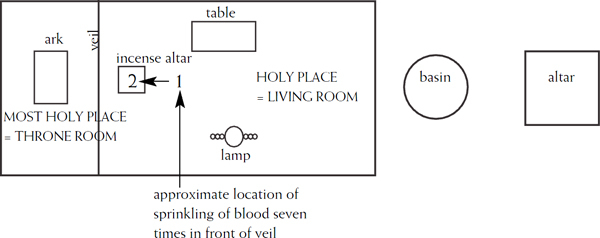
The words “in front of the (inner) curtain/veil” in 4:6, 17 do not require that the sevenfold sprinkling be closer to the veil than the incense altar. In light of how “in front of” (ʾet peney) is used elsewhere, the sprinkling is simply located in the outer sanctum, that is, somewhere in the area in front of the inner sanctum, the boundary of which is defined by the veil (cf. Gen. 33:18; Lev. 10:4; 2 Kings 16:14).13
“Outer altar” purification offering. The outline of activities belonging to the “outer altar” purification offering appears three times in 4:22–35 to allow for variations concerning the offerer and the animal victim. A chieftain is required to bring a male goat (vv. 22–26), but a commoner offers a female flock animal, whether a goat (vv. 27–31) or a sheep (vv. 32–35).
The “outer altar” ritual differs from the more elaborate “outer sanctum” type (see above) in several respects. (1) The “outer altar” sacrifice uses flock animals rather than bulls. (2) An ordinary priest can officiate it. (3) There is only one application of blood: to the horns of the altar outside the sacred Tent. (4) The officiating priest eats the meat.
The following list gives activities belonging to the “outer altar” purification offering that are explicitly mentioned in at least one of the three sections of Leviticus 4 that concern this kind of sacrifice (4:22–26, 27–31, 32–35) or in the additional instructions to the priests in chapter 6 (“eat meat”; 6:26, 29), or that are implied by practical necessity (italics):
lean hand on head of animal
slay animal
collect blood14
present blood to outer altar15
put some blood on horns of altar
pour remaining blood at base of altar
remove suet
present suet to altar16
burn suet on altar
eat meat
Bridging Contexts
PAVING THE WAY for divine forgiveness. The goal or meaning of each “outer sanctum” or “outer altar” purification offering is provided by the text of Leviticus 4 at or near the end of the section prescribing it (4:20, 26, 31, 35), except for the first section regarding the high priest’s sacrifice. While there are variations in wording the goal formula, the goal is the same in each case. So although the “outer sanctum” type has a more elaborate procedure, it provides the same kind of benefit as the “outer altar” sacrifice. The high priest’s offering is not explicitly assigned a goal, but in context he receives the expiation he needs as do the other offerers.
Procedural differences between the “outer sanctum” and “outer altar” types are due to the fact that the former remedies inadvertent sins of community-wide rather than individual impact, namely, the sin of the high priest, who represents the people before the Lord (see, e.g. Ex. 28:29–30, 38), or of the community itself. This vastly wider scope explains why the “outer sanctum” offering requires the most expensive victim (bull), the highest ritual functionary (high priest), blood applications inside rather than outside the sacred Tent, and performance of two blood applications rather than one.
The repeated purification offering goal formula (4:20, 26, 31, 35) has two parts. (1) What the priest accomplishes by officiating the ritual is that he makes “expiation” (Heb. kipper; see Bridging Contexts section on Lev. 1) on behalf of the offerer with regard to the offerer’s sin. Since expiation refers to removal of evil, the ritual removes the sin.
(2) The offerer “will be forgiven.” This passive expression does not say that the priest grants forgiveness. Since the sinner has violated one of God’s commandments (4:2, 3, 13, 22, 27), the one who forgives must be the Lord himself (cf. Ex. 34:6–7). As his representative, the priest makes expiation by performing the ritual, but he has no authority to forgive. This agrees with use of the same verb slḥ (“forgive”) elsewhere: It is never performed by a human being, but always refers to a kind of pardon granted directly by God, which only he can give.17
God expects us to forgive one another for the ways in which we hurt each other, as the Lord’s Prayer says, “Forgive us our debts, as we also have forgiven our debtors” (Matt. 6:12). But in a higher sense, “Who can forgive sins but God alone?” (Mark 2:7). Teachers of the law who asked this rhetorical question regarded Jesus as a blasphemer when he forgave a paralytic (2:5–7; cf. Luke 5:21). They were right unless he was divine.18 Understanding the stakes, Jesus addressed the thoughts of his critics and demonstrated his divine power by healing the paralytic (Mark 2:8–12).
God has never delegated to any human being the right to forgive in the way Jesus did. It is true that Christ said to his disciples, “whatever you bind on earth shall have been bound in heaven, and whatever you loose on earth shall have been loosed in heaven” (Matt. 16:19; 18:18, NAS95—correct translation of Greek tenses here). But this means that he authorizes his church community to make decisions in accordance with what has already been decided in heaven. Similarly, Jesus said, “If you forgive the sins of any, [their sins] have been forgiven them; if you retain the [sins] of any, they have been retained” (John 20:23, NAS95). A specific example of retaining sins was Peter’s condemnation of Ananias and Sapphira (Acts 5:1–11), which showed insight into God’s judgment against them.
Unlike the inevitable effect of purity from a properly performed ritual to remove physical ritual impurity (e.g., Lev. 12:7–8), forgiveness for moral fault does not automatically result from sacrifice. Since God alone decides whom to forgive, he is free to reject a hypocritical sacrifice that is unaccompanied by sincere penitence and a desire to obey him (see, e.g., 1 Sam. 15:22; Isa. 1:11–20).
A broken Altar, Lord, thy servant rears,
Made of a heart, and cemented with tears . . .19
We have found that removing sin through an expiatory sacrifice had to be performed before God granted forgiveness. Therefore the goal of a purification offering to remedy a moral fault in this way can be summed up: to remove sin, prerequisite to divine forgiveness.
What does a purification offering purge? In Leviticus 4 it is clear that in each case the sin belongs to the offerer, who committed it. Verse 26 explicitly calls it “his sin” (NRSV) and verse 35 says that the expiation is “for the sin he has committed.” However, from published English translations it is not immediately certain where the sin is located when the sacrifice removes it. Is it still on/in the offerer, or has it previously gone to the parts of the sanctuary to which the priest applies the sacrificial blood?
The Hebrew text tells us that apart from the initial purification of the outer altar when it was consecrated (Lev. 8:15; cf. Ex. 29:36) and the unique sacrifices that purge the sanctuary on the Day of Atonement (Lev. 16), purification offerings throughout the year remove evils from their offerers rather than from the sanctuary and its sancta.20 Direct evidence is found in the preposition min, which first appears in the goal formula for the chieftain’s “outer sanctum” purification offering: “This is how the priest must perform the rite of expiation for him to free him from [min] his sin, and he will be forgiven” (Lev. 4:26 NJB). Following a verb that signifies removal of something (e.g., kipper, “expiate”), the preposition min with a word for that which is targeted for removal (e.g., sin or ritual impurity) indicates that “from” which someone/something is freed (see also 5:6, 10; 14:19; 15:15, 30).21
The first part of the purification offering formula includes the following components: kipper ʿal + offerer + min + evil belonging to offerer (“perform removal for the offerer from an evil belonging to the offerer”).22 This would be like saying that a surgeon performs removal for a cancer patient from cancer belonging to that patient. There is no question that the evil is located in the patient when it is removed. When a purification offering goal formula is abbreviated by omitting min + evil belonging to offerer (e.g., 4:20, 31), it is still functionally equivalent and therefore means the same thing as the fuller version. There is no hint that the ritual removes evil from the sanctuary and/or its sancta.23
Leviticus 12:7 supports removal from the offerer. This verse tells us the result of a purification offering (coupled with a burnt offering) that remedies the physical ritual impurity of a woman who has just given birth: “and then she will be ceremonially clean from (min) her flow of blood” (NIV). In this context, min prefixed to a term for the woman’s impurity cannot mean anything but “from,” indicating that the evil is removed from her.24
Further support is found in Numbers 8:21, which states that when Aaron offered a purification offering paired with a burnt offering (cf. v. 12) on behalf of the Levite work force, he made expiation (kipper) “for them to purify them.” Here the final “them,” referring to the Levites, functions as the direct object. So the ritual affected the offerers, not the sanctuary (see comments on Num. 8).25
The conclusion that a purification offering removes evil from its offerer withstands a number of potential objections.26 (1) It does not deny a role to an Israelite’s prior repentance or washing with water. Repentance or washing contributes to the remedial process, but neither completes it; sacrifice accomplishes the final stage.27 One who commits a sin for which a purification offering is required can receive divine forgiveness only when the sacrifice is accomplished; there is no indication that repentance alone can result in forgiveness.28
(2) Another objection is the fact that purification offering blood was physically applied to sanctuary objects rather than to persons. However, in our study of Leviticus 6:27 we will find a good reason why purification offering blood, which removed evil from persons, was not placed on the offerers themselves: Why put an evil back on the one who is being freed from it? The question remains: So why should the blood, the transfer agent that washed away and carried moral or ritual evil from the offerer, go to part of the sanctuary, which was God’s domain? Because God has freed offerers from “debt” toward him by accepting/absorbing the “cost.” Later God himself was freed from the “cost,” as represented by the cleansing of his sanctuary through special application of purification offering blood to it on the Day of Atonement (see Bridging Contexts of ch. 16).
Notice that the role of purification offering blood in relation to a moral or ritual evil depended on where the evil was located at the beginning of the sacrifice. If the evil was located on an offerer who needed expiation prerequisite to forgiveness or physical ritual purification, the blood transferred the evil from him or her at the sanctuary. When evils had already reached the sanctuary and accumulated there, as they had by the Day of Atonement, the blood of additional purification offerings transferred them from the sanctuary. Compare the fact that you can use water to wash yourself in a bath and then use more water to clean the bath from the dirt that came from your body. At each stage water contacts the bath, just as purification offering blood contacted the sanctuary at each stage, but the role of the bath/sanctuary changes as the pollution moves.
(3) A third objection to the idea that a purification offering removes evil from its offerer is the fact that on the Day of Atonement the same kinds of blood applications to parts of the sanctuary are explicitly said to purge these objects/areas (16:14–19). However, aside from the change in location of the evil being removed (see above), we should recognize that similar or identical physical actions can carry different meanings because no action, ritual or otherwise, has meaning in and of itself. Rather, the meaning of an action in a particular context is assigned to it by some kind of authority, which in this case is the Lord.29 Compare the fact that symbolic gestures in everyday life, such as motioning with an extended thumb by the side of a road to hitch a ride or swiveling our heads from side to side to say “no” have no inherent meaning. Culture attaches meaning, which is why these motions do not necessarily mean the same thing in other cultures.
(4) It is true that in Leviticus 20:3 and Numbers 19:13, 20 the sanctuary is automatically defiled when people commit the grave offenses of Molech worship or neglect to undergo purification from corpse contamination. In each of these cases, the sinner is condemned to the terminal punishment of “cutting off,” with no opportunity to receive the benefit of expiation (cf. Num. 15:30–31; contrast vv. 22–29). Thus, automatic defilement and sacrificial expiation to benefit the sinner are mutually exclusive. Therefore, “outer altar” and “outer sanctum” purification offerings that provide expiation for sinners cannot remedy defilement that has already reached the sanctuary automatically (see comments on Lev. 20:3).30
The fact that “outer sanctum” and “outer altar” purification offerings were to remove evils from their offerers tells us that these sacrifices played an essential role in restoring divine-human relations. For a Christian this means that the sacrifice of Christ, “the Lamb of God, who takes away the sin of the world” (John 1:29), is essential for removing from a sinner the evil that separates him or her from God. Human repentance is no substitute for divine sacrifice and is only possible because Christ died and rose again “that he might give repentance and forgiveness of sins to Israel” (Acts 5:31). Peace with God is “through our Lord Jesus Christ, through whom we have gained access by faith into this grace in which we now stand” (Rom. 5:1–2; cf. 8:1–3). Without the shedding of Christ’s blood there is no forgiveness (Heb. 9:13–26).
Because purification offerings performed throughout the year did not purge parts of the sanctuary, we see that evils removed from offerers at the sanctuary by means of these sacrifices remained there and were included among the accumulated impurities and sins that had to be annually purged out on the Day of Atonement (16:16). Thus, each evil was treated in two stages of sacrificial expiation (kipper): First it was removed from the offerer by an “outer altar” or “outer sanctum” purification offering (e.g., ch. 4). Then the same evil was removed from the sanctuary on the Day of Atonement (ch. 16).
Blood, debt, and ransom. In any other kind of animal sacrifice, the Israelite priest dashed/tossed the blood on the sides of the outer altar (e.g., 1:5; 3:2; 7:2). Only in a purification offering did the officiant put blood on the horns of an altar, which were projections from its four upper corners and formed its highest parts, thereby highlighting the importance of the blood.31
The more prominent the blood, the more powerful its expiation. Thus, the remedy for sin of communal scope involved not only daubing blood on the highest points of the incense altar, it also called for application of blood inside the sacred Tent, in the outer sanctum. In these ways blood was extended toward God in two directions: vertically toward his heavenly dwelling (Ps. 11:4) and horizontally toward his Presence enthroned above the ark in the earthly Most Holy Place (Ex. 25:22; Num. 7:89; 1 Sam. 4:4; 6:2; 2 Kings 19:15).32
It should be apparent by now that application of blood carried the core of the overall meaning/function of the purification offering: to expiate for the offerer, prerequisite to divine forgiveness. This expiation was required when a person’s sin or serious ritual impurity brought him or her under obligation to the Lord. So rather than a token gift, a purification offering constituted token payment of obligation or debt in order to remove a difference that came between the divine-human relationship.33 This does not mean that the ritual purchased expiation, the price of which is out of reach of human beings (Ps. 49:7). However, it was a mandatory token, as when a parent requires a child who has misbehaved to give up a money “allowance” in order to learn the seriousness of doing wrong.
Several additional factors reinforce the idea that a purification offering functioned as a token debt payment. (1) Although the suet/fat of a purification offering was turned into smoke as “an aroma pleasing to the LORD” (Lev. 4:31), it is never called an ʾiššeh (“gift”) of food (so-called “offering made by fire”).34 Contrast the suet of a voluntary well-being offering, which constituted the ʾiššeh portion for God (3:3–5, 9–11, 14–16). The purification offering was not a voluntary gift because it was a mandatory token payment of a “debt” to God, whose order had been violated.35
(2) The offerer of a purification offering was not permitted to eat any of the meat. Only the priest was to eat his portion as an “agent’s commission” (6:26, 29). However, if a priest performed a purification offering on his own behalf or on behalf of the entire community, which included himself, he was not allowed to eat it and the meat was disposed of by incineration (4:11–12, 21; 6:30; 9:11). The fact that an offerer could not benefit from his or her own purification offering can be explained by the principle that a debtor cannot receive back part of a debt payment.
(3) A purification offering was performed first when it was paired with a burnt offering (see 9:8–14, 15–16), apparently because a debt (purification offering) must be paid before a gift (burnt offering) is accepted.36 If you owe someone $100 and then give that person $100, it is a debt payment rather than a gift. If you subsequently give more, it is a gift.
The suet of a purification offering, emphasizing token debt payment, complemented the blood, which stood for sacrificed life that God appointed to ransom the life of the offerer (see comments on 17:11), who in this case would be the debtor. It was the entire ritual, including both of these elements, that was necessary for expiation (4:20, 26, 31, 35)37 in the sense of removing debt to God that demanded the life of the offerer.
Purification offerings pointed to sacrifice as the means by which God can answer our prayer: “Forgive us our debts” (Matt. 6:12). The fact that the debt is paid and thereby removed by a blood sacrifice shows that it is not just any debt. It is debt for life, which is signified by blood (cf. Lev. 17:11).
It is no accident that the Hebrew noun koper (“ransom”), referring to the price of a life (Job 33:24; Isa. 43:3; cf. Ex. 30:12), comes from the same root kpr as the verb “expiate” (kipper). By ransoming us through his blood (1 Peter 1:18–19; cf. Matt. 20:28; Mark 10:45; 1 Tim. 2:6) and by being lifted up on the cross (John 12:32) rather than on the horns of a literal altar, Christ has paid and thereby removed/expiated our debt, which was so great that it demanded our death because “the wages of sin is death” (Rom. 6:23). He gave up his life for our lives, bringing a happy ending to Romans 6:23: “but the gift of God is eternal life in Christ Jesus our Lord.” His payment of our obligation so that we might live, eternally rather than for just a few decades, is God’s gift to us.
“Ransoming life through sacrifice is a serious reality. It is not simply a beautiful figure of speech to inspire us while the choir sings, the pipe organ plays, and the sun streams through stained-glass windows.”38 We learn the value of ransom when we consider what happens when it is not paid. An Israelite murderer was ineligible for ransom and therefore had to die (Num. 35:31). A person who committed a “high-handed”/defiant sin was ineligible for offering an expiatory sacrifice and therefore was “cut off,” a divine penalty that most likely refers to extirpation of the sinner’s line of descendants (15:30–31).39 Neglecting to give a ransom (koper) to the Lord for the life of each Israelite counted in a census would result in a plague (Ex. 30:11–16; cf. 2 Sam. 24:15).
At the threshing floor of Araunah/Ornan, guilty David was ransomed by sacrifices when he offered to die in place of the people of Jerusalem, who were about to be destroyed with those who had already perished because of the census he had wrongfully ordered (2 Sam. 24:17–25; 1 Chron. 21:16–27). It is no coincidence that the temple built by Solomon was erected at the very spot where David’s sacrificial ransom for human life took place: on Mount Moriah at the threshing floor of Ornan (2 Chron. 3:1). Mount Moriah was where innocent Isaac, the beloved son of Abraham, had been ransomed by a ram caught in a thicket (Gen. 22:13). So the permanent place of sacrifice was located at the place of ransom for human life, where the stories of Isaac and David came together.40 Ransom for human life was central to the Israelite system of sacrifices for sin, after which came the ultimate ransom provided by Christ—the innocent, beloved Son.
Contemporary Significance
THE COST OF forgiveness. Forgiveness is not to be taken for granted as if it is easy, to be dispensed the way we hand out compliments. To forgive means to give up something. True forgiveness is tough. It is not automatic and it has a cost, even for God—especially for God, who absorbs the prerequisite cost in the sacrifice of his Son.
We should have a forgiving attitude as Jesus did when he was being crucified, praying, “Father, forgive them, for they do not know what they are doing” (Luke 23:34). If we do not forgive others, we cannot receive forgiveness from God (Matt. 6:12). However, forgiveness should not be an unthinking “knee-jerk” reaction. We need to keep in mind the cost of forgiveness.41
In West Paducah, Kentucky, Michael Carneal, age 14 and a student at Heath High School, shot and killed three of his female classmates. Within a very short time, surviving members of his class put up a sign assuring, “WE FORGIVE YOU, MIKE!” Dennis Prager, a talk show host in Los Angeles, reacted negatively to this example of what he calls a “feel-good doctrine of automatic forgiveness”:
Even by God, forgiveness is contingent on the sinner repenting, and it can be given only by the one sinned against. “And if your brother sins against you, rebuke him; and if he repents, forgive him,” reads Luke 17:3–4. “And if seven times of the day he sins against you, and seven times of the day turns to you saying, I repent, you shall forgive him.”42
Perhaps Prager underestimated the pain carried by the students who offered forgiveness to Michael. Perhaps it was not as automatic and meaningless as it appeared. But Prager is right that true forgiveness is not automatic; it is a deliberate and conscious choice. It is not only something that is given; it is a transaction between two parties, the one who committed the offense and the one who has been wronged. Although the latter can unilaterally offer forgiveness, the transaction is not complete until the former repents and accepts the benefit of forgiveness. Leviticus understood this: Although God continually made forgiveness available, a sinner was only said to be “forgiven” when he or she accepted God’s provision by offering a sacrifice (4:31, 35).
True forgiveness can be agonizing. In the book of Genesis, when Jacob’s sons showed up in Egypt to buy grain, Prime Minister Joseph did not immediately post a sign saying, “I FORGIVE YOU, BROTHERS!” or even reveal his identity. Rather, he tested them to find out whether they were the same sort of miserable scoundrels who had stripped him, thrown him in a pit, callously sat down to eat, and sold him to a living death of slavery (Gen. 37:23–28). Because they passed the character tests he devised, showing that their malignantly selfish attitudes were dead and that they had sincerely repented for what they had done, Joseph became willing to reveal himself in order to forgive them (45:1–3).
Philip Yancey comments:
When grace finally broke through to Joseph, the sound of his grief and love echoed throughout the palace. What is that wail? Is the king’s minister sick? No, Joseph’s health was fine. It was the sound of a man forgiving.
Behind every act of forgiveness lies a wound of betrayal, and the pain of being betrayed does not easily fade away.43
First, Joseph made known his identity, then he expressed forgiveness by words and actions of kissing and weeping (Gen. 45:4–15). He did not reveal himself until he was ready to forgive.44 When he forgave, he absorbed a cost so great that his brothers could only have paid it with their lives (cf. Ex. 21:16; Deut. 24:7). Joseph’s brothers knew this, which is why they were speechless with terror at Joseph’s presence when he revealed himself (Gen. 45:3). Their worst nightmare had incarnated. The skeleton had walked out of the closet, robed in majesty and with absolute power of life and death over them! No wonder Joseph had to work so hard to reassure them that his forgiveness was genuine (45:4–15), even later after Jacob died (50:15–21)!
Thousands of years have not made it easier to forgive. Corrie ten Boom describes her intense struggle in Munich in 1947, when she was approached by a man who had been one of the cruelest Nazi guards at the concentration camp in Ravensbruck, where she had suffered and her sister Betsie had died. He had become a Christian. He knew that God had forgiven him, but he wanted to hear from Corrie that she had also forgiven him. He stood there with his hand held out, but Corrie had trouble responding. She describes her thinking:
The message that God forgives has a prior condition: that we forgive those who have injured us. “If you do not forgive men their trespasses,” Jesus says, “neither will your Father in heaven forgive your trespasses.”
I knew it not only as a commandment of God, but as a daily experience. Since the end of the war I had had a home in Holland for victims of Nazi brutality. Those who were able to forgive their former enemies were able also to return to the outside world and rebuild their lives, no matter what the physical scars. Those who nursed their bitterness remained invalids. It was as simple and as horrible as that.45
What happened next is stunning:
And still I stood there with the coldness clutching my heart. But forgiveness is not an emotion—I knew that too. Forgiveness is an act of the will, and the will can function regardless of the temperature of the heart. “Jesus, help me!” I prayed silently. “I can lift my hand. I can do that much. You supply the feeling.”
And so woodenly, mechanically, I thrust my hand into the one stretched out to me. And as I did, an incredible thing took place. The current started in my shoulder, raced down my arm, sprang into our joined hands. And then this healing warmth seemed to flood my whole being, bringing tears to my eyes.
“I forgive you, brother!” I cried. “With all my heart.”
For a long moment we grasped each other’s hands, the former guard and the former prisoner. I had never known God’s love so intensely as I did then. But even so, I realized it was not my love. I had tried, and did not have the power. It was the power of the Holy Spirit as recorded in Romans 5:5, “. . . because the love of God is shed abroad in our hearts by the Holy Ghost which is given unto us.”46
Like Joseph, Corrie absorbed a cost. In human terms, she had every right to bear a monumental grudge. She defied her emotions in order to consciously and painfully give up what she had against him. This was no “feel-good doctrine of automatic forgiveness.” The good feeling came only after the deliberate choice was made and acted on, just as the swollen Jordan River parted for the priests carrying the ark only after they dipped their feet in the water (Josh. 3:15–16).
Martin Luther kept things in perspective when he prayed:
Grant forgiveness also to those who have harmed or wronged us, as we forgive them from our hearts. They inflict the greatest injury upon themselves by arousing thy anger in their actions toward us. We are not helped by their ruin; we would much rather that they be saved with us.47
Never having been severely victimized, I have felt utterly inadequate to explain forgiveness to a Holocaust survivor in Jerusalem, a descendant of slaves in Jamaica, and a Hispanic woman in California who was sexually molested by a relative when she was a child. Not having been through their experiences, I cannot truly empathize or understand. Anything I say will only trivialize the evil and the pain. All I can do is to offer a hug and point to those who have found healing by absorbing great cost, such as Joseph, Corrie, and God.
Unlike Joseph and Corrie, God went after Adam and Eve to reveal himself before they showed any sign of repentance (Gen. 3:8–9). God’s willingness to continue revealing himself to human beings in all kinds of ways, most fully when Christ emigrated to our Planet (John 1:14), has consistently demonstrated his desire to forgive. If he did not want to forgive, why would he bother to reveal himself? Any discouraged person who doubts that God forgives can look at a Bible and be reassured by its very existence.
If it can be excruciating to forgive after those who have hurt us show repentance, how much tougher must it be for God, with his undulled sensitivity, to offer forgiveness before we even want to repent and while we are still inflicting wounds of betrayal? By providing for the sacrifice of his Son, he has mercifully opened the way for reconciliation even before wrongdoers realize what they have done (Rom. 5:7–8).
Just as the carcass of the purification offering to expiate for the community was incinerated outside the camp (Lev. 4:21), so Christ suffered rejection, reproach, and agony outside Jerusalem in order to provide forgiveness for others. Any abuse that comes to us as a result of having identified with him to accept the restoration that he offers is nothing in comparison (see Heb. 13:11–13).
Letting go of the burden. When the Lord accepted a purification offering and granted forgiveness, the sinner no longer bore the burden of evil. Witnessing the blood and smoke, a sincerely repentant Israelite could have assurance that his or her relationship with God was truly restored even though no heavenly voice or banner let down from the sky proclaimed, “I FORGIVE YOU!”48 “How much more, then, will the blood of Christ, who through the eternal Spirit offered himself unblemished to God, cleanse our consciences from acts that lead to death, so that we may serve the living God!” (Heb. 9:14; cf. Rev. 1:5).
One of the most beloved passages in Christian literature is John Bunyan’s allegorical depiction of expiation from sin:
Up this way, therefore, did burdened Christian run, but not without great difficulty, because of the load on his back. He ran thus till he came at a place somewhat ascending; and upon that place stood a cross, and a little below, in the bottom, a sepulchre. So I saw in my dream, that just as Christian came up with the cross, his burden loosed from off his shoulders, and fell from off his back, and began to tumble, and so continued to do, till it came to the mouth of the sepulchre, where it fell in, and I saw it no more.49
Notice that Christian let his burden of sin go, and once it was gone, he accepted that reality. He did not go spelunking in order to retrieve it. Corrie ten Boom draws on another metaphor: “‘When we confess our sins,’ I said, ‘God casts them into the deepest ocean, gone forever. And even though I cannot find a Scripture for it, I believed God then places a sign out there that says, NO FISHING ALLOWED.’”50
The act of letting go and accepting that God hurls “all our iniquities into the depths of the sea” (Mic. 7:19; cf. Ps. 103:12) is a transaction, not simply a feeling. Hannah Whitall Smith describes the experience of a woman who had accepted Christ, but who had trouble letting go of the “burden” and whose emotions wanted to go “fishing”:
Every emotion she had within her rose up in rebellion against it, and had she considered her emotions to be her king, she would have been in utter despair. But she had learned this secret of the will, and knowing that, at the bottom, she herself did really choose the will of God for her portion, she did not pay the slightest attention to her emotions, but persisted in meeting every thought concerning the trial, with the words, repeated over and over, “Thy will be done! Thy will be done!” asserting in the face of all her rebelling feelings, that she did submit her will to God’s, that she chose to submit, and that His will should be and was her delight! The result was, that in an incredibly short space of time every thought was brought into captivity; and she began to find even her very emotions rejoicing in the will of God.51
This woman found the sure result of letting go: peace and joy (cf. Rom. 5:1, 10–11). Joyless, melancholy Christians would do well to ask themselves whether they have failed to totally let go. If so, it is time to go up the hill again, take another look at the cross, and let the burden roll back into the sepulchre for good.
Corporate guilt. In Leviticus 4 a more serious situation of corporate wrongdoing calls for a more intimate and elaborate transaction with the Lord to make amends (4:13–21).52 This makes perfect sense. If an individual wrongs someone, the solution is simple by comparison with a case in which an entire nation is guilty.
Leviticus 4 teaches us that the complexity of corporate guilt and the ease of remedy that can “slip through the cracks.” The fact that everyone else is responsible does not absolve a large group from responsibility to rectify its moral failures. The ancient Israelites learned this during their desert wandering, as we will see in the book of Numbers, and also later in their history. Other ancient peoples reproved in biblical “prophecies against the nations” (e.g., Isa. 10, 13–35; Jer. 46–51; Ezek. 25–32) also learned it the hard way. So did the United States during the Civil War, according to Abraham Lincoln’s second inaugural address, in which he expressed the idea that the country paid for slavery with blood on battlefields. The price of corporate guilt is paid one way or another—if not constructively, then destructively.
Although the United States is not and should not attempt to be a theocracy as ancient Israel was, in the “Pledge of Allegiance” we affirm that our country is “one nation under God,” thereby acknowledging basic moral accountability to him. He has the address of a nation just as he does of an individual. Whatever the polls may say about political factors involved in our domestic and international affairs, we must preserve our sense of moral perspective and humility—including willingness to admit and remedy our mistakes—or we will surely go the way of the Canaanites, Philistines, Assyrians, and Babylonians.