Original Meaning
IF THE ISRAELITE MEN were to be organized into an army, their camp had to be a military camp. So Numbers 2 outlines the arrangement of tribal groups within the war camp. Numbers 1:52–53 has already briefly summarized the overall plan, and to resume this topic, 2:2 reiterates: “The Israelites are to camp around the Tent of Meeting some distance from it, each man under his standard with the banners of his family.”
The rest of chapter 2 specifies the locations of the various tribes around the sanctuary. The twelve tribes, not including Levi, are to be divided into four groups of three tribes each. With reference to the sanctuary and Levite camp in the middle, each group of three tribes occupies a position to one of the four directions of the compass. The text lists these directions in clockwise rotation beginning with east, the direction of sunrise and the standard starting point for Israelite directions: east, south, west, north. Each of the four groups is led by one of the three tribes of which it is composed, so that the groups are called “the camp of Judah” (2:9), “the camp of Reuben” (2:16), “the camp of Ephraim” (2:24), and “the camp of Dan” (2:31).
The Israelite encampment is arranged as a square, just like the Egyptian war camp of Pharaoh Rameses II (thirteenth century B.C.). While the similarity is striking, so is a crucial difference: The center of the Israelite war camp is occupied by the Lord’s sanctuary rather than the tent of Pharaoh, a human god-king.1 As Balaam later observes, the Israelites enjoy the power and protection of a Leader in their midst who is not only royal; he is truly divine (Num. 23:21)!
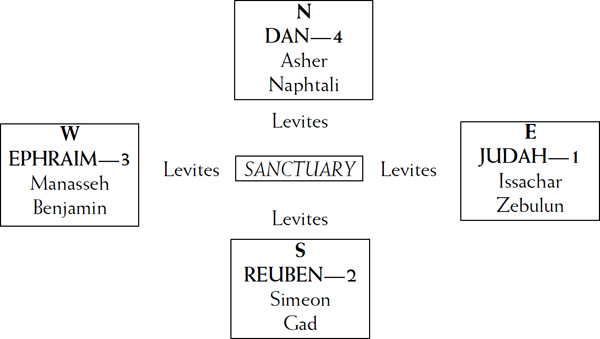
The numbers assigned to the four groups indicate the order in which the groups set out when the Israelites move from place to place. The Levites carrying the sanctuary and its furnishings come between groups 2 and 3 (2:17). Thus the Israelites march in this order:
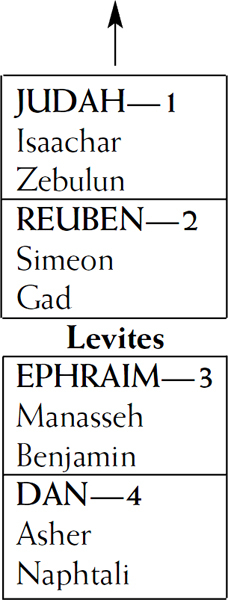
Just as the Lord’s sanctuary occupies the protected middle of the camp, which protects it in the event of an attack (cf. Ex. 17:8), so it travels with the Levites in the middle of the marching column, in case the Israelites are attacked in front or behind (cf. Num. 21:1). Because the order of encampment corresponds to the marching order (2:17), the Israelites can hit the road or set up camp with optimum efficiency. Aside from cutting stress and fatigue, this prevents “road rage” disputes that could easily develop by people and animals getting in each other’s way. It also enables the Israelites to react quickly in case of emergency.
Bridging Contexts
ORDER. THE CENSUS and organization of Numbers 1–2 were important steps to make a mob of ex-slaves into a focused, disciplined, conquering army. Around the fully functioning sanctuary of the divine King at the core of the war camp, every able-bodied man was in his place and accounted for. All was in order for efficient and effective deployment.
Why should the Lord be concerned with order and efficiency? After all, hadn’t he promised to give the land of Canaan to the Israelites by his own power? To begin with, the Bible portrays the Lord God as a God of order. In the creation account of Genesis 1–2 he set up everything on and around Planet Earth to function in harmonious order (cf. Job 38).
After sin disrupted the order God had set up, he proclaimed on Mount Sinai and demonstrated at the Israelite sanctuary a well-functioning order in harmony with his holy character. Through the instructions of Leviticus, he taught his model community how to interact with and emulate him at every level of life and society. In this way he sought to establish a holy New World Order that was really a beachhead for restoration of his Original World Order.
God provided all the order, efficiency, and power the Israelites needed, and to him went the glory for every victory, but he did not do for them what they could and should do themselves. Canaan was his gift to them, but they could only receive it if they would go up and take it. When they did go up, they needed careful strategy and precise execution of plans to get the most “shock for the shekel.”
For example, an overconfident attack on the small city of Ai by only about three thousand Israelites was a dismal failure, and their swash quickly buckled (Josh. 7:3–5). But after sin had been purged from their midst, a carefully planned assault by Joshua and his whole army, which included a clever ambush, resulted in resounding success (Josh. 8; cf. Judg. 20). Confidence in superior numbers to squash the opposition may provide sloppy arrogance, but victory comes through cooperation with the Lord, who empowers fully utilized and well-ordered human intelligence and strength.
Contemporary Significance
WHO IS AT the center? The annals of egocentrism are glutted with gloating. The Assyrian tyrant Sennacherib (seventh cent. B.C.), who called his residence at Nineveh “Palace Without a Rival” (beat that, Donald Trump!), vaingloriously styled himself as follows:
Sennacherib, the great king, the mighty king, king of the universe, king of Assyria, king of the four quarters (of the earth); the wise ruler [lit., shepherd, “pastor”], favorite of the great gods . . . perfect hero, mighty man; first among all princes, the powerful one who consumes the insubmissive, who strikes the wicked with the thunderbolt; the god Assur, the great mountain, an unrivaled kingship has entrusted to me, and above all those who dwell in palaces, has made powerful my weapons; from the upper sea of the setting sun to the lower sea of the rising sun, all humankind (the black-headed race) he has brought in submission at my feet and mighty kings feared my warfare. . . . 2
Similarly, King Nebuchadnezzar’s words betray no problem with low self-esteem: “Is not this the great Babylon I have built as the royal residence, by my mighty power and for the glory of my majesty?” (Dan. 4:30). Julius Caesar was briefer, but no less forceful: Veni, vedi, vici (“I came, I saw, I conquered”).
Although W. E. Henley was not a ruler or conqueror, in a poem commonly known as “Invictus” he penned some lines that soar to heights of individual self-assurance:
It matters not how strait the gate,
How charged with punishments the scroll,
I am the master of my fate:
I am the captain of my soul.
These assertions of personal power and unassailable self-sufficiency pale in comparison with the hyper-hubris of the fallen “morning star, son of the dawn,” who said in his heart:
“I will ascend to heaven;
I will raise my throne
above the stars of God;
I will sit enthroned on the mount of assembly,
on the utmost heights of the sacred mountain.
I will ascend above the tops of the clouds;
I will make myself like the Most High.” (Isa. 14:13–14)
“I will make myself like the Most High” does not refer to imitation of God’s holy moral character (e.g., Lev. 19:2), but to a desire to usurp God’s sovereign power and authority. Eve heard this philosophy from a forked tongue: “You will not surely die,” the serpent said to the woman. “For God knows that when you eat of it your eyes will be opened, and you will be like God, knowing good and evil” (Gen. 3:4–5, emphasis supplied). Eve was already created in God’s image (1:26), but here was something more: uniquely divine insight that would make her like God so that she would be independent of him for knowledge. With her curiosity and ego intoxicated, she took the bait (3:6).
Our modern culture revels in personal independence. Living in private dwellings, perhaps in restricted access communities, we can live our own lives the way we want and control much of our contact with other people. We have answering machines, voice mail, and e-mail to facilitate limited communication according to our schedules. Now we can do much of our business from home over the Internet. Everything is designed around us for our security, convenience, and comfort. In our private cars we have wraparound sound. At home we have remotes for TV, video, CD, and DVD. Commercials bombard us from all directions to reinforce what we already know: We are the center of the universe, and our desires govern it.
Numbers 2 disagrees with our egocentric worldview. In the Israelite camp, the Lord spatially demonstrated the only proper place of the Most High in the world order of his people: at the center. The desert war camp formed a hollow square, with the tabernacle of the divine Presence in the middle. He was the Source of strength, the “nuclear reactor.” God’s people were not islands of destiny but a community under God, with each individual and every subgroup fully accountable to him.
We cannot be the center of our own religion if we want to claim the religion of the Bible. Placing ourselves, anything, or anyone in place of God makes us his enemy. King Manasseh did it when he placed a symbol of the goddess Asherah in Solomon’s temple (2 Kings 21:7). In 2 Thessalonians 2 a “man of lawlessness” who is “doomed to destruction” also does it: “He will oppose and will exalt himself over everything that is called God or is worshiped, so that he sets himself up in God’s temple, proclaiming himself to be God” (2 Thess. 2:4).
Eve bought the lie and become the mother of sorrows, acquainted with grief. It is better to be content with what we are—people created in God’s image—than to reach above it, only to find that we fall far below it.3 As Dr. Seuss’s story Yertle the Turtle illustrates, he who tries to climb higher and higher at everyone else’s expense in order to be king of all that he sees will end up falling into the mud, where he will see only mud, and therefore be king of the mud.4