Original Meaning
BOTH THE FIRST personal singular reference in verses 14–15 and the description of personal circumstances (“I hope to come…[but]…if I am delayed…”) lead the reader to assume that the writer is Paul. If this were constructed by some follower of Paul, it would have been either a tour de force or outright deception to make it appear as if Paul were writing it himself.1 Concern over this possible delay providentially caused Paul not only to write the instructions in this chapter, but, in that connection, to affirm the importance of the church and to append the creedal statement in verse 16.
The purpose of this letter is mainly to deal with false teaching and teachers, but in the need for truth and personal integrity it is also concerned with church relationships as God’s “household.” Paul emphasizes this by concluding the section on overseers and deacons with a statement of his purpose, “that…you will know how people ought to conduct themselves in God’s household…the church,” in which the household terminology appears again (see also 3:4–5, 12).
But the passage goes on to emphasize doctrine: “the church of the living God, the pillar and foundation of the truth.” This wording calls to mind the truth of Peter’s great confession, “You are the Christ, the Son of the living God,” and Jesus’ response, “on this rock [i.e., the foundation] I will build my church” (Matt. 16:16, 18).2 The words “pillar” and “foundation” may be intended to recall the solid structure of God’s house, the temple, in the Old Testament.
The introduction to Paul’s great creedal statement in verse 16 begins with an affirmation, “beyond all question.” While this could apply to the reliability of the creed, grammatically it refers to the description “great” in the predicate nominative position. No one can disagree that the creed is indeed great, so that is what lies “beyond all question.” If the reliability of the creed itself were in view, Paul would probably have used instead the familiar phrase, “Here is a trustworthy saying.” His point here is the magnificence of the revealed truth called “the mystery of godliness.”
The word “mystery” (mysterion, see comments on 3:9) describes God’s revelation of his sovereign work throughout history. In this context Paul may be thinking of Christ as the center of the mystery (cf. Col. 1:25–27). Christ was not known until his revelation through the Incarnation and further stages of his experience (e.g., “declared with power to be the Son of God by his resurrection from the dead”). “Godliness” (eusebeia, see also comments on this word in 2:2) is a broad term used in Greek literature to mean religion or personal piety. Christ is the source of the Christian religion and of our spiritual life (cf. 1 Cor. 1:30). Therefore “the mystery of godliness” is Christ himself, revealed and vindicated.
The hymnic form of this remarkable statement calls for an analysis of its structure.3 While that structure is obviously less important than the content, to study it helps the reader to focus carefully on content and its points of emphasis. Among the possibilities are the following:
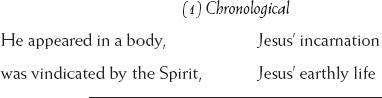
| was seen by angels, |
Jesus’ resurrection |
| was preached among the nations, |
missionary proclamation |
| was believed on in the world, |
response to this proclamation |
| was taken up in glory. |
Jesus’ acceptance and in glorification in heaven |
The obvious problem here is that chronologically the last phrase would seem to belong earlier in the sequence. Also, there is sufficient ambiguity in the creed (the meaning of “vindicated [or justified] by the Spirit” and the time when he “was seen by angels”) that it is hard to make a firm determination of the chronology. The vindication by the Spirit could have taken place at the resurrection (cf. 1 Peter 3:18, “made alive by the Spirit”), and Jesus could have been “seen by angels” at his ascension. But the word in the last phrase for “taken up” refers in Acts 1:2 to the ascension and also appears in Luke 9:51, almost certainly an allusion to the ascension. How can this have been preceded by the missionary proclamation and the nations’ response to it?
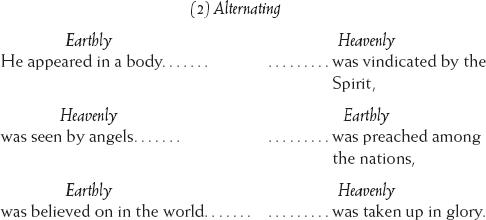
This scheme gives more attention to the literary structure and is consistent within itself. Its bipolar structure causes the reader (and speaker) to focus on the two loci of the revelation of Christ.
(3) Emphatic
The reappearance near the middle of each line of the Greek suffix - the (to indicate the third singular aorist passive form) draws attention to the verbs. Each verb expresses a kind of vindication, manifestation, or attestation. This is embedded in the actual structure of the Greek text and stands whatever other scheme may be proposed.
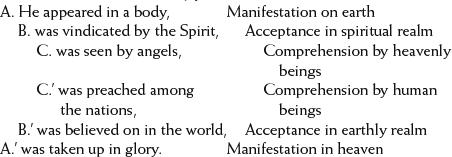
Since chiasm (a literary structure that involves the repetition, in reverse order, of words, phrases, or, as here, ideas) was an acceptable structural scheme in ancient times to draw attention to the successive ideas and their relationships, it is legitimate to consider the possibility of one here. But one must be careful not to go beyond the intention of the author and force such a scheme on a text improperly.
Bridging Contexts
THE HYMN IN
its context. This hymn is a magnificent conclusion to chapters 2–3. But it is more than that—it is a climax and a crux. It is a climax in that it is a distinctive literary form, it comprises essential truths relevant to the preceding verses, and it brings the reader to a high point of praise. It is a crux in that it forms a pivotal doctrinal hinge between the preceding chapters, where Paul has been discussing “how people ought to conduct themselves in God’s household” (3:15), and chapter 4, where Paul discusses how to confront the heresy he first mentioned in chapter 1.
Paul has made it clear that wise, godly ministry and leadership in the church are essential to the maintenance of doctrinal purity and that doctrine and behavior are closely related. As noted above, the qualifications for eldership in 1 Timothy do not include a doctrinal test. That omission is significant in that it purposefully puts the weight on personal morality and character. But this hymn shows that doctrine lies at the heart of it all. It is profoundly Christological. It draws attention, whichever literary scheme is closest to the original intention, to the various events that brought glory to our Lord. The dominant idea is that he who was one with the Father in the eternal past and unseen by human beings, was revealed at his incarnation. By the Holy Spirit, by the heavenly beings who welcomed him on his ascension, and by those human beings who heard and believed the preaching about him, he has been accepted and honored. The images of this hymn are representative, but not exhaustive. They provide both a means of praise (one can hardly simply study this passage!) and a model for further praise.4
Hymnology and Christology. There are some great hymns to Christ that celebrate the successive steps of his ministry, death, resurrection, present glory, and coming glory. Others range over aspects of his being and works. Among these are “Crown Him With Many Crowns” (Matthew Bridges and Godfrey Thring), “Thou Who Wast Rich Beyond All Splendour” (Frank Houghton), “At the Name of Jesus” (Caroline Maria Noel), “Jesus! The Name High Over All” (Charles Wesley), “The Head That Once Was Crowned With Thorns” (Thomas Kelly), “Join All the Glorious Names” (Isaac Watts), and “We Come, O Christ, to Thee” (E. Margaret Clarkson). The two most recent of these are those by Houghton and by Clarkson. We will comment on the contribution of contemporary praise songs under the Contemporary Significance section.
The truths that are so strikingly presented in the Christological hymn of verse 16 have endured through the centuries and within the multiple societies that have succeeded that of first-century Ephesus. The fact that Scripture includes such a condensed, structured hymn should validate the enterprise of reproducing the essential doctrines about Christ in ways that are acceptable vehicles of truth in each culture. Nations, tribes, and various groups have regularly conveyed truth for generations in many different ways, such as songs, narratives, anecdotes, actions, and interactive dialogue. There is a “story to tell to the nations,” and it calls on the best of our God-given abilities to tell it well.
The church year and the lectionary can provide a framework and biblical context within which to stir remembrance of the major aspects of Jesus’ life and ministry. But there are other ways as well. It is not necessary, as in the Middle Ages, to paint or enact the events in Jesus’ life, but there are ways to make the story clear in each age. The “Jesus Film” has done this marvelously in our day.
The function of the hymn of verse 16 is apparently to remind the believers at Ephesus, through Timothy, about the foundation of the church that cannot be destroyed by false teachers. The doctrine of Christ (Christology) is the unchanging sine qua non of Christian theology. Since there will always be opponents of the gospel, this hymn is always necessary and foundational.
The inclusion of a hymn that omits the cross is not an oversight, since its main theme, the coming of Christ as an epiphany, with his vindication and acceptance in heaven and earth, is appropriate here. The epiphany theme is repeated at various points in the Pastoral Letters (1 Tim. 6:14; 2 Tim. 1:10; 4:1, 8; Titus 2:11, 13; 3:4). Sub- or anti-Christian teachings are often veiled in vague religious language. In contrast, this hymn on the manifestation of Christ is by its very nature open. These things, as Paul said, “[were] not done in a corner” (Acts 26:26).
Contemporary Significance
PROCLAIMING THE TRUTH of Christ. The centrality of Christology needs constant emphasis. The years leading up to the writing of this commentary have witnessed a renewed interest in the Jesus of the Gospels, an interest that has unfortunately been marked by the skepticism of the “Jesus Seminar” and resulting publications. At the same time notable evangelical and Catholic leaders have declared their common allegiance to certain central doctrines, including the deity of Christ. Whatever other areas of agreement are necessary for cooperation in social, moral, or evangelistic enterprises, Christology must always be the essential foundation for any fellowship.
In 1998 the Southern Baptists held their annual convention in the Mormon territory of Salt Lake City. This occasioned considerable discussion on both sides as to whether the Mormons should be considered genuine Christians. One of the issues regarding Mormons continues to be the meaning attached to biblical terms concerning Christ and his sacrificial death, resurrection, and ascension. The present hymn contributes significantly to all Christological discussion.
Numerous studies of the religion of “Baby Boomers” and of “Generation X” have pointed out that contemporary hymnology is more an expression of personal intimacy with God than a static statement of objective truths about God. (It should also be noted, however, that some of the most passionate hymns about Christ came from monasteries in the Middle Ages.) Also for this generation the learning of truth must be accompanied by its application. Eternal truths must have immediacy. A distant God must also be immanent. That which is static must be transformed into what is active. Aimlessness and hopelessness must be addressed.
The message of the Christological hymn in 3:16 is appropriate to these concerns. Its very structure rests on verbs rather than nouns. It centers on the Christ who came to us and the response he has received and deserves to receive further from us. The proclamation of Christ evokes a response. There is a sense of purpose and hope as Christ moves, so to speak, from his incarnation to his ascension. Those who feel misunderstood can identify with the Christ who needed vindication. Those who feel alone as Christians can be encouraged by the reminder of how widespread faith in Christ really is in our world. Those who are self-centered can be reminded by this Christocentric hymn where the center of our attention and affection belong. Along with all this there must still be an objective Christological foundation.5
Traditional and contemporary church music. If any generation has needed to sing, it is ours, though in many ways we are passive in our music. As we go along with our portable CD players, it is hard to conceive of a past generation that did not have CDs, radios, TV, or multimedia computers. We may not sing ourselves as much as our ancestors did, but we do love to listen. However, apart from the productions of perhaps one classical music station per major city, what we hear on most stations appeals by its beat and emotion rather than by soaring melodic lines, much less by cerebral counterpoint.
Much traditional Christian hymnody, it is said, lacks the characteristics that move us today, such as a focus on single themes. Those who criticize contemporary “praise songs” sometimes maintain that they are not as biblical as the old hymns. While that has been true of many “choruses” and other songs of recent decades, it is not true of the best of contemporary praise songs. Many of them are quotations from Scripture, often from the Psalms. A strong defense of contemporary worship music by theologian John M. Frame appeared in 1997.6
Each period of church music has had its emphases and its omissions. In planning a series of worship services that will be uplifting and honoring to God, we should make sure that there is a rich and varied doctrinal content. If there is enthusiastic emphasis on joy and victory, we need to be sure that attention is also given to the cross, suffering, and discipleship. We want to be careful not only to celebrate Christ, but also God as Father and the person and work of the Holy Spirit. The exaltation and present intercession of Christ at the right hand of God the Father seems rarely mentioned if at all, and the present hymn with its focus on the heavenly reception of Christ could well be incorporated to help rectify that neglect.
One’s private devotional times can also be immensely enriched by meditating on hymns from various periods of Christian history. It is the nature of hymn books to have the hymns topically listed, a means of making sure that the great doctrines of the faith are covered. One way to construct a list of possible hymns and songs for use in church worship is to start with such a passage as 1 Timothy 3:16, examining its doctrinal content, its usefulness in offering praise, and its potential in instructing the Christians who sing it.
Other key passages can be also examined. The Psalms, of course, are obvious, but again they do not contain the whole range of biblical theology. Colossians 1 and Philippians 2 have yielded great hymns and praise songs. But important as they are, one’s own private worship of God can also profit from such carefulness in spanning the various doctrinal themes in hymns and songs and weaving them into the time alone in God’s presence.
Preachers bear the responsibility of conveying the “mystery of our religion” in many sermons over a lifetime. The heresies that threaten us will differ from those at Ephesus, but the essential Christological message is relevant and must be proclaimed over and over. The individual verbal affirmations in verse 16 (“appeared,” “was vindicated,” “was seen,” “was preached,” “was believed on,” “was taken up”) move from the presentation of Christ and his claims to his earthly and heavenly acceptance. This is the goal of Christian evangelism and missions: faithful preaching and teaching, effective witness and apologetics. To reaffirm this is the constant joyful task of believers.
1. For a position opposite to the above, see the descriptive language in Bassler’s commentary referring to “the letter’s fictional situation…. The resulting scenario provides an ideal pretext for introducing the letter’s exhortations…” (1 Timothy, 2 Timothy, Titus, 72).
2. See also “how you turned to God from idols to serve the living and true God” (1 Thess. 1:9), and “no one can lay any foundation other than the one already laid, which is Jesus Christ” (1 Cor. 3:11, italics added).
3. The origin of the hymn is unknown. It is assumed to be a hymn because of its structure, though it is not clear whether it was a hymn (or fragment of a hymn) that Paul incorporated or whether he composed it himself. We accept it as part of Scripture in its canonical context. The fact that the first word in the original text probably was “who” (given an “A” rating in the UBS text on the basis of extensive early manuscript support) rather than “God” is usually thought to indicate a hymn, though opinions are changing on Phil. 2:5–11 in that regard.
4. Young (Theology of the Pastoral Letters, 59–68) summarizes this passage together with others on Christology in the Pastorals.
5. It is a mistake to think that this has been absent from contemporary worship music. One thinks of one of the earlier of the contemporary songs, Melody Greene’s “There Is a Redeemer,” as a fine example.
6. See his Contemporary Worship Music: A Biblical Defense (Phillipsburg, N.J.: Presbyterian and Reformed, 1997).